
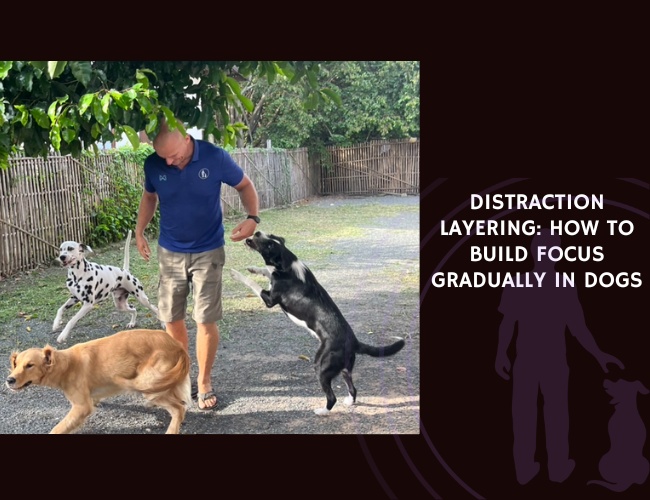
Have you ever watched your dog lose complete focus the moment another dog appears in the distance, or perhaps when a leaf skitters across the path? You’re not alone. Building sustained attention in our canine companions is one of the most rewarding yet challenging aspects of the human-dog relationship. Today, let us guide you through a scientifically grounded approach called distraction layering—a method that transforms scattered attention into calm, reliable focus through gradual, intentional exposure.
This isn’t about forcing your dog to ignore the world around them. Rather, it’s about teaching them to navigate environmental stimuli with confidence and clarity, creating a foundation where trust and attention become second nature. Through the NeuroBond approach, we’ll explore how emotional synchrony between you and your dog becomes the cornerstone of this learning journey.
Understanding the Foundation: What Is Distraction Layering?
Distraction layering is a structured training methodology that systematically exposes your dog to increasing levels of environmental stimuli while maintaining calm focus and reliable behavior. Think of it as building a cognitive muscle—you wouldn’t start weightlifting with your maximum capacity, and similarly, your dog needs to develop attentional strength progressively.
The process works by introducing distractions in controlled increments, starting with low-intensity stimuli and gradually increasing complexity, duration, and proximity. Each layer builds upon the previous one, creating a stable foundation of focus that can withstand real-world unpredictability.
What makes this approach particularly powerful is its alignment with how your dog’s brain naturally processes and adapts to information. By managing cognitive load and preventing overwhelm, we create optimal conditions for neural adaptation and emotional regulation. Your dog learns not just to obey commands despite distractions, but to genuinely maintain calm awareness even when their environment becomes stimulating.
The Science Behind Sustained Attention
How Your Dog’s Brain Processes Distractions
Your dog’s brain is constantly filtering an extraordinary amount of sensory information—sounds you can’t hear, scents you can’t imagine, visual movements in their peripheral vision. The ability to focus amidst this sensory flood involves complex neural networks, particularly in regions associated with attention, executive function, and sensory processing.
When your dog encounters a distraction, their brain must decide whether to prioritize this new stimulus or maintain focus on your cue. This decision-making process involves what neuroscientists call executive function—the mental toolkit for impulse control, cognitive flexibility, and working memory. Research shows that training experience can significantly enhance these cognitive capacities, particularly in tasks requiring inhibitory control.
Neural plasticity, the brain’s remarkable ability to modify its connections based on experience, plays a fundamental role here. Just as the developing visual system can be fine-tuned by environmental exposure, your dog’s attentional networks strengthen through systematic practice. Each successful focus moment amid distraction literally reshapes neural pathways, making future focus easier and more automatic.
Cognitive Load and Learning Efficiency
Cognitive Load Theory offers profound insight into why distraction layering works so effectively. This framework suggests that learning is most effective when the amount of information being processed doesn’t overwhelm working memory. When we introduce too many distractions too quickly, we exceed your dog’s cognitive bandwidth, leading to stress, confusion, and learning breakdown.
By gradually increasing distraction complexity, we keep cognitive load within an optimal range. Your dog can successfully process each challenge level, integrating new learning without becoming overwhelmed. This measured approach prevents information overload and facilitates deeper, more reliable learning that truly transfers to real-world situations.
Think of your dog’s attention like a spotlight. In a dark, quiet room, that spotlight shines brightly and steadily. Add a few distractions, and the spotlight might flicker slightly but remain focused. Overwhelm the environment with too many competing stimuli, and that spotlight scatters into ineffective fragments. Distraction layering trains your dog to maintain spotlight intensity regardless of environmental noise.
The Emotional Dimension: Arousal and Regulation
Finding Your Dog’s Optimal Arousal Zone
The relationship between arousal level and focus performance follows what researchers call an inverted U-curve. Too little arousal, and your dog lacks motivation and engagement. Too much arousal, and their ability to think clearly and respond to cues deteriorates rapidly. The sweet spot—moderate arousal—is where optimal learning and performance occur.
Different dogs have different baseline arousal levels. A naturally high-energy Border Collie might need calming strategies to reach optimal arousal, while a laid-back Basset Hound might benefit from gentle arousal-boosting techniques. Understanding your individual dog’s arousal patterns is crucial for effective distraction training.
Gradual distraction layering aims to keep arousal within that optimal range throughout the learning process. We’re not trying to create an unnaturally calm dog who ignores everything—we’re building a dog who can maintain functional arousal and clear thinking even when environmental stimulation increases. This balanced state allows your dog to remain engaged and responsive without tipping into overstimulation or shutdown.
The Polyvagal Perspective: Safety as Foundation
Polyvagal Theory, developed by Dr. Stephen Porges, provides a powerful lens for understanding your dog’s physiological responses during distraction training. This framework explains how the autonomic nervous system influences social engagement, emotional regulation, and stress responses through a hierarchical organization of neural pathways.
The ventral vagal complex—the most evolved aspect of the autonomic nervous system—facilitates social engagement, curiosity, and learning when your dog feels safe. When distraction levels exceed your dog’s coping capacity too quickly, they may shift into defensive states controlled by the sympathetic nervous system (fight or flight) or the dorsal vagal complex (freeze or shutdown).
Safe and predictable progression of difficulty, as in distraction layering, maintains ventral vagal engagement. Your dog remains in a physiological state where learning is possible, social connection with you stays strong, and emotional regulation functions smoothly. This isn’t just about behavioral compliance—it’s about fostering genuine physiological flexibility and resilience.
Emotional Co-Regulation: Your Role as Social Anchor
Here’s where the magic of the NeuroBond framework truly shines. Your emotional state directly influences your dog’s ability to regulate their own arousal and maintain focus. Behavioral and physiological synchrony between dogs and handlers creates a powerful feedback loop where calm begets calm, and stress can unfortunately amplify stress.
When your dog encounters a challenging distraction and looks to you, they’re not just seeking instruction—they’re seeking emotional regulation. Your steady breathing, relaxed posture, and calm energy act as what researchers call a “social anchor,” helping your dog return to a regulated state even when internal arousal surges.
This co-regulation is comparable to attachment relationships in human development, where secure bonds provide emotional scaffolding. By maintaining your own calm presence during distraction training, you become a living example of the focus and emotional balance you wish to cultivate in your dog. This emotional synchrony stabilizes your dog’s arousal, enabling sustained focus and trust even in unpredictable environments. 🧡

Building the Layers: A Progressive Training Structure
Starting Point: Assessment and Baseline
Before introducing any systematic distraction training, you need to understand your dog’s current capacity. What can they already focus through? At what point does their attention fracture? This baseline assessment informs your starting point and prevents the common mistake of beginning with distractions that are already too intense.
Conduct simple exercises in a quiet, familiar environment first. Can your dog hold a sit-stay for 30 seconds with no distractions? Can they maintain eye contact for five seconds? Can they walk calmly beside you in your empty living room? These baseline behaviors become the foundation upon which you’ll layer increasing challenges.
Key baseline behaviors to assess:
- Eye contact duration: Can your dog maintain soft eye contact for 3-5 seconds when you ask, without environmental competition for their attention?
- Stationary positions: Does your dog hold a sit or down-stay for 30 seconds in a familiar, quiet space with minimal fidgeting or breaking position?
- Loose-leash walking: Can your dog walk calmly beside you for 2-3 minutes indoors or in your yard without pulling, sniffing excessively, or scanning frantically?
- Recall reliability: When called from a short distance (10-15 feet) in a boring environment, does your dog respond within 2-3 seconds consistently?
- Impulse control foundations: Can your dog wait calmly for food, toys, or door access when asked, demonstrating basic self-regulation?
Pay attention to your dog’s individual threshold—the point where focus begins to deteriorate. Some dogs can handle moderate visual movement but struggle with auditory surprises. Others might maintain focus beautifully until novel scents appear. Understanding these nuances allows you to personalize the layering sequence for maximum effectiveness.
Layer One: Single, Stationary, Distant Distractions
Your first distraction layer should be intentionally simple—a single stimulus that remains stationary and at a comfortable distance from your dog. This might be a person standing still 20 feet away, a toy placed on the ground at a distance, or a recorded sound played at low volume.
At this stage, work on basic focus behaviors: eye contact, simple cues like sit or down, calm walking. The goal isn’t perfection but rather maintaining connection with you despite the presence of something mildly interesting in the environment. Reward generously for any moment of focus, even if it’s brief.
Spacing is critical here. Don’t rush through multiple exposures back-to-back. Allow time between training sessions for memory consolidation and neural integration. Your dog’s brain needs processing time to strengthen the pathways associated with focus amid distraction. Two or three short, successful sessions are far more valuable than one long, overwhelming session.
Layer Two: Movement and Multiple Stimuli
Once your dog can reliably maintain focus with stationary, single distractions, introduce movement. That person who was standing still? Now they walk slowly parallel to your path. That toy? Perhaps it rolls gently across the ground at a distance. Movement naturally increases salience and arousal, making this a meaningful step up in difficulty.
You might also begin introducing multiple stimuli—but still keeping intensity moderate. Two people standing at a distance, or a visual distraction paired with a gentle auditory one. The key is systematic progression, not dramatic leaps. If your dog’s focus fractures, you’ve moved too quickly. Simply return to the previous layer until stability returns.
Signs your dog is approaching cognitive overload:
- Respiratory changes: Excessive panting unrelated to temperature or recent physical activity, or sudden shallow, rapid breathing that indicates stress rather than exertion.
- Food refusal: Inability or unwillingness to take treats they normally love, suggesting arousal has exceeded their ability to engage in normal appetitive behaviors.
- Environmental scanning: Frantic, rapid head movements scanning the environment without settling on any particular focal point, indicating overwhelm rather than curiosity.
- Physical tension: Stiff body posture, tucked tail, whale eye (showing whites of eyes), or tense facial muscles that signal discomfort and defensive arousal.
- Responsiveness loss: Complete inability to respond to familiar, well-known cues that they normally perform reliably, indicating cognitive resources are fully depleted.
- Displacement behaviors: Sudden scratching, yawning, lip licking, or sniffing the ground when these behaviors seem out of context—often signs of internal conflict and stress.
Watch for these signals carefully. They tell you to reduce intensity, create more distance, or take a reset break. Learning to read these subtle communications strengthens your bond and improves training outcomes.
Layer Three: Proximity, Intensity, and Complexity
As your dog demonstrates reliable focus through moving, multiple stimuli, gradually decrease distance and increase intensity. Distractions come closer. Movement becomes more dynamic. Sounds get slightly louder. Scents become more enticing.
This is also where you might begin introducing different sensory modalities in sequence or combination. While there’s no universally perfect sequence, many trainers find success starting with visual distractions (often easiest to control), then auditory, then olfactory (most challenging for many dogs), and finally social distractions involving other dogs or enthusiastic people.
Social distractions often represent the highest level of challenge because they combine multiple sensory inputs with emotional significance and potential arousal. Another dog isn’t just a visual stimulus—they’re a moving, scented, vocalizing, emotionally complex distraction that triggers your dog’s social circuitry in powerful ways.
Integration of Reset Cues and Calm Intervals
Throughout all layers, intentionally build in “reset cues” or calm intervals between exposures. These structured breaks serve multiple crucial functions. They provide opportunities for arousal de-escalation, allowing your dog’s nervous system to return to baseline before the next challenge. They also support memory consolidation, giving the brain time to process and integrate what was just learned.
A reset cue might be a specific word like “breathe,” a calming touch, or simply removing your dog from the training space for a minute of quiet decompression. The Invisible Leash concept applies beautifully here—you’re not controlling your dog through physical restraint but through cultivated awareness and emotional connection that transcends the tangible.
These intervals prevent cumulative stress and manage cognitive load over longer training sessions. Without them, arousal can gradually escalate until your dog reaches threshold and experiences a complete breakdown in focus. Regular resets maintain the optimal arousal zone we discussed earlier, supporting sustained learning capacity.
Layer. Focus. Flow.
Attention is built, not demanded. Each controlled distraction becomes a stepping stone toward steadier awareness. Focus grows when challenge meets capacity, not when pressure overwhelms.
The brain learns through rhythm. Gradual exposure sculpts neural pathways that hold attention under strain. Every small success rewires chaos into clarity.


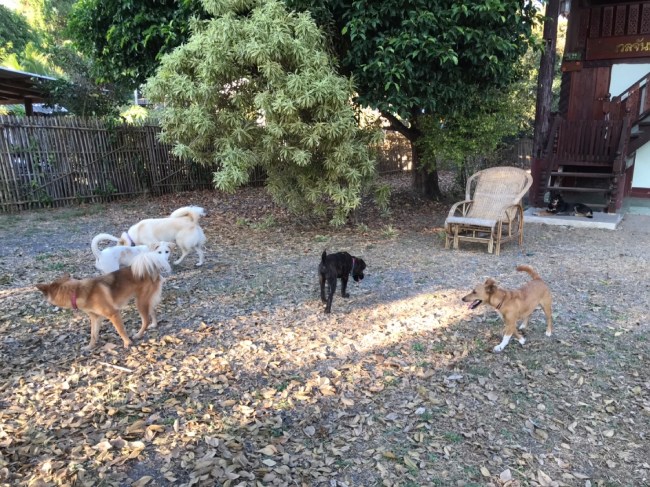
Calm anchors cognition. When emotion and arousal balance, learning deepens. Connection replaces control, and your dog’s mind stays with you—no matter the noise around it.
Measuring Progress: Behavioral and Cognitive Indicators
Response Latency and Cue Accuracy
Two primary metrics reveal how distraction training is progressing: response latency (how quickly your dog responds to cues) and cue accuracy (how correctly they perform requested behaviors). As distraction tolerance builds, you should observe faster, more accurate responses even in increasingly complex environments.
Early in training, your dog might take three or four seconds to sit when you ask, especially if a distraction is present. As neural pathways strengthen and focus becomes more automatic, that latency should decrease. Similarly, the precision of the behavior should improve—a sit becomes prompt and square rather than slow and sloppy.
Track these metrics informally by noting your dog’s performance across different distraction levels. If response quality remains high as you increase environmental complexity, you’re progressing appropriately. If quality deteriorates, you’ve moved too quickly and need to return to a previous layer temporarily.
Task Persistence and Recovery Speed
Task persistence—your dog’s willingness to maintain effort despite challenges—is another revealing indicator. A dog with strong distraction resilience doesn’t give up when the environment becomes stimulating. They might briefly orient toward a distraction but quickly re-engage with you and the task at hand.
Recovery speed matters tremendously. When your dog does lose focus (and they will—it’s part of learning), how quickly can they return to working state? Initially, recovery might take 30 seconds or more. With consistent training and handler co-regulation, that recovery time should decrease significantly, often to just a few seconds.
Pay attention to emotional recovery as well as behavioral recovery. Does your dog bounce back with tail wagging and relaxed body language, or do they seem stressed and hesitant? Healthy distraction training builds confidence alongside focus, creating dogs who approach challenges with eagerness rather than anxiety.
Generalization Across Contexts
The ultimate test of distraction layering success is generalization—can your dog maintain focus in truly novel environments where they haven’t specifically trained? This context-independent reliability is the goal, and it develops through systematic variation during training.
Intentionally practice in different locations: your yard, quiet parks, busier parks, urban sidewalks, pet-friendly stores. Vary times of day, weather conditions, and types of distractions present. This variability trains your dog’s brain to extract the core principle: “Focus on my handler regardless of the specific environmental noise.”
Strong generalization also means your dog can transfer skills across different activities. A dog trained to maintain focus during obedience work should also demonstrate improved attention during loose-leash walking, during play, and during everyday household activities. This transfer effect reveals deep learning rather than context-specific memorization.
🎯 Distraction Layering Essentials
Building calm focus through systematic progression
🧠 Understanding the Foundations
What is Distraction Layering?
A systematic training approach that builds your dog’s attention span through controlled, incremental distraction exposure. Like strength training, we start with light “weights” and gradually increase intensity as capacity develops.
Key Principles:
- Cognitive Load Theory: Prevent working memory overwhelm
- Neural Plasticity: Strengthen attention networks through repetition
- Polyvagal Theory: Maintain ventral vagal state for optimal learning
- Gradual Progression: Simple to complex, never skip layers
🎓 The 7 Training Layers
Step-by-Step Progression
Layer 1-2: Single, stationary distractions at distance → Add movement
Layer 3-4: Systematically decrease distance → Movement at moderate distance
Layer 5-6: Closer proximity with movement → Controlled social interactions
Layer 7: Generalization to novel environments and unpredictable situations
Critical: Only progress at 80-90% success rate across multiple sessions!
💚 Reset Strategies & Co-Regulation
Emotional Stabilization Between Exposures
Reset breaks aren’t optional—they’re essential for memory consolidation and arousal regulation. Through NeuroBond co-regulation, your calm presence becomes a “social anchor” for your dog’s nervous system.
Effective Reset Techniques:
- Calming verbal cue: “Breathe,” “settle,” or “easy” in slow, soft tone
- Tactile grounding: Gentle, slow-motion touch on shoulders/chest
- Sniff walks: 2-3 minutes of unrestricted, leisurely sniffing
- Environmental retreat: Brief move to completely neutral, boring space
- Parallel calm presence: Simply being together without demands
⚠️ Cognitive Overload Warning Signs
Recognize When Your Dog Reaches Threshold
These signals tell you to reduce intensity, increase distance, or take a reset break immediately:
- Excessive panting unrelated to temperature or exertion
- Refusing treats they normally love
- Frantic environmental scanning without settling
- Stiff body posture, tucked tail, whale eye (showing whites)
- Complete loss of response to familiar cues
- Displacement behaviors: scratching, yawning, sniffing out of context
When you see these signs, return to the previous layer—this isn’t regression, it’s strategic reinforcement!
⚡ The 80/20 Rule of Thumb
80% Success Rate across multiple sessions = ready for next layer
20% Training new layers, 80% Reinforcing established layers
2:1 Ratio → 2 minutes reset per 1 minute intense distraction work
3-5 Days Rest between layer transitions for neural consolidation
🧡 The Essence of Zoeta Dogsoul
Distraction layering is more than technique—it’s embodied NeuroBond philosophy. Through emotional synchrony, your calmness becomes your dog’s resource. The Invisible Leash emerges not through force, but through cultivated awareness and trust. In every moment of focused presence despite distraction, you’re not just strengthening neural pathways—you’re deepening the soul connection between you.
That’s the balance between science and soul—between measurable progress and felt connection. That’s Zoeta Dogsoul in action.
© Zoeta Dogsoul – Where neuroscience meets soul in dog training
Practical Applications: From Companion Dogs to Working Roles
Everyday Companionship and Quality of Life
For companion dogs, distraction resilience directly translates to improved quality of life and enhanced relationship with you. Walks become genuinely enjoyable rather than exercises in leash-pulling and reactivity. Your dog can accompany you to more places because their focus remains reliable even in stimulating environments.
Real-life situations where distraction training transforms daily experiences:
- Doorbell arrivals: Instead of explosive barking and jumping when visitors arrive, your dog pauses, orients to you for calm guidance, and can settle quickly with a brief redirect—creating peaceful welcomes rather than chaotic greetings.
- Wildlife encounters: When a squirrel darts across the yard or a deer appears on the trail, your dog watches with natural curiosity but maintains recall reliability and doesn’t bolt into dangerous pursuit or pull you off balance.
- Outdoor dining: You can enjoy a meal at a pet-friendly patio while your dog rests calmly beneath the table, unbothered by passing servers, nearby dogs, or dropped food from adjacent tables—making social outings genuinely relaxing.
- Veterinary visits: During examinations, your dog can maintain enough focus on you to accept gentle handling and unfamiliar sensations without escalating into fear-based reactions or requiring excessive restraint.
- Household transitions: When family members leave or return, when delivery trucks rumble past, or when neighborhood children play loudly outside, your dog acknowledges these events without sustained reactivity that disrupts the household peace.
- Multi-dog households: Your dog can disengage from arousing play with housemates when called, preventing over-arousal and allowing you to manage energy levels and prevent conflicts before they escalate.
Think about common scenarios: the doorbell rings, and instead of explosive barking, your dog orients to you for guidance. A squirrel darts across the yard, and your dog watches with interest but maintains recall reliability. These everyday moments of calm focus reduce household stress and deepen your bond.
Distraction training also supports emotional wellbeing. Dogs who can regulate their arousal and maintain focus experience less chronic stress and anxiety. They’re not constantly at the mercy of environmental stimulation, jerked from one reaction to another. Instead, they develop what researchers call “stress resilience”—the ability to recover from and resist the negative effects of challenging experiences.
Service, Detection, and Therapy Dogs
For working dogs, distraction resilience isn’t just beneficial—it’s absolutely essential. Service dogs must maintain focus on their handler’s needs despite bustling shopping centers, loud restaurants, and countless strangers. Detection dogs must accurately identify target scents amid thousands of competing olfactory distractions. Therapy dogs must remain calm and engaged with clients even in unpredictable, emotionally charged environments.
Distraction layering provides the structured foundation these working roles demand. By systematically building focus capacity, we create dogs who can truly function reliably under pressure. Memory consolidation in detection dogs, for instance, can be influenced by arousal levels during and after training, highlighting the importance of methods that manage arousal optimally.
The stakes are high in these roles. A service dog who loses focus might miss a critical medical alert. A detection dog who can’t filter distractions might fail to locate dangerous substances. Therapy dogs who become overstimulated might startle or withdraw from vulnerable clients. Distraction layering doesn’t just improve performance—it ensures reliability when it matters most.
Training Sequence: Focus Before Complexity
Across all applications, a fundamental principle emerges: focus-building should be prioritized before introducing high task complexity. This sequence aligns perfectly with Cognitive Load Theory and respects how learning actually works in the brain.
Attempting to teach intricate behaviors in highly distracting environments sets dogs up for failure. Without adequate focus, they simply cannot process and retain the information related to complex tasks. Frustration builds for both handler and dog, and learning progress stalls.
Instead, establish solid distraction resilience first. Once your dog can maintain calm attention in various environments, introducing task complexity becomes dramatically easier. They have the attentional bandwidth available to process new information rather than using all cognitive resources simply to manage environmental stimulation. This foundation-first approach may seem slower initially but accelerates overall progress significantly.
Common Challenges and Troubleshooting Strategies
When Progress Stalls or Regresses
Even with careful layering, you may encounter periods where progress stalls or even regresses. This is normal and doesn’t indicate failure—it’s simply information about your dog’s current capacity or about factors affecting their state.
First, assess physical and emotional variables. Is your dog experiencing pain, illness, or hormonal changes? Are there significant stressors in their environment (moving, schedule changes, new pets)? These factors can temporarily reduce distraction tolerance, and pushing through often worsens the situation.
Common causes of training plateaus or regression to investigate:
- Physical discomfort: Undetected pain from dental issues, joint problems, digestive upset, or ear infections can dramatically reduce your dog’s ability to focus and tolerate normal levels of environmental stimulation.
- Hormonal fluctuations: Female dogs experiencing heat cycles, dogs of either sex reaching adolescence, or dogs experiencing age-related hormonal changes may show temporary increases in distractibility and arousal.
- Environmental stressors: Recent moves, changes in household composition, alterations to daily routines, construction noise, or new pets in the home create background stress that depletes your dog’s coping resources.
- Sleep quality: Inadequate or disrupted sleep prevents proper memory consolidation and emotional regulation, leaving your dog with reduced cognitive capacity for managing distractions.
- Nutritional factors: Food sensitivities, poor-quality diet, or sudden dietary changes can affect energy levels, gut health, and consequently brain function and emotional stability.
- Progression too rapid: The most common training error—advancing to the next layer before the previous one is truly solid, creating a weak foundation that crumbles under increased pressure.
Second, review your layering progression. Have you unconsciously increased difficulty too quickly? Sometimes we become impatient and add complexity before the foundation is truly solid. There’s no shame in returning to an easier layer temporarily. This isn’t going backward—it’s strategic reinforcement that ultimately accelerates long-term progress.
Managing High-Arousal Temperaments
Some dogs are simply wired for higher baseline arousal. Herding breeds, terriers, and many sporting dogs were specifically selected for high energy and environmental responsiveness. For these dogs, distraction training requires additional patience and often benefits from incorporating arousal-down strategies.
Pre-training arousal reduction techniques for high-energy dogs:
- Decompression sniffing: Allow 10-15 minutes of completely unrestricted, leisurely sniffing in a safe area before formal training begins—this activates calming neural pathways and provides mental satisfaction that reduces the need to seek stimulation during training.
- Slow scatter feeding: Toss small treats or kibble into grass or across a large area, requiring methodical searching rather than rapid consumption—the slow, focused activity naturally down-regulates arousal while satisfying foraging instincts.
- Gentle massage or T-Touch: Use slow, deliberate pressure along the shoulders, neck, and chest for 3-5 minutes, which can trigger parasympathetic responses and create a calmer physiological baseline before asking for focused work.
- Parallel calm walking: Take a long, slow walk beside your dog without any training demands, allowing them to move at their pace with loose leash freedom—this physical outlet reduces excess energy without creating further arousal through excitement or play.
- Calming supplements or aids: Consider veterinarian-approved options like l-theanine, adaptogenic herbs, calming pheromone collars, or anxiety wraps that provide gentle support for nervous system regulation.
- Environmental management: Train during naturally lower-energy times of day for your individual dog, ensure adequate prior sleep, and choose training locations with naturally soothing qualities like shade, gentle sounds, or familiar spaces.
Before training sessions, include activities that promote calmness: sniffing exercises, slow scatter feeding, gentle massage, or calm parallel walking. These activities activate the parasympathetic nervous system and create a better starting point for focus work.
During training, keep sessions shorter and increase the frequency of reset intervals. High-arousal dogs fatigue more quickly from the effort of maintaining calm focus, and preventing overwhelm is crucial. Celebrate tiny increments of progress, as these dogs often need more repetitions at each layer before moving forward.
The Role of Breed and Individual Differences
Breed characteristics and individual personality significantly influence how distraction training unfolds. A Bloodhound, bred for scent tracking, will find olfactory distractions far more compelling than a Greyhound, bred for visual pursuit. Understanding these predispositions allows you to tailor training approaches and sequence distraction types strategically.
Individual differences matter equally. Two Golden Retrievers from the same litter might have vastly different distraction profiles based on subtle genetic variation, early experiences, and temperament. Avoid comparing your dog to others or to breed stereotypes. Instead, meet your individual dog exactly where they are and progress at their unique pace.
This personalization is where the art of training meets the science. Guidelines and frameworks provide structure, but your intimate knowledge of your specific dog’s triggers, strengths, and communication style determines actual implementation. Trust your observations and adjust protocols to serve your dog’s individual needs. 🧠
Advanced Concepts: The Neuroscience of Sustained Focus
Dual-Process Learning: Balancing Emotion and Cognition
Cognitive science recognizes two qualitatively different processing systems in the brain. System 1 operates quickly and intuitively, driven largely by emotional and automatic responses. System 2 operates slowly and deliberately, engaging higher-order thinking and conscious control.
When your dog sees a squirrel, System 1 fires immediately: “Chase! Exciting! Must pursue!” Distraction training gradually strengthens System 2’s ability to override these automatic impulses: “Wait. Listen to handler. Calm decision-making.” The goal isn’t to eliminate System 1 responses—they’re natural and often valuable—but to build System 2 capacity to modulate them appropriately.
Moments of Soul Recall reveal how memory and emotion intertwine in behavior. Past experiences with distractions, whether positive or negative, shape current responses through emotional memory. A dog who was once overwhelmed by a farmers market will carry that emotional imprint, requiring patient, gradual re-exposure to rewrite the narrative from “overwhelming” to “manageable and safe.”
Neural Pathways and Attentional Networks
The brain’s attention networks involve multiple regions working in concert: the prefrontal cortex for executive control, the anterior cingulate for conflict monitoring, and the parietal cortex for directing attention spatially. When your dog practices focus amid distractions, these networks activate repeatedly, and with each successful repetition, the neural connections strengthen.
This process, called activity-dependent plasticity, is how all learning creates lasting change. Initially, maintaining focus requires significant conscious effort from your dog. Neural signals must take relatively inefficient pathways, and the processing is slow and effortful. With repetition, these pathways become faster and more automatic—what neuroscientists call “myelination” and “synaptic strengthening.”
Eventually, focus in the presence of moderate distractions becomes nearly automatic, requiring minimal conscious effort. This frees up cognitive resources for other tasks, which is why a well-trained dog can perform complex sequences reliably even in stimulating environments. The attentional foundation has become automatic, allowing higher-order processing to proceed smoothly.
Working Memory and Executive Function
Working memory—the ability to hold and manipulate information temporarily—plays a crucial role in distraction resilience. When you give your dog a cue while a distraction is present, they must hold the cue in working memory, inhibit the impulse to orient toward the distraction, and then execute the appropriate response. This requires robust executive function.
Progressive distraction training systematically challenges and therefore strengthens working memory capacity. Like a muscle that grows stronger with resistance training, your dog’s ability to maintain mental representation of your cues despite competing stimuli improves through practice.
This cognitive strengthening transfers beyond training contexts. Dogs with well-developed executive function through distraction work often show improved problem-solving abilities, better impulse control in everyday situations, and enhanced adaptability when facing novel challenges. You’re not just teaching focus—you’re building general cognitive resilience.
Creating Your Distraction Training Protocol
Assessment and Goal-Setting
Begin by conducting an honest assessment of your dog’s current distraction tolerance across different scenarios and sensory modalities. Create a simple chart listing common distraction types (other dogs, people, vehicles, novel sounds, wildlife, food scents) and rating your dog’s current focus level with each from 1-10, where 1 is “complete loss of focus” and 10 is “maintains reliable attention.”
This assessment reveals where to start and helps you set realistic short-term and long-term goals. Perhaps your dog scores 8 with stationary people but 2 with other dogs—this tells you exactly where focused work is needed and where you can already train with higher-level challenges.
Questions to guide your initial distraction assessment:
- Visual distractions: At what distance can your dog maintain focus when people walk past? When other dogs are visible? When vehicles move nearby? Does stationary versus moving visual stimuli make a significant difference in your dog’s ability to respond to you?
- Auditory sensitivity: How does your dog react to sudden sounds like door slams, vehicle horns, or dropped objects? Can they recover quickly and return attention to you, or does the sound create sustained distraction or fearful behavior?
- Olfactory competition: When interesting scents are present—food on the ground, animal trails, garbage bins—can your dog disengage when called? How long does it take them to shift from scent investigation back to handler focus?
- Social complexity: Does your dog’s focus deteriorate more dramatically with calm, neutral people or with enthusiastic, approaching strangers? What about children versus adults? Known people versus unfamiliar individuals?
- Environmental novelty: In familiar training locations, does your dog maintain better focus than in completely new environments? How quickly can they settle and offer attention in an unfamiliar setting?
- Multi-modal challenges: When multiple types of distractions occur simultaneously (visual movement plus novel sounds, or social stimuli plus olfactory interest), does your dog’s focus collapse more completely than with single-modality distractions?
Set specific, measurable goals: “Within six weeks, maintain eye contact for 5 seconds with another dog visible at 30 feet” or “Within three months, complete a loose-leash walk through the town center during moderate traffic.” These concrete targets keep you accountable and allow you to celebrate genuine progress.
Designing Your Layer Sequence
Based on your assessment, design a systematic layer sequence that addresses your dog’s specific challenges. Each layer should be practiced until your dog demonstrates consistent success—typically 80-90% reliable responses across multiple sessions and different locations before progressing. Rushing through layers undermines the entire approach.
Example progression for a dog highly reactive to other dogs:
- Layer 1: Distant, stationary dogs visible but not directly approaching (50+ feet) – allowing your dog to simply acknowledge the presence of another dog while maintaining ability to take treats and respond to basic cues from you.
- Layer 2: Distant dogs showing mild movement (walking parallel but not approaching) – which adds the challenge of tracking motion while maintaining focus without the pressure of direct approach or social interaction.
- Layer 3: Decreasing distance with stationary dogs (40 feet, then 30, then 25) – systematically reducing the buffer zone while other dogs remain calm and non-threatening in their stillness.
- Layer 4: Moderate distance with moving dogs (30 feet, dogs walking parallel) – combining the earlier proximity gains with movement challenges, requiring your dog to manage both spatial closeness and motion simultaneously.
- Layer 5: Closer proximity with controlled movement (20 feet, dogs walking parallel) – significantly increasing the salience of the distraction while maintaining predictable, non-threatening patterns that keep arousal manageable.
- Layer 6: Brief, calm social interactions with known, stable dogs – introducing actual proximity and social engagement but with carefully selected, emotionally balanced dogs who won’t escalate your dog’s arousal.
- Layer 7: Generalization to multiple unknown dogs in various contexts – testing whether your dog can maintain focus and emotional regulation when encountering unfamiliar dogs in unpredictable situations across different environments and scenarios.
Training Session Structure
Individual training sessions should follow a consistent structure that supports learning and emotional regulation:
Warm-up (5 minutes): Simple, familiar exercises in low-distraction environment to establish connection and baseline focus.
Core work (10-15 minutes): Exposure to current layer distractions with focus exercises, including generous reinforcement.
Reset intervals (2-3 minutes each): Periodic calm breaks to prevent arousal accumulation.
Cool-down (5 minutes): Return to easy, successful exercises that allow ending on a positive, confident note.
Processing time: After session ends, allow quiet time without additional stimulation for memory consolidation.
Keep sessions relatively short, especially in early stages. Multiple brief sessions distributed across days or weeks produce superior learning compared to long, exhausting sessions. Quality repetitions within optimal arousal trumps quantity of repetitions while overwhelmed.
Tracking Progress and Adjusting
Maintain a simple training log noting date, distraction type and intensity, your dog’s performance, and any relevant observations about arousal or emotional state. This documentation reveals patterns you might otherwise miss and helps you make data-driven decisions about when to progress or when to reinforce current levels.
Review your log weekly, looking for consistent improvement patterns or concerning plateaus. If progress seems stuck for more than two weeks at the same level, troubleshoot: Are you inadvertently varying difficulty too much? Is an unrecognized stressor affecting your dog? Do you need to add more reset intervals or adjust session length?
Remember that progress isn’t always linear. You may see rapid advancement followed by temporary plateaus or even minor regression. This is normal learning consolidation. The brain doesn’t strengthen connections in a perfectly smooth curve—it makes gains, integrates them, then makes further gains. Trust the process and remain patient with your individual dog’s learning rhythm.
The Invisible Leash: Attention as Connection
Throughout this journey of building focus and distraction resilience, a profound shift occurs in your relationship with your dog. What begins as training exercises evolves into something deeper—a quality of connection where attention flows naturally between you, not through coercion but through cultivated trust and mutual awareness.
The Invisible Leash represents this transformation. It’s the felt sense of connection that transcends physical tools, where your dog chooses engagement with you not because they must but because your relationship has become the most valuable aspect of their environment. Distractions don’t disappear, but they no longer fragment the bond you share.
This level of connection doesn’t develop overnight, and it requires your own growth alongside your dog’s. As you practice emotional co-regulation, you become more attuned to subtle shifts in your dog’s state. You learn to read arousal levels before they reach threshold, to provide support precisely when needed, and to celebrate the small victories that build toward lasting change.
Conclusion: Building Resilience Through Partnership
Distraction layering isn’t simply a training technique—it’s a philosophy of gradual, respectful capacity-building that honors your dog’s individual nervous system, cognitive abilities, and emotional needs. By systematically expanding what your dog can handle, you create genuine resilience rather than mere compliance.
The scientific foundations we’ve explored—from Cognitive Load Theory to Polyvagal Theory, from neural plasticity to the NeuroBond framework—all point toward the same truth: lasting focus develops when we manage learning in ways that support rather than overwhelm the brain and nervous system. When we pair this structured approach with emotional attunement and patient progression, we create conditions for remarkable transformation.
Your dog’s ability to maintain calm focus amidst life’s inevitable distractions is built one layer at a time, one successful repetition at a time, one co-regulated moment at a time. There will be setbacks and plateaus, moments of frustration and breakthroughs of joy. Through it all, remember that you’re not just training behaviors—you’re strengthening neural networks, building emotional resilience, and deepening a relationship that transcends the leash connecting you.
That balance between science and soul, between systematic structure and intuitive connection, between what we can measure and what we can only feel—that’s the essence of Zoeta Dogsoul. And in the patient layering of distractions, in the celebration of small victories, in the calm presence you offer when your dog looks to you amid chaos, you embody this essence beautifully.
Next, as you begin implementing distraction layering with your own dog, remember: start where your dog is, not where you wish they were. Trust the process, celebrate progress, and know that every moment of sustained focus you cultivate together is a gift—to your dog’s wellbeing, to your relationship, and to the life you’re building side by side. 🧡










