

Have you ever wondered why your dog walks beautifully on the leash with you, only to transform into a pulling machine the moment someone else holds the leash? You might notice your furry friend tugging relentlessly when your partner takes them out, or perhaps they settle into perfect heel position with one family member but seem to forget all their training with another. This phenomenon, known as cross-handler confusion, reveals something profound about the invisible threads of communication that bind us to our dogs.
The way your dog responds on the leash tells a story far deeper than simple obedience or the lack thereof. It speaks to the emotional dance between handler and dog, a complex interplay of energy, rhythm, and unspoken understanding. Through the lens of neuroscience and behavioral observation, we begin to see that leash manners are not just about training commands but about something more fundamental: the quality of connection and emotional synchrony between you and your dog.
In this exploration, let us guide you through the fascinating world of cross-handler dynamics, where subtle differences in body language, emotional regulation, and communicative clarity can dramatically influence your dog’s behavior. You will discover why consistency matters beyond just repeating commands, how your nervous system state travels down the leash, and what you can do to help your dog maintain calm walking behavior regardless of who is holding the leash.
Understanding the Emotional Foundations of Leash Behavior
The Hidden Language of the Nervous System
Your dog is reading you in ways you might not realize. Every walk becomes a conversation conducted not through words but through the subtle symphony of physiological signals your body continuously broadcasts. When you hold the leash, your dog is not just receiving instructions through verbal commands or tugs on the collar. They are perceiving your internal state through micro-movements, breath patterns, muscle tension, and even the rhythm of your heartbeat transmitted through your shared connection.
The Polyvagal Theory helps us understand this remarkable sensitivity. Your dog’s nervous system is constantly scanning for safety cues from you, their trusted companion. A relaxed handler, breathing deeply and moving with fluid confidence, activates their dog’s ventral vagal state—the physiological condition associated with social engagement, calm exploration, and receptiveness to learning. Conversely, a tense handler with shallow breathing and rigid posture may inadvertently trigger their dog’s sympathetic nervous system, the state associated with vigilance, reactivity, and the fight-or-flight response.
This explains why two handlers using identical verbal cues can elicit dramatically different responses from the same dog. One handler’s internal calm creates a container of safety, while another’s internal tension broadcasts danger signals, no matter what words they speak. Your dog is not being stubborn or selective—they are responding authentically to the emotional reality they perceive.
The Dance of Emotional Systems
Deep within your dog’s brain, fundamental emotional systems are continuously shaping their behavior and responses. The SEEKING system drives your dog’s motivation to explore the world, investigate interesting scents, and engage with their environment. The FEAR system, conversely, activates in response to perceived threats or uncertainty, preparing your dog to either avoid danger or confront it.
Here is what makes cross-handler confusion so fascinating: these systems respond dynamically to social input from humans. When your dog walks with a handler who provides consistent, reassuring cues, their SEEKING system guides them in calm, purposeful exploration. The leash becomes loose because your dog feels secure enough to walk beside you rather than pulling ahead to control their environment or escape perceived threats.
With a different handler—perhaps one whose cues are unpredictable or who inadvertently communicates uncertainty through hesitant movements—your dog’s FEAR system may activate. This does not necessarily mean your dog is afraid of the person; rather, the inconsistent input creates a state of uncertainty. In this state, pulling may emerge as your dog attempts to gain control, predict what comes next, or create distance from the source of confusion. 🧠
Emotional Contagion: The Leash as a Conduit
You have likely experienced this yourself: you walk into a room where people are laughing, and you find yourself smiling without knowing why. Or you encounter someone who is anxious, and tension creeps into your own shoulders. This is emotional contagion, the rapid and often unconscious transfer of emotional states between individuals. The same phenomenon occurs between you and your dog, amplified by the intense nature of your attachment bond.
The leash serves as more than a physical tether—it becomes a conduit for emotional energy. A handler gripping the leash tightly out of nervousness transmits that tension directly to the dog. The dog feels the rigidity, senses the elevated stress hormones in the handler’s scent, and mirrors that state internally. Their arousal level increases, their attention scatters, and pulling becomes more likely as their body seeks an outlet for the mounting tension.
When you understand emotional contagion, you begin to see why one person’s calm walks seem effortless while another person’s walks feel like a constant struggle. It is not about authority or dominance—it is about the emotional state you bring to the shared experience.
Signs Your Dog is Experiencing Emotional Contagion:
- Mirrored tension: Your dog’s body stiffens when your shoulders tighten
- Escalating arousal: Your anxiety leads to increased pulling, panting, or scanning behavior
- Rapid state changes: Your dog’s demeanor shifts within seconds of your emotional shift
- Leash sensitivity: Your dog reacts before you consciously register seeing another dog or person
- Breathing synchrony: Your dog’s breathing rate matches your own shallow or rapid breathing
- Hypervigilance: Your nervous energy translates to constant environmental scanning in your dog
The Science Behind Handler-Specific Responses
How Dogs Learn in Context
Your dog’s brain is a sophisticated learning machine, but it processes information differently than you might expect. When your dog learns to walk calmly on the leash with you, they are not simply memorizing a command. They are creating a rich, context-dependent association that includes your specific scent, the sound of your footsteps, the rhythm of your breathing, the feel of your leash handling, and countless other subtle variables that form the complete picture of “walking with you.”
This is why dogs often seem to “forget” their training when a new person takes the leash. They have not forgotten—the behavior simply has not generalized to this new context. From your dog’s perspective, walking with Person B is an entirely different situation than walking with Person A, even if both people are using the same verbal cues and attempting the same techniques.
What Your Dog Includes in Their “Walking Context”:
- Scent profile: Each handler has a unique scent signature
- Vocal patterns: Pitch, tone, rhythm, and volume of speech
- Movement style: Stride length, pace consistency, and gait pattern
- Leash handling: Grip tension, pressure timing, and hand position
- Energy signature: Overall arousal level and emotional state
- Body mechanics: Posture, arm swing, and weight distribution
- Predictability: Consistency of responses to pulling or distractions
- Emotional associations: The feelings that arise when with each specific person
Research reveals that dogs who are more relaxed during behavioral assessments tend to be less reactive on the leash overall. This finding underscores that your dog’s general behavioral state and their prior learning history create the foundation for their leash manners. A dog trained in a state of calm with one handler may not automatically transfer that learning to interactions with another handler who evokes a different emotional state or provides different physical cues.
Kinaesthetic Communication: The Language of Movement
Did you know that your dog may be paying more attention to how you move than to what you say? While verbal commands certainly have value, dogs are extraordinarily attuned to kinaesthetic feedback—the physical sensations and rhythms they experience through the leash, your stride pattern, and your body positioning.
Your gait tells your dog a story. A confident, consistent stride with clear directional intent helps your dog synchronize their movement with yours. This physical harmony creates a flow state where the leash remains loose because you and your dog are moving as a coordinated unit. Your dog reads the subtle weight shifts in your body, the speed variations in your steps, and the tension patterns in the leash as continuous, real-time information about where you are going and what you expect.
Contrast this with a handler whose stride is hesitant or erratic. Each inconsistent step sends conflicting signals. The dog receives unclear directional information and may pull ahead to fill the leadership void or lag behind in confusion. This is particularly evident in handler transitions—when your dog pulls with a new person, it may be because that person’s movement patterns do not match the physical rhythm your dog has learned to follow.
The concept of behavioral synchrony demonstrates this beautifully. Studies of therapy dogs working with children show that synchronized movement and coordinated interaction between human and dog increase over time, creating stronger bonds and more effective communication. This synchrony extends beyond verbal commands to encompass the full spectrum of physical coordination.
How to Recognize When Your Dog is Reading Your Movement:
- Anticipatory positioning: Your dog moves before you do, reading your weight shift
- Stride matching: Your dog naturally adjusts their pace to match yours
- Directional awareness: Your dog turns when you turn, without verbal cues
- Tension response: Your dog reacts to the slightest change in leash pressure
- Gait harmony: You and your dog move as a coordinated unit
- Micro-adjustment: Your dog constantly fine-tunes position based on your body language
The Reinforcement Puzzle
Imagine you are learning a new skill, and one teacher rewards you for a particular technique while another teacher inadvertently rewards the opposite approach. How quickly would confusion set in? This is precisely what happens to dogs when different handlers provide inconsistent reinforcement patterns.
Here is a common scenario: Handler A consistently stops walking the moment the dog pulls, rewarding only loose-leash behavior with forward movement. Over time, the dog learns that pulling stops progress, while a loose leash earns the reward of continued exploration. Handler B, however, continues moving forward despite leash tension, perhaps talking to the dog or giving gentle tugs but ultimately still progressing toward interesting destinations.
From your dog’s perspective, pulling now has intermittent reinforcement with Handler B—it sometimes works to get where they want to go. Intermittent reinforcement is the most powerful type of reinforcement schedule, making behaviors extremely resistant to extinction. Your dog has not suddenly become disobedient with Handler B; they have simply learned that different rules apply with different people.
This highlights why handler-specific expectations develop. Your dog becomes incredibly skilled at discriminating between handlers, adjusting their behavior based on what each individual has historically reinforced. What looks like inconsistent obedience is actually highly consistent learning—your dog is simply responding to the contingencies each handler has established.
Common Handler Inconsistencies That Confuse Dogs:
- Timing differences: One handler stops immediately when pulling occurs, another delays several seconds
- Reward placement: One handler treats at their side, another allows the dog to pull toward treats
- Distance tolerance: Different handlers have different thresholds for acceptable leash tension
- Distraction management: Varied responses when the dog shows interest in other dogs or stimuli
- Speed variation: One handler walks briskly, another strolls slowly
- Attention patterns: One handler maintains focus on the dog, another frequently checks their phone
- Verbal feedback: Different amounts and types of praise or correction
The Physiological Reality of Handler Transitions
Measuring Stress: What Your Dog’s Body Reveals
When we move beyond observation and examine what is happening inside your dog’s body during walks with different handlers, fascinating patterns emerge. Heart rate variability—the variation in time intervals between heartbeats—serves as a window into your dog’s autonomic nervous system function. Higher heart rate variability typically indicates parasympathetic nervous system activity, the state associated with calm, rest, and emotional regulation.
Research suggests that dogs walking with their primary, securely attached handler often exhibit higher heart rate variability and lower cortisol levels—the stress hormone that rises in response to perceived challenges or threats. This physiological profile reflects a dog in a state of regulated calm, feeling safe and connected. The walk becomes a shared activity rather than a stressful event requiring constant vigilance.
When the same dog walks with a secondary or less familiar handler, particularly one whose cues are inconsistent or whose demeanor is tense, we might observe lower heart rate variability and elevated cortisol. These markers indicate sympathetic nervous system activation—your dog’s body is preparing for potential threats or navigating uncertainty. In this state, pulling becomes more likely as your dog’s arousal level increases and their capacity for impulse control diminishes.
These physiological changes are not visible to the naked eye, but they profoundly influence behavior. Your dog cannot simply decide to ignore their body’s stress signals. Understanding this helps us approach cross-handler confusion with compassion rather than frustration. 🧡
Physiological Markers That Indicate Handler-Related Stress:
- Elevated heart rate: Sustained increased pulse during walks with certain handlers
- Lower heart rate variability: Reduced parasympathetic activity indicating poor emotional regulation
- Increased cortisol levels: Stress hormone elevation measurable in saliva or blood
- Rapid shallow breathing: Panting or quick respiration even in cool weather
- Muscle tension: Observable tightness in shoulders, neck, and hindquarters
- Dilated pupils: Wider pupils indicating sympathetic nervous system activation
- Digestive changes: Stress-related stomach upset or loss of appetite after walks
The Mismatch of Emotional Dissonance
Emotional dissonance occurs when your dog’s internal state does not align with the emotional signals they receive from you. Imagine your dog feeling anxious about an approaching stimulus while you, absorbed in your phone or rushing to get home, remain unresponsive to their signals. This creates dissonance—your dog needs reassurance or a change in approach, but the handler’s energy suggests everything is routine.
In response to this mismatch, pulling often intensifies. Your dog may surge forward to create distance from the perceived threat or pull backward to resist moving closer. Neither response reflects disobedience; both represent your dog’s attempt to resolve the dissonance between what they feel and what you are communicating.
Conversely, when a handler is emotionally attuned—noticing the dog’s subtle stress signals and adjusting pace, direction, or providing reassurance—the dissonance dissolves. Through the NeuroBond approach, handlers learn to prioritize this emotional synchrony, recognizing that a dog in a state of calm connection is far more capable of following guidance than a dog experiencing emotional dissonance.
Modern technology now allows us to measure this phenomenon in real-time. Devices using load cells and tri-axial accelerometers can record both the tension and direction of forces on the leash, providing objective data about these interactions. This quantification helps trainers and researchers understand exactly when and how emotional dissonance manifests as increased pulling.
Handler Communication: The Subtle Art of Connection
Your Posture Speaks Volumes
Before you say a single word or give any command, your posture has already communicated volumes to your dog. A handler who stands tall with shoulders back and head level conveys confidence and clear intent. This posture creates a sense of secure leadership, helping your dog relax into the role of follower because they trust the direction you provide.
In contrast, a handler who hunches forward, tenses their shoulders, or constantly looks down at the dog sends signals of uncertainty or anxiety. Your dog perceives these postural cues and may respond by taking more control of the walk, pulling ahead to navigate since the leadership signals appear unclear.
Your micro-movements matter too—those tiny weight shifts, hand adjustments on the leash, or slight changes in your center of gravity that happen beneath conscious awareness. Your dog, however, is acutely aware of these micro-movements. A sudden tightening of your grip on the leash before you have even registered seeing another dog tells your dog that something noteworthy is approaching. This often triggers preemptive pulling as your dog prepares for whatever you have noticed.
The pace you maintain creates another crucial element of non-verbal communication. A steady, purposeful pace suggests confidence and clear direction. An erratic pace—speeding up, slowing down, stopping unpredictably—creates uncertainty. Your dog cannot synchronize with an unpredictable rhythm, and the lack of physical harmony often manifests as pulling or distraction.
Postural Cues Your Dog Reads Constantly:
- Shoulder position: Relaxed and back vs. hunched or tense forward
- Head carriage: Level and forward-facing vs. down-looking or distracted
- Spine alignment: Upright and centered vs. tilted or curved
- Hip stability: Smooth, even gait vs. uneven weight distribution
- Arm position: Natural swing vs. rigid holding or tension
- Foot placement: Confident, purposeful steps vs. hesitant or shuffling
- Center of gravity: Balanced and grounded vs. forward-leaning or unstable
The Leash as an Extension of Your Nervous System
Can your dog feel your stress through the leash? Absolutely. The leash is far more than a safety device—it becomes an extension of your nervous system, a direct line of communication between your internal state and your dog’s perception.
A tense handler typically grips the leash more tightly, often unconsciously. This rigid grip transmits through the leash as constant pressure, a signal your dog cannot ignore. Combined with the tense handler’s shallow breathing, rigid posture, and quickened pulse, your dog receives a comprehensive message: “There is something to be worried about.”
Your dog’s mirror neurons activate, and they begin to match your state. Their own arousal level rises. Their breathing becomes more rapid. Their muscles tense in preparation. In this state, asking your dog to walk calmly is like asking someone to relax while you shout “RELAX!” at them—the meta-communication contradicts the message.
The remarkable aspect of this transmission is its subtlety. You may not consciously realize you are tense, but your dog knows. They feel it through every point of physical connection and through the pheromones your body releases under stress. This is why experienced trainers often focus more on teaching handlers to manage their own nervous system than on teaching dogs to obey commands.
A relaxed handler with a loose grip, breathing deeply and moving fluidly, transmits calm. This allows your dog’s nervous system to down-regulate, creating the physiological conditions for calm behavior to emerge naturally.
Signs You May Be Transmitting Tension Through the Leash:
- White-knuckle grip: Your hand is clenched tightly around the leash handle
- Short leash length: You habitually keep the leash very short with constant pressure
- Arm rigidity: Your arm holding the leash is locked or tense rather than relaxed
- Anticipatory tightening: You grip harder when you see potential triggers before your dog reacts
- Reactive jerking: You frequently give sharp tugs or corrections
- Breath holding: You unconsciously hold your breath in tense moments
- Shoulder elevation: Your shoulders rise toward your ears when walking
- Jaw clenching: Facial tension that translates through your entire body
Emotional Synchrony Before Instruction
This brings us to a core principle that transforms how we understand cross-handler confusion: the concept that emotional synchrony must precede instruction. If your dog is emotionally dysregulated—whether over-excited, anxious, or confused—their brain is not in a state to process and respond to commands effectively.
The NeuroBond principle emphasizes establishing a co-regulated emotional state first. This means taking the time to help your dog settle into a calm, connected state before expecting them to execute specific behaviors. For some dogs and handlers, this happens automatically—their connection is strong enough that emotional synchrony exists as a baseline. For others, particularly with handler transitions, this synchrony must be consciously cultivated.
Research on behavioral synchrony between therapy dogs and children reveals that this emotional attunement grows over time and serves as a key mechanism for effective interaction. The same principle applies to your walks. When a new handler takes the leash, investing time in building connection—through calm presence, consistent movement, and positive reinforcement of your dog’s calm states—creates the foundation for all other learning.
This is why verbal cues alone often fail with a new handler. The cue “heel” means nothing without the underlying emotional connection that gives it context and relevance. Through the Invisible Leash of emotional awareness rather than physical tension, handlers guide their dogs into cooperation.
Hands. Energy. Pull.
Leash tension mirrors nervous tension. Each handler transmits a unique rhythm—breath, pace, intent—that a dog reads faster than any command. Calm steadiness invites trust; hesitation breeds pull.
Emotion drives motion. When one handler’s cues align with safety, the SEEKING system flows. When uncertainty seeps in, the FEAR circuit takes the lead, and control replaces cooperation.


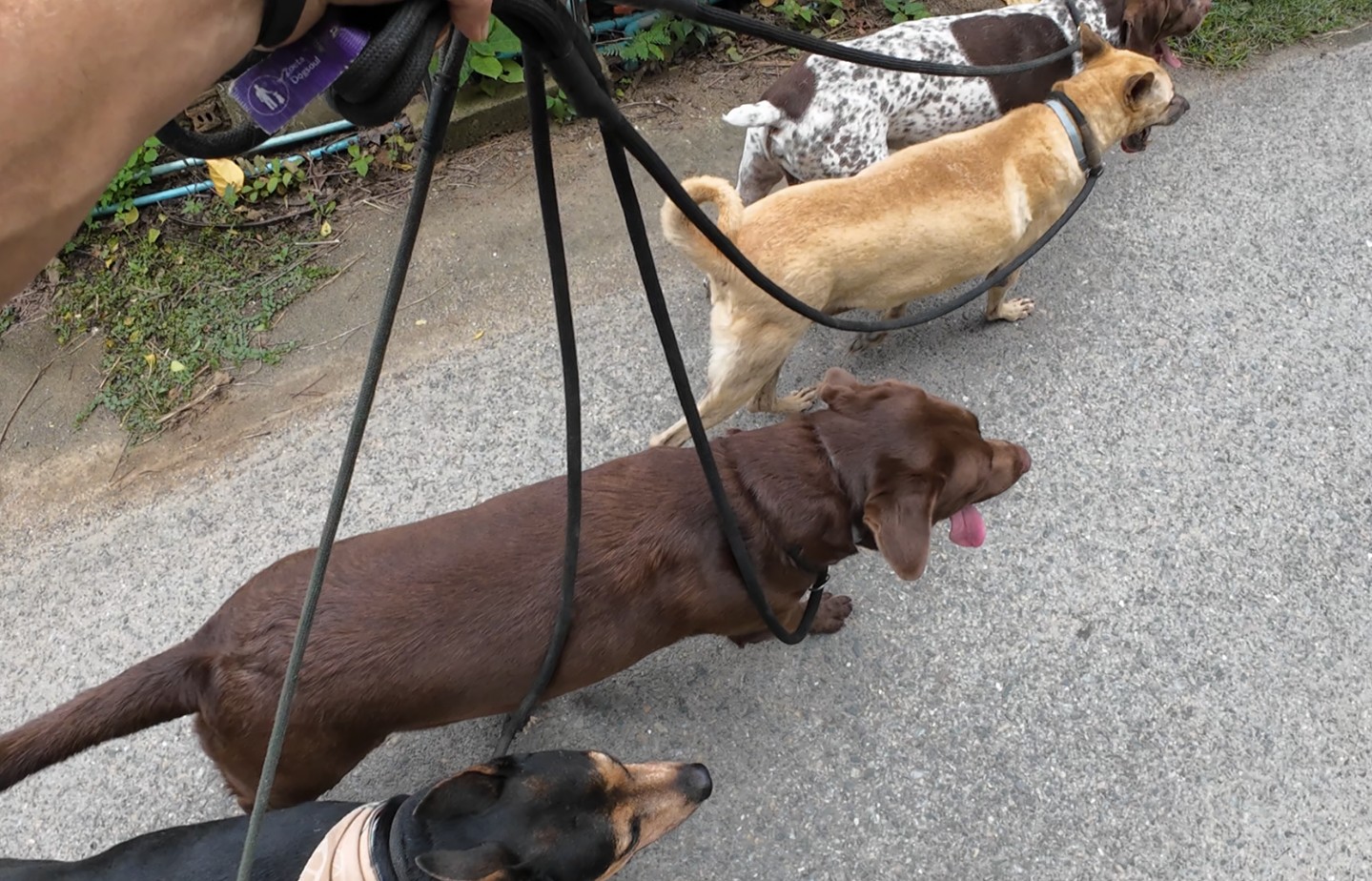
Synchrony restores balance. Ground your breath, match your dog’s tempo, and lead with quiet clarity. Connection, not correction, turns the leash from restraint into resonance.
Attachment Patterns and Adaptability
The Security of Connection
Your dog’s attachment pattern to you significantly influences how they respond to other handlers. Dogs with secure attachment—characterized by confidence in their primary caregiver’s availability and responsiveness—are generally more resilient and adaptable. These dogs show some initial hesitation when walked by a new person, which is completely normal, but they are more likely to generalize their trained behaviors once basic trust is established.
Secure attachment develops when you consistently respond to your dog’s needs, provide predictable routines, and serve as a source of comfort during stress. Your dog learns that the world is generally safe and that humans can be trusted, making transitions to new handlers smoother.
Dogs with anxious or insecure attachment patterns face more significant challenges with handler transitions. These dogs may exhibit heightened stress, increased vigilance, and control-seeking behaviors when walked by someone other than their primary person. The pulling in these cases often represents an attempt to manage anxiety—moving faster to return home quickly, pulling away from perceived threats, or pulling ahead to maintain some sense of control in an uncertain situation.
Signs of Secure vs. Anxious Attachment Patterns:
Secure Attachment Indicators:
- Comfortable exploring while checking back with handler periodically
- Quick recovery from startling events when handler provides reassurance
- Confident with new handlers after brief adjustment period
- Relaxed body language during most of the walk
- Willing to accept guidance from secondary handlers
Anxious Attachment Indicators:
- Constant monitoring of primary handler’s location
- Extreme distress when walked by others, even familiar people
- Slow recovery from stressful events
- Excessive pulling to return home or to primary person
- Hypervigilance and scanning behavior with secondary handlers
- Difficulty settling or relaxing during walks
Understanding your dog’s attachment pattern helps you approach cross-handler confusion with appropriate expectations and strategies. A securely attached dog might need just a few walks with a new handler to adjust, while an anxiously attached dog may require more systematic desensitization and confidence-building exercises. 😊
🐕 Cross-Handler Confusion: Understanding Why Dogs Pull More With Different People 🔄
Discover the neuroscience and emotional dynamics behind handler-specific leash behavior
Phase 1: Recognizing the Pattern
Identifying cross-handler confusion in your household
🧠 Understanding the Signs
Your dog walks beautifully with one person but transforms into a pulling machine with another. This isn’t disobedience—it’s context-dependent learning. Dogs create rich associations that include the handler’s scent, movement patterns, emotional state, and communication style. When any of these variables change, your dog experiences an entirely different walking context.
🎯 Common Observable Patterns
• Significant pulling difference between household members
• Changed behavior with dog walkers or pet sitters
• Increased stress signals (panting, yawning) with certain handlers
• “Testing boundaries” more with specific people
• Different rules about sniffing and exploring between handlers
Phase 2: The Emotional Foundation
How nervous system states travel through the leash
🧬 Polyvagal Theory in Action
Your dog’s nervous system constantly scans for safety cues through your breath patterns, muscle tension, and movement rhythm. A relaxed handler activates their dog’s ventral vagal state—the physiological condition for calm exploration. A tense handler triggers sympathetic nervous system activation, preparing your dog for vigilance and reactivity. Through the NeuroBond principle, emotional synchrony precedes instruction.
⚡ Emotional Contagion Signals
• Mirrored body tension between handler and dog
• Escalating arousal when handler feels anxious
• Rapid state changes following handler’s emotional shifts
• Leash reactions before conscious awareness of triggers
• Synchronized breathing patterns (shallow = stressed)
⚠️ Warning: The Tension Loop
A tense handler grips the leash tightly, transmitting rigidity directly to the dog. The dog feels this tension, mirrors the stress internally, and their arousal increases. This creates pulling behavior, which makes the handler more tense—creating a self-reinforcing stress cycle that’s difficult to break without conscious intervention.
Phase 3: Kinaesthetic Communication
The language of movement your dog prioritizes
🎵 Reading Your Movement Rhythm
Dogs prioritize physical cues over verbal commands. Your stride pattern, leash tension consistency, and body posture provide continuous real-time information. A confident, steady gait creates synchrony where the leash stays loose because you move as a coordinated unit. Hesitant or erratic movement sends conflicting signals, prompting your dog to pull ahead or lag behind in confusion.
✅ Postural Cues to Master
• Shoulders: Relaxed and back (not hunched or tense forward)
• Head carriage: Level and forward-facing (not down-looking)
• Spine alignment: Upright and centered (confident posture)
• Foot placement: Confident, purposeful steps (not hesitant)
• Center of gravity: Balanced and grounded (stable energy)
🔄 Behavioral Synchrony Indicators
When your dog anticipates your turns before you signal, matches your stride naturally, and adjusts position based on subtle weight shifts, you’ve achieved physical harmony. This is the Invisible Leash of mutual awareness—where the physical tether becomes almost irrelevant because communication flows through movement synchrony.
Phase 4: Understanding Inconsistent Reinforcement
Why different handlers create different rules
📚 Handler-Specific Learning
Your dog develops handler-specific expectations based on what each person has historically reinforced. Handler A stops immediately when pulling occurs; Handler B continues moving despite tension. From your dog’s perspective, pulling has intermittent reinforcement with Handler B—the most powerful reinforcement schedule. This isn’t disobedience; it’s sophisticated discrimination learning.
🎯 Common Inconsistencies
• Different timing of stopping when pulling occurs
• Varied tolerance for acceptable leash tension
• Inconsistent responses to environmental distractions
• Different walking speeds and pace consistency
• Varying attention focus (on dog vs. phone/distracted)
• Different amounts and types of verbal feedback
🛠️ Building Consistency
All handlers must agree on core approaches: similar leash tension thresholds, consistent walking pace, unified responses to pulling, and coordinated reinforcement timing. Document your successful approach explicitly—what works for you may not be obvious to others. The Soul Recall of positive associations requires all handlers to create similar emotional and behavioral contexts.
Phase 5: Measuring Internal States
What happens inside your dog’s body during handler transitions
🔬 Physiological Reality
Dogs walking with their primary, securely attached handler often exhibit higher heart rate variability (indicating parasympathetic calm) and lower cortisol levels. With secondary or tense handlers, these markers reverse—lower heart rate variability and elevated cortisol signal sympathetic activation. Your dog cannot ignore these internal stress signals, making pulling more likely in a physiologically aroused state.
🩺 Observable Stress Indicators
• Rapid shallow breathing or excessive panting
• Dilated pupils and wide-eyed expression
• Muscle tension in shoulders and hindquarters
• Yawning, lip licking, or whale eye
• Inability to settle or constant scanning
• Digestive upset after walks with certain handlers
⚠️ Emotional Dissonance
When your dog’s internal state doesn’t align with your emotional signals, pulling intensifies. If your dog feels anxious about an approaching stimulus while you remain unresponsive, this mismatch creates dissonance. Your dog may surge forward to escape or pull backward to resist—neither reflects disobedience, both represent attempts to resolve the emotional disconnect.
Phase 6: The Role of Attachment
How bond quality affects handler adaptability
🔗 Secure Attachment Advantages
Dogs with secure attachment to their primary handler are more resilient and adaptable with new handlers. They show initial hesitation but generalize trained behaviors once basic trust is established. These dogs comfortably explore while checking back periodically, recover quickly from startling events, and accept guidance from secondary handlers after a brief adjustment period.
😰 Anxious Attachment Challenges
Dogs with anxious or insecure attachment patterns face greater difficulties with handler transitions. They exhibit constant monitoring of the primary handler’s location, extreme distress when walked by others, slow recovery from stressful events, excessive pulling to return home, and hypervigilance with secondary handlers. The pulling represents anxiety management, not defiance.
💚 Building Multi-Handler Relationships
Secondary handlers should engage in positive, low-pressure interactions beyond walks: feeding sessions, play without agenda, calm parallel activities, training fun tricks, gentle grooming, puzzle solving together, and decompression sniffing walks. These activities build trust and create the emotional foundation for successful walking together.
Phase 7: Managing Your Own State
The foundation of successful walks starts with you
🌟 Pre-Walk Regulation Techniques
• Three deep breaths: Inhale for 4 counts, hold for 4, exhale for 6
• Body scan: Notice and release tension from head to toe
• Intention setting: Commit to staying present and calm
• Grounding exercise: Feel your feet, notice surroundings
• Phone away: Be fully present, not distracted
• Timeline adjustment: Allow extra time to avoid rushing
🎯 State Synchrony Elements
Effective training prioritizes emotional synchrony over cue repetition. Focus on breath awareness, regular body tension check-ins, energy matching with your dog, pace modulation based on their state, present-moment focus, responsive pausing when needed, and cultivating genuine calm rather than forced control. Through the NeuroBond approach, emotional connection precedes instruction.
🔍 Signs You’re Transmitting Tension
White-knuckle grip on the leash, habitually keeping the leash very short, locked or tense arm, anticipatory tightening before your dog reacts, frequent sharp tugs, unconscious breath holding, elevated shoulders, or jaw clenching—all signal you’re transmitting stress. Your dog feels this through every point of physical connection.
Phase 8: Building Cross-Handler Success
Systematic protocols for behavior generalization
📋 Systematic Training Protocol
Step 1: All handlers practice self-regulation techniques
Step 2: Document and align on physical cues and responses
Step 3: Secondary handlers build relationship through non-walking activities
Step 4: Start in lowest-distraction environment (backyard)
Step 5: Gradually increase complexity as success builds
Step 6: Reward calm states, not just absence of pulling
🎯 Focus on Internal State
Training that prioritizes state synchrony recognizes that your dog’s internal state determines their capacity to learn and respond. A dog in a calm, focused state can process information. A dog in high arousal or anxiety cannot access their training, regardless of repetitions practiced. The balance between science and soul—that’s the essence of Zoeta Dogsoul.
💡 Reframing “Relapses”
When your dog walks beautifully with you but pulls with your partner, they’re not being bad or stubborn. They’re responding authentically to different communication patterns, reinforcement histories, and emotional contexts. This understanding shifts focus from blaming the dog to educating handlers about their profound impact on behavior—improving welfare for both dogs and humans.
🔄 Handler Type Comparisons: Understanding Different Profiles
The Calm Leader 🌟
Characteristics: Consistent breath, relaxed posture, fluid movement
Dog Response: Loose leash, calm exploration, natural synchrony
Result: Effortless walks with minimal pulling
The Anxious Walker 😰
Characteristics: Tense grip, shallow breathing, anticipatory tightening
Dog Response: Increased pulling, hypervigilance, mirrored tension
Result: Stressful walks with frequent reactivity
The Distracted Handler 📱
Characteristics: Inconsistent attention, phone checking, erratic pace
Dog Response: Self-directed pulling, reduced responsiveness
Result: Dog takes initiative, ignores handler cues
The Inconsistent Reinforcer 🎲
Characteristics: Variable response timing, unclear boundaries
Dog Response: Testing behavior, handler-specific rules
Result: Intermittent pulling based on context
The Rushed Walker ⏰
Characteristics: Fast pace, pulling forward, time pressure
Dog Response: Stressed hurrying, minimal sniffing opportunities
Result: Unfulfilling walks, increased frustration
The Synchronized Partner 🤝
Characteristics: Attuned to dog’s signals, responsive pausing, matching energy
Dog Response: Confident exploration, quick regulation, trust
Result: Harmonious walks with mutual enjoyment
⚡ Quick Reference: The 3-2-1 Handler Consistency Formula
3 Essential Alignments:
• Physical cues (leash tension, pace, posture)
• Emotional state (calm, present, regulated)
• Reinforcement timing (consistent responses)
2 Foundation Principles:
• State synchrony before instruction
• Relationship building before performance expectations
1 Core Truth:
Your dog is always responding authentically to what they perceive. Handler inconsistency creates behavior inconsistency.
🧡 The Zoeta Dogsoul Approach to Cross-Handler Harmony
Cross-handler confusion reveals a profound truth: leash behavior is not about control—it’s about connection. Through the NeuroBond principle, we understand that emotional synchrony between handler and dog forms the foundation for all learning. The Invisible Leash of mutual awareness becomes stronger than any physical tether when handlers prioritize state regulation over command repetition. And through Soul Recall, we recognize that positive associations with multiple handlers create the emotional security dogs need to generalize calm behavior across contexts.
The leash in your hand is a communication channel through which your emotional state, intentions, and relationship flow. When you meet your dog in that space of open communication—when you prioritize the emotional foundation before behavioral expectations—something beautiful emerges: genuine partnership where awareness guides the path, not tension.
This is the heart of Zoeta Dogsoul: not training the dog, but training ourselves to be worthy of their trust and clear in our guidance. Where science meets soul, understanding creates harmony.
© Zoeta Dogsoul – Where neuroscience meets soul in dog training
Why “Forgetting” Training is Actually Smart Learning
When your dog seems to forget all their leash training with a new person, they are not being stubborn or selectively obedient. They are demonstrating sophisticated contextual learning—a sign of intelligence, not defiance.
Every learning experience for your dog includes the full environmental context: who is present, where they are, what they smell and hear, and crucially, the specific behavioral patterns of the handler. When one element of that context changes dramatically—such as the handler—your dog must reassess whether the previous rules still apply.
From your dog’s perspective, “sit” said by you in your voice, with your specific inflection, while you hold the leash in your characteristic way, is different from “sit” said by another person with different vocal tones and handling style. The sound may be similar, but the complete gestalt of the situation is distinct.
This context-dependency extends to emotional associations. If your dog has learned to walk calmly while experiencing a particular emotional state elicited by your presence and handling style, they cannot simply transfer that calm state to a new handler who elicits different emotions. This is why training focused solely on command compliance often fails to generalize—it addresses only one small element of the complete learning context.
Recognizing this helps us design better training protocols that explicitly teach generalization rather than assuming it will happen automatically.
Training for Generalization: Building Cross-Handler Success
State Synchrony Over Cue Repetition
Traditional leash training often focuses heavily on repetition: practice the “heel” command hundreds of times until the dog responds automatically. While repetition has value, this approach misses the more fundamental element—the emotional state in which learning occurs and behavior is performed.
Training that prioritizes state synchrony recognizes that your dog’s internal state determines their capacity to learn and respond. A dog in a calm, focused state with moderate arousal can process information and make good choices. A dog in a state of high arousal, anxiety, or confusion cannot access their training, no matter how many repetitions they have practiced.
This means effective training begins with teaching handlers to recognize and influence their dog’s emotional state. Can you tell when your dog is slightly over-threshold before they fully react? Can you adjust your own energy to help bring your dog back to a regulated state? Can you create conditions that promote calm rather than just issuing commands to a dog who is not in a state to comply?
When multiple handlers work with the same dog, the focus should be on all handlers developing the skill of creating and maintaining emotional synchrony with that dog. This might mean walking more slowly, taking breaks for calming activities, or practicing in lower-distraction environments until synchrony becomes easier to achieve and maintain.
Core Elements of State Synchrony Training:
- Breath awareness: Handlers learn to maintain deep, rhythmic breathing
- Body scanning: Regular check-ins with your own physical tension
- Energy matching: Assessing and adjusting your arousal level to match or guide your dog’s
- Pace modulation: Adjusting walking speed to your dog’s emotional state
- Present-moment focus: Minimizing distractions to stay attuned to your dog
- Responsive pausing: Stopping to allow your dog to regulate when needed
- Positive emotional state: Cultivating genuine calm rather than forced control
- Non-verbal attunement: Reading your dog’s signals before they escalate
That balance between science and soul—between understanding the neuroscience of stress and arousal while also honoring the relational, emotional dimension of the human-dog bond—that is the essence of Zoeta Dogsoul.
Designing Handler-Transition Protocols
If you want your dog to walk well with multiple people in your household or with a dog walker, intentional training protocols can facilitate this generalization. Here is what trainers and handlers can implement:
Start with Handler Self-Regulation — Before working on the dog’s behavior, each handler must learn to manage their own nervous system. This might include breathing exercises before walks, body awareness practices, or simply taking a moment to center oneself emotionally before picking up the leash. A regulated handler creates the conditions for a regulated dog.
Establish Consistent Physical Cues — While some individual variation is inevitable, handlers should agree on core physical approaches: similar leash tension, walking pace, body positioning, and response to pulling. The more consistent these physical cues across handlers, the easier it becomes for your dog to generalize their training.
Reward Calmness, Not Just Compliance — Instead of only reinforcing the dog for not pulling, actively reward calm emotional states. This might mean treating your dog for soft eyes, relaxed body language, and attention to the handler, even if they have not been asked to do anything specific. This teaches your dog that the goal is internal regulation, not just external compliance.
Gradual Exposure to Multiple Handlers — Begin in the most controlled environment possible—perhaps just walking in the backyard or quiet street with the new handler. Gradually increase difficulty as your dog demonstrates success. This systematic approach builds confidence and allows learning to occur without overwhelming your dog’s capacity to cope.
Build Individual Relationships — Encourage secondary handlers to engage in positive, low-pressure interactions with your dog beyond just walks. Play sessions, training games, or simply calm time together help build trust and attachment, making handler transitions less stressful. The Soul Recall of positive associations with multiple people creates a foundation for generalized good behavior.
Relationship-Building Activities for Secondary Handlers:
- Feeding sessions: Taking over meal times to create positive associations
- Play without agenda: Unstructured fun time with toys or games
- Calm parallel activities: Sitting together while reading or watching TV
- Training fun tricks: Teaching non-essential skills in a playful context
- Gentle grooming: Brushing or massage sessions
- Treat scatter games: Low-pressure food enrichment activities
- Decompression sniffing walks: Slow, dog-led exploration time
- Puzzle solving together: Interactive enrichment toys or activities
Use Objective Feedback — If available, technology that measures leash tension and direction can provide handlers with real-time feedback about their technique. Seeing objective data about when tension increases or decreases helps handlers identify which of their behaviors influence their dog’s responses.
Understanding “Relapses” Through a New Lens
How often have you heard someone say their dog is “being bad” or “testing them” when behavioral relapses occur? This interpretation causes unnecessary frustration and often leads to punitive approaches that damage the human-dog relationship without addressing the actual problem.
Handler-specific inconsistencies provide a much more accurate and compassionate explanation for these apparent relapses. When your dog walks beautifully with you but pulls with your partner, they are not choosing to misbehave. They are responding authentically to different communication patterns, reinforcement histories, and emotional contexts.
This understanding shifts the focus from blaming your dog to educating handlers about their profound impact on behavior. It opens the door to solutions centered on improving human consistency and awareness rather than attempting to make the dog more compliant through force or frustration.
Recognizing this distinction improves welfare for both dogs and humans. Dogs experience less confusion and stress when we address the actual source of the problem—handler inconsistency—rather than punishing them for responding logically to the situation as they perceive it. Handlers experience less frustration when they understand that their dog is not being stubborn but rather responding to real differences in how they are being handled.
Questions to Identify Cross-Handler Confusion:
- Does your dog pull significantly more with one household member than another?
- Does your dog’s leash behavior change dramatically with a dog walker?
- Do family members use different verbal cues or hand signals for the same behaviors?
- Does one handler get frustrated or tense during walks while another remains calm?
- Does your dog seem to “test boundaries” more with certain people?
- Do different handlers have different rules about where the dog can sniff or investigate?
- Does your dog show stress signals (panting, yawning, lip licking) more with certain handlers?
- Have you attributed these differences to your dog being “stubborn” or “selective”?
The Welfare Implications of Cross-Handler Awareness
Reducing Unnecessary Stress
Every time your dog experiences confusion or stress during a walk, it affects their overall welfare. Chronic stress from inconsistent handling can lead to increased cortisol levels over time, potentially impacting health, immune function, and emotional wellbeing. When we recognize that pulling often reflects confusion, emotional dissonance, or stress rather than disobedience, we can approach the situation with strategies that reduce rather than compound that stress.
Traditional corrections for pulling—sharp leash pops, verbal reprimands, or even electronic collars—fail to address the underlying emotional and communicative issues. In fact, these approaches often increase stress and anxiety, making the problem worse while damaging the trust between handler and dog.
A welfare-centered approach asks different questions: What is my dog experiencing right now? What am I communicating through my body and energy? How can I help my dog feel safer and clearer about what I am asking? These questions lead to solutions that enhance rather than compromise your dog’s emotional wellbeing.
Building Confidence Through Understanding
When handlers understand why their dog pulls more with them than with someone else, the knowledge itself becomes empowering. Instead of feeling inadequate or frustrated, handlers can recognize specific areas for development—perhaps they need to work on their own stress management, develop more consistent physical cues, or spend more time building a positive relationship with the dog before expecting perfect leash manners.
This awareness also builds confidence in dogs. When a dog repeatedly experiences confused, tense, or stressful walks, they may develop generalized anxiety about walking altogether. Some dogs even begin showing reluctance to go out, associating the leash with stress rather than pleasure.
By improving handler consistency and emotional regulation, we give dogs clearer communication, more predictable experiences, and the opportunity to succeed. Success builds confidence, and confident dogs are more resilient, adaptable, and able to generalize their training across contexts.
The Ripple Effect on the Human-Dog Bond
The quality of your daily walks has implications far beyond that activity alone. Walks are often the primary shared activity between dogs and their people, a time for connection, exploration, and mutual enjoyment. When walks become a source of frustration—with pulling, tension, and conflict—the entire relationship suffers.
Conversely, when walks become a dance of synchronized movement and emotional attunement, they strengthen your bond immeasurably. You and your dog learn to read each other more subtly, to trust each other more deeply, and to enjoy simply being together. This enhanced connection ripples into every other aspect of your relationship, from training in other contexts to your dog’s overall sense of security and attachment.
Understanding cross-handler confusion and working to minimize its negative effects is thus an investment in the entire relationship, not just in the specific behavior of walking politely on leash.
Practical Steps for Better Cross-Handler Walks
For Primary Handlers
If you are the person your dog walks beautifully with, you play a crucial role in helping them generalize that behavior to others:
Document Your Approach — Pay attention to exactly how you walk your dog. What is your pace? How do you hold the leash? How do you respond when your dog shows interest in something? The more explicitly you can identify your approach, the more effectively you can communicate it to others.
Communicate Clearly with Secondary Handlers — Do not assume others can see what you are doing or understand why it works. Explicitly teach your approach, demonstrating the physical elements and explaining your thought process.
Build the Dog-Handler Relationship — Before expecting your dog to walk well with a secondary handler, ensure that person has built some positive relationship capital with your dog through play, training games, or other enjoyable interactions.
Start Simple — When introducing a new handler, begin in easy environments with short duration, gradually increasing difficulty as success builds.
Focus on Emotional State — Teach secondary handlers to prioritize your dog’s emotional state over perfect performance. A slightly imperfect but emotionally calm walk is far better than a tense struggle for compliance.
For Secondary Handlers
If you are the person the dog pulls with, do not take it personally—and do not blame the dog:
Manage Your Own State First — Before each walk, take a moment to check in with yourself. Are you rushed? Tense? Distracted? Make a conscious effort to settle into a calm, present state before picking up the leash.
Pre-Walk Self-Regulation Techniques:
- Three deep breaths: Inhale for 4 counts, hold for 4, exhale for 6
- Body scan: Notice and release tension from head to toe
- Intention setting: Mentally commit to staying present and calm
- Grounding exercise: Feel your feet on the ground, notice your surroundings
- Emotional check-in: Name your current emotional state without judgment
- Timeline adjustment: Allow extra time so you’re not rushed
- Phone away: Commit to being fully present rather than distracted
- Positive visualization: Picture the walk going smoothly and calmly
Study the Dog’s Communication — Learn to read the specific dog’s signals. What does their body language tell you about their emotional state? The more fluent you become in reading this individual dog, the better you can respond appropriately.
Match the Primary Handler’s Approach — As much as possible, mirror the physical approach of the person the dog walks well with. This gives your dog familiar cues to follow.
Build Your Relationship — Invest time in positive interactions outside of walks. This builds trust and makes your dog more willing to cooperate when you do walk together.
Be Patient with Yourself and the Dog — Generalization takes time. Progress may be gradual, and that is completely normal. Celebrate small improvements rather than expecting immediate perfection.
For Professional Trainers
Professionals working with clients experiencing cross-handler confusion can implement protocols that address root causes:
Assess All Handlers — Evaluate not just the dog but also each person who walks them. Identify specific differences in handling style, emotional regulation, and physical approach.
Teach Handler Awareness — Help clients develop body awareness and emotional awareness. Use video feedback, mindfulness exercises, or even biofeedback devices to help handlers understand their own contributions to the dynamic.
Create Graduated Training Plans — Design protocols that systematically build generalization, starting in controlled environments and gradually increasing complexity as both dog and handlers demonstrate readiness.
Focus on the Relationship — Encourage secondary handlers to build positive relationships with the dog through multiple types of interactions, not just leash walking.
Use Objective Measurement — When available, employ technology that objectively measures leash tension, handler movement, and other variables. This data can reveal patterns that are not visible through observation alone.
Educate About Nervous System Regulation — Teach handlers practical tools for managing their own stress and anxiety, recognizing that the handler’s state directly influences the dog’s behavior.
The Future of Cross-Handler Training
Emerging Research Directions
The field of canine behavior science continues to evolve, and cross-handler confusion represents a rich area for future research. We need longitudinal studies that track dogs across multiple handler transitions, measuring both behavioral and physiological markers to fully understand how these dynamics unfold over time.
Research into social cognition in dogs is revealing increasingly sophisticated understanding of how dogs perceive and respond to human behavior. Future studies might explore how dogs develop handler-specific behavioral strategies, whether certain breeds or individual temperaments show greater or lesser sensitivity to handler differences, and what neural mechanisms underlie the discrimination between handlers.
The development of wearable technology for both dogs and humans offers exciting possibilities. Imagine devices that could measure both the dog’s heart rate variability and the handler’s simultaneously, providing real-time feedback about their level of co-regulation. Such technology could revolutionize training by making invisible physiological states visible and quantifiable.
Shifting the Training Paradigm
As our understanding of cross-handler confusion deepens, we see a broader shift in dog training philosophy. The field is moving away from purely compliance-based models toward relationship-centered approaches that prioritize emotional wellbeing, clear communication, and mutual understanding.
This shift recognizes that dogs are not machines that should respond identically regardless of context. They are sentient beings capable of sophisticated discrimination, whose behavior is influenced by their emotional state, their relationship with the handler, and the quality of communication they receive.
Training methods of the future will likely focus more on teaching humans than on drilling dogs. They will emphasize handler self-awareness, nervous system regulation, and the subtle art of communicative synchrony. This is not about being “soft” on dogs—it is about being smart and effective by addressing the actual mechanisms that drive behavior.
A More Compassionate Understanding
Perhaps the most important shift is cultural: moving from viewing behavioral inconsistencies as defiance or unreliability to understanding them as natural responses to different contexts and communication patterns. This more compassionate understanding reduces blame—both of dogs and of handlers who struggle—and opens space for curiosity and problem-solving.
When you stop asking “why is my dog being bad?” and start asking “what is my dog experiencing?” or “what am I communicating without realizing it?” you open the door to real solutions. This question reframing reflects the depth of understanding that grows from genuine respect for dogs as complex emotional beings, not just as animals to be controlled.
Conclusion: Is Understanding Cross-Handler Confusion Right for You?
Cross-handler confusion is not a problem that every dog-human team will face equally. Some dogs and handlers have such natural synchrony that behavior generalizes easily. Others will find this a persistent challenge requiring conscious effort and systematic training.
If your dog’s leash manners vary significantly between handlers, understanding the principles we have explored offers a path forward. Rather than viewing the inconsistency as a training failure or a character flaw in your dog, you can recognize it as valuable information about the subtlety and sophistication of canine communication.
The journey toward better cross-handler consistency requires several elements: a commitment to self-awareness for all handlers, willingness to examine and adjust your own behavior rather than just trying to fix the dog, patience with the gradual process of building relationships and generalizing learning, and an appreciation for the profound impact that emotional states and communication patterns have on behavior.
Benefits of Understanding Cross-Handler Confusion:
- Reduced frustration: Viewing behavior through a lens of communication rather than disobedience
- Improved human relationships: Family members working together rather than blaming each other or the dog
- Enhanced dog welfare: Less stress and confusion for your furry friend
- Faster progress: Addressing root causes rather than symptoms
- Stronger bonds: Deeper connection with your dog through improved understanding
- Better generalization: Skills that transfer across handlers and contexts
- Compassionate training: Moving away from punishment toward education
- Handler growth: Personal development in emotional regulation and body awareness
- Long-term success: Sustainable behavior change rather than temporary compliance
- Quality of life: More enjoyable walks for everyone involved
For families with multiple members walking the same dog, this understanding is essential. For professional dog walkers and trainers, it offers crucial insights for working effectively with client dogs. For anyone who shares their life with a dog, recognizing how deeply your own nervous system state and communication style influence your dog’s behavior opens new possibilities for connection.
The leash in your hand is more than a physical connection—it is a communication channel through which your emotional state, your intentions, and your relationship flow. What you transmit down that leash matters as much as any command you give. When you understand this, walking your dog transforms from a task to manage into an opportunity for genuine connection, a moving meditation in mutual awareness.
Your dog is always communicating with you, always responding authentically to what they perceive. When you meet them in that space of open communication, when you prioritize the emotional foundation before the behavioral expectation, something beautiful emerges: the Invisible Leash of mutual understanding that renders the physical leash almost irrelevant.
That is the heart of it—not control, but connection. Not commands, but communication. Not training the dog, but training ourselves to be worthy of their trust and clear in our guidance. Through this lens, cross-handler confusion becomes not a problem to fix but an invitation to grow deeper in our relationship with our dogs and our understanding of ourselves. 🧡
The path forward is clear: approach each walk with presence, regulate your own nervous system first, communicate through your whole being rather than just through words, build genuine relationships with the dogs in your care, and trust that when you create the emotional foundation, the behavior will follow. That is the Zoeta Dogsoul way—where science meets soul, and understanding creates harmony.










