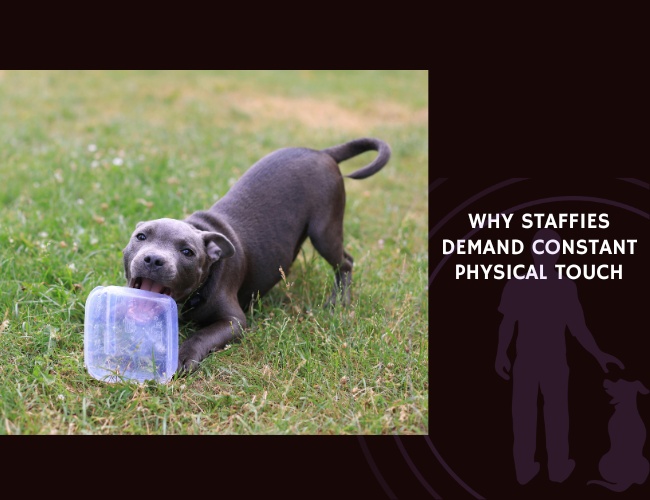
You settle onto the couch, and within seconds, your Staffie is pressed against you. Not sitting nearby—actually touching you. Leaning. Heavy. Warm. When you shift, they shift. When you stand, they follow. And if you dare close a door between you, the world might as well be ending.
This isn’t clinginess. This isn’t insecurity. This is something far more profound—a neurobiological drive coded into the very fabric of what makes a Staffordshire Bull Terrier who they are. Through the NeuroBond approach, we begin to understand that this constant physical contact represents not dependence, but a sophisticated form of emotional communication that has been selectively bred into these remarkable dogs over centuries.
Let us guide you through the fascinating science behind why your Staffie can’t seem to exist without touching you, and what this reveals about one of the most misunderstood breeds in the canine world.
The Historical Blueprint: How Breeding Shaped the Staffie Touch Drive
From Fighting Rings to Family Hearths
The Staffordshire Bull Terrier emerged in 19th-century England, specifically in the Black Country of Staffordshire. But here’s what most people get wrong: while these dogs were originally bred for bull-baiting and later dog fighting, breeders simultaneously selected for an almost contradictory trait—absolute gentleness and loyalty toward humans.
This dual selection created something extraordinary. Handlers needed dogs who could be pulled from fights without redirecting aggression toward people. They needed dogs who, despite being in an aroused state, would immediately soften at human touch. This meant breeding for dogs with an exceptional capacity to regulate their emotional state through physical contact with their people.
When blood sports were banned in 1835, Staffies transitioned fully into companion roles. But that neurological wiring—that deep-seated need for human physical proximity—remained embedded in their genetic code. What had been a safety mechanism became a defining characteristic of the breed.
The Nanny Dog Legacy and Tactile Trust
You’ve likely heard Staffies called “nanny dogs.” While this term is somewhat romanticized, there’s truth in the observation that Staffies display remarkable patience and gentleness with family members, especially children. This trait didn’t emerge by accident.
Breeders favored dogs who sought proximity to all family members, who monitored household members through physical presence, and who used their bodies as bridges between their arousal states and calmness. A Staffie that could self-regulate through touch was a Staffie that could be trusted in any family situation.
This created dogs with:
- Heightened tactile sensitivity: Their skin and nervous systems became exceptionally responsive to touch
- Proximity-seeking behavior: They learned that closeness equals safety and emotional balance
- Touch-mediated emotional regulation: Physical contact became their primary tool for managing stress and arousal
🧡 This is why your Staffie doesn’t just want to be near you—they need to feel you to feel right in their world.
The Neurobiology of Touch: What Happens in Your Staffie’s Brain
The Oxytocin Connection
When your Staffie leans against you, something remarkable happens in both your brains. Physical touch triggers a cascade of oxytocin release—often called the “love hormone” or “bonding hormone.” But in Staffies, research suggests this system may be particularly sensitive and responsive.
Oxytocin does several critical things:
- Reduces cortisol levels: The stress hormone decreases, creating a calming effect
- Enhances social recognition: Your Staffie becomes more attuned to your emotional state
- Reinforces bonding behaviors: Each touch creates a neurological reward, encouraging more touch-seeking
- Modulates the amygdala: The brain’s fear and anxiety center becomes less reactive
For Staffies, this system appears to have a particularly low threshold for activation. Even brief physical contact can trigger significant oxytocin release, which explains why they constantly seek touch throughout the day. They’re not being needy—they’re engaging in sophisticated neurochemical self-regulation.
Somatovisceral Resonance: Feeling What You Feel
Here’s where it gets truly fascinating. Research on interpersonal touch demonstrates something called somatovisceral resonance—a physiological synchronization that occurs between individuals in physical contact. When your Staffie presses against you, their autonomic nervous system begins to couple with yours.
This means:
- Their heart rate variability can synchronize with yours
- Their breathing patterns may align with your own
- Their electrodermal activity (a measure of emotional arousal) couples with yours
- They literally begin to feel what you feel
The Invisible Leash operates here not through tension, but through this remarkable physiological connection. Your Staffie isn’t just touching you—they’re reading your entire emotional state through their skin, their nervous system acting as a sophisticated biofeedback system.
Studies on human-dog bonding show that dogs possess specialized neural pathways for processing human touch differently than touch from other dogs. For Staffies, this system appears amplified. Their anterior cingulate cortex (ACC) and anterior insula—brain regions involved in empathy and emotional processing—show heightened activity in response to human contact.
The C-Tactile Fiber System
Your Staffie’s skin contains specialized nerve fibers called C-tactile (CT) afferents. These slow-conducting fibers specifically respond to gentle, stroking touch—the kind of touch that occurs when you pet your dog or when they lean against you.
CT fibers are unique because they:
- Connect directly to emotional brain centers: They bypass conscious processing and go straight to areas that regulate mood
- Respond optimally to specific touch: Gentle pressure at specific speeds triggers maximum activation
- Release endogenous opioids: Creating natural pain relief and pleasure
- Activate the parasympathetic nervous system: Promoting rest, digestion, and recovery
In Staffies, the density and sensitivity of these fibers may be greater than in other breeds. This would explain why they don’t just tolerate touch—they actively crave it with an intensity that can seem almost desperate to observers who don’t understand the neurological drive behind it.
🧠 Each time your Staffie touches you, they’re not just seeking comfort—they’re engaging in essential neurological maintenance.
Attachment Patterns: Understanding Your Staffie’s Touch Language
The Secure Attachment Base
Attachment theory, originally developed by John Bowlby and Mary Ainsworth, provides a powerful framework for understanding why Staffies behave the way they do. In healthy human-dog relationships, dogs develop secure attachment to their primary caregivers, using them as a “secure base” from which to explore the world.
But Staffies take this a step further. Their secure base isn’t just emotional—it’s profoundly physical. Research on parent-child attachment shows that physical closeness facilitates caregiver sensitivity and responsiveness, promotes reciprocity, and reduces psychological distress. The same principles apply to Staffie-human bonds.
A securely attached Staffie displays:
- Confident exploration: They’ll investigate new environments—but check in physically with you regularly
- Distress upon separation: But recovers quickly upon your return (with physical contact)
- Preference for your presence: Especially during stressful situations, where they seek physical touch to regulate
- Responsive touch-seeking: They initiate contact but also respond when you initiate
This pattern reflects not clingy insecurity, but rather a healthy, functioning attachment system that uses physical touch as its primary regulatory mechanism.
Anxious-Ambivalent Patterns and Over-Attachment
Not all Staffies develop secure attachment. Some develop anxious-ambivalent patterns, particularly if their early experiences included inconsistent availability of physical contact or caregiving. These dogs display:
- Excessive separation distress: Severe anxiety when you leave, potentially leading to destructive behavior
- Hypervigilant touch-seeking: Following you room to room, unable to settle even when you’re home
- Poor emotional regulation: Difficulty calming without constant physical contact
- Approach-avoidance conflict: Seeking touch but remaining tense during contact
This pattern often develops when:
- Caregivers are inconsistent in responding to the dog’s proximity-seeking behavior
- The Staffie experiences repeated separations during critical developmental periods
- Physical contact is withheld as punishment
- The human-dog relationship lacks predictable structure
The key insight from moments of Soul Recall is understanding that these patterns aren’t character flaws—they’re adaptive responses to environmental unpredictability. An anxiously attached Staffie has learned that physical contact is precious and potentially withdrawn at any moment, driving them to seek it compulsively.
The Impact of Early Touch Experiences
The neonatal and early developmental periods are critical for establishing healthy touch patterns. Research on infant-caregiver interactions shows that close skin contact during the neonatal period:
- Facilitates caregiver sensitivity and responsiveness
- Promotes parent-infant reciprocity
- Reduces psychological distress
- Helps regulate physiological systems including circadian rhythm and autonomic function
For Staffie puppies, similar principles apply. Puppies who receive consistent, gentle handling during their first twelve weeks develop:
- Lower baseline cortisol levels: They’re generally calmer
- Better stress recovery: They bounce back faster from frightening experiences
- More confident social behavior: They approach novel situations with less fear
- Healthier touch-seeking patterns: They seek contact but can also self-soothe
Conversely, puppies with limited positive touch experiences may develop:
- Touch-aversion behaviors
- Hyperreactive touch-seeking (unable to get enough)
- Poor emotional regulation
- Difficulty settling without physical contact
The foundation of your adult Staffie’s touch patterns was laid in those first few weeks of life.
Environmental Factors: How You Shape Your Staffie’s Touch Behavior
The Reinforcement Cycle
Let’s be honest: we reinforce our Staffies’ touch-seeking behavior, often without realizing it. And in many cases, that’s perfectly healthy. But understanding the mechanisms helps us ensure we’re building healthy patterns rather than problematic dependencies.
Every time your Staffie touches you and experiences:
- Your attention (even if it’s just acknowledgment)
- Your affection (petting, verbal praise)
- Reduction in their own anxiety
- Access to something they want
You’ve reinforced that behavior. This creates what behaviorists call a “positive feedback loop.” The behavior increases in frequency because it consistently produces rewarding outcomes.
For most Staffies and their families, this works beautifully. The dog seeks touch, gets emotional regulation and social connection, and the human benefits from the affection and bonding. It’s a win-win.
When Touch-Seeking Becomes Problematic
However, sometimes the reinforcement pattern can create excessive dependence. This happens when:
Physical contact becomes the only avenue for emotional regulation: If your Staffie cannot calm themselves without touching you, they lack crucial coping skills.
Touch-seeking prevents normal activities: If your dog cannot be groomed, examined by a vet, or handled by others because they’re focused solely on touching you, it limits their quality of life.
Separation causes significant distress: While Staffies naturally prefer your company, severe separation anxiety that triggers destructive behavior, self-harm, or complete inability to function indicates problematic over-attachment.
Touch-seeking becomes compulsive: If your Staffie displays rigid, repetitive touching behaviors that they cannot interrupt, even with high-value rewards or distractions, this may indicate an anxiety disorder rather than healthy attachment.
Signs of problematic touch-dependence:
- Pacing and whining when you’re home but not touching them
- Inability to sleep unless in physical contact
- Aggressive behavior toward people or animals who interrupt physical contact with you
- Refusal to eat unless you’re present and touching them
- Self-injurious behavior during separations
Building Healthy Independence Alongside Connection
The goal isn’t to eliminate your Staffie’s desire for touch—that would be fighting against their fundamental nature. Instead, you want to build what researchers call “secure independence”: the ability to be comfortable both in connection and in brief separations.
Here’s how to cultivate this balance:
Practice micro-separations: Start with being in the same room but not touching. Reward calm behavior with touch. Gradually increase the distance and duration.
Create positive associations with independence: Give your Staffie an enrichment toy or long-lasting chew when you step away. They learn that brief separations bring good things.
Teach a “place” or “settle” command: This gives your Staffie a job—staying in their designated spot—which can provide structure and purpose that supports emotional regulation even without constant touch.
Maintain consistent routines: Predictability reduces anxiety. When your Staffie knows that you always return after certain activities, they worry less during brief separations.
Provide alternative regulation tools: Sniffing activities, appropriate chewing, physical exercise, and mental stimulation all support emotional regulation through non-contact channels.
😄 The strongest Staffie-human bonds combine intense connection with quiet confidence in each other’s reliable presence.
The Science of Somatic Communication: What Your Staffie Is Really Telling You
Touch as Emotional Language
When your Staffie leans against your leg, presses their head into your hand, or drapes themselves across your lap, they’re speaking. This is somatic communication—the expression of emotional states through body position and physical contact.
Research on interpersonal touch identifies it as a unique channel for affect communication. Your Staffie uses different types of touch to convey different emotional messages:
The Lean: A slow, deliberate press of their body weight against you typically signals:
- “I feel safe with you”
- “I need emotional grounding”
- “I’m monitoring you”
The Head Press: Pushing their head into your hand or lap indicates:
- “I’m seeking reassurance”
- “I trust you completely”
- “I need you to acknowledge me”
The Full Body Contact: Lying on or against you with maximum surface area contact suggests:
- “I’m deeply relaxed with you”
- “I’m sharing this emotional moment”
- “I want to feel everything you’re feeling”
The Paw Touch: Placing a paw on you signals:
- “I’m asking for engagement”
- “I want your attention right now”
- “I’m checking if you’re emotionally available”
Reading Your Staffie’s Touch Requests
Not all touch-seeking is the same. Learning to differentiate between different motivations helps you respond appropriately:
Attention-seeking touch: Usually accompanied by eye contact, play bows, or bringing toys. The touch is light, intermittent, and accompanied by excited body language. Your Staffie is saying “play with me” or “pay attention to me.”
Anxiety-regulation touch: More intense, sustained pressure. Your Staffie may be panting, unable to settle, or displaying other stress signals. They’re saying “I’m overwhelmed and need you to help me calm down.”
Affection/bonding touch: Gentle, relaxed contact during calm moments. Your Staffie is content, their body soft, breathing even. They’re saying “I love being near you” or “this is where I want to be.”
Monitoring touch: Brief, periodic check-ins, especially when you’re engaged in an activity. Your Staffie maintains light contact, often just one paw or their side against your leg. They’re saying “I’m keeping tabs on you” or “I want to know what you’re doing.”
Social support touch: Occurs when you’re stressed or upset. Your Staffie may press against you with sustained, firm contact. Research suggests dogs can detect human emotional states and attempt to stabilize them through physical presence. Your Staffie is saying “I sense you’re not okay, and I’m here to help.”
Leaning. Warm. Non-Negotiable.
This isn’t clinginess—it’s contact as survival.
Your Staffie’s need to press against you is a hardwired regulation system, using skin-to-skin closeness to stabilize their nervous system and translate emotion into safety.
History turned touch into a requirement, not a preference.
Selective breeding for dogs who could be pulled from fights without redirecting aggression toward humans created a lineage that softens, calms, and reorients the moment human hands make contact.
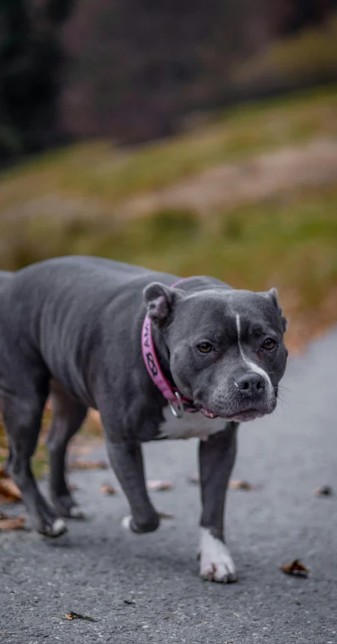
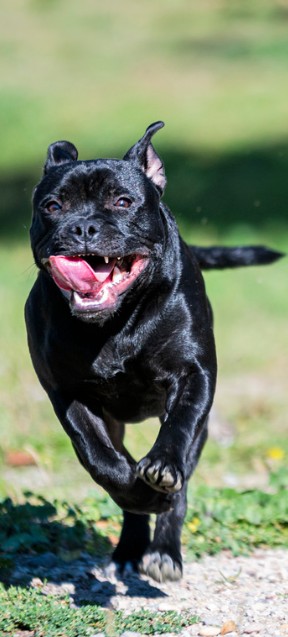
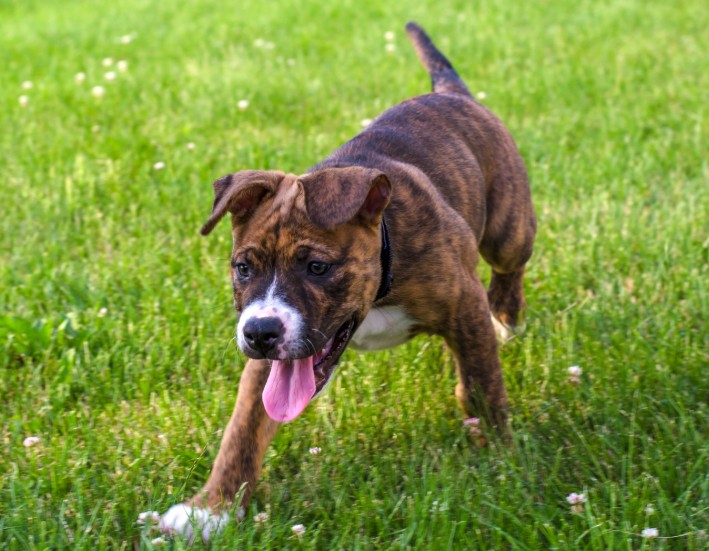
Modern “Velcro” behavior is just that legacy in your living room.
When your Staffie leans, follows, and panics at closed doors, they’re not being needy—they’re activating an ancient program that says their emotional balance lives exactly where your body meets theirs.
Training Implications: Working With Your Staffie’s Touch Drive
The Challenge of Traditional Training Methods
Many traditional dog training methods were developed for breeds with different motivational structures. Working breeds like Border Collies respond brilliantly to toy rewards and movement-based games. Hounds can be motivated by scent work. Retrievers live for fetching games.
But what motivates a Staffie? Physical connection with you.
This creates both opportunities and challenges. Your Staffie will work incredibly hard to maintain proximity to you. But if training methods emphasize distance or use space as punishment, you’re working against your Staffie’s fundamental wiring.
Approaches that don’t work well for Staffies:
- Alpha rolling or physical corrections: These trigger stress, which increases their need for reassuring touch, creating a counterproductive cycle
- Extended timeout isolation: For an animal whose nervous system regulates through touch, isolation is profoundly distressing
- Distance-based rewards: Sending your Staffie away to “go to your bed” as a default may feel like punishment to them
- Minimal physical interaction during training: Training that’s all verbal cues and food rewards misses the primary motivator for Staffies
🐾 The Science Behind Your Staffie’s Touch Drive 🧡
Understanding why your Staffordshire Bull Terrier experiences love through constant physical contact—and what neuroscience reveals about this profound behavioral drive
🧠 Neurobiological Fundamentals
The Oxytocin Connection
When your Staffie touches you, both brains release oxytocin—the bonding hormone. But Staffies possess a particularly sensitive oxytocin system with a low activation threshold, meaning even brief contact triggers significant neurochemical rewards. This isn’t neediness; it’s sophisticated self-regulation through connection.
Somatovisceral Resonance
Your Staffie’s nervous system literally synchronizes with yours during physical contact. Their heart rate, breathing, and emotional arousal couple with your own physiological state. They’re not just touching you—they’re reading your entire emotional landscape through their skin.
C-Tactile Fiber Density
Specialized nerve fibers in your Staffie’s skin respond specifically to gentle touch, connecting directly to emotional brain centers and releasing natural opioids. Staffies may possess higher densities of these fibers, explaining why they don’t just tolerate touch—they neurologically crave it.
💝 Reading Your Staffie’s Touch Language
Different Touch Types, Different Messages
The Lean: Slow, deliberate body weight against you = “I feel safe” or “I need emotional grounding”
The Head Press: Pushing their head into your hand = “I trust you completely” or “I need reassurance”
Full Body Contact: Maximum surface area against you = “I’m deeply relaxed” or “I want to feel what you’re feeling”
The Paw Touch: Placing a paw on you = “I’m asking for engagement right now”
Reciprocal Emotional Regulation
Your Staffie doesn’t just seek touch to calm themselves—they offer physical presence to stabilize your emotional state. When you’re stressed or upset, that insistent pressing against you represents sophisticated empathy expressed through their primary language: somatic communication.
🎯 Training With Touch as the Primary Motivator
Touch-Based Positive Reinforcement
For Staffies, physical contact IS the reward. Effective training incorporates:
• Treats paired with deliberate physical affection to compound reward value
• “Touch base” behaviors that reward checking in with you through brief contact
• Calm proximity practice—rewarding peaceful coexistence near you
• Touch-based communication cues where specific pressure patterns predict activities
Building Distance Without Breaking Connection
Teach distance skills progressively: connected practice → visual contact with proximity → brief separations with touching breaks → gradual duration building. Throughout, maintain psychological contact through voice, eye contact, and body language. Your Staffie learns distance is temporary and connection always returns.
⚠️ When Touch-Seeking Signals Problems
Problematic Touch-Dependence Red Flags
• Severe separation anxiety: Destructive behavior, self-harm, or complete inability to function when you leave
• Compulsive patterns: Rigid, repetitive touching that cannot be interrupted even with high-value rewards
• Inability to self-regulate: Cannot calm without physical contact—zero alternative coping mechanisms
• Aggressive guarding: Hostile behavior toward people or animals who interrupt your physical contact
Medical vs. Behavioral Touch-Seeking
Sudden increases in touch-seeking, restlessness during contact, specific positioning to have you touch certain body areas, or vocalization while seeking touch may signal pain, joint issues, skin allergies, or neurological conditions. Consult your veterinarian if patterns change abruptly.
⚡ The Staffie Touch Formula
Healthy Touch Pattern = Confident proximity-seeking + Ability to settle during contact + Flexibility with your availability + Brief separation tolerance
Problematic Pattern = Anxious hypervigilance + Inability to calm without touch + Rigid demands + Severe distress when separated
🧡 The Zoeta Dogsoul Perspective
Through the NeuroBond approach, we understand that your Staffie’s constant touch-seeking represents sophisticated emotional communication coded into their neurological architecture. The Invisible Leash isn’t created through control—it emerges through the physiological synchronization that occurs when your Staffie presses against you, your nervous systems coupling in shared regulation.
Your Staffie isn’t demanding attention. They’re speaking the language of connection their breed has perfected over centuries—where touch becomes a bridge between two emotional worlds, allowing for mutual understanding, reciprocal calming, and the profound experience of being truly known by another being.
© Zoeta Dogsoul – Where neuroscience meets soul in dog training
Touch-Based Positive Reinforcement
Instead, the most effective training for Staffies incorporates their touch drive into the learning process:
Use physical contact as a reward: After your Staffie performs a behavior correctly, the reward isn’t just a treat—it’s a treat plus deliberate physical affection. This compounds the reward value.
Incorporate “touch base” behaviors: Teach your Staffie that checking in with you through brief physical contact is rewarding. This builds the Invisible Leash—they stay connected to you through awareness and choice rather than through restrictive control.
Practice calm physical proximity: Reward your Staffie for being near you in a calm state. This teaches that proximity doesn’t always mean play or excitement; it can mean peaceful coexistence.
Use touch to shape emotional states: Before practicing challenging behaviors, spend time in calming physical contact with your Staffie. This puts their nervous system in the optimal state for learning.
Create touch-based communication cues: Teach your Staffie that certain types of touch from you predict certain activities. A specific gentle pressure might mean “time to settle,” while a different touch pattern means “we’re about to play.”
Building Distance Skills While Honoring Touch Needs
You can teach your Staffie to work at a distance without violating their need for connection. The key is building the distance gradually and maintaining what trainers call “psychological contact”—your Staffie knows you’re still engaged with them even when not physically touching.
Progressive distance training:
- Connected practice: Teach new behaviors while in physical contact or very close proximity
- Visual contact with proximity: Your Staffie performs the behavior a few feet away but can see and return to you immediately
- Brief separations with connection: Practice behaviors that require distance, but for short durations, with plenty of touching breaks
- Building duration at distance: Gradually extend the time your Staffie works away from you, always ending with physical reconnection
- Distance with confidence: Your Staffie learns that distance is temporary and connection always returns
Throughout this process, use your voice, eye contact, and body language to maintain that sense of connection. Your Staffie doesn’t need to be touching you every second—they need to feel that the connection is reliable and will be restored.
🧡 That balance between science and soul, between training methodology and emotional reality—that’s the essence of Zoeta Dogsoul.
Health Considerations: When Touch-Seeking Signals Medical Issues
Differentiating Behavioral from Medical Touch-Seeking
Sometimes what appears to be your Staffie’s breed-typical touch drive actually masks an underlying health issue. Dogs experiencing pain, discomfort, or illness often seek physical contact with their humans as a coping mechanism.
Red flags that touch-seeking may have a medical component:
Sudden increase in touch-seeking behavior: If your previously independent Staffie suddenly can’t stop touching you, something has changed. Pain, illness, or sensory changes could be driving this shift.
Touch-seeking accompanied by restlessness: Constantly seeking contact but unable to settle comfortably suggests discomfort. Your Staffie may be looking for relief that the contact doesn’t fully provide.
Specific body positions during contact: If your Staffie always positions themselves so you’re touching a particular area, they may be experiencing pain or discomfort in that region.
Vocalization during touch-seeking: Whining, whimpering, or other vocalizations while seeking contact indicate distress rather than simple desire for connection.
Changes in touch tolerance: If your Staffie normally loves physical contact but suddenly shows sensitivity or discomfort when touched, this strongly suggests a medical issue.
Common Health Issues in Staffies Affecting Touch Behavior
Several health conditions common to Staffies can affect their touch-seeking behavior:
Hip dysplasia and joint pain: Dogs with joint pain often seek physical support and pressure that helps stabilize painful joints. Your Staffie may lean heavily against you or prefer lying pressed against your body because the contact provides physical support.
Skin allergies: Staffies are prone to skin issues. The pressure and gentle friction from leaning against you may provide relief from itching. Watch for increased licking, scratching, or redness alongside touch-seeking behavior.
Anxiety disorders: While anxiety is behavioral rather than strictly medical, it can have neurobiological components including neurotransmitter imbalances. Dogs with clinical anxiety disorders may seek touch compulsively as a self-soothing mechanism.
Vision or hearing loss: Sensory deficits can increase touch-seeking as your Staffie relies more heavily on physical contact to navigate their world and stay connected to you.
Neurological conditions: Though rare, certain neurological issues can cause compulsive contact-seeking behavior that differs in quality from normal Staffie touch drive.
When to Consult Your Veterinarian
Schedule a veterinary examination if you notice:
- Abrupt changes in touch-seeking patterns
- Touch-seeking accompanied by signs of pain (limping, stiffness, reluctance to move)
- Excessive licking, scratching, or skin irritation
- Behavioral changes beyond touch-seeking (changes in appetite, energy level, bathroom habits)
- Inability to settle or rest comfortably even with physical contact
- Age-related changes in senior Staffies (increased clinginess, confusion, changes in sleep patterns)
Your veterinarian can assess whether your Staffie’s touch behavior reflects their wonderful breed temperament or signals an underlying health concern requiring treatment.
Living With a Velcro Dog: Practical Strategies for Daily Life
Creating a Touch-Positive Home Environment
Since you can’t change your Staffie’s fundamental need for physical contact—and honestly, why would you want to?—the solution is creating an environment that honors this need while maintaining balance in your household.
Designate contact zones: Create areas where physical contact is expected and welcome. This might be the couch during evening relaxation time, your home office where your Staffie has a bed next to your chair, or your bed if you allow dog co-sleeping.
Provide alternative touch experiences: Consider a weighted blanket or heated dog bed for times when you can’t provide direct contact. While not equivalent to touching you, these can provide some sensory input that helps regulation.
Schedule touch time: This may sound clinical, but having dedicated times when you provide focused physical affection can help your Staffie relax during other periods. They know connection time is coming.
Allow appropriate contact during activities: If you’re cooking and your Staffie is pressed against your leg, that’s fine if it doesn’t interfere with safety. If you’re working at your desk and your Staffie is lying on your feet, wonderful. Work with their needs rather than against them.
Managing Touch-Seeking in Challenging Situations
Some situations require managing your Staffie’s touch drive more actively:
Vet visits: Practice cooperative care at home, building positive associations with handling and examination. Bring a familiar blanket or item that smells like you, which can provide some sensory comfort when you can’t be in direct contact during procedures.
Grooming: Many Staffies find grooming challenging because it involves restraint and positioning that limits their ability to control physical contact. Build grooming tolerance gradually, with plenty of breaks for reconnection.
Guests and social situations: Some Staffies transfer their touch-seeking to visitors, which can be overwhelming. Teach an alternative behavior like going to a designated spot where they can still see and monitor everyone without demanding touch from guests.
Multi-dog households: In homes with multiple dogs, your Staffie may compete for physical contact with you. Ensure each dog gets individual attention and contact, preventing resource guarding of your physical space.
Touch Etiquette for Staffie Families
If you share your life with a Staffie, certain practices help everyone coexist happily:
Communicate your Staffie’s needs to others: Help family members and visitors understand that your Staffie’s constant proximity isn’t pushy behavior—it’s their way of being comfortable and connected.
Establish consent-based touching: Teach your Staffie that they can request touch, but you decide when and how much. This prevents demanding or pushy behavior while still honoring their needs.
Create “alone together” time: Practice being in the same room while engaged in separate activities. Your Staffie learns that connection doesn’t require constant active touching.
Respect individual thresholds: Every Staffie is different. Some are content with occasional check-ins; others need sustained contact. Honor your individual dog’s threshold rather than comparing to others.
😄 Your Staffie isn’t asking for all of you—they’re asking to be part of your world, expressed through the language they speak best: touch.
The Emotional Intelligence of Touch: What We Can Learn From Our Staffies
Reciprocal Emotional Regulation
Research on human-dog co-regulation reveals something fascinating: the emotional exchange isn’t one-directional. Yes, your Staffie seeks touch from you to regulate their emotional state. But the research shows they also attempt to regulate your emotional state through their physical presence.
Studies demonstrate that dogs can detect human emotional states through multiple channels—facial expressions, vocal tone, body language, and even chemical signals. When you’re stressed, anxious, or upset, your Staffie knows. And their response? To offer physical contact.
This represents sophisticated social cognition. Your Staffie recognizes your distress, understands that physical proximity helps regulate emotions (because it works for them), and offers that support to you. It’s a form of empathy expressed through the medium your Staffie understands best—touch.
The Therapeutic Potential of Staffie Touch
This reciprocal regulation has real therapeutic potential. Research on social touch shows that physical contact with a close companion:
- Attenuates reactivity in emotional brain areas like the anterior cingulate cortex
- Reduces subjective feelings of distress
- Lowers physiological stress markers
- Provides tangible comfort during challenging situations
Your Staffie’s insistence on physical contact isn’t just meeting their needs—it’s potentially supporting your wellbeing as well. The warm weight of a Staffie pressed against you activates your own parasympathetic nervous system, promoting rest and recovery.
Touch as Mindfulness Practice
There’s something profoundly grounding about a Staffie’s physical presence. They don’t touch you while distracted by a phone, preoccupied with tomorrow’s worries, or mentally elsewhere. When your Staffie leans against you, they’re completely present in that moment of connection.
This offers us a model for mindfulness—full presence in physical experience. The weight of your dog against your leg, the warmth of their body, the rhythm of their breathing—these sensory details anchor you in the present moment.
Perhaps your Staffie’s constant touch-seeking is less a demand and more an invitation: to be here, now, fully present in this shared experience of connection.
The Long View: Touch Needs Across Your Staffie’s Lifespan
Puppyhood: Building the Foundation
During the first year of life, your Staffie puppy is learning how physical contact functions in relationships. This is when healthy touch patterns are established—or problematic ones are accidentally created.
Puppyhood best practices for touch:
- Provide consistent, gentle handling: Touch your puppy daily in various contexts, building positive associations
- Teach consent and boundaries: Sometimes you initiate touch; sometimes they request it; sometimes the answer is “not right now”
- Encourage brief independence: Practice micro-separations even during this bonding period, preventing the development of anxious attachment
- Socialize with varied touch experiences: Let your puppy experience gentle handling from different people in different contexts
Adolescence: Testing Boundaries
Between 6-18 months, your Staffie may test the touch patterns established during puppyhood. Some adolescent Staffies become more independent temporarily (though they remain more contact-oriented than many breeds). Others become even more insistent about physical proximity.
This is normal developmental behavior. Your Staffie is figuring out where they fit in the social structure and how relationships work. Maintain consistency while remaining flexible to their changing needs.
Adulthood: Settled Patterns
By age 2-3, most Staffies have established their individual touch pattern. Some remain constant contact-seekers; others mature into dogs who are content with regular check-ins and evening cuddle sessions.
Neither pattern is “better”—what matters is that the pattern works for both you and your Staffie. The healthiest adult Staffies show:
- Confident proximity-seeking without anxiety
- Ability to settle comfortably when touching you
- Flexible responses to your availability
- Contentment during brief necessary separations
Senior Years: Increased Touch Needs
As your Staffie ages, you may notice changes in their touch-seeking behavior. Many senior Staffies become more physically affectionate, seeking contact more frequently. This reflects several factors:
Sensory changes: Vision and hearing often decline with age. Physical contact becomes more important for navigation and connection.
Physical comfort: Older dogs may experience joint pain or discomfort. The pressure and warmth from leaning against you provides relief.
Cognitive changes: Some senior dogs experience cognitive decline similar to dementia in humans. Physical contact with you provides orientation and reassurance.
Emotional security: Older dogs may feel more vulnerable. Touch provides the security they need to feel safe.
Honor your senior Staffie’s increased need for contact. These are their golden years with you—let them spend them pressed against the person they love most.
🧡 Every stage of life brings different expressions of the same fundamental truth: your Staffie experiences connection through touch.
Conclusion: Embracing the Contact-Seeking Soul
Your Staffie’s demand for constant physical touch isn’t a flaw to be corrected or a behavior to be managed away. It’s a fundamental expression of who they are—a breed shaped by centuries of selection for deep, physically expressed attachment to humans.
Understanding the neurobiology behind this drive—the oxytocin release, the somatovisceral resonance, the C-tactile fiber activation—doesn’t diminish the emotional truth of your bond. If anything, it deepens it. You’re not just sharing affection; you’re engaging in sophisticated neurological co-regulation that benefits both of you.
The Staffie pressed against your leg isn’t being clingy. They’re speaking their primary language: touch. They’re telling you they feel safe, they trust you, they want to share this moment, they’re monitoring your emotional state, and yes—they simply love being close to you.
Can you build some independence and flexibility into this pattern? Absolutely. Should you? In measured ways that prevent separation anxiety and support your Staffie’s ability to cope when you’re not available—yes. But the goal isn’t to create a Staffie who doesn’t need physical contact. The goal is to create a Staffie who can navigate life’s demands while still expressing their fundamental nature.
Living with a Staffie means accepting that you will rarely be alone. You will have a warm, solid presence against you on the couch, under your desk, next to your bed, and following you from room to room. You will be monitored, tracked, and physically accompanied through your days.
And if you can embrace that—if you can see it not as dependence but as a unique form of sophisticated emotional communication—you’ll discover one of the most profound interspecies bonds available.
Your Staffie isn’t demanding attention. They’re not being needy. They’re not clingy or insecure.
They’re touching you because, in their world, that’s how you say: “You are my person, my safe place, my home. And being near you is where I most want to be.”
That’s not a demand. That’s devotion.
Is a touch-seeking Staffie right for you?
Consider your Staffie match if you:
- Genuinely enjoy constant companionship and physical affection
- Work from home or have lifestyle flexibility that allows frequent presence
- Understand that independence and flexibility can be taught, but the fundamental touch drive remains
- Are prepared to honor this need rather than fight against it
- Find peace and joy in the grounded, mindful presence of physical connection
- Want a dog who experiences and expresses love through proximity
A Staffie might not be your best match if you:
- Value significant periods of solitude and personal space
- Work long hours away from home with no ability to bring your dog
- Find constant physical presence overwhelming or intrusive
- Prefer dogs who are more independent and task-oriented
- Expect your dog to be content with minimal interaction
The right match isn’t about whether Staffies are good dogs—they’re extraordinary dogs. It’s about whether their way of being in the world aligns with your way of moving through life.
If it does, you’re in for one of the most physically, emotionally, and neurobiologically connected relationships available in the canine world.