
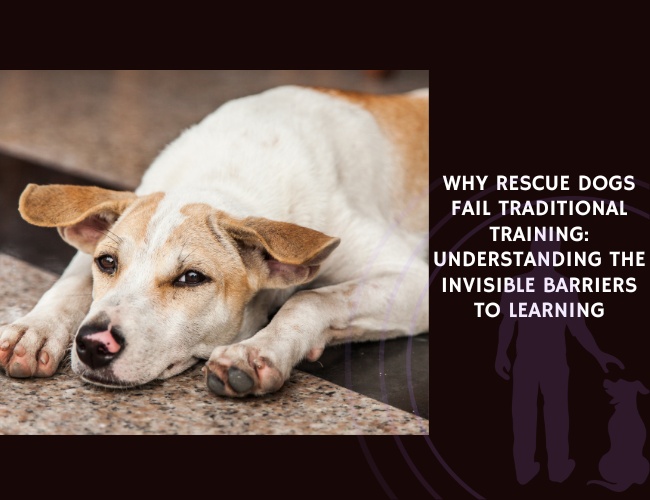
You bring your rescue dog to training class filled with hope. Perhaps you imagine walks without pulling, calm greetings at the door, or simply a dog who responds when called. The trainer demonstrates a command, your dog watches intently, and for a moment, success feels within reach. Then, inexplicably, everything falls apart. At home, nothing transfers. In the park, your dog acts as though you’ve never trained together. The exercises that worked perfectly in class vanish the moment you step into the real world.
If this resonates with you, you’re not alone. Thousands of rescue dog guardians face this same bewildering pattern:
- Their intelligent dogs seem unable to learn what appears straightforward to other dogs
- Behaviors mastered in class completely disappear in real-world settings
- Progress stalls despite consistent practice and dedication
- The dog seems anxious, shut down, or resistant during training sessions
- Traditional methods that work for other dogs fail completely with their rescue
The problem isn’t your dog’s intelligence or your dedication as a handler. The issue runs far deeper, rooted in fundamental mismatches between how traditional training methods work and how rescue dogs actually learn.
This isn’t about blame or judgment. It’s about understanding why certain approaches consistently fail with dogs whose early experiences have shaped their nervous systems in profound ways. When we recognize these invisible barriers, we can finally move past frustration toward methods that genuinely work.
Recognizing Your Dog: Different Presentations of the Same Problem
Before we dive into why traditional training fails, it helps to understand that rescue dogs present their learning challenges in different ways. Your dog’s specific pattern might look completely different from another rescue dog’s, yet both are responding to similar underlying issues with trust, predictability, and nervous system regulation.
The Shutdown Dog
This dog appears to be the perfect student. They’re calm in class, don’t pull on the leash, and seem to comply readily with requests. Trainers often praise these dogs as “quick learners” or “naturally obedient.” But look closer at their body language. Their stillness isn’t relaxation—it’s freezing. Their compliance isn’t understanding—it’s survival strategy.
The shutdown dog has learned that the safest response to uncertainty is to do nothing. They’ve discovered that big reactions invite unpredictable consequences, so they’ve learned to make themselves small, quiet, and invisible.
Signs your dog might be shutdown:
- Unusually “calm” or still in new situations
- Minimal eye contact or engagement
- Doesn’t initiate play or interaction
- Freezes when uncertain rather than exploring
- Complies immediately but without enthusiasm
- Body tension despite appearing calm
- Avoids making choices when offered
What looks like ideal behavior is actually a nervous system locked in a particular type of stress response. These dogs often struggle most when they finally do begin to feel safe and their real personality starts emerging.
The Reactive Dog
This is the dog who lunges at other dogs, barks at strangers, or seems “aggressive” in situations that don’t appear threatening to you. Traditional training often interprets this dog as dominant, out of control, or lacking discipline. But reactivity is usually the opposite of dominance—it’s profound fear expressed through offense as defense.
Common reactive dog behaviors:
- Lunging or barking at triggers (dogs, people, bikes, etc.)
- Intense focus on potential threats in the environment
- Rapid escalation from calm to explosive
- Difficulty recovering after reactive episodes
- Constant scanning and monitoring
- Creates distance through dramatic displays
- Hypervigilant even in “safe” environments
The reactive dog has learned that the world is threatening and that their early warning signals (subtle body language, distance-increasing signals) don’t work or aren’t respected. So they’ve escalated to behaviors that do create distance: dramatic displays that make the scary thing go away. They’re not trying to dominate or attack; they’re trying desperately to manage their own terror through the only strategy that’s worked for them.
The Flight-Risk Dog
This dog’s primary strategy is avoidance. They might bolt when startled, pull away when approached, or constantly position themselves near exits. They’re difficult to catch if they get loose, and they seem to view every interaction as something they need to escape from. Traditional training often labels these dogs as “aloof,” “independent,” or “not bonded.”
Flight-risk dog indicators:
- Positions near exits or escape routes
- Bolts when startled or overwhelmed
- Difficult to catch or corner
- Pulls away from approaching people or dogs
- Keeps physical distance even from family
- Scans constantly for exit strategies
- Freezes when escape isn’t possible
But the flight-risk dog is actually exhibiting a different survival strategy than the shutdown dog. Where the shutdown dog freezes, the flight-risk dog flees. They’ve learned that escape is the most reliable way to stay safe. Their constant vigilance for exit routes isn’t aloofness—it’s hypervigilance born from experiences where staying meant danger.
The People-Pleaser
This dog seems eager to comply and works hard to figure out what you want. They watch you intensely, respond quickly to cues, and appear highly motivated to get things “right.” This sounds positive, and it’s easy to think this dog doesn’t fit the rescue profile at all. But watch their body language when they make a mistake or don’t understand what’s wanted.
People-pleaser warning signs:
- Intense, unwavering eye contact that feels anxious
- Rapid-fire trying of different behaviors to “guess right”
- Visible stress when they make mistakes
- Overwork themselves trying to understand expectations
- Collapse or shutdown when confused
- Difficulty relaxing or “switching off”
- Seem exhausted after training sessions
The people-pleaser is performing through stress. They’ve learned that human approval is conditional and potentially fragile, so they work constantly to maintain it. Their intense focus isn’t confidence—it’s anxiety. Their quick responses aren’t understanding—they’re rapid-fire guessing hoping to land on the right answer before something bad happens. These dogs are exhausting themselves trying to read your mind, and when training becomes ambiguous, they can collapse into confusion or shutdown.
Why These Patterns Matter
Recognizing your dog’s specific presentation helps you understand what their behavior is actually communicating.
What each type needs:
- Shutdown dogs: Permission to have opinions and make choices
- Reactive dogs: Distance and predictability so they can begin to feel safe
- Flight-risk dogs: Secure boundaries and consistent responses that prove staying is safe
- People-pleasers: Understanding that mistakes don’t equal danger and relationship isn’t conditional on performance
Traditional training treats all these dogs the same—as students who need to learn commands. But they’re not starting from the same place, and they won’t all respond to the same approach. Understanding your dog’s pattern is the first step toward recognizing what they actually need.
The Foundation That Isn’t There: What Traditional Training Assumes
Traditional dog training rests on assumptions so deeply embedded that most trainers never question them. These methods were developed primarily with puppies from stable backgrounds—dogs who arrived into predictable homes with consistent routines and reliable human behavior. The training protocols assume certain conditions already exist before the first lesson begins.
The Invisible Prerequisites
When a trainer works with a typical pet dog, they unconsciously rely on several foundational elements already being in place.
What traditional training assumes already exists:
- Environmental predictability: Consistent routines, stable living situations, reliable daily patterns
- Relational continuity: Primary caregivers who remain present and dependable over time
- Low threat baseline: Absence of chronic stress or survival-mode activation
- Positive learning history: Previous experiences where trying new things led to positive outcomes
- Secure base: A safe space for exploration, mistakes, and trying again without fear
Your dog is expected to have experienced environmental predictability throughout their development, meaning consistent routines, stable living situations, and a reliable sense of how each day unfolds. They assume relational continuity exists—that your dog has known primary caregivers who remained present and dependable over time.
Perhaps most critically, traditional methods assume a low threat baseline. They presume your dog isn’t operating from a place of chronic stress or survival-mode activation. They expect your dog has a history of successful learning experiences with humans, where trying something new led to positive outcomes rather than confusion or harm. They anticipate your dog possesses what attachment researchers call a “secure base”—a safe space from which to explore, make mistakes, and try again without fear of abandonment or punishment.
For many rescue dogs, none of these conditions exist. Your dog may have experienced multiple home placements, each with different rules and expectations. They might have learned that human behavior is fundamentally unpredictable—kind one moment, harsh the next, or simply absent when needed most. Their nervous system may have developed under conditions where vigilance meant survival, where letting your guard down invited danger.
Yet training protocols proceed as if these baselines were universal constants rather than privileged starting conditions. The method doesn’t account for what’s missing because it was never designed for dogs who lack these foundations.
When Compliance Masks Confusion
Here’s something that surprises many handlers: early obedience doesn’t necessarily indicate learning. Traditional training often mistakes compliance for understanding, treating a dog who quickly follows commands as evidence of successful teaching. But what looks like cooperation may actually reflect something quite different.
What “good behavior” might actually be:
- Inhibition under uncertainty: Freezing or passive compliance to avoid perceived threats
- Appeasement behavior: Submission signals misread as cooperation
- Context-bound performance: Behavior that only appears in specific, controlled settings
- Stress-induced rigidity: Behavioral flexibility shutting down under pressure
Watch a rescue dog in their first training sessions. That immediate “good behavior” might actually be inhibition under uncertainty—a dog who freezes or passively complies because they’re trying to avoid perceived threats. What appears as attentiveness could be appeasement behavior, submission signals that trainers misread as engagement. The dog who performs perfectly in class but “forgets everything” at home hasn’t lost their training; they never generalized it beyond that specific context in the first place.
Some rescue dogs show what trainers call “excellent focus” during early training. Their bodies go still, their attention fixes on the handler, and they respond to cues with remarkable precision. This looks like ideal student behavior until you recognize it as stress-induced rigidity—behavioral flexibility shutting down under pressure, not expanding through learning.
This misinterpretation creates a dangerous cycle. The trainer rewards what is actually a stress response, inadvertently reinforcing the very states that undermine long-term learning capacity. Your dog learns that to be safe, they must shut down their own decision-making and operate in a state of heightened alertness. This isn’t the foundation for a trusting relationship or flexible, reliable behavior.
The Context Trap: Why Everything Works in Class but Nowhere Else
You’ve experienced this, haven’t you? Your dog sits perfectly in the training facility but acts confused when you ask for the same behavior in your living room. They heel beautifully on the quiet street near your home but pull frantically the moment you reach the park. Commands that worked flawlessly yesterday seem to have evaporated from their memory today.
Your dog isn’t being stubborn or defiant. They’re demonstrating something profound about how learning actually works—especially for dogs whose nervous systems developed under unpredictable conditions.
How Context Becomes Part of the Command
Research on learning and memory reveals something crucial: when we learn something while in an elevated state of arousal, that information becomes tightly bound to the specific context in which we acquired it. For your rescue dog, this means the behavior isn’t actually learned as a general rule but as a highly specific package: “sit in this room, with this person, when these particular sounds and smells are present.”
Why rescue dogs show context-dependent performance:
- Elevated arousal during learning: Behavior learned under stress binds to the specific context
- Lack of abstract extraction: Dogs learn “sit here” rather than “sit means lower hindquarters anywhere”
- Cue-context fusion: The command becomes inseparable from environmental features
- State-dependent memory: Behavior retrieval requires matching the emotional state from encoding
Your dog’s brain doesn’t extract the abstract concept of “sit means lower your hindquarters regardless of where we are.” Instead, they learn something far more concrete and context-dependent. The command becomes inseparable from the environmental features present during training—the rubber flooring, the fluorescent lights, the scent of other dogs, the trainer’s specific tone of voice, even the emotional state they were in when the learning occurred.
This happens because of how arousal affects memory formation. When your dog learns a behavior while their nervous system is activated—vigilant, uncertain, working hard to manage their own stress—that arousal becomes part of what’s encoded. State-dependent memory means they can most easily retrieve that learned behavior when they’re in a similar emotional state, in a similar environment, with similar cues present.
The Generalization Gap
Traditional training assumes that once a behavior is “learned,” it will transfer across contexts. This works reasonably well for dogs with stable backgrounds and flexible nervous systems. For your rescue dog, it’s a fundamentally flawed assumption.
Factors preventing generalization in rescue dogs:
- High context dependence: Each new environment processed as a novel threat landscape
- Attentional narrowing: Stress-induced tunnel vision prevents recognizing familiar cues
- Working memory constraints: Elevated arousal reduces capacity to hold and manipulate learned rules
- Exploratory suppression: Fear systems override flexible problem-solving
Each new environment gets processed through a different lens. That park isn’t just a new location—it’s an entirely novel threat landscape requiring constant assessment. Is that dog across the field friendly or dangerous? Who are all these people? Where are the exits? What unpredictable things might happen here?
This creates what researchers call attentional narrowing. Under stress, your dog’s focus tunnels toward potential threats. They literally cannot attend to your familiar cues in the same way because their cognitive resources are directed elsewhere. It’s not that they’ve forgotten the command; it’s that their brain is processing the environment through a completely different filter than the one present during training.
Working memory—the mental space available to hold and manipulate information—becomes severely constrained under arousal. The simple act of remembering what “sit” means while simultaneously monitoring for threats, managing leash pressure, processing novel smells, and tracking your movements might exceed their available cognitive bandwidth entirely.
Perhaps most importantly, the exploratory system that enables flexible problem-solving gets suppressed by fear systems. Generalization requires a dog to experiment mentally: “Does this cue mean the same thing here as it did there?” But that kind of cognitive flexibility requires emotional safety. When the fear system dominates, learning doesn’t expand—it contracts to the most familiar, most practiced responses in the most similar contexts.
The Pressure Paradox: When Trying Harder Makes Things Worse
Every trainer has seen it: a dog who was progressing suddenly hits a wall. No amount of practice seems to help. The handler increases repetition, trying to “proof” the behavior more thoroughly. The trainer suggests more consistency, higher-value rewards, clearer corrections. Yet progress doesn’t resume—it reverses. The dog becomes less responsive, not more. What’s happening?
The Bandwidth Problem
Think of your dog’s cognitive capacity as limited bandwidth. Under ideal conditions—low stress, predictable environment, trusted handler—most of that bandwidth is available for learning. Your dog can attend to cues, process what you’re asking, consider their options, and choose a response.
Cognitive consequences of premature performance demands:
- Reduced learning bandwidth: Resources diverted to threat monitoring
- Exploratory suppression: Decreased willingness to try novel behaviors
- Increased error sensitivity: Heightened reactivity to perceived failure
- Disengagement: Withdrawal from the learning interaction entirely
Now add the conditions many rescue dogs experience during training: an unfamiliar environment, other dogs present, unpredictable sounds, uncertain expectations, and perhaps most significantly, pressure to perform correctly. Suddenly, massive amounts of cognitive bandwidth get diverted to threat monitoring. Your dog’s processing capacity for learning shrinks dramatically.
When compliance pressure enters this equation early—before the nervous system has stabilized, before trust has formed, before the dog can predict that this environment and this human are reliably safe—something counterintuitive happens. The system becomes overloaded. Like an internet connection asked to stream too many videos simultaneously, performance doesn’t improve under pressure; it degrades.
Research on systems under stress reveals that excessive pressure can push learning into unstable states where adding more input actually worsens outcomes. Your rescue dog subjected to premature performance demands experiences reduced learning bandwidth, with cognitive resources redirected toward managing their own arousal. Their willingness to try novel behaviors decreases because experimentation feels too risky. They become hypersensitive to perceived failure, and eventually, they may disengage from the learning interaction entirely.
When Repetition Becomes Poison
Traditional training relies heavily on repetition to establish behavior. Practice makes perfect, the logic goes. But this assumes repetition occurs under conditions conducive to learning—conditions of clarity, safety, and reasonable success rates.
What repetition under uncertainty produces:
- Cue degradation: The command loses meaning through association with confusion
- Learned helplessness: Repeated inability to predict outcomes reduces motivation
- Avoidance learning: The training context itself becomes aversive
- Behavioral rigidity: Stereotyped responses that resist modification
When repetition happens under uncertainty or threat, it produces the opposite of its intended effect. The command itself begins to lose meaning through association with confusion. Your dog hears “come” repeatedly in contexts where they don’t understand what’s wanted or can’t comply successfully, and the cue degrades. It becomes background noise rather than meaningful information.
Worse still, repeated inability to predict outcomes—doing what seems right but getting inconsistent responses, or trying and failing without understanding why—can produce learned helplessness. Your dog’s motivation to engage with training diminishes because they’ve learned that their actions don’t reliably produce the outcomes they’re seeking.
The training context itself can become aversive. Your dog starts to tense when you reach for the leash, not because they hate walks but because walks have become associated with confusing demands and the stress of not knowing what’s expected. The behavioral responses become rigid rather than flexible, stereotyped patterns that resist modification because they’re survival strategies, not thoughtfully learned skills.
The Plateau That Isn’t
What trainers often label a “training plateau” deserves closer examination. When progress stalls despite continued practice, traditional thinking suggests the dog needs more repetition, higher-value rewards, or perhaps corrections for “stubborn” behavior. But plateaus with rescue dogs typically mean something entirely different.
What “plateaus” actually signal:
- Cognitive disengagement: The dog has stopped processing training as meaningful
- Arousal ceiling: Stress levels where new learning is neurologically impossible
- Trust erosion: Accumulated unpredictability has degraded the handler-dog relationship
- Method exhaustion: The approach has extracted all possible learning given the dog’s current state
Your dog may have stopped processing the training as meaningful. They’re going through the motions, but actual learning has ceased. Or they’ve reached an arousal ceiling where stress levels make new learning neurologically impossible—the hormonal environment in their body and brain simply won’t support the formation of new neural connections.
Sometimes a plateau signals trust erosion. Accumulated unpredictability has degraded the handler-dog relationship to a point where your dog no longer views you as a reliable source of information. Or the method itself has been exhausted—it has extracted all possible learning given your dog’s current state and cannot produce more without fundamental changes to approach.
Rather than indicating a need for more of the same, plateaus often signal that the training method has become the obstacle. That realization—that the solution might be less pressure, not more—contradicts everything traditional training teaches. Yet for your rescue dog, it may be the only way forward.
Trust, Authority, and the Sequence That Traditional Training Gets Backward
Traditional training contains a fundamental sequence error that becomes glaringly obvious when working with rescue dogs. The method demands obedience before trust, creating a paradoxical situation where success requires conditions that are only granted after success has been demonstrated.
Why Commands From Strangers Don’t Work
Imagine a colleague you’ve never met walks up to you in the office and says, “I need you to completely reorganize your filing system using my method. Start now.” Even if their system is objectively superior, even if you’re generally cooperative, something in you would likely resist. You don’t know this person. You don’t know if their method works. You haven’t yet learned that following their guidance leads to positive outcomes.
Your rescue dog faces this situation constantly in traditional training. They’re expected to respond to cues from handlers with whom they have no established relationship. The training assumes that cue authority precedes trust establishment—that the command itself carries inherent weight regardless of who delivers it.
But research on social context and learning reveals something different. The presence or absence of trusted social partners fundamentally alters baseline arousal and learning capacity. For your rescue dog, cue salience depends on source credibility. Commands from unknown handlers lack motivational weight not because your dog is stubborn but because they have no reason to believe that compliance leads anywhere positive.
Through the NeuroBond approach, we recognize that predictability must precede cooperation. Your dog needs to first learn that your behavior is consistent, that you’re a reliable source of information about the environment, that following your guidance produces outcomes they value. Only then does cognitive bandwidth become available for learning. Only when threat monitoring can be reduced does your dog have the mental space to process and respond to cues.
The Circular Trap
Here’s the bind traditional training creates: Training requires compliance. Compliance requires trust. Trust requires predictable positive interactions. But positive interactions are made conditional on compliance.
Your rescue dog cannot enter this circle. They’re trapped in a system where they cannot succeed because the prerequisites for success are withheld until success is demonstrated. It’s like telling someone they can’t have a job until they have experience, but they can’t get experience without having a job.
This isn’t a hypothetical problem. You’ve likely witnessed it directly. Your dog struggles in class because they don’t yet trust the trainer, the environment, or the process. The trainer interprets this as a training problem requiring more structure and clearer consequences. The increased pressure further erodes trust. Your dog’s performance worsens. The cycle accelerates downward.
What Must Come First
Before performance-based training can be effective with your rescue dog, several relational foundations need to be established.
Relational readiness indicators:
- Predictable handler behavior: Similar actions reliably produce similar responses across contexts
- Non-contingent positive interaction: Experiences of safety not dependent on performance
- Autonomy support: Opportunities to make choices without penalty
- Emotional co-regulation: Handler’s calm presence reduces dog’s arousal
- Secure base establishment: Genuine sense of safety for exploration and error-making
Your behavior must become predictable to them—they need to learn that similar actions on their part reliably produce similar responses from you across different contexts. They need non-contingent positive interaction, meaning experiences of safety and connection that don’t depend on their performance.
Your dog requires autonomy support: opportunities to make choices without penalty, chances to explore their environment and learn about it through their own investigation. They need to experience emotional co-regulation, where your calm presence actively helps reduce their arousal rather than adding to it. Perhaps most fundamentally, they need a secure base—a genuine sense of safety from which exploration and error-making become possible.
The Invisible Leash reminds us that awareness, not tension, guides the path. Your dog doesn’t need to be controlled into cooperation; they need the conditions under which cooperation becomes their preferred choice. This requires a complete reversal of traditional training’s sequence. Relationship comes before obedience. Predictability comes before performance. Trust comes before training.

The Reinforcement Riddle: Why Rewards Sometimes Make Things Worse
Food rewards are the cornerstone of modern positive reinforcement training. They’re powerful, immediate, and nearly universal in their appeal. Yet with rescue dogs, food-based reinforcement sometimes produces unexpected and counterproductive results. Understanding why requires looking beyond the simple behavior-reward pairing to the emotional context in which reinforcement occurs.
The Arousal Package Problem
Here’s something most training protocols miss: reinforcement doesn’t just strengthen behavior. It strengthens the entire physiological and emotional state present when that reinforcement arrives. When you deliver a food reward to your dog, you’re not only reinforcing the act of sitting or coming or staying. You’re reinforcing everything happening in their body and brain at that moment.
What gets reinforced along with the behavior:
- Stress-state encoding: Elevated cortisol, muscle tension, threat vigilance
- Arousal amplification: Food rewards can increase rather than decrease arousal
- State-dependent retrieval: Behavior becomes accessible only in similar arousal states
- Regulation interference: Timing that ignores emotional state teaches aroused performance
For your rescue dog learning under conditions of elevated arousal, this creates a problematic package. That treat delivered for sitting successfully also reinforces the elevated cortisol in their system, the muscle tension in their shoulders, the vigilant scanning of the environment, the rapid heart rate. The reinforced package includes not just the visible behavior but the invisible state of stress accompanying it.
This is why some dogs seem to become more anxious with training rather than less, even when using exclusively “positive” methods. The food isn’t creating calm, confident performance; it’s strengthening aroused, uncertain performance. Your dog learns the behavior, yes, but they learn it as something that happens while stressed, not as something that emerges from a calm, thinking state.
State-dependent retrieval compounds this problem. When behavior is encoded along with a particular emotional state, it becomes most accessible when your dog is in a similar state. This means the carefully trained sit might be easy to produce when your dog is mildly anxious but difficult to access when they’re genuinely relaxed—the exact opposite of what you’re hoping to achieve.
Food as a Double-Edged Sword
High-value food rewards can inadvertently increase arousal beyond optimal learning levels. Your dog becomes excited about the treat, which raises their overall activation. This might look like engagement and enthusiasm, but it’s actually pushing them further from the calm, thinking state where genuine learning happens most effectively.
Potential complications with food-centric reinforcement:
- Resource guarding activation: Food in uncertain contexts can trigger defensive behavior
- Arousal escalation: High-value food increases excitement beyond optimal learning levels
- Attention competition: Food focus may override cue attention
- Dependency creation: Behavior becomes contingent on food presence rather than cue meaning
For some rescue dogs, food in uncertain contexts can trigger resource guarding behaviors. Even dogs without a guarding history may suddenly tense around treats when they’re already feeling uncertain about the situation. The food becomes another thing to worry about rather than a simple reinforcement tool.
Attention can become divided problematically. Instead of focusing on understanding what behavior earned the reward, your dog focuses on the food itself—when it’s coming, where it is, how to get more. The cue’s meaning takes a back seat to food anticipation. Over time, behavior can become contingent on food presence rather than cue meaning. Your dog learns “I sit when treats appear” rather than “sit is something I do in response to this cue because it’s valuable to cooperate.”
Timing and Emotional State
Effective reinforcement for rescue dogs requires exquisite attention to emotional state. The reward needs to arrive not just when the behavior occurs but when your dog is in an optimal arousal range for learning—engaged but not frantic, attentive but not frozen.
This means sometimes the right choice is to not reinforce a technically correct behavior because your dog executed it while in a heightened state you don’t want to strengthen. It means sometimes the most valuable reinforcement is for the absence of behavior—for your dog taking a breath, softening their body, or choosing to look away from a trigger.
The relationship quality between you and your dog affects how powerful any reinforcement becomes. Rewards from trusted sources carry more weight than identical rewards from strangers. This is why rushing to training before the relationship has developed often produces mediocre results; the reinforcements simply don’t matter enough to your dog to shape behavior effectively.
Moments of Soul Recall reveal how memory and emotion intertwine in behavior. Your dog doesn’t just remember what earned rewards; they remember how they felt in those moments, what was happening in the environment, what internal state accompanied success. When we ignore emotional context in reinforcement, we miss the opportunity to shape not just what dogs do but how they feel while doing it.
The Labels We Use When Training Fails
When rescue dogs struggle with traditional training, the language we use to describe their difficulties reveals our assumptions about where the problem lies. These labels shape how we think about solutions and, more critically, how we think about the dogs themselves.
The Mislabeling Problem
“Stubborn” is perhaps the most common label applied to rescue dogs who don’t respond to traditional training. But what we call stubborn is usually uncertainty about expectations. Your dog isn’t willfully refusing to comply; they’re confused about what’s being asked, uncertain whether compliance is safe, or unable to perform what’s requested given their current emotional state.
Common labels and what they actually mean:
- “Stubborn” → Uncertain about expectations or whether compliance is safe
- “Unmotivated” → Overwhelmed or shut down, nervous system protecting itself
- “Distracted” → Actively threat-monitoring, not choosing irrelevant stimuli
- “Dominant” → Seeking predictability through control, not seeking dominance
- “Untrainable” → Trained with inappropriate methods for their learning profile
“Unmotivated” dogs aren’t lacking in drive or desire. They’re overwhelmed or shut down. Their lack of visible enthusiasm isn’t apathy; it’s a nervous system protecting itself from further confusion or stress by withdrawing from engagement.
“Distracted” is the label given to dogs whose attention seems to wander during training. But that wandering attention is usually active threat-monitoring. Your dog isn’t choosing to focus on irrelevant stimuli; their nervous system is compelling them to track potential dangers because past experience taught them that letting down their guard invites trouble.
The “dominant” label has largely fallen out of favor in modern training, but its ghost lingers in attitudes toward dogs who seem to want control. These dogs aren’t seeking dominance; they’re seeking predictability. When the environment and the people in it have proven unreliable, taking control becomes a survival strategy, not a personality flaw.
Perhaps most damaging is “untrainable”—the terminal diagnosis given to dogs who have failed multiple training attempts. These dogs aren’t incapable of learning. They’ve been trained with inappropriate methods for their learning profile and nervous system state. The label reflects method failure, not dog failure, yet it follows the dog, limiting their opportunities and sometimes their chances at finding a permanent home.
The Attribution Error
Traditional training’s failure with rescue dogs typically gets attributed to the dog rather than the method. This attribution error has serious consequences. It suggests the problem is fixed—inherent in who the dog is—rather than dynamic and responsive to changes in approach. It removes responsibility from handlers and trainers to modify methods and places the burden of change entirely on the dog.
When we blame the dog for training failure, we miss the opportunity to examine what the method itself might be missing. We don’t question whether demanding obedience before establishing trust makes sense. We don’t consider whether context-bound learning is a feature of the training approach rather than a defect in the dog. We don’t investigate whether our reinforcement timing or environmental setup is creating the very problems we’re trying to solve.
When Dogs Need Something Different: Regulation Before Obedience
What if we reversed the sequence entirely? What if, instead of demanding behavioral control first, we taught emotional regulation first? What if we built the missing foundations before asking your dog to perform on them?
This isn’t a minor modification to traditional training. It’s a fundamental reimagining of what the early stages of working with rescue dogs should accomplish.
Stabilization as the First Goal
Before any formal training begins, your rescue dog needs baseline stabilization. This means establishing predictable routines where they can begin to learn that their days have a structure, that certain actions reliably lead to certain outcomes, that their environment operates according to discoverable rules.
The regulation-first training sequence:
- Baseline stabilization: Establish predictable routines and safe spaces
- Emotional co-regulation: Handler models calm, predictable behavior
- Autonomy support: Provide choices without performance demands
- Exploratory encouragement: Reward curiosity and engagement, not specific behaviors
- Gradual complexity: Add performance expectations only after regulation is established
You become the model of calm, predictable behavior. Not through explicit training but through consistent responses to your dog’s behavior across contexts. They learn that when they approach you, you respond with the same gentle acknowledgment. When they’re uncertain, you remain steady. When they’re overwhelmed, you provide space without disappearing entirely.
During this phase, you provide choices without performance demands. Can they choose which side of you to walk on? Which toy to investigate? Whether to engage with a novel object or observe from a distance? These small autonomy supports teach something crucial: that they have agency, that their choices matter, that the world is somewhat responsive to their decisions.
You reward curiosity and engagement rather than specific behaviors. When your dog investigates something new, that’s valuable whether or not they’re sitting when they do it. When they look to you for information about whether something is safe, that’s relationship-building that matters more than immediate obedience. When they try something and discover the outcome, that’s learning worth reinforcing regardless of whether they “succeed” in traditional terms.
Only after regulation begins to establish—after your dog can settle in various environments, after they seek proximity to you voluntarily, after their stress recovery becomes quicker and their baseline arousal lowers—do performance expectations gradually enter the picture. And even then, they enter as opportunities for collaboration rather than tests of compliance.
Task-Based Learning
Rather than obedience-first training, task-based approaches leverage what your rescue dog already finds motivating. Natural behavioral repertoires like searching, retrieving, or problem-solving engage their mind without the ambiguity and pressure of learning what arbitrary cues mean.
Advantages of task-based methods:
- Intrinsic motivation: Tasks tap into natural behavioral repertoires
- Clear success criteria: Objective outcomes reduce ambiguity
- Autonomy within structure: Dogs make decisions within defined parameters
- Relationship building: Collaborative work strengthens handler-dog bond
- Generalization support: Abstract rules emerge from varied task contexts
Tasks provide clear success criteria. Your dog either finds the hidden toy or doesn’t. They either figure out how to open the puzzle box or they don’t. The feedback is objective and immediate, reducing the confusion that comes from trying to interpret human approval signals that may feel inconsistent or unclear.
Tasks also provide autonomy within structure. Your dog makes decisions—which search pattern to use, how to approach the problem—within defined parameters. This combination of freedom and guidance builds confidence and cognitive flexibility. The trial and error inherent in task work teaches that mistakes are information rather than failures, normalizing the learning process in a way that explicit corrections never can.
Collaborative task work strengthens the handler-dog bond organically. You’re working together toward a shared goal rather than demanding compliance. Your dog learns that partnership with you produces good outcomes, that your presence and guidance make challenging things achievable, that cooperation is intrinsically rewarding.
Because tasks can occur in varied contexts, abstract rules begin to emerge naturally. Your dog learns principles rather than context-bound responses: “searching means using my nose to locate things” rather than “I perform this specific behavior sequence in this specific location.”
Blocked. Misread. Mismatched.
Learning Needs Safety Rescue dogs struggle when training ignores nervous system state because stress inhibits integration making skills context bound rather than transferable.
Compliance Masks Shutdown Apparent obedience often reflects freeze responses where stillness replaces engagement preventing real learning or adaptive decision making.

Regulation Enables Learning When emotional safety predictability and NeuroBond aligned guidance precede instruction barriers dissolve allowing skills to generalise and behaviour to stabilise.
Pattern Work and Predictability Training
Before you ask for specific behaviors, your rescue dog benefits enormously from learning foundational patterns about how the world works. These meta-learnings create the framework within which specific training can succeed.
Foundational patterns rescue dogs need to learn:
- Handler behavior is predictable: Same actions lead to same outcomes
- Environments follow rules: Spaces have consistent features and expectations
- Choices have consequences: Actions reliably produce specific results
- Mistakes are safe: Errors don’t lead to punishment or abandonment
- Success is achievable: Tasks are calibrated to current capacity
They need to learn that your behavior is predictable—that similar situations reliably produce similar responses from you. When they look at you uncertainly, you don’t sometimes laugh, sometimes ignore them, and sometimes get frustrated. You consistently acknowledge their question and provide information they can use.
They need to discover that environments follow rules. Your living room has expectations that differ from the park, but within each environment, the rules remain consistent. This reduces the cognitive load of constant novelty and threat assessment.
They learn that choices have consequences in reliable ways. Not punishing consequences, but informative ones. Approaching the door gets it opened. Moving away from something uncomfortable creates distance. Looking to you for guidance produces helpful information. These reliable patterns teach that the world is somewhat comprehensible and controllable, reducing helplessness and building confidence.
Perhaps most importantly, they learn that mistakes are safe—that errors don’t lead to punishment, abandonment, or harm. This is where genuine learning becomes possible, where your dog can experiment, try things, discover what works without the weight of performance pressure.
That balance between science and soul—recognizing both the neurological realities of trauma-shaped nervous systems and the emotional experience of learning to trust again—that’s the essence of Zoeta Dogsoul.
🐾 Why Rescue Dogs Struggle With Traditional Training
Understanding the invisible barriers that block learning—and the regulation-first approach that actually works for dogs with trauma histories
🧠 The Foundation Problem
What Traditional Training Assumes:
Traditional methods were designed for puppies from stable homes—dogs who already have predictable routines, secure attachment, and low baseline stress. These protocols assume conditions that simply don’t exist for most rescue dogs.
- • Environmental predictability and stable living situations
- • Established trust with a primary caregiver
- • Absence of chronic stress or survival-mode activation
- • Previous positive learning experiences with humans
- • A secure base for exploration and error-making
What Rescue Dogs Actually Have:
Multiple home placements with inconsistent rules. Unpredictable human behavior. Nervous systems shaped by experiences where vigilance meant survival. When training demands compliance before trust exists, it creates a paradox: your dog needs the very conditions that training withholds until they “succeed.”
🎯 The Context Trap
Why Behaviors Don’t Transfer:
When your dog learns under elevated arousal, the behavior becomes tightly bound to that specific context. They’re not learning “sit means lower hindquarters anywhere”—they’re learning “sit in this room, with this person, when these sounds and smells are present.”
- • Elevated arousal during learning: Stress makes behaviors context-specific
- • Attentional narrowing: Fear creates tunnel vision toward threats
- • State-dependent memory: Behaviors retrieve best in similar emotional states
- • Working memory limits: Stress reduces capacity to generalize rules
The Real Issue:
Your dog who sits perfectly in class but “forgets everything” at the park hasn’t lost their training. The learning was never abstracted beyond its original context because their nervous system was managing threat, not building flexible understanding.
🌱 What Actually Works: Regulation First
The Right Sequence:
Instead of demanding obedience before trust, regulation-first training builds the foundations that make learning neurologically possible. Through the NeuroBond approach, trust becomes the foundation of learning, not the reward for compliance.
- • Baseline stabilization: Weeks to months establishing predictable routines
- • Emotional co-regulation: Your calm presence reduces their arousal
- • Autonomy support: Choices without performance demands
- • Pattern games & scent work: Build confidence through natural behaviors
- • Decompression walks: Exploration without obedience pressure
Realistic Timelines:
Weeks 1-4: No “training” progress—watch for faster settling and stress recovery. Months 2-3: Trust signals emerge—voluntary proximity, physical relaxation. Months 3-6: Natural behaviors appear without explicit teaching. This isn’t slow—it’s building the neurological infrastructure for lasting change.
🚨 Red Flags in Training Approaches
Avoid These Methods:
Traditional training creates a predictable failure cascade with rescue dogs. Initial pressure elevates arousal, which reduces learning capacity, which leads to handler frustration, which causes escalation, which erodes trust further—creating dogs labeled “untrainable” when the method itself is the problem.
- • Dominance-based language: “Pack leader,” “alpha,” “establishing dominance”
- • Immediate performance expectations: Formal training in first sessions
- • Blaming the dog: Labeling them “stubborn,” “unmotivated,” or “distracted”
- • One-size-fits-all timelines: Every dog should progress identically
What “Stubbornness” Really Means:
“Stubborn” = uncertainty about expectations. “Unmotivated” = overwhelmed or shut down. “Distracted” = actively threat-monitoring. “Untrainable” = trained with inappropriate methods. The labels reflect method failure, not dog failure.
⚡ The Essential Formula for Rescue Dog Success
Stabilization → Trust → Regulation → Behavior
Not: Compliance → Trust → Obedience. Your dog can’t learn when their nervous system is managing threat. Build the foundation first—predictable routines, emotional co-regulation, autonomy support—then watch behaviors emerge naturally from a regulated state. The Invisible Leash reminds us that awareness, not tension, guides the path.
🧡 The Zoeta Dogsoul Perspective
Rescue dogs don’t fail traditional training because they’re broken—they fail because the method doesn’t account for how trauma shapes the nervous system. When we honor their starting point and build regulation before demanding performance, something remarkable happens: the learning that was impossible under pressure becomes natural under support. Moments of Soul Recall reveal how memory and emotion intertwine in behavior—and why healing through learning, not forcing through fear, creates lasting transformation.
That balance between science and soul—recognizing both the neurological realities of trauma-shaped nervous systems and the emotional experience of learning to trust again—that’s where genuine change lives.
© Zoeta Dogsoul – Where neuroscience meets soul in dog training
The Cascade of Failure: Why Bad Matches Get Worse
When traditional methods meet rescue dogs, a predictable pattern unfolds. Understanding this cascade helps explain why early intervention and appropriate methods matter so much—and why waiting for dogs to “figure it out” or “just need more consistency” often makes situations worse rather than better.
The Downward Spiral
The pattern typically begins with initial pressure. The training demands compliance before the prerequisites for compliance exist. Your dog experiences this pressure as elevated arousal—their nervous system activates in response to uncertain expectations and the sense that they’re not meeting requirements they don’t fully understand.
The predictable failure cascade:
- Initial pressure → Elevated arousal
- Arousal elevation → Reduced learning capacity
- Learning difficulty → Handler frustration
- Handler frustration → Escalation of methods
- Escalation → Trust erosion
- Trust erosion → Increased non-compliance
- Non-compliance → Further escalation
- Continued failure → Dog labeled “untrainable”
Elevated arousal reduces learning capacity. The cognitive bandwidth needed to understand new cues, remember sequences, and respond flexibly gets consumed by stress management and threat monitoring. Your dog’s performance suffers not because they’re defiant but because the neurological conditions for learning aren’t present.
Learning difficulty leads to handler frustration. You expected the training to work. You’ve followed the protocol. Yet your dog seems confused, resistant, or unable to progress. This frustration, however well you try to hide it, communicates itself through tension in your body, changes in your voice, and alterations in your handling.
Handler frustration typically leads to escalation. Not necessarily harsh corrections, but intensification of the existing approach: more repetition, higher-value treats, firmer commands, less freedom. The underlying logic is that the method is sound but insufficient intensity is the problem.
Escalation erodes trust further. Your dog learns that the training context is unpredictable and increasingly pressured. The relationship that should provide security becomes another source of stress. They become more vigilant around you, less likely to seek you out for guidance, more defensive in their responses.
Trust erosion increases apparent non-compliance. Your dog stops offering behaviors readily because they’re uncertain about outcomes. What looks like increased stubbornness is actually increased wariness. They’re protecting themselves from further confusion or stress by withdrawing cooperation.
This non-compliance gets interpreted as requiring further escalation. The cycle accelerates. Each iteration makes the problem worse while appearing to justify the intensification that makes it worse. Eventually, the dog may be labeled “untrainable,” and the relationship—whether with this particular handler or with the training process itself—may be permanently damaged.
Breaking the Pattern
The cascade can be interrupted at any point, but the earlier the intervention, the less damage needs to be undone. Recognition that the method itself might be the problem—rather than the dog’s character or the handler’s implementation—creates space for a different approach.
This requires humility from trainers and handlers alike: the willingness to say “this approach isn’t working, and that’s information about the approach, not the dog.” It requires setting aside ego-driven needs to make the traditional method succeed and instead asking what this particular dog actually needs.
Breaking the cascade means stepping back from performance demands to rebuild foundations. It means acknowledging that trust cannot be demanded or scheduled but must be earned through consistency and proved through experience. It means accepting that the timeline for success with rescue dogs may be months rather than weeks, and that apparent slowness now enables solid progress later.
What to Do Instead: Practical Exercises That Build Regulation and Trust
Understanding why traditional training fails is valuable, but you need concrete alternatives. What does regulation-first training actually look like in practice? Here are specific exercises and approaches that work with your rescue dog’s nervous system rather than against it.
Pattern Games: Building Predictability Through Repetition
Pattern games teach your dog that sequences are predictable and that they can anticipate what comes next. This is fundamentally different from obedience training because the goal isn’t compliance—it’s creating a sense of safety through predictability.
The 1-2-3 Pattern Game works beautifully for building focus without pressure. Place three treats in a line on the ground, spaced about two feet apart. Let your dog eat the first treat, then the second, then the third. Repeat this exact pattern multiple times. Your dog begins to predict the sequence: treat at position one, then position two, then position three. Once the pattern is established, you can begin to use it as a regulation tool—when your dog becomes aroused or uncertain, the familiar pattern helps them settle because it’s completely predictable.
The Find It Game engages your dog’s natural searching behavior while building optimism. Start absurdly easy: say “find it” and toss a treat where your dog can clearly see it land. Let them “find” it. Repeat several times in obvious locations. Gradually make it slightly harder—toss it into low grass, near a chair leg, in a small cluster of leaves. The key is maintaining a very high success rate. Your dog learns that searching produces rewards, that their efforts matter, and that this activity with you is reliably positive.
The Middle Game teaches your dog that positioning near you is safe and valuable. Pat your legs and say “middle,” then reward your dog for standing between your legs facing forward. Once they understand the position, you can use “middle” as a safe base in uncertain situations. Your body creates a physical boundary that feels protective, and the familiar position becomes a regulation tool your dog can return to when overwhelmed.
These games share a common principle: they’re predictable, repeatable, and success is guaranteed through thoughtful setup. Your dog isn’t being tested; they’re experiencing reliability.
Decompression Walks: Learning Without Performance Demands
Traditional walks often become stressful exercises in obedience: heel, don’t pull, ignore that dog, focus on me. Decompression walks flip this entirely. They’re about exploration, investigation, and autonomy—walks where your dog gets to be a dog without performance expectations.
Decompression walk principles:
- Dog chooses pace and direction (within safety limits)
- Sniffing is encouraged, not discouraged
- No obedience demands during the walk
- Follow their lead on what to investigate
- Leash for safety, not control
- Duration based on their engagement, not your schedule
On a decompression walk, your dog chooses the pace and direction (within safety limits). If they want to sniff a particular spot for three minutes, you wait. If they want to watch squirrels, you observe with them. If they want to meander in apparently random patterns, you follow. The leash exists for safety, not control.
This isn’t permissiveness or lack of structure. It’s intentional autonomy support. Your dog learns that their choices matter, that exploration is allowed, that you’re not constantly requiring something from them. The walk becomes about their experience of the world rather than your expectations of their behavior.
Many handlers worry that decompression walks will create a dog who never listens. The opposite tends to be true. Dogs who receive regular opportunities to exercise autonomy become more willing to cooperate when cooperation is needed because they’re not operating from a place of constant restriction and denied agency.
Start with shorter decompression walks in lower-stimulation environments. As your dog’s confidence builds, you can gradually introduce more challenging settings. Watch their body language—if they become tense and vigilant rather than curious and exploratory, the environment may be too stimulating for decompression yet.
Choice-Based Activities: Teaching Agency
Choice provision is one of the most powerful tools for building confidence in dogs whose early experiences taught them they had no control over their circumstances. These exercises explicitly teach that their decisions matter and produce predictable outcomes.
Two-Toy Choice is beautifully simple. Hold two toys where your dog can see both. Wait. Whichever toy they look at or move toward, that’s the one you play with. Your dog learns that their communication (even subtle communication like gaze direction) produces results. Over time, you can extend this to more significant choices: which direction to walk, which person to greet first, which activity to do next.
Engagement/Disengagement Choice teaches your dog they can opt in or out of interaction. Approach your dog and offer gentle interaction—a chin scratch, soft petting. If they lean in or stay relaxed, continue briefly then stop. If they move away or show any tension, immediately give them space. Your dog learns that their comfort signals are respected, that they have agency over who touches them and when. This is particularly critical for dogs whose boundaries were violated in previous situations.
Path Choice during walks gives your dog decision-making practice in low-stakes situations. When you reach an intersection or fork in the path, pause and let your dog indicate which direction they prefer. Follow their choice (unless it’s unsafe). These small choices accumulate into a dog who understands that communication produces outcomes, that their preferences matter, that partnership with you involves their input.
Scent Work Basics: Leveraging Natural Motivation
Scent work taps into what dogs naturally do brilliantly: use their noses. It builds confidence because success depends on their ability, not on correctly interpreting ambiguous human cues. It’s also inherently calming—the act of scenting engages the parasympathetic nervous system, naturally reducing arousal.
Why scent work builds confidence:
- Leverages natural ability: Dogs are biologically equipped to succeed
- Clear success criteria: Either they find it or they don’t—no ambiguity
- Inherently calming: Scenting activates the parasympathetic nervous system
- Scales to ability: Difficulty adjusts to current capacity
- Independent problem-solving: Dogs figure it out rather than following commands
- Impossible to fail when set up properly
Start absurdly simple. Let your dog watch you hide a high-value treat in an obvious location—under a towel, behind a chair leg. Say “find it” and let them discover it. Celebrate their success enthusiastically. Repeat with slight variations in location. Your dog learns the game: my human hides something, I use my nose to locate it, success produces celebration and treats.
As your dog gains confidence, increase difficulty gradually. Hide treats in containers they need to indicate rather than grab directly. Use multiple locations so they must search systematically. Introduce “blank” searches where sometimes there’s nothing hidden, teaching persistence and thorough searching rather than quick guessing.
The beauty of scent work is that your dog cannot fail if you set it up properly. They have the biological equipment to succeed. The challenge scales to their current ability. And the activity itself—focused scenting—produces the calm, thinking state where genuine learning happens.
Reframing Relationship: Predictability Over Transactions
Traditional training often employs “Nothing in Life is Free” protocols: the dog must earn every resource through obedience. Sit before meals, down before door opening, stay before getting the toy. The logic is that this establishes handler authority and teaches impulse control.
For rescue dogs, this approach often backfires. It creates a transactional relationship where every interaction is conditional, where the dog never experiences non-contingent positive connection. It can increase anxiety rather than building confidence because the dog learns that resources are always provisional, always requiring performance to access.
Consider instead “Everything in Life is Predictable.” Your dog learns that dinner comes at roughly the same time each day, that doors open when they need to go out, that affection is available without performance requirements, that the world operates according to discoverable patterns. This doesn’t mean chaos or lack of structure—it means structure based on reliability rather than compliance testing.
Within this framework, you can still teach valuable skills like waiting politely at doorways or settling during meal prep. But these emerge from a foundation of security rather than as prerequisites for accessing basic needs. Your dog learns to wait because they trust that the door will open, not because they’re afraid it won’t if they make a mistake.
The distinction seems subtle but produces profoundly different outcomes. Transactional relationships create anxious dogs constantly working to maintain access to resources. Predictable relationships create confident dogs who can relax because they trust the foundational reliability of their world.
Moving Forward: What Works When Traditional Training Doesn’t
You’ve read about why traditional approaches fail. You’ve recognized patterns in your own dog’s responses. Now comes the practical question: what actually works?
The answer isn’t a different protocol you can follow step-by-step. It’s a different way of thinking about what you’re trying to accomplish and how learning happens for dogs whose experiences have shaped their nervous systems in profound ways. 🧡
Assessment Before Action
Before beginning any training, spend time genuinely assessing where your dog is.
Key readiness questions:
- Can they settle in the training environment, or does arousal remain elevated?
- Do they voluntarily seek proximity to you, or maintain distance?
- Can they explore new spaces without constant vigilance?
- Does every novel element trigger scanning and tension?
- How quickly do they recover from mild stressors?
- Do they show interest in interaction and problem-solving?
Can they settle in the training environment, or does their arousal remain elevated? Do they voluntarily seek proximity to you, or do they maintain distance? Can they explore new spaces without constant vigilance, or does every novel element trigger scanning and tension?
Watch their stress recovery. After something mildly unsettling—a sudden noise, an unexpected visitor, a minor startle—how quickly do they return to their previous state? Fast recovery suggests resilience and regulation capacity. Prolonged arousal or shutdown suggests their nervous system is still operating from a place of chronic stress.
Observe their engagement capacity. Do they show interest in interaction and problem-solving, or do they seem withdrawn and difficult to motivate? Engagement isn’t about obedience; it’s about whether your dog finds the world interesting and whether they’re willing to try new things without excessive fear of consequences.
These assessments tell you where to begin. A dog who cannot settle needs stabilization work before any performance training. A dog who maintains distance needs relationship building before cooperative work. A dog who shows limited engagement needs to discover that exploration and experimentation are safe and valuable.
Modified Protocols
When you do begin training, the modifications for rescue dogs are substantial.
Essential protocol modifications for rescue dogs:
- Extended stabilization period: Weeks to months of relationship building before performance demands
- Regulation training first: Teaching emotional control before behavioral control
- Context diversity early: Training in multiple environments from start to prevent context-binding
- Autonomy integration: Providing choices within structured activities
- Success calibration: Ensuring 80%+ success rate to build confidence
- Arousal monitoring: Adjusting demands based on real-time emotional state
- Relationship-based reinforcement: Emphasizing handler attention over food
- Error normalization: Treating mistakes as information, not failures
Plan for an extended stabilization period—often weeks to months—of relationship building before any significant performance demands. During this time, you’re not “wasting time” or “going too slowly.” You’re building the neurological and relational infrastructure that makes later learning possible.
Teach regulation before behavior. Help your dog learn to notice and modulate their own arousal. This might look like rewarding moments of calm, creating routines that support settling, or teaching active stress-reduction behaviors like targeting or pattern games that occupy the mind without elevating arousal.
Introduce context diversity early rather than late. Don’t perfect a behavior in one location before generalizing. Instead, practice in multiple environments from the start, accepting lower performance levels in exchange for learning that works across contexts. This prevents context-binding before it becomes entrenched.
Integrate autonomy throughout training. Provide choices within structured activities. Can your dog choose which direction to walk on a parallel path? Which reward they want? When to take breaks? These small choices build the sense of agency that trauma often destroys.
Calibrate for success. Your dog should be succeeding 80% or more of the time. If success rates drop lower, the training is too difficult for their current capacity. This isn’t about making things easy; it’s about working within the zone where learning actually happens.
Monitor arousal in real-time and adjust demands accordingly. Some days your dog has more bandwidth than others. Some environments are harder than others. Flexibility in response to their current state teaches them that you’re paying attention, that their signals matter, that the demands placed on them are responsive to their capacity.
Emphasize relationship-based reinforcement—your attention, your approval, your calm pleasure in their efforts—over food. Food has its place, but the most powerful reinforcer ultimately becomes the quality of connection with you.
Normalize errors by treating them as information rather than failures. When your dog makes a mistake, your response matters enormously. Frustration teaches wariness. Matter-of-fact redirection or simply trying a different approach teaches that learning involves trial and error, that mistakes are normal and safe.
Handler Education
Perhaps the most critical element is education for trainers and adopters about how rescue dogs actually learn.
Critical concepts handlers need to understand:
- Learning readiness prerequisites: What must be in place before training can succeed
- Context-dependent learning: Why performance varies across settings
- Arousal effects on cognition: How stress undermines learning
- Trust as foundation: Why relationship precedes obedience
- Alternative success metrics: Measuring regulation and engagement, not just compliance
- Long-term perspective: Realistic timelines for rescue dog development
This includes understanding the prerequisites for learning readiness, why performance varies across settings, and how stress undermines cognition in measurable, predictable ways.
Handlers need to understand that trust isn’t something you demand or expect but something you earn through predictable, supportive behavior over time. They need alternative success metrics—ways to measure progress through regulation and engagement rather than only through compliance.
Most importantly, they need realistic timelines. The dog who needs six months to stabilize before beginning performance training isn’t slow or difficult. They’re responding appropriately to their own history and nervous system state. The handler who accepts this timeline and works with it rather than against it sets both themselves and their dog up for genuine success.
What Progress Actually Looks Like: Timeline Expectations
One of the most common reasons handlers abandon regulation-first approaches is that progress doesn’t look like what traditional training taught them to expect. You might see no improvement in formal obedience for weeks or months, leading you to conclude the method isn’t working. But if you know what to watch for, you’ll recognize that profound changes are occurring beneath the surface.
Weeks 1-4: Stabilization and Baseline Establishment
During the first month, you might see what appears to be no training progress at all. Your dog still pulls on the leash, still doesn’t come when called, still shows the behaviors that brought you to training in the first place. This is normal and expected. You’re not teaching behaviors yet; you’re establishing the conditions under which behavior learning will become possible.
What to actually watch for during stabilization:
- Settles slightly faster than two weeks ago
- Eats meals with less environmental scanning
- Initiates proximity or interaction once or twice daily
- Stress recovery improving incrementally
- Baseline arousal decreasing gradually
What you should watch for instead: Does your dog settle slightly faster than they did two weeks ago? Can they eat a meal without scanning the room quite so vigilantly? Do they initiate proximity or interaction with you even once or twice per day? These small shifts indicate nervous system regulation beginning to establish. A dog who settles 30 seconds faster than they did last week is making tremendous progress, even if they still won’t sit on cue.
Months 2-3: Trust Signals and Voluntary Engagement
Around the second and third month, if you’ve been consistent with regulation-first approaches, you’ll begin to see shifts in how your dog relates to you.
Trust signals to watch for:
- Seeks you out when uncertain
- Brings toys spontaneously
- Physically relaxes in your presence (softer eyes, looser mouth, less shoulder tension)
- Recovers from startles more quickly
- Tolerates higher environmental stimulation
- Shows more curiosity, less vigilance
They might seek you out when uncertain rather than managing uncertainty alone. They might bring you toys spontaneously rather than only engaging when you initiate. They might physically relax in your presence—softer eyes, looser mouth, less tension in their shoulders.
These are trust signals emerging. Your dog is beginning to view you as a source of safety and reliable information rather than another unpredictable element in their environment. This relational shift is more valuable than any specific trained behavior because it’s the foundation on which all future learning will build.
You might also notice subtle improvements in arousal regulation: your dog recovers from startles more quickly, can tolerate slightly higher levels of environmental stimulation, or shows more curiosity and less vigilance. These changes often happen so gradually you won’t notice them day to day, but comparing month three to month one reveals significant transformation.
Months 3-6: Natural Behavior Emergence
Somewhere in this period, many handlers report that behaviors they never explicitly trained begin appearing spontaneously. A dog who was never taught “stay” might naturally wait at doorways. A dog who pulled frantically on every walk might suddenly check in with you periodically without being asked. A dog who never offered eye contact might begin glancing at you when uncertain.
This isn’t magic. It’s the result of several months of learning that: (1) you’re predictable and reliable, (2) cooperation with you produces positive outcomes, (3) their communication matters and produces responses, and (4) mistakes don’t equal danger. With these foundations in place, your dog becomes an active problem-solver in the partnership rather than a passive recipient of commands.
This is when you might begin introducing more formal training if desired, but now you’re working with a dog whose nervous system can actually support learning. The behaviors you teach now will generalize more readily because they’re not being encoded under stress. Progress will likely feel faster and more reliable than anything traditional training produced because you’re finally working with a dog who’s neurologically ready to learn.
6+ Months: Integration and Generalization
After six months of regulation-first work, many rescue dogs begin showing the kind of behavioral flexibility and context generalization that was impossible earlier. They can perform known behaviors in novel environments, they can maintain focus despite distractions, they can recover from setbacks without falling apart.
But here’s what’s crucial to understand: this timeline isn’t universal. Some dogs need longer—a year or more—before they’re ready for formal performance training. Dogs with severe trauma histories, significant medical issues, or particular sensitivity may progress more slowly. This doesn’t mean the approach isn’t working; it means your dog needs what they need.
Conversely, some dogs stabilize more quickly and might be ready for gentle performance training around month four. The timeline matters less than your willingness to respond to your dog’s actual state rather than an arbitrary schedule.
Non-Obedience Progress Markers
Throughout this process, watch for these signs of genuine progress even when obedience hasn’t emerged:
Physical indicators:
- Softer body language (relaxed mouth, soft eyes, loose shoulders)
- Improved sleep quality (deeper sleep, less vigilant positioning)
- Regular, relaxed breathing patterns
Behavioral markers:
- Faster recovery from arousal (minutes rather than hours)
- Increased exploration and curiosity
- Play behavior emerging (genuine play, not just aroused mouthing)
- Voluntary proximity seeking
Communication improvements:
- Looks at you when uncertain
- Brings you toys or items
- Uses distance-increasing/decreasing signals
- Initiates interaction
These markers indicate nervous system healing and relational security developing. They’re more valuable than a perfect “sit” because they represent the foundation on which everything else builds.

The Handler’s Nervous System: Your Half of the Partnership
Here’s something most training protocols ignore entirely: training is a dyadic process involving two nervous systems, not one. Your emotional and physiological state directly affects your dog’s capacity to learn. No matter how perfectly you execute regulation-first protocols, if your own nervous system is dysregulated, your dog will struggle.
Nervous System Synchronization
Research on physiological synchrony shows that individuals in close relationship begin to mirror each other’s autonomic states. Heart rates synchronize, stress hormones align, breathing patterns match. This happens unconsciously and constantly between you and your dog.
When you’re anxious—even if you’re trying to hide it—your dog’s nervous system detects and mirrors that anxiety. Your elevated heart rate, your altered breathing, the subtle tension in your muscles, the slight sharpness in your voice: all of these communicate stress. Your dog responds to what you’re experiencing, not what you’re trying to project.
This is why the handler who’s frustrated that training “isn’t working fast enough” often sees their dog’s behavior worsen. The handler’s impatience creates tension. The dog mirrors that tension. Learning capacity decreases further. The handler becomes more frustrated. The cycle accelerates.
Recognizing Your Own Escalation
Before you can regulate your nervous system, you need to recognize when it’s becoming dysregulated.
Your warning signs might include:
Physical:
- Jaw clenching or shoulder tightening
- Breath holding or shallow breathing
- Muscle tension
Mental:
- “This should be working by now”
- “Other dogs learn faster”
- “Maybe my dog really is broken”
Behavioral:
- Voice becoming sharper
- Movements becoming more abrupt
- Patience wearing thin
Emotional:
- Frustration, disappointment, helplessness, anger
The earlier you catch escalation, the easier it is to interrupt. If you wait until you’re fully frustrated, regulation becomes much harder. Develop the habit of checking in with your own state several times during each training session: “How’s my breathing? Where am I holding tension? What am I feeling?”
Regulation Techniques for Handlers
When you notice dysregulation beginning, you have tools available:
Box breathing works rapidly to downregulate arousal. Breathe in for four counts, hold for four, out for four, hold for four. Repeat several cycles. This activates the parasympathetic nervous system and creates the physiological state of calm rather than just trying to think your way to calm.
Grounding techniques pull you out of anxious future-thinking or frustrated past-rumination and into present awareness. Notice five things you can see, four you can hear, three you can touch, two you can smell, one you can taste. This simple exercise interrupts anxiety spirals by redirecting attention to immediate sensory experience.
Temporal perspective helps when you’re frustrated with slow progress. Ask yourself: “Will this matter in a year? In five years?” Often the answer reveals that you’re adding urgency that doesn’t actually exist. Your dog’s timeline doesn’t need to match your preferences.
Self-compassion practices counteract the harsh self-judgment many handlers experience when training doesn’t go as hoped. Speak to yourself the way you’d speak to a friend in the same situation: “This is hard. I’m doing my best. Progress isn’t linear. It’s okay that this is taking time.”
Your Dog as Mirror
One of the most profound realizations in training rescue dogs is that they function as mirrors for your own emotional state. When your dog seems unable to settle, check your own nervous system—are you settled? When your dog seems anxious, investigate your own anxiety. When your dog can’t focus, examine whether you’re genuinely present or distracted by other concerns.
This isn’t about blame. It’s about recognizing that you’re half of the learning partnership. Your regulation supports your dog’s regulation. Your calm enables their calm. Your patience creates space for their learning.
Many handlers find that working with a rescue dog becomes a profound practice in their own emotional regulation. You can’t fake calm with these dogs—they read you too accurately. You must actually become calmer, more patient, more present. In teaching your dog regulation, you develop your own. That’s the beauty of the work.
Reading Your Dog in Real-Time: When to Proceed and When to Stop
All the theory in the world means nothing if you can’t read your dog’s signals in the moment and adjust accordingly. This section gives you practical tools for real-time decision making during training and daily life.
Body Language Indicators: The Learning-Ready State
A dog ready for engagement and learning shows specific physical signals:
Signs of learning readiness:
- Soft eyes: Relaxed lids, soft gaze, brief trust blinks, no visible sclera (whites)
- Loose, mobile body: Fluid movement, easy weight shifts, natural tail motion
- Relaxed mouth: Slightly open with visible tongue, or closed without tension
- Interested engagement: Curious investigation without hypervigilance, periodic check-ins
- Appropriate arousal: Alert but not frantic, calm but not shut down, regular breathing
Soft eyes – The eyes are relaxed, lids slightly heavy, gaze soft rather than hard and staring. You might see a “soft eye blink” where they close their eyes briefly in your presence, a trust signal. The whites of the eyes (sclera) aren’t visible except momentarily with quick glances.
Loose, mobile body – The dog’s body looks fluid rather than rigid. Weight shifts easily from paw to paw. The tail has natural range of motion (appropriate to the dog’s tail type—a greyhound’s tail movement looks different from a retriever’s). The overall impression is flexibility and readiness to move in any direction.
Relaxed mouth – The mouth is slightly open with tongue visible, or closed without tension. The commissures (corners of the mouth) are relaxed, not pulled back tight. You might see the dog licking their lips in a relaxed way, not the quick stress-licks of anxiety.
Interested engagement – The dog shows curiosity about the environment without hypervigilance. They investigate things because they’re interesting, not because they might be threatening. They can redirect attention relatively easily. They check in with you periodically without needing to maintain constant visual contact.
Appropriate arousal level – The dog is alert but not frantic, calm but not shut down. Their breathing is regular and relaxed. They can settle relatively quickly when the interesting thing passes. This is the “optimal arousal zone” where learning happens most effectively.
Red Flag Signals: Stop and Provide Support
These signals tell you your dog has exceeded their capacity and needs the pressure reduced:
Critical stress indicators:
- Whale eye: Whites of eyes visible, head turned away but eyes tracking
- Body rigidity: Still, tense posture, weight shifted back, lowered body
- Stress panting: Rapid, shallow breathing when not hot or active
- Displacement behaviors: Out-of-context scratching, intense ground sniffing, air snapping, excessive yawning, lip licking
- Scanning/hypervigilance: Constant head movement, checking environment, can’t settle gaze
- Avoidance attempts: Moving away, pulling toward exits, positioning behind you, hiding
- Shutdown signals: Very still, stops responding, “checked out,” glazed eyes
Whale eye – When you can see the whites of your dog’s eyes, especially if their head is turned away but eyes are trying to track something, this indicates significant stress. The dog is monitoring a threat while trying to create distance or avoid confrontation.
Body rigidity – The dog’s body becomes still and tense. Weight might shift backward onto rear legs (preparing to retreat). Muscles are tight, particularly through the shoulders and hindquarters. The dog might lower their body or crouch.
Panting when not hot – Stress panting looks different from heat panting. It’s often more rapid, more shallow, and accompanied by other stress signals. The dog might pant while completely still rather than while active.
Displacement behaviors – Sudden scratching, sniffing the ground intensely, snapping at air, excessive yawning, or lip licking can all signal that your dog is experiencing stress they’re trying to manage. These behaviors appear out of context and often seem random.
Scanning and hypervigilance – The dog’s head moves constantly, checking and rechecking the environment. They can’t settle their gaze or attention. They seem unable to relax into the moment because they’re monitoring for threats.
Avoidance attempts – The dog tries to move away, pulls toward exits, positions themselves behind you, or attempts to hide. These are clear communication: “I need more space or less pressure.”
Shut down signals – The dog becomes very still, stops responding to cues, seems “checked out” or absent. Eyes glaze. The body is present but the mind has essentially left the situation. This is an emergency brake—stop immediately and provide space and decompression.
Breathing Pattern Changes
One of the most reliable indicators of stress vs. calm is breathing. A calm, learning-ready dog breathes regularly and relatively deeply. You can see their sides move with each breath, and the breathing has a rhythmic quality.
A stressed dog’s breathing becomes shallow and rapid, or they might hold their breath during particularly tense moments. If you notice breathing changes, pause whatever you’re doing and help your dog regulate before proceeding.
Recovery Speed: The Gold Standard
Perhaps the most valuable metric is how quickly your dog recovers from mild stress. Introduce a small challenge—a novel object, a slightly surprising sound, a brief separation. How long until your dog returns to their previous state?
Fast recovery (seconds to a minute) indicates good resilience and regulation capacity. You can probably proceed with gentle challenges. Slow recovery (many minutes to hours) indicates the nervous system is already taxed. This dog needs more stabilization work before any additional challenges.
Decision Framework: Green Light, Yellow Light, Red Light
Green Light – Proceed with current plan:
- Soft body language
- Voluntary engagement
- Quick recovery from minor stress
- Curiosity and exploration present
- Regular breathing
- Can settle within minutes
Yellow Light – Adjust intensity or duration:
- Some tension visible but not extreme
- Engagement inconsistent
- Recovery taking several minutes
- Displacement behaviors appearing occasionally
- Can settle but takes longer than usual
Red Light – Stop, provide support, rebuild calm:
- Significant stress signals (whale eye, rigid body, panting)
- Avoidance or shut down
- Slow or absent recovery
- Persistent displacement behaviors
- Cannot settle despite time and space
The art is reading these signals in real-time and responding immediately. When you see yellow lights appearing, dial back intensity, take breaks, or shift to something easier. When you see red lights, stop completely, give your dog agency (let them move away if they choose), and provide a way to decompress before attempting anything else.
This isn’t permissiveness. It’s working at the edge of your dog’s capacity without pushing past it—the zone where growth happens without trauma. With practice, you’ll develop an intuitive feel for where this edge is and how to keep your dog in their optimal learning zone.
Common Mistakes Even with Better Methods
Switching to regulation-first approaches doesn’t guarantee success if certain pitfalls aren’t avoided. These are mistakes handlers commonly make even when they understand the theory and genuinely want to work differently.
Moving Too Fast to Performance Demands
You understand the importance of stabilization. You’ve spent two months focusing on relationship and regulation. Your dog seems calmer, more engaged, more willing. So you decide it’s time to start “real training.” You introduce sit, down, stay in quick succession. Your dog performs well initially, confirming your belief they’re ready.
Then suddenly everything deteriorates. Your dog becomes resistant, anxious, or shut down. What happened?
You moved to performance demands before the foundation was truly solid. Two months of improvement doesn’t mean the nervous system has fully reorganized around security and predictability. The early performance success was likely compliance under mild stress—your dog trying hard to meet expectations—not genuine learning from a regulated state.
The solution: When you think your dog is ready for performance training, wait another month. Then start with one simple behavior in one easy environment. Practice this single behavior for weeks before adding complexity. If your dog shows any regression in their baseline regulation (settling takes longer, recovery is slower, engagement decreases), you’ve moved too fast. Step back and rebuild the foundation.
Mistaking Tolerance for Trust
Your dog no longer flinches when you reach toward them. They allow handling. They stay when you leave the room. You interpret this as trust developing. But tolerance and trust are different things.
Tolerance is your dog learning that certain things won’t hurt them, so they stop actively resisting. Trust is your dog believing that you actively support their wellbeing and will respond to their communication. A dog might tolerate grooming while hating every minute. A trusting dog actively participates in their care because they understand the process benefits them.
Watch for the difference: Does your dog lean in to contact or just not move away? Do they seek proximity voluntarily or just not resist your approach? Do they communicate their preferences or simply comply with whatever happens? True trust includes agency—the dog actively engages in the partnership, not just passively accepts what occurs.
Over-Helping and Removing Autonomy
You’ve learned that your dog needs support and scaffolding. So you become highly attentive to their struggles, jumping in to help whenever they seem uncertain. You guide them through challenges, prevent them from making mistakes, and create an environment where they rarely encounter difficulty.
This seems supportive but actually undermines confidence building. Your dog never develops their own problem-solving capacity because you solve everything for them. They learn that uncertainty means “wait for human to fix this” rather than “try different approaches until something works.”
The balance is tricky: provide enough support that your dog doesn’t become overwhelmed and shut down, but not so much that they don’t develop competence through their own efforts. Let them struggle a little. Let them make mistakes. Let them figure things out. Be available as a resource when they ask for help, but don’t preemptively remove every challenge.
Inconsistency in Providing Choices
You understand that autonomy support is valuable, so you offer choices—sometimes. When you’re not rushed, you let your dog choose which direction to walk. When you have energy, you offer toy choices. But when you’re tired, busy, or distracted, you default back to making all decisions unilaterally.
From your dog’s perspective, this creates confusion rather than empowerment. Sometimes their communication produces outcomes; sometimes it’s ignored. They can’t predict when their choices will matter, so the exercise loses its power to build confidence and trust.
If you’re going to offer choices, offer them consistently in the contexts you’ve established for choice-making. It’s better to have fewer choice points that are completely reliable than many choice points that are inconsistently honored. Your dog learns more from “I always get to choose which toy” than from “sometimes I get to choose, but I never know when.”
Applying the Method Mechanically Without Reading Your Dog
You’ve learned specific exercises: pattern games, decompression walks, choice provision. You implement these dutifully according to the protocols you’ve learned. But you’re so focused on doing the exercises “correctly” that you miss what your dog is actually communicating about whether the exercise is working for them in this moment.
Regulation-first training isn’t a protocol to execute; it’s a framework for responding to your individual dog’s needs in real-time. The exercises are tools, not rules. If pattern games seem to increase your dog’s arousal rather than regulate it, modify or abandon them for this dog. If decompression walks lead to increased reactivity because your dog isn’t ready for that much environmental stimulation, walk in less stimulating places.
Stay connected to your dog’s responses rather than attached to doing specific exercises. The goal isn’t to implement a program correctly; it’s to support your dog’s nervous system effectively. Those might require different things for different dogs at different times.
Choosing Professional Support: Red Flags and Green Flags
At some point, many rescue dog guardians seek professional help. Whether you’re starting fresh or trying to undo damage from previous training, knowing how to identify trainers and approaches that align with regulation-first principles can save months of frustration and prevent further harm to your dog.
Obvious Red Flags: Traditional Methods in Disguise
Some warning signs are clear and should end the conversation immediately:
Immediate disqualifiers:
- Dominance-based language: “Pack leader,” “alpha rolls,” “establishing dominance,” “showing who’s boss”
- Emphasis on corrections: Focus on what to do when dog gets things wrong
- Aversive tools as standard: Prong collars, choke chains, e-collars as first-line tools
- One-size-fits-all timelines: “All dogs should learn X within Y sessions”
- Breed stereotyping: “This breed is naturally stubborn/dominant/aggressive”
Dominance-based language – Any trainer who talks about being the “pack leader,” “establishing dominance,” “showing the dog who’s boss,” or “alpha rolls” is working from outdated and harmful frameworks. These approaches are rooted in debunked theories about wolf behavior and create fear-based compliance rather than genuine learning.
Emphasis on corrections – If the trainer’s primary focus is on what to do when the dog gets things wrong rather than how to set the dog up for success, you’re looking at a correction-based approach. Phrases like “corrections build respect” or “sometimes dogs need to be told no” reveal a punitive mindset incompatible with trauma-informed training.
Aversive tools as standard practice – Prong collars, choke chains, e-collars, or any tool designed to cause discomfort should not be the first line of intervention, especially for rescue dogs. Any trainer who immediately reaches for these tools doesn’t understand nervous system regulation or the specific needs of dogs with trauma histories.
One-size-fits-all timelines – “All dogs should learn sit within two sessions” or “if they haven’t generalized by week three, there’s a problem” suggests the trainer doesn’t understand how learning actually works for dogs with different histories and nervous system states.
Subtle Red Flags: Well-Meaning But Still Problematic
These are harder to catch because they often come from trainers who consider themselves “positive” or “force-free”:
Warning signs in “positive” trainers:
- Immediate performance expectations: Jumping straight to sit, down, stay in first session
- Blaming the dog: “He’s just stubborn,” “She’s not motivated enough,” “choosing not to listen”
- Dismissing your observations: “He’s fine,” “That’s just how he learns,” “You’re being overprotective”
- Rigid method adherence: Every dog must be trained exactly the same way
- No emotional state discussion: Focuses exclusively on behavior without discussing arousal or stress
Immediate performance expectations – Even without aversive tools, a trainer who expects your rescue dog to start learning formal behaviors immediately doesn’t understand the stabilization period many rescue dogs require. Watch for trainers who jump straight to sit, down, stay in the first session.
Blaming the dog – Language like “he’s just stubborn,” “she’s not motivated enough,” or “this dog is choosing not to listen” attributes training failures to the dog’s character rather than examining whether the method matches the dog’s needs.
Dismissing your observations – If you report that your dog seems stressed during training and the trainer dismisses this (“he’s fine,” “that’s just how he learns,” “you’re being overprotective”), this person isn’t centering your dog’s experience or respecting your knowledge of your own dog.
Rigid adherence to specific methods – A trainer should have a toolbox of approaches and select based on what this individual dog needs, not insist that every dog must be trained exactly the same way regardless of history or presentation.
Lack of attention to emotional state – If the trainer focuses exclusively on behavior without discussing arousal, stress signals, or emotional regulation, they’re missing the foundation that makes learning possible for rescue dogs.
Questions to Ask Potential Trainers
These questions help reveal whether a trainer understands trauma-informed, regulation-first approaches:
Essential screening questions:
- “How do you work with fearful or shut-down dogs?”
- ✅ Good: Discusses building safety before performance, giving agency and choice, working at dog’s pace
- 🚩 Red flag: Focuses on desensitization protocols that push through fear or suggests need for more structure
- “What’s your typical timeline for a rescue dog?”
- ✅ Good: “It depends on the individual dog” + discusses assessment and readiness signals
- 🚩 Red flag: Gives specific week-by-week plans or expects immediate obedience progress
- “What do you do when a dog doesn’t respond to a cue?”
- ✅ Good: Investigates why (stress level, environment difficulty, cue clarity, trust level)
- 🚩 Red flag: Focuses on increasing motivation through better rewards or adding corrections
- “How do you measure progress in the first few months?”
- ✅ Good: Discusses settling ability, recovery speed, voluntary engagement, stress reduction
- 🚩 Red flag: Only mentions obedience benchmarks like commands learned
- “What’s your approach to dogs who seem anxious during training?”
- ✅ Good: Stop training, reduce pressure, focus on emotional state, possibly reevaluate readiness
- 🚩 Red flag: Suggests pushing through anxiety, using higher-value rewards, or “getting used to it”
“How do you work with fearful or shut-down dogs?”
Good answers will include discussion of building safety and predictability before asking for performance, giving the dog agency and choice, working at the dog’s pace rather than a predetermined timeline. Red flag answers focus on “desensitization protocols” that push the dog through fear or suggest the dog just needs more structure and consistency.
“What’s your typical timeline for a rescue dog to begin learning formal behaviors?”
Good answers will say “it depends on the individual dog” and discuss assessment periods, watching for readiness signals, and expecting weeks to months of foundation work. Red flag answers give you specific week-by-week plans or suggest you should see obedience progress immediately.
“What do you do when a dog doesn’t respond to a cue?”
Good answers will include investigating why (is the dog too stressed, is the environment too difficult, is the cue unclear, does the dog trust the handler sufficiently?). Red flag answers focus on increasing motivation through better rewards or adding corrections to make the cue “more meaningful.”
“How do you measure progress in the first few months?”
Good answers will discuss regulation metrics like settling ability, recovery speed, voluntary engagement, and stress signal reduction. Red flag answers focus only on obedience benchmarks like commands learned or behaviors mastered.
“What’s your approach to dogs who seem anxious during training?”
Good answers will include stopping the training, reducing pressure, focusing on emotional state before returning to any performance demands, possibly reevaluating whether the dog is ready for formal training at all. Red flag answers suggest pushing through the anxiety, using higher-value rewards to override it, or suggesting the dog just needs to get used to it.
Green Flags: What to Look For
These indicators suggest a trainer understands nervous system-focused, trauma-informed approaches:
Positive indicators in trainers:
- Discusses nervous system explicitly: Talks about arousal, stress responses, parasympathetic activation
- Emphasizes relationship before obedience: Focuses on bond-building and trust before behaviors
- Individualizes timelines: Assesses your specific dog and adjusts based on progress
- Teaches you to read your dog: Helps you learn to interpret signals for independent decision-making
- Comfortable with slow progress: Doesn’t seem anxious when progress is slower than average
- Addresses handler’s emotional state: Acknowledges your nervous system affects your dog
- Uses accessible scientific language: References current research but translates to practical guidance
- Provides multiple options: Offers alternatives rather than insisting on one specific approach
Discusses nervous system regulation explicitly – The trainer talks about arousal, stress responses, parasympathetic activation, or other indicators they understand the physiological basis of learning and behavior.
Emphasizes relationship before obedience – They spend time discussing bond-building, trust development, and predictability establishment before ever mentioning specific behaviors to train.
Individualizes timelines – They assess your specific dog and create a plan based on what that dog needs, explicitly stating that timelines will adjust based on your dog’s progress and readiness.
Teaches you to read your dog – Rather than just telling you what to do, they help you learn to interpret your dog’s signals so you can make appropriate decisions when they’re not there.
Comfortable with slow progress – They don’t seem anxious or frustrated when progress is slower than average. They celebrate small wins in regulation and relationship even when no formal behaviors have been learned.
Discusses handler’s emotional state – They acknowledge that your nervous system affects your dog’s and help you develop your own regulation skills alongside training your dog.
Uses scientific language accessible – They reference current research on learning, memory, stress, and behavior but translate it into practical, understandable guidance rather than using jargon to obscure lack of depth.
Provides multiple options – Instead of insisting on one specific approach, they offer alternatives and help you determine what’s likely to work best for your individual dog.
When to Seek Specialized Help
Some situations exceed what general trainers or DIY approaches can adequately address:
Situations requiring professional specialists:
- Behavioral veterinary consultation: Severe anxiety, compulsive behaviors, extreme reactivity, stress unresponsive to environmental management
- Separation anxiety specialists: True panic when alone, destructive behavior, loss of bowel/bladder control, self-injury attempts
- Aggression specialists: Bite history, genuine aggressive intent (not reactive displays), liability concerns
- Medical evaluation: Rule out pain, thyroid issues, cognitive dysfunction, or other medical causes
Behavioral veterinary consultation – If your dog shows severe anxiety, compulsive behaviors, extreme reactivity, or if their stress seems completely unresponsive to environmental management and training modifications, a veterinary behaviorist can assess whether medication might support their nervous system while behavior work proceeds.
Separation anxiety specialists – True separation anxiety (not just isolation distress) requires specific protocols that differ substantially from general training. If your dog shows genuine panic when alone—destructive behavior, loss of bowel/bladder control, injuring themselves attempting to escape—seek a certified separation anxiety trainer.
Aggression specialists – If your dog has bitten or shown genuine aggressive intent (not reactive displays, but calculated aggression), work with someone who specializes in aggression cases and understands the liability and safety implications.
Medical evaluation – Before attributing all behavioral issues to trauma or training problems, rule out medical causes. Pain, thyroid issues, cognitive dysfunction, and other medical problems can create or exacerbate behavioral challenges.
Most importantly, they need realistic timelines. The dog who needs six months to stabilize before beginning performance training isn’t slow or difficult. They’re responding appropriately to their own history and nervous system state. The handler who accepts this timeline and works with it rather than against it sets both themselves and their dog up for genuine success.
The Path Forward
Your rescue dog’s struggles with traditional training aren’t a reflection of their intelligence, their character, or your abilities as a handler. They’re a mismatch between method and need, between the assumptions embedded in standard protocols and the reality of what your dog brings to the learning relationship.
When we recognize this mismatch, frustration can transform into understanding. We stop asking why our dogs can’t just learn like other dogs and start asking what conditions would enable them to learn in their own way. We stop trying to fit square pegs into round holes and start creating approaches that actually match our dogs’ shapes.
This doesn’t mean giving up on training or accepting that rescue dogs can’t learn. It means recognizing that they can learn remarkably well when taught with methods that account for their starting point. It means building foundations before expecting structures. It means trusting the process of relationship-building rather than rushing toward performance outcomes.
The work takes longer this way. There’s no getting around that. But the alternative—repeatedly applying methods that consistently fail while hoping for different results—wastes far more time and damages trust in ways that may never fully heal.
Your rescue dog can learn. They can develop the skills you’re hoping for—reliable recall, calm greetings, loose-leash walking, all of it. But they need to get there via a different path than traditional training provides. They need stabilization before performance, relationship before obedience, regulation before behavior.
When you provide these foundations, something remarkable happens. The learning that was impossible under pressure becomes natural under support. The behaviors that couldn’t transfer across contexts begin to generalize. The dog who seemed anxious and shut down begins to relax and engage. Not because you found better treats or practiced more repetitions, but because you created the conditions under which their nervous system could finally feel safe enough to learn.
That’s not just more effective training. That’s healing through learning, building capacity rather than demanding compliance, creating a relationship where both you and your dog can trust the process and each other. That’s the real work. And it’s worth every moment it takes. 🐾










