
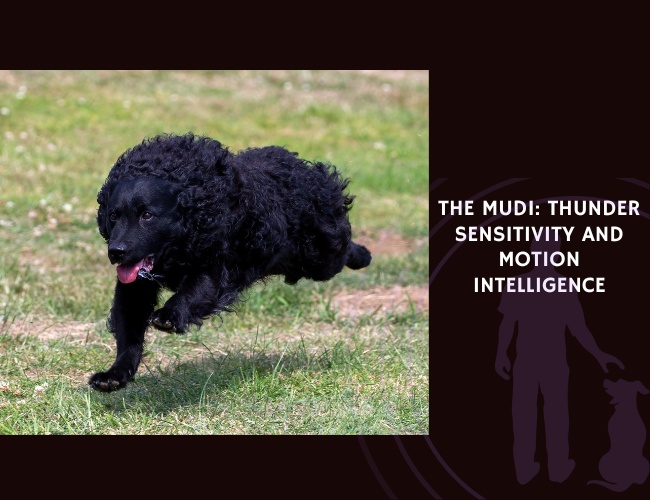
The Mudi is a breed that reads the world differently. Where other dogs might notice a sudden clap of thunder, your Mudi has already detected the barometric pressure drop twenty minutes earlier. While most breeds react to what they hear, the Mudi responds to what they predict. This is not a flaw in their character but rather a feature of their remarkable cognitive design—a mind built for constant scanning, rapid processing, and instantaneous interpretation of environmental shifts.
If you share your life with a Mudi who trembles before the first rumble of thunder or becomes anxious when the wind picks up, you’re witnessing something profound: a herding intelligence so finely tuned to environmental changes that modern storms can feel overwhelming. Let us guide you through the fascinating intersection of thunder sensitivity and motion intelligence in this extraordinary breed, exploring not just why they react, but how we can help them navigate their heightened awareness with confidence rather than fear.
Understanding the Mudi’s Motion-First Intelligence
The Mudi’s cognitive architecture is not shaped by accident. Centuries of selective breeding for fast, pressure-reading herding work created a dog whose brain prioritizes motion detection above nearly everything else. When your Mudi watches the world, they’re not simply observing—they’re constantly analyzing patterns of movement, detecting subtle shifts in their environment, and preparing for rapid response.
How did this remarkable intelligence develop? In the working fields of Hungary, Mudis needed to manage livestock with minimal human direction. They learned to read the slightest shift in a flock’s movement, anticipate where an animal might break away, and respond with split-second precision. This wasn’t just about seeing motion—it was about predicting it, understanding it, and acting upon it before the situation fully unfolded.
This “change detection” mechanism became the primary mode through which Mudis process their world. Research on attentional processes shows that both stimulus-driven and goal-driven mechanisms influence where attention flows, and for breeds like the Mudi, environmental changes carry extraordinary emotional salience. A subtle gust of wind that another dog might ignore becomes a significant data point for your Mudi—something to track, assess, and potentially act upon.
You might notice this motion-first intelligence in everyday situations:
- Your Mudi spots a leaf tumbling across the yard before you even register movement
- They orient toward a distant car turning onto your street while you’re still unaware of its presence
- Their head tilts at sounds you cannot hear, tracking frequencies beyond human perception
- They position themselves strategically before you understand why
- They notice the neighbor’s cat three houses down while you see nothing unusual
- They detect subtle changes in your body language that signal you’re about to stand up or leave
This is motion-first intelligence at work, a cognitive bias toward detecting change rather than static stimuli 🧠
The speed-oriented nature of their working style compounds this sensitivity. A breed developed for rapid response must process information quickly, and this accelerated processing makes them particularly susceptible to sudden transitions. Wind pattern shifts, barometric pressure drops, and sound waves that might register as background noise to other breeds become urgent signals demanding immediate attention from a Mudi’s finely-tuned sensory system.
Thunder Sensitivity: More Than Just Noise Phobia
When your Mudi begins pacing thirty minutes before you hear the first crack of thunder, they’re not overreacting—they’re forecasting. This distinction is crucial for understanding what many people mistakenly label as simple “noise phobia” in Mudis. What we’re actually witnessing is environmental forecasting anxiety, a sophisticated form of anticipatory stress driven by their ability to detect atmospheric changes long before storms become audible.
Research confirms that dogs can experience profound noise aversion, with loud sounds like thunder frequently triggering startle responses. But the Mudi’s reaction pattern tells a more complex story. They show anxiety before audible thunder occurs, suggesting that sound is only one component in a multi-sensory experience of storm detection.
What cues are they picking up? Multiple environmental signals work together:
- Barometric pressure changes: Drops of several millibars affect the Mudi’s inner ear and overall physiological state
- Shifts in air currents: Changes in wind direction, speed, or turbulence patterns
- Changes in humidity: The atmosphere feels different as moisture content increases
- Variations in static electricity: The electrical charge in the air intensifies before storms
- Electromagnetic field fluctuations: Subtle changes in the earth’s electromagnetic environment
- Light quality shifts: The characteristic dimming and color changes as storm clouds gather
- Temperature variations: Often a sudden drop as the storm front approaches
These pre-storm environmental cues act as predictive signals, triggering an anticipatory response.
Through the lens of predictive processing theory, we understand that your Mudi’s brain constantly generates predictions about incoming sensory information. These pre-storm environmental cues become associated through classical conditioning with the unpleasant sensations that follow: the loud crashes, the pressure waves, the chaotic sensory environment of a full thunderstorm. The Mudi’s brain essentially runs a prediction: “These subtle changes mean something loud and frightening is coming,” and the fear response triggers before the primary threat even arrives.
This is where the NeuroBond model offers valuable insight. When we recognize that sensitivity as a form of environmental prediction rather than irrational fear, we can begin building interventions that work with their intelligence rather than against it. Your Mudi isn’t being difficult—they’re being accurate in their environmental assessment, but they lack the context to know that storms, while intense, are ultimately safe 🧡
Did you know that the Incentive Sensitization Theory suggests that attentional bias can develop early in response to certain stimuli, and these cognitive mechanisms might be partially within conscious awareness? For your Mudi, this means they’ve learned to actively scan for storm-related cues, their attention automatically drawn to any environmental signal that matches their internal storm prediction model.
The Auditory Landscape: What Mudis Actually Hear
Your Mudi’s ears process sound in ways that differ dramatically from human perception. While we hear thunder as a series of loud crashes, your Mudi experiences a complex auditory event with multiple frequency components, many of which fall outside human hearing range.
Dogs possess auditory capabilities that extend into both higher and lower frequencies than humans can detect. The low-frequency rumbles of thunder—those deep, bone-rattling vibrations that you feel as much as hear—register with particular intensity for your Mudi. These low-frequency sounds, sometimes classified as infrasound when below 20 Hz, travel through the environment differently than higher-frequency sounds. They penetrate structures more effectively, creating an inescapable auditory experience even when your Mudi seeks shelter indoors.
The pressure waves accompanying these low-frequency sounds add another layer to the experience. Thunder doesn’t just make noise—it creates waves of compressed air that dogs can physically feel. For a breed as environmentally attuned as the Mudi, these pressure waves might be processed as tactile information in addition to auditory input, creating a multi-sensory assault that explains why simple ear protection often proves insufficient.
Research on canine auditory processing suggests that certain breeds show heightened sensitivity to specific frequency ranges, likely related to their breeding history and original functions. The Mudi’s herding background required acute hearing to detect livestock movement across distances, to hear the subtle sounds of hooves on different terrain types, and to distinguish between normal and concerning acoustic patterns in their working environment.
This refined auditory system, so valuable in the field, becomes a liability during thunderstorms. The acoustic chaos of a storm—multiple sound sources at varying frequencies, echoing and reverberating through the environment, punctuated by unpredictable crashes—overwhelms the Mudi’s ability to process and categorize what they’re hearing. Unlike the structured soundscape of a herding environment where sounds had meaning and context, storm sounds feel random, unpredictable, and impossible to interpret through their usual cognitive frameworks.
The Mudi’s struggle with storm sounds also reflects what researchers call “trigger stacking.” Each loud crack of thunder doesn’t exist in isolation but compounds with the pressure changes, the static electricity in the air, the visual chaos of wind and rain, and the ongoing low-frequency rumble that never quite stops. These triggers stack upon each other, reducing the latency of reaction and potentially pushing your Mudi into a state of sustained high arousal that can persist even after the storm passes 🌩️
Environmental Literacy and Urban Challenges
In a natural environment, your Mudi would possess remarkable environmental literacy—the ability to read wind direction, interpret terrain features, and use distance cues to contextualize atmospheric events. A storm approaching across open fields offers information: you can see the direction it’s moving, estimate its distance by the time between lightning and thunder, and feel the wind patterns that signal its intensity and trajectory.
Urban and suburban living fundamentally disrupts this environmental literacy. When your Mudi experiences a storm from inside a building, they lose access to the very cues that would help them understand and contextualize what’s happening. They hear the thunder amplified and distorted by building structures, feel the pressure changes without visual confirmation of their source, and experience wind as chaotic noise rather than directional information.
Modern environments compound these challenges with layers of additional stimuli:
- Emergency vehicle sirens: Wailing during storms as services respond to weather incidents
- HVAC systems: Creating pressure fluctuations and low-frequency hums that mimic or mask storm cues
- Building acoustics: Glass windows amplifying certain frequencies while dampening others
- Construction noise: Ongoing urban sounds that overlap with storm sounds
- Traffic patterns: Changing vehicle sounds during weather events
- Electronic devices: Humming, beeping, and buzzing that create additional auditory complexity
- Neighbor activity: Sounds from adjacent units that add to sensory overload
For a Mudi trying to use their natural environmental reading abilities, this urban storm experience provides contradictory and overwhelming information.
The buildings themselves channel and amplify wind in unpredictable ways. Urban wind patterns don’t follow natural terrain logic—they swirl around structures, accelerate through narrow passages between buildings, and create localized pressure zones that feel chaotic rather than directional. For a Mudi trying to use their natural environmental reading abilities, this urban storm experience provides contradictory and overwhelming information.
Perhaps most significantly, indoor confinement removes your Mudi’s natural coping strategies:
- Distance modulation: Cannot move to what feels like a safer distance from the storm
- Natural shelter seeking: Unable to find den-like spaces under trees or in terrain depressions
- Body orientation: Cannot position themselves to reduce exposure to wind and rain
- Escape routes: No access to alternative locations if one area feels too threatening
- Visual monitoring: Limited ability to track storm movement and assess duration
- Grounding contact: No access to earth contact that some dogs find calming
These behaviors, developed through evolutionary pressure, give dogs a sense of agency and control over their safety. Confined indoors during a storm, your Mudi cannot employ these strategies, creating feelings of helplessness that make each subsequent storm more difficult to manage 🏙️

Training Approaches That Honor Sensitivity
Working effectively with a thunder-sensitive Mudi requires approaches that respect their perception without reinforcing fear. You’re not trying to convince them that storms aren’t happening—they know better than you do when a storm is approaching. Instead, you’re helping them reframe their interpretation of what that storm means and providing them with coping strategies that work with their cognitive strengths.
Core Training Principles for Thunder-Sensitive Mudis:
- Predictive routines: Create consistent, positive patterns around weather changes
- Motion grounding: Use structured movement to channel their motion-first intelligence
- Spatial clarity: Provide clear, consistent safe zones where they can retreat
- Early intervention: Begin protocols before anxiety peaks, during the prediction phase
- Choice-based coping: Allow agency in movement and positioning rather than forced stillness
- Emotional neutrality: Model calm responses to environmental changes
- Validation without reinforcement: Acknowledge their perceptions while guiding emotional responses
Predictive routines form the foundation of this approach. Since your Mudi excels at prediction and pattern recognition, you can leverage this strength by creating predictable, positive routines around weather changes. This might look like a specific “storm protocol” that begins at the earliest signs of atmospheric change—before your Mudi’s anxiety peaks.
Your storm routine could include moving to a designated safe space, engaging in a calm but engaging activity like puzzle toys or scent work, or providing a high-value chew that requires focused attention. The key is consistency and early implementation. By initiating this routine when you notice the barometric pressure dropping or when weather apps predict storms, you begin the reconditioning process before your Mudi’s fear response fully activates.
Motion grounding offers another powerful tool for working with thunder-sensitive Mudis. Their motion-first intelligence means that purposeful, structured movement can help ground their awareness and provide a sense of control during unsettling environmental changes.
Effective Motion Grounding Activities:
- Pre-storm structured walks: Brief, focused walks before the storm arrives to discharge nervous energy
- Targeting exercises: Having your Mudi touch specific targets with nose or paw, requiring focus and precise movement
- Slow-paced retrieval games: Controlled fetch with calm delivery and release
- Obedience sequences: Practicing sit-down-stand transitions or heel work at a deliberate pace
- Platform work: Moving between elevated platforms or specific marked locations
- Scent work trails: Following scent patterns that require concentrated attention
- Balance exercises: Using wobble boards or balance pods for focused physical engagement
This might involve structured walks before a storm arrives, specific obedience exercises that require focus and physical engagement, or even indoor motion work like targeting exercises or slow-paced retrieval games.
Through the Invisible Leash approach, calm movement becomes a communication tool. When you move with deliberate, smooth pacing and maintain emotional neutrality despite the environmental chaos, you’re sending a clear message to your Mudi: “I’m not concerned. This situation requires calm navigation, not panic.” Your dog reads your body language, your energy, and your spatial confidence, and these cues can significantly influence their threat appraisal.
Spatial clarity becomes crucial during storms. Providing your Mudi with clear, consistent safe zones—spaces where they can retreat and feel secure—reduces the uncertainty that compounds fear. This might be a crate covered with a blanket to muffle sound, a quiet interior room away from windows, or a designated corner with familiar bedding and comfort items. The safety comes not just from the physical space but from the predictability: “This is where I go when storms come, and here I am safe.”
Research on cognitive bias tasks in animal welfare assessment suggests that we can measure emotional state and the effectiveness of our interventions by observing how dogs approach novel or ambiguous situations. A Mudi whose storm anxiety is being successfully managed should show more exploratory behavior, less generalized anxiety, and improved recovery time between storm episodes.
Choice-based coping strategies consistently outperform forced stillness for high-motion-intelligence breeds like the Mudi. Forcing an anxious Mudi to lie still and “calm down” works against their natural coping mechanisms and can increase feelings of helplessness. Instead, allowing them to move to their chosen safe spot, pace within a confined but adequate space, or engage in controlled motion tasks respects their cognitive architecture and empowers them to participate actively in their own emotional regulation 🐾
Advanced Preparation and Early Intervention
The most effective management of thunder sensitivity happens long before the first thunderclap. Early intervention—both in terms of starting young and catching each storm event early—dramatically improves outcomes for sensitive Mudis.
If you’re raising a Mudi puppy, proactive storm preparation should begin before they’ve ever experienced thunder anxiety. This involves controlled exposure to storm-related sounds at low volumes during positive experiences, teaching them that their safe zone is a wonderful place to be (not just during storms), and building their overall confidence in navigating environmental changes.
For adult Mudis already showing thunder sensitivity, early cue recognition becomes your primary tool. Learn to recognize the signs that your Mudi has detected an approaching storm: increased scanning behavior, restlessness, seeking proximity to you, or subtle changes in body posture and ear position. Many dogs show these signs thirty minutes or more before humans would notice any storm-related cues.
When you spot these early indicators, initiate your storm routine immediately. This might mean:
- Moving calmly to your designated safe space and making it inviting with treats, toys, or special items only available during storms
- Beginning a structured activity that requires focused attention, such as scent work or slow-feeding puzzle toys
- Implementing calming protocols like gentle massage, slow-paced breathing exercises, or playing calm classical music designed for canine anxiety reduction
- Engaging in joint observation rituals where you calmly acknowledge the environmental changes together, modeling neutrality and confidence
Joint observation rituals deserve special attention for breeds with high environmental awareness like the Mudi. This involves sitting or standing with your dog in a position where you can both observe the environmental changes—watching the wind in the trees, seeing the clouds gather, noticing the light change—while you maintain calm, neutral body language and occasionally offer reassuring touches or calm verbal observations.
This approach works because it validates your Mudi’s perception (they’re right that environmental changes are occurring) while simultaneously modeling that these changes don’t require a fear response. You’re essentially saying, “Yes, I see what you’re noticing, and I’m completely unconcerned about it.” This social referencing—looking to a trusted companion to determine appropriate responses to novel or ambiguous situations—is powerful for dogs and can gradually reshape their emotional associations with pre-storm cues.
The concept of emotional grounding before storms, rather than during peak fear, reflects deep understanding of how learning and reconditioning work. When your Mudi is already in a state of high arousal or fear, their capacity for new learning is dramatically reduced. The amygdala has essentially hijacked their cognitive processing, making rational learning nearly impossible. But when you work during the early predictive phase—when they’re concerned but not yet panicked—you’re operating in a window where new associations can form and alternative response patterns can be practiced.
Consider weather-tracking technology as your ally in this process. Weather apps that provide hour-by-hour forecasts, barometric pressure readings, and storm alerts can help you stay ahead of your Mudi’s predictions. When you can initiate your calm routine before your dog even detects the approaching storm, you’re demonstrating leadership and creating an opportunity to shape their emotional response from the very beginning of the predictive loop 🌤️
Your Step-by-Step Storm Protocol
Having a consistent, practiced protocol transforms chaotic storm events into manageable routines. This timeline-based approach helps you intervene at the optimal moment when your Mudi is still capable of learning and responding rather than being overwhelmed by fear.
30 Minutes Before Storm Arrival (Early Detection Phase)
When you notice weather alerts or your Mudi shows early scanning behaviors, this is your critical intervention window. Your dog has detected atmospheric changes but hasn’t yet escalated to full anxiety.
Essential Storm Supplies to Have Ready:
- High-value treats your dog only receives during storms (special jerky, freeze-dried liver, cheese)
- Long-lasting chews (bully sticks, frozen Kongs, pig ears)
- Puzzle toys and slow-feeder bowls
- Favorite blankets or bedding with familiar scents
- Water bowl and fresh water
- Calming music playlist or white noise machine ready to play
- Any prescribed anti-anxiety medication if applicable
- Comfort items your dog gravitates toward naturally
Begin by calmly gathering your storm supplies without rushing or showing concern. Move to your designated safe zone and make it inviting—turn on white noise or calming music, place high-value treats or puzzle toys in the space, and ensure water is available. Your energy during this preparation matters tremendously. Deliberate, smooth movements communicate that you’re preparing for a known event, not panicking about an emergency.
Initiate a brief structured activity that engages your Mudi’s mind without elevating arousal:
- Scent work: Hide treats around the safe zone for your dog to find
- Calm settle practice: Rewarding relaxed down-stays with gentle reinforcement
- Slow feeding puzzles: Snuffle mats or puzzle feeders that require methodical searching
- Gentle massage: Starting at the ears and working down the neck and shoulders
- Simple targeting: Having your dog touch your hand or a target stick for treats
- Pattern games: Predictable sequences of easy behaviors your dog knows well
The goal is to establish a positive emotional state before the storm intensifies.
15 Minutes Before Storm Arrival (Transition Phase)
As environmental cues strengthen, guide your Mudi to their safe zone if they haven’t already chosen to go there. Use calm spatial leadership—walk confidently to the space, sit or position yourself comfortably, and allow your dog to settle near you. Avoid excessive verbal reassurance, which often communicates anxiety rather than calm.
Provide a long-lasting chew or food puzzle that requires sustained focus:
- Frozen Kong toys: Stuffed with peanut butter, yogurt, or wet food and frozen solid
- Lick mats: Spread with pumpkin, cream cheese, or dog-safe spreads
- Bully sticks or pizzles: Long-lasting natural chews requiring extended gnawing
- Puzzle feeders: Interactive toys that dispense kibble or treats slowly
- Marrow bones: Frozen bones with marrow intact for extended chewing
- Antlers or nylon bones: Durable chews for persistent chewers
- Frozen fruit treats: Dog-safe fruits like banana or apple pieces frozen in broth
These work well because they engage the dog’s attention while providing oral satisfaction that has calming effects. The act of licking and chewing activates parasympathetic nervous system responses that counter stress physiology.
If your Mudi shows increased restlessness, allow controlled movement within the safe zone rather than insisting on stillness. Some dogs benefit from pacing in a confined area—this honors their motion intelligence while preventing full-blown panic behaviors. You might practice slow, deliberate obedience commands that channel their need for movement into predictable patterns.
During the Storm (Active Management Phase)
Maintain your own emotional neutrality throughout the storm. Your Mudi is monitoring you constantly for threat assessment cues. If you remain calm, engaged in quiet activities like reading or working on a laptop, you communicate that the situation doesn’t warrant fear responses.
Continue providing intermittent reinforcement for calm behaviors. When your dog settles, even briefly, mark this with a quiet “yes” and offer a treat. You’re not rewarding fear—you’re reinforcing any moment of calm that emerges during the storm experience.
If your Mudi seeks physical contact, provide it calmly. There’s no evidence that comforting a fearful dog reinforces fear, despite persistent myths to the contrary. However, avoid hovering or excessive handling, which can increase arousal. Let your dog determine the level of contact they need while you maintain a calm, stable presence.
For dogs showing moderate to severe distress, this might be when you implement additional tools: a pressure wrap if your dog tolerates it, calming supplements if previously administered, or prescription anti-anxiety medication if you’re working with a veterinary behaviorist. These interventions work best when combined with behavioral protocols rather than used in isolation.
After the Storm (Recovery and Reinforcement Phase)
Don’t immediately dismantle your storm setup when the thunder stops. Your Mudi may still be processing the experience, and abrupt changes can be jarring. Allow a gradual transition back to normal routine over 15-30 minutes.
Engage in a positive activity your dog enjoys—a brief play session with a favorite toy, some gentle massage, or a short walk if the weather permits. This helps reset their emotional state and ends the storm experience on a positive note rather than leaving them with residual anxiety.
Note your observations for future reference—these details help you refine your protocol:
- Detection timing: How many minutes before audible thunder did anxiety begin?
- Peak intensity: What was the highest level of distress on a scale of 1-10?
- Intervention effectiveness: Which calming strategies worked best this time?
- Recovery duration: How long after the storm ended did your dog return to baseline?
- Food acceptance: Were they able to take treats? At what point did they refuse?
- Location preferences: Where did your dog choose to position themselves?
- Physical symptoms: Any panting, drooling, trembling, or other stress indicators?
- Sleep impact: Did the storm disrupt sleep patterns that night?
This data helps you refine your protocol for subsequent storms and provides valuable information if you’re working with a professional

Creating an Effective Safe Zone
Your safe zone serves as both physical shelter and emotional anchor during storms. The quality of this space significantly impacts your Mudi’s ability to manage their anxiety, making thoughtful setup essential.
Location Selection
Choose an interior room away from windows where exterior noise penetrates least:
Optimal Safe Zone Locations:
- Interior bathrooms: Naturally sound-buffered with limited windows
- Walk-in closets: Den-like spaces with minimal exterior noise
- Interior hallways: Away from exterior walls and windows
- Basement rooms: Best natural sound buffering if your dog tolerates being below ground
- Under stairways: Naturally enclosed spaces that feel protective
- Interior bedrooms: Away from street-facing walls, preferably with minimal windows
- Laundry rooms: If interior and away from exterior noise sources
The space should be large enough for your Mudi to move around comfortably but confined enough to feel den-like and secure.
Avoid locations near exterior walls where your dog might feel the vibrations of thunder more intensely. If your home has a basement, this often provides the best natural sound buffering, though some dogs prefer to be on the main floor near their humans rather than isolated below ground.
Test your chosen location during calm weather. Spend positive time there with your dog—feeding meals, offering special treats, practicing relaxation exercises. The space should have strong positive associations before you ever need it during an actual storm.
Sound Management
Sound dampening makes the single biggest difference in safe zone effectiveness:
Effective Sound-Dampening Materials:
- Heavy moving blankets: Draped over crates or hung on walls to absorb sound waves
- Acoustic foam panels: Professional sound absorption, available in various sizes
- Thick quilts or comforters: Multiple layers create better sound barriers
- Egg crate foam: Budget-friendly alternative to acoustic panels
- Weather stripping: Seals gaps around doors to reduce sound penetration
- Carpet or rugs: Layered on floors to absorb vibrations and sound
- Curtains or drapes: Heavy fabric hung over any windows in the safe zone
- Furniture placement: Strategic positioning of bookcases or cabinets against exterior walls
Heavy blankets or moving blankets draped over a crate or hung on walls absorb sound waves and reduce acoustic chaos. Acoustic foam panels designed for recording studios can be strategically placed if you’re creating a permanent storm space.
White noise machines or fans create consistent background sound that masks the unpredictable crashes of thunder. Position the white noise source between your dog and the direction from which storm sounds typically arrive. The constant, predictable sound gives your Mudi’s auditory system something neutral to focus on rather than hypervigilantly scanning for the next boom.
Music therapy specifically designed for canine anxiety uses frequencies and rhythms that promote calm states. Through a Dog’s Ear and similar products have been researched for anxiety reduction. Play this music at moderate volume—loud enough to provide masking but not so loud that it becomes another stressor. Start playing calming music before the storm rather than only during peak anxiety.
Physical Comfort Elements
Provide bedding that your Mudi finds comforting—this might be their regular bed, blankets that smell like you, or materials they’ve chosen themselves. Some dogs prefer elevated beds that keep them off the floor, while others want to burrow into soft materials. Honor your dog’s preferences rather than imposing what you think should be comfortable.
A covered crate often provides the den-like security many dogs instinctively seek during storms. Cover three sides and the top with heavy blankets, leaving the entrance open so your dog never feels trapped. Some dogs prefer a partially covered crate where they can still see out and monitor their environment—another reason to let individual preference guide setup.
Ensure adequate ventilation, especially if using heavy coverings. Your dog will already be experiencing stress-related changes in body temperature and respiration, so preventing the space from becoming stuffy matters for their physical comfort and ability to calm.
Common Mistakes to Avoid:
- Storm-only associations: Creating the safe zone exclusively during storms, building associations only with fear rather than positive experiences
- Forcing entry: Physically pushing or dragging a resistant dog into the space, creating negative associations
- Inaccessible locations: Placing the safe zone where you can’t easily sit with your dog during extended storm events
- Punishment associations: Ever using the safe zone for timeouts or corrections, contaminating the positive association
- Poor ventilation: Over-covering the space without ensuring adequate airflow, making it uncomfortable
- No practice runs: Waiting until an actual storm to introduce the safe zone concept
- Inconsistent location: Moving the safe zone frequently, preventing your dog from developing location-based security
- Ignoring preferences: Imposing your idea of comfort without observing what your dog actually chooses
Don’t create the safe zone only during storms. Your dog needs positive associations with this space built over time, not just desperate associations with fear and chaos 🏠
Alert. Predictive. Overloaded.
Forecasting Minds
Mudis respond to environmental change before it becomes visible or audible. Their intelligence is wired for prediction, not reaction.
Motion First Processing
Bred to manage movement independently, their nervous system prioritises shift detection over stillness. This makes storms feel imminent long before thunder arrives.



Sensitivity Needs Structure
What appears as fear is often anticipatory overload rather than noise aversion. With grounding and clear emotional reference points, their awareness transforms into calm precision.
Technology and Tools for Storm Management
Modern technology offers valuable support for managing thunder-sensitive Mudis, from prediction tools that help you intervene early to therapeutic aids that reduce anxiety during storms.
Weather Tracking Applications:
- WeatherBug: Hour-by-hour forecasts with barometric pressure readings and customizable storm alerts
- Weather Underground: Hyper-local forecasting using crowd-sourced weather station data and pressure tracking
- Dark Sky/Apple Weather: Minute-by-minute precipitation predictions for precise intervention timing
- Spark: Real-time lightning strike tracking with distance indicators and storm cell movement
- Barometer apps: Dedicated pressure tracking designed for migraine sufferers, perfect for storm prediction
- Storm Radar: Visual storm cell tracking showing direction, intensity, and estimated arrival times
- AccuWeather: MinuteCast feature providing minute-by-minute predictions for your exact location
These provide detailed hour-by-hour forecasts including barometric pressure readings—crucial information for anticipating your Mudi’s detection of approaching storms. Set alerts for pressure drops of 0.1 inches of mercury or more, as these changes often precede your dog’s behavioral changes.
Sound Therapy Resources:
- Through a Dog’s Ear: Clinically researched music with simplified arrangements and 50-60 BPM tempos
- iCalmPet: Specialized noise phobia therapy combining music with psychoacoustic techniques
- RelaxMyDog: YouTube channel with hours of research-backed calming frequencies
- Pet Acoustics: Species-specific sound modifications designed for canine hearing ranges
- White noise machines: Consistent masking sounds without musical variations that might startle
- Fan noise: Simple, free option creating steady background sound
- Nature sounds: Gentle rain, ocean waves, or forest sounds at consistent volumes
- Pink noise: Lower frequency than white noise, often more effective for masking thunder
Calming music specifically engineered for canine anxiety uses simplified arrangements, consistent tempos around 50-60 beats per minute, and frequency ranges that promote relaxation.
White noise generators or apps provide consistent masking sounds without the potential drawbacks of music that might contain unexpected changes in volume or tone. Apps like myNoise allow you to customize white noise profiles and adjust frequency ranges to most effectively mask the specific thunder sounds challenging your dog.
Some dogs respond well to binaural beat therapy, though research on this for canine anxiety remains limited. If you experiment with this approach, use frequencies in the delta range (1-4 Hz) associated with deep relaxation and sleep states.
Monitoring Tools:
- FitBark: Tracks sleep quality, activity levels, and behavioral pattern changes over time
- Whistle: GPS tracking plus health monitoring including rest and activity metrics
- PetPace: Medical-grade monitoring including heart rate, respiration, and activity
- Furbo: Video monitoring with treat-dispensing and bark alerts
- Wyze Cam: Budget-friendly video monitoring with time-stamped footage
- Petcube: Interactive video with two-way audio and laser play features
- Heart rate monitors: Specialized canine monitors for objective arousal data during storms
- Sleep tracking apps: Smartphone-based monitoring of sleep disruptions correlating with storms
By monitoring your Mudi’s patterns, you can objectively assess whether your storm management protocols are reducing overall stress—look for improved sleep quality after storms and decreased restlessness during events.
Physical Intervention Tools:
- Thundershirt: Original pressure wrap design, works for approximately 40% of anxious dogs
- Anxiety Wrap: Alternative pressure garment with adjustable tension points
- DIY ace bandage wrap: Budget option using elastic bandages in specific patterns
- Calming caps: Reduce visual stimulation for dogs with visual storm triggers
- Cooling vests: Help regulate temperature during stress-related overheating
- Calming supplements: L-theanine, alpha-casozepine, chamomile, or valerian root formulations
- CBD products: Emerging option, though research is still limited; consult your vet
- Adaptil diffusers: Dog-appeasing pheromone products for ambient calming
Thundershirts and similar pressure wraps work for approximately 40% of anxious dogs by providing consistent, gentle pressure that appears to have calming effects. The garment must fit properly—snug but not restrictive—and should be introduced during calm periods so your dog doesn’t associate it exclusively with storms.
When to Consider Medication:
For severe thunder phobia that doesn’t respond adequately to behavioral interventions alone, prescription anti-anxiety medications may be appropriate:
- Trazodone: Fast-acting, given 1-2 hours before predicted storms, mild sedative effects
- Gabapentin: Reduces anxiety and can be combined with other medications
- Alprazolam (Xanax): Short-acting benzodiazepine for acute anxiety episodes
- Clonidine: Reduces arousal without heavy sedation, good for anticipatory anxiety
- Fluoxetine (Prozac): Long-acting SSRI for chronic use during storm seasons
- Clomipramine: Tricyclic antidepressant specifically approved for separation anxiety, often helps with phobias
- Sileo: FDA-approved gel for noise aversion in dogs, absorbed through gums
- Acepromazine: Older sedative, less recommended as it may increase noise sensitivity
Medication should never replace behavioral protocols but rather support them by reducing anxiety to levels where learning becomes possible 💊
🌩️ The Mudi Thunder Protocol 🧠
Understanding Environmental Forecasting Anxiety in Motion-First Intelligence Breeds
Phase 1: Early Detection Window
30-60 Minutes Before Storm
What Your Mudi Detects
Your Mudi’s brain processes barometric pressure drops, electromagnetic field changes, and atmospheric shifts long before thunder becomes audible. This isn’t overreacting—it’s accurate environmental forecasting through their motion-first intelligence system.
Behavioral Signs to Watch
• Increased environmental scanning with rapid head movements
• Proximity-seeking and shadow behavior
• Restless pacing between monitoring locations
• Frequent checking-in looks seeking your assessment
Your Action Steps
Begin your storm protocol immediately—this is your critical intervention window. Calmly gather supplies, activate white noise, and guide your Mudi to their safe zone with smooth, deliberate movements that communicate “I’ve got this.”
Phase 2: Structured Preparation
20-30 Minutes Pre-Storm
Motion Grounding Techniques
Channel their motion-first intelligence through purposeful activity. Brief scent work, targeting exercises, or slow-paced obedience sequences help ground their awareness. Movement isn’t the problem—unstructured movement is.
The NeuroBond Approach
Through the NeuroBond framework, you’re creating emotional grounding before fear peaks. Your calm presence during atmospheric changes teaches your Mudi that environmental prediction doesn’t require panic—you’re the interpreter of threat level.
Safe Zone Essentials Ready
High-value treats (special storm-only rewards), frozen Kongs, white noise machine activated, sound-dampening blankets positioned, and familiar bedding with your scent. Your energy matters more than the setup—move with purpose, not panic.
Phase 3: Atmospheric Intensification
10-15 Minutes Pre-Thunder
Physiological Changes Occurring
Your Mudi’s HPA axis activates, releasing cortisol and adrenaline. Heart rate increases, pupils dilate, hearing intensifies. Understanding this cascade helps you recognize when intervention shifts from prevention to management mode.
Invisible Leash Principles
Implement calm spatial leadership—guide your Mudi to the safe zone with smooth pacing, minimal verbal noise, and confident navigation. Your body language communicates safety more effectively than words. The Invisible Leash stabilizes arousal through presence, not pressure.
Long-Lasting Focus Tools
Provide frozen Kongs, lick mats, or bully sticks. The act of licking and chewing activates parasympathetic responses that counter the stress cascade. Allow controlled movement within the safe zone—don’t insist on forced stillness.
Phase 4: Active Storm Management
During Peak Thunder Activity
What Your Mudi Experiences
Multi-sensory assault: low-frequency rumbles penetrating structures, pressure waves as tactile information, auditory hyperacuity making thunder overwhelming, and trigger stacking as each element compounds. This isn’t simple noise phobia—it’s environmental forecasting anxiety realized.
Emotional Neutrality Protocol
Maintain your calm throughout. Engage in quiet activities—reading, working on laptop—showing the situation doesn’t warrant fear. Provide intermittent reinforcement for any calm moments. Comforting a fearful dog doesn’t reinforce fear; abandoning them to cope alone does damage.
Critical Don’ts
Don’t force stillness on a motion-intelligent breed. Don’t hover or check anxiously—this confirms threat. Don’t isolate your dog “to avoid reinforcing fear.” Your calm presence is the intervention, not the problem.
Phase 5: Recovery & Reinforcement
15-60 Minutes Post-Storm
Cortisol Half-Life Reality
Cortisol has a 60-90 minute half-life in dogs. Your Mudi’s body remains in heightened stress state for hours after thunder stops. Don’t immediately dismantle your setup—allow gradual transition back to normal routine.
Positive Reset Activities
Engage in enjoyable activities your dog loves—brief play with favorite toys, gentle massage, or short walk if weather permits. End the storm experience on a positive note rather than leaving residual anxiety. This reconditioning matters.
Documentation for Progress
Note detection timing, peak intensity (1-10), intervention effectiveness, recovery duration, and food acceptance patterns. This data refines your protocol and provides crucial information if working with a veterinary behaviorist.
Phase 6: Building Long-Term Resilience
Between Storms & Ongoing
Safe Zone Positive Associations
Feed meals there during calm weather. Provide special chews. Practice relaxation exercises. Your dog needs dozens of positive safe zone experiences unconnected to fear—building associations with comfort, not just desperate shelter.
Soul Recall Development
Through consistent, patient work during low-arousal moments, you’re creating Soul Recall patterns—moments where your Mudi chooses to trust your calm assessment over their own anxiety. These emotional memories become the foundation for reconditioning the predictive loop.
Realistic Timeline Expectations
Behavioral modification: 4-6 weeks initial improvement, 6-12 months continued progress. Combined with medication: 2-3 weeks. Desensitization protocols: 12-18 months. Progress isn’t linear—celebrate small victories and track aggregate improvement.
Phase 7: When to Seek Expert Help
Recognizing Severe Cases
Red Flag Indicators
• Panic with frantic escape attempts or destructive behaviors
• Complete inability to settle despite consistent intervention
• Self-injurious behaviors or involuntary elimination
• Recovery periods lasting days, not hours
• Generalization to non-storm sounds
Medication as Support Tool
For severe cases, prescription anti-anxiety medications (trazodone, gabapentin, fluoxetine) create neurological space for behavioral interventions to work. A dog in full panic cannot learn—medication supports protocols, doesn’t replace them. Consult veterinary behaviorists (DACVB) for expertise.
Progress Plateau Considerations
After 6-12 months of consistent, professional-guided intervention with minimal progress, some dogs reach their functional maximum. Success means quality of life and manageable stress—not achieving theoretical perfect calm that may not align with their neurological reality.
Phase 8: Lifespan Considerations
Age-Appropriate Protocols
Puppies (3-16 Weeks) – Prevention Focus
Critical socialization window for storm desensitization. Play storm sounds at low volumes during meals and play. Build positive safe zone associations before first real storm. Expose to varied weather conditions in positive contexts. Neuroplasticity is maximal—invest now for lifetime benefits.
Adolescents (4-18 Months) – Critical Intervention
Sensitivity often emerges or intensifies during adolescent brain development. Implement protocols immediately—don’t wait to “see if they outgrow it.” Anxiety patterns established now often persist. However, adolescent neuroplasticity makes interventions highly effective if consistent.
Seniors (8+ Years) – Comfort Priority
Cognitive decline may worsen sensitivity. Hearing loss paradoxically intensifies reactions to physical storm sensations without auditory context. Ensure safe zones are accessible (avoid stairs), provide orthopedic bedding, manage pain (worsens anxiety). Focus on comfort over new training—routine consistency matters most.
🐕 Breed Sensitivity Comparison: Understanding the Mudi Difference
Mudis
Anticipatory anxiety 20-40 min pre-storm. Pressure-change sensitive with flight/freeze responses. Highly attuned to atmospheric shifts—motion-first intelligence makes them environmental forecasters, not just reactors.
Border Collies
Similar pre-storm anxiety but displays through fixation behaviors and environmental control attempts. Less flight-oriented, more “I must manage this situation” response pattern.
Australian Shepherds
Primary auditory sensitivity with intense startle responses to crashes. Less anticipatory than Mudis—more reactive than predictive. Show moderate sensitivity overall.
German Shepherds
Lower sensitivity rates overall. Confidence-oriented working style with more environmental engagement than avoidance. Less subtle environmental reading than Mudis.
Shetland Sheepdogs
High noise sensitivity but different pattern—more general sound phobia than pressure-change detection. Reactive to multiple sound types, not storm-specific forecasting.
Pembroke Welsh Corgis
Moderate sensitivity with less anticipatory pattern. More reactive to actual storm sounds than atmospheric changes. Generally more confident overall than motion-reading herders.
⚡ Quick Reference Formula
Early Detection Window = Critical Intervention Zone
If barometric pressure drops ≥0.1 in Hg → Activate protocol immediately
If your Mudi shows scanning + proximity-seeking → You have 20-30 min before peak anxiety
Cortisol Half-Life = 60-90 minutes → Recovery takes 2-3 hours minimum post-storm
Success Timeline: Behavioral alone = 4-6 weeks initial, 6-12 months progress | With medication = 2-3 weeks visible improvement
Golden Rule: Intervention before peak arousal = 5x more effective than during panic
🧡 The Zoeta Dogsoul Truth About Thunder Sensitivity
Your thunder-sensitive Mudi isn’t broken or defective—they’re precisely designed for environmental awareness and rapid response. Through the NeuroBond approach, we recognize that their sensitivity is intelligence, their prediction is accuracy, and their anxiety is simply a nervous system lacking the context to know that storms, while intense, are ultimately safe.
The Invisible Leash teaches us that calm movement stabilizes arousal during environmental shifts. Your deliberate, smooth pacing and emotional neutrality become the anchor point—communicating through presence, not pressure, that you’ve assessed this environment and deemed it manageable. This is leadership through embodied calm.
Those Soul Recall moments—when your Mudi looks to you during environmental uncertainty and chooses to trust your calm assessment over their own anxiety—these are the foundations of reconditioning. You’re not suppressing their intelligence; you’re becoming fluent in their language of motion and prediction, providing the framework that allows their remarkable awareness to function without overwhelming their emotional regulation.
© Zoeta Dogsoul – Where neuroscience meets soul in dog training
Recognizing Early Warning Signs
Your ability to detect your Mudi’s earliest behavioral changes determines your success with proactive intervention. Storm-sensitive dogs often show subtle signals 30-60 minutes before humans notice any weather changes, making careful observation essential.
Scanning and Vigilance Behaviors:
- Frequent head movements: Rapid scanning of the environment in multiple directions
- Ear swiveling: Ears constantly tracking sounds from different sources
- Window/door checking: Repeatedly moving to exterior access points to monitor outside
- Elevated alert posture: Body held rigid, weight distributed for quick movement
- Staring behaviors: Fixed gazes at ceiling, walls, or windows tracking sounds
- Pacing patterns: Systematic movement between monitoring locations
- Nose working overtime: Increased sniffing as they gather atmospheric data
- Checking in with you: Repeatedly looking to you for threat assessment information
Increased environmental scanning appears as these behaviors, signaling your Mudi is gathering data about atmospheric conditions. This investigative behavior precedes overt anxiety.
Distinguishing between normal monitoring and anxious scanning requires attention to intensity and focus. Normal vigilance appears relaxed—your dog checks the environment, processes the information, and returns to other activities. Anxious scanning appears compulsive and driven—your dog cannot disengage from monitoring even when called or offered preferred activities.
Watch for “checking in” behaviors where your Mudi repeatedly looks to you for information about how to interpret what they’re sensing. This social referencing indicates they’ve noticed concerning changes and are seeking guidance. This is your optimal intervention moment—before they’ve made their own threat assessment.
Physical Indicators:
- Weight shift forward: Leaning onto front legs creating ready-to-move stance
- Tail position changes: Lower carriage or slight tucking compared to relaxed state
- Ear position: Swiveling backward or flattening against the head
- Mouth tension: Tightly closed mouth with visible jaw muscle tension
- Frequent lip licking: Stress signal unrelated to food or water
- Whale eye: Whites of eyes visible as they track without moving their head
- Paw lifting: Raising one paw repeatedly, a sign of uncertainty
- Trembling: Subtle shaking that may not be immediately obvious
- Piloerection: Hair standing up along the spine or shoulders
- Increased respiration: Faster breathing rate before panting begins
Subtle changes in body posture often appear before overt anxiety behaviors, providing your earliest intervention window.
Behavioral Changes:
- Proximity-seeking: Staying unusually close, following room to room, body contact seeking
- Shadow behavior: Remaining within a few feet of you at all times
- Difficulty settling: Frequently changing positions, unable to maintain relaxation
- Repeated lying down and getting up: Restless cycle without apparent cause
- Purposeful pacing: Systematic movement patterns different from random wandering
- Slow response to cues: Needing multiple repetitions of normally immediate commands
- Loss of focus: Appearing “distant” even while physically present
- Toy/activity disinterest: Abandoning normally engaging activities
- Seeking hiding spots: Moving toward dark, enclosed spaces
- Vocalization changes: Increased whining, whimpering, or unusual vocalizations
These behaviors signal cognitive resources being diverted to environmental monitoring, representing the cognitive load of processing concerning environmental data.
Displacement Behaviors:
Watch for displacement activities—normal behaviors appearing in contexts where they don’t fit:
- Sudden grooming: Licking paws or body when not dirty
- Scratching: When clearly not itchy, often briefly and repeatedly
- Yawning: Repeated yawning while clearly not tired
- Sniffing ground: Excessive floor sniffing with no apparent target
- Shaking off: As if wet, but completely dry
- Stretching: Repeated play bows or stretches without play invitation
- Increased water seeking: Visiting water bowl without drinking much
- Food seeking: Interest in food without actual consumption
- Object carrying: Picking up toys or items without playing with them
These behaviors serve as coping mechanisms, helping the dog self-soothe during increasing anxiety.
Distinguishing True Anxiety from Normal Awareness
Not every instance of environmental monitoring requires intervention. Mudis are naturally vigilant dogs who notice environmental changes as part of their cognitive wiring. The key distinction lies in whether your dog processes the information and returns to normal behavior or becomes stuck in a monitoring loop that escalates toward anxiety.
A Mudi who notices changing weather, investigates briefly, and then settles back into relaxation or play shows healthy environmental awareness. A Mudi who remains fixated on environmental cues, cannot be redirected, and shows escalating physical tension signals the transition from awareness to anxiety requiring your support 👁️

Breed Comparisons and Realistic Expectations
Understanding how Mudi thunder sensitivity compares to other herding breeds helps you gauge whether your dog’s reactions fall within typical ranges or signal need for more intensive intervention.
Mudi Versus Other Herding Breeds:
- Mudis: Anticipatory anxiety 20-40 minutes pre-storm, pressure-change sensitive, flight/freeze responses, highly attuned to atmospheric shifts
- Border Collies: Intense environmental awareness, fixation behaviors during storms, attempts to control environment, pre-storm anxiety similar to Mudis
- Australian Shepherds: Primary auditory sensitivity, startle responses to crashes, less anticipatory than Mudis, more reactive than predictive
- German Shepherds: Lower thunder sensitivity rates, confidence-oriented working style, more environmental engagement than avoidance
- Belgian Malinois: Similar to GSDs, lower sensitivity rates, environmental confidence, less subtle environmental reading
- Shetland Sheepdogs: High noise sensitivity but different pattern, more general sound phobia than pressure-change detection
- Pembroke Welsh Corgis: Moderate sensitivity, less anticipatory, more reactive to actual storm sounds than atmospheric changes
The key difference lies in cognitive bias: Mudis are bred to prioritize environmental change detection above nearly all other stimuli, making their thunder sensitivity often more anticipatory and sometimes more difficult to manage than other herding breeds.
What’s Typical Versus Concerning:
Typical Mudi Storm Response (Manageable):
- Notices environmental changes 20-40 minutes before storms
- Shows moderate restlessness or proximity-seeking
- Responsive to calming protocols and interventions
- Accepts some treats during storms, even if appetite is reduced
- Recovers to baseline within 1 hour after storm passes
- Can settle in safe zone with human support
- Physical tension present but not extreme
- Maintains some ability to focus on activities
Concerning Responses (Professional Help Needed):
- Panic behaviors like frantic escape attempts
- Destructive behaviors directed at doors, windows, or confinement areas
- Complete inability to settle despite consistent intervention
- Refusal of all food including highest-value treats
- Recovery periods lasting several hours or days after storms
- Self-injurious behaviors (scratching until bleeding, breaking teeth/nails)
- Involuntary elimination despite being house-trained
- Generalization to other sounds beyond storm-related triggers
- Escalating intensity with each storm experience
- Physical symptoms like vomiting or diarrhea during storms
A typical response is manageable with consistent protocols and doesn’t typically require medication. Concerning responses warrant consultation with a veterinary behaviorist.
If your Mudi’s thunder sensitivity is generalizing to other sounds—reacting fearfully to fireworks, construction noise, or even unrelated loud sounds when no storm patterns are present—this suggests the anxiety is spreading beyond storm-specific triggers and requires professional intervention before it becomes a more pervasive noise phobia.
Why These Comparisons Matter
Understanding breed tendencies helps you maintain realistic expectations about outcomes. A Mudi owner comparing their dog to a breed with naturally lower environmental sensitivity might feel their protocols are failing when actually they’re managing a more challenging baseline appropriately.
These comparisons also help you assess whether to seek professional help. If your Mudi’s reactions significantly exceed what’s typical even for this sensitive breed, early consultation with a behavioral specialist can prevent escalation and improve long-term outcomes 🐕
Age-Related Considerations Across the Lifespan
Thunder sensitivity in Mudis changes across developmental stages, requiring age-appropriate approaches at each life phase.
Puppy Prevention Strategies (3-16 Weeks):
The critical socialization period offers your best opportunity to prevent storm sensitivity from developing. During this window, implement these prevention strategies:
- Sound desensitization: Play storm audio at very low volumes during meals, play, and positive experiences
- Safe zone conditioning: Feed meals in the safe zone, provide special toys there, create dozens of positive associations
- Environmental confidence building: Walks during light rain, play during wind, outdoor time during pressure changes
- Varied weather exposure: Experience different weather conditions in positive contexts
- Calm modeling: Show relaxed behavior yourself during weather changes
- Gradual volume increases: Slowly increase storm sound volumes over weeks, never rushing
- Positive storm associations: Special treats only given during storm sound exposure
- Early cue recognition training: Reward calm behavior when weather changes occur naturally
- Multiple location comfort: Practice settling in various locations throughout the home
- Social learning: Allow puppy to observe confident adult dogs during weather events
However, Mudi puppies already possess their breed’s characteristic environmental sensitivity, making careful, controlled exposure essential rather than overwhelming them.
Juvenile and Adolescent Periods (4-18 Months):
Storm sensitivity often emerges or intensifies during adolescence even in dogs who showed no concern as young puppies. This reflects brain development in areas processing fear and arousal regulation.
Adolescent Management Strategies:
- Immediate protocol implementation: Address emerging sensitivity right away, don’t wait to “see if they outgrow it”
- Consistency despite testing: Maintain routines even when your adolescent challenges them
- Increased positive reinforcement: Generous rewards for calm behavior during weather changes
- Mental enrichment: Provide outlets for their developing cognitive abilities
- Physical exercise: Adequate activity to manage adolescent energy that can amplify anxiety
- Environmental exposure continues: Don’t stop weather confidence building during this phase
- Social support maintenance: Continue calm modeling and leadership presence
- Early intervention focus: Catch anxiety at the earliest signs before full escalation
- Documentation: Track patterns as sensitivity may fluctuate during development
- Professional guidance: Consider consulting a behaviorist if intensity increases rapidly
The adolescent brain shows remarkable neuroplasticity, meaning interventions during this period can be highly effective despite the challenging developmental phase.
Adult Dogs (2-7 Years)
Adult Mudis with established storm sensitivity benefit from the full protocol outlined in this article. The adult brain, while less plastic than the developing brain, still responds to consistent behavioral intervention and can form new associations and coping patterns.
For adult dogs showing severe anxiety, consider whether medication support during the training period might allow them to remain under threshold where learning is possible. Many dogs can eventually reduce or eliminate medication once new behavioral patterns are well-established, though some benefit from ongoing pharmacological support during storm seasons.
Track your adult Mudi’s responses over full storm seasons rather than individual events. Progress often appears as aggregate improvement—shorter recovery times, less intense peak anxiety, better responsiveness to intervention—rather than linear reduction in every measurable parameter.
Senior Dogs (8+ Years):
Senior Mudis may show changes in storm sensitivity related to cognitive aging, sensory changes, or increased baseline anxiety.
Senior Dog Adaptations:
- Accessible safe zones: Avoid stairs, ensure easy physical access
- Orthopedic bedding: Joint-supportive surfaces for arthritic dogs
- Pain management evaluation: Chronic pain worsens anxiety, address both together
- Cognitive function assessment: Rule out dementia-related anxiety increases
- Hearing loss considerations: May intensify reactions to physical storm sensations
- Vision adjustments: Ensure safe zones are well-lit if night vision is declining
- Increased patience: Learning new coping strategies takes longer in senior brains
- Routine rigidity: Rely more heavily on established patterns for comfort
- Medication reevaluation: Age-related changes may require dose adjustments
- Shorter intervention sessions: Less stamina for extended protocols
- Comfort prioritization: Focus on physical and emotional comfort over new training
- Veterinary monitoring: Regular health checks to address age-related changes affecting anxiety
Cognitive dysfunction syndrome (canine equivalent of dementia) can increase baseline anxiety and reduce capacity to cope with environmental stressors. If your senior Mudi’s storm anxiety suddenly worsens, comprehensive veterinary evaluation including cognitive assessment is warranted before assuming it’s purely behavioral 🕰️
Understanding the Physiology of Storm Fear
Recognizing what’s happening in your Mudi’s body during fear responses helps you understand why certain interventions work and when to implement them for maximum effectiveness.
The Cascade of Fear Physiology:
When your Mudi detects early storm cues, their brain triggers a multi-system response:
- Amygdala activation: Fear processing center evaluates cues and determines threat level
- HPA axis engagement: Hypothalamic-pituitary-adrenal system releases stress hormone cascade
- Cortisol and adrenaline surge: Floods bloodstream within seconds preparing for survival responses
- Heart rate increase: Dramatic elevation providing more oxygen to muscles
- Blood pressure rises: Systemic preparation for fight or flight
- Respiratory changes: Rapid, shallow breathing replacing normal deep breaths
- Blood flow redirection: Away from digestion toward large muscle groups
- Pupil dilation: Enhanced visual awareness of environmental threats
- Hearing hyperacuity: Already exceptional auditory sensitivity intensifies further
- Muscle tension: Throughout body, particularly shoulders, neck, and hindquarters
- Digestive shutdown: Explains why anxious dogs refuse food
- Temperature regulation changes: Often panting or trembling
This explains why anxious dogs often refuse food—their digestive system has essentially shut down as non-essential to immediate survival.
Why Understanding Timing Matters
This physiological cascade takes time to develop and even longer to resolve. Once cortisol floods the system, it doesn’t instantly disappear when the storm passes. Cortisol has a half-life of 60-90 minutes in dogs, meaning your Mudi’s body remains in a heightened stress state for hours after the threat ends. This explains why dogs often seem “wound up” or reactive for extended periods following storms.
This biological reality underscores why early intervention is crucial. Once the full cascade activates, your dog’s capacity for learning and rational response dramatically decreases. The prefrontal cortex—responsible for executive function, learning, and emotional regulation—essentially goes offline when the amygdala hijacks processing resources. You’re no longer working with your dog’s thinking brain but rather their survival brain operating on instinct and previous conditioning.
Interventions begun before full cascade activation can often prevent or significantly reduce peak anxiety. However, interventions attempted during peak physiological arousal face the challenge of competing with a nervous system flooded with stress hormones and primed for survival responses rather than learning or social cooperation.
The Role of Cumulative Stress
Each storm experience doesn’t exist in isolation but rather compounds previous experiences. If your Mudi experiences multiple storms in close succession—common during spring and summer storm seasons—cortisol levels may never fully return to baseline between events. This creates a state of chronic stress where your dog’s baseline arousal remains elevated.
Chronically elevated cortisol affects memory, learning, immune function, and overall health. Dogs experiencing frequent storms without adequate management may show changes in appetite, sleep patterns, digestive function, or even susceptibility to illness. The stress isn’t just emotional—it’s a whole-body physiological experience with real health implications.
This cumulative effect also explains trigger stacking. A dog whose cortisol remains elevated from yesterday’s storm has a much lower threshold for today’s triggers. What might normally be manageable becomes overwhelming when added to existing physiological stress load.
Physical Manifestations to Monitor:
Watch for stress-related physical symptoms indicating your Mudi’s anxiety is affecting overall health:
- Coat changes: Quality degradation or excessive shedding outside normal seasonal patterns
- Digestive issues: Loose stools, decreased appetite persisting beyond storm events
- Sleep disruptions: Difficulty settling even during calm weather
- Stress urination/defecation: Involuntary elimination during storms despite house-training
- Skin problems: Stress-related hot spots, excessive grooming, or dermatitis
- Weight changes: Loss of appetite leading to weight decline over storm season
- Immune function: Increased susceptibility to illness during stressful storm seasons
- Obsessive behaviors: Licking, scratching, or other repetitive stress behaviors
- Physical exhaustion: Prolonged fatigue after storm events
- Muscle soreness: From sustained tension during anxiety episodes
The connection between anxiety and physical health is bidirectional—managing one supports the other 🧬
Success Rates and Realistic Outcome Expectations
Setting appropriate expectations about what storm sensitivity management can achieve helps you evaluate progress accurately and maintain commitment to protocols during challenging periods.
What “Success” Actually Means:
Complete elimination of all storm awareness is neither realistic nor desirable for a Mudi. Their environmental sensitivity is integral to their cognitive architecture and breed identity.
Realistic Success for Mild to Moderate Cases:
- Mudi detects approaching storms but settles in safe zone with minimal intervention
- Accepts high-value treats and engages with activities during storms
- Recovers to baseline behavior within 30-60 minutes after storms end
- Shows progressively less intense peak anxiety over multiple storm seasons
- Can remain in home without destructive behaviors
- Maintains some appetite during less intense storms
- Responds to calming cues and human leadership
- Sleep returns to normal within hours after storm
Realistic Success for Severe Cases:
- Reduces panic behaviors to manageable anxiety levels
- Decreases recovery time from several hours to under two hours
- Achieves ability to remain in home without escape attempts
- Reduces medication dosages over time as protocols gain traction
- Shows fewer physical stress symptoms during storms
- Improved quality of life even if perfect calm isn’t achieved
- Can eat treats at beginning of storm even if appetite decreases later
- No longer requires emergency veterinary visits for storm-related injury
For severe cases, success might look different: reducing panic behaviors to manageable anxiety, decreasing recovery time from several hours to under two hours, achieving ability to remain in the home without destructive escape attempts, or reducing medication dosages over time as behavioral protocols gain traction.
Understanding that regression happens during particularly intense storms or periods of high stress helps you maintain perspective. A difficult night during an unusually severe storm doesn’t erase months of progress—it simply demonstrates that your current protocols have limits and may need adjustment for extreme conditions.
Timeline Expectations for Different Approaches:
- Behavioral modification alone: Initial improvements within 4-6 weeks, gradual progress over 6-12 months, assumes consistent storm exposure
- Medication + behavior: Faster initial improvement within 2-3 weeks, goal is reducing medication over time as coping strategies strengthen
- Environmental management: Immediate partial relief, but doesn’t address underlying anxiety without concurrent behavioral work
- Desensitization/counter-conditioning: Longest timeline at 12-18 months, potentially most robust long-term outcomes
- Infrequent storm regions: Progress tracking extends over multiple years due to limited real-world practice opportunities
- Intensive intervention: Daily practice may show improvements within 3-4 weeks for motivated owners
- Seasonal protocols: Most progress occurs during active storm seasons with real-world application
Understanding that regression happens during particularly intense storms or periods of high stress helps you maintain perspective. A difficult night during an unusually severe storm doesn’t erase months of progress—it simply demonstrates that your current protocols have limits and may need adjustment for extreme conditions.
Factors Predicting Better Outcomes:
- Early intervention: Addressing sensitivity during first season it appears
- Owner consistency: Maintaining protocols even during challenging storms
- Owner commitment: Willingness to invest time and effort long-term
- Singular sensitivity: Anxiety limited to thunderstorms rather than generalized
- Young age at intervention: Puppies and young adults show faster progress
- Strong human-dog bond: Trust and secure attachment facilitate learning
- Adequate resources: Access to appropriate tools, space, and professional support
- Stable home environment: Consistent routines and low household stress
- Owner emotional regulation: Human’s ability to remain calm during storms
- Appropriate expectations: Understanding realistic timelines prevents premature abandonment
- Professional guidance: Working with qualified behaviorists when needed
- Financial capacity: Affording tools, medications, or professional services as needed
The longer anxiety persists, the more deeply ingrained neural pathways become, and the more patient the reconditioning process.
Factors Making Progress More Challenging:
- Frequent severe storms: Weekly or daily exposure in high-storm regions
- Multiple household dogs: Managing different sensitivity levels simultaneously
- Unidentified pain/medical conditions: Chronic discomfort reducing emotional regulation capacity
- Prior traumatic experiences: Property damage, injury, or separation during severe storms
- Generalized anxiety: Storm sensitivity as one component of broader anxiety patterns
- Owner anxiety: Human’s fear of storms amplifying dog’s reactions
- Inconsistent household: Multiple caregivers with different approaches
- Limited resources: Financial constraints preventing optimal intervention
- Work schedules: Owner absent during many storm events
- Housing limitations: Apartment living without ideal safe zone options
- Cognitive decline: Senior dogs with dementia or other neurological changes
- Multiple phobias: Fear of various sounds beyond just storms
- Established patterns: Years of rehearsed anxiety responses
Living in regions with frequent, severe storms provides more exposure but also more opportunities for fear rehearsal and sensitization. Dogs experiencing storms weekly during certain seasons face higher chronic stress loads that complicate improvement trajectories.
When to Adjust Expectations
Some dogs reach a plateau where they’ve made significant improvement but haven’t achieved the ideal calm response. If your Mudi’s current response, while not perfect, allows them to maintain quality of life and doesn’t escalate over time, this may represent their functional maximum given their individual neurobiology.
For dogs who’ve made minimal progress after 6-12 months of consistent, professional-guided intervention, consultation with a veterinary behaviorist becomes essential. Some dogs have underlying neurological differences affecting fear processing that require medical management rather than purely behavioral approaches.
The goal remains maximizing your Mudi’s welfare and quality of life within their individual capabilities. Success means your dog can live comfortably in their environment with manageable stress during storms, not achieving some theoretical perfect response that may not align with their neurological reality 📊
The NeuroBond Framework for Weather-Sensitive Herders
The NeuroBond approach to working with thunder-sensitive Mudis recognizes that emotional connection and clear leadership form the foundation for helping these intelligent dogs navigate environmental challenges. This isn’t about dominance or forcing compliance—it’s about providing the emotional grounding and structured framework that allows your Mudi to trust your judgment when their own environmental predictions trigger alarm.
Emotional neutrality combined with clear spatial leadership creates a powerful intervention for reducing threat appraisal. When you remain calm and unreactive to the environmental cues that concern your Mudi, you’re providing crucial information: “I am reading this same environment, and I am not concerned.” Dogs are remarkably attuned to human emotional states, and your Mudi watches you constantly for cues about how to interpret ambiguous or potentially threatening situations.
Clear spatial leadership means guiding your dog calmly and confidently to their safe zone, maintaining consistent personal space and body language, and moving through the environment with purpose rather than anxiety. This provides structure and predictability during a time when the environment feels chaotic. Your Mudi can defer to your judgment rather than shouldering the burden of constant threat assessment themselves.
The Invisible Leash principles—calm movement, smooth pacing, minimal verbal noise—become especially valuable during environmental shifts. Excess verbal reassurance, while well-intentioned, often communicates anxiety rather than calm to your dog. Rapid movements, checking behaviors, or hovering can signal to your Mudi that you, too, are concerned about the situation. Instead, deliberate, smooth movements and confident navigation of space communicate safety and control.
Can emotional grounding before storms recondition the predictive loop? The answer lies in understanding how emotional memories form and how they can be reshaped. Each time your Mudi experiences pre-storm cues followed by fear and chaos, that association strengthens. But when pre-storm cues are consistently followed by your calm presence, structured routine, and positive experiences, new neural pathways begin to form.
This reconditioning doesn’t happen overnight. The amygdala—the brain’s fear center—learns quickly from negative experiences but unlearns slowly. However, with consistent, proactive intervention, many Mudis can shift from intense environmental forecasting anxiety to more manageable concern or even neutral acknowledgment of approaching storms. The key is patience, consistency, and starting the intervention before the fear response fully activates.
Soul Recall moments during these training processes can be profound. When your Mudi looks to you during environmental uncertainty and chooses to trust your calm assessment over their own anxiety, when they move with you to the safe zone instead of panicking, when they engage with the puzzle toy despite detecting storm cues—these are moments of deep relational bonding. You’re teaching your dog that you can be trusted to accurately assess environmental threats and that your judgment is reliable even when their instincts scream danger.
The integration of motion intelligence into storm management protocols respects what makes Mudis extraordinary. Rather than trying to suppress their environmental awareness or override their motion-detection capabilities, you’re channeling these traits into structured, purposeful activities that provide outlets for their cognitive energy while building confidence. A Mudi engaged in scent work during a storm is using their intelligence actively rather than letting it spiral into anxiety. A Mudi practicing precise obedience exercises is channeling their motion intelligence into behaviors they can control and predict.
That balance between acknowledging their sensitivity while building confidence, between respecting their predictions while reframing their meanings—that’s the essence of Zoeta Dogsoul philosophy applied to thunder-sensitive herding breeds 🧡
Health Considerations and Stress Management
Chronic thunder sensitivity doesn’t exist in isolation from other aspects of your Mudi’s health and wellbeing. Repeated exposure to intense fear responses can have cascading effects on physical health, behavior patterns, and overall quality of life.
The physiological toll of repeated fear episodes includes elevated cortisol levels, increased muscle tension, disrupted sleep patterns, and potential impacts on immune function. Dogs experiencing chronic anxiety may show changes in appetite, digestive issues, or increased susceptibility to illness. Monitoring your Mudi’s overall health becomes especially important if they live in regions with frequent thunderstorms or severe weather patterns.
Trigger stacking—the accumulation of stressful stimuli within a short timeframe—can significantly impact your Mudi’s threshold for reactivity. A dog who experiences a stressful veterinary visit, then a loud noise from construction, then an approaching storm all within the same day has a dramatically reduced capacity to cope with each subsequent trigger. Understanding this principle helps you manage your Mudi’s overall stress load, potentially avoiding certain activities on days when severe weather is predicted.
For some thunder-sensitive Mudis, veterinary intervention may be appropriate. Anti-anxiety medications, used in conjunction with behavior modification, can help during severe weather seasons. Some options include fast-acting medications given before predicted storms, while others involve daily administration during high-risk weather periods. These decisions should be made in consultation with a veterinarian familiar with behavioral medicine, weighing the benefits of reduced anxiety against any potential side effects.
Alternative therapies have shown promise for some dogs. Thundershirts or anxiety wraps that provide gentle, constant pressure may help some Mudis feel more secure. Calming supplements containing ingredients like L-theanine, alpha-casozepine, or chamomile might take the edge off mild anxiety. Pheromone diffusers designed to mimic the calming pheromones mother dogs produce can create a more calming environment. None of these approaches work universally, but they may be worth exploring as part of a comprehensive management strategy.
The importance of overall enrichment and confidence-building cannot be overstated. Mudis who lead mentally and physically fulfilling lives, who have opportunities to use their intelligence in structured ways, and who have strong bonds with their humans tend to show greater resilience to environmental stressors. Regular training sessions, problem-solving opportunities, appropriate physical exercise, and positive social experiences all contribute to a more resilient, confident dog better equipped to handle life’s challenges—including thunderstorms 🏥
Lifestyle Compatibility and Owner Considerations
If you’re considering bringing a Mudi into your life, or if you’re already navigating thunder sensitivity with your current dog, understanding the lifestyle implications is crucial for both your wellbeing and theirs.
Mudis as a breed tend toward higher environmental sensitivity, though individual variation exists. If you live in a region with frequent thunderstorms—the American Southeast, certain areas of the Midwest, or anywhere with distinct storm seasons—be prepared for this to potentially impact your dog’s quality of life and your daily routines. This doesn’t mean Mudis can’t thrive in these regions, but it does mean that storm management becomes a significant aspect of their care.
The urban versus rural consideration extends beyond simple storm frequency. Urban environments typically amplify and distort storm sounds, create more trigger stacking opportunities, and limit your Mudi’s ability to use natural environmental literacy. However, urban settings also offer more options for sound-buffered indoor spaces, access to veterinary behaviorists, and often better building structures for weather protection. Rural settings provide better environmental context for storms but may mean longer duration events and less immediate access to professional support if needed.
Your own temperament and lifestyle matter significantly. Successfully managing a thunder-sensitive Mudi requires patience, consistency, and emotional regulation on your part. If you naturally run anxious during storms, your dog will detect this. If you travel frequently during storm seasons or work long hours away from home, your Mudi may experience storms without your calming presence, potentially worsening their sensitivity.
The time commitment for proper management should be considered honestly. This isn’t a five-minute-a-day concern—it might mean tracking weather patterns, maintaining consistent routines, spending extended periods helping your dog through storm events, and potentially modifying your schedule around weather forecasts. For dedicated owners, this becomes part of the relationship, but it’s important to enter this understanding with realistic expectations.
Consider also your Mudi’s overall temperament and resilience. Some Mudis show environmental sensitivity primarily around thunder, while others display broader anxiety patterns that may include separation anxiety, noise sensitivity to multiple sound types, or generalized fearfulness. A dog with multiple anxiety manifestations requires more comprehensive behavior modification and potentially more intensive support.
The rewarding aspects of living with a motion-intelligent, environmentally aware breed like the Mudi shouldn’t be understated. These are extraordinary dogs—brilliant, responsive, deeply bonded to their humans, and capable of remarkable work. Their sensitivity, while challenging in certain contexts, reflects the same cognitive sophistication that makes them such engaging companions. When you learn to work with their awareness rather than against it, when you become fluent in their language of environmental prediction, the relationship deepens into something quite special 🏡
Building Long-Term Resilience and Confidence
The goal of working with thunder sensitivity isn’t merely to suppress fear but to build genuine confidence and resilience that allows your Mudi to navigate environmental changes without overwhelming anxiety. This long-term perspective shapes every intervention and training decision.
Confidence-building exercises that generalize to storm situations focus on controllable environmental challenges. Teaching your Mudi to navigate new surfaces, explore novel objects, problem-solve through scent work or puzzle toys, and recover from mild startle events all contribute to overall resilience. Each time your dog encounters something uncertain, works through it, and experiences a positive outcome, they build a mental catalog of “I can handle unexpected things.”
The “challenge and recover” principle becomes a template for growth. Rather than avoiding all potentially concerning situations, you expose your Mudi to manageable levels of environmental variation—always staying below their panic threshold—and help them recover to a calm state. This might mean taking walks during light rain, playing during windy conditions, or practicing calm behaviors near construction noise (at a distance where your dog can still think and learn).
Generalized confidence affects storm-specific responses because it changes your dog’s default assumption about uncertain situations. A Mudi who has repeatedly learned “new or intense environmental experiences might be uncomfortable, but I can handle them, and my human helps me navigate them successfully” approaches storm cues with a different baseline than a dog whose experiences have taught them “environmental changes are terrifying and overwhelming.”
The neuroplasticity of the canine brain—its capacity to form new neural pathways and reorganize itself based on experience—offers hope for even severely thunder-sensitive Mudis. While deeply ingrained fear responses can be challenging to modify, the brain retains capacity for change throughout life. Consistent, patient work that emphasizes positive experiences during low-arousal moments can gradually reshape how your dog’s brain processes storm-related cues.
Track your progress over time rather than expecting linear improvement. Some storms will be harder than others based on intensity, your Mudi’s overall stress load that day, or factors you might not even recognize. A regression after a particularly severe storm doesn’t erase previous progress—it’s simply data about what situations exceed your current coping strategies and might require additional support.
Celebrate small victories: the storm where your Mudi settled in their safe zone ten minutes faster than usual, the day they ate treats during thunder when previously they refused all food, the morning after a storm when they seemed relaxed rather than showing residual anxiety. These incremental improvements reflect real changes in how your dog experiences and processes environmental stress.
The journey of helping a thunder-sensitive Mudi navigate their world with confidence rather than fear becomes, ultimately, a journey of deepening connection. You learn to read subtle changes in your dog’s body language and behavior. They learn to trust your assessment of environmental threats. Together, you develop a communication system that works with their intelligence and sensitivity rather than fighting against these fundamental aspects of their nature 🌈
Conclusion: Living Successfully with Environmental Awareness
The Mudi’s pronounced sensitivity to thunderstorms and atmospheric changes represents a complex interplay of herding breed ethology, heightened sensory acuity, and sophisticated predictive processing. Their motion-first intelligence, while invaluable for their original herding purpose, can predispose them to rapid arousal and environmental forecasting anxiety in unpredictable modern environments.
Understanding that their reactions often reflect accurate environmental prediction rather than irrational fear transforms how we approach management and training. When you recognize pre-storm anxiety as your Mudi’s brain running its prediction algorithm—detecting subtle atmospheric cues and forecasting the intense sensory experience to come—you can begin working with their intelligence rather than against it.
Effective strategies focus on early intervention, emotional grounding through calm human leadership, structured motion tasks that channel their cognitive strengths, and creation of predictable safe zones that provide agency and security. The NeuroBond framework emphasizes the importance of emotional connection and clear spatial leadership, recognizing that your Mudi looks to you for guidance in interpreting ambiguous or threatening environmental situations.
By understanding the Mudi’s unique cognitive and emotional architecture, you can move beyond merely suppressing fear to fostering genuine confidence. This comprehensive approach, integrating insights from canine cognition, affective neuroscience, and practical training methodology, aims to enhance welfare while strengthening the human-animal bond.
Your thunder-sensitive Mudi isn’t broken or defective—they’re precisely designed for environmental awareness and rapid response. The challenge and opportunity lie in helping them contextualize modern environmental events within a framework of safety and trust. When you learn to speak their language of motion and prediction, when you provide the calm grounding that allows their intelligence to function without overwhelming their emotional regulation, you unlock the full potential of this remarkable breed.
Living with a weather-sensitive herder means accepting that some storms will be difficult, that progress isn’t always linear, and that your dog’s awareness of environmental changes will always exceed your own. But it also means experiencing the profound connection that comes from truly understanding and supporting an intelligent, sensitive being as they navigate a complex world. That’s the journey, that’s the relationship, and that’s what makes sharing life with a Mudi so deeply rewarding.










