
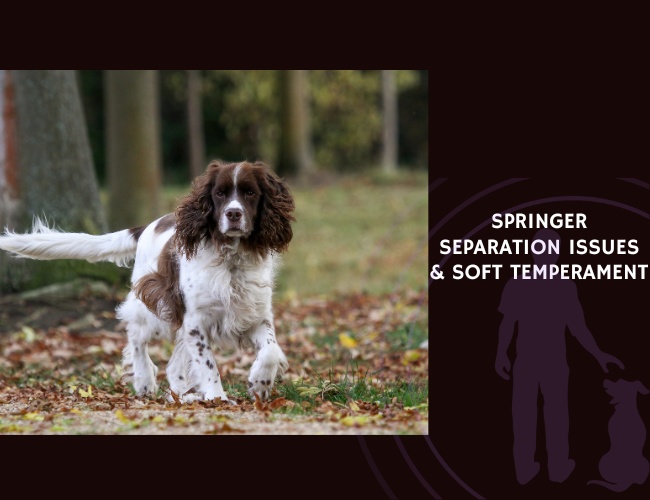
You watch your Springer Spaniel’s eyes follow you from room to room, that gentle gaze filled with devotion and trust. Perhaps you’ve noticed the restlessness when you reach for your keys, or the way your furry friend seems to anticipate your departure with visible anxiety. This isn’t just attachment—it’s a window into one of the most emotionally complex and sensitive temperaments in the gundog world.
Springer Spaniels are celebrated for their intelligence, eagerness to please, and exceptional working drive. Yet beneath this cooperative exterior lies an emotional architecture so finely tuned that separation can become a source of profound distress. If you’ve ever wondered why your Springer struggles more with alone time than other breeds, or why training methods that work for Labradors seem to backfire with your sensitive companion, you’re not alone.
Let us guide you through the fascinating paradox of the Springer temperament—where strength meets sensitivity, and where understanding their unique emotional landscape becomes the key to fostering resilience and independence.
The Springer’s Emotional Blueprint: A Legacy of Cooperation
How Selective Breeding Created Heightened Social Sensitivity
The story of your Springer’s emotional sensitivity begins centuries ago in the fields and marshlands where these dogs earned their reputation as exceptional hunting companions. Unlike retrievers who work at distance or hounds who follow scent trails independently, Springer Spaniels were bred for close-quarter flushing work—a task that required constant, split-second communication with their human partners.
This selective breeding for cooperative hunting created something remarkable: dogs who could read human intention with extraordinary precision, anticipate direction changes, and respond to the subtlest cues. Every generation that excelled at this close-range partnership passed on genes for social attentiveness, human-directed focus, and what we might call “emotional receptivity.”
What this means for your Springer:
- They’re wired to monitor your emotional state continuously
- Proximity to you isn’t just preference—it’s part of their functional design
- Their nervous system developed to synchronize with human presence
- Separation represents a disruption of their core behavioral programming
Through the NeuroBond approach, we recognize that this isn’t dependence—it’s specialization. Your Springer’s brain literally developed neural pathways optimized for human partnership.
The Attachment Architecture: Stronger Bonds, Greater Vulnerability
Did you know that not all gundog breeds form attachments with equal intensity? While a Labrador might cheerfully work for any handler who throws a ball, Springers tend to form deeply specific bonds with their primary caregiver. This human-directed attachment runs deeper than simple training or food motivation.
Research on social bonding across species reveals that early-life family structure profoundly impacts adult attachment patterns and affiliative behaviors. For Springers, generations of selection for close cooperation have likely favored genetic traits that enhance bonding capacity—the very traits that make them such devoted companions also predispose them to separation distress.
Signs of deep attachment in your Springer:
- Preference for physical contact even when resting
- Monitoring your location constantly, even in familiar environments
- Reduced interest in activities when separated from you
- Heightened responsiveness to your emotional state
- Difficulty settling when you’re home but in another room
This isn’t “neediness” in the problematic sense—it’s the expression of neurobiological systems shaped by centuries of partnership. The challenge lies in helping your Springer maintain this beautiful connection while building the capacity for emotional independence.
Decoding the “Soft” Temperament: Emotional Sensitivity as a Trait
What “Soft” Really Means Neurologically
When trainers describe a Springer as “soft,” they’re observing something more profound than simple sensitivity to correction. A soft emotional profile suggests a nervous system with a lower threshold for emotional arousal and a slower return to baseline after stressful events. 🧠
Think of emotional arousal like a thermostat. In a “harder” temperament, the thermostat has a wide range—it takes significant input to trigger a response, and the system cools down quickly. In a soft temperament, the thermostat is more sensitive—smaller inputs create larger responses, and the system remains activated longer.
For your Springer, this manifests in several ways:
- Minor frustrations may evoke pronounced emotional responses
- Recovery from stress takes longer, sometimes hours rather than minutes
- Emotional memory of negative experiences persists more vividly
- The capacity for “psychic pain” (emotional suffering) is more acute
- Regulation of intense feelings requires more support and time
This sensitivity isn’t weakness—it’s the same quality that makes Springers so attuned to your feelings, so responsive to gentle guidance, and so capable of nuanced communication. The Invisible Leash reminds us that awareness, not force, guides the most sensitive souls.
Frustration Tolerance and Stress Recovery
You might notice that your Springer struggles more with frustration than other dogs. Perhaps they shut down when a training exercise becomes challenging, or they show prolonged distress after a minor correction. This reduced frustration tolerance stems from that same soft emotional architecture.
When faced with stress—whether it’s separation, a training challenge, or environmental change—the soft-tempered Springer experiences what neuroscientists recognize as multidimensional pain. This isn’t just physical discomfort; it’s emotional suffering that encompasses loss, uncertainty, and the disruption of social safety.
How soft temperament affects daily life:
- Training requires more patience and smaller incremental steps
- Harsh corrections can cause emotional shutdown lasting days
- Environmental changes need gradual introduction with emotional support
- Competition or high-pressure situations may trigger overwhelm
- Recovery spaces and decompression time become essential
The key insight? Your Springer’s soft temperament requires you to become fluent in emotional regulation support—what we might call co-regulation, where your calm presence helps stabilize their nervous system.

The Neurobiology of Springer Attachment: Brain Chemistry Matters
Oxytocin, Serotonin, and the Bonding Brain
While specific research on English Springer Spaniels’ neurochemistry remains limited, we can draw powerful insights from broader neuroscience. Two systems stand out as critical for understanding your Springer’s attachment patterns: oxytocin and serotonin.
Oxytocin—the bonding neuropeptide: Oxytocin floods the brain during social bonding moments—physical touch, eye contact, cooperative activities. For Springers, bred for continuous human interaction, this system likely operates at high sensitivity. Every gentle stroke, every shared glance, every moment of collaboration triggers oxytocin release, deepening the bond.
But here’s the challenge: when that source of oxytocin (you) disappears, the sudden neurochemical shift can feel catastrophic to a system built on social connection. It’s not unlike withdrawal—the brain that’s adapted to regular oxytocin surges must suddenly function without them.
Serotonin—the resilience regulator: Serotonin governs mood stability, emotional resilience, and the capacity to self-soothe. Variations in serotonin system function can explain why some Springers bounce back from stress easily while others struggle. A less robust serotonin system means reduced capacity for emotional regulation and increased vulnerability to anxiety states.
The fascinating interplay: social touch and connection actually support healthy serotonin function. This means your Springer’s need for proximity isn’t just emotional preference—it’s neurobiological necessity for maintaining stable mood regulation.
Cortisol, Stress Response, and the PANIC/GRIEF System
When you leave your Springer alone, what happens in their brain? The PANIC/GRIEF system—one of the fundamental emotional circuits identified in affective neuroscience—activates. This ancient mammalian system evolved to prevent separation from caregivers, because in nature, isolation meant death.
For soft-tempered Springers, this system may be more reactive than in more independent breeds. Though specific data on Springer cortisol levels remains unavailable, the logical inference is compelling: if they’re predisposed to stronger human-directed attachment, separation constitutes a more significant stressor, potentially leading to:
- Higher baseline cortisol during separation
- Slower autonomic nervous system recovery after reunion
- More persistent activation of stress response pathways
- Greater susceptibility to chronic stress with repeated separations
The social touch deprivation that occurs during separation has documented biopsychosocial consequences. For a breed engineered for constant human proximity, even brief separations can trigger profound stress responses. 🧡
Amygdala-Prefrontal Pathways: The Regulation Challenge
Understanding the Emotional Brain Architecture
Your Springer’s capacity to regulate emotion depends largely on the relationship between two brain regions: the amygdala and the prefrontal cortex. The amygdala processes emotional information, especially fear and anxiety—it’s the alarm system. The prefrontal cortex provides executive control, rational thinking, and emotional regulation—it’s the control center.
Research suggests that certain rearing conditions can lead to atypically larger amygdala volume and associated difficulties in emotion regulation. If Springers, through selective breeding for heightened social sensitivity, developed more reactive amygdalae or less robust prefrontal regulatory pathways compared to independent breeds, this would explain their emotional vulnerability.
What this means practically:
- Your Springer’s “alarm system” may activate more easily
- The “control center” may have less capacity to calm the alarm
- They rely more heavily on external regulation (your presence) for emotional stability
- Building internal regulation capacity requires patient, consistent training
- Stressful experiences can overwhelm their regulatory capacity more easily
Think of it this way: where a Labrador’s brain might say “human left, no problem, I’ll nap,” a Springer’s brain might say “human left, potential threat, heightened vigilance, distress signal.” The same event, profoundly different neurological response.
External Regulation Dependency
This brings us to a crucial insight about Springer temperament: they may rely more on external regulation for emotional stability. In puppyhood, this is normal—pups learn emotional regulation through their mother’s calm presence. But in breeds selected for continuous human partnership, this reliance can persist into adulthood.
You become your Springer’s emotional anchor, their external prefrontal cortex when their own regulatory capacity feels insufficient. This isn’t failure on their part—it’s the natural expression of a brain optimized for partnership rather than independence.
The training challenge becomes clear: how do we honor this need for connection while building their internal capacity for self-regulation? Through Soul Recall, we recognize that emotional memory and bonding create the foundation from which independence can safely grow.
Separation-Related Behaviors: Reading the Language of Distress
Common SRB Patterns in Springers
When your Springer experiences separation distress, they’re not being “naughty”—they’re expressing psychic pain, the emotional equivalent of physical suffering. Understanding the specific patterns helps us respond with compassion and effectiveness.
Vocalization (seeking contact): The most immediate expression of distress for many Springers is vocalization—whining, barking, howling. This isn’t manipulation; it’s a distress signal, the canine equivalent of crying out for help. They’re literally calling for the social contact their nervous system craves for regulation.
Pacing and restlessness (anxiety-driven movement): You might see evidence of pacing patterns—worn paths on carpet, scratches at doorways. This constant movement serves a function: it’s an attempt to discharge the overwhelming anxiety building in their system. The physical activity provides temporary relief from emotional distress.
Destructive behavior (outlet for frustration and anxiety): Chewed doorframes, shredded cushions, items that carry your scent destroyed—these behaviors aren’t revenge. They represent an overwhelmed nervous system seeking any outlet for unbearable emotional energy. Objects with your scent may receive particular attention because they simultaneously comfort and remind your Springer of your absence.
Self-directed grooming or withdrawal: Some sensitive Springers respond to separation with excessive licking, grooming, or complete withdrawal. These behaviors serve as self-soothing attempts or complete emotional shutdown when the distress becomes too overwhelming to process actively.
Each pattern tells a story of a brain struggling to cope with neurobiological distress.
Anticipatory Anxiety: When Pre-Departure Cues Trigger Panic
Perhaps you’ve noticed your Springer’s stress begins before you even leave. The moment you pick up your keys, put on certain shoes, or check your bag, their anxiety visibly escalates. This anticipatory anxiety reveals just how attuned their nervous system is to environmental cues.
For soft-tempered Springers, the ability to detect patterns becomes a source of suffering. They recognize the sequence of events that precedes abandonment (from their perspective), and their PANIC/GRIEF system activates immediately. The sympathetic nervous system engages—heart rate increases, stress hormones release, emotional distress begins—sometimes 20 or 30 minutes before you actually leave.
Signs of anticipatory anxiety:
- Increased following behavior as you prepare to leave
- Panting, pacing, or whining when departure cues appear
- Reduced interest in food or treats during pre-departure period
- Attempts to block your exit or increased attention-seeking
- Visible physical tension or trembling
This pattern reveals an important training opportunity: if we can change the emotional association with departure cues, we can reduce suffering significantly.
Devoted. Sensitive. Attached.
Partnership shapes emotion.
Your Springer’s close-range working heritage created a brain wired to track your presence, mood, and movement, making separation feel like a break in their core design rather than a simple absence.
Softness reflects wiring.
Their nervous system rises quickly to emotional arousal and settles slowly, amplifying distress when routines shift or when your cues aren’t available to guide their internal balance.



Independence grows through safety.
When you pair deep connection with gentle structure and steady reassurance, their attachment becomes strength—allowing resilience to develop without dimming their innate sensitivity.
Early Life Experiences: The Foundation of Emotional Security
How Breeder Environment Shapes Attachment Patterns
The foundation of your Springer’s capacity for healthy attachment—or vulnerability to separation issues—forms long before they arrive in your home. Early-life experiences profoundly impact later emotional and social development, shaping neural pathways that persist throughout life.
Research demonstrates that early-life family structure influences adult social attachment and alloparental behavior. For Springer puppies, the first eight to twelve weeks create templates for emotional regulation, stress response, and attachment security.
Critical early-life factors:
- Maternal care consistency and warmth
- Breeder handling practices and socialization approach
- Environmental stability and predictability
- Exposure to appropriate stress (enough to build resilience, not overwhelm)
- Early separation experiences from mother and littermates
A breeder environment that promotes secure attachment—through gentle, consistent handling, maternal care support, and gradual, appropriate independence training—sets puppies up for emotional resilience. Conversely, inconsistent handling, stressful conditions, or abrupt separations can predispose Springers to insecure attachment styles and heightened anxiety.
🐾 Understanding Springer Separation Distress & Soft Temperament 🧠
A comprehensive guide to the emotional architecture of English Springer Spaniels and their unique vulnerability to separation-related behaviors
🧬 The Springer’s Emotional Blueprint
Bred for Partnership, Vulnerable to Separation
Centuries of selective breeding for close-quarter flushing work created extraordinary social sensitivity. Springers were designed to read human intention with split-second precision, making proximity a functional necessity—not just preference.
Key insight: Their nervous system synchronizes with human presence. Separation disrupts core behavioral programming.
The “Soft” Temperament Explained
A soft emotional profile means lower threshold for arousal and slower return to baseline after stress. Like a sensitive thermostat—smaller inputs create larger responses, and recovery takes longer.
• Reduced frustration tolerance
• Prolonged emotional responses to minor stressors
• Heightened capacity for “psychic pain” (emotional suffering)
• Greater need for co-regulation support
Neurobiological Architecture
Oxytocin system: Highly sensitive bonding chemistry creates deep attachment but also withdrawal-like distress during separation
Serotonin regulation: Potentially less robust, reducing emotional resilience and self-soothing capacity
PANIC/GRIEF system: More reactive than independent breeds—separation triggers ancient mammalian alarm circuits
🛠️ Recognizing Separation-Related Behaviors
Common Distress Patterns in Springers
Vocalization: Whining, barking, howling—distress signals seeking contact for nervous system regulation
Pacing & restlessness: Anxiety-driven movement attempting to discharge overwhelming emotional energy
Destructive behavior: Not revenge—an overwhelmed nervous system seeking outlets, especially with scent-bearing objects
Self-directed grooming/withdrawal: Self-soothing attempts or emotional shutdown when distress becomes unbearable
Anticipatory Anxiety Warning Signs
Soft-tempered Springers detect pre-departure patterns with remarkable precision. Their PANIC/GRIEF system activates before you even leave:
• Increased following as you prepare to leave
• Panting, pacing, or whining when picking up keys/shoes/bag
• Refusing treats during pre-departure period
• Physical tension, trembling, or attempts to block exits
• Stress begins 20-30 minutes before actual departure
Early-Life Impact on Attachment Security
Foundation forms in first 8-12 weeks: consistent maternal care, gentle breeder handling, and gradual independence exposure create secure attachment. Conversely, early-life stress, inconsistent handling, or abrupt separations predispose to heightened anxiety and insecure attachment patterns persisting into adulthood.
✅ Building Independence with Security
Gradual Desensitization Protocol
Step 1: Desensitize departure cues (keys, shoes, doorknobs) without leaving—repeat until no anxiety response
Step 2: Micro-absences of 5 seconds, extending only when previous duration is comfortable
Step 3: Incremental building guided by emotional state—stress signals mean slow down
Step 4: Variable practice (2 min, 10 min, 30 min) prevents duration-based anticipatory anxiety
Counter-Conditioning Strategies
Create positive associations so departure predicts wonderful experiences:
• Special enrichment: Frozen Kongs, puzzle feeders reserved exclusively for alone time
• “Go to place”: Safe zone (crate/bed) associated with calm rewards whether you’re present or absent
• Scent anchors: Recently worn clothing providing olfactory comfort
• Calm-state departure: Leave following regulated nervous system state, not excitement
Environmental Resilience Supports
Scent-based enrichment: Taps into 300 million olfactory receptors, shifting brain from social distress circuits to cognitive engagement
Predictable routines: Consistency creates psychological safety, reducing anxious scanning and conserving energy for rest
Decompression walks: Natural environment exploration at dog’s pace promotes nervous system regulation, mental fatigue, and independent confidence
⚠️ Critical Mistakes to Avoid
Never Use Punishment or “Tough Love”
Soft-tempered Springers learn through safety and success, not stress. Punitive methods cause emotional shutdown, damage trust, and worsen separation anxiety. Their amygdala-prefrontal pathways require gentle support—harsh corrections overwhelm regulatory capacity and create trauma. Forcing independence through flooding or isolation can cause psychological harm lasting months or years.
Don’t Inadvertently Foster Dependency
Constant companionship without structured independence opportunities creates emotional dependency:
• Never experiencing comfortable alone time even in same house
• All enrichment and stimulation coming from interaction with you
• No practice with self-soothing or independent activities
• Distress when you’re home but in another room signals unhealthy attachment
Avoid Overstimulation & Hyperarousal
Chronic hyperarousal (common in working lines) impairs settling ability. A nervous system stuck in sympathetic activation cannot downregulate when left alone. Balance requires appropriate stimulation PLUS calm rest practice. Training calm behaviors is as essential as training active behaviors—rest and settling are skills requiring deliberate development.
⚡ Quick Reference: The Springer Separation Formula
Start Earlier → Begin separation training at 8-16 weeks, during critical socialization period when neural pathways remain most plastic
Progress Slower → Respect soft temperament with micro-increments; stress signals mean return to previous successful level
Support Deeper → Calm co-regulation, scent enrichment, predictable routines, and safe zones provide neurobiological scaffolding
Balance Connection + Independence → Deep attachment enables healthy separation; one without the other creates imbalance
🧡 The Zoeta Dogsoul Perspective
Through the NeuroBond framework, we understand that your Springer’s sensitivity isn’t a flaw—it’s the expression of centuries of partnership breeding. Their need for emotional connection provides the foundation from which true independence can safely grow. The Invisible Leash teaches us that genuine guidance flows through awareness and attunement, not control or force. When we honor their soft temperament with patient, science-based strategies, we transform vulnerability into resilience.
Moments of Soul Recall—those instances when emotional memory surfaces—remind us that healing happens through felt safety, not pressure. Your Springer’s separation challenges are communications from a sensitive nervous system asking for understanding, not corrections. That balance between honoring attachment and building independence, between science and soul—that’s the essence of supporting the remarkable English Springer Spaniel.
© Zoeta Dogsoul – Where neuroscience meets soul in dog training
The Impact of Maternal Behavior
Your Springer’s mother played a crucial role beyond providing nutrition. Her emotional regulation, stress response patterns, and caretaking style influenced her puppies’ developing nervous systems. A calm, confident mother who appropriately balances nurturing with encouraging independence teaches puppies emotional regulation through direct nervous system synchronization.
Puppies with mothers who showed chronic stress, inconsistent care, or either extreme neglect or excessive hovering may develop less robust emotional regulation capacity. These early patterns can persist, making separation challenges more likely in adulthood.
What this means for rescue Springers: If you’ve adopted a Springer with unknown early history, compassion becomes even more essential. Behavioral challenges may reflect early-life adversity rather than inherent temperament flaws. These dogs may require more patience, slower progression, and deeper emotional support as you help them build the secure attachment they missed in puppyhood.
Human Interaction Patterns: How We Shape Springer Emotions
The Double-Edged Sword of Constant Companionship
Here’s where many well-meaning Springer owners inadvertently contribute to separation challenges. Because these dogs are so wonderfully responsive and affectionate, we naturally include them in everything. They sleep in our beds, accompany us room to room, participate in all family activities, rarely experience solitude.
This constant companionship feels natural—after all, Springers were bred for partnership. But without intentional opportunities for independence, we can inadvertently create emotional dependency that makes separation unbearable.
The paradox: your Springer needs deep connection AND the capacity for independent contentment. One without the other creates imbalance.
Signs you may be fostering dependency:
- Your Springer has never experienced comfortable alone time
- They show distress when you’re home but in another room
- All enrichment and stimulation comes from interaction with you
- They’ve never learned to self-soothe or entertain themselves
- Calm independent behavior is never practiced or reinforced
The solution isn’t reducing affection or connection—it’s adding structured opportunities for independence while maintaining the secure attachment that makes independence feel safe.
Overstimulation and the Inability to Settle
Paradoxically, overstimulation can impair your Springer’s ability to settle alone as effectively as understimulation. This is particularly common in working lines, where high drive and constant activity become the norm.
A Springer in chronic hyperarousal—from excessive exercise, intense training, or constant environmental stimulation—develops a nervous system stuck in sympathetic activation. The “rest and digest” parasympathetic state becomes difficult to access. When left alone, they can’t downregulate because their system never learned to shift out of high gear.
Balancing stimulation for emotional health:
- Appropriate physical exercise matched to individual needs (not exhaustion)
- Mental enrichment that promotes calm problem-solving, not frenetic activity
- Regular “decompression” time in low-stimulation environments
- Training calm behaviors as deliberately as active behaviors
- Recognition that rest and settling are skills requiring practice
Through the NeuroBond framework, we understand that calm, connected moments teach emotional regulation as powerfully as active training sessions. Your peaceful presence becomes the template your Springer’s nervous system learns to internalize.
Environmental Strategies: Creating Spaces That Support Independence
Scent-Based Enrichment for the Springer Brain
Your Springer’s nose contains approximately 300 million olfactory receptors compared to your 6 million. This remarkable scent processing capacity offers a powerful tool for managing separation anxiety and promoting independence.
Scent-based enrichment taps into the Springer’s natural abilities, providing mental stimulation that can reduce anxiety and redirect focus constructively. When your Springer is absorbed in scent work, their brain shifts from social distress circuits to cognitive engagement circuits.
Effective scent enrichment strategies:
- Scent-detection games using hidden treats or toys
- Snuffle mats or scatter feeding for meal times
- Safe outdoor environments for decompression sniffing walks
- Scent articles (your worn clothing) left as comfort anchors
- Novel scents introduced regularly to maintain interest
The beauty of scent work: it’s inherently independent. Your Springer can engage their remarkable nose without your direct participation, building confidence in solo activities while satisfying deep biological drives.
Predictable Routines: Security Through Structure
For soft-tempered Springers, unpredictability amplifies anxiety. Their sensitive nervous systems constantly scan for threats, and inconsistency registers as potential danger. Predictable routines create psychological safety—your Springer knows what comes next, reducing the cognitive and emotional load of constant vigilance.
Building security through routine:
- Consistent daily schedule for feeding, exercise, training, and rest
- Pre-departure rituals that remain identical regardless of absence duration
- Return routines that are calm and understated
- Predictable locations for resources (food, water, sleeping areas)
- Consistent responses to behaviors, creating clear communication
When your Springer can anticipate the rhythm of daily life, their nervous system relaxes. Energy devoted to anxious scanning can redirect toward rest and contentment. This predictability doesn’t mean rigidity—it means creating reliable patterns within which your dog can feel secure.
Decompression Walks: Nervous System Reset
Not all walks serve the same purpose. While leashed neighborhood walks provide exercise, decompression walks offer something equally essential: nervous system regulation through natural environment exploration.
A decompression walk allows your Springer to move at their own pace through natural spaces—parks, trails, fields—following their nose, making their own choices about where to explore, engaging their full sensory system without pressure or direction.
Benefits for separation resilience:
- Reduces overall stress and cortisol levels
- Promotes mental fatigue that facilitates rest
- Builds confidence through independent decision-making
- Satisfies biological needs for exploration and scent investigation
- Creates positive associations with the wider world beyond human presence
These walks don’t replace connection-based training or together time—they supplement it, giving your Springer experiences of competence and contentment that aren’t dependent on your direct involvement. The Invisible Leash principle applies: true guidance comes through awareness and trust, not constant control.
Welfare-Oriented Training Strategies: Building Independence with Security
Starting Earlier: Prevention Over Cure
Given Springers’ heightened social sensitivity and attachment predisposition, separation training should begin earlier than with more independent breeds. Ideally, this starts during the critical socialization period (8-16 weeks), when puppies are naturally more adaptable and neural pathways remain most plastic.
Early separation training principles:
- Brief, positive alone experiences starting from first days home
- Gradual extension of duration based on puppy’s comfort level
- High-value enrichment paired with alone time
- Multiple daily practice sessions rather than occasional long absences
- Monitoring for stress signals and adjusting accordingly
The goal isn’t just tolerance of separation—it’s building positive associations and internal confidence. Your Springer puppy should experience alone time as ordinary, even pleasant, rather than as abandonment.
Gradual Desensitization: Respecting the Soft Temperament
For Springers showing separation distress, patience becomes your most valuable training tool. Gradual desensitization respects the soft temperament’s need for small, manageable steps rather than flooding or “tough love” approaches that can create emotional trauma.
Systematic desensitization approach:
Step 1: Departure cue desensitization Practice picking up keys, putting on shoes, touching doorknobs—without leaving. Repeat until these cues no longer trigger anxiety response.
Step 2: Micro-absences Step outside door for 5 seconds, return. Repeat at this level until your Springer remains calm and relaxed. Gradually extend to 10 seconds, 15 seconds, 30 seconds.
Step 3: Incremental duration building Extend absences only when previous duration is comfortable. If your Springer shows distress, you’ve progressed too quickly—return to previous successful level.
Step 4: Variable practice Once longer durations are achieved, practice variable lengths. Sometimes 2 minutes, sometimes 10, sometimes 30. This prevents anticipatory anxiety based on predictable duration patterns.
Throughout this process, your Springer’s emotional state guides progression. Stress signals—panting, pacing, whining, inability to settle—indicate the need to slow down, not push through. The soft temperament learns through safety and success, not stress and challenge. 😊
Counter-Conditioning: Creating Positive Emotional Associations
While desensitization reduces fear responses, counter-conditioning actively builds positive associations. Instead of merely tolerating your absence, your Springer learns that your departure predicts wonderful experiences.
Effective counter-conditioning strategies:
Special enrichment items: Reserve certain high-value items exclusively for alone time—frozen Kong toys, lick mats with frozen treats, puzzle feeders with particularly delicious contents. These items appear only when you leave and disappear when you return.
Calm-state activation: Before departing, engage in calming activities—gentle massage, slow-paced training, quiet connection. Your departure follows a regulated nervous system state rather than excited or anxious arousal.
“Go to place” training: Teach your Springer that their designated safe zone (crate, bed, specific room) predicts calm, rewarding experiences whether you’re present or absent. This space becomes an anchor of security.
Scent comfort objects: Leave recently worn clothing items that carry your scent, providing olfactory comfort during absence without requiring your physical presence.
The sophisticated approach: these strategies work synergistically. Your Springer’s brain begins associating solitude with positive experiences, neural pathways strengthening with each successful practice.
Independence-Building Games: Confidence Without Isolation
Teaching independence doesn’t mean reducing connection—it means expanding your Springer’s behavioral repertoire to include confident solo activities. Independence-building games provide structure for this learning.
Games that foster healthy independence:
Scent games and nose work: Hide treats throughout safe space, encourage independent searching and problem-solving.
Food-dispensing puzzles: Provide cognitive challenges that require sustained independent effort for food rewards.
Settle protocols: Train calm resting on a mat or bed while you’re present but not interacting. Gradually increase distance and add distractions.
Environmental exploration: In safe, enclosed spaces, practice staying stationary while your Springer investigates independently, building confidence in autonomous behavior.
These activities teach a crucial lesson: fulfillment and engagement can exist independent of constant human interaction. Your Springer discovers internal resources for contentment.
Environmental Modifications for Resilience: Shaping Space, Shaping Emotions
Safe Zones: The Psychology of Place Attachment
Your Springer needs a space that feels unambiguously safe—a “den” where security is guaranteed and stress is impossible. This concept draws on place attachment theory, which recognizes the psychological benefits of specific locations associated with safety and calm.
Creating an effective safe zone:
Physical characteristics:
- Appropriately sized crate or designated room
- Comfortable bedding with familiar scents
- Dim lighting or covered crate for den-like security
- Distance from high-traffic areas and external stimulation sources
- Consistent location (not moving between different areas)
Emotional associations:
- Positive experiences only in this space
- High-value enrichment items available here
- Never used for punishment or forced isolation during distress
- Voluntary entry reinforced with calm praise and rewards
- Association with your calm presence during training
When properly established, this safe zone becomes a psychological anchor—a physical location where your Springer’s nervous system automatically shifts toward parasympathetic rest state.
Scent Anchors: Olfactory Comfort
Your scent provides powerful comfort to your Springer’s sensitive nervous system. Scent anchors leverage this biological reality, offering olfactory presence when physical presence isn’t possible.
Implementing scent anchors effectively:
- Leave recently worn t-shirts or small blankets in safe zone
- Rotate items to maintain scent freshness
- Introduce during calm, connected moments so positive associations form
- Avoid washing these items too frequently (your scent is the comfort)
- Combine with other environmental supports for maximum effect
The neurobiological mechanism: olfactory information connects directly to limbic system structures governing emotion and memory. Your scent literally activates neural pathways associated with safety, bonding, and calm—providing physiological comfort beyond simple familiarity.
Controlled Exits and Entries: Normalizing Transitions
The emotional charge surrounding your departures and arrivals can either support or undermine separation training. Overly emotional goodbyes and enthusiastic reunions, while tempting, can actually intensify your Springer’s distress.
Low-key departure protocol:
- Avoid extended goodbyes, emotional speeches, or reassuring behavior
- Provide enrichment item calmly, without fanfare
- Depart matter-of-factly, as if stepping out for 30 seconds
- No eye contact, touching, or verbal interaction in final moments
- Maintain this protocol whether leaving for 5 minutes or 5 hours
Calm reunion protocol:
- Ignore excited greeting behavior upon return
- Wait for calm state before acknowledging your Springer
- Greet with gentle, understated affection once settled
- Avoid creating dramatic contrast between absence and presence
- Resume normal household routine without excessive attention
This approach teaches a powerful lesson: your departures and returns are ordinary, unremarkable events. The emotional intensity that amplifies separation distress gradually diminishes, replaced by calm acceptance.
The Path Forward: Integration and Hope
The emotional sensitivity that makes English Springer Spaniels vulnerable to separation distress is inseparable from the qualities we cherish most—their responsiveness, their devotion, their remarkable capacity for partnership. Understanding their unique neurobiological architecture, attachment patterns, and soft temperament doesn’t just explain their challenges—it illuminates the path toward solutions.
Your Springer’s brain, shaped by generations of selective breeding for cooperation, requires what all sensitive beings need: security in connection AND confidence in independence. These aren’t contradictory goals—they’re complementary dimensions of emotional health.
The comprehensive approach combines:
- Early prevention starting in puppyhood when neural plasticity is highest
- Respect for soft temperament through gradual, positive training methods
- Environmental modifications that support nervous system regulation
- Scent enrichment engaging natural abilities and building independent confidence
- Predictable routines creating psychological safety
- Balance between connection and independence-building experiences
- Recognition that punishment damages rather than teaches
- Patience matching the pace of neurobiological change
Through calm-state co-regulation, your steady presence teaches internal regulation. Through the NeuroBond framework, deep connection becomes the foundation from which healthy independence grows. Through the Invisible Leash principle, guidance flows through awareness and emotional attunement rather than control.
Your Springer’s separation challenges aren’t failures—they’re communications from a sensitive nervous system asking for support, patience, and understanding. With knowledge of their emotional architecture and commitment to welfare-oriented strategies, you can help your beloved companion develop the resilience to thrive both in your presence and when left alone.
That balance between science and soul, between honoring attachment and building independence—that’s the essence of Zoeta Dogsoul. Your Springer’s soft temperament is a gift, even when it presents challenges. In meeting those challenges with compassion and intelligence, you honor the remarkable sensitivity that makes this breed so extraordinarily special. 🧡
Frequently Asked Questions
How long does it typically take to resolve separation anxiety in Springers? Resolution timelines vary dramatically based on severity, early-life experiences, and consistency of intervention. Mild cases may show improvement within 4-8 weeks of dedicated training, while moderate to severe cases can require 6 months or longer. Remember: you’re reshaping neurobiological patterns, not just teaching commands. Patience and consistency matter more than speed.
Can medication help with severe separation distress? In severe cases, anti-anxiety medication prescribed by a veterinary behaviorist can support training efforts by reducing baseline anxiety enough to allow learning. Medication alone rarely solves separation issues, but combined with behavioral modification, it can accelerate progress for dogs whose distress prevents them from benefiting from training alone.
Is crate training helpful or harmful for anxious Springers? When introduced properly with positive associations, a crate becomes a safe den offering security. However, forcing an anxious Springer into a crate can create panic and worsen distress. The key: gradual, positive introduction where the crate represents safety, not confinement. Never use the crate for punishment.
Should I get another dog to keep my Springer company? Adding another dog addresses loneliness but not necessarily separation anxiety, which stems from attachment to humans specifically. Some Springers benefit from companionship, but others show no reduction in distress despite having canine company. Address the underlying human-directed attachment issues before assuming another dog will solve the problem.
How do I know if my Springer’s behavior is true separation anxiety or just boredom? True separation anxiety involves genuine distress—physiological stress responses, inability to settle even with enrichment, symptoms beginning immediately upon departure. Boredom-related behaviors typically start later during absence, respond well to increased enrichment, and don’t involve the same level of physiological distress. Video recording your Springer’s behavior when alone can help distinguish between these conditions.










