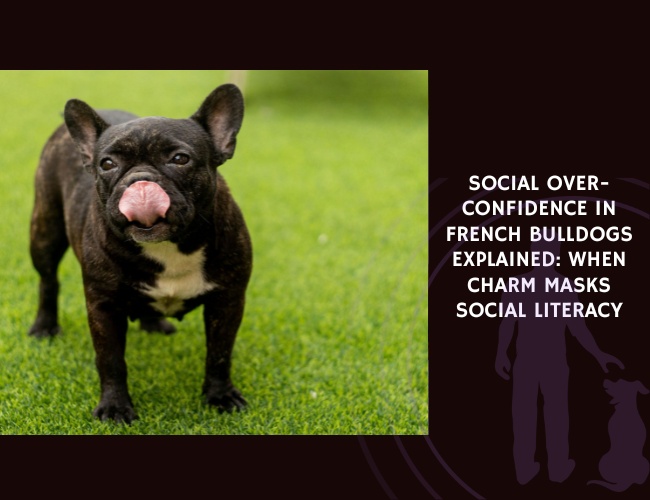
Have you ever watched a French Bulldog bound enthusiastically toward another dog, seemingly oblivious to the other dog’s stiffening body or averted gaze? Perhaps you’ve noticed how your Frenchie assumes every dog wants to be their best friend, pushing closer even when subtle signals suggest otherwise. This pattern—charming, bold, and sometimes concerning—reveals something fascinating about how selective breeding for human companionship can paradoxically create gaps in dog-to-dog communication.
Social over-confidence in French Bulldogs represents more than simple exuberance. It’s a complex interplay between breeding history, morphology, cognition, and human influence that creates dogs who excel at reading us while sometimes struggling to read their own kind. Let us guide you through the neuroscience, behavior patterns, and practical implications of this phenomenon, helping you understand what lies beneath that irresistible charm.
Breed Design and the Human Connection Trade-Off
The Evolution of Human-Directed Communication
French Bulldogs represent generations of selective breeding for one primary purpose: human companionship. Recent research reveals that owners of brachycephalic breeds like French Bulldogs form significantly stronger relationships with their dogs compared to owners of longer-snouted breeds. This isn’t accidental—it reflects intentional selection for traits that enhance human-dog bonding at a neurological and behavioral level.
The infant-like appearance of French Bulldogs—those large, forward-facing eyes, flat faces, and round heads—triggers powerful nurturing responses in humans. This resemblance to human baby features activates caregiving circuits in our brains, facilitating deeper emotional bonds and more frequent social interactions. Over generations, French Bulldogs have been shaped to excel at:
- Enhanced eye contact and sustained attention toward human faces
- Communicative behaviors specifically directed at owners
- Exceptional comprehension of human gestures, particularly pointing
- Emotional expressiveness that humans find compelling
The Canine Communication Cost
Here’s where the trade-off emerges. Dogs who spend extensive time observing and interpreting human behavior become remarkably skilled at understanding our communication systems. French Bulldogs demonstrate exceptional performance in tasks requiring them to follow human pointing cues, showing unexpectedly high success rates in choosing correctly indicated objects.
But cognitive resources are finite. Enhanced allocation toward human-directed social cognition may reduce the mental bandwidth available for processing canine-to-canine communication. Think of it like learning two languages simultaneously—exceptional fluency in one can sometimes come at the expense of the other. 🧠
Your French Bulldog’s ability to read your facial expressions, body language, and even your emotional state is extraordinary. They’ve been designed, through careful selection, to be expert interpreters of human behavior. However, this specialization may create a blind spot: the subtle, complex language other dogs use to communicate with each other.
When Expressiveness Creates False Impressions
The distinctive facial features that make French Bulldogs so endearing also create a significant perceptual problem. Research shows that humans don’t assess a dog’s emotional state based solely on behavior—we rely heavily on context and our own projections. Those large eyes, wrinkled brows, and expressive faces lead us to attribute emotional intelligence and social awareness that may not actually exist.
You might look at your Frenchie’s face and see thoughtful consideration, emotional depth, or social confidence. But what you’re often seeing is your own emotional projection combined with morphological features that happen to resemble human expressions. This anthropomorphic interpretation reinforces behaviors that might be socially inappropriate in canine contexts, creating a cycle where charm obscures competence.
Confidence Without Competence: Understanding the Distinction
Defining Social Over-Confidence in French Bulldogs
Social over-confidence can be operationally defined through four key components working together:
Bold approach behavior + Low risk assessment + Poor reading of canine stress signals + Assumption of positive reception
This isn’t simple friendliness or extroversion. It’s a specific pattern where enthusiasm and confidence exist independently from actual social skill. Research indicates that French Bulldogs who score high on human-directed cognitive tasks aren’t necessarily skilled at dog-to-dog social navigation—these are different competency domains.
Context-Blind Initiation: The Rush Before the Read
Studies reveal fascinating patterns in French Bulldog decision-making. Males often show higher success rates in human-directed tasks than females. Untrained dogs sometimes outperform trained ones in specific cognitive tests. Perhaps most telling: quicker decision times correlate with better performance in human-oriented activities.
These patterns suggest a cognitive style characterized by rapid, confident decision-making without extensive evaluation. In human contexts, this works beautifully—your Frenchie quickly recognizes your pointing gesture and acts immediately. But in dog-to-dog interactions, where signals are more subtle and context shifts rapidly, this “decide fast, act faster” approach creates problems. 🐾
You might notice your French Bulldog:
- Approaching other dogs without pausing to observe their body language
- Making immediate contact rather than offering a polite greeting arc
- Rushing forward at the sight of another dog, regardless of that dog’s emotional state
- Assuming play invitation when none has been offered
This isn’t rudeness—it’s a mismatch between cognitive style and social context.
Assumption-Based Confidence: When Past Success Predicts Future Problems
Research demonstrates that dogs spending quality time with their owners recognize pointing gestures immediately and make choices without hesitation. This reveals assumption-based confidence: expecting positive outcomes based on past experiences, primarily with humans.
Your French Bulldog has learned that approaching you yields positive results. Moving toward your outstretched hand brings treats, toys, or affection. Eye contact and proximity create happy interactions. This creates a neural template: approach equals reward.
The problem emerges when this template generalizes inappropriately to canine social contexts, where:
- Signals are more nuanced and constantly changing
- Context requires continuous reassessment rather than instant decision
- Positive assumptions can lead to boundary violations
- Rapid approach without careful evaluation increases conflict risk significantly
Through the NeuroBond approach, we understand that confidence must be built on genuine skill rather than assumptive patterns. True social confidence involves reading, assessing, and responding appropriately—not simply assuming acceptance.
Missing the Subtle Warnings: Why French Bulldogs Don’t See What’s Coming
Anatomical Specialization and Its Consequences
The morphological features that enhance human bonding create unexpected vulnerabilities in canine social navigation. Research reveals that ganglion cells in brachycephalic dogs are more centrally concentrated in the retina, meaning they respond optimally to stimuli in the central visual field—directly in front of them—while being less responsive to peripheral visual information.
This anatomical specialization creates a critical blind spot for detecting subtle canine body language, which often occurs in peripheral vision:
- Lateral body positioning: When dogs turn slightly sideways to signal discomfort
- Peripheral head turns: Subtle gaze aversion that communicates “I need space”
- Spatial pressure signals: The gradual closing or opening of distance
- Approach-avoidance movements: Small shifts in position that indicate receptivity or concern
Your French Bulldog may quite literally not see these signals in their peripheral vision, missing warnings that other dogs broadcast clearly.
The Boundary-Pushing Pattern
Fascinating research reveals that while owners often feel intense emotional closeness to their French Bulldogs, this feeling isn’t always reciprocated equally—at least not in ways we might expect. This asymmetry may contribute to social patterns where French Bulldogs:
- Overestimate their social acceptance by other dogs
- Persist in face-to-face contact despite subtle discomfort signals
- Continue approaching despite freeze responses or avoidance behaviors
- Escalate through repetitive contact attempts—jumping, pawing, face-licking
You might interpret this as “my dog just loves everyone,” but it may actually reflect an inability to read declining invitations or revoked consent.
Creating Vulnerability Through Boldness
The combination of bold approach, poor signal reading, and assumption of acceptance creates significant risk. Your French Bulldog may:
- Approach dogs showing early stress signals like lip licking, yawning, or body stiffening
- Persist despite escalating warnings such as whale eye, lip lifts, or growls
- Fail to recognize spatial pressure—when another dog creates distance—as communication
- Experience sudden corrections they genuinely didn’t anticipate
- Develop fear-based reactivity after unexpected negative encounters that seem to come “out of nowhere”
The Invisible Leash reminds us that true guidance comes from awareness, not force. Unfortunately, French Bulldogs often lack the awareness needed to guide themselves appropriately in complex social situations with other dogs.
Human Influence: How We Accidentally Reinforce Risky Behavior
Misreading Our Dogs, Reinforcing Problems
Research demonstrates a sobering reality: humans typically don’t accurately assess their dog’s emotional state. Instead, we judge canine emotions according to the context of events we witness, filtered through our own interpretations and expectations.
This creates a reinforcement cycle:
Human misperception → Inappropriate praise → Reinforced boldness → Increased risk → Eventual conflict
You might interpret your French Bulldog’s behaviors as:
- “Friendliness” when they’re actually boundary-pushing
- “Playfulness” when they’re showing high arousal without social skill
- “Social confidence” when they’re displaying assumption-based approach
- “Bravery” when they’re ignoring warning signals they can’t perceive
Each misinterpretation followed by praise reinforces exactly the behaviors that create social risk. 😊
The Emotional Feedback Confusion
Consider this insight from research: when you scold your dog and she makes “that guilty face,” is it genuine guilt or fear of further reprimand? This question highlights how easily we misinterpret canine emotional displays, projecting our narratives onto their expressions.
In social contexts with other dogs, this manifests as:
- Cheering during inappropriate approaches: “Go say hi!” when the other dog is showing discomfort
- Soothing after corrections: Comforting your dog immediately after another dog sets a boundary, which prevents learning from consequences
- Apologizing to other owners: Communicating that the behavior is just “who they are” rather than something to address
- Laughing at persistence: Finding it endearing when your Frenchie won’t take “no” for an answer
Each of these responses, while well-intentioned, teaches your dog that boundary-pushing is acceptable or even praiseworthy.
High-Arousal Environments: Where Decisions Deteriorate
Research shows that as decision time increases under pressure, choice quality decreases. In emotionally charged environments—dog parks, busy cafés, greeting scenarios on walks—this translates to even more problematic patterns.
Your French Bulldog in high-arousal contexts experiences:
- Impulsive approach without any preliminary assessment
- Reduced inhibition and self-regulation capacity
- Amplified confidence without corresponding increase in competence
- Dramatically decreased sensitivity to subtle signals
The very environments where social skill matters most become the contexts where your Frenchie’s ability to exercise that skill collapses entirely.
Charming. Social. Misread.
Bred for human connection. Generations of selection shaped French Bulldogs to read our faces, feel our emotions, and mirror our expressions with remarkable precision. In that excellence, a quiet gap emerged—one where canine signals became less fluent.
Charm can disguise miscommunication. Their expressive faces trigger human empathy, often leading us to project understanding that isn’t there. What looks like social intuition may simply be morphology mimicking emotional depth.



Confidence without literacy. When a Frenchie approaches every dog as a friend, it isn’t arrogance—it’s specialization. They excel at human bonding, not always at canine negotiation. In the space between intention and interpretation, charm meets consequence.
What’s Really Driving the Approach: Arousal, Frustration, and Dependency
High Arousal Masquerading as Social Desire
Research indicates that rapid response patterns may reflect activation of the SEEKING system—the neurological circuit driving curiosity, anticipation, and exploratory behavior—rather than carefully calibrated social intention.
Your French Bulldog may experience:
- Sensory excitement mistaken for social desire: Responding to movement, sound, or smell rather than genuine interest in interaction
- Arousal-driven approach: Acting on internal activation rather than connection-seeking
- Stimulus-response patterns: Automatic reactions rather than intentional social engagement
- Generalized enthusiasm: Broad, undifferentiated excitement rather than specific social interest
That enthusiastic pull toward another dog might not be “I want to make a friend” but rather “stimulus detected, must investigate immediately.” The distinction matters enormously for understanding and addressing the behavior.
When Frustration Looks Like Friendliness
Studies found that higher food motivation correlates with better cognitive performance, suggesting dogs who anticipate rewards perform better. This insight reveals that what appears as “social enthusiasm” may actually be:
- Frustration from blocked access: Leash restraint creating urgency and arousal
- Environmental overstimulation: Responding to multiple sensory inputs simultaneously
- Anticipation of positive outcomes: Expecting rewards based on past human interactions, inappropriately generalized
- Relief-seeking behavior: Attempting to reduce internal tension through contact
You’re at the dog park, your Frenchie straining at the leash, whining and pulling. Is that social interest or frustration intolerance? Often, it’s the latter masquerading as the former. 🧡
Over-Stimulation and Diminished Social Awareness
Research demonstrates that arousal levels significantly impact decision-making quality. Studies show that neutered dogs often display better cognitive performance, suggesting hormonal influences on impulse control and assessment capacity.
Over-stimulation in your French Bulldog may:
- Reduce capacity for detecting subtle signals
- Increase impulsive contact-seeking without evaluation
- Decrease inhibitory control—the ability to stop and think
- Amplify approach behavior while simultaneously reducing assessment ability
The more excited your Frenchie becomes, the less capable they are of reading social situations accurately. It’s a dangerous inverse relationship.
Attachment Patterns: When Closeness Becomes Dependency
Social Dependency Versus True Sociability
Research reveals that owners of brachycephalic breeds generally form stronger relationships with their dogs, but this intense bonding may create emotional dependency patterns rather than genuine social confidence toward other dogs.
Evidence suggests interesting age-related patterns:
- Younger French Bulldogs receive more frequent interactions with their owners
- Interaction frequency decreases as dogs age
- Younger dogs require more attention, potentially reinforcing proximity-seeking
This creates a potential vulnerability: your French Bulldog learns that social fulfillment comes primarily from you, without developing independent social skills with other dogs. When encountering canine companions, they may:
- Seek proximity as an end in itself, regardless of receptivity
- Use other dogs as arousal outlets rather than genuine social partners
- Struggle with independent social navigation
- Experience anxiety when forced into canine social situations without you as a buffer
Proximity-Seeking Without Social Reciprocity
Research suggests that the human-dog bond in French Bulldogs may be particularly human-directed, with less reciprocity than we often assume. Your Frenchie may love being near you intensely, but this doesn’t automatically translate to:
- Understanding social reciprocity with other dogs
- Reading and respecting boundaries
- Engaging in mutual, balanced interactions
- Developing age-appropriate independence
You might notice your French Bulldog:
- Seeking constant physical contact with you but poor-quality interactions with other dogs
- Showing anxiety when separated from you but little interest in appropriate canine companionship
- Preferring human attention even when dog playmates are available
- Using other dogs more as toys or obstacles than as social partners
Through moments of Soul Recall, we recognize how emotional memory shapes behavior patterns. Your Frenchie’s deepest emotional memories center on human connection, creating templates that don’t serve them well in canine social contexts.
Building Genuine Social Literacy: Practical Approaches
Recognizing the Real Problem
Before addressing social over-confidence, you must first recognize it accurately. This means distinguishing between:
True Social Competence:
- Approaching with curved body language rather than direct frontal approach
- Pausing to assess before initiating contact
- Responding to subtle signals by adjusting behavior
- Engaging in reciprocal interaction where both dogs contribute
- Respecting withdrawal or disengagement cues
Social Over-Confidence:
- Direct, linear approaches without preliminary assessment
- Ignoring or not perceiving stress signals from other dogs
- Persisting despite lack of reciprocal interest
- Escalating approach when the other dog shows discomfort
- Appearing surprised when corrections occur
Your first step is honest observation without the lens of what you hope to see.
Teaching Observation Before Action
Building genuine social literacy requires teaching your French Bulldog to observe and assess before approaching. This involves several interconnected skills:
Impulse Control Foundations:
- Teaching wait and release patterns in non-social contexts first
- Building capacity for stillness while aroused
- Rewarding self-regulation and emotional downshifting
- Creating neural pathways for “pause before proceed”
Directed Observation Training:
- Teaching your dog to orient toward and watch other dogs from distance
- Rewarding calm observation without approach
- Building the skill of reading body language from safe distances
- Developing predictive awareness: “That dog looks uncomfortable, I stay here”
Environmental Management:
- Controlling distance to prevent rehearsal of poor patterns
- Creating scenarios where success is possible
- Preventing negative encounters that damage confidence or create reactivity
- Building positive associations with restraint and distance
This isn’t about suppressing your French Bulldog’s personality. It’s about building competence that matches their confidence, creating genuine skill rather than assumptive boldness.
NeuroBond-Style Calm Leadership
Research found that dogs with stronger bonds to their owners demonstrate better learning capacity, but this bond must be built on clear communication rather than emotional intensity. Applied to social training, this means:
Teaching Pause and Assessment:
- Interrupting impulsive approach patterns calmly and consistently
- Rewarding stillness and observation generously
- Building capacity for delayed gratification
- Developing observational learning skills through modeling
Emotional Regulation Support:
- Modeling calm presence near other dogs yourself
- Teaching arousal management techniques like settle, breathe, orient to handler
- Building confidence through controlled, successful exposure
- Developing your dog’s capacity for self-soothing
Consensual Contact Principles:
- Teaching approach-retreat patterns: move forward, then back, then forward again
- Rewarding respect for space and boundaries
- Building understanding of invitation signals versus neutral or avoidant body language
- Developing awareness of social reciprocity: “They engage, I engage; they disengage, I respect that”
Through the NeuroBond approach, trust becomes the foundation of learning. Your French Bulldog trusts your guidance enough to override their assumptions and impulses, creating space for genuine social competence to develop.
Aligning Confidence With Emotional Clarity
Research indicates that the number of correct choices increases with quality interaction but decreases with emotional intensity that lacks clarity. This suggests that effective training requires clear communication rather than heightened emotion.
For social confidence calibration, implement:
Clear Boundaries:
- Consistent consequences for boundary violations
- Predictable structure in social contexts
- Clear communication about what is and isn’t acceptable
- Reliable feedback systems your dog can understand
Competence-Based Confidence:
- Building skills before increasing challenge level
- Rewarding accurate signal reading heavily
- Developing genuine social literacy through structured practice
- Creating success through careful preparation and management
Risk Reduction:
- Preventing negative encounters through proactive management
- Building positive associations gradually and systematically
- Developing appropriate caution without creating fear
- Teaching context-appropriate behavior for different social settings
The Invisible Leash reminds us that true guidance comes from awareness rather than force. Your goal is to help your French Bulldog develop the awareness needed to navigate canine social situations safely and skillfully.
Understanding the Paradox: When Charm and Competence Diverge
The Exceptional Communicator With a Blind Spot
French Bulldogs represent a fascinating paradox in canine cognition and behavior. They are exceptional communicators—just not always with other dogs. Their breeding history has created animals that:
- Excel at human-directed communication but may struggle with canine-specific signals
- Display bold confidence without corresponding risk assessment capacity
- Show high enthusiasm that can mask or compensate for social incompetence
- Exhibit persistent approach behavior despite warning signals they cannot perceive
This paradox isn’t a flaw—it’s a predictable outcome of selective breeding for specific traits. Understanding it allows you to work with your dog’s nature rather than against it.
Critical Distinctions That Guide Training
True Social Competence involves:
- Accurate reading of subtle canine body language and signals
- Context-appropriate behavior that shifts based on environmental and social cues
- Reciprocal interaction patterns where both participants contribute
- Risk-aware approach that considers potential outcomes
Social Over-Confidence manifests as:
- Assumption-based approach without preliminary assessment
- Context-blind initiation regardless of circumstances
- Persistent boundary-pushing despite lack of reciprocation
- Risk-unaware boldness that creates vulnerability
Your training approach must address which pattern you’re seeing, not simply increasing or decreasing confidence globally.
The Human Role in Creating and Solving the Problem
For French Bulldog guardians, several insights become crucial:
Recognition: Understand that human-directed skills don’t automatically translate to canine social competence. Your Frenchie’s ability to read you tells you nothing reliable about their ability to read other dogs.
Interpretation: Bold approach may reflect arousal, emotional dependency, or assumption rather than genuine social confidence. Learn to distinguish between these drivers.
Reinforcement: Avoid inadvertently reinforcing boundary-pushing behavior. Distinguish between appropriate friendliness and social insensitivity, praising only the former.
Preparation: Teach observation and assessment skills before allowing approach. Build genuine literacy rather than hoping boldness will work out.
Structure: Provide clear guidance through structured, calm exposure with immediate, understandable feedback about appropriate versus inappropriate behavior.
That balance between science and soul—understanding both the neurological foundations of behavior and the emotional experience of your dog—that’s the essence of Zoeta Dogsoul.
Moving Forward: Building Social Competence That Matches Confidence
Practical Implementation Steps
Phase 1: Foundation Building (Weeks 1-4)
Begin by creating calm observation capacity:
- Practice stillness exercises in non-social contexts
- Teach focus and attention to you as a competing reinforcer
- Build impulse control through wait, stay, and release patterns
- Develop arousal down-regulation skills
Phase 2: Distant Observation (Weeks 4-8)
Introduce observation of other dogs from safe distances:
- Reward calm watching without approach
- Practice orienting to you when excited
- Build understanding that dogs exist without requiring interaction
- Develop predictive skills: noticing and naming other dogs’ emotional states
Phase 3: Controlled Approach Practice (Weeks 8-12)
Begin teaching appropriate greeting patterns:
- Use calm, well-socialized dogs as practice partners
- Implement approach-retreat patterns
- Reward reading and responding to signals
- Interrupt and redirect boundary-pushing immediately
Phase 4: Generalization and Real-World Application (Months 3-6)
Gradually increase complexity and challenge:
- Practice in varied environments
- Work with different dogs and situations
- Build capacity for longer interactions
- Develop reliable response to your interruption signals
Managing Expectations Realistically
Your French Bulldog may never become a dog park regular who navigates complex social dynamics effortlessly. That’s perfectly acceptable. The goal isn’t to change your dog’s fundamental nature but to:
- Build enough skill to prevent negative encounters
- Develop awareness that protects them from corrections
- Create genuine confidence based on competence
- Allow safe, appropriate socialization within their capabilities
Some French Bulldogs will develop strong social skills with careful training. Others will remain happiest with structured, limited social contact. Both outcomes represent success when your dog is safe, confident, and genuinely comfortable. 🐾
The Long-Term Perspective
Building genuine social literacy is a marathon, not a sprint. Research suggests that quality of interaction matters more than quantity, and clarity matters more than emotional intensity. This means:
- Consistent, calm practice over months and years
- Regular reassessment and adjustment of approach
- Acceptance that your dog’s social comfort zone may differ from your hopes
- Celebration of incremental progress rather than expectation of transformation
Through the framework of Soul Recall, we understand that emotional memory shapes behavior patterns deeply. Creating positive emotional memories around appropriate social behavior—not just exciting social encounters—builds the foundation for long-term success.
Final Reflections: Charm, Competence, and the Path Forward
Social over-confidence in French Bulldogs represents a complex interplay of selective breeding, morphological features, cognitive specialization, human influence, and emotional patterns. Understanding this complexity allows us to move beyond simple judgments—”my dog is friendly” or “that dog is aggressive”—toward nuanced recognition of what’s actually happening beneath the surface.
Your French Bulldog’s charm is real and valuable. Their enthusiasm brings joy to your life and often to the lives of those around you. But charm alone doesn’t ensure positive social outcomes with other dogs. Building genuine social competence requires:
- Recognition that confidence and competence can diverge significantly
- Understanding of the neurological and anatomical factors shaping perception
- Awareness of how human influence can reinforce risky patterns
- Commitment to teaching observation, assessment, and appropriate response
- Patience with a process that unfolds over months and years, not days or weeks
The path forward isn’t about suppressing your French Bulldog’s personality or eliminating their enthusiasm. It’s about channeling that wonderful energy through the lens of genuine skill, creating social interactions that are not just bold, but truly competent and mutually positive.
By understanding the foundations of social over-confidence in French Bulldogs, we can develop approaches that honor their breeding history and individual nature while protecting them from the risks their boldness creates. We can build dogs who are not just charming and confident, but also genuinely socially literate—able to read, respond, and engage appropriately with their own kind.
That integration of scientific understanding with emotional awareness, of structure with soul, of clarity with compassion—that’s what creates lasting change. Not just in behavior, but in the quality of life for both you and your furry companion. 🧡
Your French Bulldog doesn’t need to become someone they’re not. They need support in developing skills that keep them safe while allowing their natural personality to shine. With understanding, patience, and the right approach, that’s entirely achievable.