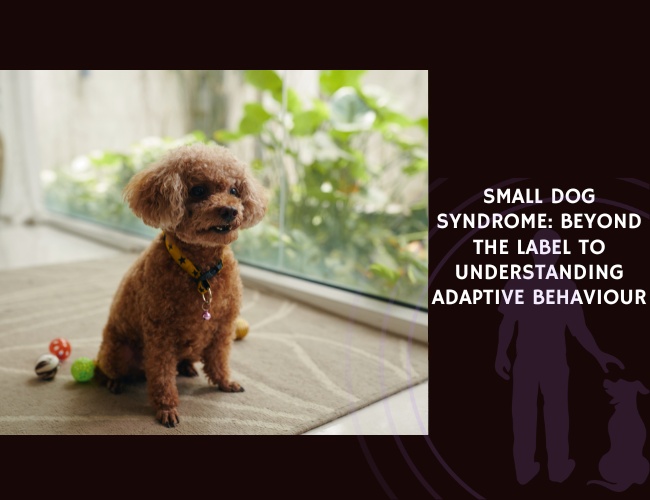
You’ve heard the term thrown around at dog parks, in training forums, or perhaps from well-meaning friends commenting on your Chihuahua’s spirited personality. “Oh, that’s just Small Dog Syndrome,” they say dismissively, as if those three words explain everything about why your little companion barks, guards their space, or reacts intensely to approaching strangers.
But what if I told you that what we call “Small Dog Syndrome” isn’t really a syndrome at all? What if these behaviours we’ve pathologized are actually rational adaptive strategies shaped by genuine vulnerability and, more significantly, by how we humans handle, train, and perceive small dogs differently from their larger counterparts?
This isn’t about making excuses for challenging behaviours. It’s about understanding the real mechanisms at work so we can address them effectively, compassionately, and with the same standards we’d apply to any dog, regardless of size. Let’s explore what’s really happening when your small dog displays what others might dismiss as inevitable “small dog behaviour.”
Understanding the Mislabeled “Syndrome”
Why Labels Matter More Than You Think
When we label a constellation of behaviours as a “syndrome,” we create powerful psychological effects that shape both our perceptions and our actions. The term “Small Dog Syndrome” suggests an intrinsic pathology, something hardwired into small dogs that makes them fundamentally different, somehow deficient in temperament or trainability.
This framing carries three critical problems. First, it implies that size itself causes problematic behaviour, ignoring the substantial role of environmental shaping and human interaction patterns. Second, it creates a self-fulfilling prophecy where behaviours are expected, tolerated, or even inadvertently reinforced because they’re viewed as inevitable rather than modifiable. Third, it obscures the adaptive nature of behaviours that, when viewed through a clearer lens, represent rational responses to genuine vulnerability and inconsistent social environments.
Behaviours commonly grouped under the “Small Dog Syndrome” label:
- Excessive vocalization (barking, growling, whining at thresholds lower than larger dogs)
- Reactivity toward strangers (lunging, defensive displays, barrier frustration)
- Inter-dog aggression (particularly toward larger dogs despite size disadvantage)
- Resource guarding (food, toys, resting spaces, and owner access)
- Resistance to handling (struggling during grooming, veterinary procedures, or physical management)
- Apparent “defiance” (ignoring cues, refusing compliance with known requests)
- Attention-demanding behaviour (jumping, pawing, persistent solicitation)
- Territorial displays (guarding doorways, furniture, vehicles, or specific household zones)
Here’s what’s crucial to understand: these exact same behaviours occur in large dogs, but we respond to them entirely differently. A growling German Shepherd prompts immediate training intervention. A growling Pomeranian elicits amused tolerance or protective coddling. Same behaviour, vastly different response, which leads to vastly different outcomes.
Distinguishing Pathology from Adaptation
Before we go further, we need to distinguish between genuine behavioural pathology and adaptive compensation. True pathology involves behaviour patterns that are maladaptive across contexts, resistant to environmental modification, and indicative of underlying neurological or affective dysfunction. Adaptive compensation, by contrast, involves behaviour patterns that emerge as functional responses to specific environmental pressures, vulnerability factors, or learned contingencies.
Much of what gets labeled as “Small Dog Syndrome” falls squarely into the adaptation category. These are behaviours that make strategic sense given the dog’s physical constraints, social environment, and learning history. When your Yorkshire Terrier barks intensely at an approaching Labrador, that’s not pathology, that’s a rational defensive strategy from a creature that weighs 3kg facing one that weighs 30kg. Through the NeuroBond approach, we recognize that trust and safety form the foundation from which all behaviour emerges, and for small dogs, that safety is constantly negotiated in a world built for much larger beings.
The Reality of Size and Vulnerability
Physical Vulnerability Shapes Defensive Strategy
Let’s be honest about something that often gets overlooked in our eagerness to dismiss small dog behaviour: small dogs face genuine physical risks that larger dogs simply do not encounter. These aren’t imaginary concerns or overprotective owner anxieties. They’re real, quantifiable threats that shape how small dogs experience and navigate their world.
Genuine vulnerability factors small dogs face daily:
- Injury risk from size-mismatched play: Even enthusiastic, friendly interactions with larger dogs can result in serious physical harm due to weight and force disparities
- Trampling risk in crowded spaces: Constant navigation at human foot-level means being stepped on is a real and frequent danger
- Predatory interest triggers: Small size can activate prey drive in some larger dogs and wildlife
- Physical override ease: Being easier to physically restrain or manipulate against their will reduces their sense of control
- Environmental hazard magnification: Falls, closing doors, dropped objects, and uneven terrain pose proportionally greater risks
- Limited defensive capacity: Reduced physical size means defensive displays must compensate for lack of intimidation factor
Given these genuine vulnerability factors, pre-emptive defensive displays aren’t overreactions—they’re adaptive strategies. Early warning signals reduce the likelihood of physical confrontation. Exaggerated displays compensate for reduced physical intimidation capacity. Distance-increasing behaviours create safety buffers before threats escalate to physical contact. What we interpret as “aggression” or “overreaction” may actually represent appropriate threat assessment given genuine vulnerability. 🐾
The Mathematics of Size Asymmetry
Consider the proportional size difference between dogs and humans. A five-kilogram dog experiences humans as ten to fifteen times their size. A forty-kilogram dog experiences humans as one-and-a-half to two times their size. This dramatic disparity fundamentally alters the experience of human-dog interaction.
For a small dog, being lifted without warning isn’t a minor inconvenience. It’s the equivalent of being suddenly grabbed and hoisted into the air by a creature three stories tall. Physical corrections that seem gentle to us represent overwhelming displays of force to them. Even benign handling feels more invasive when you’re constantly being picked up, carried, placed, and repositioned by giants.
This size asymmetry extends to dog-dog interactions. The relative size matters profoundly in threat assessment. Research demonstrates that threats from significantly larger individuals trigger stronger defensive responses across species. When escape options are limited, defensive displays intensify. Prior negative experiences with larger dogs lower future tolerance thresholds. Constant exposure to size-mismatched social partners maintains elevated baseline arousal.
How dramatic size asymmetry shapes small dog experience:
- Human interactions feel fundamentally different: A 5kg dog experiences humans as 10-15x their size, while a 40kg dog experiences humans as only 1.5-2x their size
- Handling is proportionally more overwhelming: Being lifted is equivalent to being grabbed and hoisted by a giant three stories tall
- Physical corrections feel exponentially more intense: Even gentle restraint represents complete loss of control and overwhelming force
- Spatial crowding is magnified: Human feet, legs, and bodies dominate the entire visual field at dog eye-level
- Escape options are significantly limited: Creating distance from threats is physically harder when your stride length is measured in inches
- Recovery from startle takes longer: The nervous system needs more time to regulate after threats that are proportionally more significant
What appears as chronic reactivity might actually be chronic risk assessment in a world where most social partners are potential physical threats. The behaviour isn’t the problem. The environmental reality and our response to it create the problem. 🧠
The Handling Bias That Shapes Behaviour
How We Touch Small Dogs Differently
Here’s where human behaviour becomes the crucial variable. We handle small dogs in ways that systematically differ from how we handle large dogs, and these handling patterns have profound behavioural consequences.
Handling patterns unique to small dogs:
- Frequent non-consensual lifting: Routinely picked up without warning or consent signals, often multiple times daily
- Spatial autonomy reduction: Carried in bags, held in laps, restricted from autonomous floor exploration
- Extended confinement: Placed in carriers, purses, or confined spaces for longer periods than larger dogs would tolerate
- Unsolicited stranger contact: Strangers reach down to touch without asking permission—something they’d never do with larger dogs
- Protective carrying in social situations: Removed from interactions rather than being taught to navigate them independently
- Restraint without negotiation: Physically overridden during grooming or veterinary procedures rather than taught cooperation
Small dogs are frequently lifted, often without warning or consent signals. They’re carried in bags, held in laps, and restricted from autonomous floor exploration. They’re placed in confined spaces like purses and carriers for extended periods. They experience constant unsolicited contact from strangers who would never dream of reaching down to pet an unfamiliar German Shepherd without asking permission first.
This pattern of handling creates several problems. First, it reduces opportunities for dogs to develop agency and confidence through successful environmental navigation. When dogs are constantly lifted over obstacles, carried past challenges, or removed from situations rather than learning to navigate them, they don’t build the skills and confidence that come from autonomous problem-solving.
Behavioural consequences of these handling patterns:
- Reduced agency and confidence: Fewer opportunities to successfully navigate environmental challenges independently
- Handling sensitivity development: Negative associations with being touched, grabbed, or restrained unpredictably
- Escape behaviours emerge: Struggling, snapping, or freezing when hands approach
- Spatial insecurity: Difficulty settling because resting locations and body position are unpredictable
- Trust erosion: Reduced confidence in owner’s respect for their communication signals
- Learned helplessness: Repeated inability to control outcomes reduces motivation to try
Second, frequent non-consensual handling can sensitize dogs to touch rather than desensitize them. When handling is unpredictable, unavoidable, and sometimes uncomfortable, dogs learn to be wary of hands reaching toward them. Resistance to grooming, veterinary procedures, and general handling often stems from this pattern of unpredictable, unavoidable physical management.
Third, the spatial autonomy reduction affects emotional regulation capacity. Dogs need opportunities to create distance, choose resting locations, and control their social interactions. When small dogs are constantly held, carried, or confined, they lose these regulatory tools, leading to increased anxiety and compensatory controlling behaviours when finally released.
The Inconsistency Problem
Perhaps the most significant handling issue is boundary inconsistency. Because small dogs are physically manageable, we apply rules inconsistently in ways we would never do with larger dogs. Sometimes jumping is cute; sometimes it’s annoying. Sometimes the dog can sleep on the couch; sometimes they’re removed. Sometimes barking gets attention; sometimes it’s ignored. Sometimes begging works; sometimes it doesn’t.
How inconsistency creates behavioural problems:
- Generates chronic anxiety: Dogs cannot predict which behaviours will be successful, creating persistent uncertainty
- Increases testing behaviour: Unpredictable rules require constant experimentation to determine what works each moment
- Impairs learning: No clear contingency between behaviour and outcome makes training extraordinarily difficult
- Reduces confidence: Dogs never develop certainty about expectations or their ability to succeed
- Creates frustration: Both dog and owner experience increased conflict from unclear communication
- Maintains problem behaviours: Variable reinforcement (sometimes it works, sometimes it doesn’t) creates behaviours highly resistant to extinction
This inconsistency creates three major problems. First, it generates anxiety. When dogs cannot predict which behaviours will be successful, they experience chronic uncertainty. Second, it increases testing behaviour. When rules are unpredictable, dogs must constantly experiment to discover what works in each moment. Third, it makes training extraordinarily difficult because there’s no clear contingency between behaviour and outcome.
Compare this to how we typically handle large dogs. Rules tend to be clearer, more consistent, and more rigorously enforced precisely because the consequences of failing to do so feel more significant. A Rottweiler isn’t sometimes allowed to jump and sometimes not. The consistency we apply to large dogs provides the clarity that supports confident, well-regulated behaviour. Small dogs deserve that same consistency. 🐾
The Permissiveness Trap: Over-Controlled Yet Under-Guided
Here’s a paradox that creates particularly confusing experiences for small dogs: they often live simultaneously over-controlled and under-guided lives. This contradictory combination produces dogs who are both anxious about handling and uncertain about behavioural expectations—a perfect storm for the behaviours we label as “syndrome.”
Physical over-control small dogs experience:
- Lifted without warning or consent when they’d prefer to walk
- Carried in bags when they’d choose to explore ground-level
- Placed in confined spaces (purses, carriers) for extended periods
- Physically restrained during grooming without taught cooperation
- Removed from situations rather than taught to navigate them
- Regular loss of control over their own body and movement through space
Simultaneous behavioural under-guidance:
- Inconsistent rules about jumping, barking, or spatial boundaries that shift with context
- Attention-seeking behaviours sometimes rewarded, sometimes ignored
- Demanding behaviours occasionally work, creating unpredictable reinforcement
- Few clear expectations about which behaviours successfully achieve goals
- Variable consequences make it unclear what behaviour is “right”
- Testing is necessary because rules change unpredictably
Small dogs frequently experience intense physical control. They’re lifted without warning, carried when they’d prefer to walk, placed in confined spaces for extended periods, physically restrained during grooming or veterinary care, and removed from situations rather than taught to navigate them. Their physical autonomy is constantly overridden. They experience regular loss of control over their own body and movement through space.
Yet simultaneously, these same dogs often experience significant behavioural permissiveness. Rules about jumping, barking, begging, or spatial boundaries shift based on context, mood, or convenience. Attention-seeking behaviours are sometimes rewarded and sometimes ignored. Demanding behaviours occasionally work, creating unpredictable reinforcement patterns. Few clear expectations exist about which behaviours will successfully achieve goals.
This creates dogs who are simultaneously handling-resistant and behaviourally demanding. The over-control produces dogs who struggle, snap, or freeze when touched because handling has meant repeated loss of autonomy and control. The under-guidance produces dogs who test boundaries constantly, escalate demanding behaviours, and display persistent attention-seeking because the rules are unclear and inconsistent.
The combination is particularly problematic because each aspect reinforces the other. Handling resistance leads to more forceful physical control, which increases resistance. Demanding behaviour that occasionally works becomes more persistent and intense. Owners then attribute both the handling problems and the demanding behaviour to “small dog personality” rather than recognizing them as predictable outcomes of this contradictory management approach.
Breaking this pattern requires simultaneous change in both directions: reduce physical control while increasing behavioural guidance. Give dogs more autonomy over their bodies and movement while providing clearer, more consistent rules about behaviour. Respect their communication about handling while establishing firm boundaries about demanding behaviours. This balanced approach—more respect paired with more clarity—creates the foundation for confident, well-regulated behaviour. 🧠
The Training Double Standard
Expectations That Vary with Size
Let’s examine a fundamental truth: we apply systematically different training expectations based on dog size, and these different expectations produce different outcomes that we then attribute to inherent temperament differences. This is attribution error at scale.
When a large dog growls at a stranger, we interpret it as a warning sign requiring immediate training intervention. When a small dog growls at a stranger, we might find it amusing, protective, or simply tolerable. When a large dog jumps on people, it’s unacceptable and must be stopped. When a small dog jumps on people, it’s adorable attention-seeking behaviour. When a large dog pulls on leash, it’s a problem requiring correction. When a small dog pulls on leash, it’s manageable because we can physically control them.
The same behaviour receives entirely different interpretations based solely on the size of the dog displaying it. This interpretation shapes whether and how we intervene. Large dog behaviours are attributed to trainable factors requiring intervention. Small dog behaviours are attributed to fixed traits requiring acceptance or mere tolerance.
The Double Standard in Action: Identical Behaviours, Different Responses
To make this bias viscerally clear, let’s examine how identical behaviours receive entirely different interpretations and interventions based solely on dog size:
| Behaviour | Large Dog Response | Small Dog Response | Consequence |
|---|---|---|---|
| Growling at strangers | “Warning sign—needs immediate training” | “Cute—thinks he’s so tough!” | Small dog’s defensive communication is invalidated |
| Jumping on people | “Unacceptable—must be stopped” | “Adorable—wants attention” | Small dog learns jumping successfully gains attention |
| Pulling on leash | “Problem requiring correction tools” | “Manageable—just hold tight” | Small dog never learns loose-leash walking |
| Barking at doorbell | “Needs to be trained quiet” | “Good watchdog behavior!” | Small dog’s alert barking is reinforced |
| Refusing recall | “Serious obedience issue—safety risk” | “Stubborn little thing” | Small dog’s recall is never prioritized |
| Snapping at children | “Dangerous—requires intervention” | “Scared—needs protection” | Different intervention strategies applied |
| Guarding food bowl | “Aggression problem—address immediately” | “Protective of resources—understandable” | Different urgency in addressing behaviour |
| Begging at table | “Strictly prohibited—never reward” | “Intermittently rewarded” | Small dog becomes persistent beggar |
Notice what’s happening here. The exact same behaviour—a growl, a jump, a snap—receives fundamentally different interpretation based on the size of the dog displaying it. Large dog behaviours are framed as trainable problems requiring intervention. Small dog behaviours are framed as fixed traits requiring acceptance or are even celebrated as endearing personality quirks.
This attribution difference becomes a self-fulfilling prophecy. Small dogs don’t receive the systematic training that would modify behaviour precisely because the behaviours are viewed as inevitable, inconsequential, or even desirable. Without consistent training, the behaviours persist and often intensify. The persistence is then cited as evidence that small dogs are “just that way”—reactive, stubborn, yappy—which justifies the continued lack of training investment.

The Delayed Intervention Problem
Because behaviours are tolerated longer in small dogs, several things happen. The behaviour becomes more entrenched, supported by a longer reinforcement history. Emotional associations strengthen through repeated practice. The behaviour generalizes to more contexts as the dog learns it works in various situations. By the time owners finally seek intervention, the behaviour has often been practiced thousands of times across multiple contexts with consistent success in achieving the dog’s goals.
This makes intervention significantly more difficult than it would have been with early, consistent training. Yet we frame this difficulty as evidence of small dog “stubbornness” or “temperament issues” rather than recognizing it as the predictable outcome of delayed intervention following inconsistent handling and training standards.
Environmental Context and Stress Accumulation
Urban Life Through Small Dog Eyes
The environments most small dogs inhabit present unique stressors that contribute to what appears as heightened reactivity or “syndrome” behaviour. Urban and suburban environments, where most companion dogs live, are not neutral spaces—they’re filled with continuous challenges that affect small dogs disproportionately.
Urban environmental stressors affecting small dogs disproportionately:
- Visual crowding at dog eye-level: Environment appears more crowded and stimulating than what larger dogs experience at their height
- Floor-level noise exposure: Greater intensity of traffic, conversations, and mechanical sounds at ground level
- Vibration sensitivity: Foot traffic, subway rumbles, and bass frequencies more noticeable at small dog height
- Constant foot and leg presence: Human lower bodies dominate visual field, creating persistent low-grade alertness
- Stroller and bicycle proximity: Wheels at face-level create ongoing startle potential
- Drainage grate hazards: Environmental features dangerous or frightening at small dog scale
- Unpredictable stranger approaches: People routinely reach down to pet without asking permission
Visual crowding at dog eye-level means that small dogs experience their environment as more crowded and stimulating than larger dogs navigating the same space. Floor-level noise exposure is greater. Vibrations from foot traffic that larger dogs barely notice are significant at small dog height. The constant presence of feet, legs, strollers, and bicycles at their eye-level creates persistent low-grade stress.
Add to this the frequent unpredictable approaches from well-meaning strangers. People who would never reach down to touch an unfamiliar large dog will routinely attempt to pet small dogs without asking. Children run toward them with excitement. Other dogs approach rapidly because owners perceive small dogs as less threatening and exercise less vigilance in controlling their own dogs’ greetings.
Trigger Stacking in Small Dog Life
Trigger stacking—the accumulation of stressors without adequate recovery time—occurs more frequently for small dogs for several reasons. Their daily lives often involve more handling events, more unpredictable social approaches, more environmental startles at ground level. Their walks may be shorter, providing less opportunity for stress dissipation through movement and exploration. They’re frequently placed in carrying bags or confined spaces during transitions, adding handling stress to environmental stress.
Why small dogs are especially vulnerable to trigger stacking:
- More handling events daily: Each lift, placement, and restraint adds to the arousal stack
- More unpredictable social approaches: Strangers feel entitled to interact without permission
- More environmental startles at ground level: Dropped objects, feet, doors all create frequent micro-stressors
- Shorter walks typically provided: Less time for stress dissipation through movement and exploration
- Frequent confinement during transitions: Carrier bags and confined spaces add stress rather than providing recovery
- Baseline arousal often higher: Chronic urban stress and size vulnerability maintain elevated nervous system activation
- Recovery time may be shorter: Walks that allow decompression are briefer than what larger dogs receive
What we observe as “overreaction” to a single stimulus may actually represent the tipping point in an accumulated stack of stressors. The behaviour isn’t disproportionate to the total stress load—it’s proportionate but appears excessive when we only notice the final trigger rather than the accumulated preceding stressors. That barking at the passing dog might seem like an overreaction until you consider the elevator ride, the lobby crowding, the stranger who grabbed at them on the way out, and the skateboard that passed too close just minutes before.
A Typical Urban Walk: Understanding Cumulative Arousal
Let me walk you through a concrete example that illustrates how stimulus stacking actually works in your small dog’s daily life. Imagine a typical morning walk in an urban environment—what seems like routine to you might be an escalating series of stress events for your dog.
Your Papillon starts their walk already carrying some baseline arousal from breakfast time excitement. Then the accumulation begins:
Lifted into carrier bag (Arousal +1): Loss of autonomy, sudden height change, confined space
Elevator ride with stranger (Arousal +2): Enclosed space, unfamiliar person looming overhead, mechanical sounds and movement
Placed on sidewalk (Arousal +1): Sudden transition, need to reorient
Stranger bends down to pet (Arousal +2): Personal space invasion, hand approaching from above, unpredictable interaction
Large off-leash dog approaches rapidly (Arousal +3): Size threat, no escape route, unpredictable intention
You tighten the leash reflexively (Arousal +1): Physical restraint, your tension transmitted through the Invisible Leash
Delivery truck backfires nearby (Arousal +2): Sudden loud noise, startle response
Total accumulated arousal: 12 points over just seven minutes.
Now your dog barks, lunges, and displays what looks like dramatic overreaction to the truck noise. Observers see only the final trigger and think, “This dog is incredibly reactive to traffic sounds.” But your dog isn’t responding to just the truck—they’re responding to the cumulative load of twelve arousal points accumulated across seven different stressors.
Predictable changes at high arousal levels:
- React to stimuli that normally wouldn’t trigger any response
- Show more intense reactions than the immediate trigger seems to warrant
- Take significantly longer to recover between triggering events
- Demonstrate reduced ability to respond to familiar cues
- Display decreased impulse control and frustration tolerance
- Show compromised ability to learn or process new information
- May generalize reactivity to previously neutral stimuli
At this arousal level, dogs display predictable changes: they react to stimuli that normally wouldn’t trigger response, show more intense reactions than the immediate trigger seems to warrant, take longer to recover between events, and demonstrate reduced ability to respond to your cues. What appears as poor training or temperament issues is actually normal nervous system response to accumulated stress.
The misattribution problem here is significant. We focus on the visible reaction to the final stimulus while remaining completely unaware of the six preceding stressors that built the foundation for that response. This is why your dog might handle the same truck noise perfectly well on one walk but react intensely on another—the difference isn’t the truck, it’s everything that happened before the truck. 🧠
Adaptive. Rational. Misread.
Vulnerability Drives Strategy Small dogs display intense behaviours as rational responses to physical disadvantage and environmental pressure rather than inherent pathology or temperament flaws.
Labels Shape Outcomes Framing adaptive behaviour as a syndrome normalises inconsistency tolerance and reinforcement creating self fulfilling patterns that differ only by dog size not behaviour.


Safety Enables Regulation When small dogs receive the same structure predictability and NeuroBond aligned guidance as larger dogs defensive strategies soften into balanced confident behaviour.
Understanding Communication: Why “Sudden Aggression” Isn’t Sudden
The Escalation Ladder: How Dogs Communicate Discomfort
One of the most dangerous misconceptions about small dog behaviour is that aggression appears “out of nowhere.” The truth is far different and far more preventable. What appears as sudden aggression is almost always the endpoint of a communication sequence where earlier, subtler signals were systematically missed, invalidated, or punished.
Dogs communicate discomfort through a predictable escalation ladder. Understanding this progression is critical not just for preventing bites, but for recognizing when your dog is asking for help long before the situation becomes dangerous.
Level 1: Subtle Body Language
Your dog’s first communications are quiet and easy to miss, especially in small dogs where body language is less visible. Watch for lip licks when no food is present, yawning in non-tired contexts, head turns away from the approaching stimulus, whale eye (showing the whites of their eyes), subtle body stiffening or weight shifts, and ears pinned back or held differently than usual. These signals say: “I’m uncomfortable. Please help me create distance from this situation.”
Early warning signals to watch for:
- Lip licking when no food is present
- Yawning in non-tired contexts
- Head turns away from approaching stimulus
- Whale eye (white showing around eyes)
- Subtle body stiffening or weight shifts
- Ears pinned back or held at unusual angle
- Paw lifts or slow, deliberate movements
- Looking away repeatedly
- Mouth tension or clamped shut lips
Level 2: Clear Avoidance
When subtle signals are ignored, dogs escalate to more obvious spatial communication. They move away from the trigger, seek elevation or hide behind furniture or your legs, refuse to approach despite encouragement, turn their entire body away, or suddenly refuse treats they’d normally take eagerly. These signals say: “I tried subtle communication. Now I’m physically showing you I need space.”
Avoidance behaviors indicating discomfort:
- Moving away from the trigger or approaching person/dog
- Seeking elevation (jumping on furniture, your lap)
- Hiding behind furniture, legs, or other barriers
- Refusing to approach despite encouragement or calling
- Turning entire body away from the stimulus
- Suddenly refusing high-value treats
- Attempting to leave the area entirely
- Creating physical distance however possible
Level 3: Mild Warning Displays
If avoidance is impossible or ineffective—perhaps because they’re on leash, being held, or the trigger keeps approaching—dogs move to active defensive communication. You’ll see soft growls or grumbles, lips curling to show teeth, air snaps (snapping without making contact), freezing completely still, or stiff, slow movements. These signals say: “The situation hasn’t changed and I cannot escape. I am giving you clear warning that I’m prepared to defend myself if necessary.”
Level 4: Intense Warning Displays
When milder warnings are ignored or punished, or when the trigger continues approaching despite clear communication, dogs escalate to more dramatic displays. This includes loud barking with intent (different from alert barking), hard stares with rigid body posture, lunging forward (typically still without contact), snapping with force but often still without contact, or raised hackles with full defensive display. These signals say: “All my previous communication has failed. This is my final warning before I use physical defense.”
Level 5: Bite
This is always the last resort, used only when all other communication has been ineffective or actively punished. The bite says: “Every other communication method I possess has failed to create safety. I have no other option.”
The critical insight that changes everything: what we observe as “sudden aggression” is typically the end point of this long communication sequence where earlier signals were systematically invalidated. The aggression isn’t sudden—we simply weren’t fluent enough in dog communication to see the progression. 🐾
🐾 Small Dog Syndrome: Beyond the Myth
What we call “syndrome” is actually adaptive behaviour shaped by vulnerability, inconsistent handling, and our own size-based biases. Understanding the real mechanisms transforms how we support our small companions.
🧠 Understanding the Reality
Not a Syndrome—An Adaptation
Small dogs face genuine physical vulnerability that larger dogs don’t experience. A 5kg dog encounters humans as 10-15 times their size, while a 40kg dog sees humans as only 1.5-2 times larger. What appears as “overreaction” is often appropriate threat assessment given real risk factors like injury from size-mismatched play, trampling danger, and limited defensive capacity.
The Double Standard in Action
Identical behaviours receive entirely different responses based on dog size:
- • Large dog growling → “Warning sign, needs training”
- • Small dog growling → “Cute, thinks he’s tough”
- • Large dog jumping → “Unacceptable behaviour”
- • Small dog jumping → “Adorable attention-seeking”
Trigger Stacking Reality
Small dogs accumulate stress faster: elevator ride (+2), stranger reaching down (+2), large dog approaching (+3), leash tension (+1), loud noise (+2) = 10 arousal points before the “triggering” event. The behaviour isn’t disproportionate—it’s responding to cumulative load we don’t see.
🤝 The Handling Revolution
The Permissiveness Trap
Small dogs experience a confusing paradox: over-controlled physically (constant lifting, restraint, spatial restriction) yet under-guided behaviourally (inconsistent rules, unclear boundaries). This creates dogs who are simultaneously handling-resistant AND behaviourally demanding—both symptoms of the same management contradiction.
Consent-Based Handling
Transform handling resistance into cooperation:
- • Establish pre-lifting cue and wait for consent signal (chin rest, nose target)
- • Start grooming with single-second interactions, build gradually
- • Practice brief, mild restraint paired with high-value rewards
- • Always release before struggle occurs
Build Confidence Through Autonomy
Allow floor time—let your dog navigate stairs, curbs, obstacles independently. Extend walks to 30-45 minutes based on actual needs, not size assumptions. Create safe off-leash opportunities. Each successful navigation builds enormous confidence and reduces reliance on defensive strategies.
🎯 Size-Neutral Standards
Boundary Consistency Foundation
Apply the same rules regardless of dog size. If jumping would be unacceptable in a Golden Retriever, address it in a Maltese. Consistency across contexts, people, and situations reduces anxiety, clarifies expectations, and eliminates testing behaviour. Predictable environments support emotional regulation.
Why Consistency Transforms Behaviour
- • Reduces anxiety through predictable outcomes
- • Clarifies which behaviors successfully achieve goals
- • Eliminates need for testing when rules are clear
- • Builds relationship trust through reliable contingencies
- • Accelerates learning with clear feedback
Quality Socialization Guidelines
Prioritize quality over quantity. Protect from overwhelming greetings. Arrange size-matched play opportunities. Ensure escape routes always exist. Monitor stress signals and intervene early. One positive experience is worth more than ten overwhelming ones. Your job is creating conditions where positive learning can occur.
⚠️ Critical Safety: The Communication Ladder
“Sudden Aggression” Isn’t Sudden
Dogs communicate through a predictable escalation ladder: Level 1 – Subtle signals (lip licks, stiffening, whale eye) → Level 2 – Clear avoidance (moving away, hiding) → Level 3 – Mild warnings (soft growl, teeth showing) → Level 4 – Intense warnings (loud bark, snap) → Level 5 – Bite (last resort when all communication failed).
Why Small Dog Signals Get Missed
- • Physical size makes body language less visible
- • Height disadvantage—signals happen below eye level
- • Growls misinterpreted as “cute” rather than warnings
- • Physical override easier—owners simply pick them up
- • Lower perceived risk leads to dismissal of signals
Never Laugh Off Warnings
Dismissing defensive displays (“He thinks he’s so tough!”) removes your dog’s ability to communicate boundaries safely. This dramatically increases bite risk because dogs skip warnings entirely when they’ve learned warnings don’t work. Punishing growls doesn’t reduce fear—it only teaches the dog that communicating about fear is dangerous. Respect warning signals as gifts of clear communication.
⚡ The Core Formula for Small Dog Success
Reduce physical control (more floor time, consent-based handling, respect for autonomy) + Increase behavioural guidance (consistent boundaries, size-neutral standards, clear consequences) = Confident, well-regulated behaviour. The “syndrome” dissolves when we change our handling and training approach, not when we try to “fix” the dog.
🧡 The Essence of Zoeta Dogsoul
Through the NeuroBond approach, trust becomes the foundation from which all behaviour emerges. The Invisible Leash reminds us that awareness and calm energy guide the path forward, not tension or force. In moments of Soul Recall—when emotional memory and present experience align—we help dogs form new associations that support confident choices. Your small dog isn’t suffering from a syndrome. They’re responding intelligently to their environment and waiting for the clarity, consistency, and respect that allows regulated behaviour to emerge naturally.
© Zoeta Dogsoul – Where neuroscience meets soul in dog training
Why Small Dog Signals Are Especially Likely to Be Missed
Small dogs face particular challenges in having their communication recognized and respected. Their body language is physically smaller and therefore less visible—a lip curl that’s obvious on a Labrador is barely noticeable on a Maltese. They’re often at or below human knee level, meaning we literally don’t see their facial expressions and body language unless we’re specifically looking down.
Reasons small dog warning signals are missed or invalidated:
- Physical size makes signals less visible: Subtle body language is harder to see in dogs under 10kg
- Height disadvantage: Dogs at or below knee level means facial expressions go unnoticed
- Signals misinterpreted as “cute”: Growling becomes amusing, freezing seen as “being good”
- Physical override is easier: Owners simply pick up the dog rather than respecting the signal
- Lower perceived risk: Stress signals don’t trigger the same concern as in larger dogs
- Anthropomorphic misattribution: Behavior interpreted through human emotional frameworks rather than canine communication
- Cultural expectation: Small dogs “should” be friendly and handleable by everyone
- Diminished signal vocabulary: Early signals have been punished or ignored so long the dog has stopped using them
Additionally, when we do notice their signals, we frequently misinterpret them. A growl from a German Shepherd triggers immediate respect and concern. A growl from a Chihuahua triggers laughter: “Oh, he thinks he’s so tough!” Freezing and stiffening in a large dog prompts caution. In a small dog, it’s often interpreted as “being good” because they’re staying still.
Perhaps most problematically, physical override is easier with small dogs. When a large dog signals discomfort with approaching, we respect it because forcing interaction feels dangerous. When a small dog signals the same discomfort, we simply pick them up and override their communication entirely. This is signal invalidation at scale.
The consequences of this systematic signal invalidation are profound and dangerous. When early warning signals are consistently ignored, dogs learn that subtle communication doesn’t work. Signal extinction occurs—the dog stops using nuanced communication because it never achieves the desired outcome. They escalate to higher-intensity signals, learning that only dramatic displays get response. Their signal repertoire reduces from a gradient of communication to essentially binary on/off displays.
What happens when warning signals are consistently invalidated:
- Signal extinction: Dog stops using subtle communication that never works
- Escalation to higher-intensity signals: Only dramatic displays get response, so those become default
- Reduced signal repertoire: Nuanced communication replaced by binary on/off displays
- Increased chronic stress: Dog experiences persistent inability to control social interactions
- Apparent “sudden aggression”: Observers miss the progression because early signals were suppressed or punished
- Learned helplessness: Dog feels they have no effective way to communicate needs
- Generalized defensiveness: Strategy spreads to more contexts as the only reliable approach
- Trust erosion in human-dog relationship: Dog learns their communication is ineffective or dangerous
This creates dogs who appear to go from “fine” to “aggressive” with no warning. But the warning was there—at levels 1, 2, and 3. We simply didn’t see it, didn’t understand it, or actively prevented the dog from acting on their communication by physically overriding their attempts to create distance.
The Dangerous Pattern: Laughing Off Warning Signals
Let’s address something that’s both common and genuinely dangerous: the pattern of dismissing, laughing at, or deliberately provoking small dog defensive displays. This is one of the most significant factors in creating dogs who bite “without warning.”
Common dismissive responses to small dog warning signals:
- Laughing: “Oh, he thinks he’s so tough!” or “Look at the fierce little guy!”
- Teasing: Deliberately provoking displays for entertainment or to show others
- Dismissing: “She’s too small to hurt anyone” or “It’s not a real threat”
- Punishing: Correcting the warning without addressing what triggered it
- Overriding: Physically forcing interaction despite clear objection
- Encouraging: “It’s okay, let the nice person pet you” while dog is signaling discomfort
- Minimizing: “He’s just grumpy” or “She’s always like that”
When your Pomeranian growls at an approaching stranger and people respond with “Aww, look at him trying to be tough!” or when someone thinks it’s funny to tease your Yorkie until they snap, or when your Chihuahua’s clear defensive displays are met with “She’s too small to hurt anyone,” something critically important is being destroyed: your dog’s ability to communicate boundaries safely.
This creates multiple serious problems. First, it removes the safety valve. When warning signals are laughed at or punished, dogs learn that communication is ineffective or actively dangerous. This dramatically increases bite risk because dogs may skip warning displays entirely, moving directly to biting because they’ve learned warnings don’t work or result in punishment.
Critical problems created by dismissing warning signals:
- Removes the safety valve: Dog loses ability to communicate boundaries before escalation
- Dramatically increases bite risk: Dogs skip warnings entirely, moving directly to physical defense
- Creates “unpredictable” biters: Dogs who bite “without warning” because their warning system was dismantled
- Erodes relationship trust: Dog learns their communication attempts are mocked or punished
- Maintains trigger sensitivity: Underlying fear or discomfort never addressed, only suppressed
- Teaches learned helplessness: Dog experiences chronic inability to influence outcomes
- Suppresses symptoms without addressing cause: Fear remains but communication about it becomes dangerous
- Increases overall stress and anxiety: Dog feels both the original threat AND the consequence of communicating about it
Second, it erodes trust. Your dog learns that their communication—their attempts to say “I need help, I’m uncomfortable, please intervene”—is not only ineffective but may be mocked or punished. This creates profound insecurity in the relationship.
Third, it maintains trigger sensitivity. When we laugh off warnings without addressing the underlying concern, we never help the dog overcome their fear or discomfort. The trigger remains frightening, but now the dog has lost their ability to safely communicate about it.
Here’s the critical principle that many people miss: punishing warning signals doesn’t reduce the underlying emotion. If your dog is afraid of or uncomfortable with something, punishing their growl doesn’t make them less afraid. It only teaches them that communicating their fear is dangerous. The fear remains, but the warning system is dismantled. This creates what appears as unpredictable aggression—dogs who bite “out of nowhere” because they’ve been taught that warning signals are either ineffective or punishable.
The appropriate response to warning signals is fundamentally different from what most people do instinctively. When your dog displays defensive communication, acknowledge it—respect that your dog is uncomfortable and is asking for help. Remove or reduce the trigger by creating distance or ending the interaction. Address the underlying emotion through systematic counter-conditioning and desensitization rather than suppressing the symptom. Reinforce alternative behaviours by teaching your dog other ways to create safety, like moving behind you or targeting your hand. And prevent future exposure by managing the environment to avoid repeated triggering while you work on building better associations.
How to respond appropriately to warning signals:
- Acknowledge the communication: Respect that your dog is uncomfortable and asking for help
- Remove or reduce the trigger: Create distance, end the interaction, or block the approaching stimulus
- Address the underlying emotion: Use counter-conditioning and desensitization to change how your dog feels about the trigger
- Reinforce alternative behaviors: Teach your dog other ways to create safety (move behind you, target hand, go to mat)
- Prevent future exposure: Manage environment to avoid repeated triggering while building better associations
- Never punish the warning: Punishing growls or defensive displays removes communication without reducing fear
- Validate your dog’s concern: Even if the trigger seems silly to you, it’s real to your dog
- Build confidence gradually: Systematic exposure at sub-threshold levels creates positive associations
Your dog’s warning signals are gifts. They’re your dog communicating clearly about their emotional state and needs. When we respect and respond appropriately to those signals, we maintain safe communication channels and can address problems before they escalate to biting. When we dismiss, laugh at, or punish those signals, we create dogs who bite with what appears to be no warning—but really, we simply dismantled their warning system.
Reframing: From Syndrome to Strategy
What Your Small Dog Is Actually Doing
Let’s reframe these commonly labeled “syndrome” behaviours by examining what’s actually happening from the dog’s perspective, with attention to the Invisible Leash—that subtle thread of awareness and energy that connects handler and dog even without physical constraint.
What “syndrome” behaviors actually represent:
- Excessive vocalization: Distance-increasing communication that’s been inadvertently reinforced; barking successfully makes uncomfortable stimuli retreat, gets owner attention, or alerts to threats
- Reactivity toward strangers/dogs: Learned prediction based on prior experiences, compensatory defensive signaling for reduced physical deterrent capacity, response to handler tension transmitted through the Invisible Leash
- Resource guarding: Rational protection of valuable items when loss is unpredictable, compensatory control behavior when overall autonomy is limited, successful defensive strategy
- Handling resistance: Accumulated experiences of unpredictable/uncomfortable physical management, insufficient consent-based handling training, sensitization rather than desensitization through repeated exposure
- Apparent “defiance”: Response to unreliable cue history, unclear contingencies between behavior and outcomes, rational testing when rules are inconsistent
- Attention-demanding behavior: Successful strategy for gaining interaction, unmet needs for stimulation and connection, intermittent reinforcement creating persistent behavior
Excessive vocalization isn’t random noise or innate “yappiness.” It’s often distance-increasing communication that has been inadvertently reinforced. The dog learns that barking makes uncomfortable stimuli go away, gets owner attention during periods of isolation, or successfully alerts to potential threats. The behaviour persists because it works consistently to achieve these goals.
Reactivity toward strangers or other dogs reflects learned prediction based on prior experiences, compensatory defensive signaling for reduced physical deterrent capacity, and response to handler tension transmitted through leash or body language. That invisible connection between you and your dog means your anxiety about approaching threats becomes their anxiety, amplifying their response beyond what they might display without that emotional transmission.
Resource guarding represents rational protection of valuable items in an environment where loss is unpredictable, compensatory control behavior when overall autonomy is limited, or learned strategy from successful defensive displays. When your small dog guards their food bowl, they’re not displaying a syndrome—they’re employing a strategy that works in their context.
Handling resistance develops from accumulated experiences of unpredictable, uncomfortable, or overwhelming physical management, insufficient consent-based handling training, and sensitization rather than desensitization through repeated exposure. Each time handling is forced rather than requested, each time restraint feels overwhelming rather than secure, the association between hands and discomfort strengthens.
The Compensation Hypothesis
Perhaps the most useful reframing is to view many small dog behaviours through the lens of compensation. These dogs are solving problems presented by their environment, their vulnerability, and their handling history. The solutions they’ve developed work within their context, which is why the behaviours persist.
A small dog who barks intensely at approaching large dogs has learned this behaviour successfully creates distance. A dog who guards resources has found this prevents loss. A dog who resists handling has discovered that struggling sometimes results in release. These aren’t pathological behaviours—they’re successful strategies given the contingencies in place.
This reframing shifts intervention from “fixing the dog” to modifying the environment, changing handling practices, teaching alternative strategies, and ensuring that desired behaviours work better than the current compensatory strategies. Through moments of Soul Recall—those instances when emotional memory and current experience align—we can help dogs form new associations that support different behavioural choices. 🐾
Effective Intervention: Applying Consistent Standards
Boundary Consistency as Foundation
The foundation of effective intervention is establishing clear, consistent boundaries that are size-neutral. The same rules apply regardless of dog size. If a behaviour would be unacceptable in a Golden Retriever, it should be addressed in a Maltese. If we would train an alternative behaviour for a Labrador, we should provide the same training for a Chihuahua.
Core principles for establishing clear boundaries:
- Rules are size-neutral: The same standards apply regardless of dog size—no double standards
- Consistency across contexts: Rules don’t change based on location, time of day, or owner mood
- Consistency across people: All family members and regular caregivers enforce the same boundaries
- Clear consequences: Behavior reliably predicts outcomes, creating predictable environment
- Proactive teaching: Dogs are taught what TO do, not just what not to do
- Immediate feedback: Consequences happen close in time to the behavior for clear learning
- Realistic expectations: Rules must be achievable given the dog’s current skill level
- Gradual complexity: Build from simple to complex expectations systematically
Rules should be consistent across contexts—they don’t change based on location, owner mood, or convenience. They’re consistent across people—all family members enforce the same boundaries. They provide clear consequences where behaviour reliably predicts outcomes. And critically, they’re proactive rather than reactive, teaching dogs what TO do rather than only suppressing what not to do.
Consider furniture access. The inconsistent approach allows access sometimes but not others based on factors unclear to the dog—perhaps owner mood, time of day, or whether guests are present. The consistent approach establishes a clear rule: always allowed, always forbidden, or allowed only with specific permission cue. The dog learns the expectation and stops testing boundaries because the outcome is predictable.
The same principle applies to greeting behaviour, attention-seeking, spatial boundaries, and food boundaries. Consistency reduces anxiety by creating a predictable environment that supports emotional regulation. It clarifies expectations so dogs know which behaviours will be successful. It reduces testing because there’s no need to experiment when rules are clear. It builds trust through reliable contingencies that create secure relationships.
Why consistency in boundaries matters profoundly:
- Reduces anxiety: Predictable environment supports emotional regulation and confidence
- Clarifies expectations: Dog knows exactly which behaviors will successfully achieve goals
- Reduces testing behavior: No need to experiment when outcomes are predictable
- Builds relationship trust: Reliable contingencies create sense of security with handler
- Accelerates learning: Clear feedback allows faster behavior modification
- Decreases frustration: Both dog and owner experience less conflict
- Supports emotional stability: Predictability is foundation of nervous system regulation
- Enables confidence: Dogs can make good decisions when they understand the rules
Spatial Respect and Autonomy
Treating small dogs as behaviourally competent requires respecting their spatial choices and autonomy. Minimize unnecessary lifting, allowing dogs to navigate their environment on their own four feet. This builds confidence, physical capability, and problem-solving skills. Request permission before handling using a cue and waiting for consent signals. This creates predictable, cooperative handling experiences rather than sudden grabs.
Key practices for respecting small dog autonomy:
- Minimize unnecessary lifting: Allow navigation on their own four feet whenever safely possible
- Request permission before handling: Use clear cue and wait for consent signal
- Provide escape options: Ensure dog can move away from uncomfortable situations
- Respect spatial choices: Allow dog to choose resting locations and positioning
- Teach handling cooperation: Train willing participation rather than forced compliance
- Create predictable routines: Consistent patterns reduce anxiety around necessary handling
- Honor “no” signals: When dog signals unwillingness, respect it unless emergency exists
- Build positive associations: Pair handling with rewards and positive experiences
Provide escape options, ensuring dogs can move away from uncomfortable situations. This is crucial for emotional regulation. When dogs know they can leave, they often choose to stay. When they cannot leave, even tolerable situations become stressful because there’s no control. 🧡
Respect spatial choices by allowing dogs to choose their resting locations. Teach handling cooperation rather than forcing compliance, training dogs to participate willingly in grooming and care procedures. This transforms handling from something done TO the dog into something done WITH the dog, fundamentally altering the emotional association.
Training with Equal Expectation
Small dogs are capable of learning everything larger dogs learn. They can master loose-leash walking, reliable recall, calm greetings, settled behaviour during meals, and appropriate social behaviour with unfamiliar people and dogs. The only limitation is our willingness to train these behaviours with the same consistency and expectation we apply to larger breeds.
This means establishing clear criteria for success, providing systematic training rather than hoping the dog “figures it out,” reinforcing desired behaviours consistently, and addressing unwanted behaviours through teaching alternatives rather than tolerating them. It means recognizing that a three-kilogram dog needs the same quality training as a thirty-kilogram dog—perhaps more so, given their increased vulnerability in environments where poor training could lead to dangerous situations.
The Invisible Leash reminds us that awareness, not tension, guides the path forward. Small dogs need handlers who maintain calm, clear expectations and who guide through presence and consistency rather than force or repeated corrections. When we apply these principles consistently, remarkable changes occur—not because we’ve “fixed” a syndrome, but because we’ve removed the environmental factors that were shaping compensatory behaviours.
Prevention: Setting Up for Success
Early Socialization with Protection
Socialization for small dogs requires particular attention to quality over quantity. The goal isn’t maximum exposure but rather carefully managed positive experiences that build confidence without overwhelming. This means protecting puppies from well-meaning but too-enthusiastic greetings, preventing large dogs from overwhelming small puppies even in play, ensuring escape routes are always available, and monitoring puppies for signs of stress or fear.
Guidelines for quality small dog socialization:
- Quality over quantity always: One positive experience worth more than ten overwhelming ones
- Protect from overwhelming greetings: Intervene when interactions become too intense
- Size-matched play priorities: Arrange opportunities with appropriately-sized dogs
- Ensure escape routes exist: Never trap puppy in interaction they can’t exit
- Monitor for stress signals: Watch for subtle signs of discomfort and intervene early
- Keep sessions brief: End while puppy still wants more, not when they’re exhausted
- Advocate firmly for your dog: Say “no” to inappropriate interactions, regardless of others’ feelings
- Gradual exposure to challenges: Systematic introduction to novel stimuli at sub-threshold levels
- Positive associations paramount: Pair new experiences with treats, play, comfort
- Respect individual temperament: Not all dogs need to be social butterflies
- Build confidence through success: Successful navigation of appropriately-sized challenges builds resilience
It means advocating for your small dog in social situations rather than allowing unlimited access. Your job as a handler is to create the conditions where positive learning can occur, which sometimes means limiting interaction, ending play sessions before they become overwhelming, or declining well-meant but poorly matched social opportunities.
Building Confidence Through Autonomy
Confidence develops through successful navigation of challenges, not through being protected from all difficulty or carried over obstacles. Allow small dogs to navigate steps, explore new environments, interact with appropriate novel objects, and solve simple environmental puzzles. Each successful navigation builds confidence and reduces reliance on defensive strategies.
Confidence-building opportunities for small dogs:
- Navigate stairs independently: Wait patiently while dog figures out up and down
- Explore new environments: Regular visits to novel locations builds adaptability
- Interact with novel objects: Safe investigation of new items builds curiosity over fear
- Solve simple puzzles: Environmental challenges (how to reach under furniture, navigate obstacles)
- Make choices during walks: Allow dog to choose direction and investigation points
- Experience different surfaces: Walk on grass, gravel, wood chips, sand, etc.
- Practice recall in safe spaces: Build confidence in coming when called
- Navigate around obstacles: Let dog figure out how to go around, not just lifting them over
- Climb into car independently: Teach using steps or ramp rather than always lifting
- Engage with appropriate dog friends: Social confidence through positive play experiences
Teach dogs to actively cooperate in handling rather than passively accepting it. This includes training for voluntary stationing during grooming, consent signals for lifting, cooperative behavior during veterinary exams, and calm acceptance of novel handling situations. When dogs learn they have some control over handling through cooperation, resistance decreases significantly.
The Exploration Deficit: Building Confidence Through Autonomy
One of the most overlooked factors in small dog behaviour is what we might call the exploration deficit—the systematic reduction in opportunities for autonomous environmental navigation, problem-solving, and confidence-building experiences that occurs when dogs are routinely carried, confined, or protected from normal environmental challenges.
Small dogs are frequently lifted over obstacles they could navigate independently, carried past challenges that would build problem-solving skills, removed from mildly stressful situations rather than learning to cope with them, and restricted from ground-level exploration through excessive use of carriers and bags. Their walks are often shorter based on assumptions about exercise needs rather than actual requirements. They receive limited off-leash time due to safety concerns, restricting their movement repertoire and decision-making opportunities.
The behavioural consequences of this exploration restriction are significant and directly contribute to behaviours we label as “syndrome.” Reduced confidence emerges because dogs have fewer opportunities to successfully navigate challenges independently. Every time we lift a dog over stairs they could have climbed, we inadvertently communicate “you can’t handle this.” Heightened reactivity to novel stimuli develops because limited exposure means new experiences are more arousing and potentially overwhelming.
Behavioral consequences of exploration deficit:
- Reduced confidence: Fewer successful independent navigations mean less self-assurance
- Heightened reactivity to novelty: Limited exposure makes new experiences more arousing
- Increased frustration: Unmet needs for investigation, choice-making, and autonomous movement
- Demand behaviors emerge: Dogs seek stimulation through attention-seeking, barking, or destructiveness
- Reduced resilience: Less practice with arousal regulation and natural recovery cycles
- Problem-solving deficits: Fewer opportunities to figure out environmental challenges
- Increased dependency: Dogs rely on human intervention rather than own capabilities
- Lower frustration tolerance: Less experience working through challenges independently
Frustration builds from unmet needs for investigation, choice-making, and autonomous movement. This often manifests as demand behaviours—persistent attention-seeking, barking, or destructive behaviour as dogs seek the stimulation and agency they’re missing in their daily lives. Reduced resilience emerges from less practice with arousal regulation and recovery cycles. Dogs who rarely experience the natural ups and downs of autonomous exploration don’t develop the emotional regulation skills that come from that practice.
Practical Solutions for Building Confidence:
Allow floor time. Let your small dog navigate environments on their own four feet whenever safely possible. Yes, this means waiting while they figure out how to navigate stairs, curbs, or uneven terrain. These moments of successful problem-solving build enormous confidence.
Actionable strategies to address exploration deficit:
- Increase floor time dramatically: Let your dog walk rather than carrying, even when it’s slower
- Extend walk duration: Provide 30-45 minutes daily based on actual needs, not size assumptions
- Create safe off-leash opportunities: Use securely fenced areas or long lines for autonomous movement
- Allow environmental problem-solving: Let your dog figure out stairs, obstacles, terrain variations
- Provide size-matched socialization: Arrange playdates with appropriate-sized dogs for confident play
- Sniffing walks prioritized: Allow extensive investigation time rather than forcing pace
- Novel environment exposure: Regularly visit new places for confidence-building experiences
- Choice-making opportunities: Allow your dog to choose directions, investigation points, rest spots
- Gradual challenge progression: Systematically increase difficulty of navigational challenges
- Celebrate successful navigation: Acknowledge and reinforce independent problem-solving
Extend walk duration based on your dog’s actual needs rather than size-based assumptions. A healthy small dog often needs 30-45 minutes of walking daily, not the 10-minute loop many receive. The mental stimulation of environmental exploration is as important as the physical exercise.
Create safe off-leash opportunities where your dog can experience autonomous movement and decision-making. This might be a securely fenced area or a long line in an appropriate space. The ability to move freely, investigate at their own pace, and make choices about direction and duration provides crucial agency.
Provide appropriate socialization with size-matched playmates when possible. Small dogs benefit from play experiences with other small dogs where size disparity isn’t a factor and natural play behaviours can emerge without risk of injury.
Teach your dog to navigate environmental challenges rather than automatically lifting them over obstacles. With patience and encouragement, most small dogs can learn to navigate stairs, jump into cars, and handle terrain variations. Each successful navigation builds confidence that carries over into other contexts.
The goal isn’t to eliminate all assistance or protection—that would be as inappropriate as the current over-protection. The goal is thoughtful balance: protecting from genuine danger while providing ample opportunity for confidence-building autonomous navigation. When small dogs develop confidence through successful environmental interaction, their reliance on defensive strategies typically decreases significantly. 😄
Consent-Based Handling: Teaching Cooperation Rather Than Forcing Compliance
Perhaps one of the most transformative interventions for handling resistance is shifting from forced compliance to taught cooperation through consent-based handling training. This approach fundamentally changes the dog’s experience of being touched, moved, and managed.
The core principle is simple but powerful: teach your dog to actively signal consent for handling rather than simply overriding their communication when they resist. This doesn’t mean asking permission for every interaction—emergencies exist and safety sometimes requires immediate action. But for routine handling, consent-based training creates dogs who participate willingly rather than enduring grudgingly.
Teaching Consent Signals for Lifting:
Start by establishing a clear pre-lifting cue. This might be a verbal cue like “up” combined with presenting your hands palm-up at dog level. Initially, don’t lift—just present the cue and reward your dog for moving toward your hands or remaining calm during the presentation.
Step-by-step consent-based lifting training:
- Establish pre-lifting cue: Present hands palm-up with verbal “up” cue, reward approach or calm response
- Build positive association: Repeat cue presentation without lifting, paired with high-value treats
- Introduce brief lifts: Lift just inches off ground, immediately return, reward
- Gradually extend duration: Slowly increase height and time lifted as dog remains calm
- Add consent signal: Teach chin rest or nose-target to palm before lifting occurs
- Wait for active consent: Present palm, wait for dog to deliberately touch/rest before lifting
- Respect “no” responses: If dog doesn’t offer consent signal, find alternative solution
- Practice regularly: Build strong history of positive, predictable lifting experiences
- Generalize to contexts: Practice in various locations and situations
- Maintain throughout life: Continue honoring consent signals even after established
Gradually build to brief lifts of just inches, immediately returning the dog to the ground and providing reinforcement. The message is: “This cue predicts lifting, and cooperation makes it brief and positive.” Slowly extend duration and height as your dog relaxes into the process.
Teach an active consent signal like chin rest or nose target to your palm. Before lifting, present your palm and wait for your dog to deliberately touch or rest against it. This transforms lifting from something done TO your dog into something your dog actively agrees to participate in. If they don’t offer the consent signal, respect that communication and use an alternative solution if possible.
Cooperative Grooming Training:
For grooming activities, teach stationing behaviour where your dog learns to stand, sit, or lie on a specific surface and remain there while being groomed. Start with extremely brief handling—literally one brush stroke—followed immediately by release and reward. The short duration is crucial initially; it teaches your dog that cooperation predicts relief, not endless uncomfortable handling.
Building cooperative grooming behavior:
- Teach stationing first: Dog learns to position on grooming surface and hold position
- Start with single-second interactions: One brush stroke, immediate release and reward
- Build duration gradually: Add one second at a time, never pushing past comfort threshold
- Pair tools with rewards: Clippers appear = treat, brush touches = treat
- Create predictable patterns: Same sequence every time so dog knows what to expect
- Use high-value reinforcement: Reserve special treats exclusively for grooming cooperation
- Stop before discomfort: Always end session before dog becomes uncomfortable
- Multiple short sessions: Five 30-second sessions better than one long session
- Celebrate cooperation: Enthusiastic reward for willing participation
- Reset calmly if needed: If dog breaks position, simply reset without punishment
Build duration gradually, always stopping before your dog becomes uncomfortable. If your dog breaks position, calmly reset without punishment and reduce the difficulty. The goal is building a history of successful cooperation, not testing endurance.
Pair all grooming tools and procedures with high-value rewards. Nail clippers appear, treats happen. Brush touches dog, treats happen. The dog learns that grooming tools predict good things, not just uncomfortable sensations.
Creating Predictable Handling Routines:
Establish consistent patterns for necessary handling. If your dog requires regular medication, create a routine: cue, dog positions, handling occurs, immediate reward and release. The predictability reduces anxiety because your dog knows exactly what to expect and how long it will last.
Use clear communication signals before handling begins. Just as we’d ask before hugging a friend, we can teach our dogs that certain cues mean “I need to handle you now, and here’s what will happen.” This respects their autonomy while still accomplishing necessary care tasks.
Building Positive Associations with Restraint:
For situations requiring restraint (veterinary care, grooming, nail trimming), systematic desensitization creates dogs who tolerate or even cooperate with restraint rather than panicking. Start with extremely mild, brief restraint—perhaps just gentle pressure on the shoulders—paired with high-value rewards. Release before any struggle occurs.
Systematic desensitization to restraint:
- Start with minimal pressure: Gentle hand placement without actual restraint, paired with treats
- Brief duration initially: 1-2 seconds maximum, building gradually over weeks
- Release before struggle: Always end restraint before dog shows discomfort or resistance
- Pair with high-value rewards: Reserve special treats exclusively for restraint practice
- Gradually increase pressure: Add intensity only after dog is comfortable at current level
- Extend duration slowly: Build from seconds to minutes over many sessions
- Practice in low-stress contexts: Establish skill at home before expecting it at vet
- Multiple body areas: Systematically work through all areas that need handling
- Regular practice: Daily brief sessions maintain positive association
- Generalize to new people: Practice with various people once comfortable with you
- Stay sub-threshold: If dog shows stress, reduce difficulty immediately
Gradually increase pressure and duration, always staying below your dog’s threshold for resistance. If struggle occurs, you’ve progressed too quickly. The goal is building a positive association: “restraint predicts rewards and is always brief and safe.”
Practice these skills regularly in low-stress contexts so they’re established before you need them in high-stress situations. A dog who has practiced cooperative handling at home is far more likely to generalize that cooperation to the veterinary clinic.
The transformation that occurs with consent-based handling training is remarkable. Dogs who previously struggled, snapped, or froze during handling often become willing participants. The key insight is that we’re not removing the need for handling—we’re changing how the dog experiences it from something imposed to something collaboratively accomplished. This single shift can resolve the majority of handling resistance issues that are commonly attributed to “small dog temperament.” 🧠
Establishing Realistic Expectations
Set expectations based on individual temperament and training, not on size-based stereotypes. Some small dogs are naturally confident and social. Others are more reserved or cautious. Neither is wrong—they’re simply different temperaments that benefit from training approaches tailored to their needs.
Guidelines for setting realistic, individual expectations:
- Assess your specific dog: Individual temperament, not breed or size stereotypes
- Identify specific behaviors needing development: Clear, measurable goals
- Create systematic training plans: Step-by-step progression toward goals
- Celebrate progress relative to starting point: Compare to where your dog began, not to other dogs
- Adjust expectations to temperament: Confident dogs vs. cautious dogs need different approaches
- Consider learning history: Dogs with more practice need less time; those with poor history need patience
- Respect individual preferences: Not all dogs need to love every person/dog they meet
- Build on strengths: Use what your dog does well to support developing weaker areas
- Avoid comparing to imagined ideal: Your real dog is better than any fantasy
- Recognize small victories: Small improvements compound over time into major changes
Avoid comparing your small dog to an imagined ideal or to larger dogs with different histories and handling experiences. Instead, assess your dog as an individual, identify specific behaviours that need development, create systematic training plans, and celebrate progress relative to your dog’s starting point.
The Path Forward: That’s the Essence of Zoeta Dogsoul
What we’ve explored here isn’t a defense of problematic behaviour or an excuse for avoiding training. It’s a reframing that allows more effective intervention by addressing actual mechanisms rather than fighting imagined pathology.
Key principles for moving forward with your small dog:
- Challenge the syndrome label: Recognize behaviors as learned responses to environment, not innate pathology
- Apply size-neutral standards: Train with same expectations as you would any dog
- Respect communication signals: Honor warning signs rather than dismissing or punishing them
- Provide consistent boundaries: Clear, predictable rules across all contexts and people
- Build through autonomy: Confidence from successful navigation, not constant protection
- Practice consent-based handling: Teach cooperation rather than forcing compliance
- Address trigger stacking: Recognize cumulative stress, not just final trigger
- Increase quality exploration: Floor time, longer walks, autonomous problem-solving
- Understand compensation: Behaviors are solutions to problems in their environment
- Modify contingencies: Make desired behaviors more successful than current strategies
- Trust the process: Behavior change takes time but is absolutely achievable
Small dogs are not broken. They’re adapting to their environment, their vulnerability, their handling history, and the contingencies we’ve established through our responses to their behaviour. When we change those variables—when we handle consistently, train systematically, respect autonomy, and apply the same behavioural standards we would to any dog—the behaviours we’ve labeled as syndrome often diminish or disappear entirely.
This approach requires us to examine our own biases and practices. It asks us to notice when we’re tolerating in a small dog what we would immediately address in a large one. It requires consistent application of clear boundaries even when inconsistency is more convenient. It demands that we respect our small dogs as capable learners deserving of quality training rather than dismissing them as innately difficult. 😄
The relationship between human and dog, regardless of the dog’s size, is built on trust, clear communication, and mutual respect. When we provide small dogs with consistent boundaries, respect their autonomy, protect them from overwhelming situations while building their confidence, and train them with the same expectations we’d apply to any dog, we create the conditions where they can thrive.
That balance between science and soul, between understanding vulnerability and building competence, between protecting and empowering—that’s the essence of Zoeta Dogsoul. Your small dog isn’t suffering from a syndrome. They’re responding intelligently to their environment. Our job is to shape that environment, our handling practices, and our training approach so that the most successful behaviours are also the ones we want to see.
You might discover that your “Small Dog Syndrome” case was actually a normal dog responding predictably to size-based vulnerability and inconsistent handling, waiting patiently for the clarity, consistency, and respect that allows confident, regulated behaviour to emerge. When you provide those conditions, you might be surprised how quickly the “syndrome” resolves into simply a well-trained small dog navigating their world with competence and grace. 🐾