
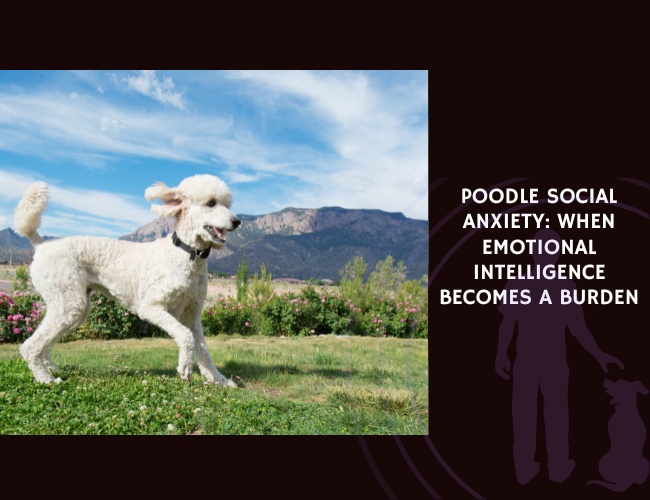
Have you ever watched your Poodle scan a room full of people or dogs with an intensity that seems almost human? That searching gaze, the subtle tension in their body, the way they seem to read every shift in energy around them—this isn’t just attentiveness. For many Poodles, this heightened awareness represents something deeper: a genetic gift that can become an emotional challenge when sensitivity lacks structure.
Poodles were bred to be our emotional partners, attuned to the smallest shifts in human mood and intention. But what happens when that extraordinary sensitivity meets an unpredictable social world? When your furry friend can detect stress, tension, and uncertainty in every interaction but doesn’t know how to filter or process what they’re receiving? This is the paradox of Poodle social anxiety: too much awareness paired with too little emotional framework.
Let us guide you through understanding why your intelligent, loving Poodle might struggle in social situations, and more importantly, how you can transform their sensitivity from a source of anxiety into a foundation for confident connection. 🧡
Genetic Predisposition: The Architecture of Emotional Sensitivity
Bred for Connection, Vulnerable to Overwhelm
The Poodle’s social anxiety doesn’t emerge from nowhere. It’s woven into their genetic design. Centuries of selective breeding prioritized emotional expressiveness, human attunement, and cooperative sensitivity. These dogs were developed to work closely with people, reading intentions and responding to subtle cues. But this genetic architecture comes with a vulnerability.
Research in emotional development reveals that the limbic system—crucial for learning, memory, and emotional regulation—can be profoundly shaped by early experiences and inherent sensitivities. When breeding amplifies emotional receptivity without corresponding emotional regulation mechanisms, you create a dog that’s essentially an emotional antenna without a filter.
Your Poodle’s brain is designed to notice everything: the tension in your shoulders, the shift in your tone, the subtle change in household energy. They process facial expressions, body language, and even chemical signals from stress hormones in human sweat. Studies on emotional perception show that heightened sensitivity to social cues—including the ability to detect fear and anxiety through smell—correlates with increased vulnerability to social stress.
Think of it this way: your Poodle has high-definition emotional reception but standard-definition processing capacity. They’re downloading more social and emotional data than their nervous system knows how to organize and interpret.
The Decoder Without a Manual
Here’s the fascinating paradox: Poodles excel at decoding emotions but struggle to regulate their own emotional responses. They can read your anxiety, detect your frustration, sense your excitement—but they often lack the internal framework to decide what to do with that information.
This creates a perpetual state of vigilance. Your Poodle becomes a scanner, constantly monitoring the emotional landscape but never quite settling into security. They’re asking questions their nervous system can’t answer: “Is this energy safe? Should I approach or retreat? What does this tension mean for me?”
In human anxiety research, we see similar patterns: individuals can be acutely aware of emotional stimuli yet struggle with regulating their responses. The awareness itself becomes the problem. For your Poodle, this means every social interaction carries cognitive load—a processing burden that can quickly tip into overwhelm.
Signs Your Poodle Is Processing Emotional Overload:
- Rapid scanning behavior with quick head movements between multiple stimuli
- Increased panting despite comfortable temperature and no recent physical exertion
- Yawning repeatedly in social situations (stress signal, not tiredness)
- Inability to settle or hold still, constant position shifting
- Excessive focus on you rather than exploring the environment
- Dilated pupils even in well-lit spaces
- Trembling or muscle tension visible in shoulders and hindquarters
- Refusal of high-value treats they normally love
Too Much Awareness, Not Enough Structure
The Burden of Over-Noticing
Does your Poodle seem to notice everything? The subtle shift in another dog’s posture, the nearly imperceptible change in your facial expression, the ambient tension in a crowded space? This “over-noticing” is both their gift and their challenge.
Sensory processing sensitivity creates a low filtering threshold. While other dogs might register basic social cues and move on, your Poodle is capturing high-resolution data from every interaction. They’re reading micro-expressions, detecting postural shifts, analyzing vocal tones, and processing olfactory emotional signals simultaneously.
But without a framework for interpretation, this data becomes noise. Imagine trying to learn a language by listening to ten conversations at once—you’d hear everything but understand nothing. That’s often the Poodle’s social experience: overwhelming input without clear meaning.
Common Sensory Triggers That Overwhelm Poodles:
- Loud, sudden vocalizations from other dogs (barking, whining, growling)
- Erratic movement patterns from energetic or poorly socialized dogs
- Direct staring or intense eye contact from humans or animals
- Crowded spaces with limited personal space (dog parks, pet stores, grooming salons)
- Strong scents from anxious dogs, unfamiliar animals, or novel environments
- Children’s unpredictable movements and high-pitched voices
- Approaching head-on rather than at an angle
- Multiple dogs approaching simultaneously from different directions
This over-noticing manifests in specific behaviors:
Hyper-vigilant scanning: Constant head movements, watching every person or dog in the environment Freeze responses: Sudden stillness when processing complex social information Decision paralysis: Hesitation at doorways, thresholds, or before approaching others Retreat behaviors: Backing away from interactions that contain too much ambiguous social data
When Sensitivity Becomes Insecurity
The crucial question becomes: what transforms sensitivity into social anxiety? The answer often lies in leadership clarity—or the lack of it.
Without confident emotional direction from their human, a sensitive Poodle must make decisions their nervous system isn’t equipped to handle. Should they greet that approaching dog? Is that stranger’s excited energy safe? How should they respond to the chaos of a busy dog park?
Research on early caregiving environments shows that consistent, clear guidance shapes emotional development profoundly. The same principle applies to your Poodle’s daily life. When emotional leadership is absent—when rules are unclear, tone is inconsistent, or guidance amounts to vague encouragement like “just be friendly”—your sensitive dog is forced into constant decision-making without a reliable framework.
This is where sensitivity curdles into insecurity. The NeuroBond approach recognizes that trust-based leadership provides the emotional scaffolding sensitive breeds need. Your Poodle doesn’t need you to solve every social situation for them, but they do need you to provide clear direction, calm energy, and consistent boundaries that give their sensitivity a structure to operate within.
Protective Factors That Prevent Sensitivity From Becoming Anxiety:
- Predictable daily routines that reduce ambient uncertainty
- Clear, consistent boundaries around acceptable and unacceptable behaviors
- Calm human energy that doesn’t mirror or amplify the dog’s stress
- Gradual, controlled exposure to social situations rather than flooding
- Regular mental enrichment that builds confidence outside social contexts
- Physical exercise that regulates nervous system arousal
- Safe spaces where your Poodle can retreat and decompress
- Patient humans who read and respect early stress signals
Attachment Dynamics: When Connection Becomes Dependence
The Anxious Attachment Pattern
Have you noticed your Poodle exhibiting these patterns?
Clinginess: Following you from room to room, unable to settle when you’re out of sight Hyper-vigilant watching: Staring at you intensely, monitoring your every move Shadowing behavior: Maintaining constant physical proximity, positioning themselves to always see you Sudden avoidance: Paradoxically withdrawing after seeking closeness, as if confused about their own needs
These behaviors point to anxious or ambivalent attachment—a pattern where proximity is used not for affection but for emotional anchoring and safety-seeking. Your Poodle isn’t simply being affectionate; they’re using your presence as a buffer against a world that feels unpredictable and overwhelming.
Attachment theory reveals that insecure bonding patterns emerge when the attachment figure (you) is inconsistent, emotionally unavailable, or inadvertently reinforces anxious behaviors. Research on loneliness and social isolation shows that perceived insecurity in relationships correlates with heightened depression, anxiety, and negative emotional states.
For your Poodle, this means every separation becomes a potential crisis. Every social interaction without your stabilizing presence feels risky. They’re not just bonded to you—they’re dependent on you for emotional regulation they haven’t developed internally.
Red Flags of Anxious Attachment in Your Poodle:
- Inability to eat, drink, or rest when you leave the room
- Destructive behavior that only occurs during separations
- Excessive vocalization (barking, whining, howling) when left alone
- Following you obsessively, even to the bathroom
- Showing distress when you prepare to leave (grabbing keys, putting on shoes)
- Refusing to engage with other family members in your absence
- Physical symptoms like drooling, pacing, or house soiling during separation
- Intense, frantic greeting behavior when you return, taking 20+ minutes to settle
- Refusal to go on walks or engage in activities without your presence
Emotional Antennas Without Buffers
Think of your Poodle as an emotional antenna, constantly receiving signals from the environment. They detect your stress when you’re running late, absorb tension during household conflicts, pick up on your performance anxiety before social events. They’re exquisitely attuned to emotional weather patterns.
But here’s the problem: detection without buffering leads to absorption. Your Poodle doesn’t just notice stress—they take it in, hold it, become it. Without internal mechanisms to process and release emotional input, they become repositories for ambient anxiety.
This is why your Poodle might seem more anxious than the situation warrants. They’re not only responding to the immediate environment; they’re carrying accumulated emotional residue from previous exposures. The Soul Recall framework recognizes that emotional memory in sensitive dogs runs deep—moments of overwhelm create lasting impressions that influence future responses.
The solution lies in teaching your Poodle regulated proximity. This means connection that doesn’t depend on constant physical contact, attachment that includes confident independence, and proximity that communicates security rather than feeding mutual anxiety.
Steps to Build Regulated Proximity and Reduce Anxious Dependence:
- Practice place training where your Poodle stays on a mat while you move around the room
- Reward calm behavior when you’re at distance, not just when you’re close
- Create brief separations during the day (going to another room for 5-10 minutes)
- Use baby gates to maintain visual connection while establishing physical boundaries
- Avoid making arrivals and departures emotionally charged events
- Teach your Poodle to settle independently during calm home time
- Engage other trusted family members in care routines to distribute attachment
- Celebrate your Poodle’s independent choices (exploring, chewing a toy alone)
Social Over-Attunement: The Mirroring Problem
Emotional Echoing and Social Confusion
Your Poodle’s social anxiety often stems from an extraordinary but problematic ability: emotional mirroring. They don’t just observe emotional states—they absorb and reflect them, sometimes without conscious control.
When you feel anxious about an upcoming social interaction with another dog owner, your Poodle reads your tension through posture, breathing patterns, vocal tone, and chemical signals. Then something fascinating and troubling happens: they begin to mirror that anxiety back to you. Your tension becomes their tension, which amplifies your concern, which intensifies their response—creating a feedback loop of escalating worry.
Research on emotional contagion demonstrates that emotional information transmits between individuals through multiple channels. For a dog as socially attuned as a Poodle, this contagion operates at high speed and intensity. They’re essentially emotional sponges in social situations.
This creates several challenges:
Confusion about emotional ownership: Your Poodle can’t distinguish between anxiety that originates within them versus anxiety they’ve absorbed from you or the environment
Social shutdown: When overwhelmed by conflicting or intense emotional signals, they may freeze, withdraw, or display displacement behaviors
Hypervigilance to human emotion: Rather than focusing on the actual social situation (like meeting another dog), they’re monitoring your emotional state for cues about how to feel
Loss of authentic response: Their genuine social preferences get buried under layers of mirrored emotion and reactive patterns
Displacement Behaviors That Signal Emotional Confusion:
- Sudden scratching when not actually itchy
- Excessive sniffing of the ground during tense social moments
- Shaking off (like they’re wet) when they’re completely dry
- Circling or spinning before settling into position
- Mounting behavior not driven by sexual motivation
- Zoomies or sudden bursts of manic energy followed by shutdown
- Obsessive licking of paws, objects, or surfaces
- Play bowing to defuse tension rather than initiate genuine play
Performance Pressure and Social Confidence
Here’s a counterintuitive reality: excessive praise and performance-based social engagement can increase your Poodle’s anxiety rather than building confidence.
When every social interaction comes loaded with excited encouragement—”Go say hi! Good dog! Be friendly!”—you’re inadvertently creating pressure. Your Poodle learns that social interactions aren’t just about their own comfort or genuine connection; they’re about meeting your expectations and earning your approval.
For a breed already prone to over-analyzing social situations, this performance framework adds another layer of stress. Now they’re not only trying to read the other dog’s intentions and manage their own uncertainty; they’re also monitoring whether they’re performing the interaction “correctly” for you.
Studies on experimental anxiety, particularly around performance situations, show that anticipatory pressure and evaluation concerns generate significant stress responses. When your social framing communicates urgency, excitement, or expectation, your sensitive Poodle interprets this as confirmation that the situation is indeed high-stakes and potentially risky.
The Invisible Leash principle offers a different approach: calm presence without pressure, direction without demands, support without performance requirements. This allows your Poodle to experience social situations through their own authentic response rather than through the filter of your expectations.
Examples of Problematic Social Framing to Avoid:
- “Go say hi! Be nice! Good boy!” (creates performance pressure)
- Pulling your Poodle toward other dogs or people
- Repeatedly encouraging interaction when your Poodle shows hesitation
- Making exaggerated excited sounds or movements near social opportunities
- Praising effusively for any social engagement (implies it’s remarkable rather than normal)
- Expressing disappointment or frustration when your Poodle avoids interaction
- Comparing your Poodle to more socially confident dogs
- Creating an audience for social interactions (inviting others to watch)
Behavioral Expressions: Reading the Anxiety Signals
The Language of Social Discomfort
Your Poodle’s social anxiety speaks through their body long before it escalates to obvious avoidance or reactivity. Learning to read these early signals helps you intervene before overwhelm becomes shutdown.
Early warning signs:
Tongue flicks and lip licking: Brief, rapid tongue flicks indicate processing stress, not thirst Whale eye: Showing the whites of their eyes while tracking movement peripherally Ear position changes: Ears pulled back or pinned, especially with a tense forehead Tail tucking or stillness: The absence of a relaxed wag, tail held low or tucked Slow-motion movement: Approaching or moving in exaggerated slow motion, indicating uncertainty Sniffing patterns: Sudden, intense ground sniffing as a displacement behavior to avoid social engagement
Escalated anxiety behaviors:
Freezing: Complete stillness, often mistaken for calm but actually indicating processing overload Behind-the-legs positioning: Hiding behind your legs or positioning you between themselves and the perceived stressor Leash tension and pulling: Attempting to increase distance from the trigger Barking or lunging: Often a last-resort behavior when earlier signals have been ignored Submissive urination: Extreme appeasement gesture indicating overwhelming stress
Post-Exposure Stress Indicators (Signs Your Poodle Needs Recovery Time):
- Taking longer than 15 minutes to settle after returning home
- Refusing food or water for several hours after social exposure
- Excessive sleeping or lethargy following social situations
- Increased startle response to normal household sounds
- Avoidance of areas or activities they normally enjoy
- Digestive upset (diarrhea, vomiting) within 24 hours of stressful event
- Increased clinginess or shadowing behavior in the days following exposure
- Withdrawal from family members or usual routines
Environmental Triggers and Context Sensitivity
Not all social situations challenge your Poodle equally. Understanding which environments amplify anxiety helps you make strategic choices about exposure and training.
High-stress social environments:
Dog cafés and busy playgroups: Chaotic, unpredictable movement with multiple unfamiliar dogs and high ambient energy creates sensory overload for sensitive Poodles
Fast-moving social settings: Environments where interactions happen quickly without time for assessment trigger decision paralysis
Confined spaces with multiple dogs: Indoor settings with limited escape routes amplify feeling trapped and increase vigilance
Performance contexts: Training classes, competitions, or social gatherings where your Poodle senses evaluation pressure
Lower-stress social opportunities:
Parallel walking: Side-by-side movement with another calm dog at distance, no forced face-to-face interaction
Open spaces with clear exit routes: Environments where your Poodle can choose distance and maintain control over proximity
One-on-one interactions with familiar, calm dogs: Predictable social partners reduce the processing load
Structured activities with clear roles: Scent work, trick training, or cooperative games that provide social connection through activity rather than ambiguous “play”
The physical environment matters profoundly. Open spaces can provide freedom but also increase scanning burden—your Poodle must monitor threats from all directions. Confined spaces reduce scanning demands but can trigger claustrophobia if an interaction goes poorly. Finding the right balance for your individual dog requires careful observation and gradual experimentation.
Characteristics of Ideal Social Partners for Anxious Poodles:
- Calm, stable energy with predictable body language
- Gentle greeting style (approaching at an angle, offering space)
- Similar size or slightly smaller to reduce intimidation
- Well-socialized with excellent bite inhibition and social skills
- Tolerant of anxious behavior without becoming pushy or overwhelmed
- Preference for parallel activities (walking, sniffing) over face-to-face intensity
- Handlers who understand sensitive dogs and won’t take avoidance personally
- Dogs who naturally offer calming signals (play bows, turning away, sniffing ground)
Aware. Unfiltered. Overwhelmed.
Sensitivity without structure. Poodles feel more than most breeds, perceiving emotional shifts with uncanny precision—but without a framework to interpret them, awareness becomes tension instead of connection.
Anxiety born from vigilance. Their high-definition emotional reception keeps them scanning, decoding, and anticipating, often unable to settle—because the mind never stops listening.

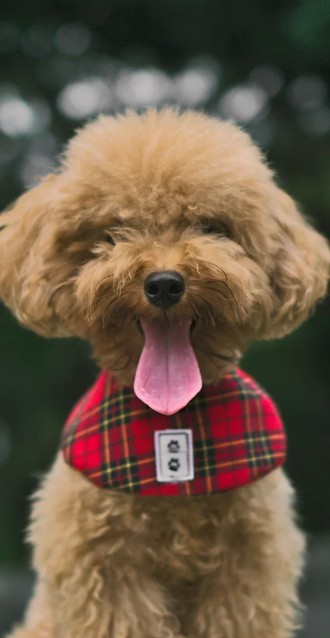

Connection needs grounding. When emotional intelligence lacks boundaries, even kindness feels heavy. True confidence emerges not from sensing everything, but from knowing what to let go.
Human Influence: How Leadership Shapes Anxiety
The Accidental Reinforcement Pattern
You love your Poodle. When you see them anxious, your instinct is to comfort, reassure, and help. But here’s the painful truth: many well-intentioned human behaviors inadvertently reinforce anxiety rather than building security.
Anxiety-reinforcing patterns:
Over-comforting during stress: When you respond to your Poodle’s anxiety with heightened soothing—rushing to pet them, speaking in a high, concerned voice, picking them up—you’re inadvertently confirming that their concern is justified. Your emotional intensity signals: “Yes, this situation is indeed dangerous.”
Micromanaging social interactions: Constantly intervening, redirecting, or narrating social encounters prevents your Poodle from developing their own assessment and coping skills
Excited social framing: Approaching dog interactions with high energy and enthusiastic encouragement creates pressure and communicates that something significant is about to happen
Inconsistent boundaries: Allowing social interaction one day but pulling your Poodle away the next creates confusion about what’s safe and appropriate
Feeding mutual anxiety: Your own worry about how your Poodle will respond becomes a self-fulfilling prophecy as they mirror your concern
Common Verbal Reassurance Mistakes That Reinforce Anxiety:
- “It’s okay, it’s okay, it’s okay” repeated in a worried, high-pitched tone
- Excessive talking when your Poodle shows stress (silence is often more calming)
- Using your Poodle’s name repeatedly in an anxious voice
- Asking questions they can’t answer (“Are you scared? What’s wrong?”)
- Apologizing to other dog owners for your Poodle’s anxious behavior
- Narrating the situation (“Look, it’s just a nice dog, see?”)
- Trying to convince your Poodle they shouldn’t be anxious
- Making promises you can’t keep (“Nothing bad will happen”)
Research on caregiving and emotional development consistently shows that the caregiver’s emotional regulation profoundly influences the dependent individual’s developing nervous system. When you’re emotionally dysregulated—anxious, frustrated, or unpredictable—your Poodle lacks the stable reference point they need to build security.
🧠 Poodle Social Anxiety Management Guide 🐩
From Emotional Overwhelm to Confident Connection: A Progressive Framework
Phase 1: Recognition & Assessment
Understanding Your Poodle’s Anxiety Profile
🧬 The Genetic Foundation
Poodles were bred for emotional attunement and human partnership. This heightened sensitivity creates extraordinary bonds but also vulnerability to overwhelm. Their limbic system processes more social data than their nervous system can easily regulate, creating the foundation for anxiety patterns.
⚠️ Early Warning Signs
• Hyper-vigilant scanning with rapid head movements
• Whale eye (showing whites) while tracking stimuli
• Excessive tongue flicks and lip licking
• Freeze responses in social situations
• Behind-the-legs positioning or shadowing behavior
• Slow-motion movement indicating uncertainty
📋 Create Your Anxiety Journal
Document specific triggers, threshold distances, environmental factors, and your own emotional state. Track time of day, recovery duration, and what interventions help. This detailed assessment prevents one-size-fits-all approaches and reveals your Poodle’s unique anxiety fingerprint.
Phase 2: Self-Regulation Foundation
Building Your Own Emotional Clarity First
🎯 The Leadership Truth
Your Poodle cannot develop confidence if your own energy remains anxious or unpredictable. Through the NeuroBond approach, you become the emotional anchor—providing calm stability that allows your sensitive dog to observe without absorbing. Your nervous system regulation directly influences theirs.
💪 Daily Leadership Practice (Weeks 1-4)
• Grounded walking in non-triggering environments
• Shoulders back, slow breathing, relaxed hands
• Regulated proximity exercises at home
• Clear communication signals for direction changes
• Mat training while you move around
• Consistent energy baseline across all situations
❌ Avoid These Anxiety Reinforcers
“It’s okay, it’s okay” in worried, high-pitched tone • Over-comforting during stress • Micromanaging interactions • Excited social framing • Pulling toward triggers • Expressing disappointment when they avoid • Your own visible anxiety about their response
Phase 3: Observation Without Interaction
Learning to See Without Engaging
🌟 The Power of Passive Exposure
Your Poodle doesn’t need to interact to build confidence—they need to observe from safety. Position at distances where they can see dogs or people without triggering stress. Your completely neutral energy teaches: “Yes, I see that too. It’s just information. We’re observing, not engaging.”
🎓 Observation Protocol (Weeks 5-8)
• Sit where social stimuli are visible but distant
• Start with 3-5 minute sessions, build to 15-20 minutes
• Maintain steady, calm breathing throughout
• No asking for attention or interaction
• Walk away calmly in different direction to end
• Practice at outdoor cafés, training class perimeters, park edges
📊 Success Indicators
Soft body language with loose muscles • Accepts treats readily • Brief glances at triggers then looks away naturally • Shows curiosity about environment • Recovers quickly from startle (under 5 seconds) • Maintains normal appetite and sleep patterns
Phase 4: Controlled Proximity Building
Decreasing Distance While Maintaining Calm
🎯 The Invisible Leash Principle
True leadership isn’t about physical control—it’s about energetic clarity. When you embody calm certainty through purposeful movement and grounded presence, your Poodle learns to be near social stimuli without reactive behavior. Awareness, not tension, guides the path.
🔄 Parallel Walking Protocol (Weeks 9-16)
• Walk side-by-side with calm, well-matched dogs
• Start beyond threshold distance, gradually decrease
• No face-to-face interaction required
• Your focus stays on direction, not your dog’s reaction
• Brief structured greetings only when consistently calm
• Keep interactions 3-5 seconds, end before arousal increases
🎒 Essential Walk Tools
High-value treats (real meat, cheese) • 6-8 foot leash for positioning choice • Comfortable harness • Water and collapsible bowl • Treat pouch at your side • Mental map of escape routes • Calm mindset with realistic expectations
Phase 5: Environmental Management
Creating an Anxiety-Reducing Home Base
🛡️ The Safe Space Concept
Anxious Poodles need designated calm spaces where their nervous system can downregulate. This isn’t isolation—it’s providing retreat zones where social stimulation is minimal and predictability is high. A stable home environment allows confidence building to progress.
🏡 Home Environment Essentials
• Designated quiet room away from windows
• White noise machine or calming music
• Elevated resting spots for safe observation
• Consistent furniture arrangement
• Regular daily schedule for meals, walks, rest
• Calm entry/exit protocols
• Limited or structured guest introductions
🧩 Non-Social Enrichment
Nose work and scent games • Food puzzle toys • Trick training in quiet spaces • Snuffle mats • Frozen Kong treats • Interactive dispensing toys • Cardboard destruction activities • “Find it” games with hidden objects
Phase 6: Emotional Memory Rewriting
Building Positive Associations Through Soul Recall
💫 Understanding Emotional Imprinting
Your Poodle doesn’t just remember events—they remember emotional states. Through Soul Recall principles, we recognize that negative emotional memories often outweigh positive ones in sensitive dogs. Each calm, successful experience creates deposits in the positive memory account, gradually shifting their default response.
✨ Memory-Building Activities
• Sitting at outdoor cafés with dogs at comfortable distance
• Parallel walking behind calm dogs without interaction
• Watching training classes from outside the fence
• Pet-friendly stores during quiet hours
• Car rides to locations with visible but distant dogs
• Structured activities in presence of calm, known dogs
⏱️ The Consistency Factor
Progress requires patience. Every calm observation session—even without direct interaction—creates neural pathway changes. With consistent positive experiences over weeks and months, your Poodle’s brain begins defaulting to “social situations can be safe” rather than “potentially threatening.”
Phase 7: Flexible Social Confidence
Allowing Choice Within Structure
🎭 From Control to Guidance
At this stage (Week 17+), your Poodle has the foundation to make some social choices within the framework you’ve established. They can indicate interest in interaction, but you still control distance, duration, and exit strategy. This builds authentic social preferences rather than compliance or avoidance.
🎯 Graduated Exposure Guidelines
• Allow your Poodle to indicate social interest
• You determine if the situation is appropriate
• Control all parameters: distance, duration, exit
• Gradually introduce more complex environments
• Maintain escape routes and distance options
• Celebrate choices without creating performance pressure
🔄 Managing Setbacks
Confidence building is non-linear. Expect setbacks during adolescence, household changes, or after overwhelming experiences. The difference now is you have tools to manage setbacks without reinforcing anxiety. Return to earlier phases temporarily, rebuild, and progress again.
Phase 8: Long-Term Maintenance
Sustaining Progress and Preventing Regression
🔄 Lifelong Practice
Social anxiety management isn’t a destination—it’s an ongoing practice. Your Poodle will always be sensitive; that’s their nature. The goal is ensuring sensitivity remains a gift rather than reverting to a burden. This requires consistent maintenance of the frameworks you’ve built.
💪 Ongoing Maintenance Practices
• Continue foundation skills even after improvement
• Maintain routines during household changes
• Respect limits on difficult days
• Celebrate small wins without pressure
• Stay alert to early warning signs
• Adjust expectations during transitions
• Reinforce calm behavior regularly
🚨 When to Seek Professional Help
If anxiety escalates despite consistent work • Aggressive displays emerge • Physical symptoms develop • Anxiety generalizes to multiple areas • Your stress becomes overwhelming • Quality of life significantly impaired → Consult a force-free behaviorist or veterinary behaviorist
🔍 Comparing Social Anxiety Across Different Contexts
Standard vs. Toy/Miniature Poodles
Standard Poodles: Larger physical presence can mask anxiety; tend toward general environmental overwhelm; respond well to structured physical activities; need more space for decompression.
Toy/Miniature: More visibly reactive; specific trigger sensitivity; easily overwhelmed by size differences; benefit from careful partner matching; require extra environmental management.
Puppy vs. Adult Onset Anxiety
Puppy Onset: Often socialization-gap related; highly responsive to progressive exposure; neural plasticity advantage; prevention easier than treatment; critical period sensitivity.
Adult Onset: Usually trauma-triggered; deeper emotional memory patterns; requires patience and regression acceptance; may need professional support; longer timeline for progress.
Dog-Directed vs. Human-Directed Anxiety
Dog-Directed: Usually poor early experiences with dogs; benefits from careful partner selection; parallel walking highly effective; needs distance management; responds to calm dog models.
Human-Directed: Often over-handling or inconsistent human behavior; requires human leadership clarity; less about exposure, more about your regulation; attachment work essential.
Mild vs. Severe Social Anxiety
Mild: Shows hesitation but recovers quickly; accepts treats during exposure; maintains soft body; responds to home management alone; 8-12 week improvement timeline.
Severe: Refuses food, freezes, or shows aggression; physical symptoms present; generalized to multiple contexts; requires professional intervention; may benefit from medication support; 6-12 month timeline minimum.
Outdoor vs. Indoor Social Stress
Outdoor Settings: More escape routes reduce anxiety; increased scanning burden from 360° threats; distance management easier; weather/environmental variables; benefits from structured walks.
Indoor Settings: Confined spaces increase stress; limited exits trigger claustrophobia; sound amplification issues; closer forced proximity; requires careful environment selection.
Single Dog vs. Multi-Dog Households
Single Dog: Undivided human attention; easier to manage; clearer communication; less ambient stress; potentially over-attached; benefits from individual protocols.
Multi-Dog: May mirror other dogs’ anxiety; resource guarding complications; provides social modeling opportunities; complex household dynamics; requires individual work plus pack management.
⚡ Quick Reference: Social Anxiety Management Formula
Your Emotional Regulation + Predictable Structure + Distance Management + Passive Observation Time = Confident Poodle
Timeline Guideline:
• Weeks 1-4: Foundation (Your regulation)
• Weeks 5-8: Observation practice (No interaction)
• Weeks 9-16: Controlled proximity (Parallel walking)
• Week 17+: Flexible confidence (Guided choices)
Daily Minimum: 15 minutes grounded walking + 10 minutes mat training + consistent calm energy across all interactions
🧡 The Zoeta Dogsoul Approach to Poodle Social Anxiety
Your Poodle’s sensitivity isn’t a flaw—it’s the foundation of extraordinary connection. Through NeuroBond principles, we recognize that trust-based leadership provides the emotional scaffolding sensitive breeds need. Your calm, grounded presence becomes their security, transforming overwhelm into observation. The Invisible Leash teaches us that awareness, not tension, guides the path—your energetic clarity matters more than any physical control. And through Soul Recall, we honor how deeply emotional memory shapes behavior, building positive experiences that gradually rewrite anxious patterns. This is the essence of transforming sensitivity from burden to gift: providing the structure that allows emotional intelligence to flourish without overwhelm. Your Poodle doesn’t need to change who they are—they need you to be the anchor that makes their sensitivity safe.
© Zoeta Dogsoul – Where neuroscience meets soul in dog training
The Leadership Clarity Solution
What does effective emotional leadership look like for an anxious Poodle? It’s not about dominance, control, or force. It’s about providing the calm, clear structure that allows sensitivity to become strength rather than vulnerability.
Grounded leadership principles:
Emotional neutrality during stress: When your Poodle shows anxiety, your response should be matter-of-fact and calm, not heightened concern or excitement
Spatial awareness and direction: Use your body positioning and movement to guide situations, creating buffer zones and controlling approach distance without verbal fuss
Consistent communication framework: Your tone, energy, and expectations remain stable across contexts so your Poodle can predict and trust your guidance
Confident decision-making: You make the calls about social engagement—whether to approach, how long to stay, when to leave—removing that burden from your Poodle’s overwhelmed processing system
Calm presence over verbal reassurance: Your steady breathing, relaxed posture, and grounded energy communicate safety more effectively than any amount of “It’s okay, you’re fine”
The Invisible Leash approach recognizes that true leadership isn’t about physical control—it’s about energetic clarity. When you embody calm certainty, your Poodle can observe social situations without absorbing them. They can be sensitive without being overwhelmed because your stability provides the container their sensitivity needs.
This doesn’t mean avoiding all social situations. It means approaching them strategically, with you as the emotional anchor rather than as another variable your Poodle must monitor and manage.
Body Language Elements That Communicate Calm Leadership:
- Shoulders back and down, not hunched forward with tension
- Slow, deep breathing from your diaphragm (your Poodle feels this through the leash)
- Soft eyes and relaxed facial muscles (avoid staring intensely at triggers)
- Grounded weight through your feet, not bouncing or fidgeting
- Smooth, purposeful movements rather than jerky or hesitant gestures
- Neutral or slightly positive facial expression, not worried frown
- Head up and forward rather than constantly looking down at your dog
- Relaxed hands and arms, especially your leash-holding hand
NeuroBond Regulation: Transforming Sensitivity into Stability
From Analysis Overload to Secure Observation
The goal isn’t to eliminate your Poodle’s sensitivity—that’s both impossible and undesirable. Their emotional attunement is part of their beauty, their bond with you, their essential nature. The goal is to give that sensitivity a supportive framework that prevents overwhelm.
The NeuroBond approach to social anxiety operates on several key principles:
Emotional clarity over verbal instruction: Your internal state matters more than your words. A calm, confident emotional baseline provides your Poodle with a secure reference point. They can check in with you energetically and receive the message: “This situation is manageable. I’ve got this. You’re safe.”
Predictable structure reduces scanning: When your Poodle knows what to expect—you always walk the same way, respond to triggers consistently, maintain steady energy—their nervous system can relax its vigilant monitoring. Predictability doesn’t mean boring; it means reliable.
Directional walking and spatial management: The way you move through space communicates volumes. Purposeful, grounded walking with clear direction signals calm leadership. Hesitant, reactive movement amplifies anxiety. This is where Invisible Leash principles transform daily walks from potential stress into confidence-building practice.
Regulated proximity builds independence: Teaching your Poodle to remain calm at varying distances from you—sometimes close, sometimes across the room—develops their capacity for self-regulation. They learn: “I can feel secure even when I’m not physically touching my person.”
Practical Implementation: Building the Framework
Let’s translate these principles into specific practices you can implement immediately:
The Calm Approach Protocol:
When approaching a potential social situation (another dog, group of people, new environment), your energy and movement pattern set the template for your Poodle’s response.
Start by grounding yourself—feel your feet on the ground, take a deep breath, drop your shoulders. Your body should communicate: “I’m assessing this situation, and I’m calm.”
Move at a steady, purposeful pace—not rushing forward or hanging back hesitantly. Your walking speed should be consistent.
Keep your leash hand relaxed—tension in the leash creates tension in your Poodle’s nervous system. A soft leash communicates trust.
Make the decision—decide whether to approach, maintain distance, or redirect. Don’t ask your Poodle to choose when they’re already overwhelmed with processing data.
The Buffer Zone Exercise:
Sensitive Poodles need practice maintaining comfortable social distance without reactive behavior.
Identify your Poodle’s threshold distance—how close can they get to another dog or person before showing stress signals? This is your starting point.
Practice parallel walking at a distance beyond that threshold. You and your Poodle walk parallel to another dog and handler, maintaining that comfortable distance.
Your focus should be on your own direction and pace, not on your Poodle’s reaction. This communicates that you’re handling the situation; they don’t need to.
Gradually decrease distance over multiple sessions, but only when your Poodle can maintain a relaxed body at the current distance.
The Observation Without Absorption Practice:
This exercise helps your Poodle learn to notice social stimuli without internalizing the associated anxiety.
Position yourselves where your Poodle can observe dogs or people from a comfortable distance—far enough that they’re alert but not stressed.
Sit or stand with completely neutral energy. You’re not asking your Poodle to interact, perform, or even pay attention to you. You’re simply being present together.
When your Poodle looks at the social stimulus, you maintain steady, calm breathing and relaxed posture. You’re modeling: “Yes, I see that too. It’s just information. We’re observing, not engaging.”
After a few minutes, calmly walk away in a different direction. You’re teaching that social observation doesn’t always lead to interaction, and that walking away is a confident choice, not a fearful retreat.
Essential Tools for Confidence-Building Social Walks:
- High-value treats that are truly special (real meat, cheese, not regular kibble)
- Longer leash (6-8 feet) that allows your Poodle some choice in positioning
- Water bottle and collapsible bowl for breaks during observation sessions
- Treat pouch worn at your side for easy, calm reward delivery
- Comfortable harness that doesn’t restrict breathing during stress
- Mental note of escape routes and distance-increasing options at every location
- Your phone to track session duration (start short, build gradually)
- Calm mindset and realistic expectations (progress is slow and non-linear)
The Role of Physical Structure
Physical structure—not just emotional grounding—plays a crucial role in managing social anxiety. The way you organize your Poodle’s environment and daily routine creates a foundation for emotional stability.
Designated calm spaces: Create areas in your home where social stimulation is minimal. This isn’t isolation; it’s providing your Poodle with a retreat where their nervous system can downregulate without constant social input.
Structured rest periods: Anxious Poodles often struggle to settle because their scanning behavior prevents relaxation. Implementing mat training or crate protocols that signal “this is rest time” helps their nervous system learn to power down.
Predictable daily rhythm: Wake time, walk time, meal time, rest time—maintaining a consistent schedule reduces ambient anxiety because your Poodle’s brain isn’t constantly trying to predict what happens next.
Controlled social exposure: Rather than random social interactions determined by circumstance, create intentional social opportunities where you control the variables—the distance, duration, and intensity of engagement.
Elements of an Anxiety-Reducing Home Environment:
- Designated quiet room or crate area away from windows and main traffic
- White noise machine or calming music to buffer external sounds
- Elevated resting spots where your Poodle can observe safely
- Consistent furniture arrangement (changes increase scanning behavior)
- Minimal visual stimulation from windows during high-traffic times
- Regular household schedule for meals, walks, and rest periods
- Calm entry and exit protocols (no excited greetings that spike arousal)
- Limited guest visits or structured introductions when visitors come
Through the NeuroBond framework, that sensitivity transforms from a liability into an asset. Your Poodle’s emotional awareness becomes the foundation of your deepest bond, their capacity to read you becomes a source of secure connection rather than anxious monitoring. 🧠
The Neuroscience of Canine Social Anxiety
Understanding the Limbic System and Emotional Processing
To truly help your Poodle, it helps to understand what’s happening in their brain during social anxiety episodes. The limbic system—particularly structures like the amygdala and hippocampus—plays a central role in processing emotions, forming memories, and regulating responses to social stimuli.
Research in affective neuroscience reveals that when the FEAR system activates without adequate safety signals or emotional inhibition, it creates a state of sustained vigilance and over-analysis. For your Poodle, this means their threat-detection system is constantly active, scanning for danger even in benign social situations.
The challenge intensifies because the same structures that process fear also handle social bonding and attachment. When these systems become dysregulated, your Poodle struggles to distinguish between genuine threats and neutral social information. Everything becomes potentially significant; nothing can be dismissed as irrelevant.
Neurochemical Factors Contributing to Social Anxiety:
- Elevated cortisol levels from chronic stress affecting brain development
- Insufficient serotonin production impacting mood regulation
- Overactive norepinephrine response creating sustained vigilance
- Dysregulated dopamine pathways affecting motivation and reward processing
- Oxytocin system dysfunction reducing social bonding comfort
- GABA deficiency decreasing nervous system’s ability to calm
- Heightened adrenaline sensitivity creating exaggerated startle responses
- Inflammatory markers that can influence behavior and emotional processing
Studies on sensory processing sensitivity suggest that some individuals—human and canine—have nervous systems with lower filtering thresholds. They receive more sensory and emotional input than others, and their brains take longer to categorize and dismiss irrelevant stimuli. For a Poodle, this means every social encounter generates more data to process, more uncertainty to resolve, and more potential for overwhelm.
Cognitive Bias and Pessimistic Social Interpretation
Here’s where it gets particularly challenging: anxious brains develop cognitive biases that reinforce anxiety. Your Poodle, when faced with ambiguous social signals, tends toward pessimistic interpretation.
That approaching dog with neutral body language? An anxious Poodle might interpret it as potentially threatening. That stranger extending a hand? Possibly risky. That group of dogs playing in the distance? Overwhelming and potentially dangerous.
Research on cognitive bias in anxiety shows that individuals under emotional stress exhibit threat interpretation patterns—they see danger where others see neutrality. For your Poodle, this means their social world becomes progressively more threatening as their anxiety deepens, creating a self-reinforcing cycle.
This is why exposure alone rarely solves social anxiety. Simply putting your Poodle in more social situations doesn’t teach their brain to interpret those situations more optimistically. Without addressing the underlying cognitive bias and providing emotional regulation tools, exposure can actually reinforce anxiety by confirming their pessimistic predictions.
Examples of Pessimistic Social Interpretation in Anxious Poodles:
- Neutral dog sniffing = potential threat rather than normal greeting behavior
- Direct human approach = invasion rather than friendly interaction
- Play invitation from another dog = forced confrontation rather than opportunity
- Environmental noise (cars, bikes) = imminent danger rather than background stimulus
- Unfamiliar location = unpredictable threat zone rather than exploration opportunity
- Other dogs’ excitement = aggression warning rather than enthusiasm
- Owner’s absence = permanent abandonment rather than temporary separation
- Novel social situation = guaranteed failure rather than learning opportunity
Emotional Memory and the Soul Recall Principle
One of the most significant challenges in addressing Poodle social anxiety involves emotional memory. Your Poodle doesn’t just remember events; they remember the emotional states associated with those events. And in sensitive dogs, negative emotional memories often carry more weight than positive ones.
A single overwhelming experience at a dog park can create an emotional imprint that influences your Poodle’s response to all dog parks—or even to all dogs—for months or years afterward. This is the essence of Soul Recall: the way emotional memory shapes present behavior.
Research on social stress and emotional memory demonstrates that stressful experiences can impair emotional processing and create lasting changes in how similar situations are perceived. For your Poodle, this means that building confidence isn’t just about positive experiences; it’s about creating new emotional memories that are powerful enough to compete with and eventually override those early negative imprints.
This is why consistency matters so profoundly. Every calm, successful social observation (not even interaction—just observation) creates a small deposit in the positive emotional memory account. Over time, with enough consistent positive experiences, the balance shifts. Your Poodle’s brain begins to default to “social situations can be safe” rather than “social situations are potentially threatening.”
Activities That Build Positive Emotional Memory Without Overwhelming:
- Sitting quietly at outdoor cafés where dogs pass at a comfortable distance
- Parallel walking behind or beside calm dogs without direct interaction
- Watching puppy classes or training sessions from outside the fence
- Attending low-key events where social interaction is optional
- Visiting pet-friendly stores during quiet hours with minimal crowds
- Practicing calm behaviors near (not with) other dogs at the veterinarian
- Car rides to locations with dogs visible but at safe distances
- Structured training activities in the presence of calm, known dogs
Building a Long-Term Anxiety Management Strategy
Assessment: Know Your Individual Poodle
Before implementing any anxiety management protocol, you need a clear understanding of your individual dog’s specific triggers, thresholds, and patterns.
Create an anxiety profile by documenting:
Specific triggers: Not just “other dogs” but which types of dogs, in which contexts, at which distances
Environmental factors: Time of day, location types, weather conditions, ambient noise levels that influence anxiety
Progression patterns: Does anxiety escalate gradually or trigger suddenly? How long does it take for your Poodle to recover after an anxious episode?
Success factors: When has your Poodle handled social situations well? What variables were different?
Your influence: How does your own emotional state, energy level, and focus affect your Poodle’s anxiety?
Tracking Questions for Your Anxiety Journal:
- What was the specific trigger? (Be detailed: “black Lab, male, intact, approached head-on”)
- What was the distance when anxiety first appeared?
- What time of day did the incident occur? (Morning vs. evening energy differs)
- How long had it been since your Poodle’s last meal or exercise?
- What was your emotional state before and during the encounter?
- What early warning signs appeared before obvious anxiety behaviors?
- How long did it take your Poodle to recover to baseline calm?
- What intervention (if any) helped de-escalate the situation?
This detailed assessment prevents the one-size-fits-all approach that often fails with sensitive dogs. Your Standard Poodle with a history of poor socialization needs a different protocol than your Toy Poodle who developed anxiety after a single negative encounter.
The Progressive Exposure Framework
Once you understand your Poodle’s specific profile, implement a progressive exposure framework that builds confidence gradually without triggering overwhelm.
Phase 1: Foundation Building (Weeks 1-4)
Focus entirely on building your own emotional regulation and leadership clarity. Your Poodle cannot develop confidence if your own energy remains anxious or unpredictable.
Practice calm, grounded walking in non-triggering environments. Your goal is to establish a movement pattern and energy baseline that communicates stability.
Implement regulated proximity exercises at home—teaching your Poodle to remain calm at varying distances from you.
Establish clear communication signals for direction changes, stops, and movement initiation. Consistency in these basic interactions creates the foundation for trust.
Daily Foundation-Building Practices (10-15 Minutes Each):
- Structured decompression walks in quiet areas with minimal triggers
- Mat training where your Poodle settles while you move around
- Hand-feeding meals to build calm focus and impulse control
- Threshold exercises (waiting calmly before going through doors)
- Name recognition training with immediate reward for attention
- Touch and release exercises building consent-based handling
- Calm settle protocols after any arousing activity
- Evening routine that signals nervous system downregulation
Phase 2: Observation Without Interaction (Weeks 5-8)
Begin exposing your Poodle to social stimuli from safe distances where they can observe without engaging or becoming overwhelmed.
Practice the observation without absorption protocol regularly—sitting quietly where dogs or people are visible but at a distance that allows your Poodle to remain below threshold.
Increase exposure duration gradually. Start with just a few minutes, building up to 15-20 minute observation sessions.
Vary the locations but maintain the protocol—you’re teaching your Poodle that social observation is safe across different contexts.
Phase 3: Controlled Proximity (Weeks 9-16)
Gradually decrease distance to social stimuli while maintaining your Poodle’s calm state.
Use parallel walking with calm, well-matched dogs. The key is non-interactive social proximity—your Poodle learns they can be near other dogs without engaging directly.
Introduce brief, structured greetings only when your Poodle shows consistent calm at close proximity. Keep these interactions short—3-5 seconds—and end before arousal increases.
Continue prioritizing distance management over interaction. The goal is building your Poodle’s confidence in their ability to be near social stimuli, not forcing social engagement.
Signs Your Poodle Is Ready to Progress to the Next Phase:
- Maintains soft body language (loose muscles, relaxed tail) at current distance
- Shows curiosity or interest in the environment rather than fixed staring
- Accepts treats readily without frantic or distracted behavior
- Recovers quickly (under 5 seconds) when briefly startled
- Checks in with you calmly rather than seeking reassurance desperately
- Chooses to look at triggers briefly then look away on their own
- Shows playful or exploratory behavior after exposure sessions
- Sleeps well and maintains normal appetite between sessions
Phase 4: Flexible Social Confidence (Weeks 17+)
Now your Poodle has the foundation to make some of their own choices within the framework you’ve established.
Allow your Poodle to indicate interest in social interaction, but you still control the parameters—distance, duration, and exit strategy.
Gradually introduce more complex social environments, but always maintain escape routes and the ability to increase distance quickly if needed.
Remember that confidence building is non-linear. Your Poodle will have setbacks. The difference now is that you have the tools to manage those setbacks without reinforcing anxiety patterns.
Lifestyle Adjustments for Long-Term Success
Managing social anxiety isn’t just about training protocols. It requires lifestyle adjustments that support your Poodle’s emotional regulation on a daily basis.
Mental enrichment that doesn’t involve social stress: Sensitive Poodles need cognitive engagement, but social interaction shouldn’t be their only source of stimulation. Scent work, puzzle toys, and trick training provide mental exercise without social pressure.
Non-Social Mental Enrichment Activities for Anxious Poodles:
- Nose work games (hiding treats around the house or yard)
- Food puzzle toys that require problem-solving
- Trick training in a quiet, familiar environment
- “Find it” games using toys or scented objects
- Cardboard box destruction activities
- Frozen enrichment treats (Kong stuffed with wet food)
- Snuffle mats that engage natural foraging instincts
- Interactive treat-dispensing toys that reward persistence
Physical exercise with emotional regulation: Your Poodle needs physical activity, but chaotic play sessions or overstimulating dog park visits might undermine their emotional stability. Prioritize structured activities like hiking, swimming, or solo fetch sessions that provide physical outlets without social overwhelm.
Dietary considerations: Emerging research suggests that gut health and nutritional factors can influence anxiety levels. While diet alone won’t solve social anxiety, ensuring your Poodle receives optimal nutrition supports overall nervous system health.
Rest and recovery: Anxious dogs often struggle with true rest. Create an environment that encourages downtime—quiet spaces, calming protocols, and respect for your Poodle’s need to decompress after social exposure.
Consistent household energy: The humans in your home set the emotional temperature. Households with high drama, inconsistent boundaries, or ambient tension make it nearly impossible for a sensitive Poodle to develop confidence. Creating a calmer home environment benefits everyone, not just your anxious dog.
Maintaining Long-Term Progress and Preventing Regression:
- Continue practicing foundation skills even after seeing improvement
- Maintain consistent routines during times of household change or stress
- Respect your Poodle’s limits on difficult days rather than pushing through
- Celebrate small wins without creating performance pressure
- Stay alert to early warning signs before anxiety escalates
- Adjust expectations during adolescence, illness, or major life transitions
- Keep reinforcing calm behavior, not just correcting anxious reactions
- Remember that progress isn’t linear—setbacks are part of the journey
When to Seek Professional Support
Recognizing the Limits of Self-Guided Management
While many cases of Poodle social anxiety respond beautifully to the approaches outlined here, some situations require professional intervention. Knowing when to seek help prevents anxiety from deepening into more serious behavioral issues.
Consider professional support if:
Your Poodle’s anxiety is escalating despite consistent implementation of management strategies
Social anxiety has progressed to aggressive displays—lunging, snapping, or biting
Your Poodle is experiencing such severe stress that they’re showing physical symptoms like digestive issues, skin problems, or weight loss
Anxiety has generalized beyond social situations to include separation anxiety, noise phobias, or global fearfulness
You find yourself becoming increasingly stressed, frustrated, or hopeless about the situation
Your Poodle’s quality of life is significantly impaired—they can’t enjoy walks, interactions with family members, or basic daily activities
Finding the right professional:
Look for trainers or behaviorists who understand sensitive breeds and use force-free, relationship-based methods. The approach should align with NeuroBond principles—building security through trust and clarity rather than attempting to suppress anxiety through punishment or dominance.
Veterinary behaviorists can assess whether medication might help your Poodle—not as a replacement for behavior modification but as a tool to reduce anxiety enough that learning can occur. Some dogs have such severe anxiety that their nervous systems need pharmaceutical support to reset.
A qualified professional will conduct a thorough assessment, develop an individualized protocol, and provide ongoing support as you implement changes. They should teach you to understand and work with your Poodle’s anxiety, not just manage symptoms.
Is a Poodle Right for You? Understanding the Commitment
The Reality of Living with a Sensitive Breed
Before we conclude, let’s address the question for potential Poodle owners: should you choose this breed if you’re aware of their potential for social anxiety?
The honest answer is: it depends on your lifestyle, temperament, and willingness to provide the structure and leadership sensitive dogs require.
Poodles thrive with humans who:
Value emotional depth and connection over casual pet ownership
Can maintain calm, consistent energy even when stressed or busy
Have the time and commitment for progressive socialization and ongoing anxiety management
Appreciate intelligence and sensitivity as gifts rather than viewing them as problems to fix
Understand that a Poodle’s emotional needs are high, requiring daily attention to their nervous system regulation
Can provide mental enrichment, physical exercise, and structured routines consistently
Poodles struggle with humans who:
Want a socially outgoing, effortlessly confident dog for active social scenes
Have chaotic, unpredictable households with high ambient stress
Expect dogs to figure things out independently without clear guidance
Become frustrated with sensitivity or view emotional needs as weakness
Cannot commit to the long-term consistency required for confidence building
Are unwilling to examine and modify their own emotional regulation and leadership patterns
The Reward of Understanding Sensitivity
Here’s what makes the commitment worthwhile: when you provide the framework a sensitive Poodle needs, you don’t just get a well-behaved dog. You get a soul-level companion whose attunement to you creates a bond unlike any other.
Your Poodle will read your emotions with uncanny accuracy, respond to your needs before you articulate them, and offer a quality of presence that feels almost human in its depth. That sensitivity—properly supported and structured—becomes the foundation of extraordinary partnership.
The key is recognizing that sensitivity isn’t a flaw to overcome. It’s a temperament to honor and support. Through the NeuroBond approach, you learn to be the anchor your Poodle needs, providing the calm leadership that transforms their awareness from a burden into a gift.
That balance between science and soul, between structure and sensitivity, between leadership and partnership—that’s the essence of Zoeta Dogsoul. 🧠
Conclusion: From Overwhelm to Confidence
Your Poodle’s social anxiety doesn’t have to define their life—or yours. With understanding, consistency, and the right approach, you can help them transform overwhelming sensitivity into secure confidence.
Remember these core principles:
Your Poodle’s heightened awareness is genetic, not a personal failure or a training problem
Sensitivity needs structure—clear leadership, predictable routines, and emotional clarity from you
Anxiety reinforces itself through cognitive bias and emotional memory, so early intervention matters
True confidence building happens through progressive exposure that never triggers overwhelm
Your own emotional regulation is the most powerful tool in your Poodle’s anxiety management
The path from social anxiety to confidence isn’t quick or linear. There will be setbacks. There will be moments when you question whether progress is possible. But with each calm walk, each successful observation session, each day of consistent leadership, you’re building new neural pathways in your Poodle’s brain—pathways that lead to security rather than vigilance.
Your sensitive Poodle is capable of becoming a confident, socially comfortable companion. They need you to be their guide, their anchor, their calm in the chaos of social uncertainty. Through the Invisible Leash principles and NeuroBond framework, you provide exactly what their nervous system needs to settle into security.
The journey requires patience, consistency, and a willingness to examine your own patterns. But the reward—a deeply bonded, confident Poodle who can navigate the world with grace—is worth every moment of commitment.
Your Poodle’s sensitivity is their superpower. Your leadership is what transforms that superpower from a vulnerability into their greatest strength. Together, you can build the confidence that allows both of you to enjoy the social world without overwhelm or anxiety. 🐾🧡










