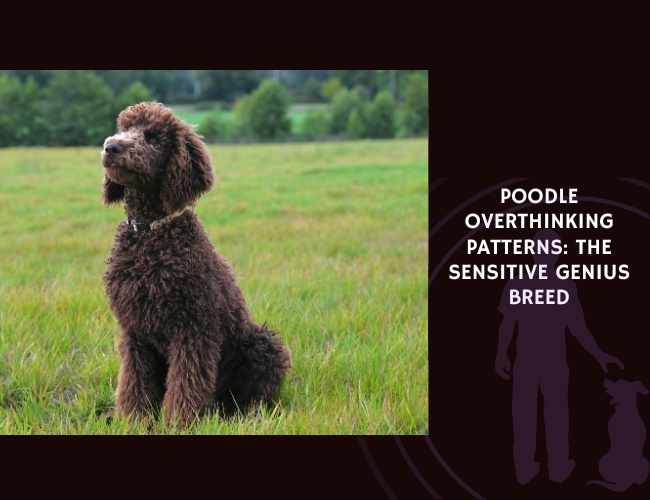
Understanding the Cognitive Depth and Emotional Complexity of Your Poodle
Have you ever watched your Poodle pause at a doorway, seemingly calculating every possible outcome before stepping through? Or noticed them scanning your face with an intensity that suggests they’re reading volumes in your micro-expressions? You’re witnessing something remarkable: a mind that doesn’t just process information but contemplates it, analyzes it, and sometimes gets caught in loops of consideration that can tip from thoughtfulness into anxiety.
Poodles, whether Toy, Miniature, or Standard, carry a reputation as one of the most intelligent breeds in the canine world. But intelligence, especially when paired with emotional sensitivity, creates a unique psychological landscape. This isn’t just about a dog who learns quickly or performs tricks with ease. This is about a companion whose cognitive capacity runs deep enough to anticipate, to worry, to rehearse scenarios before they unfold, and sometimes to trap themselves in patterns of rumination that mirror the anxious overthinking we recognize in ourselves. 🧠
The journey we’re about to take explores the architecture of the Poodle mind, where brilliance meets sensitivity, where problem-solving intelligence can transform into anticipatory stress, and where a dog’s deep attunement to human emotion can become a burden they carry with quiet intensity.
The Heritage of a Thinking Breed
From Water Retrievers to Performance Artists
The Poodle’s cognitive design didn’t emerge by accident. For centuries, these dogs were selectively bred for complex, multi-step tasks that demanded more than obedience:
Historical roles that shaped the Poodle mind:
- Water retrievers reading terrain and anticipating fallen game trajectories
- Circus performers mastering intricate routines with precise timing
- Truffle hunters requiring sophisticated scent discrimination and problem-solving
- Military messengers navigating complex environments under stress
- Obedience competitors excelling in split-second decision-making
- Service dogs adapting to varied human needs and environments
Each generation of breeding reinforced not just trainability but cognitive flexibility. The ability to scan a situation, consider multiple approaches, and adjust strategy became hardwired into their neural architecture. This versatility across roles, from service work to show ring to family companion, speaks to a mind built for pattern recognition and mental simulation.
But here’s where complexity enters the picture: a brain designed to consider multiple possibilities can struggle to simply act. When you create a dog who excels at analyzing situations, you sometimes create a dog who analyzes too much, who sees not just the present moment but a branching tree of potential outcomes, who asks themselves “what if?” before committing to action.
The “What If” Mind
Unlike breeds developed for single-purpose drive, Poodles were bred for versatility. A herding dog sees sheep and engages instinct. A retriever sees a bird and follows impulse. But a Poodle sees a situation and considers options. This cognitive style, when functioning optimally, creates a responsive, adaptable companion. When stressed or uncertain, it creates a dog who hesitates, reconsiders, checks back, and sometimes freezes in the space between possibilities.
Through generations of selection for performance work that demanded anticipation and adjustment, Poodles developed what we might call a “scanning” cognitive style. They don’t just react; they predict. They don’t just follow; they interpret. And in the gap between stimulus and response, their active minds fill the space with simulation and consideration.
This is the foundation of what we see as overthinking: not a flaw but an adaptation pushed beyond its optimal range, a strength that becomes a vulnerability when the environment provides too much ambiguity or emotional noise.
How Size Shapes the Overthinking Experience
The Toy Poodle: Heightened Environmental Sensitivity
Toy Poodles carry all the cognitive complexity of their larger cousins compressed into a body that weighs less than ten pounds. This physical reality creates unique psychological challenges. Their small stature means the world looms larger, sounds register more intensely, and physical vulnerability becomes a constant subconscious calculation.
You might notice your Toy Poodle showing particular vigilance around larger dogs, children’s sudden movements, or environmental changes that a Standard would barely register. This isn’t simple fear; it’s their intelligent mind accurately assessing that they’re more physically vulnerable and adjusting their threat detection accordingly. The problem emerges when this accurate assessment becomes a filter through which everything passes, turning reasonable caution into pervasive anxiety.
Toy Poodles often develop what we might call “compensatory vigilance,” where their brilliant minds work overtime to predict and prevent situations their small bodies couldn’t easily escape.
Common overthinking triggers in Toy Poodles:
- Larger dogs approaching, even if friendly
- Children’s sudden movements or high-pitched voices
- Being picked up unexpectedly or handled roughly
- Loud household noises (vacuum, doorbell, dropped objects)
- Walking on unfamiliar surfaces or at heights
- Changes in daily schedule or household energy
- New visitors entering their safe spaces
They may become particularly attuned to subtle environmental cues: the sound of keys that means someone’s leaving, the shift in household energy that precedes guests arriving, the pattern of sounds that suggests a walk is coming. This predictive capacity serves them well until it doesn’t, until the scanning never stops and rest becomes impossible.
The Miniature Poodle: Social Complexity and Hierarchy Stress
Miniature Poodles occupy an interesting psychological space. Large enough to engage confidently with the world but small enough to retain some vulnerability awareness, they often develop the most complex social processing patterns. These are the Poodles who seem to understand and track every subtle dynamic in a household, who know which family member is upset with whom, who sense hierarchical tensions between themselves and other pets.
Their overthinking frequently centers on social positioning and relationship security.
Questions Miniature Poodles mentally process:
- Where do I fit in this family hierarchy?
- Did that interaction affect my status with the other dog?
- Is my primary person still bonded to me after spending time with others?
- Should I intervene in this family tension I’m sensing?
- What does it mean that I was fed second today?
- Am I losing favor because another pet received attention first?
A Miniature might spend considerable cognitive energy analyzing these dynamics, exhausting themselves trying to navigate and stabilize the social climate through behavior adjustment and emotional monitoring.
This size category often shows the most pronounced people-pleasing patterns combined with social anxiety. They want desperately to get things right, to maintain their place in the social structure, to prevent conflict or disapproval. When household dynamics are unclear or unstable, Miniature Poodles can exhaust themselves trying to navigate and stabilize the social climate through behavior adjustment and emotional monitoring.
The Standard Poodle: Energy, Intensity, and Cognitive Overflow
Standard Poodles bring physical power and endurance to their cognitive intensity, creating a different set of challenges. These dogs have the energy to sustain long periods of mental activity, which means their overthinking can have remarkable stamina. A Standard in a rumination loop can maintain that cognitive state for hours, their powerful minds churning through scenarios with an intensity that smaller Poodles might not physically sustain.
Their size also means they need appropriate outlets for both physical and mental energy. A Standard Poodle with insufficient structured activity doesn’t just become bored; their active minds often turn inward, analyzing, predicting, creating concerns where none existed. The cognitive energy that should flow into purposeful work instead circles into worry and vigilance.
Standards often show their overthinking through physical restlessness combined with mental vigilance.
Behavioral signs in overthinking Standard Poodles:
- Purposeful pacing as if patrolling territory
- Elaborate checking rituals at doors and windows
- Monitoring family members’ locations throughout the house
- Repeated trips to look outside without clear cause
- Standing sentinel-style in central household locations
- Restless repositioning without settling fully
- Alert ears and body tension even during “rest” periods
They may develop these patterns as their cognitive intensity, when not properly channeled, manifests as guard-like hypervigilance that exhausts both dog and household.
Interestingly, Standards may also show more capacity for recovery when given appropriate outlets. Their physical resilience often supports cognitive resilience, meaning that structured activity, clear routines, and purposeful engagement can more quickly shift them out of overthinking patterns than might be possible with smaller, more physically delicate varieties.
Universal Threads Across Sizes
Despite these differences, all three sizes share the core Poodle cognitive architecture: the scanning mind, the emotional sensitivity, the tendency to analyze rather than simply react. Understanding your specific Poodle’s size-related vulnerabilities helps you provide targeted support, but the fundamental approach remains consistent across varieties. They all need clarity, predictability, appropriate mental challenge, and genuine emotional rest. 🐾
Emotional Sensitivity and Cognitive Rumination
When Feelings Become Thought Loops
Your Poodle doesn’t just experience emotions; they think about them. This distinction matters enormously. Many dogs feel fear, joy, excitement, or distress in the moment, then move on when circumstances change. Poodles often carry emotional experiences forward, replaying them, analyzing them, searching for patterns and meaning.
Did you scold your Poodle for a mistake this morning? They might still be reviewing that interaction hours later, scanning your subsequent behavior for signs of whether you’ve forgiven them, whether the relationship is secure, whether they should adjust their future actions. This isn’t simple memory; it’s cognitive rehearsal, the mind returning again and again to significant emotional events.
Research in behavioral psychology shows that individuals with higher sensitivity to negative experiences often demonstrate stronger links between emotional events and subsequent cognitive processing. A harsh word or moment of conflict doesn’t just create temporary distress; it opens a file in their mental archive that gets reviewed repeatedly.
The Rehearsal of Social Experience
Watch a sensitive Poodle after a training session where they struggled or made errors. Even after the session ends and you’ve moved on, you might notice behavioral indicators of mental rehearsal:
Post-training cognitive rumination signs:
- Remaining subdued for hours after the session
- Offering repeated appeasement gestures (lowered body, avoiding eye contact)
- Monitoring your mood with unusual intensity
- Following you more closely than usual
- Refusing treats or showing reduced appetite
- Hesitating before normal activities they typically enjoy
- Checking back constantly for reassurance
They’re not just feeling bad about the experience; they’re mentally rehearsing it, trying to understand what went wrong, how to prevent it next time, whether your response means something about the security of your bond.
This cognitive replay serves an adaptive purpose when moderate. It helps intelligent dogs learn from experience and refine their social strategies. But in sensitive individuals, especially those exposed to inconsistent feedback or unpredictable emotional environments, this process can spiral into rumination, where the mind circles the same concerns without reaching resolution or peace.
The emotional softness that makes Poodles such empathetic companions also makes them vulnerable to getting stuck in these thought loops. They feel deeply, and they think about what they feel, and sometimes the thinking amplifies the feeling, which triggers more thinking, creating the kind of cognitive-emotional spiral we recognize from human anxiety. 🧡
Social Over-Attunement and Human-Focused Perception
Reading the Room (Perhaps Too Well)
Your Poodle is watching you right now, even when you think they’re resting. Not just looking, but reading multiple channels of information simultaneously:
Subtle human cues Poodles track:
- Shoulder tension and postural shifts
- Breathing rhythm changes
- Micro-expressions during phone conversations
- Tone variations in voice, even when words are neutral
- How you hold the leash (tighter or looser than usual)
- Walking pace and energy changes
- Sighs, throat clearing, or other vocal sounds
- How long you make eye contact
- Your scent changes related to stress hormones
They’re gathering data constantly, building an internal model of your emotional state, and adjusting their own behavior accordingly.
This hyper-attunement to human emotional states is one of the Poodle’s most remarkable traits, and one of their greatest vulnerabilities. Where many breeds respond primarily to clear, direct signals like raised voices or physical gestures, Poodles pick up the subtleties, the sighs, the slight shifts in tone, the way you held the leash just a bit differently today.
Research on social sensitivity shows that individuals highly attuned to others’ emotional states can begin to over-interpret neutral or ambiguous cues. A human’s distracted moment becomes “am I in trouble?” A sigh becomes “did I disappoint them?” A change in routine becomes “is something wrong in our relationship?”
The Search for What They Did Wrong
This creates a cognitive pattern that looks remarkably like guilt or worry: the Poodle who perceives tension in their human might begin searching their recent behavior for explanations. They become little detectives of their own actions, reviewing the past hours or days for what might have caused your current state, even when your mood has nothing to do with them.
This self-referential thinking, where the dog assumes responsibility for human emotional states, places an enormous cognitive burden on them. Instead of simply existing alongside you, they’re constantly analyzing, predicting, trying to manage or prevent negative emotions they sense in you.
In homes where human emotional climate is volatile, unpredictable, or frequently tense, sensitive Poodles can exhaust themselves with this monitoring. Their cognitive energy pours into reading and responding to human states rather than attending to their own needs for play, rest, or simple, unworried presence.
The Cost of Empathy
The same quality that allows Poodles to work brilliantly as therapy dogs, to sense when their humans need comfort, to attune so precisely to emotional nuance, also means they absorb emotional states like a sponge absorbs water. They don’t just observe your stress; they internalize it, carry it, and often amplify it through their own cognitive processing.
This is where the concept of emotional leadership becomes crucial. Your Poodle needs you to hold emotional clarity, to provide consistent signals about the state of your relationship and the security of their world, so they can stop analyzing and simply trust. When that clarity is absent, their brilliant, sensitive minds fill the void with worry.
How Overthinking Manifests in Behavior
The Visible Signs of an Active Mind
Overthinking doesn’t stay internal in dogs. It leaks out in behavior patterns that observant guardians can learn to recognize:
Common overthinking behaviors:
- Hesitation before following familiar commands
- Freezing in doorways or at thresholds
- Constant checking back during walks
- Repetitive micro-rituals (circling, nose-touching spots)
- Extended decision-making around simple choices
- Oscillating between options without committing
- Seeking permission for previously confident actions
- Over-responding to minor environmental changes
Your Poodle might hesitate before following a familiar command, not from disobedience but from mental consideration of variables: Is this the right moment? Did you mean exactly that? What might happen next?
Some Poodles freeze in doorways or at thresholds, seemingly calculating. Others check back constantly during walks, not just for connection but as if seeking continuous confirmation that they’re doing things correctly. You might notice repetitive micro-rituals: the dog who must circle three times before sitting, or who touches their nose to the same spot before exiting through a door.
These ritualized behaviors often serve as cognitive anchors, ways of creating predictability and control in a mind that processes too many possibilities. When uncertainty floods the mental system, rituals provide structure, a known sequence in a world of ambiguous choices.
Displacement Behaviors as Pressure Valves
When cognitive load becomes overwhelming, Poodles often channel that mental tension into physical actions as pressure valves for accumulated stress:
Common displacement behaviors:
- Excessive paw licking or leg chewing
- Scratching when no itch exists
- Pacing specific circuits through the house
- Frequent yawning without fatigue
- Intense sniffing of familiar, unchanging surfaces
- Lip licking or tongue flicking
- Sudden grooming sessions
- Shaking off as if wet when dry
These displacement behaviors aren’t meaningless; they’re ways the nervous system releases accumulated stress when the mind can’t find resolution.
Pay attention to when these behaviors appear. A Poodle who begins licking their paws after a confusing training session, or who paces after you’ve had an emotional phone conversation, is showing you that their cognitive-emotional system is working hard to process something they can’t quite resolve.
Some sensitive Poodles develop checking behaviors that mirror human obsessive patterns: repeatedly returning to the same spot, insisting on specific arrangements of their belongings, or becoming distressed when familiar objects are moved. These behaviors suggest a mind seeking control and predictability as antidotes to internal uncertainty. 🐾
Decision Paralysis and Avoidance
Perhaps the most direct manifestation of overthinking is the dog who simply can’t choose. Presented with two food bowls, they oscillate between them. Called to come while engaged in sniffing something interesting, they freeze, caught between conflicting impulses. Asked to enter a slightly unfamiliar space, they hesitate at the threshold, mentally simulating outcomes.
This decision paralysis often worsens in environments where past choices led to unexpected consequences or where feedback from humans has been inconsistent. The Poodle mind learns that analysis is safer than action, that consideration prevents mistakes, and gradually the pause before action stretches longer and longer.

The Role of Environment and Routine
Predictability as Cognitive Medicine
For the overthinking Poodle mind, environmental predictability functions like medicine. When routines follow consistent patterns, when spaces remain familiar, when social interactions unfold along recognizable scripts, the need for constant analysis diminishes. The mind can rest because it knows what comes next.
Research on stress and mental health consistently demonstrates that predictable environments buffer against anxiety and rumination. When an intelligent, sensitive dog knows the rhythm of the day, the locations of their resources, the typical flow of human activity, they can allocate their cognitive capacity to engagement and presence rather than vigilance and prediction.
This doesn’t mean rigid inflexibility. It means creating reliable frameworks within which variation can occur safely. Your Poodle doesn’t need every day to be identical, but they benefit enormously from core anchors:
Essential predictability anchors:
- Meals at consistent times (within 30-minute windows)
- Morning and evening walks following familiar routes
- Bedtime routines that signal day’s end
- Regular locations for water, food, and sleeping areas
- Consistent wake-up times, even on weekends
- Predictable human work/home schedules when possible
- Stable sleeping arrangements
- Routine bathroom break timing
When Change Becomes Threat
The flip side reveals itself when environments shift unpredictably. A schedule that changes daily, spaces that constantly rearrange, social dynamics that feel unstable, all these create cognitive demand. The Poodle mind must continuously rebuild its internal model, updating predictions, recalculating expectations, never settling into the ease of familiarity.
Sensitive individuals exposed to chronic unpredictability often shift into a state of perpetual anticipatory processing. They scan constantly for what might change next, rehearse responses to possible disruptions, and maintain a baseline of vigilance that never fully releases. This state exhausts the nervous system and reinforces the very overthinking patterns we hope to reduce.
Consider how your Poodle responds to changes in your routine, to rearranged furniture, to unfamiliar visitors. The dog who becomes anxious or withdrawn isn’t being difficult; they’re showing you that their cognitive system is working overtime to re-map their world and re-establish predictive accuracy.
The Evolution of Overthinking Across the Lifespan
Puppyhood: When the World is New and Overwhelming
Poodle puppies enter the world with their cognitive machinery already sophisticated, but without the experience or emotional regulation to manage what that machinery perceives. Between 8 and 16 weeks, they pass through critical fear periods where their developing brains become hypersensitive to threat detection. For the thinking Poodle puppy, these aren’t just moments of simple fear; they’re periods when their minds begin building elaborate threat assessment models.
A single negative experience during a fear period, something another breed might shake off within minutes, can become a reference point a Poodle puppy mentally revisits repeatedly. The puppy who had an unpleasant encounter with a person wearing a hat might spend days analyzing every hat-wearing person they see, building increasingly complex predictions about what hats might mean.
What looks like typical puppy caution in a Poodle often contains seeds of their later overthinking patterns. The puppy who pauses extensively before trying something new isn’t necessarily more fearful than other breeds; they’re thinking more, simulating outcomes, building mental models. This is developmentally normal for Poodles, but it becomes concerning when the pausing extends indefinitely or when the puppy begins avoiding experiences rather than gradually approaching them.
During puppyhood, your primary task isn’t to eliminate this thoughtful caution but to prevent it from calcifying into rigid avoidance.
Supporting puppies through fear periods:
- Maintain calm, confident energy during novel experiences
- Allow the puppy to approach new things at their own pace
- Never force interaction with feared objects or people
- Provide positive associations with new experiences through treats
- Keep socialization sessions brief and always end positively
- Avoid overwhelming environments (crowded, loud, chaotic)
- Create safe retreat spaces where puppies can observe without pressure
- Celebrate small brave moments without excessive excitement
You’re teaching the young Poodle mind that consideration can lead to action, that careful assessment doesn’t require paralysis, that the world, while complex, is fundamentally safe enough to explore.
Adolescence: The Anxiety Peak
Between roughly 6 and 18 months, depending on size, Poodles pass through adolescence, and this period often represents the peak of overthinking vulnerability. Hormonal changes combine with continued brain development and increasing social awareness to create a perfect storm of cognitive-emotional intensity.
The adolescent Poodle who was confident as a puppy might suddenly become hesitant, scanning environments they previously navigated easily. They’re not regressing; their maturing brain is now perceiving layers of complexity it couldn’t detect before. It’s as if someone turned up the resolution on their threat detection system without simultaneously increasing their emotional regulation capacity.
This is when many Poodles develop their most entrenched overthinking patterns. The adolescent mind, flooded with new perceptions and lacking adult emotional stability, often defaults to hypervigilance and analysis as coping mechanisms.
Adolescent overthinking indicators:
- Sudden hesitation in previously confident situations
- Obsessive tracking of other dogs’ body language
- Over-interpreting human reactions and feedback
- Extensive mental rehearsal before social interactions
- New fears or concerns that weren’t present as puppies
- Increased separation distress
- Heightened reactivity to environmental changes
- Social withdrawal or avoidance patterns emerging
Social situations become particularly challenging; the adolescent Poodle might obsessively track other dogs’ body language, over-interpret human reactions, and mentally rehearse interactions extensively before and after they occur.
Guardians often describe their adolescent Poodle as “suddenly anxious” or “newly worried,” but what’s actually happening is the full flowering of their cognitive complexity without yet having the life experience or emotional tools to manage it gracefully. This is the life stage where consistent routine, clear communication, and patient support matter most. The patterns established during adolescence often persist into adulthood.
Adulthood: Pattern Solidification or Adaptive Wisdom
By age 2 to 3, most Poodles have transitioned into emotional and cognitive adulthood. The overthinking patterns visible during adolescence either solidify into chronic anxiety or mature into adaptive thoughtfulness, depending largely on the support and experiences of their earlier years.
The well-supported adult Poodle often shows remarkable emotional intelligence.
Characteristics of adaptive adult thoughtfulness:
- Distinguishing genuine threats from benign situations
- Settling into rest without prolonged vigilance
- Recovering quickly from stressful events (within hours)
- Approaching novel situations with curiosity rather than fear
- Using learned coping strategies during uncertainty
- Maintaining appetite and sleep quality despite changes
- Engaging playfully even with active minds
- Showing confidence in familiar routines and environments
They’ve learned which situations genuinely require careful analysis and which can be navigated with confidence. They’ve developed coping strategies for cognitive overload. They’ve built enough positive experiences to balance their natural caution with trust. Their scanning mind has learned when to rest.
However, adult Poodles who struggled through adolescence without adequate support often display fully developed overthinking patterns: elaborate avoidance behaviors, chronic vigilance, difficulty settling, persistent social anxiety. These aren’t permanent or unchangeable, but they require more intentional intervention than the malleable patterns of younger dogs.
Adult Poodles also show us something important: their overthinking isn’t always present at the same intensity. Even dogs with anxiety patterns have good days and difficult ones, periods of relative calm and periods of heightened worry. Learning to recognize what triggers increases or decreases in your adult Poodle’s overthinking helps you provide targeted support when they need it most.
Senior Years: Cognitive Changes and Increased Vulnerability
As Poodles move into their senior years, typically around age 8 to 10 depending on size, cognitive changes can affect overthinking patterns in complex ways. Some senior Poodles actually become less anxious; the cognitive energy that once fueled elaborate worry patterns naturally diminishes, leaving a calmer, more settled dog who’s seen enough of life to know most things work out.
But other seniors show increased anxiety as cognitive changes affect their ability to process and adapt to their environment. The previously confident Poodle might become newly hesitant as their sensory processing slows or becomes less reliable. Vision or hearing changes mean the world provides less predictable information, and for a mind built on prediction and pattern recognition, this loss of reliable data can trigger increased vigilance and worry.
Canine cognitive dysfunction, similar to human dementia, can manifest in senior Poodles as increased anxiety, confusion, and obsessive behaviors. The dog who always thought deeply but managed it well might begin cycling through worry patterns without resolution, becoming distressed by situations they once navigated smoothly.
Senior Poodles need particularly consistent routine and environmental predictability. Their aging minds rely more heavily on familiar patterns and may struggle more intensely when those patterns disrupt.
Senior support adjustments:
- Increase routine consistency and reduce surprises
- Maintain furniture and resource locations unchanged
- Provide nightlights for vision-impaired seniors
- Use scent markers to help navigation if hearing declines
- Offer more frequent but shorter activity periods
- Create easily accessible, comfortable sleeping areas
- Reduce household chaos and loud noises
- Consider veterinary evaluation for cognitive dysfunction supplements
The cognitive flexibility that allowed younger Poodles to adjust to change often decreases with age, meaning that what was once merely unsettling becomes genuinely distressing.
Supporting the senior overthinking Poodle means simplifying rather than challenging, providing reliability rather than novelty, and recognizing that some increase in anxiety or cognitive rigidity is a normal part of aging rather than a failure of earlier training or support. 🧡
Brilliant. Sensitive. Caught.
A mind built to simulate. Poodles don’t just respond to the moment — they pre-experience it. Their intelligence creates pathways of prediction, turning simple choices into mental rehearsals that linger before action.
Sensitivity deepens the loop. Emotional attunement, once an asset for human connection and performance work, can become a trigger for hesitation when environments feel uncertain or emotionally ambiguous.



Strength becomes burden. The same cognitive flexibility that solves problems can also generate them. In the space between impulse and action, thought multiplies—and sometimes, it doesn’t let go.
Attachment Patterns and Emotional Responsibility
The Weight of Connection
Poodles form profound attachments to their humans, bonds characterized by emotional depth and psychological interdependence. This capacity for connection is one of their most cherished qualities, but it also creates vulnerability. The more deeply attached a dog becomes, the more their emotional equilibrium depends on the security and stability of that relationship.
Dogs with insecure or anxious attachment patterns often show increased over-analysis around separations, reunions, and changes in their human’s availability.
Signs of anxious attachment in Poodles:
- Intense distress during pre-departure cues (keys, shoes, coat)
- Extended anxiety that persists after you’ve left
- Overly exuberant or frantic reunions
- Constant shadowing and inability to be in separate rooms
- Refusal to eat or settle when alone
- Destructive behavior focused on owner’s belongings
- Excessive vocalization during absences
- Physical symptoms (panting, drooling, trembling) at separations
They don’t just miss you when you leave; they worry about what your absence means, whether you’ll return, whether something has changed in the relationship. Reunions become moments of intense emotional checking: Are we still okay? Did something happen while we were apart?
Some Poodles develop what we might call hyper-attachment, where their sense of self-regulation becomes overly dependent on their human’s presence and emotional state. These dogs struggle to relax when alone, not simply from loneliness but from the cognitive work of managing uncertainty without their primary reference point.
🧠 Understanding Poodle Overthinking Patterns
A Complete Guide to Supporting Your Sensitive Genius Through Cognitive Complexity
Phase 1: Recognition
Identifying the Thinking Mind
Your Poodle pauses at doorways, scanning possibilities before acting. They check back constantly during walks, not for connection but for confirmation. These aren’t signs of fear—they’re the visible markers of a mind that analyzes, predicts, and considers multiple outcomes before committing to action.
• Hesitation before familiar commands
• Freezing at thresholds or decision points
• Repetitive micro-rituals (circling, nose-touching)
• Extended checking behaviors
• Displacement activities (licking, yawning, sniffing)
Begin tracking when these behaviors appear. Keep a simple journal noting time of day, what preceded the behavior, and how long it lasted. Recognition without judgment is your foundation—you’re gathering data about your dog’s unique cognitive patterns.
Phase 2: Understanding Size-Specific Patterns
How Physical Size Shapes Mental Patterns
At under 10 pounds, Toy Poodles experience the world as larger and more threatening. Their brilliant minds work overtime predicting situations their small bodies couldn’t easily escape. Environmental sounds register more intensely, and physical vulnerability becomes a constant subconscious calculation.
Miniatures develop complex social processing patterns, tracking household dynamics with remarkable precision. They mentally calculate their position in family hierarchy, analyze relationship security, and exhaust themselves trying to stabilize social climates through behavior adjustment.
Standards bring physical stamina to their mental intensity. Their overthinking can persist for hours, manifesting as physical restlessness combined with mental vigilance. Without appropriate outlets, their powerful minds turn inward, analyzing and creating concerns where none existed.
Phase 3: Environmental Foundation
Creating Predictability as Medicine
For the overthinking Poodle, environmental predictability functions like medicine. When routines follow consistent patterns, the mind can rest because it knows what comes next. This isn’t rigid inflexibility—it’s creating reliable frameworks within which safe variation can occur.
• Meals at consistent times (within 30-minute windows)
• Morning and evening walks following familiar routes
• Bedtime routines that signal day’s end
• Stable locations for water, food, sleeping areas
• Predictable wake-up times, even on weekends
Constantly changing schedules, frequently rearranged furniture, and unpredictable household energy force the Poodle mind to continuously rebuild its internal model. This perpetual recalibration exhausts the nervous system and reinforces overthinking patterns.
Phase 4: Life Stage Support
Age-Appropriate Intervention
During critical fear periods, your Poodle puppy’s sophisticated cognitive machinery lacks emotional regulation. A single negative experience can become a reference point mentally revisited for days. Your task: prevent thoughtful caution from calcifying into rigid avoidance through patient, positive exposure.
This represents peak overthinking vulnerability. Hormonal changes combine with increasing social awareness to create cognitive-emotional intensity. The patterns established during adolescence often persist into adulthood—consistent routine and patient support matter most during this critical window.
Well-supported adults show remarkable emotional intelligence—their scanning minds have learned when to rest. Senior Poodles need increased consistency as cognitive flexibility decreases. Environmental predictability becomes even more critical when sensory processing slows or becomes less reliable.
Phase 5: Training Methodology
Reducing Cognitive Load Through Clarity
Methods relying on subtle cues or emotional intensity increase cognitive burden. When communication uses clear physical markers, consistent timing, and minimal language, the Poodle mind focuses on action rather than interpretation. A distinct hand signal carries less ambiguity than varied verbal commands.
• Clear hand signals over varied verbal commands
• Clicker training for precise feedback timing
• Predictable session structures
• High rate of reinforcement for known behaviors
• Training in familiar, low-distraction environments
• Breaking complex tasks into simple steps
The thinking Poodle benefits from structured cognitive challenges with definite conclusions. Scent work, puzzle feeders with obvious success points, and trick training with clear criteria provide mental engagement without triggering analysis paralysis. The mind can rest when it knows the puzzle is solved.
Phase 6: Strategic Enrichment
Calming vs. Overwhelming Stimulation
• Scent work and nose games (hide treats, tracking)
• Lick mats with appropriate spreads
• Long-lasting chews (bully sticks, dental chews)
• Frozen Kong toys with layered fillings
• Structured training of already-known behaviors
• Calm parallel activities (you read, they rest)
• Gentle massage or touch work
Highly novel environments, complex puzzles with unclear solutions, constantly changing toy selections, and high-intensity play without boundaries can trigger vigilance rather than satisfaction. For the overthinking Poodle, indiscriminate enrichment often backfires—quality over quantity matters.
Overthinking Poodles need intentional decompression time where nothing is asked. Many guardians fall into patterns of constant interaction, believing stimulation prevents problems. But for these sensitive minds, genuine rest—permission for their brilliant brains to truly settle—may be the most important intervention.
Phase 7: Emergency Protocol
When Your Poodle Is Stuck
Recognition: Frozen movements with intense scanning, repetitive micro-behaviors, persistent displacement activities, checking back without finding reassurance.
Interrupt: Gentle pattern break—change location, offer calm physical contact, suggest brief walk, initiate simple known behavior.
Redirect: Provide clear, achievable focus—brief scent work, training of well-known behaviors, slow-paced walk, long-lasting chew.
Reset: Support return to baseline through quiet parallel time, gentle settling routine, protecting any sleep that emerges.
After a significant overthinking episode, provide 24 hours of reduced demands: shorter walks, familiar environments, extra rest, no new training. This prevents the pattern where one episode triggers others in succession. The mind that hasn’t fully settled is vulnerable to tipping back into rumination.
Phase 8: Physical Foundation
When Body Affects Mind
The gut microbiome produces neurotransmitters directly influencing mood and anxiety. An imbalanced gut environment contributes to increased anxiety and cognitive restlessness. For Poodles showing chronic overthinking, consider digestive health as a contributing factor—chronic inflammation creates physiological stress manifesting as behavioral anxiety.
B vitamins for neurotransmitter synthesis, Omega-3 fatty acids for brain health, L-theanine for calming, probiotics for gut-brain axis health, and magnesium for nervous system support all play roles in cognitive-emotional regulation. Approach supplementation with veterinary guidance—more isn’t always better.
Thyroid dysfunction, chronic pain, allergies, digestive disorders, vision or hearing impairment, and neurological conditions can all mimic or worsen anxiety. If overthinking patterns emerged suddenly or occur alongside physical symptoms, veterinary evaluation is essential before assuming purely behavioral causes.
🔄 Understanding Your Poodle’s Unique Profile
Primary Trigger: Environmental vulnerability
Manifests As: Compensatory vigilance, heightened startle responses
Best Support: Predictable routines, safe retreat spaces, gradual exposure
Primary Trigger: Social complexity
Manifests As: Hierarchy stress, relationship analysis, people-pleasing anxiety
Best Support: Clear social structure, individual attention, stable dynamics
Primary Trigger: Insufficient cognitive outlets
Manifests As: Extended rumination, physical restlessness, patrol behaviors
Best Support: Structured activity, purposeful work, clear routines
Characteristic: Building threat models during fear periods
Risk: Single negative experiences become persistent reference points
Focus: Preventing caution from becoming avoidance
Characteristic: Peak overthinking vulnerability
Risk: Patterns established now often persist
Focus: Consistent routine, patient support, clear communication
Well-Supported Adult: Scanning mind has learned when to rest
Senior Needs: Increased consistency as flexibility decreases
Focus: Maintaining stability, simplifying rather than challenging
Predictable Structure + Appropriate Challenge + Genuine Rest = Cognitive Balance
• Morning: Consistent routine + moderate walk in familiar area
• Midday: Brief engagement or calm rest period
• Evening: Structured activity + wind-down routine
• Night: Predictable sleep environment + consistent timing
Weekly Pattern: 5-6 days structured routine + 1-2 “rest days” with reduced intensity
Remember: Your Poodle’s sensitive genius needs clarity, not complexity. When in doubt, simplify and add predictability.
The overthinking Poodle embodies what we recognize through NeuroBond—a mind so attuned to connection that it carries the weight of emotional responsibility. Through the Invisible Leash, we provide the clear emotional leadership their brilliant minds are searching for, allowing them to stop analyzing and start trusting. And in those moments when their rumination transforms into presence, we witness Soul Recall: the deep recognition between beings who understand each other without constant interpretation.
Your Poodle’s sensitivity isn’t a flaw to fix but a gift to support. When we honor their cognitive architecture with clarity, predictability, and genuine rest, their overthinking transforms into thoughtfulness, their vigilance becomes awareness, and their rumination evolves into wisdom. This is where neuroscience meets soul—in understanding that the sensitive genius needs not less intelligence, but better guidance for where to direct it.
Support the thinking mind. Trust the feeling heart. Celebrate the remarkable being who shares your life.
© Zoeta Dogsoul – Where neuroscience meets soul in dog training
Self-Assigned Emotional Management
Here’s where attachment and overthinking intersect in fascinating ways. Some Poodles appear to assign themselves emotional responsibility for their humans, as if they’ve decided their job is to prevent, manage, or ameliorate negative emotional states in the household.
You might notice your Poodle becoming unusually vigilant when you’re stressed, offering constant physical contact, interrupting activities they perceive as tension-generating, or showing signs of distress when they sense conflict between family members. They’re not just responding to emotional states; they’re trying to manage them, to make them better, to carry a burden that isn’t theirs to carry.
This pattern likely emerges from the same hyper-attunement we discussed earlier, combined with the Poodle’s problem-solving orientation. They detect emotional distress, their minds engage the problem, and lacking clear understanding of human emotional complexity, they assume a causal role: Maybe if I do this, it will help. Maybe if I’m extra good, things will settle. Maybe if I stay close enough, I can prevent whatever I’m sensing.
The cognitive load of this self-assigned responsibility is enormous. These dogs never fully rest because they’re always on duty, always monitoring, always prepared to intervene or adjust in response to emotional fluctuations they believe they must manage.
The Gift of Clear Leadership
This is where the Invisible Leash becomes essential in understanding Poodle psychology. These sensitive, brilliant dogs need you to hold clear emotional authority, not through dominance but through calm, consistent presence that says: I’ve got this. You don’t need to manage me. You can simply be a dog.
When humans provide clear relational structure, when they communicate confidence and stability without volatility or dependence, they free the Poodle mind from its vigilance. The dog can stop scanning for emotional threats, stop trying to regulate human states, and redirect their intelligence toward cooperation, play, and simple companionship.
This doesn’t mean suppressing your emotions or pretending stress doesn’t exist. It means maintaining a centered core that signals to your sensitive companion: Whatever I’m feeling, our relationship is secure, and you are not responsible for fixing my emotional state.

Overthinking in Multi-Dog Households
The Social Comparison Trap
When Poodles live with other dogs, their tendency toward overthinking often extends into elaborate social analysis. They don’t just coexist with other dogs; they study them, compare themselves, track subtle shifts in household hierarchy, and mentally process complex social dynamics that simpler breeds might never consciously register.
You might notice your Poodle watching another dog receive attention, not with simple jealousy but with what looks like careful analysis: What did that dog do to earn praise? How does my behavior compare? Should I adjust my approach? This cognitive processing of social comparison can become exhausting, especially in households with multiple dogs where social dynamics shift frequently.
The overthinking Poodle in a multi-dog home often becomes the household’s emotional barometer and unofficial social coordinator. They track tensions between other dogs, position themselves to prevent conflicts, and adjust their own behavior based on constantly updated assessments of the social climate. This self-assigned role as mediator and monitor adds enormous cognitive load to their already active minds.
Hierarchy Stress and Positional Anxiety
Poodles are not typically dominant or aggressive, but they’re acutely aware of social structure. In multi-dog households, the Poodle who can’t confidently locate themselves within the hierarchy often shows increased anxiety and overthinking. They might obsessively defer to more confident dogs while simultaneously monitoring whether that deference is protecting them or lowering their status. They might rehearse social interactions before they happen and review them extensively afterward.
Some Poodles develop what we might call positional anxiety, where they’re constantly recalculating their social standing based on micro-interactions: Did the other dog get fed first today? Did the human greet them before me? What does that mean about my place here? This mental accounting exhausts them and often leads to stress behaviors even in households where actual conflict between dogs is minimal or absent.
The challenge intensifies when household hierarchy is genuinely unclear or unstable. If humans don’t provide clear social structure, if other dogs are pushy or inconsistent, or if social rules change frequently, the Poodle’s mind works overtime trying to map an ever-shifting landscape. They need the social framework to make sense, and when it doesn’t, their anxiety often increases proportionally to the ambiguity.
The Confident Dog as Model or Stressor
Living with a confident, emotionally stable dog can significantly benefit an overthinking Poodle, but only under the right conditions. When the confident dog demonstrates that the environment is safe, that social interactions are predictable, and that humans are trustworthy, the Poodle can borrow that confidence. They watch the other dog move through the world with ease and gradually learn that such ease is possible.
This positive modeling works best when the confident dog is calm rather than intense, when they provide social structure without being pushy or demanding, and when the Poodle has space to observe without being forced into interactions before they’re ready. Think of the confident dog as a living example of the settled, peaceful state the Poodle’s mind is seeking.
However, a highly energetic, socially pushy, or dominant dog can increase rather than decrease Poodle overthinking. The Poodle ends up in constant vigilance mode, monitoring the other dog’s movements, predicting their behavior, managing interactions to avoid conflict or unwanted intensity. Far from providing a calming model, such a dog becomes another element requiring constant cognitive processing.
When Other Dogs Increase Anxiety
Some Poodles simply do better as only dogs. If your Poodle shows signs of chronic stress in a multi-dog household, the social complexity might exceed their capacity to manage comfortably.
Signs multi-dog living is overwhelming:
- Persistent monitoring of other dogs without relaxation
- Unable to settle even when other dogs are calm
- Decreased appetite or eating only when alone
- Increasing displacement behaviors around other dogs
- Guarding resources that weren’t previously guarded
- Sleeping with eyes half-open or in alert positions
- Avoiding common areas to escape social demand
- Weight loss or physical stress symptoms
- Refusing play or engagement they previously enjoyed
This isn’t failure on anyone’s part. It’s recognition that some sensitive, overthinking Poodles find the cognitive demand of multi-dog living overwhelming. They might function beautifully in carefully managed dog interactions, enjoy playing with select dog friends, and still find 24/7 cohabitation with other dogs exhausting.
If separating dogs isn’t possible, creating spaces where your Poodle can fully escape the social demands matters enormously. A room where they can retreat without being followed, rest without being observed, and genuinely decompress from the cognitive work of social monitoring can make multi-dog living manageable for Poodles who find it stressful.
Strategic Social Support
For Poodles who do well with other dogs but still show signs of social overthinking, strategic management helps. This might mean feeding separately to reduce food-related social stress, providing individual attention time so your Poodle doesn’t feel they’re constantly competing, and creating clear, consistent social rules that all dogs follow.
It also means watching for and interrupting social comparison spirals. When you notice your Poodle becoming fixated on monitoring another dog’s interactions with you, you can calmly redirect their attention, provide them with their own engagement, and communicate through your emotional clarity that their position is secure regardless of what other dogs are doing.
The goal isn’t to eliminate social awareness, which is natural and healthy, but to prevent that awareness from becoming an all-consuming source of worry and analysis. Your Poodle can notice and respond to other dogs without making their relationship with you or their place in the household dependent on constant social calibration. 🐾
Training Approaches That Reduce Cognitive Load
The Power of Clarity
For the overthinking Poodle, training methodology matters enormously. Methods that rely on subtle cues, complex verbal explanations, or emotional intensity often increase rather than decrease cognitive burden.
Training approaches that calm the overthinking mind:
- Low-verbal communication with clear physical markers
- Consistent hand signals rather than varied verbal commands
- Clicker training for precise feedback timing
- Predictable training session structures
- Clear criteria for success defined before starting
- Calm emotional tone without intensity or frustration
- High rate of reinforcement for known behaviors
- Breaking complex tasks into simple, clear steps
- Training in familiar, low-distraction environments initially
The dog’s mind becomes occupied with parsing meaning, reading undertones, predicting outcomes, leaving little capacity for simple learning when methods are unclear.
Low-verbal training approaches work beautifully with these dogs. When communication relies on clear physical markers, consistent timing, and minimal language, the Poodle mind can focus on action rather than interpretation. A distinct hand signal carries less ambiguity than a verbal command delivered with varying intonation. A click or marker word provides precise information without emotional coloring.
Calm repetition allows learning to settle into pattern recognition rather than anxiety-provoking testing. When training follows predictable structures, when success is clearly defined and consistently acknowledged, the Poodle can engage their intelligence without triggering worry about making mistakes or disappointing you.
Puzzles With Clear End Points
The thinking Poodle often benefits from structured cognitive challenges that have definite conclusions. Puzzle feeders, scent work, trick training with clear success criteria, all these provide mental engagement with built-in resolution. The dog’s mind can fully invest in problem-solving because there’s a clear moment when the puzzle is solved, the food is obtained, the trick is complete.
This contrasts with the open-ended mental work of monitoring unpredictable emotional environments or trying to decode ambiguous social signals. Those cognitive tasks have no clear finish line, no moment when the mind can declare the problem solved and rest.
Structured walks with clear direction also serve this function. The walk isn’t an endless wandering where the dog must continuously decide what to investigate or where to go. It follows a route, has waypoints, includes designated sniff-and-explore times within an overall framework. The Poodle mind can relax into the structure rather than maintaining constant vigilance about what might happen next.
Decompression and Mental Rest
Perhaps most importantly, overthinking Poodles need intentional decompression time, periods where nothing is asked of them, where they’re not being watched or evaluated, where they can simply exist without cognitive demand. This might be calm time in a quiet room, lying on a comfortable bed while you read nearby without interaction. It might be gentle parallel activity where you’re both present but not engaging.
Many guardians of intelligent, sensitive dogs fall into a pattern of constant interaction, believing that keeping the dog mentally stimulated prevents problems. But for the Poodle prone to overthinking, some of that “stimulation” becomes just more cognitive work, more analysis, more vigilance. They need permission and space for their brilliant minds to genuinely rest.
Watch your Poodle’s resting behavior. Do they actually settle into deep relaxation, with soft eyes and loose body? Or do they remain in a state of alert rest, always half-monitoring, ready to spring into analysis at the first stimulus? Teaching true rest, creating environments that support genuine downtime, may be one of the most important training goals for these dogs.
Creating a Balanced Weekly Routine
The Framework: Structure Without Rigidity
For the overthinking Poodle, a well-structured weekly routine provides the predictability their minds crave while avoiding the monotony that can lead to understimulation and increased mental circling. The goal is creating a rhythm where your Poodle knows what generally comes next without every moment being identical.
A balanced routine addresses four essential elements: physical exercise, mental engagement, social interaction, and genuine rest. The specific balance depends on your Poodle’s size, age, and individual temperament, but the framework remains consistent. Let’s look at how this might appear in practice.
Sample Weekly Structure for an Adult Standard Poodle
Morning (45-60 minutes total) Wake at consistent time, brief bathroom break, calm breakfast routine. Follow with either a structured walk (Monday, Wednesday, Friday) where you move with clear direction through a familiar route, or brief yard time (Tuesday, Thursday) focusing on simple fetch or sniffing. Weekends might include longer exploratory walks in novel environments, but only after the week has established solid baseline calm.
The morning routine establishes tone for the day. Consistency here matters enormously; when your Poodle knows the morning follows a predictable pattern, they can relax into it rather than scanning for what might happen next.
Midday (15-30 minutes) For Poodles who are home during the day, midday check-ins provide structure. This might be a bathroom break, brief training session (5-10 minutes working on known behaviors rather than learning new ones), or puzzle feeder. Some days this is active engagement; others it’s simply calm presence while you work nearby.
Afternoon (variable) This is typically rest time. Your Poodle has had morning engagement and now has permission to genuinely decompress. This might be several hours of undisturbed rest in a comfortable spot. Some overthinking Poodles need this explicitly taught; they don’t naturally settle unless the environment communicates that nothing is required of them.
Evening (60-90 minutes total) Second walk or activity session, more substantial than morning. This might include training work (Tuesday, Thursday), scent games (Monday, Friday), or calm social time (Wednesday). Weekends might feature dog park visits for social Poodles or parallel hiking for those who prefer human-only outings.
Follow evening activity with calm-down routine: perhaps gentle grooming, quiet time together, or mat training where your Poodle practices settling while you’re present. Dinner comes at consistent time, followed by a brief bathroom break and then evening wind-down.
Before Bed (30 minutes) Final bathroom break, then deliberate transition to sleep mode. This might include your Poodle’s bed routine, any medications or supplements, and clear signals that the day is ending. The consistency of this routine helps the Poodle mind release its vigilance and transition into genuine rest.
Adjustments for Size and Age
Toy and Miniature Poodles typically need less total exercise duration but more frequent social check-ins. Their routines might include shorter walks (15-20 minutes instead of 45-60) but additional brief training or play sessions distributed throughout the day. Their smaller size means they reach physical fatigue faster but may still need significant mental engagement.
Puppies and Adolescents require shorter, more frequent activity periods with extensive rest between. A 4-month-old Poodle puppy might have five brief (10-15 minute) activity periods throughout the day with enforced rest between each. Adolescents often need increased physical output but should still have structured rest to prevent them from maintaining vigilance all day.
Senior Poodles benefit from maintained routine but shorter, gentler activity. The familiar structure becomes even more important as their cognitive flexibility decreases. Their walks might be 15-20 minutes instead of 45, with more time for sniffing and less for distance. Mental engagement remains important but should focus on familiar, confidence-building activities rather than challenging new tasks.
Activity Variations Within Structure
While the timing remains consistent, the specific activities can rotate to prevent boredom while maintaining predictability. Your Poodle learns that Tuesday evening means training, but the specific skills practiced might vary. Friday morning is always a neighborhood walk, but the exact route has minor variations. This provides novelty within a framework of predictability.
The key is distinguishing between structural consistency (when things happen, the general category of activity) and content variety (specific details of the activity). Overthinking Poodles need the structural consistency but benefit from content variety, as long as variations occur within established frameworks rather than randomly disrupting the overall rhythm.
The Rest Days Principle
Interestingly, many overthinking Poodles benefit from what we might call “lower intensity days” built into the weekly structure. Perhaps Sunday is intentionally calmer: shorter walks, more rest time, less novelty or social demand. This gives the nervous system regular recovery periods and communicates that not every day requires maximum engagement or performance.
This differs from random low-activity days caused by human schedule disruptions. This is intentional, predictable downtime that becomes part of the rhythm your Poodle learns to anticipate and relax into. It’s the difference between a nervous system that never knows when it can truly rest and one that knows recovery is built into the weekly pattern.
Enrichment That Calms Rather Than Overwhelms
Understanding the Enrichment Paradox
The modern dog training world emphasizes enrichment, mental stimulation, and constant engagement. For most dogs this is beneficial, but for the overthinking Poodle, indiscriminate enrichment can backfire. Some forms of mental stimulation are actually cognitively calming, creating focus and satisfying the mind’s need for purposeful work. Other forms increase cognitive load, adding more variables for the already-active mind to process and analyze.
Learning to distinguish between calming enrichment and stimulating enrichment transforms how we support these dogs. The goal isn’t less enrichment but more strategic enrichment that engages the Poodle’s intelligence without triggering their overthinking patterns.
Calming Enrichment Activities
Activities that engage without overwhelming:
- Scent work and nose games (hide treats, scent trails)
- Lick mats with appropriate spreads (pumpkin, yogurt, peanut butter)
- Long-lasting chews (bully sticks, dental chews, appropriate bones)
- Frozen Kong toys with layered fillings
- Structured training of already-known behaviors
- Calm parallel activities (you read, they rest nearby)
- Structured sniff walks with exploration permission
- Gentle massage or touch work
- Mat training and “place” practice
- Slow-feeding puzzle bowls for meals
These activities provide exceptional cognitive engagement that naturally focuses attention and reduces rumination. When your Poodle is actively working their nose, their mind fully occupies with sensory processing in the present moment.
Enrichment to Approach Carefully
Activities that may increase overthinking:
- Highly novel environments without gradual introduction
- Complex puzzle toys with unclear solutions or mechanisms
- Constantly changing toy selections
- Frequently rearranged living spaces
- High-intensity play without clear boundaries
- Multi-step puzzles requiring extended frustration tolerance
- Unpredictable activity schedules
- Overwhelming group play situations
- Toys with startling sounds or unpredictable movements
- Activities forcing rapid decision-making under pressure
These activities can be enriching for confident dogs but overwhelming for overthinking Poodles. A completely new park or hiking trail provides vast amounts of new information to process and assess. For sensitive individuals, this can trigger vigilance rather than enjoyment.
Toy Selection and Rotation
Maintain a core of familiar, reliable toys that are always available, providing security through consistency. These are the comfort items your Poodle returns to when they need something safe and known. Rotate a smaller selection of “sometimes toys” that appear periodically, providing novelty without overwhelming their environment with constant change.
The toys that remain constant are typically simple: a favorite ball, a reliable chew, a beloved stuffed toy. The rotating toys might be different puzzle feeders, various chew options, or toys with different textures and functions. This strategy satisfies the Poodle need for both predictability and variety without triggering the stress that comes from constant environmental upheaval.
Quality Over Quantity
An overthinking Poodle benefits more from deeply engaging with fewer, well-chosen enrichment activities than from scattered exposure to many. Fifteen minutes of focused scent work provides more genuine cognitive satisfaction than an hour of distracted play with multiple toys in a chaotic environment. The mind that’s learning to settle needs depth of engagement in calm activities rather than breadth of stimulation across many.
This principle extends to your entire enrichment approach. Rather than filling every moment with activity options, create deliberate engagement periods followed by genuine rest. Rather than offering constant choice and variety, provide clear structure with selected opportunities for exploration and problem-solving. The goal is a satisfied, settled mind, not an exhausted or overstimulated one. 😊
The NeuroBond Approach to Sensitive Intelligence
Emotional Clarity as Foundation
The NeuroBond framework recognizes that dogs like Poodles don’t need more information; they need clearer information. Their minds are already processing volumes of data, scanning constantly for patterns and meaning. What they lack, often, is clear emotional signaling from their humans that would allow them to stop guessing and start trusting.
Emotional clarity doesn’t mean emotional simplicity or suppression. It means your dog can read your actual state without needing to decode complexity or guess at hidden layers. When you’re calm, your entire being communicates calm. When you’re providing direction, your intent is direct. When you’re offering approval, it’s unambiguous.
For the overthinking Poodle, this clarity functions as an external organizing structure. Their minds can sync with yours rather than working in isolation to figure you out. The cognitive energy that would go into analysis and prediction instead flows into cooperation and connection. This is Soul Recall in action: the deep recognition between beings who understand each other without need for constant interpretation.
Low Noise, High Signal
The concept of noise in communication extends beyond sound. Emotional noise, mixed signals, inconsistency between verbal and non-verbal cues, all these create cognitive work for your Poodle. Their sensitive systems pick up discrepancies and contradictions, then must work to resolve or make sense of them.
A training session conducted with emotional calm, clear markers, and consistent feedback provides high signal, low noise. The dog knows exactly what you want, exactly when they’ve succeeded, exactly what comes next. Their mind can engage fully with learning because it’s not simultaneously trying to manage your emotional state or decode ambiguous cues.
Contrast this with training sessions laden with frustration, changing criteria, or complicated verbal instructions. The Poodle’s attention splits between the task and reading you, between performing and managing relationship security, between learning and worrying.
Directional Intent and Purposeful Engagement
When you interact with your Poodle with clear directional intent, you’re essentially showing them where to direct their considerable mental energy. Instead of their mind spinning through possibilities and what-ifs, it can align with your direction and move forward with purpose.
This shows up in simple activities: On a walk where you move with clear intention rather than distracted wandering, your Poodle’s energy can flow with yours rather than fragmenting into vigilant monitoring. In training where you know exactly what you’re shaping and communicate it clearly, their mind can focus on the task rather than uncertainty about what you want.
The goal isn’t to control your Poodle’s every thought, but to provide clear enough leadership that their brilliant, sensitive minds don’t exhaust themselves trying to fill a vacuum of direction with anxious speculation. When they can trust your guidance, they can redirect their intelligence toward creativity, cooperation, and the joy of shared activity, which is what their cognitive architecture was meant to support.
Building Resilience in the Sensitive Genius
From Rumination to Reflection
The same mind that gets caught in overthinking also has capacity for adaptive reflection, where experience is processed and integrated without spiraling into anxiety. The difference lies not in the Poodle’s inherent nature but in how we support their cognitive-emotional development.
Building resilience starts with recognizing that sensitivity isn’t a flaw to fix but a trait to support. Your Poodle’s tendency to deeply process experience, to read emotional nuance, to consider carefully before acting, these qualities make them who they are. The goal isn’t to make them less sensitive but to help them feel safe enough in their sensitivity that it doesn’t overwhelm them.
This means creating an environment where their deep processing can occur without getting stuck. Where they can feel emotions fully but also complete the emotional cycle and return to baseline. Where they can think about experience without ruminating on it endlessly. Where their intelligence serves adaptation and learning rather than anxiety and avoidance. 😊
The Practice of Presence
One of the most powerful interventions for overthinking Poodles is teaching them to be present. Not through force or suppression, but by creating moments where presence is more rewarding than analysis, where being in their body and in the moment feels safer than living in prediction and worry.
This might come through scent work that anchors them in immediate sensory experience. Through body awareness exercises where you help them notice and release physical tension. Through play that’s so engaging it temporarily displaces vigilance. Through calm parallel activity where they learn that nothing needs to happen, nothing needs to be managed, and simply being is enough.
These practices work because they offer the Poodle mind an alternative to its default patterns. Instead of constantly scanning the future or reviewing the past, attention can rest in the richness of now. And in those moments of presence, the nervous system learns that it can relax, that constant vigilance isn’t necessary, that peace is possible.
Celebration of Cognitive Gifts
Finally, it’s important that we hold space for celebrating what makes Poodles remarkable rather than focusing solely on their vulnerabilities. Yes, their sensitivity can tip into anxiety. Yes, their intelligence can spiral into overthinking. But these same qualities allow them to learn with breathtaking speed, to attune to human emotion with therapeutic precision, to solve problems creatively, to form bonds of extraordinary depth.
When we understand the architecture of their minds, when we provide the environmental and relational support they need, when we communicate with the clarity they’re searching for, the sensitive genius Poodle becomes not a problem to manage but a partner of remarkable capability. Their overthinking transforms into thoughtfulness. Their vigilance becomes awareness. Their rumination evolves into wisdom.
When Your Poodle Is Stuck: Emergency Protocol for Overthinking Episodes
Recognition: Identifying the Spiral
Before you can help your Poodle out of an overthinking episode, you need to recognize when they’re in one. This looks different from simple fear or distraction.
Physical signs of an overthinking episode:
- Frozen or very slow movements with intense scanning
- Eyes moving rapidly while body remains still
- Repetitive micro-behaviors without resolution
- Extended displacement activities (licking, yawning, sniffing)
- Inability to settle despite apparent physical fatigue
- Checking back repeatedly without finding reassurance
- Tight, wound energy rather than relaxed or fearful
- Whale eye (showing whites of eyes)
- Furrowed brow or tense facial muscles
- Tail tucked or held rigidly
The overthinking Poodle shows a particular quality of mental engagement that feels different from either panic or calm attention. The quality of their energy feels wound tight rather than energized. They’re intensely present but not in a good way; there’s vigilance without visible cause, attention that can’t land anywhere, mental activity without purpose. You might feel that your Poodle is “somewhere else” even though they’re physically right beside you, caught in an internal loop that’s disconnected from present reality.
Interrupt: Breaking the Pattern
Once you recognize overthinking in progress, the first step is gentle interruption.
Effective pattern interrupts:
- Change location (move to different room or go outside)
- Gentle physical contact or slow, rhythmic petting
- Invitation to get a favorite toy
- Suggest a brief walk or change of scene
- Initiate simple known behavior (“sit,” “touch,” “find it”)
- Offer a drink of water
- Open a door for fresh air and new scents
What doesn’t work (avoid these):
- Demanding attention with intense voice or energy
- Scolding or expressing frustration about their state
- Introducing novel challenges or complex tasks
- Forcing interaction they’re not ready for
- Overwhelming with multiple stimuli
- Repeating commands they’re not processing
The goal isn’t to startle or distress but to create a pattern break that allows their mind to disengage from its current track. The interrupt should be calm, clear, and simple, a gentle “come back to me” rather than a dramatic intervention.
Redirect: Providing Alternative Focus
After breaking the overthinking pattern, immediately provide something specific for your Poodle’s mind to engage with.
Ideal redirection activities:
- Brief scent work (hide 3-5 treats to find)
- Simple training of well-known behaviors (5 perfect sits)
- Slow-paced walk around the block
- Long-lasting chew they can settle with
- Gentle fetch with calm retrieves
- “Find it” game with visible treats
- Mat work or place training
- Calm grooming or massage session
This needs to be clear, achievable, and not anxiety-provoking. The activity should have a clear beginning, middle, and end, or at least a natural conclusion point. Open-ended activities can sometimes allow rumination to resume. Your Poodle finds treats, the search concludes, they can relax. They complete five perfect sit-stays, the training ends, success is achieved. This containment helps the mind find resolution rather than continuing to spiral.
Bring calm, clear energy to the redirection. Your Poodle’s mind is looking for something stable to orient toward; you provide that through your steady presence and clear direction. This is the NeuroBond principle in action: offering external clarity when internal clarity has been lost.
Reset: Supporting Return to Baseline
After redirection has engaged your Poodle for several minutes, focus shifts to helping them return to genuine calm rather than simply occupying their mind.
Signs your Poodle is genuinely settling:
- Deeper, slower breaths
- Soft, relaxed eyes (not scanning or wide)
- Loose body posture
- Sighing or yawning (genuine sleepy yawns)
- Shifting into more comfortable position
- Lowered shoulders and relaxed neck
- Soft tail position
- Half-closed or fully closed eyes
- Reduced startle response to normal sounds
Watch for these indicators that their nervous system is downregulating. Continue supporting this state without interfering with it. Simply be present, calm, and available without creating new stimulation.
Some Poodles need a full sleep cycle to truly reset after an overthinking episode. If your dog settles into actual sleep, protect that rest. Deep sleep is where the nervous system fully processes and integrates, where the mind finally releases its vigilance. An hour of genuine sleep may do more to resolve overthinking patterns than any active intervention.
Prevent Escalation: Addressing Triggers
After your Poodle has returned to baseline, consider what triggered the overthinking episode. Was it environmental change, social stress, physical discomfort, schedule disruption, or something you can’t identify? Understanding triggers allows you to prevent or prepare for future episodes.
If specific triggers are clear, work on gradual desensitization or environmental management. If triggers aren’t obvious, focus on strengthening your Poodle’s overall resilience through consistent routine, adequate rest, and reduced chronic stressors. Sometimes overthinking episodes emerge not from single triggers but from accumulated stress that finally overflows.
Keep notes if episodes occur frequently. Track what happened before, during, and after. Patterns often emerge that aren’t visible in single instances. Your Poodle might consistently struggle after visitors leave, during particular times of day, or following specific types of activity. This information guides both prevention and intervention.
The 24-Hour Recovery Window
After a significant overthinking episode, give your Poodle a 24-hour recovery period of reduced demands. This doesn’t mean complete inactivity but rather gentler routine: shorter walks, familiar rather than novel environments, extra rest time, no training of new skills or exposure to challenging situations. Think of it as cognitive recovery time after mental exhaustion.
This recovery period prevents the common pattern where one overthinking episode triggers others in quick succession. The mind that hasn’t fully settled is more vulnerable to tipping back into rumination. Protecting that recovery space allows genuine baseline restoration and reduces the likelihood of developing a chronic anxiety state.
Some Poodles show clear signs they’re still in recovery: slightly subdued energy, preference for staying close to home or familiar people, less enthusiasm for typically enjoyed activities. Honor these signals rather than pushing back to “normal” too quickly. Trust your dog’s communication about what they need. 🐾
Nutrition, Physical Health, and the Thinking Mind
The Gut-Brain Connection in Sensitive Dogs
Emerging research continues to reveal profound connections between digestive health and neurological function, particularly relevant for sensitive, overthinking breeds. The gut microbiome produces neurotransmitters, including serotonin and dopamine, that directly influence mood, anxiety, and cognitive function. An imbalanced gut environment can contribute to increased anxiety, difficulty settling, and intensified stress responses.
For Poodles showing chronic overthinking patterns, consider digestive health as a contributing factor.
Signs of gut-related anxiety issues:
- Inconsistent stool quality (alternating firm/soft)
- Excessive gas or bloating
- Frequent digestive upset or vomiting
- Food sensitivities or allergic reactions
- Chronic low-grade inflammation
- Decreased appetite during stress
- Stomach gurgling or discomfort sounds
- Eating grass excessively
- Licking surfaces compulsively
- Anxiety that worsens after meals
These physical symptoms often correlate with increased anxiety and cognitive restlessness. A Poodle with chronic low-grade digestive inflammation may show heightened stress responses simply because their system is in constant low-level alarm.
High-quality, consistent nutrition provides a foundation for nervous system stability. Frequent diet changes, foods with multiple artificial additives, or nutrition that doesn’t meet your Poodle’s specific needs can all contribute to physiological stress that manifests as behavioral anxiety. While diet alone won’t solve overthinking patterns, poor nutrition can certainly exacerbate them.
Nutrient Considerations for Anxious Poodles
Nutrients that support nervous system regulation:
- B vitamins (B6, B12) for neurotransmitter synthesis
- Omega-3 fatty acids (EPA/DHA) from fish oil
- L-theanine for calming without sedation
- L-tryptophan as serotonin precursor
- Magnesium for nervous system support
- Probiotics for gut-brain axis health
- Vitamin D for mood regulation
- Zinc for neurotransmitter function
Certain nutritional elements support cognitive-emotional regulation. Some guardians find benefit in foods or supplements containing these targeted nutrients for their anxious Poodles. However, approach supplementation thoughtfully and ideally with veterinary guidance. More isn’t always better, and some supplements can interact with medications or create imbalances if given inappropriately.
Protein quality and digestibility matter particularly for sensitive dogs. Highly processed proteins or those from sources your individual Poodle doesn’t tolerate well can contribute to inflammation and physiological stress. Many Poodles show improvement in overall anxiety when switched to limited-ingredient diets with high-quality, easily digestible proteins.
Physical Exercise: Type and Intensity Matter
The relationship between physical exercise and mental state isn’t straightforward in overthinking Poodles. Adequate exercise is essential, but the type and intensity significantly affect whether it reduces or increases cognitive stress.
Exercise types that support cognitive calm:
- Moderate-paced leash walks in familiar areas
- Structured retrieving games with clear rules
- Swimming at comfortable pace
- Gentle hiking on familiar trails
- Scentwork or tracking activities
- Calm parallel walks with other stable dogs
- Structured agility or obedience work
- Low-key play sessions with clear endpoints
Exercise types that may increase vigilance:
- Chaotic off-leash park play
- High-intensity fetch in unfamiliar areas
- Rough wrestling or chase with unclear boundaries
- Dog parks with unpredictable social dynamics
- Running alongside bicycles at high speed
- Intense herding ball sessions
- Tug-of-war that escalates arousal
- Exercise in highly novel or busy environments
Watch your individual dog’s response to different exercise types. Some Poodles settle beautifully after swimming or retrieving games; others become more vigilant and struggle to calm down after intense physical activity. Some do well at dog parks if the environment is calm; others find the social complexity overwhelming regardless of physical benefits. Adjust exercise based on how your specific Poodle responds rather than following general breed recommendations.
Sleep Quality and Cognitive Function
Overthinking Poodles often struggle with sleep quality, creating a cycle where poor sleep increases anxiety, which further impairs sleep. Adult dogs need 12-14 hours of total sleep daily, with several hours being deep, restorative sleep. Poodles who never fully settle, who remain in alert rest states, or who wake frequently aren’t getting the neurological reset that quality sleep provides.
Environmental factors dramatically affect sleep quality. Temperature, noise levels, light exposure, and sleeping surface all matter. Some sensitive Poodles sleep better in crates that provide den-like security; others feel trapped and anxious in confined spaces. Some need complete quiet; others actually settle better with white noise that masks unpredictable sounds. Experiment to find what supports your individual dog’s sleep quality.
Consistent sleep schedules help regulate the nervous system. When your Poodle’s body learns to expect sleep at particular times, internal systems that support rest begin preparing in advance. This is part of why routine matters so significantly for anxious dogs; it allows their physiology to anticipate and prepare for different states rather than remaining in constant readiness.
Health Conditions That Mimic or Worsen Anxiety
Physical discomfort or illness often manifests behaviorally as increased anxiety or restlessness.
Health conditions that mimic or worsen anxiety:
- Thyroid dysfunction (hyper or hypothyroidism)
- Chronic pain (arthritis, dental disease, injuries)
- Allergies and skin conditions
- Digestive disorders (IBD, pancreatitis)
- Ear infections or chronic ear issues
- Vision or hearing impairment
- Neurological conditions
- Hormonal imbalances
- Urinary tract infections or kidney issues
- Heart conditions
- Addison’s disease
- Canine cognitive dysfunction (senior dogs)
A Poodle with undiagnosed allergies, chronic pain, thyroid dysfunction, or other health issues may show intensified overthinking patterns simply because their body is in distress. They can’t explain that they hurt or feel unwell; it emerges as behavioral changes including increased vigilance, difficulty settling, or heightened reactivity.
Thyroid function particularly deserves attention in anxious dogs. Both hyperthyroidism and hypothyroidism can produce symptoms that look like anxiety disorders. Standard veterinary thyroid panels sometimes miss subtle dysfunction; comprehensive thyroid testing through specialized labs often provides more complete pictures for dogs showing unexplained behavioral changes.
Chronic pain, whether from joint issues, dental disease, digestive problems, or other sources, creates physiological stress that lowers the threshold for psychological stress. A dog in pain has less resilience for handling environmental or social challenges. Addressing physical discomfort often produces remarkable improvements in apparently behavioral issues.
If your Poodle’s overthinking patterns emerged suddenly, intensified significantly, or occur alongside physical symptoms like appetite changes, energy shifts, or elimination issues, veterinary evaluation is essential. What appears as pure behavior often has physical components that, when addressed, allow behavioral interventions to work far more effectively.
The Whole-Dog Approach
Supporting the overthinking Poodle means attending to physical wellness as foundation for behavioral and emotional health. High-quality nutrition, appropriate exercise, good sleep, and absence of pain or illness create the physiological conditions where psychological interventions can succeed. Conversely, even the best behavioral support often fails when the dog’s physical state works against their nervous system’s ability to regulate and settle.
This doesn’t mean every anxious Poodle has a physical illness requiring treatment. It means considering the whole dog, physical and psychological, and ensuring that what we’re asking behaviorally is possible given their physical state. Sometimes the most effective intervention for overthinking isn’t training or routine change but addressing an undiagnosed food sensitivity, improving sleep quality, or managing chronic pain. The mind and body aren’t separate; supporting one inherently supports the other. 🧡
Recognizing When Professional Help Is Needed
Normal Overthinking Versus Clinical Anxiety
Not every thoughtful pause or moment of hesitation requires professional intervention. Poodles are careful thinkers; some level of consideration before action is normal for the breed.
Normal breed-typical thoughtfulness:
- Brief hesitation followed by action
- Appropriate caution in genuinely novel situations
- Sensitivity to emotions without becoming distressed
- Ability to settle and rest despite active minds
- Recovery from stress within hours to a day
- Enjoyment of life despite some anxious moments
- Ability to learn and adapt with support
- Maintains appetite and normal routines
Clinical anxiety requiring professional help:
- Extended paralysis even in familiar situations
- Avoidance of normal activities (walks, play, eating)
- Inability to settle or rest despite exhaustion
- Persistent stress signals throughout the day
- Panic responses to minor changes
- Aggression or extreme fear that’s worsening
- Physical symptoms (chronic digestive issues, skin problems)
- Declining quality of life for dog or household
- Self-harm behaviors
The question isn’t whether your Poodle sometimes overthinks but whether their cognitive patterns interfere with their quality of life, prevent normal functioning, or cause them genuine distress.
Duration, Intensity, and Impact
When assessing whether your Poodle’s overthinking crosses into territory requiring professional help, consider three factors. Duration: Has the behavior persisted for weeks or months despite your intervention efforts? Intensity: Is the distress level high, with strong physical stress signs, panic, or complete inability to function? Impact: Does it significantly limit your dog’s life, prevent them from engaging in normal activities, or create household crisis?
One or more of these factors at significant levels suggests professional support would benefit your Poodle. This isn’t failure on your part; it’s recognition that some dogs need more intensive intervention than home management can provide. Just as some humans benefit from therapy or medication for anxiety disorders, some dogs need veterinary behavioral medicine or professional training support.
Physical Symptoms Requiring Veterinary Attention
Stress symptoms needing medical evaluation:
- Persistent digestive issues (chronic diarrhea, vomiting)
- Loss of appetite lasting more than 24-48 hours
- Self-harm behaviors (lick granulomas, hot spots from scratching)
- Tail chasing causing injury or exhaustion
- Weight loss related to stress-altered eating
- Sleep disturbance so severe the dog appears sleep-deprived
- Excessive panting or difficulty breathing at rest
- Trembling or shaking that persists
- Skin conditions worsening with stress
- Seizure-like episodes or collapse
Certain physical manifestations of stress warrant veterinary evaluation regardless of behavioral severity. These symptoms indicate the stress response has moved beyond psychological into physiological crisis. The body is breaking down under chronic stress load. This level of disturbance requires medical evaluation to rule out underlying health issues and potentially to provide medication support while behavioral interventions are implemented.
When Home Management Isn’t Enough
You’ve implemented consistent routine, provided appropriate exercise and enrichment, worked on training, managed the environment thoughtfully, and your Poodle’s anxiety isn’t improving or is worsening. This is the point where professional help becomes necessary rather than optional. Continuing to struggle alone when expert support exists doesn’t serve your dog.
Similarly, if your Poodle’s anxiety creates safety concerns—aggression toward people or dogs, panic responses that could cause injury, or extreme fear that puts them at risk during necessary activities like veterinary care—professional intervention is essential. These situations require expertise beyond what general dog training knowledge provides.
Types of Professional Support
Professional resources for anxious Poodles:
Veterinary Behaviorists (DACVB):
- Board-certified veterinarians specializing in behavior
- Can prescribe medication and provide behavior plans
- Ideal for complex cases or medication consideration
- Best for intertwined medical and behavioral issues
Certified Applied Animal Behaviorists (CAAB):
- Advanced degrees in animal behavior
- Science-based behavioral modification approaches
- Work collaboratively with vets when medication needed
- Excellent for serious behavioral issues
Certified Professional Dog Trainers (CPDT-KA, CBCC-KA):
- Certified trainers with behavioral expertise
- Skilled support for moderate overthinking patterns
- Cannot prescribe medication
- Often more accessible and affordable
Veterinary Technicians Specialized in Behavior (VTS):
- Licensed veterinary technicians with behavior specialty
- Can implement behavior plans under veterinary supervision
- Valuable for ongoing support and training
Look for credentials from respected organizations and professionals who use science-based, positive reinforcement methods.
What to Expect and How to Prepare
Prepare for your professional consultation:
- Detailed written history of when behaviors started
- List of all interventions tried and their results
- Video clips showing the behaviors of concern
- Your dog’s complete medical history
- Current diet and supplement information
- Daily routine and schedule details
- Household composition (people, pets)
- Your capacity for implementing behavior plans
- Questions about treatment options
- Any triggers you’ve identified
- Notes on when behaviors are better or worse
Professional behavioral work typically begins with comprehensive assessment: detailed history of the behavior, your dog’s overall health and background, environmental and social factors, and what you’ve tried previously. Come prepared with honest information about your household and capacity for implementing behavior modification plans.
Effective behavioral treatment is usually multimodal: environmental management, training protocols, lifestyle adjustments, and potentially medication. It requires consistency and time; behavioral patterns that developed over months or years rarely resolve in weeks. Set realistic expectations about timeline and be prepared for gradual improvement rather than instant transformation.
Good professionals will educate you about your dog’s specific issues, explain their recommendations clearly, adjust plans based on your Poodle’s response, and support you throughout the process. If a professional makes you feel judged, provides only generic advice without individualizing to your dog, or promises quick fixes, seek a second opinion.
The Decision to Medicate
Anxiety medication for dogs often carries stigma, but for some Poodles, it’s genuinely necessary and humane. Medication doesn’t change personality or create dependency; it reduces suffering and allows the dog to engage with behavioral modification that would be impossible in a state of high anxiety. Think of it as providing scaffolding while building skills for independent coping.
Not every overthinking Poodle needs medication, but some do, at least temporarily. Dogs whose anxiety is so severe they can’t sleep, eat normally, or engage with any training benefit from medication that reduces their distress enough to allow behavioral interventions to work. Some need long-term medication support; others use it during intensive behavior modification then gradually discontinue as coping skills develop.
The decision to use behavioral medication should come from thorough veterinary evaluation, ideally by a veterinary behaviorist who specializes in these decisions. Trust professional guidance over internet opinions, and remember that medication is one tool among many, most effective when combined with behavioral work rather than used in isolation. 😊
Living Well With a Thinking Dog
Practical Integration
Supporting a Poodle prone to overthinking isn’t about massive interventions but consistent, thoughtful adjustment of daily life. It’s creating morning routines that signal the day’s beginning with calm predictability. It’s structuring walks so they balance freedom and guidance. It’s recognizing when your dog has hit cognitive overload and needs decompression rather than more activity.
It’s learning to read your individual Poodle’s signs of mental exhaustion: the subtle withdrawing, the increase in displacement behaviors, the quality of their rest. And then responding with environmental management: quieter spaces, less social demand, time for their nervous system to reset.
It’s also about honest examination of your own emotional patterns. If your Poodle is constantly trying to manage your stress, the intervention might need to start with you. Not that you must be perfectly calm at all times, but that you become more consistent, more clear in your emotional communication, more aware of what you’re asking your sensitive companion to process.
The Long View
Poodles can live 12 to 15 years or more, and their cognitive-emotional patterns evolve over that lifespan. The overthinking puppy might mature into a thoughtful adult. The anxious adolescent might settle as they gain life experience and environmental familiarity. But some sensitive individuals will always tend toward deep processing and will always need support in not getting lost in their brilliant, busy minds.
This means the work of supporting your Poodle isn’t a problem you solve once but a relationship you tend continuously. You learn their patterns, anticipate their vulnerabilities, provide scaffolding for their strengths. You create the conditions where their sensitivity becomes an asset rather than a burden, where their intelligence finds healthy expression rather than anxious loops.
The journey asks patience from us: patience with hesitation, with checking back, with the dog who thinks before acting. And it asks understanding: that what looks like worry or indecision is often a mind doing what it was bred to do, considering possibilities, reading complexity, trying to get it right.
The Gift of Deep Connection
Living with an overthinking Poodle ultimately offers a unique form of relationship. These are dogs who truly see you, who track the subtleties of your emotional landscape with precision that can feel almost uncanny. When supported well, when given the emotional leadership and environmental predictability they need, they become companions of extraordinary attunement.
They’re the dog who knows you’re sad before you’ve fully admitted it to yourself. Who responds to your genuine emotional state rather than your performed one. Who can work with you in activities demanding precise timing and cooperation because they’re always reading, always adjusting, always engaged in the dance of shared intention.
That balance between science and soul, between their remarkable cognitive capacity and their vulnerable emotional depth, that’s the essence of Zoeta Dogsoul. It’s honoring what makes them complex while providing what allows them to thrive. It’s seeing the overthinking not as failure but as the shadow side of brilliance, and knowing that with understanding and support, even shadows can soften into the light of presence, trust, and peace. 🧡
The Poodle mind is a territory worth exploring with compassion and respect. In understanding their tendency to overthink, we discover not a flaw but an invitation: to create relationship with more clarity, to provide environment with more consistency, to communicate with more precision. And in meeting that invitation, both human and dog are changed, deepened, brought into a form of partnership where intelligence and emotion, thought and feeling, find their graceful integration.
Your Poodle’s sensitive genius isn’t something to overcome. It’s something to understand, support, and ultimately celebrate as part of the remarkable being who shares your life, your home, and your heart.