
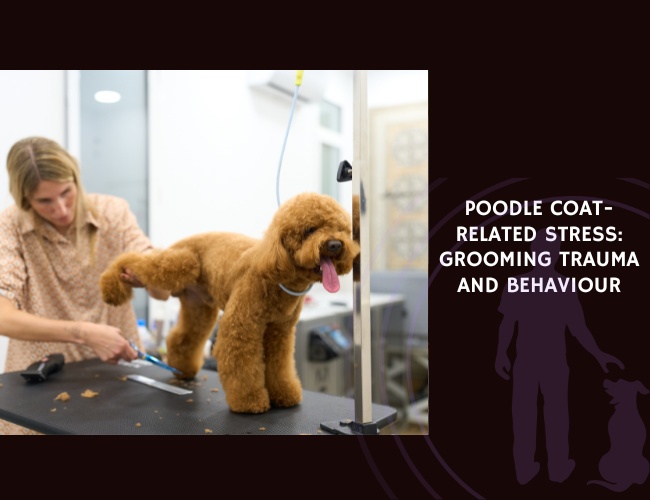
Your Poodle’s luxurious, iconic curls are more than just a statement of elegance. Beneath those beautiful coils lies a complex relationship between coat care, sensory experience, and emotional wellbeing that many owners never fully understand. If you’ve noticed your Poodle flinching at the brush, trembling before grooming appointments, or withdrawing after a salon visit, you’re witnessing something far deeper than simple nervousness.
Let us guide you through the intricate connection between your Poodle’s high-maintenance coat and their emotional landscape. This isn’t about grooming tips or styling choices. This is about understanding how repeated tactile experiences can shape your dog’s trust, their sense of safety, and their relationship with touch itself.
The Poodle’s Unique Coat: A Sensory Reality
The Poodle’s dense, curly, continuously growing coat isn’t just visually distinctive. It creates a sensory reality that fundamentally differs from dogs with lower-maintenance coats. While a Labrador might need occasional brushing and seasonal grooming, your Poodle requires consistent, frequent, and highly specialized coat care throughout their entire life.
This inherent characteristic means your Poodle experiences tactile exposure at levels most other breeds never encounter. Regular brushing to prevent matting, frequent bathing to maintain skin health, and precise clipping every four to eight weeks become woven into the fabric of their lived experience. Each grooming session isn’t just a practical necessity. It’s a sensory event that can build trust or erode it, create safety or establish fear.
Understanding Tactile Hypersensitivity
Did you know that individual dogs process touch, pressure, and restraint differently based on their unique somatic sensory processing? Some Poodles demonstrate what appears to be tactile hypersensitivity, responding more intensely to handling, grooming tools, or physical manipulation than their littermates might. This heightened sensitivity isn’t weakness or poor breeding. It’s a neurological reality influenced by:
- Genetic disposition toward heightened sensory processing
- Early experiences with handling and grooming
- Accumulated associations between touch and emotional outcomes
- Individual neurological variations in somatic sensory thresholds
Think of the “sensitive genius” temperament often attributed to Poodles. Their remarkable intelligence and emotional attunement come with a neurological system that processes environmental stimuli, including touch, with extraordinary depth. When you combine this sensitivity with the constant grooming demands their coat requires, you create a scenario where emotional regulation around handling becomes a critical developmental task.
The concept of emotional dysregulation, defined as the inability to regulate the intensity and quality of emotional responses, becomes particularly relevant here. A Poodle’s genetic predisposition toward sensitivity, combined with early negative grooming experiences, can contribute to heightened tactile defensiveness that makes every future grooming encounter increasingly challenging.
The Hidden Pain of Matted Coats
Coat matting isn’t just an aesthetic concern. When fur becomes tangled and forms tight mats close to the skin, it creates chronic physical discomfort through constant pulling and skin tension. Imagine wearing a shirt that’s perpetually too tight, creating persistent low-level pain that you can’t escape. That’s the experience of a Poodle living with matted fur.
This persistent discomfort creates a foundation of stress that predisposes your Poodle to develop negative associations with grooming itself. Matting impacts your Poodle through:
- Constant skin tension from pulling on hair follicles
- Restricted movement in areas with severe matting
- Moisture retention against the skin leading to irritation
- Pain during normal activities like sitting, lying down, or walking
- Increased trauma risk during dematting procedures
- Heightened defensive readiness as ongoing discomfort sensitizes them to touch
The procedures meant to relieve their discomfort may be perceived as extensions of that pain, especially when dematting requires pulling or when clippers must work close to irritated skin. Chronic physical discomfort from matting can contribute to a state of ongoing emotional vulnerability, where your Poodle exists in a heightened state of defensive readiness. 🧠
Size Matters: Understanding Variety-Specific Vulnerabilities
Your Poodle’s size fundamentally shapes their grooming experience and their vulnerability to specific stressors. Standard, Miniature, and Toy Poodles share the same high-maintenance coat, but their different body sizes create distinct challenges that deserve individualized approaches.
Toy Poodles: The Vulnerability of Smallness
Toy Poodles, typically weighing four to six pounds, experience grooming through a lens of profound size disparity. When human hands approach their tiny bodies, the physical reality involves being completely enveloped and controlled by beings many times their size. This size differential amplifies the psychological impact of restraint.
Physical restraint that a Standard Poodle might barely notice can feel completely overwhelming to a Toy. A grooming loop around their neck represents a proportionally larger constraint. A hand holding their leg immobilizes a greater percentage of their body. The grooming table, already an elevated and potentially frightening surface, places them at a height where falling would cause serious injury, intensifying their need to remain motionless.
Toy Poodles demonstrate heightened vulnerability to what researchers call “small dog syndrome” responses during grooming, where their size makes them more prone to defensive reactivity when they feel trapped or threatened. Their smaller lung capacity means they heat up more quickly under dryers, potentially requiring more frequent breaks. Their delicate bone structure makes forceful handling particularly dangerous, both physically and emotionally.
When working with Toy Poodles, adjust your approach:
- Minimize restraint intensity and duration
- Use smaller-sized grooming tools that feel less overwhelming
- Work at lower table heights when possible to reduce fall anxiety
- Recognize that “gentle” handling may feel forceful to a 4-6 pound dog
- Watch for subtle stress signals that are easier to miss on smaller faces
- Provide more frequent breaks during drying to prevent overheating
- Use lower air velocity and temperature settings
- Allow more time overall, even though coat volume is smaller
Miniature Poodles: The Middle Ground
Miniature Poodles, weighing ten to fifteen pounds, occupy an interesting middle ground in grooming vulnerability. They’re large enough that restraint doesn’t completely overwhelm them, yet small enough that handling requires care and precision. This middle position often means their specific needs get overlooked as groomers apply one-size-fits-all approaches.
Miniatures frequently demonstrate what appears to be “big dog energy” in a medium-sized package, sometimes attempting behaviors during grooming that their size doesn’t actually support safely. They may struggle more vigorously than Toys but with less physical resilience than Standards, potentially putting themselves at greater injury risk during resistant episodes.
Miniature Poodle-specific considerations:
- Balance between confidence and physical capability often mismatched
- Medium stamina levels may not match grooming duration needs
- Specific needs often overlooked in one-size-fits-all approaches
- Moderate coat volume with variable tolerance for prolonged standing
- Injury risk during resistance due to energetic struggles with medium-sized bodies
- Need for groomers who understand their unique middle-ground position
Standard Poodles: Size Advantages and Unique Challenges
Standard Poodles, weighing forty to seventy pounds, generally tolerate physical aspects of grooming better than their smaller counterparts. Their larger body size means restraint feels less overwhelming, their greater mass provides more stability on grooming tables, and their larger lung capacity helps them regulate temperature more effectively during drying.
However, Standards face their own distinct challenges. Their substantial coat volume means grooming sessions run significantly longer, testing their emotional and physical stamina. A full groom on a Standard Poodle in full coat can take three to four hours, an exhausting duration for maintaining emotional regulation.
Standard Poodle grooming challenges include:
- Extended session duration (3-4 hours for full grooming)
- Greater coat volume requiring more time and handling
- Underestimated stress levels due to size-based assumptions
- Missed stress signals from groomers expecting better tolerance
- Orthopedic strain from prolonged standing positions
- Weight-related joint stress particularly in seniors
- Increased physical challenge for groomers when distress occurs
- Potential for rushed procedures when stress behaviors emerge
Large Poodles with orthopedic issues face particular difficulties maintaining standing positions for extended periods. Their weight places more strain on aging joints, and the physical discomfort of prolonged standing can create or exacerbate grooming-related stress.
Tailoring Your Approach by Size
Understanding these size-specific vulnerabilities allows you to advocate more effectively for your Poodle’s needs. When discussing your dog with groomers, explicitly mention size-related considerations relevant to your Poodle. For Toys, emphasize the need for minimal restraint and smaller tools. For Miniatures, request regular assessment of their tolerance levels throughout the session. For Standards, ensure adequate breaks are planned into longer grooming appointments and discuss any orthopedic concerns that affect their standing tolerance.
Your Poodle’s size isn’t just about which grooming table height to use. It’s about recognizing how their physical reality shapes their psychological experience of handling, restraint, and the grooming process itself.

Age-Specific Grooming Considerations
Your Poodle’s age profoundly influences both their vulnerability to grooming trauma and their capacity for recovery. Understanding developmental stages and age-related changes allows you to calibrate your approach appropriately.
Puppies: The Critical Foundation Period
The window between eight and sixteen weeks represents the most important period for establishing positive grooming associations. During this critical socialization period, your Poodle puppy’s brain remains highly plastic, readily forming associations that will influence their lifelong responses to handling and grooming.
Positive experiences during this window create neural pathways that support stress tolerance and emotional regulation around grooming throughout life. Conversely, traumatic experiences during this sensitive period can establish deep-rooted fear responses that prove significantly harder to modify later.
Critical socialization grooming goals (8-16 weeks):
- Brief, pleasant brush touches while playing or eating
- Gentle paw handling during positive interactions
- Ear touching and examination with treats
- Introduction to grooming tool sounds at a distance
- Light face touches around muzzle and eyes
- Nail touching (not yet trimming) with rewards
- Brief bathing experiences with warmth and comfort
- Exposure to grooming environment sounds and smells
- Positive associations with grooming table or elevated surfaces
- Meeting groomers in non-grooming social contexts
Your puppy doesn’t need extensive grooming during this period. They need pleasant, brief, successful experiences that build positive associations. A thirty-second introduction to the sound of clippers while eating a special treat teaches more than a thorough but stressful puppy trim. Gentle handling of paws during play, brief brushing sessions that end while your puppy still feels happy, letting them investigate grooming tools at their own pace—these micro-experiences accumulate into a foundation of “grooming predicts good things.”
Avoid the temptation to achieve perfect grooming results during puppyhood. The stakes of getting the coat exactly right are low compared to the stakes of establishing emotional associations that will persist for twelve to fifteen years. A slightly imperfect puppy coat with excellent grooming associations serves your Poodle far better than immaculate grooming achieved through force or stress.
Adolescents: Fear Periods and Regression
Between six and fourteen months, your Poodle enters adolescence, a period marked by hormonal changes, increased independence, and secondary fear periods. Dogs who previously accepted grooming calmly may suddenly show reluctance, anxiety, or resistance that seems to emerge from nowhere.
These fear periods represent normal developmental stages where your adolescent Poodle’s brain becomes temporarily more vigilant about potential threats. What they previously accepted without concern may suddenly seem suspicious or frightening. This isn’t regression or stubbornness. It’s neurodevelopment.
Managing adolescent fear periods (6-14 months):
- Reduce grooming intensity rather than pushing through resistance
- Shorten session durations during peak fear periods
- Focus on maintaining positive associations over completion
- Avoid introducing new procedures during fear period peaks
- Increase reward rates for previously comfortable procedures
- Provide extra emotional support and patience
- Recognize temporary nature of heightened sensitivity
- Resume normal progression once fear period resolves
- Track fear period timing to anticipate future sensitive windows
Adolescent Poodles also test boundaries and may experiment with resistant behaviors during grooming. Distinguishing between fear-based resistance and boundary-testing requires careful observation. Fear-based resistance includes stress signals, while boundary-testing typically lacks these physiological indicators and often responds to calm, consistent handling without emotional escalation.
Adult Poodles: Established Patterns and Rehabilitation
Adult Poodles between two and seven years have typically established clear patterns around grooming. Those with positive early experiences generally approach grooming with relative calm. Those who experienced trauma or inadequate socialization during critical periods often demonstrate persistent grooming-related anxiety.
Adult Poodles benefit most from consistent, predictable approaches that honor their established patterns while gently expanding their comfort zones when rehabilitation is needed. Their mature nervous systems require more repetitions to establish new associations compared to puppies, but meaningful change remains entirely possible with patient, systematic approaches.
Rehabilitation timelines for adult Poodles with established trauma typically span three to six months for noticeable improvement and six to twelve months for substantial transformation. These timelines assume consistent implementation of cooperative care protocols, regular positive exposures, and absence of retraumatizing experiences during the rehabilitation period.
Senior Poodles: Physical Comfort and Cognitive Changes
As your Poodle enters their senior years, typically around eight to ten years depending on size, physical comfort during grooming becomes increasingly important. Arthritis, reduced muscle mass, decreased stamina, and reduced flexibility all affect their ability to stand comfortably during extended grooming sessions.
Senior Poodle grooming modifications needed:
- More frequent position changes during grooming
- Softer, cushioned surfaces for standing comfort
- Additional physical support during certain procedures
- Shorter grooming sessions with longer recovery periods
- Lower grooming tables to reduce balance anxiety
- Warmer room temperatures for arthritic joints
- Gentler handling around stiff or painful areas
- Increased patience with slower movement
- More breaks for rest and stress recovery
- Simplified clip styles requiring less standing time
- Home grooming distribution across multiple short sessions
Cognitive changes in senior dogs can also affect grooming tolerance. Some senior Poodles develop cognitive dysfunction syndrome, experiencing confusion, disorientation, or anxiety in situations they previously managed well. They may forget familiar routines, struggle to understand what’s happening during grooming, or show increased anxiety in the grooming environment despite years of successful appointments.
Vision and hearing loss, common in senior Poodles, create additional vulnerabilities. When your Poodle can’t see or hear the groomer’s approach, touch becomes more startling. They can’t use visual or auditory cues to predict what’s coming next, increasing their need for tactile predictability and gentleness.
Senior Poodles benefit from shorter, more frequent grooming sessions rather than lengthy appointments. They need groomers who understand age-related physical limitations and adjust expectations accordingly. Perfect grooming becomes less important than maintaining your senior Poodle’s dignity, comfort, and quality of life during their remaining years. 🧡
Coat Type Variations and Grooming Implications
Not all Poodle coats are created equal. Within the breed, significant variations in coat texture, density, and behavior create different grooming experiences and distinct maintenance challenges.
Woolly Coats: Dense and Mat-Prone
Woolly coats feel thick, dense, and springy to the touch. Individual hair strands tend to be thicker and more tightly curled than other coat types. This coat texture, while stunning visually, presents the highest maintenance demands and the greatest matting risk.
Woolly coat characteristics and needs:
- Brushing frequency: Daily to every other day minimum
- Professional grooming: Every 4-6 weeks recommended
- Matting speed: Rapid, forms tight mats close to skin
- Grooming duration: Longest due to density and volume
- Drying time: Extended due to coat density
- Recommended clip length: Shorter styles reduce maintenance stress
- Home maintenance: Essential for preventing painful matting
- Tool requirements: High-quality slicker brushes and metal combs
- Detangling: Most challenging, requires patience and skill
When woolly coats do develop mats, they tend to form tight, painful tangles close to the skin. Dematting becomes more physically uncomfortable, increasing trauma risk. For woolly-coated Poodles, prevention through frequent home maintenance becomes essential not just for coat health but for emotional wellbeing.
These Poodles benefit from shorter clip styles that reduce maintenance intensity between appointments. While show-length coats are beautiful, the daily maintenance required and the increased grooming appointment intensity may create stress levels that outweigh aesthetic benefits for pet Poodles.
Cottony Coats: Soft and Tangle-Prone
Cottony coats feel soft, fluffy, and somewhat wispy. Individual hair strands are finer than woolly coats, creating a lighter, airier texture. While beautiful, cottony coats share woolly coats’ tendency toward frequent matting, though the mats typically form differently.
Cottony coat characteristics:
- Mat formation: Superficial at first, can cover large areas quickly
- Texture: Fine, soft, prone to static electricity
- Appearance: Shows dirt and debris more readily
- Brushing response: Responds well when caught early
- Flyaway tendency: High, especially during drying
- Static issues: Significant, requires anti-static products
- Conditioning needs: Benefits from regular conditioning treatments
- Professional grooming: Every 4-6 weeks recommended
- Best clip lengths: Moderate to short for manageability
Static electricity becomes a particular challenge with cottony coats, causing hair to fly during drying and making the coat harder to control during grooming. The fine texture also means these coats can become flyaway and frizzy, sometimes requiring different grooming products or techniques than woolly coats need.
Cottony-coated Poodles often benefit from shorter coat lengths and conditioning treatments that reduce static and improve manageability. Their soft coat can be lovely to touch during handling practice, potentially offering advantages for building positive touch associations if their finer texture feels less overwhelming during home grooming practice.
Silky Coats: Lower Maintenance but Less Common
Silky coats, less common in Poodles but occasionally seen, feature straighter, sleeker hair with more luster and flow. Individual strands are fine but lay more smoothly, creating less propensity for matting compared to woolly or cottony textures.
Silky-coated Poodles typically require less frequent brushing, often maintaining good coat condition with thorough brushing every few days rather than daily. Professional grooming intervals can sometimes be extended slightly without coat quality suffering. The reduced maintenance intensity means lower cumulative stress exposure over your Poodle’s lifetime.
However, silky coats may not hold traditional Poodle clip styles as effectively as woolly coats do. The hair lacks the same structure and body, potentially requiring different grooming approaches or clip style adaptations. Some groomers less familiar with silky-coated Poodles may struggle to achieve desired results, potentially leading to longer appointments or increased handling as they work to perfect the groom.
Recognizing Your Poodle’s Coat Type
Understanding your Poodle’s specific coat type allows you to set realistic expectations for maintenance frequency, select appropriate grooming intervals, choose suitable clip styles, and communicate effectively with groomers about your dog’s specific needs.
Ask your groomer about your Poodle’s coat type if you’re uncertain. Their experience touching many Poodle coats gives them valuable perspective on where your dog falls within the texture spectrum. This information helps you make informed decisions about clip length, grooming frequency, and home maintenance routines that balance coat health with emotional wellbeing.
Your Poodle’s coat type isn’t something you can change, but understanding it empowers you to work with their specific reality rather than against it. 🧠
How Grooming Trauma Develops
Trauma doesn’t require life-threatening events. For a Poodle, trauma can emerge from a single overwhelming grooming experience or accumulate gradually through repeated uncomfortable procedures. Understanding how fear becomes embedded in your dog’s nervous system helps you recognize why changing grooming-related behavior requires more than just “getting them used to it.”
The Moment Fear Takes Root
A single painful or frightening grooming experience can create lasting fear responses through classical conditioning. When your Poodle experiences pain during dematting, fear during restraint, or panic from a high-velocity dryer, their brain rapidly forms associations between previously neutral stimuli and that negative emotional state.
The grooming table transforms from neutral furniture into a predictor of discomfort. The sound of clippers shifts from meaningless noise to a warning signal. The groomer’s touch, regardless of how gentle it becomes later, may trigger defensive responses based on one remembered moment when it preceded pain. This rapid fear conditioning mirrors neurological patterns observed in trauma research, where a single prolonged stress event can induce lasting behavioral abnormalities and emotional dysregulation.
Which Procedures Trigger Trauma?
Not all grooming procedures carry equal trauma risk. Based on both the nature of these procedures and the sensitive areas they involve, certain grooming tasks emerge as common trauma triggers:
High-risk grooming procedures for trauma development:
- Dematting – Most physically painful, causes pulling and tugging especially in sensitive areas
- Face clipping – Limited visibility, heightened nerve density, vulnerability perception
- Feet/paw work – High nerve ending concentration, balance instability concerns
- Sanitary clipping – Intimate areas, invasive restraint feeling
- Nail trimming – Quick risk, lasting fear from single painful experience
- High-velocity drying – Overwhelming sensory experience, prolonged duration, inescapable feeling
- Physical restraint – Removal of autonomy, helplessness induction
- Ear cleaning – Deep canal work, vulnerable area sensitivity
Each of these procedures deserves special attention and modified approaches for sensitive or trauma-prone Poodles.
Dematting stands as perhaps the most physically painful procedure. When groomers must work through established mats, the pulling and tugging can cause genuine pain, especially when mats are close to the skin or located in sensitive areas like behind the ears, under the legs, or around the groin.
Face, feet, and sanitary clipping require working around your Poodle’s most sensitive and vulnerable areas. The face, particularly around the eyes and muzzle, represents a zone where your dog has limited visibility of approaching tools and heightened sensory nerve density. Feet contain numerous nerve endings, and many Poodles demonstrate natural sensitivity around their paws. Sanitary clipping involves intimate areas where restraint feels particularly invasive.
Nail trimming carries the ever-present risk of quicking, where the clipper cuts into the blood vessel and nerve bundle inside the nail. A single painful nail trim can create lasting fear that extends to all future nail care attempts.
High-velocity dryers create an overwhelming sensory experience through combined intense noise, forceful air pressure, and prolonged duration. For sensitive Poodles, the dryer can feel like an inescapable assault on their auditory and tactile systems.
Physical restraint, particularly when forceful, represents the removal of autonomy and control. Grooming loops, table restraints, and hands holding your Poodle in position can trigger panic responses, especially in dogs who have experienced previous trauma or who possess naturally higher anxiety levels.
Fear Generalization: When Grooming Fear Spreads
Once fear conditioning occurs around grooming, your Poodle’s brain doesn’t necessarily limit that fear to the grooming salon. Fear generalizes to similar contexts, creating a widening circle of anxiety that can impact daily life in unexpected ways.
Common fear generalization patterns from grooming trauma:
- Clipper noise → Hairdryers, vacuum cleaners, kitchen appliances
- Face handling → Veterinary exams, eye cleaning, affectionate head touches
- Paw handling → Harness application, nail care, foot inspection
- Restraint → Veterinary procedures, car rides, confined spaces
- Grooming table → Elevated surfaces, examination tables, platforms
- Groomer’s touch → Stranger approach, veterinary staff, new people
- Bathing → Rain, water bodies, garden hoses, swimming
- Salon environment → Pet stores, veterinary clinics, similar buildings
You might notice your Poodle becoming increasingly resistant to having their harness put on, withdrawing when you reach toward their paws, or showing unexpected anxiety at the veterinary office despite no negative vet experiences. These behaviors often trace back to unresolved grooming trauma that has generalized beyond its original context. 🧡
Reading Your Poodle’s Stress Signals
Your Poodle communicates their discomfort and fear long before they snap or shut down completely. Learning to recognize early micro-signals allows you to intervene before stress escalates into trauma, and these subtle indicators deserve your careful attention.
Early Warning Signs
Early stress micro-signals to watch for:
- Paw withdrawal: Pulling foot back when you reach for it, even slightly
- Flinching: Anticipatory tension when brush or tools approach
- Lip licking: Rapid tongue flicks, often in absence of food
- Yawning: During grooming preparation, not from tiredness
- Head turns: Looking away from grooming tools or your hands
- Frozen stillness: Rigid immobility, often misread as cooperation
- Whale eye: Showing whites of eyes, tense eye muscles
- Ear position changes: Pinned back or flattened against head
- Tail tucking: Held tight against body or between legs
- Slow movements: Cautious, deliberate motion quality
- Reduced responsiveness: Not responding to name or cues
- Polite avoidance: Subtle backing away or positioning behind furniture
- Lowered body posture: Crouching or making self smaller
- Panting: Stress-related, not temperature-driven
These signals represent your Poodle’s attempt to communicate discomfort before resorting to more intense defensive behaviors.
Chronic Stress Manifestations
When grooming stress becomes chronic rather than acute, behavioral changes evolve and intensify along a spectrum:
Active resistance behaviors:
- Growling when grooming tools appear
- Air snapping near hands or tools
- Attempts to bite during handling
- Intense struggling against restraint
- Escape attempts from grooming area
- Aggressive displays to create distance
Passive coping behaviors:
- Complete unresponsiveness to environment
- “Statue behavior” – rigid immobility
- Dissociative staring into distance
- Emotional shutdown and collapse
- Learned helplessness presentation
- Apparent cooperation masking internal panic
Appeasement over-compliance:
- Perfectly still despite internal distress
- Suppression of all stress signal expression
- External stillness with internal terror
- Learned inhibition of resistance
- Frozen compliance from hopelessness
- Absence of any behavioral feedback
These aren’t signs of aggression or good behavior in traditional senses. They’re defensive responses from a dog whose nervous system has exceeded capacity for regulation, or who has learned that communication produces no relief.
Post-Grooming Behavioral Changes
The hours and days following grooming appointments often reveal the true emotional impact of the experience.
Post-grooming stress indicators (first 24-48 hours):
- Increased clinginess: Following you constantly, seeking reassurance
- Withdrawal behaviors: Hiding, avoiding interaction, isolating
- Irritability: Snappish with family members, reduced tolerance
- Heightened startle response: Jumping at normal sounds or movements
- Sleep disruption: Restlessness, difficulty settling, nightmares
- Appetite changes: Reduced food intake or stress eating
- Attention-seeking: Unusual demands for interaction or comfort
- Avoidance of grooming areas: Refusing to enter rooms where tools are stored
- Sensitivity to touch: Pulling away from normal affection or handling
- Regression in training: Previously reliable behaviors become inconsistent
- Increased anxiety overall: Generalized nervousness in daily activities
- Physical symptoms: Excessive yawning, panting, or stress-related digestive issues
These post-grooming changes aren’t random mood shifts. They’re reliable indicators of emotional distress experienced during the grooming process, providing you with critical feedback about your Poodle’s internal experience regardless of how “well-behaved” they appeared during the actual grooming. 😄
When Physical Health Compounds Grooming Stress
Medical conditions and physical health issues don’t just affect your Poodle’s overall wellbeing. They fundamentally alter their grooming experience, often transforming procedures that might otherwise be tolerable into genuinely painful or frightening encounters.
Skin Conditions and Dermatological Sensitivity
Poodles prone to skin conditions experience grooming through a lens of physical discomfort that healthy-skinned dogs never encounter. Common dermatological issues create distinct challenges during handling and coat care.
How skin conditions transform the grooming experience:
Allergies and Atopic Dermatitis:
- Chronically itchy, inflamed skin hypersensitive to touch
- Normal brushing becomes actively painful
- Bathing may sting inflamed areas
- Clippers on irritated skin feel intolerable
- Resistance reflects genuine pain, not behavioral issues
Sebaceous Adenitis:
- Dry, scaly, inflamed skin with significant discomfort
- Compromised skin and coat structure tangles more readily
- Combination of painful skin plus difficult coat maintenance
- Perfect storm for grooming trauma development
- Every grooming involves managing painful mats on uncomfortable skin
Folliculitis and Skin Infections:
- Tender, painful areas react strongly to touch
- Hot spots, pustules, or inflamed follicles create no-touch zones
- Groomers may inadvertently cause pain without knowledge of condition
- Establishes trauma associations with grooming procedures
When your Poodle has active skin conditions, communicate this clearly with your groomer before appointments. Discuss which areas are most sensitive, whether modifications to bathing products are needed, and whether certain procedures should be deferred until the skin condition improves. Sometimes the kindest choice involves accepting less-than-perfect grooming results while prioritizing your Poodle’s physical comfort during healing periods.
Orthopedic Issues and Position Tolerance
Standing still on a grooming table for thirty minutes to two hours requires significant physical stamina and comfort. Orthopedic conditions transform this seemingly simple task into an endurance challenge that may exceed your Poodle’s physical capacity.
Orthopedic conditions requiring grooming modifications:
Hip Dysplasia:
- Pain during prolonged standing positions
- Difficulty with back leg positioning for sanitary clipping
- Need for frequent position changes
- Resistance may indicate pain relief seeking, not behavioral issues
Luxating Patellas:
- Instability during standing
- Frequent stance adjustments needed
- Reluctance to bear full weight on affected legs
- Position resistance often misinterpreted as misbehavior
Arthritis:
- Stiff, uncomfortable joints after short standing periods
- Cumulative distress during longer sessions
- Age-related decrease in grooming tolerance
- Pain-based rather than anxiety-based resistance
Spinal Issues (IVDD):
- Sensitivity around back and neck areas
- Pain from grooming loops around neck
- Discomfort from restraining hands on body
- Positions requiring flexion or extension trigger pain
Required accommodations:
- Padded, cushioned standing surfaces
- More frequent position changes
- Opportunities to sit or lie down between procedures
- Shorter overall session lengths
- Split grooming across multiple appointments
- Lower grooming tables for easier access
- Gentle support rather than firm restraint
Sensory Deficits: Vision and Hearing Loss
When your Poodle can’t see or hear normally, their entire grooming experience transforms. Sensory deficits remove the predictability that helps dogs tolerate handling, replacing it with a world where touch appears without warning.
Vision loss, whether from progressive retinal atrophy, cataracts, or age-related changes, means your Poodle can’t see the groomer’s hands approaching, can’t watch tools moving toward them, and can’t use visual information to predict what’s coming next. Every touch becomes a surprise, potentially a startling one. The grooming environment, with its unfamiliar sounds and smells, becomes harder to navigate and understand without visual context.
Hearing loss removes auditory warnings and verbal cues that hearing dogs use to prepare for handling. Your deaf Poodle can’t hear the clipper noise that signals trimming is about to begin, can’t hear verbal reassurance or warnings, and may startle more easily when touched unexpectedly because they lack auditory awareness of the groomer’s proximity.
Poodles with sensory deficits require modified grooming approaches that compensate for their reduced sensory input. This includes increased reliance on tactile cues, slower pacing to allow processing time, ensuring your Poodle can smell the groomer’s approach before being touched, using vibration or gentle taps to signal upcoming handling, and maintaining extremely consistent routines that allow prediction through pattern learning rather than sensory cues.
Distinguishing Pain from Behavioral Resistance
Recognizing whether your Poodle’s grooming resistance stems from pain or fear is essential for appropriate intervention. Pain-based resistance shows specific characteristics that differ from anxiety-based responses.
Distinguishing pain from fear – key indicators:
Pain-Based Resistance Indicators:
- Resistance specific to certain body areas or positions
- Sudden, sharp reactions when particular spots touched
- Improvement when positioning changes
- Vocalization quality different from fear sounds (sharper, more urgent)
- Muscle tension or trembling in specific localized areas
- Resistance patterns correlating with known physical conditions
- Inconsistent resistance (fine some days, resistant others)
- Relief visible when pressure removed from affected areas
Fear-Based Resistance Indicators:
- Generalized stress signals present before specific handling begins
- Improvement with breaks and emotional support
- Consistency across different body areas
- Responses matching classical conditioning patterns
- Anticipatory anxiety before procedures start
- Stress signals throughout grooming environment exposure
- Response to context cues (grooming table, salon, tools)
- Improvement with desensitization and counter-conditioning
When to Seek Veterinary Evaluation:
- Any resistance that seems pain-based requires veterinary assessment before behavioral interventions
- Treating grooming resistance as purely behavioral when physical pain is present is ineffective and potentially harmful
- Allows pain conditions to progress while your Poodle suffers unnecessarily
- Some Poodles experience both pain and fear simultaneously, requiring parallel interventions This complex presentation benefits from coordinated care between your veterinarian, a veterinary behaviorist or certified behavior consultant, and a groomer trained in working with special needs dogs. 🧡
Touched. Triggered. Guarded.
Beauty shaped by burden. A Poodle’s elegant coat demands relentless contact, turning grooming from routine care into repeated emotional tests. When sensitivity meets touch without trust, the body remembers before the mind understands.
Sensory overload becomes fear. Their finely tuned nervous system feels each brush, each restraint, each tension of a mat not as minor discomfort—but as a signal of unpredictability. What begins as care can quietly become caution.
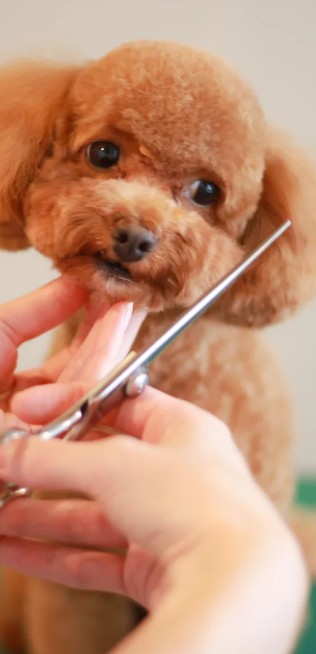
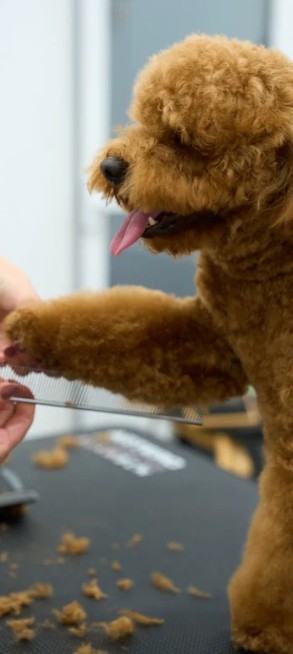
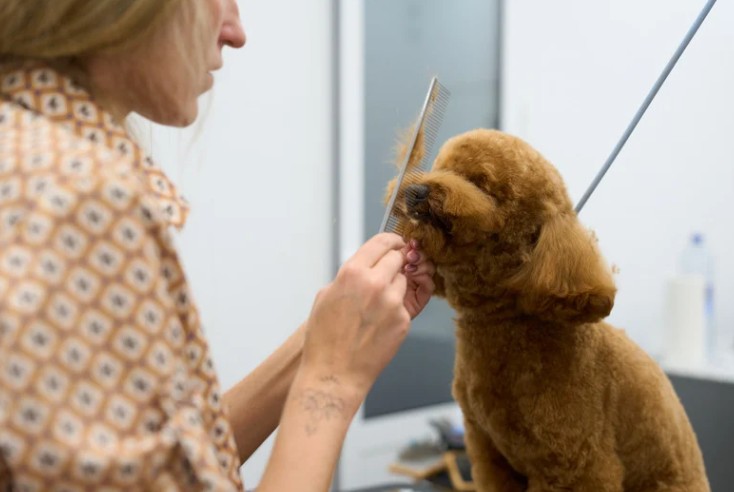
Trust is built through touch. When grooming respects sensitivity rather than overriding it, touch becomes communication instead of intrusion. Safety isn’t styled—it’s felt.
The Critical Role of Handling Methods
How your Poodle gets groomed matters as much as whether they get groomed. The approach groomers take, the equipment they use, and the emotional environment they create fundamentally shape whether grooming builds trust or establishes trauma.
Forceful Restraint vs. Cooperative Care
Traditional grooming approaches often prioritize efficiency and completion over emotional wellbeing. When speed takes precedence, forceful restraint becomes the default method for managing dogs who express discomfort. Grooming loops tighten, additional hands hold your Poodle in position, and the groomer powers through resistance to finish the appointment on schedule.
This restraint-heavy approach creates exactly the conditions that establish trauma. Your Poodle experiences helplessness, lack of control, and the inescapable nature of the aversive experience. Their nervous system registers this as a threat scenario where their communication is ignored and their autonomy is completely removed. Early experiences with restraint-heavy grooming can program your Poodle for heightened stress responses in similar situations throughout their life.
Cooperative care represents a fundamentally different philosophy. Rather than forcing compliance, cooperative care approaches prioritize your Poodle’s emotional state, offering choices, honoring their communication, and pacing procedures according to their stress tolerance. This approach recognizes that building trust and maintaining emotional wellbeing produces better long-term outcomes than achieving short-term efficiency through force.
The Emotional Environment
Your groomer’s emotional state and energy quality significantly impact your Poodle’s experience. Dogs are extraordinary readers of human emotion, particularly Poodles with their heightened sensitivity and attunement. When your groomer works from a place of frustration, impatience, or emotional stress, your Poodle perceives and responds to that emotional state.
Calm, emotionally regulated handling creates safety. Through the NeuroBond approach, trust becomes the foundation of learning and experience. When your groomer maintains emotional clarity, uses minimal verbal noise, and communicates primarily through structured, predictable touch, they create conditions where your Poodle can begin to relax into the experience rather than brace against it.
Rushed grooming appointments prioritize task completion over emotional pacing. Your Poodle needs time to process, to adjust to transitions between procedures, to regulate their arousal level as the session progresses. When groomers move too quickly from one procedure to the next without allowing this processing time, they prevent your Poodle from ever achieving a regulated state, keeping them in a constant state of overwhelm throughout the appointment.
🐩 Understanding & Healing Poodle Grooming Trauma
A comprehensive journey from prevention to rehabilitation—transforming grooming from fear to trust
Phase 1: Recognition & Assessment
Identifying stress signals before trauma develops
Early Warning Micro-Signals
Your Poodle communicates discomfort long before escalation. Watch for paw withdrawal, lip licking, yawning during preparation, frozen stillness, and polite avoidance. These subtle signals represent your window for intervention before fear becomes embedded.
Size & Age Vulnerabilities
• Toy Poodles: Heightened restraint sensitivity, proportionally overwhelming handling
• Miniatures: Middle-ground challenges, stamina vs. duration mismatch
• Standards: Extended sessions (3-4 hours), underestimated stress levels
• Puppies (8-16 weeks): Critical socialization window for positive associations
• Seniors: Orthopedic pain, cognitive changes, reduced tolerance
⚠️ Emergency Stop Indicators
Dilated pupils, uncontrollable trembling, loss of bladder control, dissociative staring, or panic responses require immediate cessation. These aren’t mild stress—they’re emergency responses requiring complete stop and professional support.
Phase 2: Medical Evaluation
Distinguishing pain from fear-based resistance
Physical Health Compounds Trauma
Skin conditions (allergies, sebaceous adenitis, folliculitis) make normal grooming genuinely painful. Orthopedic issues (hip dysplasia, luxating patellas, arthritis) transform prolonged standing into endurance challenges. Vision or hearing loss removes predictability, making every touch a surprise.
Pain vs. Fear Recognition
Pain indicators: Resistance specific to certain areas, sudden reactions to touch, improvement with position changes, localized muscle tension.
Fear indicators: Generalized stress before handling begins, consistency across body areas, improvement with breaks, pattern matching classical conditioning.
Veterinary Consultation Priority
Before implementing behavioral interventions, rule out medical causes. Treating grooming resistance as purely behavioral when physical pain exists is ineffective and potentially harmful. Some Poodles require parallel interventions addressing both pain and emotional trauma.
Phase 3: Prevention Foundation
Building positive associations from the start
Critical Socialization Window (8-16 Weeks)
• Brief brush touches during play or meals
• Gentle paw and ear handling with treats
• Grooming tool sounds at distance
• Positive grooming environment exposure
• Meeting groomers in non-grooming contexts
Goal: Pleasant, brief experiences that build “handling predicts good things” database.
Daily Touch Desensitization
30-60 second micro-sessions throughout the day: paw touches during breakfast preparation, ear touches while eating, body handling during couch time. Progress from least to most sensitive areas: shoulders → sides → ears → paws → face → sanitary areas. Consistency matters more than duration.
Coat Type Matters
Woolly coats: Daily brushing needed, highest mat risk, longer grooming sessions.
Cottony coats: Superficial mats, static challenges, benefits from conditioning.
Silky coats: Lower maintenance, less frequent professional grooming needed. Understanding your Poodle’s specific coat sets realistic expectations.
Phase 4: Systematic Desensitization
10-week protocols for specific procedures
Clipper Desensitization Timeline
Weeks 1-2: Sound at distance, investigation encouraged
Weeks 3-4: Running clippers gradually closer
Weeks 5-6: Inactive clipper touch + nearby active sound
Weeks 7-8: Brief active clipper contact on less sensitive areas
Weeks 9-10: Functional clipping in challenging zones
Adjust timeline based on individual responses—slower is always safer.
Dryer, Nail Grinding & Face Handling Protocols
Each procedure follows similar progressive exposure: sound habituation → tool familiarization → proximity increase → brief contact → duration building → functional use. Face handling requires extra patience due to vulnerability perception and limited visibility of approaching tools.
Choice-Based Handling Power
Through the Invisible Leash approach, teach consent signals: chin rest = “continue,” lifting chin = “pause.” When your Poodle discovers they can truly influence the process, grooming shifts from something that happens to them to something they participate in. This transforms their perception from helplessness to agency.
Phase 5: Groomer Selection & Partnership
Finding professionals who prioritize emotional wellbeing
Critical Questions to Ask
• “What training do you have in fear-free or cooperative care grooming?”
• “What do you do when a dog shows stress signals?”
• “How do you handle dogs who need breaks?”
• “Can you describe your typical restraint methods?”
• “Are you willing to split grooming across multiple appointments?”
• “Can I observe a session first?”
Red Flag Responses
“Don’t worry, we can handle any dog” (one-size-fits-all approach). “Most dogs are fine once you separate them from owners” (dismisses valid anxiety). “We just have to get through it” (completion over wellbeing). “I rarely use treats, dogs should behave without bribes” (outdated philosophy). Trust your instincts—if uncomfortable, continue searching.
Communication During Grooming
Share medical conditions, orthopedic issues, known triggers, specific stress signals, and priorities. Make clear that emotional wellbeing matters more than perfect results. Don’t hesitate to intervene if observing significant stress—respectful groomers welcome informed input from owners who know their dogs intimately.
Phase 6: Home Grooming Environment
Equipment and setup for stress-reduced maintenance
Essential Stress-Reducing Equipment
Silent/low-noise clippers (<45dB) with low-vibration motors
Low-velocity dryers with variable speed and warm (not hot) settings
Quality slicker brushes with protective pin tips for Poodle coats
Metal combs (fine and coarse) for thorough coat assessment
Non-slip surface (non-negotiable for physical security)
Rounded-tip scissors for safe detail work
Optimal Space Setup
Bright, even lighting without harsh shadows. Comfortable room temperature (68-72°F). Low-noise environment when possible. Good ventilation preventing overheating. Clean, organized space reducing chaotic feeling. Appropriate table height (waist-high for you, stable for your Poodle). Equipment quality represents preventive healthcare investment.
Progressive Skill Development
Beginner: Daily brushing, paw checking, ear inspection
Intermediate: Bathing, nail grinding, sanitary trimming
Advanced: Body clipping, face shaping, full grooming
More home maintenance = less professional grooming frequency = reduced cumulative stress exposure over your Poodle’s lifetime.
Phase 7: Trauma Rehabilitation
Rebuilding trust after established trauma
Realistic Timeline Expectations
Adult Poodles with established trauma:
• 3-6 months for noticeable improvement
• 6-12 months for substantial transformation
• Assumes consistent implementation and no retraumatizing events
Puppies and adolescents typically progress faster. Seniors may require more accommodations but can still achieve meaningful improvement.
NeuroBond Cooperative Care Framework
Through the NeuroBond approach, emotionally coherent, low-pressure handling rebuilds relational safety around touch. Train consent signals outside grooming contexts first. Establish predictable routines with consistent sequences. Begin with comfortable touch zones, progressing gradually toward challenging areas. Moments of Soul Recall reveal how memory and emotion intertwine—your consistency rebuilds trust in predictable positive outcomes.
When Professional Support Becomes Essential
Consult veterinary behaviorist or certified behavior consultant when: anxiety significantly impacts quality of life, standard protocols show no progress after 3-6 months, multiple groomers unable to work successfully, emergency stress responses occur, or generalized anxiety affects multiple life areas. Professional support offers customized protocols, medication management when appropriate, and expertise with complex cases.
Phase 8: Ongoing Management & Multi-Dog Households
Maintaining progress and preventing fear contagion
Pre & Post-Grooming Protocols
24-48 hours before: Adequate exercise, calming supplements if using, increased routine predictability, extra bonding time, avoid feeding 2-3 hours before appointment.
After grooming: Quiet recovery time (first 2-4 hours), gentle walks in familiar environments, calming enrichment activities, avoid high-energy play or novel experiences for 24 hours. Monitor sleep, appetite, and stress signal frequency.
Observational Fear Learning Prevention
Dogs learn fear by watching other dogs’ reactions. Puppies particularly susceptible. Strategies: Groom confident dogs first, physically separate during stressed dog’s grooming, use white noise to mask distress vocalizations, create positive experiences for non-groomed dogs during another’s appointment. Stagger grooming across different days when possible to prevent household “grooming day” anxiety buildup.
Medication Support When Needed
Situational medications (Trazodone, Gabapentin) reduce fear intensity enough for desensitization participation. Give 2-3 hours before appointment, always trial at home first. Natural alternatives (L-theanine, DAP pheromones, quality CBD) offer mild support. Medication enables cooperation, doesn’t create compliance through sedation—supports behavioral work, never replaces it.
🔍 Understanding Your Poodle’s Unique Profile
Toy Poodles (4-6 lbs)
Most vulnerable to restraint overwhelm. Require minimal restraint, smaller tools, lower table heights, more frequent breaks during drying. Heat up quickly, need extra monitoring. Subtle stress signals easily missed.
Miniature Poodles (10-15 lbs)
Middle-ground challenges often overlooked. “Big dog energy” in medium package. Moderate stamina may not match session duration. Need careful balance between completion and tolerance limits.
Standard Poodles (40-70 lbs)
Better physical tolerance but extended sessions (3-4 hours) test emotional stamina. Greater coat volume. Stress levels often underestimated. Orthopedic strain significant in seniors.
Woolly Coat Type
Dense, highest maintenance. Daily brushing essential. Rapid mat formation, tight tangles close to skin. Longer grooming sessions. Most painful dematting. Shorter clip styles recommended to reduce stress exposure.
Cottony Coat Type
Soft, fine texture. Superficial mats covering large areas. Static electricity challenges. Shows dirt readily. Benefits from conditioning treatments. Responds well to early intervention on tangles.
Silky Coat Type
Straighter, less common. Lower maintenance—brushing every few days. Less mat-prone. Professional grooming intervals can extend. May not hold traditional clip styles as effectively. Reduced cumulative stress exposure.
⚡ Quick Reference: Trauma Prevention Formula
Prevention = Early Socialization (8-16 weeks) + Daily Touch Desensitization (30-60 sec) + Right Groomer Selection + Quality Equipment
Emergency Response = Immediate Stop + Freedom of Movement + Calm Quiet Presence + Allow Recovery (15-60 min) + Document Trigger + Professional Consultation
Rehabilitation Timeline = 3-6 Months (Noticeable) + 6-12 Months (Substantial) + Consistent Implementation + No Retraumatization
Consent Signal Training = Outside Grooming Context First + Predictable Routines + Honor Communication + Build Agency
🧡 The Zoeta Dogsoul Philosophy
Your Poodle’s relationship with grooming isn’t fixed or predetermined. Even after significant trauma, you can rebuild trust, restore positive associations, and transform grooming from a source of fear into a ritual that strengthens rather than threatens your bond.
Through the NeuroBond approach, emotionally coherent handling rebuilds relational safety around touch. The Invisible Leash reminds us that awareness, not tension, guides the path—when your Poodle learns they have agency through consent signals, grooming shifts from helplessness to partnership. Soul Recall moments reveal how memory and emotion intertwine in behavior, showing us that consistent, predictable positive experiences can transform even deeply embedded fear patterns.
That balance between scientific understanding and emotional attunement, between necessary care and psychological safety, between technical skill and relational trust—that’s the heart of this work. Every touch, every interaction, every moment of handling either builds or erodes the emotional bond that makes all training, all care, all shared life possible.
© Zoeta Dogsoul – Where neuroscience meets soul in dog training
Equipment Choices and Their Impact
The tools and equipment used during grooming carry their own emotional weight. High-velocity dryers, while efficient, create intense sensory experiences that many sensitive Poodles find overwhelming. Lower-velocity dryers or cage drying with appropriate breaks offer less intense alternatives that accomplish the same goal with reduced stress.
Sharper blades and well-maintained clippers move through the coat more smoothly, requiring less pressure and fewer passes. Dull blades pull at the fur, creating discomfort even when the groomer’s technique is otherwise excellent. The quality and condition of grooming tools directly impact your Poodle’s physical experience.
Table height, lighting, temperature, and ambient noise levels all contribute to the overall sensory environment. A grooming space designed with canine stress reduction in mind looks different from one designed purely for human convenience. Non-slip surfaces provide physical security. Appropriate lighting prevents shadows that might startle. Controlled temperature prevents overheating during the drying process. These environmental factors accumulate into either supporting or challenging your Poodle’s ability to remain emotionally regulated.
The Value of Groomer-Owner Communication
Perhaps the most overlooked element in preventing grooming trauma involves clear, detailed communication between you and your groomer. Your groomer needs to know your Poodle’s temperament, their specific sensitivities, their history with grooming, and their previous experiences with trauma or stress.
When you can describe your Poodle’s early warning signals, your groomer can recognize and respond to those signals during the appointment. When you share what procedures your Poodle finds most challenging, your groomer can modify their approach, take extra time with those areas, or implement desensitization strategies. When you discuss your goals and priorities, your groomer can make informed decisions about tradeoffs between perfection and emotional wellbeing.
This communication flows both ways. Your groomer should be reporting back about what they observed during the appointment, which procedures your Poodle handled well, where they struggled, and what strategies they employed. This ongoing dialogue creates a partnership focused on your Poodle’s long-term emotional health rather than just achieving a finished haircut. 😊
Long-Term Consequences of Unresolved Trauma
Grooming trauma doesn’t stay contained within the grooming salon. When stress and fear around handling remain unaddressed, the emotional consequences ripple outward, affecting multiple areas of your Poodle’s life and fundamentally altering their relationship with touch, trust, and the world around them.
Touch Aversion and Handling Problems
Unresolved grooming trauma often manifests as generalized touch aversion. Your Poodle may begin resisting routine handling tasks that previously posed no challenge. Putting on their harness becomes a struggle. Cleaning their ears triggers defensive responses. Checking their paws for foxtails or debris results in withdrawal or snapping.
This generalization occurs because your Poodle’s nervous system has learned that handling often precedes discomfort or loss of control. Their brain doesn’t distinguish between grooming-related touch and other forms of handling. Touch itself becomes categorized as potentially threatening, leading to defensive responses that protect them from anticipated negative experiences.
Face and muzzle sensitivity frequently intensifies after grooming trauma, particularly if your Poodle experienced pain or fear during face clipping. You might notice them pulling away when you reach toward their head, showing anxiety when children approach their face, or becoming increasingly resistant to medications, eye cleaning, or dental care. These behaviors reflect a nervous system that has learned to protect the most vulnerable areas from perceived threats.

Generalized Anxiety Development
Chronic grooming stress creates conditions that predispose your Poodle to developing generalized anxiety that extends beyond handling situations. The experience of trauma, especially when it occurs repeatedly or remains unresolved, can lead to persistent deficits in emotional regulation. Your Poodle may become more reactive overall, demonstrating lower tolerance for frustration, quicker arousal to minor stimuli, and difficulty returning to baseline calm after excitement or stress.
Sound sensitivity often emerges or intensifies following grooming trauma, particularly around sounds that resemble grooming equipment. Your Poodle might begin reacting anxiously to hairdryers, vacuum cleaners, kitchen appliances, power tools, or other household sounds they previously ignored. This sensitivity reflects their nervous system maintaining a heightened state of vigilance, constantly scanning the environment for threats that remind them of their traumatic experiences.
Veterinary fear frequently develops alongside grooming trauma because vet visits involve similar elements: restraint, handling of sensitive areas, potentially uncomfortable procedures, and lack of control. If your Poodle has learned through grooming experiences that handling environments are unpredictable and potentially painful, they extend that expectation to the veterinary clinic, creating increasing challenges for routine medical care.
Social and Relational Impacts
The most profound consequences of unresolved grooming trauma often appear in your Poodle’s relationships and their overall emotional approach to the world. Defensive behaviors toward children may emerge, not from aggression but from hypervigilance around quick movements and unpredictable touching. Children’s higher-pitched voices, sudden gestures, and less regulated approaches to interaction can trigger defensive responses in a Poodle whose trust in handling has been compromised.
Decreased confidence and increased fearfulness ripple through your Poodle’s entire personality. Dogs who were previously outgoing and curious may become cautious and withdrawn. Their willingness to engage with novel experiences diminishes. Their recovery time from minor stressors lengthens. The overall quality of their emotional life decreases as chronic anxiety becomes their baseline state.
Physical Health Implications
Beyond the emotional toll, unresolved grooming trauma creates practical barriers to maintaining your Poodle’s physical health. When your Poodle strongly resists grooming, you may delay appointments, allowing mats to form and skin conditions to develop unchecked. The chronic pain from matted fur and the inflammatory skin reactions that follow create additional physical discomfort that further compounds their stress.
Veterinary care becomes increasingly challenging when your Poodle associates handling with threat. Routine examinations require sedation. Minor procedures become major ordeals. The stress of vet visits may accelerate or exacerbate health problems, creating a cycle where medical care itself becomes a health risk factor.
This isn’t just about grooming anymore. It’s about your Poodle’s overall quality of life, their health, their relationships, and their capacity to move through the world with confidence rather than fear. That’s why prevention and rehabilitation deserve your serious attention. 🧡
Prevention: Building a Foundation of Trust
Preventing grooming trauma begins long before your Poodle’s first professional grooming appointment. The foundation you build during puppyhood, the groomer you choose, and the approach you take to home handling all contribute to whether grooming becomes a source of trauma or a trusted ritual.
Early Positive Experiences
Gentle, positive exposure to grooming-related experiences during the critical socialization period creates neural pathways that support future stress tolerance. Your Poodle puppy should experience brushing, handling of paws and face, bathing, and the sound of grooming equipment within contexts that feel safe, playful, and rewarding.
These early experiences don’t need to accomplish actual grooming goals. A thirty-second brushing session that ends while your puppy still feels positive teaches more than a thorough but stressful grooming. Touching their paws during play, gently handling their ears while offering treats, letting them investigate grooming tools at their own pace, all these micro-experiences build a database of “handling predicts good things” that protects against future trauma.
The goal during this early period involves creating positive associations and building tolerance gradually, never pushing past your puppy’s comfort threshold in pursuit of thorough coat care. A slightly imperfect puppy coat with excellent emotional associations serves your Poodle better long-term than immaculate grooming achieved through force or stress.
Systematic Desensitization
Desensitization works best when implemented proactively rather than reactively. Before your Poodle needs extensive grooming, you can systematically expose them to each element of the grooming process at levels they can handle comfortably.
Let them hear clippers running in another room while engaged in something pleasant. Gradually decrease the distance over multiple sessions until clippers can run near them without causing stress. Touch them with the inactive clippers before ever attempting to use them for actual trimming. Turn on the dryer at low speed from across the room, pairing the sound with treats, before ever directing air toward their coat.
This systematic approach respects your Poodle’s nervous system, allowing them to habituate to stimuli gradually rather than forcing them to tolerate overwhelming experiences. Each element of grooming gets broken down into manageable components, and your Poodle progresses at a pace that maintains their emotional comfort throughout the process.
Step-by-Step Desensitization Protocols
Detailed, systematic protocols provide the structure needed for successful desensitization. These timelines represent guidelines that should be adjusted based on your individual Poodle’s responses.
Clipper Desensitization Protocol
Week 1-2: Sound at Distance Place inactive clippers in the same room while your Poodle eats meals or engages in play. Let them investigate the clippers voluntarily if interested. Pair the sight of clippers with high-value treats simply for being in the same space. Your goal: neutral or positive association with clipper presence.
Week 3-4: Sound Introduction Run clippers in an adjacent room while your Poodle engages in pleasant activities. Gradually move the running clippers closer to the doorway over multiple sessions. Continue pairing the sound with treats, play, or meals. Watch for any stress signals and slow progression if they appear. Your goal: calm acceptance of clipper sound at moderate distance.
Week 5-6: Proximity and Touch With clippers off, touch your Poodle’s body gently with the clipper body, pairing each touch with treats. Work different body areas gradually. Turn clippers on briefly while holding them near but not touching your Poodle, immediately offering treats. Your goal: tolerance of inactive clipper touch and nearby active clipper sound.
Week 7-8: Active Clipper Contact Touch running clippers briefly to less sensitive body areas like the shoulder or back, immediately offering high-value rewards. Keep initial contacts to one or two seconds. Gradually increase duration as your Poodle remains calm. Your goal: acceptance of running clippers on body.
Week 9-10: Functional Use Begin removing tiny amounts of coat in non-sensitive areas, keeping sessions very brief. Gradually extend to more challenging areas like paws and face only after success in easier zones. Your goal: calm acceptance of actual clipping procedures.
Dryer Acceptance Training Protocol
Week 1-2: Sound Habituation Play recordings of dryer sounds at very low volume during positive activities. Gradually increase volume over multiple sessions while maintaining positive associations. Your Poodle should remain engaged in their activity without showing stress. Your goal: neutral response to dryer sounds at normal volume.
Week 3-4: Visual and Sound Place an inactive dryer in your Poodle’s environment. Let them investigate voluntarily. Turn the dryer on at lowest setting from across the room for brief periods while offering treats. Your goal: calm acceptance of dryer operation at distance.
Week 5-6: Air Direction and Proximity Direct dryer air away from your Poodle while gradually decreasing distance. When they accept this calmly, begin directing brief puffs of air toward their body, starting with less sensitive areas. Use constant treats during air exposure. Your goal: tolerance of air flow on body.
Week 7-8: Duration Building Gradually extend the duration of air exposure on each body area. Work systematically through different zones, spending more time on areas your Poodle finds easier before progressing to sensitive regions like face and feet. Your goal: acceptance of thorough drying procedures.
Week 9-10: Full Simulation Combine drying with light dampness on the coat, simulating post-bath conditions. Practice complete drying sessions with breaks, building toward the duration needed after actual baths. Your goal: calm tolerance of complete drying process.
Nail Grinding Introduction Protocol
Week 1-2: Tool Familiarization Allow your Poodle to investigate the inactive nail grinder. Pair its presence with treats. Turn it on in another room while your Poodle eats or plays. Your goal: neutral association with grinder tool.
Week 3-4: Sound and Vibration Run the grinder near your Poodle without touching them. Touch the running grinder to their shoulder or side so they feel vibration on less sensitive areas. Heavy treats during all exposures. Your goal: acceptance of sound and vibration sensation.
Week 5-6: Paw Touch and Tool Association Handle paws gently while the grinder runs nearby (not touching). Touch the inactive grinder to paw pads and nails. Touch the running grinder briefly to paw fur without touching nails. Your goal: relaxed paws with grinder proximity.
Week 7-8: Nail Contact Touch the running grinder to one nail for less than one second, immediately treating. Start with less sensitive nails (middle nails are often easier than dewclaws or outer nails). Do only one or two nails per session initially. Your goal: acceptance of brief nail grinding.
Week 9-10: Functional Sessions Gradually extend grinding time per nail and number of nails per session. Work toward completing one paw per session, then multiple paws as tolerance builds. Your goal: calm cooperation for complete nail care.
Face Handling Progression Protocol
Week 1-2: General Face Touches Briefly touch your Poodle’s face during calm moments, immediately offering treats. Touch different areas: cheeks, top of muzzle, chin, forehead. Keep touches light and brief. Your goal: positive association with face handling.
Week 3-4: Face Restraint Practice Gently cup your Poodle’s muzzle for one second, release, treat. Hold their head still very briefly, treat generously. Practice different gentle holds that stabilize without squeezing. Your goal: tolerance of face stabilization.
Week 5-6: Area-Specific Touch Focus on areas that require grooming attention: around eyes, ears, top of head between ears, under chin. Use tools like combs or brushes on these areas briefly while treating. Your goal: acceptance of touch in sensitive zones.
Week 7-8: Tool Introduction Near Face Bring inactive clippers near face while treating. Touch face gently with inactive tools. Run clippers near but not touching face. Your goal: calm acceptance of tools near sensitive areas.
Week 9-10: Simulated Grooming Combine gentle face restraint with inactive tool touch, mimicking actual grooming procedures. Progress to very brief active clipper touches on less sensitive face areas. Your goal: cooperation with face grooming procedures.
These protocols assume no previous trauma. Poodles with existing fear may require significantly longer timelines, smaller steps, or professional guidance to progress successfully. 🧠
Choice-Based Handling
Teaching your Poodle that they have agency within grooming situations fundamentally changes their emotional experience. Choice-based handling involves training consent signals where your Poodle can communicate “yes, continue” or “no, I need a break,” and having those communications honored.
The Invisible Leash reminds us that awareness, not tension, guides the path. When your Poodle learns they can pause the process, that their communication matters, that breaks will be offered and honored, the perceived threat level of grooming dramatically decreases. They’re no longer trapped in an inescapable situation. They’re a partner in a collaborative process.
This approach requires patience and flexibility. Sessions may take longer initially. You might not complete every task in a single session. But the long-term payoff, a Poodle who approaches grooming with trust rather than fear, far outweighs the short-term inconvenience of working at your dog’s pace.
Selecting the Right Professional Groomer
Your choice of groomer represents perhaps the most important prevention decision you make. Not all groomers employ the same philosophy or approach, and finding a groomer who prioritizes emotional wellbeing alongside technical skill determines whether professional grooming builds or erodes trust.
Look for groomers who discuss cooperative care principles, who ask about your Poodle’s temperament and sensitivities, who are willing to adapt their approach to your dog’s needs. Groomers who mention taking breaks, working at the dog’s pace, using lower-stress equipment options, or offering pre-grooming visits for new clients demonstrate awareness of the emotional dimensions of their work.
Visit the grooming facility before your Poodle’s appointment. Observe the environment, listen to the noise levels, watch how staff interact with dogs. Trust your instincts. If the environment feels chaotic, rushed, or focused purely on throughput, it likely isn’t the right fit for a sensitive Poodle.
Ask specific questions about their approach to dogs who show stress signals, how they handle resistance, what their protocol is if a dog becomes overwhelmed, and whether they’re willing to split difficult procedures across multiple shorter appointments. The answers reveal whether this groomer understands and respects the psychological dimensions of their work. 😄
Essential Groomer Interview Questions
Finding the right groomer requires asking specific questions that reveal their philosophy, training, and practical approaches. Here are critical questions that help you evaluate whether a groomer will support your Poodle’s emotional wellbeing.
Philosophy and Training Questions
“What training or certifications do you have in fear-free, low-stress, or cooperative care grooming?” This reveals whether they’ve invested in education specifically focused on emotional wellbeing rather than just technical grooming skills. Look for mentions of specific certification programs or ongoing education.
“How do you define a successful grooming appointment?” The answer tells you their priorities. Groomers focused on emotional wellbeing mention the dog’s stress levels and positive experience alongside grooming completion. Those focused purely on technical results may prioritize appearance over emotional state.
“What’s your approach to dogs who haven’t been groomed professionally before?” Their answer reveals whether they understand the importance of first impressions and gradual acclimation, or whether they view all dogs as needing the same standard procedures regardless of experience level.
Practical Handling Questions
“What do you do when a dog shows stress signals like panting, trembling, or trying to get away?” This critical question reveals their observational skills and response priorities. You want to hear about stopping, taking breaks, adjusting approach, or even ending sessions early. Red flags include answers suggesting they push through resistance or that they rarely see stress signals.
“How do you handle dogs who need breaks during grooming?” This reveals whether breaks are part of their normal protocol or viewed as unusual accommodations. Ideal groomers build breaks into their process proactively rather than only offering them when dogs are clearly overwhelmed.
“Can you describe your typical restraint methods?” Listen carefully to this answer. While some gentle positioning assistance is normal, descriptions of multiple restraints, tight loops, or firm holding suggest force-based approaches. Look for mentions of minimal restraint, consent-based positioning, or alternatives to traditional restraints.
“What equipment do you use, and do you have lower-stress alternatives available?” This reveals flexibility and awareness that different dogs need different approaches. Groomers with options like lower-velocity dryers, silent clippers, or varied tool types demonstrate commitment to individualizing their approach.
Communication and Flexibility Questions
“How do you communicate with owners about their dog’s behavior during grooming?” You want honest, detailed feedback about how your Poodle handled the appointment, which procedures they found challenging, and what the groomer observed. Groomers who report only “they did fine” may miss or minimize stress signals.
“Are you willing to split grooming across multiple appointments if needed?” This tests flexibility and willingness to prioritize emotional wellbeing over efficiency. Some Poodles genuinely need shorter sessions, and groomers should accommodate this without resistance or price penalties.
“Can I stay and observe during the first grooming session?” While not all Poodles do better with owners present, the groomer’s willingness to allow observation demonstrates confidence in their methods and transparency in their approach.
“What happens if you’re unable to complete the grooming due to my dog’s stress level?” Their answer reveals whether they view incomplete grooming as acceptable when necessary for emotional wellbeing, or whether completion takes priority regardless of the dog’s state.
Red Flag Responses to Watch For
Certain responses should raise serious concerns about whether this groomer is appropriate for your Poodle:
“Don’t worry, we can handle any dog” suggests a one-size-fits-all approach that doesn’t account for individual differences or trauma histories. Confidence without flexibility is a warning sign.
“Most dogs are fine once you separate them from their owners” dismisses the valid anxiety some dogs experience and suggests the groomer attributes all stress to owner presence rather than considering other factors.
“We just have to get through it” or “They need to learn to tolerate it” indicates a completion-focused philosophy that overrides emotional wellbeing concerns. Grooming trauma is more likely in these environments.
“I rarely use treats, dogs should behave without bribes” reveals outdated training philosophy and a potential unwillingness to use positive reinforcement to build better associations.
“I’ve been grooming for 20 years, I know what I’m doing” without any mention of ongoing education suggests reliance on experience alone rather than keeping current with evolving understanding of canine stress and behavior.
Trust your instincts during these conversations. If a groomer’s answers make you uncomfortable, if they seem dismissive of your concerns, or if they can’t clearly articulate their approach to stress management, continue your search. Your Poodle’s emotional wellbeing is too important to compromise. 🧡
Rehabilitation: Rebuilding Trust After Trauma
If your Poodle has already experienced grooming trauma, the path forward requires patience, consistency, and a fundamentally different approach than what created the trauma initially. Rehabilitation doesn’t mean forcing your Poodle to “get over it.” It means slowly rebuilding their sense of safety around handling and touch.
Cooperative Care Protocols
Cooperative care provides the framework for trauma rehabilitation. This approach centers on teaching your Poodle consent signals, where specific behaviors communicate their willingness to participate or their need for a break. A chin rest on your hand might signal “I’m ready, you can continue.” Lifting their chin or looking away signals “I need a pause.”
Training these consent signals occurs outside of actual grooming contexts initially. Your Poodle learns the behavior and its meaning when they feel safe and calm, pairing it with rewards and positive outcomes. Only after the consent signal is well-established do you begin connecting it to very brief, low-intensity versions of grooming procedures.
The power of consent signals lies in the control they return to your Poodle. When they discover they can truly influence the process, that their communication results in breaks or adjustments, their perception of grooming shifts from something that happens to them to something they participate in. This shift represents the foundation of trauma recovery.
Creating Predictable Routines
Predictability reduces stress by allowing your Poodle’s nervous system to accurately anticipate what will happen next. Inconsistent or unpredictable experiences keep your Poodle in a state of hypervigilance, unable to relax because they can’t predict whether the next moment will bring comfort or distress.
Establish consistent sequences for grooming-related activities. Always follow the same order of operations. Use the same verbal cues. Maintain the same environmental setup. This consistency allows your Poodle to develop accurate mental models of the grooming process, reducing the cognitive and emotional resources required to navigate it.
Predictability extends to the emotional quality of interactions. Moments of Soul Recall reveal how memory and emotion intertwine in behavior. Your Poodle needs to know that grooming sessions will remain calm, that you’ll honor their consent signals, that breaks will be offered at regular intervals. This consistency rebuilds their trust in the predictability of positive outcomes rather than bracing for unpredictable threats.
Structured Touch and Tactile Communication
Rebuilding positive associations with touch requires thoughtful, structured approaches rather than random or inconsistent handling. Begin with types of touch and body areas your Poodle finds most comfortable, pairing that touch with highly valued rewards, calm energy, and immediate cessation when they signal discomfort.
Progress gradually toward more challenging areas or types of touch. You might spend weeks working on paw handling before attempting to hold their foot steady enough for nail inspection. You might practice brief face touches during calm moments long before attempting to work around their eyes or muzzle with grooming tools.
The quality of touch matters as much as the quantity. Calm, confident, emotionally clear handling communicates safety more effectively than hesitant or anxious touch. Your Poodle reads your emotional state through your hands, your breath, your energy. When you can remain regulated and clear while handling them, you help regulate their nervous system rather than amplifying their stress.
Professional Support and Modified Grooming
During rehabilitation, your Poodle still requires regular coat care, but the approach must adapt to their emotional state. This might mean splitting grooming across multiple short sessions rather than completing everything in one appointment. It might involve accepting less-perfect results initially in favor of maintaining positive emotional associations.
Working with a groomer trained in cooperative care, fear-free handling, or low-stress grooming techniques becomes essential during this period. Traditional grooming approaches that prioritize completion and perfection will likely retraumatize your Poodle, undoing any rehabilitation progress you’ve achieved.
Some Poodles benefit from working with a veterinary behaviorist or certified behavior consultant who can design systematic desensitization protocols, recommend appropriate anti-anxiety interventions if needed, and provide ongoing guidance as rehabilitation progresses. Grooming trauma represents a legitimate behavioral health issue that deserves professional support, not just groomer-shopping or hoping time will resolve the problem.
The NeuroBond Approach to Grooming Rehabilitation
The NeuroBond model emphasizes emotionally coherent, low-pressure handling and cooperative care to rebuild relational safety around touch. This philosophy recognizes that grooming trauma isn’t just about fear of specific procedures. It’s about a fractured sense of trust in handling relationships and a nervous system that has learned to categorize touch as potentially threatening.
Calm leadership, characterized by emotional clarity and minimal verbal noise, creates the foundation for rehabilitation. Your Poodle doesn’t need verbal reassurance or enthusiastic encouragement during grooming procedures. They need your grounded, regulated presence that communicates through structured touch and predictable energy that this experience is safe, that you remain in control, that their wellbeing guides all decisions.
By transforming necessary coat maintenance from a source of trauma into a predictable, trust-building ritual, you don’t just accomplish the practical goal of keeping your Poodle’s coat healthy. You rebuild their confidence in handling relationships, restore their sense of agency, and demonstrate that communication and consent form the foundation of your interactions. This is the essence of Zoeta Dogsoul: recognizing that every touch, every interaction, every moment of handling either builds or erodes the emotional bond that makes all training, all care, all shared life possible. 🧠
The Neuroscience Behind Grooming Trauma
Understanding the neurological mechanisms underlying grooming trauma helps contextualize why these experiences create such lasting impacts and why rehabilitation requires patient, systematic approaches rather than simply “desensitizing” your Poodle through repeated exposure.
Affective Neuroscience and Core Emotional Systems
Grooming trauma activates core emotional systems in your Poodle’s brain, particularly the FEAR and PANIC systems identified in affective neuroscience research. When your Poodle experiences pain, restraint, or overwhelming sensory input during grooming, these ancient emotional systems activate, triggering survival responses designed to protect them from perceived threats.
Repeated activation of these systems without your Poodle having any sense of control or ability to escape may eventually trigger the RAGE system, manifesting as defensive aggression toward groomers, grooming tools, or the grooming environment. Alternatively, when these systems activate repeatedly while your Poodle remains helpless to change the situation, emotional shutdown can occur, where they cease active resistance not from cooperation but from collapsed emotional capacity.
These aren’t conscious choices your Poodle makes. These are neurological systems operating below the level of conscious control, shaped by evolution to protect mammals from danger. Understanding this helps you approach rehabilitation with appropriate respect for the deeply embedded nature of trauma responses.
Classical Conditioning and Fear Memory
A single highly aversive grooming event can lead to rapid classical conditioning, where previously neutral stimuli become powerfully fear-eliciting. Your Poodle’s brain forms immediate associations between the grooming context and the fear or pain experienced, creating implicit memories that activate automatically whenever similar stimuli appear.
These conditioned fear responses don’t require conscious thought or rational evaluation. The sight of clippers, the sound of certain equipment, the smell of the grooming salon, even the appearance of the groomer themselves can trigger immediate physiological fear responses before your Poodle consciously processes what they’re experiencing.
Research on trauma demonstrates that single prolonged stress events can result in neurological dysregulation and behavioral abnormalities that persist long after the original event. This explains why one particularly bad grooming experience can create fear responses that last months or years, requiring systematic rehabilitation rather than simply waiting for your Poodle to “get over it.”
Somatic Sensory Processing and Touch Memory
Your Poodle’s somatic sensory system processes touch, pressure, temperature, and pain through complex neural pathways that integrate current sensory input with memories of past experiences. Individual differences in tactile sensitivity influence how your Poodle interprets future touch, and memories of past pain significantly shape their anticipatory responses to handling.
When your Poodle experienced pain during previous grooming, their nervous system encoded both the physical sensations and the emotional state accompanying that pain. Future grooming situations activate these encoded memories, triggering anticipatory stress responses before any actual discomfort occurs. Your Poodle’s body remembers even when their conscious mind might not have narrative memory of the specific incident.
This somatic memory explains why your Poodle might show stress responses to grooming preparation (getting in the car, entering the grooming salon, seeing grooming tools) before any actual handling occurs. Their nervous system recognizes the context and prepares defensively based on encoded memories of past experiences.
Learned Helplessness and Emotional Collapse
When your Poodle experiences repeated inescapable aversive grooming sessions where their stress signals are ignored and their attempts to communicate discomfort produce no change in the situation, they may enter a state of learned helplessness. This neurological and psychological state involves the perception that outcomes are uncontrollable, leading to passive coping strategies and emotional shutdown.
The “perfectly behaved” Poodle who stands motionless on the grooming table might not reflect trust or cooperation but rather this learned helplessness, where they’ve ceased active resistance because experience has taught them resistance produces no change. This emotional collapse represents severe dysregulation, not successful adaptation.
Understanding learned helplessness helps you recognize that apparent cooperation doesn’t always indicate positive emotional states, and that rehabilitation requires rebuilding your Poodle’s sense that their communication matters and their behavior can influence outcomes. 🧡
Critical Warning Signs: When to Stop Immediately
Recognizing emergency stress indicators allows you to intervene before stress becomes trauma. Some stress signals require immediate cessation of grooming procedures, not just modifications or breaks.
Emergency Stress Indicators
Critical warning signs requiring immediate grooming cessation:
- Dilated pupils – Large pupils remaining dilated even in normal lighting, indicating extreme fear
- Excessive panting – Disproportionate to temperature, rapid, labored, panicked breathing
- Uncontrollable trembling – Full-body shaking that persists even when handling stops
- Loss of bladder/bowel control – Elimination during grooming indicates extreme fear response
- Dissociative staring – Glazed appearance, looking through you rather than at you
- Panic responses – Frantic escape attempts, thrashing, intense struggling that escalates
- Intense vocalization – Yelping, screaming, sounds qualitatively different from normal resistance
- Foaming or excessive drooling – Stress-induced salivation beyond normal levels
- Vomiting or retching – Extreme stress causing gastrointestinal response
- Collapsing or going limp – Complete loss of muscle tone from overwhelm
- Hyperventilation – Rapid, shallow breathing with increased respiratory rate
- Fixed, unblinking stare – Eyes wide, unmoving, trance-like state
Any of these signals means STOP IMMEDIATELY – these aren’t mild stress indicators requiring modification, they’re emergency responses requiring complete cessation.
Immediate Response Protocol
When you observe these emergency indicators, follow this protocol:
Emergency Stop Protocol – Step by Step:
- Stop all grooming procedures immediately – Put down tools, cease restraint, back away if possible
- Remove all restraints – Release grooming loops, remove hands from body
- Allow freedom of movement – Let your Poodle step off table or leave grooming area if safe
- Remain calm and quiet – Your emotional state influences their recovery; avoid excessive talking
- Provide space or contact based on their cues – Some seek contact when frightened, others need distance
- Monitor recovery indicators:
- Breathing slows and normalizes
- Pupils return to normal size
- Trembling decreases or stops
- Engagement with environment returns
- Body posture begins to relax
- Allow adequate recovery time – Full recovery may take several minutes to an hour
- Document the trigger – Note specific procedure, body area, or environmental factor that precipitated response
- Do not attempt to resume – This is a session-ending event requiring future preventive planning
When Grooming Cannot Continue
Sometimes, stopping means completely abandoning the grooming session, not just taking a break.
Indicators requiring complete session abandonment:
- Extended recovery time – Poodle fails to return to baseline calm within 15-20 minutes
- Repeated escalation – Stress indicators return immediately when grooming attempts resume
- Multiple emergency indicators – Several severe stress signals rather than single transient signal
- Physical health concerns – Vomiting, diarrhea, concerning consciousness changes
- Complete shutdown – Dissociation that doesn’t resolve with break
- Increasing intensity – Each resumption attempt produces stronger stress response
- Exhaustion – Physical or emotional depletion preventing engagement
- Environmental factors – Unsafe conditions (extreme temperature, equipment malfunction)
After an Emergency Stop
Essential follow-up actions after emergency cessation:
- Contact veterinary behaviorist or certified behavior consultant – Professional guidance needed for systematic rehabilitation
- Schedule veterinary assessment – Rule out pain, illness, or medical conditions lowering stress tolerance
- Inform all care providers – Groomers, vet staff, dog walkers need awareness of emergency response
- Document incident thoroughly – Date, triggers, indicators observed, recovery timeline
- Begin or revisit desensitization protocols – Systematic approach needed before attempting grooming again
- Adjust expectations – May need weeks or months of rehabilitation before successful grooming
- Consider professional grooming alternatives – Mobile groomers, house-call services, sedation-assisted grooming (as last resort)
- Address your own stress – Your Poodle reads your anxiety; manage your emotional state
Your Poodle’s emergency stress response isn’t failure, stubbornness, or bad behavior. It’s their nervous system signaling that their capacity for stress tolerance has been exceeded. Respecting these signals protects them from developing lasting trauma that will make all future grooming exponentially more difficult. 🧠
Essential Home Grooming Equipment
The tools you use at home significantly impact your Poodle’s stress levels during grooming maintenance. Investing in appropriate equipment reduces physical discomfort and creates more positive grooming experiences.
Clipper Considerations
Silent or low-noise clippers generate significantly less sound than standard grooming clippers, reducing auditory stress for sensitive Poodles. While more expensive, brands specifically marketed as “silent” or “ultra-quiet” can make substantial differences for noise-sensitive dogs.
Clipper selection criteria:
- Noise level: Silent (<45dB) > Quiet (45-55dB) > Standard (55-70dB)
- Vibration: Low-vibration models reduce tactile discomfort
- Power source: Cordless for freedom of movement vs. corded for consistent power
- Blade heat: Ceramic blades stay cooler than steel
- Weight: Lighter clippers easier for extended use
- Blade sharpness: Sharp blades glide vs. dull blades pull
- Replacement blade availability: Easier maintenance extends tool life
- Speed settings: Variable speed allows customization
Maintenance requirements:
- Replace or sharpen blades every 4-6 months with regular use
- Oil blades before each use
- Clean hair and debris after each session
- Check for unusual vibration or noise indicating wear
Dryer Options
Low-velocity dryers provide gentler air flow compared to high-velocity professional dryers used in many salons. While drying takes longer, the reduced force and noise make the experience more tolerable for anxious Poodles.
Ideal dryer features for stress reduction:
Air Flow Management:
- Variable speed settings (start low, increase gradually)
- Adjustable air temperature (warm, not hot)
- Directional nozzle for controlled air placement
- Lower velocity than professional force dryers
Noise Reduction:
- Quieter motor designs (<60dB preferred)
- Sound-dampening housing
- Smooth operation without rattling
Safety Features:
- Automatic shut-off to prevent overheating
- Cool-shot button for heat breaks
- Temperature regulation to prevent burns
- Lightweight design for maneuverability
Setup Options:
- Stand dryers for hands-free operation (allows simultaneous brushing)
- Handheld dryers for flexibility and control
- Cage dryer compatibility (when appropriate for temperament)
Brushing and Combing Tools
Quality slicker brushes with appropriately spaced pins make significant differences in comfort. Pins that are too dense pull more, while pins with protective tips reduce skin irritation. Brands designed specifically for Poodle coats tend to work more effectively and comfortably than general-purpose brushes.
Essential grooming tools checklist:
Brushes:
- Quality slicker brush with flexible pins and protective tips
- Pin brush for maintenance between thorough brushing
- Soft bristle brush for face and sensitive areas
Combs:
- Metal greyhound-style comb (fine and coarse teeth)
- Wide-tooth comb for initial detangling
- Fine-tooth comb for face and finishing work
- Flea comb for detail work around eyes
Specialized Tools:
- Mat splitter (use cautiously, proper training essential)
- Dematting rake (for woolly coats, gentle technique required)
- Thinning shears for blending
- Curved scissors for body work
- Straight scissors for detail work
- Rounded-tip scissors for sensitive areas
Table and Surface Setup
Non-slip surfaces are non-negotiable. Rubber matting, yoga mats, or purpose-designed grooming table covers prevent your Poodle from slipping, reducing physical insecurity and the stress it creates.
Optimal grooming space setup:
Surface Requirements:
- Non-slip mat or rubber surface covering entire table
- Appropriate height (waist-high for human, stable for Poodle)
- Sturdy construction without wobbling
- Adequate size for your Poodle’s body
- Cushioned surface for senior or orthopedic-challenged dogs
Environmental Factors:
- Bright, even lighting without harsh shadows
- Comfortable room temperature (68-72°F ideal)
- Low-noise environment when possible
- Good ventilation to prevent overheating
- Clean, organized space reducing chaotic feeling
Safety Features:
- Secure but gentle restraint options if needed
- Easy access for your Poodle to get on/off
- First aid supplies readily available
- Non-cluttered work space
- All tools within easy reach
Additional Comfort Considerations
Rounded-tip scissors for small detail work near sensitive areas reduce injury risk. Safety scissors designed for pet grooming offer sharper cutting edges than human scissors while maintaining rounded tips.
Nail grinders rather than clippers eliminate the risk of quicking and distribute the sensation differently. Many Poodles who resist nail clippers tolerate grinders better once desensitized to the sound and vibration.
Calming aids including pheromone sprays, calming music designed for dogs, or adaptil diffusers in the grooming space can create more relaxing environments. While not substitutes for proper technique, they contribute to overall stress reduction.
Quality equipment represents investment in your Poodle’s long-term wellbeing. While budget-conscious choices are understandable, extremely inexpensive tools often work poorly, require more passes and corrections, and ultimately create more stress than better-quality options. View grooming equipment as preventive healthcare investment rather than discretionary expense. 🧡
Multi-Dog Household Dynamics
When you share your home with multiple dogs, grooming stress doesn’t affect just the individual being groomed. Dogs learn from observing other dogs’ experiences, and stress can propagate through the household in ways that compound grooming challenges.
Observational Fear Learning
Dogs possess remarkable capacity for social learning, including learning fear responses by watching other dogs’ reactions. When one Poodle observes another appearing frightened or stressed during grooming, they form associations with the grooming context even without direct experience of stressful handling themselves.
How fear transfers between dogs:
Direct Observation:
- Watching another dog show stress signals during grooming
- Hearing another dog vocalize distress (whining, yelping, barking)
- Observing another dog’s resistance or escape attempts
- Witnessing another dog’s post-grooming stress behavior
Environmental Associations:
- Linking grooming sounds with another dog’s fear responses
- Associating grooming salon smells with pack member’s distress
- Connecting grooming table/equipment with other dog’s anxiety
- Learning that “grooming day” precedes household stress
Age-Based Vulnerability:
- Puppies most susceptible to observational fear learning
- Adolescents moderately vulnerable during fear periods
- Adult dogs can still learn fear observationally but less readily
- Bonded pairs show heightened mutual influence
Prevention Strategies:
- Physical separation during grooming of anxious dogs
- Groom confident dogs first when multiple dogs need grooming same day
- Mask distress vocalizations with white noise or music
- Ensure non-groomed dogs don’t witness stressed dog’s procedures
- Create positive experiences for observers during another’s grooming time
Strategic Grooming Scheduling
In multi-dog households, thoughtful scheduling prevents stress contagion and optimizes each dog’s emotional state:
Optimal scheduling strategies:
Order of Grooming:
- Groom most confident dog first to model calm behavior
- Save anxious dogs for when they’re well-rested and calm
- Never groom stressed dog where others can observe
- Consider separate days for dogs with very different tolerance levels
Separation Strategies:
- Physical separation during actual grooming (different rooms)
- Sound masking (white noise, music) to prevent hearing distress vocalizations
- Visual barriers preventing observation of grooming procedures
- Remove non-groomed dogs from home during severe anxiety cases
Timing Considerations:
- Stagger grooming across different days when possible
- Avoid “grooming day” household anxiety buildup
- Schedule during times when dogs are naturally calmer
- Allow adequate recovery time before grooming next dog
Positive Associations for Non-Groomed Dogs:
- Special treats for waiting dogs during grooming time
- Engaging enrichment activities (puzzle toys, frozen Kongs)
- Play time with other family member
- Favorite activities to create positive “grooming time” associations
- Prevent them from feeling neglected or anxious during another’s groom
Managing Social Dynamics
Pack hierarchy influences stress responses. In some households, lower-ranking dogs show increased anxiety when higher-ranking pack members appear stressed. Understanding your dogs’ social dynamics helps you predict which dogs might be most affected by others’ grooming stress.
Resource competition can increase stress. If dogs compete for your attention, the dog not being groomed may experience stress from separation or from perceived unfair attention distribution. Ensuring adequate attention and resources for all dogs reduces this dynamic.
Bonded pairs may need special consideration. Dogs with particularly close bonds sometimes show separation distress when their companion undergoes grooming. These pairs might benefit from grooming together in the same room (though not simultaneously) or from shorter separation periods.
When One Dog’s Trauma Affects Others
If one dog in your household develops significant grooming trauma, addressing their rehabilitation becomes important not just for them but for preventing fear spread to other dogs:
Implement rehabilitation protocols with the traumatized dog while maintaining positive associations for other household dogs. Their continued comfort with grooming helps prevent fear generalization.
Consider professional grooming for the traumatized dog outside the home while maintaining home grooming for confident dogs. This prevents other dogs from witnessing the traumatized dog’s stress reactions during rehabilitation.
Use separate grooming spaces or times so that calmer dogs don’t begin associating grooming with the traumatized dog’s distress vocalizations or resistant behaviors.
Multi-dog households require additional strategic thinking about grooming management, but the principles remain the same: reduce stress exposure, build positive associations, honor individual differences, and prevent fear learning whether direct or observational. 😄
Pharmaceutical and Supplement Support
While behavioral approaches form the foundation of grooming trauma prevention and rehabilitation, sometimes additional support through medications or supplements helps your Poodle maintain regulation during necessary grooming procedures.
When Pharmaceutical Intervention Helps
Situational anxiety medications prescribed for specific events like grooming appointments can reduce fear intensity enough that your Poodle can participate in desensitization protocols that would otherwise be impossible.
Common situational anxiety medications:
Trazodone:
- Timing: Give 2 hours before grooming appointment
- Effects: Mild to moderate anxiety reduction without heavy sedation
- Duration: 4-8 hours
- Advantages: Allows learning to occur, reduces emotional intensity
- Appropriate for: Moderate anxiety, first-time pharmaceutical trial
- Side effects: Mild sedation, occasionally increased anxiety (rare)
Gabapentin:
- Timing: Give 2-3 hours before appointment
- Effects: Anxiolytic plus mild pain relief
- Duration: 6-8 hours
- Advantages: Helpful for dogs with pain plus anxiety
- Appropriate for: Orthopedic issues, senior dogs, nerve pain
- Side effects: Sedation, wobbliness, occasionally increased appetite
Combination Protocols (Trazodone + Gabapentin):
- When used: Severe anxiety or inadequate response to single medication
- Dosing: Veterinarian determines appropriate ratio
- Effects: Enhanced anxiety reduction through complementary mechanisms
- Monitoring: Requires careful observation for oversedation
- Trial period: Test at home before grooming appointment
Critical Medication Guidelines:
- Always trial new medications at home first, not on appointment day
- Never adjust dosing without veterinary consultation
- Monitor for adverse reactions or unexpected responses
- Document effectiveness for future reference
- Combine with behavioral protocols, never use alone
Long-Term Anxiety Management
For Poodles with generalized anxiety that extends beyond grooming situations, daily medication may be appropriate. These aren’t for grooming specifically but rather for overall anxiety management that indirectly improves grooming tolerance:
SSRIs (selective serotonin reuptake inhibitors) like fluoxetine work gradually over weeks to months to reduce baseline anxiety levels. These daily medications support dogs with generalized anxiety disorders where grooming represents just one of many anxiety triggers.
Tricyclic antidepressants like clomipramine offer similar long-term anxiety reduction through different neurological mechanisms. Your veterinary behaviorist can help determine which class of medication best suits your Poodle’s specific presentation.
Natural Alternatives and Supplements
While generally less powerful than pharmaceutical options, some natural supplements show promise for anxiety reduction:
Natural calming options and their characteristics:
L-Theanine:
- Mechanism: Promotes relaxation without sedation
- Timing: Give 1 hour before grooming
- Effectiveness: Mild, works for some dogs
- Safety: Very safe, minimal side effects
- Best for: Mild anxiety, sensitive dogs, combination with other methods
Calming Pheromones (DAP – Dog Appeasing Pheromone):
- Forms: Spray, diffuser, collar
- Mechanism: Mimics maternal calming pheromones
- Effectiveness: Subtle, cumulative effects
- Timing: Spray 15 minutes before, diffuser run continuously
- Best for: Environmental anxiety reduction, young dogs
CBD Products:
- Research status: Preliminary promise, limited formal studies
- Quality concerns: Significant variation between products
- Dosing: Requires veterinary guidance
- Legal status: Varies by location
- Effectiveness: Variable, some dogs respond well
- Best for: Dogs who respond to CBD, owners preferring natural options
Herbal Formulations:
- Common ingredients: Chamomile, valerian root, passion flower, L-tryptophan
- Effectiveness: Variable, limited scientific evidence
- Safety concerns: Can interact with other medications
- Veterinary consultation: Essential before use
- Best for: Mild anxiety when combined with behavioral protocols
Calming Supplements (Prescription or OTC):
- Examples: Composure, Zylkene, Anxitane, Solliquin
- Mechanisms: Various (casein, L-theanine, magnolia/phellodendron)
- Effectiveness: Mild to moderate for some dogs
- Trial period: 4-6 weeks often needed for full effect
- Best for: Long-term support alongside training
Important Supplement Considerations:
- Always consult veterinarian before starting supplements
- Quality varies dramatically between brands
- Effects generally subtle compared to pharmaceuticals
- May interact with other medications
- Not substitutes for behavioral work
Critical Considerations About Medication Use
Medication enables cooperation, it doesn’t create compliance through sedation. Appropriate anxiolytic use reduces fear enough that your Poodle can participate and learn, maintaining consciousness and the ability to form new positive associations. Over-sedation prevents learning and doesn’t address underlying fear.
Medication supports behavioral work, it doesn’t replace it. Giving your Poodle anxiety medication for grooming without implementing systematic desensitization, cooperative care protocols, or other behavioral interventions wastes the opportunity medication provides for forming new associations.
Trial and error often necessary. Not all dogs respond identically to medications. Your Poodle may need dosage adjustments, timing modifications, or trials of different medications before finding what works optimally for them.
Veterinary behaviorist consultation valuable for complex cases. While general practitioners can prescribe common anxiolytics, veterinary behaviorists offer specialized expertise in medication selection, behavior modification integration, and complex anxiety presentations.
When to Consider Professional Behavioral Support
Consult a veterinary behaviorist or certified behavior consultant when:
Indicators professional support is needed:
Severity Indicators:
- Grooming anxiety significantly impacts quality of life or health
- Inability to complete necessary coat care leads to matting or skin conditions
- Emergency stress responses during grooming attempts
- Aggressive behaviors toward groomers or family during grooming
- Complete shutdown or dissociation during handling
- Generalized anxiety affecting multiple life areas beyond grooming
Lack of Progress Indicators:
- Standard desensitization efforts show no progress after 3-6 months
- Multiple groomers unable to successfully work with your Poodle
- Home grooming attempts consistently result in stress
- Behaviors worsening despite consistent positive approaches
- Difficulty implementing protocols without guidance
- Uncertainty about whether approach is appropriate
Complexity Indicators:
- Multiple previous interventions have failed
- Combination of pain, fear, and trauma complicating picture
- Medical conditions interacting with behavioral issues
- Need for medication management alongside behavioral work
- Severe trauma history requiring specialized rehabilitation
- Multi-dog household with fear contagion issues
Professional Support Benefits:
- Systematic desensitization protocols customized to your Poodle
- Medication recommendations and management when appropriate
- Objective assessment of progress and realistic timelines
- Troubleshooting when standard approaches aren’t working
- Support for complex cases requiring multi-modal intervention
- Education for family members on implementation
- Coordination with veterinarians and groomers
Medication represents a tool in your comprehensive approach to supporting your Poodle’s emotional wellbeing, not a standalone solution. When used appropriately as part of multi-modal intervention alongside behavioral protocols, environmental modifications, and skilled handling approaches, medication can make the difference between a Poodle who continues suffering through necessary grooming and one who gradually builds genuine comfort with the process. 🧠
Practical Implementation: Daily Actions for Long-Term Success
Understanding grooming trauma intellectually matters little if you don’t translate that understanding into concrete daily practices. Here’s how to implement these principles in ways that rebuild trust and prevent future trauma.
Home Handling Routines
Incorporate brief, positive handling sessions into your daily routine outside of actual grooming needs.
Daily touch desensitization micro-sessions (30-60 seconds each):
- Morning routine: Gentle paw touches while preparing their breakfast
- Mealtime: Touch ears, face, or tail base while they eat
- Couch time: Run hands along body during calm relaxation
- Play breaks: Brief handling between play sessions
- Training sessions: Incorporate touch as part of reward sequence
- Bedtime routine: Gentle body massage before sleep
- After walks: Paw inspection presented as positive interaction
- Throughout day: Random gentle touches paired with treats
Progressive touch zones (easiest to most challenging):
- Shoulders and back (least sensitive)
- Sides of body
- Base of tail
- Top of head
- Ears
- Legs (upper)
- Chest and belly
- Paws and between toes
- Face and muzzle
- Tail tip and sanitary areas
These micro-sessions build positive associations with handling when your Poodle feels safe and relaxed, creating a reservoir of positive touch experiences that buffers against the stress of necessary grooming procedures. Consistency matters more than duration. Brief daily positive handling outweighs occasional lengthy grooming battles.
Pre-Grooming Preparation
Before professional grooming appointments, ensure your Poodle receives adequate physical exercise and mental enrichment. A tired dog with satisfied needs enters grooming with lower baseline arousal and greater stress tolerance.
Pre-grooming preparation checklist (24-48 hours before):
Physical Preparation:
- Adequate exercise day before appointment (tired dog = calmer dog)
- Avoid feeding 2-3 hours before grooming (prevents nausea from stress)
- Ensure good sleep night before appointment
- Light exercise morning of appointment for nervous energy release
- Bathroom break immediately before departure
Emotional Preparation:
- Calming supplements started 2-3 days prior (if using)
- Increased environmental predictability and routine
- Reduced household chaos and unexpected events
- Extra calm bonding time reinforcing security
- Practice consent signals or cooperative care behaviors
Logistical Preparation:
- Schedule appointment for your Poodle’s best time of day
- Allow extra travel time to avoid rushing
- Bring high-value treats for positive associations
- Prepare list of concerns or sensitive areas for groomer
- Plan quiet post-grooming recovery activities
Arrival Protocol:
- Arrive 10-15 minutes early for acclimation
- Allow sniffing and environmental exploration
- Calm, confident energy from you (they read your stress)
- Brief positive interaction with groomer before separation
- Consider pre-grooming “happy visits” for anxious dogs (enter, treats, leave)
During Grooming: Advocacy and Communication
Your role as your Poodle’s advocate doesn’t end when you hand their leash to the groomer.
Critical information to communicate to your groomer:
Medical/Physical:
- Any pain conditions or orthopedic issues
- Skin conditions or sensitive areas
- Vision or hearing loss
- Recent injuries or surgical sites
- Medications that might affect behavior
Behavioral/Emotional:
- Known triggers or particularly difficult procedures
- Stress signals specific to your Poodle
- History of grooming trauma if applicable
- Which procedures they tolerate well vs. struggle with
- Successful strategies from previous grooming sessions
Priorities and Preferences:
- That emotional wellbeing matters more than perfect results
- Willingness to split sessions if needed
- Request for updates if stress escalates
- Preference for staying vs. leaving during grooming
- Any specific handling approaches that work well
During the Appointment (if staying):
When to intervene:
- Your Poodle shows emergency stress indicators
- Stress signals groomer isn’t acknowledging
- Procedures being rushed despite visible stress
- Restraint intensity seems excessive
- Your gut tells you something isn’t right
How to intervene respectfully:
- “I’m noticing some stress signals, could we take a break?”
- “That area is particularly sensitive for them, can we go slower?”
- “I think they need a moment to decompress”
- “Would it help if I [specific supportive action]?”
For Poodles with significant grooming anxiety, staying during the appointment may help or hinder depending on your individual dog. Some Poodles feel more secure with their person present. Others focus better without the additional emotional complexity of their owner’s presence. Experiment to discover what serves your Poodle best, and be willing to adjust based on their responses.
Post-Grooming Recovery
After grooming appointments, provide your Poodle with quiet recovery time rather than immediately engaging in high-energy activities or exposing them to additional stressors.
Optimal post-grooming recovery activities (first 24 hours):
Immediately After (first 2-4 hours):
- Quiet car ride home with minimal stimulation
- Access to water and comfortable resting spot
- Gentle, brief walk in familiar environment if desired
- Quiet time with you without demands
- High-value treat or meal as positive association
- Avoid overwhelming greetings from family/other pets
Calming Activities to Offer:
- Gentle walks in familiar, low-stimulation environments
- Quiet time together (you reading, them resting nearby)
- Enrichment activities: Frozen Kongs, snuffle mats, lick mats
- Gentle massage if they enjoy touch (avoid recent-groomed areas)
- Favorite calm activities (not high-energy play)
Activities to Avoid (first 24-48 hours):
- Dog parks or high-energy dog interactions
- Training sessions or learning new behaviors
- Overwhelming social situations (parties, visitors)
- Novel environments or experiences
- Intense physical exercise
- Rough play or arousing games
- Additional stressors or demands
Monitoring Recovery:
- Sleep patterns and quality
- Appetite and eating behavior
- Energy levels throughout day
- Social behavior with family/other pets
- Stress signal frequency
- Touch tolerance and body sensitivity
- Return to baseline calm (typically 24-48 hours)
Building Grooming Skills at Home
The more grooming maintenance you can competently handle at home, the less frequently your Poodle requires professional appointments, reducing overall stress exposure.
Essential home grooming skills to develop (in order of difficulty):
Beginner Level:
- Daily brushing – Line brushing technique for mat prevention
- Paw pad checking – Inspecting for debris, cuts, or foxtails
- Ear checking – Visual inspection for redness or odor
- Eye cleaning – Gentle tear stain removal
- Teeth inspection – Checking dental health
Intermediate Level: 6. Bathing – Proper wetting, shampooing, rinsing technique 7. Nail grinding/trimming – Safe nail shortening without quicking 8. Ear cleaning – Gentle cleaning with appropriate solutions 9. Sanitary trimming – Keeping intimate areas clean 10. Paw pad trimming – Removing hair between pads 11. Face trimming – Maintaining visibility and cleanliness
Advanced Level: 12. Body clipping – Maintaining overall coat length 13. Face shaping – Creating breed-appropriate style 14. Feet shaping – Clean, rounded foot appearance 15. Topknot maintenance – Managing head coat 16. Full grooming – Complete at-home grooming capability
Learning Resources:
- Professional grooming classes or workshops
- Online video tutorials from reputable groomers
- Books on Poodle grooming techniques
- Mentorship from experienced Poodle owners
- Practice with cooperative care protocols
Home Grooming Philosophy: Honor consent signals and take frequent breaks. Work within your current skill level and prioritize emotional wellbeing over perfect results. Home grooming sessions that build trust serve your Poodle better than professional sessions that create stress.
Consider that grooming doesn’t always require completion in single sessions. You might spend one day on face work, another on paws, another on body brushing. This flexible approach reduces stress intensity while still maintaining coat health, demonstrating that practical needs and emotional wellbeing can coexist when you’re willing to work creatively. 😄
Questions for Reflection and Action
As you consider your own Poodle’s relationship with grooming and touch, these questions can guide your assessment and planning:
Current State Assessment
Behavioral Observations:
- Does your Poodle approach grooming tools with curiosity and relaxation, or show avoidance and stress signals?
- Can you identify specific procedures, body areas, or aspects of grooming that trigger stronger stress responses?
- How does your Poodle’s behavior change in the hours and days following grooming appointments?
- Do you observe early warning signals (lip licking, yawning, head turns) during home handling?
- Has your Poodle’s grooming tolerance improved, stayed the same, or worsened over time?
Medical Factors:
- Does your Poodle have any skin conditions, orthopedic issues, or sensory deficits affecting grooming?
- Could pain be contributing to their grooming resistance?
- Have you ruled out medical causes for grooming difficulty with veterinary examination?
- Are there physical accommodations that could improve their comfort during grooming?
Groomer Evaluation:
- Does your current groomer discuss your Poodle’s emotional state and respect stress signals?
- Does the groomer demonstrate willingness to adjust their approach based on your dog’s needs?
- Have you directly observed your groomer’s handling methods and environment?
- Does the groomer have training in fear-free or cooperative care approaches?
Action Planning
Skills and Knowledge:
- What specific home grooming skills could you develop to reduce professional grooming frequency?
- Do you understand your Poodle’s specific coat type and its maintenance requirements?
- Can you recognize the difference between pain-based and fear-based resistance?
- Are you familiar with systematic desensitization protocols for specific procedures?
Support Systems:
- Have you consulted professionals trained in fear-free handling if your Poodle shows significant anxiety?
- Would your situation benefit from veterinary behaviorist consultation?
- Do you have access to cooperative care trained groomers in your area?
- Are you connected with other Poodle owners who can share experiences and resources?
Commitment Assessment:
- Are you prepared to prioritize emotional wellbeing over perfect grooming results?
- Can you commit to consistent implementation of desensitization protocols (10+ weeks)?
- Are you willing to adjust your approach based on your Poodle’s feedback?
- Do you have realistic expectations about rehabilitation timelines for trauma?
Pinpointing your current situation through these questions allows you to design targeted interventions rather than vague attempts to “get them used to grooming,” creating actionable steps rather than feeling helpless about the situation.
Moving Forward: Creating a New Grooming Story
Your Poodle’s relationship with grooming isn’t fixed or predetermined. Even after significant trauma, you can rebuild trust, restore positive associations, and transform grooming from a source of fear into a ritual that strengthens rather than threatens your bond.
This transformation requires seeing grooming not just as a practical necessity for coat maintenance but as a relationship-building opportunity. Every handling session, every moment of touch, every grooming appointment represents a chance to demonstrate that you hear your Poodle’s communication, that you respect their emotional limits, that their wellbeing guides your decisions.
The path forward involves patience with the process, compassion for your Poodle’s current reality regardless of how they “should” behave, and commitment to approaches that honor their nervous system rather than overwhelming it. It means selecting groomers who share these values, investing in your own handling skills, and accepting that progress may be gradual rather than immediate.
That balance between scientific understanding and emotional attunement, between necessary care and psychological safety, between technical skill and relational trust – that’s the heart of this work. Your Poodle’s curly coat will always require substantial maintenance. But whether that maintenance becomes a trauma source or a trust-building ritual depends entirely on the choices you make about approach, philosophy, and priorities.
Every Poodle deserves to move through grooming experiences with dignity intact, communication honored, and trust preserved. When you commit to that standard, you don’t just maintain a healthy coat. You nurture a healthy relationship, a confident dog, and a life together built on mutual respect rather than forced compliance. That’s the promise of understanding grooming trauma deeply enough to prevent it, and the commitment to rehabilitation approaches that truly heal rather than simply forcing tolerance.
Your Poodle’s emotional wellbeing matters as much as their physical health. Their grooming experience shapes both. Choose approaches that honor both dimensions, and you create not just a well-groomed Poodle, but a emotionally secure one. 🧠










