
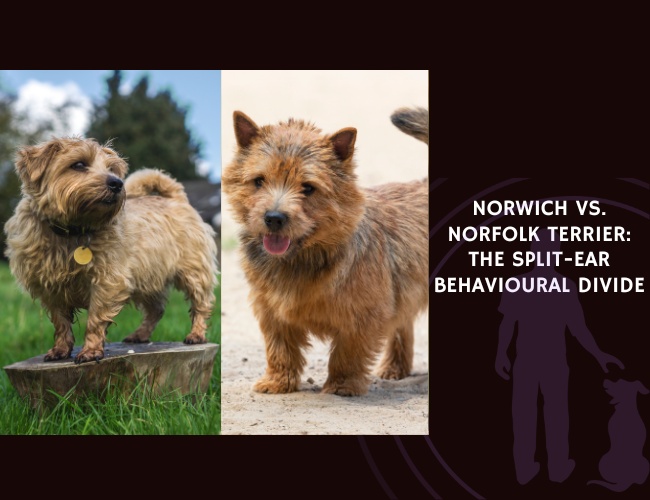
If you’ve ever stood beside a Norwich Terrier and a Norfolk Terrier, you might have thought they were the same breed. Both are small, compact terriers with weatherproof coats and endearing expressions. Both weigh around 11-12 pounds and stand no taller than 10 inches at the shoulder. But look closer—particularly at those ears—and you’ll begin to understand that the difference between these two breeds runs far deeper than a simple fold of cartilage.
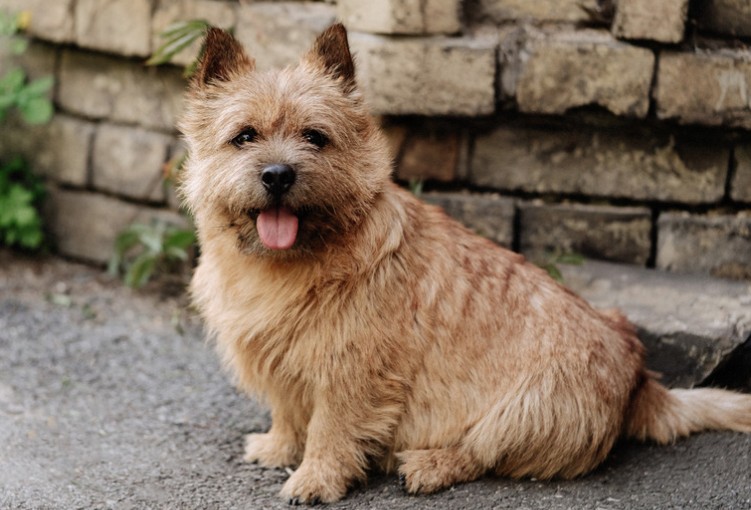
The Norwich sports erect, pointed ears that stand at attention, while the Norfolk’s ears fold forward in a gentle drop. This seemingly minor morphological distinction marks one of the most fascinating case studies in canine behaviour: how a single physical trait can become the visible marker for an entire constellation of temperamental differences. What began as aesthetic variation within one breed has evolved, through decades of selective breeding, into two distinct behavioural profiles.
You might wonder: can ear shape really influence personality? The answer is both simpler and more complex than you’d expect. While ears don’t determine behaviour directly, they profoundly affect how dogs signal their internal states and how humans interpret and respond to those signals. Through the NeuroBond lens, we can understand how morphology and psychology intertwine, creating feedback loops that shape the very essence of how these terriers experience and interact with their world.
Let us guide you through this remarkable split-ear divide, exploring not just the physical differences but the neurobiological, emotional, and practical implications that every owner, trainer, and enthusiast should understand.
Quick Physical Comparison:
- Size: Both 10 inches tall, 11-12 pounds
- Ears: Norwich = erect and pointed; Norfolk = folded forward
- Coat: Both have weather-resistant double coats (red, wheaten, black/tan, grizzle)
- Build: Compact, sturdy, low to ground
- Expression: Norwich = alert and sharp; Norfolk = soft and approachable
- Lifespan: Both typically 12-15 years
Historical Context: When One Breed Became Two
The Shared Foundation
The story of these two terriers begins in the rolling countryside of East Anglia, England, during the late Victorian era. Farmers and huntsmen needed small, courageous dogs capable of pursuing vermin into tight spaces and bolting foxes from their dens. The early terriers that would eventually become Norwich and Norfolk were bred for:
- Unwavering courage in underground work where retreat was impossible
- Compact size that allowed them to navigate narrow tunnels and burrows
- Weather-resistant double coats that protected them during long days in the field
- Independent problem-solving ability when working beyond human sight
- Strong prey drive combined with surprising social tolerance
These working terriers varied considerably in appearance—some had pricked ears, others had drop ears, and coat colours ranged from red to wheaten to grizzle. For decades, this variation existed within a single breeding population, with breeders prioritizing working ability over aesthetic uniformity.
The Great Divide of 1964
Until the mid-20th century, both ear types coexisted within what was simply called the Norwich Terrier. But in 1964, The Kennel Club (UK) made a decision that would forever alter the course of these dogs’ development: they recognized the prick-eared and drop-eared varieties as separate breeds.
This administrative decision set in motion a cascade of consequences:
Geographical separation: Breeding populations began to diverge, with certain bloodlines emphasizing one ear type over another.
Philosophical differences: Breeders started to develop distinct visions for what each breed should represent.
Show ring influences: Different aesthetic ideals emerged, with Norwich breeders seeking alert, upstanding presentations and Norfolk breeders cultivating softer, more approachable expressions.
Selection pressure divergence: For the first time, the two types were breeding true to type, and temperamental traits began to concentrate along with physical ones.
What’s remarkable is how quickly behavioural differences became apparent. Within just a few generations, breeders and owners began noting distinct temperamental patterns that seemed to track with ear carriage.
Post-Split Selection: Two Paths from One Source
Following the separation, breeding philosophies crystallized into two distinct approaches:
Norwich Terrier Selection Priorities:
Breeders emphasized dogs with bold, outgoing temperaments that matched their alert physical presence. They selected for:
- Confident carriage and forward-moving energy
- Strong presence in the show ring
- Maintenance of working terrier spirit with refined presentation
- Independent problem-solving and environmental boldness
- Clear boundary assertion with other dogs
Norfolk Terrier Selection Priorities:
Breeders focused on cultivating companionable, adaptable dogs with softer social styles. They selected for:
- Approachable, less intense expressions
- Family suitability and tolerance for handling
- Cooperative temperament in training contexts
- Emotional attunement to human household dynamics
- Social flexibility rather than confrontational assertiveness
The Genetics of Divergence
Here’s where it gets fascinating from a neurobiological perspective. The behavioural differences we observe today result from a complex interplay of factors:
Founder effects: When breeding populations are small and separated, certain temperamental traits become amplified through genetic drift. Even random variation can become fixed in a population when numbers are limited.
Assortative mating: Breeders naturally pair dogs with similar temperaments, concentrating the genes that influence arousal regulation, confidence, and sociability.
Phenotype-linked selection: Here’s the subtle part—breeders unconsciously selected for behaviours that seemed to “match” the ear type. Alert, pricked ears looked right on confident, forward dogs. Soft, folded ears looked right on approachable, companionable dogs. Over time, appearance and temperament became correlated.
Environmental reinforcement: Different handling and training approaches emerged based on perceived breed character, creating self-fulfilling prophecies we’ll explore later.
Temperament Contribution Breakdown:
- Genetic factors: 40-60% of temperament variance
- Early socialization (0-16 weeks): 20-30%
- Training history and experiences: 15-25%
- Individual variation: 10-20%
Current estimates suggest that while genetics set the stage, environment and experience play crucial supporting roles. This means that even within breed, individual dogs will vary—but the baseline tendencies remain distinct. 🧬
Ear Morphology as Behavioural Signal Amplifier
The Signal Theory Framework
Before we dive into breed-specific patterns, let’s establish a crucial principle: canine communication relies heavily on visual signalling. Dogs evolved to broadcast their internal states through body language, and ears are particularly expressive communication tools.
Ear carriage functions as a visual amplifier of internal state, affecting three critical dimensions:
- Signal transmission (dog → environment): How clearly the dog broadcasts arousal, attention, and emotional state
- Signal reception (environment → dog): How other dogs and humans interpret these signals and respond
- Feedback loops (human interpretation → reinforcement): How human responses shape the dog’s future behaviour through learning
This isn’t just about communication—it’s about how morphology creates entirely different feedback systems that shape temperament over time.
Norwich Terrier: The Alert Antenna Effect
Erect Ears as Signal Enhancers
When you watch a Norwich Terrier, one of the first things you’ll notice is how immediately readable their attention and arousal states are. Those pricked ears function like radar dishes, broadcasting every shift in focus and interest.
Vigilance amplification: Forward-pointing ears create what we might call the “radar dish” effect. Micro-movements become highly visible to observers, and orientation changes broadcast attention shifts with remarkable clarity. Even subtle rotations signal where the dog’s focus lies. This creates a perception of constant alertness—the Norwich appears perpetually aware and engaged.
Confidence signaling: The combination of upright posture and erect ears creates a distinctive “ready for action” silhouette. This enhances perceived boldness and assertiveness, which may trigger more respect-based handling from humans. Interestingly, this can reinforce forward-moving, investigative behaviour through a feedback loop we’ll examine shortly.
Social implications for dog-dog interaction: Other dogs read Norwich Terriers as more assertive based partially on this alert presentation. In multi-dog households or dog park settings, Norwich Terriers often establish clear spatial boundaries early, and their body language leaves little room for misinterpretation. Their early signals of arousal are highly visible, which actually helps prevent escalation—other dogs can read the warning from a distance.
Norwich Visual Communication Advantages:
- Micro-movements broadcast attention shifts immediately
- Early warning signals prevent escalation
- Other dogs can read intentions from distance
- Reduces misunderstandings in social contexts
- Creates perception of constant awareness and confidence
The human response pattern: Humans interpret this alertness as confidence and competence. You’re less likely to coddle or over-reassure a Norwich, which grants them more independence and reinforces their natural boldness. This creates a self-reinforcing cycle where perceived confidence elicits handling that builds actual confidence.

Norfolk Terrier: The Softened Signal Effect
Drop Ears as Signal Dampeners
The Norfolk’s folded ears create an entirely different communication dynamic. With the ear leather covering the ear canal and reducing visible movement, arousal and attention changes become less immediately apparent.
Reduced visual clarity: Ear movements are partially obscured, meaning arousal changes show up more slowly to observers. This creates a perception of a calmer baseline, even when internal arousal may be rising. Because humans can’t read the early warning signs as easily, intervention may come later in the arousal curve.
Approachability enhancement: The softer facial expression created by drop ears makes Norfolk Terriers appear less intense and more inviting. This look naturally elicits more nurturing responses from humans and encourages closer social proximity. People are more likely to reach down to pet a Norfolk than a Norwich, simply based on that softer expression.
Compensatory vocalization: Here’s where it gets really interesting. When visual signals are dampened, vocal expression often increases to compensate. Barking becomes the primary distance-increasing behaviour when body language isn’t getting through. Norfolk Terriers may develop a more elaborate vocal repertoire as a result, which humans sometimes misinterpret as “more reactive” when it’s actually compensatory communication. 🐾
Norfolk Communication Compensation Strategies:
- Increased barking frequency replaces visual clarity
- Varied vocal repertoire (whines, grumbles, “talking”)
- Sustained vocalization when aroused
- Earlier vocal warnings than visual warnings
- More elaborate sound patterns to convey emotional states
The human response pattern: That softer appearance triggers a different handling style. Humans offer more reassurance, speak more gently, and provide more social support. While this creates wonderful bonds, it can inadvertently foster social dependency if not balanced with confidence-building experiences.
Through the Invisible Leash principle, we understand that the quality of connection between human and dog isn’t about physical control but about mutual awareness and emotional clarity. With Norfolk Terriers, maintaining that awareness requires tuning into subtler signals since the visual broadcast is dampened.
The Self-Fulfilling Prophecy
Here’s the critical feedback loop that shapes these breeds over time:
Norwich pathway: Alert posture → Human reads confidence → More independence granted → Dog develops actual boldness → Behaviour reinforces original perception.
Norfolk pathway: Softer appearance → Human offers reassurance → More social proximity → Dog develops social attunement → Behaviour reinforces original perception.
Neither pathway is better or worse—they’re simply different developmental trajectories shaped by how morphology influences the human-dog interaction pattern. Understanding this helps us work with each breed’s natural inclinations rather than against them.
Arousal Profiles: Fast-On vs. Slow-Burn
Understanding Arousal Architecture
Arousal isn’t just about excitement—it’s the neurobiological foundation for how dogs respond to their environment. It encompasses everything from subtle interest to full fight-or-flight activation. The key dimensions include:
Key Arousal Dimensions:
- Threshold: How much stimulation triggers arousal response
- Intensity: How strongly the dog reacts to triggers
- Duration: How long the arousal state persists
- Recovery: How quickly the dog returns to baseline
- Visibility: How clearly arousal shows in body language
What’s become clear through observation and owner reports is that Norwich and Norfolk Terriers demonstrate distinctly different arousal profiles, even when raised in similar environments.
Norwich Terrier: The Fast-On Arousal Profile
Characteristics you’ll recognize:
When something catches a Norwich’s attention, the response is immediate and obvious. State transitions happen rapidly—one moment calm, the next alert, then active investigation, then back to calm. This isn’t hyperactivity; it’s efficient arousal regulation. High sensory vigilance keeps them scanning the environment, but they also show quick recovery after arousal events. You’ll see visible early warning signals, giving you time to intervene if needed.
The neurobiological basis:
From a brain architecture perspective, Norwich Terriers show enhanced activation of what neuroscientist Jaak Panksepp called the SEEKING system—the dopamine-driven network that motivates exploration and investigation. They have a lower threshold for the orienting response (that automatic attention shift toward novelty) and demonstrate efficient sympathetic nervous system engagement. The strong novelty-seeking drive means they’re naturally drawn to investigate changes in their environment.
What this looks like in daily life:
Your Norwich responds immediately to environmental changes—a door opening, someone approaching, a sound outside. They move forward to investigate rather than hanging back. Reactions are brief but intense, and then there’s a quick return to baseline. After a squirrel chase or greeting a visitor, they settle relatively quickly compared to many terrier breeds.
The risk profile:
The downside of this efficient arousal system is potential impulsivity under high arousal. Norwich Terriers may test boundaries when understimulated—they need mental engagement. Movement restriction creates frustration, which is why leash manners require specific attention. They may conflict with slow-moving, indecisive dogs who don’t match their energetic pace.
Norwich Terrier Risk Factors:
- Impulsivity when arousal peaks too high
- Boundary testing when mentally understimulated
- Frustration with physical movement restriction
- Potential conflict with hesitant dogs
- Over-arousal in highly stimulating environments
- Difficulty with prolonged waiting or stillness
Norfolk Terrier: The Slow-Burn Arousal Profile
Characteristics you’ll recognize:
Norfolk Terriers build arousal more gradually. Early warning signs are less visible—by the time you notice obvious reactivity, internal arousal has been accumulating for a while. Recovery periods are longer, and arousal may surface as vocalization rather than obvious body language.
The neurobiological basis:
Norfolk Terriers show greater sensitivity in Panksepp’s FEAR system—not that they’re fearful, but that the neural networks processing threat and uncertainty are more reactive. They have a higher threshold for visible response, meaning arousal builds internally before outward expression. Greater emotional memory formation means experiences have lasting impacts, both positive and negative.
What this looks like in daily life:
Your Norfolk may seem calm during a walk, then suddenly react vocally to something that’s been building their arousal for several minutes. Reactions are delayed but sustained—once activated, they persist in the behaviour. Vocalization becomes the primary outlet for stress, and they show difficulty downregulating once thresholds are crossed. You might notice them still aroused from an earlier event even after you’ve moved on.
The risk profile:
The primary concern is chronic stress accumulation. Because you can’t see arousal building early, it may cross thresholds before intervention. Vocal reactivity, particularly barrier frustration, is common. When arousal thresholds are finally crossed, emotional flooding can occur—they become overwhelmed and have difficulty processing information. Without proper management, generalized anxiety can develop. 😊
Norfolk Terrier Risk Factors:
- Chronic stress accumulation from invisible arousal build-up
- Vocal reactivity and barrier frustration
- Emotional flooding when thresholds are crossed
- Generalized anxiety without proper management
- Difficulty processing information when overwhelmed
- Extended recovery periods after stressful events
Leash Behaviour: Where Arousal Profiles Become Obvious
Norwich on leash:
You’ll experience forward-pulling when something interests them, with brief lunging at stimuli. Quick redirection is possible because they haven’t built up sustained arousal. They respond well to spatial management—if you create distance from the trigger, they settle relatively quickly.
Norfolk on leash:
You’ll hear vocal frustration at barriers (leash, fence, closed door). Pulling toward goals is more sustained and persistent. They’re slower to disengage because arousal has been building internally. They respond better to emotional grounding techniques—calming your own nervous system and providing reassuring presence—than to purely spatial management.
Recovery Time: The Critical Difference
Understanding recovery times prevents frustration and sets realistic training expectations:
Post-arousal recovery patterns:
| Aspect | Norwich | Norfolk |
|---|---|---|
| Visible signs | Rapid decrease | Gradual decrease |
| Internal state | Quick reset | Prolonged activation |
| Optimal strategy | Brief timeout | Extended decompression |
| Risk if rushed | Impulsive rebound | Emotional flooding |
Practical application:
After an arousing event (vet visit, dog park, houseguest), your Norwich needs a brief period to decompress—maybe 15-30 minutes of quiet time. Your Norfolk needs longer—potentially 1-2 hours before introducing new activities or expectations. Rushing either breed through recovery increases stress and can create negative associations with the original trigger.
Through Soul Recall—understanding how emotional memory shapes behaviour—we recognize that inadequate recovery time after stressful experiences creates layered associations that complicate future training efforts.
Confidence vs. Sociability: The Core Temperament Divide
Defining These Independent Dimensions
Here’s a critical distinction that many people miss: confidence and sociability are not opposite ends of the same spectrum. They operate on independent axes, and understanding this illuminates the Norwich-Norfolk divide.
Confidence: Willingness to engage with novelty, assert boundaries, and operate independently. It’s about environmental boldness and self-assurance.
Sociability: Desire for social proximity, sensitivity to social feedback, and cooperative engagement. It’s about connection-seeking and relationship orientation.
A dog can be high in both, low in both, or—as with our two terrier breeds—show different balances between these dimensions.
Norwich Terrier Profile: High Confidence, Moderate Sociability
Strengths that make them remarkable:
Norwich Terriers demonstrate environmental boldness—they explore new spaces readily and investigate novel objects without hesitation. Their clear boundary assertion actually prevents escalation; other dogs know where they stand quickly. Independent problem-solving means they can entertain themselves and don’t require constant direction. Resilience to environmental stressors helps them adapt to travel, moves, and changing circumstances.
Norwich Terrier Key Strengths:
- Environmental boldness and novelty tolerance
- Clear, early boundary assertion with other dogs
- Independent problem-solving abilities
- Resilience to environmental stressors
- Quick adaptation to changes and travel
- Self-entertainment capabilities
Vulnerabilities to be aware of:
Lower tolerance for social pressure means they don’t appreciate being crowded or pushed beyond their comfort zone. They may escalate if boundaries are repeatedly ignored—this isn’t aggression, it’s clear communication that needs respect. They can be dismissive of softer, more tentative dogs, which requires management in multi-dog settings. There’s a risk of social isolation if over-confidence isn’t balanced with appropriate social experiences.
The optimal environment:
Norwich Terriers thrive with clear spatial rules. They need respect for personal space—both theirs and others’. Task-oriented activities engage their problem-solving nature beautifully. They respond best to confident human leadership that provides structure without micromanagement. 🧡
Norfolk Terrier Profile: Moderate Confidence, High Sociability
Strengths that make them wonderful:
Norfolk Terriers demonstrate remarkable social flexibility—they adapt to group dynamics and read social cues skillfully. Cooperation with familiar humans is natural; they want to please and connect. Emotional attunement to household mood means they’re sensitive to tension or upset, often offering comfort. Tolerance for handling makes them excellent for families with children or for necessary care routines.
Norfolk Terrier Key Strengths:
- Exceptional social flexibility and adaptability
- Natural cooperation with familiar humans
- Emotional attunement to household dynamics
- High tolerance for handling and care routines
- Strong desire to please and connect
- Excellent family dog temperament
Vulnerabilities to be aware of:
Emotional overload occurs in chaotic environments where too much is happening too fast. Dependency on social reassurance can develop if not balanced with confidence-building experiences. Sensitivity to correction means harsh handling damages the relationship and creates avoidance. Stress accumulation in unpredictable environments requires proactive management.
The optimal environment:
Norfolk Terriers thrive with predictable routines that create security. Supportive social structure—where they know what’s expected and feel emotionally safe—allows them to flourish. Calm household dynamics help them regulate their own arousal. Relationship-based training that emphasizes connection and cooperation plays to their natural strengths.
The Training Implications
Understanding these confidence-sociability profiles transforms training approaches:
For Norwich Terriers:
Focus on impulse control exercises (wait, stay, leave it) that harness their forward energy. Distance work and send-aways build independence. Clear criteria with yes/no feedback prevents confusion. Avoid over-managing—they need autonomy to thrive. Through the NeuroBond approach, trust becomes the foundation of learning when we respect their need for independence while providing clear structure.
For Norfolk Terriers:
Emphasize confidence-building through gradual, achievable challenges. Arousal management protocols teach them to self-regulate. Relationship reinforcement through proximity rewards and connection-based motivation work beautifully. Avoid over-reassurance that creates dependency. The Invisible Leash reminds us that awareness, not tension, guides the path—especially important for these relationship-oriented terriers.

Vocalization & Communication Patterns: The Compensation Hypothesis
Understanding Canine Communication Systems
Dogs communicate through multiple channels simultaneously—visual signals (body posture, ear position, tail carriage), vocal signals (barks, whines, growls), and olfactory signals (scent marking, pheromones). When one communication channel is reduced or dampened, dogs naturally compensate by amplifying others to maintain communicative effectiveness.
This compensation hypothesis provides a fascinating lens through which to understand the Norwich-Norfolk vocalization divide. It’s not that one breed is “better behaved” and the other “yappy”—it’s that they’ve adapted different communication strategies based on their morphological differences.
The Visual-Vocal Trade-Off
Core principle: Erect ears enhance visual signal transmission, while drop ears dampen it. To maintain overall communicative effectiveness, Norfolk Terriers have evolved a more elaborate vocal repertoire to compensate for reduced visual clarity.
Think of it this way: if you’re trying to communicate across a crowded room, you have two options—exaggerated gestures (visual) or raising your voice (vocal). Norwich Terriers rely more on the first strategy, Norfolk Terriers on the second. Neither is wrong; they’re simply different solutions to the same problem.
Norwich Terrier Vocal Profile
Characteristics you’ll observe:
Norwich Terriers demonstrate selective barking—they vocalize for specific, meaningful triggers rather than general excitement or arousal. Their barks are brief and sharp, serving as punctuation rather than sustained commentary. Posture and ear orientation remain their primary communication tools, with barking functioning as a final warning before physical action.
Common vocalization contexts:
Alert barking: When something novel enters their awareness—an unfamiliar person approaching, unusual sounds, changes in the environment. This is information-sharing, not anxiety.
Demand barking: Relatively rare unless inadvertently reinforced by humans. When it occurs, it’s usually brief and direct—”I want out,” “I want that toy.”
Play vocalizations: Minimal during play. Norwich Terriers are typically quiet players, using body language and movement to communicate play intentions.
Frustration barking: Brief expressions when prevented from reaching a goal, but they quickly redirect to alternative strategies.
Norwich Typical Barking Triggers:
- Unfamiliar people approaching the home
- Unusual or unexpected environmental sounds
- Doorbell or knocking
- Wildlife sightings (squirrels, birds)
- Brief frustration at barriers (quickly redirects)
- Final warning before boundary enforcement
Why humans interpret them as “quiet for a terrier”:
Their selective vocalization means when a Norwich barks, humans take it seriously—there’s usually a legitimate reason. This respectful response actually reinforces their sparing use of vocalization. The bark retains its communicative power because it’s not diluted by overuse. Handlers are less likely to ignore or punish these barks, which maintains the dog’s trust in vocal communication.
Training implications:
With Norwich Terriers, you can often intervene before vocalization occurs by reading their visual signals—ear orientation, body tension, forward lean. This allows proactive redirection. Training focuses on impulse control and alternative behaviors rather than suppressing barking, because the barking itself is rarely the primary issue.
Norfolk Terrier Vocal Profile
Characteristics you’ll observe:
Norfolk Terriers vocalize more frequently across a wider range of contexts. Their vocal repertoire is remarkably varied—you’ll hear different types of whines, grumbles, “talking,” and barks, each conveying distinct emotional states. Vocalization becomes their primary distance-increasing and attention-getting behavior, and once aroused, their barking may be sustained rather than brief.
Common vocalization contexts:
Barrier frustration: This is the big one. Windows, gates, fences, leashes—any barrier between them and a goal triggers vocal expression. Because visual signals don’t clearly broadcast their rising arousal, vocalization becomes the release valve.
Attention-seeking: If they’ve learned that barking gets human attention (even negative attention), this behavior can become quite elaborate. The “talking” behavior many Norfolk owners describe emerges from this reinforcement pattern.
Play vocalizations: Much more common than in Norwich. You’ll hear excitement barks, play growls, and various sounds during interactive games. This isn’t aggression—it’s joyful expression.
Anxiety barking: When stressed or overwhelmed, Norfolk Terriers may bark persistently. This is different from alert barking—it has a higher pitch, more rapid cadence, and doesn’t stop when the trigger is removed.
Norfolk Typical Barking Triggers:
- Barrier frustration (windows, fences, leashes, gates)
- Seeing other dogs or people they can’t reach
- Being left alone or separated from family
- Play and excitement (vocal joy expression)
- Attention-seeking when reinforced
- Anxiety or stress accumulation
- Changes in routine or environment
Why humans may label them as “yappy”:
The frequency and variety of vocalization can overwhelm owners who don’t understand its communicative function. Humans may habituate to the barking, ignoring it until it becomes excessive, which teaches the dog to vocalize more intensely to be heard. There’s a risk of punishment-based training that increases anxiety without addressing the underlying arousal, creating a negative spiral.
The critical misunderstanding:
Many people try to stop Norfolk barking through punishment or suppression. This is not only ineffective—it’s counterproductive. The barking is compensatory communication. If you block the vocal channel without providing alternative outlets or addressing the underlying arousal, stress accumulates internally, leading to more serious behavioral problems.
Training Implications: Breed-Specific Approaches
For Norwich Terriers:
Strategy: Capitalize on their visual communication by learning to read early warning signals. When you notice forward-leaning posture, intense ear orientation, or body tension, redirect before arousal escalates to barking.
Impulse control exercises: Teach “wait,” “leave it,” and “check in” behaviors that give them alternative choices when interested in something. These harness their forward energy without suppressing natural alertness.
Reward quiet observation: When they notice something interesting but remain calm, acknowledge and reward that choice. This reinforces their natural tendency toward selective vocalization.
Common mistake: Over-correcting the rare barks they do produce, which can damage their trust in communication and make them either suppress legitimate warnings or escalate to more serious responses.
For Norfolk Terriers:
Strategy: Address arousal at its source rather than suppressing vocalization. The barking is a symptom, not the problem. Focus on arousal management, confidence building, and teaching self-regulation.
Proactive arousal management: Before barrier frustration develops (at windows, on leash), create distance from triggers or provide alternative activities. Don’t wait until they’re barking to intervene—by then, arousal is already high.
Teach explicit “quiet” or “enough” cues: But only after addressing underlying arousal. Once calm, reward silence. The sequence is: manage arousal → dog calms → mark and reward quiet → release to activity.
Provide legitimate vocal outlets: Some vocalizing is natural and healthy. Allow “talking” during play or greetings in appropriate contexts. This prevents complete suppression while teaching discrimination about when vocalization is acceptable.
Confidence building: Much Norfolk barking stems from uncertainty or anxiety. As confidence grows through gradual exposure and positive experiences, excessive vocalization often diminishes naturally.
Common mistakes: Punishing barking (increases anxiety), shouting “quiet!” (adds to arousal), or completely ignoring all vocalization (teaches them to escalate intensity).
Managing Barrier Frustration Specifically
Since barrier frustration is such a common Norfolk challenge, here’s a detailed protocol:
Environmental management: Block visual access to triggering windows during high-traffic times. Use frosted window film, move furniture, or close curtains strategically.
Premptive redirection: Before they approach the window or fence, call them to an alternative activity. Reward engagement with you before arousal builds.
Distance work: Practice calm behavior near barriers at times when triggers are absent. Build positive associations with these locations during low-arousal states.
Impulse control games: “Wait” at doorways, “settle” on a mat near windows—teach that good things happen when they remain calm near barriers.
Gradual desensitization: Systematically expose them to trigger at distances where they can remain calm, rewarding quiet observation, then slowly decrease distance over weeks.
Norfolk Barrier Frustration Management Steps:
- Block visual access to high-trigger windows/areas
- Redirect before arousal builds (proactive, not reactive)
- Practice calm behavior near barriers when no triggers present
- Teach explicit impulse control at doorways and windows
- Gradually desensitize at distances where dog can stay calm
- Reward quiet observation consistently
- Provide adequate decompression after trigger exposure
- Never punish barking—address underlying arousal instead
The Bigger Picture: Communication Respect
Understanding the compensation hypothesis transforms how we view Norfolk vocalization. It’s not a behavioral problem to be eliminated—it’s an adaptive communication strategy that deserves respect and thoughtful management.
Through Soul Recall, we recognize how emotional memory and communication patterns intertwine. If a Norfolk learns that their vocal communication is punished or ignored, they may either escalate (louder, more persistent) or suppress (creating internal stress). Neither outcome serves the relationship.
The goal isn’t silence—it’s appropriate, context-sensitive vocalization in both breeds. Norwich Terriers maintain their selective barking when their visual signals are respected. Norfolk Terriers learn to modulate their vocalization when their arousal is managed and their communication needs are met through alternative channels. 🐾
Alert. Soft. Divergent.
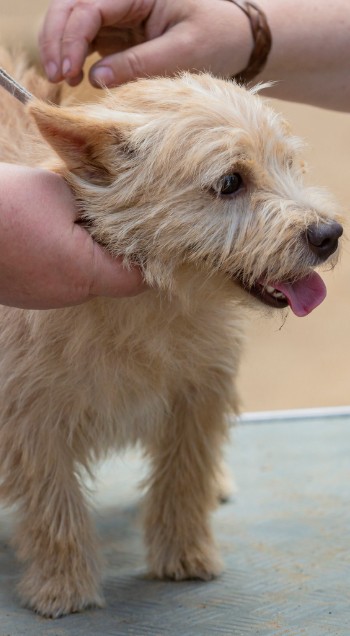
Ears Signal Temperament
Norwich and Norfolk Terriers diverge in how they present and process the world. Ear carriage influences signalling style, not courage.
Selection Changed Expression
Breeding focus after separation amplified different emotional tones. Norwich lines retained sharper alertness, while Norfolk lines softened social presentation.

Interpretation Shapes Behaviour
Human response to visual signals feeds back into temperament development. Over time, this loop reinforced two distinct behavioural profiles.
Social Dynamics: How They Interact with Other Dogs
The Multi-Dog Household Reality
If you’re considering adding a Norwich or Norfolk to a home with existing dogs, understanding their distinct social styles prevents conflict and promotes harmony.
🐕 Norwich vs. Norfolk Terrier 🐕
Understanding the Split-Ear Behavioral Divide: A Complete Guide to Two Distinct Temperaments
Phase 1: Recognition
Identifying the Physical Distinction
The Visible Marker
Both breeds are nearly identical in size (10 inches, 11-12 pounds) and build, but the ears tell the story. Norwich sport erect, pointed ears that stand at attention, while Norfolk ears fold forward in a gentle drop. This seemingly minor morphological difference has become the visible marker for profound behavioral distinctions developed over 60 years of separate breeding.
What to Observe
Beyond ear carriage, notice expression differences. Norwich project alertness and sharp focus—their entire posture broadcasts readiness. Norfolk present softer, more approachable expressions that invite interaction. These visual differences aren’t just aesthetic—they reflect underlying neurobiological patterns that shape how each breed experiences and responds to their world.
Phase 2: Arousal Architecture
Understanding Fast-On vs. Slow-Burn
Norwich: Fast-On System
Norwich Terriers demonstrate rapid state transitions—calm to alert to action to calm again. Their arousal builds quickly, peaks briefly, and dissipates efficiently. You’ll see visible warning signals early, giving you time to redirect before reactivity develops. Recovery takes 15-30 minutes after arousing events. This efficient regulation stems from enhanced SEEKING system activation.
Norfolk: Slow-Burn System
Norfolk Terriers build arousal gradually and internally. By the time you notice obvious reactivity, arousal has been accumulating for minutes. Recovery periods extend to 1-2 hours post-event. This pattern reflects greater FEAR system sensitivity—not fearfulness, but heightened processing of uncertainty. Early intervention requires reading subtle stress signals most people miss.
Critical Recognition
Misunderstanding arousal patterns leads to the most common training mistakes. Expecting Norwich to sustain calm through prolonged waiting creates frustration. Expecting Norfolk to “just relax” without addressing accumulated arousal sets them up for failure. Arousal management must match the breed’s neurobiological architecture.
Phase 3: Communication Strategies
The Compensation Hypothesis
Visual vs. Vocal Balance
Erect ears enhance visual signal transmission—every ear movement broadcasts attention and arousal clearly. Drop ears dampen these visual signals. To maintain communicative effectiveness, Norfolk Terriers compensate by amplifying vocal expression. This isn’t behavioral dysfunction—it’s adaptive communication adjustment based on morphology.
Training for Communication Style
Norwich: Capitalize on visual signals. Read body tension and ear orientation before barking develops. Reward quiet observation when they notice but don’t react. • Norfolk: Address arousal at its source rather than suppressing vocalization. Manage barrier frustration proactively. Teach explicit calm protocols before stress accumulates. The barking is a symptom, not the problem.
Phase 4: Boundary Assertion
Predictable vs. Delayed Warning Systems
Norwich Escalation Ladder
Norwich follow a predictable progression: stiffening → lip curl/growl → air snap → bite. Each level gives clear warning, allowing intervention before escalation. Other dogs read these signals quickly, which actually prevents conflict. The predictability builds trust—their communication works, so they continue using it.
Norfolk Delayed Pattern
Norfolk appear tolerant → show subtle stress signals (lip licking, yawning, head turns) → suddenly escalate to growl or snap. To observers, this seems unpredictable, but they’ve been signaling—the signals are just easily missed. Stress accumulates internally before becoming visible externally.
Handler Support Required
Norwich: Respect early signals. Never punish warnings. Advocate for their space in public settings. • Norfolk: Learn subtle stress signals. Remove them from stressful situations at the FIRST sign of discomfort, not the third or fourth. Proactive management prevents the delayed explosion pattern from rehearsing.
Phase 5: Motivation & Drive
SEEKING vs. CARE System Dominance
Norwich: Task-Driven Explorers
Powered by dopamine-driven SEEKING system. Primary motivators: • Environmental exploration • Problem-solving challenges • Movement and action • Novelty seeking. The pursuit itself is rewarding—they don’t need external validation to find satisfaction in exploration and task completion.
Norfolk: Relationship-Driven Companions
Influenced by oxytocin-mediated CARE system. Primary motivators: • Social approval and connection • Food as social exchange • Predictable routines • Proximity to handler. The relationship context amplifies reward value—it’s not just what they receive, but who it comes from.
Training Application
Norwich: Use environmental rewards, keep sessions novel, deliver rewards matter-of-factly. Variable ratio schedules maintain engagement. • Norfolk: Emphasize social approval, maintain consistent routines, combine food with warm praise. Fixed ratio initially, then gradually variable. Through the NeuroBond approach, trust becomes the foundation when we honor these natural drive systems.
Phase 6: Social Integration
Multi-Dog Household Dynamics
Norwich Social Style
High confidence, moderate sociability. Establishes boundaries early and clearly. Prefers object-focused play (fetch, tug) over sustained social play. May guard valued resources transparently. Same-sex pairings require careful management, especially males. Pairs well with confident, clear-communicating dogs.
Norfolk Social Style
Moderate confidence, high sociability. Demonstrates social flexibility and affiliation-seeking. Cooperative play comes naturally. Often shows deference to confident dogs. Sensitive to household emotional climate—tension affects them even when not directly involved. Generally harmonious in multi-dog households.
Ideal Pairing
Norwich + Norfolk = Often excellent! The Norwich’s clarity complements the Norfolk’s adaptability. The Norfolk’s social ease buffers the Norwich’s intensity. Key: ensure the Norwich respects the Norfolk’s need for reassurance and the Norfolk doesn’t become overly dependent. The Invisible Leash reminds us that awareness, not tension, guides harmonious multi-dog relationships.
Phase 7: Training Methodology
Precision vs. Relationship Approaches
Norwich: Precision Training
Clear criteria, immediate feedback, task orientation. Sessions: 5-10 minutes, low distraction initially, then increase complexity. Focus: Impulse control, distance work, boundary respect. Mistakes to avoid: Over-managing, excessive praise, unclear criteria, repetitive drilling. They need autonomy within structure.
Norfolk: Relational Training
Connection-based, reassurance with rhythm, gradual shaping. Sessions: 15-20 minutes, calm predictable settings, consistent progressions. Focus: Confidence building, arousal management, relationship reinforcement. Mistakes to avoid: Over-reassurance, inconsistency, pressure, rushing progressions. They need emotional safety to take learning risks.
Shared Principle, Different Delivery
Both breeds learn “stay,” but Norwich learns through spatial precision and clear criteria while Norfolk learns through relationship security and gradual confidence. Same behavior, different neural pathway. This is the essence of Zoeta Dogsoul—honoring the neurobiological reality of who our dogs are.
Phase 8: Urban Living
Modern Environment Management
Universal Urban Stressors
Both breeds face: • Constant stimulation (noise, movement, crowds) • Leash restriction limiting autonomy • Forced proximity to triggers • Unpredictable schedules and encounters. These violate natural spacing preferences and create sustained arousal that must be managed proactively.
Norwich Urban Strategy
Resilience: Novelty tolerance, quick recovery, environmental confidence. Strategy: Daily off-leash time, predictable routes, space advocacy, mental stimulation through task work. Exercise: 30-45 minutes vigorous daily. Their fast-on system handles stimulation well if adequately exercised and mentally engaged.
Norfolk Urban Strategy
Resilience: Social adaptability, handler focus, routine comfort. Strategy: Decompression walks in quiet areas, consistent schedules, proactive arousal management, extended recovery time post-stimulation. Exercise: 30-60 minutes moderate daily. Their slow-burn system requires careful arousal management to prevent accumulation.
⚖️ Quick Comparison Guide
Arousal Profile
Norwich: Fast-on, quick recovery (15-30 min)
Norfolk: Slow-burn, extended recovery (1-2 hours)
Communication Style
Norwich: Visual signals primary, selective barking
Norfolk: Vocal compensation, frequent varied sounds
Boundary Warnings
Norwich: Predictable escalation ladder (early & clear)
Norfolk: Delayed pattern (tolerance then sudden)
Motivation System
Norwich: SEEKING system (task-driven, novelty)
Norfolk: CARE system (relationship-driven, approval)
Training Approach
Norwich: Precision, clear criteria, impulse control
Norfolk: Relational, confidence building, arousal management
Ideal Owner
Norwich: Values independence, active lifestyle
Norfolk: Values connection, predictable routine
⚡ Quick Reference Formulas
Arousal Recovery Time: Norwich = 15-30 minutes | Norfolk = 1-2 hours
Training Session Length: Norwich = 5-10 minutes | Norfolk = 15-20 minutes
Temperament Split: 40-60% genetic, 20-30% early socialization, 15-25% training
Exercise Daily: Norwich = 30-45 min vigorous | Norfolk = 30-60 min moderate
Warning Signal Timing: Norwich = early visible | Norfolk = delayed subtle
Multi-Dog Success: Norwich + Norfolk = Often excellent pairing
🧡 The Zoeta Dogsoul Perspective
The Norwich-Norfolk divide teaches us a fundamental truth: morphology, psychology, and environment exist in constant interaction. Through the NeuroBond approach, we understand that trust becomes the foundation of learning when we respect each breed’s neurobiological architecture. The Invisible Leash principle reminds us that the strongest connection doesn’t come from control but from clarity—understanding who our dogs truly are and meeting them where they stand. Through Soul Recall, we recognize how emotional memory shapes behavior—inadequate recovery time creates layered associations that complicate future training.
Whether those ears stand at attention or fold softly forward, the opportunity for profound partnership exists when we bring awareness, patience, and informed understanding to the relationship. That balance between science and soul—that’s the essence of Zoeta Dogsoul.
© Zoeta Dogsoul – Where neuroscience meets soul in dog training
Norwich Terrier Social Style
Boundary assertion patterns:
Norwich Terriers establish spatial boundaries early and clearly. You’ll notice them communicating their comfort zones through body language and, if ignored, through escalating warnings. They’re not looking for conflict—quite the opposite. Clear, early communication prevents fights by making expectations obvious.
Resource guarding considerations:
Their confidence extends to valued resources. Norwich Terriers may guard food, toys, or sleeping spaces, but they’re usually transparent about it. The key is respecting these boundaries and managing the environment to prevent rehearsal of guarding behaviour.
Play style preferences:
Norwich Terriers enjoy play but often prefer object-focused activities (fetch, tug) over sustained social play. They may disengage quickly from rough, chaotic play that lacks structure. They do best with similarly confident, clear-communicating dogs rather than anxious or overly submissive playmates.
Norwich Ideal Play Activities:
- Fetch and retrieve games (satisfies SEEKING system)
- Tug-of-war with clear rules
- Problem-solving puzzle toys
- Scent work and tracking games
- Agility and obstacle courses
- Short, intense play sessions with breaks
Same-sex household considerations:
Norwich Terriers of the same sex, particularly males, may compete for status. This doesn’t mean they can’t coexist, but it requires thoughtful management, individual attention, and respect for their need for personal space. Opposite-sex pairings typically work more smoothly.
Norfolk Terrier Social Style
Affiliation and cooperation:
Norfolk Terriers tend toward social affiliation—they prefer proximity and enjoy being part of a group. Cooperative play comes naturally, and they’re generally tolerant of less-assertive dogs. Their social flexibility makes them relatively easy to integrate into multi-dog households.
Norfolk Ideal Play Activities:
- Cooperative games with handler involvement
- Gentle tug with social connection
- Hide-and-seek games (builds confidence)
- Calm fetch with praise between throws
- Group activities with other friendly dogs
- Enrichment toys enjoyed near family members
Vocal communication in groups:
Here’s where their compensatory vocalization becomes especially apparent. In multi-dog settings, Norfolk Terriers may bark to join excitement or to express frustration at being left out. This isn’t aggression—it’s social communication—but it requires training to manage appropriately.
Sensitivity to group dynamics:
Norfolk Terriers are highly attuned to the emotional climate of the household. Tension between other dogs affects them more than it might affect a Norwich. They may become stressed by conflict even when they’re not directly involved. This emotional sensitivity makes them excellent “mediators” but also means they need a calm, stable pack environment.
Deference patterns:
Norfolk Terriers often show more deference to confident dogs, which usually prevents serious conflict. However, if paired with a bully who doesn’t respect their signals, stress can accumulate and eventually surface as defensive reactivity.
Pairing Recommendations
Norwich + Norwich: Possible but requires excellent management, individual attention, and respect for boundaries. Opposite-sex pairings work better. Expect clear hierarchy negotiations.
Norfolk + Norfolk: Generally harmonious, especially if one is more confident than the other. Their social flexibility facilitates cooperation. Watch for stress accumulation.
Norwich + Norfolk: Often an excellent combination! The Norwich’s clarity complements the Norfolk’s adaptability. The Norfolk’s social ease can buffer the Norwich’s intensity. Key is ensuring the Norwich respects the Norfolk’s need for reassurance and the Norfolk doesn’t become overly dependent on the Norwich.
With other breeds: Norwich Terriers pair well with confident, clear-communicating breeds but may clash with anxious or overly submissive dogs. Norfolk Terriers typically integrate well with a wide variety of breeds, though they may be overwhelmed by very high-energy, pushy dogs.
Understanding Boundary Assertion: The Critical Safety Skill
One of the most important aspects of social dynamics—and one that prevents bites and conflicts—is understanding how each breed asserts boundaries and communicates discomfort. The patterns are strikingly different, and misunderstanding them leads to preventable conflicts.
Norwich Terrier: Early & Clear Communication
The escalation ladder (predictable progression):
Norwich Terriers follow a remarkably consistent warning sequence that gives both dogs and humans multiple opportunities to respect their boundaries:
Level 1 – Subtle warning (often missed): Body stiffening, weight shift backward or forward, direct stare. Mouth closes, muscles tense. This happens when discomfort first registers.
Level 2 – Clear warning (should never be ignored): Lip curl, low growl, or whale eye (showing whites of eyes). Head may lower slightly, body completely still. This is explicit communication: “I’m uncomfortable. Back off.”
Level 3 – Final warning (last chance): Air snap—teeth click together without contact. This is restrained aggression, a clear statement that boundaries have been violated. It’s remarkably controlled given the provocation.
Level 4 – Boundary enforcement (if all else fails): Actual bite. If a Norwich reaches this level, it means all previous warnings were ignored. The bite is typically inhibited (doesn’t break skin) unless the dog has learned that lesser warnings don’t work.
Norwich Warning Signals Checklist:
- ✓ Body stiffening and tension
- ✓ Direct, hard stare at trigger
- ✓ Mouth closes (stops panting)
- ✓ Ears forward and rigid
- ✓ Weight shift (preparing to move)
- ✓ Lip curl or teeth flash
- ✓ Low, rumbling growl
- ✓ Air snap (teeth click without contact)
- ✓ Inhibited bite (last resort)
Advantages of this pattern:
The predictability prevents escalation through clear communication. Other dogs learn quickly where the Norwich’s boundaries lie, which actually reduces conflict frequency over time. Experienced dog owners can intervene at Level 1 or 2, preventing any escalation. The Norwich retains trust in communication because their signals are effective.
What this looks like in daily life:
At the dog park, a Norwich establishes personal space immediately. If another dog crowds them, you’ll see the stiffening and stare. Most dogs read this and give space. If a dog doesn’t respect the signal, the growl makes it unmistakable. Fights are rare because communication works.
In multi-dog households, hierarchy gets established quickly through these clear signals. Once boundaries are understood, dogs coexist peacefully because expectations are transparent.
Handler support strategies:
Respect early signals: When you see Level 1 warnings, create space immediately. Don’t force interaction or reassure the dog—simply remove the trigger or create distance. This teaches them that subtle communication works.
Advocate for space: In public settings, use your body to block other dogs or people from invading your Norwich’s space. Be their spokesperson: “He needs a bit of space, thanks.”
Never punish warnings: Growling, lip curls, and even air snaps are communication, not misbehavior. Punishing these warnings doesn’t eliminate discomfort—it only eliminates the warning system, making the dog “unpredictable” (go straight to bite).
Reward disengagement: When your Norwich notices something uncomfortable but chooses to look away or move away without escalating, reward that choice. Build their confidence that distance-increasing strategies work.
Management trumps training: Don’t repeatedly expose them to situations where they need to assert boundaries. This rehearses defensive behavior and erodes trust.

Norfolk Terrier: Delayed & Sudden Communication
The tolerance-then-explosion pattern (appears unpredictable):
Norfolk Terriers demonstrate a very different pattern that often catches both dogs and humans off guard:
Phase 1 – Tolerance (false calm): They appear completely fine with interaction, proximity, or handling. To the untrained eye, everything looks normal. But internally, arousal and stress are building.
Phase 2 – Subtle stress signals (usually missed): Lip licking, yawning, turning head away, body tension, faster breathing. These are displacement behaviors signaling discomfort, but they’re easily overlooked—especially since the dog isn’t growling or showing teeth.
Norfolk Subtle Stress Signals to Watch:
- Lip licking (not food-related)
- Yawning when not tired
- Turning head or body away
- Avoiding eye contact
- Whale eye (showing whites)
- Faster breathing or panting
- Ears pulled back or flat
- Low, tucked tail
- Body tension or freezing
- Attempting to leave situation
Phase 3 – Sudden escalation (shocking to observers): Seemingly out of nowhere, the dog growls, snaps, or even bites. To others, it appears unprovoked. In reality, they’ve been signaling for a while, but the signals were too subtle or too different from “normal” warning patterns.
Phase 4 – Prolonged arousal (difficulty calming): Even after the trigger is removed, the Norfolk remains aroused for an extended period. They may continue to be reactive or shut down entirely. This slow-burn arousal pattern means recovery takes time.
Why this pattern is problematic:
Appears unpredictable to other dogs: Because there’s no clear escalation ladder, other dogs get blindsided. A dog who would have respected a growl never gets that warning, leading to conflict.
Stress accumulates between incidents: Each tolerance episode adds to cumulative stress, lowering the threshold for the next incident. Without adequate recovery time, reactivity increases.
Humans miss warning signs: The subtle stress signals don’t register as warnings, so intervention comes too late. By the time humans notice, the Norfolk is already in escalation.
Creates negative feedback loops: If the sudden escalation successfully increases distance, it gets reinforced. The dog “learns” that subtle signals don’t work but sudden intensity does.
What this looks like in daily life:
At the dog park, your Norfolk tolerates an enthusiastic dog getting in their space—until suddenly they don’t. The snap seems to come from nowhere, earning them a reputation as “unpredictable.”
In multi-dog households, they may endure small boundary violations from other dogs until stress accumulates to a breaking point, then have a seemingly disproportionate reaction.
With children, they tolerate handling and interaction beautifully until fatigue and stress combine, then react defensively—frightening everyone involved.
Handler support strategies:
Proactive management (prevention over intervention): Don’t wait for visible distress. Know your Norfolk’s tolerance limits (time, intensity, context) and remove them from situations before thresholds are crossed. This prevents rehearsal of the escalation pattern.
Learn subtle stress signals: Educate yourself on displacement behaviors—lip licking, yawning, head turns, body stiffening, faster panting. When you see these, create space or end the interaction immediately.
Early removal from stressful situations: At the first sign of discomfort (not the third or fourth sign), remove your Norfolk from the situation calmly. This teaches them that you’re watching and will advocate for them, reducing their need to self-advocate dramatically.
Teach explicit disengagement cues: Train a reliable “let’s go” or “touch” (hand target) that allows them to remove themselves from uncomfortable situations. This gives them agency and an alternative to defensive reactivity.
Adequate recovery time: After any stressful interaction, provide extended decompression time—quiet space, calm activities, no additional challenges. This prevents stress accumulation.
Confidence building exercises: Much of the tolerance stems from uncertainty about how to assert boundaries appropriately. Confidence-building training helps them develop clearer communication.
Never force interaction: If your Norfolk indicates discomfort (even subtly), never force them to “tolerate” handling or interaction. This teaches them their communication is ignored, making escalation more likely.
Same-Sex Aggression: Breed-Specific Risk Profiles
Norwich Terrier patterns:
Higher risk with same-sex dogs of similar confidence levels, particularly intact males. However, conflicts tend to be honest and clear—boundary testing, resource competition, hierarchy establishment. Once hierarchy is established through clear communication, most Norwich same-sex pairs coexist peacefully. Risk increases if both dogs are equally confident and neither defers.
Management: Provide individual resources (food bowls, beds, toys) with adequate space between them. Respect hierarchy—feed, greet, and attend to the higher-ranking dog first. Provide individual attention to prevent competition. Neuter males if hierarchy conflicts persist. Monitor closely during adolescence when social maturity shifts dynamics.
Norfolk Terrier patterns:
Lower initial risk due to greater social flexibility and deference. However, delayed conflict can emerge after prolonged stress accumulation—they may tolerate another dog’s presence for months or years before stress builds to a breaking point. Females may show sudden escalations during hormonal shifts. When conflicts occur, they may be more emotionally intense due to the slow-burn arousal pattern.
Management: Watch for subtle signs of stress accumulation—avoidance, decreased appetite near the other dog, tension during routine interactions. Provide individual decompression spaces. Maintain strict routines to reduce unpredictability. Consider whether personality clash is creating chronic stress—sometimes re-homing one dog is the kindest solution for both.
Child Interaction Safety
Norwich with children:
Tolerates respectful interaction from school-age children who understand boundaries. Communicates discomfort clearly through warnings, giving attentive parents time to intervene. May avoid chaotic toddler play but coexists peacefully if personal space is respected. Best suited for families with older (7+) children who can learn to read dog body language.
Safety protocols: Teach children to never approach a stiff, still dog. Supervise all interactions. Create dog-free zones where Norwich can retreat. Never allow children to crowd, grab, or follow the dog.
Norfolk with children:
More patient with handling and tolerant of child energy, making them popular family dogs. However, the delayed warning pattern is dangerous with children who can’t read subtle stress signals. May tolerate excessive handling until suddenly reacting, frightening everyone involved.
Safety protocols: Teach children to watch for stress signals (yawning, looking away, walking away). Always provide an escape route—never corner or trap the dog. Limit interaction time before arousal builds. Never leave toddlers unsupervised. Create structured interaction periods with adult oversight.
Understanding these boundary assertion patterns isn’t just about preventing bites—it’s about respecting each breed’s communication style and creating environments where clear, effective communication prevents stress and conflict. Through the NeuroBond approach, trust becomes the foundation of learning when both species feel heard and understood. 🧡
Motivation & Drive Profiles: The Neurobiological Foundation
Understanding What Drives Behavior
Before we can train effectively, we need to understand what motivates each breed at a fundamental neurobiological level. This isn’t just about whether they prefer food or toys—it’s about the underlying brain systems that drive their behavior and shape their experience of the world.
Neuroscientist Jaak Panksepp identified seven core emotional systems that drive mammalian behavior. Two of these are particularly relevant to understanding the Norwich-Norfolk divide: the SEEKING system (dopamine-driven exploration and anticipation) and the CARE system (oxytocin-mediated bonding and attachment).
Norwich Terrier: SEEKING System Dominance
The dopamine-driven explorer:
Norwich Terriers demonstrate classic SEEKING system dominance. This neural network, powered primarily by dopamine, generates the motivation to explore, investigate, and interact with the environment. It’s the system that makes novelty rewarding and problem-solving satisfying.
Primary motivators you’ll observe:
Environmental exploration: Your Norwich is naturally drawn to investigate new spaces, objects, and situations. The exploration itself is rewarding—they don’t need external reinforcement to be interested in their surroundings.
Problem-solving challenges: Give them a puzzle toy, and they’ll work persistently to solve it. The satisfaction comes from figuring it out, not just from the reward inside. This is SEEKING system activation—the pleasure is in the pursuit.
Movement and action: Norwich Terriers are energized by activity. Running, chasing, tugging, digging—these aren’t just exercise; they’re intrinsically rewarding experiences that satisfy their drive systems.
Novelty seeking: They prefer new experiences over familiar ones. A new route on walks, a different toy, a novel training challenge—variety itself is motivating.
Norwich Training Motivators (In Order of Effectiveness):
- Environmental exploration and access to interesting spaces
- Problem-solving opportunities and puzzle challenges
- Movement-based rewards (chase, tug, fetch)
- Novel toys and experiences (variety is key)
- Task completion satisfaction
- Moderate-value food treats (delivered calmly)
- Brief, matter-of-fact praise
Neurobiological characteristics:
High baseline dopaminergic activity: Their SEEKING system runs “hot,” meaning they’re constantly scanning for interesting stimuli and opportunities. This creates that characteristic alertness and forward energy.
Strong anticipatory arousal: The expectation of reward or interesting outcomes activates them as much as the reward itself. You’ll see excitement building as they anticipate activities.
Variable reinforcement maintains engagement: Because the SEEKING system thrives on anticipation and uncertainty, variable reward schedules (sometimes reward, sometimes not) actually maintain motivation better than predictable rewards.
Risk of impulsivity when over-rewarded: Too much excitement from rewards can push arousal into impulsive territory, decreasing precision and increasing difficulty with impulse control.
Training implications:
Use environmental rewards: Access to sniffing areas, permission to investigate interesting things, opportunities to chase or dig—these are powerful motivators that leverage their natural drives.
Keep sessions novel: Repeat the same exercise in different locations, with different distractions, at different times. Variation prevents boredom and maintains engagement.
Lower reward intensity: Matter-of-fact delivery prevents arousal spillover. You want focused engagement, not frantic excitement.
Task completion as reward: The satisfaction of successfully executing a behavior sequence can itself be motivating. Build chains of behaviors where completing the sequence becomes the goal.
Norfolk Terrier: CARE System Influence
The oxytocin-bonded companion:
Norfolk Terriers demonstrate stronger CARE system influence—the neural network involved in attachment, nurturing, and social bonding. Oxytocin, often called the “bonding hormone,” plays a central role in this system, creating feelings of warmth, trust, and connection.
Primary motivators you’ll observe:
Social approval: Your Norfolk is deeply motivated by your happiness and approval. A warm “good dog” delivered with genuine affection can be as powerful as food. They read your emotional state and want to please you.
Food rewards: Norfolk Terriers are typically highly food-motivated, but it’s often the ritual of receiving the treat from you that’s as rewarding as the food itself. It’s a social exchange, not just calories.
Predictable routines: Unlike Norwich who thrive on novelty, Norfolk find security and satisfaction in familiar patterns. The routine itself becomes rewarding because it reduces uncertainty and reinforces the bond.
Proximity to handler: Simply being near you, working together, maintaining connection—these are intrinsically rewarding experiences for Norfolk Terriers. Distance work can be trained but goes against their natural inclination.
Norfolk Training Motivators (In Order of Effectiveness):
- Social approval and warm verbal praise
- High-value food treats delivered with connection
- Proximity to handler and physical affection
- Predictable routines and familiar patterns
- Collaborative activities with handler involvement
- Relationship-building games
- Calm, reassuring presence during challenges
Neurobiological characteristics:
Higher oxytocin sensitivity: Their bonding system is highly responsive, creating strong attachments and sensitivity to relationship quality. This makes them wonderful companions but also vulnerable to separation anxiety.
Strong attachment behaviors: Proximity-seeking, following, checking in, body contact—these aren’t neediness; they’re expressions of a strongly activated CARE system.
Risk of dependency if over-rewarded: Too much social reassurance can create dependency where the dog can’t function confidently without handler proximity. Balance is essential.
Needs balanced independence training: While honoring their relationship orientation, they benefit from building confidence in independent problem-solving and self-soothing.
Training implications:
Use relationship-based rewards: Praise, affection, proximity, collaborative activities—these leverage their natural drive for connection and cooperation.
Consistent routines: Training sessions at predictable times, in familiar locations, with consistent progressions help them feel secure enough to take learning risks.
Calm, warm delivery: Your emotional state matters immensely. Calm confidence and warm encouragement create the emotional safety they need to engage fully.
Build independence gradually: While respecting their social nature, consciously teach them that they can succeed without constant handler proximity. This prevents problematic dependency.
Arousal Spillover Risk: When Rewards Backfire
Understanding how high-value rewards affect arousal differently in each breed prevents common training mistakes:
Norwich Terrier arousal spillover:
Pattern: High-value rewards (intensely exciting treats, over-enthusiastic praise) → Increased arousal → Impulsivity → Boundary testing → Difficulty with impulse control.
What it looks like: Your Norwich gets so excited about training rewards that they start jumping, mouthing, or barking. Precision deteriorates. They anticipate rewards so intensely they can’t focus on criteria. Off-leash reliability decreases because excitement overwhelms impulse control.
Management strategy:
- Lower reward intensity—use medium-value treats delivered calmly
- Increase criteria before rewarding (make them work harder for less frequent rewards)
- Build in brief calming behaviors between high-arousal exercises
- Use environmental rewards (access, exploration) instead of food when possible
- Deliver rewards matter-of-factly without building anticipation
Norfolk Terrier arousal spillover:
Pattern: High-value rewards (especially in exciting contexts) → Arousal accumulation → Vocal reactivity → Difficulty downregulating → Generalized anxiety.
What it looks like: Your Norfolk gets increasingly excited during training, vocalization increases, and even after the session ends, they remain aroused. You may notice barrier frustration or reactivity increase on walks following exciting training sessions. Recovery time lengthens.
Management strategy:
- Calm delivery of all rewards—even high-value treats given with emotional neutrality
- Build in decompression breaks during training sessions
- End sessions before arousal peaks (quit while they’re still calm and focused)
- Follow training with calming activities (sniffing, chewing, quiet companionship)
- Watch for cumulative arousal across days—if reactivity increases, reduce training intensity

Reinforcement Schedules: Breed-Specific Optimization
For Norwich Terriers:
Variable ratio schedules: Sometimes reward after 2 repetitions, sometimes after 5, sometimes after 1—unpredictability maintains SEEKING system engagement. This is why “jackpot” rewards (occasionally giving an exceptionally high-value reward) work beautifully.
Novelty as reinforcer: Rotate rewards—different treats, different toys, different types of praise, different activities. The novelty itself adds value beyond the reward’s inherent worth.
Brief, intense sessions: Their fast-on arousal profile means they engage intensely but fatigue quickly. Five focused minutes outperform twenty meandering minutes.
Task completion as reward: Build behavior chains where successfully completing the sequence (sit-stay-recall-sit) becomes satisfying independent of external rewards.
For Norfolk Terriers:
Fixed ratio initially: When learning new behaviors, consistent rewards (every correct response gets rewarded) build confidence and clarity. Transition to variable schedules only after behavior is solid.
Food and praise combination: The social element (your pleasure) enhances the food reward’s value. Never feed treats mechanically—include warm acknowledgment.
Longer, calmer sessions: Their slower arousal build allows for sustained focus if arousal is managed. Fifteen minutes of calm, relationship-based training works well.
Social approval as primary reward: While food is useful, the ultimate reward is your genuine happiness with their performance. Cultivate authentic pleasure in their success.
The Bigger Picture: Respecting Biological Drives
Understanding these motivation systems transforms training from mechanical conditioning into collaborative partnership. Norwich Terriers aren’t “stubborn”—they’re driven by exploration and problem-solving. Norfolk Terriers aren’t “needy”—they’re driven by attachment and cooperation.
When we align training approaches with natural drive systems, learning accelerates, stress decreases, and the human-dog relationship deepens. Force a Norwich into dependency-based training, and you’ll see frustration and resistance. Push a Norfolk into purely task-based training without relationship elements, and you’ll see anxiety and avoidance.
Through the NeuroBond approach, trust becomes the foundation of learning when we respect the neurobiological reality of who our dogs are—SEEKING explorers or CARE companions—and meet them where their natural drives already live. 🐾
Training Methodologies: One Size Does Not Fit All
The Problem with Generic Terrier Training
Many training programs treat all terriers as if they’re interchangeable, assuming that “stubborn,” “independent,” and “high-energy” apply equally across breeds. This one-size-fits-all approach increases instability in both Norwich and Norfolk Terriers because it fails to respect their distinct arousal profiles and motivation systems.
Norwich-Specific Training Protocols
Emphasis: Precision and Clear Criteria
Norwich Terriers excel when they understand exactly what’s expected and receive clear, immediate feedback. Ambiguity creates frustration, which leads to creative problem-solving that may not align with your goals.
Optimal training environment:
Low-distraction initially (they need to process criteria before adding variables), then gradually increasing complexity. Short, focused sessions (5-10 minutes) capitalize on their intense engagement. Task variety prevents boredom—these dogs need mental challenge.
Motivation strategies:
Norwich Terriers respond powerfully to novel objects and problem-solving opportunities. Use toys, food, and environmental access as rewards, but recognize that the work itself often motivates them. Praise should be matter-of-fact rather than effusive—too much enthusiasm increases arousal and decreases precision.
Key exercises:
Impulse control: Wait at doors, stay on mat, leave it with distractions. These harness forward energy productively.
Distance work: Send-aways, go to place, directional cues. Build independence and confidence.
Boundary respect: Door manners, greeting protocols, threshold behaviour. Teach spatial clarity.
Handler focus: Attention exercises that compete with environmental distractions. Build choice-making.
Common mistakes to avoid:
Over-managing (micromanagement reduces confidence), excessive praise (increases arousal inappropriately), forcing sustained interaction (violates their need for autonomy), repetitive drilling (creates boredom and disengagement).
Norfolk-Specific Training Protocols
Emphasis: Relationship and Confidence Building
Norfolk Terriers learn beautifully through connection-based training that emphasizes the human-dog relationship. They need to feel emotionally safe before they can focus on skill acquisition.
Optimal training environment:
Calm, predictable settings initially (arousal management is crucial), with very gradual complexity increases. Longer sessions (15-20 minutes) work well if paced appropriately with breaks. Routine consistency helps them feel secure enough to take learning risks.
Motivation strategies:
Food rewards work extremely well, as does verbal encouragement delivered in a calm, warm tone. Proximity to the handler and connection-based activities motivate strongly. Physical affection at appropriate moments reinforces the relationship. The work satisfies their cooperative drive.
Key exercises:
Confidence building: Novel surface exploration, gradual environmental challenges, safe exposure to triggers. Build boldness incrementally.
Arousal management: Relaxation protocols, calm mat work, settle on cue. Teach self-regulation.
Relationship reinforcement: Check-ins on walks, proximity games, following exercises. Strengthen connection.
Predictable cues: Strong verbal markers for behaviours. Create security through consistency.
Common mistakes to avoid:
Over-reassurance (creates dependency and reinforces anxiety), inconsistency (increases insecurity), pressure or harsh corrections (causes shutdown or fear), rushing through progressions (leads to emotional flooding).
Shared Principles, Different Delivery
Example: Teaching “Stay”
Norwich approach:
Start with spatial clarity (mat or specific spot). Release cue is critical—they need permission to move. Gradually increase duration and distance. Consequence for breaking stay is loss of freedom (return to spot) with minimal verbal. Success: The dog learns precise boundaries and develops impulse control.
Norfolk approach:
Build duration first with proximity and reassurance. Add gentle verbal cue (“stay” or “wait”). Frequent rewards for approximations. Consistent practice in same location before generalizing. Success: The dog develops confidence in the position and trusts the handler’s return.
Both dogs learn to stay, but the Norwich learns through spatial precision and clear criteria, while the Norfolk learns through relationship security and gradual confidence building. That balance between science and soul—that’s the essence of Zoeta Dogsoul.
Adolescent Development: When Temperaments Crystallize
The Critical Period: 6-18 Months
Adolescence in dogs is often misunderstood as simply “the teenage phase,” but it’s actually a critical period of neurobiological development when temperamental traits become more fixed and adult patterns emerge.
Universal Adolescent Changes
Regardless of breed, canine adolescence brings:
Hormonal influences: Sexual maturation affects confidence, territorial awareness, and same-sex relationships.
Neurological development: The adolescent brain undergoes significant reorganization, particularly in the prefrontal cortex (impulse control) and amygdala (fear processing).
Social maturity: Dogs become more aware of social hierarchies and boundaries, both with other dogs and with humans.
Environmental sensitivity: There’s a secondary fear period where previously confident puppies may suddenly show wariness of familiar things.
Norwich Terrier Adolescence
Typical trajectory (6-18 months):
You’ll see confidence → boldness → potential over-confidence. Environmental exploration intensifies, and boundary testing becomes more pronounced. Arousal regulation needs active training during this period. Social challenges with other dogs often emerge, particularly with same-sex individuals.
Common challenges:
Impulsivity peaks during this period—they want to investigate everything NOW. Leash frustration increases as their desire for independence conflicts with restriction. Same-sex dog relationships may become tense as social maturity develops. If understimulated, they may develop nuisance behaviours (digging, excessive barking, destructive chewing).
Management strategies:
Maintain clear, consistent boundaries (now is not the time to be lenient). Increase physical exercise and mental stimulation (channel that energy productively). Provide appropriate outlets for working instincts (dig boxes, scent games, ratting opportunities with toys). Continue socialization but watch for mounting tension with other dogs. Reinforce impulse control daily.
Norfolk Terrier Adolescence
Typical trajectory (6-18 months):
You may see cooperation → uncertainty → either resilience or reactivity, depending on experiences during this period. The slow-burn arousal pattern becomes more apparent. Stress tolerance may decrease temporarily. Vocalization often increases as a communication tool.
Common challenges:
Emotional sensitivity peaks—they’re more easily overwhelmed by chaos or unpredictability. Stress accumulation becomes problematic without adequate recovery time. Vocal reactivity may emerge or intensify, particularly barrier frustration. Separation-related behaviours can develop if not proactively addressed. Some individuals become more anxious during the secondary fear period.
Management strategies:
Maintain routines religiously (predictability creates security during neurological reorganization). Provide gradual exposure to controlled challenges (build confidence without flooding). Offer emotional support without coddling (acknowledgment without reinforcement). Build independence through confidence exercises (teach them they can handle things). Implement arousal management protocols before problems develop.
Sex Differences Post-Split
Males:
Norwich males: Show more pronounced boundary testing with both humans and dogs. May develop same-sex intolerance earlier. Require firm but fair structure.
Norfolk males: Display more vocal reactivity, particularly barrier frustration. May become more territorially alert. Generally maintain social flexibility with appropriate management.
Females:
Norwich females: Often mature earlier with stable, confident behaviour emerging sooner. May be more tolerant socially than males. Still require boundary respect.
Norfolk females: Show more variability—some become quite bold while others develop anxiety. Early experiences during adolescence have lasting impact. Benefit from proactive confidence-building.
The Long-Term Impact
How you navigate adolescence significantly influences adult temperament. Norwich Terriers who receive consistent boundaries and adequate stimulation during this period develop into confident, well-adjusted adults. Those who are over-managed or understimulated may become reactive or destructive.
Norfolk Terriers who experience predictable routines and confidence-building during adolescence develop emotional resilience. Those exposed to chaos, inconsistency, or inadequate recovery time may develop generalized anxiety or chronic reactivity.
This is when the foundation you’ve built in puppyhood is tested. Patient, informed management during adolescence pays dividends for the dog’s entire adult life.
Urban Living: Environmental Mismatch Challenges
The Modern Reality
Most terriers today live in urban or suburban environments that differ dramatically from the working farms and countryside where they were originally developed. Understanding how each breed copes with modern environmental demands helps prevent stress and behaviour problems.
Urban Environmental Stressors
High stimulation: Constant noise (traffic, construction, sirens), visual movement (crowds, vehicles, other dogs), and olfactory complexity create sustained arousal.
Leash restriction: Limited choice and autonomy. The inability to increase or decrease distance from triggers creates frustration.
Close proximity: To other dogs, people, and environmental triggers without the option to retreat. Violates natural spacing preferences.
Unpredictability: Variable schedules, inconsistent routes, unexpected encounters. Reduces sense of control and predictability.
Common Urban Challenges for Both Breeds:
- Constant environmental noise (traffic, sirens, construction)
- Visual overstimulation (crowds, moving vehicles)
- Leash restriction limiting autonomy and choice
- Forced proximity to other dogs and people
- Unpredictable encounters and schedules
- Limited off-leash exploration opportunities
- Confined living spaces (apartments, small yards)
- Elevator and hallway stress in buildings
Norwich in Urban Environments
Resilience factors:
Norwich Terriers demonstrate novelty tolerance—they adapt to stimulation relatively quickly and can habituate to consistent triggers. Quick recovery means they bounce back from stressful encounters without sustained impact. Environmental confidence helps them explore new spaces readily. This makes them surprisingly adaptable to city living despite their working heritage.
Vulnerability factors:
Low intrusion tolerance becomes problematic when strangers reach down to pet without permission or when crowded sidewalks violate their spatial preferences. Leash frustration increases when they spot interesting triggers but can’t investigate freely. Conflict risk rises with other assertive dogs in close quarters, particularly in areas with limited escape options.
Optimal urban management:
Provide off-leash time in secure areas (fenced parks, private yards) where they can exercise choice and autonomy. Use predictable routes that allow habituation to environmental triggers. Practice space advocacy—politely prevent uninvited interactions. Teach excellent leash manners that give them some choice within structure. Consider living situations with private outdoor access if possible.
Norwich Urban Success Strategies:
- Daily off-leash time in secure, fenced areas
- Predictable walking routes for habituation
- Space advocacy (blocking unwanted interactions)
- Mental stimulation to prevent understimulation
- Task-oriented activities (scent work, puzzle toys)
- Respect for personal space in crowded areas
- Short, intense exercise sessions
- Private outdoor access when possible
Norfolk in Urban Environments
Resilience factors:
Norfolk Terriers show social adaptability—they tolerate proximity to people and dogs relatively well. Handler focus means they’re less distracted by environmental stimuli. Routine comfort allows them to thrive on predictable walks and consistent schedules. This social ease makes them well-suited to urban living in many ways.
Vulnerability factors:
Stress accumulation occurs when daily walks involve chronic arousal without adequate recovery. Vocal reactivity surfaces as barrier frustration, particularly in apartment buildings where leash restriction is constant. Emotional flooding happens in chaotic environments like busy street corners during rush hour or crowded outdoor dining areas.
Optimal urban management:
Prioritize decompression walks in quiet areas before or after busy times. Maintain consistent schedules that reduce anxiety. Implement arousal management training proactively. Create recovery time after stimulating outings. Consider living situations that minimize constant stimulation (higher floors away from street noise, buildings with less dog traffic).
Norfolk Urban Success Strategies:
- Decompression walks in quiet areas (early morning/late evening)
- Consistent daily routines and schedules
- Proactive arousal management training
- Extended recovery time after stimulating events
- Block visual access to high-trigger windows
- Calming activities after walks (sniffing, chewing)
- Living situations minimizing constant stimulation
- Predictable elevator and hallway routines
Exercise Requirements in Urban Settings
Norwich Terriers:
Need vigorous exercise but it can be brief (30-45 minutes daily of running/playing). Mental stimulation is equally important—puzzle toys, scent games, training sessions. Without adequate outlets, they create their own entertainment (often destructive).
Norfolk Terriers:
Need moderate exercise (30-60 minutes daily of walking) but quality matters more than intensity. Arousal management during exercise is crucial—walks shouldn’t push them into sustained high arousal. Mental enrichment should be calming rather than intensely stimulating.
The Apartment Question
Can Norwich Terriers live in apartments? Yes, if they receive adequate exercise, mental stimulation, and have owners who respect their need for predictability and space. The bigger issue is often barking at environmental triggers, which requires training.
Can Norfolk Terriers live in apartments? Yes, often more easily than Norwich due to their social flexibility. However, vocal reactivity (especially barrier frustration) requires proactive management. Thin walls and close neighbors mean early training investment is crucial.
Both breeds can thrive in cities—but success requires understanding their distinct needs and managing environmental stressors thoughtfully.
Health Considerations: Physical Foundations of Behaviour
The Mind-Body Connection
Behaviour never occurs in a vacuum. Physical health profoundly influences temperament, and understanding breed-specific health concerns helps us distinguish between behavioural issues and pain-related reactions.
Shared Health Vulnerabilities
Both Norwich and Norfolk Terriers share some health concerns due to their common foundation:
Hip dysplasia: Less common than in larger breeds but still present. Mild cases may cause subtle discomfort that increases irritability or reduces exercise tolerance.
Luxating patella: Kneecap dislocation that ranges from mild (occasional popping) to severe (chronic lameness). Pain from this condition can make dogs defensive about rear-end contact.
Dental disease: Small breeds are prone to dental issues. Chronic oral pain affects behaviour, often increasing irritability and reducing appetite.
Allergies: Environmental and food allergies create chronic discomfort. Itching, digestive upset, and inflammation all increase stress and reduce frustration tolerance.
Upper airway concerns: Some lines show brachycephalic-adjacent features (shorter muzzles) that can compromise breathing, especially in heat or during exertion.
Shared Health Concerns to Monitor:
- Hip dysplasia (less common but present)
- Patellar luxation (kneecap issues)
- Dental disease (requires daily care)
- Environmental and food allergies
- Upper respiratory concerns
- Heart conditions (valvular disease in seniors)
- Eye issues (cataracts, progressive retinal atrophy)
- Obesity (small breeds prone to weight gain)
Behaviour-Health Connections
Sudden behaviour changes: If your previously tolerant dog becomes snappy, consider pain. If your confident dog becomes hesitant, consider discomfort. Physical examination should always precede behavioural intervention when changes appear suddenly.
Exercise intolerance: Dogs in pain often limit their own activity. What looks like “laziness” may be avoidance of discomfort.
Touch sensitivity: Guarding specific body areas, yelping when picked up, or avoiding certain positions all suggest physical problems requiring veterinary evaluation.
Sleep disturbances: Pain and discomfort disrupt sleep, which then affects daytime behaviour and stress resilience.
Preventive Care
Regular veterinary examinations: Annual (or twice-annual for seniors) complete physicals catch problems early.
Dental care: Daily tooth brushing, regular professional cleanings, and dental-specific diets prevent painful oral disease.
Weight management: Both breeds should maintain lean body condition. Excess weight stresses joints and exacerbates health issues.
Appropriate exercise: Match intensity to your dog’s fitness level and health status. Forced exercise in pain creates negative associations.
Nutrition: High-quality, complete nutrition supports overall health. Some individuals benefit from joint supplements or omega-3 fatty acids.
Understanding that behaviour reflects both psychology and physiology helps us respond appropriately when problems arise. Through the NeuroBond approach, we recognize that trust becomes the foundation of learning—but that foundation rests on physical wellbeing. 🐾
Practical Owner Considerations: Is This Breed Right for You?
The Critical Questions
Before falling in love with those adorable faces, ask yourself these honest questions. Your answers will guide you toward the right breed—or perhaps toward a different breed entirely.
Norwich Terrier: The Right Match
You’re likely a good match if you:
- Value independence and don’t need constant affection
- Appreciate confidence and boldness in a small package
- Have experience setting and maintaining clear boundaries
- Can provide vigorous exercise and mental stimulation
- Want an active, task-oriented companion for outdoor activities
- Don’t mind some same-sex dog intolerance
- Have a relatively predictable schedule and environment
- Respect personal space (yours and theirs)
You’re probably not a good match if you:
- Want a lap dog who’s always seeking cuddles
- Prefer highly biddable, eager-to-please temperaments
- Have limited tolerance for boundary testing
- Live in a chaotic, unpredictable environment
- Want a dog park regular who’s friendly with all dogs
- Need a dog who tolerates being carried and constantly handled
- Expect unquestioning obedience without relationship investment
Norfolk Terrier: The Right Match
You’re likely a good match if you:
- Value connection and enjoy a socially attuned companion
- Appreciate sensitivity and emotional intelligence
- Can maintain predictable routines and consistent expectations
- Have patience for gradual confidence-building
- Want a adaptable family dog who’s tolerant of handling
- Can provide adequate recovery time after stimulating events
- Are committed to proactive arousal management training
- Enjoy relationship-based training approaches
You’re probably not a good match if you:
- Want a dog who’s completely emotionally independent
- Have a chaotic household with constant unpredictability
- Lack patience for slow-burn arousal patterns
- Want a dog who requires minimal emotional support
- Are gone for long hours without adequate companionship
- Have very high-energy dogs who might overwhelm them
- Expect quick behavioral changes without patient management
Family Considerations
With children:
Norwich: Generally good with respectful, school-age children who understand boundaries. May not tolerate rough handling or boundary violations from toddlers. Supervision essential.
Norfolk: Often excellent with children if socialized properly. More tolerant of handling but still requires supervision. Teaching children appropriate interaction is crucial.
First-time owners:
Norwich: Challenging for first-time owners without terrier experience. Their confidence requires knowledgeable handling.
Norfolk: More forgiving for first-time owners willing to invest in training and provide consistent structure.
Seniors:
Norwich: Good for active seniors who can provide exercise. Independence means they don’t require constant attention.
Norfolk: Excellent for seniors who are home regularly and can provide companionship. Lower exercise demands but need emotional engagement.
The Honest Reality
Neither breed is low-maintenance. Both are terriers—intelligent, independent thinkers with strong personalities. Both require training investment, socialization, and environmental management. Both can be vocal if bored or anxious. Both have grooming needs (hand-stripping to maintain proper coat texture).
Grooming & Maintenance Requirements (Both Breeds):
- Hand-stripping 2-4 times yearly (maintains coat texture)
- Weekly brushing to prevent matting
- Nail trimming every 2-3 weeks
- Daily tooth brushing (small breed dental concerns)
- Ear cleaning as needed (Norfolk more prone to ear infections)
- Professional grooming every 2-3 months
- Regular health check-ups and vaccinations
But the rewards are substantial: loyal, entertaining, characterful companions who bring joy and personality into your life. The key is choosing the temperament that matches your lifestyle and handling preferences.
Conclusion: Two Breeds, One Foundation, Distinct Paths
The Norwich-Norfolk split represents far more than a simple morphological variation. What began in 1964 as an administrative decision to separate ear types has resulted in two genuinely distinct behavioural profiles—testament to how quickly selective breeding can shape temperament when combined with environmental feedback loops.
Through our exploration, we’ve discovered that the split-ear divide reflects deeper differences in:
Arousal regulation: Fast-on versus slow-burn patterns that shape daily experience and training needs.
Confidence-sociability balance: Environmental boldness versus social attunement, each valuable in different contexts.
Signal amplification: How ear morphology affects communication, creating feedback loops that reinforce temperamental differences.
Learning style: Precision and clarity versus relationship and reassurance, requiring adapted training approaches.
Environmental resilience: Different stress tolerances and recovery needs in modern urban settings.
Key Takeaways for Prospective Owners:
- Norwich = fast-on arousal, high confidence, moderate sociability, precision training
- Norfolk = slow-burn arousal, moderate confidence, high sociability, relationship training
- Neither breed is “better”—they suit different lifestyles and handling styles
- Ear type became a marker for deeper temperamental selection
- Both require significant training and socialization investment
- Understanding breed-specific needs prevents frustration and rehoming
- Arousal management is critical for Norfolk; impulse control for Norwich
- Both thrive with informed, patient, breed-appropriate handling
- Health and behavior are interconnected—address both
- Urban living is possible but requires breed-specific management strategies
Understanding these differences transforms how we select, raise, train, and live with these remarkable terriers. The worst outcome is choosing based on appearance alone, then being frustrated when temperament doesn’t match expectations. The best outcome is informed selection followed by breed-appropriate management that respects natural inclinations while building necessary skills.
Neither breed is superior—they’re simply different, each suited to particular lifestyles, handling preferences, and household dynamics. The Norwich’s confident independence appeals to those who want an active, self-assured companion for outdoor adventures. The Norfolk’s social attunement attracts those who value emotional connection and family adaptability.
Perhaps most importantly, this exploration reveals a fundamental principle that extends beyond these two breeds: morphology, behaviour, and environment exist in constant interaction, each influencing the others through feedback loops that shape development over time. When we understand these dynamics, we can work with natural inclinations rather than against them, creating partnerships built on respect, understanding, and mutual awareness.
Through the Invisible Leash principle, we recognize that the strongest connection doesn’t come from control but from clarity—understanding who our dogs truly are and meeting them where they stand. Whether those ears stand at attention or fold softly forward, the opportunity for profound partnership exists when we bring awareness, patience, and informed understanding to the relationship.
The split-ear divide is real—not because ears determine behaviour, but because they became visible markers for selection pressures that shaped two distinct temperamental profiles from a shared foundation. By understanding these differences, we honour both breeds’ unique qualities and set ourselves up for relationships characterized by harmony, understanding, and mutual respect.
That balance between science and soul, between understanding breed-typical patterns and honoring individual personality—that’s the essence of Zoeta Dogsoul. May your journey with whichever breed you choose be filled with discovery, connection, and joy. 🧡










