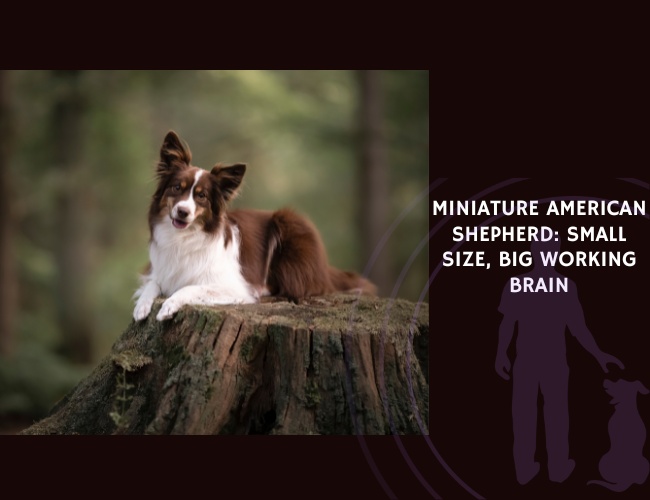
The Miniature American Shepherd sits before you, eyes tracking your every movement, tail in perfect balance, body coiled with potential energy. At barely 18 inches tall, this compact herding dog carries the same neurological wiring as its larger Australian Shepherd cousins—the same pressure-reading cognition, the same motion-sensitive awareness, the same intense focus that can lock onto a moving bicycle from half a block away.
But here’s what makes this breed fascinating: all that working intelligence has been compressed into a smaller frame, creating a dog that often operates at a higher intensity than its size would suggest. The Miniature American Shepherd isn’t a “small Australian Shepherd”—it’s a distinct breed with its own behavioral profile, one that requires understanding beyond basic training commands.
If you’ve chosen or are considering this breed, you’re not signing up for a lap dog with herding aesthetics. You’re partnering with a brain that was built to read pressure, predict movement, and make split-second decisions. The question isn’t whether your MAS is intelligent—the question is whether you can provide the structure and clarity that allows that intelligence to flourish without tipping into nervous over-processing. 🧠
Let us guide you through what makes this breed tick, and more importantly, how to channel their brilliance into stable, joyful cooperation.
Understanding the Herding Heritage in a Compact Frame
Your Miniature American Shepherd may be small enough to tuck under your arm, but their cognitive architecture tells a different story. Through selective breeding, the core herding cognition remains fully intact—the neural pathways for gathering, driving, and balancing livestock are all present and actively seeking expression.
This means your MAS possesses three key herding capabilities that shape their daily behavior:
Pressure reading allows them to perceive subtle shifts in body language and spatial relationships. You might notice your MAS adjusting their position based on where you’re standing, or how they seem to “know” when you’re about to move before you actually do. This isn’t psychic ability—it’s hardwired observational processing that was designed to read the pressure zones around livestock. Common signs of pressure reading include:
- Repositioning themselves based on your body orientation
- Anticipating direction changes before you make them
- Reading tension in your shoulders or stance
- Adjusting distance based on your energy level
- “Knowing” when you’re about to sit, stand, or leave a room
Motion control instinct drives them to stop or redirect moving objects. When your MAS chases bicycles, fixates on running children, or blocks your path in the kitchen, they’re not being difficult. Their brain is processing movement as something that needs to be controlled, and without livestock to herd, they’ll apply that instinct to whatever moves in their environment.
Anticipation capacity enables them to predict trajectories and reactions, making them remarkably quick learners. But this same ability means they can pre-empt your commands or react to perceived threats before they fully materialize, leading to behaviors that seem overly vigilant or unnecessarily reactive.
The challenge with downsizing a working breed isn’t just about reducing physical capacity—it’s about what happens neurologically when you compress all that working drive into a smaller package. A MAS experiences the world from approximately 13–18 inches off the ground, which significantly alters their interaction patterns and stress exposure.
From their perspective, the world is dominated by human legs, feet, and lower body movements. Children’s faces appear at eye level. Other dogs loom larger. Ground-level sounds and objects are more prominent. This constant exposure to triggers that taller dogs might barely notice can increase reactivity simply because the stimuli are more present, more immediate, more unavoidable. Specific ground-level challenges include:
- Eye-level contact with small children (who may reach suddenly)
- Direct exposure to dropped food and ground debris
- Proximity to other dogs’ faces and bodies during greetings
- Constant presence of moving human feet and legs
- Lower visual horizon limiting early detection of approaching triggers
- Increased vulnerability to being stepped on in crowded spaces
While your MAS is physically easier to handle than a full-sized Australian Shepherd, this proximity comes with its own challenges. The constant presence of human feet and legs can be perceived as “moving objects” to be managed, activating herding instincts in inappropriate contexts. The increased physical contact that comes with being smaller can reduce personal space, potentially contributing to stress if boundaries aren’t clearly maintained.
Understanding this herding heritage isn’t about making excuses for unwanted behavior—it’s about recognizing that your MAS’s responses often stem from legitimate cognitive processing, not disobedience or stubbornness. When you frame their behavior through this lens, training becomes less about suppression and more about providing appropriate outlets for instincts that won’t simply disappear because you live in a suburb. 🐾
Hyper-Attunement: The Double-Edged Sword of Handler Sensitivity
If you’ve lived with a Miniature American Shepherd for any length of time, you’ve probably noticed something remarkable: they watch you constantly. Not just casual observation, but intense, focused scanning that seems to register every micro-movement, every shift in your posture, every change in your breathing pattern.
This hyper-attunement is one of the breed’s most distinctive characteristics, and it comes directly from their herding background. A working herding dog must constantly observe subtle cues from both livestock and handler—a slight weight shift, a change in eye direction, a subtle tension in the shoulders. Your MAS brings this same level of attentiveness to their relationship with you.
This means they can pick up on your facial expressions with startling accuracy. They register when your jaw tightens, when your breathing quickens, when your movements become slightly more abrupt. They detect changes in your emotional state before you’ve consciously processed them yourself, reading patterns in your body tension that reveal stress, frustration, excitement, or uncertainty. Signs your MAS is hyper-attuned to you:
- Constant eye contact and visual checking
- Immediate response to subtle body language shifts
- Stress responses when you’re anxious (even if silent)
- Different behavior patterns with different family members
- Noticing when you’re about to leave before you move
- Reading your mood from across the room
- Responding to micro-expressions before verbal cues
For training, this hyper-attunement creates a remarkable advantage. Your MAS can learn new commands and routines with exceptional speed because they’re constantly processing information from both their environment and you. They don’t just hear your verbal cue—they integrate it with your body position, your timing, your emotional delivery, creating a rich, multi-layered understanding of what you want.
But here’s where it becomes complicated: this same sensitivity makes them profoundly vulnerable to inconsistency.
When your body language contradicts your verbal commands, your MAS notices. When your emotional state is anxious or frustrated during training, they absorb that tension. When your timing varies from session to session, they struggle to build reliable predictions about what behavior will earn reinforcement. Common inconsistencies that create confusion:
- Saying “stay” while leaning forward (inviting approach)
- Using calm words with tense body language
- Reinforcing behavior at different moments across sessions
- Different emotional energy during similar training contexts
- Variable criteria (sometimes accepting approximations, sometimes demanding precision)
- Inconsistent consequences for the same behavior
- Mixed messages from different family members
The result isn’t a dog that’s being difficult—it’s a dog experiencing genuine confusion and stress, trying desperately to decode signals that keep shifting.
This is where the NeuroBond approach becomes essential. By providing calm structure and predictable rhythm, you give your hyper-attuned MAS something reliable to read. You become a steady presence rather than a source of confusing variables.
You might also notice that your MAS performs significantly better with you than with other family members, even when they use similar commands. This handler-specific learning pattern emerges because your MAS has built an incredibly detailed “model” of your communication style—the precise timing of your gestures, the subtle inflections in your voice, the micro-patterns in your body language that precede commands.
When a different person attempts to work with them, even minimal differences in timing, posture, or emotional delivery can disrupt their predictive processing. It doesn’t mean they can’t learn from multiple people, but their peak performance and deepest sense of security typically resides with their primary, consistent handler.
This has practical implications for training. If multiple family members will be working with your MAS, you’ll need to consciously coordinate your approaches—not just the words you use, but the timing, the body language, the emotional tone. Consistency across handlers matters far more for this breed than for dogs with less sensitive attunement systems.
The goal isn’t to eliminate this sensitivity—it’s one of the breed’s greatest strengths, enabling the kind of deep partnership that makes working with a MAS so rewarding. The goal is to provide clarity and consistency that allows their attunement to be an asset rather than a source of anxiety. When you understand that your MAS is reading you at a level most breeds simply don’t operate at, you can adjust your own behavior to provide the clear, calm signals that help them thrive. 🧡
Small Dog, Big Arousal: Understanding Emotional Intensity
The compact size of your Miniature American Shepherd creates an interesting physiological reality: emotional intensity can escalate rapidly in a smaller body. This isn’t about personality or temperament alone—it’s about how quickly a smaller nervous system can accelerate into states of high arousal.
Think of it this way: the physiological responses to stress—increased heart rate, adrenaline release, cortisol elevation—occur just as powerfully in your 20-pound MAS as they do in a 70-pound dog. But there’s less physical “buffer” to absorb and dissipate these responses. The result is faster acceleration from calm to highly aroused, quicker stress spikes, and less time for you to intervene before your dog crosses into dysregulation.
You might notice your MAS can go from settled to frantic in moments—a doorbell rings and suddenly they’re spinning, barking, unable to hear your commands. This rapid escalation isn’t behavioral stubbornness; it’s physiological reality. Their nervous system reaches threshold quickly, and once they’re over that edge, returning to baseline takes time and proper decompression.
How your MAS expresses stress matters as much as the stress itself. Unlike breeds that tend toward withdrawal or shutdown under pressure, most MAS dogs express stress through overt, high-energy behaviors:
Barking becomes a primary stress release—often high-pitched, persistent, and difficult to interrupt once it starts. This isn’t just “alerting”; it’s a way of coping with overwhelming stimuli, attempting to control the environment through vocal output.
Spinning or circling reflects both pent-up energy and herding drive activation. When your MAS can’t physically “move” the triggering stimulus, they may redirect that motion impulse into spinning, particularly in confined spaces where forward movement is limited.
Frantic jumping serves multiple functions—it releases physical energy, attempts to gain better visual access to triggers, and can be an effort to redirect your attention or “gather” you into a different location.
Mouthiness manifests as nipping, grabbing at clothes or hands, particularly during excitement or frustration. This often stems from herding instincts (nipping heels to move livestock) being redirected toward human body parts when the dog is overwhelmed or trying to “control” a situation.
Additional stress signals to watch for:
- Excessive panting when not hot or exercised
- Whale eye (showing whites of eyes)
- Lip licking or nose licking when no food present
- Yawning outside of tired contexts
- Pacing or inability to settle
- Excessive shedding during stressful events
- Trembling or shaking
These behaviors aren’t random chaos—they’re your MAS’s attempts to cope with internal overwhelm, release accumulated tension, or exert control when their environment feels unpredictable. Understanding this helps you respond more effectively. Punishing these stress expressions typically increases anxiety without teaching alternative coping strategies.
The most insidious challenge comes from chronic arousal—when your MAS rarely drops into genuine calm, instead operating in a constant state of mild-to-moderate alertness. This chronic elevation has cascading effects:
Impulse control deteriorates because the prefrontal cortex (responsible for inhibition) becomes less effective when the limbic system is constantly activated. Your MAS struggles to stop themselves from lunging at triggers, excessive barking, or other impulsive actions because the “brakes” aren’t functioning properly.
Frustration tolerance diminishes, making them prone to outbursts when their desires are thwarted or when they encounter obstacles. The threshold for triggering a reaction becomes progressively lower, so that minor irritations produce disproportionate responses.
Sleep quality suffers because the nervous system remains “on edge” even during rest periods. You might notice your MAS startles easily while sleeping, has difficulty settling fully, or wakes frequently. This prevents deep, restorative rest, creating a vicious cycle where poor sleep exacerbates arousal, which further impairs sleep.
Signs of chronic arousal in your MAS:
- Never fully relaxing (always one ear up, one eye open)
- Difficulty staying asleep for extended periods
- Overreacting to minor environmental changes
- Quick escalation from calm to reactive
- Decreased ability to “bounce back” from stressful events
- Constant scanning behavior even in familiar environments
- Physical tension held in body even during rest
This pattern aligns with the concept of trigger stacking—accumulated stress without adequate recovery leads to a lower threshold for reactivity. Your MAS might handle one stimulus fine, but when multiple triggers occur in succession (delivery person, loud noise, another dog walking past), they exceed their capacity and react intensely to something that would normally be manageable.
The solution isn’t to avoid all stimulation—that’s neither practical nor beneficial. The solution is to build recovery routines into your dog’s life. This means scheduled decompression periods after stimulating events, dedicated calm spaces where your MAS can fully relax, and recognition that their nervous system needs active support to return to baseline after arousal.
Through the Invisible Leash principles of calm pacing and smooth transitions, you help your MAS maintain a lower baseline arousal level. You’re not suppressing their energy—you’re teaching their nervous system that constant vigilance isn’t necessary, that you’re handling environmental management, that they can actually relax.
When you understand that your small dog carries big emotional intensity, you can adjust your expectations and interventions accordingly. You give them time to decompress, you manage their trigger exposure thoughtfully, you recognize when they’re approaching threshold before they cross it. This is how you preserve their brilliance while preventing their nervous system from running the show. 😊
Motion Sensitivity and the Urban Trigger Load
Your Miniature American Shepherd’s brain was designed to respond to movement—not as a passive observer, but as an active controller. This motion sensitivity, while perfectly adapted for herding livestock, becomes a significant challenge in modern urban and suburban environments where movement is constant, varied, and utterly beyond your dog’s ability to control.
Let’s be specific about what triggers this instinct most powerfully:
Bicycles represent one of the highest-value triggers because they combine rapid movement, silent approach (compared to cars), and unpredictable trajectories. Your MAS’s brain registers a bicycle as something that needs to be gathered, stopped, or redirected—the exact response that would be appropriate for wayward livestock.
Running children activate herding instincts with particular intensity because they’re small, fast-moving, erratic in direction, and often emit high-pitched sounds. These are all characteristics that signal “needs to be controlled” to a herding dog’s processing system.
Cars and traffic create constant motion stimulation, especially challenging when your MAS is on-leash and unable to create the distance or control they instinctively seek. The restriction converts herding drive into leash reactivity—they can’t move toward or away from the trigger effectively, so the energy redirects into lunging, barking, or frustrated pulling.
Skateboards, scooters, and rollerbladers combine rapid movement with unusual motion patterns that don’t conform to typical “walking” rhythms, making them particularly hard for your MAS to predict and categorize. The uncertainty amplifies reactivity.
Other common motion triggers include:
- Joggers and runners passing on trails
- Other dogs running or playing
- Birds taking flight suddenly
- Squirrels or rabbits darting across paths
- Motorcycles and loud vehicles
- Shopping carts or strollers with unusual movement patterns
- Anything blowing in the wind (bags, leaves, debris)
This motion sensitivity creates what we might call an “urban trigger load”—the cumulative effect of constant movement stimuli in modern environments that weren’t part of the genetic landscape when herding instincts were being refined. Your MAS isn’t reacting to one bicycle; they’re managing dozens of movement triggers during a single walk, each one activating neural pathways designed for livestock control.
Leash restriction intensifies this challenge considerably. Off-leash in an appropriate setting, your MAS could use distance and positioning to manage movement—circling around a trigger, creating space, adjusting their angle of approach. The leash eliminates these options, creating barrier frustration where their instinctual response patterns are physically blocked.
This manifests as classic leash reactivity: lunging, barking, spinning, or fixating on triggers that they might handle differently if given more spatial freedom. It’s not that your MAS has “leash aggression”—it’s that the leash converts herding drive into frustrated attempts to control movement when their preferred strategies are unavailable.
Certain environmental contexts are strong predictors of reactive episodes:
Crowded sidewalks create constant movement at varying speeds and directions, all within your MAS’s immediate space. Their brain is trying to process and predict multiple trajectories simultaneously while being unable to create working distance.
Dog parks present layered challenges—not just the movement of other dogs, but unpredictable approach patterns, varying energy levels, and the potential for overwhelming social pressure. Many MAS dogs who seem fine with individual dogs become reactive in multi-dog environments where they can’t effectively “manage” all the movement.
Window watching allows your MAS to see movement triggers without being able to respond appropriately. This creates rehearsal of reactive behaviors (barking at passersby) without consequence, and the behavior becomes self-reinforcing. The window essentially becomes a “hunting screen” where herding instincts activate repeatedly without proper outlet.
Threshold areas like doorways and gates concentrate movement and create natural pressure points. Your MAS may intensify reactivity in these locations because they’re subconsciously trying to “control” who enters or exits, which aligns with boundary-guarding aspects of herding work.
Additional high-risk contexts include:
- Narrow pathways where escape routes are limited
- Off-leash dog areas with poor supervision
- Farmers markets or outdoor festivals with dense crowds
- School zones during pickup/dropoff times
- Parks with multiple sports activities happening simultaneously
- Veterinary clinic waiting rooms with other anxious animals
- Pet store aisles with unpredictable encounters
Managing motion sensitivity isn’t about eliminating your MAS’s awareness of movement—that’s neurologically impossible. It’s about teaching them that noticing movement doesn’t require acting on it, and that you’re handling environmental management.
The shared-role model (“you notice; I decide”) becomes particularly valuable here. You acknowledge your MAS’s excellent observational skills while clearly establishing yourself as the decision-maker about how to respond. This framework allows your dog to use their intelligence to observe and alert, but removes the burden of having to act on every perceived stimulus.
Practically, this means teaching your MAS that seeing a bicycle doesn’t require lunging—they can notice it, look at you, and wait for direction. That running children are something you’re aware of and managing, not something they need to control. That cars passing are neutral events that don’t require response.
This retraining takes time because you’re essentially rewiring the automatic connection between “movement detected” and “must respond.” But through consistent practice, calm reinforcement when they notice without reacting, and strategic management of their trigger exposure, you can significantly reduce the intensity of their motion sensitivity.
You’re not eliminating their herding brain—you’re teaching it when to activate and when to rest, giving them clarity about which movements are their concern and which ones aren’t. That distinction transforms chronic reactivity into calm awareness, preserving their observational gifts while reducing the constant stress of feeling responsible for every moving thing in their environment. 🐾
Separation Stress and the Velcro Dog Reality
If your Miniature American Shepherd follows you from room to room, waits outside the bathroom door, and positions themselves to maintain visual contact at all times, you’re experiencing what many owners call the “velcro dog” phenomenon. But there’s an important distinction to make here: healthy bonding versus shadow-dog attachment patterns that stem from insecurity.
Healthy bonding means your MAS enjoys your presence, seeks interaction, and feels secure in your relationship. Shadow-dog attachment means they cannot self-regulate when you’re out of sight—they experience genuine distress when the visual connection breaks, leading to behaviors like whining, pacing, scratching at doors, or destructive actions.
This difference matters because one reflects a confident dog who loves their person, while the other reflects a dog who has become dependent on constant proximity to maintain emotional stability. Many MAS dogs develop this heightened separation sensitivity due to their hyper-attunement and handler-specific learning patterns—they’ve learned to rely on reading you for emotional regulation, and when you’re not available to read, their system becomes dysregulated.
Several factors contribute to this pattern:
Constant proximity as puppies often seems sweet and harmless—your adorable MAS wants to be near you, and it feels bonding to have them follow you everywhere. But this constant contact can inadvertently teach them that your presence is necessary for their emotional baseline, rather than being a positive addition to an already stable state.
Handler as primary emotional regulator develops when your MAS learns to use your calm to regulate their own arousal. They read your body language, sync to your energy, and essentially “borrow” your nervous system stability. This co-regulation becomes problematic when they haven’t learned to regulate themselves independently.
Lack of structured alone-time means your MAS never builds confidence in being separate. If departures always happen unexpectedly, or if returns are emotionally charged (excited greetings), they never develop the understanding that separation is temporary, predictable, and not a source of distress.
Reinforcement of proximity behaviors occurs unintentionally when you respond to their following behaviors with attention, touch, or reassurance. From your MAS’s perspective, staying close produces positive outcomes, so the behavior intensifies.
Contributing factors specific to MAS dogs:
- Working breed need for “job assignment” translating to monitoring handler
- High sensitivity to environmental changes when alone
- Handler-specific learning making other people poor substitutes
- Natural herding instinct to keep “flock” together
- Hyper-attunement requiring constant information gathering from handler
- Small size making physical proximity easier to maintain constantly
The expression of separation stress in MAS dogs typically includes:
Vocalization that begins immediately when visual contact breaks—whining, barking, howling that escalates until you return or they exhaust themselves.
Destructive behavior focused on exit points (doors, windows) or items with your scent, which represents attempts to reach you or cope with anxiety through physical action.
House soiling that occurs specifically during your absence, even when the dog is fully housetrained otherwise, reflecting stress-induced loss of bladder control.
Excessive greeting behaviors when you return—jumping, spinning, mouthing—that go beyond normal enthusiasm into frantic relief, indicating the separation was genuinely distressing.
Physical symptoms like panting, drooling, trembling, or refusal to eat when alone, demonstrating that the stress response is physiological, not just behavioral.
Red flags that separation stress is severe:
- Escape attempts resulting in self-injury
- Destruction that’s focused and intense (not random boredom)
- Neighbor complaints about constant vocalization
- Weight loss due to stress-related appetite suppression
- Diarrhea or vomiting specifically when left alone
- Excessive grooming or self-soothing behaviors leading to hot spots
Addressing separation stress in MAS dogs requires a specific approach that honors their sensitivity while building genuine independence:
Predictable departure routines help your MAS understand that your leaving follows a pattern and always precedes your return. This might include specific cues—putting on shoes, picking up keys—that reliably predict separation. The predictability itself reduces anxiety because their brain can prepare rather than being caught off-guard.
Calm returns are essential but often overlooked. When you arrive home, avoid excited greetings for the first several minutes. Instead, engage in a brief calm routine (put away items, change clothes) before acknowledging your MAS in a low-key way. This teaches them that returns aren’t emotionally charged events requiring intense response.
Structured alone-time practice should happen even when you’re home. Use baby gates or closed doors to create brief separations where your MAS can’t see you but knows you’re present. Gradually extend these periods, teaching them that not being able to see you doesn’t mean you’ve disappeared.
Independence skills include teaching your MAS to settle on a mat or in a crate while you’re visible but not interacting. This creates the foundation for being separate while maintaining security, and eventually transfers to situations where you’re not visible at all.
Emotional neutrality during transitions means avoiding the common pattern of giving your MAS extra attention right before you leave (which actually highlights that something stressful is about to happen). Instead, your departure should be matter-of-fact, unremarkable, just another part of the daily rhythm.
Practical independence-building exercises:
- Place training with gradual distance increases
- Settle on mat while you move around the house
- Behind-barrier practice (baby gate separations)
- Brief car departures with predictable returns
- Calm greetings after all separations
- Independent play skills with puzzle toys
- Crate training as a safe haven (not punishment)
- Graduated alone-time starting with 30 seconds
Through the NeuroBond framework, you’re teaching your MAS that your absence isn’t a crisis requiring their intervention, and your presence isn’t the only source of safety and regulation. You’re helping them develop an internal sense of stability that persists even when you’re not in the room.
This doesn’t mean creating an aloof dog who doesn’t care about you—it means creating a confident dog who loves you deeply but doesn’t need constant visual confirmation that you exist. The goal is relaxed independence, where your MAS can comfortably be in a different room, rest deeply when you’re gone, and greet your return with joy rather than frantic relief.
When you understand that velcro behavior often stems from insecurity rather than devotion, you can address it with compassion while building the skills your MAS needs to feel secure in their own capacity for calm. That’s the essence of Zoeta Dogsoul: preserving the bond while cultivating the independence that makes both of you more confident in the relationship. 🧡
Compact. Alert. Intense.
Big Brain Inside
Miniature American Shepherds carry full herding cognition in a smaller body. Their size does not reduce drive, awareness, or mental demand.
Herding Never Shrinks
Pressure reading, motion control, and anticipation remain fully active. Everyday movement easily triggers instincts meant for managing livestock.
Scale Amplifies Sensitivity
Downsizing increases vigilance and lowers tolerance for chaos. With structure and clarity, their intensity becomes focused partnership rather than reactivity.
Intelligence Underload: When a Working Brain Has Nothing to Work On
Your Miniature American Shepherd’s brain was built to solve problems—to read pressure, anticipate movement, make decisions, and actively manage their environment. When you place that working brain in a modern pet life where most decisions are made for them and most challenges are absent, something interesting happens: they create their own jobs.
This concept of cognitive underload is distinct from lack of physical exercise, and understanding the difference is crucial. You might have a MAS who gets two walks daily, plays fetch in the yard, and still exhibits problem behaviors like excessive barking, destructive chewing, or anxious pacing. That’s because their body got movement, but their brain didn’t get work.
The self-created “jobs” that underloaded MAS dogs develop often look like misbehavior, but they’re actually attempts to engage their cognitive systems:
Excessive alerting transforms every sound into a meaningful event requiring response. Your MAS appoints themselves as household security officer, barking at delivery people, neighbors walking past, cars parking on the street. This isn’t anxiety necessarily—it’s their working brain finding a task that feels purposeful: monitoring and controlling the environment.
Herding humans manifests as blocking pathways, nipping at heels during movement, or positioning themselves to control family members’ locations. Your MAS is literally practicing herding skills on the nearest moving creatures available, and without proper outlets, this becomes their primary cognitive engagement.
Obsessive monitoring of specific objects, areas, or routines develops when your MAS doesn’t have varied mental challenges. They might fixate on watching one particular window, guarding a specific toy, or becoming overly invested in certain household routines. The repetition provides the feeling of having a job even though it’s not meeting their cognitive needs adequately.
Demand behaviors like persistent nudging, whining, or bringing toys become more frequent and intense. Your MAS is essentially saying “give me something to do” through the only communication methods available, but without proper outlets, these behaviors can escalate into frustration-driven reactivity.
Other signs of intelligence underload:
- Obsessive toy obsession or resource guarding
- Counter surfing and creative food acquisition
- Destructive chewing targeting specific items
- Excessive digging or landscape modification
- Door dashing and escape artist behaviors
- Nuisance barking with precise timing patterns
- Creating games you never taught them
The distinction between cognitive stimulation and physical exercise matters because you can’t tire out a MAS brain simply through running. They need tasks that require:
Problem-solving where they must figure out how to achieve a goal, whether that’s finding hidden treats, working through puzzle toys, or learning new skills that build on previous knowledge.
Decision-making opportunities where they can make choices within boundaries you’ve established. This might include scent work where they decide which direction to search, or learning tricks where they offer behaviors to see which ones earn reinforcement.
Pattern recognition which engages their natural herding intelligence. Games that require them to learn sequences, recognize cues, or predict outcomes based on environmental information tap directly into their cognitive strengths.
Varied experiences that prevent habituation. Your MAS’s brain stops engaging when everything becomes predictable and routine. Introducing novel challenges, even small ones, keeps their cognitive systems actively processing.
Practical applications of cognitive engagement for MAS dogs include:
Scent work represents one of the highest-value activities because it requires decision-making, problem-solving, and sustained focus. Teaching your MAS to find specific scents, track trails, or discriminate between odors engages their brain at the level their genetics prepared them for.
Pattern games like following sequences of commands, learning chains of behaviors, or working through increasingly complex tricks provide the kind of mental challenge that feels satisfying to a working brain.
Varied obedience goes beyond basic commands to include duration work (extended stays), distance work (responding from far away), and distraction work (maintaining behaviors amid challenging stimuli). These variations prevent habituation and keep the training mentally engaging.
Food puzzles and slow feeders transform mealtime into cognitive work. Rather than eating from a bowl in thirty seconds, your MAS spends ten minutes problem-solving to access their food, which provides both cognitive stimulation and natural calming through focused work.
Rotated enrichment prevents the common problem where a toy or activity becomes “boring” after a few repetitions. Keep certain puzzles or games available only occasionally, maintaining their novelty value and cognitive challenge.
Training new skills regularly keeps your MAS’s brain actively learning rather than simply rehearsing known behaviors. Even if the skills themselves aren’t particularly useful (like learning to wave or spin), the process of learning engages cognitive systems that need regular activation.
Additional cognitive enrichment ideas:
- Hide and seek games with toys or family members
- Name recognition for different toys or objects
- Target training with different body parts
- Trick chaining (combining multiple tricks in sequence)
- Box puzzles and interactive feeders
- Snuffle mats and scatter feeding
- Novel environment exploration (new walking routes)
- Cooperative tasks requiring problem-solving with handler input
The goal isn’t to occupy every moment of your MAS’s day with structured activities—that would create its own problems with over-arousal and inability to rest. The goal is to provide regular, meaningful cognitive challenges that satisfy their working brain’s need for engagement, allowing them to settle more deeply during rest periods because they’ve actually used their intelligence.
When you frame problem behaviors through the lens of intelligence underload, you can address them more effectively. Instead of punishing the excessive barking or herding behaviors, you provide legitimate cognitive outlets that meet the same needs in appropriate ways. Your MAS stops creating their own jobs when you give them real ones that match their cognitive capacity.
Through the NeuroBond approach, you’re teaching your MAS that their intelligence has purpose and outlet, that their working brain can be satisfied without dysregulation, that being brilliant doesn’t have to mean being busy every moment. You’re channeling their cognitive capacity into structured cooperation rather than scattered attempts to create their own purpose.
This is how you honor the working dog genetics while adapting them to modern life: you don’t try to suppress their intelligence or pretend they’re a low-drive breed, but you also don’t allow their brain to run unsupervised, creating problems in its attempt to find work. You become the bridge between their herding heritage and their pet reality, providing the cognitive engagement that keeps them satisfied, stable, and genuinely fulfilled. 🧠
🧠 Miniature American Shepherd: Small Size, Big Working Brain 🐾
A Complete Developmental Guide from Puppyhood to Mature Partnership
Phase 1: Understanding the Herding Heritage
Birth to 8 Weeks – Genetic Blueprint
🧬 Neurological Wiring
Your MAS inherits complete herding cognition in a compact body. Three core capabilities are hardwired from birth: pressure reading (detecting spatial relationships), motion control instinct (responding to movement), and anticipation capacity (predicting trajectories). These aren’t learned—they’re genetically encoded.
👀 What to Expect
Even as young puppies, MAS show orientation to movement and keen observational focus. • Early fixation on moving objects • Intense eye contact patterns • Quick startle responses to sudden stimuli • Sensitivity to human emotional states from the earliest interactions
✅ Foundation Building
Choose breeders who understand MAS sensitivity and provide appropriate early neurological stimulation. Look for puppies exposed to varied sounds, surfaces, and gentle handling. The first 8 weeks establish emotional resilience—calm, structured environments prevent later anxiety patterns.
Phase 2: Quality Over Quantity Socialization
8-16 Weeks – Building Confidence Without Overwhelm
🧠 The Sensitivity Factor
MAS puppies process social information at high intensity. Each new experience creates significant cognitive load. Without recovery time, they become progressively overwhelmed, leading to “social flooding” that creates lifelong reactivity rather than confidence.
⚠️ Warning Signs of Over-Socialization
• Progressive suspicion of new people or dogs • Barky, defensive behavior that worsens • Shutdown or refusal to investigate • Generalized anxiety about leaving home • Taking longer to recover after outings • Stress signals during “fun” activities
🎯 Strategic Socialization Approach
Structured observation from safe distances builds neutrality. Brief, positive interactions with calm, known dogs. Recovery days between exposures. Gradual intensity progression over weeks, not days. One positive experience where your puppy stays calm is worth more than five overwhelming ones.
Phase 3: Hyper-Attunement and Bond Formation
3-6 Months – Building NeuroBond Foundation
📡 Reading Your Micro-Signals
Your MAS reads you at a level most breeds don’t operate at. They detect jaw tension, breathing changes, subtle postural shifts. This hyper-attunement enables rapid learning but creates vulnerability to inconsistency. Through the NeuroBond approach, you become a reliable signal source rather than confusing variables.
🔄 Handler-Specific Learning
MAS dogs build detailed “models” of their primary handler’s communication style. They may perform beautifully with you but struggle with family members using similar commands—because the timing, body language, and emotional delivery differ. Coordinate training approaches across all handlers.
🎓 Training Style Essentials
Precision without pressure: 3-5 minute training blocks, clean timing with markers, calm reinforcement delivery. Avoid high-pitched praise that increases arousal. Your emotional neutrality provides the stability their sensitive system needs to focus on learning rather than managing their own anxiety.
Phase 4: Arousal Management and Trigger Training
4-8 Months – Teaching the Invisible Leash
🚴 Motion Sensitivity Reality
Bicycles, running children, cars, skateboards—your MAS’s brain registers all movement as requiring control. The compact body escalates emotional intensity rapidly. The urban trigger load (constant movement stimuli) wasn’t part of their genetic development, creating chronic arousal without proper management.
🚨 Chronic Arousal Warning
Dogs who never fully relax develop: deteriorating impulse control, diminished frustration tolerance, poor sleep quality. This creates trigger stacking where accumulated stress lowers their reactivity threshold. One trigger might be manageable; three in succession exceed capacity.
🎯 “You Notice; I Decide” Protocol
The Invisible Leash principle: acknowledge your MAS’s observation skills while establishing yourself as decision-maker. Reward noticing triggers, but you determine response. They see a bicycle → look to you → receive reinforcement. Observation without action becomes the new pattern.
Phase 5: Building Independent Confidence
5-10 Months – Breaking Velcro Patterns
🔗 Shadow-Dog vs. Healthy Bonding
Healthy bonding means enjoying your presence; shadow-dog attachment means inability to self-regulate without visual contact. MAS dogs often develop handler-dependency because they’ve learned to “borrow” your nervous system stability. They need to build their own internal regulation capacity.
📊 Separation Stress Expressions
• Immediate vocalization when visual contact breaks • Destructive behavior at exit points • House soiling during absence only • Frantic greeting behaviors • Physical symptoms (panting, trembling, appetite loss) • These indicate genuine distress, not “spite”
🛠️ Independence Training Protocol
Predictable departure routines. Calm, unremarkable returns (no excited greetings for several minutes). Structured alone-time practice even when home. Behind-barrier separations with gradual duration increases. Emotional neutrality during transitions. Build confidence in their own capacity for calm.
Phase 6: Navigating the Working Brain Storm
6-18 Months – Adolescent Reorganization
🧠 Neurological Reality
Your adolescent MAS isn’t being stubborn—their brain is genuinely reorganizing. Hormonal changes amplify herding instincts. The prefrontal cortex undergoes developmental changes that temporarily impair impulse control. Previously mastered behaviors become unreliable as neural pathways reconnect.
⚠️ MAS-Specific Challenges
• Noise sensitivity escalation • Motion reactivity intensification • Leash behavior deterioration • Barrier frustration increases • Social selectivity emerges • “Forgetting” reliable recall • Increased herding behaviors toward family • Resource guarding that appears suddenly
💪 Management Strategies
Continue training despite apparent regression. Increase trigger management rather than expecting previous performance levels. Provide additional mental stimulation (increased drive needs outlets). Maintain structure religiously. Prevent rehearsal of reactive behaviors. Patience: this phase is temporary but crucial for adult temperament formation.
Phase 7: Intelligence Fulfillment and Purpose
12-24 Months – Channeling the Working Brain
🔧 Cognitive Underload Problem
Modern pet life under-stimulates the MAS working brain. Without appropriate challenges, they create their own jobs: excessive alerting, herding humans, obsessive monitoring, demand behaviors. Physical exercise alone cannot satisfy cognitive needs—the brain requires actual problem-solving work.
🎭 Self-Created “Jobs”
Underloaded MAS behaviors: • Appointing themselves household security • Blocking pathways and nipping heels • Fixating on windows or specific routines • Persistent nudging and demand behaviors • Counter surfing and creative problem-solving • Door dashing and escape artistry
🧩 Legitimate Cognitive Outlets
Scent work (highest value for decision-making), pattern games and trick chains, varied obedience with duration/distance/distraction, food puzzles and slow feeders, rotated enrichment (prevents habituation), regular new skill learning. These satisfy the working brain without creating chronic arousal.
Phase 8: The Grounded Working Partnership
2+ Years – Stable Adult Cooperation
🎓 Adult Temperament Emerges
Most MAS show significant stability improvement through 18-24 months. Adult temperament reflects how you handled previous phases. Consistent support produces stable, reliable adults. Punishment or overwhelming exposure during development often carries reactive patterns into adulthood as established behavior rather than temporary phases.
✨ Soul Recall in Action
Moments of Soul Recall reveal how emotional memory shapes current responses. Your mature MAS carries the accumulated experiences of their development. Positive patterns established early create confident adults who trust your leadership. Understanding this helps you address root patterns rather than just surface behaviors.
🤝 The Mature Partnership
A well-raised adult MAS: observes without over-processing, engages intelligently without dysregulation, bonds deeply without dependency, handles environmental variety calmly. They embody the breed’s brilliance—attentive, capable, loyal—without the common pitfalls of chronic reactivity or anxiety. This is the Zoeta Dogsoul vision realized.
🔄 MAS vs. Other Herding Breeds: Key Differences
vs. Australian Shepherd
MAS carries full herding cognition in smaller package, leading to higher intensity expression. Faster arousal escalation, more reactive to ground-level triggers, stronger handler-specific learning. Same intelligence, amplified sensitivity.
vs. Border Collie
Border Collies show stronger eye and stalk behaviors. MAS are more handler-focused and less independent in decision-making. MAS require more emotional management, less physical stamina, but similar cognitive needs.
vs. Pembroke Corgi
Both small herding breeds, but Corgis show more stubborn independence and less hyper-attunement. MAS are more emotionally sensitive, faster learners, more prone to anxiety without proper structure. Corgis handle inconsistency better.
Shelties show more vocal alerting, MAS show more physical control attempts. Both sensitive to handler emotion, but MAS have stronger motion triggers and less tolerance for household chaos. Similar training approach works for both.
vs. Companion Breeds
MAS are NOT lap dogs with herding aesthetics. They require active cognitive engagement, precision training, trigger management that most companion breeds don’t need. Under-stimulation creates serious behavioral problems.
Size Advantage
Physical manageability makes MAS apartment-compatible and travel-friendly. However, small size doesn’t reduce exercise, training, or mental stimulation needs. All working brain requirements remain at full-sized intensity.
⚡ Quick Reference: MAS Success Formula
Daily Cognitive Work: 20-30 minutes structured mental enrichment (scent work, pattern games, varied obedience)
Training Style: 3-5 minute sessions × 3-5 daily, calm reinforcement, clean timing, emotional neutrality
Socialization Ratio: 1 quality exposure with recovery > 5 overwhelming experiences. Distance is your friend.
Arousal Management: Predictable routines + smooth transitions + recovery time = lower baseline intensity
Independence Building: Structured alone-time practice + calm departures/returns + emotional neutrality during transitions
Adolescent Survival: Maintain training consistency + increase management + provide extra mental stimulation + patience with regression
🧡 The Zoeta Dogsoul Approach to Miniature American Shepherds
The Miniature American Shepherd embodies a profound truth: brilliance requires grounding. Their exceptional intelligence, hyper-attunement, and working heritage create a dog capable of extraordinary partnership—but only when their sensitivity finds structure, their awareness finds calm leadership, and their working brain finds legitimate purpose.
Through the NeuroBond framework, you provide the consistent signals their hyper-attuned system needs. Through the Invisible Leash principles, you teach them that observation doesn’t require constant action. Through moments of Soul Recall, you understand how their emotional memory shapes their responses, allowing you to address root patterns rather than surface behaviors.
This isn’t about suppressing their herding instincts or pretending they’re a low-drive breed. It’s about becoming the bridge between their genetic heritage and their modern life—channeling their cognitive capacity into stable cooperation rather than scattered attempts to control their environment. When you honor both their intelligence and their sensitivity, you create a partnership where awareness meets calm, where working drive finds structured outlet, where brilliance operates without nervous system dysregulation.
That balance between science and soul, between genetic blueprint and learned partnership, between working heritage and modern harmony—that’s the essence of Zoeta Dogsoul. Your Miniature American Shepherd doesn’t need less of their brilliance; they need you to provide the structure that allows that brilliance to flourish without tipping into overwhelm.
© Zoeta Dogsoul – Where neuroscience meets soul in dog training
Training Style: Precision Without Pressure
Your Miniature American Shepherd will learn faster than most breeds you’ve encountered. They pick up patterns quickly, remember sequences after minimal repetition, and seem to anticipate what you want before you fully communicate it. This exceptional learning capacity is one of the breed’s greatest assets—and one of its greatest vulnerabilities when training approaches aren’t carefully calibrated.
The key principle for MAS training is precision without pressure: clean timing, clear criteria, calm delivery, without the high-energy excitement or emotional intensity that can destabilize their sensitive nervous systems.
Let’s start with what doesn’t work well with this breed:
High-pitched praise might seem motivating, but for many MAS dogs, it increases arousal rather than reinforcing calm behavior. Their hyper-attunement means they process your vocal tone as information about their performance and the environmental state. Excited, high-pitched praise signals that something exciting is happening, which can prevent them from settling into the focused calm that enables their best learning.
Constant verbal commentary creates noise that obscures your actual cues. When you narrate everything (“good, that’s right, yes, keep going, perfect”), your MAS struggles to identify which specific moment earned reinforcement. The precision timing that enables their fast learning becomes muddied by constant verbal input.
Extended training sessions push past their optimal attention window. While a MAS can focus intensely, maintaining that focus for twenty or thirty minutes straight often leads to mental fatigue, frustration, and decreased performance. Shorter sessions preserve the quality of their engagement.
Physical corrections are rarely necessary with this breed and often backfire. Given their sensitivity and handler attunement, a harsh correction can create profound insecurity, damaged trust, and shutdown behaviors where they become hesitant to offer any action for fear of getting it wrong.
Inconsistent criteria creates the most significant problems for MAS dogs. If “sit” sometimes means “butt on the ground immediately” and sometimes means “maybe sit when you get around to it,” their predictive processing becomes confused. They waste cognitive energy trying to decode when you actually mean what you say, rather than focusing on the behavior itself.
Training approaches to avoid:
- Flooding with overwhelming stimuli
- Alpha rolls or physical intimidation
- Yelling or harsh verbal corrections
- Training when handler is frustrated or stressed
- Long repetitions of the same command
- Mixed signals from multiple trainers without coordination
- Punishment for stress-based behaviors
What does work exceptionally well with this breed:
Precise, short training blocks of 3-5 minutes, repeated several times daily, maintain high-quality attention without mental fatigue. Your MAS learns more from three five-minute sessions than one thirty-minute session because their focus remains sharp throughout each brief interaction.
Clean timing means marking the exact moment they perform the desired behavior, not several seconds later when you’ve processed what happened. Using a clicker or precise verbal marker (“yes”) at the instant of correct behavior leverages their sensitivity to temporal patterns, accelerating learning dramatically.
Calm reinforcement delivery maintains focus better than excitement. When you deliver treats or praise in a matter-of-fact, slightly warm but not effusive manner, your MAS can remain in the focused, cognitively engaged state that enables optimal learning. You’re not suppressing joy—you’re preventing over-arousal that fragments attention.
Clear criteria with gradual shaping means you define exactly what behavior earns reinforcement, then systematically raise criteria as your MAS masters each level. This creates the predictability their brain craves while providing the challenge their intelligence requires.
Variable reinforcement schedules (once behaviors are established) maintain engagement without creating dependence on constant rewards. Your MAS learns that correct behavior always matters, but the specific reward might vary in timing or type, keeping them attentive without frustration.
Generous use of release cues gives your MAS clear information about when the “work” is done and they can relax. Teaching a solid release word (“okay,” “free,” “break”) creates structure where your MAS knows when precision is required and when they can disengage.
Essential training principles for MAS success:
- Start in low-distraction environments
- Build duration before adding distance or distractions
- Reward effort during learning phase, precision during proofing
- End sessions on success (not frustration)
- Train when both handler and dog are calm
- Use food rewards matched to difficulty level
- Practice behaviors in multiple contexts for generalization
- Celebrate small wins without creating over-excitement
The concept of calm structure becomes particularly important in training contexts. This doesn’t mean training without emotion or connection—it means training without chaos. Your body language remains relaxed, your voice stays even, your movements are fluid rather than jerky. This calm provides the stable foundation your MAS needs to focus their considerable intelligence on the actual learning task rather than managing their own arousal or trying to decode your emotional state.
One training approach that deserves special attention for this breed is teaching impulse control exercises from an early age. Games like “wait at doors,” “leave it,” and “settle on mat” aren’t just good manners—they’re essential life skills that help your MAS develop the self-regulation capacity their genetics didn’t automatically provide. These exercises teach them that they can manage their own impulses, that patience produces rewards, and that calm behavior opens doors (literally and figuratively).
Foundation impulse control exercises for MAS dogs:
- Wait at doors before exiting (prevents bolting)
- Leave it with food, toys, and environmental distractions
- Settle on mat with duration building gradually
- Eye contact on cue (attention foundation)
- Sit-stay with increasing distance and distractions
- Down-stay for relaxation training
- Release to eat after bowl is set down
- Waiting politely for leash attachment
- Calm greeting behaviors with guests
Another key element is building strong engagement before introducing distractions. Many owners make the mistake of training in high-distraction environments before their MAS has solid focus in quiet settings. But given this breed’s motion sensitivity and environmental awareness, they need to build a strong foundation of attention and response in controlled settings before you ask them to maintain that focus amid triggers.
This means your early training happens in your living room, backyard, or other low-distraction spaces. Only when your MAS responds reliably and calmly in these settings do you gradually introduce environmental challenges—first mild distractions, then moderate, then more intense. This systematic progression respects their sensitivity while building confidence.
Through the Invisible Leash principles, your training becomes a form of communication that your MAS can decode clearly. You’re not overwhelming them with information or emotion; you’re providing precise, calm guidance that allows their intelligence to shine. You’re teaching them that learning is a collaborative process, not a test they might fail, and that their working brain has a legitimate outlet in training cooperation.
When you understand that your MAS’s rapid learning capacity requires equally precise teaching, you can avoid the common pitfall of assuming “they should know better” when behaviors break down. Usually, the breakdown stems from unclear communication, inconsistent criteria, or arousal that exceeded their capacity to process effectively—not from stubbornness or defiance.
Training a Miniature American Shepherd well means respecting both their intelligence and their sensitivity, providing the clarity that allows them to learn while maintaining the calm that keeps their nervous system stable. That balance—precision without pressure—creates a dog who is reliable, confident, and genuinely enjoys the training process because it meets their cognitive needs without overwhelming their emotional capacity. 😊
Socialization: Building Confidence Without Overexposure
The conventional wisdom about socialization suggests maximum exposure during the critical period: take your puppy everywhere, let them meet everyone, expose them to all possible stimuli. But for Miniature American Shepherds, this high-volume approach often backfires, creating the exact problems it’s meant to prevent.
Here’s why: your MAS’s nervous system processes social information at high intensity. Each new person, dog, or environment creates significant cognitive and emotional load as they assess, categorize, and determine appropriate responses. Without adequate recovery time between exposures, they don’t have the opportunity to integrate these experiences positively—instead, they become progressively more overwhelmed, leading to “social flooding.”
Social flooding manifests as:
Progressive suspicion of new people or dogs, where your MAS becomes increasingly reactive or avoidant with each encounter rather than more confident.
Barky, defensive behavior that seems to worsen despite more socialization, because they’re trying to create distance from stimuli that feel overwhelming.
Shutdown or refusal to engage where your MAS stops investigating novel things entirely, having learned that new experiences are stressful rather than positive.
Generalized anxiety about leaving the house or entering new environments, because their system associates “new” with “overwhelm.”
Warning signs of over-socialization:
- Regression in previously confident behaviors
- Increased startle responses to normal stimuli
- Hesitation or refusal to approach new things
- Stress signals appearing during “fun” activities
- Taking longer to recover baseline after outings
- Decreased appetite after social experiences
- Sleep disturbances following socialization days
The alternative approach emphasizes quality over quantity, controlled exposure over maximum volume:
Structured observation allows your MAS to watch activity from a comfortable distance without requirement to interact. They can observe other dogs playing at the park while sitting calmly with you fifty feet away, processing the information without performance pressure. This builds neutrality—the understanding that other dogs exist but don’t require their engagement.
Brief, positive interactions with carefully selected people or dogs who understand appropriate greeting behavior work better than extended play sessions with unfamiliar dogs or crowds of people. A calm two-minute greeting with a well-mannered dog teaches more positive lessons than thirty minutes in a chaotic dog park.
Recovery time between exposures is as important as the exposures themselves. After a socialization outing, your MAS needs time to decompress, integrate the experience, and return to baseline before the next novel encounter. This might mean scheduling socialization activities every few days rather than multiple times daily.
Success indicators matter more than exposure volume. One positive experience where your MAS remained calm, investigated something new, and returned to you confidently is worth far more than five experiences where they were overwhelmed, overstimulated, or shut down.
Gradual intensity progression respects your MAS’s sensitivity while building genuine confidence. You might start with watching traffic from your front yard (low intensity), progress to walking quiet residential streets (moderate intensity), then eventually handle busier urban environments (higher intensity)—but this progression happens over weeks or months, not days.
Quality socialization principles:
- Distance is your friend (use it generously)
- Watch body language, not just behavior
- End before stress accumulates
- Allow your dog to choose approach speed
- Respect when they say “no” to interactions
- Build positive associations with neutrality
- Prioritize calm over friendly
- Recovery days are productive days
Building neutrality deserves special emphasis for this breed. Neutrality means your MAS can notice stimuli without needing to react—they see another dog across the street and remain calm, they hear children playing nearby without needing to investigate or control, they observe movement triggers without activating herding instincts.
This neutrality directly addresses the MAS tendency toward hypervigilance and control-seeking. When they learn that not everything requires their assessment or response, their baseline arousal decreases significantly. They can walk through environments that previously triggered constant reactivity because they’ve learned to filter information rather than process every stimulus as potentially significant.
Practical neutrality training includes:
Watch-and-release exercises where you reward your MAS for noticing something (a person, dog, bicycle) and then immediately looking back at you rather than fixating. You’re teaching them that acknowledgment without sustained attention is the appropriate response.
Parallel walking with other dogs where all participants maintain distance and nobody interacts. Your MAS learns that proximity to other dogs doesn’t automatically mean greeting, playing, or managing—sometimes it just means coexisting in the same space.
Stationary observation in various environments where you and your MAS simply sit and watch activity without participating. This builds their tolerance for stimulus-rich environments while teaching them they don’t need to engage with everything they see.
Reward for disengagement rather than only rewarding engagement. When your MAS looks away from a trigger, relaxes their body, or settles calmly despite environmental activity, that’s exactly the behavior you want to reinforce.
Specific neutrality-building exercises:
- Cafe sits (observing without interacting)
- Park perimeter walks (seeing dogs without approaching)
- “It’s just a…” labeling game (bicycle, person, dog = neutral)
- Auto-check ins (rewarding voluntary attention to handler)
- Permission-based greetings (only approach on cue)
- Pass-by practice with known triggers
- Settle during environmental activity
- Oriented attention away from distractions
One common mistake with MAS socialization is assuming that breed traits require extensive dog-dog play to satisfy social needs. While some MAS enjoy dog play, many are actually more fulfilled by structured activities with their handler than by chaotic free play with unfamiliar dogs. Respecting this individual preference prevents forcing social interactions that increase stress rather than building confidence.
Similarly, not all MAS dogs need to be “friendly with everyone.” Teaching polite neutrality toward strangers—acknowledging their presence without seeking interaction—can be more appropriate for this breed than expecting them to enthusiastically greet every person they encounter. This reduces their social burden while maintaining good manners.
The goal of socialization isn’t to create a dog who loves everything and everyone—it’s to create a dog who can handle reasonable environmental variety without becoming reactive or stressed. For MAS dogs, this means building confidence through positive experiences while preventing overwhelm through thoughtful exposure management.
Through the NeuroBond framework, socialization becomes less about exposure volume and more about building your MAS’s capacity to observe without over-processing, notice without reacting, and trust that you’re managing environmental decisions. You’re teaching them that their job isn’t to assess every stimulus—it’s to look to you for guidance about what matters and what doesn’t.
When you understand that more socialization isn’t always better, particularly for a sensitive, hyper-attuned breed, you can approach their social development with the patience and precision it requires. You’re creating a confident dog who can move through the world calmly, not an exhausted dog who’s been pushed past their processing capacity in the name of socialization. 🐾
Adolescence: The Working Brain Storm
If you’ve successfully navigated your Miniature American Shepherd’s puppyhood and suddenly find yourself dealing with a teenage dog who seems to have forgotten everything they learned, you’re experiencing the working brain storm of adolescence. This developmental period, typically occurring between 6-18 months, represents one of the most challenging phases for MAS owners—not because the dog is being defiant, but because neurological and hormonal changes create temporary cognitive disruption.
During adolescence, your MAS experiences:
Increased drive intensity as hormonal changes amplify their herding instincts, prey drive, and reactivity to movement triggers. Behaviors that were mild in puppyhood can suddenly intensify dramatically.
Boundary testing that reflects normal developmental exploration of independence and social hierarchy, but can feel like deliberate disobedience when your previously compliant puppy starts challenging established rules.
Heightened reactivity risk as their nervous system becomes temporarily more sensitive to environmental triggers. Noises that didn’t bother them before might suddenly provoke barking; dogs they tolerated might trigger reactivity.
Reduced impulse control even for previously mastered behaviors, as the prefrontal cortex undergoes developmental changes that temporarily impair executive function.
Selective attention where your MAS seems to “forget” their recall, ignore known commands, or become impossibly focused on environmental distractions that previously weren’t problematic.
Adolescent behavioral changes to expect:
- Sudden fear periods (brief spikes in anxiety)
- Increased independence and distancing from handler
- More selective social preferences with other dogs
- Testing previously accepted boundaries
- Increased vocalization and “talking back”
- Greater physical confidence leading to riskier behaviors
- Hormone-driven marking and territorial behaviors
- Temporary memory lapses for known commands
The neurological reality is that your adolescent MAS isn’t being stubborn—their brain is genuinely reorganizing, creating temporary disconnections between learned behaviors and reliable execution. This doesn’t mean abandoning training expectations, but it does mean adjusting your approach to account for their developmental state.
Common adolescent challenges specific to MAS dogs include:
Noise sensitivity escalation where your teenager suddenly becomes reactive to sounds they previously ignored—traffic, household appliances, outdoor activity. This reflects the temporary hypersensitivity of their developing nervous system.
Motion reactivity intensification as their herding instincts reach full strength. That bicycle tolerance you worked hard to build might suddenly collapse as their teenage brain becomes overwhelmed by the intensity of their own drive.
Leash pulling or reactivity that emerges or worsens as their physical strength increases and their impulse control temporarily decreases. The combination creates perfect conditions for leash behavior deterioration.
Barrier frustration at windows, gates, or fences becomes more intense as their territorial awareness develops and their ability to manage frustration diminishes during this developmental phase.
Social changes with other dogs—your MAS might become more selective about playmates, develop same-sex discomfort, or show increased reactivity to unfamiliar dogs as their adult social patterns begin emerging.
MAS-specific adolescent red flags:
- Suddenly “forgetting” reliable recall around distractions
- Increased herding behaviors toward people or pets
- Window reactivity that wasn’t present before
- Resource guarding that emerges seemingly overnight
- Increased sensitivity to handler frustration
- Over-arousal that takes longer to recover from
- Fixation behaviors (staring, stalking, intense focus)
The key to navigating adolescence successfully is maintaining consistency while adjusting expectations:
Continue training even when it feels like you’re getting nowhere. Your MAS’s brain is still encoding these experiences; the reliability will return as their nervous system stabilizes, but only if you maintain the practice during this challenging period.
Increase management of trigger exposure rather than expecting your adolescent MAS to handle the same environmental intensity they managed as a puppy. This isn’t regression—it’s strategic support during temporary developmental vulnerability.
Provide additional mental stimulation because the increased drive intensity means your teenage MAS has even more cognitive energy requiring outlet. Under-stimulation during adolescence dramatically increases the risk of problem behaviors developing.
Maintain structure and routine with particular consistency, as the predictability helps stabilize their temporarily dysregulated nervous system. Adolescence is not the time to relax rules or become inconsistent with boundaries.
Proactive trigger management prevents rehearsal of reactive behaviors during this sensitive period. If your MAS is going through a phase of increased reactivity to bicycles, actively manage exposure rather than repeatedly putting them in situations where they practice the unwanted response.
Patience with regression understanding that temporary skill loss is neurologically normal. Your MAS hasn’t forgotten everything—their brain just needs time to reconnect learned behaviors through new neural pathways as reorganization completes.
Adolescent management strategies:
- Increase frequency of training sessions (shorter but more often)
- Revisit foundation skills in low-distraction settings
- Add environmental management (window film, strategic barriers)
- Increase decompression time after stimulating events
- Adjust exercise to include more mental work
- Maintain house rules with zero exceptions
- Document progress to see patterns you might otherwise miss
- Consider professional support if regression is severe
One critical aspect of adolescent management involves preventing the establishment of long-term reactivity patterns. Behaviors that were temporary and manageable in puppyhood can become permanent if they’re repeatedly rehearsed during adolescence. A teenage MAS who practices leash reactivity dozens of times is encoding that response pattern more deeply than a puppy going through the same experience.
This means adolescence requires more thoughtful management than puppyhood, not less. You’re preventing the crystallization of problem behaviors while supporting your MAS through temporary developmental challenges.
The good news: adolescence is temporary. Most MAS dogs show significant improvement in impulse control, attention, and overall stability as they mature through 18-24 months. The training and management you maintained during the difficult teenage period pays off as their nervous system stabilizes and adult temperament emerges.
But that adult temperament reflects how you handled their adolescence. An MAS who received consistent support, appropriate management, and patient training during their teenage phase typically develops into a stable, reliable adult. An MAS who was punished for developmental challenges, exposed to overwhelming triggers, or allowed to rehearse reactive behaviors often carries those patterns into adulthood as established behavioral patterns rather than temporary developmental phases.
Through the NeuroBond approach, you navigate adolescence by providing the calm structure your MAS needs while acknowledging that their brain is temporarily less capable of meeting previous performance standards. You adjust your expectations without abandoning them, support their nervous system while maintaining boundaries, and prevent the establishment of reactive patterns that could extend beyond this developmental period.
When you understand that adolescence represents neurological reorganization rather than deliberate misbehavior, you can respond with the patience and strategic management this phase requires. You’re preserving the foundation you built in puppyhood while helping your MAS emerge from their teenage phase as a confident, stable adult who retained their brilliance without acquiring permanent reactivity or anxiety patterns. 🧡
NeuroBond Framework: Grounding a Small Working Brain
Everything we’ve explored about the Miniature American Shepherd—their herding heritage, hyper-attunement, motion sensitivity, separation stress, intelligence underload, and developmental challenges—points toward one fundamental need: this breed requires calm, clear structure that grounds their working brain without suppressing their intelligence.
The NeuroBond framework provides exactly this through three core principles that address the specific vulnerabilities we’ve identified:
Invisible Leash principles create the foundation through calm pacing, spatial clarity, and smooth transitions. These aren’t training techniques as much as a way of moving through the world that teaches your MAS’s nervous system that vigilance and control-seeking aren’t necessary.
Calm pacing means you move through environments at a rhythm that allows your MAS to process information without becoming overwhelmed. You’re not rushing through trigger-dense areas, but you’re also not stopping to “work through” every reaction. You maintain steady, confident movement that communicates environmental management.
Spatial clarity establishes clear expectations about where your MAS should be in relation to you during different activities. This reduces their need to constantly problem-solve positioning, allowing their cognitive energy to remain available for other tasks rather than being consumed by spatial management questions.
Smooth transitions between activities prevent the arousal spikes that occur when everything happens suddenly. Your MAS learns to anticipate changes in routine, reducing the startle response and vigilance that come from unpredictability.
Emotional neutrality from the handler addresses the MAS tendency toward co-regulation and handler fixation. When you maintain a calm, even emotional tone regardless of what’s happening around you, you become a stable reference point rather than a source of additional arousal or anxiety.
This doesn’t mean being cold or disconnected—it means being steady. When your MAS sees a trigger and looks to you for information, your calm body language and neutral emotional state communicate that no significant response is required. You’re not suppressing their observation (which would create confusion), but you’re also not amplifying their concern through your own tension or anxiety.
Emotional neutrality becomes particularly important during reactive episodes. Your MAS barks at another dog, and instead of tensing up, verbally correcting, or becoming frustrated, you remain matter-of-fact and simply create distance or redirect attention. Your emotional stability tells them more powerfully than any command that the situation isn’t as significant as their instincts suggested.
The shared-role model (“you notice; I decide”) provides perhaps the most powerful intervention for this breed because it directly addresses their tendency toward hypervigilance and control-seeking. This framework acknowledges your MAS’s excellent observational skills while clearly establishing you as the decision-maker about environmental responses.
In practice, this means you reward your MAS for noticing things—they see a bicycle and look at you, and that observation earns reinforcement. But the decision about what to do about the bicycle belongs to you. You might move to the side of the path, continue walking, or ask for a simple attention behavior—but your MAS learns that their job is observation, not action.
This model preserves their intelligence and awareness (which feels satisfying to their working brain) while removing the burden of having to manage every stimulus they detect. They can notice without needing to react, observe without needing to control, be brilliant without being constantly vigilant.
The practical application of this framework transforms your daily life with your MAS:
Morning routines become predictable sequences where your MAS knows what happens next, reducing anxious scanning or demand behaviors as they wait for direction.
Walks shift from reactive episodes to cooperative navigation, where your MAS maintains connection with you while observing their environment without constant need to react to triggers.
Home behavior becomes calmer as your MAS learns that you’re monitoring the environment, removing their self-assigned security duties that manifested as window barking or alert behaviors.
Training sessions become more focused as your MAS learns to read your clear, calm signals rather than scanning for subtle cues amid emotional intensity or inconsistent communication.
Social situations become manageable as your MAS looks to you for direction rather than taking it upon themselves to manage interactions with other dogs or people.
Daily life transformations with NeuroBond:
- Threshold manners without constant cueing
- Calm settling in previously triggering locations
- Reduced scanning and hypervigilance
- More restful sleep and genuine downtime
- Decreased stress signals during routine activities
- Improved recall around distractions
- Relaxed body language in public spaces
- Confidence to disengage from triggers independently
The NeuroBond framework specifically addresses the risk factors we’ve identified throughout this article:
For hyper-attunement, it provides consistent signals to read rather than confusing emotional variability.
For arousal management, it maintains lower baseline intensity through calm structure and smooth pacing.
For motion sensitivity, it establishes the shared-role model where observation doesn’t automatically require action.
For separation stress, it builds independence through predictable routines and emotional neutrality that doesn’t create dependency.
For intelligence underload, it provides mental engagement through the constant problem-solving of cooperative navigation rather than chaotic attempts to control the environment.
For training effectiveness, it creates the calm, precise context where your MAS’s learning capacity can function optimally.
NeuroBond benefits across all challenge areas:
- Hyper-attunement: Reduces handler fixation through emotional neutrality
- Arousal: Prevents escalation through calm pacing
- Motion triggers: Shared-role model removes control burden
- Separation anxiety: Independence building without co-regulation dependency
- Cognitive needs: Cooperative work provides legitimate brain engagement
- Reactivity: Clear leadership reduces self-appointed responsibilities
- Handler-specific learning: Consistent signals transfer across contexts
- Chronic stress: Predictability allows genuine nervous system recovery
Moments of Soul Recall reveal how your MAS’s emotional memory shapes their responses to environmental triggers, allowing you to address root patterns rather than surface behaviors. This is the essence of Zoeta Dogsoul: recognizing that brilliance requires grounding, that sensitivity needs clarity, that a working brain needs legitimate work rather than being left to create its own chaotic jobs. You’re not suppressing your MAS’s herding heritage or trying to turn them into something they’re not—you’re providing the structure that allows their exceptional intelligence to express itself through stable cooperation rather than nervous over-processing.
When you implement these principles consistently, you’ll notice your MAS begins to soften. Not losing their awareness or enthusiasm, but developing a quality of calm presence that wasn’t possible when they felt responsible for managing everything around them. They become more confident because they trust your leadership, more relaxed because constant vigilance isn’t necessary, more engaged because their working brain has legitimate outlet through cooperative partnership.
This transformation doesn’t happen overnight—it requires consistent application, patience during challenging developmental periods, and willingness to adjust your own behavior to provide the clarity your MAS needs. But for owners who commit to this approach, the result is a Miniature American Shepherd who embodies the breed’s best qualities—intelligent, attentive, loyal, capable—without the common pitfalls of reactivity, anxiety, or dysregulation that plague so many working dogs in modern environments. 🧠
Is the Miniature American Shepherd Right for You?
After exploring the cognitive complexity, emotional sensitivity, and training needs of this breed, you might be wondering whether a Miniature American Shepherd is the right choice for your life. The honest answer depends on your capacity to provide what this breed genuinely needs—not what we might wish they needed, but what their neurology and genetics actually require.
Consider whether you can commit to:
Daily mental stimulation beyond basic walks, recognizing that your MAS’s working brain needs genuine cognitive challenges to prevent problem behaviors from developing.
Consistent, calm training that honors their sensitivity and provides the precision their learning capacity requires, rather than sporadic or emotionally intense training sessions.
Thoughtful trigger management especially during puppyhood and adolescence, accepting that this breed’s motion sensitivity and reactivity risk require strategic environmental management.
Independence training from early age, investing time in teaching your MAS to self-regulate rather than becoming dependent on your constant presence.
Emotional stability in your own behavior, providing the neutral reference point their hyper-attunement needs rather than variable emotional responses that create insecurity.
Long-term perspective understanding that adolescence will be challenging and that building a stable adult MAS requires patience through difficult developmental periods.
Specific time and resource commitments:
- 20-30 minutes daily for structured mental enrichment
- 3-5 short training sessions throughout the day
- Regular environmental management (window film, strategic barriers)
- Investment in quality puzzle toys and enrichment tools
- Potential professional training support during adolescence
- Consistent daily routines with minimal schedule variation
- Recovery time built into weekly activities
- Ongoing education about breed-specific needs
This breed thrives with owners who:
Appreciate intelligence and find satisfaction in working with a dog who learns quickly and remains mentally engaged with training throughout their life.
Value partnership over simple obedience, enjoying the collaborative relationship that develops when you work with your MAS’s awareness rather than against it.
Can provide structure without rigidity, creating clear expectations and consistent routines while remaining flexible enough to adjust to your dog’s individual needs.
Understand sensitivity as a trait to honor rather than a problem to solve, adjusting their approach to accommodate their MAS’s emotional intensity.
Have time for engagement beyond basic care, recognizing that this breed needs regular training, mental stimulation, and cooperative activities to remain balanced.
Ideal MAS owner traits:
- Patient with developmental challenges
- Interested in ongoing dog training education
- Calm under pressure (doesn’t escalate with dog’s arousal)
- Consistent in daily routines and expectations
- Observant of subtle behavioral changes
- Willing to adjust lifestyle to meet dog’s needs
- Comfortable with professional guidance when needed
- Enjoys problem-solving and creative training approaches
This breed struggles with households that:
Expect low-maintenance companionship, wanting a dog who can be left alone for long periods without environmental management or structured alone-time training.
Use harsh training methods, not understanding that this breed’s sensitivity makes punishment-based approaches both unnecessary and counterproductive.
Provide minimal mental stimulation, assuming physical exercise alone will satisfy a working dog’s cognitive needs.
Have inconsistent routines or unpredictable household patterns that prevent the development of secure expectations.
Want a social butterfly who enthusiastically greets everyone and plays well with all dogs, rather than accepting this breed’s often-selective social preferences.
Red flag household situations:
- Frequent long work hours with dog alone most of the day
- High household chaos or unpredictability
- Multiple young children without structured supervision
- Expectation of off-leash reliability without training investment
- Apartment living without commitment to multiple daily outings
- First-time dog owners without willingness to seek guidance
- Households with frequent visitors or party hosting
- Inconsistent enforcement of rules across family members
The Miniature American Shepherd can be an exceptional companion—brilliant, attentive, deeply bonded, and endlessly entertaining. Their small size makes them physically manageable, their intelligence makes training rewarding, and their loyalty creates profound human-canine partnerships when the relationship is built correctly.
But they’re not a breed for everyone. Their sensitivity requires consistency, their working brain requires engagement, their herding instincts require management, and their emotional intensity requires calm leadership. When these needs aren’t met, the same traits that make them exceptional can manifest as problem behaviors that frustrate both dog and owner.
If you’re drawn to this breed because of their size, appearance, or perceived convenience, take time to honestly assess whether you’re prepared for their cognitive and emotional reality. If you’re drawn to them because you want an intelligent, engaged partner who will challenge you to become a more thoughtful handler, and you’re willing to provide the structure and stimulation they need, then the Miniature American Shepherd might be exactly the right choice.
The relationship you build with a well-raised MAS represents one of the most rewarding experiences in dog ownership—a partnership where intelligence meets structure, sensitivity finds security, and working heritage discovers purpose in modern life. That balance between science and soul, brilliance and grounding, awareness and calm—that’s the essence of Zoeta Dogsoul, and it’s exactly what your Miniature American Shepherd needs to thrive. 🐾