
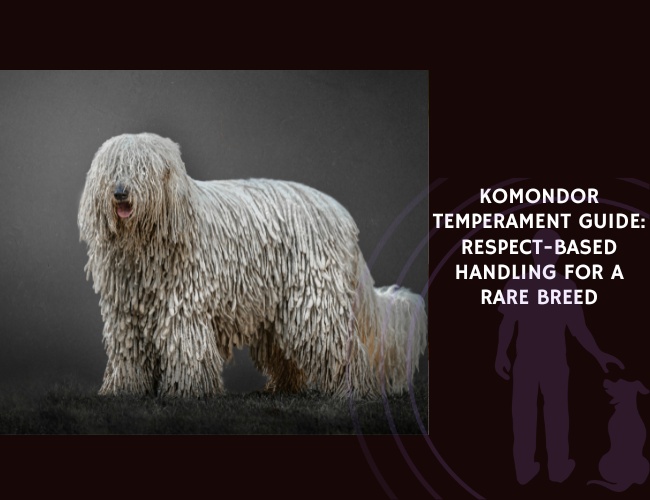
Respect-Based Handling for a Rare and Remarkable Breed
There’s something profoundly different about sharing your life with a Komondor. Perhaps you’ve noticed it already — that quiet, watchful presence that seems to take in everything without demanding anything in return. Or maybe you’re considering welcoming one of these magnificent corded guardians into your home and want to understand what truly makes them tick.
Here’s the truth that many traditional training guides miss: the Komondor isn’t stubborn, aloof, or difficult. This breed carries centuries of autonomous guardian wisdom in their DNA, and understanding that heritage changes everything about how we approach our relationship with them.
Let us guide you through the fascinating world of Komondor temperament — not to train them into something they’re not, but to honor who they truly are.
Ancestral Roots: Where Temperament Begins
The Hungarian Plains and a Different Kind of Partnership
To truly understand your Komondor’s behavior today, we need to travel back to the Hungarian puszta — vast, open plains where these remarkable dogs developed their unique temperament architecture over centuries of purposeful breeding.
Unlike herding breeds that evolved to work under constant human direction, or companion breeds selected for eager-to-please sociability, the Komondor was bred for something far more autonomous. They were nocturnal sentinels, making independent decisions about threats while their human partners slept. They worked with minimal verbal commands, developing an extraordinary capacity for self-directed problem-solving and environmental reading.
Night vigilance shaped their character profoundly. When predator threats peaked during darkness, it was the Komondor who assessed, decided, and acted — often without any human guidance whatsoever. This wasn’t disobedience; this was professional competence of the highest order. 🧡
Minimal micromanagement became their working norm. Success depended not on constant handler focus but on territorial attachment and intuitive judgment. The bond they formed wasn’t one of subordination — it was partnership built on mutual trust and respected expertise.
Isolated environments created selective sociability. With limited exposure to strangers and novel stimuli, these dogs developed deep bonds with their specific charges rather than the broad friendliness we see in breeds designed for social versatility.
Key traits shaped by this ancestral role include:
- Autonomous decision-making without human direction
- Calm, sustained vigilance rather than high-arousal reactivity
- Strong territorial attachment over handler-focused obedience
- Selective bonding with specific charges rather than broad sociability
- Self-directed problem-solving and environmental reading
- Nocturnal alertness patterns that persist in modern settings
What This Means in Your Modern Home
Your Komondor carries this ancestral programming into your living room, your backyard, your daily walks. Understanding this translation helps everything fall into place.
Common modern expressions of guardian heritage:
- Establishing patrol patterns around property boundaries
- Selecting elevated observation posts throughout the home
- Increased alertness during evening and nighttime hours
- Wariness toward unfamiliar visitors or delivery people
- Preference for predictable routines over spontaneous activity
- Need for “off-duty” rest periods between vigilance
Territorial behavior intensifies in smaller spaces. Those guardian instincts designed for open pastures become more concentrated in suburban yards. You might notice your Komondor establishing natural patrol patterns, choosing specific observation posts, monitoring boundaries with serious attention. This isn’t problematic behavior requiring correction — it’s their heritage expressing itself.
Nocturnal alertness persists. If your Komondor seems more watchful at night, more responsive to sounds after dark, you’re witnessing genetics at work. Rather than interpreting this as anxiety or restlessness, consider how you might honor this innate drive through structured nighttime responsibility.
Chaos tolerance runs low by design. A breed selected for calm, sustained vigilance naturally struggles with high-frequency social environments. Urban settings with constant novel stimuli can create what behaviorists call “trigger stacking” — a cumulative stress load that erodes well-being. Your Komondor thrives in predictability, not excitement.
Did you know that what many owners interpret as “being difficult” is actually a sophisticated guardian doing exactly what centuries of breeding programmed them to do? 🧠
Puppy Development: Building the Guardian’s Foundation
The Critical Window That Shapes Everything
If you’re bringing home a Komondor puppy, or if you’re a breeder shaping the next generation of these magnificent guardians, understanding the critical developmental periods isn’t just helpful — it’s essential. The confidence architecture that defines a well-adjusted adult Komondor is built during a surprisingly narrow window of early life.
The primary socialization period spans roughly 3 to 16 weeks of age, with the most sensitive learning occurring between 8 and 12 weeks. During this window, your puppy’s brain is uniquely primed to categorize experiences as “normal” or “threatening.” What they encounter during this period — and how those encounters feel emotionally — shapes their baseline responses for life.
Here’s what makes guardian breed socialization different: companion breeds benefit from maximum exposure to as many people, places, and experiences as possible. The goal is broad sociability — a dog comfortable with everyone and everything. Guardian breeds like the Komondor require a more nuanced approach. The goal isn’t indiscriminate friendliness; it’s confident assessment capability.
Guardian puppy socialization goals differ from companion breeds:
- Confident assessment of novel situations rather than automatic friendliness
- Ability to recover quickly from unexpected experiences
- Comfortable tolerance of necessary handling and veterinary care
- Appropriate responses proportional to actual threat levels
- Capacity to relax in familiar environments
- Trust in human leadership during uncertain situations
Quality Over Quantity: The Guardian Puppy Approach
Your Komondor puppy needs positive exposure to variety, but the emphasis falls on positive and controlled rather than on sheer volume. Overwhelming a guardian puppy with too much, too fast can actually create the insecurity-driven over-guarding you’re trying to prevent.
Introduce novelty at the puppy’s pace. Watch your puppy’s body language during new experiences. Soft, curious investigation indicates they’re processing well. Freezing, tucked tails, or attempts to escape signal overwhelm. When you see stress signals, increase distance or reduce intensity rather than pushing through.
Create positive associations with human variety. Your puppy needs to meet different people — men and women, children and elderly, people wearing hats or uniforms, people of different appearances and movement patterns. But each encounter should feel safe. Have visitors offer treats without forcing interaction. Allow your puppy to approach on their own terms. Build the association: “novel humans predict good things, and I get to decide how close I want to be.”
Types of people your Komondor puppy should meet positively:
- Men and women of varying ages
- Children who understand gentle interaction
- People wearing uniforms, hats, or unusual clothing
- People using mobility aids or wheelchairs
- People with different movement patterns and energy levels
- Delivery workers and service personnel (at appropriate distance)
Expose to environmental variety with escape routes. Different surfaces, sounds, locations, and objects all need introduction. But always ensure your puppy can retreat if they feel uncertain. A puppy who learns “I can move away when I’m uncomfortable” develops confidence. A puppy who learns “I’m trapped with scary things” develops defensive anxiety.
Environmental elements to introduce during socialization:
- Various floor surfaces: tile, carpet, grass, gravel, metal grates
- Household sounds: vacuum cleaners, blenders, television, doorbells
- Outdoor sounds: traffic, sirens, construction, thunder recordings
- Moving objects: bicycles, strollers, shopping carts, skateboards
- Different locations: friends’ homes, quiet parks, pet-friendly stores
- Novel objects: umbrellas opening, balloons, holiday decorations
Prioritize recovery over exposure count. After novel experiences, give your puppy time to process. Sleep, calm play, and relaxed home time allow their developing brain to integrate new information. Packing too many new experiences into too short a period prevents proper processing and can sensitize rather than habituate.
What Appropriate Early Socialization Looks Like
Week 8-10: Gentle foundation building. Focus on positive experiences within your home and immediate environment. Introduce household sounds gradually — vacuum cleaners at a distance, television, kitchen noises. Allow exploration of different textures and surfaces. Keep visitor encounters brief, positive, and puppy-directed.
Week 10-12: Expanding the circle carefully. Begin short outings to calm environments. Quiet parks during off-hours, friends’ yards, low-traffic areas where your puppy can observe the world without being overwhelmed. Continue positive associations with a widening variety of people. Introduce basic handling — touching paws, ears, mouth — paired with rewards.
Week 12-16: Controlled complexity. Gradually introduce more challenging environments while maintaining positive emotional states. Short car rides, brief visits to pet-friendly stores during quiet times, exposure to other calm, vaccinated dogs. Continue building positive associations with handling that will support future veterinary care and grooming needs.
Beyond 16 weeks: Ongoing development. The primary socialization window begins closing around 16 weeks, but learning continues throughout adolescence. Maintain positive exposure to variety while respecting your developing Komondor’s increasing guardian instincts. They may become more selective about who they accept — this is normal. Your job shifts from broad socialization to maintaining positive associations with necessary experiences.
Warning Signs of Inadequate Socialization
Recognizing early what insufficient or poorly executed socialization looks like helps you intervene before patterns solidify.
Generalized fearfulness suggests missed opportunities. A puppy who startles at most novel stimuli, who struggles to recover from surprises, who seems anxious in any environment beyond their immediate home has likely missed critical exposure windows. This requires careful remedial work with a professional who understands guardian breed temperament.
Aggressive responses to novelty indicate negative associations. If your puppy lunges, barks frantically, or shows defensive aggression toward new people or situations, they’ve learned to perceive novelty as threat. This pattern, if unaddressed, develops into the over-guarding behavior that makes adult Komondors difficult to live with.
Inability to settle signals nervous system dysregulation. Puppies who cannot relax, who remain hypervigilant even in familiar environments, who startle repeatedly at normal household activity have nervous systems that haven’t learned to feel safe. This foundation makes adult confidence nearly impossible to achieve.
The good news? With appropriate intervention during puppyhood, these patterns can often be reversed. The challenging news? The longer they persist, the more difficult remediation becomes. Early recognition and appropriate response give your Komondor puppy the best chance at developing into the confident guardian they were bred to be. 🐾
Dignity, Distance, and the Art of Respectful Connection
Reframing “Aloofness” as Something Beautiful
If you’ve ever felt hurt by your Komondor’s apparent distance, or wondered why they don’t greet you with the exuberant enthusiasm of a Labrador, this section will transform your understanding.
What traditional breed descriptions call “aloofness” is more accurately understood as dignified reserve — a preference for low-noise, non-invasive interaction that serves their guardian function perfectly. This isn’t coldness. It’s professional awareness combined with deep, quiet loyalty.
Observation-based engagement defines their social style. Your Komondor prefers to monitor from a comfortable distance rather than maintain constant physical contact. This positioning allows them to watch over you while maintaining environmental awareness — quite literally, they’re doing their job even while relaxing nearby. Forcing proximity can trigger stress because it prevents them from fulfilling their innate guardian positioning needs.
Selective initiation of contact reveals their affection language. When your Komondor approaches you on their own terms, they’re demonstrating trust. They’ve assessed the environment as secure enough to reduce their vigilance momentarily and connect with you. This isn’t rejection when they maintain distance — it’s responsible guardian behavior.
Low-noise communication works best. Komondors respond poorly to excessive verbal commands, repeated instructions, or emotional intensity in communication. They prefer clear, calm direction delivered once. High-frequency verbal interaction can actually feel chaotic and threatening to a breed designed for quiet vigilance.
Reading the Subtle Language of Your Komondor
Understanding Komondor communication requires developing sensitivity to their subtle signals — the quiet language that occurs long before any overt defensive behavior becomes necessary.
Comfort looks like this:
Soft body posture with visibly relaxed musculature tells you your Komondor feels safe. Watch for slow, deliberate movements when they approach or are approached. A comfortable Komondor orients toward stimuli without fixation, offering soft eye contact or calmly looking away. These micro-signals indicate a dog at ease in their environment.
Signs your Komondor feels comfortable and secure:
- Soft, relaxed body posture without muscle tension
- Slow, deliberate movements rather than quick or jerky motion
- Soft eye contact or calm looking away
- Loose, natural tail position
- Willingness to turn their back to the environment
- Easy, rhythmic breathing
- Ability to settle and rest while maintaining awareness
Early discomfort whispers before it shouts:
Body stiffening or subtle muscle tension often goes unnoticed by inexperienced owners. Watch for orientation changes — turning their body away or creating distance are clear communications of “I need space.” Increased environmental scanning and subtle weight shifts backward or sideways signal that your Komondor is processing something that concerns them.
Early discomfort signals to watch for:
- Body stiffening or increased muscle tension
- Turning body away from the stimulus
- Creating distance or attempting to move away
- Increased environmental scanning
- Weight shifting backward or sideways
- Closed mouth with tight lips
- Ears rotating or pinning back slightly
- Yawning, lip licking, or shake-offs (displacement behaviors)
Pre-escalation markers demand attention:
Fixed staring with hard eye contact represents a significant warning. Stillness — that moment when normal movement ceases entirely — indicates high arousal. Raised hackles along the spine and forward weight shift with lowered head mean your Komondor has moved into serious defensive readiness. Recognizing these earlier signals allows intervention before this point.
Critical pre-escalation signals requiring immediate response:
- Fixed, hard staring at the trigger
- Complete stillness — cessation of all movement
- Raised hackles along the spine and shoulders
- Forward weight shift with lowered head
- Closed mouth with visible tension in jaw muscles
- Low, rumbling growl or sudden silence after barking
- Tail held high and rigid or tucked tightly
Research consistently demonstrates that human calming behaviors like head-turning and averted gaze most effectively reduce canine arousal, while direct staring significantly increases it. This is particularly relevant for Komondors, whose guardian instincts make them highly sensitive to anything resembling confrontation.

Building Cooperation Through Respected Distance
The principle of spatial respect fundamentally transforms Komondor cooperation. Through the NeuroBond approach, we recognize that trust becomes the foundation of learning — and trust requires respect.
Allow dog-initiated contact. When you wait for your Komondor to approach rather than reaching for them, trust builds more rapidly. Forced engagement triggers defensive instincts rather than the social bonding you’re hoping to create. Your patience teaches them that you respect their decision-making autonomy.
Practice non-invasive interaction protocols. Approach indirectly, in curves rather than straight lines, to reduce threat perception. Crouch with averted gaze to signal non-threatening intent. Allow your Komondor to sniff and investigate before physical contact — you’re honoring their assessment process, which is fundamental to who they are.
Use social distance as communication. Your Komondor uses physical distance to regulate their comfort. Respecting this distance demonstrates your understanding of their language. Violation of their boundary can trigger defensive escalation not because they’re aggressive, but because you’ve communicated threat through spatial invasion. 🐾
Guardian Confidence vs. Insecurity: A Critical Distinction
Recognizing True Guardian Confidence
Distinguishing authentic guardian confidence from insecurity-driven over-guarding is one of the most important skills you can develop as a Komondor owner. The behaviors can look similar to untrained eyes, but the underlying emotional states — and appropriate responses — differ dramatically.
Calm stance and quiet observation mark genuine confidence. A truly confident guardian maintains a relaxed but alert posture, observing potential concerns without immediate escalation. Their body language shows readiness without tension. They’re prepared, not panicked.
Measured, proportional responses reveal security. Confident Komondors assess before acting. Their responses match actual threat levels rather than overreacting to minimal stimuli. Crucially, they can de-escalate once a perceived threat passes — this flexibility indicates emotional stability.
Environmental confidence shows in their movement. A confident Komondor moves through their territory with comfortable authority. They establish self-directed patrol patterns without constantly checking in with you. They can settle and rest while maintaining awareness — vigilance doesn’t require hypervigilance.
Social confidence allows tolerance. Confident guardians can tolerate neutral strangers at appropriate distances. They show curiosity rather than immediate aggression toward novel stimuli. Most importantly, they demonstrate clear communication signals before any defensive action becomes necessary.
Summary of true guardian confidence markers:
- Calm, relaxed posture with alert awareness
- Measured responses proportional to actual threat
- Ability to de-escalate when threat passes
- Self-directed patrol without constant handler checking
- Tolerance of neutral strangers at appropriate distance
- Curiosity rather than immediate defensiveness toward novelty
- Clear warning communication before any defensive action
- Capacity to settle and rest while maintaining awareness
Identifying Insecurity-Driven Over-Guarding
Research on livestock guardian dog effectiveness reveals a sobering truth: behavioral problems often stem from inadequate socialization rather than inherent temperament flaws. Recognizing insecurity helps you address the underlying emotional need rather than just managing symptoms.
Rigidity and chronic tension signal underlying fear. An insecure Komondor shows constant muscle tension even in non-threatening situations. They struggle to truly relax or settle. Hypervigilance prevents normal rest patterns, creating a cycle of exhaustion and heightened reactivity.
Excessive scanning without focus indicates overwhelm. Insecure dogs engage in compulsive environmental monitoring that serves no practical purpose. They can’t filter relevant stimuli from background noise. Normal household activities trigger heightened startle responses.
Disproportionate reactions reveal emotional flooding. Over-reaction to minor stimuli — a delivery truck, a neighbor’s voice, movement outside — suggests a nervous system overwhelmed by perceived threat. Difficulty de-escalating once aroused indicates the dog has lost access to their thinking brain.
Compensation behaviors develop as coping mechanisms. Excessive barking, barrier frustration, fence-fighting, and inability to disengage from triggers often represent attempts to manage overwhelming anxiety through action.
Signs of insecurity-driven over-guarding:
- Constant muscle tension even in safe situations
- Inability to truly relax or settle
- Hypervigilance that prevents normal rest
- Compulsive environmental scanning without focus
- Heightened startle response to normal activity
- Disproportionate reactions to minor stimuli
- Difficulty de-escalating once aroused
- Excessive barking, fence-fighting, or barrier frustration
- Generalized suspicion rather than specific threat assessment
What Creates Guardian Confidence?
The pathway to genuine confidence runs through several essential elements that every Komondor owner should understand.
Appropriate socialization during critical periods establishes baseline security. Early positive exposure to varied people, environments, sounds, and experiences creates a dog who can process novelty without defensive escalation. Missed critical periods can be partially addressed through careful remedial work, but prevention remains far more effective than rehabilitation.
Consistency and predictability reduce chronic stress. When your Komondor can predict what happens next — when meals arrive, when visitors are expected, what daily routines look like — their nervous system can relax into security rather than maintaining constant high alert.
Clear role definition provides psychological stability. Knowing their job and having appropriate opportunities to perform it gives your Komondor purpose and fulfillment. Confusion about expectations creates anxiety; clarity creates confidence.
Respect-based handling builds trust over time. Every interaction either deposits trust into your relationship account or withdraws from it. Consistent respect accumulates into deep security.
Rehabilitation: Rebuilding Trust in Adult Komondors
When History Creates Challenges
Perhaps you’ve adopted an adult Komondor whose history remains unknown. Or maybe you’ve rescued one from circumstances that clearly involved inappropriate handling — harsh training methods, neglect, or simply well-meaning owners who didn’t understand guardian breed needs. These dogs present unique challenges, but rehabilitation is possible when approached with patience and understanding.
The respect-based framework applies to rehabilitation work, but the timeline extends significantly and the approach requires even greater sensitivity. A dog whose trust has been damaged needs more time, more consistency, and more evidence of safety before they can begin to relax into partnership.
Understanding what you’re working with matters deeply. A Komondor who experienced punishment-based training may associate human approach with threat. One who was isolated may lack the social skills to interpret human communication accurately. A dog from chaotic environments may be unable to settle because their nervous system never learned what safety feels like. Identifying the likely source of your dog’s challenges helps you target your rehabilitation approach appropriately.
The Decompression Period
Before any training or behavior modification begins, newly adopted adult Komondors need decompression time — a period of minimal demands where they can simply exist in their new environment without pressure.
The two-week shutdown provides essential foundation. During the first two weeks, keep life as quiet and predictable as possible. Establish consistent routines for feeding, elimination opportunities, and rest. Avoid introducing your new Komondor to visitors, other pets, or novel experiences. Your only goal is helping them understand that this new place is safe and predictable.
Two-week shutdown essentials:
- Consistent feeding times in the same quiet location
- Regular elimination opportunities on a predictable schedule
- Minimal visitors — ideally none during this period
- No introductions to other household pets yet
- Quiet household environment without excessive activity
- Same person handling primary care when possible
- Comfortable, secure resting area that feels like sanctuary
- No training demands — just establishing safety
Observe without intervening. During decompression, you’re gathering information. When does your Komondor seem most relaxed? What triggers visible tension? How do they respond to your movement, your voice, your approach? This observational period reveals the specific challenges you’ll need to address and the resources your dog brings to the rehabilitation process.
Allow choice and control wherever possible. Dogs who’ve experienced loss of control often show dramatic improvement when given agency. Let your new Komondor decide when to approach you. Offer food without requiring interaction. Provide multiple resting spots so they can choose their position. Every choice they make successfully builds confidence.
Rebuilding Trust Through Consistency
After decompression, active trust-building begins — slowly, patiently, with respect for your dog’s history.
Predictability becomes your primary tool. Dogs from chaotic or abusive backgrounds often show hypervigilance because they’ve learned that bad things happen unpredictably. Counter this by becoming radically predictable. Same routine, same locations for activities, same calm tone. Predictability allows the nervous system to stop bracing for surprise.
Positive associations replace negative ones. If your Komondor shows fear or defensive behavior toward specific triggers — men, sudden movements, reaching hands, particular sounds — you’ll work to rebuild those associations through careful counter-conditioning. Present the trigger at a distance or intensity that doesn’t provoke defensive response, pair it with something your dog values, repeat consistently over time. This process cannot be rushed.
Respect defensive communication absolutely. When a rehabilitating Komondor growls, stiffens, or shows other warning signals, they’re communicating that their threshold has been crossed. Thank them for the information and reduce pressure immediately. Punishing these signals — or pushing through them — destroys the trust you’re trying to build and teaches the dog that communication doesn’t work.
Celebrate tiny progress. Rehabilitation milestones may be invisible to outside observers. Your Komondor holding eye contact for a moment, approaching you voluntarily, relaxing their body in your presence — these small shifts represent significant internal change. Acknowledge them, even if only to yourself.
Rehabilitation milestones worth celebrating:
- Brief voluntary eye contact
- Approaching you without being called
- Visible body relaxation in your presence
- Eating with you in the room
- Accepting treats from your hand
- Resting in the same space as you
- Soft tail wag when you appear
- Willingness to follow you between rooms
- Tolerating brief, gentle touch
- First play behavior or relaxed exploration
Timeline Expectations for Rehabilitation
Rehabilitating an adult Komondor with trauma history requires patience measured in months, not weeks.
Months 1-3: Establishing safety. During this period, focus entirely on decompression and predictability. Don’t expect affection, engagement, or cooperation. Your goal is simply helping your Komondor believe that this environment won’t hurt them.
Months 3-6: Emerging trust. You may begin seeing voluntary approach, moments of relaxation, tentative engagement. Continue maintaining predictability while very gradually introducing minimal requests. Build positive associations with necessary handling like leash attachment and brief examinations.
Months 6-12: Developing partnership. With foundation established, you can begin more active training using respect-based methods. Introduce structured responsibility appropriate to your dog’s growing confidence. Expect setbacks — they’re normal. The overall trajectory matters more than any single day.
Beyond year one: Ongoing relationship. Some rehabilitated Komondors achieve near-normal confidence and function. Others retain sensitivities that require ongoing management. Both outcomes represent success when measured against where your dog started.
Through the NeuroBond approach, even damaged trust can be rebuilt — but it requires humans who are willing to move at the dog’s pace rather than their own expectations. The guardian partnership that eventually emerges from successful rehabilitation often becomes the deepest bond either partner has known. 🧡
Calm. Corded. Certain.
Autonomy defines their nature.
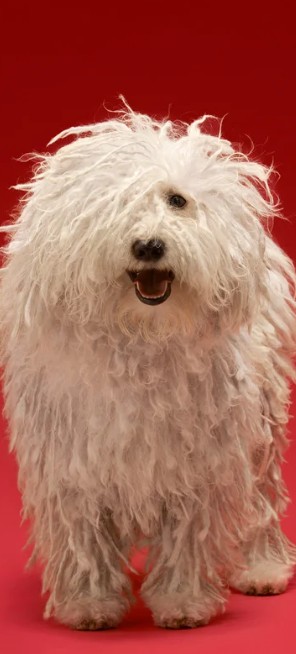
Your Komondor isn’t distant or disobedient—they’re expressing guardian instincts shaped by centuries of independent night vigilance on the Hungarian plains.
Environment shapes their vigilance.
Patrol patterns, selective sociability, and nighttime alertness aren’t quirks but territorial intelligence translating old-world duties into modern spaces.
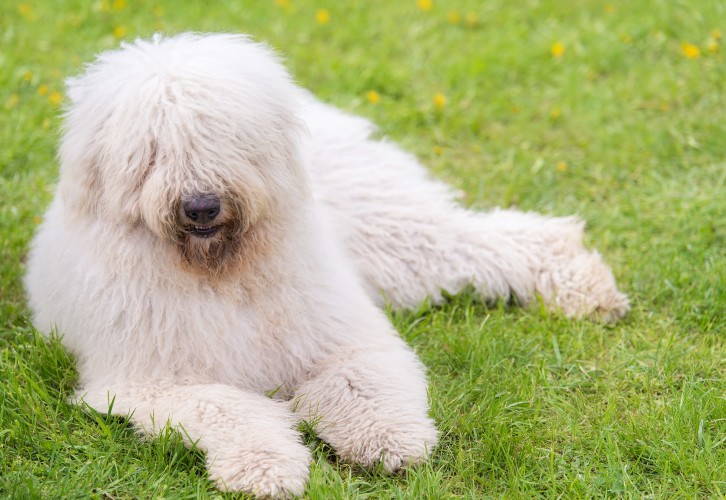
Respect steadies the partnership.
When you honor their self-governing temperament with predictable structure and low-pressure guidance, their dignity turns into stable, devoted guardianship.
Training Philosophy: Respect Over Control
Why Traditional Obedience Training Fails Komondors
Here’s a truth that contradicts much conventional dog training wisdom: the Komondor was never designed for obedience in the traditional sense. Understanding why requires examining what obedience training actually assumes.
Why traditional obedience methods fail guardian breeds:
- Assumes handler-focus as default (Komondors focus on environment)
- Expects immediate compliance (Komondors assess before acting)
- Uses repetitive commands (Komondors respond to clear, single direction)
- Requires sustained eye contact (perceived as threat by guardians)
- Values quick, snappy responses (conflicts with thoughtful assessment)
- Often includes punishment (destroys trust foundation)
- Prioritizes control over cooperation (creates resistance, not partnership)
Standard obedience assumes handler-focus as default. Traditional training methods work best with breeds selected for intense attention to human direction — dogs who find looking to their handler for guidance intrinsically rewarding. The Komondor’s heritage selected for exactly the opposite: environmental awareness, autonomous assessment, and self-directed action.
Command-based training conflicts with guardian cognition. When you repeatedly command a Komondor and expect immediate compliance, you’re working against their fundamental cognitive architecture. They’re not being stubborn — they’re doing what centuries of breeding programmed them to do: assess the situation independently before acting.
Punishment-based methods destroy trust catastrophically. Research consistently demonstrates that coercive training approaches damage the human-canine bond, increase stress hormones, and often increase the very behaviors they’re meant to eliminate. For a guardian breed whose cooperation depends entirely on trust, punishment-based training creates exactly the opposite of what you need.
Forced eye contact creates confrontation. Many traditional training methods require sustained eye contact as a marker of attention and respect. For a Komondor, direct staring is a threat signal. Demanding it creates defensive arousal rather than cooperative engagement.
🐕🦺 Komondor Temperament Guide 🛡️
Respect-Based Handling for the Dignified Guardian — Understanding the Autonomous Protector
Phase 1: Ancestral Heritage
Understanding the Guardian Architecture🧠 Historical Foundation
The Komondor developed on Hungarian plains as an autonomous night guardian. They made independent decisions about threats while humans slept — this isn’t stubbornness, it’s professional competence bred over centuries.
🎯 What to Expect
• Autonomous decision-making rather than handler-focus
• Selective bonding with specific charges
• Nocturnal alertness patterns
• Calm vigilance rather than high-arousal reactivity
Phase 2: Puppy Development
Critical Socialization Window (8-16 Weeks)📚 Guardian Breed Difference
Unlike companion breeds needing maximum exposure, Komondor puppies need quality over quantity. The goal isn’t indiscriminate friendliness — it’s confident assessment capability.
✅ Socialization Approach
• Week 8-10: Gentle foundation at home
• Week 10-12: Expanding carefully to calm environments
• Week 12-16: Controlled complexity introduction
• Always provide escape routes and recovery time
⚠️ Warning Signs
Generalized fearfulness, aggressive responses to novelty, or inability to settle indicate missed critical periods requiring professional intervention.
Phase 3: Communication Mastery
Reading the Subtle Guardian Language😊 Comfort Signals
• Soft, relaxed body posture
• Slow, deliberate movements
• Soft eye contact or calm looking away
• Willingness to turn back to environment
😟 Early Discomfort
• Body stiffening or muscle tension
• Turning body away or creating distance
• Increased environmental scanning
• Yawning, lip licking (displacement behaviors)
🚨 Pre-Escalation Markers
• Fixed, hard staring at trigger
• Complete stillness — cessation of movement
• Raised hackles, forward weight shift
• Intervene immediately — create distance
Phase 4: Confidence Assessment
True Guardian vs. Insecurity-Driven Behavior💪 True Confidence
• Calm observation without immediate escalation
• Measured, proportional responses
• Ability to de-escalate when threat passes
• Can settle and rest while maintaining awareness
😰 Insecurity Signs
• Constant tension even in safe situations
• Hypervigilance preventing normal rest
• Disproportionate reactions to minor stimuli
• Excessive barking, fence-fighting, barrier frustration
Phase 5: Respect-Based Training
Partnership Over Control❌ Why Traditional Training Fails
• Assumes handler-focus (Komondors focus on environment)
• Demands immediate compliance (they assess first)
• Requires sustained eye contact (perceived as threat)
• Punishment destroys trust foundation
✅ Respect-Based Approach
• Acknowledge their guardian competence
• Provide direction without micromanagement
• Allow assessment time before expecting response
• Build cooperation through consistent trust deposits
📅 Training Timeline
Weeks 1-4: Foundation — minimize demands, build trust
Weeks 5-12: Development — introduce structured responsibility
Ongoing: Maintenance — partnership continues for life
Phase 6: Real-World Management
Practical Guardian Protocols📦 Delivery Management
• Acknowledge alert calmly: “Thank you, I see it”
• Redirect to settle spot away from door
• Use barriers allowing observation without access
• Avoid scolding — confirms something was wrong
👥 Guest Protocol
• Secure your Komondor before guests enter
• Introduce on leash after guests settle
• Guests toss treats without eye contact
• Let your dog decide when to approach closer
🎯 Fixation Interruption
• Change direction suddenly with movement
• Create distance — break line of sight
• Reward any disengagement, however brief
• Never shout, jerk leash, or force head away
Phase 7: Coat Maintenance
Physical Comfort Affects Behavior📅 Development Timeline
0-6 months: Soft puppy coat
8-12 months: Critical cord formation begins
12-24 months: Active separation needed
2+ years: Mature cords, ongoing maintenance
⚠️ Critical: Drying
Cords take 24+ hours to dry completely. Trapped moisture causes mildew, bacterial growth, and skin infections — directly affecting behavior and mood. Use high-velocity dryers, never leave damp.
🔍 Discomfort Signs
• Persistent scratching at specific areas
• Reluctance to be touched in certain spots
• Musty odor indicating moisture problems
• Behavior changes: irritability, restlessness
Phase 8: Rehabilitation
Rebuilding Trust in Adult Rescues🏠 Two-Week Shutdown
• Consistent feeding times in quiet location
• No visitors or introductions to other pets
• Same person handling primary care
• No training demands — just establishing safety
📈 Timeline Expectations
Months 1-3: Establishing safety — no expectations
Months 3-6: Emerging trust — tentative engagement
Months 6-12: Developing partnership
Beyond year 1: Ongoing relationship building
🔄 Guardian Breeds vs. Companion Breeds
🎯 Primary Focus
Guardian: Environmental awareness, territory monitoring, autonomous assessment
Companion: Handler-focus, human interaction, eager-to-please responses
🤝 Bonding Style
Guardian: Selective, deep bonds with specific family; dignified reserve with strangers
Companion: Broad sociability; friendly with many people
📚 Training Response
Guardian: Assesses before acting; responds to clear, single direction; values autonomy
Companion: Quick compliance; repetition-friendly; values praise
🏃 Activity Needs
Guardian: Moderate, purposeful; patrol walks; mental stimulation through responsibility
Companion: Variable; play-focused; puzzle toys; social exercise
👀 Eye Contact
Guardian: Sustained staring = threat signal; soft glances preferred; environmental scanning normal
Companion: Eye contact = connection; “watch me” commands; direct gaze rewarded
🐕 Socialization Goal
Guardian: Confident assessment capability; appropriate tolerance; quality over quantity
Companion: Broad friendliness; maximum exposure; comfort with everyone
⚡ Quick Reference: Guardian Partnership Rules
Trust Formula: Consistent Respect + Predictable Environment + Honored Assessment = Deep Partnership
The 3 D’s: Dignity (respect their reserve) • Distance (honor spatial needs) • Decision-making (allow assessment time)
Response Rule: When in doubt, create distance. Movement beats commands. Calm models calm.
Rehabilitation Timeline: Think months, not weeks. Safety → Trust → Partnership → Ongoing Relationship
🧡 The Zoeta Dogsoul Perspective
The Komondor represents what the NeuroBond philosophy teaches us about true partnership — that trust, not control, forms the foundation of learning. Through the Invisible Leash, we understand that awareness, not tension, guides the path with a guardian breed. Their dignified reserve isn’t aloofness; it’s professional vigilance refined over centuries.
When we honor their autonomous decision-making heritage, moments of Soul Recall emerge — that deep relational bonding where memory and emotion intertwine to create partnership more profound than any obedience could achieve.
That balance between understanding their neurobiological needs and honoring their emotional intelligence — that’s the essence of living with a guardian breed.
© Zoeta Dogsoul — Where neuroscience meets soul in dog training
The Respect-Based Alternative
The Invisible Leash reminds us that awareness, not tension, guides the path to true partnership with a guardian breed.
Core principles of respect-based Komondor training:
- Acknowledge their guardian competence and instincts
- Provide clear direction without micromanagement
- Allow assessment time before expecting response
- Use natural consequences rather than punishment
- Build cooperation through consistent trust deposits
- Respect their spatial needs and social preferences
- Divide responsibilities: you navigate, they monitor
- Recognize appropriate guardian behavior positively
Acknowledge their competence. Your Komondor brings genuine expertise to your partnership — centuries of refined guardian instinct that you simply cannot replicate through training. Respect-based handling begins with recognizing that they have skills and judgment worth honoring.
Provide direction without micromanagement. Your role is to provide clear leadership about destinations, timing, and major decisions. Their role is environmental awareness and threat assessment. This division of labor reduces conflict and allows each partner to contribute their strengths.
Use natural consequences rather than punishment. When your Komondor makes choices that don’t serve them well, allow natural results to provide feedback when safe. This approach respects their decision-making capacity while allowing them to learn from experience.
Build cooperation through trust deposits. Every time you respect their space, honor their pace, and acknowledge their communication, you’re building the trust foundation that enables genuine cooperation. This investment pays dividends in reliability and partnership.
Practical Training Framework
Foundation phase establishes trust (weeks 1-4). During this period, minimize demands while building relationship. Observe your Komondor’s natural patterns — when they’re alert, when they relax, what they’re drawn to investigate. Respect their distance preferences consistently. Focus on becoming predictable and safe rather than impressive or authoritative.
Development phase introduces structured responsibility (weeks 5-12). Now you can begin offering appropriate guardian work. Assign zones for them to monitor. Allow patrol patterns that satisfy their instinctual needs. Recognize and acknowledge appropriate guardian behavior. Introduce problem-solving exercises that engage their intelligence without creating frustration.
Maintenance phase continues for life. Partnership with a Komondor is ongoing relationship, not a training program with graduation. Continue providing decision-making opportunities. Respect their assessment process consistently. Embrace partnership as your operating framework rather than control.

Real-World Scenarios: Practical Guardian Management
When Life Brings Strangers to Your Door
Living with a Komondor means managing their guardian instincts during the inevitable moments when unfamiliar people need to enter their territory. Each scenario requires specific protocols that honor your dog’s nature while maintaining functional daily life.
Delivery people and mail carriers present recurring challenges. These strangers approach the territory daily, trigger your Komondor’s alert response, then leave — which from your dog’s perspective means their defensive behavior successfully repelled the intruder. This pattern strengthens reactive behavior over time.
Delivery management strategies:
- Designate a delivery area away from primary territory when possible
- Acknowledge your dog’s alert calmly: “Thank you, I see it”
- Redirect to a settle spot away from the door
- Consider secure area confinement during expected delivery windows
- Use physical barriers allowing observation without door access
- Avoid scolding — this confirms something was wrong
- Reward calm behavior after the delivery person leaves
Management strategies that work: establish a designated delivery area away from your Komondor’s primary territory if possible. When deliveries arrive, calmly acknowledge your dog’s alert — “thank you, I see it” — then redirect them to a settle spot away from the door. If your Komondor struggles significantly with this scenario, consider timing deliveries for when they’re in a secure area, or create a physical barrier that allows them to observe without direct access to the door.
Service workers and contractors require advance planning. When repair people, cleaners, or contractors need to work in your home, your Komondor faces extended exposure to territorial intrusion — a significant stressor that requires thoughtful management.
Contractor visit protocol:
- Exercise your Komondor moderately before arrival to reduce arousal
- Prepare a secure, comfortable confinement area in advance
- Brief the worker on your protocols before they enter
- Allow one brief, controlled introduction before securing your dog
- Provide enrichment activities in the secure area
- Check on your dog periodically during extended work
- After workers leave, walk your dog through affected areas
- Allow investigation of changes on their own terms
- Expect heightened alertness for several hours post-visit
Before the worker arrives, exercise your Komondor moderately to reduce arousal baseline. Prepare a secure, comfortable area where they’ll stay during the work — ideally a space where they can observe from distance if that reduces their stress, or a completely separate area if observation heightens reactivity. Introduce your dog to workers briefly and calmly before securing them, allowing one controlled exposure rather than repeated confrontations throughout the work period. Provide enrichment in their secure area to occupy their mind. After workers leave, walk your Komondor through the affected area so they can investigate the changes on their own terms.
Invited guests require introduction protocols. When friends or family visit, your Komondor needs structured introduction that respects their assessment process.
Guest introduction protocol:
- Inform guests of the protocol before they arrive
- Secure your Komondor before guests enter the home
- Allow guests to settle in before any introduction
- Bring your Komondor into the space on leash
- Maintain distance — allow observation first
- Have guests toss treats without approaching or eye contact
- Let your Komondor decide when to approach closer
- Never force interaction — some guests may need multiple visits
- Watch body language throughout and end on a positive note
Before guests arrive, inform them of the protocols. Have your Komondor in a secure area when guests enter — this prevents the defensive response triggered by people appearing in their territory. Once guests are settled, bring your Komondor into the space on leash. Allow them to observe from distance. If their body language shows curiosity rather than threat assessment, guests can toss treats without approaching or making eye contact. Let your Komondor decide whether and when to approach closer. Some guests may become accepted quickly; others may require multiple visits before your Komondor relaxes in their presence. Never force interaction.
Managing Unexpected Encounters on Walks
Despite your best efforts at creating predictable environments, walks introduce uncontrollable variables. Preparing for unexpected encounters helps you respond effectively rather than reactively.
When off-leash dogs approach. This scenario triggers many Komondors’ defensive instincts, and the other dog’s owner rarely helps matters by yelling or running toward their dog. Position yourself between your Komondor and the approaching dog if safely possible. Use calm, clear voice commands to your dog while creating distance. If the other dog reaches you, avoid tightening the leash dramatically — this signals threat to your Komondor and can escalate their response. Instead, move steadily away while keeping your body relaxed. Most brief encounters resolve without incident when you remain calm.
When strangers approach to pet your dog. Many people assume all dogs welcome attention. Your Komondor likely doesn’t. When you see someone approaching with that intention, speak up early and clearly: “She’s not friendly with strangers” or “He needs his space, please don’t approach.” Most people respect clear direction. If someone ignores your request, position yourself between them and your dog and repeat more firmly. You’re advocating for your Komondor’s boundaries — this builds their trust in you.
When something suddenly startles your dog. Unexpected noises, sudden movements, or surprising sights can trigger defensive responses even in confident Komondors. When you notice startle, avoid the instinct to tighten the leash and babble reassurance — both signal to your dog that something is indeed wrong. Instead, continue moving calmly, speak in normal tones, and model relaxed behavior. Your Komondor reads your response carefully. If they see you’re unconcerned, their arousal typically decreases.
When Your Komondor Has Fixated on Something
Fixation — that locked-on, intense focus that precedes defensive action — requires immediate intervention. Recognizing and interrupting this state prevents escalation.
Signs your Komondor has entered fixation:
- Hard staring locked onto the trigger
- Completely still body — frozen in place
- Forward weight distribution
- Closed, tense mouth
- Ears locked forward or pinned
- Failure to respond to name or normal cues
- Shallow, rapid breathing or breath-holding
- Raised hackles (may be difficult to see through cords)
- Low, sustained growl or complete silence
Signs of fixation include: hard staring, still body, forward weight, closed mouth, ears locked forward, and failure to respond to normal cues. Your Komondor has shifted from assessment mode to action-preparation mode.
Interruption strategies that work: physical movement works better than verbal commands for breaking fixation. Change direction suddenly, encouraging your dog to move with you. If leashed, gentle leash pressure combined with movement cues them to disengage. Create distance from the trigger — breaking line of sight often allows the thinking brain to come back online. Once fixation breaks, redirect to a simple known behavior, then reward. Don’t return toward the trigger; continue moving away until your Komondor’s body language fully relaxes.
Effective fixation interruption techniques:
- Change direction suddenly with encouraging movement
- Use gentle leash pressure combined with body movement
- Create distance from the trigger quickly
- Break line of sight when possible
- Once fixation breaks, redirect to a simple known behavior
- Reward any disengagement, however brief
- Continue moving away until body language fully relaxes
- Keep your own body language calm and confident
What doesn’t work: shouting, jerking the leash, or physically forcing your dog’s head away. These approaches often increase arousal rather than decreasing it, and can trigger redirected defensive behavior toward you.
After fixation incidents: give your Komondor time to decompress. Elevated stress hormones take time to clear — sometimes hours. Avoid additional challenges during this recovery period. A calm, boring afternoon helps their nervous system return to baseline. 🐾
Vocalization and Communication
Understanding How Your Komondor “Talks”
Komondors are not typically excessive barkers, but their vocalizations carry significant meaning when they do speak. Learning to interpret their communication strengthens your partnership and helps you respond appropriately.
Komondor vocalization guide:
- Deep, measured single barks: “I’ve noticed something worth monitoring”
- Rapid, escalating barks: “Threat level is increasing”
- Low rumbling growl: “I’m uncomfortable with this situation”
- High-pitched bark: Excitement or frustration
- Sustained barking at boundary: Active territorial warning
- Quiet watchfulness: Confident, comfortable assessment
- Sudden silence after barking: May indicate escalation to action-ready state
Alert barking serves genuine purpose. When your Komondor barks at something outside, they’re performing their job. A deep, measured bark often indicates “I’ve noticed something that requires monitoring.” Acknowledging their alert — “Thank you, I see it too” — and then calmly assessing the situation models the partnership they expect.
Escalating bark intensity signals increasing concern. If barking becomes more rapid, higher-pitched, or more insistent, your Komondor is communicating that they believe the threat level has increased. This is valuable information, not annoying behavior to suppress.
Low rumbling vocalizations indicate warning. A low growl from a Komondor is clear communication: “I’m uncomfortable with this situation.” This is actually helpful information — they’re telling you about their emotional state before taking any action. Never punish warning growls, as this trains dogs to skip the warning and proceed directly to defensive action.
Quiet confidence is their normal state. A silent, watchful Komondor is typically a comfortable Komondor. They don’t need to vocalize when they feel secure in their assessment of the environment.
Body Language Fluency
Beyond vocalization, your Komondor communicates constantly through physical signals. Developing fluency in this language transforms your relationship.
Tail position and movement convey information. A relaxed tail held at neutral position indicates calm confidence. A raised, stiff tail signals heightened alertness. Slow, sweeping wags suggest comfortable engagement, while rapid, stiff wagging can actually indicate arousal rather than happiness.
Ear position speaks volumes. Ears held naturally forward indicate interested attention. Ears pinned back suggest discomfort or uncertainty. Ears rotating like radar dishes demonstrate active environmental monitoring.
Weight distribution reveals intent. Weight balanced evenly or slightly back indicates a calm, assessing dog. Weight shifted forward suggests readiness for action. Watching these subtle shifts helps you understand your Komondor’s internal state.
Eye softness matters tremendously. Soft, slightly squinted eyes indicate relaxation. Wide eyes with visible whites (whale eye) signal stress or concern. Hard, fixed staring represents serious warning. Learning to read eye expression helps you intervene appropriately.

Health Considerations and Their Behavioral Impact
Physical Health Affects Behavior
Understanding common Komondor health considerations helps you distinguish between behavioral issues and physical discomfort that may manifest behaviorally.
Health conditions that commonly affect Komondor behavior:
- Hip dysplasia and joint issues — pain causes irritability and movement reluctance
- Skin conditions hidden beneath cords — chronic discomfort affects mood
- Ear infections — increased head shaking and touch sensitivity
- Eye problems (entropion) — may cause light sensitivity or irritability
- Bloat/gastric torsion — emergency requiring immediate veterinary care
- Thyroid imbalances — can cause lethargy or unexplained aggression
- Age-related cognitive decline — confusion and anxiety in senior dogs
- Dental problems — may cause food guarding or mouth sensitivity
Joint and structural concerns deserve attention. As a large breed, Komondors can experience hip dysplasia and other orthopedic conditions. A dog in chronic pain may become irritable, reluctant to move, or reactive when touched in certain ways. What looks like behavior problems may actually be pain communication.
Coat care impacts comfort significantly. The Komondor’s distinctive corded coat requires significant maintenance. Mats pulling on skin, moisture trapped against the body, or skin conditions hidden beneath cords can all create discomfort that affects behavior and mood.
Bloat risk requires awareness. Like many deep-chested breeds, Komondors face gastric torsion risk. Understanding the signs — restlessness, unproductive retching, distended abdomen — can be life-saving. Feeding management that reduces bloat risk also creates the calm, predictable mealtimes that support emotional well-being.
Age-related changes affect temperament. Cognitive changes in senior Komondors may manifest as confusion, increased anxiety, altered sleep patterns, or changed social behavior. Recognizing these shifts as age-related helps you respond with compassion rather than frustration.
Nutrition and Behavior Connection
What your Komondor eats influences their behavior more than many owners realize.
Nutritional factors that influence temperament:
- Consistent feeding schedule supports blood sugar stability
- High-quality protein supports brain function and mood regulation
- Omega-3 fatty acids reduce inflammation and support cognitive health
- Adequate B vitamins support nervous system function
- Appropriate caloric intake prevents obesity-related discomfort
- Clean, fresh water availability affects overall well-being
- Avoiding artificial additives may reduce hyperactivity in sensitive dogs
- Feeding ritual predictability contributes to emotional security
Blood sugar stability affects mood. Consistent feeding schedules with appropriate nutrition help maintain stable blood sugar levels, which supports emotional stability. Erratic feeding or poor-quality nutrition can contribute to irritability and reactivity.
Food quality matters for brain function. The brain requires specific nutrients for optimal function. Omega-3 fatty acids, appropriate protein levels, and adequate micronutrients all support the neurological health that underlies stable temperament.
Feeding rituals create positive associations. Calm, predictable mealtimes contribute to overall sense of security. Rushed, chaotic, or unpredictable feeding creates stress that accumulates over time.
Coat Care: Maintaining the Magnificent Cords
Understanding the Corded Coat’s Development
The Komondor’s distinctive corded coat isn’t simply long hair that tangles — it’s a complex structure that develops over time and requires specific maintenance approaches. Understanding this development helps you support healthy coat formation while preventing problems that affect both appearance and comfort.
Komondor coat development timeline:
- Birth to 6 months: Soft, fluffy puppy coat
- 6-10 months: Adult coat begins growing beneath puppy fluff
- 8-12 months: Critical cord formation period begins
- 12-18 months: Regular separation needed as cords define
- 18-24 months: Cords fully forming, requiring less intensive separation
- 2+ years: Mature cords continue lengthening throughout life
- Full maturity: Show dogs may have cords reaching the ground
Puppies start with soft, wavy coats. Young Komondors have fluffy, curly coats that give little indication of the dramatic cords to come. Around 8-10 months of age, the adult coat begins growing in beneath the puppy fluff. This transitional period requires attention to prevent matting before proper cords can form.
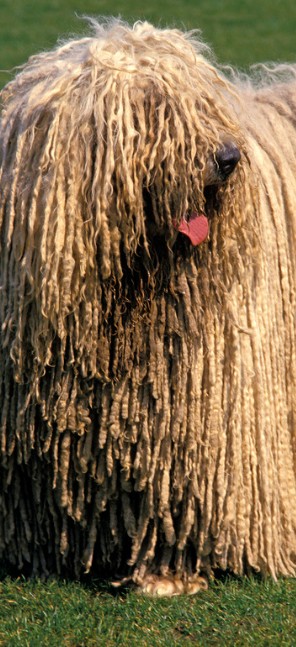
Cord formation is guided, not automatic. Left completely alone, a Komondor’s coat would mat into large, uncomfortable plates rather than the distinct rope-like cords that define the breed. During the transitional period, you’ll need to separate the forming cords by hand — gently pulling apart clumps that want to mat together, defining individual cords, and preventing the skin-level matting that causes discomfort and skin problems.
Mature cords take years to fully develop. A Komondor’s coat continues developing until around age 2, and the cords continue lengthening throughout life. Mature show dogs may have cords reaching the ground. Even pet Komondors kept in shorter cords require ongoing maintenance to keep their coat healthy and comfortable.
Bathing: The Most Critical Maintenance Task
Bathing a Komondor requires significant time, specific technique, and complete commitment to thorough drying. Many coat and skin problems trace back to inadequate bathing and drying protocols.
Frequency depends on lifestyle and coat length. A Komondor with shorter cords who lives primarily indoors may need bathing only every few months. One with longer cords or more outdoor exposure may need more frequent bathing. Judge by smell and appearance — a healthy Komondor coat should smell like clean dog, not mildew or must.
Pre-bath preparation prevents problems. Before bathing, check the entire coat for mats at skin level. These won’t wash out and will only tighten when wet. Separate them by hand first. Check inside ears, between pads, and around sanitary areas where debris collects. Remove any foreign material from the cords — grass, sticks, burrs.
Pre-bath checklist:
- Check entire coat for mats at skin level — separate by hand
- Examine inside ears for debris or infection signs
- Check between paw pads for foreign material
- Inspect sanitary areas for soiling or matting
- Remove all debris from cords: grass, sticks, burrs, leaves
- Ensure adequate time available — bathing takes hours, not minutes
- Prepare high-velocity dryer and drying area
- Have diluted shampoo ready for cord penetration
Bathing technique matters tremendously. Use a diluted shampoo that penetrates the cords rather than sitting on the surface. Work the lather through each cord from skin to tip, squeezing rather than rubbing to avoid creating additional tangles. Rinse thoroughly — trapped shampoo residue irritates skin and attracts dirt. Repeat if necessary until the rinse water runs completely clear.
Drying is non-negotiable and time-intensive. This is where many owners create problems. A Komondor’s cords can take 24 hours or more to dry completely, even with assistance. Moisture trapped in the cords creates ideal conditions for mildew, bacterial growth, and skin infections. These problems cause discomfort that absolutely affects behavior and mood.
Critical drying requirements:
- Use high-velocity dryers designed for dogs — not human hair dryers
- Work systematically through the entire coat section by section
- Lift and separate cords to expose all surfaces to airflow
- Continue until cords feel dry at the skin level, not just surface
- Allow 24+ hours for complete drying of long cords
- Supervised outdoor sun-drying helps but isn’t sufficient alone
- Never leave a damp Komondor in humid, poorly ventilated spaces
- Check cords at skin level the following day to confirm dryness
Use high-velocity dryers designed for dogs — regular human hair dryers don’t move enough air and can overheat. Work systematically through the coat, lifting and separating cords to expose all surfaces to airflow. In warm weather, supervised outdoor drying in sun and breeze helps, but isn’t sufficient alone. Never allow a damp Komondor to remain in humid, poorly ventilated conditions.
Between-Bath Maintenance
Regular maintenance between baths keeps the coat healthy and prevents problems from developing.
Weekly maintenance checklist:
- Separate cords that are joining together at skin level
- Check friction areas: behind ears, under legs, collar area
- Remove debris collected in cords during outdoor time
- Part cords to examine skin condition in several areas
- Feel along skin level for lumps, bumps, or tender spots
- Check ears for wax buildup, odor, or redness
- Trim sanitary areas if needed for hygiene
- Assess overall coat smell — mustiness indicates problems
Cord separation requires ongoing attention. Check the coat regularly for cords that are joining together or matting at the skin. Separate these by hand before they become problematic. Pay particular attention to areas where friction occurs — behind ears, under legs, around the collar area.
Debris removal happens constantly. After outdoor time, run your hands through the cords to check for collected materials. Grass, leaves, twigs, and other debris should be removed promptly before they work their way deeper into the coat or create mats.
Spot cleaning addresses localized issues. When your Komondor gets dirty in a specific area — muddy paws, soiled sanitary area — you can clean locally without full bathing. Use diluted shampoo, rinse thoroughly, and dry completely just as you would for a full bath.
Skin checks require intentional effort. The corded coat hides the skin completely. Regular parting of cords to examine skin condition catches problems early. Look for redness, irritation, hot spots, parasites, or unusual changes. Run your hands along the skin level feeling for lumps, bumps, or tender areas.
Recognizing Coat-Related Discomfort
Because the coat hides so much, recognizing signs of coat-related discomfort helps you catch problems before they significantly impact your Komondor’s well-being and behavior.
Signs of coat-related discomfort:
- Persistent scratching or chewing at specific areas
- Sudden reluctance to be touched in previously tolerated locations
- Musty or mildew odor indicating moisture problems
- Visible skin redness when cords are parted
- Behavior changes: irritability, restlessness, reluctance to settle
- Excessive head shaking (may indicate ear problems)
- Changes in movement patterns or reluctance to lie down
- Hot spots or wet areas when running hands through coat
- Scooting or attention to sanitary area
Scratching and chewing at specific areas suggests localized discomfort. While some scratching is normal, persistent attention to one area often indicates skin irritation, parasites, or mat pain beneath the cords.
Reluctance to be touched in certain locations can indicate hidden problems. If your Komondor suddenly objects to handling in an area they previously tolerated, investigate beneath the cords for mats pulling on skin, skin infections, or injuries.
Musty odor indicates moisture problems. A Komondor who smells mildewed has coat problems requiring immediate attention. This smell indicates bacterial or fungal growth occurring against the skin — uncomfortable for the dog and damaging to skin health.
Changes in behavior may trace to coat discomfort. Irritability, restlessness, reluctance to settle, or changes in movement patterns sometimes stem from chronic coat-related discomfort. When behavior changes, always rule out physical causes including coat problems before assuming the issue is psychological.
The Invisible Leash philosophy reminds us that awareness guides the path — including awareness of our dog’s physical comfort. A well-maintained coat supports the calm, confident demeanor that defines a well-adjusted Komondor. A neglected coat creates chronic discomfort that erodes emotional stability over time. 🧡
Lifestyle and Environmental Needs
Creating the Optimal Home Environment
Your Komondor’s living environment profoundly influences their well-being and behavior. Thoughtful environmental management prevents problems before they develop.
Elements of an optimal Komondor home environment:
- Secure, appropriately fenced yard for patrol behavior
- Elevated observation points: deck, hill, or raised platform
- Multiple rest areas throughout the home for strategic positioning
- Predictable daily routines: feeding, walks, rest periods
- Calm household atmosphere without excessive chaos
- Established visitor protocols everyone follows consistently
- Appropriate climate control for coat comfort
- Quiet retreat space when the dog needs recovery time
Secure, appropriate outdoor space matters enormously. A securely fenced yard that allows patrol behavior satisfies deep instinctual needs. Elevated observation points — a deck, a hill, or even a raised platform — let your Komondor fulfill their guardian drive to survey their territory.
Multiple rest areas support strategic positioning. Rather than designating one dog bed in one location, provide comfortable resting spots in several areas. This allows your Komondor to position themselves according to their assessment of where monitoring is needed.
Predictable household rhythms reduce chronic stress. Consistent wake times, meal times, activity patterns, and rest periods create the security that allows your Komondor’s nervous system to relax. Chaos and unpredictability create chronic low-level stress that erodes well-being over time.
Visitor management protocols prevent defensive escalation. Establish clear routines for how guests are introduced. This might include putting your Komondor in a secure area before guests arrive, allowing them to observe from distance initially, and only facilitating closer interaction when they indicate readiness. Predictable protocols reduce defensive responses.
Exercise and Stimulation Needs
Balancing your Komondor’s exercise needs requires understanding that more isn’t always better.
Moderate, purposeful activity suits their temperament. Unlike high-energy breeds that require intense daily exercise, Komondors generally prefer moderate activity with clear purpose. Patrol walks of their territory often satisfy better than meaningless jogging.
Mental stimulation through guardian work fulfills deeply. Rather than puzzle toys designed for different temperaments, consider how you might engage your Komondor’s natural drives. Giving them something or someone to watch over, establishing patrol routines, or providing structured observation opportunities all engage their guardian intelligence.
Mental stimulation activities suited to guardian temperament:
- Structured patrol walks with purpose and routine
- Observation post time: supervised yard monitoring
- “Watch” commands giving responsibility for specific objects or areas
- Accompanying you during property maintenance or chores
- Controlled exposure to novel situations for assessment practice
- Scent work activities that engage investigative instincts
- Calm, purposeful walks in varied environments
- Training sessions focused on impulse control and settling
Avoid overstimulation through excessive activity. More exercise can actually increase arousal and reactivity in guardian breeds. If your Komondor seems worse behaved after intense activity, you may be overstimulating rather than satisfying them.
Climate Considerations
The Komondor’s distinctive coat creates specific climate needs.
Heat management requires attention. That heavy corded coat provides excellent insulation — in both directions. In warm climates or during summer months, ensure your Komondor has access to shade, cool surfaces, and fresh water. Avoid activity during high temperatures.
Cold weather generally suits them well. Their Hungarian heritage adapted them to cold winters, and most Komondors handle low temperatures comfortably. However, wet, cold conditions can create problems if their coat doesn’t dry properly.
Coat care affects temperature regulation. A well-maintained coat insulates properly. A matted, dirty, or damaged coat can actually trap heat or moisture, creating discomfort regardless of ambient temperature.
Seasonal Behavior Variations
Many Komondor owners notice behavioral changes across seasons that, once understood, become predictable patterns rather than puzzling shifts. Recognizing these variations helps you distinguish normal seasonal adjustments from concerning behavioral changes.
Darker months often intensify vigilance. As daylight decreases in autumn and winter, many Komondors show heightened alertness. This makes evolutionary sense — their ancestors faced increased predator activity during longer nights. You might notice more alert barking at evening sounds, increased patrol behavior, or difficulty settling during dark hours. These patterns typically resolve as daylight increases in spring.
Supporting your Komondor through darker months involves ensuring adequate rest during daylight hours, maintaining calm evening routines, and potentially providing strategic lighting that reduces the contrast between indoor and outdoor darkness. Some owners find that keeping curtains closed during darkness reduces startle responses to movement outside.
Summer heat affects energy and mood. That magnificent coat that protects against Hungarian winters creates real challenges in warm weather. Your Komondor may become more sedentary during heat, preferring to rest in the coolest available location rather than engage in activity. Some dogs show irritability when warm — shorter tolerance for interaction, quicker startle responses, less patience with environmental challenges.
Summer heat management strategies:
- Limit activity to cool morning and evening hours only
- Ensure constant access to fresh, cool water
- Provide shaded outdoor areas and cool indoor retreats
- Consider elevated beds allowing air circulation beneath
- Never leave in vehicles or enclosed sun-exposed spaces
- Watch for heat stress: excessive panting, drooling, lethargy
- Adjust expectations — reduced activity is appropriate
- Consider cooling mats or wet towels on very hot days
- Schedule grooming to ensure coat isn’t trapping excess heat
Summer management includes limiting activity to cool morning and evening hours, ensuring constant access to fresh water and shade, providing cooling options like elevated beds that allow air circulation, and never leaving your Komondor in vehicles or enclosed spaces. Watch for signs of heat stress including excessive panting, drooling, or lethargy, and adjust expectations for summer activity accordingly.
Weather changes can trigger sensitivity. Many dogs respond to barometric pressure changes, and Komondors are no exception. Some owners notice increased restlessness or alertness before storms, changes in appetite during weather fronts, or altered sleep patterns during pressure shifts. While you can’t control the weather, recognizing these patterns helps you provide additional support during sensitive periods.
Spring shedding affects coat management. While Komondors don’t shed conventionally, they do release undercoat seasonally. Spring often brings increased loose hair within the cords that requires more frequent maintenance. This shedding period can cause itchiness that affects mood and comfort. Increased grooming attention during this period supports both coat health and emotional well-being.
Seasonal activity patterns mirror ancestral rhythms. You might notice your Komondor naturally becomes more active in cooler weather, more interested in patrol behavior during autumn’s longer twilight periods, more inclined to rest and conserve energy during summer heat. These patterns reflect their heritage rather than indicating problems. Working with these natural rhythms rather than against them supports your dog’s well-being.
Understanding seasonal variations helps you plan appropriately — scheduling veterinary visits, major household changes, or challenging activities during seasons when your Komondor is naturally most stable, while providing extra support during their more challenging seasonal periods. 🐾
Living with Multiple Animals
Komondors and Other Dogs
Introducing and maintaining peaceful multi-dog households requires understanding Komondor social style.
Keys to successful multi-dog households with Komondors:
- Consider opposite-sex pairings — same-sex often creates tension
- Never rush introductions — take days or weeks, not hours
- Use parallel walking at distance before face-to-face meetings
- Feed dogs separately to prevent resource competition
- Provide multiple water sources throughout the home
- Ensure each dog has their own resting areas
- Supervise interactions until relationship patterns are established
- Accept that peaceful coexistence may be the goal, not friendship
- Recognize individual variation — some Komondors tolerate others better
Same-sex pairings often create more tension. Many Komondors, particularly males, have lower tolerance for same-sex companions. Opposite-sex pairings frequently work better, though individual variation exists.
Slow introductions prevent defensive responses. Never rush introductions between your Komondor and new dogs. Extended parallel walking, gradual reduction of distance over days or weeks, and careful reading of body language help establish positive associations.
Resource management prevents conflict. Feed dogs separately, provide multiple water sources, and ensure each dog has access to their own resting areas. Resource competition triggers guardian instincts that can escalate to conflict.
Recognize their social selectivity. Your Komondor may never become best friends with other dogs, and that’s okay. Peaceful coexistence with respectful distance may be the appropriate goal rather than enthusiastic friendship.
Komondors and Other Household Animals
The guardian instinct that makes Komondors protective of their charges can extend to other household animals under the right conditions.
Early exposure supports acceptance. Komondors raised with cats, livestock, or other animals from puppyhood typically incorporate them into their “flock” — the group they protect rather than guard against.
Adult introductions require careful management. Bringing new animals into an established Komondor’s territory requires patience and thoughtful protocols. The Komondor needs time to reclassify the newcomer from “intruder” to “charge.”
Prey drive varies individually. While Komondors weren’t bred as hunting dogs, individual prey drive varies. Some individuals may never be safe with small animals, while others readily accept them as family members.
Senior Komondor Care
Aging Gracefully with Your Guardian
As your Komondor ages, their needs shift in ways that require adaptation.
Senior Komondor accommodations:
- Orthopedic beds supporting aging joints
- Ramps instead of stairs for easier navigation
- Raised food and water bowls reducing neck strain
- Non-slip flooring or rugs preventing falls
- More frequent, shorter walks rather than long outings
- Climate control accommodating reduced temperature regulation
- Regular veterinary monitoring for age-related conditions
- Patience with cognitive changes and confusion
- Adjusted grooming to accommodate reduced tolerance for handling
- Continued routine and predictability for emotional security
Physical comfort becomes paramount. Orthopedic beds, ramps instead of stairs, raised food and water bowls, and non-slip flooring help aging bodies navigate daily life without pain.
Cognitive changes may emerge. Senior dogs can develop cognitive dysfunction similar to human dementia. Signs include confusion, altered sleep-wake cycles, changes in social interaction, and house soiling. Veterinary consultation and management strategies can help maintain quality of life.
Guardian instincts may intensify or diminish. Some senior Komondors become more vigilant as their senses decline, compensating for reduced input with increased alertness. Others gradually relax their guardian duties. Either pattern is normal.
Patience and accommodation replace expectations. Your senior Komondor has earned your patience. Accommodate their changing needs with grace, adjusting routines and expectations to support their comfort and dignity.
Moments of Soul Recall reveal how memory and emotion intertwine in behavior — your senior Komondor remembers a lifetime of partnership with you, and that history deserves honor. 🧡
Is This Breed Right for You?
Honest Questions for Prospective Owners
Before welcoming a Komondor into your life, honest self-assessment serves everyone’s interests.
Questions to ask yourself before getting a Komondor:
- Do I have a securely fenced yard for patrol and observation?
- Can I provide the calm, predictable environment they need?
- Am I comfortable with dignified reserve rather than constant affection?
- Can I commit to significant ongoing coat maintenance?
- Do I understand respect-based handling versus control-based training?
- Can I manage their guardian instincts around visitors and strangers?
- Am I prepared for a 10-12 year commitment to this unique breed?
- Do I have experience with independent, thinking breeds?
- Can I afford potential health care for a large breed dog?
- Is my household stable enough to provide consistent routines?
Do you have appropriate space? Komondors need secure, fenced outdoor areas where they can patrol and observe. Small apartments or homes without yards create chronic frustration for guardian breeds.
Can you provide predictability? Chaotic, unpredictable households with constant visitors, variable schedules, and high noise levels conflict with what Komondors need to thrive. They do best with calm, consistent routines.
Are you prepared for their social style? If you want a dog who greets everyone enthusiastically, loves dog parks, and enjoys constant physical affection, the Komondor’s dignified reserve may disappoint you. They offer deep loyalty expressed through quiet presence, not exuberant demonstration.
Can you commit to their coat care? The corded coat requires significant maintenance. Are you prepared to invest the time, or to pay professional groomers who understand the breed’s needs?
Do you understand respect-based handling? If your training philosophy centers on control, dominance, or immediate obedience, you’ll find the Komondor frustrating and may damage both the dog and your relationship. They require partnership, not subordination.
The Rewards of Understanding
For those who can meet their needs, Komondors offer profound rewards.
Rewards of life with a well-matched Komondor:
- Deep, unwavering loyalty that develops over time
- Reliable guardian presence providing genuine security
- Calm, dignified companionship without demanding neediness
- Partnership with a thinking, decision-making dog
- Growth in your own observation and communication skills
- Connection to centuries of guardian dog heritage
- Pride in maintaining a rare and remarkable breed
- Profound bond built on mutual respect rather than obedience
- Quiet presence that enriches rather than disrupts daily life
Deep, unwavering loyalty develops over time. The bond that forms with a Komondor may develop more slowly than with eager-to-please breeds, but it runs deeper. They commit completely to their family.
Reliable guardian presence provides genuine security. A well-raised Komondor provides not just the feeling of safety but actual deterrent presence. Their assessment skills mean they distinguish genuine concerns from background noise.
Calm companionship suits certain lifestyles perfectly. If you appreciate quiet presence rather than constant interaction, dignified reserve rather than demanding attention, the Komondor’s company feels like perfect fit.
Partnering with intelligence engages your own growth. Living with a thinking dog who makes real decisions challenges you to become more observant, more patient, and more skilled in nonverbal communication.
Final Thoughts: The Partnership Path
Living successfully with a Komondor requires releasing expectations formed by companion breed experiences and embracing something different — a partnership with a capable guardian who brings their own expertise to your relationship.
Key principles for Komondor partnership:
- Respect their need for appropriate social distance
- Provide predictable environments and consistent routines
- Honor their assessment process rather than demanding instant compliance
- Appreciate quiet loyalty expressed through presence, not performance
- Acknowledge their guardian competence and instincts
- Use respect-based handling rather than control-based training
- Maintain their magnificent coat for physical and emotional comfort
- Understand that trust, once earned, runs deeper than obedience
When you respect their need for appropriate distance, provide predictable environments that allow their nervous systems to relax, honor their assessment process rather than demanding immediate compliance, and appreciate the quiet loyalty they offer, something remarkable develops. The Komondor who might have seemed aloof transforms into a devoted partner whose trust you’ve earned through consistent respect.
This isn’t the relationship built on eager obedience and constant interaction that many dog owners expect. It’s something rarer and, for the right person, more profound — a partnership between species based on mutual respect, clear communication, and honored expertise.
Your Komondor was bred to make decisions, to assess threats, to protect what matters without constant direction. When you work with that heritage rather than against it, when you provide direction without micromanagement and trust without domination, you discover the guardian partnership that has connected humans and Komondors for centuries.
That balance between science and soul — between understanding their neurobiological needs and honoring their emotional intelligence — that’s the essence of Zoeta Dogsoul. And when you achieve that balance with your Komondor, you’ll understand why this rare breed has inspired such devotion in those who truly know them. 😊










