
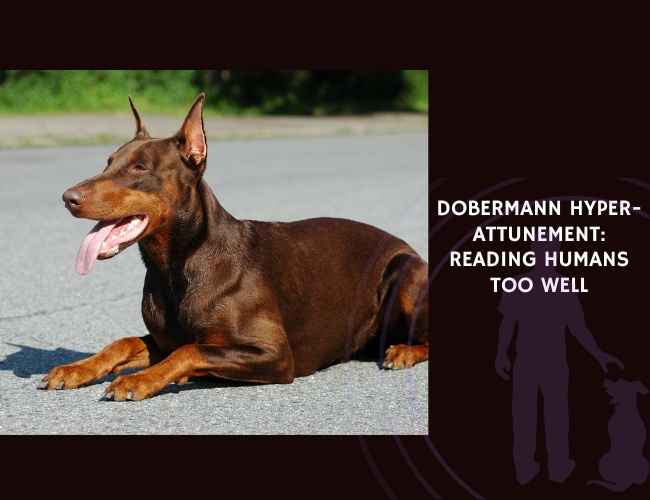
If you share your life with a Dobermann, you have probably experienced moments that feel almost telepathic. Your dog shifts position before you stand. They tense before you even register your own anxiety. They seem to know what you are feeling before you do.
This is not imagination. This is hyper-attunement, and understanding it might be one of the most important things you do for your Dobermann’s wellbeing. What makes Dobermanns different is not just their intelligence or loyalty—it is their extraordinary capacity to read human emotional states with precision that borders on the uncanny.
They track micro-signals most dogs miss: the subtle tightening of your jaw, the barely perceptible change in your breathing, the micro-second hesitation in your step. This heightened sensitivity creates bonds of remarkable depth, but it also carries hidden costs that many owners never recognize until behaviour problems emerge. Let us explore what happens when a dog reads humans too well, why Dobermanns developed this trait, and how you can help your sensitive companion navigate emotional complexity without becoming overwhelmed. 🧠
The Origins of Hyper-Attunement: Bred to Read You
How History Shaped Hypersensitivity
The Dobermann did not evolve naturally. This breed was engineered with specific purpose by Karl Friedrich Louis Dobermann in late 19th-century Germany. As a tax collector navigating dangerous neighbourhoods, Dobermann needed a companion who could anticipate threats, coordinate seamlessly with his movements, and distinguish between genuine danger and everyday encounters.
Think about what this required. Unlike livestock guardian breeds that work independently across vast territories, the Dobermann was designed to operate within arm’s reach of their human. Success meant constant monitoring: watching posture shifts, tracking gaze direction, interpreting vocal tones, and most importantly, reading emotional states to calibrate protective responses appropriately.
This human-centric design created selective pressure for dogs who prioritized human signals above all else. A Dobermann who missed subtle cues about their handler’s confidence or vulnerability would fail at their primary job. Over generations, this bred dogs with an almost compulsive focus on human emotional landscapes.
The Bodyguard’s Burden: What Protection Work Requires
When you select for bodyguard-style presence, you inadvertently select for sensitivity. Effective protection requires more than physical capability—it demands a sophisticated reading of human emotional states.
Here is what successful protection work requires:
- Anticipation: Reading shifts in your posture and muscle tension before threats materialize
- Coordination: Processing your signals rapidly enough to move with you, not after you
- Emotional Calibration: Gauging your internal state to know when to deter and when to engage
- Threat Assessment: Using your reactions as primary data for interpreting ambiguous situations
This constant vigilance became hardwired. The Dobermann who could detect a handler’s rising anxiety and position themselves protectively was more successful than one who waited for explicit commands. The result? Modern Dobermanns carry genetic predisposition toward what we might call “emotional hypervigilance”—a heightened baseline sensitivity to human micro-signals that never fully turns off.
You might notice this in everyday moments. Your Dobermann often reacts to changes you have not consciously registered yet. They seem to know you are leaving before you reach for your keys. They become alert when you feel uncertain, even if your face remains neutral. This is not magic—this is generations of selective breeding creating a dog whose survival strategy centres on reading you with extraordinary precision. 🧡
Do Dobermanns Prioritise Human Signals Over Canine Social Cues?
The evidence suggests yes. Dobermanns often exhibit profound focus on their human companions, sometimes to the exclusion of canine social interactions. While direct genetic markers are not yet fully identified, behavioural patterns strongly support this predisposition.
Several factors contribute to this human-centric focus:
- Early Socialization: Raised in close human environments and trained for human-directed tasks
- Reinforcement History: Human signals consistently predict outcomes (food, praise, activity, safety)
- Evolutionary Niche: Their role as personal protectors means human signals are paramount
- Decision-Making Hierarchy: In situations of ambiguity, the human’s state often takes precedence
This does not mean they ignore canine cues entirely. Rather, when conflict arises between canine social signals and human emotional states, the Dobermann’s attention typically defaults to their human. This aligns with social referencing theory, where the Dobermann uses human reactions as primary data for interpreting the world around them.
Understanding Emotional Scanning: The Invisible Work Your Dobermann Does
The Constant Monitor
While you go about your day, your Dobermann is working. They track your breathing patterns, monitor your gait, scan your facial micro-expressions, and analyse your vocal tones. This continuous emotional scanning operates mostly below your awareness, but it represents significant cognitive labour for your dog.
Most dogs notice obvious cues: raised voices, dramatic gestures, clear excitement. Dobermanns notice the micro-signals others miss. They detect the quarter-second pause before you speak, the slight tension in your shoulders, the barely detectable shift in your breath rhythm. They build internal models of your “normal” baseline and immediately flag deviations.
This extraordinary capacity likely stems from several mechanisms working together:
- Visual Focus: Intense gaze and maintained eye contact allows detection of minute facial movements
- Auditory Sensitivity: Keen hearing discerns subtle vocal changes, throat tightening, speech pauses
- Pattern Recognition: Thousands of interactions create sophisticated predictive models of your behaviour
- Olfactory Input: Changes in your scent chemistry during emotional shifts may contribute to assessment
The sophistication of this scanning system means your Dobermann often knows you are stressed before you consciously acknowledge it yourself. 🧠
The Speed of Response: Split-Second Emotional Contagion
What truly distinguishes Dobermann hyper-attunement is not just accuracy but speed. Where other guardian breeds might take several seconds to register and respond to your emotional shift, Dobermanns often react almost instantaneously. You feel a flutter of anxiety, and before you consciously process it, your dog is beside you, alert and scanning.
This rapid response served their historical protection role brilliantly. Split-second reactions could mean the difference between safety and danger. But in modern life, this same speed creates vulnerability to emotional contagion.
Consider how this plays out:
- Your momentary stress becomes their sustained alertness
- Your brief uncertainty triggers their protective positioning
- Your passing frustration shifts their entire nervous system toward vigilance
- Your micro-moment of fear amplifies into their threat assessment
The challenge is that constant emotional scanning carries cognitive costs. Imagine trying to concentrate on a complex task while simultaneously monitoring someone else’s emotional state every moment. The mental energy required is substantial. For Dobermanns, this scanning rarely stops, creating chronic low-level cognitive load that accumulates over time.
When Attunement Becomes Overload: The Hidden Costs
Cognitive and Emotional Exhaustion
The same sensitivity that makes Dobermanns such remarkable companions can become a source of chronic stress. Constant emotional scanning creates what researchers call “cognitive overload”—a state where the brain’s processing capacity is persistently taxed without adequate recovery periods.
You might observe this as:
- Difficulty Settling: Your Dobermann struggles to relax even in safe, familiar environments
- Hypervigilance: Constant monitoring of doors, windows, sounds, and movement patterns
- Startle Responses: Overreactions to minor environmental changes or sudden stimuli
- Restless Sleep: Frequent waking, position changes, or inability to reach deep sleep states
- Physical Tension: Persistent muscle tightness, particularly in neck, shoulders, and hindquarters
This is not simply an “alert” dog. This is a dog whose nervous system never fully downregulates. Their brain remains in a heightened processing state, continuously scanning for micro-signals that might indicate changes in safety, status, or required action.
The Burden of Emotional Over-Responsibility
Perhaps the most challenging aspect of Dobermann hyper-attunement is the development of what we call “emotional over-responsibility.” When your dog reads you too well, they may begin to feel accountable for your emotional state. This manifests as attempts to manage, fix, or protect you from your own feelings.
Signs your Dobermann may be carrying emotional over-responsibility:
- Anxious Proximity: Following you from room to room, unable to relax unless physically close
- Intervention Behaviours: Inserting themselves between you and perceived stressors
- Escalation Matching: Their arousal level mirrors and amplifies yours
- Protective Positioning: Constant scanning and body-blocking when you show uncertainty
- Refusal to Disengage: Inability to “switch off” even when you are calm and settled
This burden is exhausting. Your Dobermann was not designed to be your emotional regulator or therapist. When they assume this role, the weight of responsibility creates chronic stress that affects their physical health, behaviour, and quality of life. 🧡

Limbic Resonance: When Emotions Fuse
Dobermanns demonstrate profound limbic resonance—the direct mirroring and amplification of emotional states between bonded individuals. This neurological phenomenon explains why your anxiety becomes their anxiety, your tension becomes their tension. Their intense bond makes them highly susceptible to emotional contagion.
When limbic resonance is balanced, it facilitates beautiful co-regulation. You remain calm, your Dobermann settles. You project confidence, they relax into trust. But when human emotional states are inconsistent, anxious, or unresolved, limbic resonance becomes problematic.
The risk is emotional fusion—a state where boundaries between your emotional experience and your dog’s emotional experience blur. Your Dobermann no longer responds to your emotional state; they become your emotional state. This is particularly dangerous because it means your internal struggles directly translate into your dog’s chronic stress, even when no external threat exists.
Misreading the Signals: When Hyper-Attunement Goes Wrong
The Problem of Over-Interpretation
Dobermanns do not just read signals accurately—they read signals constantly. This creates a significant risk: over-interpretation. Your dog may assign meaning to neutral behaviours, reading threat or significance into ordinary moments.
Common patterns of over-interpretation include:
- False Positives: Treating normal visitor behaviour as threatening based on your micro-tension
- Amplified Responses: Reacting to your mild concern as if it signals immediate danger
- Misplaced Protection: Guarding you from situations you are managing comfortably
- Social Misreads: Interpreting friendly human interactions as conflicts requiring intervention
This over-interpretation stems from their hyperactive pattern-recognition systems. They are so attuned to deviations from your baseline that they sometimes create correlations that do not exist. A momentary stiffening when someone approaches becomes data that “this person is a threat.” A brief hesitation before greeting becomes evidence that “greetings are dangerous.”
Cognitive Bias Under Stress: The Pessimistic Lens
Under chronic stress, Dobermanns develop cognitive biases that skew their threat assessment toward the negative. This is a well-documented phenomenon in affective neuroscience—when the fear system is chronically activated, neutral stimuli are interpreted more pessimistically.
For your hyper-attuned Dobermann, this means:
- Ambiguous situations are assumed dangerous until proven safe
- Neutral body language from strangers is read as threatening
- Novel stimuli trigger defensive rather than exploratory responses
- Social interactions require higher evidence thresholds to be deemed safe
This pessimistic cognitive lens makes the world feel dangerous. Your Dobermann’s hyper-attunement, combined with chronic stress, creates a feedback loop where they scan for threats, find them everywhere (because stress biases interpretation), which increases their scanning intensity, which increases stress. 🧠
Perceptive. Sensitive. Overwhelmed.
They don’t just sense you — they scan you.
A Dobermann doesn’t wait for commands; they read your posture, breath, and even emotional hesitation before you notice it yourself.
Their strength is their burden.
What once made them exceptional guardians now makes them emotionally exposed in modern life. When your internal state fluctuates, their nervous system activates, mirroring your tension before you speak or move.



Leadership isn’t control — it’s emotional clarity.
A Dobermann doesn’t need louder commands or stricter discipline — they need steadier energy. Your calm is their anchor, your stability their structure.
Misdirected Protection: Reading Tension as Threat
One of the most challenging manifestations of hyper-attunement is misdirected protective behaviour. Your Dobermann reads your emotional tension as evidence of external threat, even when the tension is internal, unrelated, or about something entirely different.
Examples of misdirected protection:
- You are stressed about work, your dog becomes reactive toward visitors
- You feel socially awkward, your dog interprets this as threat and guards you aggressively
- You are having a tense conversation, your dog perceives the other person as attacking you
- You feel uncertain in a new environment, your dog escalates to defensive posturing
The problem is not that your Dobermann is trying to protect you—that is their nature. The problem is that they are using your emotional state as the primary data point for threat assessment, and human emotional states are notoriously unreliable indicators of actual danger in modern contexts.
The NeuroBond Approach: Recalibrating Hyper-Attunement
Clear Intent: Reducing the Need to Guess
Through the NeuroBond approach, we recognize that hyper-attuned dogs suffer most when they must constantly interpret ambiguous signals. When your intent is clear, your Dobermann does not need to “read” you—they can simply trust you. This reduces cognitive load dramatically.
Clear intent means:
- Decisive Movement: Walking with purpose, entering spaces confidently, moving without hesitation
- Explicit Communication: Using consistent markers for transitions, departures, and activities
- Predictable Patterns: Establishing routines that signal what comes next without requiring interpretation
- Congruent Messaging: Ensuring your body language, vocal tone, and actions align
When you develop clear intent, your Dobermann can relax their constant scanning. They do not need to guess whether you are leaving, whether someone is welcome, or whether a situation is safe. You communicate these things explicitly through your grounded presence.
Stable Body Language: Becoming the Emotional Anchor
Your Dobermann looks to you as the primary source of environmental information. When your body language is stable, calm, and confident, you provide an emotional anchor that allows them to regulate their own nervous system. This directly counteracts their tendency toward limbic resonance with anxiety.
Stable body language includes:
- Relaxed Shoulders: Dropping tension from your upper body signals safety
- Steady Breathing: Deep, regular breath patterns calm both you and your dog
- Grounded Stance: Weight evenly distributed, rooted posture rather than tense or fidgety
- Soft Eyes: Relaxed gaze rather than wide-eyed scanning or hard staring
- Flowing Movement: Smooth transitions rather than jerky, startled, or hesitant motion
This is not about suppressing your emotions. This is about developing enough somatic awareness to recognize when your body is sending alarm signals and consciously choosing to soften them. Your Dobermann’s nervous system will follow yours—make yours worth following. 🧡
Coherent Emotional Messaging: Eliminating Mixed Signals
Perhaps the most critical element of recalibrating Dobermann hyper-attunement is coherent emotional messaging. Mixed signals—saying “it’s okay” while feeling anxious, acting calm while internally panicking—are deeply stressful for hyper-attuned dogs. They trust their ability to read your micro-signals more than your words, and when these conflict, cognitive dissonance results.
Coherent emotional messaging requires:
- Internal-External Alignment: Your inner state matches your outer presentation
- Honest Acknowledgment: If you are nervous, be quietly nervous without pretending otherwise
- Managed Processing: Handling your emotions before interacting with your dog
- Authentic Calm: Developing genuine regulation rather than performed composure
Your Dobermann will respect authentic nervous calm far more than fabricated confidence. When your internal state, external behaviour, and verbal cues align, you reduce their cognitive load and build trust. They learn they do not need to “read between the lines” because your lines are clear.
Practical Management: Protecting Your Dobermann from Overload
Structured Neutrality Training: Learning to Disengage
One of the most valuable skills you can teach your hyper-attuned Dobermann is the ability to disengage from constant monitoring. This does not mean ignoring you—it means trusting that they do not need to scan you every moment for changes or threats.
Key elements of structured neutrality training:
- Place Command: Teaching your dog to settle on a designated mat or bed and remain there calmly
- Independent Occupy: Providing enrichment activities that absorb attention away from human monitoring
- Boundary Reinforcement: Rewarding your dog for maintaining physical distance while you move about
- Duration Building: Gradually extending the time your dog can remain settled while you are present
- Calm Transitions: Practising low-key departures and arrivals that do not trigger hypervigilance
The goal is teaching your Dobermann that they can be “off duty” while you are present. They learn that not everything you do requires their attention or response. This creates mental rest periods that are essential for preventing cognitive overload. 🧠
Environmental Design: Creating Predictable Safety
Your home environment either supports or undermines your Dobermann’s ability to regulate their nervous system. Thoughtful environmental design reduces ambiguity, which directly reduces the scanning behaviour that leads to chronic stress.
Essential environmental elements:
- Clear Thresholds: Gates or boundaries that define which spaces require monitoring and which are rest zones
- Designated Off-Duty Areas: A crate, bed, or quiet room where your dog knows they are not responsible for guarding
- Low-Chaos Rituals: Predictable, calm routines around high-arousal events like meals, departures, arrivals
- Controlled Social Exposure: Managed introductions to visitors with clear protocols your dog can predict
- Visual Barriers: Strategic use of baby gates, furniture, or visual blocks to reduce constant scanning of windows and doors
When your Dobermann knows which spaces are “theirs,” which situations follow predictable patterns, and when they are genuinely off-duty, their baseline stress decreases significantly. This is not about reducing their world—it is about making their world comprehensible.
Teaching True Relaxation: Beyond Physical Tiredness
Many Dobermann owners focus on physical exercise, believing a tired dog is a calm dog. But for hyper-attuned dogs, physical exhaustion without mental regulation simply creates a tired dog who still cannot relax. True relaxation requires nervous system downregulation, not just energy depletion.
Practices that support genuine relaxation:
- Massage and Touch: Slow, intentional physical contact that releases muscle tension
- Scent Work: Nose-based activities that engage the seeking system without triggering vigilance
- Settling Protocols: Capturing and rewarding moments of voluntary relaxation
- Meditation Walks: Slow, meandering walks focused on sniffing rather than destination
- Parallel Calm: Sitting quietly near your dog without interaction, modeling settled presence
These activities teach your Dobermann’s nervous system what safety feels like. Over time, they build capacity for genuine rest rather than just exhaustion-based collapse. This distinction matters enormously for long-term wellbeing.
The Invisible Leash: Leading Without Tension
Understanding Energy-Based Leadership
The Invisible Leash reminds us that the most powerful leadership happens through energy, not equipment. For your hyper-attuned Dobermann, what you project matters more than what you say or do. They are reading your energetic state constantly, using it as a compass for how to respond to the world.
When you lead with tension—tight leash, tight shoulders, tight breath—your Dobermann receives the message that the environment is dangerous. They escalate their vigilance to match yours. When you lead with grounded calm—relaxed grip, soft eyes, steady breath—you communicate safety. Your dog’s nervous system follows.
This is not about dominance or control. This is about becoming a reliable source of information about environmental safety. Your Dobermann trusts your assessment because you have proven yourself consistent, predictable, and emotionally stable. 🧡
Awareness Over Control: Shifting the Paradigm
Traditional training often focuses on control: teaching your dog to obey commands regardless of their internal state. For hyper-attuned Dobermanns, this approach often backfires. They comply outwardly while inwardly remaining in a state of hypervigilance, which compounds their stress.
The Invisible Leash shifts the focus to awareness—teaching your dog to be conscious of you without being controlled by you. This means:
- Voluntary Check-Ins: Rewarding your dog for choosing to look at you rather than demanding it
- Proximity by Choice: Allowing your dog to move through space while maintaining connection
- Emotional Availability: Being present and responsive when your dog seeks guidance
- Confident Navigation: Moving through the world with calm assurance your dog can follow
This approach transforms the dynamic from “dog monitors human for emotional state” to “dog trusts human to navigate safely.” The distinction is subtle but profound. Your Dobermann learns they can be attentive without being anxious, connected without being consumed.
Soul Recall: Healing Through Deep Relational Bonding
When Memory and Emotion Intertwine
For Dobermanns with challenging histories—rescue dogs, dogs from inconsistent backgrounds, or dogs who have experienced trauma—hyper-attunement often becomes entangled with emotional memory. They do not just read current signals; they layer them with past experiences, creating complex emotional responses that seem disproportionate to the present moment.
Soul Recall explores how emotional memory shapes behaviour. Your Dobermann may react intensely to a particular type of person, situation, or environmental cue because it resonates with stored emotional experience. Their hyper-attunement means these memories are vivid and easily triggered.
Healing requires:
- Patient Pattern Replacement: Gradually creating new emotional associations through consistent positive experiences
- Trauma-Informed Approach: Recognizing that some behaviours are protective mechanisms, not defiance
- Nervous System Support: Providing experiences that teach safety rather than just obedience
- Relational Security: Building attachment that is consistent enough to override old survival patterns
This work takes time. You are not just changing behaviour—you are helping your dog’s nervous system learn that the past does not dictate the present. 🧠
Building Secure Attachment Without Over-Dependence
The challenge with hyper-attuned Dobermanns is balancing deep connection with healthy independence. You want your dog to feel securely attached without becoming anxiously dependent. This balance is delicate but achievable.
Secure attachment looks like:
- Your dog is comfortable when you are present but does not panic when you leave
- They seek you for guidance in uncertain situations but can problem-solve independently
- They monitor you periodically rather than constantly
- They show joy at reunions without desperation or overwhelm
- They can relax in your presence without requiring physical contact
Over-dependence looks like:
- Panic or distress behaviours when you are out of sight
- Inability to settle unless in physical contact with you
- Following you obsessively from room to room
- Heightened anxiety during normal daily separations
- Inability to engage with enrichment activities when you are home
Building secure attachment without over-dependence requires you to be emotionally available while also encouraging independence. You are present, consistent, and responsive—but you also have clear boundaries and expectations that your dog can be comfortable in their own experience. 🧡
Living With Hyper-Attunement: The Daily Reality
Recognizing Your Dog’s Signals of Overload
Learning to recognize when your Dobermann is experiencing cognitive or emotional overload is essential for protecting their wellbeing. These signals often appear long before obvious behavioural problems emerge.
Early warning signs of overload:
- Displacement Behaviours: Excessive licking, yawning, or scratching when no physical cause exists
- Refusal to Settle: Repeated position changes, restless circling, inability to maintain relaxed posture
- Scanning Behaviour: Constant visual or auditory monitoring of environment, stiff body language
- Reactivity Increase: Lower threshold for barking, lunging, or defensive responses
- Attention Seeking: Persistent pawing, nosing, or demands for interaction
- Withdrawal: Unusual hiding, avoidance, or decreased interest in normal activities
When you notice these patterns, it is time to reduce stimulation, increase predictability, and provide opportunities for genuine nervous system downregulation. Ignoring these signals will lead to more serious behavioural manifestations.
The Owner’s Role in Co-Regulation
You cannot fix your Dobermann’s hyper-attunement, but you can profoundly influence how it manifests. Your own nervous system regulation becomes the foundation for your dog’s regulation. This is the essence of co-regulation—two nervous systems influencing each other toward either calm or escalation.
As a Dobermann owner, your responsibilities include:
- Personal Regulation: Developing your own capacity for calm, grounded presence
- Emotional Awareness: Recognizing when your internal state is bleeding into your dog’s experience
- Consistent Leadership: Providing clear, predictable guidance through transitions and challenges
- Boundary Maintenance: Teaching your dog they are not responsible for your emotional state
- Environmental Management: Creating spaces and routines that support nervous system health
This is not about being perfect. This is about being aware. When you notice your anxiety affecting your dog, you pause, breathe, and consciously regulate yourself before asking your dog to regulate. You become the stable point around which your dog’s nervous system can organize itself.
Celebrating the Gift While Managing the Challenge
Dobermann hyper-attunement is simultaneously a profound gift and a significant challenge. The depth of connection, the exquisite responsiveness, the almost magical sense of being truly understood—these are treasures that many dog owners never experience. Your Dobermann sees you in ways few creatures ever will.
But this gift requires stewardship. You must honour their sensitivity by protecting them from overload. You must appreciate their attunement while teaching them they do not need to carry your emotional world. You must celebrate the bond while maintaining the boundaries that keep it healthy.
When managed well, hyper-attunement becomes grounded responsiveness. Your Dobermann remains perceptive, attuned, and deeply connected—but not anxious, over-responsible, or chronically stressed. They read you well enough to be your partner, but not so intensely that they lose themselves in your emotional landscape. That balance between science and soul—that is the essence of Zoeta Dogsoul. 🧡
Conclusion: Transforming Sensitivity Into Strength
The Dobermann’s capacity to read humans with such precision is both their greatest strength and their greatest vulnerability. This hyper-attunement creates bonds of extraordinary depth, allows for communication that feels almost telepathic, and produces working partnerships of remarkable sophistication. But without understanding and management, this same sensitivity becomes a burden that your dog carries silently, manifesting as chronic stress, behavioural challenges, and diminished quality of life.
Understanding the mechanisms behind hyper-attunement—the evolutionary pressure that created it, the neurological systems that sustain it, the cognitive costs it imposes—empowers you to support your Dobermann effectively. You learn to recognize when their sensitivity is serving them versus when it is overwhelming them. You develop the skills to provide clear, coherent leadership that reduces their need to constantly scan and interpret. You create environments that allow genuine rest rather than requiring perpetual vigilance.
Most importantly, you learn that the goal is not to eliminate your Dobermann’s sensitivity. That sensitivity is core to who they are. The goal is recalibration—transforming hyper-attunement from a source of chronic stress into a foundation for grounded, balanced responsiveness. Your Dobermann remains perceptive, remains connected, remains the remarkable being they were bred to be—but without carrying the crushing weight of emotional over-responsibility.
This transformation requires intention, consistency, and compassion. It asks you to examine your own emotional patterns, to develop genuine regulation rather than performed calm, to lead with clarity rather than ambiguity. It asks you to honour your Dobermann’s sensitivity by protecting them from its costs while celebrating its gifts.
When you do this work, something remarkable emerges. Your hyper-attuned Dobermann becomes a partner of extraordinary capability—reading you accurately without anxiety, responding precisely without over-reaction, connecting deeply without fusion. They remain vigilant when needed but can fully relax when safe. They trust your leadership enough to release their sense of over-responsibility. They become what they were always meant to be: not your emotional regulator, not your anxious guardian, but your grounded, confident, deeply attuned companion.
That is the promise of understanding Dobermann hyper-attunement. Not a solution that erases who they are, but an approach that allows them to be fully themselves without being consumed by the very sensitivity that makes them extraordinary. 🧡










