
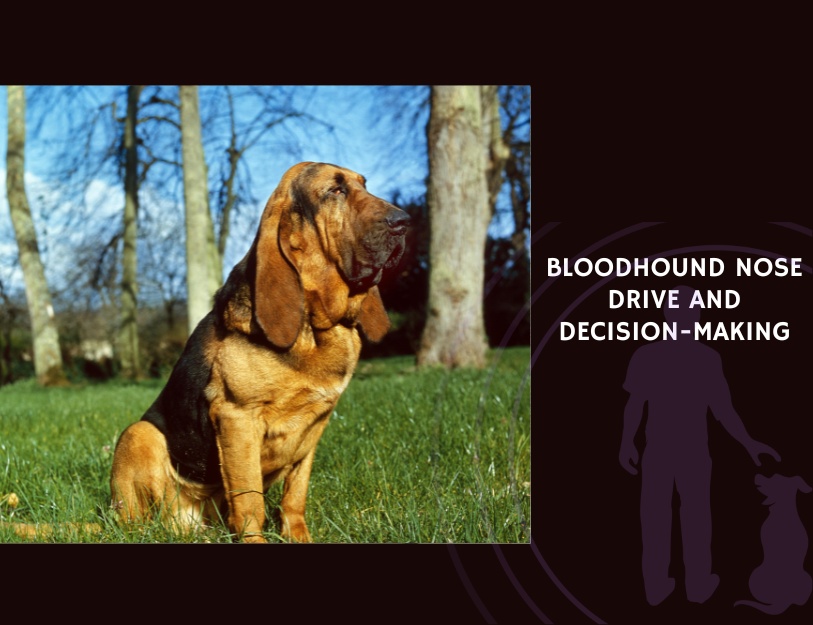
Introduction: A World Built From Scent
Imagine walking into a room where every conversation from the past week still hangs in the air—not as fading echoes, but as vivid, layered stories you can follow thread by thread. For a Bloodhound, this isn’t imagination. It’s Tuesday.
These remarkable dogs don’t just smell better than other breeds—they experience reality through an entirely different sensory lens. With up to 300 million scent receptors (compared to our modest 6 million), and olfactory bulbs that occupy a disproportionate amount of their brain space, Bloodhounds are living, breathing scent-processing machines. But this extraordinary gift comes with profound implications for their behavior, their relationship with handlers, and the very way they make decisions about the world around them.
When a Bloodhound locks onto a trail, something remarkable happens. The focused intensity, the unwavering commitment, the seeming imperviousness to calls, treats, or even physical discomfort—these aren’t signs of stubbornness or disobedience. They’re windows into a cognitive state so deeply immersed in olfactory pursuit that the rest of the world temporarily fades into background noise.
Understanding this phenomenon isn’t just academically interesting. For handlers working with these magnificent tracking dogs, for families sharing their homes with Bloodhounds, and for anyone fascinated by the outer limits of canine cognition, recognizing when and why “nose drive” overrides everything else becomes essential knowledge. Let us guide you through the fascinating neuroscience, the practical implications, and the profound beauty of a brain built primarily to follow invisible trails through time itself. 🧠
The Olfactory Architecture: Built Different From The Ground Up
A Nose That Rewrites The Rules
Your Bloodhound’s face tells the story before you even reach their brain. Those long, drooping ears? They’re not just adorable—they’re functional scent sweepers, wafting ground-level odor molecules upward toward that massive nose. The pendulous lips and abundant facial wrinkles? They trap and hold scent particles, creating a personal scent library that updates continuously as the dog moves.
But the real magic happens inside. A Bloodhound’s nasal cavity is a labyrinth of bony scrolls called turbinates, creating a surface area roughly the size of a handkerchief—exponentially more real estate for scent detection than you’d find in other breeds. As air flows through these passages, it follows two paths: one for breathing, one exclusively for analyzing scent.
Research using MRI imaging reveals that the olfactory bulbs in Bloodhounds occupy a significantly larger proportion of their brain compared to other breeds. This isn’t just about having more receptors—it’s about having more neural processing power dedicated to making sense of those scent signals. Think of it as the difference between having a larger hard drive and having a faster processor. Bloodhounds have both.
The Neural Highway: From Nose To Decision
When scent molecules bind to receptors in your Bloodhound’s nose, they trigger electrical signals that travel directly to the olfactory bulb. What happens next is where things get fascinating. Unlike other sensory information that must first route through the thalamus (the brain’s sensory relay station), olfactory information has a direct line to the limbic system—the emotional and memory centers of the brain.
This means scent doesn’t just inform your Bloodhound’s decisions. It shapes their emotional state, triggers memories, and activates reward pathways before conscious processing even occurs. The connection to the amygdala means scent instantly carries emotional weight. The link to the hippocampus means every smell is cross-referenced against every scent memory they’ve ever formed.
And here’s where it gets particularly relevant for understanding behavior: the olfactory system also connects directly to the ventral tegmental area, the origin of dopamine pathways. When your Bloodhound catches a promising scent, their brain doesn’t just register information—it floods with the same neurochemical reward associated with food, play, and social connection. The pursuit itself becomes intrinsically reinforcing. This is Panksepp’s SEEKING system in its purest form—the hunt for information becomes the reward. 🧡
Sensory Dominance: When Smell Drowns Out Everything Else
Most dogs navigate their world through a combination of senses—sight, sound, smell, and touch all contribute to their understanding of any given moment. Bloodhounds, however, demonstrate what neuroscientists call “sensory dominance.” When olfactory information is present and relevant, it doesn’t just influence their perception—it dominates it.
Think about how hard it is to have a conversation when you’re trying to solve a complex puzzle. Your auditory processing doesn’t stop working, but your brain allocates fewer resources to it. For Bloodhounds engaged in scent work, this resource allocation is extreme. Functional brain imaging studies suggest that when tracking, the regions dedicated to olfactory processing show significantly elevated activity while areas responsible for processing auditory and visual input show measurably reduced activation.
This isn’t willful ignorance or selective hearing. It’s neurological prioritization—the brain literally reducing the volume on other sensory channels to better process the overwhelming complexity of scent information. Your voice isn’t unheard; it’s simply competing with a sensory experience so rich and rewarding that everything else registers as static.
The Olfactory Flow State: When Focus Becomes Absolute
Defining The Tracking Trance
You’ve probably noticed it—the moment when your Bloodhound transitions from sniffing around to something else entirely. The body language shifts. The tail might still wag, but it’s different now: purposeful, rhythmic, almost mechanical. The head stays low, swinging methodically. The breathing changes, becoming more deliberate, with those characteristic snorting exhales that clear the nasal passages for the next deep inhalation.
This is what we might call the “olfactory flow state,” borrowing terminology from human psychology. In humans, flow describes a state of complete absorption in an activity—time distorts, self-consciousness disappears, and the activity itself becomes intrinsically rewarding. Athletes call it “being in the zone.” For Bloodhounds, scent pursuit can induce a remarkably similar state.
Research using wearable sensors on working Bloodhounds reveals distinct physiological signatures during intense tracking. Heart rate variability patterns shift toward what’s called “coherence”—a state associated with focused calm rather than anxious arousal. Respiratory rhythm becomes more regular and deliberate. Even skin conductance measurements suggest a particular kind of engaged arousal that’s distinct from stress or excitement.
In this state, your Bloodhound isn’t anxious or frantic—they’re deeply, utterly focused. Through the lens of NeuroBond understanding, this isn’t a state to interrupt or combat. It’s a state to recognize, respect, and eventually learn to work with. 🐾
The Neuroscience Behind The Immersion
What makes this flow state so powerful—and so difficult to interrupt—lies in how the brain manages attention under conditions of intense reward. When your Bloodhound is tracking, their dopaminergic reward pathways aren’t just active—they’re in a state of sustained activation that resembles nothing so much as a controlled addiction.
Each successful scent discrimination, each turn that proves correct, each moment when the trail strengthens delivers a small hit of dopamine. This creates what neuroscientists call a “variable ratio reinforcement schedule”—the most powerful form of reward conditioning known. Like a gambler at a slot machine, your Bloodhound never knows exactly when the next big payoff will come, which makes every sniff potentially rewarding.
But there’s more happening than just reward. Evidence suggests that during intense olfactory focus, Bloodhounds experience what’s termed “cognitive gating”—a temporary suppression of executive function in favor of pattern recognition and instinctive behavior. The prefrontal cortex, responsible for impulse control and decision-making, shows reduced influence. The basal ganglia, responsible for habitual and reward-driven behavior, takes over.
This explains something handlers often observe: a Bloodhound who responds perfectly to recall cues in everyday situations becomes seemingly deaf when on a hot trail. It’s not that they’re choosing to ignore you. Their brain has temporarily deprioritized the neural circuits responsible for processing and responding to social cues.
Physical Markers You Can Observe
Understanding the internal neuroscience helps, but you need practical indicators you can actually see. Here are the telltale signs that your Bloodhound has entered deep olfactory immersion:
Body Language Shifts:
- Head remains consistently low, often with the nose literally touching the ground
- Tail carriage changes to a more focused, purposeful position—neither playfully high nor fearfully tucked
- Ear position becomes less responsive to environmental sounds
- Body movement becomes more methodical, almost machine-like in its consistency
- Muscle tension visible in the neck and shoulders as they pull into the scent
Behavioral Indicators:
- Dramatically reduced response to previously reliable cues
- Decreased reaction to environmental distractions (other dogs, loud noises, food)
- Characteristic snorting exhales between deep inhalations
- Increased pulling intensity on the leash, often seeming unaware of physical discomfort
- Vocalization patterns may change—some Bloodhounds become completely silent; others bay with increasing frequency
The Handler Disconnect: Perhaps most striking is what handlers describe as the “look through” phenomenon. If you manage to get your Bloodhound’s head up and make eye contact, their gaze seems unfocused—they’re looking at you but not quite seeing you. The social connection that normally exists feels temporarily severed. This isn’t personal. It’s neurological.
Decision-Making During Scent Pursuit: Instinct Versus Intelligence
The Scent Puzzle: How Bloodhounds Solve Invisible Problems
When a Bloodhound works a trail, they’re solving a problem that would overwhelm most cognitive systems—tracking a single scent signature through an environment contaminated with thousands of competing odors, interpreting the age and direction of the scent, and making constant micro-decisions about whether they’re still on track.
What’s remarkable is how much of this appears to be pattern recognition rather than conscious problem-solving. When confronted with a scent pool (an area where scent has settled and mixed), experienced Bloodhounds will often execute what’s called a “cast”—a systematic search pattern that spirals outward from the last known good scent. This behavior appears largely instinctive; young Bloodhounds with minimal training will spontaneously perform variations of this search pattern.
Research into canine decision-making suggests that during tracking, Bloodhounds operate primarily through what neuroscientists call “System 1” thinking—fast, automatic, pattern-based processing. “System 2” thinking—slow, deliberate, effortful reasoning—seems largely offline during intense pursuit. This makes sense from an efficiency standpoint. Conscious deliberation takes time and energy. Pattern recognition is fast and energetically cheap.
But this has implications. It means your Bloodhound isn’t carefully weighing options when they’re tracking. They’re responding to patterns they’ve learned to recognize, driven by instinctive drives that have been selected for over centuries of breeding.

Conflicting Information: When Trails Cross
One of the most fascinating windows into Bloodhound cognition comes from observing how they handle conflicting scent information. When two trails intersect, or when an older trail overlaps a newer one, what determines which path they follow?
Studies using controlled scent trails reveal some consistent patterns. Bloodhounds show a strong bias toward scent intensity—they’ll typically follow the stronger scent even if it’s not the “correct” target trail. This makes evolutionary sense; a stronger scent likely indicates a more recent passage and is easier to follow. But it can also lead them astray if the target trail has degraded significantly.
Interestingly, handler cues can influence this decision point—but only if delivered at precisely the right moment. If you intervene too early, before your Bloodhound has fully processed the scent information, they’ll typically ignore you. Too late, after they’ve committed to a direction, and they’ve already entered that cognitive state where external input is gated out. There’s a narrow window where they’re still in what might be called “scent evaluation mode,” and that’s when communication has its best chance of being heard.
This connects directly to the Invisible Leash concept—the understanding that effective communication with a scent-driven dog isn’t about force or volume, but about timing, clarity, and working with their cognitive state rather than against it.
The Over-Pursuit Problem: When Drive Overrides Welfare
There’s a darker side to this intense drive. Bloodhounds can and will track beyond the point of physical exhaustion. They’ll work through injured pads, exhaustion, dehydration, and environmental hazards. The neurochemical reward of pursuit can override the body’s signals of distress.
Handlers report Bloodhounds continuing to track even when limping significantly, or working in extreme heat when other breeds would have shut down. This isn’t courage or determination in the human sense—it’s dopamine-driven persistence that overrides normal self-preservation instincts.
This is where handler awareness becomes critical. Your Bloodhound cannot always be trusted to make welfare-appropriate decisions when in deep pursuit. That responsibility falls to you. Recognizing the signs of transition from healthy focus to problematic over-pursuit requires careful attention:
- Panting becomes labored rather than just increased
- Gait changes subtly—they may still move forward, but with less smoothness
- Recovery time between scent checks lengthens
- They begin making uncharacteristic errors—missing obvious turns or backtracking more frequently
These signs suggest that physical fatigue is beginning to overwhelm even their extraordinary drive. That’s your signal to intervene, even if—especially if—they show no inclination to stop on their own. 🧡
The Handler-Bloodhound Dynamic: Communication Across Cognitive States
Why Traditional Recall Training Often Fails
If you’ve tried standard recall training with your Bloodhound and found it frustratingly inconsistent, you’re not alone. The methods that work beautifully with retrievers or herding breeds often produce disappointing results with Bloodhounds. Understanding why helps prevent the frustration that damages the human-dog bond.
Traditional recall training operates on a simple premise: build a reward history strong enough that the dog will reliably disengage from distractions and return when called. For most dogs, this works because the “distraction” involves sensory processing that shares neural resources with social processing. A dog chasing a squirrel can still hear you because visual pursuit and auditory processing don’t create the same resource competition.
Scent pursuit is different. As we’ve discussed, intense olfactory focus creates cognitive gating that literally reduces the brain’s capacity to process social cues. It’s not that your reward history isn’t strong enough—it’s that during deep tracking, your Bloodhound’s brain has temporarily deprioritized the very circuits that would allow them to process and respond to recall cues.
This doesn’t mean recall is impossible. It means it needs to be built differently—trained specifically in the context of graduated scent exposure, with an understanding that the goal isn’t creating a single reliable recall, but creating multiple context-specific recalls calibrated to different levels of olfactory engagement.
Building NeuroBond Communication: Working With The Nose, Not Against It
The NeuroBond framework offers a different approach—one that recognizes the Bloodhound’s olfactory dominance as a feature, not a bug. Rather than trying to override their scent drive through increasingly powerful rewards or corrections, we work to create communication channels that remain accessible even during moderate olfactory engagement.
This starts with understanding that communication with a tracking Bloodhound has to work through the modalities that remain online. Vision becomes less reliable because their head is down. Hearing is compromised by cognitive gating. But proprioception—physical sensation—remains accessible. Touch, pressure, and movement patterns can communicate when words cannot.
Consider how you might use leash pressure. Traditional corrections use sudden, sharp pressure—punishment meant to create discomfort that interrupts behavior. This rarely works well with tracking Bloodhounds and often damages trust. Instead, think in terms of rhythmic, gentle pressure—a pattern rather than a punishment. Some handlers develop a specific rhythm of three soft pulses that they pair extensively with rewards during low-distraction training. When that pattern appears during tracking, it doesn’t demand immediate compliance, but it does create a moment of slight disengagement—just enough to remind the dog that the handler exists and has input.
Similarly, voice cues can be rebuilt with acoustic properties that penetrate cognitive gating more effectively. Low-pitched, rhythmic vocalizations seem to maintain accessibility better than high-pitched or urgent calls. Some handlers develop a specific humming pattern or use of rhythmic breathing sounds that their dog learns to associate with handler check-ins.
The goal isn’t perfect obedience during tracking—that’s neurologically unrealistic. The goal is maintaining a thread of connection that prevents complete disengagement, creating moments where your Bloodhound’s awareness briefly expands to include you before narrowing again to the scent work. 🐾
Driven. Focused. Immersed.
Scent overrides everything.
When a Bloodhound locks onto an odor, their brain floods with dopamine, turning pursuit into its own reward and pushing all other stimuli—commands, comfort, even pain—into the background.
Biology fuels obsession.
With hundreds of millions of scent receptors and enlarged olfactory bulbs, their sensory world operates on a scale beyond human comprehension, where each molecule becomes a map of emotion and memory.
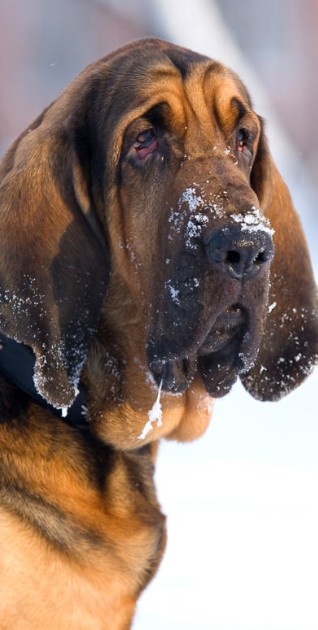
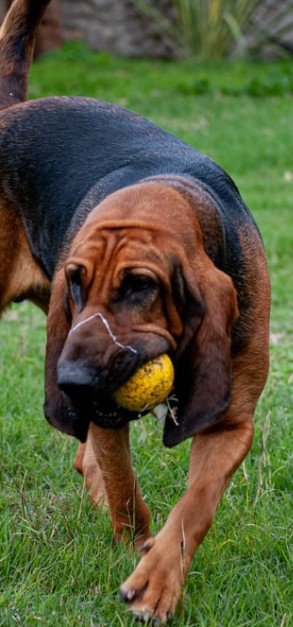
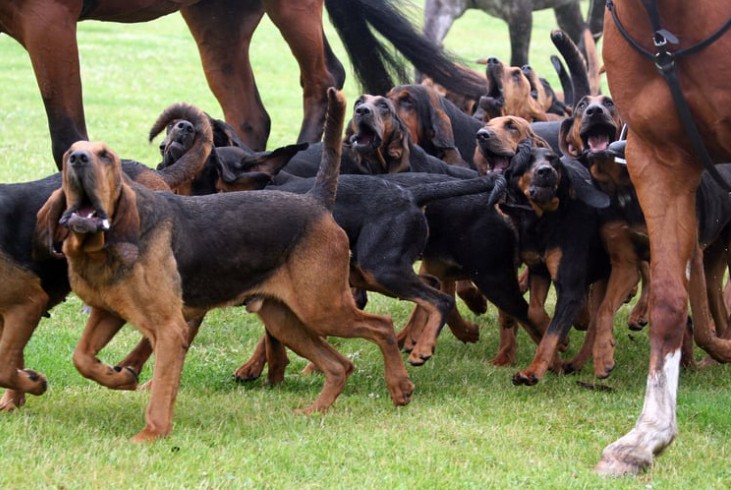
Connection requires respect.
Working with a Bloodhound means honoring the autonomy of their nose—guiding, not controlling—so partnership forms where instinct and intention move in harmony.
Calm-State Co-Regulation: The Recovery Phase
What happens after a tracking session is just as important as what happens during it. When your Bloodhound disengages from a trail—whether successfully or not—they don’t immediately return to baseline. The physiological arousal, the neurochemical activation, the cognitive patterns all need time to downregulate.
This is where calm-state co-regulation becomes essential. Your own physiological state directly influences your dog’s recovery. If you’re excited, frustrated, or amped up from the tracking session, your Bloodhound will struggle to downregulate. But if you can access genuine calm—slow breathing, relaxed body language, steady energy—you become a physiological anchor that helps their nervous system shift gears.
Practical recovery protocols might include:
Immediate Post-Track:
- Allow the dog to physically slow down gradually rather than stopping abruptly
- Use long, slow strokes along the body to encourage parasympathetic activation
- Maintain calm, quiet presence rather than enthusiastic praise (save that for later)
- Offer water in a way that encourages slow, deliberate drinking rather than frantic gulping
First 15 Minutes:
- Gentle walking without scent work
- Simple, well-known cues that rebuild handler connection
- Environmental transition—moving from the tracking environment to a more neutral space
- Physical contact that emphasizes security—steady contact rather than excited petting
30-60 Minutes Post-Track:
- This is when deeper rest can occur—some Bloodhounds will sleep deeply after intense tracking
- Monitor for signs of delayed stress (panting, restlessness, inability to settle)
- Maintain predictable, calm environment
- Consider whether the tracking session was within their capacity or pushed into over-pursuit territory
Understanding this recovery cycle respects the profound cognitive and physiological demands that scent work places on your Bloodhound. It’s not just a fun activity—it’s a state of consciousness that requires support both entering and exiting.
🧠 When The Nose Takes Control: Understanding Bloodhound Olfactory Dominance
Discover why your Bloodhound enters an altered cognitive state during tracking—and how to work with their extraordinary sensory world rather than against it 🐾
🔬 The Olfactory Architecture: Built Different
Neurological Specialization
Bloodhounds possess up to 300 million scent receptors compared to our 6 million. Their olfactory bulbs occupy a disproportionately large area of brain space—this isn’t just better smell, it’s an entirely different sensory reality.
Why this matters: Scent information bypasses the thalamus and connects directly to the limbic system (emotions and memory) and ventral tegmental area (dopamine/reward). Every scent carries emotional weight and triggers reward pathways before conscious processing occurs.
Sensory Dominance Effect
• Brain reduces auditory and visual processing during intense scent work
• Cognitive resources reallocate to olfactory centers
• Your voice isn’t unheard—it’s competing with overwhelming sensory input
• This is neurological prioritization, not disobedience
🌊 The Olfactory Flow State: Recognizing Deep Immersion
Physical Signs of Flow State
• Head consistently low, nose touching ground
• Methodical, machine-like body movements
• Characteristic snorting exhales between deep inhalations
• Ears less responsive to environmental sounds
• Pulling intensity increases, seemingly unaware of discomfort
• The “look through” phenomenon—eyes unfocused when you make contact
What’s Happening in the Brain
Heart rate variability shifts toward “coherence” patterns (focused calm, not anxious arousal). Dopamine creates variable ratio reinforcement—like a slot machine, every sniff is potentially rewarding. The prefrontal cortex (impulse control) reduces influence while the basal ganglia (reward-driven behavior) takes over.
🎯 Building Structured Disengagement: The Progressive Approach
The Four-Level Training Progression
Level 1: Disengagement from passive environmental scents
Level 2: Disengagement from low-intensity tracking (older trails)
Level 3: Disengagement from moderate tracking (fresh trails)
Level 4: Emergency interrupt from deep immersion (never 100% reliable)
Communication That Penetrates Cognitive Gating
• Use rhythmic, gentle leash pressure (patterns, not corrections)
• Low-pitched, rhythmic vocalizations work better than high-pitched calls
• Proprioception (touch/pressure) remains accessible when hearing is gated
• Train specific “check-in” patterns during low-distraction practice
• Goal: maintain connection thread, not demand perfect obedience
⚠️ The Over-Pursuit Problem: When Drive Overrides Welfare
Critical Warning Signs
Bloodhounds will track beyond exhaustion, through injured pads, and in dangerous conditions. Dopamine-driven persistence overrides self-preservation instincts. Your dog cannot be trusted to make welfare-appropriate decisions during deep pursuit—that responsibility is yours.
Watch For These Signals
• Panting becomes labored, not just increased
• Gait changes subtly—less smooth movement forward
• Recovery time between scent checks lengthens
• Uncharacteristic errors—missing obvious turns, frequent backtracking
• Continued tracking while visibly limping
⚡ Key Principle: Working With Olfactory Dominance
Traditional recall training often fails with Bloodhounds because:
Intense olfactory focus creates cognitive gating that temporarily reduces the brain’s capacity to process social cues. It’s not about reward history strength—it’s about which neural circuits are currently active. Train disengagement while your dog is still capable of disengaging, not after they’ve entered deep flow state.
🧡 The Zoeta Dogsoul Approach
Through the NeuroBond framework, we recognize that your Bloodhound’s olfactory dominance isn’t a training problem to fix—it’s a cognitive reality to understand and respect. The Invisible Leash reminds us that effective guidance comes not from force, but from timing that aligns with their neurological state.
When you learn to recognize the signs of deep olfactory immersion, practice calm-state co-regulation during recovery, and build communication channels that remain accessible even during tracking, you create something remarkable: a partnership that honors their extraordinary capabilities while keeping them safe.
That balance between honoring their genius and protecting their wellbeing—that’s where science meets soul.
© Zoeta Dogsoul – Where neuroscience meets soul in dog training
Training Implications: Structured Disengagement and Focus Recovery
Building The “Off Switch” That Actually Works
If there’s one training skill that Bloodhound handlers universally seek, it’s a reliable “off switch”—a way to bring their dog out of scent pursuit when necessary. But this isn’t a single skill. It’s a progression of increasingly difficult disengagement challenges that must be trained systematically.
Level 1: Disengagement from passive scent (residual environmental odors without an active trail) Start here. If your Bloodhound can’t reliably disengage from interesting but irrelevant odors, they’ll never disengage from active tracking. Use high-value rewards, short exposure times, and lots of repetition to build the neural pattern of “shift attention away from scent and toward handler.”
Level 2: Disengagement from low-intensity tracking (older, cooler trails) Once basic scent disengagement is reliable, introduce actual tracking scenarios, but keep them mild. Short trails, very fresh or moderately aged, low distraction environments. Practice having your dog track for 30 seconds, then cue disengagement, reward heavily, then allow return to tracking. This builds the concept that disengaging doesn’t mean the end of the good stuff—just a pause.
Level 3: Disengagement from moderate tracking (fresh trails, moderate complexity) Increase the difficulty gradually. Fresher trails, more interesting targets, moderate environmental complexity. The key is working within the zone where your dog is engaged but not yet in deep cognitive immersion. If you can’t get disengagement at this level, the trail is too difficult or too long.
Level 4: Emergency interrupt from deep immersion This is the hardest level and honestly may never be 100% reliable. But you can build a better-than-nothing interrupt using unique, rarely-presented cues that retain novelty value. Some handlers use specific sound patterns (a distinct whistle), others use unique verbal cues reserved exclusively for emergencies. The idea is that infrequent use preserves effectiveness.
The important principle: train disengagement while your Bloodhound is still capable of disengaging. Waiting until they’re in deep flow state to practice is setting everyone up for failure.
Focus Recovery Exercises: Rebuilding Handler Connection
After your Bloodhound has been in deep olfactory immersion, their cognitive state needs active management to rebuild handler orientation. These aren’t standard obedience exercises—they’re specifically designed to shift cognitive resources back toward social processing and away from scent fixation.
Pattern Interrupts: Simple, novel movements that break cognitive loops. These might include:
- Sudden direction changes during walking (not corrections, just unexpected turns)
- Brief, playful movements that invite engagement
- Introduction of a novel object or sound that creates curiosity
Grounding Exercises: Physical activities that emphasize body awareness and handler connection:
- Targeting exercises where the dog must touch their nose to your hand
- Platform work where they stand on slightly elevated surfaces
- Slow, deliberate walking with frequent handler check-ins
Cognitive Cooldown: Mental exercises that require executive function without scent:
- Simple known cues performed in sequence
- Gentle food puzzles that require problem-solving
- Calm environmental observation without active engagement
The goal of these exercises isn’t to suppress your Bloodhound’s scent drive—that would be cruel and counterproductive. The goal is to build cognitive flexibility, helping your dog develop the neural pathways that allow shifting between scent-focused and handler-focused states with greater ease. This is Soul Recall in action—using practiced patterns to access different emotional and cognitive states through learned associations. 🧡
Health and Welfare Considerations: The Physical Toll of Olfactory Dominance
Respiratory Strain and Nasal Health
The very structures that make Bloodhounds extraordinary scent trackers also make them vulnerable to specific health issues. Those long, moisture-trapping facial folds can harbor bacteria and yeast if not kept clean and dry. The pendulous lips collect debris and saliva, creating an environment where skin infections can flourish.
But there’s a less obvious concern: the respiratory demands of intense tracking. When your Bloodhound is working a trail, their respiratory rate and pattern change dramatically. Deep, forceful inhalations followed by explosive exhales create significant air pressure changes in the nasal passages. Over time, chronic intense scent work can contribute to inflammatory changes in the nasal mucosa.
You might notice increased nasal discharge after tracking sessions, or occasional nosebleeds in dogs who work particularly intensely. While these aren’t always cause for alarm, they do warrant monitoring. Chronic inflammation can reduce scent discrimination ability over time—the equivalent of an athlete developing chronic injury in their primary skill area.
Preventive care includes:
- Regular cleaning of facial folds with appropriate solutions
- Monitoring for signs of nasal irritation or discharge
- Ensuring adequate hydration before, during, and after scent work
- Allowing recovery time between intense tracking sessions
- Environmental awareness—certain ground covers and vegetation can be particularly irritating
Musculoskeletal Stress: The Toll of Intense Pulling
A Bloodhound on a hot trail pulls. Not occasionally, not with typical leash pressure, but with focused, sustained force that can exceed 50% of their body weight. Hour after hour of this creates significant stress on the cervical spine, shoulder girdle, and forelimbs.
Repetitive strain injuries aren’t unique to humans. Dogs who engage in sustained pulling during tracking can develop:
- Cervical muscle strain and spasm
- Shoulder soreness and inflammation
- Carpal (wrist) stress and early arthritis
- Thoracic outlet syndrome (nerve compression from chronic head-low positioning)
Many handlers don’t recognize these issues because Bloodhounds will work through discomfort. Remember—their dopamine-driven pursuit can override pain signals. By the time they show obvious lameness, the problem has often been developing for weeks.
Protective strategies include:
- Regular massage and bodywork to address developing tension
- Conditioning exercises that strengthen the neck and shoulder muscles
- Using harnesses designed to distribute pulling force more evenly
- Monitoring for subtle gait changes or reluctance to lower the head (which might indicate neck pain)
- Incorporating rest days into tracking schedules, even if your dog seems eager to work
Cognitive and Emotional Health: Is Constant Pursuit Healthy?
Here’s a question that doesn’t get asked enough: Is it psychologically healthy for a Bloodhound to spend significant portions of their life in a state of intense, dopamine-driven pursuit?
The research on this specific question is limited, but we can extrapolate from what we know about reward system activation and behavioral health. Chronic activation of reward pathways without variable satisfaction—basically, always pursuing but not always succeeding—can create a state resembling behavioral addiction. The dog becomes increasingly fixated on opportunities to pursue scent, shows frustration when unable to engage in tracking, and may show reduced interest in other activities.
Some working Bloodhounds develop what handlers call “scent obsession”—a state where the dog is constantly searching for opportunities to track, cannot settle in environments with interesting odors, and shows stress behaviors when prevented from pursuing scent. This isn’t healthy drive; it’s dysregulated drive.
Maintaining psychological health in a scent-driven dog requires balance:
- Ensuring they have non-scent-based outlets and enrichment
- Building strong handler relationship that provides social reward separate from tracking
- Creating predictable structure around when tracking does and doesn’t happen
- Monitoring for signs that tracking has shifted from joyful engagement to compulsive fixation
- Providing cognitive rest—time when the world isn’t interpreted primarily through pursuit
That balance between science and soul, between honoring their extraordinary abilities and protecting their overall wellbeing—that’s the essence of Zoeta Dogsoul.
Living With A Nose-Driven Dog: Practical Management for Families
Daily Life: When The World Is A Scent Buffet
Living with a Bloodhound means accepting that walks will never be simple point-A-to-point-B affairs. Every hydrant, every patch of grass, every spot where another dog paused five hours ago is potentially fascinating. For some families, this is delightful. For others, it’s frustrating beyond measure.
Successful cohabitation requires adjusting expectations. Your Bloodhound isn’t being stubborn when they insist on thoroughly investigating that seemingly empty patch of sidewalk. They’re reading a story you can’t access—who was here, when, what they were feeling, where they went next. Forcing them to hurry past without adequate investigation is like someone ripping a book out of your hands mid-sentence.
Practical strategies for peaceful daily life:
Structured Sniff Time: Designate portions of every walk as “free sniffing” where your Bloodhound can investigate at will, and other portions as “purposeful walking” where forward progress is the goal. This isn’t about dominance or control—it’s about clear communication. Many Bloodhounds respond beautifully when they understand “this is your exploration time” versus “this is moving forward time.”
Environmental Management: Accept that certain environments will be impossible for your Bloodhound to navigate calmly. Dog parks, crowded urban streets, or areas with heavy wildlife activity may simply be too stimulating for calm behavior. This isn’t failure—it’s recognition of neurological reality.
Indoor Scent Work: Providing structured scent challenges indoors can help satisfy some of that drive in controlled ways. Hide treats, teach deliberate scent discrimination games, or set up simple nosework courses in your home. Twenty minutes of mental scent work can be more satisfying than an hour of walking where they’re constantly prevented from investigating.
The Hierarchy of Needs: Remember that scent investigation isn’t optional for your Bloodhound—it’s a fundamental need similar to physical exercise or social connection. A Bloodhound denied adequate opportunity to use their nose isn’t just bored; they’re experiencing a genuine deprivation of a core behavioral need.
Social Challenges: When Other Dogs Are Just Scent Sources
Many Bloodhound families report that their dog seems oddly uninterested in other dogs—at least in the conventional play-and-socialize sense. This often isn’t antisocial behavior; it’s priority allocation.
When meeting another dog, your Bloodhound is gathering enormous amounts of information through scent—far more than they’d gain through play. To them, thorough investigation of where that dog has been, what they’ve eaten, their hormonal state, and their emotional condition is often more interesting than wrestling or chasing.
This can create social friction. Other dogs often interpret extended sniffing as either threatening (especially intense face and rear-end investigation) or frustrating (when the Bloodhound won’t engage in play invitations). Learning to recognize when dog-dog interactions are becoming tense and redirecting before conflict occurs becomes an essential skill.
Some Bloodhounds do enjoy play, but usually after the scent investigation phase is complete. Allowing adequate sniff time before expecting play often results in more successful social interactions.
Children and Bloodhounds: Special Considerations
Bloodhounds often adore children—they’re typically gentle, patient, and tolerant. But that intense scent drive creates unique considerations. Young children smell fascinating to dogs: food residue, interesting body chemistry, varied emotions creating scent changes. A Bloodhound may persistently investigate children in ways that feel intrusive or overwhelming.
Additionally, when in scent pursuit mode, a Bloodhound’s spatial awareness decreases dramatically. They may accidentally knock over small children, not because they’re aggressive or even rambunctious, but because they literally didn’t register the child’s presence while focused on a scent trail.
Safety principles for families with children:
- Never leave young children unsupervised with a Bloodhound, especially during feeding or when the dog is engaged with scent-based toys
- Teach children that a working/tracking Bloodhound should not be approached or distracted
- Create spaces where the dog can retreat when scent stimulation becomes overwhelming
- Monitor closely during the “post-walk wind-down” period when the dog is transitioning out of scent focus
Looking Forward: The Future of Bloodhound Training and Research
Emerging Technologies: Quantifying The Invisible State
Recent advances in wearable technology are beginning to give us objective windows into the subjective experience of tracking dogs. Heart rate monitors, accelerometers, and even EEG sensors small enough for canine use are helping researchers identify the physiological signatures of different cognitive states.
This technology holds tremendous promise for handler education. Imagine being able to see, in real-time, when your Bloodhound transitions from casual sniffing into deep olfactory immersion. Imagine having objective data on how long they can maintain healthy focus before cognitive fatigue sets in. These tools could revolutionize training by making the invisible visible.
Early research using these technologies is already revealing patterns handlers have long suspected but couldn’t prove—that different tracking conditions create distinct physiological responses, that individual Bloodhounds show consistent personal patterns in how they work scent, and that recovery time after tracking is longer than most protocols allow for.
Refining Training Methodology: Beyond Traditional Approaches
The field of scent dog training is undergoing quiet revolution. The old model—essentially teaching obedience and then adding scent work—is being challenged by approaches that start with understanding the dog’s natural scent-driven cognition and build human-dog communication that works with those patterns rather than overriding them.
This means less focus on perfect heeling and immediate recalls, and more focus on building flexible attention, graduated disengagement skills, and handler communication that remains accessible during working states. It means accepting that a Bloodhound in deep pursuit is in an altered cognitive state and training accordingly.
It also means taking handler education seriously. Understanding the neuroscience of olfactory dominance, recognizing the signs of different tracking states, and developing the timing and skill to work effectively with a scent-driven dog—these are sophisticated competencies that deserve serious training investment. 🐾
The Ethics of Extreme Specialization
As we deepen our understanding of how profoundly different the Bloodhound cognitive experience is from other dogs, we face important ethical questions. Is it fair to breed for increasingly extreme olfactory capability without considering the welfare implications? Are we creating dogs whose natural drives can lead them into harmful over-pursuit? What responsibility do we have to provide adequate outlets for drives we’ve intensified through selective breeding?
These aren’t easy questions, and they don’t have simple answers. But they’re worth asking. The goal should never be creating a better tracking machine—it should be creating dogs who can live balanced, fulfilled lives where their extraordinary abilities are honored without causing harm.
This is where thoughtful breeding, educated handling, and genuine respect for the dog’s experience all intersect. It’s possible to have both—dogs who are exceptional at what they do and who live happy, healthy lives. But it requires commitment to understanding, resources dedicated to proper training and management, and the wisdom to know when “more” becomes “too much.”
Conclusion: Respecting The Genius In The Nose
Your Bloodhound’s brain is organized around a sensory experience you’ll never fully understand. When they tell you there’s something incredibly important in that utterly unremarkable patch of grass, they’re not wrong. When they pull toward a trail with single-minded focus that seems to exclude everything else, they’re not being disobedient. When they seem not to hear your call because they’re following an invisible thread through time, they’re not choosing you second—they’re simply experiencing a reality built differently than yours.
Understanding olfactory dominance isn’t just intellectually interesting. It’s the foundation for building a relationship based on respect rather than frustration, on working with your dog’s neurobiology rather than against it. It transforms “my stubborn dog won’t listen” into “my dog is in a cognitive state where social processing is temporarily deprioritized.” That reframing changes everything.
Can you build reliable communication with a Bloodhound? Absolutely. Can you create moments of genuine handler focus even during scent work? Yes. Can you help your dog develop the cognitive flexibility to shift between scent-driven and socially-oriented states? With patient, informed training, you can.
But it requires accepting that their experience of reality is fundamentally different from yours or from most other dogs. It requires meeting them where they are, building communication channels that work through modalities that remain accessible, and developing timing that aligns with their cognitive states rather than demanding they align with yours.
That respectful, informed partnership—built on genuine understanding of how differently their brain processes the world—creates something remarkable. Not perfect obedience, but real connection. Not a dog who ignores their profound gifts, but one who can engage those gifts while maintaining a thread of awareness that includes you.
When you watch your Bloodhound work a trail with absolute focus, when you see them puzzle through complex scent pictures with concentration that’s almost visible, when you witness the joy they experience in doing what their brain is built to do—you’re seeing specialization and passion in its purest form.
Your job isn’t to diminish that. It’s to understand it, support it, keep it healthy, and build bridges that allow you to remain present even when their consciousness is occupied with tracking invisible stories only they can read.
That’s not just good training. That’s the respectful relationship between human and dog at its finest. That’s understanding that sometimes, the nose really does know best—and your role is to be the guardian who ensures that extraordinary gift never becomes a burden. 🧡
Understanding when the nose takes control isn’t about fighting it—it’s about recognizing the profound cognitive state your Bloodhound enters, respecting it, and building communication that works with their neurobiology. That balance between honoring their extraordinary capabilities and protecting their welfare—that’s the heart of Zoeta Dogsoul.










