
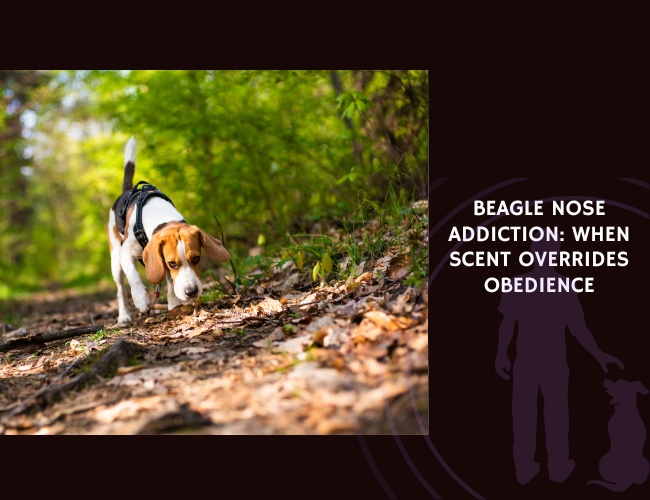
Picture this: you’re standing in the park, calling your Beagle’s name with increasing urgency while your furry friend remains completely absorbed, nose pressed to the ground, tail wagging furiously, utterly oblivious to your existence. Sound familiar? You’re not alone, and more importantly, you’re not dealing with a stubborn or defiant dog. What you’re witnessing is something far more profound—a neurological phenomenon where scent literally hijacks your Beagle’s brain, making them temporarily unreachable through conventional commands or even your loving voice.
Understanding this isn’t about excusing behaviour or accepting chaos. It’s about recognising the extraordinary olfactory architecture that makes Beagles who they are. When we grasp the neuroscience behind what many call “selective hearing,” we can finally move beyond frustration and punishment toward training methods that work with, rather than against, their magnificent scenting ability. Through the NeuroBond approach, trust becomes the foundation of learning when we understand rather than fight our dog’s deepest instincts 🧡
The Scent Hunter’s Legacy: Breeding for Absorption
How Selective Breeding Created Task-Obsessed Trackers
Beagles weren’t created to be companion dogs that check in constantly or respond to every subtle hand gesture. For centuries, these remarkable hounds were meticulously bred for one singular, all-consuming purpose: to follow a scent trail relentlessly, often for hours at a stretch, across challenging terrain, frequently beyond the sight or sound of their human handlers. This selective breeding history has profound implications for how Beagles process the world around them today.
The breeders who shaped this remarkable breed prioritised specific traits that would ensure hunting success. They sought dogs with exceptional olfactory systems, yes, but equally important were determination, stamina, and a powerful independent hunting drive. Success in the field meant a Beagle that would “stick to the line” regardless of distractions, regardless of fatigue, regardless of the handler’s location.
Key Traits Selected Through Centuries of Breeding:
- Task absorption over handler attention – Dogs that maintained unwavering focus on scent trails without requiring constant human input
- Independent decision-making – Beagles who could interpret terrain, adjust their tracking strategy, and problem-solve autonomously
- Extreme perseverance – The ability to track for hours without abandoning a trail despite obstacles or lack of immediate reward
- Single-channel cognitive locking – Once on a scent, ability to filter out all competing sensory information
- Low reliance on human direction – Capacity to work effectively when handlers were out of sight or earshot
The Trade-Off: Independence Over Responsiveness
What makes a brilliant hunting hound often creates challenges in modern pet life. The very traits that made Beagles exceptional trackers mean they were implicitly designed with reduced handler responsiveness. Consider the historical context: during a hunt, constant checking in with humans, immediate recall, or being easily diverted from a trail were not just undesirable traits—they were fundamental flaws that could end a dog’s breeding career.
Beagles worked independently or as part of a pack, frequently out of human sight and earshot. The handler’s role was to release the pack and follow, not to micromanage every moment of the hunt. This means that for generations upon generations, dogs that maintained focus on scent above all else were the ones selected for breeding 🐾
Pack Hunting and the Culture of Independence
The group hunting heritage of Beagles shaped more than just their scenting ability. When Beagles worked in packs, they relied heavily on each other’s olfactory information and vocalisations. Communication happened dog-to-dog, through bays and howls that signalled the location and intensity of a scent trail.
This tradition created dogs with remarkable noise tolerance but also dogs less attuned to human verbal cues compared to breeds developed for close handler work. Their vocalisation wasn’t just acceptable—it was essential to pack coordination. Understanding this heritage helps explain why your Beagle might seem to tune you out completely when their nose is engaged.
Pack Hunting Legacy Impact:
- Independence – Minimal direct human guidance once the hunt began; dogs relied on each other
- Noise tolerance – Pack hunting is inherently chaotic with multiple dogs baying; Beagles learned to function amid cacophony
- Low human direction reliance – The handler released the pack and followed rather than directing each moment
- Vocal communication priority – Bays and howls to signal findings to the pack, not responses to human commands
Beagles Among Scent Hounds: Understanding the Spectrum
How Beagles Compare to Other Tracking Breeds
While all scent hounds share certain characteristics, understanding where Beagles fall on the spectrum helps clarify what makes them unique. Beagles sit in an interesting middle ground among their scenting cousins, combining specific traits that create their particular brand of nose addiction.
Bloodhounds: The Extreme End Bloodhounds represent the pinnacle of scenting ability and fixation intensity. With over 300 million olfactory receptors (compared to a human’s 5 million), they possess the most powerful nose in the canine world. Their scent fixation is even more profound than Beagles’, with cognitive locking that can last hours. However, Bloodhounds tend to be calmer and more methodical in their tracking, with less of the frantic energy Beagles display.
Basset Hounds: The Deliberate Tracker Basset Hounds share the Beagle’s tenacity and single-minded focus but express it differently. Their low-slung build and slower pace make their tracking more methodical and less explosive. Bassets experience similar cognitive hijack but with less physical intensity. They’re equally determined but less likely to injure themselves in pursuit, simply due to their physical limitations. The neurological mechanisms are remarkably similar—it’s the physical expression that differs.
Beagles: The Energetic Middle Ground Beagles combine intense scenting drive with high energy, medium size, and remarkable athleticism. This combination makes their nose addiction particularly challenging in domestic settings. They have the determination of Bloodhounds, the persistence of Bassets, but with significantly more speed and agility. Their moderate size means they can access areas larger hounds cannot, while their energy levels mean they can maintain pursuit far longer than many expect 🐾
The Intensity Spectrum: What Makes Beagles Unique
Several factors combine to create the Beagle’s particular expression of scent fixation. Their SEEKING system activation appears to occur more rapidly than in slower hounds like Bassets. Once engaged, their physical response is more explosive—immediate body tension, rapid acceleration into tracking mode, and intense vocalization. The combination of speed, stamina, and determination creates scenarios where they can quickly disappear from sight, following a trail with single-minded focus.
Beagles also seem to have a lower threshold for scent interest activation compared to some other hounds. Where a Basset might sample a scent and move on, a Beagle is more likely to commit fully to investigation. This lower threshold means more frequent challenges in everyday life. Every walk presents dozens of potential hijack moments, whereas slower-paced hounds might be more selective about which scents warrant full investigation.
Scent Hound Comparison: Key Characteristics
Bloodhounds:
- Olfactory power: Highest (300+ million receptors)
- Fixation intensity: Extreme, can track for many hours
- Physical expression: Methodical, slower, deeply focused
- Vocalization: Deep, resonant baying when trailing
- Handler responsiveness: Very low during tracking
- Domestic challenges: Size, drool, housing needs
Basset Hounds:
- Olfactory power: Very high (220+ million receptors)
- Fixation intensity: High but more manageable due to pace
- Physical expression: Deliberate, methodical, persistent
- Vocalization: Deep bay, less frequent than Beagles
- Handler responsiveness: Low but physical limitations help management
- Domestic challenges: Stubbornness, health issues related to build
Beagles:
- Olfactory power: High (220+ million receptors)
- Fixation intensity: Very high with rapid onset
- Physical expression: Explosive, energetic, rapid acceleration
- Vocalization: Frequent, high-pitched bay/howl when trailing
- Handler responsiveness: Very low during active tracking
- Domestic challenges: Escape artist tendencies, noise, energy management
Why These Strategies Work Across Scent Breeds
The training approaches discussed in this article apply broadly to all scent hounds because they address the underlying neurological mechanisms rather than breed-specific behaviours. The olfactory dominance theory, SEEKING system activation, and single-channel cognitive locking occur across all tracking breeds. The intensity and physical expression vary, but the core neurological processes remain consistent.
This means that whether you’re working with a Bloodhound, Basset, Beagle, or any other scent hound, the fundamental principles remain the same. Structured scent work satisfies their SEEKING system. Proactive management prevents cognitive hijack. Understanding the neurological reality behind their behaviour prevents frustration and misguided punishment. Building connection through trust rather than force creates cooperation within the limits of their genetic programming.
The specific implementation might adjust based on the breed’s physical capabilities and energy levels, but the underlying philosophy and methodology remain consistent. If you’re succeeding with these approaches with your Beagle, you’re using principles that would equally benefit your friend with a Basset or your neighbour with a Bloodhound 🧠
Scent Drive Across the Lifespan: From Puppy to Senior
The Puppy Phase: Before Cognitive Locking Solidifies (8 Weeks – 6 Months)
Your Beagle puppy’s extraordinary nose is functional from birth, but the intensity of scent fixation and cognitive locking develops gradually. This early window represents your best opportunity to build foundational skills before the SEEKING system reaches its full, overwhelming power. Understanding this developmental timeline helps you work proactively rather than reactively.
Young puppies between 8-16 weeks show scent interest but typically haven’t developed full single-channel cognitive locking yet. You’ll notice them investigating smells, but they’re still highly distractible. A novel sound, movement, or your voice can easily redirect their attention. Their prefrontal cortex is still developing, which paradoxically makes them both harder to train in some ways (poor impulse control) but easier to recall from scent investigation.
This is the golden period for establishing check-in habits and building a strong recall cue. Because they haven’t yet experienced the full intensity of scent-driven dopamine loops, they’re more likely to respond to you. Practice recall hundreds of times during this phase, always with high-value rewards. You’re building neural pathways that will compete with scent fixation later, even though they won’t always win 🐾
Puppy Phase Training Priorities (8 Weeks – 6 Months):
- Name recognition – Practice until your puppy’s name creates automatic attention to you
- High-frequency recall – 20-30 successful recalls daily with jackpot rewards
- Structured sniff time – Teach “go sniff” and “all done” cues before fixation becomes intense
- Check-in rewards – Heavily reinforce every voluntary attention to you during walks
- Long-line introduction – Get puppy comfortable with freedom on a long line
- Scent game foundations – Begin simple nose work games to channel the emerging drive
The Adolescent Surge: When the SEEKING System Peaks (6 Months – 2 Years)
Adolescence in Beagles represents the most challenging period for scent-related behaviours. Between 6-18 months, the SEEKING system matures and intensifies dramatically. Hormonal changes amplify arousal and motivation. The dopamine response to scent becomes significantly more powerful. This is when many owners feel they’ve “lost” their dog, as the cooperative puppy transforms into a scent-obsessed tracking machine.
The prefrontal cortex (responsible for impulse control and decision-making) is still developing during this period, while the limbic system (emotional and motivational centres) is in overdrive. This creates a perfect storm: maximum motivation to follow scents combined with minimal ability to inhibit the impulse. Your adolescent Beagle experiences scent fixation more intensely than they will at any other life stage.
This is also when cognitive locking becomes most pronounced. Where your 4-month-old puppy might have glanced at you when called during scent investigation, your 10-month-old adolescent becomes completely unreachable. The neurological hijack is faster, deeper, and more complete. Understanding this isn’t permanent makes it bearable—you’re not failing, you’re managing a developmental phase 🧠
Adolescent Phase Management (6 Months – 2 Years):
- Increased management – More reliance on long lines, secure areas, environmental control
- Realistic expectations – Accept that regression is normal and neurological, not behavioural
- Structured scent work intensification – Provide daily outlets for the amplified SEEKING system
- Safety prioritization – This is highest-risk period for escape and getting lost
- Patience and consistency – Maintain training without expecting linear progress
- Relationship protection – Avoid punishment that will damage trust during this vulnerable period
The Adult Beagle: Stable But Intense (2 – 7 Years)
Around age 2-3, most Beagles reach neurological maturity. The intensity of scent drive stabilizes—it doesn’t disappear or significantly diminish, but it becomes more predictable. The prefrontal cortex finishes development, providing slightly better impulse control. Your adult Beagle still experiences powerful scent fixation, but they’re somewhat more capable of disengaging if the foundation training from puppyhood was solid.
Adult Beagles who’ve had consistent structured scent work throughout adolescence often show improved responsiveness. They’ve learned that scenting opportunities will come, reducing the frantic “must investigate everything NOW” mentality. The dopamine loops remain powerful, but there’s slightly more cognitive resource available for processing your cues before full hijack occurs. This doesn’t mean they’ll always listen—it means the window for effective intervention might extend from 5 seconds to 15 seconds.
This is also when the benefits of the NeuroBond approach become most apparent. Adult Beagles with strong trust-based relationships and regular scent work outlets show the best balance between expressing their natural drives and maintaining connection with their handlers. The work you did during the challenging adolescent phase pays dividends in increased cooperation, even though the fundamental scent drive remains as powerful as ever 🐾
Adult Phase Expectations (2 – 7 Years):
- Stable intensity – Scent drive remains high but becomes more predictable
- Improved interventions – Slightly longer window for successful redirection
- Routine benefits – Consistent structured scent work shows clear behavioral impact
- Individual variation – Some adults mellow slightly, others maintain adolescent intensity
- Maintenance training – Continue check-in rewards and scent work structure
- Enjoyment – Many owners find this the most rewarding phase once they accept their Beagle’s nature
The Senior Years: Gradual Softening (7+ Years)
As Beagles enter their senior years (typically around 7-9 years depending on health), you may notice gradual changes in scent fixation intensity. Physical changes come first: reduced stamina means they can’t track as long, arthritis might make explosive takeoffs uncomfortable, reduced hearing means they’re already less responsive to verbal cues for different reasons. But what about the neurological drive itself?
Research suggests the SEEKING system’s intensity does diminish somewhat with age, though individual variation is significant. Some senior Beagles maintain near-adult levels of scent drive well into their teens, while others show noticeable mellowing by age 8-9. The dopamine system’s responsiveness typically decreases with age across species, which may reduce the addictive quality of scent tracking. Senior Beagles often investigate scents more casually, showing interest without the same consuming fixation.
However, don’t expect your senior Beagle to suddenly become reliably responsive off-leash. The neural pathways established over a lifetime remain functional. Even with reduced intensity, cognitive locking still occurs—it just might happen less frequently and be slightly easier to interrupt. The gift of senior years is often a dog who maintains their essential Beagle character but with slightly more manageable expression 🧡
Senior Phase Considerations (7+ Years):
- Physical limitations – Use these to your advantage for safety (shorter walks, slower pace)
- Possible mellowing – Some cognitive locking reduction, but highly individual
- Health monitoring – Sudden changes in scent behavior might indicate health issues
- Continued enrichment – Senior Beagles still need scent work, adapted to physical capacity
- Relationship depth – Years of trust create strongest possible connection
- Acceptance and gratitude – Appreciating who they’ve been throughout their life
Working with Each Life Stage: Strategic Approach
Understanding these developmental phases allows you to calibrate your approach appropriately. Don’t expect adolescent-level responsiveness from your 10-month-old and risk damaging your relationship through frustration. Don’t assume your puppy’s easy distractibility will continue and fail to build crucial foundations. Don’t expect your 12-year-old to become a different dog, but do appreciate any softening that occurs.
The most successful Beagle owners adjust their strategies as their dog matures. Heavy investment in foundation training during puppyhood. Maximum management and patience during adolescence. Enjoyment of the stable adult years. Gentle adaptation during the senior phase. Through it all, the core principles remain: understand the neurology, provide structured outlets, build connection through trust, and accept your Beagle’s essential nature 🐾

The Neurological Architecture of Scent Fixation
Inside the Scent-Driven Brain
When your Beagle’s nose locks onto a compelling scent, something extraordinary happens inside their brain. This isn’t a simple matter of interest or preference—it’s a profound neurological shift that fundamentally alters how they process information from the world around them. The olfactory cortex in scent hounds like Beagles is significantly enlarged compared to other breeds, and when activated by a compelling scent, this region demands enormous computational resources from the brain.
According to Olfactory Dominance Theory, this intense olfactory engagement actively suppresses processing in other brain regions. Specifically, when your Beagle is tracking, the prefrontal cortex (responsible for executive functions like impulse control, planning, and decision-making) experiences reduced efficiency. Meanwhile, auditory processing regions struggle to recognise and respond to familiar cues.
Think of it like this: imagine trying to hold a complex conversation while simultaneously solving a challenging puzzle that requires all your concentration. Your friend might be talking, but their words simply don’t register because your brain has allocated its resources elsewhere. For Beagles in scent mode, commands from you fall into this same category of unprocessed information 🧠
The SEEKING System: Nature’s Most Powerful Drive
One of the most illuminating frameworks for understanding Beagle behaviour comes from affective neuroscience, particularly Jaak Panksepp’s research on primary emotional systems. The SEEKING system is one of the brain’s most fundamental motivational circuits, driving exploration, investigation, and the pursuit of resources. When activated, it creates an intensely rewarding internal state that compels the animal forward.
For Beagles, scent work activates this primal system with exceptional intensity. Once the SEEKING system is fully engaged, it can override other cognitive functions, including social attention and learned obedience. Your Beagle isn’t choosing to ignore you—their brain is flooded with neurochemicals that make following the scent trail the single most important imperative in that moment.
Neurological Changes During Scent Engagement:
- Olfactory cortex activation – Consumes significant brain processing power, leaving less for other functions
- Prefrontal cortex suppression – Reduces impulse control, planning ability, and executive function
- Auditory processing reduction – They genuinely hear commands less effectively, not selective hearing
- Dopamine release – Creates powerful internal reward that reinforces tracking behaviour
- Attention narrowing – Filters out peripheral information including visual cues from handlers
- SEEKING system dominance – Overrides learned behaviours and social attention
The Dopamine Loop: Why Scent Is Addictive
Every step along a scent trail delivers a hit of dopamine to your Beagle’s brain. This neurotransmitter is central to motivation, reward, and the experience of pleasure. But here’s what makes scent tracking particularly compelling: the reward isn’t just at the end of the trail. Each successful interpretation of a scent, each turn that keeps them on track, each intensification of the smell creates a micro-reward.
This is what researchers call “perseverance tracking.” The behaviour becomes self-reinforcing through dopamine-rich feedback loops. Your Beagle isn’t working toward a distant goal—they’re receiving constant neurochemical rewards throughout the entire tracking process. This makes scent following intrinsically rewarding, independent of any external reinforcement like treats or praise from you.
The compulsive nature of this behaviour cannot be overstated. This isn’t a conscious decision your Beagle makes; it’s an automatic, highly reinforced behavioural sequence that becomes increasingly difficult to interrupt once initiated. The pursuit pattern resembles what we see in compulsive behaviours—not defiance, but neurological absorption 🐾
The Brain Hijack Explained: Visual Metaphors for Complex Science
Your Beagle’s Brain as a Computer Processor
Sometimes the most complex neuroscience becomes clearer when we use everyday analogies. Imagine your Beagle’s brain as a computer with limited processing power. In normal operation, this processor handles multiple programs simultaneously: visual awareness runs at 20%, auditory processing at 15%, social attention to you at 25%, movement coordination at 20%, and various other functions share the remaining capacity.
Now imagine what happens when a compelling scent is detected. The “Scent Analysis Program” suddenly demands 85-90% of the processor’s total capacity. All other programs are forced into minimal operation or suspend entirely. The “Listen to Handler” program crashes. The “Make Eye Contact” program goes offline. Even the “Decision Making” program that would normally allow your Beagle to choose whether to follow the scent enters a frozen state.
This is why pulling the leash or shouting doesn’t work during scent hijack. Your inputs are trying to access programs that aren’t currently running. The computer hasn’t crashed completely, but it’s so consumed by the primary task that all other operations are temporarily suspended 🧠
The Second-by-Second Timeline of Cognitive Hijack
Understanding what happens moment-by-moment during scent fixation helps you recognise when intervention is possible and when it’s too late. This timeline represents the critical 15-30 seconds between initial detection and full cognitive lock.
Seconds 0-3: Initial Detection The olfactory receptors in your Beagle’s nose detect something interesting. The brain’s thalamus (sensory relay station) flags this information as potentially significant. Your Beagle’s head turns slightly toward the source. At this stage, they’re still processing multiple inputs—you can call their name and they’ll glance at you while continuing to sample the air.
Seconds 4-8: Engagement Beginning The olfactory cortex activates more intensely, beginning its detailed analysis. The SEEKING system starts to power up, releasing initial dopamine. Your Beagle’s body language shifts: ears orient forward, tail position changes to horizontal, breathing becomes more deliberate. They’re still somewhat responsive, but their attention is dividing—60% scent, 40% everything else.
Seconds 9-15: Critical Threshold The SEEKING system reaches moderate activation. Dopamine levels rise significantly. The prefrontal cortex begins to lose its regulatory influence. Your Beagle’s focus is now 80% on scent, 20% on the environment. This is your last reliable window for intervention. High-value treats presented directly to the nose might still work. A well-practiced recall cue might penetrate. But the window is closing rapidly.
Seconds 16-30: Full Cognitive Lock The olfactory cortex consumes 85-90% of processing resources. The SEEKING system is at peak activation, flooding the brain with dopamine. Single-channel cognitive locking is complete. Auditory processing drops to minimal function—your voice becomes background noise. Visual attention to you is impossible. The prefrontal cortex’s executive functions are suppressed. Your Beagle is now neurologically unreachable until the scent interest naturally diminishes or the trail ends 🐾
Breaking Down the Brain Regions in Simple Terms
Let’s demystify the key brain structures involved in scent addiction and what each one does during tracking:
Olfactory Bulb and Cortex: The Scent Processor Think of this as your Beagle’s “scent supercomputer.” In scent hounds, this region is dramatically enlarged compared to other breeds. When active, it’s analyzing thousands of scent molecules per second, comparing them to scent memories, tracking changes in concentration to determine direction, and predicting the source’s location. This computational demand is why everything else goes offline.
Prefrontal Cortex: The Executive Manager This is the “control centre” responsible for impulse control, planning, and decision-making. It’s what allows your Beagle to hear “come” and choose to stop what they’re doing to respond. During scent hijack, this region is actively suppressed—not by choice, but by neurological resource allocation. The manager has left the building, leaving no one to make executive decisions about behaviour.
Amygdala and SEEKING System: The Motivation Engine This ancient, primal system drives all exploratory behaviour and reward-seeking. When the SEEKING system activates intensely, it creates an overwhelming motivation to pursue the scent. It’s like having a powerful engine with no brakes. The amygdala adds emotional intensity to the experience, making the pursuit feel urgent and essential.
Auditory Cortex: The Listener This region processes sounds, including your voice and commands. During intense olfactory engagement, this area receives minimal processing priority. It’s still technically functioning, but the signals it processes are deprioritised to the point of irrelevance. Your Beagle genuinely doesn’t register your words as meaningful communication 🧠
The Dopamine Cascade: Understanding Addiction Mechanisms
The term “nose addiction” isn’t just metaphorical—the neurological mechanisms mirror what we see in other addictive behaviours. Each successful step in tracking creates a small dopamine release. These micro-rewards accumulate, creating a powerful feedback loop that makes stopping feel neurologically impossible.
Imagine trying to stop eating a meal when you’re ravenously hungry, or trying to stop scrolling social media when each swipe shows something interesting. Your Beagle experiences something far more intense. Every sniff brings new information that triggers another dopamine hit, and another, and another. The behaviour becomes self-perpetuating, not through conscious choice but through neurochemical reinforcement that operates below the level of decision-making.
This is why punishment fails so completely. You’re not dealing with a behaviour your Beagle chooses; you’re dealing with a neurochemical cascade that has temporarily overridden choice itself. Understanding this distinction is crucial for developing effective, humane training approaches 🐾
Locked. Low. Listening.
Scent isn’t distraction—it’s dominance. When a Beagle’s nose locks onto a trail, the world narrows. Commands don’t disappear—they simply get outranked by instinct.
Independence was designed, not developed. Generations of breeding rewarded dogs who followed scent, not handlers. Focus became fixation. Obedience became optional.
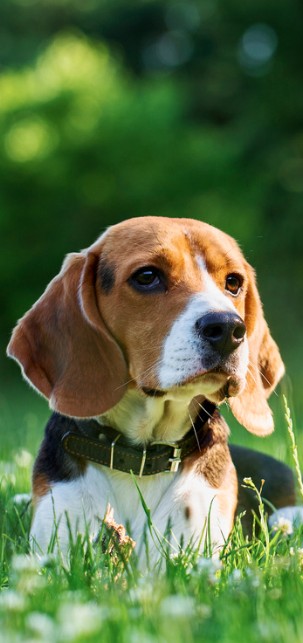
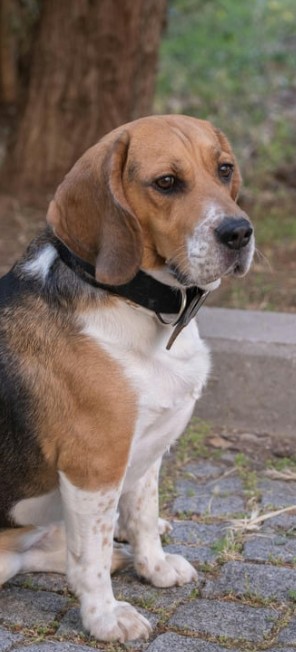
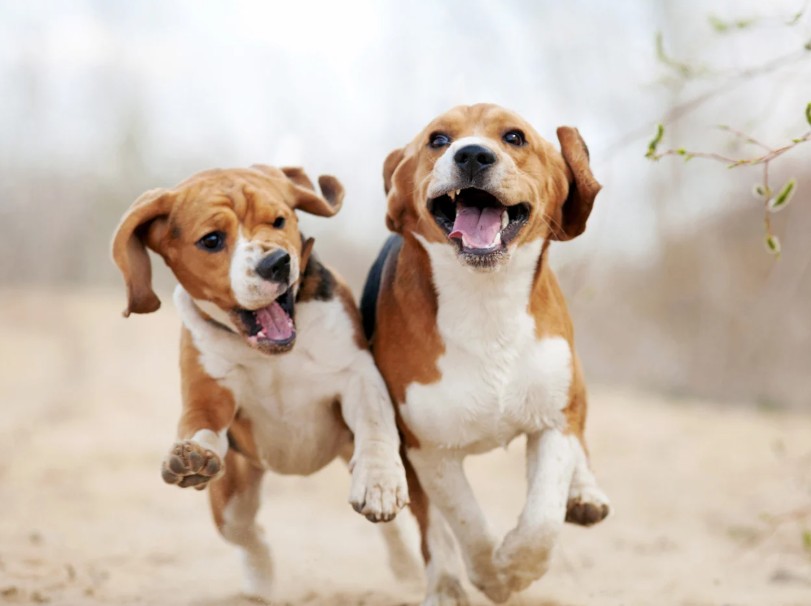
Connection replaces control. When training works with their sensory drive—not against it—attention isn’t forced. It returns on its own.
Understanding Single-Channel Cognitive Locking
When the Brain Can Only Process One Thing
Have you noticed that your Beagle seems to have a remarkably low natural switch frequency between sensory tasks? This isn’t your imagination. Beagles, along with other dedicated scent hounds, exhibit a demonstrably lower ability to shift attention between different sensory inputs, particularly when their olfactory system is highly engaged. This is the phenomenon known as single-channel cognitive locking.
Once a compelling scent is detected and the SEEKING system activates, their cognitive resources become overwhelmingly dedicated to processing that olfactory information. The brain prioritises the scent trail, making it genuinely difficult to disengage and re-engage with other sensory inputs like auditory commands or visual cues from you. This isn’t a conscious choice but a neurological default state.
Think about it: when was the last time your Beagle was tracking and you could get their attention simply by calling? The cognitive resources required to process the scent trail are so intensive that switching to process your voice, interpret its meaning, inhibit the tracking behaviour, and redirect attention requires more cognitive flexibility than is available in that moment 🧠
🐕 Understanding Beagle Nose Addiction 👃
The Complete Neurological Journey from Detection to Hijack
Phase 1: Initial Detection
Seconds 0-3: The Gateway Moment
What’s Happening in the Brain
The olfactory receptors detect something interesting. The brain’s thalamus flags this as potentially significant. Your Beagle’s head turns slightly toward the source. At this stage, they’re still processing multiple inputs—you can call their name and they’ll glance at you while continuing to sample the air.
Observable Signs
• Head turn toward scent source
• Ear orientation changes
• Still responsive to your voice
• Sampling air with deliberate sniffs
• Processing power: 60% normal awareness, 40% scent investigation
Window of Opportunity
This is your easiest intervention point. Your Beagle is curious but not fixated. A cheerful redirect, high-value treat, or movement away from the source can easily succeed. The NeuroBond you’ve built makes them willing to choose you over investigation at this stage.
Phase 2: Engagement Beginning
Seconds 4-8: The SEEKING System Activates
Neurological Shift
The olfactory cortex activates more intensely, beginning detailed analysis. The SEEKING system starts to power up, releasing initial dopamine. Your Beagle’s brain is now allocating significantly more resources to scent processing. The reward circuits are warming up.
Body Language Changes
• Ears orient fully forward
• Tail position shifts to horizontal
• Breathing becomes more deliberate
• Body begins to tense
• Processing split: 70% scent, 30% environment
• Still shows some ear flicking toward your voice
Intervention Strategy
Your window is narrowing but still open. Use your highest-value rewards now. Present treats directly to the nose to interrupt the scent cascade. Your well-practiced reset cue might still penetrate. Movement creates competing sensory input that can help break the building pattern.
Phase 3: Critical Threshold
Seconds 9-15: Last Reliable Window
Approaching the Point of No Return
The SEEKING system reaches moderate activation. Dopamine levels rise significantly. The prefrontal cortex begins losing regulatory influence. Your Beagle’s cognitive resources are now 85% dedicated to scent processing. The “brain computer” is overloading non-essential programs.
Warning Signs
• Body fully tensed and lowered
• Ears locked in position
• Rapid, shallow breathing pattern
• Tail rigid and horizontal
• Minimal response to name
• Eye contact becoming impossible
• Processing: 85% scent, 15% everything else
Critical Decision Point
This is your absolute last chance for behavioral intervention. After this threshold, only physical management (long line) works. If your reset cue doesn’t work immediately, accept that cognitive hijack is imminent. Fighting it now damages trust without achieving compliance.
Phase 4: Full Cognitive Lock
Seconds 16-30: Neurologically Unreachable
Complete Neurological Hijack
The olfactory cortex now consumes 90% of brain processing resources. The SEEKING system is at peak activation, flooding the brain with dopamine. Single-channel cognitive locking is complete. Your Beagle’s “computer” has suspended all non-essential programs to handle the massive scent processing load.
What’s Offline
• Auditory processing (your voice is background noise)
• Visual attention (cannot make eye contact)
• Handler awareness (you effectively don’t exist)
• Impulse control (prefrontal cortex suppressed)
• Decision-making (automatic tracking only)
• Social attention (NeuroBond temporarily overridden)
What NOT to Do
Do not yell, pull the leash harshly, or punish. Your Beagle cannot process these inputs as connected to their behavior. Punishment now creates fear of you, erodes trust, and increases future fixation intensity. The Invisible Leash reminds us that awareness, not tension, guides the path.
Phase 5: Active Tracking Mode
The Dopamine Loop in Full Flow
The Addiction Mechanism
Every step along the trail delivers a dopamine hit. Each successful interpretation of scent direction, each turn that keeps them on track, creates a micro-reward. This is perseverance tracking—the behavior becomes self-reinforcing through constant neurochemical rewards. Your Beagle isn’t working toward a distant goal; they’re receiving pleasure with every sniff.
Behavioral Expression
• Mechanical, automatic movement patterns
• Nose glued to ground
• May vocalize (bay or howl)
• Oblivious to surroundings
• No food or toy interest
• Will track past exhaustion
• May track for minutes to hours depending on trail
Management During This Phase
Use your long line for physical safety. Don’t fight the behavior—you cannot win neurologically. Wait for natural disengagement (trail ends, scent dissipates, physical fatigue). Then reward immediately when they naturally disengage and reconnect with you. You’re reinforcing the return to awareness.
Phase 6: Gradual Disengagement
The Trail Ends or Weakens
Brain Coming Back Online
As the scent trail weakens or ends, the olfactory cortex’s demand for processing power gradually decreases. Other brain regions begin receiving more resources. The prefrontal cortex starts regaining regulatory function. Dopamine levels drop. Your Beagle is slowly transitioning back to normal multi-sensory processing.
Signs of Re-engagement
• Head lifts from ground
• Ears begin moving again
• Environmental scanning returns
• May glance toward you
• Body tension releases
• Breathing normalizes
• First moment they respond to their name
Critical Reinforcement Moment
The instant your Beagle reconnects with you—through eye contact, approaching you, or responding to their name—jackpot reward immediately. You’re reinforcing the behavior of choosing you after scent engagement. This builds the foundation where moments of Soul Recall can occur even amid powerful drives.
Phase 7: Recovery and Reset
Returning to Baseline State
Neurological Recovery
Full cognitive function returns over 2-5 minutes after disengagement. The brain redistributes processing power back to normal operations. Dopamine levels stabilize. Your Beagle can now process commands, make decisions, exercise impulse control, and engage socially with you again. The “computer programs” restart one by one.
Training After Fixation
Wait 3-5 minutes before asking for any obedience behaviors. Allow full recovery. Then practice simple, highly rewarded behaviors to rebuild connection. A short training session of easy wins (sit, touch, eye contact) reinforces that you’re still a source of good things. This prevents the fixation episode from defining the entire walk negatively.
Long-term Pattern Building
Each cycle of: scent interest → intervention OR management → successful recovery → immediate reward for reconnection, builds neural pathways. Over hundreds of repetitions, your Beagle learns that reconnecting with you after scent exploration brings rewards. You’re not eliminating the drive; you’re adding a competing neural pattern.
Phase 8: Prevention and Proactive Management
Long-term Success Strategy
Structured Scent Work
Provide daily, controlled scent activities: nose work games, tracking exercises, scatter feeding, hide-and-seek. When the SEEKING system receives regular, satisfying engagement on your terms, random environmental tracking reduces. Your Beagle learns that amazing scent opportunities will come—they don’t need to grab every one frantically.
Environmental Selection
Choose training locations strategically. Low-distraction environments during skill building. Gradually increase challenge as competence grows. Use high-distraction areas for management practice with long lines, not for expecting obedience. Match environment to your training goals and your Beagle’s current skill level.
Reading Early Signals
Become fluent in your Beagle’s pre-fixation body language. The head turn, ear perk, breathing shift, and tail position changes happen seconds before cognitive lock. Master recognizing these micro-signals, and you’ll intervene during Phases 1-3 instead of fighting Phase 4. Early intervention is everything.
Building the Invisible Leash
Through thousands of repetitions of rewarding check-ins, you create a habit of connection. Your Beagle learns that voluntary attention to you brings rewards more reliably than chasing every scent. This doesn’t override hijack, but it reduces frequency and extends the intervention window. Connection becomes their default, not an afterthought.
🔄 Understanding Scent Fixation Across Different Contexts
Puppy (8 wks – 6 months)
Fixation Level: Low to Moderate
Cognitive Lock: Incomplete, easily broken
Intervention Success: High (80-90%)
Key Strategy: Build check-in habits and recall foundation before SEEKING system reaches full power
Adolescent (6 mos – 2 years)
Fixation Level: Highest
Cognitive Lock: Rapid and complete
Intervention Success: Low (20-40%)
Key Strategy: Maximum management with long lines, realistic expectations, maintain relationship through this challenging phase
Adult (2-7 years)
Fixation Level: High but stable
Cognitive Lock: Still complete but slightly slower onset
Intervention Success: Moderate (50-70%)
Key Strategy: Structured scent work shows maximum benefits; foundation training from puppyhood pays dividends
Senior (7+ years)
Fixation Level: Moderate with some mellowing
Cognitive Lock: Less intense, easier to interrupt
Intervention Success: Moderate to High (60-80%)
Key Strategy: Appreciate the lifelong relationship built; physical limitations naturally reduce intensity
Low-Distraction Environment
Examples: Quiet streets, empty fields, indoors
Intervention Window: Extended (15-30 seconds)
Training Success: High
Best Use: Foundation skill building, reset cue training, check-in habit development
High-Distraction Environment
Examples: Dog parks, hiking trails, beaches
Intervention Window: Minimal (3-8 seconds)
Training Success: Low
Best Use: Management practice, structured scent work sessions, realistic expectation setting
⚡ Quick Reference: The Intervention Timeline
0-3 seconds: Easy intervention, 90% success rate
4-8 seconds: Moderate difficulty, 70% success rate
9-15 seconds: Challenging, 40% success rate
16+ seconds: Cognitive hijack complete, 0-10% success rate
Remember: Success means intervening in the first 15 seconds. After that, switch from training to management mode. Your long line prevents danger while you wait for natural disengagement. Never punish what cannot be controlled neurologically.
🧡 The Zoeta Dogsoul Perspective
Understanding these eight phases reveals a profound truth: your Beagle’s “disobedience” is neurological reality, not behavioral choice. Through the NeuroBond approach, we build trust and connection that creates the strongest possible foundation for responsiveness—even though it has limits. The Invisible Leash develops through thousands of rewarded check-ins, making voluntary attention your Beagle’s default. And in those moments when they choose you despite compelling scents, Soul Recall shows how deep your bond has become.
This isn’t about perfect obedience—it’s about partnership. When we understand the science, respect the drive, provide structured outlets, and build connection through trust rather than force, we create relationships where cooperation emerges naturally. That balance between honoring their nature and teaching necessary skills—that’s where transformation happens.
Your Beagle’s nose addiction is their superpower, not their flaw. Our role isn’t to suppress it but to channel it, manage it wisely, and appreciate the extraordinary sensory world it reveals. That balance between science and soul—that’s the essence of Zoeta Dogsoul.
© Zoeta Dogsoul – Where neuroscience meets soul in dog training
The Reality of Being “Locked In”
During intense scent engagement, your Beagle experiences what can only be described as cognitive tunnel vision. Their brain’s processing power is almost entirely consumed by the primary task. This state has several identifying characteristics that help us understand what’s happening inside their head.
The olfactory information isn’t just being processed—it’s being analysed for patterns, compared to previous scent experiences, used to make predictions about the source’s location and movement, and constantly updated as new information arrives. This computational load is staggering.
Signs Your Beagle Is Cognitively Locked:
- Ears become immobile – No flicking toward sounds, including your voice
- Body tension increases – Muscles prepare for pursuit, creating physical rigidity
- Breathing pattern changes – Rapid, shallow sniffing to maximise scent intake
- Tail position locks – Usually horizontal and still, indicating intense focus
- Eye contact becomes impossible – Visual attention is completely suppressed
- Movement becomes automatic – Following the scent trail with mechanical precision
When Obedience Goes Offline: The Hijack State
Recognising Neurological Unreachability
There comes a point in the scent-tracking sequence where your Beagle crosses a threshold. Before this point, intervention is possible. After it, you’re essentially calling to a dog whose brain is temporarily offline to your input. Understanding how to recognise this critical threshold can save you enormous frustration and help you time your interventions more effectively.
The early stages of scent interest present a window of opportunity. Your Beagle might show initial curiosity—head turning toward a smell, a slight pause, perhaps a few investigative sniffs. At this stage, they’re still processing multiple inputs. You might notice ear flicking, occasional glances in your direction, or a slight hesitation before fully committing to investigation.
But once full fixation occurs, everything changes. The neurological hijack is complete when you observe the complete absence of environmental scanning, zero handler awareness despite your presence, and an inability to make eye contact even when you position yourself directly in their line of sight. At this point, punishment, pulling, or verbal pressure won’t just fail—they’ll damage your relationship 🧡
What Gets Suppressed During Scent Hijack
When your Beagle enters this state of complete absorption, specific cognitive functions essentially go offline. This isn’t selective or intentional—it’s a predictable neurological consequence of the brain’s resource allocation during intense olfactory processing.
Eye contact becomes neurologically impossible because the visual attention networks are suppressed. Auditory cue recognition fails because the auditory cortex is receiving minimal processing priority. Handler awareness disappears because social attention circuits are overridden by the SEEKING system. And impulse control—the very thing you need them to exercise—is precisely what the suppressed prefrontal cortex normally provides.
Critical Functions Suppressed During Hijack:
- Eye contact and visual attention – Cannot process your visual cues or meet your gaze
- Auditory cue recognition – Your familiar commands become meaningless sounds
- Handler awareness – Social attention to you is completely overridden
- Impulse control – Prefrontal cortex suppression eliminates ability to “choose” obedience
- Spatial awareness of surroundings – Focus narrows to scent trail, eliminating peripheral awareness
- Response to physical touch – May not register your hand on their body
The Window Before Full Hijack
Early intervention is everything. If you can recognise the micro-signals that your Beagle is beginning to fixate, you have a brief window where engagement is still possible. Watch for the initial head turn toward a scent source, the first few investigative sniffs where they’re still sampling rather than tracking, and any ear flicking or glances that indicate they’re still processing multiple inputs.
This is the moment for action. A high-value treat presented directly to their nose can interrupt the cascade. A calm, familiar recall cue delivered before full absorption might still penetrate. Movement away from the scent source, if done before fixation completes, can help break the building pattern.
But—and this is crucial—once you see the complete absence of these responsive signals, once the ears lock, the body rigidifies, and the mechanical tracking begins, you’ve missed the window. At that point, management through physical containment (like a long line) becomes your only option until the scent interest naturally diminishes 🐾
Why Traditional Training Fails During Scent Hijack
The Fundamental Problem with Punishment
Let’s address why punishment, leash corrections, verbal pressure, or any form of confrontation fails spectacularly during scent hijack. The answer is both simple and profound: your Beagle is neurologically unreachable. Their brain is not processing these inputs as meaningful deterrents or commands.
When you pull the leash, yell their name, or attempt any form of correction during full fixation, these actions are perceived as irrelevant noise or unpleasant physical discomfort that doesn’t connect to the scent pursuit. The dog cannot form the association you’re trying to create because the cognitive systems required for that learning are suppressed. It’s like trying to teach algebra to someone who’s currently drowning—their brain is occupied with survival, not learning.
Worse still, these methods don’t just fail—they actively damage your relationship. Your Beagle learns that you are a source of unpredictable discomfort or anger when they’re simply following their most primal instincts. This erodes trust and makes them less likely to seek connection with you in other situations 🧠
How Punishment Worsens Disconnection
The long-term consequences of using punishment during scent hijack extend far beyond the immediate moment. Each instance where you apply pressure, corrections, or punishment while your Beagle is cognitively locked creates a negative association—not with the scenting behaviour (which they cannot connect to your response), but with you as a handler.
Trust erosion happens gradually but consistently. The dog begins to perceive you as unpredictable and potentially threatening. Stress and arousal levels increase, which paradoxically makes them more likely to fixate on scent as an escape or coping mechanism. And critically, you’re suppressing the expression of natural behaviour without addressing the underlying drive or teaching any alternative.
Why Punishment Methods Fail and Harm:
- Neurological unreachability – Brain cannot process correction as connected to behaviour
- Creates confusion and fear – Dog doesn’t understand why discomfort is occurring
- Erodes trust foundation – You become unpredictable source of unpleasant experiences
- Increases stress arousal – Makes future fixation more likely as coping mechanism
- Suppression without understanding – Dog learns fear, not alternative behaviours
- Damages future responsiveness – Reduced willingness to check in or respond in any context
The Limits of Relational Influence
Even with a strong bond, there are limits. The NeuroBond Model emphasises that relationship-based influence can shape when a Beagle is open to connection and responsive to human cues. A trusting relationship built on positive experiences creates a foundation where your dog chooses to check in, values your input, and seeks connection. This is powerful and forms the basis of all effective training.
However, the model also critically acknowledges that this influence has boundaries. Once scent drive is fully engaged and neurological hijack occurs, relationship-based influence alone cannot override the primal drive. The SEEKING system, when fully activated, supersedes social bonds temporarily. This isn’t a failure of your relationship—it’s a neurological reality.
This understanding is liberating. It means you can stop blaming yourself for your Beagle’s “disobedience” and instead focus on proactive management, appropriate timing, and structured outlets for their scenting drive. The Invisible Leash reminds us that awareness, not tension, guides the path 🐾
Structured Scent Work: Harnessing the Drive
The Paradigm Shift from Fighting to Channelling
The most effective approach to living with a scent-obsessed Beagle involves a fundamental change in philosophy. Instead of viewing scent drive as a problem to be suppressed or punished, we must recognise it as a powerful, innate, neurologically driven behaviour that is central to your Beagle’s identity and wellbeing.
When we shift from fighting the drive to harnessing it with structure, everything changes. Your Beagle’s natural behaviour becomes an asset rather than a liability. Their extraordinary nose becomes something you work with rather than against. And most importantly, you become the facilitator of their most rewarding activity rather than an obstacle to it.
This is where structured scent work becomes transformative. By providing designated, controlled outlets for scenting, your Beagle learns that they will get to use their nose—but on mutually agreed terms. This reduces the frantic, opportunistic random hunting in inappropriate environments because their SEEKING system receives regular, satisfying engagement 🧡
Implementing Controlled Scent Activities
Structured scent work takes many forms, and the beauty is that you can adapt it to your living situation and skill level. The key principle is that these activities happen on your terms, in locations you choose, with clear start and end cues that your Beagle learns to recognise and respect.
K9 Nose Work or scent detection games involve hiding treats or scented objects around your home or garden and teaching your Beagle to search on cue. Tracking exercises in safe, enclosed areas allow them to follow scent trails you’ve laid. Hide-and-seek games where family members hide and your Beagle searches build both scenting skills and recall motivation. Even structured sniff walks where you designate specific “sniff zones” and “let’s go” zones help your Beagle understand when scenting is appropriate.
Effective Structured Scent Activities:
- K9 Nose Work classes – Professional training in scent detection work with clear rules
- Tracking exercises – Following scent trails you create in controlled environments
- Hide-and-seek games – Family members hide, Beagle searches on release cue
- Scent discrimination – Teaching your Beagle to identify specific scents among distractors
- Structured sniff walks – Designated “go sniff” zones alternated with “let’s walk” zones
- Food puzzles and scent toys – Indoor activities that engage their nose constructively
Teaching Cue-Based Release and Recall
One of the most powerful tools you can develop is a solid “go sniff” cue paired with an equally clear “all done” or “let’s go” transition cue. This framework helps your Beagle understand when it’s appropriate to engage their nose fully and when it’s time to disengage and redirect attention to you.
Start in low-distraction environments where success is easy. Say “go sniff,” allow your Beagle to investigate a designated area for a set time (start with 30 seconds), then use your “all done” cue paired with a high-value reward for disengaging. Gradually increase the duration and add mild distractions. The goal is building impulse control and responsiveness within the context of scenting—not eliminating the behaviour but structuring it.
This approach dramatically improves your connection because scent work becomes a shared activity. Your Beagle learns to associate you with access to their most rewarding activity, and you gain influence over when and where it happens. The cooperation you build here generalises to other contexts, strengthening your overall relationship 🐾
Building the Invisible Leash: Connection Beyond Commands
Proactive Management Strategies
The Invisible Leash concept involves training your Beagle to stay connected to you even in distracting environments, through consistent positive reinforcement for checking in, maintaining proximity, and showing responsiveness. This isn’t about physical restraint—it’s about building such a strong habit of connection that checking in with you becomes a default behaviour.
But this level of connection requires proactive management, especially while you’re building these skills. Using a long line (15-30 feet) in distracting environments prevents your Beagle from reaching full cognitive hijack while still allowing freedom of movement. You can intervene with high-value rewards before fixation completes, and you maintain physical safety without constant tension.
Choosing appropriate training locations is equally crucial. Early in training, avoid environments with overwhelming scent distractions. Build skills in gradually increasing challenges rather than throwing your Beagle into situations where failure is inevitable 🧠
High-Value Reinforcement and Reset Cues
For a scent hound, competing with environmental smells requires reinforcement that is genuinely more compelling than those smells. This means discovering what your individual Beagle finds most rewarding. For some, it’s specific high-value treats (freeze-dried liver, real meat). For others, it’s a favourite toy or even access to a highly desired sniff spot given on cue.
Teaching a “reset” cue—a specific signal that means “disengage from what you’re doing and re-engage with me”—becomes your emergency brake. But this cue must be heavily reinforced in low-distraction settings first. Practice when your Beagle is mildly interested in something, not during full hijack. Reward generously every single time they respond.
Proactive Management Essentials:
- Long line training – 15-30 feet allows freedom while preventing full hijack
- Environmental selection – Choose training locations with appropriate distraction levels
- High-value reinforcement – Find what genuinely competes with environmental scents
- Reset cue training – Practice in easy contexts before using in challenging situations
- Timing intervention – Act at earliest signs of fixation, not after hijack completes
- Consistent check-in rewards – Reinforce every voluntary attention to you
Empowerment Through Structured Choice
Allowing your Beagle to make choices within safe boundaries reduces frustration and improves cooperation. This might look like offering two walking routes and letting them choose. Allowing them to sniff a particular bush for 30 seconds before moving on. Giving them access to a designated sniff area after completing a training exercise.
These small choices communicate respect for your Beagle’s autonomy and preferences. They learn that you’re not trying to eliminate their natural behaviours but instead helping them navigate the world in ways that work for everyone. This collaborative approach strengthens your bond and increases their willingness to cooperate when you do need to set firm boundaries.
The essence here is partnership over dominance. When your Beagle understands that you facilitate access to what they love while keeping them safe, they become more willing participants in training. That balance between structure and freedom, between respecting their nature and setting necessary boundaries—that’s where true cooperation emerges 🧡
Practical Training Protocols: Step-by-Step Implementation
Building the Reset Cue: Your Emergency Brake
The reset cue is perhaps your most valuable tool—a signal that means “disengage from what you’re doing and re-engage with me.” Unlike a standard recall that asks your Beagle to come to you, the reset cue interrupts the fixation process before cognitive hijack completes. This distinction is crucial: you’re not asking them to abandon an active trail, you’re interrupting the transition into full fixation.
Week 1-2: Foundation in Zero-Distraction Environment
Begin indoors with no competing scents. Choose a unique word or sound that you won’t use for anything else—perhaps “reset,” “switch,” or a specific whistle pattern. While your Beagle is calmly doing something mildly engaging (sniffing their bed, looking out a window), deliver your cue in a pleasant tone. The instant they look at you, mark it with “yes” and deliver a jackpot reward (3-5 high-value treats fed one at a time, creating duration of engagement with you).
Practice 10-15 times daily in various rooms. Success criteria: your Beagle’s immediate head turn toward you when they hear the cue. Don’t increase difficulty until this response is automatic. This phase typically requires 50-100 repetitions before the neural pathway is solid enough to begin generalization 🐾
Week 3-4: Adding Mild Distractions
Move to your garden or quiet outdoor space. Wait until your Beagle is mildly interested in something—perhaps looking at a bird or sniffing grass casually (not intensely fixated). Deliver your reset cue. If they respond, jackpot reward. If they don’t respond within 2 seconds, gently use your long line to create movement toward you while repeating the cue, then reward when they reach you.
The goal is catching them before fixation, not during. You’re teaching: “When you hear this sound, disengaging and coming to me is more rewarding than continuing what you were doing.” Practice 5-10 times per session, ensuring 80%+ success rate before increasing difficulty. If success drops below 70%, you’ve moved too fast.
Week 5-8: Increasing Scent Distractions
Now practice during structured walks in gradually more challenging environments. Start in locations with mild scent interest. Wait for your Beagle to show early fixation signs (head drop beginning, initial intense sniffing, ear orientation) but before full cognitive lock. Deliver your reset cue.
Success here means interrupting the fixation cascade within that 9-15 second window we discussed earlier. Heavy rewards every time—this is advanced work that fights against powerful neurological forces. If your Beagle is already in full hijack, don’t use the cue; you’ll poison it by associating it with failure. Instead, use physical management (long line) and wait for natural disengagement 🧠
Ongoing Maintenance
The reset cue requires lifelong reinforcement. Even well-established, it will never override full cognitive hijack—that’s neurologically impossible. But it becomes increasingly effective at interrupting the transition into hijack. Continue to reward every successful response, varying reward value based on difficulty. Easy context? Single treat. Interrupted scent interest before fixation? Jackpot.
High-Value Reward Hierarchy for Beagles
Not all rewards are created equal, and for scent hounds, competing with environmental scents requires genuinely compelling reinforcement. Here’s how to build your personalized hierarchy:
Testing Protocol: Present each potential reward when your Beagle is mildly hungry and calm. Offer it and observe their response. Do they take it immediately and enthusiastically? Seek more? Or take it casually? Rate each item from 1-10 based on their intensity of response.
Common High-Value Options for Beagles:
Level 10 (Reserve for most challenging scenarios):
- Fresh cooked chicken or turkey
- Real beef or liver
- Cheese (if tolerated digestively)
- Commercial freeze-dried raw treats
- Individual food preferences (some Beagles go crazy for specific items)
Level 7-9 (Regular training in distracting environments):
- Premium commercial training treats (small, soft, aromatic)
- Hot dogs (small pieces)
- String cheese
- Dried liver
- Peanut butter (on spoon for jackpots)
Level 4-6 (Low-distraction training):
- Standard dog treats
- Kibble (if food motivated)
- Lower-value commercial treats
- Carrots or apple pieces (some Beagles love these)
Critical Principles:
- Size matters: treats should be pea-sized for rapid delivery without satiation
- Accessibility: keep highest-value rewards in easily accessible pouch during walks
- Variety: rotate rewards to prevent habituation and maintain interest
- Timing: deliver within 0.5 seconds of desired behavior for clear association
- Protection: reserve your level 10 rewards exclusively for most challenging scenarios
Many Beagles also respond strongly to toy rewards or opportunities to sniff specific locations on cue. Test these as well—some dogs value “go sniff that bush” as much as food 🐾
Weekly Training Schedule Template
Consistency creates success, but the schedule must be sustainable. Here’s a realistic template adaptable to various lifestyles:
Daily Essentials (15-20 minutes total):
Morning (5 minutes):
- Scatter feeding breakfast in garden (engages nose, creates positive start)
- 3-5 reset cue practices during garden time
- Check-in rewards every time Beagle voluntarily looks at you
Midday (5 minutes):
- Short nose work game indoors (hide treats in cardboard boxes, under towels)
- Practice “go sniff” and “all done” cue sequence
Evening Walk (30-45 minutes with 10 minutes active training):
- Structured sniff walk with designated sniff zones
- 5-10 reset cue practices at early fixation signs
- Reward every voluntary check-in
- End with 2-minute “find it” game before going inside
Three Times Weekly (20-30 minutes each):
Session Focus Rotation:
- Day 1: Tracking games (lay scent trail with treats, practice following on cue)
- Day 2: Scent discrimination (teach finding specific items by smell)
- Day 3: Extended nose work session (hide-and-seek, multiple search areas)
Weekly Special Activity (45-60 minutes):
- Visit new environment for sniff adventure (beach, forest, different neighborhood)
- Attend K9 Nose Work class if available
- Set up complex scent puzzle in home or garden
- Social scent walk with another dog (if dog-social)
Troubleshooting Tracking: Keep notes on: contexts where reset cue fails, reward hierarchy effectiveness, fixation triggers, progress indicators. Adjust schedule if compliance drops or frustration increases 🧠
Common Challenges and Solutions
Challenge 1: “My reset cue worked great, now it doesn’t”
Solution: You’ve likely poisoned the cue by using it during full cognitive hijack when response was impossible. Start over with a new cue word, being scrupulous about only using it when your Beagle is actually capable of responding (before full fixation). Also check if your rewards have lost value—upgrade to higher-value options.
Challenge 2: “My Beagle ignores all food during walks”
Solution: The environmental scents are more rewarding than your treats. Try: (a) shorter walks in lower-distraction areas where appetite remains, (b) slightly hungry timing (before meals), (c) dramatically upgraded reward value (real meat, not commercial treats), (d) motion-based rewards (quick run forward) or scent-based rewards (access to specific sniff spot on cue) instead of food.
Challenge 3: “The structured scent work makes them MORE obsessed”
Solution: You’ve increased their scent drive without adequate structure around it. Add clearer start/end cues, practice in controlled environments only, ensure they’re truly disengaging at the end of sessions (not staying aroused), and make sure daily routine includes mental and physical fatigue, not just scent work.
Challenge 4: “They do perfectly in our garden, fail completely on walks”
Solution: The distraction gap is too large. You need intermediate steps. Practice in: quiet side streets, friend’s enclosed garden, empty parking lots early morning, gradually building toward busier areas. Also ensure your garden practice includes realistic distractions (scatter novel scents, have family members walk past during training).
Challenge 5: “I’m too slow to catch the early fixation signs”
Solution: This is a skill that develops with practice. Start by just observing without intervening for several walks. Note what happens in your Beagle’s body 5, 10, 15 seconds before full fixation. Once you can predict it reliably, you’ll naturally intervene earlier. Also consider that some environments might be too challenging currently—choose easier contexts to build your timing skills 🐾
Challenge 6: “Training feels like constant management, no freedom”
Solution: This is often true during adolescence or early training. Remember that: (a) management IS training (preventing unwanted neural pathway reinforcement), (b) freedom comes gradually as foundations solidify, (c) complete off-leash freedom may never be safe for Beagles, (d) long-line freedom is genuine freedom that feels like management to you but not to your dog. Adjust your expectations around what “success” looks like.
Reading the Early Warning Signs
Micro-Signals That Predict Fixation
Becoming fluent in reading your Beagle’s body language before they reach full cognitive hijack is one of the most valuable skills you can develop. These micro-signals appear in the seconds before fixation completes, giving you a brief window for intervention.
Watch for subtle changes in ear position—a sudden perk toward a scent source, followed by a slight forward lean of the body. Notice when their breathing pattern shifts from normal to rapid, shallow sniffing. Observe tail position changes, especially when the tail moves from relaxed to horizontal and begins to stiffen. See the head turn that orients toward something you can’t yet perceive.
These signals tell you that scent interest is building. Your Beagle is sampling the air, detecting something compelling, and beginning to allocate cognitive resources toward investigation. This is your moment for intervention—before the SEEKING system reaches peak intensity 🐾
Distinguishing Interest from Hijack
There’s a critical difference between “my Beagle is interested in a smell” and “my Beagle has entered cognitive hijack.” Learning to distinguish these states prevents overreaction to normal, manageable curiosity while helping you recognise when serious intervention or management is needed.
During interest, your Beagle will still show some environmental awareness. They might sniff something but glance at you when you speak. Their ears might flick toward your voice. They may investigate briefly and then move on without fixation. Their body remains relatively relaxed, and they can disengage without significant difficulty.
Interest vs. Hijack: Key Distinctions
Interest Phase:
- Ear flicking toward sounds including your voice
- Occasional glances at handler despite scent presence
- Relatively relaxed body posture
- Ability to disengage after brief investigation
- Still responsive to high-value food presented to nose
- Some environmental scanning and peripheral awareness
Hijack Phase:
- Ears completely immobile, no response to sounds
- Zero handler awareness or acknowledgment
- Body tension and mechanical movement patterns
- Cannot disengage, tracks compulsively
- No response to food, touch, or verbal cues
- Complete tunnel vision with no peripheral awareness
Building Your Observation Skills
Developing these observation skills takes time and practice. Start by simply watching your Beagle during walks without trying to intervene. Note what happens in their body just before they become fully absorbed. Does one ear move forward first? Does their pace quicken slightly? Do they take several rapid, shallow breaths before committing to investigation?
Create a mental catalogue of your individual dog’s warning signals. While general patterns exist across the breed, each Beagle has subtle individual variations. The more accurately you can predict fixation, the more effectively you can time your interventions and the fewer confrontations you’ll experience 🧠
Decoding the Beagle Voice: Understanding Vocalizations
The Bay, Howl, and Yodel: What They’re Really Saying
Beagle vocalizations are legendary—and often the source of neighbor complaints. But these sounds aren’t random noise or attention-seeking behavior. They’re deeply connected to the scent-tracking neurological processes we’ve explored, serving both communication and self-reinforcement functions. Understanding what your Beagle is “saying” helps you interpret their mental state and predict their behavior.
The characteristic bay is a medium-to-high pitched, sustained vocalization that typically occurs when your Beagle is actively on a scent trail. This isn’t frustration or excitement in the emotional sense humans experience—it’s a neurologically-driven announcement of success. In pack hunting, this sound communicated “I’ve got the scent” to other dogs, allowing the pack to coordinate efforts. The bay represents peak SEEKING system activation combined with successful scent information processing.
The howl differs slightly—it’s typically longer, more melodic, and often occurs when your Beagle has lost the trail or is separated from their pack (you). This vocalization serves a different function: location signaling and potential regrouping call. Some Beagles also produce a distinctive “yodel” or “baroo” sound, usually during intense excitement or when the scent trail suddenly intensifies. This appears to be an expression of extremely high arousal state 🐾
The Neuroscience of Beagle Baying
Here’s something fascinating: vocalization during scent tracking appears to be part of the dopamine reward loop itself. When your Beagle bays while tracking, they’re not just communicating—they’re experiencing a neurochemical reward that reinforces the tracking behavior. The act of vocalizing when successfully following a scent creates additional dopamine release, intensifying the already powerful addiction cycle.
Think of it as an exclamation point on their internal experience. “I’m following this amazing scent trail” (dopamine release) + “I’m announcing my success” (additional dopamine from vocalization) = profoundly reinforcing behavior that’s nearly impossible to interrupt. The bay becomes both cause and effect—it’s triggered by successful tracking, and it amplifies the reward of that success.
This explains why punishment or correction for baying while tracking fails so completely. You’re attempting to suppress a behavior that’s intrinsically wired into the reward system itself. It’s like trying to stop someone from smiling when they’re experiencing joy—the vocalization is an integral part of the neurochemical cascade, not a separate, conscious choice your Beagle makes 🧠
Vocalization Types and Their Meanings:
- Bay (sustained, rhythmic) – “I’m actively tracking, scent is strong, I’m succeeding”
- Occurs during successful trail following
- Indicates peak SEEKING system activation
- Part of dopamine reward loop
- Often increases in frequency as scent intensifies
- Howl (long, melodic) – “Where is everyone? I’m separated from my pack”
- Common during separation or when trail is lost
- Communication function more than reward function
- Can indicate mild distress or uncertainty
- Often triggers howling in other dogs (contagious vocalization)
- Yodel/Baroo (ascending, excited) – “This is incredibly exciting!”
- Expression of extreme arousal
- Often when scent trail suddenly intensifies
- Can occur during play or greeting excitement
- Individual variation in frequency
- Repetitive barking (short, sharp) – “Pay attention to this! Something is here!”
- Alert or demand barking
- Less connected to tracking, more to stationary scent source
- Can indicate frustration at inability to access scent source
Managing Excessive Vocalization: Realistic Approaches
If you live in close quarters with neighbors, Beagle vocalizations present real challenges. However, understanding the neurological basis helps you develop realistic strategies. You cannot eliminate baying during intense scent tracking without eliminating the tracking itself—they’re neurologically inseparable. But you can reduce overall vocalization frequency and teach some context-appropriate quieting.
The key is preventing the situations that trigger intense vocalization rather than punishing the sound itself. If your Beagle bays most during backyard scent investigations, structured scent work in controlled sessions reduces random environmental tracking. If they howl when left alone, separation anxiety protocols address the root cause. If they bark at every passing scent through the fence, visual barriers and redirected attention work better than anti-bark collars.
For situations where some vocal control is necessary, teaching a “quiet” cue requires careful timing and realistic expectations. You cannot teach “quiet” during active tracking—remember, they’re neurologically unreachable. But you can teach it during lower-arousal situations and gradually apply it to mild scent interest before fixation occurs 🐾
Practical Vocalization Management Strategies:
- Structured scent outlets – Regular nose work reduces frantic random tracking and associated baying
- Environmental management – Visual barriers reduce fence barking at passing scents
- Appropriate housing choices – Detached homes or pet-friendly communities when possible
- Communication with neighbors – Explain breed characteristics, show training efforts
- Quiet cue training – Teach in low-arousal contexts first, gradually increase difficulty
- Timing awareness – Never punish vocalization during tracking; it damages trust without reducing behavior
- Separation anxiety protocols – Address howling due to isolation through gradual desensitization
- Exercise and enrichment – Tired, mentally satisfied Beagles vocalize less overall
Teaching “Quiet” While Respecting Their Nature
If you decide to teach a quiet cue, approach it with compassion for your Beagle’s genetic programming. Start in situations with minimal scent arousal—perhaps when your Beagle barks mildly at a delivery person or neighbor dog. The moment they pause their vocalization naturally (even for a breath), mark it with “yes” or a clicker and reward heavily. You’re capturing the behavior of being quiet, not suppressing vocalization through correction.
Gradually increase difficulty, but never expect your Beagle to be quiet during active scent tracking. That’s asking them to suppress an integrated part of their neurological reward system. Instead, use your quiet cue during interest phases before full fixation, or during low-level barking that isn’t connected to intense tracking. Reasonable goals might include: reducing duration of barking at the doorbell, quieting sooner when you redirect attention, or learning to investigate some scents silently.
Accept that your Beagle will always be more vocal than many breeds. This isn’t a training failure—it’s respecting their genetic heritage while teaching some contextual modulation. The Beagles who are most successful in urban environments typically have owners who’ve found the balance between management, training, and acceptance of what cannot be changed 🧡
Living Successfully with a Scent-Driven Beagle
Daily Life Adjustments
Living with a Beagle means accepting that scent will always be a primary motivator and adjusting your expectations and management strategies accordingly. This doesn’t mean accepting chaos—it means being realistic about what training can and cannot achieve with a dog whose brain is literally wired differently than other breeds.
Off-leash freedom in unfenced areas will likely never be safe for most Beagles. Their history of selective breeding means that once a compelling scent is detected, recall becomes unreliable at best. This isn’t a training failure—it’s genetic reality. Long lines, secure fencing, and choosing enclosed exercise areas become necessary management tools.
Similarly, expecting immediate response to commands during high-distraction environments sets both you and your Beagle up for frustration. Instead, prevent scenarios where failure is likely, reward heavily when your Beagle makes good choices in challenging situations, and maintain realistic expectations about their capabilities 🐾
Exercise and Mental Stimulation
A tired Beagle with a satisfied SEEKING system is far easier to live with than one whose natural drives are constantly suppressed. This means providing adequate physical exercise combined with specific scenting activities that engage their brain in the way it’s designed to work.
Daily scent enrichment doesn’t have to be complicated. Scatter feeding in the garden forces your Beagle to use their nose to find breakfast. Rotating scent toys keeps novelty high. Brief training sessions focusing on nose work games provide mental stimulation. Even allowing extended sniffing time during walks (rather than constant forward movement) helps satisfy their olfactory needs.
Daily Enrichment for the Beagle Brain:
- Scatter feeding – Hide meals in garden or use snuffle mats for nose work during eating
- Rotating scent toys – Different puzzle toys and scent games prevent habituation
- Structured sniff walks – Allow generous sniffing time, not just exercise walks
- Hide-and-seek training – Daily games where Beagle searches for hidden family members or toys
- Novel environments – New walking locations provide fresh scent landscapes
- Interactive feeding – Food puzzles and slow feeders engage problem-solving and scenting
Environmental Management: Setting Your Beagle Up for Success
Home Environment Setup: Managing Indoor Scent Triggers
Your home environment significantly impacts your Beagle’s scent fixation frequency and intensity. While you can’t eliminate all scent triggers, strategic management reduces unnecessary arousal and creates a calmer baseline state. The goal is minimizing random scent hunting while providing appropriate outlets.
Kitchen and Dining Areas: These are prime fixation zones. Food preparation releases powerful scent molecules that activate your Beagle’s SEEKING system intensely. Instead of allowing constant kitchen access during cooking, create a comfortable boundary using baby gates or a bed positioned just outside the kitchen. Reward your Beagle for settling on their designated spot during food prep. After meals, immediately clean spills rather than leaving them for your Beagle to discover and fixate on. Consider using designated meal times for scatter feeding in your garden—redirect that food-seeking energy into structured nose work 🐾
Entry Points and Windows: Doors and windows bring external scents inside—passing dogs, wildlife, delivery people, neighbors cooking. These trigger intense interest and often vocalization. Strategic management includes: teaching a reliable “place” cue where your Beagle goes to a specific bed when the doorbell rings, using window film on lower panes to reduce visual triggers that amplify scent fixation, creating positive associations with the “place” spot through regular high-value rewards unrelated to triggers.
Sleeping and Rest Areas: Ironically, a Beagle who doesn’t get adequate rest becomes more prone to scent fixation—overtired dogs have worse impulse control. Ensure your Beagle has a quiet, comfortable space away from high-traffic areas. Consider crate training if your Beagle struggles to settle independently. A proper rest schedule (12-14 hours of sleep for adults, 16-18 for puppies) improves overall responsiveness and reduces frantic scent-seeking behavior 🧠
Garden and Yard Modifications: Creating Structure in Outdoor Spaces
Your garden or yard can either amplify scent chaos or become your greatest training asset. Thoughtful modifications create opportunities for structured scenting while reducing escape attempts and fence fixation.
Designated Sniff Zones: Rather than allowing your Beagle to frantically investigate every corner randomly, create specific “sniff zones” where intensive investigation is encouraged. This might be a section with interesting textures (mulch, leaves, varied plantings) where you regularly hide treats or toys. Teach your Beagle that this area is always available for nose work, while other zones are pass-through spaces. The structure reduces random hunting and gives you control over when and where intensive scenting occurs.
Secure Fencing with Visual Barriers: Beagles are notorious escape artists, particularly when a compelling scent trail leads them to test fence boundaries. Secure fencing means: buried barriers or concrete footings to prevent digging, height of at least 5-6 feet (Beagles can climb surprisingly well), checking regularly for potential escape routes. Visual barriers (solid panels on lower fence sections, strategic plantings) reduce fixation on scents from neighbors’ yards, passing dogs, or wildlife 🐾
Scent Enrichment Stations: Create permanent features that provide controlled scent enrichment. This might include: a digging pit filled with sand where you hide toys (satisfies both digging and scenting drives), a “sniff garden” with aromatic herbs (rosemary, mint, lavender) that provide novel scents, rotating scent toys hidden in various locations, scatter feeding areas with different textures. These become part of your daily routine—5 minutes of guided exploration satisfies the SEEKING system significantly.
Elimination Area Strategy: Beagles often fixate on their own elimination areas, tracking scent trails repeatedly. Designate a specific elimination spot and clean it regularly. This concentration of scent in one area makes it less novel and reduces fixation. It also makes other areas of your garden more suitable for training without competing elimination scents.
Walking Route Strategies: Choosing Locations Strategically
Not all walking environments are created equal for Beagle training. Strategic route selection during different training phases dramatically impacts your success rate and reduces daily frustration.
Low-Distraction Environments (Foundation Training): During early training or when working on new skills, choose routes with minimal scent distractions: quiet residential streets during off-peak hours, industrial areas on weekends when empty, school tracks or sports fields outside activity times, newer neighborhoods with less accumulated scent history. These environments allow your Beagle to practice responsiveness without overwhelming scent competition.
Medium-Distraction Environments (Building Skills): As skills develop, gradually increase challenge: busier residential streets, parks during quiet hours, trails with moderate wildlife activity, areas with some dog traffic but not overwhelming. Monitor your Beagle’s success rate—if it drops below 60-70% for reset cue or check-ins, the environment is too challenging currently.
High-Distraction Environments (Maintenance and Management): Popular dog parks, beaches, hiking trails with wildlife, areas with concentrated animal activity—these require maximum management even with well-trained adult Beagles. Long lines remain essential. Expectations shift from training to successful management. These environments are excellent for structured scent work sessions but challenging for responsiveness training 🧠
Time of Day Considerations: Scent intensity varies dramatically by time. Early morning brings concentrated overnight scent deposits. Dusk activates wildlife movement. Midday heat dissipates some scents. Humidity intensifies scent—walks after rain can be overwhelmingly distracting. Adjust your timing based on your training goals: need a lower-distraction walk? Avoid dawn and dusk.
Seasonal Scent Variations: Weather’s Impact on Fixation
Understanding how weather affects scent intensity helps you adjust expectations and management strategies throughout the year. Your Beagle’s fixation level varies significantly with environmental conditions, often in ways that surprise handlers unfamiliar with scent dynamics.
Spring: Peak Scent Season Wildlife breeding season brings maximum scent deposits. Flowers and plants release pollens that carry animal scents further. Increased animal activity means fresh trails everywhere. Many Beagles experience their most intense fixation during spring months. Increase management, reduce expectations for responsiveness, provide extra structured scent outlets to satisfy the amplified SEEKING system.
Summer: Heat Dispersion Hot, dry weather actually reduces scent concentration—heat dissipates scent molecules more rapidly. However, early morning and evening see concentrated scent deposits from overnight activity. Many Beagles are slightly more manageable during summer midday but intensely fixated during cooler hours. Adjust walk timing strategically.
Autumn: Renewed Intensity Cooling temperatures concentrate scents again. Wildlife prepares for winter, increasing activity. Fallen leaves hold scent deposits and create exciting rustling sounds. Beagles often experience renewed fixation intensity. Some handlers find autumn nearly as challenging as spring.
Winter: Variable Impact Cold, dry air can reduce scent intensity, making some Beagles more manageable. However, snow can concentrate scent trails, and some Beagles fixate intensely on wildlife tracks in snow. Frozen ground releases fewer plant scents but preserves animal trails longer. Individual variation is highest during winter.
Rain and Humidity Effects: Just after rain, scents intensify dramatically—moisture activates dormant scent molecules. Walking immediately post-rain often triggers intense fixation. However, during heavy rain, scents wash away and some Beagles are more manageable. High humidity without rain intensifies scents significantly—many handlers report this as the most challenging condition 🐾
Multi-Dog Household Dynamics: Pack Effects on Scent Fixation
How Multiple Beagles Amplify Each Other
If you think one Beagle’s scent fixation is challenging, multiple Beagles create an entirely different dynamic. Pack energy amplifies individual drives through social facilitation—when one dog starts tracking, others instinctively join, even if they didn’t detect the original scent. This creates cascading fixation that’s significantly harder to interrupt than individual behavior.
The neurological mechanisms behind this are fascinating. Dogs are social learners with strong pack coordination drives. When one Beagle exhibits intense scent fixation behaviors—body tension, rapid sniffing, directional focus—other Beagles interpret this as a signal that something rewarding has been detected. Their own SEEKING systems activate in response to their packmate’s behavior, not necessarily the original scent.
This creates a feedback loop: Dog A detects scent and fixates. Dog B sees Dog A’s fixation and joins. The excitement between them amplifies arousal states. Vocalization starts, which further intensifies everyone’s excitement. The pack energy creates a collective dopamine surge that makes interruption even more challenging than with a single dog 🧠
Multi-Beagle Household Challenges:
- Social facilitation – One dog’s fixation triggers others, even without direct scent detection
- Amplified vocalization – Baying triggers contagious howling across the pack
- Competitive tracking – Dogs compete to follow trails, increasing speed and intensity
- Pack mentality override – Collective behavior overrides individual training
- Escape coordination – Multiple dogs working together to escape toward scent source
- Handler dilution – Your attention divides across multiple dogs, reducing individual management
Managing Multiple Beagles: Practical Strategies
Living with multiple Beagles requires adjusted strategies that account for pack dynamics. The good news: once you establish pack-level routines, they can reinforce each other positively as easily as they amplify fixation.
Individual Training Sessions: Critical for building each dog’s reset cue and check-in behaviors. Train separately at least 3-4 times weekly. Each Beagle needs one-on-one time where they learn to respond to you without pack influence. These individual skills become your foundation for pack management. Rotate which dog gets individual training so none feel left out or anxious during separation.
Pack Training with Structured Release: During pack walks, use staggered release for scent activities. Dog A gets “go sniff” cue while Dog B waits. This prevents the collective rush that leads to pack fixation. Gradually work toward simultaneous release, but maintain the skill of individual control. The dog waiting learns impulse control; the dog sniffing gets focused attention to their activity.
Separate Rest and Feeding: Beagles should have individual rest spaces where they can decompress without pack energy. Feeding separately prevents resource guarding and reduces the collective arousal that comes from pack feeding (all that food scent intensifies their SEEKING systems simultaneously). This creates calmer baseline states that improve overall responsiveness 🐾
Reinforcement Hierarchies: In packs, establish clear reward hierarchies. The dog who checks in first gets rewarded first. The dog who holds their “wait” while another sniffs gets heavily rewarded. This creates healthy competition for responsive behaviors rather than fixation behaviors. Be scrupulously fair—Beagles notice preferential treatment and it undermines pack harmony.
Mixed-Breed Households: Scent Hound with Non-Scent Breeds
Living with a Beagle alongside non-scent breeds creates interesting dynamics. The Beagle’s fixation behaviors can confuse breeds with different motivational systems, leading to frustration, anxiety, or unwanted learning.
Common Scenarios and Management:
Herding Breed + Beagle: Herding dogs (Border Collies, Australian Shepherds) are often frustrated by Beagles’ lack of responsiveness during scent fixation. The herding dog may attempt to “herd” the Beagle back to the handler, creating conflict. Management includes: acknowledging each breed’s different drives, training herding breed to disengage rather than interfere, using separate leashes/handlers during high-scent activities, appreciating that they’ll never have the same style of interaction with you.
Retriever + Beagle: Retrievers typically have strong handler focus and biddability. They may become confused or distressed when the Beagle doesn’t respond to recalls. The retriever might reduce their own responsiveness through social learning (seeing the Beagle “gets away with” ignoring cues). Management: train separately frequently, heavily reinforce retriever’s responsiveness to prevent degradation, don’t expect them to share similar play styles.
Guardian Breed + Beagle: Large guardian breeds (Pyrenees, Anatolians) work independently but for different reasons—territory monitoring versus scent tracking. These pairings often work well because both breeds accept independent work. Challenges arise if the guardian breed becomes protective of the fixated Beagle, creating handler access issues. Management: strong recall for guardian breed, ensuring guardian sees you as higher priority than “protecting” the Beagle.
Terrier + Beagle: Both have strong prey drives but express them differently. Terriers tend toward visual pursuit and faster reaction times; Beagles follow scent trails methodically. Together, they might trigger each other’s prey drives intensely. Management: carefully supervised outdoor time, potentially separate walking schedules, significant structured play to satisfy both drives safely 🧠
The key with mixed households is respecting that different breeds have fundamentally different neurological wiring. Your Beagle isn’t being stubborn compared to your Retriever—they’re expressing their breed’s genetic programming. Training and management must be individualized while maintaining fair pack rules that all dogs understand.
Setting Realistic Expectations
The final piece of living successfully with your Beagle involves accepting their nature rather than fighting it. Your Beagle will never be a Border Collie with handler focus as their primary drive. They will never show the biddability of a Golden Retriever. And that’s perfectly okay.
What they will be is affectionate, playful, determined, and possessed of one of the most remarkable noses in the canine world. When you stop measuring them against breeds with different genetic programming and instead appreciate them for what they are, frustration diminishes and enjoyment increases.
Training goals should focus on safety, basic manners, and building connection rather than perfect obedience in all contexts. Success means a Beagle who checks in regularly on walks, who comes when called in low-distraction environments, who has structured outlets for their scenting drive, and who trusts you enough to occasionally choose you over a compelling smell. That’s achievement worth celebrating 🧡
The Science-Soul Balance: Understanding, Not Excusing
Bridging Neuroscience and Relationship
Throughout this exploration of Beagle nose addiction, we’ve journeyed deep into neuroscience, genetics, and behavioural biology. Understanding the olfactory dominance theory, the SEEKING system, dopamine loops, and single-channel cognitive locking gives us crucial insight into why our Beagles behave as they do. But knowledge alone isn’t enough.
This is where science meets soul. Moments of Soul Recall reveal how memory and emotion intertwine in behaviour—your Beagle’s response to you is built on every interaction you’ve shared, every moment of trust established, every time you’ve been a source of safety or stress. Understanding the neuroscience doesn’t excuse poor management or give up on training; rather, it informs better strategies.
When you recognise that your Beagle isn’t being stubborn but is neurologically hijacked, your emotional response changes. Frustration transforms into compassion. Punishment gives way to proactive management. And in that shift, your relationship deepens 🧠
Training with Wisdom and Compassion
Effective training for scent hounds requires a delicate balance. On one side, we have the scientific reality of their neurological architecture and genetic programming. On the other, we have the need for safety, structure, and cooperation in modern life. The sweet spot exists where we honour their nature while teaching skills that allow them to navigate our world successfully.
This means abandoning outdated notions of dominance or obedience for obedience’s sake. It means embracing training methods that work with neurological reality rather than against it. And it means accepting that some limitations are permanent features, not training failures. Your Beagle may never have reliable off-leash recall in high-scent environments, and that’s not your fault or theirs.
Principles of Scent-Hound Training:
- Honour the drive – Provide structured outlets rather than attempting suppression
- Time interventions wisely – Act before cognitive hijack, not during
- Build connection proactively – Strong bond creates willingness to choose you when possible
- Use management tools – Long lines, secure fencing, appropriate environment selection
- Celebrate small victories – A check-in during mild distraction is genuine success
- Maintain compassion – Remember the neurological reality behind their behaviour
The Zoeta Dogsoul Perspective
What we’ve explored throughout this article represents a fundamental shift in how we understand and work with scent-driven breeds. It’s a movement away from confrontation and toward collaboration, from suppression and toward structured expression, from frustration and toward understanding. That balance between science and soul—that’s the essence of Zoeta Dogsoul.
When we acknowledge the profound neurological forces that drive our Beagles, we stop taking their behaviour personally. When we implement proactive management and structured scent work, we provide them with the outlets they desperately need. And when we build connection through trust rather than coercion, we create relationships where cooperation emerges naturally.
Your Beagle’s nose addiction isn’t a flaw to be fixed but a feature to be understood and channelled. Their extraordinary olfactory abilities, their single-minded determination, their independent problem-solving—these traits made them exceptional hunters for centuries. In modern life, these same traits require thoughtful management and appropriate outlets. But they also bring joy, fascination, and a unique companionship that enriches our lives immeasurably 🐾
Living in Harmony with Your Scent Hound
The Path Forward
If you’ve felt frustrated, defeated, or confused by your Beagle’s apparent selective hearing, this article offers you a new lens. The science tells us that what looks like disobedience is actually neurological hijack. What seems like stubbornness is single-channel cognitive locking. What feels like your dog ignoring you is often your dog being temporarily unreachable due to how their brain processes scent.
This understanding liberates both of you. You can release the guilt and frustration that comes from feeling like a failed trainer. Your Beagle can be freed from punishment for following instincts they cannot override. And together, you can build a new approach based on realistic expectations, proactive management, and genuine appreciation for their remarkable abilities.
The path forward involves daily structured scent work, careful environment management, high-value reinforcement for check-ins and responsiveness, recognition of early warning signals before fixation, and most importantly, compassion for both yourself and your dog. Progress will be incremental, but it will be genuine and sustainable 🧡
Your Beagle’s Gift to You
Living with a scent-obsessed Beagle teaches patience, observation skills, and humility. These dogs remind us that not everything can be controlled or commanded. They demand that we work as partners rather than masters. And in doing so, they offer us the gift of a deeper relationship built on understanding rather than dominance.
Your Beagle’s nose addiction might be challenging, but it’s also a window into an extraordinary sensory world we humans can barely imagine. When you watch your Beagle work a scent trail, you’re observing millions of years of evolutionary refinement and centuries of selective breeding expressing themselves through this individual dog. That’s something worth honouring.
The strongest relationships emerge not when we try to change our dogs into something they’re not, but when we meet them where they are, understand their needs, and build structure that allows both species to thrive. Your Beagle will never be perfectly obedient in all contexts. But they can be happy, fulfilled, safely managed, and deeply bonded to you. That’s a realistic goal worth pursuing 🐾
Understanding Beagle nose addiction means accepting the neurological reality of how these remarkable dogs process their world. It means shifting from punishment to management, from fighting natural drives to channelling them constructively, and from frustration to fascination. The journey requires patience, consistency, and compassion—but the reward is a relationship built on mutual understanding and genuine respect for who your Beagle truly is.










