
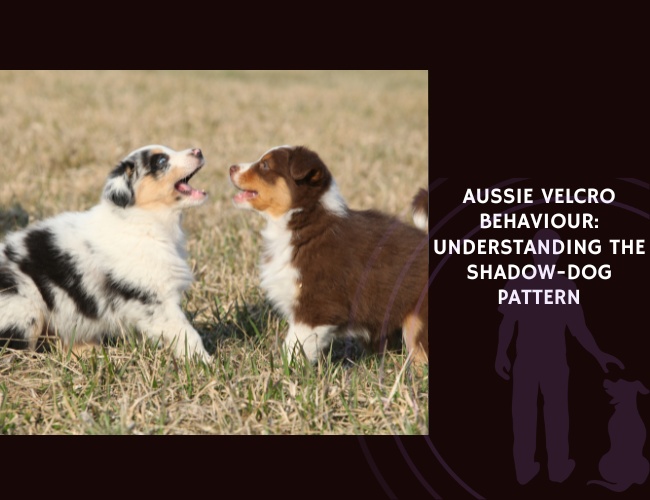
Have you ever noticed your Australian Shepherd following you from room to room, lying at your feet wherever you settle, and seemingly anticipating your every move? You’re not alone. This distinctive pattern, affectionately termed “Velcro behaviour” or the “shadow-dog pattern,” is one of the most recognizable characteristics of the breed. But what drives this intense proximity-seeking? Is it pure devotion, working instinct, or something more complex?
Understanding this behaviour requires us to explore the fascinating intersection of genetics, cognition, and emotional bonding. Your Aussie’s tendency to follow isn’t simply about being clingy or needy. It’s a sophisticated expression of their herding heritage, their unique cognitive architecture, and their profound capacity for attachment. Let’s explore the science and soul behind why your Australian Shepherd becomes your constant companion, and how to nurture this connection in ways that support both your wellbeing and theirs.
The Working Heritage: Where the Shadow Begins
To understand your Aussie’s shadow-dog behaviour, we must first journey back to the pastures and ranches where this breed was forged. Australian Shepherds weren’t developed to be lap dogs or casual companions. They were created for demanding, dynamic work that required constant vigilance, sophisticated decision-making, and an almost telepathic connection with their handler.
The Herding Blueprint
The core tasks of a herding dog involve a continuous, dynamic dance with livestock. Your Aussie’s ancestors performed four essential functions that have become deeply embedded in their behavioural architecture:
Key herding behaviors that translate to shadow-dog patterns:
- Flanking: Moving around the perimeter of the flock to gather or direct them, demanding acute spatial awareness and the ability to track multiple moving targets simultaneously. When your Aussie circles around you in the kitchen or moves to position themselves between you and the door, they’re applying this same strategic positioning.
- Following: Staying behind or alongside the flock, guiding them forward with precise distance management. A skilled herding dog maintains just the right amount of space—close enough to influence, far enough to allow movement. You might notice this when your Aussie trails a few steps behind you through the house, adjusting their pace to match yours perfectly.
- Blocking: Intercepting individual animals to change direction or prevent straying. This involves reading movement cues and anticipating trajectories. When your Aussie steps into your path or positions themselves strategically in doorways, they’re demonstrating this deeply ingrained behaviour pattern.
- Close surveillance: Perhaps the most relevant to shadow-dog behaviour. Herding dogs must continuously monitor their charges for any signs of deviation, distress, or potential threats. This state of hyper-vigilance, of reading and responding to subtle cues, becomes second nature. In your home, you have become the singular focus of this surveillance system.
From Flock to Family
When you bring an Australian Shepherd into your home, something remarkable happens. Their sophisticated herding protocols don’t simply switch off—they redirect. You become “the flock,” and your Aussie’s brain applies the same strategies developed over generations of working dogs.
This isn’t merely companionship or affection in the conventional sense. It’s the application of a deeply embedded working protocol to their primary social unit. Your movements through the house trigger the same neural pathways that once activated when a sheep strayed from the group. Your shift from couch to kitchen initiates the same predictive processing that determined where a flock would move next.
This genetic wiring means your Aussie’s brain is constantly scanning for and interpreting movement cues. Your posture shifts, eye movements, hand gestures, and changes in walking pace become critical data points for processing. They’re not just observing—they’re predicting your next action, often with remarkable accuracy. 🧠
Distance Management in Domestic Spaces
Historically, herding dogs exercised distance-modulated control. They needed proximity to exert influence and apply pressure, but also distance to allow natural movement and maintain perspective. This required sophisticated understanding of personal space and influence zones.
In a domestic environment, particularly indoors, the entire concept of “working distance” transforms. The vast pasture becomes a living room. The sprawling flock becomes a single human. Your Aussie’s instinct to maintain control and surveillance, combined with these limited spatial options, naturally leads to much closer physical proximity.
Why domestic spaces intensify proximity-seeking:
- Reduced working distance: There’s no expansive field to manage—your “flock” is often just a few feet away, eliminating the need for distance-based influence.
- Intensified focus: With fewer external stimuli compared to a working environment (no other livestock, predators, or environmental challenges), you become the singular, most salient target for their herding instincts.
- Lack of natural outlets: Without actual herding tasks to perform, the innate drive to manage movement and proximity finds its expression in managing your movement through daily domestic routines.
- Confined spatial parameters: Indoor spaces limit the physical distance available, forcing adaptation of distance-modulated control into closer-range surveillance.
Therefore, the modern tendency to stay physically close indoors isn’t an abandonment of distance-modulated control—it’s an adaptation to a confined, human-centric environment. Your Aussie is still attempting to “manage” movement, but the parameters have compressed to the immediate vicinity of your presence.
Attachment or Motion Surveillance? Decoding the Drive
Understanding the shadow-dog pattern requires disentangling two intertwined threads: emotional attachment and innate motion surveillance. It’s rarely one or the other, but rather a complex, fascinating interplay that reveals the sophisticated nature of canine cognition.
The Motion Fixation Factor
Is your Aussie’s Velcro behaviour always rooted in attachment? Not necessarily. While a strong bond is typically present, a significant component is frequently driven by motion fixation and herding cognition.
Australian Shepherds are highly visually oriented and extraordinarily sensitive to movement. A human moving from one room to another, standing up from a chair, or even shifting position on the couch can trigger an automatic response to track and follow. This is hardwired sensory input that demands attention, much like a sheep breaking from the flock once triggered immediate action.
Their brains are wired for predictive processing related to movement. Following isn’t just about being near—it’s about gathering data, anticipating, and potentially influencing. This cognitive engagement can occur even without deep emotional need in that specific moment. You might notice your Aussie following a visiting friend through your home, not out of attachment to that person, but from an instinct to monitor and manage movement within perceived territory.
Cognitive Engagement vs. Emotional Need
When your Aussie follows you to the bathroom for the third time today, multiple factors may be at play:
The cognitive layers of following behavior:
- Prediction drive: Their brain is engaged in anticipating your next move. Where will you go after the bathroom? This predictive processing is inherently rewarding for their cognitive architecture.
- Control impulse: There’s a subtle drive to influence or at least maintain awareness of your trajectory, even without actual herding to perform.
- Pattern management: Your Aussie may be constructing and maintaining a mental map of your movement patterns throughout the day, fulfilling their instinct for environmental management.
- Emotional connection: Genuine attachment and the desire for proximity play significant roles, but they operate alongside these cognitive drives rather than as the sole explanation.
This distinction matters tremendously for training and management. If you only address the emotional component through reassurance or affection, you might miss the cognitive needs driving the behaviour.
The Eye-Stalk Connection
One particularly telling behaviour is the “eye-stalk” posture. You might notice your Aussie lying with their head up, eyes fixed intently on you, body oriented in your direction even when resting. This isn’t just watching—it’s active cognitive processing.
The eye-stalk evolved as a crucial component of herding work, where the dog uses focused eye contact to exert pressure and influence livestock movement. In the domestic setting, this translates to constant visual monitoring. Your Aussie maintains this vigilant posture even during supposed rest periods, processing micro-movements and anticipating your next action.
This behaviour reveals that for many Aussies, “relaxation” in human presence isn’t truly restful—it’s a modified working state. Their body may be still, but their mind remains engaged in surveillance and prediction. Understanding this helps explain why some Australian Shepherds struggle with genuine settling and why proximity doesn’t necessarily equal relaxation.
When Companionship Becomes Clinginess: Reading the Signs
While the shadow-dog pattern is natural for Australian Shepherds, there’s an important distinction between healthy companionship and stress-driven, problematic clinginess. Recognizing where your Aussie falls on this spectrum is essential for their emotional wellbeing and your mutual quality of life.
Markers of Healthy Proximity
Healthy shadow behaviour has several key characteristics that distinguish it from problematic clinginess:
Signs your Aussie’s proximity is balanced and healthy:
- Genuine rest while near you: Their body is relaxed, breathing is regular, and they occasionally shift attention away from you to their surroundings. They’re present but not vigilant.
- Tolerance of brief separations: When you move to another room momentarily, they might look up or shift position but don’t immediately follow or show signs of anxiety.
- Responsive rather than insistent proximity: They come when called and enjoy being near you, but they don’t demand constant attention through pawing, nudging, or vocalizing.
- Environmental awareness beyond you: They’ll investigate sounds, play with toys, or observe passing wildlife even while staying relatively close to your location.
- Calm transitions: Movement between activities or spaces occurs smoothly without escalation in arousal or anxiety levels.
Red Flags of Anxious Attachment
Problematic clinginess often manifests through concerning patterns that signal underlying anxiety or stress:
Warning signs of anxiety-driven shadow behavior:
- Insistent pawing or nudging: Repeatedly making physical contact even after acknowledgment, as if seeking constant reassurance that you’re aware of their presence.
- Pathway blocking: Positioning themselves directly in your path, making movement difficult. This goes beyond spatial awareness and becomes an attempt to control or restrict your movement.
- Whining or vocalizing during separation: Even brief departures to another room trigger distressed vocalizations, suggesting inability to emotionally regulate without your presence.
- Inability to settle: Even when lying near you, remaining tense with rapid breathing, rigid body posture, or constant shifting, struggling to genuinely relax despite proximity.
- Pre-departure anxiety: Recognizing cues that you’re preparing to leave (picking up keys, putting on shoes) and becoming increasingly agitated, sometimes attempting to follow you out the door or blocking your exit.
- Redirected herding behaviors: During stressful moments, nipping at heels, circling frantically, or barking insistently—herding behaviors intensified by anxiety rather than working drive.
- Hypervigilance during rest: Maintaining constant eye contact and rigid alertness even during designated calm periods, unable to truly disengage mentally.
The Stress-Response Connection
For some Australian Shepherds, shadow behaviour becomes a stress-response mechanism rather than a natural expression of attachment. You might notice increased following during these situations:
Triggers that intensify anxiety-driven proximity seeking:
- Environmental changes or routine disruptions: New furniture, houseguests, or schedule alterations create uncertainty, causing your Aussie to monitor you more intensely for behavioral cues.
- Social tension in the household: Arguments, stressed family members, or interpersonal conflict get picked up by your highly perceptive dog, leading to increased vigilance and proximity-seeking as they attempt to manage the emotional atmosphere.
- Insufficient mental or physical stimulation: When working drive remains unfulfilled, that energy redirects into managing your movements as a substitute task or “self-appointed job.”
- Previous experiences of abandonment or rehoming: Any history of loss or transition can create lasting hypervigilance, where your Aussie feels they must constantly monitor you to prevent another separation.
- Changes in family structure: New babies, departing family members, or loss of companion animals can destabilize your dog’s sense of security, increasing proximity-seeking behaviors.
Understanding whether your Aussie’s shadow behaviour stems from healthy bonding or anxiety-driven need helps determine the most effective approach to management and training.
The Neurological Architecture of Attachment
To truly understand Velcro behaviour in Australian Shepherds, we must explore the neurological foundations of attachment and how this breed’s unique cognitive architecture shapes their bonding patterns. This isn’t abstract theory—it’s the biological reality underlying your daily interactions with your shadow companion.
Oxytocin and the Bonding Cascade
The attachment between you and your Aussie is mediated by complex neurochemical processes. Oxytocin, often called the “bonding hormone,” plays a central role. When you make eye contact, speak in gentle tones, or engage in physical affection with your dog, both your brains release oxytocin, creating a positive feedback loop that reinforces proximity-seeking.
For Australian Shepherds, this system appears particularly sensitive. Research on herding breeds suggests they may have heightened oxytocin responsiveness, which makes sense given their historical need to work in close partnership with human handlers. This neurochemical sensitivity means your Aussie doesn’t just enjoy your company—they experience profound biochemical reinforcement for being near you.
This creates what we might call a “NeuroBond” effect, where repeated positive interactions literally wire your dog’s brain to associate your presence with safety, reward, and emotional regulation. Over time, this neural pathway becomes so strong that separation triggers stress responses, while proximity triggers calming, regulatory effects.

Amygdala Sensitivity and Hypervigilance
The amygdala, your dog’s emotional processing center, plays a crucial role in threat detection and anxiety responses. In Australian Shepherds, particularly those with anxious attachment patterns, the amygdala may become hypersensitive to separation cues.
When your Aussie notices subtle signs that you’re preparing to leave—reaching for keys, changing shoes, picking up a bag—their amygdala processes these as potential threats to their security. This triggers a cascade of stress hormones (primarily cortisol and adrenaline) that drive increased proximity-seeking, vocalization, or blocking behaviours.
What’s fascinating is that this hypersensitivity can develop even in dogs without traumatic histories. The combination of breed-typical vigilance, individual temperament, and inadvertent reinforcement of anxious behaviours can sensitize the amygdala over time.
Predictive Processing and Control
Your Aussie’s prefrontal cortex—the brain region responsible for planning, decision-making, and impulse control—is highly developed compared to many breeds. This cognitive sophistication means they’re constantly engaged in predictive processing.
When you stand up from your desk, your Aussie’s brain doesn’t just register the movement—it predicts a sequence of possible outcomes. Will you go to the kitchen? The door? Another room? This predictive processing is cognitively engaging and, for a working breed, inherently satisfying. The act of predicting, monitoring, and responding provides mental stimulation.
However, this same cognitive capacity can become problematic when coupled with anxiety. An anxious Aussie with strong predictive abilities may develop elaborate anticipatory behaviours, showing stress responses not just when you leave, but when they predict you might leave based on subtle contextual cues.
Dopamine and the Reward Circuit
Dopamine, the neurotransmitter associated with motivation and reward, significantly influences shadow behaviour. Each time your Aussie successfully “manages” your movement—following you to the kitchen and receiving attention, blocking your path and getting acknowledgment—their dopamine system reinforces this behaviour.
For intelligent, driven breeds like Australian Shepherds, solving puzzles and achieving goals triggers dopamine release. Your movements become puzzles to predict and manage. Your acknowledgment becomes the reward. Over time, this creates a self-reinforcing cycle where following and monitoring become intrinsically rewarding activities.
This neurological reality explains why simply ignoring shadow behaviour often isn’t sufficient to reduce it. The behaviour has become rewarding at a neurochemical level, independent of external reinforcement. Effective intervention requires redirecting this drive rather than attempting to extinguish it. 🧠
How Human Behaviour Shapes the Shadow Pattern
While genetics and neurology provide the foundation for Velcro behaviour, the way you respond to your Aussie profoundly shapes whether this natural tendency develops into healthy companionship or problematic dependency. Often without realizing it, we create patterns that either support emotional regulation or inadvertently intensify anxious attachment.
The Inconsistency Trap
One of the most powerful reinforcers of anxious shadow behaviour is inconsistency in your responses and boundaries. Consider these common scenarios:
Sometimes you allow your Aussie on the couch while you work, other times you ask them to go to their bed. Sometimes you permit following into the bathroom, other times you close the door. Sometimes you leave without much acknowledgment, other times there’s an elaborate goodbye ritual.
For a breed as intelligent and observant as the Australian Shepherd, this inconsistency creates profound uncertainty. If they can’t predict when proximity will be welcomed or rejected, when you’ll return or be gone for hours, they default to constant monitoring as an attempt to gather more data and regain predictability.
This uncertainty is cognitively and emotionally exhausting. Your Aussie can’t relax because the “rules” keep changing. The only reliable strategy becomes hypervigilance—watching for cues, following to maintain awareness, and attempting to control situations to reduce unpredictability.
Establishing consistent boundaries doesn’t mean being rigid or unkind. It means creating clear, predictable patterns that allow your dog to understand expectations and feel secure in the structure you’ve created.
Verbal Overload and Continuous Engagement
Many well-intentioned owners maintain constant verbal engagement with their Aussie—narrating their actions, providing running commentary, asking questions, or offering reassurance throughout the day. While communication is important, continuous verbal interaction can actually increase anxious shadow behaviour.
When you constantly talk to your dog, you train them to expect continuous engagement. Silence becomes unusual, potentially concerning. Your Aussie learns they should always be attending to you, always listening, always ready to respond. This prevents them from developing the capacity to settle independently and self-regulate emotionally.
Moreover, excessive verbal reassurance during anxious moments—”It’s okay, I’ll be back soon, don’t worry”—can inadvertently reinforce anxiety by signalling that there is indeed something to worry about. Your tone and energy communicate more than your words.
The Invisible Leash concept reminds us that genuine connection doesn’t require constant verbal confirmation. Dogs communicate primarily through energy, body language, and consistent patterns. Learning to be present with your Aussie without constant verbal engagement actually deepens your bond while supporting their emotional independence.
Emotional Transfer and Energy
Australian Shepherds are remarkably attuned to human emotional states. Your stress, anxiety, excitement, or calm directly influences your dog’s emotional regulation. When you’re anxious about leaving, rush through departures, or return home with excessive excitement, you create emotional volatility that your Aussie absorbs and responds to.
Consider the typical departure scenario: You’re running late, feeling guilty about leaving your dog, and this internal conflict manifests in your energy. You might move quickly, speak in unusual tones, or give extra attention to compensate for your guilt. Your Aussie reads all of this as confirmation that departures are indeed stressful, significant events worthy of concern.
Similarly, reunion excitement—while emotionally gratifying—can reinforce the message that separations are dramatic, significant events. The greater the reunion celebration, the more importance your dog places on your departures and returns.
Creating emotional neutrality around transitions is one of the most powerful tools for reducing anxious attachment. This doesn’t mean being cold or distant—it means maintaining calm, consistent energy that communicates departures and returns are normal, unremarkable parts of daily life.
Reinforcing Attention-Seeking
Every time you respond to a paw on your leg, a nudge to your hand, or insistent staring by giving attention, you reinforce the effectiveness of these strategies. Your Aussie learns that physical contact and persistent demands successfully achieve their goal: your engagement.
This creates what behaviorists call a “variable reinforcement schedule”—sometimes you respond immediately, sometimes after several attempts, sometimes you redirect them. Variable reinforcement is actually more powerful than consistent reinforcement because it creates hope that persistence will eventually pay off.
Over time, your Aussie becomes increasingly creative and persistent in their attention-seeking. They might escalate from gentle paws to more insistent nudging, add vocalizations, or develop elaborate sequences designed to capture your attention. Each successful attempt strengthens the neural pathways associating these behaviours with reward.
The solution isn’t to ignore your dog completely—that can damage your bond and increase anxiety. Instead, it involves teaching them to request attention appropriately and rewarding calm, patient waiting rather than insistent demanding. This preserves connection while supporting emotional regulation and impulse control.
Checking In and Constant Monitoring
Do you frequently look at your Aussie, call their name just to see their response, or acknowledge their presence even when they’re resting quietly? These seemingly innocuous interactions can create a reciprocal surveillance loop.
When you constantly monitor your dog, checking on them even when they’re settled, you send the message that constant mutual awareness is expected. Your Aussie learns that you’re always watching them, which reinforces their belief that they should always be watching you. This prevents both of you from experiencing genuine, independent relaxation even while sharing space.
Creating moments of parallel presence—where you’re both in the same space but not actively engaged with each other—teaches your Aussie that proximity doesn’t require constant interaction. You can be near without being “on,” present without being vigilant. This is actually a profound expression of secure attachment: the ability to simply exist together without constant confirmation of the bond.
Attached. Alert. Aligned.
Shadowing is strategy. Your Australian Shepherd isn’t being clingy—they’re positioning, observing, and guarding you with the same precision once used to guide livestock.
Proximity is communication. Following, blocking, and flanking are not habits, but inherited protocols—expressions of attachment shaped by purpose.



Closeness creates clarity. In the quiet space at your heels, the Aussie finds alignment—not obedience, but connection.
Structured Approaches: From Anxious Surveillance to Mindful Partnership
Transforming problematic shadow behaviour requires more than understanding its origins—it demands practical, structured interventions that respect your Aussie’s intelligence and working heritage while supporting healthier emotional patterns. These approaches, rooted in clear communication and purposeful engagement, can shift anxious surveillance into confident partnership.
The Foundation: Emotional Clarity Through Routine
Before implementing specific training techniques, establish foundational emotional clarity through predictable routines. Your Aussie’s intelligence means they’re constantly analyzing patterns and predicting outcomes. When you provide consistent, predictable structure, you dramatically reduce the cognitive burden of uncertainty.
Essential routine elements that reduce anxiety-driven monitoring:
- Consistent feeding times: Same times daily, same location, same process. This anchors your dog’s day with reliable, pleasurable events they can anticipate.
- Regular exercise and stimulation: Predictable walking times, training sessions, and play periods that your Aussie can count on. Knowing when mental and physical needs will be met reduces anxiety.
- Designated rest periods: Scheduled quiet times where both you and your dog engage in calm, independent activities, teaching that downtime is normal and expected.
- Clear transition cues: Consistent verbal markers or rituals that precede changes (“Time for work,” “Evening routine,” “Settling time”). These allow your Aussie to anticipate and prepare for transitions rather than being startled by sudden changes.
- Predictable departure and return patterns: Regular work schedules or outing times that follow consistent patterns, reducing uncertainty about when you’ll leave and return.
When your dog can predict the rhythm of daily life, they don’t need constant surveillance to manage uncertainty. Mental energy previously devoted to anxious monitoring can redirect toward genuine rest and engagement in activities beyond managing your movements.
🐾 Understanding Aussie Velcro Behaviour 🐾
The Shadow-Dog Pattern: From Herding Instinct to Mindful Partnership
Phase 1: Genetic Foundations
Understanding the Herding Blueprint
The Working Heritage
Australian Shepherds were bred for demanding herding work requiring constant vigilance and sophisticated decision-making. Their cognitive architecture is designed for four core tasks:
• Flanking: Moving strategically around their “flock”
• Following: Maintaining precise distance control
• Blocking: Intercepting and redirecting movement
• Close surveillance: Continuous monitoring and prediction
What This Means for Your Home
When you bring an Aussie home, you become “the flock.” Their herding protocols don’t switch off—they redirect. Your movements through the house trigger the same neural pathways that once activated when livestock strayed. This isn’t clinginess; it’s the application of deeply embedded working instincts to their primary social unit.
Phase 2: The Neurological Drive
Brain Chemistry Behind the Bond
The NeuroBond Effect
Oxytocin-driven bonding creates a positive feedback loop where proximity triggers reward chemicals. Australian Shepherds appear to have heightened oxytocin responsiveness, making your presence profoundly biochemically rewarding. Their amygdala processes separation cues as potential threats, while their sophisticated prefrontal cortex constantly predicts your next move.
Motion Fixation vs. Attachment
Your Aussie’s following isn’t always about emotional need. Motion fixation triggers automatic tracking responses. Their visually-oriented brain processes your standing up or moving rooms as data requiring response—much like a sheep breaking from the flock. This cognitive engagement occurs alongside, not instead of, genuine attachment.
Phase 3: Recognizing the Difference
Healthy Companionship vs. Anxious Clinginess
Signs of Healthy Proximity
• Genuine rest while near you—relaxed body, regular breathing
• Tolerance of brief separations without distress
• Responsive rather than insistent proximity
• Environmental awareness beyond just monitoring you
• Calm transitions between activities and spaces
Red Flags of Anxious Attachment
• Insistent pawing or nudging even after acknowledgment
• Pathway blocking to control your movement
• Whining during brief separations
• Inability to settle despite proximity
• Pre-departure anxiety when recognizing leaving cues
• Hypervigilance during supposed rest periods
Phase 4: Human Impact
How Your Behavior Shapes the Pattern
Common Reinforcement Traps
Inconsistent boundaries create profound uncertainty. When rules about proximity constantly change, your Aussie defaults to hypervigilance. Continuous verbal engagement prevents independent settling. Emotional transfer during departures—rushing, guilt, anxiety—confirms that leaving is indeed stressful. Variable reinforcement of attention-seeking makes the behavior stronger, not weaker.
Creating Emotional Clarity
Establish consistent routines for feeding, exercise, rest, and transitions. Maintain calm, neutral energy during departures and arrivals. Allow parallel presence—being together without constant interaction. Through the Invisible Leash principle, genuine connection transcends constant verbal confirmation.
Phase 5: Calm-Follow Training
Permission-Based Movement
The Invisible Leash Method
Teach distinct cues for invited following (“With me”) versus staying (“Place,” “Wait”). Practice low-stakes transitions with brief separations, gradually increasing duration. Introduce lead-in movement cues—announce transitions before they happen. Reward calm decision-making, especially when your Aussie chooses to remain settled as you move.
Building Confident Distance
Visual check-ins replace physical proximity—reward eye contact from a distance. Practice cooperative movement at varying distances with clear markers. Threshold work builds impulse control at doorways. Distance becomes a choice you guide, not a compulsion they fulfill.
Phase 6: Channeling Working Drive
From Surveillance to Collaboration
Purposeful Activities
Transform walks into pattern work with heel training and pace changes. Assign daily tasks—”Bring me your leash,” “Find your bowl,” “Help carry this.” Scent work and search games engage focus intensely while teaching independent work. Cooperative care routines build partnership through participation.
Cognitive Enrichment
Puzzle feeders transform feeding into 20-minute cognitive challenges. Rotate toys weekly to maintain novelty. Regular exposure to new environments satisfies curiosity. Continuous training challenges provide accomplishment satisfaction. Mental stimulation is often more impactful than physical exercise for reducing shadow behavior.
Phase 7: Building Separation Confidence
Independence Through Graduated Exposure
Micro-Separation Protocol
Start with separations so brief they precede anxiety—sometimes just three seconds behind a door. Create predictable pre-separation cues that reliably predict return. Vary duration unpredictably to prevent time-based anxiety. Maintain departure and return neutrality—no emotional fanfare that amplifies significance.
Rewarding Voluntary Distance
When your dog spontaneously settles away from you, quietly acknowledge with calm reward delivery. Place high-value items in their bed when you leave—distance becomes associated with good things appearing. Teach a “go away” cue that empowers voluntary movement. Practice being in different rooms while home to normalize spatial separation.
Managing Departure Cues
Desensitize triggers by performing departure actions without leaving—pick up keys and sit down, put on shoes and work at your computer. Create false departures where you complete your routine, leave briefly, and immediately return. Randomize preparation sequences to reduce predictive anxiety.
Phase 8: Sustainable Partnership
Living Successfully with Your Shadow
Acceptance and Adaptation
Some shadow behavior will remain—this isn’t failure, it’s acceptance of breed characteristics. The goal isn’t eliminating awareness of you, but ensuring it expresses in healthy ways. Embrace appropriate closeness. Adapt your environment with strategic placement of beds and visual barriers. Build flexibility through controlled variability in routines.
Sustainable Routines
Maintain daily structure while incorporating weekly variation. Regular social activities beyond the human-dog dyad provide enrichment. Your emotional wellbeing directly affects your dog—maintaining your own routine and stress management creates the calm foundation your Aussie needs for emotional regulation.
When to Seek Professional Support
Severe separation anxiety, aggression linked to proximity, or lack of progress after 8-12 weeks warrants professional consultation. Veterinary behaviorists, certified trainers, and separation anxiety specialists provide essential support when needed.
🔍 Shadow Behavior Across Different Contexts
Puppyhood (0-6 months)
Pattern: Natural proximity-seeking for security and attachment formation.
Approach: Support healthy bonding while preventing anxious dependency from developing early.
Adolescence (6-18 months)
Pattern: Intensified following as dog navigates role uncertainty and relationship dynamics.
Approach: Consistent structure is crucial—this period establishes long-term patterns.
Maturity (2-7 years)
Pattern: Behavioral stability—shadow patterns established by now tend to persist without intervention.
Approach: Focus on refining and maintaining healthy patterns through consistent routines.
Senior Years (7+ years)
Pattern: May increase proximity-seeking due to sensory decline or cognitive changes.
Approach: Compassionate accommodation while monitoring for health-related causes.
High-Drive Temperament
Pattern: Exceptionally intense shadow behavior driven by working drive and cognitive intensity.
Approach: Requires more structured outlets, purpose-based tasks, and mental challenges.
Rescue/Rehomed Dogs
Pattern: Often display hypervigilance and anxiety-driven clinginess from past abandonment experiences.
Approach: Patient, gradual confidence-building with emphasis on predictability and security.
⚡ Quick Reference: The Shadow-to-Partnership Formula
Emotional Clarity (Predictable Routines) + Permission-Based Movement (Invited vs. Stay Cues) + Purpose-Based Tasks (Daily Jobs & Mental Challenges) + Gradual Separation (Micro-Exposures) = Mindful Proximity instead of Anxious Surveillance
Remember: The goal isn’t eliminating following—it’s transforming compulsive surveillance into confident partnership. Your Aussie’s awareness of you is a gift when channeled wisely.
🧡 The Zoeta Dogsoul Perspective 🧡
Through the NeuroBond approach, we recognize that shadow behavior emerges from the intersection of neurological architecture, genetic heritage, and profound attachment. The Invisible Leash teaches us that genuine connection transcends physical proximity—awareness becomes cooperation, surveillance transforms into partnership. In moments of Soul Recall, when your Aussie rests peacefully nearby without vigilance, or tolerates your departure with calm confidence, you witness the deepest expression of secure attachment.
This is where science meets soul—where understanding cognitive drives and emotional needs allows us to honor the working heritage of Australian Shepherds while supporting their capacity for emotional regulation and confident independence. The most profound partnerships aren’t measured by constant proximity, but by mutual trust, clear communication, and the peaceful knowledge that you truly belong together.
© Zoeta Dogsoul – Where neuroscience meets soul in dog training
Calm-Follow Training: Teaching Regulated Proximity
Structured calm-follow training addresses shadow behaviour at its source by teaching your Aussie that proximity can be cooperative rather than compulsive, mindful rather than anxious.
Steps for implementing permission-based following:
- Establish clear verbal cues: Create distinct markers for invited following (“With me,” “Come along”) versus staying put (“Stay,” “Wait,” “Place”). Your Aussie learns that not every movement triggers a need to follow.
- Practice low-stakes transitions: Throughout your home, stand, give a “Stay” cue, move to another visible location, wait three seconds, return and reward. Gradually increase distance and duration.
- Introduce lead-in movement cues: Before transitions, give your dog advance notice: “I’m going to the kitchen now,” paired with either an invitation to follow or a cue to stay. This prevents reactive following by allowing processing time.
- Reward calm decision-making: When your Aussie chooses to remain settled while you move, quietly acknowledge this with calm praise or a treat delivered to their location. You’re reinforcing that not following can be just as rewarding as following.
- Build duration gradually: Start with movements to visible locations for seconds, then progress to different rooms for minutes, building your dog’s tolerance incrementally.
The goal isn’t preventing following entirely—that would contradict your dog’s nature. Instead, you’re teaching that following is a choice you guide, not an compulsion they must fulfill. This distinction transforms the quality of your Aussie’s proximity from anxious to intentional.
The Invisible Leash: Awareness-Based Distance
The Invisible Leash training methodology teaches your Australian Shepherd to maintain comfortable, flexible distance without physical tethering or constant commands. This approach respects their need for awareness while reducing obsessive proximity.
Core Invisible Leash exercises for building confident distance:
- Visual check-ins: Teach your Aussie to check in with eye contact rather than physical proximity. Reward the moment they look to you while maintaining distance, satisfying their surveillance drive while encouraging spatial independence.
- Distance variations: Practice movement at varying distances—sometimes close at heel, sometimes several feet behind or beside, sometimes in a different room but within audible range. Use clear markers to indicate desired distance (“Close,” “Free,” “Back”).
- Cooperative movement patterns: Rather than simple following, teach matching your pace, pausing when you pause, and adjusting direction based on your movement. This engages predictive processing in structured, purposeful ways.
- Threshold work: Practice transitions through doorways where your dog waits for permission to follow, building impulse control and reinforcing that movement through space is cooperative, not automatic.
- Distance-based rewards: Periodically reward your dog for maintaining appropriate distance during activities, reinforcing that space between you is acceptable and even desirable.
The Invisible Leash creates a sense of connection that transcends physical proximity. Your Aussie learns they can maintain awareness and partnership without being glued to your side, developing confidence in distance while preserving the bond.

Purpose-Based Engagement: Channeling Working Drive
One of the most effective ways to reduce anxious shadow behaviour is providing legitimate outlets for your Aussie’s working drive. When their intelligence and herding instincts find purposeful expression, the need to create self-appointed jobs (like constant surveillance) diminishes.
Purposeful activities that redirect working drive positively:
- Pattern walking: Transform daily walks into cognitive exercises with heel work, changes of pace, about-turns, and attention work. Your Aussie focuses on the task rather than simply accompanying you, satisfying both physical and mental needs while teaching regulated, purposeful proximity.
- Task assignments: Give specific jobs throughout the day—”Bring me your leash,” “Find your bowl,” “Get your toy,” or “Help carry this.” These assignments provide purpose and accomplishment, redirecting intelligence away from monitoring you toward collaborative tasks.
- Scent work and search games: Hide treats or toys throughout your home and teach your Aussie to search on cue. This engages focus intensely while teaching independent work away from your direct presence.
- Structured training sessions: Regular training—even teaching simple tricks—provides mental engagement and reinforces your role as leader and guide, reducing the need for self-management through herding behaviors.
- Cooperative care routines: Transform grooming, nail care, and health checks into cooperative activities where your Aussie actively participates. Teaching them to offer a paw, hold still, or move into position builds partnership while reinforcing trust.
When you provide purpose-based engagement, you tap into your Australian Shepherd’s deepest satisfaction—working alongside their human partner toward meaningful goals. This transforms their relationship with proximity from anxious management to collaborative presence.
Place Training and Settle Protocols
Teaching your Aussie to go to a designated place and settle there independently is one of the most valuable skills for managing shadow behaviour. This creates structured separation within shared space.
Building a reliable place command:
- Establish a designated “place”: Choose a mat, bed, or specific location that becomes your dog’s settling spot. This should be comfortable and located where they can still see you but aren’t directly adjacent.
- Build positive associations: Begin by rewarding your Aussie for simply being on their place—even for a few seconds. Use high-value treats and calm praise. Gradually increase duration before rewards.
- Add the verbal cue: Pair a consistent cue (“Place,” “Settle,” “Bed”) with the behavior once your dog reliably goes to the location. Practice sending from increasing distances.
- Incorporate into daily routines: Use the place cue during meals, when you’re working, during household tasks, and whenever you need your dog to settle independently. This normalizes the behavior as part of daily life.
- Practice calm departures from place: Once your dog settles reliably, practice brief departures—stepping into another room briefly, then returning before any anxiety develops. Gradually increase duration and distance.
- Reward duration and calmness: Focus on rewarding genuine settling—relaxed body, steady breathing, and calm demeanor—rather than just physical presence on the mat.
The place command becomes a psychological anchor for your Aussie. It’s not a punishment but rather a clear, predictable expectation that reduces decision-making burden and provides structure during times when following isn’t appropriate. 🧡
Environmental Management and Enrichment
Beyond direct training, how you structure your Aussie’s environment and daily enrichment significantly impacts shadow behaviour. Creating conditions that support independent engagement and emotional regulation reduces reliance on constant proximity for stimulation or security.
Creating Zones of Independence
Rather than allowing free-roaming access throughout your home at all times, consider creating structured zones that encourage independent activity:
Enrichment areas: Designate spaces with puzzle toys, chews, and engaging objects where your Aussie can occupy themselves. These zones become associated with solo activity and self-entertainment.
Visual barriers: Strategic use of baby gates or partially closed doors creates gentle separation without complete isolation. Your dog can still hear and occasionally see you, reducing anxiety while preventing constant physical following.
Elevated perspective spots: Many Australian Shepherds enjoy having a location where they can observe household activity from a comfortable vantage point. A raised bed or designated perch near (but not in) the main living area allows surveillance without intrusive proximity.
Outdoor access: If safely available, access to a secure yard or patio provides alternative space for your Aussie to occupy. The enrichment of outdoor sounds, smells, and visual stimulation can reduce fixation on indoor human movement.
Cognitive Enrichment Strategies
Mental stimulation is absolutely crucial for reducing anxious shadow behaviour in Australian Shepherds. An understimulated Aussie will inevitably redirect their considerable intelligence toward managing their environment—including you.
Effective mental enrichment that reduces proximity fixation:
- Puzzle feeders and food toys: Dispensing meals through puzzle toys, slow feeders, or snuffle mats transforms feeding into a 15-30 minute cognitive challenge rather than a 30-second consumption event.
- Rotating toy selection: Rather than leaving all toys available constantly, rotate them weekly. This maintains novelty and interest, preventing habituation and boredom.
- Novel experiences: Regular exposure to new environments, surfaces, objects, and situations—even brief car rides to different locations—provides mental enrichment that satisfies curiosity and reduces boredom.
- Continuous training challenges: Keep teaching new skills, even seemingly “useless” tricks. The process of learning engages your Aussie’s brain and provides accomplishment satisfaction independent of shadowing you.
- Social enrichment: Appropriate interactions with other dogs, people, or controlled exposure to novel animals (safely observing from distance) provides social cognitive stimulation beyond the human-dog dyad.
- Problem-solving games: Hide-and-seek with toys, name recognition games where your dog must select specific items, or “which hand” guessing games engage cognitive processing.
Physical Exercise Requirements
While mental stimulation is often more impactful than physical exercise for reducing shadow behaviour, Australian Shepherds still require significant physical activity. However, the type and quality of exercise matters more than sheer quantity.
Structured exercise: Purposeful activities like agility training, herding lessons, or dock diving engage mind and body simultaneously, providing deeper satisfaction than simply running in circles.
Variable terrain walking: Walking on different surfaces and through varied environments provides richer sensory input and physical challenges compared to the same route daily.
Play with purpose: Rather than random fetch, teach your Aussie to fetch specific items, return objects to designated locations, or participate in hide-and-seek games that combine physical activity with problem-solving.
Decompression time: After intense exercise or stimulating experiences, your Aussie needs time to process and settle. Create opportunities for post-exercise rest in their independent space rather than immediately engaging them again.
Managing Arousal and Over-Stimulation
Interestingly, excessive stimulation or excitement can actually increase anxious shadow behaviour. An overstimulated Australian Shepherd struggles with emotional regulation and may become more clingy or demanding as they seek help managing their arousal state.
Calm interactions: Default to calm, measured responses to your dog rather than high-energy excitement. This models emotional regulation.
Down-regulation practice: After any exciting activity, deliberately guide your Aussie through calming exercises—slow walking, gentle massage, or simple settle work—teaching them to shift gears.
Avoid chaotic environments: Recognize when your dog is becoming overwhelmed and provide breaks or removal from situations that push them beyond their capacity to self-regulate.
Sleep and rest: Australian Shepherds often need 12-14 hours of sleep daily, yet their vigilant nature may prevent adequate rest. Creating dark, quiet rest spaces and actively encouraging daytime naps supports nervous system regulation.
When you thoughtfully structure your Aussie’s environment and enrichment, you remove many of the conditions that fuel anxious shadow behaviour. Your dog develops confidence in independent activity, finds satisfaction in solo problem-solving, and learns that security doesn’t require constant proximity monitoring.
Separation Training: Building Confidence in Distance
For Australian Shepherds with pronounced shadow patterns, deliberate separation training becomes essential. This isn’t about creating distance for its own sake—it’s about building your dog’s confidence that they can regulate emotionally without your constant presence and that your departures predict reliable returns.
The Gradual Exposure Approach
Successful separation training operates on a principle of gradual, systematic exposure that never exceeds your dog’s current capacity to remain calm. Pushing too far too fast increases anxiety rather than building confidence.
Micro-separations: Begin with separations so brief they precede any anxiety response—sometimes just stepping behind a door for three seconds. Return before worry develops, rewarding calm behavior.
Predictable patterns: Create consistent pre-separation cues that become reliable predictors of your return. A specific phrase, placing a particular object, or a brief routine that always precedes separation. Through repetition, these cues begin to trigger anticipation of return rather than anxiety about departure.
Variable duration: Once your Aussie remains calm during brief separations, vary the duration unpredictably—sometimes 30 seconds, sometimes five minutes, sometimes two minutes. This prevents them from timing your absence and developing anxiety at specific time thresholds.
Departure neutrality: Practice leaving without emotional fanfare. No extended goodbyes, no guilty apologizing, no excessive affection right before departure. Simply perform your cue and leave calmly. This communicates that departures are unremarkable.
Return neutrality: Similarly, greet your returning calmly. Ignore your dog for the first few minutes after arriving home. Once they’ve settled, then engage calmly. This reduces the emotional significance of your return.
Building Independence Through Choice
An often-overlooked aspect of separation training involves teaching your Aussie that choosing distance can be rewarding. This shifts the psychological framing from “you’re leaving me” to “I’m confidently occupying my own space.”
Strategies for rewarding voluntary independence:
- Reward voluntary distance: When your dog spontaneously settles away from you—in another room, on their bed while you’re on the couch—quietly acknowledge this with a calm treat delivery or gentle praise. You’re reinforcing that independent activity and location are valuable.
- Create distance-based rewards: Place high-value items (special chews, puzzle toys, or treats) in your dog’s bed or designated area when you leave. Distance becomes associated with good things appearing, not abandonment.
- Teach a “go away” cue: Though counterintuitive, teaching your Aussie to move away on cue empowers them. Start by tossing a treat a short distance, pairing it with a cue like “Go explore” or “Free time.” Gradually increase distance and add duration before recall.
- Practice being in different rooms while home: Deliberately spend time in separate spaces. Work in your office while your Aussie is in the living room, cook dinner while they’re on the patio, read in the bedroom while they’re in their crate. This normalizes not being in constant physical proximity.
- Reward the return to independence: After brief interactions or training sessions, cue your dog to return to their independent space and reward them for settling there. This teaches that interactions have clear endings and returning to solo activity is positive.
Voluntary choice transforms the dynamic from forced separation to confident independence.
Managing Departure Cues
Australian Shepherds quickly learn to read the subtle cues that predict your departure—picking up keys, putting on certain shoes, grabbing your bag. These cues can trigger anticipatory anxiety long before you actually leave.
Techniques for reducing departure-cue sensitivity:
- Desensitize trigger cues: Regularly perform departure-associated actions without leaving. Pick up your keys and sit back down. Put on your shoes and work at your computer. Grab your bag and make lunch. This disrupts the predictive chain between cue and departure.
- Create false departures: Go through your entire departure routine, walk out the door, wait 30 seconds, and return. Repeat irregularly throughout the week. Your dog learns that departure cues don’t reliably predict extended absence.
- Randomize routine sequences: Vary the order and combination of your departure preparations when possible. Sometimes keys before shoes, sometimes coat before keys. This reduces your Aussie’s ability to predict the exact moment of departure, lowering anticipatory anxiety.
- Remove emotional charge from cues: Handle departure items (keys, bags, coats) calmly and matter-of-factly throughout the day, not just when leaving. This normalizes these objects as unremarkable rather than anxiety-triggering.
- Practice departure sequences during calm times: Run through your leaving routine when you’re not actually departing and your dog is already calm, reinforcing that these actions don’t always mean separation.
These strategies interrupt the learned associations between specific cues and your absence.
Using Technology Mindfully
Modern technology offers tools for managing separation, but these should support—not replace—behavioral training:
Video monitoring: Cameras allow you to observe your dog’s behavior when alone, helping you gauge their actual stress level versus your assumptions. Many owners discover their dog settles within minutes of departure.
Interactive feeders: Automatic treat dispensers or puzzle toys activated remotely can provide engagement during your absence, but shouldn’t become a crutch that prevents developing genuine independence.
Background sound: Many dogs find comfort in ambient noise. White noise, classical music, or even leaving the television on can provide acoustic enrichment that reduces perceived isolation.
Scent comfort: Leaving recently worn clothing with your scent in your dog’s rest area provides olfactory comfort without requiring your physical presence.
The goal of separation training isn’t simply getting your Aussie to tolerate your absence—it’s building their genuine confidence that they possess the internal resources for emotional regulation, that your departures predict reliable returns, and that independence can be peaceful rather than anxious. This transformation in their relationship with distance represents profound emotional growth and deepens the security of your attachment. 🧠
Understanding Individual Variation
While we’ve explored the common patterns of Velcro behaviour in Australian Shepherds, it’s crucial to recognize that individual variation is significant. Not every Aussie will display intense shadow patterns, and those who do will express it differently based on genetics, early experiences, and current environment.
Temperament Spectrum
Australian Shepherds exist on a temperament spectrum from intensely driven and vigilant to more balanced and independent. Understanding where your individual dog falls on this spectrum helps you calibrate expectations and interventions appropriately.
High-drive individuals: Some Aussies possess exceptional working drive, intelligence, and sensitivity. These dogs may naturally display more intense shadow behavior because their cognitive architecture is running at higher intensity levels. They require more structured outlets and clearer regulation support.
Moderate temperament: Many Aussies fall into a middle range where shadow behavior is present but manageable, responding well to consistent structure and moderate enrichment.
Independent personalities: Some Australian Shepherds, while still loyal and attached, naturally demonstrate more independence. These dogs may follow occasionally but also readily engage in solo activities or rest apart from their human.
None of these variations is inherently superior—they’re simply different expressions of breed characteristics. The key is recognizing your individual dog’s temperament and working with it rather than against it.
Early Experience Impact
Your Aussie’s early life experiences significantly shape how shadow behaviour manifests:
Puppyhood socialization: Dogs exposed to varied environments, appropriate separations, and multiple caregivers during critical developmental periods (3-14 weeks) typically develop more resilient, balanced attachment patterns.
Rescue or rehoming history: Australian Shepherds who’ve experienced abandonment, multiple home transitions, or inconsistent care may develop more anxious attachment styles, expressing shadow behaviour as hypervigilance against future loss.
First-home experiences: Dogs remaining in their initial home throughout life may display different patterns than those experiencing transitions, regardless of the quality of current care.
Trauma or adverse experiences: Any history of prolonged isolation, punishment-based training, or traumatic separation can intensify clingy behaviour patterns that persist even in secure environments.
Understanding your Aussie’s history helps you approach their behaviour with appropriate compassion and realistic expectations for change.
Life Stage Considerations
Shadow behaviour often varies across your dog’s lifespan:
Puppyhood: Young Aussies naturally display proximity-seeking as part of normal attachment formation. This developmental stage requires balance—supporting healthy bonding while preventing development of anxious patterns.
Adolescence (roughly 6-18 months): This period often brings intensified following behaviour as your dog navigates uncertainty about their role and relationship with you. Consistent structure during this stage is crucial.
Maturity (2-7 years): Most Australian Shepherds reach behavioral stability during these years. Shadow patterns established by this point tend to persist without intervention but can still be modified with consistent training.
Senior years (7+ years): Older Aussies may increase proximity-seeking due to declining sensory abilities (wanting to stay close to maintain awareness), cognitive changes, or increased anxiety. Alternatively, some senior dogs naturally become more independent as working drive diminishes.
Recognizing these life stage patterns helps you distinguish between developmentally normal proximity-seeking and patterns requiring intervention.
Health and Shadow Behaviour
Physical health significantly impacts behaviour patterns. Before attributing increased shadow behaviour solely to behavioural or emotional factors, consider potential medical contributors:
Medical conditions that may intensify proximity-seeking:
- Pain or chronic discomfort: Dogs experiencing arthritis, dental pain, gastrointestinal issues, or other chronic conditions may seek proximity for comfort or reassurance, or may follow to avoid being alone during vulnerable moments.
- Sensory decline: Progressive hearing or vision loss can increase proximity-seeking as your dog relies more heavily on physical closeness to maintain awareness of your location and movements.
- Cognitive dysfunction: Senior dogs developing canine cognitive dysfunction (similar to dementia) may display increased confusion, disorientation, and anxiety-driven clinging behaviour as their mental map of the world deteriorates.
- Hormonal imbalances: Thyroid dysfunction, Cushing’s disease, Addison’s disease, or other endocrine disorders can significantly affect mood, anxiety levels, and behavioural patterns including attachment behaviors.
- Neurological conditions: Any condition affecting brain function—from seizure disorders to tumors—may alter personality, impulse control, and attachment behaviours.
- Anxiety-related medical issues: Conditions causing discomfort (urinary tract infections, digestive issues) may increase anxiety and proximity-seeking as your dog associates physical distress with needing your presence.
If your Aussie’s shadow behaviour suddenly intensifies or changes quality, veterinary evaluation should precede or accompany behavioral intervention. Medical issues require medical solutions, and training cannot address physiological causes of behavioural change. 🧡
Long-Term Management: Living with Your Shadow
For many Australian Shepherd owners, some degree of shadow behaviour will remain even with excellent training and management. This isn’t failure—it’s acceptance of breed characteristics. The goal isn’t eliminating your dog’s natural tendency to stay aware of you, but rather ensuring it expresses in healthy, manageable ways that support both your wellbeing.
Acceptance and Adjustment
Part of successful long-term management involves adjusting your expectations and lifestyle to accommodate your Aussie’s nature:
Embrace appropriate closeness: Your dog wanting to be in the same room isn’t problematic. It’s when this becomes anxious, demanding, or prevents them from relaxing that intervention is needed. Allow and even enjoy reasonable proximity.
Adapt your environment: Simple adjustments like placing your dog’s bed where they can see you while you work, or using baby gates to create visual connection during necessary separations, honors their need for awareness while maintaining necessary boundaries.
Build flexibility: While consistency is important, also gradually introduce controlled variability so your Aussie learns to adapt. Occasionally change walking routes, adjust meal times slightly, or modify evening routines. This builds resilience and reduces rigidity.
Maintain perspective: Your Australian Shepherd’s desire to be near you reflects the depth of your bond and their breed heritage. This is fundamentally positive, even when management requires effort.
Creating Sustainable Routines
Long-term success requires routines you can maintain indefinitely, not just during intensive training periods:
Daily structure: Maintain consistent wake times, meal times, exercise periods, training sessions, and bedtimes. This predictability supports your dog’s emotional regulation without requiring constant attention.
Weekly variation: Within your daily structure, incorporate weekly variety—different walking routes each day, rotating enrichment activities, varying weekend schedules. This prevents boredom while maintaining overall predictability.
Social integration: Regular social activities—whether training classes, dog sports, or playdates with compatible dogs—provide enrichment and connection beyond the human-dog dyad.
Self-care for you: Your emotional wellbeing directly affects your dog. Maintaining your own routine, stress management, and emotional regulation creates the calm foundation your Aussie needs.
When to Seek Professional Support
While the strategies discussed here address common shadow behaviour patterns, some situations require professional assistance:
Situations requiring professional behavioral support:
- Severe separation anxiety: If your Aussie displays destructive behaviour, excessive vocalization lasting more than 15 minutes, elimination indoors, or self-harm when alone, consult a veterinary behaviorist or certified separation anxiety trainer immediately.
- Aggression linked to proximity: If your dog shows possessive aggression when near you, guards you from family members, or displays concerning behaviour toward visitors related to proximity issues, professional evaluation is essential for safety.
- Lack of training progress: If you’ve consistently implemented behavioral protocols for 8-12 weeks without noticeable improvement, professional guidance can identify missing elements or underlying factors you may have overlooked.
- Owner overwhelm or burnout: If your dog’s behaviour significantly impacts your quality of life, mental health, relationships, or household harmony, seeking support isn’t weakness—it’s responsible ownership and self-care.
- Sudden behavioral changes: If shadow behavior suddenly intensifies or changes quality without obvious environmental triggers, professional evaluation can rule out medical causes and identify appropriate interventions.
- Complex medical-behavioral interactions: When physical health issues and behavioral concerns overlap, coordinated care from both veterinary and behavioral professionals provides the most comprehensive support.
Professional resources to consider include Certified Applied Animal Behaviorists (CAAB), Veterinary Behaviorists (board-certified specialists), Certified Professional Dog Trainers (CPDT) with behavior modification experience, and separation anxiety specialists using modern, science-based protocols.
Celebrating the Bond
Through understanding the neurology, genetics, and emotional dynamics of shadow behaviour, something remarkable emerges: this intense connection, when properly channeled, represents one of the most rewarding aspects of sharing life with an Australian Shepherd.
Your Aussie’s awareness of you, their desire to work alongside you, their capacity to predict your movements and intentions—these aren’t flaws to eliminate but gifts to steward wisely. Through the NeuroBond approach, you’re not diminishing their attachment but rather refining it, transforming anxious vigilance into confident partnership.
When your Aussie rests peacefully nearby without rigid vigilance, follows when invited rather than compulsively, and tolerates necessary separations with calm confidence, you’ve achieved something profound. You’ve honored their working heritage while supporting their emotional wellbeing. You’ve created a relationship where proximity reflects secure attachment rather than anxious dependency.
That balance between awareness and independence, between connection and confidence, between science and soul—that’s the essence of Zoeta Dogsoul. It’s the recognition that the deepest bonds aren’t measured by physical proximity but by mutual understanding, trust, and the peaceful confidence that comes from secure attachment. This is the transformation from shadow to partner, from surveillance to presence, from anxiety to the profound rest that comes from knowing you truly belong together.
Conclusion: From Shadow to Partnership
The “Aussie Velcro Behaviour” emerges from a fascinating convergence of genetic heritage, neurological architecture, and emotional bonding. Your Australian Shepherd’s tendency to follow, monitor, and maintain proximity isn’t simply clingy behaviour—it’s the sophisticated expression of generations of breeding for close partnership, keen observation, and working collaboration.
Understanding the distinction between healthy companionship and anxiety-driven dependency is essential. While natural attachment and breed-typical proximity-seeking are not only normal but desirable, problematic patterns develop when this behaviour becomes compulsive, prevents relaxation, or creates distress during necessary separations. Recognizing red flags—insistent demanding, pathway blocking, inability to settle, or pre-departure anxiety—allows early intervention before patterns become deeply entrenched.
The neurological foundations of attachment reveal why simple approaches often fail. Oxytocin-driven bonding, amygdala hypersensitivity, sophisticated predictive processing, and dopamine-reinforced behaviour patterns create complex, self-sustaining cycles. Understanding these mechanisms allows you to address root causes rather than simply managing symptoms.
Perhaps most importantly, human behaviour profoundly shapes how shadow patterns develop and persist. Inconsistent boundaries, excessive verbal engagement, emotional transfer during transitions, and inadvertent reinforcement of attention-seeking all intensify anxious proximity patterns. Conversely, structured routines, emotional clarity, purposeful engagement, and calm leadership create conditions for secure, balanced attachment.
The practical strategies outlined—from calm-follow training and permission-based movement to separation protocols and enrichment activities—provide concrete pathways for transformation. These approaches respect your Aussie’s intelligence and working heritage while supporting emotional regulation and confidence. They don’t eliminate your dog’s natural desire for proximity but rather refine it into healthy, sustainable patterns.
Remember that individual variation is significant. Your Aussie’s temperament, early experiences, life stage, and health all influence how shadow behaviour manifests and responds to intervention. What works perfectly for one dog may require adaptation for another. Patience, consistency, and willingness to adjust your approach as you learn your individual dog’s patterns are essential.
Living successfully with an Australian Shepherd means embracing certain realities: this is a breed that thrives on partnership, works best with clear structure, and possesses remarkable sensitivity to your emotional states and movement patterns. Rather than viewing these characteristics as burdens, recognize them as the foundation of an extraordinarily connected relationship when properly channeled.
The journey from anxious shadow to confident partner isn’t about creating distance—it’s about building security. It’s teaching your Aussie that proximity doesn’t require vigilance, that your departures predict reliable returns, and that they possess the internal resources for emotional regulation. Through this transformation, something beautiful emerges: the peaceful confidence of secure attachment, where your dog can rest genuinely in your presence and tolerate your absence without distress.
This is the Soul Recall of the human-dog bond—the deep recognition that true connection transcends physical proximity. It’s found in the quiet moment when your Aussie rests peacefully several feet away, secure in your relationship. It’s present in their calm confidence when you leave, trusting your return. It’s expressed in their joyful but measured greeting when you arrive home.
Your Australian Shepherd’s shadow isn’t a problem to solve—it’s a connection to honor, understand, and thoughtfully guide. When you combine scientific understanding with emotional intelligence, structured training with genuine partnership, and clear boundaries with deep compassion, you create something transcendent: a relationship where your dog feels simultaneously connected and confident, present and peaceful, bonded and balanced.
That equilibrium between togetherness and independence, between awareness and rest, between instinct and training—that’s the art of living with Australian Shepherds. It’s work that honors both the science of behaviour and the poetry of the bond you share. It’s the recognition that the most profound partnerships aren’t built on constant proximity but on mutual trust, clear communication, and the peaceful knowledge that you’re partners in every sense—working together, resting together, growing together.
This is what transforms a shadow into a companion, surveillance into presence, and anxiety into the deep contentment that comes from genuinely belonging together.










