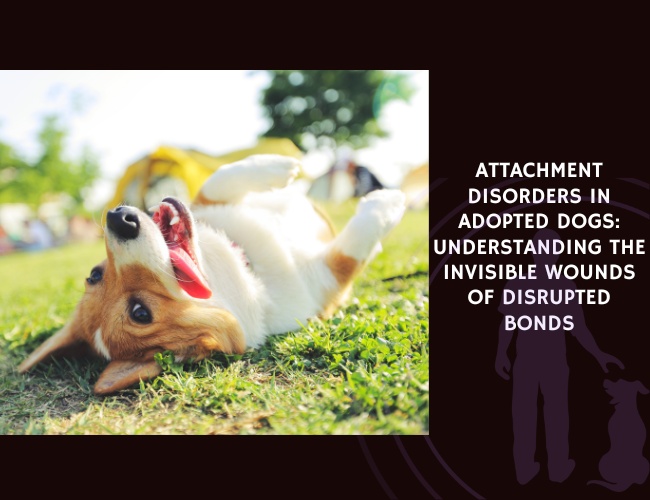
When you bring an adopted dog into your home, you might notice something unexpected. Perhaps your new companion follows you from room to room, unable to settle even when exhausted. Or maybe they keep their distance, turning away when you reach out to comfort them. These behaviors aren’t stubbornness or dominance—they’re the language of attachment disruption, speaking volumes about experiences that shaped your dog long before they met you.
Understanding attachment disorders in adopted dogs means looking beyond surface behaviors to recognize the profound impact of early relational loss. Your rescue dog isn’t simply adjusting to a new home; they’re navigating a world where caregivers have appeared and disappeared, where trust was built and broken, where the fundamental question—”Will you stay?”—remains terrifyingly unanswered. Let us guide you through the science and soul of attachment disruption, so you can become the secure foundation your dog desperately needs.
The Critical Foundation: How Early Bonds Shape Lifelong Patterns
When Attachment Formation Goes Wrong
The first weeks of a puppy’s life aren’t just about growth and nutrition—they’re about building the neurological architecture of trust. Research reveals that specific developmental windows exist where attachment system formation is particularly vulnerable to disruption. In the second postnatal week especially, brain maturation processes including neurogenesis, synaptogenesis, and microglial development create a sensitive period where early-life stress can fundamentally alter how your dog’s brain processes relationships.
Think of it like building a house. If the foundation is poured incorrectly, every wall and beam built afterward will reflect that initial instability.
Critical developmental windows in puppies include:
- Days 0-14: Primary attachment formation with mother; disruption affects HPA axis development
- Weeks 3-5: Transition period where puppies begin interacting with littermates; social behavior patterns form
- Weeks 6-8: Peak socialization window where exposure to humans shapes lifelong human-dog relationship capacity
- Weeks 8-12: Fear impact period where traumatic experiences have disproportionate long-term effects
- Weeks 12-16: Secondary socialization period; disruption here affects generalization of trust patterns
When maternal separation occurs during these critical windows, several cascading effects unfold:
Neuroendocrine programming changes forever. The hypothalamic-pituitary-adrenal (HPA) axis—your dog’s stress response system—develops differently when early maternal bonds are disrupted.
Early maternal deprivation affects:
- Cortisol reactivity patterns that persist into adulthood
- Oxytocin system functioning critical for social bonding capacity
- Serotonin regulation influencing mood and impulse control
- Dopamine pathways affecting reward-seeking and pleasure response
- Stress hormone receptor density in key brain regions
Your adopted dog isn’t choosing to be anxious; their nervous system learned a different baseline.
Behavioral patterns emerge that persist beyond the immediate trauma. Studies examining maternal deprivation in various mammalian species show that premature separation creates altered interaction patterns, changes in stress-related behaviors, and sex-specific differences in coping strategies. The puppy who lost their mother at three weeks carries that experience in every social interaction, even years later.
Neurobiological structures physically change. Early-life stress affects neuron density in key brain regions, alters microglial morphology particularly in the prefrontal cortex (the area responsible for emotional regulation), and shifts gene expression patterns related to stress response. Your dog’s brain literally developed differently because of these early experiences. 🧠
The Compounding Impact of Multiple Losses
When a dog experiences not just one separation but multiple caregiver losses—from breeder to shelter, shelter to foster home, foster home to failed adoption, and finally to you—something more complex than simple trauma occurs. Each loss layers upon the previous one, creating what researchers call “expectation fragmentation.”
Signs of expectation fragmentation include:
- Difficulty settling into new routines even after weeks or months
- Hypervigilance about caregiver location and availability
- Anticipatory anxiety before any change in household patterns
- Reluctance to form strong attachments despite apparent desire for connection
- Scanning behavior checking for signs of impending abandonment
- Difficulty accepting comfort or reassurance when distressed
Your dog develops inconsistent internal working models of caregiver availability. They struggle to form stable predictions about whether social partners will stay or leave. Heightened vigilance for signs of abandonment becomes not paranoia but learned wisdom based on lived experience.
Research on genetic variation in attachment behavior provides fascinating insight here. Studies examining the mu-opioid receptor gene found that individuals carrying specific genetic variants show heightened separation distress and increased contact-seeking behavior during reunions, often at the expense of exploring their environment or affiliating with others. This suggests some dogs may be biologically predisposed to more intense attachment responses—responses that become amplified and distorted through repeated separation experiences.
The longitudinal nature of these disruptions matters profoundly. Dogs experiencing multiple caregiver losses show cumulative effects rather than simple additive impacts. The timing of losses creates critical period interactions where the third separation might have disproportionate impact compared to the first. And perhaps most heartbreaking, dogs develop compensatory mechanisms that appear functional but remain fragile—they look “fine” until a trigger reveals the instability beneath.
Decoding Attachment Styles: Which Pattern Does Your Dog Show?
The Four Core Attachment Patterns
Yes, your adopted dog can be meaningfully categorized into attachment-style patterns, though we must adapt human attachment frameworks for canine-specific expressions. Understanding which pattern your dog displays helps you provide exactly what they need rather than what feels intuitively right to you.
Secure Attachment: The Rare Gift
You’ll recognize secure attachment through its balanced quality.
Characteristics of secure attachment:
- Balanced proximity-seeking: approaches when needed, explores independently when confident
- Effective stress regulation: uses you as secure base during novel situations
- Flexible responsiveness: adjusts behavior based on context and your signals
- Recovery capacity: returns to baseline after separation within minutes
- Confident exploration: ventures into new environments with periodic check-ins
- Clear communication: signals needs without excessive intensity or suppression
Your dog approaches you when needed but explores independently with confidence. They use you as a secure base during novel or stressful situations—checking in periodically but not clinging desperately. Their responsiveness is flexible, adjusting based on context and your signals. Most tellingly, they recover after separation or stress, returning to baseline rather than remaining dysregulated for hours.
Securely attached dogs trust that you’ll be there when needed, so they don’t need to constantly verify your presence. This is the goal of attachment repair—not creating dependency, but building trust that enables independence.
Avoidant Attachment: The Self-Reliant Survivor
Avoidant dogs maintain distance even when stressed, showing what appears to be impressive independence. But look closer. This isn’t confidence—it’s suppression of attachment needs learned through repeated unavailability of caregivers.
Red flags of avoidant attachment:
- Proximity minimization: consistently chooses distance over closeness
- Emotional dampening: appears stoic even in frightening situations
- Caregiver dismissal: ignores or avoids you upon reunion
- Self-reliance emphasis: refuses help even when struggling
- Minimal distress signals: shows little visible anxiety during separation
- Interaction resistance: turns away when you initiate contact
These dogs show minimal distress signals during separation (leading adoptive families to mistakenly believe they’re “low maintenance”), and they may ignore or avoid you upon reunion.
Watch for proximity minimization where your dog consistently chooses distance over closeness, emotional dampening where they seem stoic even in frightening situations, and caregiver dismissal where your attempts at connection are actively rejected. The avoidant dog learned that expressing attachment needs leads to disappointment or worse—so they stopped expressing them. 🐾
Ambivalent/Anxious Attachment: The Hypervigilant Monitor
If your dog tracks your every movement, oscillates between clinging to you and resisting your touch, shows exaggerated responses to separation or perceived unavailability, and struggles to soothe even when you’re physically present—you’re seeing ambivalent attachment.
Behaviors indicating anxious attachment:
- Hypervigilant monitoring: constant tracking of your location and attention
- Inconsistent proximity regulation: oscillates between clinging and resistance
- Heightened distress: exaggerated responses to separation
- Difficult soothing: struggles to regulate even when you’re present
- Anticipatory anxiety: panic before you’ve even left
- Contact-seeking alternating with contact-resistance: conflicted about closeness
These dogs experience constant internal conflict: they desperately need reassurance but can’t quite trust it when offered. Inconsistent proximity regulation means they simultaneously want to be closer and push you away. The inconsistency they experienced from previous caregivers—sometimes available, sometimes not, unpredictably shifting—created this internal chaos.
Hypervigilant monitoring becomes their survival strategy. If they watch you constantly, perhaps they can predict the moment you’ll leave and prepare themselves. Except they can’t prepare. The anxiety simply intensifies with each cycle of vigilance, anticipation, separation, and reunion.
Disorganized Attachment: When Nothing Makes Sense
The most heartbreaking pattern emerges when a dog simultaneously approaches and avoids you, when their behavior varies dramatically across similar situations, when stress dysregulation means they cannot manage arousal in social contexts, and when relational confusion leaves them without clear strategies for managing proximity and safety.
Disorganized attachment manifests as:
- Contradictory behaviors: simultaneous approach and avoidance
- Unpredictable responses: behavior varies across similar situations
- Stress dysregulation: cannot manage arousal in social contexts
- Relational confusion: no clear strategies for proximity management
- Freeze responses: immobility when overwhelmed rather than fight or flight
- Behavioral incoherence: actions don’t match apparent emotional state
Disorganized attachment develops when early caregiving was not just inconsistent but frightening—when the source of comfort was also the source of threat. The dog’s attachment system receives contradictory commands: “Approach for safety” and “Flee for survival” fire simultaneously. The result is behavioral incoherence that can look like unpredictability, aggression, or profound anxiety depending on the moment.
How These Patterns Manifest in Daily Life
The Clinging Behaviors
Excessive following where your dog shadows you from bathroom to kitchen to bedroom. Contact maintenance where they must be touching you even when resting. Separation anticipation where putting on shoes triggers panic. Attention demands where they persistently solicit interaction regardless of your availability.
Common clinging behaviors include:
- Shadow following: cannot remain in another room even briefly
- Physical contact insistence: must be touching you while resting
- Pre-departure panic: anxiety begins with pre-leaving cues like keys or shoes
- Persistent attention-seeking: pawing, whining, nudging regardless of context
- Doorway blocking: positioning to prevent your movement without them
- Barrier scratching or vocalizing: intense distress when physically separated by doors
Research reveals biological underpinnings for these clinging patterns—certain genetic variants create individuals who seek more contact during reunions. But environment intensifies or moderates these tendencies. Your anxiously attached dog isn’t manipulating you; they’re expressing genuine distress rooted in neurological reality.
The Monitoring Behaviors
Visual tracking where constant eye contact becomes exhausting for both of you. Position optimization where your dog strategically places themselves to maintain visual access regardless of your movement. Alert responsiveness where the slightest shift in your posture produces immediate reaction. Anticipatory positioning where they move before you signal intent, having learned to read micro-expressions most humans miss.
These dogs become exquisitely attuned to your behavior—not from devotion alone, but from necessity. Predicting your movements means managing their own anxiety about potential abandonment.
The Withdrawal Behaviors
Social avoidance where your dog consistently chooses distance over proximity. Interaction resistance where they turn away when you approach. Self-soothing emphasis through solitary coping strategies like excessive licking, chewing, or sleeping. Emotional suppression where minimal expression of distress or need creates the illusion of independence.
Withdrawal patterns to watch for:
- Choosing distance: consistently positions away from family members
- Turning away: physically orients body away when approached
- Solitary coping: excessive licking, chewing, or sleeping in isolation
- Emotional flatness: minimal visible response to positive or negative events
- Rejection of comfort: moves away when distressed rather than seeking support
- Preference for objects over people: engages with toys but avoids human interaction
Avoidant dogs aren’t indifferent—they’re protecting themselves from the pain of attachment disappointment. Their withdrawal is an adaptation, not a personality trait. Understanding this shifts everything about how you approach them. 💙
The Oscillation Patterns
Approach-avoidance conflict where simultaneous desire for and fear of closeness creates behavioral chaos. Dramatic shifts in proximity-seeking where your dog is velcroed to you one moment and pushing you away the next. Context hypersensitivity where small environmental changes trigger major behavioral shifts. Relational unpredictability where you cannot reliably predict responses even in familiar situations.
This oscillation exhausts both dog and human. The inconsistency feels personal—like your dog is rejecting you specifically—but it reflects internal confusion, not evaluation of your worthiness.
Why Adoption Pathways Matter: The Context of Disruption
Shelter Adoptions and Their Attachment Signatures
Dogs adopted from traditional shelters often display ambivalent or anxious attachment patterns. The shelter environment itself creates conditions for this: unpredictable caregiver availability as staff shifts change, high-stress settings with constant noise and movement, and multiple brief interactions with various humans who arrive, engage intensely, and disappear forever.
How shelter environments shape attachment:
- Unpredictable caregiver availability: staff shifts create inconsistent faces
- High-stress overstimulation: constant noise, barking, and movement
- Brief intense interactions: potential adopters engage then disappear
- Routine disruption: feeding times and walks vary by staffing
- Kennel stress: isolation alternating with forced proximity to other dogs
- Loss of control: dogs have no agency over interactions or environment
Your shelter dog learned that humans are inconsistent and that safety is temporary. Hypervigilance became their survival strategy in an environment where routines constantly shifted and familiar faces rarely returned. The generalized insecurity they developed—where all humans become somewhat untrustworthy—isn’t paranoia but pattern recognition based on extensive data collection.
Foster-Based Adoptions: The Variable Outcomes
Foster-based adoptions show more variability in attachment patterns. When foster care provided consistent, responsive caregiving for adequate duration, dogs may show relatively secure patterns—or at least transitional ambivalence that resolves with stability in their permanent home.
Foster care factors affecting attachment outcomes:
- Duration of placement: longer stays (8+ weeks) support better outcomes
- Consistency of caregiver: same person providing primary care matters
- Quality of daily interaction: responsive caregiving vs. just housing
- Number of transitions: each move compounds attachment disruption
- Foster home environment: calm, predictable settings support recovery
- Preparation for transition: gradual introduction to permanent home reduces stress
However, foster care quality varies tremendously. Short-term fostering (under six weeks) with multiple transitions may actually create more attachment disruption than direct shelter adoption. The dog experiences repeated pattern: settle into routine, begin trusting, relationship disrupts, start over. Each cycle makes trust more difficult, not easier.
Street Rescues: The Independent Survivors
Dogs rescued from street life often present avoidant attachment patterns. Self-reliance developed during independent survival, where other dogs or humans couldn’t be relied upon for resources or safety.
Street survival patterns affecting attachment:
- Resource independence: learned to find food, water, shelter without human help
- Threat vigilance: constant scanning for danger creates hypervigilance
- Social wariness: humans were unpredictable—sometimes kind, sometimes threatening
- Pack reliance: bonded more strongly with other dogs than humans
- Territory attachment: connected to places rather than people
- Emotional suppression: displaying vulnerability invited attack or exploitation
These dogs learned that attachment needs go unmet, so they stopped having them—or more accurately, stopped expressing them.
Street dogs with severely disrupted early socialization may show disorganized attachment, particularly if their history included both positive and negative human interactions. The inconsistency of receiving food from one human and abuse from another creates the relational confusion characteristic of disorganization.
Breeding Operation Rescues: The Understimulated
Dogs from breeding operations—particularly puppy mills—face unique attachment challenges. Minimal human contact during critical socialization periods means they never learned how human-dog relationships function. Lack of individual attention created what looks like avoidance but is actually underdevelopment of attachment capacity.
These dogs aren’t rejecting relationship—they don’t fully understand what relationship means. The repair process looks different: less about healing damaged attachment and more about building attachment capacity from scratch.

The Invisible Leash: How Attachment Patterns Influence Training
Why Traditional Training Often Fails with Attachment-Disrupted Dogs
You’ve probably tried traditional training approaches with your adopted dog. Perhaps you noticed that techniques working beautifully with other dogs produce confusion, shutdown, or increased anxiety in yours. This isn’t training failure—it’s attachment pattern interference.
For avoidant dogs: Positive reinforcement using treats as primary motivators may have limited effectiveness because these dogs have learned to meet their own needs rather than seeking resources from humans. The treat becomes just another resource to obtain independently, not a relationship-building moment.
For anxiously attached dogs: Training sessions requiring separation or independence (even brief stays while you move across the room) trigger such intense distress that learning becomes impossible. Their nervous system is in survival mode, not learning mode.
For disorganized dogs: Inconsistent responses to the same cues stem from their inability to predict outcomes based on your behavior. When nothing made sense historically, current consistency doesn’t yet compute as meaningful.
The Invisible Leash philosophy recognizes that effective communication requires understanding your dog’s attachment lens. Before commands can be learned, basic trust must exist. Before behaviors can be shaped, the relationship must provide safety.
Training Adaptations for Each Attachment Style
Secure Attachment Foundation Building
All training with attachment-disrupted dogs must first prioritize secure attachment development over behavior modification.
Foundation-building priorities:
- Predictable daily routines: meals, walks, play, rest at consistent times
- Consistent responses: similar situations receive similar reactions from you
- Clear communication: simple, repeated signals your dog can learn
- Gradual changes: prepare your dog for transitions rather than surprising them
- Pressure-free presence: being available without demanding performance
- Trust before obedience: relationship security precedes command training
This means: Regular, predictable routines that create learnable patterns. Your dog needs to know what happens next, when meals arrive, when walks occur, when rest is available. Consistency builds the neural architecture of trust.
Consistent responses to similar situations. If jumping on the counter produced one response Monday and a different response Tuesday, your dog cannot develop reliable predictions. Reliability matters more than the specific response chosen.
Clear communication patterns your dog can learn to read. Simple signals repeated consistently create comprehensible cause-effect relationships. Complexity comes later, after foundation exists.
Gradual changes introduced with preparation. Sudden shifts in routine retrigger abandonment fear. Telegraphing changes—putting on walking shoes 10 minutes before departure, for example—allows processing time.
Avoidant Dogs: Building Voluntary Engagement
For avoidant dogs, training must respect their protective distance while gently inviting connection:
Effective strategies for avoidant dogs:
- Allow choice in interactions: never force contact or engagement
- Reward voluntary proximity: mark and treat when they choose to approach
- Use environmental rewards: access, permission, opportunity over food treats
- Maintain emotional neutrality: avoid excessive excitement or pressure
- Progress incrementally: celebrate tiny movements toward connection
- Respect their timeline: slower progress builds more stable foundation
Allow choice in all interactions. Forced engagement reinforces their belief that humans override autonomy. Voluntary approach teaches that relationship offers benefits without threatening independence.
Reward proximity without demanding it. Mark and treat when your dog chooses to be near you, but don’t require touch or eye contact. Let them control the degree of intimacy.
Use environmental rewards as much as social ones. Avoidant dogs often respond better to opportunity rewards (access to another room, permission to sniff, ability to explore) than to human-delivered treats.
Progress slower than feels necessary. Your impatience to bond faster can push avoidant dogs further away. Trust your dog’s timeline, not your own. 🐾
Anxiously Attached Dogs: Teaching Self-Regulation
For anxiously attached dogs, training must gradually increase tolerance for independence:
Self-regulation training steps:
- Start with presence as reinforcer: you being there is the primary reward initially
- Introduce micro-separations: begin with 3 feet for 10 seconds, gradually increase
- Teach explicit settle cues: “place” or “settle” on mat with calm duration building
- Avoid excessive reassurance: constant soothing confirms there’s danger to worry about
- Practice calm departures: no emotional goodbyes that signal something significant
- Reward relaxation: mark and treat when you notice your dog calm and settled
Start with your presence as the primary reinforcer. Early in training, your calm presence matters more than treats. Let them learn that you’re available without requiring constant performance.
Introduce micro-separations systematically. Move three feet away, return immediately, reward calm waiting. Gradually increase distance and duration, but return before panic begins.
Teach settle behaviors explicitly. Anxious dogs don’t spontaneously relax—they must be taught that calm behavior is desired and safe. Reward relaxation, not just action.
Avoid excessive reassurance. Constant verbal soothing actually increases anxiety by confirming there’s something to worry about. Calm, neutral presence communicates safety more effectively than anxious reassurance.
Disorganized Dogs: Creating Coherent Patterns
For dogs with disorganized attachment, training must prioritize pattern clarity above all:
Creating predictability for disorganized dogs:
- Ultra-consistent sequences: every time X happens, Y always follows
- Simplified communication: one clear cue per behavior, no variations
- Extended processing time: allow 3-5 seconds between cue and response expectation
- Minimal emotional intensity: keep energy stable and moderate always
- Predictable consequences: same behavior produces same outcome every time
- Environmental consistency: minimize changes to household routines and layout
Ultra-consistent cause-effect sequences. Every single time X happens, Y follows. No exceptions until the pattern is deeply internalized.
Simplified communication initially. Use one clear cue per desired behavior. Avoid multiple commands, complex sequences, or nuanced signals until basic trust exists.
Longer processing time between cue and response. Disorganized dogs need extra time to recognize the pattern and formulate appropriate response. Patience during this processing prevents misinterpretation as disobedience.
Minimal emotional intensity. Keep your energy level stable and moderate. Excitement or frustration introduces variables that disrupt their fragile ability to read situations.
Fractured. Watchful. Repairing.
Early Bonds Disrupted Separation during critical developmental windows alters attachment architecture calibrating the nervous system for loss uncertainty and guarded connection rather than secure trust.
Expectations Fragment Repeatedly Multiple caregiver losses destabilise prediction models creating hypervigilance proximity seeking or withdrawal as adaptive responses to anticipated abandonment.



Stability Rewrites Safety Through consistent presence predictable routines and NeuroBond aligned co regulation attachment patterns soften allowing secure connection trust and emotional settling to emerge.
The Misreading Crisis: When Love Looks Like Misbehavior
Common Misinterpretations and Their Consequences
Perhaps the most damaging aspect of attachment disorders in adopted dogs is how frequently attachment behaviors get misread as behavioral problems, dominance issues, or training failures. These misinterpretations aren’t just incorrect—they’re actively harmful, often creating secondary problems worse than the original attachment disruption.
Most common misinterpretations include:
- Following behavior labeled as “dominance” or “controlling”
- Lack of greeting interpreted as absence of love or bond
- Separation destruction seen as spite or revenge
- Defensive snapping misread as aggressive temperament
- Hypervigilance mistaken for obedience or attentiveness
- Withdrawal assumed to indicate depression or illness
“My dog is being dominant by following me everywhere”
What the human sees: Controlling behavior, lack of respect for personal space, dominance assertion through constant proximity.
What’s actually happening: Anxious attachment pattern where hypervigilance about caregiver location is the dog’s primary coping mechanism for managing abandonment fear. Following isn’t control—it’s desperation.
The consequence of misinterpretation: Attempts to “establish dominance” by punishing following behavior increase the dog’s anxiety and insecurity, often intensifying the very behavior the human wants to eliminate.
“My dog doesn’t love me—they ignore me when I come home”
What the human sees: Indifference, lack of bond, possible depression or illness.
What’s actually happening: Avoidant attachment pattern where the dog learned that expressing attachment needs leads to disappointment. The suppression of reunion greeting is protective, not indicative of absence of feeling.
The consequence of misinterpretation: Increased human efforts to force affection (picking up the dog, insisting on eye contact, following them) reinforces the dog’s need for distance, widening the relational gap.
“My dog is manipulative—they act fine when I’m gone but destroy things the moment I leave”
What the human sees: Spite, manipulation, deliberate misbehavior designed to punish the human for leaving.
What’s actually happening: Separation distress rooted in attachment insecurity. The destructive behavior is self-soothing during panic, not revenge. The dog appears “fine” during departure because they’re in shutdown, with destruction emerging as anxiety escalates in isolation.
The consequence of misinterpretation: Punishment upon return teaches the dog that the human’s return is also unpredictable and potentially dangerous, compounding the original separation anxiety.
“My dog has aggression problems—they snap when I try to pet them”
What the human sees: Aggressive temperament, possible abuse history, dangerous unpredictability.
What’s actually happening: Disorganized attachment creating approach-avoidance conflict. The dog simultaneously wants connection and fears it. The snap is defensive behavior when internal conflict becomes overwhelming, not predatory aggression.
The consequence of misinterpretation: Viewing the dog as aggressive rather than confused leads to increased distance, physical corrections, or rehoming—all of which confirm the dog’s expectation that humans are unpredictable and relationships are dangerous. 😔
💔 Understanding Attachment Disorders in Adopted Dogs
When early bonds break, your dog’s nervous system remembers. Discover how to recognize attachment patterns and become the secure foundation your rescue dog needs to finally trust again.
🧠 The Neuroscience of Broken Bonds
Critical Windows Matter
The second postnatal week is especially vulnerable—brain maturation processes including neurogenesis and microglial development create sensitive periods where early separation fundamentally alters your dog’s attachment capacity.
What happens: HPA axis develops differently, cortisol reactivity shifts, oxytocin system functioning changes, and the biological capacity for social bonding itself becomes compromised.
The Four Attachment Patterns
- Secure: Balanced proximity-seeking, explores confidently, recovers from stress quickly
- Avoidant: Maintains distance even when stressed, suppresses attachment needs, appears independent
- Anxious/Ambivalent: Hypervigilant monitoring, oscillates between clinging and resistance, difficult to soothe
- Disorganized: Contradictory behaviors, unpredictable responses, simultaneous approach and avoidance
🔍 Reading the Invisible Wounds
Misinterpretations That Damage Trust
Following behavior isn’t “dominance”—it’s anxious attachment where hypervigilance manages abandonment fear. The dog ignoring you at homecoming isn’t indifference—it’s avoidant attachment protecting against disappointment.
Common errors: Labeling separation destruction as “spite” • Punishing clinging as “controlling” • Forcing affection on avoidant dogs • Interpreting defensive snapping as “aggression”
Soul Recall: When Memory Triggers Present Behavior
The suitcase triggering panic isn’t logical reasoning—it’s emotional memory. High-cortisol states during abandonment carved neural pathways that activate now, flooding your dog’s system with the same fear experienced during past losses. You’re seeing present manifestation of past pain.
🛤️ The NeuroBond Path to Repair
Pattern-Specific Interventions
- For Avoidant Dogs: Allow voluntary approach • Use environmental rewards over social pressure • Progress slower than feels necessary
- For Anxious Dogs: Build micro-separation tolerance gradually • Teach explicit settle cues • Reduce reassurance, increase consistency
- For Disorganized Dogs: Ultra-consistent sequences • Simplified communication • Extended processing time between cue and response
The Invisible Leash: Predictability Over Intensity
Secure attachment emerges not from constant reassurance but from predictable routines, emotional clarity, and calm leadership. Your dog needs to clearly read your emotional state and predict your responses. Consistency matters infinitely more than quantity of interaction.
⚠️ When Professional Support Becomes Essential
Red Flags Requiring Expert Intervention
- Severe aggression: Dangerous biting with poor inhibition or unpredictable triggers
- Self-injurious behaviors: Compulsive licking causing wounds, tail chasing causing injury
- Complete shutdown: Refusal to eat, drink, eliminate, or move for days or weeks
- Caregiver burnout: Overwhelming frustration, resentment, or despair affecting your emotional stability
Rule Out Medical Causes First
Chronic pain, thyroid dysfunction, neurological conditions, and sensory decline can all mimic attachment disorders. A thorough veterinary examination including bloodwork should occur before intensive behavioral intervention—especially for sudden changes or extreme responses.
⚡ The Attachment Repair Timeline
0-3 months: Initial adjustment—behaviors may not reflect settled personality
3-6 months: True attachment patterns emerge—often hardest period for caregivers
6-12 months: Foundation building—progress invisible for weeks, then sudden breakthroughs
12-24 months: Stabilization begins—stress triggers less severe, faster recovery
24+ months: Long-term maintenance—subtle vulnerabilities may persist around historical triggers, and that’s okay
🧡 The Essence of Zoeta Dogsoul
Your adopted dog carries invisible wounds—neurological patterns carved by loss and inconsistency. But through NeuroBond, you become more than a caregiver: you become the secure base they’ve needed all along. Not through constant reassurance, but through predictable presence. Not through emotional intensity, but through calm clarity. The Invisible Leash connecting you isn’t built from control—it’s woven from consistent moments where your dog learns: “This one stays. This one is predictable. This one is safe.”
Soul Recall means they may always carry sensitivity around certain triggers. But your steady presence teaches that this time, this relationship, follows different rules. The disrupted bond can heal. Trust the process, trust your dog’s capacity for change, and trust that your consistency—even when progress feels invisible—is doing exactly what needs doing.
© Zoeta Dogsoul – Where neuroscience meets soul in dog training
The Cascade of Misunderstanding
These misinterpretations create cascading consequences:
Trust erosion occurs rapidly through:
- Early misinterpretation during critical first weeks damages emerging attachment
- Punishment for attachment behaviors increases insecurity exponentially
- Dog learns to suppress expression of needs, creating learned helplessness
- Avoidance patterns establish that override future repair attempts
- Caregiver fails to become reliable secure base resource
- Each misinterpretation compounds the next, accelerating relational damage
Trust erosion occurs rapidly. Early misinterpretation during the critical initial weeks can damage emerging attachment. Punishment for attachment behaviors increases insecurity. The dog learns to suppress expression of needs, creating learned helplessness. Avoidance patterns establish that override future repair attempts. The caregiver fails to become a reliable secure base resource.
Caregiver frustration intensifies. Misinterpretation produces ineffective interventions that don’t address underlying attachment issues. Repeated “failures” occur where the dog doesn’t “improve” as expected because the intervention targets surface behavior rather than relational foundation. Relationship strain develops as frustration damages the caregiver-dog bond. Intervention fatigue sets in as caregivers become discouraged, sometimes leading to rehoming—the ultimate confirmation of the dog’s deepest fear.
The optimal intervention window closes. Early accurate assessment enables timely attachment-focused intervention addressing the relational foundation. Without it, secondary problems develop—fears, compulsions, aggression—that complicate treatment. Prevention of these secondary issues is always easier than repair. The longer insecurity persists, the more difficult repair becomes. Research on early-life adversity demonstrates that timing of intervention matters critically, with earlier interventions producing more complete recovery.
Soul Recall: When Memory and Emotion Shape Present Behavior
The Neuroscience of Emotional Memory in Adopted Dogs
Your dog remembers—not just events, but the emotional experience of those events. The concept of Soul Recall recognizes that behavioral responses in the present often reflect emotional memories from the past, particularly traumatic memories encoded during high-stress experiences like abandonment, shelter intake, or previous rehoming.
The amygdala, your dog’s emotional processing center, encodes experiences differently under stress. High-cortisol states during traumatic events create powerful memory consolidation, meaning abandonment experiences become deeply etched in neural pathways. These memories aren’t consciously recalled like you might remember what you ate for breakfast—they’re implicit memories that trigger emotional and behavioral responses without conscious awareness.
When your adopted dog panics at the sight of a suitcase, they’re not logically concluding you’re leaving forever. They’re experiencing Soul Recall—an emotional memory of previous abandonments triggered by visual similarity. The suitcase activates the neural pathway carved by previous departures, flooding their system with the same fear experienced during past losses.
Trigger Recognition and Pattern Awareness
Understanding Soul Recall helps you identify triggers you might otherwise miss:
Common trigger categories include:
- Temporal triggers: specific times when previous abandonments occurred
- Environmental triggers: sounds, smells, sights similar to trauma locations
- Social triggers: specific types of people, voices, or interaction styles
- Routine triggers: changes mirroring patterns before previous disruptions
- Object triggers: suitcases, boxes, or items associated with transitions
- Activity triggers: car rides, veterinary visits, or experiences linked to loss
Temporal triggers: Specific times of day when previous abandonments occurred. If your dog was relinquished to a shelter in the morning, morning routines may trigger disproportionate anxiety.
Environmental triggers: Sounds, smells, or sights similar to shelter environment, veterinary clinics where medical procedures occurred, or locations associated with previous homes. Your dog may react intensely to stimuli you didn’t even notice because you lack the emotional memory association.
Social triggers: Specific types of people, voices, or interaction styles similar to previous caregivers. Your dog may inexplicably fear men with beards or flinch at certain vocal tones because of associations you’ll never know.
Routine triggers: Changes in patterns that preceded previous disruptions. Packing boxes, cleaning intensity, or shifts in your behavior that mirror what happened before previous rehomings.
The challenge with Soul Recall is that you cannot always identify the original traumatic experience. You’re seeing the present manifestation of past pain, often without knowing what that pain was. This requires a different approach to behavior modification—one focused on building new positive associations rather than trying to “fix” the fear. 🧠
Building New Neural Pathways
Soul Recall isn’t permanent doom—it’s modifiable through patient, consistent new experiences that gradually build different neural pathways:
Strategies for creating new associations:
- Counter-conditioning at sub-threshold intensity: trigger present without fear activation
- Predictable relationship patterns: consistent availability teaches new rules
- Emotional regulation support: teaching recovery rather than elimination of response
- Patience with regression: stress temporarily reactivates old pathways normally
- Gradual exposure progression: systematically increase trigger intensity
- Positive pairing: triggers appear during already-pleasurable activities
Counter-conditioning without flooding: Introduce triggering stimuli at intensities below threshold (the point where fear activates), paired with positive experiences. The suitcase appears while favorite activities occur, gradually teaching that suitcases don’t always predict abandonment.
Predictable relationship patterns: Consistent availability teaches that this caregiver relationship follows different rules than previous ones. Over time, new neural pathways strengthen while old fear pathways remain dormant through lack of reinforcement.
Emotional regulation support: Teaching your dog to return to baseline after trigger exposure. This isn’t about eliminating the emotional memory but about building capacity to recover from its activation.
Patience with regression: Soul Recall means that stress, illness, or environmental changes may temporarily reactivate old fear pathways even after months of progress. This isn’t training failure—it’s normal memory function. Your response to regression matters more than the regression itself.
NeuroBond: The Science of Secure Attachment Building
What NeuroBond Means for Attachment Repair
The NeuroBond approach recognizes that secure attachment isn’t built through emotional intensity or constant reassurance—it emerges from predictability, emotional clarity, and calm leadership that teaches your dog’s nervous system new rules about relationship.
NeuroBond core principles:
- Predictability over intensity: consistency matters more than emotional volume
- Emotional clarity: readable, consistent emotional expression from caregiver
- Calm leadership: steady presence regardless of dog’s emotional state
- Autonomy within structure: clear boundaries with choice inside them
- Agency support: dog controls proximity and engagement levels
- Trust through reliability: availability patterns dog can learn and predict
Traditional approaches often assume more attention, more affection, and more interaction will heal attachment wounds. But anxiously attached dogs receiving constant reassurance often become more anxious, not less. Avoidant dogs given excessive attention frequently increase their distance-keeping. Why? Because attachment security isn’t about quantity of interaction—it’s about quality of predictability.
Emotional clarity as foundation: Your dog needs to clearly read your emotional state and predict your responses. Ambiguous signals create confusion that reactivates attachment anxiety. Consistent emotional expression—where similar situations produce similar emotional responses from you—allows your dog to develop accurate predictions.
Calm leadership as secure base: Leadership doesn’t mean dominance; it means emotional stability. Your dog learns that regardless of their behavior, you maintain steady presence. This teaches them that their emotional state doesn’t control your availability—a critical shift from previous experiences where caregiver availability was contingent and unpredictable.
Autonomy within structure: NeuroBond emphasizes providing clear boundaries while supporting agency. Your dog learns reliable rules while maintaining choice within those rules. This balance prevents both the chaos of no structure (which increases anxiety) and the rigidity of no choice (which increases avoidance or rebellion).
Practical NeuroBond Interventions for Attachment Repair
Establishing predictable routines:
Create fixed schedules for feeding, walking, play, and rest.
Elements of predictable routines:
- Fixed meal times within 30-minute windows daily
- Consistent walk routes and departure times
- Predictable rest periods: same location, same time
- Pre-activity rituals: specific actions signal what comes next
- Spatial consistency: activities occur in same locations
- Preparation signals: telegraphing changes 10-15 minutes in advance
Timing doesn’t need to be exact-to-the-minute, but should occur within predictable windows. Your dog learns when needs will be met, reducing vigilance and anxiety.
Use consistent location patterns—meals in the same spot, walks starting from the same door, rest periods in the same area. Spatial consistency adds another layer of predictability.
Implement pre-activity rituals that signal what’s coming. Putting on specific shoes means walk, picking up their bowl means meal time, dimming lights means bedtime. These rituals provide preparation time that reduces startle and supports emotional regulation.
Practicing neutral presence:
Spend time in the same room with your dog without active interaction. Read, work on your laptop, or engage in hobbies while being physically present. This teaches that presence doesn’t always demand performance or interaction—sometimes it’s just safe coexistence.
Avoid constant talking, petting, or attention during neutral presence periods. Your calm energy provides the security; your restraint prevents over-stimulation or pressure.
Notice when your dog relaxes in your presence without seeking interaction—this is secure attachment developing. The goal isn’t for them to always be engaged with you, but to be comfortable with you there.
Supporting voluntary engagement:
Never force interaction. Let your dog approach on their timeline. For avoidant dogs especially, this means accepting that initial months may involve minimal physical contact.
Reward approach without escalating intensity. When your dog moves toward you, acknowledge it calmly rather than flooding them with excited affection that may feel overwhelming.
Create multiple opportunities for brief, low-pressure interactions throughout the day rather than intensive “bonding sessions.” Many short, predictable moments build trust faster than fewer intense experiences.
Providing clear boundaries:
Establish house rules and enforce them consistently. Whether dogs are allowed on furniture, where they sleep, when they eat—consistency in rules creates predictability even if the specific rules themselves matter less.
Communicate boundaries before enforcement. Use clear signals (verbal cues, hand signals, body positioning) to indicate what’s not allowed, giving your dog opportunity to self-correct before you intervene.
Maintain boundaries without anger or frustration. Your emotional steadiness during limit-setting teaches that rules exist within safe relationship, not as punishment from an unpredictable authority. 💙
Gradual independence building:
For anxiously attached dogs, systematically increase time apart starting with seconds, then minutes, then hours. Always return before panic begins, teaching that separation is temporary and predictable.
Practice brief separations with you still visible—you move to another room within sight, then behind a partial barrier, then completely out of sight. Visual separation is often harder than physical distance for attachment-disrupted dogs.
Teach your dog to settle on their bed while you’re home and active. This creates psychological separation even within physical proximity, building capacity for independent emotional regulation.
Contingency-based responsiveness:
Respond to your dog’s signals rather than preemptively intervening. If they come to you, engage. If they’re comfortable at a distance, let them be. This teaches that their needs are respected and their communication is effective.
Avoid anxious checking-in or constant reassurance-seeking toward your dog. Your calm confidence that they’re okay teaches more than repeated verification.
Ensure similar behaviors consistently produce similar outcomes. If whining gets attention sometimes but not others, you create exactly the uncertainty that sustains anxious attachment.

Special Considerations: When Attachment Disruption Runs Deeper
Medical Issues Mimicking or Compounding Attachment Disorders
Before attributing all problematic behaviors to attachment disorders, rule out medical causes that can mimic or compound relational issues:
Medical conditions that mimic attachment disorders:
- Chronic pain: arthritis, dental disease, gastrointestinal issues causing withdrawal
- Neurological conditions: cognitive dysfunction, seizures, brain tumors affecting behavior
- Sensory decline: hearing or vision loss increasing startle or apparent “ignoring”
- Thyroid dysfunction: hypothyroidism causing anxiety, aggression, or lethargy
- Hormonal imbalances: affecting mood and stress response capacity
- Nutritional deficiencies: impacting brain chemistry and emotional regulation
Pain and discomfort: Chronic pain creates irritability and withdrawal that looks like avoidant attachment. Arthritis, dental disease, or gastrointestinal distress can cause dogs to avoid interaction or snap when approached—not from relational confusion but from physical suffering.
Neurological conditions: Cognitive dysfunction syndrome (canine dementia), seizure disorders, or brain tumors can produce behavioral changes including clinginess, confusion, or aggression that stem from medical causes rather than attachment history.
Sensory decline: Hearing or vision loss increases startle responses and may create seeming “ignoring” of cues that’s actually sensory inability. Older adopted dogs especially may show behaviors rooted in sensory change rather than attachment patterns.
Thyroid dysfunction: Hypothyroidism commonly affects behavior in dogs, causing anxiety, aggression, or lethargy that overlay or exacerbate attachment-related behaviors.
A thorough veterinary examination including bloodwork should occur before intensive behavioral intervention, especially for dogs showing sudden behavioral changes or extreme responses.
When Professional Support Becomes Necessary
Some attachment disruptions require professional intervention beyond what even knowledgeable, committed caregivers can provide alone:
When to seek professional support:
- Severe aggression: dangerous biting with poor inhibition or unpredictable triggers
- Self-injurious behaviors: compulsive licking, tail chasing, or other self-harm
- Complete shutdown: refusal to eat, drink, eliminate, or move for days/weeks
- Caregiver burnout: overwhelming frustration, resentment, or despair
- No progress: attachment patterns worsen despite consistent intervention
- Safety concerns: behavior poses risk to humans, other pets, or the dog itself
Severe aggression rooted in attachment confusion: When disorganized attachment manifests as dangerous aggression—particularly when the dog cannot inhibit bite pressure or predict their own behavior—veterinary behaviorist consultation becomes essential. Psychopharmaceuticals may be necessary to reduce arousal enough for behavioral intervention to be effective.
Self-injurious behaviors: Compulsive licking leading to lick granulomas, tail chasing causing injury, or other self-harm behaviors require professional assessment. These may indicate anxiety severity beyond attachment disruption alone.
Complete shutdown: Dogs who won’t eat, drink, eliminate, or move despite days or weeks in a new home show trauma response requiring expert guidance. This level of shutdown suggests the nervous system is in freeze response, beyond normal adjustment period challenges.
Caregiver compassion fatigue: When you feel consistently overwhelmed, resentful, or despairing about your dog’s behavior, professional support helps you maintain the emotional stability your dog needs. Your wellbeing matters—sustainable care requires support for the caregiver.
Age-Specific Attachment Considerations
Puppies adopted young: Even puppies separated from mothers and littermates prematurely show attachment effects, but their nervous system plasticity means intervention often produces faster results. Early consistency may prevent permanent attachment pattern formation.
Adolescent dogs: Dogs adopted during adolescence (6-18 months) face dual challenges—attachment disruption combined with normal adolescent behavioral changes including increased independence-seeking and reduced responsiveness to caregiver cues. Patience during this developmental stage is critical.
Adult dogs: Most shelter and rescue adoptions involve adult dogs with established attachment patterns. Repair takes longer but remains absolutely possible. Adult nervous systems retain neuroplasticity—change happens slower but no less profoundly.
Senior dogs: Older adopted dogs often show both attachment disruption and age-related changes (cognitive decline, sensory loss, pain). Intervention must address multiple factors simultaneously. However, senior dogs also often settle faster into secure routines, appreciating predictability after years of uncertainty. 🐾
The Path Forward: Building Trust That Lasts
Realistic Timelines for Attachment Repair
One of the most common mistakes well-meaning adopters make is expecting too much too soon. Attachment repair doesn’t follow neat timelines, but general patterns exist:
Attachment repair timeline phases:
- 0-3 months: Initial adjustment; behaviors may not reflect settled personality
- 3-6 months: True attachment patterns emerge; often hardest period for caregivers
- 6-12 months: Foundation building; progress may be invisible for weeks
- 12-24 months: Stabilization begins; stress triggers less severe responses
- 24+ months: Long-term maintenance; subtle vulnerabilities may persist around historical triggers
Initial adjustment (0-3 months): Your dog is still orienting to their new environment. Behaviors during this period may not reflect their settled personality. Some dogs present “better” initially through shutdown, then show true attachment patterns as they feel safer expressing themselves.
Pattern emergence (3-6 months): True attachment style becomes evident. This is often the hardest period for caregivers because initial hope (“it’s getting better!”) meets reality of deep-seated patterns. This isn’t regression—it’s revelation of the actual work ahead.
Foundation building (6-12 months): With consistent NeuroBond-aligned intervention, you’re building new neural pathways and expectation patterns. Progress may be invisible for weeks, then sudden breakthroughs occur. Trust the process even when you can’t see evidence.
Stabilization (12-24 months): Secure attachment patterns begin stabilizing. Stress may still trigger old responses, but recovery time decreases. Your dog returns to baseline faster, showing that new pathways are strengthening.
Long-term maintenance (24+ months): While secure attachment has developed, your dog may always show subtle vulnerability around their historical triggers. This isn’t failure—it’s honoring their experience. Your continued consistency maintains the security they’ve achieved.
These timelines extend for dogs with severe early deprivation or multiple rehomings. Some dogs show measurable improvement within months; others require years. Neither timeline reflects your capability as a caregiver or your dog’s “brokeness”—it reflects the depth of original disruption and individual nervous system response to repair.
Measuring Progress: What Success Actually Looks Like
Forget perfect performance or elimination of all anxiety. Progress in attachment repair shows up more subtly:
Indicators of attachment repair progress:
- Increased baseline calm: more time relaxed, less constant vigilance
- Faster stress recovery: dysregulation duration decreases from hours to minutes
- Voluntary proximity shifts: avoidant dogs approach, anxious dogs tolerate distance
- Behavioral flexibility: emotional range expands, responses match context
- Trust in your signals: uses you as secure base for uncertain situations
- Improved stress resilience: tolerates routine disruptions without destabilization
- Reduced trigger intensity: same stimuli produce less extreme reactions
- Independent coping: self-soothes more effectively without constant caregiver intervention
Increased baseline calm: Your dog spends more time relaxed rather than vigilant, even if they still startle easily or track your movements sometimes.
Faster recovery from stress: The duration of dysregulation after triggering events decreases. Your dog who once remained anxious for hours after you returned from being out now settles within minutes.
Voluntary proximity shifts: Avoidant dogs begin approaching on their own; anxiously attached dogs can settle at a distance. Movement toward middle ground indicates secure attachment developing.
Behavioral flexibility: Your dog shows ability to adjust behavior based on context. They can be calm in some situations, playful in others, showing emotional range rather than fixed patterns.
Trust in your signals: Your dog looks to you for information about how to respond in uncertain situations—using you as a secure base rather than either ignoring you (avoidant) or panicking regardless of your calmness (anxious).
Improved stress resilience: New or unexpected situations produce less extreme responses. Your dog can tolerate small disruptions to routine without complete destabilization.
These changes emerge gradually, often invisible day-to-day but evident comparing month-to-month. Trust the trajectory rather than fixating on daily fluctuations. 💙
Your Role: From Rescuer to Secure Base
The final shift required for successful attachment repair is internal—in you, not your dog. You must move from seeing yourself as rescuer to becoming secure base.
Rescuer mindset vs. Secure base mindset:
- Rescuer: Views dog as broken needing repair → Secure base: Views dog as adaptive, updating old patterns
- Rescuer: Feels responsible for dog’s emotional state → Secure base: Validates emotions without needing to immediately fix
- Rescuer: Becomes anxious, angry, or defeated by dog’s behavior → Secure base: Maintains calm regardless of dog’s state
- Rescuer: Overfunctions, preventing all distress → Secure base: Allows manageable challenges to build competence
- Rescuer: Creates dependency through constant intervention → Secure base: Builds independence through appropriate support
- Rescuer: Communicates “something’s wrong with you” → Secure base: Communicates “your history makes sense, let’s update together”
Rescuers focus on fixing: They approach the dog as broken, needing repair. This subtly communicates that something is fundamentally wrong with the dog, which the dog perceives and internalizes.
Secure bases focus on being: They approach the dog as adaptive—having learned patterns that once served survival but now need updating. This communicates respect for the dog’s intelligence and honors their journey.
Rescuers feel responsible for the dog’s emotional state: They become anxious when the dog shows distress, angry when progress stalls, or defeated when setbacks occur. This emotional reactivity creates the very unpredictability that maintains attachment insecurity.
Secure bases maintain emotional stability: They remain calm regardless of the dog’s current behavior. They understand that the dog’s emotions are valid but not their responsibility to immediately fix. This stability provides the foundation for the dog’s own emotional regulation development.
Rescuers overfunction: They constantly try to prevent distress, anticipate needs, and smooth every challenge. This prevents the dog from developing capacity for independent emotional management.
Secure bases appropriately underfunction: They provide support when truly needed but allow the dog to navigate manageable challenges independently. This builds competence and confidence.
The essence of Zoeta Dogsoul philosophy lives here—in recognizing that secure attachment isn’t built through doing more but through being more consistent, clear, and calmly present. Your dog doesn’t need your anxiety about their anxiety. They need your steady confidence that with time, patience, and appropriate support, they can learn new patterns.
Creating Your Attachment Repair Plan
Assessment: Understanding Your Specific Dog
Begin by honestly assessing your dog’s attachment pattern without judgment:
Baseline behaviors to document for two weeks:
- Proximity-seeking patterns: how often, at what distance, in which situations
- Departure responses: behavior when you prepare to leave and during absence
- Return responses: greeting behavior and time to settle after reunion
- Stress indicators: panting, pacing, whining, destructive behavior frequency
- Recovery time: duration from trigger to baseline calm return
- Behavioral consistency: do similar situations produce predictable responses?
- Independent behavior: can they settle when you’re home but not interacting?
- Sleep quality: where, how long, degree of restlessness
Document baseline behaviors: For two weeks, simply observe and record: proximity-seeking patterns (how often, at what distance), responses to your departure and return, stress indicators during routine activities, recovery time after stressful events, and behavioral consistency across similar situations.
Identify triggers specifically: Note what circumstances produce the most intense responses. Is it visual cues like suitcases? Time-of-day patterns? Specific types of people? Particular activities? The more specific your understanding, the more targeted your intervention.
Recognize your patterns: Notice your emotional responses to your dog’s behavior. When do you feel frustrated, anxious, guilty, or helpless? Your reactions matter because they affect your consistency and emotional clarity.
Intervention: Building Your Customized Approach
Based on your assessment, design intervention matching your dog’s specific needs:
Intervention priorities by attachment pattern:
For avoidant dogs:
- Priority one: Allow and reward voluntary approach
- Priority two: Use environmental rewards over social pressure
- Priority three: Extend timeline expectations significantly
- Daily practice: 10-minute neutral presence sessions where you’re available but not pursuing
For anxiously attached dogs:
- Priority one: Build tolerance for micro-separations systematically
- Priority two: Teach explicit relaxation and self-soothing
- Priority three: Reduce reassurance while increasing consistency
- Daily practice: Gradual distance exercises starting at 30 seconds, 3 feet away
For disorganized dogs:
- Priority one: Ultra-consistent routines and responses
- Priority two: Simplified communication using single clear cues
- Priority three: Professional support for safety if aggression present
- Daily practice: Predictable sequence training (same activities in same order)
For all patterns:
- Establish three non-negotiable daily predictables (meal times, brief walk, settle period)
- Identify one boundary to enforce absolutely consistently
- Schedule one 5-minute neutral presence session daily
- Track progress weekly rather than daily to see patterns over noise
Sustainability: Making It Last
Attachment repair isn’t a sprint followed by finish line—it’s integration into lifestyle:
Strategies for sustainable attachment repair:
- Build support system: connect with others managing attachment-disrupted dogs
- Professional guidance: veterinary behaviorist or certified consultant for complex cases
- Maintain your reserves: your emotional wellbeing enables consistent caregiving
- Adjust seasonal expectations: stress affects behavior temporarily, prepare mentally
- Celebrate incremental progress: notice small shifts rather than waiting for transformation
- Create accountability: weekly progress tracking maintains perspective
- Prepare for regression: stress will temporarily reactivate old patterns normally
- Self-compassion practice: this work is difficult; honor your effort and imperfection
Build your support system: Connect with adopters of dogs with similar challenges. Professional support through veterinary behaviorists or certified behavior consultants specializing in attachment issues. Online communities focused on reactive or anxious dogs can provide validation and practical strategies.
Maintain your emotional reserves: Your capacity for consistency depends on your wellbeing. Regular breaks, activities you enjoy, and attention to your own stress management aren’t selfish—they’re necessary for sustainable caregiving.
Adjust expectations seasonally: Recognize that stress (yours or your dog’s) may temporarily affect behavior. Holiday seasons, moving, new jobs, or health challenges may trigger temporary regression. Prepare mentally for these rather than interpreting them as failure.
Celebrate incremental progress: Notice and acknowledge small shifts rather than waiting for dramatic transformation. The dog who now settles 10 minutes faster, approaches one foot closer, or recovers from startle slightly quicker deserves recognition for real change.
Conclusion: The Journey From Disruption to Security
Your adopted dog carries invisible wounds—not physical scars you can see but neurological patterns carved by experiences of loss, inconsistency, and broken trust. These patterns aren’t their fault, and they’re not your failure. They’re adaptive responses to difficult circumstances, strategies that once ensured survival but now complicate connection.
Understanding attachment disorders in adopted dogs means seeing beyond surface behaviors to recognize the profound impact of disrupted early bonds. It means accepting that your dog’s following isn’t dominance, their distance isn’t indifference, and their inconsistency isn’t manipulation—these are the languages of attachment disruption, speaking volumes about what shaped them before they met you.
But here’s the profound truth that makes this entire journey worthwhile: attachment patterns, though deeply carved, aren’t permanent destiny. Your dog’s nervous system retains plasticity—the capacity to build new neural pathways, to learn new relationship rules, to develop trust even after repeated betrayal. The NeuroBond approach, emphasizing emotional clarity, calm leadership, and predictable presence, provides the framework for this reconstruction.
The Invisible Leash connecting you and your dog isn’t built from control or dominance—it’s woven from consistent moments of reliability, from patterns your dog learns to predict, from your emotional stability when they cannot yet regulate their own state. Soul Recall means they may always carry sensitivity around certain triggers, but your steady presence teaches that this time, this relationship, follows different rules.
Will the journey be quick? No. Will it be linear? Rarely. Will there be moments of doubt where you question whether progress is possible? Almost certainly. But will your patient, consistent, emotionally clear presence eventually teach your dog that this attachment—this bond—is different from all the ones that came before? Yes.
That’s the essence of Zoeta Dogsoul—recognizing that building secure attachment isn’t about fixing broken dogs but about providing the consistent, clear, calm presence that allows their nervous system to finally learn: “This one stays. This one is predictable. This one is safe.”
Your adopted dog is waiting to learn this truth. Every consistent routine, every calm response, every moment of neutral presence builds the foundation. You’re not just training a dog—you’re rewriting their understanding of what relationship means. That’s profound work, worthy of patience, compassion, and time.
The disrupted bond can heal. Trust the process, trust your dog’s capacity for change, and trust that your steady presence—even when progress feels invisible—is doing exactly what needs doing. You’re becoming the secure base they’ve needed all along. 🧡