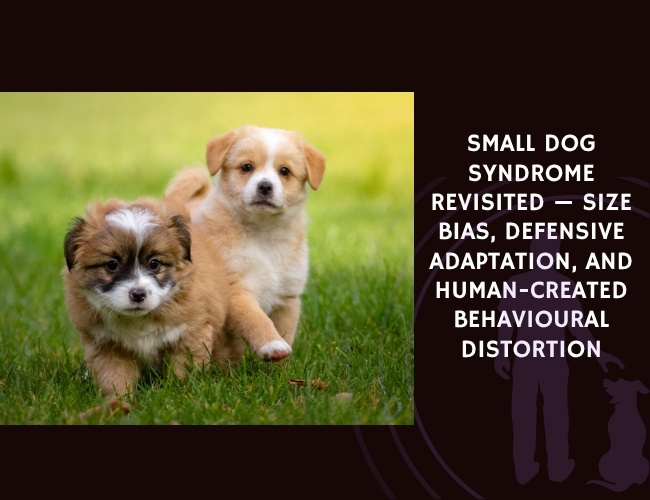
Few labels in popular dog culture are as widely used — and as poorly understood — as “Small Dog Syndrome.” The term gets thrown around casually to explain why your Chihuahua snaps at guests, why your Dachshund refuses to back down from a Rottweiler, or why your Pomeranian seems to run the entire household. It sounds clinical. It sounds like a diagnosis. And it gives everyone involved a tidy explanation that closes the conversation almost as soon as it opens.
But here is the problem: it is not a real syndrome. Not in any scientifically meaningful sense of the word.
This article is an invitation to look deeper — past the label, past the easy attribution, and into the actual behavioural mechanics that produce the patterns so often misread as a size-driven personality flaw. What you will find is not a broken dog. You will find an adaptive organism responding to a world that has consistently misread it, mishandled it, and failed to give it the clarity it needed to feel safe.
Understanding that distinction is not just intellectually interesting. It is the difference between a dog that spends its life in chronic stress and one that finally gets the support it deserves. 🧡
Is “Small Dog Syndrome” Actually Real?
The Problem with a Popular Label
Let us start with the term itself. Small Dog Syndrome” — commonly abbreviated to SDS — is used to describe a wide range of behaviours: excessive barking, snapping at strangers, resource guarding, frantic attention-seeking, reactivity toward larger dogs, and apparent defiance of commands. In popular usage, these behaviours are grouped together and explained by a single cause: the dog is small.
This is, to put it plainly, not a scientific explanation. It is a social attribution.
Size is a physical characteristic. It does not, on its own, produce behavioural instability. What size does do is change the context in which a dog lives — the way it is handled, the threats it perceives, the agency it is granted, the consistency of the rules it receives, and the way its communication is interpreted by the humans around it. These contextual variables are the true drivers of the behaviours grouped under the SDS label. Size is the setting. Everything else is the story.
A scientifically meaningful behavioural construct requires a clear operational definition, a unified mechanistic explanation, empirical validation, and diagnostic criteria that distinguish it from other conditions. SDS meets none of these criteria. It is a colloquial umbrella term that groups together behaviours with diverse origins — some rooted in breed-specific traits, some in individual learning history, some in chronic stress, some in owner-reinforced patterns, and some in legitimate defensive adaptation to physical vulnerability.
Treating all of these as a single syndrome does not illuminate the problem. It obscures it.
What Happens When We Apply the Label
The consequences of mislabelling are not trivial. When a dog’s behaviour is attributed to an inherent syndrome, several harmful outcomes follow — almost automatically.
When a dog’s behaviour is attributed to an inherent syndrome, these harmful outcomes follow — almost automatically:
- Owners stop examining their own behaviour as a contributing factor
- Training interventions become misdirected, targeting the dog’s “attitude” rather than the conditions producing it
- The dog is denied appropriate behavioural support because the problem is perceived as fixed or constitutional
- Welfare is compromised as chronic stress states go unaddressed
- Relinquishment rates climb when owners feel they are living with an unfixable animal
Attribution Bias Theory helps us understand why this happens so reliably. When we apply the SDS label, we are engaging in what researchers call a dispositional attribution — locating the cause of behaviour in the individual’s fixed characteristics rather than in situational factors. It is cognitively efficient. It is also behaviourally counterproductive. If the dog is reactive because it has SDS, there is nothing to investigate. The cause is already known. This closes off inquiry and protects owner self-perception at the cost of the dog’s wellbeing.
Understanding SDS as a human-created pattern — rather than a dog-created one — is both a scientific and an ethical imperative. 🐾
Size, Vulnerability, and the Logic of Threat
Seeing the World Through Small Eyes
To understand small dog behaviour honestly, you first need to understand what the world looks like from a small dog’s physical perspective.
A Chihuahua weighing 2–3 kilograms exists in an environment populated by entities — humans, other dogs, vehicles, children — that are many times its size and mass. The physical consequences of a misjudged social interaction are categorically different for a small dog than for a large one. This is not a trivial point. Threat assessment is calibrated to physical vulnerability.
An organism that can be seriously injured by a single strike from a conspecific or a human will, if its nervous system is functioning adaptively, develop a lower threshold for defensive responding than one that can absorb such contact without serious consequence. This principle is well-established in evolutionary biology and comparative ethology. Smaller animals in multi-species environments consistently show:
- Earlier threat detection — perceptual thresholds calibrated lower than larger animals
- More intense alarm responses — higher amplitude signalling to compensate for size disadvantage
- Greater reliance on pre-emptive communication — warning before contact becomes necessary
- Faster escalation to defensive behaviour when warnings are repeatedly ignored
These are not signs of instability. They are signs of adaptive calibration to physical reality.
Pre-Emptive Signalling as Rational Strategy
The concept of pre-emptive signalling is central to understanding why small dogs often appear to “overreact” to stimuli that larger dogs simply ignore. When the cost of a failed defensive response is high — as it is for a dog that cannot physically overpower a threat — the rational strategy is to signal early and loudly, before the threat closes the distance.
The larger dog can afford to wait and assess. The smaller dog cannot. What looks like disproportionate reactivity from the outside is, from the dog’s perspective, a proportionate response to its actual vulnerability. The critical question is never “why is this dog overreacting?” The right question is: “What is this dog’s threat threshold, and what has shaped it?”
When defensive behaviours in small dogs are repeatedly misread as overreaction or attitude, two harmful processes unfold. First, the dog’s legitimate threat assessment is invalidated — it is not removed from the threatening situation; it is laughed at, scolded, or ignored. This teaches the dog that its communication is ineffective. Second, the dog remains in the threatening situation with its nervous system in a state of activation. If this happens repeatedly, the baseline arousal level rises — a process consistent with what stress physiology describes as allostatic load: the cumulative cost of repeated stress activation without resolution.
The result is a dog that is chronically more reactive. Not because it has a syndrome. Because its nervous system has been shaped by repeated experiences of threat without resolution. 🧠
Handling Bias and the Loss of Agency
How Small Dogs Are Handled Differently
Small dogs are handled differently from large dogs in ways so normalised they are rarely examined:
- Picked up when they show discomfort, fear, or reactivity — removing their ability to self-regulate
- Carried through environments rather than allowed to navigate them on their own four paws
- Restrained physically during interactions they are actively trying to avoid
- Crowded by well-meaning humans who find their small size non-threatening
- Passed between people without consent or warning
- Placed in situations — laps, bags, arms — that remove their ability to move away
Each of these handling patterns shares a common feature: they remove the dog’s agency over its own body and spatial position.
The relationship between agency and behavioural stability is one of the most robust findings in behavioural neuroscience. Organisms that retain predictable control over their environment show lower baseline cortisol levels, more stable emotional responding, greater behavioural flexibility, and reduced defensive and vigilance-based behaviour. Organisms repeatedly exposed to uncontrollable events — including unwanted physical contact, forced proximity to threats, and inability to escape — develop what Seligman’s foundational research described as learned helplessness: a state in which the organism stops attempting to influence its environment because experience has taught it that such attempts are futile.
However, loss of agency does not always produce passivity. In many cases, particularly when the organism retains some capacity for action, it produces compensatory intensification — louder, more persistent, more extreme behaviour as the animal attempts to regain influence over its situation. This is precisely the pattern seen in many small dogs labelled with SDS.
The Case of Being Lifted
The practice of lifting a small dog when it shows fear or reactivity deserves particular attention because it is so common and so consistently misunderstood.
From the owner’s perspective, lifting is protective and comforting. From the dog’s perspective, it involves:
- Removal of ground contact — the loss of the ability to flee, which is a primary defensive option
- Forced proximity to the threat — being held at human height often brings the dog closer to the face of the person or dog it was trying to avoid
- Physical restraint — the dog cannot move away even if it wants to
- Reinforcement of the reactive behaviour — the dog learns that barking or lunging reliably produces the outcome of being picked up
Over time, this pattern produces a dog that barks or lunges in order to be lifted — not because it is dominant or aggressive, but because it has learned that this behaviour reliably produces a specific outcome. This is textbook operant conditioning. The owner, observing the continued reactivity, concludes it has SDS. The dog, operating on its learned history, is simply doing what has worked.
Through the NeuroBond approach, we understand that trust becomes the foundation of learning — and trust cannot be built when the dog’s body and choices are consistently overridden by the very hands it is supposed to rely on.
Boundary Inconsistency and What Gets Reinforced
The Harmlessness Heuristic
One of the most consistent patterns in small dog management is what might be called the harmlessness heuristic: the tendency of owners to apply less rigorous behavioural boundaries to small dogs because their behaviour is perceived as physically harmless.
A 30 kilogram Labrador that jumps on guests is corrected immediately — it can knock people over. A 3 kilogram Chihuahua that jumps on guests is laughed at and petted, because it cannot cause harm. The behaviour is identical. The response is entirely different.
The small dog receives the message that jumping on guests is acceptable — or even rewarded with attention and physical contact. The large dog learns that it is not. When the small dog later jumps on a guest who does not welcome it, or escalates to scratching and nipping, the owner is surprised and attributes the behaviour to SDS. The behaviour was not produced by a syndrome. It was shaped by inconsistent reinforcement history.

Variable Ratio and Escalating Demand
Inconsistent rule enforcement is one of the most reliable producers of behavioural instability in any learning organism. When the same behaviour sometimes produces reward, sometimes produces punishment, and sometimes produces no response at all, the organism cannot form a stable expectation about the consequences of its actions.
This is what learning theory describes as a variable ratio reinforcement schedule — the most powerful schedule for maintaining behaviour, but also one that produces high levels of frustration, persistence, and emotional reactivity when the expected reward fails to appear. A small dog that has been inconsistently reinforced for demanding behaviour — sometimes getting attention, sometimes being ignored, sometimes being scolded — will show exactly the pattern attributed to SDS: persistent, escalating, emotionally intense demands. This is not a syndrome. It is the predictable output of a specific reinforcement history.
Owners also frequently reinforce the very behaviours they find most problematic through three primary unintentional mechanisms. Rescue behaviour: when a small dog barks at another dog, the owner picks it up and moves away, teaching the dog that barking produces removal from the aversive situation. Attention reinforcement: when a small dog barks or whines for attention, the owner responds — even a scolding response delivers the attention being sought. Avoidance reinforcement: when a small dog growls at a visitor and the owner apologises and moves the dog away, the dog learns that growling achieves the desired outcome and is more likely to repeat it. In each case, the owner’s response — motivated entirely by care, embarrassment, or conflict avoidance — inadvertently strengthens the behaviour it is trying to manage. 🐾
Communication Breakdown and the Escalation Ladder
How Dogs Actually Communicate Stress
Dogs communicate stress, discomfort, and the desire for distance through a well-documented hierarchy of signals that progress from the subtle to the intense:
- Level 1 — Calming & Appeasement Signals: Lip licking, yawning, looking away, blinking, slow movement, sniffing the ground
- Level 2 — Stress Signals: Panting without heat, whale eye (showing the whites of the eyes), ears pinned back, tail tucked, body lowering
- Level 3 — Distance-Increasing Signals: Stiffening, direct stare, low growl, raised hackles
- Level 4 — Active Warning: Barking, lunging, snapping in the air
- Level 5 — Contact Behaviour: Biting
This hierarchy exists precisely so that dogs can communicate their state and needs without escalating to contact behaviour. The system works beautifully when the signals are recognised and respected. It breaks down, completely and predictably, when they are not.
Why Small Dogs Lose the Right to Whisper
Small dogs are disproportionately likely to have their early-level signals ignored, overridden, or misinterpreted — for four consistent reasons:
- Physical proximity: Humans interact with small dogs at close range, often holding them, making the dog’s subtle distance-increasing signals physically impossible to act on
- Anthropomorphisation: A dog yawning and looking away is read as “being cute” or “being shy” rather than communicating genuine discomfort
- Size-based dismissal: A small dog’s growl is less alarming than a large dog’s, so it is more likely to be laughed at rather than respected as a real communication
- Forced social interaction: Small dogs are frequently placed in the arms of strangers, brought to children’s faces, or held while being approached by other dogs — situations where Level 1 and Level 2 signals are structurally impossible to act on
When those early signals are consistently ignored, the dog faces a clear choice: escalate or accept. For a dog whose nervous system is functioning adaptively, escalation is the rational response. If yawning and looking away do not produce distance, the dog must try something louder. This is Signal Escalation Theory in direct application. The dog is not becoming more aggressive or more unstable. It is doing what any communicating organism does when its messages are not received: it turns up the volume.
The tragedy is that by the time the dog reaches Level 4 or Level 5 behaviour — the barking, lunging, or snapping that owners find alarming — it has already sent dozens of earlier communications that went unacknowledged. The dog is then labelled as aggressive or diagnosed with SDS, when in fact it has been systematically trained to escalate by the repeated failure of its earlier signals to produce any effect. The Invisible Leash reminds us that awareness, not tension, is what guides the path — and that awareness begins with learning to hear the quietest communications before they are forced to become loud ones. 🧠
Environmental Mismatch and Chronic Arousal
The Urban Small Dog Problem
Small dogs are disproportionately kept in urban environments — apartments, dense neighbourhoods, busy streets — precisely because their size makes them practical in such settings. But the urban environment presents specific challenges that fall disproportionately hard on small dogs:
- Constant proximity to larger entities: Ongoing exposure to larger dogs, rushing pedestrians, cyclists, and vehicles — all potential threats with no defensive counter available
- Unpredictable handling: Frequent encounters with strangers who want to pet, pick up, or interact without the dog’s consent
- Sensory overload: High ambient noise levels and constant movement that maintain elevated arousal states throughout the day
- Restricted movement: On-lead navigation that removes the dog’s primary coping strategy — creating distance
- Forced social proximity: Dog parks, cafés, and public spaces that involve unwanted closeness to unfamiliar dogs and humans the dog has no means to manage
Stimulus Stacking and Threshold Flooding
Stimulus stacking is a concept every small dog owner needs to understand. It refers to the cumulative effect of multiple stressors occurring in close temporal proximity. Each individual stressor may be below the dog’s reactive threshold, but their combination pushes the dog over it.
A small dog that is already mildly anxious from a morning vet visit, then walked past a construction site, then approached by an off-lead large dog, then picked up by an enthusiastic stranger — may react explosively to the final stimulus in a way that seems entirely disproportionate. The owner sees the reaction to the stranger and concludes the dog is aggressive or has SDS. The dog is experiencing threshold flooding: the cumulative effect of multiple stressors that, individually, would have been manageable.
Small dogs are more vulnerable to stimulus stacking for several overlapping reasons. Their baseline arousal is often already elevated due to chronic environmental insecurity. Their threat threshold is lower due to physical vulnerability. They have fewer coping options available — they cannot flee, cannot physically deter threats. And their recovery time between stressors is frequently insufficient because owners do not recognise the need for decompression.
What Chronic Stress Does to the Nervous System
Chronic exposure to unresolved stressors does not merely produce behavioural changes — it produces neurological changes. The stress response system, when repeatedly activated without resolution, undergoes sensitisation: the threshold for activation decreases, the amplitude of response increases, and recovery becomes slower.
This is the neurological substrate of what owners observe as a dog that is “always on edge,” “always reactive,” or “impossible to calm down.” The dog’s nervous system has been shaped by its history into a state of chronic hypervigilance. This is not a personality trait. It is the predictable neurological outcome of chronic, unresolved stress. And it has a direct implication for intervention: addressing the behaviour without addressing the underlying arousal state will produce limited and temporary results. Lasting change requires changing the environment, the handling patterns, and the reinforcement history — not just the dog’s surface responses.
Adaptive. Contextual. Mislabelled.
Size Does Not Cause Small dog behaviour reflects environmental handling perception and learning history rather than an inherent syndrome tied to physical size.
Labels Distort Understanding Attributing behaviour to a fixed label prevents analysis of context reinforcement and human influence reinforcing patterns instead of resolving them.

Clarity Restores Balance When structure consistency and NeuroBond aligned guidance replace bias defensive behaviours shift into stable confident and regulated responses.
Human Perception and the Double Standard
How We Read Behaviour Differently Based on Size
Attribution Bias Theory predicts that human interpretation of behaviour will be influenced by the perceived characteristics of the actor — including their size, appearance, and the perceived threat they represent. This prediction applies directly to how humans interpret dog behaviour.
When a large dog growls at a stranger, the human response is typically alarm, caution, and immediate action to manage the situation. When a small dog growls at a stranger, the typical response is amusement, dismissal, or mild irritation. The behaviour is identical. The interpretation is entirely different.
For the dog, this differential interpretation means its communication is not respected, which drives signal escalation. For the owner, it means they do not develop the habit of reading and responding to their dog’s communication, missing early warning signals and repeatedly being surprised by escalated behaviour. For the training relationship, it means the dog learns that its signals are ineffective, which undermines the communicative foundation of everything that comes after.
The Double Standard in Action
The size-based double standard operates in both directions simultaneously.
Behaviours tolerated in small dogs that would be corrected in large dogs:
- Jumping on people
- Barking at visitors
- Growling at handling
- Sleeping on furniture and beds without boundaries
- Pulling on the lead
- Demanding food from the table
- Snapping when disturbed during rest
Behaviours corrected in small dogs that would be accepted in large dogs:
- Attempting to greet other dogs (dismissed as “picking fights”)
- Moving ahead on lead (labelled “out of control”)
- Barking at perceived threats (called “neurotic” rather than alert)
This double standard creates a behavioural environment of profound inconsistency for the small dog. Some behaviours that would normally be corrected are permitted. Some behaviours that would normally be accepted are punished. The dog cannot form stable expectations about what is acceptable, which produces exactly the unstable, reactive, demanding behaviour that gets attributed to SDS.
🐾 Small Dog Syndrome Revisited
A step-by-step framework for understanding what’s really driving reactive, demanding, or unstable behaviour in small dogs — and what to do about it.
Phase 1: Question the Label
SDS lacks a clinical definition, a unified mechanistic cause, and empirical validation. It groups together behaviours with entirely different origins under one convenient label — and that convenience comes at the dog’s expense.
Applying SDS is a dispositional attribution — it locates the cause inside the dog and stops inquiry there. It protects owner self-perception while the dog’s actual needs go unaddressed. The label is a diagnostic dead end, not a diagnosis.
Instead of “what is wrong with this dog?”, ask: “What conditions are producing this behaviour — and which of those conditions can I change?” That shift from syndrome thinking to systems thinking is where real progress begins.
Phase 2: Understand the Physical Reality
An organism that can be seriously injured by a single misjudged interaction develops a lower threshold for defensive responding. This is not instability — it is adaptive calibration. Small dogs aren’t overreacting. They’re responding proportionately to their actual physical situation.
The larger dog can afford to wait and assess a threat. The smaller dog cannot. What looks like disproportionate reactivity from the outside is a proportionate response to real vulnerability. The right question is never “why is this dog overreacting?” — it’s “what has shaped this dog’s threat threshold?”
When a small dog’s defensive communication is repeatedly dismissed, its nervous system does not calm down — it adapts upward. Chronic unresolved stress creates allostatic load: a progressively lower threshold and a progressively louder response. The “always-on” dog you see is the product of that history.
Phase 3: Examine How You Handle Your Dog
Organisms that retain predictable control over their environment show lower baseline cortisol, more stable emotional responding, and reduced defensive behaviour. Organisms repeatedly denied that control develop compensatory intensification — louder, more persistent, more extreme behaviour as an attempt to regain influence.
Lifting a reactive dog removes ground contact (the ability to flee), forces proximity to the threat, restrains the dog physically, and reinforces the barking or lunging through negative reinforcement. Over time, the dog barks to be picked up — not out of aggression, but because it has learned that this works. This is operant conditioning, not SDS.
Consent-based handling, ground-based navigation, and structured choice give the dog back the sense of control that produces behavioural stability. Allow your dog to walk through environments rather than being carried through them. Allow distance-seeking. These are not soft options — they are precision interventions.
Phase 4: Learn to Read the Signal Ladder
• Level 1: Lip licking, yawning, looking away, slow movement — quiet requests for space
• Level 2: Panting without heat, whale eye, ears back, body lowering — stress signals
• Level 3: Stiffening, direct stare, low growl, raised hackles — active distance-seeking
• Level 4: Barking, lunging, snapping in the air — active warning
• Level 5: Biting — contact behaviour when all else has failed
Punishing a Level 3 growl does not reduce the underlying stress. It removes the warning signal, making it more likely the dog skips directly to Level 4 or Level 5 behaviour. A dog that no longer growls before biting is more dangerous, not better trained.
When your dog yawns, looks away, or lowers its body — remove the stressor or create distance. Do not push through, soothe with a strained voice, or ignore it. Responding early makes escalation unnecessary. The Invisible Leash is built from this kind of awareness: not tension in the lead, but attunement in the handler.
Phase 5: Rule Out Pain First
• Dental disease: Crowded teeth, chronic periodontal inflammation → food guarding, muzzle sensitivity, irritability
• Luxating patella: Intermittent kneecap dislocation → snapping when lifted, hindquarter resistance, unpredictable reactivity
• IVDD (spinal): Especially Dachshunds, Corgis, Shih Tzus → yelping without cause, reluctance to be lifted, sudden personality shifts
Behavioural changes from pain precede obvious physical signs. Snapping, guarding, and reactivity may be present for months before a limp or yelp appears. Any unexplained sudden shift in behaviour — especially around handling — warrants a veterinary assessment before any behavioural intervention is attempted.
If your small dog has developed new guarding behaviour, snaps in specific locations on its body, yelps without apparent cause, or has shown a sudden change in temperament — book a vet check before your next training session. The dog is communicating something real. The first job is to find out what.
Phase 6: Know Your Breed Group
Jack Russells, Cairn Terriers, Westies: bred for independent decision-making, high prey drive, and tenacity. Their “stubbornness” under restraint and intense reactivity to movement are functional traits, not character flaws. They need outlets — scent work, structured play, problem-solving tasks — or that drive redirects into problem behaviour.
Chihuahuas, Maltese, Toy Poodles, Italian Greyhounds: bred for companionship and tuned to human emotional states. Their apparent clinginess and hypersensitivity is often accurate emotional perception in a dog that has never been given a stable baseline to return to. They absorb the owner’s emotional climate at a neurological level.
Dachshunds, Beagles, Miniature Schnauzers: bred to follow their nose without handler input. Low orientation toward the human and selective command responsiveness are features of the line, not failures of the individual dog. Reward-based training that makes compliance more interesting than the scent trail — with generous sniffing time as a release — is the key that fits this lock.
Phase 7: Examine Your Own Emotional State
Anxious owners produce more reactive dogs. The lead tightens → the dog reads threat confirmation → arousal elevates → the dog reacts → the owner becomes more anxious. This loop does not require bad intentions. It requires only that the owner is unaware they are transmitting information. Awareness breaks the loop.
• Tightening the lead when a trigger appears
• Raising vocal pitch in stressful situations
• Leaning forward and tensing the body
• Immediately picking the dog up at the first sign of stress
• Apologising in a tense, strained voice while restraining the dog
• Anticipating reactions before they happen — the dog reads the pre-emptive tension
Your dog does not need you to feel nothing. It needs you to demonstrate, through consistent behaviour, that the situation is navigable. Lower your vocal register. Soften the lead. Stay grounded. Through the NeuroBond framework, your self-regulation becomes an act of leadership — the most powerful signal you can transmit.
Phase 8: Build the Right Conditions
The same rules that apply to the 30 kg Labrador apply to the 3 kg Chihuahua. The same corrections, the same permissions, the same predictability. Consistent boundaries do not restrict freedom — they create the predictability that is one of the most powerful reducers of anxiety in any living system.
A multiply-rehomed dog needs quiet consistency before anything else. No forced interaction, no rushed socialisation, no immediate training demands. The dog that has learned stability does not last needs to experience stability before it can make use of anything you teach it. Give time first. Everything else follows.
After vet visits, grooming, or stressful social events — build in decompression time before the next demand. Provide sniffing, foraging, and problem-solving activities that occupy the nervous system positively. Predictable daily routines reduce baseline arousal. A dog that can predict its world can finally begin to relax in it.
🔍 Behaviour Reframed — What You See vs. What’s Actually Happening
Common label: Dominance, attitude, “thinks it’s the boss”
Accurate framing: Alarm response to unresolved threat, reinforced attention-seeking, or anxiety from unpredictable environment
Common label: Bad temperament, aggression, Napoleon Complex
Accurate framing: Level 4 signal after Levels 1–3 were repeatedly ignored; or pain-driven defensive response
Common label: Possessiveness, being spoiled
Accurate framing: Insecurity around unpredictable resource access, or dental pain making eating an aversive experience
Common label: Overconfidence, “Napoleon Complex”
Accurate framing: Rational pre-emptive threat signalling based on real physical vulnerability and prior negative experience
Common label: Neediness, “spoiled dog”
Accurate framing: Attachment insecurity from chronic overprotection, chronic loss of agency, or multiple-rehoming history
Common label: Stubbornness, bad attitude
Accurate framing: Inconsistent training history, breed-specific independence (especially scent hounds), or unclear communication from the handler
Reactive / Demanding Behaviour =
Physical Vulnerability + Handling Bias + Reinforcement History + Signal Invalidation + Chronic Arousal
• Every component except physical vulnerability is modifiable.
• Pain must be ruled out before any behavioural intervention begins.
• The socialisation window (weeks 3–14) shapes baseline threat perception — what was missed early takes longer to rework, but is never impossible.
• Breed group determines the operating system. Training must match the hardware.
• The owner is always a variable in the equation — never a neutral observer.
• Rescue dogs need decompression before training. Stability first. Everything else follows.
Every behaviour attributed to “Small Dog Syndrome” is a communication — a signal from a nervous system doing its best with the conditions it has been given. Through the NeuroBond framework, trust becomes the foundation from which real learning grows. Through the Invisible Leash, we understand that guidance flows not from tension, but from attunement. And in the quiet moments when a dog finally exhales in a handler’s presence, we witness Soul Recall — the emotional memory of safety, rebuilt one consistent interaction at a time.
The dog in front of you is not broken. It is shaped. And what has been shaped by experience can always be reshaped by a better one.
© Zoeta Dogsoul — Where neuroscience meets soul in dog training
The Napoleon Complex Myth
The popular narrative of the “Napoleon Complex” — the idea that small dogs compensate for their size with aggressive or dominant behaviour — is a particularly damaging form of attribution bias because it is so intuitively appealing. It does four things, none of them useful:
- Anthropomorphises the dog’s behaviour by projecting human psychological motivations onto it
- Localises the cause in the dog’s psychology rather than in its environment and history
- Forecloses inquiry by providing a satisfying but inaccurate explanation that requires no further investigation
- Removes owner responsibility by framing the problem as the dog’s character flaw rather than a relational or environmental one
There is no empirical evidence that small dogs are motivated by a desire to compensate for their size. There is substantial evidence that they are motivated by the same drives as all dogs — safety, social connection, predictability, and agency — and that their behaviour reflects the degree to which these needs are met or frustrated. The Napoleon Complex is a human story projected onto a dog that is simply trying to communicate. 🐾
Reframing Training and Behavioural Support
From Syndrome to System
The most important reframe in addressing SDS-labelled behaviour is the shift from syndrome thinking to systems thinking. “The dog has a problem” becomes “the dog-owner-environment system is producing a problem.” This shift has immediate practical consequences.
When we adopt systems thinking, the owner becomes an active participant in the assessment and intervention process. The environment becomes a target for modification, not just the dog’s behaviour. Reinforcement history becomes a focus of investigation rather than a background assumption. Communication patterns between dog and owner become a subject of genuine analysis. The emotional states of both dog and owner become relevant data.
This is not about blame. It is about accuracy. And accuracy is what produces results.
Boundary Clarity and Consistent Expectations
The single most impactful intervention for many SDS-labelled behaviours is the establishment of clear, consistent, size-neutral behavioural expectations.
This means applying the same rules regardless of the dog’s size. If jumping on guests is not acceptable from a large dog, it is not acceptable from a small dog. If pulling on the lead is corrected in a large dog, it is corrected in a small dog. Rules that apply in one context must apply in all contexts — a dog that is allowed on the sofa sometimes but not others cannot form stable expectations. Consistency across all family members is equally critical; inconsistency between household members is one of the most common and easily overlooked sources of behavioural instability.
The effect of consistent boundaries is not restriction of the dog’s freedom. It is the creation of predictability — which is one of the most powerful reducers of anxiety and defensive behaviour in any living system. A dog that knows what to expect can relax. A dog that cannot predict its environment must remain vigilant.
Spatial Respect and Restoring Agency
Restoring the small dog’s sense of agency over its own body and spatial position is a critical component of behavioural rehabilitation.
Consent-based handling is a foundational practice: before picking up, restraining, or passing a small dog to another person, observe the dog’s body language. If the dog is showing stress signals, do not proceed. Allow the dog to approach rather than forcing approach.
Ground-based navigation matters more than most owners realise. Allowing small dogs to walk through environments rather than being carried builds confidence, provides essential sensory information, and maintains the dog’s ability to use distance as a coping strategy. When a small dog moves away from a person, another dog, or a situation, allowing it to do so — rather than forcing re-engagement — respects one of the most fundamental coping mechanisms available to it.
Structured choice also plays a powerful role: providing the dog with opportunities to make choices, even small ones, builds its sense of agency and reduces the compensatory demanding behaviour that arises when control is chronically absent.
Validating Communication and Ending Signal Escalation
Addressing signal escalation requires one foundational commitment: validating the dog’s communication at the earliest possible level.
Owners must learn to recognise Level 1 and Level 2 signals — lip licking, yawning, looking away, body lowering, whale eye — as meaningful communications rather than cute behaviours or signs of shyness. When a dog shows these signals, the appropriate response is to remove the stressor or create distance, not to push through, soothe, or ignore.
One particular practice deserves emphasis: never punish growling. Growling is a Level 3 signal — a warning that the dog is approaching its threshold. Punishing growling does not reduce the underlying stress. It removes the warning signal, making the dog more likely to skip directly to Level 4 or Level 5 behaviour. This is one of the most dangerous interventions an owner can make, and it is far more common than most people realise.
Owners who learn to narrate their dog’s emotional state — “she’s telling us she needs more space right now” — develop more accurate interpretations of behaviour and more appropriate, effective responses. This is not sentimentality. It is functional behavioural reading. 🧡
Environmental Management and Reducing Arousal
Reducing chronic arousal requires systematic attention to the environment itself.
After stressful events — vet visits, grooming, busy social situations — providing quiet, low-stimulation recovery time before re-exposing the dog to further demands is not optional. It is essential. Predictable daily routines reduce the cognitive load of environmental unpredictability and lower baseline arousal in measurable ways. Structured, controlled introductions with appropriate distance and the ability to disengage are far more productive than overwhelming social exposure.
Enrichment activities that engage the dog’s cognitive and sensory systems — sniffing, foraging, problem-solving — provide positive outlets that reduce the arousal associated with boredom and frustration. A dog that is mentally engaged is a dog whose nervous system is occupied in healthy ways.
The NeuroBond Framework Applied
The NeuroBond framework’s core principles map directly onto the interventions described above. Emotional clarity means the owner understands and accurately interprets the dog’s emotional state, responding to the underlying need rather than the surface behaviour. Predictable leadership means the owner provides consistent, calm, size-neutral guidance that the dog can rely on — the dog does not need to manage its own safety through reactive behaviour because it trusts that the owner will do so. Respect for agency means the dog retains meaningful control over its body, its spatial position, and its social interactions within appropriate boundaries, reducing the compensatory behaviour that arises from chronic loss of control.
And crucially: size-neutral expectations. The dog is treated as a fully competent learner, capable of understanding and following clear guidance. It is not excused from behavioural expectations because of its size, nor is it subjected to harsher management because its behaviour is perceived as disproportionate.
When these principles are applied consistently, the behaviours attributed to SDS — reactivity, demanding behaviour, resource guarding, clinginess — typically reduce significantly. Not because the dog has been “fixed,” but because the conditions producing those behaviours have been changed. Moments of Soul Recall reveal how deeply memory and emotion are intertwined in behaviour: what a dog has learned about trust, safety, and communication is not erased overnight, but it is rewritten, patiently, through every interaction that offers something different.
Putting It All Together — A Unified Model
What Is Actually Driving These Behaviours?
Drawing together everything examined in this study, a unified picture emerges. The reactive, demanding, guarding, and clingy behaviours grouped under the SDS label are not expressions of innate instability or size-related personality defects. They are the functional output of a system — a dog-owner-environment system — in which multiple reinforcing factors combine to produce predictable results.
Physical vulnerability calibrates the dog’s threat threshold lower than a large dog’s. Handling bias removes agency in ways that produce compensatory intensity. Reinforcement history shapes behaviour through the same mechanisms that shape all behaviour — consequences, consistency, and predictability. Signal invalidation drives escalation by removing the dog’s ability to communicate at lower intensities. And chronic arousal sensitises the nervous system over time, lowering thresholds and slowing recovery.
Each component of this model is modifiable. Physical vulnerability is fixed, but its behavioural consequences are mediated by every other factor in the system. Handling bias, reinforcement history, signal invalidation, and chronic arousal are all products of the relationship between dog, owner, and environment — and they can all be changed through targeted, consistent, and informed intervention.
What This Means in Practice
The behaviours attributed to SDS are not a fixed feature of small dogs. They are the visible output of specific histories and conditions. Change the conditions, and the behaviours change with them.
This is good news. It means that the Chihuahua who snaps at strangers is not broken. It means the Dachshund who guards its food bowl is not inherently possessive. It means the Pomeranian who barks at everything that moves is not naturally neurotic. They are all doing exactly what their experience has shaped them to do — and experience, unlike size, is something that can be reshaped.
The shift required is not in the dog. It is in how the dog is seen, handled, communicated with, and guided through a world that has too often written it off with a three-word label before asking a single real question.
Not All Small Dogs Are the Same — Breed Group Matters
Why “Small Dog” Is Not a Behavioural Category
One of the deeper problems with the SDS label is that it treats all small dogs as a behavioural monolith. A Chihuahua, a Jack Russell Terrier, a Dachshund, and a Maltese are all small. They are not, in any meaningful behavioural sense, the same kind of dog. Grouping their behaviour under a single syndrome ignores thousands of years of selective breeding that shaped their nervous systems, drives, and thresholds in profoundly different directions.
Understanding which broad behavioural heritage your dog comes from is not optional background knowledge. It is the starting point for accurate interpretation.
Terrier-Type Reactivity — Built to Pursue, Hard to Redirect
Terriers — including Jack Russell Terriers, Fox Terriers, Cairn Terriers, and West Highland White Terriers — were selectively bred for independent decision-making, high prey drive, tenacity, and a willingness to engage threats without backing down. These are not flaws. They are precisely the traits that made them effective working dogs.
In a domestic context, those same traits manifest as high reactivity to movement and sound, intense focus that is difficult to interrupt once engaged, low tolerance for being overridden or restrained, and persistent, determined behaviour when something captures their attention. A terrier that snaps when restrained is not displaying SDS. It is expressing a deeply ingrained aversion to physical constraint that was bred into the line for functional reasons.
Terriers need outlets for their drive — structured play, scent work, problem-solving tasks — or that energy redirects into the patterns that get labelled as SDS. Management without outlet produces frustration. Frustration produces escalation. The pattern is entirely predictable once you understand the breed history behind it.
Toy Breed Anxiety Patterns — Sensitive Nervous Systems, Bigger Stakes
Toy breeds — Chihuahuas, Papillons, Toy Poodles, Maltese, Italian Greyhounds — were bred primarily for companionship, which means they were selected for sensitivity to human emotional states, attentiveness, and social bonding. These are genuinely emotionally intelligent dogs with nervous systems finely tuned to the people around them.
The downside of that sensitivity is that it cuts both ways. A toy breed living with an anxious owner in a chaotic environment will absorb that emotional climate at a neurological level. Their threat thresholds are lower not just because of physical vulnerability but because their entire nervous system is calibrated to track and respond to social and emotional signals. What reads as hypersensitivity or clinginess is often accurate emotional perception in a dog that has never been given a stable emotional baseline to return to.
Toy breeds respond exceptionally well to calm, predictable leadership and structured routines. They deteriorate quickly under inconsistency, emotional volatility, or chronic overstimulation. Understanding this is not about making excuses — it is about providing the conditions these dogs were literally bred to thrive in.
Scent Hound Independence — Stubbornness Is a Feature, Not a Bug
Small scent hounds — Dachshunds, Beagles, Basset Hounds, Miniature Schnauzers — bring an entirely different profile. These dogs were bred to follow their nose independently over long distances, making decisions without handler input. That means they have a naturally lower orientation toward the human, a higher tolerance for working alone, and a pattern of selective responsiveness to commands that is frequently — and wrongly — labelled as stubbornness or defiance.
A Dachshund that ignores a recall command while tracking a scent is not being dominant. It is doing exactly what its genetics prepared it to do. The error is expecting terrier-level engagement or toy breed attentiveness from a dog whose entire selective history pointed in the opposite direction.
Scent hound behaviour responds well to reward-based training that makes compliance more interesting than the alternative, to lead work that gives the dog sniffing opportunities as a release valve, and to owners who understand that “independent” is not the same as “untrainable.” The training timeline is longer. The payoff — a grounded, confident, self-sufficient dog — is worth it. 🐾
When Behaviour Is Actually Pain — The Medical Dimension
The Symptom That Gets Mislabelled Most Often
Sudden onset of snapping, resource guarding, or reactivity in a previously stable small dog should prompt one question before any other: is this dog in pain?
Pain-related behaviour changes are among the most commonly missed contributors to the patterns attributed to SDS. Several painful conditions occur at significantly higher rates in small and miniature dogs than in larger breeds:
- Dental disease — Endemic in small dogs due to tooth crowding and accelerated tartar accumulation. Behavioural signs include food bowl guarding, snapping when approached while eating, resistance to head and muzzle handling, and generalised irritability
- Luxating patella — The kneecap repeatedly slips out of position, causing intermittent acute pain and chronic low-grade discomfort. Behavioural signs include snapping when picked up, resistance to hindquarter handling, sudden bursts of reactivity, and apparently unpredictable aggression that mirrors the intermittent nature of the pain
- Intervertebral Disc Disease (IVDD) — A defining health concern for Dachshunds, Shih Tzus, Basset Hounds, Corgis, and French Bulldogs. Behavioural signs include sensitivity to touch along the back and neck, reluctance to be lifted, sudden yelping without apparent cause, postural changes, and significant increases in defensive reactivity
All three conditions produce behaviours that are routinely misattributed to SDS and will not respond to training until the underlying pain is addressed.
Pain Changes Behaviour Before It Changes Gait
One of the most important clinical insights for small dog owners is that behavioural changes from pain typically precede obvious physical signs. A dog will begin snapping, guarding, or withdrawing well before it starts limping or vocalising. By the time the physical signs are visible, the behavioural pattern may already be deeply established.
This means that any unexplained shift in behaviour warrants a veterinary examination before any behavioural intervention is attempted. Specific signs that should prompt a vet check include:
- Snapping or growling when touched in specific areas — particularly the back, neck, hindquarters, or mouth
- Sudden reluctance to be picked up in a dog that previously tolerated it
- Increased resource guarding around food or water — especially if it appeared without a clear trigger
- Unexplained yelping or vocalisation during normal movement or rest
- Postural changes — tucked tail, hunched back, altered gait, reluctance to climb stairs
- Sudden onset of reactivity or aggression in a dog with a previously stable history
Training a pain response out of a dog is not only ineffective; it is unkind. The dog is communicating something real. The first job is to find out what. 🧠
The Socialisation Window — What Got Missed and Why It Matters
The Critical Period Most Small Dog Owners Don’t Know About
Between approximately three and fourteen weeks of age, a puppy’s nervous system is in a uniquely receptive state. During this critical socialisation window, exposure shapes the dog’s baseline perception of the world. What is encountered tends to be categorised as normal and safe. What is absent tends to be categorised, by default, as potentially threatening.
For the window to do its work, exposure needs to be broad and varied. A well-socialised small dog puppy should encounter:
- A range of people — different ages, appearances, voices, and movement styles
- A variety of surfaces underfoot — grass, gravel, metal, tile, wooden floors, uneven ground
- Common household and urban sounds — traffic, appliances, doors, children, other animals
- Different types of handling — ears, paws, mouth, body, being lifted correctly
- Other animals — dogs of different sizes, ideally calm and well-socialised ones
- Novel environments — inside and outside, quiet and busy, familiar and unfamiliar
Each of these exposures, handled positively and at the puppy’s own pace, builds the foundation of a nervous system that registers the world as navigable rather than threatening.
This window does not stay open indefinitely. After fourteen weeks, the nervous system becomes progressively less plastic in this specific way. New experiences can still be learned and processed, but the deep baseline calibration — the dog’s foundational sense of what the world is supposed to feel like — has largely been set.
For small dogs, this window is routinely and systematically compromised in ways that directly produce the behavioural patterns attributed to SDS later in life.
How Carrying Undermines the Socialisation Process
The single most common and most damaging socialisation error for small dogs is this: they are carried through the world rather than walked through it.
Owners of small puppies carry them to protect them from larger dogs, from dirty surfaces, from the physical exhaustion of short legs. The intention is entirely benign. The neurological consequence is significant. A puppy that is carried through a busy street does not experience that street as a navigable environment. It experiences it as a series of stimuli viewed from an elevated, unstable, and uncontrollable position. It does not learn to move through crowds; it learns to be moved through them. It does not build confidence through successful navigation; it builds dependency on being carried.
When that same puppy grows into an adult dog and encounters a busy street on its own four paws for the first time, its nervous system has no successful reference for that experience. The world it was carried through becomes genuinely threatening when it has to face it at ground level.
What Undersocialisation Looks Like in the Adult Dog
A dog that has been undersocialised during the critical window does not necessarily present as obviously fearful. Some do — they freeze, cower, or shut down in novel environments. But many present as reactive and apparently “aggressive”: barking at unfamiliar people, lunging at other dogs, refusing to engage with new environments, snapping at handling. These responses are frequently labelled as SDS. They are actually the nervous system doing exactly what it was calibrated to do — treating the unfamiliar as threatening, because during the window when those calibrations were being set, the unfamiliar was never shown to be safe.
This matters for intervention because undersocialisation is not the same as a reinforcement problem. You cannot simply retrain the dog’s response to novel stimuli the way you can retrain a response that was learned through operant conditioning. You are working with a nervous system whose baseline perception was set during a window that has now closed. Progress is possible — through systematic desensitisation, counter-conditioning, and patient exposure work — but it requires understanding what you are actually dealing with.
The earlier this process begins in the dog’s life, the more responsive the nervous system remains. A two-year-old with undersocialisation challenges is more workable than a seven-year-old. Neither is hopeless. Both require a realistic timeline and appropriate expectations. 🧡
The Rescue Dimension — Multiple Homes, Compounded History
Why Shelter Small Dogs Present a Specific Challenge
A significant proportion of small dogs showing the behavioural patterns attributed to SDS have come from shelters, rescue organisations, or multiple previous homes. This is not coincidental. The same behavioural patterns that lead to the SDS label — reactivity, resource guarding, demanding behaviour, snapping — are also among the most common reasons small dogs are surrendered. The result is a population of dogs whose histories include not just one set of inconsistent handling patterns but several, layered on top of each other.
Each home brings its own rules, or lack of them. Each transition brings the disruption of established routines, attachment figures, and environmental predictability. Each surrender represents, from the dog’s perspective, an unpredictable loss of the social structure it had begun to adapt to. Over time, the dog learns something that is very difficult to unlearn: that stability does not last.
What Repeated Transition Does to the Nervous System
The neurological effects of repeated rehoming compound in ways that are important to understand. A dog’s stress response system habituates to routine and becomes sensitised to disruption. A dog that has experienced multiple transitions has, by definition, experienced multiple periods of acute stress followed by the slow process of re-establishing a new baseline — only for that baseline to be disrupted again.
The result is often a dog whose baseline arousal is chronically elevated, whose attachment behaviour is either intensified (clinginess, separation anxiety, resource guarding toward the new owner) or suppressed (apparent emotional flatness or detachment that owners sometimes misread as calm), and whose trust in the predictability of human behaviour is genuinely, and understandably, compromised.
This is not a character flaw. It is an accurate adaptation to an unpredictable history.
What Rescue Small Dogs Actually Need
The most important thing a rescue small dog needs is not intensive training in the first weeks. It is time. Specifically, it needs a decompression period — a period of low demand, high predictability, and minimal pressure. In practical terms, this means:
- No forced interaction: Let the dog come to you. Do not initiate physical contact until the dog seeks it
- No rushing socialisation: Avoid introducing the dog to new people, dogs, and environments in quick succession in the first weeks
- No immediate training expectations: Basic routines — feeding times, toilet walks, sleeping arrangements — matter far more than commands in this phase
- Predictable structure: The same daily rhythm, the same faces, the same spaces, applied consistently every day
- Calm handling only: Quiet voices, slow movements, no drama around normal household events
- Permission to observe: Let the dog watch the household from a safe distance before it is expected to participate in it
Many rescue owners, eager to bond and help their dog settle, inadvertently increase arousal in the early weeks through excessive interaction and rushed socialisation. The dog that has learned to distrust stability needs to experience stability before it can make use of anything else. Quiet consistency — predictable routines, calm handling, clear and gentle boundaries applied without drama — is the most powerful intervention available in those early weeks and months.
Progress in a multiply-rehomed dog is not linear. There will be setbacks that seem to erase weeks of gains. These are not regressions to the starting point. They are the nervous system testing whether the new stability is real. Consistency through those moments is what answers that question. 🐾
The Owner in the Equation — Your Emotional State Is Information
Dogs Read Us More Accurately Than We Read Them
There is a well-documented phenomenon in human-dog interaction that is rarely discussed candidly with small dog owners: anxious owners produce more reactive dogs. Not because they intend to. Not because they are doing anything obviously wrong. But because dogs are exquisitely sensitive readers of human emotional states, and because the specific anxieties that small dog owners commonly carry — fear of their dog being hurt, overprotective vigilance in public, tension on the lead when a larger dog approaches — communicate directly to the dog’s nervous system in the language it reads most fluently.
Lead tension is one of the clearest examples. When an owner tightens the lead as a larger dog approaches, intending to keep their small dog safe, the dog receives a precise physical signal: the human is tense, which means something threatening is happening. The dog’s arousal elevates in direct response to what it reads as the owner’s threat assessment. The barking and lunging that follows is then attributed to the dog’s SDS — when it was, in significant part, triggered by the owner’s own response.
The Feedback Loop Between Owner and Dog
This creates a self-reinforcing loop that is worth mapping clearly. The owner is anxious about the dog’s reactivity in public. The dog reads the owner’s anxiety and becomes more aroused. The aroused dog reacts. The owner becomes more anxious. The dog reads the elevated anxiety. Reactivity increases. The owner concludes the dog has an unfixable problem.
The loop can be interrupted — but only by the owner first becoming aware that they are part of it.
The loop can be interrupted — but only by the owner first becoming aware that they are part of it. The most common owner behaviours that inadvertently elevate a small dog’s arousal include:
- Tightening the lead when a larger dog or person approaches — a physical signal the dog reads as threat confirmation
- Raising vocal pitch in stressful situations — higher-frequency, more urgent voices increase rather than reduce arousal
- Leaning forward and tensing the body when a trigger appears — broadcasting alertness, not calm
- Immediately picking the dog up at the first sign of stress — confirming that the situation was genuinely dangerous
- Apologising or soothing in a tense, strained voice while restraining the dog — the words say “it’s okay,” the body says something very different
- Anticipating reactions before they happen — the dog reads the owner’s pre-emptive tension and becomes aroused before the trigger has even appeared
Voice pitch matters. Body language matters. Handling matters. All three are transmitting information to your dog in real time, whether you intend it or not.
What Calm Leadership Actually Looks Like
Calm leadership is not the absence of emotion. It is the regulated expression of it. A dog does not need its owner to have no anxiety. It needs its owner to demonstrate, through consistent behaviour, that the anxiety is manageable — that the human has assessed the situation and determined it is navigable.
This means deliberately practising lower vocal registers in challenging situations. It means consciously softening lead tension when passing triggers. It means choosing not to pick the dog up as a first response, unless there is a genuine physical danger requiring it. It means arriving at environments with a baseline of calm rather than anticipatory tension.
None of this is about performing emotions you do not feel. It is about understanding that your dog is reading your state in real time, and that the most powerful thing you can offer it in a difficult moment is a nervous system that is not confirming its worst assessments of the situation. Through the NeuroBond framework, the owner’s self-regulation becomes an act of leadership — not control over the dog, but calm modelling that the dog can orientate toward. 🧠
What to Look for When Choosing a Small Dog
Before You Fall in Love at First Sight
The decision to bring a small dog into your life is often made emotionally — a puppy in a window, a rescue dog with expressive eyes, a friend’s dog that seemed perfect. Emotional connection is not a bad starting point. But it works best when it is accompanied by practical assessment, because the conditions under which a small dog begins its life with you will shape the patterns you are living with five years later.
There are specific things worth investigating before you commit, whether you are buying from a breeder or adopting from a rescue.
Questions to Ask a Breeder
A responsible breeder should welcome your questions and be asking equally searching ones of you. The following questions are worth asking directly:
- What socialisation has the puppy received between weeks three and twelve? Have puppies been exposed to different people, sounds, surfaces, and environments — or have they been kept in a single controlled environment?
- What is the temperament of both parents? Can you meet the mother? Temperament has a heritable component, and a reactive, anxious mother is a meaningful data point.
- What health screenings have been conducted? For small breeds, this should include patella evaluation and, for relevant breeds, spinal screening and dental assessment.
- How do the puppies respond to handling by strangers? A puppy that immediately freezes, vocalises excessively, or becomes aggressive when handled by someone it does not know is showing you something important.
- What is the breeder’s follow-up support policy? A breeder who is prepared to be a resource after the sale is one who takes the wellbeing of the dog seriously beyond the transaction.
What to Observe in the Puppy Itself
Beyond breeder questions, observe the puppy directly. The following responses give you meaningful information about the puppy’s nervous system:
Positive signs — resilience and adaptability:
- Recovers quickly from mild startles (a clap, a sudden movement) rather than remaining frozen
- Approaches novel objects with initial caution followed by curiosity
- Tolerates brief handling by an unfamiliar person without prolonged distress
- Engages with littermates in balanced play — neither relentlessly dominant nor consistently withdrawn
- Shows interest in the environment rather than fixating on exits or hiding spots
Signs that warrant careful consideration:
- Freeze responses that do not resolve within a few minutes of a mild startle
- Immediate or intense aggression toward handling by unfamiliar people
- Complete shutdown in a new environment — no curiosity, no engagement, persistent hiding
- Relentless frantic energy with no capacity to settle, even after play
- Avoidance of eye contact and body contact with all people, including the breeder
Neither set of signs is an automatic disqualifier. But both tell you something real about the nervous system you would be working with.
What to Consider When Adopting from a Rescue
Rescue small dogs often come with incomplete histories, which means you are working with informed guesses rather than certain knowledge. The most useful information a rescue can provide is behavioural observation across multiple contexts: how the dog behaves on lead, how it responds to handling by strangers, how it reacts to other dogs, and whether there are specific known triggers.
Ask directly about the dog’s history of rehoming. Ask what the rescue knows about the reason for surrender. Ask about any known medical history, including whether the dog has been assessed for pain conditions. And give yourself realistic expectations about the decompression period — a rescue small dog is not showing you its full self in the first days or even weeks. What you see initially is how it behaves under the stress of transition. What it becomes, given time, consistency, and the right conditions, is a different story.
Choosing the right dog is not about finding a perfect dog. It is about finding the right match for your circumstances, your experience level, and the commitment you can genuinely sustain. 🧡
Is a Small Dog Right for You? Honest Reflections Before You Commit
Small dogs offer extraordinary companionship — loyalty, intelligence, sensitivity, and a depth of emotional responsiveness that can genuinely surprise people who come to them with low expectations. But they are not decorative accessories, and they are not infinitely forgiving of the conditions they are placed in.
Before bringing a small dog into your life, or before reassessing the relationship you already have with one, it is worth asking a few honest questions:
- Are you prepared to apply consistent, size-neutral behavioural expectations — even when the dog’s non-compliance feels harmless or amusing?
- Can you commit to learning the full range of your dog’s communication signals, not just the loud ones?
- Are you willing to advocate for your dog’s spatial autonomy in social situations — even when that means asking a stranger not to pick it up?
- Do you have the patience to work through reinforcement history that may have produced deeply ingrained patterns, without expecting overnight results?
- Are you open to the idea that you may be a significant part of the equation?
If you can answer yes to those questions, a small dog will not give you Small Dog Syndrome. It will give you one of the most rewarding relationships available between humans and dogs — built on the kind of mutual understanding that does not happen by accident.
That balance between science and soul — that is the essence of Zoeta Dogsoul. 🧡