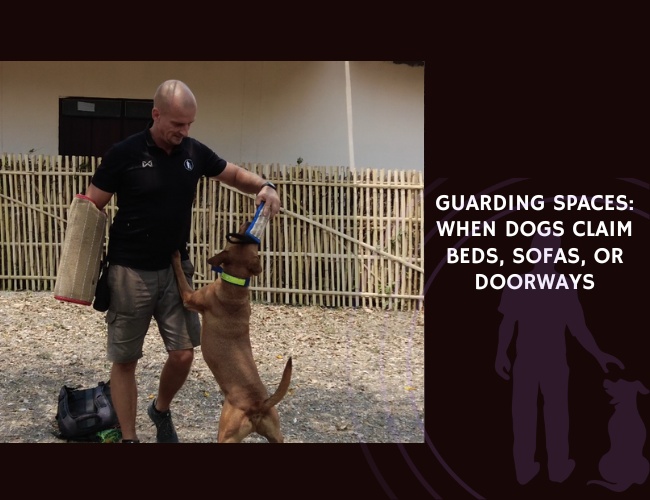
Have you ever approached your dog resting peacefully on the sofa, only to be met with a low growl or a stiffened body? Perhaps your furry friend has claimed the bedroom doorway, refusing to let you pass without a tense standoff. These moments can feel confusing, even hurtful—especially when they come from a companion you love and trust.
Spatial guarding is more common than you might think, and it reveals something profound about how your dog experiences safety, security, and belonging in your shared home. Far from being a simple “dominance” issue—a myth we’ll gently put to rest—this behaviour often emerges from deeper emotional currents: insecurity, learned patterns, or an overwhelming need to feel safe in an unpredictable world.
Let us guide you through understanding why your dog might guard specific spaces, what their body and behaviour are truly communicating, and how you can create a home environment where both you and your dog feel secure, respected, and connected. Through the NeuroBond approach, we’ll explore how trust becomes the foundation for resolving these challenges without conflict or confrontation. 🧡
Understanding Spatial Guarding: More Than Meets the Eye
What Is Spatial Guarding?
Spatial guarding occurs when a dog displays protective or defensive behaviours around specific locations in your home—most commonly beds, sofas, favourite resting spots, or strategic areas like doorways and hallways. Unlike guarding a food bowl or a cherished toy, this behaviour centers on claiming and controlling physical space itself.
You might notice your dog:
- Stiffening or freezing when you approach their resting spot
- Growling, lip-lifting, or showing teeth as you move closer
- Blocking your path through doorways or narrow spaces
- Refusing to move when asked to vacate furniture
- Snapping or lunging if you attempt to physically remove them
What makes spatial guarding particularly complex is that the “resource” being protected is intangible yet deeply meaningful to your dog. It’s not about the sofa itself—it’s about what that sofa represents: comfort, safety, elevation, warmth, or perhaps the scent of you.
Common Triggers for Spatial Guarding
Understanding what typically sparks these protective behaviours helps you recognize patterns in your own home:
- Direct approach while your dog is resting comfortably
- Reaching over or toward your dog when they’re in their claimed space
- Sudden movements near the guarded location, especially when your dog is sleeping
- Other pets approaching the valued space, creating perceived competition
- Attempts to physically move your dog from the location
- Changes in household routine that disrupt established patterns
- Visitors or strangers entering spaces your dog considers their territory
- Times of day when your dog is tired, overstimulated, or unwell
- Combination triggers such as being on the bed when the doorbell rings
Why Location Matters
Certain spaces within your home carry special significance. Beds offer comfort and the concentrated scent of their favourite humans. Sofas provide elevation—a strategic vantage point for monitoring the household. Doorways serve as control points, allowing your dog to regulate who enters or exits a room, giving them a sense of agency over their environment.
These locations become particularly valuable when they offer multiple benefits: a spot on your bed provides warmth, your scent, elevated position, and proximity to you. For an anxious or insecure dog, controlling access to such a multi-faceted resource can feel essential to maintaining emotional equilibrium.
The Emotional Landscape: What’s Really Happening
Beyond Dominance: The Truth About Control
Let’s address the elephant in the room: for decades, spatial guarding was explained through outdated dominance theory, with experts suggesting your dog was trying to be the “alpha” of your household. This interpretation has been thoroughly debunked by modern canine behavioural science.
Dogs do not operate within rigid social hierarchies in domestic settings the way wolves were once believed to in the wild. More importantly, the wolf research that spawned dominance theory was itself flawed and has since been retracted by its original author.
When your dog guards a space, they’re not plotting a household takeover. They’re communicating something far more vulnerable: fear, insecurity, or anxiety about losing something that makes them feel safe. Understanding this emotional truth is the first step toward compassionate resolution.
The Fear-Insecurity Connection
At the heart of most spatial guarding lies a profound sense of insecurity. Your dog may have learned that certain spaces provide relief from anxiety—a quiet corner where they can rest without being disturbed, a sofa where they can watch the front door for threats, or your bed where your scent provides comfort.
When these spaces are approached or challenged, your dog experiences what behaviourists call approach-avoidance conflict. They want to maintain their position (approach), but they fear the consequences of interaction or loss of the resource (avoidance). This internal conflict creates physiological arousal—increased heart rate, muscle tension, cortisol release—which manifests as defensive behaviour.
Dogs with ambivalent attachment styles, who experience inconsistency in their relationships or environments, are particularly vulnerable to this type of guarding. When the world feels unpredictable, controlling even a small territory can provide a crucial sense of stability. Through Soul Recall, we understand how past experiences of loss or uncertainty can create lasting emotional imprints that drive present-day guarding behaviours.
The Reinforcement Cycle
Here’s where learning theory intersects with emotion: every time your dog successfully “defends” their space, the behaviour strengthens. If you approach the sofa and your dog growls, and you step back, you’ve just taught your dog that growling works. This is negative reinforcement—the removal of something aversive (your approach) increases the likelihood of the behaviour (guarding) happening again.
This isn’t a conscious manipulation. Your dog isn’t thinking, “Aha! I’ve trained my human!” They’re simply learning that a specific behaviour leads to a desired outcome: maintaining their safe space. Unfortunately, this cycle can escalate over time, with guarding behaviours becoming more intense or occurring at lower thresholds.
How Guarding Behaviours Typically Escalate
Understanding the progression helps you intervene early:
- Tension and stillness – Your dog freezes but doesn’t vocalize
- Avoidance signals – Turning head away, whale eye, lip licking
- Low warning growl – A clear “please don’t come closer” message
- Intense stare and body stiffness – The warning becomes more serious
- Louder growling with lip lifting – Showing teeth as a visual deterrent
- Snarling and air snapping – Warning bites that deliberately miss
- Contact aggression – Actual biting when all other signals have failed
Most dogs don’t want to reach the final stages. Each step is an attempt to communicate discomfort and create distance without conflict. When we punish early warning signs like growling, we inadvertently teach dogs to skip straight to biting, removing the crucial warning system that keeps everyone safe. 🐾
The Science Behind the Behaviour
Neurobiological Foundations
When your dog perceives a threat to their valued space, their amygdala—the brain’s threat-detection center—activates a cascade of neurochemical responses. Stress hormones like cortisol and adrenaline flood the system, preparing for fight-or-flight responses.
Research using salivary cortisol measurements has shown that dogs displaying spatial guarding often have elevated baseline stress levels, not just during guarding episodes. This suggests that the behaviour may emerge from chronic anxiety rather than momentary possessiveness.
Heart Rate Variability (HRV), which reflects the balance between sympathetic (stress) and parasympathetic (calm) nervous system activity, tends to be lower in guarding dogs. Lower HRV indicates reduced capacity for emotional regulation and higher baseline arousal—essentially, these dogs are living in a state of heightened vigilance, making defensive reactions more likely.
Territorial Instincts and Evolutionary Context
From an evolutionary perspective, protecting a den or prime resting location would have conferred survival advantages. A safe sleeping spot meant protection from predators, shelter from elements, and a defendable position for raising offspring.
While your living room sofa isn’t exactly a wolf den, these ancient instincts still influence modern dog behaviour. Breeds developed for guarding or territorial work—German Shepherds, Rottweilers, Anatolian Shepherds, and some terrier breeds—may have stronger genetic predispositions toward spatial protection, though individual variation within breeds is always significant.
This doesn’t mean these behaviours are inevitable or unchangeable. It simply means we should approach them with understanding of their deep evolutionary roots, respecting that your dog’s brain is following ancient programming even in a contemporary context.
Attachment Theory and Spatial Control
Attachment research in dogs has revealed fascinating connections between the quality of the dog-owner bond and behavioural issues, including spatial guarding. Dogs with secure attachments—characterized by trust, consistent responses from their owners, and a reliable sense of safety—rarely need to guard spaces because they feel secure regardless of location.
Conversely, dogs with ambivalent or avoidant attachment styles, often resulting from inconsistent interactions, unpredictable household routines, or past rehoming experiences, may use spatial control as a coping mechanism. By claiming and defending a specific location, they create one predictable element in an otherwise uncertain world.
This is particularly poignant in rescue dogs with unknown histories. A dog who has experienced multiple homes, kenneling, or abandonment may guard spaces more intensely because they’ve learned that stability is fleeting and must be actively protected.

Environmental and Social Factors
Household Dynamics That Increase Guarding
Certain environmental patterns significantly increase the likelihood of spatial guarding:
Restricted Living Spaces: In smaller homes or apartments, the perceived value of comfortable resting spots increases. With fewer options for personal space, your dog may feel increased pressure to defend the locations they prefer.
Multi-Dog Households: Adding social dynamics to the equation introduces competition, even in harmonious packs. If resources feel limited—whether that’s your attention, prime sleeping spots, or access to windows—dogs may begin to claim and defend specific territories to ensure their needs are met.
Inconsistent Boundaries: Perhaps the most impactful factor is inconsistency in household rules. If your dog is sometimes allowed on the sofa and sometimes not, or if different family members have different expectations, your dog lacks clarity about what’s acceptable. This uncertainty can drive them to take control of the situation by guarding the space proactively.
Unpredictable Routines: Dogs thrive on predictability. Irregular feeding times, inconsistent walk schedules, or frequent changes in household composition create background anxiety that may manifest as increased territorial behaviour.
Red Flags: Environmental Stressors That Fuel Guarding
Watch for these household patterns that may contribute to spatial guarding behaviours:
- Inconsistent rules about furniture access across family members
- High household traffic in areas where your dog tries to rest
- Lack of a designated “safe space” where your dog is never disturbed
- Frequent visitors or house guests disrupting your dog’s routine
- Young children who don’t yet understand canine body language or boundaries
- Recent changes such as moving, new baby, new pet, or loss of a family member
- Competition for your attention among multiple pets
- Limited enrichment leading to boredom and increased resource value
- Punishment-based training that has eroded trust and increased defensiveness
- Previous rehoming or shelter experience creating insecurity about stability
The Role of Human Behaviour
Your approach, tone, body language, and timing profoundly influence whether spatial guarding escalates or dissolves:
Direct Confrontation: Standing over your dog, making direct eye contact, reaching toward them, or using a stern tone when they’re in a guarded space can be perceived as a threat, potentially triggering defensive aggression. The Invisible Leash reminds us that awareness, not tension, guides the path—meaning your emotional state and approach style matter more than physical control.
Physical Correction: Attempting to physically remove your dog, pushing them off furniture, or using corrections like leash pops or spray bottles typically backfire. These methods confirm your dog’s fear that their space isn’t safe, intensifying the need to guard more aggressively next time.
Unintentional Reinforcement: As mentioned earlier, backing away when your dog growls teaches them that guarding works. While stepping back might be the safest immediate response, without a long-term training plan, this pattern entrenches the behaviour.
Lack of Communication: Dogs need clear, consistent signals about what’s expected. Without training that establishes predictable patterns and mutual understanding, your dog fills the communication void with their own interpretations and decisions.
Scent, Routine, and Perceived Ownership
Dogs are scent-driven creatures, and locations that carry concentrated human or family scent become particularly valuable. Your bed, your favourite chair, the sofa where you watch television—these spaces are saturated with your scent, creating a powerful connection for your dog.
Established routines further reinforce perceived ownership. If your dog has slept on your bed every night for three years, they’ve formed a strong association: “This is my sleeping place.” Suddenly restricting access without explanation or transition feels arbitrary and threatening, potentially triggering guarding.
Similarly, doorways and hallways where your dog habitually positions themselves become part of their daily routine and spatial map of the home. These strategic positions allow them to monitor entrances, participate in household activities, and maintain connection with family members—all reinforcing the behaviour through repeated success.
Space. Safety. Signal.
Guarding is not greed. It’s the nervous system protecting peace where it feels most fragile.
Control fills the gap where trust should live. When safety feels uncertain, possession becomes comfort.

Reclaim connection, not territory. When you guide with calm presence, space stops being defended—and starts being shared. 🧡
Individual Differences: Breed, Temperament, and Personality
Breed Predispositions
While individual personality always trumps breed generalizations, certain breeds show higher incidences of territorial or protective behaviours:
Guardian Breeds: Dogs bred for property or livestock protection—such as Anatolian Shepherds, Great Pyrenees, or Caucasian Shepherds—often have strong territorial instincts that can manifest as spatial guarding in domestic settings.
Herding Breeds: Border Collies, Australian Shepherds, and German Shepherds may guard spaces that allow them to monitor and “control” household movement, reflecting their working heritage.
Terrier Breeds: Many terriers were bred to work independently and show tenacious resource holding. This can translate to stubborn defense of preferred spaces.
Companion Breeds: Even breeds developed primarily for companionship can guard spaces, particularly those associated with their primary person, reflecting strong attachment and possessiveness.
Breeds with Higher Guarding Tendencies
These breeds may be more prone to spatial guarding, though individual temperament varies significantly:
- German Shepherd – protective instincts, strong handler attachment
- Rottweiler – guardian heritage, territorial nature
- Doberman Pinscher – alert watchdog, protective of home and family
- Belgian Malinois – intense work drive, space-aware behaviour
- Akita – independent, strong territorial instincts
- Chow Chow – reserved with strangers, protective of resources
- Jack Russell Terrier – tenacious, resource-possessive
- Cocker Spaniel – can develop possessive behaviours, especially around favourite people
- Chihuahua – strong attachment to primary person, space-defensive
- Australian Cattle Dog – independent working heritage, control-oriented
Remember: breed is only one factor. Individual temperament, early socialization, training history, and environmental factors play equally important roles in whether spatial guarding develops.
Temperament Traits
Personality characteristics significantly predict both the onset and intensity of spatial guarding:
High Anxiety: Anxious dogs guard more frequently and intensely because they perceive more threats and feel less secure overall. Their threshold for defensive behaviour is lower.
Low Confidence: Paradoxically, less confident dogs often guard more aggressively than confident ones. They lack trust that they can maintain resources through social negotiation, resorting to defensive displays instead.
High Arousal/Impulsivity: Dogs who become quickly aroused or react impulsively may escalate to guarding behaviour before processing the situation fully, showing intense responses even to minor triggers.
Conflict Aversion: Some dogs guard simply because they’ve learned it’s the most effective way to avoid conflict. If asking nicely (soft eye contact, moving away) doesn’t work, they escalate to growling, which does.
The Attachment Variable
The quality of your relationship with your dog cannot be overstated. Dogs with secure attachments rarely develop serious spatial guarding because they trust that their needs will be met regardless of their location. They feel safe enough to be flexible.
Dogs with ambivalent attachments—experiencing inconsistency, uncertainty, or unpredictability in their primary relationship—use spatial control to manage their anxiety. If they can’t predict your responses or trust in the stability of your bond, they compensate by controlling their environment.
This is why purely behavioural interventions often fail without addressing the underlying relationship. Through the NeuroBond approach, we recognize that healing guarding behaviour requires strengthening the emotional foundation of trust between you and your dog. 🧠
Recognizing the Signs: What to Watch For
Early Warning Signals
Spatial guarding typically escalates gradually. Recognizing early signs allows intervention before behaviour becomes entrenched:
Subtle Tension: Your dog’s body stiffens slightly when you approach their resting spot, though they don’t move or vocalize.
Whale Eye: You see the whites of your dog’s eyes as they track your movement without turning their head—a classic sign of discomfort.
Lip Licking and Yawning: These appeasement signals indicate stress when you approach certain spaces.
Resource Hovering: Your dog positions themselves on or near valued spaces more frequently, as if claiming them preemptively.
Reduced Responsiveness: Your dog, who normally responds to their name or commands, ignores you when occupying certain locations.
Escalating Behaviours
As guarding intensifies, you’ll notice:
Freezing: Complete stillness, often with a hard stare—the canine equivalent of “back off.”
Low Growling: A clear warning that your dog is uncomfortable and requesting distance.
Showing Teeth: Lip lifting or snarling, indicating your dog feels threatened enough to display weapons.
Air Snapping: A warning bite that deliberately misses, communicating serious discomfort.
Contact Aggression: In severe cases, actual biting, though this is typically a last resort when all other signals have been ignored.
Context Matters
Pay attention to when guarding occurs:
- Is it specific to certain family members?
- Does it happen more when your dog is tired or unwell?
- Is it triggered by specific events (doorbell ringing, guests arriving)?
- Does it correlate with household changes or stressors?
Understanding these patterns helps identify the underlying triggers and emotional states driving the behaviour.
Compassionate Resolution: Evidence-Based Approaches
Foundational Principles
Effective intervention for spatial guarding rests on three pillars:
Emotional Safety: Creating an environment where your dog feels secure enough not to need defensive behaviours.
Clear Communication: Establishing predictable patterns and boundaries so your dog understands expectations without confusion.
Positive Association: Building new, positive associations with situations that currently trigger guarding.
Notably absent from this list: punishment, confrontation, or dominance-based techniques. These approaches, still unfortunately common, typically worsen spatial guarding by confirming the dog’s fear that their space isn’t safe.
Management: Creating Immediate Safety
Before behavior modification can succeed, you need management strategies to prevent rehearsal of guarding:
Temporary Space Restriction: If your dog guards furniture, temporarily restrict access using baby gates, closed doors, or furniture blockers. This isn’t punishment—it’s removing the trigger while you work on the underlying issues.
Alternative High-Value Spaces: Provide your dog with an equally comfortable, designated space (a plush dog bed, a crate with cozy bedding) that becomes “theirs” without ambiguity.
Prevention of Triggers: If guests trigger territorial behaviour, manage your dog’s environment during visits, using separation or supervised, controlled interactions rather than forcing social situations.
Leash Indoors: In severe cases, having your dog drag a light leash indoors (under supervision only) allows you to calmly guide them away from guarded spaces without physical confrontation.
Essential Management Tools
These practical strategies help create safety while you work on long-term behaviour change:
- Baby gates – Create physical barriers to guarded spaces without confrontation
- High-value dog bed – Orthopedic or heated options that compete with furniture comfort
- Crate training – A safe den where your dog can retreat voluntarily
- Visual barriers – Screens or furniture placement that reduce territorial monitoring
- Tether stations – Designated tie-out points in common areas for supervised containment
- Door management – Keep bedroom/living room doors closed during training phases
- Furniture covers – Make furniture less appealing with textures your dog dislikes
- White noise machines – Reduce doorway guarding triggered by outdoor sounds
- Elevated dog beds – Provide the “height advantage” dogs seek on furniture
- Scent items – Place your worn clothing on dog’s designated bed to increase appeal
Desensitization and Counter-Conditioning
This is the gold standard for changing emotional responses:
Step 1: Identify Threshold: Determine the distance at which your dog notices your approach but doesn’t guard. This is your starting point.
Step 2: Pair Approach with Positive: From beyond threshold, toss high-value treats to your dog on their space. Repeat until your dog eagerly anticipates treats when they see you approaching. You’re building a new association: “Human approaches = good things appear.”
Step 3: Gradual Progression: Over many sessions (think weeks, not days), slowly decrease the distance, always staying below the threshold that triggers guarding. If your dog guards, you’ve moved too quickly—step back to the previous distance.
Step 4: Add Duration: Once you can approach the space, add duration to your presence, continuing to deliver treats and rewards for calm behaviour.
Step 5: Introduce Movement: Eventually, practice asking your dog to move from the space using a cue they already know (“off” or “place”), heavily rewarding compliance with treats, play, or other valued rewards.
Building Consent and Agency
Teaching your dog they have choice dramatically reduces guarding:
“Off” with Choice: Rather than forcing your dog off furniture, teach a reliable “off” cue that’s always followed by a reward. Your dog learns that leaving the space is their choice and brings good things.
Platform Training: Train your dog to go to a specific “place” (a mat or bed) on cue, and reward heavily. This gives them an alternative behaviour that’s equally reinforced.
Consent Tests: Before approaching your dog in a guarded space, call them to you instead. If they come willingly, reward and interact positively. If they don’t, respect their space at that moment and try again later. This teaches your dog they can communicate their needs, reducing the perceived necessity of guarding.
Permission-Based Access: Rather than allowing your dog unrestricted furniture access, implement a system where they must perform a simple behaviour (sit, wait, or respond to their name) before being invited up. This establishes that access is earned through cooperation, not taken through defense.
Emotional Regulation Training
Teaching your dog to self-regulate reduces the arousal that fuels guarding:
Calm Protocol: Dr. Karen Overall’s Relaxation Protocol teaches your dog to remain calm during gradually increasing distractions and durations, building their capacity to stay emotionally regulated in challenging situations.
Mat Training: Creating a positive association with a specific mat where your dog learns to settle and relax, providing them with a portable “calm space” they can access anywhere in the home.
Breathing and Body Awareness: Newer approaches incorporate awareness of your own breathing and emotional state when interacting with your guarding dog. The Invisible Leash philosophy emphasizes that your calm, grounded energy influences your dog’s capacity to regulate their own emotions.
Predictable Routines: Establishing consistent daily patterns for meals, walks, play, and rest reduces background anxiety, decreasing your dog’s need to control their environment through guarding.
Environmental Modifications
Strategic changes to your physical environment support behaviour modification:
Multiple Comfortable Spaces: Ensure your dog has several appealing resting options throughout your home, reducing the perceived scarcity of valued resources.
Strategic Furniture Placement: Position dog beds and resting spots in locations where your dog can still monitor household activities without occupying high-value human furniture.
Scent Management: Place items with your scent (worn t-shirts, blankets) on your dog’s designated spaces to create positive associations and reduce their need to claim your furniture for access to your scent.
Visual Barriers: For dogs who guard doorways to maintain visual monitoring, consider baby gates or partial barriers that allow them to see activity without feeling they must physically control access points.
Special Considerations
Multi-Dog Households
Spatial guarding becomes more complex with multiple dogs:
Individual Spaces: Each dog needs their own designated, respected space where they can retreat without interference from other household dogs.
Staggered Access: If multiple dogs compete for preferred spaces, implement a schedule where each dog gets exclusive access at different times, reducing direct competition.
Supervision and Separation: During initial behaviour modification, prevent situations where one dog can practice guarding from another, using baby gates or separation to manage the environment.
Resource Abundance: Ensure there are more high-value resting spots than there are dogs, reducing the perception of scarcity.
Rescue Dogs and Unknown Histories
Dogs with incomplete or traumatic histories require extra patience:
Slower Timelines: Expect behaviour modification to take longer with rescue dogs, as you’re working with unknown emotional baggage and potentially years of reinforced patterns.
Trauma-Informed Approach: Assume a history of inconsistency, loss, or insecurity, and prioritize building secure attachment before addressing specific guarding behaviours.
Professional Support: Consider working with a certified behaviour consultant (IAABC, CCPDT) experienced with rescue dog behaviour, as these cases often benefit from individualized protocols.
Medical Considerations
Always rule out medical contributors to spatial guarding:
Pain: Dogs experiencing chronic pain or acute injuries may guard resting spots because movement is uncomfortable. Arthritic dogs, for example, may growl when approached because they anticipate the pain of being disturbed.
Cognitive Decline: Senior dogs with canine cognitive dysfunction may become more territorial or defensive due to confusion, disorientation, or reduced ability to process social information.
Sensory Changes: Hearing or vision loss can make dogs more easily startled when approached, leading to defensive reactions that resemble guarding.
Thyroid Function: Hypothyroidism has been linked to increased irritability and aggression in dogs, and should be screened for when behavioural changes emerge.
A thorough veterinary examination, including pain assessment and bloodwork, should precede or accompany any behaviour modification program for spatial guarding.
Long-Term Success: Maintaining Progress
Consistency Is Key
Once you’ve made progress reducing spatial guarding, maintaining improvement requires ongoing consistency:
Permanent Boundary Clarity: Whatever system you establish—furniture permission based on invitation, designated dog spaces, consent-based interactions—must remain consistent across all family members and all situations.
Continued Positive Reinforcement: Don’t stop rewarding the behaviours you want. Your dog should continue to receive positive feedback for appropriate space-sharing behaviours throughout their life.
Regular Check-Ins: Periodically return to foundation exercises, particularly during stressful periods (moving, new baby, holidays) when guarding behaviours might resurface.
When to Seek Professional Help
Some situations require professional intervention:
Bite History: If your dog has bitten someone over spatial guarding, work with a certified behaviour consultant or veterinary behaviourist immediately. Safety must be the priority.
Escalating Intensity: If guarding behaviours are intensifying despite your best efforts, professional assessment can identify missing pieces in your approach.
Multiple Behaviour Issues: Dogs displaying spatial guarding alongside other aggressive behaviours, severe anxiety, or compulsive behaviours need comprehensive assessment and treatment planning.
Family Stress: If spatial guarding is creating significant household stress, relationship damage, or safety concerns, professional support can accelerate progress and provide emotional support for the entire family.
Look for professionals certified through organizations like the International Association of Animal Behavior Consultants (IAABC), Certification Council for Professional Dog Trainers (CCPDT), or veterinary behaviourists (DACVB).
Prevention: Setting Your Dog Up for Success
Early Socialization and Training
Preventing spatial guarding is easier than treating it:
Positive Handling from Puppyhood: Teach puppies that human approach always predicts good things, building foundational trust.
Furniture Rules from the Start: Decide early whether your dog will have furniture access, and if so, establish invitation-based systems before guarding can develop.
Multiple Resting Options: From the beginning, provide abundant comfortable spaces so your puppy learns that valuable resources are plentiful.
Consent-Based Interactions: Even with young puppies, respect their communication and give them appropriate choice and control over interactions, building confidence and trust.
Building Secure Attachment
The most powerful prevention tool is a secure, trusting relationship:
Predictable Responsiveness: Consistently and appropriately respond to your dog’s communication, building their confidence that you’re reliable.
Positive Training Methods: Use force-free training that builds cooperation through positive reinforcement, creating a foundation of trust rather than fear.
Quality Time: Regular, positive one-on-one time—training, play, grooming, or simply quiet companionship—strengthens your bond and reduces insecurity.
Meeting Core Needs: Ensure your dog’s physical needs (exercise, mental stimulation, social interaction, rest) are consistently met, reducing overall anxiety and the need for compensatory behaviours like spatial guarding.
Conclusion: A Path Forward Rooted in Understanding
Spatial guarding, when understood through the lens of emotional security rather than dominance, reveals itself as a communication from your dog: “I’m not sure my needs will be met. I need to protect what makes me feel safe.”
This understanding transforms our approach entirely. Rather than confronting or punishing the behaviour, we address the emotional needs driving it. We create environments where dogs feel secure enough not to guard. We establish clear, kind communication that reduces uncertainty. We build relationships where trust replaces defensiveness.
Through moments of Soul Recall, we recognize that every guarding behaviour tells a story—perhaps of past loss, present insecurity, or simply a learned pattern that once served a purpose. By honoring that story while gently guiding toward new patterns, we create space for healing and growth.
The journey from spatial guarding to peaceful space-sharing isn’t always quick or linear, but it’s always possible with patience, consistency, and compassion. Your dog isn’t trying to dominate you. They’re trying to feel safe in the only ways they know how. Your gift to them is showing them a better way—one built on mutual understanding, clear communication, and unshakable trust.
That balance between understanding the science of behaviour and honoring the emotional landscape—that’s the essence of Zoeta Dogsoul. �
Next Steps:
- Assess your dog’s current environment and identify potential triggers
- Begin keeping a behaviour log to track patterns
- Implement management strategies for immediate safety
- Start threshold-based desensitization exercises
- Consider consulting with a certified behaviour professional for personalized guidance
Your dog is doing their best with the tools they have. With understanding and the right approach, you can give them better tools—and build a relationship where both of you feel safe, respected, and deeply connected.