
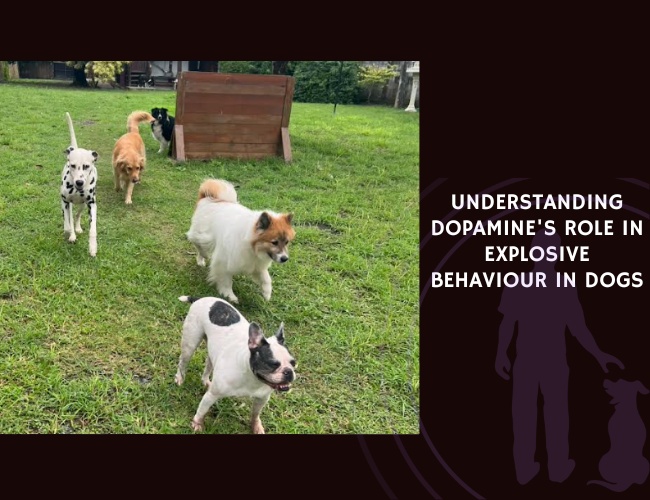
Have you ever watched your dog suddenly switch from playful excitement to an intense, almost uncontrollable reaction? Perhaps during training, when a treat doesn’t appear as expected, or on a walk when another dog passes by? These explosive moments aren’t just about poor training or stubbornness—they’re deeply rooted in your dog’s brain chemistry, specifically involving a neurotransmitter called dopamine.
Let us guide you through the fascinating and complex world of canine neurochemistry, where reward anticipation meets behavioural regulation, and where understanding your dog’s brain can transform how you approach training, daily routines, and those challenging reactive moments. This isn’t just science—it’s about building a deeper, more intuitive connection with your furry friend. 🧡
The Neurochemical Foundation: How Your Dog’s Brain Processes Reward and Motivation
The Dopamine Pathways: Your Dog’s Internal Reward System
Inside your dog’s brain, two critical pathways work together to shape motivation, impulse control, and emotional responses. The mesolimbic pathway, connecting deep brain structures to the nucleus accumbens, acts as your dog’s reward centre. Every time your dog anticipates something exciting—a treat, a toy, your approval—this pathway lights up with dopamine activity.
The mesocortical pathway connects to the prefrontal cortex, the brain’s executive control centre. Think of this as your dog’s internal “pause button,” the part that helps them think before acting, resist impulses, and maintain self-control. When these pathways work in harmony, your dog can enjoy excitement while maintaining composure. But when they become dysregulated, you might see impulsivity, intense fixation, and sudden aggressive outbursts.
Research from addiction models shows us that dopamine turnover in the nucleus accumbens intensifies during reward-seeking behaviour and relapse phases, creating a powerful drive that can override other considerations. In your dog, this same mechanism can create an almost obsessive focus on anticipated rewards.
The Delicate Balance: When Dopamine and Serotonin Fall Out of Sync
Your dog’s behaviour isn’t controlled by dopamine alone. Serotonin, another crucial neurotransmitter, acts as the brake to dopamine’s accelerator. While dopamine drives seeking, wanting, and forward momentum, serotonin provides inhibition, patience, and emotional regulation.
When this balance tips—high dopamine combined with low serotonin—you might notice your dog becoming increasingly impulsive, reactive, and prone to sudden outbursts. Studies examining aggression in dogs have found decreased plasma serotonin levels alongside elevated dopamine, creating a neurochemical environment where excitement can rapidly escalate into aggression.
This imbalance doesn’t happen in isolation. It’s influenced by genetics, early life experiences, chronic stress, and daily training practices. Through the NeuroBond approach, we recognize that understanding these neurochemical foundations allows us to work with your dog’s brain chemistry rather than against it, creating training environments that support healthy dopamine-serotonin balance.
Stress, Cortisol, and the Dopamine Connection
Chronic stress fundamentally alters how your dog’s dopamine system functions. When your dog experiences ongoing stress—from inconsistent routines, high-arousal training, or environmental unpredictability—their body releases cortisol through the hypothalamic-pituitary-adrenal axis. This stress response doesn’t just affect cortisol; it directly impacts dopamine receptor sensitivity and signalling.
Research demonstrates that prenatal stress can interact with dopamine receptor genetics to predict aggression and stress responses in adulthood. While this research involves humans, the parallel in dogs is clear: early life stress and ongoing environmental stressors can create lasting changes in how dopamine systems function, making some dogs more vulnerable to explosive reactions.
Positive human interactions—playing, calm reinforcement, predictable routines—have been shown to reduce hair cortisol levels in dogs, suggesting that your relationship and approach directly influence your dog’s neurochemical stability. This is where emotional co-regulation becomes powerful: your calm presence can help stabilize your dog’s stress response, which in turn supports healthier dopamine functioning. ## Recognising Dopamine-Driven Behaviours: What You’re Actually Seeing
The Anticipatory Arousal Pattern: When Excitement Becomes Overwhelming
Does your dog pull intensely toward the park, fixate on the treat pouch, or become almost frantic when you pick up their leash? These aren’t simply signs of enthusiasm—they’re manifestations of anticipatory arousal driven by the dopamine “seeking system.” This fundamental emotional system, identified in affective neuroscience, drives exploration, anticipation, and goal-directed behaviour.
In dogs prone to explosive reactions, this seeking system operates on overdrive. You might notice:
- Intense leash pulling that seems impossible to interrupt, as if your dog has tunnel vision toward their goal
- Fixation behaviours where your dog locks onto a stimulus—another dog, a squirrel, a toy—and becomes unresponsive to your cues
- Restless pacing or inability to settle, even in familiar environments, reflecting an internal state of constant anticipation
- Whining, barking, or other vocalizations that escalate in intensity as the anticipated reward or stimulus approaches
- Spinning, jumping, or other displacement behaviours when the anticipated reward doesn’t appear immediately
- Inability to respond to familiar cues during high-arousal moments, as if their training has completely disappeared
These behaviours indicate that your dog’s dopamine system is highly activated, creating a state of “wanting” so intense that it overwhelms their capacity for self-regulation. Dogs with ADHD-like behaviours particularly demonstrate this pattern, showing impulsivity, attention difficulties, and hyperactivity that stem from neurochemical dysregulation.
The Reward Over-Expectation Trap
Here’s something many dog owners don’t realize: using high-value rewards consistently and unpredictably can actually prime your dog’s brain for frustration-induced aggression. The Incentive Salience Theory explains this beautifully—dopamine doesn’t encode the pleasure of receiving a reward (the “liking”), but rather the motivational drive toward it (the “wanting”).
When your dog learns that amazing things might happen at any moment during training, their brain maintains a constant state of elevated “wanting.” This creates several challenges:
- Obsessive reward-seeking where your dog focuses more on getting the treat than on learning the actual behaviour
- Difficulty concentrating on anything other than when the next reward will appear
- Heightened frustration when rewards don’t materialize as quickly or frequently as expected
- Rapid escalation from excitement to frustration to aggressive responses when expectations aren’t met
- Decreased value of lower rewards making it harder to work in distracting environments without high-value treats
- Training “burnout” where your dog becomes less responsive overall due to constant neurochemical activation
This over-expectation pattern is particularly problematic during high-intensity training sessions where treats, toys, and enthusiastic praise flow rapidly and unpredictably. Your dog’s dopamine system remains perpetually activated, never given the opportunity to return to baseline. Over time, this chronic activation can lead to a “dopamine addiction” pattern where your dog needs increasingly stimulating rewards to achieve the same motivational effect.
Predictive Markers: When Seeking Becomes a Warning Sign
Learning to recognize dopamine-driven behaviours as potential warning signs can help you intervene before explosive reactions occur. The seeking, fixation, and pacing we discussed aren’t just annoying habits—they’re your dog’s way of showing you that their internal arousal is escalating beyond their capacity to manage it.
Think of these behaviours as a gauge showing your dog’s internal pressure building. A dog intensely fixating on another dog while pulling, whining, and ignoring all cues is showing you that their dopamine-driven arousal is approaching a tipping point. When this intense motivation is suddenly blocked—the other dog moves away, you pull them back, the toy isn’t thrown—that unreleased motivational energy needs somewhere to go. The Frustration-Aggression Hypothesis suggests it often converts into aggressive behaviour.
Dogs with dysregulated dopamine systems may show what researchers call “aberrant salience”—they attribute intense importance to stimuli that other dogs would find only mildly interesting. Your dog might become fixated on a specific sound, movement, or object, responding with disproportionate arousal because their dopamine system has made it hyper-salient. These fixations can serve as red flags, indicating that your dog’s neurochemical regulation needs support. 🧠

Environmental and Training Factors: How Your Approach Shapes Brain Chemistry
Five Warning Signs of Dopaminergic Overload
Learning to identify these red flags can help you intervene before explosive reactions occur:
- Progressive Intensity Escalation: Your dog’s excitement or reactivity increases steadily rather than plateauing, suggesting their arousal regulation system isn’t functioning properly
- Extended Recovery Times: After arousing events, your dog takes 20+ minutes to settle back to baseline (or never fully settles), indicating compromised dopamine regulation
- Context-Independent Arousal: Your dog maintains high arousal even in traditionally calm environments like home, showing that their baseline has shifted
- Reward Threshold Inflation: What used to motivate your dog no longer works—you need increasingly valuable rewards to achieve the same response
- Rapid State Switching: Your dog flips from calm to explosive in seconds with minimal apparent trigger, reflecting unstable neurochemical regulation
If you recognize three or more of these patterns in your dog, their dopamine system likely needs structured support.
The Hidden Cost of Unpredictable Rewards
Many modern training approaches emphasize variable reinforcement schedules, based on research showing that unpredictable rewards can strengthen behaviour. However, for dopamine-sensitive dogs, this unpredictability can become problematic. When your dog never knows when the next reward is coming, their brain maintains a constant state of anticipation, keeping dopamine activity chronically elevated.
This isn’t necessarily problematic for all dogs, but for those already prone to high arousal or impulsivity, unpredictable reward schedules can contribute to dopaminergic overload. Your dog’s brain remains in a persistent state of “maybe now? maybe now?”—a form of psychological stress that activates the hypothalamic-pituitary-adrenal axis and influences dopamine signalling.
High-intensity training sessions compound this effect. Imagine a training class where commands come rapid-fire, rewards appear sporadically, and arousal levels climb steadily throughout the session. Your dog’s dopamine system doesn’t have time to regulate between bursts of excitement. They’re perpetually “on edge,” in a state of heightened anticipation that makes frustration and reactive responses increasingly likely.
Extinction Trials and the Frustration Response
Understanding how your dog responds when expected rewards don’t appear is crucial for preventing explosive reactions. During extinction—when a previously rewarded behaviour no longer produces a reward—dopamine turnover in the nucleus accumbens decreases significantly. For a dog whose “wanting” system has been intensely primed, this sudden absence of reward can trigger profound frustration.
The Frustration-Aggression Hypothesis explains this mechanism: when goal-directed behaviour is blocked, aggression often results. For dopamine-sensitive dogs, this manifests as:
- Rapid escalation from focused work to frustrated reactions when rewards cease
- Displacement behaviours like sudden biting of the leash, barking, or jumping when the anticipated reward doesn’t appear
- Redirected aggression toward handlers, other dogs, or objects in the environment
- Extinction bursts where the dog dramatically intensifies their behaviour before it finally reduces
- Generalized frustration that affects behaviour in other contexts beyond the training scenario
- Loss of previously learned behaviours as frustration overwhelms their capacity to respond to cues
This is why traditional extinction-based training can be particularly challenging for reactive or impulsive dogs. Their neurochemistry primes them for intense frustration responses when their expectations aren’t met.
The Power of Emotional Co-Regulation
Here’s where your role becomes transformative: consistent emotional co-regulation can stabilize dopaminergic signalling and enhance your dog’s behavioural control. The prefrontal cortex plays a crucial role in regulating emotional responses, particularly in managing the amygdala’s threat responses. By providing a predictable, calm presence, you help your dog develop better emotional regulation through neural mechanisms.
Research confirms that positive human interactions—calm play, consistent routines, rewards for settled behaviour—reduce stress biomarkers in dogs, indicated by lower hair cortisol levels. This stress reduction creates a more stable neurochemical environment where dopamine systems can function optimally rather than remaining chronically activated.
Canine-assisted interventions have demonstrated remarkable success in improving social interactions and reducing hyperactivity, highlighting how the quality of the human-animal relationship directly influences behavioural regulation. For dogs with ADHD-like behaviours, treatment strategies emphasizing environmental enrichment, relaxation protocols, and behaviour modification help prevent dopaminergic overdrive from escalating into explosive behaviour.
The Invisible Leash concept embodies this approach—understanding that your emotional state, energy, and consistency create an invisible connection that guides your dog’s nervous system. When you remain calm during moments of high arousal, you’re not just modeling behaviour; you’re providing neurological support that helps your dog’s prefrontal cortex maintain control over their reactive impulses. 🧡
Cross-Species Insights: What Human Research Teaches Us About Our Dogs
The ADHD Connection: More Similar Than You’d Think
Dogs can suffer from an attention-deficit/hyperactivity disorder-like syndrome that mirrors human ADHD remarkably closely. The symptoms include impulsivity, attention difficulties, hyperactivity, and aggression—all associated with dysregulation of serotonin and dopamine systems, just as in humans.
This parallel isn’t just interesting from a scientific perspective; it offers practical insights for behaviour modification. Treatment approaches for ADHD-like dogs include environmental enrichment, relaxation protocols, behaviour modification, and sometimes pharmacological interventions. These strategies align closely with approaches used in human ADHD treatment, suggesting that insights from human neuropsychiatry can directly inform how we support our dogs.
Understanding that your dog’s explosive reactions might stem from neurochemical dysregulation similar to human impulse control disorders helps shift perspective from “my dog is being bad” to “my dog’s brain needs support managing arousal and impulse control.” This reframing opens up more compassionate, effective intervention strategies.
Intermittent Explosive Disorder: A Framework for Understanding Canine Aggression
Intermittent Explosive Disorder in humans involves recurrent episodes of impulsive aggression disproportionate to the triggering situation—sound familiar? Many dogs with explosive reactivity show remarkably similar patterns: sudden, intense aggressive responses that seem out of proportion to the trigger, followed by relatively calm periods.
In humans, cognitive-behavioural therapy has proven effective for IED, focusing on anger management, cognitive coping strategies, and impulse control. State-based relaxation therapy has also shown success in addressing these externalizing problems. These therapeutic approaches provide a valuable framework for developing structured interventions for dogs:
Cognitive coping strategies translate to teaching alternative behaviours and creating predictable response patterns that give your dog a “script” to follow in arousing situations
Relaxation techniques become protocols like “settle on your mat,” teaching your dog to actively choose calm states rather than remaining in constant arousal
Anger management parallels helping your dog develop tolerance for frustration and delay of gratification, building their capacity to handle unmet expectations without reactive responses
The success of these approaches in humans suggests that structured, therapeutic interventions for dogs showing explosive behaviours can effectively address the underlying neurochemical and behavioural patterns.
The Dopamine-Cortisol Dance: From Excitement to Aggression
The transition from excitement to aggression isn’t instantaneous—it’s a complex interaction between dopaminergic excitement and cortisol-mediated stress responses. When your dog experiences high excitement, their dopamine system activates intensely. If this excitement couples with stress or frustration, the interaction with cortisol creates a dysregulated state that can rapidly escalate into aggression.
Prenatal stress research demonstrates that early life experiences can program vulnerability to aggression through interactions between dopamine receptor genetics and stress hormone responses. In dogs, hair cortisol levels vary with lifestyle and human interactions, with positive interactions associated with lower cortisol. This suggests that a calm, predictable environment doesn’t just reduce stress—it prevents the explosive combination of high dopaminergic excitement and elevated cortisol that overwhelms coping mechanisms.
When your dog’s dopamine system is firing intensely (high excitement, strong anticipation) and their cortisol levels rise (due to stress, frustration, or environmental unpredictability), their capacity for inhibitory control diminishes. The prefrontal cortex, already challenged by high dopamine tone, becomes less effective at regulating the amygdala’s threat responses. This is when you see the sudden flip from excited to aggressive—a neurochemical perfect storm.
Practical Applications: Retraining the Dopamine System
Identifying “Dopamine Addiction” Patterns in Your Dog
Before you can support healthier dopamine regulation, you need to recognize when your dog has developed maladaptive patterns. “Dopamine addiction” in dogs manifests as behaviours that reflect an overactive “wanting” system driven by Incentive Salience Theory. Look for these signs:
- Obsessive treat-seeking where your dog cannot focus on anything but getting the next reward, even when you’re trying to teach actual skills
- Difficulty disengaging from arousing stimuli, as if your dog has lost the ability to make the choice to look away or calm down
- Escalating intensity in reward-seeking behaviours over time, needing bigger, better, more exciting rewards to achieve the same level of motivation
- Inability to work for calm praise or low-value rewards, showing that your dog’s reward threshold has been pushed higher and higher
- Persistent restlessness even after exercise or training sessions, indicating that arousal levels never return to a healthy baseline
- Reactive explosions when expected high-value rewards don’t appear, showing frustration intolerance
- Training session anticipation that begins minutes or hours before you actually start, keeping your dog in a heightened state
- Ignoring environmental dangers in pursuit of rewards, such as running toward treats without watching for cars or obstacles
These patterns indicate that your dog’s dopamine system has been conditioned to expect constant, intense stimulation. The good news? With patient retraining, you can help your dog develop calmer reward pathways and better self-regulation.
Six Practical Strategies for Dopamine Balancing
Implementing these approaches can help restore healthier neurochemical regulation:
1. The “3-Second Pause” Rule After your dog performs a behaviour, count to three before delivering the reward. This brief pause teaches that success leads to calmness, not immediate excitement, and allows dopamine levels to begin regulating.
2. Interval Training with Built-In Calm Structure training in short sets: three repetitions of a behaviour, followed by 2-3 minutes of calm activity (sniffing, gentle petting, quiet sitting), then another set. This rhythm prevents dopamine overload.
3. Progressive Reward Downgrading Once your dog reliably performs a behaviour, gradually shift from high-value treats to medium-value, then to verbal praise or life rewards. This prevents reward threshold inflation.
4. The “Calm Before Storm” Protocol Before any exciting activity (walks, play, meals), require 10-30 seconds of calm behaviour first. Your dog learns that settling opens doors to good things, rewarding dopamine regulation itself.
5. Environmental Enrichment Over Arousal Replace high-arousal activities (frantic fetch, chase games) with enrichment that engages your dog’s mind without spiking arousal: snuffle mats, puzzle feeders, exploratory walks, scent work.
6. Predictable Daily Structure Create consistent routines for meals, walks, play, training, and rest. When your dog knows what comes next, their nervous system relaxes out of constant anticipatory mode.
These strategies work synergistically—implementing several together creates cumulative benefits for dopamine regulation.
Crave. Spike. Collapse.
Dopamine fuels the chase. Each cue of reward ignites the brain’s seeking circuits, pushing excitement toward obsession. What begins as joy becomes compulsion when anticipation outpaces control.
Balance breaks under pressure. When serotonin’s calm can’t counter dopamine’s drive, the leash between thought and action snaps. Impulse replaces intention, and emotion floods the system unchecked.

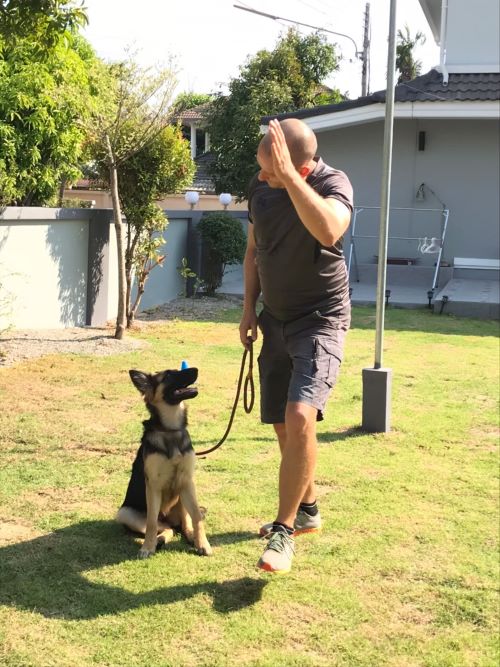
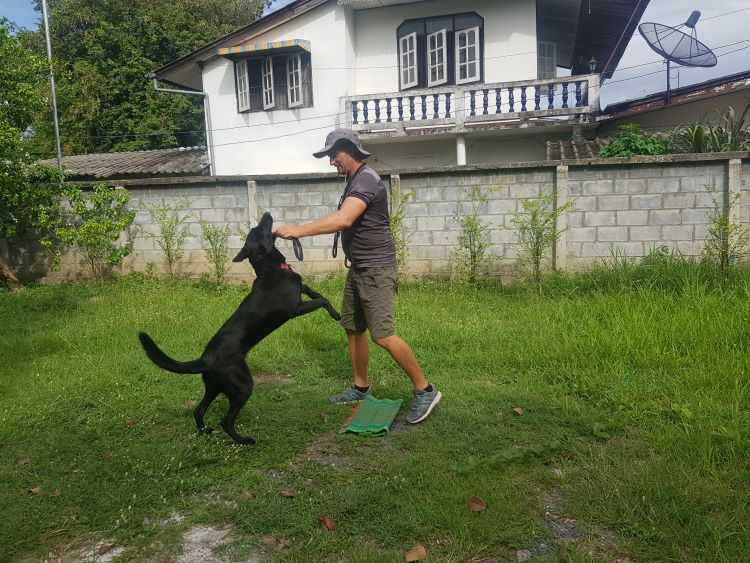
Calm chemistry builds trust. Gentle structure, predictable rhythm, and emotional steadiness restore harmony. Training becomes balance work—where excitement meets regulation, and connection tames the storm.
The Slow Reinforcement Revolution
Retraining calmer reward pathways begins with fundamentally changing your reinforcement approach. Instead of rapid-fire treat delivery that keeps dopamine constantly spiking, implement slower, more deliberate reinforcement:
Pause before rewarding: After your dog performs a behaviour, wait a beat before delivering the reward. This brief pause begins teaching your dog that calmness follows success, not immediate excitement.
Space out training repetitions: Rather than drilling a behaviour ten times in rapid succession, do three repetitions, take a break for calm sniffing or gentle petting, then resume. This allows dopamine levels to regulate between training moments.
Reward the calm after the behaviour: If your dog sits, don’t immediately throw a party. Wait for them to take a breath, settle slightly, then mark and reward. You’re reinforcing the complete behaviour sequence, including the calm that follows.
Use marker words deliberately: If you use “yes” or a clicker, make sure you’re not creating a Pavlovian response where the marker itself triggers explosive excitement. Keep your tone moderate, and ensure the marker predicts reinforcement without causing arousal spikes.
This slower approach might initially feel less dynamic or exciting, but it’s precisely this reduction in intensity that helps rebalance your dog’s dopamine regulation.
Diversifying Rewards: Beyond High-Value Treats
Many dogs with dopamine addiction patterns have been conditioned to expect only the most exciting rewards: chicken, cheese, enthusiastic praise, wild toy play. Diversifying rewards helps normalize dopamine responses and builds resilience:
Calm verbal praise: A gentle “good” in a soothing tone becomes inherently rewarding when paired with your dog’s success, without triggering excitement spirals.
Sniffing opportunities: Release your dog to sniff an interesting spot, which activates natural, calming exploratory behaviours rather than high-arousal reward seeking.
Gentle physical contact: For dogs who enjoy it, slow petting, massage, or scratching provides reward through tactile pleasure and bonding rather than excitement.
Environmental access: Opening a door to let your dog into the yard, allowing them to greet a friendly person, or permitting exploration of a new space can serve as powerful, naturally-paced rewards.
Life rewards: Incorporate what your dog wants into daily life—sitting calmly gets the leash put on for a walk, waiting patiently means their food bowl goes down, lying quietly brings you to sit with them.
The goal isn’t to eliminate high-value treats entirely, but to expand your dog’s reward “vocabulary” so their brain doesn’t depend solely on dopamine spikes from food or toy excitement.
🧠 Understanding Dopamine & Explosive Behaviour in Dogs
The Neurochemical Key to Transforming Reactivity into Regulation
🔬 The Neurochemical Foundation
What’s Really Happening in Your Dog’s Brain
Dopamine doesn’t encode pleasure—it encodes “wanting.” When your dog’s mesolimbic pathway fires intensely, they’re driven by anticipation, not satisfaction. This creates obsessive reward-seeking that can overwhelm their prefrontal cortex’s ability to regulate impulses.
The Critical Balance
• High dopamine = accelerator (seeking, wanting, motivation)
• Low serotonin = broken brake (poor impulse control)
• Elevated cortisol = stress amplifier (compromised regulation)
• Result: Explosive reactions when expectations aren’t met
👁️ Recognition: What You’re Actually Seeing
Signs of Dopaminergic Overload
• Intense fixation that seems impossible to interrupt
• Escalating arousal that never returns to baseline
• Explosive reactions when expected rewards don’t appear
• Recovery times exceeding 20+ minutes after excitement
• Ignoring familiar cues during high-arousal moments
The “Dopamine Addiction” Pattern
Your dog needs increasingly valuable rewards to achieve the same motivation. They can’t work for calm praise anymore. Training sessions create restlessness rather than satisfaction. These aren’t training failures—they’re neurochemical imbalances.
🌱 Retraining the Dopamine System
The Slow Reinforcement Revolution
• Implement the “3-Second Pause” before rewarding
• Structure training: 3 reps → 2 min calm → repeat
• Diversify rewards beyond high-value treats
• Reward calmness as deliberately as obedience
• Create environmental predictability through routine
Emotional Co-Regulation Through NeuroBond
Your calm presence isn’t just comforting—it’s neurologically therapeutic. When you remain regulated during your dog’s arousal, your prefrontal cortex supports theirs. This is the essence of NeuroBond: your emotional state directly influences their dopamine regulation.
⚠️ Critical Warning: What NOT to Do
Training Approaches That Worsen Dysregulation
• Rapid-fire, unpredictable high-value rewards
• High-arousal games (frantic fetch, intense chase)
• Abrupt extinction of previously rewarded behaviours
• Punishment during explosive moments
• Increasing stimulation to “tire them out”
Why This Backfires
For dopamine-sensitive dogs, these approaches create chronic anticipation and stress. The Frustration-Aggression Hypothesis shows that when intense “wanting” is blocked, aggression often results. You’re not building resilience—you’re creating neurochemical crisis.
⚡ Quick Reference: The Dopamine Regulation Formula
Slower Rewards + Environmental Predictability + Calmness Training + Emotional Co-Regulation = Healthier Dopamine Pathways
Remember: Neurochemical rebalancing takes 6-12 weeks of consistent application. Small improvements reflect genuine brain changes. Trust the process through the Invisible Leash—your consistency guides their nervous system toward regulation.
🧡 The Zoeta Dogsoul Perspective
Explosive behaviour isn’t defiance—it’s dysregulation. When you understand that your dog’s reactions stem from dopaminergic overload rather than willful disobedience, everything changes. Through the NeuroBond approach, you become not just a trainer but a partner in neurological wellness, providing the emotional co-regulation that stabilizes their nervous system. The Invisible Leash reminds us that awareness, not tension, guides the path. And through Soul Recall, every calm moment you create together becomes an emotional memory their brain can access during future arousing situations.
© Zoeta Dogsoul – Where neuroscience meets soul in dog training
Creating Environmental Predictability
Chaos and unpredictability keep your dog’s stress response activated and their dopamine system chronically elevated as they constantly scan for potential rewards or threats. Building environmental predictability provides crucial neurochemical stability:
Consistent daily routines: When meals, walks, play, and rest happen at similar times each day, your dog’s brain doesn’t need to remain in constant anticipation mode.
Predictable training sessions: Start and end sessions with clear rituals. Perhaps training always begins with a specific mat behaviour and ends with a releasing phrase followed by calm sniffing time.
Clear communication: Use consistent verbal and physical cues so your dog learns exactly what different signals predict, reducing cognitive load and anxiety.
Structured environments: Create specific spaces for different activities—a calm resting area, a designated training space, an appropriate play zone. This environmental structure helps your dog’s brain shift between different arousal states appropriately.
Anticipated endings: Signal when activities will end before they do. A “last one” cue before the final training repetition or a specific phrase before putting toys away helps your dog prepare for transitions rather than experiencing abrupt endings as frustrating deprivations.
Environmental predictability doesn’t mean your dog’s life becomes boring—it means their nervous system gets the structural support it needs to maintain healthy dopamine regulation rather than operating in constant uncertainty. 😄
Rewarding Calmness as a Deliberate Strategy
Perhaps the most transformative shift you can make is treating calmness itself as a rewardable behaviour rather than just the absence of excitement. This approach directly counters dopamine addiction patterns by conditioning your dog’s brain to find value in settled, regulated states:
Capture calm moments: When your dog naturally settles—lying down quietly, sitting without being asked, watching the world calmly—mark and reward these moments. You’re teaching that calm behaviour produces good outcomes.
Build duration gradually: Start with rewarding one second of calmness, then three, then five, gradually building your dog’s capacity to maintain settled behaviour for longer periods.
Use a special calm marker: Consider using a different marker for calm behaviours (“easy,” “settle,” “peace”) delivered in a soothing tone, distinguishing it from your regular training marker.
Create calm protocols: Teach structured relaxation, like Karen Overall’s Relaxation Protocol or simply having your dog spend gradually increasing time on a mat while you move around, sit nearby, or do other activities.
Reward relaxed body language: Soft eyes, loose mouth, relaxed tail, deep breathing—notice and reinforce the physical manifestations of calm states.
Through the lens of Soul Recall, these calm moments create emotional memories that your dog’s brain can access in arousing situations. When your dog has extensive experience of calmness being rewarding, their nervous system has a familiar, valued state to return to rather than remaining stuck in high-arousal patterns.
Managing Extinction Carefully
Given what we know about frustration-induced aggression in dopamine-sensitive dogs, traditional extinction procedures require careful modification:
Never go “cold turkey”: Abruptly stopping rewards for previously reinforced behaviours can trigger intense frustration. Instead, fade reinforcement gradually while teaching alternative reward pathways.
Teach incompatible behaviours: Rather than simply stopping reinforcement for an unwanted behaviour, teach a different behaviour that meets the same need. If your dog jumps for attention, teach them to sit for greeting instead.
Maintain some reinforcement: Even during behaviour modification, ensure your dog continues receiving regular reinforcement for desirable behaviours, preventing the generalised frustration that comes from an overall decrease in positive experiences.
Watch for warning signs: If you notice fixation intensifying, frustration mounting, or arousal escalating during training, stop and reassess. Pushing through can trigger explosive reactions in dopamine-sensitive dogs.
Support emotional regulation: During periods of behaviour change, provide extra environmental predictability, increase calm reinforcement, and ensure your dog has appropriate outlets for energy and stress.
The goal of any behaviour modification should be building better behavioural patterns, not simply extinguishing unwanted ones. For dogs with dopaminergic dysregulation, this supportive, gradual approach prevents the neurochemical crisis that traditional extinction can provoke.
Biological Interventions: Supporting Brain Chemistry Through Lifestyle
The Nutrition-Neurotransmitter Connection
While specific research on dietary tyrosine modulation in reactive dogs remains limited, understanding the nutrition-neurotransmitter connection offers promising avenues. Dopamine is synthesized from the amino acid tyrosine, meaning dietary intake theoretically influences dopamine production.
For dogs showing dopamine-related behavioural issues, consider:
- Protein quality and timing: Since tyrosine comes from dietary protein, ensuring your dog receives high-quality protein sources supports neurotransmitter synthesis. The timing of protein intake might also matter—some dogs benefit from protein-rich meals earlier in the day to support alertness and cognitive function, with lighter evening meals promoting calm.
- Omega-3 fatty acids: While not directly involved in dopamine synthesis, omega-3s support overall brain health, reduce inflammation, and may help stabilize mood and impulse control through multiple neurological pathways.
- B vitamins: Several B vitamins serve as cofactors in neurotransmitter synthesis. Ensuring adequate B-vitamin intake supports the biochemical pathways that produce dopamine and serotonin.
- Antioxidants: Oxidative stress can damage neuronal function and neurotransmitter systems. Antioxidant-rich foods may help protect neurological health.
- Gut microbiome support: Emerging research highlights the gut-brain axis, where gut bacteria influence neurotransmitter production and neurological function. Probiotic supplementation or naturally fermented foods might support this pathway, though specific research in dogs is still developing.
- Magnesium: This mineral plays a role in nervous system regulation and may support calmer responses to stress when dietary levels are adequate.
- Tryptophan-rich foods: Since tryptophan is the precursor to serotonin, foods naturally rich in this amino acid may help support the dopamine-serotonin balance.
Always consult with a veterinary nutritionist before making significant dietary changes, particularly if you’re considering specific supplements like tyrosine. What works for one dog may not be appropriate for another, especially given individual variations in metabolism, health status, and medication interactions.
The Exercise Equation: Movement and Dopamine
Physical exercise has complex effects on dopamine systems. While exercise does increase dopamine release and can improve overall mood and impulse control, the type and intensity of exercise matter tremendously for dopamine-sensitive dogs:
Avoid over-arousing exercise: Ball chasing, intense fetch, and other highly stimulating activities can actually worsen dopamine addiction patterns by providing massive, repeated dopamine spikes without teaching self-regulation.
Emphasise exploratory walks: Sniff walks, where your dog sets the pace and chooses what to investigate, provide natural, self-regulating dopamine activity through the seeking system without explosive intensity.
Include proprioceptive activities: Balance work, careful climbing, navigating different surfaces, and body awareness exercises engage your dog’s mind and body while promoting calmness and focus rather than arousal.
Practice structured play: Rather than endless, increasingly frantic toy play, teach games with clear starts, stops, and calm moments built in. This structures arousal rather than letting it spiral.
Incorporate rest days: Just as human athletes need recovery, your dog’s nervous system benefits from days with lower stimulation, allowing neurochemical systems to regulate and restore.
The goal is providing appropriate outlets that satisfy your dog’s physical needs while supporting rather than undermining dopamine regulation.
Pharmacological Support When Needed
For some dogs with severe dopaminergic dysregulation, behaviour modification and environmental management may need support from medication. Fluoxetine, a selective serotonin reuptake inhibitor, is commonly prescribed for dogs with ADHD-like behaviours, aggression, or severe anxiety. By increasing serotonin availability, fluoxetine can help restore the dopamine-serotonin balance.
Other medications might include:
Mood stabilizers: Such as lithium, which research suggests can decrease impulsivity by reinforcing prefrontal cortex function and regulating dopaminergic systems.
Anti-anxiety medications: For dogs whose explosive behaviour stems partly from chronic anxiety maintaining elevated stress hormones and dopamine dysregulation.
Supplements: Such as L-theanine, which promotes calm without sedation, or adaptogens that support stress resilience.
Medication should never be the only intervention—it works best alongside consistent behaviour modification, environmental management, and the emotional co-regulation we’ve discussed. Think of medication as providing neurochemical support that makes behaviour modification more effective, not as a standalone solution.
Always work with a veterinary behaviourist who can assess your individual dog’s needs, consider potential medication interactions or contraindications, monitor response and side effects, and adjust treatment plans as needed. 🧡
Building a Comprehensive Support Strategy
Assessment: Understanding Your Individual Dog
Before implementing changes, assess where your dog currently stands. This helps you create targeted interventions rather than generic approaches:
Trigger Identification
- When do explosive reactions occur? During training? On walks? Around food or toys? At specific times of day?
- Document patterns to understand what situations prime dopaminergic overload
- Note whether triggers are predictable or seem random
- Identify whether certain people, places, or activities consistently precede explosions
Reward History Evaluation
- How have you used rewards? Are they rapid, high-value, and unpredictable?
- Has your dog’s reward threshold escalated over time?
- What types of rewards create the most intense responses?
- Understanding this history reveals how their dopamine system has been conditioned
Arousal Baseline Assessment
- Does your dog have a naturally high arousal baseline, or is it situational?
- Can they settle at home but not elsewhere?
- What’s their resting respiratory rate and body language when truly relaxed?
- This distinction guides intervention strategies
Life History Considerations
- What do you know about your dog’s early experiences?
- Were there traumatic events, inconsistent care, or chronic stress that might have influenced dopamine receptor development?
- What was their breeding background and early socialization like?
- Has their explosive behaviour worsened, stayed stable, or improved over time?
Recovery Time Observation
- After arousing events, how long does it take your dog to return to baseline?
- Dogs with dysregulated dopamine systems often show prolonged recovery times
- Do they remain activated long after the triggering event ends?
- Can they sleep easily after excitement, or do they stay vigilant?
This assessment creates a clear picture of your dog’s unique neurochemical and behavioural profile, allowing you to tailor interventions effectively.
The Integrated Approach: Combining Multiple Strategies
Rarely does a single intervention solve dopamine-related explosive behaviour. The most effective approach integrates multiple strategies:
Environmental foundation: Begin with creating predictability, routine, and reduced stimulation in your dog’s environment. This provides the stable base that supports all other interventions.
Reward restructuring: Simultaneously implement slower reinforcement, reward diversification, and calmness training. These directly retrain dopamine pathways.
Relationship deepening: Strengthen your emotional co-regulation through consistent calm presence, predictable responses, and attuned interaction. The NeuroBond framework emphasizes that your relationship itself is therapeutic.
Exercise optimization: Adjust physical activity to support rather than undermine dopamine regulation, emphasizing exploration and proprioception over arousal-spiking activities.
Nutritional support: Work with a veterinary nutritionist to optimize your dog’s diet for neurological health, potentially including targeted supplementation.
Professional support: When needed, involve a veterinary behaviourist who can assess whether medication or other medical interventions would support your dog’s progress.
Ongoing assessment: Regularly revisit your dog’s progress, adjusting strategies as their dopamine regulation improves and new challenges emerge.
This comprehensive approach addresses the multiple factors influencing dopaminergic function—genetic vulnerabilities, early experiences, current environment, training history, stress levels, and daily lifestyle.
Patience and Realistic Expectations
Retraining dopamine pathways and building better impulse control takes time. Your dog’s current patterns developed over months or years; expecting them to change in weeks is unrealistic. Throughout the process:
Celebrate small progress: Notice when your dog shows slightly better impulse control, settles a bit faster, or tolerates frustration a moment longer. These incremental improvements reflect genuine neurochemical changes.
Expect setbacks: Progress isn’t linear. Stressful events, environmental changes, or simply bad days will trigger old patterns. This doesn’t mean you’ve failed—it’s a normal part of behaviour change.
Adjust your criteria: As your dog improves, gradually increase expectations. But if you hit resistance, back up and rebuild from a more successful point. Pushing too hard can trigger the frustration responses you’re trying to prevent.
Maintain consistency: Your dog’s brain needs consistent input to rewire dopamine pathways. Occasional calm training sessions won’t counter daily chaotic reinforcement.
Trust the process: Neurochemical changes and behavioural shifts happen beneath the surface before you see obvious external changes. Continue implementing strategies even when progress feels slow.
Remember that you’re not just changing behaviour—you’re supporting your dog’s brain in developing healthier dopamine regulation, better impulse control, and improved emotional regulation. That’s profound work that deserves time and patience.
A New Understanding: From Blame to Support
Shifting Perspective: It’s Not Defiance—It’s Dysregulation
One of the most transformative shifts in working with explosive dogs is moving from seeing their behaviour as willful disobedience to understanding it as neurochemical dysregulation. Your dog isn’t trying to make your life difficult. They’re not being stubborn or dominant or “bad.” Their brain chemistry is working against their capacity for self-regulation.
When you understand that explosive reactions stem from dopaminergic overload, serotonergic deficiency, elevated cortisol, and compromised prefrontal cortex function, you can respond with support rather than frustration. This doesn’t mean accepting dangerous behaviour or abandoning training—it means approaching the challenge with compassion and science-based strategies.
This perspective shift changes everything. Instead of punishing explosions, you work to prevent the neurochemical buildup that triggers them. Instead of demanding obedience during high-arousal moments, you provide environmental structure that keeps arousal manageable. Instead of increasing stimulation to motivate, you create calm pathways that make regulation possible.
The Human-Canine Neurochemical Dance
Your dog’s dopamine system doesn’t exist in isolation—it exists in relationship with you. Your emotional state, consistency, predictability, and presence influence your dog’s neurochemical regulation. This is the essence of emotional co-regulation and the foundation of NeuroBond understanding.
When you remain calm during your dog’s arousal, you provide neurological scaffolding. Your prefrontal cortex, effectively regulating your own emotional responses, helps support your dog’s prefrontal cortex function. Your predictable, consistent behaviour reduces stress and stabilizes their cortisol response, which supports healthier dopamine signalling. Your recognition and reinforcement of calm states literally rewards their brain for finding regulated states.
The Invisible Leash isn’t metaphorical—it’s the real, measurable neurological influence you have on your dog’s nervous system through proximity, attention, and emotional attunement. Research confirms that positive human interactions reduce stress biomarkers in dogs. You are not simply training a separate being; you are participating in a shared neurochemical experience.
The Path Forward: Building Lasting Change
Supporting healthier dopamine regulation in your dog isn’t a quick fix or a single technique—it’s a lifestyle approach that honours how their brain actually works. It requires patience, consistency, and a willingness to look beyond surface behaviours to underlying neurochemistry.
But here’s the beautiful truth: when you create an environment that supports healthy dopamine function, provide training that builds self-regulation rather than demanding it, and offer the emotional co-regulation that stabilizes your dog’s nervous system, you don’t just reduce explosive behaviour. You create a dog who feels more settled, more confident, more capable of navigating the world with resilience and emotional flexibility.
You build a relationship based on true understanding, where you’re not constantly battling your dog’s impulses but instead supporting their brain in developing better regulation. That kind of partnership, grounded in neuroscience but expressed through daily patience and attunement, transforms both ends of the leash. That balance between science and soul, between understanding neurochemistry and honouring the emotional bond—that’s the essence of Zoeta Dogsoul.
Conclusion: From Explosive to Empowered
Understanding dopamine’s role in explosive behaviour illuminates a path forward that’s grounded in compassion, science, and practical application. Your dog’s sudden outbursts, intense reactivity, and frustration-driven aggression aren’t character flaws—they’re windows into a nervous system that needs support developing better regulation.
The Key Insights to Remember
Throughout this exploration, several fundamental principles emerge:
- Dopamine drives “wanting,” not just “liking”: Your dog’s intense reward-seeking reflects neurochemical motivation that can become obsessive when dysregulated, creating a state where anticipation overwhelms their capacity for patience and impulse control.
- Balance matters profoundly: The interplay between dopamine and serotonin, between excitement and inhibition, shapes whether your dog can maintain composure or spirals into reactive explosions. Supporting this balance through training, environment, and lifestyle creates neurochemical stability.
- Stress amplifies vulnerability: Chronic stress and elevated cortisol don’t just make your dog anxious—they fundamentally alter dopamine receptor sensitivity and signalling, increasing susceptibility to explosive reactions. Reducing stress through predictability and positive interactions is neurologically protective.
- Your role is therapeutic: Through emotional co-regulation, you’re not just training behaviours—you’re providing neurological support that helps your dog’s prefrontal cortex maintain control, their stress response stay regulated, and their dopamine pathways develop healthier patterns.
- Explosions are predictable and preventable: The seeking, fixation, and escalating arousal that precede aggressive outbursts are your dog communicating that their internal regulation is failing. Learning to read these signals allows intervention before the tipping point.
- Change requires time and consistency: Neurochemical rebalancing happens gradually through repeated experiences. Patience with the process is essential for lasting results.
- Individual variation matters: What triggers one dog’s explosive behaviour may not affect another. Personalized assessment and intervention produce the best outcomes.
Is This Approach Right for Your Dog?
If your dog shows patterns of explosive behaviour—sudden aggression, intense reactivity, frustration intolerance, or difficulty regulating arousal—understanding the dopaminergic foundations offers hope and direction. This approach is particularly valuable if:
- Your dog seems to go from zero to explosive with little warning, suggesting compromised inhibitory control
- Training has focused on high-value, unpredictable rewards that may have conditioned dopamine addiction patterns
- Your dog struggles to settle even after exercise, indicating baseline arousal dysregulation
- Previous training approaches emphasizing corrections or punishment have worsened reactivity rather than improving it
- You sense there’s something neurological happening beyond simple “disobedience”
- Your dog shows intense fixation on specific stimuli or rewards that seems disproportionate
- Recovery from arousing events takes significantly longer than seems typical
- Your dog has been diagnosed with or shows signs of ADHD-like behaviour patterns
- Explosive reactions seem to worsen during periods of environmental stress or routine changes
- You’ve noticed escalating reward requirements—what used to motivate no longer works
The strategies outlined here—slower reinforcement, environmental predictability, reward diversification, calmness training, and emotional co-regulation—aren’t breed-specific or problem-specific. They’re brain-based approaches that support healthier neurochemical function in any dog whose dopamine regulation needs support.
Your Next Steps
Begin by observing your dog with new eyes. Watch for the subtle signs of dopaminergic overload: the intensity of their fixation, the quality of their arousal, how quickly they escalate, and how long they take to recover. These observations reveal where your dog needs the most support.
Then start with environmental changes—increasing predictability, reducing chaos, creating routines that allow their nervous system to relax into knowing what comes next. This foundation makes all other interventions more effective.
Simultaneously, begin restructuring how you use rewards. Slow down. Pause between repetitions. Reward calmness as deliberately as you reward obedience. Diversify what your dog finds reinforcing beyond high-arousal treats and toys. These changes directly retrain dopamine pathways toward healthier patterns.
Throughout this journey, remember that you are your dog’s most powerful neurological influence. Your calm presence, predictable responses, and attuned awareness provide the emotional co-regulation that stabilizes their nervous system. The Invisible Leash reminds us that this connection operates at levels deeper than verbal commands—it’s a shared neurochemical experience where your regulation supports theirs.
The Larger Vision
Working with explosive dogs from a neurochemical understanding does more than solve behaviour problems. It deepens the human-canine bond by honouring how your dog’s brain actually functions rather than imposing expectations their nervous system cannot meet. It replaces frustration with empathy, punishment with support, and blame with understanding.
When you recognize that explosive behaviour stems from dopaminergic dysregulation influenced by genetics, early experience, stress, training history, and daily environment, you become not just a handler but a partner in neurological wellness. You create conditions that allow your dog’s brain to develop the regulation it’s been struggling to achieve.
This approach acknowledges what research consistently demonstrates: dogs are not simply furry humans who should automatically possess perfect impulse control and emotional regulation. They are beings with complex neurochemical systems that can be supported or undermined by how we interact with them, train them, and structure their lives.
A Final Reflection
Every explosive outburst your dog has experienced represents a moment when their neurochemical regulation failed, when the dopamine-driven “wanting” overwhelmed their serotonin-mediated inhibition, when stress and arousal combined to shut down prefrontal cortex control. These aren’t moments of defiance—they’re moments of desperate dysregulation.
By understanding the intricate role of dopamine in explosive behaviour, you gain the knowledge to prevent these crises rather than simply managing their aftermath. You learn to read the subtle warning signs, adjust the environment, modify your training approach, and provide the emotional co-regulation that allows your dog’s brain to develop healthier patterns.
This is the work of Soul Recall—recognizing that every interaction, every training session, every moment of calm or chaos creates emotional memories that shape your dog’s neurological patterns going forward. The memories you create together, grounded in patience, understanding, and science-based support, become the foundation for lasting behavioural change.
The journey from explosive to empowered isn’t always straightforward. There will be setbacks, challenging days, and moments when you question whether progress is possible. But with each small improvement—each moment your dog chooses calm over chaos, each successful regulation of their arousal, each time they trust your co-regulation enough to settle—you’re witnessing genuine neurochemical change.
You’re not just training a dog. You’re supporting a brain in rewiring itself toward better regulation, greater resilience, and improved impulse control. That’s profound work that honours both the science of neurotransmitter function and the soul of the human-canine bond. 🧡
This comprehensive exploration of dopamine’s role in explosive canine behaviour bridges neuroscience and practical application, offering both understanding and actionable strategies. By honouring the complex neurochemical foundations of your dog’s behaviour while providing the environmental structure, training modifications, and emotional co-regulation they need, you create the conditions for lasting change—not through dominance or punishment, but through supporting their brain in developing the regulation it’s been seeking all along.










