
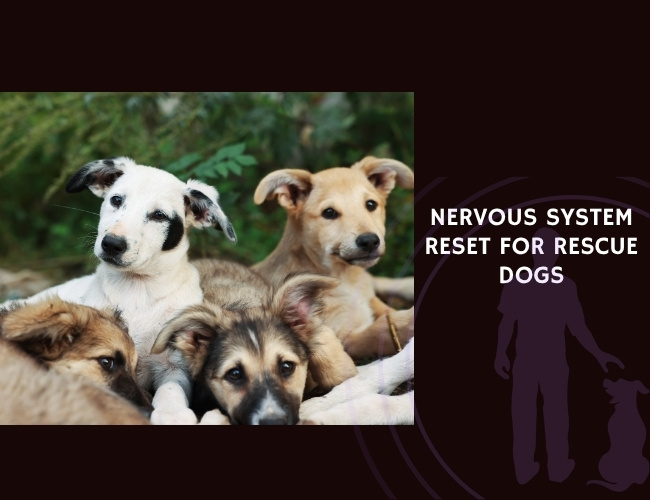
When you bring a rescue dog home, the instinct is to love them hard and fast — to shower them with warmth, introduce them to new friends, and begin the exciting work of building a life together. That impulse is beautiful. But there is something your rescue dog needs even more than your enthusiasm, and it lives not in the training plan or the toy basket — it lives in the quiet, invisible architecture of their nervous system.
Rescue dogs do not simply arrive with behavioral quirks. They arrive with neurobiological histories. The effects of chronic stress, instability, neglect, confinement, or unpredictable social environments are not written on the surface — they are encoded deep in the autonomic nervous system, shaping how the brain reads safety, how the body responds to stimulation, and how long it takes for genuine calm to become possible. Understanding this is not just academically interesting. It changes everything about how you support your rescue dog’s recovery.
This guide explores what is actually happening inside your rescue dog’s nervous system — and what genuine healing looks like, step by step.
Why the Rescue Dog’s Nervous System Is the Starting Point
Most rehabilitation approaches focus on behavior: the reactivity, the resource guarding, the shutdown, the anxiety. But behavior is downstream of neurobiology. Before a rescue dog can learn new responses, develop trust, or experience genuine calm, their nervous system must first recover enough regulatory capacity to make those things possible.
This is the central insight that changes how we approach rescue rehabilitation. The goal is not behavioral correction. It is neurobiological recalibration — the gradual restoration of the autonomic nervous system’s ability to shift fluidly between activation and rest, between vigilance and curiosity, between survival-mode processing and open, relaxed engagement with the world.
What Chronic Stress Does to the Canine Nervous System
Prolonged exposure to threat, instability, or unpredictability produces measurable changes in the brain and body. The hypothalamic-pituitary-adrenal (HPA) axis — the central stress response system — becomes chronically activated, flooding the body with cortisol. Over time, this produces a cascade of neurobiological consequences that do not simply resolve when the stressor is removed.
The hippocampus, critical for distinguishing safe from threatening contexts, shrinks under sustained cortisol exposure. The amygdala — the brain’s threat-detection center — becomes sensitised, lowering the threshold for alarm even in objectively safe environments. The prefrontal cortex, responsible for flexibility, impulse regulation, and adaptive decision-making, is suppressed. Sleep architecture deteriorates. Heart rate variability — a measure of autonomic flexibility — drops.
What chronic stress does to your rescue dog’s brain and body:
- Hippocampal atrophy — reduced ability to distinguish safe contexts from threatening ones, making it harder for the dog to “update” its sense of safety in a new home
- Amygdala sensitisation — a persistently lower threshold for alarm, so ordinary stimuli register as potentially threatening
- Prefrontal suppression — reduced capacity for flexible, adaptive responses; the dog is more reactive and less able to self-regulate
- Disrupted cortisol rhythm — the body’s natural daily stress hormone cycle loses its healthy pattern, affecting energy, mood, and recovery
- Reduced heart rate variability — the autonomic nervous system loses flexibility, making smooth transitions between arousal states much harder
- Sleep architecture disruption — the restorative deep-sleep stages that the brain needs for emotional processing and memory consolidation are shortened or absent
- Suppressed immune function — chronic cortisol elevation compromises the immune system over time, making stress-history dogs more vulnerable to illness during recovery
Together, these changes produce a nervous system that is persistently biased toward threat-detection, slow to recover from arousal, and limited in its capacity for curiosity, play, and social engagement. This is not a personality problem. It is a physiological state — and it requires specific conditions to resolve.
Heart Rate Variability: Reading the Nervous System Without a Monitor
One of the most useful concepts for understanding your rescue dog’s regulatory state is heart rate variability — the natural, moment-to-moment variation in the time between heartbeats. In a well-regulated nervous system, the heart does not beat with mechanical regularity. It speeds slightly on the inhale and slows on the exhale, flexing in response to internal and environmental cues. That flexibility is itself a sign of health. It means the parasympathetic and sympathetic branches are in dynamic dialogue, the system is responsive, and the nervous system is capable of shifting between states fluidly.
In chronically stressed dogs, heart rate variability drops. The nervous system loses that flexibility and settles into a kind of rigid, low-variance activation that reflects persistent sympathetic dominance. The dog is not spiking into acute stress — they are living in a flattened, narrowed arousal baseline that has become their new normal.
You cannot measure HRV directly without equipment, but its behavioural signatures are visible once you know what to look for. A dog with low HRV — and therefore compromised regulatory capacity — will typically show:
- Slow recovery after even mild triggers — still scanning, panting, or restless long after the stimulus has passed
- Difficulty fully settling during rest periods — lying down but never truly relaxing, changing positions frequently, startling at small sounds
- A narrow window of tolerance — the gap between calm and activated is small, so the dog moves quickly from neutral to reactive with very little provocation
- Reduced responsiveness to positive stimuli — an invitation to play, a treat, a gentle interaction lands flatly because the system doesn’t have the flexibility to shift into engagement
- A persistent, low-level vigilance that does not lift even in quiet, familiar settings
As your dog’s nervous system recovers, you will notice HRV improving behaviourally long before you could measure it instrumentally: longer, deeper rest periods, a wider gap between trigger and reaction, a more elastic quality to their emotional responses. That growing flexibility is the physiological signature of genuine autonomic recovery. 🧠
The Three Autonomic States You Need to Know
Stephen Porges’ Polyvagal Theory gives us an essential map for understanding what is happening inside your rescue dog. The autonomic nervous system operates across three hierarchical states:
- Ventral vagal engagement is the state of calm, social connection, and flexible responsiveness. It is characterised by a regulated heart rate, soft facial muscles, and openness to interaction. This is where genuine learning, bonding, and recovery happen.
- Sympathetic mobilisation is the fight-or-flight state — elevated heart rate, muscle tension, hypervigilance, reduced capacity for social engagement. This is the system activated when threat is perceived.
- Dorsal vagal shutdown is the freeze state — immobility, dissociation, reduced responsiveness, physiological conservation. This state is activated when threat feels inescapable.
For rescue dogs, the critical insight is that safety must be neurologically perceived, not merely objectively present. A dog relocated from a shelter to a loving home has not automatically shifted into ventral vagal engagement. The nervous system requires time, consistent cues of safety, and the gradual downregulation of threat-detection systems before genuine social engagement becomes possible. 🧠
The Deceptive Calm: Dorsal Shutdown vs. Genuine Regulation
One of the most important — and most frequently misread — distinctions in rescue rehabilitation is the difference between a dog that is genuinely calm and one that is in dorsal vagal shutdown.
How Dorsal Shutdown Looks (and Why It Fools Us)
Dorsal vagal shutdown presents as reduced movement, flat affect, reduced responsiveness, absence of play, minimal appetite, and apparent calmness that does not shift even in response to positive stimuli. It looks, from the outside, like a settled dog. It can even look like a good dog — quiet, compliant, easy to manage.
But this apparent calm is not regulation. It is neurological conservation. The dog is not relaxed; the dog is surviving. Its nervous system has withdrawn from engagement as a protective response to an environment it does not yet know is safe.
Genuine parasympathetic regulation looks very different:
- Relaxed, fluid body posture with weight distributed evenly
- Soft eyes, a loose jaw, relaxed facial musculature
- Curiosity and spontaneous exploration of the environment
- Responsive engagement when gently invited to play or interact
- Normal appetite and relaxed eating behaviour
- Deep, restorative sleep
- Social contact that the dog initiates, not merely tolerates
- Relatively rapid return to baseline after a mild stress trigger
The key differentiator is responsiveness to positive stimuli. A dog in genuine regulation will respond — even briefly, even gently — to a calm invitation to engage. A dog in dorsal shutdown will not. This distinction has profound implications for how you time and pace every aspect of the recovery process.
The Three-Week Paradox
Many rescue families notice a puzzling phenomenon. In the first week or two, the dog seems wonderfully settled. Then, around the three-week mark, challenging behaviours begin to emerge — reactivity, anxiety, guard behaviour, or emotional intensity that wasn’t visible before.
This is not regression. It is progress of a paradoxical kind.
The early “good behaviour” often reflects dorsal vagal conservation — the dog has not yet felt safe enough to express anything. The three-week emergence of emotional complexity is the dog beginning to emerge from shutdown. For the first time, they are activated enough to show their actual stress load. Paradoxically, this phase of apparent difficulty often signals that the nervous system is beginning to do the work of genuine recovery. Understanding this prevents the very common error of responding with increased demands, discipline, or concern at precisely the moment that requires the most patience.
Cortisol Lag: Why Your Dog Is Still “Off” Two Days Later
One of the most practically important and least understood concepts in rescue dog recovery is cortisol lag. When a stress response is triggered, cortisol is released into the bloodstream as part of the HPA axis cascade. This is not a momentary event. Cortisol has a biological half-life, and research consistently shows that after a significant stress trigger, cortisol levels can remain measurably elevated for 48 to 72 hours — even after the dog has returned to apparent calm.
This has real consequences for how you read your dog in the days following a stressful event. If your rescue dog had a reactive episode on Monday’s walk, an unsettling encounter with a visitor on Tuesday, and then seems inexplicably tense, restless, or oversensitive on Wednesday — you are not imagining it, and your dog is not being difficult. Their body is still carrying Monday’s cortisol load. The nervous system has not yet cleared the biochemical residue of the earlier stress event, and it is processing Wednesday’s ordinary stimuli from an already-elevated baseline.
This concept also explains a phenomenon that many rescue caregivers find deeply confusing: trigger stacking. A dog that handled a stranger calmly on Monday, tolerated a car journey on Tuesday, and navigated a new environment on Wednesday may erupt disproportionately at something very minor on Thursday — a sudden sound, a child running past, a change in routine. Each of those earlier events, though apparently handled, contributed to a rising cortisol tide. By Thursday, the dam is full, and a small stimulus becomes the overflow point.
Understanding cortisol lag reframes the management of your dog’s weekly rhythm entirely. Rest days are not a sign of overprotection — they are neurochemical recovery periods. After any significantly stressful event, building in 48 hours of reduced stimulation, quieter environments, and lower demands allows the cortisol tide to drop before the next challenge is introduced. That rhythmic approach to stress and recovery is one of the most protective things you can offer a nervous system that is still recalibrating its baseline. 🧠
Common trigger-stacking scenarios to watch for:
- A reactive walk on Monday + a vet visit on Tuesday = disproportionate response to a neighbour’s dog on Wednesday
- An unsettling visitor on the weekend + a thunderstorm that night = shutdown or aggression the following morning with no apparent trigger
- A new route with unfamiliar dogs + children running past + a car backfiring = eruption at home that evening over something as minor as the food bowl being moved
- Multiple short exposures to a fear trigger across one day adding up to a full threshold crossing by late afternoon
- A series of “handled well” events in quick succession depleting regulatory reserves faster than they replenish
Recognising these accumulation patterns — rather than searching for a single cause — is one of the most practically useful shifts you can make in how you manage your rescue dog’s daily life.
Stress Load, Allostatic Burden, and Why Recovery Timelines Vary
Not all rescue dogs recover on the same timeline, and this is not random. It reflects the concept of allostatic load — the cumulative physiological cost of chronic stress. Two dogs with apparently similar backgrounds may show very different recovery arcs because of differences in when their stress history began, how long it lasted, and how that stress was delivered.
What Shapes a Dog’s Recovery Capacity
Developmental timing matters enormously. Stress experienced during the critical socialisation window — roughly three to twelve weeks of age — produces more profound and lasting neurobiological effects than stress experienced in adulthood. A dog whose early life was characterised by deprivation, instability, or absence of positive human contact may carry stress-related neurobiological patterns that are more resistant to recovery and require longer, more carefully structured support.
Duration and predictability also shape the recovery landscape. A dog that experienced one acute traumatic event carries a different neurological burden than one that spent three years in chronic neglect or unpredictability. Duration matters because it determines how consolidated the stress-related changes have become — how deeply the nervous system has reorganised around the assumption of threat.
The presence or absence of positive relational history is another critical variable. Dogs that experienced at least some periods of secure attachment — even imperfectly — have relational templates to draw on. Dogs with no history of secure human connection are building the template from scratch, which requires additional time and particular relational patience.
Key factors that influence how long recovery takes:
- Age at onset of chronic stress — earlier exposure produces deeper and more resistant neurobiological change
- Duration of the stress period — months of chronic neglect leaves a heavier neurological burden than a single acute event
- Type of stressor — relational trauma (abuse, abandonment) tends to affect social engagement capacity more deeply than environmental stress alone
- Number of transitions experienced — each move between environments compounds allostatic load even when each new environment is an improvement
- Presence or absence of early secure attachment — dogs that experienced even brief windows of safe bonding have regulatory templates to return to
- Temperament and individual neurobiological sensitivity — some dogs are constitutionally more reactive to stress than others
- Quality of the current recovery environment — the conditions you create now directly influence how fast neuroplastic recovery can proceed
The Environment’s Role in Stress Load
Many well-intentioned homes inadvertently maintain elevated arousal in rescue dogs by introducing too much, too fast. High sensory complexity — noise, visual activity, multiple animals, frequent visitors — keeps the nervous system in threat-monitoring mode even in a loving environment. Inconsistent schedules, unpredictable human emotional responses, and the absence of a defined retreat space all contribute to a stress load that prevents downregulation.
The nervous system cannot shift out of vigilance when it cannot predict what comes next. Environmental predictability — consistent schedules, consistent emotional tone, reduced sensory complexity in the early weeks — is not boring. It is neurobiologically necessary. 🐾
A predictable environment: what it actually looks like in practice:
- Fixed feeding times — same bowl, same location, same time each day; no spontaneous schedule changes in the first weeks
- Consistent wake and sleep routines — the dog’s circadian rhythm needs structural anchoring to support healthy cortisol patterns
- A designated retreat space the dog can always access — a crate, corner, or room that is never invaded, never used for containment as punishment, and always available as a safe exit
- Predictable human movement patterns through the home — where you sit, where you sleep, how you move through the kitchen in the morning
- Limited introduction of new people in the first two to three weeks — every unfamiliar person is a social unknown the nervous system must assess
- A consistent caregiver as the primary relational anchor — the same person managing most feeding, walking, and quiet time in the early period
- A low-stimulation default — the baseline of the home is quiet and calm, with planned increases in activity rather than unpredictable spikes

Relational Safety and the Science of Co-Regulation
One of the most powerful tools in rescue rehabilitation is not a training protocol or an enrichment programme. It is you — and the neurobiological effect of your regulated nervous system on your dog’s.
How Co-Regulation Works
Co-regulation is the process by which one organism’s nervous system influences and stabilises another’s. It is the mechanism by which infant mammals regulate arousal through proximity to caregivers, and it remains operative throughout the lifespan in social mammals — including dogs and their human companions.
The neurobiological basis of co-regulation involves autonomic resonance, oxytocin release, and the predictability of social responses. A calm, consistently regulated human presence activates parasympathetic tone in a dog through olfactory, auditory, and visual cues. Conversely, an anxious, emotionally reactive human activates sympathetic tone — regardless of their intention.
This is the foundation of the NeuroBond understanding of recovery: that the human’s internal state is not just emotionally relevant but neurobiologically transmitted. The rescue dog’s nervous system, unable to reliably return to baseline through its own regulatory mechanisms, uses the calm, consistent presence of its human as an external reference point — an anchor for downregulation.
What makes human co-regulation neurobiologically effective:
- Genuine physiological calm — not performed calm, but actual parasympathetic regulation in the caregiver’s own body
- Consistency of emotional tone across days and weeks — the dog’s nervous system needs to learn that the human’s state is reliably predictable
- Slow, fluid physical movement — the pace and quality of your movement is read as environmental data by your dog’s threat-detection systems
- Soft, unfocused gaze rather than direct, intense eye contact — a relaxed gaze communicates safety; a hard, watchful gaze reads as pressure
- Non-demanding proximity — being present without requiring the dog to interact, acknowledge, or perform
- Calm vocal tone at a lower pitch — even neutral speech at a calmer pitch activates the ventral vagal system’s social engagement cues
- Consistent responsiveness — the dog learns that when they offer a social signal, they receive a predictable, measured response, not an unpredictable emotional reaction
Quiet Presence vs. Reassurance: The Critical Distinction
One of the most counterintuitive findings in stress recovery is that excessive reassurance can prolong, rather than resolve, the stress response. When a distressed dog is met with emotionally intense comforting — anxious verbal soothing, physical hovering, concerned engagement with the distress itself — several problematic processes occur:
The human’s heightened arousal signals to the dog that distress is warranted. The additional stimulation amplifies rather than reduces arousal. The social reward contingent on distress expression may inadvertently reinforce distress behaviour. And if the reassurance is inconsistent — sometimes offered, sometimes not — it introduces a layer of social unpredictability that the nervous system must monitor.
Quiet presence is different. Being calmly and reliably available — sitting nearby without demanding interaction, moving through the space with calm predictability, responding gently to the dog’s social initiations without amplifying them — provides the co-regulatory signal of safety without these complications. It communicates, at the autonomic level, that the environment is genuinely safe. That balance between presence and restraint — that is one of the deepest expressions of the Zoeta Dogsoul approach.
Movement, Rest, and the Completion of Stress Cycles
Recovery is not simply a matter of reducing stress input. It also requires the completion of stress cycles — the neurological process by which arousal that has been mobilised is allowed to fully resolve rather than being left suspended mid-arc.
Why Stress Cycles Need to Complete
When a stress response is activated, the body prepares for physical action. In acute situations, that action resolves the cycle — fight, flight, or the natural discharge that follows. In the complex social and environmental stressors of rescue dog experience, the physical action often does not occur, and the physiological activation remains incomplete.
Peter Levine’s work on somatic stress recovery identifies the completion of biological cycles as essential for nervous system resolution. In animals, this often takes the form of shaking, trembling, or spontaneous movement following a stress response — the body’s natural mechanism for discharging residual activation and returning to baseline. Interrupting this process — by restraining the dog, redirecting, or demanding stillness — may prevent the nervous system from completing its recovery arc.
For rescue dogs, incomplete cycles accumulate. A dog repeatedly redirected mid-arousal, or repeatedly prevented from fully exploring a stress response, develops a nervous system that is perpetually mid-cycle — never fully activated, never fully resolved, and therefore never fully at rest. This pattern often explains why some rescue dogs seem to deteriorate behaviourally over time despite receiving thoughtful, caring environments.
Movement That Supports Recovery
Not all movement is equally supportive. High-intensity exercise — long runs, vigorous play sessions, intense physical activity — activates the sympathetic nervous system, increases cortisol and adrenaline, and may maintain rather than resolve elevated arousal in dogs with unresolved stress loads.
What genuinely supports recovery is low-pressure, patterned movement: a consistent-pace walk that allows sniffing-based exploration, gentle parallel movement with a calm human, brief low-intensity play that the dog initiates and ends on their own terms. Sniffing deserves particular attention — it is one of the most effective regulatory activities available to dogs. The act of olfactory engagement actively downregulates the autonomic nervous system, reduces heart rate, and shifts the dog from scanning mode into a state of focused, grounded investigation.
Movement that supports recovery vs. movement that hinders it:
- ✓ Slow, consistent-pace sniff walks with the dog leading the route — parasympathetic, olfactory, and completion-cycle benefits
- ✓ Short parallel walks with a calm human, no agenda, no destination pressure — co-regulatory and predictable
- ✓ Scatter feeding in grass or on a sniff mat — concentrated nose-down engagement that actively lowers arousal
- ✓ Brief, dog-initiated play that ends on the dog’s terms — SEEKING activation without performance pressure
- ✓ Gentle free exploration of a safe, enclosed outdoor area — low-demand environmental investigation
- ✗ Long, fast-paced runs or hikes in the first weeks — amplifies sympathetic activation rather than resolving it
- ✗ High-energy fetch or ball games — cortisol-spiking, repetitive arousal cycles without natural discharge
- ✗ Dog park visits during the decompression period — unpredictable social load that overwhelms regulatory capacity
- ✗ Forced walking past known triggers as “desensitisation” without a formal counter-conditioning protocol — accumulates cortisol without building new associations
The Invisible Leash principle is relevant here — the idea that what guides a dog in these moments is not physical control but the quality of shared awareness and energy between human and dog. A sniff walk with a calm, unhurried human who follows the dog’s pace is a regulatory event, not just exercise.
The Olfactory System: Why Sniffing Is the Most Powerful Regulatory Tool You Have
Sniffing is not a distraction, a bad habit, or something to be rationed on walks. It is, from a neurobiological perspective, one of the most effective self-regulation tools available to your dog — and understanding why fundamentally changes how you approach daily life with a rescue dog.
The mechanism begins in the nose. When a dog sniffs, they draw air in through the nasal passage in a specific rhythmic pattern — a series of short, rapid inhalations that differs distinctly from normal breathing. This sniffing rhythm drives a direct coupling between nasal airflow and the olfactory bulb, which connects via short neural pathways to structures including the hippocampus, the amygdala, and the prefrontal cortex — the very regions most disrupted by chronic stress. Olfactory input, in other words, has unusually direct access to the brain’s regulatory and emotional centres.
Beyond the neural architecture, sniffing activates the vagus nerve — the primary pathway of the parasympathetic nervous system. Research on respiratory patterns and vagal tone consistently shows that slow, rhythmic nasal breathing increases vagal activity, reduces heart rate, and promotes parasympathetic dominance. The sniffing pattern that dogs engage in during ground investigation produces exactly this kind of vagal activation. It is, functionally, a form of self-directed nervous system regulation.
There is also a cognitive dimension. When a dog is sniffing, their SEEKING system is engaged. The brain is in a state of curious, forward-oriented processing — anticipating, investigating, building an olfactory map of the world. This state is neurobiologically incompatible with the threat-monitoring mode of sympathetic activation. You cannot be genuinely sniffing and genuinely on high alert at the same time. The two states compete, and sniffing wins.
The practical implications are significant:
- A twenty-minute sniff walk in which the dog leads the pace and chooses what to investigate is more neurologically restorative than a forty-minute brisk walk
- Scatter feeding — hiding kibble or treats in grass or across a mat — provides concentrated olfactory engagement that actively downregulates arousal before or after a stressful event
- Nose work games, even at the simplest level, can serve as a deliberate decompression tool after a triggering experience
- Allowing your dog to complete a sniff — to stay on a scent until they choose to move on — honours the completion cycle of that investigative arc and supports nervous system resolution
Easy olfactory enrichment ideas for nervous system recovery:
- Scatter a small portion of their daily kibble across a patch of grass before the morning walk — the dog’s day begins with a regulatory activity
- Hide a few pieces of food in a rolled-up towel or a muffin tin covered with tennis balls for a low-stimulation indoor nose challenge
- Introduce a “sniff zone” on every walk — a specific stretch where the dog is given unlimited time to investigate without being moved along
- Rotate natural scent items — a pinecone, a dry leaf bundle, a piece of bark — in a basket for low-key daily exploration
- Try a beginners’ nosework class once the dog is past the initial decompression period — structured olfactory work builds confidence and regulatory capacity simultaneously
- Use a lick mat with a thin layer of paste food (peanut butter, wet food, pumpkin) as a targeted calming intervention before anticipated stressful events
When your rescue dog plants their nose to the ground and disappears into a smell, they are not ignoring you. They are healing. 🐾
Sleep as Neurological Recovery
Sleep is not merely rest. It is an active neurological process during which the brain consolidates experience, processes emotional memory, and restores the prefrontal regulatory systems that govern impulse control and emotional modulation. For rescue dogs, sleep quality is often severely compromised in the early weeks of placement.
Environmental noise, hypervigilance, disrupted circadian rhythms, and social anxiety all prevent the deep sleep stages that are essential for neurological recovery. A dog that cannot sleep deeply cannot recover, and a dog that cannot recover cannot learn. The practical implications are significant:
- Provide a dedicated, genuinely quiet, and low-traffic sleep space — preferably enclosed, to reduce visual stimulation and provide a sense of boundaries
- Maintain consistent sleep and wake times to support circadian entrainment
- Protect rest periods from interruption, even well-intentioned interaction
- Understand that a dog sleeping heavily in the early weeks is not lazy — it is recovering a neurological debt that may have accumulated over months or years 🧡
Reading Your Dog: A Practical Stress Signal Glossary
One of the most empowering skills a rescue dog caregiver can develop is the ability to read early stress signals — the subtle, body-level communications that the nervous system broadcasts long before behaviour becomes obviously difficult. By the time a dog barks, lunges, growls, or shuts down, the stress response has already been building for some time. Learning to read the earlier signals gives you the ability to intervene when it is still easy — before the nervous system has reached overwhelm.
These signals exist on a spectrum, from very subtle to clearly expressive. Your rescue dog, depending on their history with punishment or suppression, may show some signals more readily than others.
Subtle and Early Signals
Lip licking that is not related to food — a quick tongue flick over the lips or nose — is one of the earliest and most easily missed stress signals. It appears when a dog is mildly anxious, uncertain, or socially uncomfortable. You may notice it during greetings with strangers, during training sessions that are moving too fast, or in moments when the dog is being asked to do something they find ambiguous.
Yawning outside of a just-woken context is a stress signal, not fatigue. It is a calming signal — both a self-soothing behaviour and a social communication to humans or other dogs that the dog is not a threat and is trying to de-escalate.
Blinking or looking away — the deliberate avoidance of direct eye contact — is another calming signal. A dog that looks away during an interaction is communicating discomfort, not disinterest. It is a polite attempt to reduce social pressure.
Sniffing the ground suddenly in the middle of an interaction or approach is frequently a stress-displacement behaviour. The dog drops their nose to interrupt an uncomfortable social exchange. It is easy to interpret as distraction. It is actually communication.
A low, slow tail wag held below the spine is not enthusiasm. Tail position and movement speed carry distinct meanings. A tail held low and wagging slowly can indicate anxiety or uncertainty, particularly when combined with other stress signals.
Moderate Signals
Whale eye — the whites of the eyes becoming visible as the dog turns their head away while keeping their gaze directed toward the trigger — is a reliable indicator of moderate discomfort or threat perception. It is frequently seen in resource-guarding contexts or during forced close social contact.
Panting without physical exertion or heat is a physiological stress response — the body preparing for action. In a rescue dog at rest in a cool room, panting signals internal activation, not temperature regulation.
Weight shifting backward — the body’s centre of gravity moving toward the hindquarters — signals a dog that is preparing to increase distance. This is the body’s pre-retreat posture, and it means the dog has registered something as potentially threatening.
Ears pinned flat against the skull indicate fear or significant stress. Ears slightly back or rotating fluidly are less concerning — it is the hard, flat pin combined with a tense body that signals the dog is in a notably elevated stress state.
A tucked tail held tight against the abdomen indicates significant fear. Combined with a lowered posture, this tells you the dog is in sympathetic activation and needs immediate distance from whatever triggered the response.
Recovering. Regulating. Stabilising.
Stress Locks System Chronic stress reshapes the nervous system lowering flexibility increasing vigilance and reducing the capacity to shift between activation and rest.
Recovery Needs Physiology Behaviour cannot stabilise until autonomic regulation improves because learning trust and calm depend on restored neurobiological capacity.



Flexibility Signals Healing As regulation returns through predictable structure and NeuroBond aligned support the system regains elasticity allowing calm engagement and resilience to emerge.
Why These Signals Matter More Than Obvious Behaviour
The reason this glossary belongs in a rescue rehabilitation guide is not just practical — it is philosophical. A rescue dog whose stress signals have historically been ignored, punished, or simply not responded to has learned that early communication is useless. When the subtle signals stop working, the dog escalates to louder ones. When those are also punished, the dog may stop signalling altogether and move directly to the behaviour that previously worked — a bite, a lunge, a freeze.
Learning to read and respond to early signals does not just help you manage difficult moments. It rebuilds the dog’s trust that communication works. That their voice, expressed in the language of the body, will be heard. That trust is among the most neurobiologically significant things you can build. 🧡
Quick-reference: stress signal spectrum from subtle to escalated:
- Lip licking (not food-related) → earliest signal; mild anxiety or social discomfort
- Yawning → calming signal; self-soothing and social de-escalation
- Blinking or looking away → polite discomfort; the dog is reducing perceived social pressure
- Sudden ground sniffing mid-interaction → displacement behaviour; the dog is interrupting an uncomfortable exchange
- Low, slow tail wag below the spine → uncertainty or mild anxiety; not enthusiasm
- Whale eye (whites of eyes visible) → moderate discomfort or guarding; respect the space immediately
- Stress panting at rest → physiological activation; sympathetic system engaged without exertion
- Weight shift backward → pre-retreat posture; the dog wants distance
- Ears pinned flat and hard → significant fear; do not push the interaction
- Tucked tail tight to abdomen + lowered body → clear fear response; create distance now
- Freezing → the nervous system has reached capacity; any further pressure risks escalation
- Growling → critical communication; never punish this signal — it is the dog’s last warning before a bite
Recognising False Progress: When “Good Behaviour” Is a Warning Sign
The most significant risk in rescue rehabilitation is not the presence of difficult behaviour — it is the misinterpretation of suppressed behaviour as healing. Early compliance, apparent calmness, and reduced reactivity may each reflect genuine regulation, or they may reflect dorsal vagal shutdown, learned helplessness, inhibition, or simple depletion.
The Behavioural Indicators That Tell the Difference
Genuine regulation is characterised by a quality of aliveness — responsiveness, curiosity, social initiation, the spontaneous emergence of play even in brief, gentle forms. Suppression is characterised by a quality of flatness — compliance without engagement, apparent calm without responsiveness, absence of the behaviours that signal that the seeking system has re-engaged.
The SEEKING system — associated with curiosity, anticipatory pleasure, and motivated engagement with the environment — is neurobiologically incompatible with sustained fear activation. When the FEAR system is chronically engaged, SEEKING is suppressed. The restoration of spontaneous, curiosity-driven exploration is therefore one of the most reliable indicators of genuine nervous system recovery. Its absence, even in a dog that appears calm and compliant, tells you that recovery is still in progress.
Did you know that a dog’s willingness to investigate a novel object — sniffing, pawing, or simply approaching with soft, forward body language — tells you more about their regulatory state than almost any other single behaviour? That spontaneous investigative gesture is the SEEKING system coming back online. It deserves to be noticed and protected.
🧠 Nervous System Reset for Rescue Dogs
A science-based guide to autonomic recovery, stress decompression, and true emotional healing 🐾
Phase 1: Understanding What Your Rescue Dog Actually Carries
Days 1–7 · The Neurobiological RealityRescue dogs arrive with neurobiological histories encoded into their nervous systems. Chronic stress shrinks the hippocampus (the brain’s safety-recognition centre), sensitises the amygdala (threat detection), and suppresses the prefrontal cortex (flexible behaviour). These changes do not resolve the moment the dog enters a loving home.
• Hippocampal atrophy — harder to recognise safe contexts
• Amygdala sensitisation — lower alarm threshold in any environment
• Suppressed prefrontal cortex — reduced self-regulation capacity
• Disrupted cortisol rhythm — affects energy, mood, and recovery
• Reduced heart rate variability — the nervous system loses autonomic flexibility
Early “good behaviour” — quietness, compliance, easy management — often reflects dorsal vagal shutdown, not genuine calm. The dog is conserving neurological resources, not relaxing. This is the most common and most consequential misread in rescue rehabilitation.
• No appetite or flat affect → likely shutdown, not contentment
• No play behaviour → SEEKING system suppressed by FEAR activation
• Minimal response to positive stimuli → nervous system is not yet online
Limit accessible space to one or two rooms. Establish fixed feeding times, consistent wake/sleep routines, and a designated retreat space the dog can always access. The priority is not connection — it is predictability. The nervous system needs to learn that this environment holds still.
• No new people, no new animals in week one
• Calm, brief, non-demanding caregiver interactions only
• Allow the dog to observe without being required to engage
Phase 2: Reading the Nervous System — Shutdown vs. Regulation
Ongoing · The Diagnostic Skill Every Caregiver NeedsStephen Porges’ Polyvagal Theory describes three hierarchical nervous system states that determine how your dog experiences and responds to the world:
• Ventral vagal → calm, social, curious, teachable — genuine recovery happens here
• Sympathetic mobilisation → fight-or-flight, hypervigilant, reactive, guarded
• Dorsal vagal shutdown → freeze, dissociation, flat affect — looks like calm, is not
Around week three, many rescue dogs suddenly show reactivity, anxiety, or challenging behaviour that wasn’t visible before. This is not regression — it is the nervous system emerging from shutdown. The dog is now activated enough to express their actual stress load. Increased difficulty at week three is paradoxically a sign of progress.
True parasympathetic regulation has a quality of aliveness that shutdown lacks. Look for these emerging signs across the first weeks:
• Relaxed, fluid body posture with even weight distribution
• Soft eyes, loose jaw, relaxed facial musculature
• Voluntary social initiation — approaching you without being called
• Brief play behaviour, even gentle and low-intensity
• Spontaneous exploration and curious investigation of the environment
Phase 3: Cortisol Lag and Trigger Stacking
Daily Management · The Chemistry Behind the “Off” DaysAfter a significant stress trigger, cortisol levels remain measurably elevated for 48 to 72 hours — even after the dog has returned to apparent calm. This means your dog may be oversensitive, reactive, or “off” for days after a single triggering event, even if nothing further went wrong.
Each stressful event — even one that appears “handled” — adds to a rising cortisol tide. When that tide is full, a minor trigger causes a disproportionate reaction. This is not aggression or stubbornness. It is accumulated neurochemistry.
• Reactive walk Monday + vet visit Tuesday = eruption Wednesday at something tiny
• Multiple “small” exposures in one day = full threshold crossing by afternoon
• Rest days are neurochemical recovery periods, not indulgence
After any significantly stressful event, build in 48 hours of reduced stimulation, quieter environments, and lower demands. Treat your dog’s weekly schedule as a stress-and-recovery rhythm, not a uniform daily programme. Planned rest days before anticipated stressors are as valuable as the management of the stressors themselves.
Phase 4: Co-Regulation — You Are the Recovery Tool
Weeks 1–8 · The Human Nervous System as AnchorCo-regulation is the process by which one organism’s nervous system stabilises another’s. A calm, consistently regulated human presence activates parasympathetic tone in a dog through olfactory, auditory, and visual cues. Your autonomic state is not just emotionally relevant — it is neurobiologically transmitted. This is the NeuroBond foundation of genuine recovery.
Excessive reassurance — anxious verbal soothing, emotional hovering, intense comforting — can amplify rather than reduce a dog’s stress response. It signals that distress is warranted. Quiet presence communicates safety without adding stimulation to an already-activated system.
• Be reliably present without demanding interaction
• Respond gently to social initiations without amplifying them
• Maintain consistent emotional tone — the predictability is the medicine
Your regulated nervous system is the most powerful tool in your dog’s recovery. Use these techniques before entering your dog’s space after a stressful event:
• Extended exhale breathing: 4-count in, 6–8-count out, for 2 minutes
• Posture reset: drop shoulders, unclench jaw, loosen leash grip
• Deliberate movement slowing — slow movement signals safety to both of you
• Affect labelling: name your emotional state to reduce its limbic intensity
Phase 5: Movement, Sniffing, and Stress Cycle Completion
Daily Practice · The Olfactory System as Regulatory ToolSniffing drives a rhythmic nasal airflow that directly activates the vagus nerve — the primary pathway of the parasympathetic nervous system. The olfactory bulb connects via short neural pathways to the hippocampus, amygdala, and prefrontal cortex. Sniffing is functionally a form of self-directed nervous system regulation, and it engages the SEEKING system in a state neurobiologically incompatible with threat-monitoring.
Long runs, vigorous fetch, and high-energy play activate the sympathetic nervous system — exactly the system already overloaded in rescue dogs. High-intensity exercise in the early recovery period can maintain elevated arousal rather than resolving it, and may deepen the cortisol burden rather than clearing it.
The Invisible Leash guides us here — true connection is built through shared awareness and unhurried presence, not performance. A slow sniff walk where your dog leads the pace is a regulatory event, not just exercise.
• Scatter kibble across grass — start the day with a regulatory activity
• Sniff mat or muffin-tin puzzle for low-stimulation indoor nose work
• Lick mat before anticipated stressors — licking activates the parasympathetic system
• Unlimited sniff zones on every walk — follow the dog’s nose, not the clock
• Rotate natural scent items (pine cones, bark, dried herbs) for daily investigation
Phase 6: Reading Stress Signals — The Language of the Body
Ongoing Skill · From Subtle to EscalatedBy the time a dog growls, lunges, or shuts down, the stress response has been building for some time. Early signals give you the window to intervene before the nervous system reaches overwhelm — if you know what to look for.
• Lip licking (not food-related) → mild anxiety or social discomfort
• Yawning out of context → self-soothing calming signal
• Looking away / blinking → polite discomfort, reducing social pressure
• Sudden ground sniffing mid-interaction → stress displacement, not distraction
• Low, slow tail wag below spine → uncertainty, not enthusiasm
These signals mean the nervous system is nearing or at threshold. Respond with distance, not correction or reassurance.
• Whale eye → whites of eyes visible, moderate discomfort or guarding
• Stress panting at rest → physiological activation without exertion
• Weight shift backward → pre-retreat posture, wants more distance
• Ears flat and hard → significant fear response
• Tucked tail + lowered body → create distance immediately
• Growling → critical communication; never punish this signal
When your dog is mid-activation, use this sequence:
1. Increase distance — calmly, without urgency
2. Slow your own body — drop shoulders, breathe out, soften gaze
3. Allow, don’t redirect — no commands while the nervous system is flooded
4. Wait for voluntary disengage — mark it quietly, then move
5. Offer a decompression activity — sniff opportunity or scatter feeding
6. Build in recovery time — 24–48 hours of reduced demands after
Phase 7: The Regulation-First Intervention Framework
Weeks 1–8+ · Decompression Before TrainingApplying behaviour modification to a neurologically dysregulated dog is like teaching complex skills to someone in acute crisis — the regulatory infrastructure required for learning is not yet available. Nervous system stabilisation must precede training. Relational safety must precede skill acquisition. Decompression must precede socialisation.
• Days 1–7: Containment and orientation — limit space, minimise stimulation, establish rhythm
• Days 7–21: Relational establishment — build predictable interaction rituals, hand-feeding, parallel presence
• Weeks 3–8: Graduated expansion — expand space, introduce stimuli one at a time, brief positive-reinforcement training
• Weeks 8+: Integration — careful socialisation, expanded environments, formal behaviour modification only now
Dogs with learned helplessness need to rediscover that their behaviour matters. Restore agency through low-stakes choice opportunities before asking for compliance:
• Choice-based feeding — two bowls, let the dog decide
• Consent-based petting — offer your hand and wait
• “Yes/no” route choices on walks — follow their lead
• Honoured exits — when the dog disengages, the session ends; no re-engaging
Phase 8: Tracking Genuine Recovery — Milestone by Milestone
Months 1–12+ · What Progress Actually Looks LikeGenuine recovery from chronic stress dysregulation is not a smooth upward curve. It involves apparent regressions — periods where a dog that seemed to be progressing shows increased reactivity or anxiety. These are the nervous system processing experiences it could not process when more deeply suppressed. They are signs of movement, not failure.
• Week 1: Establish baseline — appetite, sleep quality, scan frequency, response to your presence
• Week 3: Watch for voluntary approach, reduced scanning, first environmental curiosity
• Week 8: Expect consistent appetite, improved sleep, spontaneous social initiation, brief play
• Month 3–6: The emerging dog — personality surfaces, expanding comfort zone, faster recovery
• Month 6–12+: Rising trigger thresholds, widening tolerance window, secure attachment forming
Recovery becomes visible in small, luminous moments: the first spontaneous play bow, a brief curious investigation of something new, a slightly faster return to calm after a startle. This is Soul Recall — the dog remembering, at a cellular level, that curiosity is safe. That engagement is worth the risk of being present. These micro-expressions of the re-emerging SEEKING system are the most reliable signal that genuine neurobiological healing is underway.
🔍 Recovery Profiles by Background — What to Expect
Stress history is existential, not relational. These dogs carry deep unfamiliarity with domestic life rather than direct trauma from humans. Extended orientation timelines are essential. The three-week paradox may be dramatic as so much of the domestic world is genuinely novel stimulation.
Physically cared for but profoundly relationally deprived. Absence of play, toys, and social response is common — not personality, but a SEEKING system that has never had conditions to activate. Recovery is slow initially, then accelerates markedly once relational safety is established.
Paradoxical history: close physical proximity to many dogs (some species-level anchoring) but minimal individual human attention. Separation from the group is a genuine grief response. The caregiver must become a new, more reliable social anchor — which takes patient persistence.
Body-based interventions require extreme care — always allow the dog to initiate and exit physical contact. Never approach from above or behind without warning. Rebuilding trust in human touch is its own rehabilitation arc, separate from and preceding behavioural work.
Carry a heavy accumulated stress burden regardless of how manageable they seemed in the kennel. Assessments in shelter conditions reflect acute stress, not stable character. Apply the full decompression protocol even if the dog appears settled — do not let apparent compliance compress the timeline.
Transport, quarantine, and multiple handlers before arrival mean some of these dogs arrive already at or beyond their regulatory threshold. Factor accumulated transit stress into your baseline expectations — the clock starts even before they reach your door.
Safety before training. Predictability before enrichment. Relationship before skills. Completion before expansion.
The 48-72h rule: After a significant stress event, plan 48–72 hours of reduced demands before the next challenge.
The sniff > sprint rule: A 20-min sniff walk is more neurologically restorative than a 40-min brisk walk — always.
The quiet presence rule: When your dog is distressed, your calm availability is more powerful than your comfort.
The signal respect rule: Never punish a growl. It is communication — the last warning before silence and a bite.
The agency rule: A dog that can choose can learn. Offer choice before compliance wherever possible.
The recovery sign rule: Genuine healing looks like aliveness — curiosity, initiation, spontaneous play — not compliance and quiet.
Recovery is not something you do to a rescue dog. It is something that happens through the relationship — through the quality of presence you bring, the predictability of the environment you create, and the patience you extend across a non-linear timeline that the nervous system sets, not the calendar.
The NeuroBond between human and dog forms not through intensity but through consistency — the slow accumulation of moments in which the nervous system learns it is safe to be present. The Invisible Leash teaches us that the deepest guidance is energetic: your regulated body, your unhurried pace, your willingness to follow a nose into the grass and simply wait. And when the dog — somewhere across weeks or months — pauses, looks up, and chooses you freely, that is Soul Recall: the moment the dog remembers not just that the world can be safe, but that they themselves are worth being in it.
That is the work. That is the gift. That is the transformation that flows both ways.
© Zoeta Dogsoul — Where neuroscience meets soul in dog training
Learned Helplessness: The Hidden Dysregulation
Learned helplessness is one of the most important and least discussed phenomena in rescue rehabilitation. It develops when an animal is repeatedly exposed to uncontrollable aversive events — when their behaviour has no consistent effect on outcomes. In response, the animal stops attempting to influence its environment. The result looks like compliance, even like calm. But it reflects profound neurobiological disruption.
Dogs with learned helplessness may appear easy to manage. They accept handling without resistance, follow cues without hesitation, and show little of the reactivity that might signal distress to a caregiver. But their internal physiological state — elevated cortisol, low HRV, suppressed parasympathetic tone — tells a different story. Supporting these dogs requires particular attention to agency — creating opportunities for the dog to make low-stakes choices, to initiate interaction, to exercise control over small environmental variables. Restoring the sense that behaviour matters is neurologically rehabilitative.
Agency-building activities for dogs recovering from learned helplessness:
- Choice-based feeding — present two bowls with slightly different food and allow the dog to choose; the act of choosing is neurologically activating
- Consent-based petting — offer your hand and wait for the dog to lean in or move away; never initiate contact before they have indicated willingness
- “Yes/no” movement choices on walks — at every junction, pause and let the dog indicate direction with their body; follow their lead
- Low-stakes puzzle feeders — even simple ones that require a nudge or paw to release food restore the connection between action and outcome
- Voluntary retreat — ensure the dog can always leave any interaction without being followed, called back, or redirected; the freedom to exit is an exercise in self-determination
- Choice of resting location — offer multiple comfortable options across the home and observe which the dog selects; this respects their spatial preferences and communicates that their decisions matter
- Training sessions that end on the dog’s choice — when the dog disengages or moves away, end the session; do not re-engage; the dog’s exit is honoured as a valid communication
What to Actually Do During a Stress Spike
The article so far has focused on what not to do — and that knowledge matters. But caregivers also need a clear, simple sequence for the moments when a stress spike is happening in real time. When your dog is mid-activation — triggered on a walk, overwhelmed by a visitor, or escalating toward threshold — the following framework gives you something concrete to work with.
Step 1: Increase distance first. Before anything else, create space between your dog and the trigger. Distance is the most immediate regulatory intervention available. You are not retreating — you are managing arousal load. Move calmly and without urgency; rushing communicates threat.
Step 2: Slow your own body. Drop your shoulders. Breathe out slowly. Soften your gaze. Your dog’s nervous system is reading yours in real time. A tightened grip on the leash, a held breath, a stiffened posture all amplify their arousal. The most immediate co-regulatory tool you have is your own physical de-escalation.
Step 3: Allow, don’t redirect. Unless there is a safety concern, resist the urge to redirect, command, or demand focus. A dog mid-activation does not have the prefrontal bandwidth to process commands. Asking for a sit while the nervous system is flooded adds performance pressure to an already-overloaded system. Allow the dog to orient, scan, and process at their own pace.
Step 4: Wait for a voluntary disengage. The goal is not to force attention back to you but to wait for the dog to choose to move their focus. When the dog glances away from the trigger — even briefly — that is the disengage. Mark it quietly and move. Do not celebrate effusively; keep your energy level below theirs.
Step 5: Offer a decompression activity. Once distance is established and the acute spike is subsiding, offer a regulatory activity — a sniff opportunity, a slow parallel walk, scatter feeding in a safe spot. This gives the arousal cycle somewhere to complete rather than leaving the nervous system suspended mid-response.
Step 6: Build in recovery time. After a significant stress spike, the next 24–48 hours should be gentler than usual. Reduce demands, increase predictability, and allow the cortisol tide to drop before the next challenge. This is not coddling — it is neurochemical hygiene. 🧠
Transition Points, Shelter Environments, and High-Risk Periods
Every transition in a rescue dog’s life represents a neurobiological high-risk period. Each move — from street to shelter, from shelter to foster, from foster to adoptive home — requires the nervous system to completely rebuild its environmental map and relational framework. Even when the new environment is objectively better, allostatic load spikes sharply during transition.
What the Shelter Environment Does to the Nervous System
Kennel environments present a unique and challenging combination of stress factors: hard acoustic surfaces that amplify noise, visual exposure to distressed conspecifics, inconsistent handling across multiple caregivers, and unpredictable schedules. Even the most well-resourced shelter is characterised by high sensory complexity, relational inconsistency, and environmental unpredictability — exactly the conditions that maintain elevated sympathetic activation.
The neurobiological consequences accumulate across the shelter stay. Dogs assessed in shelter conditions are being assessed in a state of acute or chronic stress — the behaviour that results may bear little resemblance to their stable behavioural repertoire. This has profound implications for adoption matching and for the expectations that caregivers bring into the early weeks of the relationship.
What a typical shelter environment exposes a dog’s nervous system to:
- Continuous high-decibel noise — barking, kennel doors, cleaning equipment — with no ability to escape to silence
- Visual exposure to other distressed or reactive dogs through kennel barriers, activating the mirror-response of the threat-detection system
- Relational inconsistency — different handlers on different shifts, each with different interaction styles, handling pressures, and emotional tones
- Unpredictable daily schedules — feeding, cleaning, and exercise times that vary with staffing levels and facility demands
- No access to a genuine retreat space — a single kennel that serves as sleeping area, feeding area, elimination area, and social interaction point simultaneously
- Chronic olfactory stimulation from fear-related scent signals of surrounding animals
- Intermittent aversive events — unexpected loud noises, unfamiliar handling, medical procedures — with no ability to predict or avoid them
Understanding this list helps you recalibrate expectations for the first weeks at home: you are not starting from neutral; you are starting from a significant accumulated stress load.
First Impressions Are Encoded Deeply
An important and underappreciated feature of transition periods is that first impressions during these windows are neurologically encoded with particular durability. The initial experience of a new environment — including the quality of the first interaction with a new caregiver — is registered and stored by a nervous system that is already at heightened arousal.
This is not cause for anxiety about imperfect beginnings. It is simply a reason to prioritise calm, unhurried, low-demand first encounters — and to understand that the investment made in the first days pays dividends across the entire recovery arc.
Rescue Dogs in Multi-Dog Households: Managing Social Complexity
One of the most common scenarios caregivers navigate — and one of the least discussed in rehabilitation guides — is bringing a rescue dog into a home that already has resident dogs. The instinct is often to introduce them as quickly as possible, hoping the resident dog will “show the rescue the ropes” or provide social comfort. The neurobiological reality is more nuanced.
Why Resident Dogs Are Not Neutral Stimuli
A resident dog is not simply a companion — they are a social variable that the rescue dog’s nervous system must monitor, map, and respond to continuously. In the early weeks of placement, when the rescue dog’s nervous system is already carrying a significant monitoring load from the new environment, new humans, new sounds, and new routines, adding continuous social negotiation with another dog compounds the stress load in ways that can significantly slow decompression.
This does not mean a multi-dog household is harmful to a rescue dog’s recovery. It means the introduction must be thoughtfully paced, and that the early co-habitation environment must be structured to reduce rather than increase social complexity.
Practical Principles for Multi-Dog Introductions
The most effective introductions happen in neutral, low-stimulation outdoor environments before either dog enters the home together. A parallel walk — two humans walking the dogs at a comfortable distance, gradually closing that distance over multiple sessions as both dogs demonstrate relaxed body language — gives both animals time to process the social information without the added territorial intensity of a home environment.
In the early days of shared living, management matters more than integration. Separate feeding areas prevent resource-related tension from escalating before a social relationship has been established. Separate sleep spaces give the rescue dog a retreat from ongoing social monitoring. Time apart — periods of separate, quiet rest — is as neurobiologically valuable as time together.
Watch the resident dog carefully too. A well-adjusted resident dog will offer natural calming signals and may genuinely help the rescue dog establish a social anchor. But a resident dog that is itself anxious, reactive, or socially intense adds to the rescue dog’s arousal load rather than reducing it. In those cases, it is worth prioritising structure and distance over forced social proximity.
The goal in a multi-dog household is not early social harmony but early social neutrality — the point at which both dogs can share space without significant ongoing tension or vigilance. From that foundation, a genuine relationship can develop at a pace that is neurobiologically sustainable for both animals.
Multi-dog household management checklist for the first four weeks:
- Introduce via parallel walks in a neutral location before any shared time at home
- Separate feeding stations with visual barriers if either dog shows any tension around food
- Separate sleep spaces — each dog has their own area they can retreat to without the other following
- Rotate access to shared spaces initially rather than requiring continuous cohabitation
- Supervise all interactions for the first two weeks; do not leave the dogs together unsupervised
- Watch for one-sided interactions — a resident dog repeatedly pestering, mounting, or crowd-pressing the rescue dog adds stress even when it appears playful
- Allow the rescue dog to disengage from the resident dog without the resident dog following — this requires management, not just hope
- Monitor both dogs’ appetites, sleep quality, and scan behaviour as indicators of cumulative social stress
- Avoid organising forced “bonding” activities; proximity that arises organically from shared space is more neurobiologically valuable than structured social sessions
Regulating Yourself: The Caregiver’s Nervous System as a Recovery Tool
The co-regulation section of this guide established that your regulated nervous system is one of the most powerful tools available for your rescue dog’s recovery. But knowing that your calm presence matters and knowing how to create it in a moment of anxiety, frustration, or concern are two different things.
Why Caregivers Become Dysregulated Around Their Rescue Dogs
Caring for a rescue dog with significant stress history is not emotionally neutral. The hypervigilance you develop in monitoring your dog’s signals can, over time, produce a kind of secondary stress response in you. You scan their body language constantly. You analyse every behaviour for signs of progress or regression. You carry background worry about whether you are doing enough, moving too fast, or inadvertently causing harm.
That vigilance — however well-intentioned — has a body-level signature that your dog registers. A caregiver in a state of low-grade chronic worry brings a physiological tension to the interaction that the dog’s nervous system reads as relevant environmental data. Subtle signals: a slightly faster breath, a held tension in the shoulders, a quality of watchfulness in the gaze — these are all autonomic cues, and a sensitised rescue dog is well-equipped to detect them.
Practical Self-Regulation Techniques for Caregivers
The goal is not performed calm — it is genuine physiological regulation. These are simple, evidence-based techniques that shift the autonomic nervous system toward parasympathetic tone in real time:
Extended exhale breathing. The exhale activates the parasympathetic branch of the autonomic nervous system more strongly than the inhale. A simple 4-count inhale followed by a 6 to 8 count exhale — practised for one to two minutes before entering your dog’s space after a stressful event — measurably shifts HRV in a more regulated direction. You can do this on the walk back to the house, or in the car before you come in.
Deliberate postural softening. Tension in the shoulders, jaw, and hands is both a symptom of stress activation and a perpetuator of it. Consciously dropping the shoulders, unclenching the jaw, and loosening the grip on the leash interrupts the feedback loop between posture and autonomic state. The body informs the brain as much as the brain informs the body.
Slowing movement intentionally. The pace of your movement carries autonomic meaning. Moving quickly through your dog’s space — busy, purposeful, efficient — reads as activation. Moving more slowly, making fewer and more deliberate movements, sitting more and rushing less, signals to both your dog and your own nervous system that there is no urgency. Urgency is arousal. Slowness is safety.
Naming your state without judgment. Simply identifying “I am worried about this” or “I am frustrated right now” engages the prefrontal cortex and reduces the intensity of the limbic response. This is the basis of affect labelling in human neuroscience — naming an emotional state reduces its physiological intensity. It does not fix the feeling, but it creates enough distance to choose your response rather than just expressing your state.
You cannot pour from an empty regulatory cup. Taking care of your own nervous system is not separate from caring for your dog — it is part of the same relational system. 🧡
Your personal regulation toolkit: quick-reference for caregivers:
- Extended exhale breathing (4-count in, 6–8-count out) for two minutes before entering after a stressful event
- Physical posture reset — drop shoulders, unclench jaw, loosen grip, uncross arms — before approaching your dog
- Deliberate movement slowing — consciously reduce the pace of everything you do inside the home by 20%
- Affect labelling — name your emotional state to yourself (“I am worried,” “I am frustrated”) to reduce its limbic intensity
- Grounding check-in — pause and notice three things you can physically feel (feet on floor, air on skin, breath in chest) to anchor into the present moment before engaging with your dog
- Pre-walk regulation ritual — take three slow breaths and consciously relax your leash grip before stepping outside
- Post-incident debrief with a person, not with your dog — process your reaction to a challenging event with a human, so you come back to your dog regulated rather than still processing
The Regulation-First Intervention Framework
Bringing together everything above, a clear framework emerges for how to actually structure rescue dog recovery. Its central principle is this: nervous system stabilisation must precede behaviour modification. Relational safety must precede skill acquisition. Decompression must precede socialisation. Completion cycles must precede new learning.
This is the regulation-first approach — and it is not passive. It is a deliberate, structured process with specific phases.
Phase 1: Containment and Orientation (Days 1–7)
In the first week, the priority is reducing stimulation load and establishing environmental predictability. Limit the dog’s accessible space to one or two rooms. Minimise novel stimuli, visitors, and social interactions. Establish consistent daily rhythms for feeding, rest, and brief outdoor access. Allow the dog to observe the environment without being required to engage with it. Caregiver interactions should be calm, brief, and entirely non-demanding.
This is not isolation — it is the neurobiological foundation on which everything else is built.
Phase 2: Relational Establishment (Days 7–21)
Once the initial orientation period has passed, the focus shifts to building predictable interaction rituals with the primary caregiver. Low-demand cooperative activities — parallel presence, hand-feeding, sitting together without agenda — begin to establish the relational template of safety. Monitor carefully for signs of regulatory stabilisation: improved sleep, reduced scanning behaviour, voluntary approach.
Maintain environmental consistency. This is not the time to introduce new people, new animals, or new environments.
Phase 3: Graduated Expansion (Weeks 3–8)
As the dog demonstrates genuine regulatory stabilisation — not just compliance, but actual responsiveness, curiosity, and social initiation — accessible space can begin to gradually expand. New stimuli are introduced one at a time, at the dog’s pace. Brief, positive-reinforcement-based training can begin at this stage, with sessions kept very short and always ending before arousal escalates.
A critical practice during this phase: always allow the dog to disengage from interactions without consequence. The freedom to move away is neurologically protective. It creates an environment in which the dog can choose engagement rather than be required to perform it — and chosen engagement is what builds genuine NeuroBond trust.
Phase 4: Integration (Weeks 8 and Beyond)
The integration phase introduces gradual socialisation with carefully selected, calm conspecifics, expanded outdoor environments, and — only at this stage — formal behaviour modification for specific concerns. The key is maintaining the monitoring habit developed in earlier phases: watching for stress indicators and adjusting pace accordingly, rather than assuming forward momentum is guaranteed.
Recovery is not linear. Apparent regressions are a normal part of the neurobiological reorganisation process. They do not signal failure — they signal that the nervous system is processing experiences it could not process when it was more deeply suppressed.
Body-Based Support and Pharmacological Considerations
For some dogs — particularly those with significant early-life adversity or severe chronic stress histories — environmental and relational interventions alone may be insufficient in the initial period. Body-based approaches can provide valuable additional regulatory support:
Therapeutic touch and slow, rhythmic massage activate the parasympathetic nervous system and promote oxytocin release, but must be introduced with careful attention to the dog’s comfort with physical proximity. The Tellington TTouch method — a system of specific touch patterns designed to interrupt tension and promote body awareness — has a well-established track record in shelter and rescue contexts.
Compression garments provide deep pressure stimulation associated with parasympathetic activation. Structured nose work and scatter feeding engage the olfactory system as a powerful regulatory channel. These approaches are most effective when embedded within the broader regulation-first framework rather than applied in isolation.
Body-based and somatic support options ranked by accessibility:
- Scatter feeding and nose work — no equipment needed, highly accessible, strong regulatory evidence; start here
- Lick mats and food puzzles — slow feeding activates parasympathetic processes; useful before anticipated stressors
- Rhythmic gentle stroking (long, slow strokes along the back) — promotes oxytocin release when the dog has demonstrated comfort with touch
- Tellington TTouch bodywork — structured circular touch patterns that interrupt tension; learn from a qualified practitioner before applying
- Compression wraps (Thundershirt or similar) — modest but real evidence for anxiety reduction in combination with other approaches; most useful for discrete acute stressors
- Adaptil/DAP diffusers — synthetic canine appeasing pheromone; evidence is mixed but some dogs show meaningful response, particularly in the early transition period
- Veterinary pharmacology — appropriate for severe cases; always in combination with environmental and relational interventions, never as a standalone; discuss with a behaviourally experienced veterinarian
In cases of severe dysregulation, veterinary pharmacology may be an appropriate component of a comprehensive support plan. Medication does not treat behaviour — it modulates the neurological substrate that makes regulation possible, creating a window within which relational and environmental interventions can be more effective. Pharmacological support should always be managed by a veterinarian with behavioural expertise, and should be understood as a bridge, not a destination.
What Genuine Recovery Actually Looks Like
Genuine recovery from chronic stress dysregulation is not a sudden transformation. It is an incremental process of neurobiological reorganisation that unfolds across weeks, months, and in some cases years. Its signs are subtle at first — a brief play bow that wasn’t there yesterday, a moment of spontaneous investigation of something new, a slightly faster return to baseline after a minor startle.
Soul Recall is visible in these moments: the dog beginning to remember, at the cellular level, that curiosity is safe — that engagement is worth the risk of being present. These micro-expressions of re-emerging SEEKING are the most reliable signal that the nervous system is genuinely healing, not merely suppressing.
Reframing “Problem Behaviours”
One of the most liberating shifts available to rescue dog caregivers is the reframing of what are conventionally called problem behaviours. Reactivity, resource guarding, separation distress, hyperarousal, and shutdown are not character flaws, training failures, or evidence of an unworkable dog. They are adaptive responses to a nervous system that has learned, through experience, that the world is unpredictable and threatening.
This reframing changes the intervention target from behaviour suppression to regulatory support. It changes the evaluation metric from behavioural compliance to nervous system stability. It changes the timeline from weeks to months or years for dogs with significant trauma histories. And it changes the caregiver’s stance from correction to co-regulation — from trying to fix the dog to becoming a reliable anchor for the dog’s own healing process.
That shift — from fixing to accompanying — is where the real work happens. 🐾
Setting Realistic Expectations for Yourself
You will not always know which state your dog is in. You will sometimes offer reassurance when quiet presence would have served better. You will sometimes introduce stimulation too quickly and see the nervous system contract. You are not alone in this — it is the experience of every person who has ever loved a rescue dog honestly and attentively.
What matters is not perfection. What matters is the overall quality of the environment you create — its predictability, its emotional consistency, its willingness to prioritise the dog’s pace over your own eagerness. A nervous system that is rebuilding its capacity for safety needs above all to be able to trust that the environment will hold still long enough for it to catch up.
Background-Specific Notes: How History Shapes the Recovery Profile
Not all rescue dogs arrive with the same neurobiological starting point, and understanding the particular stress profile associated with different backgrounds allows you to calibrate your expectations and approach more precisely.
Former Street Dogs
Dogs that lived unsocialised on the streets — or were caught and sheltered after extended periods of feral or semi-feral living — present a distinct challenge. Their stress history is not primarily relational; it is existential. They have operated as largely independent agents in an unpredictable environment, and their nervous systems are calibrated around vigilance, resourcefulness, and self-reliance rather than around trusting relationship with humans.
Street dogs often show lower levels of direct fear of humans than dogs from abusive situations, but they carry a deep unfamiliarity with the domestic environment — indoor spaces, glass, stairs, appliances, the social rhythms of a household. The concept of a human as a reliable social anchor is genuinely novel, and the NeuroBond process of building that trust begins from near zero. Street dogs typically need extended decompression timelines and may show the three-week paradox in more dramatic form, since so much of the domestic world represents genuinely novel stimulation rather than simply recalibrated threat.
Ex-Breeding Dogs
Dogs from puppy mills or extended commercial breeding operations present a specific and frequently misunderstood profile. These dogs have typically been physically cared for at a minimal level — fed, housed, kept alive — but have experienced profound relational deprivation. They were not socialised to domestic life. They were not handled with individual attention. Human interaction, if it occurred at all, was functional rather than relational.
The result is often a dog that appears healthy but shows a striking absence of the social behaviours that most caregivers expect: no play behaviour, no interest in toys, reduced appetite curiosity, limited response to invitations to interact. This is not a personality deficit. It is the SEEKING system in profound suppression, having never been given conditions in which it was safe to activate. Recovery for ex-breeding dogs is often slow in the early phases and then shows marked acceleration once the relational baseline is established — because the change, when it comes, is the activation of an entirely dormant system rather than the recalibration of a damaged one.
Dogs from Hoarding Situations
Hoarding situation survivors often arrive with a complex combination of socialisation deficits, resource competition conditioning, and a paradoxical attachment history: they have lived in close physical proximity to many other dogs, which may have provided some degree of species-level social anchoring, but they have had minimal consistent individual human attention.
These dogs frequently show high social arousal around other dogs — sometimes in ways that appear positive but are better understood as a form of social dependency that can itself be dysregulating. Separating from the dog group, even into a loving home, represents a genuine grief response that adds to the recovery load. The caregiver’s task is to become a new and more reliable social anchor than the group was — which requires patience with what often looks like indifference or anxiety rather than the connection-seeking the caregiver might hope for.
What All These Profiles Share
Across these distinct backgrounds, the underlying neurobiological process is the same: a nervous system shaped by experience to expect a particular kind of world is now required to build a new model. That model-building takes time regardless of background. What changes is the particular architecture of the challenge — and therefore the emphasis within the regulation-first framework. But the foundation is universal: safety first, predictability before enrichment, relationship before training, completion before expansion. 🐾
Background-specific support priorities at a glance:
- Former street dog → prioritise extended environmental orientation; allow ample time to map the home before introducing the wider world; expect the three-week paradox to be pronounced
- Ex-breeding dog → focus heavily on SEEKING activation; low-demand enrichment choices, scatter feeding, and patience for delayed social engagement; do not interpret absence of play as permanent
- Hoarding survivor → allow genuine grief for the social group they have left; introduce a consistent canine companion with care only once the human relational anchor is established; manage social arousal around other dogs carefully
- Abuse history → body-based interventions require particular care; always allow the dog to initiate and exit physical contact; never approach from above or behind without warning
- Shelter long-stay dogs → expect a heavier neurobiological burden regardless of how “good” they seemed in the kennel; apply the full decompression protocol even if the dog appears settled
- International rescue dogs → factor in the stress of transport, quarantine, and multiple handlers; some of these dogs arrive already at or beyond their regulatory threshold before they have met their new home
Recovery Milestone Checklist: What to Look For and When
Recovery from chronic stress dysregulation is not linear, but it is progressive — and having a set of observable markers helps you track genuine progress without mistaking suppression for healing or regression for failure. Use this checklist as a reference point across the key phases of your rescue dog’s first year.
Week 1 Baseline Observations
At the end of the first week, you are not looking for progress — you are establishing a baseline. Note the following:
- Does the dog eat consistently, or is appetite absent or anxious?
- Does the dog sleep? Are sleep periods deep or fragmented and easily disturbed?
- Does the dog scan continuously, or are there moments of genuine environmental disengagement?
- Does the dog move through the accessible space freely, or do they stay in one spot?
- Does the dog acknowledge your presence, or are they entirely internally focused?
These observations are your starting point, not a measure of success or failure.
Week 3 Check-In
By the end of week three, the decompression period is beginning to show its effects — or the nervous system is beginning to emerge from dorsal shutdown and show its actual stress load. Look for:
- Any sign of voluntary approach toward you — a nose investigation, moving closer during rest
- Any reduction in scanning frequency or duration
- Any improvement in sleep quality — longer periods, deeper settling
- The first signs of curiosity about the environment — sniffing objects, investigating corners
- Any reaction to your movement that is oriented rather than alarmed — watching you move without tensing
If challenging behaviours are emerging around week three, this is not failure. It is, paradoxically, a sign that the nervous system is no longer fully suppressed.
Week 8 Assessment
By week eight, genuine regulatory stabilisation should be becoming visible if the decompression protocol has been maintained. You are looking for:
- Consistent appetite with relaxed eating behaviour
- Deep, restorative sleep on a predictable rhythm
- Voluntary social initiation — approaching you for contact without being called
- At least occasional brief play behaviour or toy investigation
- Faster return to baseline after minor triggers compared to week one
- Exploratory behaviour in familiar spaces without visible tension
If many of these markers are absent at week eight, this is not a reason for alarm — it is information. It suggests the dog’s allostatic load was significant, and the timeline needs adjusting. Seek professional support from a veterinary behaviourist or certified applied animal behaviourist rather than accelerating demands.
Month 3–6: The Emerging Dog
This phase is where many caregivers describe finally meeting their dog for the first time. The personality that was hidden under the stress load begins to surface. Look for:
- Consistent, freely expressed play behaviour
- Social selectivity — the dog shows clear preferences and initiates with favoured people or animals
- A clearly expanding comfort zone — willingness to approach novel stimuli with curiosity rather than avoidance
- Recovery after significant stress events within a day rather than several days
- The first signs of what you recognise as personality — characteristic behaviours, preferences, quirks
These emerging qualities are not the return of something that was lost. For many rescue dogs, they are genuinely new — the first full expression of who this animal is when the nervous system is safe enough to let them be seen.
Month 6–12 and Beyond
Long-term recovery continues well past the first year, particularly for dogs with significant early-life adversity. The changes in this period tend to be refinements rather than transformations:
- Trigger thresholds continue to rise — things that previously caused significant activation become manageable
- The window of tolerance widens — the dog can hold more stimulation before reaching threshold
- Recovery speed after stress events continues to improve
- The relationship with the primary caregiver deepens into genuine secure attachment — the dog uses the human as a safe base for exploration rather than simply tolerating their presence
There is no finish line in this process. There is only the ongoing, deepening relationship between a nervous system that is still rebuilding its capacity for safety and a human who is patient enough to keep showing up consistently. That consistency — more than any training protocol or enrichment programme — is the intervention. 🧡
What to Consider Before You Adopt: The Matching Question
Rescue dogs bring extraordinary gifts — depth of connection, resilience made visible, and a quality of gratitude that is almost indescribable once it emerges. But they ask something specific in return: not just love, but regulated love. Consistent, patient, science-informed presence that understands the nervous system underneath the behaviour.
One of the most important — and most frequently skipped — conversations in rescue adoption is honest environmental matching. A dog’s regulatory needs during the recovery period may differ substantially from their long-term needs once stabilised, and matching based on how a dog presents during a shelter assessment can result in a poor fit that causes genuine distress for both dog and caregiver. Assessments conducted in high-stress shelter conditions reflect the dog’s acute stress state, not their stable character. The dog you meet in the kennel is not the dog you will be living with in six months — in both directions.
Evaluating Your Environment Honestly
Noise levels in your home. A dog recovering from chronic stress dysregulation needs low sensory complexity in the early weeks. A home with frequent loud music, young children with unpredictable energy, a busy social calendar, or proximity to heavy traffic and construction maintains elevated arousal rather than allowing decompression. This does not mean only quiet households can adopt rescue dogs — it means that busier households need to plan proactively for how they will create genuinely quiet, protected space within that context.
Other animals in the household. As explored in the multi-dog section, resident animals are social variables that compound the monitoring load in the early weeks. The presence of multiple pets, cats with unpredictable movement, or socially intense resident dogs needs to be factored in honestly. The question is not whether other animals are present — it is whether you have the capacity to manage introductions carefully enough that the rescue dog’s decompression is not derailed.
Your working schedule and lifestyle consistency. A dog in active nervous system recovery benefits enormously from consistent, predictable human presence in the early period. Long working hours, frequent travel, irregular schedules, or a lifestyle requiring the dog to be left alone for extended daily periods significantly increases the difficulty of establishing the environmental predictability that recovery requires. This is not an absolute barrier, but it shapes the timeline and the level of supplementary support needed.
Your own stress load and regulation capacity. This is the most important factor and the most honestly answered in private. A caregiver carrying significant chronic stress, anxiety, or emotional dysregulation faces the additional challenge of providing co-regulatory presence from a base that is itself under strain. This does not disqualify anyone from adopting a rescue dog — healing relationships can genuinely go both ways — but it is worth being honest about what support structures you yourself have in place.
Your access to professional support. Recovery from significant stress dysregulation is not always navigable without professional guidance, however knowledgeable and well-intentioned a caregiver is. Having identified a veterinary behaviourist, a certified applied animal behaviourist, or a trainer experienced in trauma-informed approaches before a crisis rather than after one significantly improves outcomes. Knowing where to turn before you need to is a form of adoption readiness.
Is This the Right Dog for Your Environment Right Now?
The most compassionate adoption decisions consider not just whether you want a rescue dog, but whether your current environment is genuinely compatible with the specific regulatory needs of the dog you are considering. A highly sensitised dog with significant early-life adversity in a busy, high-stimulation household may struggle regardless of the love offered — not because the love is insufficient, but because the nervous system’s recovery requirements cannot be met in that context.
Equally, a family that might seem less conventionally ideal — perhaps quieter, more structured, less socially active — may provide exactly the low-stimulation, high-predictability environment that a particular dog’s nervous system most needs.
Matching for regulatory compatibility, not just for lifestyle preference or aesthetic connection, is one of the most meaningful things a rescue organisation can do — and one of the most honest questions a prospective adopter can ask.
Signs that professional behavioural support is indicated — do not wait:
- Growling, snapping, or biting that occurs with minimal or no apparent trigger
- Complete absence of appetite for more than three to four days after the initial transition period
- Self-directed repetitive behaviours — spinning, tail chasing, excessive self-grooming — that do not reduce with environmental management
- Severe separation-related distress (destruction, self-injury, vocalization) from the first days of placement
- No evidence of any regulatory improvement after eight weeks of consistent decompression protocols
- Sleep disturbance so severe that neither dog nor caregiver is getting adequate rest
- Escalating reactivity rather than gradually improving thresholds after the first three-week emergence period
- Caregiver feeling consistently overwhelmed, frightened, or at a loss — your wellbeing in this relationship matters, and seeking help early protects both of you
Professional support in these contexts is not a sign of failure. It is the most responsible expression of the commitment you made when you brought this dog home.
Before adopting, consider these questions with genuine care:
- Can I tolerate a non-linear recovery process that may take months or years without becoming discouraged or losing patience?
- Am I able to manage my own arousal states and avoid bringing chronic anxiety or emotional reactivity into the dog’s environment?
- Does my current lifestyle support the environmental predictability, reduced stimulation, and consistent routines that the early recovery period requires?
- Does my household environment — noise level, other animals, visitor frequency — allow for the structured decompression period this dog will need?
- Do I have access to professional support if challenges arise?
If the honest answer to these questions is yes, then a rescue dog may be one of the most rewarding relationships available to you. The healing that happens in these bonds — for the dog, and often for the human — is among the most profound expressions of what interspecies connection can become.
That depth of mutual transformation — built on patience, presence, and the willingness to understand before intervening — that is the essence of Zoeta Dogsoul.










