
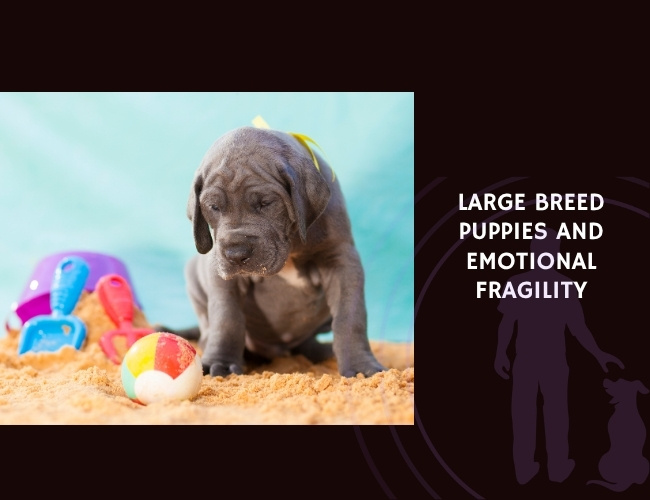
You watch your six-month-old Great Dane careen through the living room, knock over a chair, ignore every cue you know he “understands,” and then collapse in a heap of panting confusion — and you wonder if you’re doing something wrong. You’re not. What you’re watching is not a training failure. It’s developmental biology unfolding in real time, in a body that is growing faster than the nervous system can keep up with.
Large breed puppies occupy a uniquely challenging developmental space. They carry the emotional sensitivity of a young puppy inside a body that looks, moves, and bumps into the world like a juvenile adult. This mismatch — between size and neurological maturity — is at the heart of nearly every behavioural challenge that large breed owners face in the first two years of a dog’s life. Understanding it doesn’t just make you a more compassionate owner. It makes you a more effective one.
This guide explores the neurodevelopmental science behind large breed puppy emotional fragility: what is actually happening in the brain and body, why it matters for training and handling, and how you can build an environment that supports healthy emotional development rather than working against it.
The Brain That Hasn’t Caught Up Yet: Understanding Neurodevelopmental Lag
Why big bodies mean slower brains
There is a well-established principle in developmental neuroscience: larger-bodied mammals require more time for the brain to reach functional maturity. In humans, the prefrontal cortex — the region responsible for impulse control, emotional regulation, and executive decision-making — continues developing well into the mid-twenties. The same biological logic applies to dogs, and in large and giant breeds the consequences are dramatic.
A Great Dane at eight months of age is neurologically far closer to a four-month-old Chihuahua than to any adult dog. The inhibitory pathways responsible for dampening arousal, suppressing reactive impulses, and enabling recovery from stress are among the very last systems to fully myelinate and functionally integrate. What this means in practice is that the behaviours owners and trainers often label as stubbornness, defiance, or poor recall are not the product of attitude — they are the product of an incompletely wired brain.
The implications are concrete and important to internalise:
- Impulse control is not yet structurally available in the same way it will be at maturity
- Emotional regulation requires external scaffolding because internal regulation is still developing
- Recovery from arousal takes longer because the downregulation systems are immature
- Frustration tolerance is genuinely limited — not as a personality trait, but as a biological reality
This is not a reason to abandon training. It is a reason to rethink what you’re asking for, and when. 🧠
The emotional systems that run ahead of the brakes
Jaak Panksepp’s foundational work in affective neuroscience identified seven primary emotional systems present in all mammals: SEEKING, RAGE, FEAR, LUST, CARE, PANIC/GRIEF, and PLAY. These systems are subcortical, evolutionarily ancient, and fully present in dogs from an early age.
The critical issue in young large breed puppies is that these systems operate without adequate cortical modulation. The prefrontal cortex — which in mature animals provides top-down regulation of subcortical emotional responses — is not yet fully online. The FEAR system activates easily and intensely without proportionate dampening. The PLAY system generates arousal the puppy cannot regulate back to baseline. The RAGE system — frustration-based reactive impulses — can be triggered by minor obstacles because inhibitory control is insufficient. The PANIC/GRIEF system activates during separation with disproportionate intensity.
What you’re looking at in these moments is an animal experiencing emotions at full subcortical intensity, without the regulatory infrastructure to modulate, contextualise, or recover from those experiences. Understanding this shifts how you respond — and that shift changes everything.
When do the brakes actually come online?
The developmental timeline for large breed dogs looks something like this. In the neonatal period (0–3 weeks), only brainstem functions are present. The transitional and early socialisation window (3–7 weeks) sees the limbic system beginning integration, with emotional responses emerging but no inhibitory control whatsoever. During the primary socialisation window (7–16 weeks), there is rapid synaptic proliferation and high neuroplasticity — a window of both extraordinary opportunity and extraordinary vulnerability. From four to six months, hormonal changes begin and emotional volatility increases as hormonal systems activate before regulatory systems mature. Between six and eighteen months — the adolescent period — the prefrontal cortex is still developing, inhibitory control remains inconsistent, and emotional regulation fluctuates with hormonal cycles and growth surges. In large breeds, this period extends significantly beyond what small breed owners experience. In giant breeds such as Great Danes, Mastiffs, and Irish Wolfhounds, full neurological maturity may not arrive until three to four years of age.
Large breed neurological maturity — at a glance:
- 0–3 weeks — Brainstem only; reflexive responses, no emotional processing
- 3–7 weeks — Limbic integration begins; fear, play, and attachment emerge
- 7–16 weeks — Peak neuroplasticity; highest opportunity and highest vulnerability
- 4–6 months — Hormonal activation; emotional volatility increases before regulation matures
- 6–18 months — Prefrontal development ongoing; inhibitory control inconsistent
- 18–36 months — Late adolescence in large breeds; gradual stabilisation
- 3–4 years — Full neurological maturity in giant breeds (Great Danes, Mastiffs, Irish Wolfhounds)
You might notice that this timeline asks something profound of the humans in the puppy’s life: patience calibrated to developmental reality, not to the size of the body in front of you. 🐾
Growing Pains Are Real: The Physiological Pressure of Rapid Growth
A body under construction
Large breed puppies face a physiological challenge that simply has no equivalent in small breeds. They must build an enormous body in a compressed timeframe. A Great Pyrenees may gain 60–80 pounds in its first year. A Bernese Mountain Dog may triple its body weight between three and nine months of age. This growth is not passive — it is metabolically expensive, structurally demanding, and frequently uncomfortable.
Rapid skeletal growth creates microtrauma in growth plates that generates low-grade chronic discomfort. Disproportionate limb-to-body coordination makes movement effortful and sometimes genuinely awkward. Metabolic demands compete directly with neural development for available resources. Hormonal fluctuations associated with growth surges — growth hormone, insulin-like growth factor 1 (IGF-1), and the sex steroids — directly affect mood and reactivity in ways that are largely invisible to the observing owner.
Research on peripubertal stress in animal models confirms that exposure to physiological adversity during critical developmental windows — including the stress of rapid growth — has long-term consequences for cognitive functioning, emotional regulation, and endocrine reactivity. The degree to which the hypothalamus-pituitary-adrenal (HPA) axis adapts during these transitional periods directly shapes the long-term programming of behaviour and stress responsiveness.
This means that a large breed puppy experiencing a growth spurt is simultaneously physically uncomfortable, hormonally dysregulated, neurologically immature, and metabolically taxed. Expecting stable, consistent behaviour from an animal in this state is not merely unrealistic — it is a fundamental misreading of what is actually happening inside that body.
The hidden cost of growth spurts on emotional stability
Physical fatigue directly reduces emotional regulation capacity. In human research, this is well established: sleep deprivation and physical exhaustion impair prefrontal cortex function, increasing emotional reactivity and reducing inhibitory control. The same mechanism applies to puppies — and large breed puppies face an additional layer of challenge because the disconnect between surface-level activity and underlying physiological state is so frequently misread.
A large breed puppy that appears to be “still going” — running, playing, seemingly energetic — may in fact be operating in a state of fatigue-driven hyperarousal. This is a state in which inhibitory systems are depleted and the animal is running on stress hormones rather than genuine energy. The behavioural signature of this state includes increased impulsivity, reduced learning capacity, heightened emotional reactivity, and an increased likelihood of shutdown or reactive behaviour.
Did you know that the same walk that leaves your Border Terrier refreshed and ready for more may leave your four-month-old Newfoundland neurologically spent for hours? Growth takes energy. Regulating a developing brain under hormonal load takes energy. That’s energy no longer available for calm, compliant behaviour.
Behavioural signs your large breed puppy may be in a growth spurt:
- Sudden regression in previously reliable behaviours
- Increased clumsiness and spatial disorientation
- Heightened sensitivity to touch, particularly along the spine and limbs
- Shorter fuse — quicker to frustration, slower to recover
- Increased sleep demand alongside apparent restlessness
- Reduced appetite on some days, dramatically increased appetite on others
- Uncharacteristic emotional volatility — more clingy or more withdrawn than usual
These signs are not training problems. They are physiological events. Reduce demands, increase rest, and wait.
Growth plate vulnerability and the stress buffer
The growth plates (physes) of large breed puppies are open and actively growing for a significantly longer period than in small breeds. These structures are mechanically vulnerable to compression and shear forces, metabolically active and sensitive to nutritional imbalances, and a source of low-grade chronic discomfort during periods of rapid growth.
An animal experiencing chronic low-grade pain carries an elevated allostatic load — the cumulative physiological cost of managing ongoing stressors. This elevated baseline leaves less capacity to cope with additional environmental demands. A puppy that startles at a noise, reacts to an unfamiliar dog, or melts down at the end of a training session is often not failing at emotional regulation. It is running out of stress buffer.
That’s worth sitting with for a moment, because it fundamentally changes how you design a day for a large breed puppy.
Arousal, Threshold, and the Recovery That Takes Longer Than You Think
Why the same stimulus hits harder in a young large breed
Arousal threshold refers to the level of stimulation required to activate the stress response system. In mature animals with well-developed inhibitory systems, the threshold is relatively high. Minor stimuli are filtered, processed, and dismissed without triggering a full stress response. In large breed puppies with underdeveloped inhibitory pathways, the threshold is lower and the response more intense.
Stimuli that are completely neutral to an adult dog may be genuinely alarming to a six-month-old giant breed. Stimuli that are mildly exciting may trigger full arousal that the puppy cannot self-regulate back to baseline. And when multiple stimuli arrive simultaneously — a phenomenon called stimulus stacking — they can rapidly exceed threshold even when each individual stimulus would be manageable on its own.
Stimulus stacking is one of the most underappreciated dynamics in large breed puppy behaviour. The cumulative load of a busy park walk — the unfamiliar dog fifty metres away, the cyclist, the child running, the smell of food, the owner’s leash tension — can push a puppy past threshold before any single “event” has occurred. The reactive response that follows is then puzzling to the owner, because there was no obvious trigger. There was. It was the accumulation.
Common stimulus stacking sequences in large breed puppies:
- Unfamiliar dog approaches + child runs past + owner tightens the lead → reactive barking that “came out of nowhere”
- Long car journey + busy vet waiting room + physical examination → shutdown or aggression during a routine visit
- Puppy class with multiple dogs + training demands + loud environment → inability to focus that is labelled as “not food motivated”
- Morning outing + afternoon visitors + evening training session → witching hour meltdown that seems unrelated to any one event
- A stressful night + early morning walk + new environment → total emotional collapse by 10am
When you understand stacking, you stop looking for the trigger. You start looking at the day.
Recovery takes time. More time than you want it to.
Recovery from arousal — the return to physiological and behavioural baseline after a stress response — depends directly on the maturity of the downregulation systems. The GABAergic inhibitory system, the prefrontal-amygdala circuit, and the HPA axis regulation all need to work together to bring the animal back down after activation.
In large breed puppies, these systems are immature. Recovery time is substantially longer than in adults, and substantially longer than in small breed puppies of the same chronological age. A training session that leaves a small breed puppy slightly tired may leave a large breed puppy elevated and dysregulated for hours afterward.
Practically speaking, this means that the structure of a day matters enormously. An afternoon at the dog park followed immediately by a training session followed by a car trip is not three separate events for a large breed puppy — it is one cumulative stress exposure with insufficient recovery between stages. The behaviour you encounter at the end of that day is the product of that accumulation, not the product of that particular moment.
Through the NeuroBond approach, recovery is understood not as a pause in development but as an active, necessary component of it. Rest and recovery cycles allow the developing nervous system to consolidate experiences, calibrate the stress response, and build the emotional architecture that will support stable adult behaviour.
What adequate recovery actually looks like
Recovery environments matter. They should provide sensory reduction — quiet, low stimulation — alongside social safety with familiar companions, physical comfort, freedom from demands, and sufficient duration. That last point is worth emphasising: recovery for a large breed puppy in an elevated state is measured in hours, not minutes.
A crate your puppy associates with safety. A quiet corner of the house. Predictable downtime after stimulating outings. These are not indulgences. They are neurological necessities.
Your large breed puppy recovery environment checklist:
- ✅ Quiet space with low or no background noise (TV off, music off)
- ✅ Dim or natural light — avoid bright overhead lighting during rest periods
- ✅ Comfortable, appropriately sized resting surface
- ✅ Temperature comfortable — large breed puppies overheat easily
- ✅ No demands: no training, no interaction requirements, no expectations
- ✅ Familiar scents — your worn clothing near the rest area provides comfort
- ✅ Duration measured in hours after significant arousal events, not minutes
- ✅ Scheduled, not reactive — enforce rest before the puppy hits threshold, not after
The Socialisation Window: Opportunity and Vulnerability in Equal Measure
High plasticity cuts both ways
The primary socialisation window — roughly 7 to 16 weeks — is the period of highest neuroplasticity in a puppy’s development. During this window, experiences have disproportionate and lasting effects on neural architecture. This is why early socialisation is so widely recommended, and correctly so.
But neuroplasticity is a two-edged reality. The same sensitivity that makes positive experiences so formative makes negative experiences so damaging. A fearful encounter at ten weeks — with a person, a noise, an unfamiliar surface — can leave a trace in the developing brain that influences behaviour long after the event is forgotten by the owner.
For large breed puppies, the extended developmental timeline means that secondary critical periods — associated with adolescence, hormonal changes, and continued prefrontal development — extend well into the second year of life. The window of vulnerability is not closed at sixteen weeks. It remains open, in a modified form, for considerably longer.
Graduated exposure versus flooding
There is a fundamental distinction between graduated exposure and flooding that is essential to understand for anyone working with large breed puppies.
Graduated exposure presents stimuli at sub-threshold intensity with recovery time between exposures. It builds resilience. The nervous system encounters a stimulus, processes it, recovers, and is slightly more capable next time. Flooding — stimuli presented at or above threshold without recovery — builds sensitisation. The nervous system is overwhelmed, learns that the stimulus means danger, and becomes more reactive rather than less.
This is why some “well-socialised” large breed puppies are more anxious and reactive than puppies that received less but better-paced exposure. The goal is not the number of things a puppy is exposed to. It is the quality of each exposure — the intensity, the pacing, the recovery time, and the emotional state of the puppy during the encounter. 😄
Graduated exposure vs. flooding — what each looks like in practice:
| Graduated Exposure | Flooding |
|---|---|
| Puppy sees another dog at 30 metres, stays calm, gets rewarded | Puppy taken to the dog park and “allowed to sort it out” |
| Short visit to a quiet café, then home to rest | Full day in a busy urban environment to “build confidence” |
| One new surface per session, recovery between each | Puppy class with 8 dogs, loud room, multiple handlers |
| Gentle introduction to children — one child, calm, brief | Family gathering with excited children from the first week |
| Exposure ends before the puppy reacts | Exposure continues until the puppy “calms down” |
The left column builds resilience. The right column builds sensitisation. Choose the left column, every time.
High-stimulation environments — busy parks, puppy classes with multiple dogs, dog daycare facilities, urban environments — present a particular challenge for large breed puppies. They combine high sensory load, social pressure, physical demands, and cognitive demands simultaneously. A puppy may appear to be coping — playing, engaging, responding to cues — while actually operating in a state of escalating arousal that will manifest later as shutdown, reactivity, or prolonged recovery.
The Invisible Leash in socialisation
Effective socialisation is not about volume of exposure. It is about the quality of guidance you offer during exposure. The Invisible Leash — the energetic attunement between handler and puppy that communicates safety without tension — is what a puppy reads when it’s not sure whether something is safe. Your calm confidence becomes its external regulation. Your steady presence is the scaffold on which its developing nervous system learns to stand.
This is not metaphor. It is neurobiological reality.
Reading the Signals Your Puppy Is Already Sending
The stress signals that look like something else
One of the most consequential sources of harm in large breed puppy development is the systematic misreading of stress signals as defiance, dominance, or stubbornness. When a puppy freezes, it is not being stubborn — it is overwhelmed. When it yawns or licks its lips during a training session, it is not bored — it is communicating stress through displacement behaviour. When it sniffs the ground and appears to ignore you, it is not disrespecting you — it is using a calming signal to manage its own nervous system.
Slow responses to cues are frequently read as laziness or dominance, when they are almost always the product of cognitive load exceeded or simple fatigue. Jumping and mouthing — normal developmental behaviours for any puppy — are treated as aggression or disrespect in large breed puppies because of their size, which is one of the most pervasive and damaging expectation mismatches in canine handling.
When stress signals are consistently met with correction rather than support, the puppy learns that communicating stress leads to punishment. Over time, the signals are suppressed. The puppy stops yawning, stops offering calming signals, stops showing the subtle early-warning signs of overwhelm. Owners often interpret this as progress. In reality, the puppy has not reduced its stress — it has learned to hide it. The underlying pressure remains, and without communication as a safety valve, it eventually expresses itself through more dramatic means: reactive behaviour, sudden aggression, or complete shutdown.
You’re not alone if you’ve misread these signals. They’re subtle, they look like other things, and nobody teaches you to watch for them. But once you know what you’re looking at, you cannot unsee it. 🧡
Large breed puppy stress signals — what you see vs. what it means:
| What You See | Common Misread | What It Actually Means |
|---|---|---|
| Freezing / shutdown | Stubbornness, defiance | Threshold exceeded, overwhelm |
| Yawning during training | Boredom, disinterest | Stress displacement behaviour |
| Lip licking, nose licking | Random habit | Calming signal, early stress indicator |
| Sniffing the ground and ignoring you | Distracted, disrespectful | Calming signal, self-regulation attempt |
| Slow response to known cues | Laziness, dominance | Cognitive load exceeded, fatigue |
| Jumping and mouthing | Aggression, bad manners | Normal developmental arousal |
| Avoidance, turning away | Fearful, submissive | Appropriate stress communication |
| Hyperactivity after exercise | “Still has energy” | Fatigue-driven hyperarousal |
| Whale eye, panting without heat | Excitement | Anxiety, threshold approaching |
| Refusing food it normally loves | Picky eating | Above threshold — learning is not available |
The expectation mismatch and its real cost
The expectation mismatch for large breed puppies is not a minor inconvenience. It is a structural problem with real consequences for emotional development.
A six-month-old Labrador weighing 50 pounds is treated — by strangers, by owners, and often by professional trainers — as though it should behave like an adult dog. The same behaviour that is found endearing in a small breed puppy is treated as a serious problem requiring correction in a large breed puppy of identical developmental age. Jumping, mouthing, inability to settle, difficulty with recall — these are developmentally normal. In a body this size, they become problems, and the correction pressure accelerates accordingly.
This creates a cascade of harm. Premature correction disrupts the exploratory confidence necessary for healthy learning. Punishment of normal developmental behaviour creates confusion and anxiety rather than understanding. Inconsistent responses to the same behaviour — tolerated at eight weeks, corrected at sixteen weeks — destabilise emotional learning during a period when predictability is neurologically essential.
Research confirms that chronic exposure to demands that exceed regulatory capacity degrades emotional stability rather than building it. What we are asking for, when we expect an adolescent giant breed to behave like a trained adult, is the emotional equivalent of asking a human twelve-year-old to manage executive-level stress without support.
Growing. Sensitive. Overloaded.
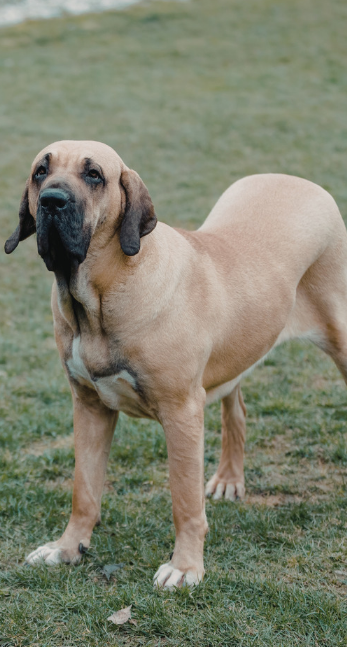
Big Body Small Brakes Large breed puppies often look physically capable long before their nervous system can regulate impulse emotion and recovery with the same maturity.
Feelings Outrun Control Powerful emotional systems activate early while cortical regulation develops slowly creating overwhelm frustration and apparent inconsistency that is biological not defiant.

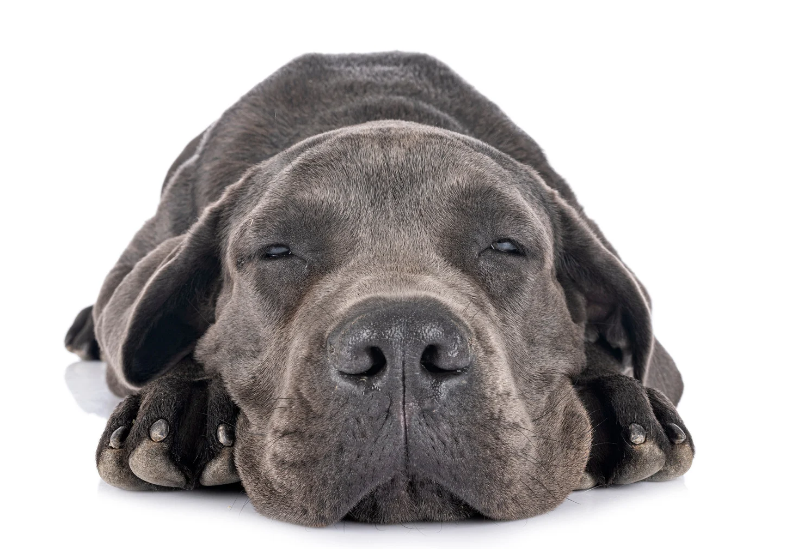
Support Builds Stability When expectations match development and NeuroBond aligned structure provides external regulation emotional resilience grows and behaviour becomes steadier over time.
The Handler’s Role: Consistency, Clarity, and Emotional Environment
Inconsistency as a source of anxiety
Inconsistent handling — in which the same behaviour receives different responses depending on the handler’s mood, the context, or which family member is present — is particularly damaging for large breed puppies. Emotional regulation, which is still developing, depends fundamentally on predictability.
A puppy that cannot predict how its behaviour will be received cannot develop the stable emotional architecture that comes from navigating a predictable world. Research confirms that prior exposure to unpredictable or inconsistent environments significantly increases stress reactivity and emotional vulnerability. Mood-dependent responses, context-dependent rules, and philosophy-switching between permissive and strict approaches all create environments in which the puppy cannot learn reliable cause-and-effect relationships, and therefore cannot feel safe.
Feeling safe is not optional for healthy development. It is prerequisite to it.
The most common inconsistency patterns that undermine large breed puppy development:
- Mood-dependent handling — jumping is ignored when you’re relaxed, corrected when you’re stressed. The puppy cannot learn a rule from this.
- Context-switching rules — allowed on the sofa at home, not at grandma’s house. The puppy experiences this as unpredictability, not distinction.
- Handler variation — one family member enforces boundaries, another does not. The puppy lives in two different emotional worlds.
- Age-based rule changes without transition — tolerated at 8 weeks, corrected at 16 weeks for the same behaviour. Creates confusion and anxiety.
- Philosophy-switching — alternating between permissive and strict approaches based on advice received that week. Destroys the stable emotional map the puppy is trying to build.
- Emotional leakage — the rule stays the same but your energy is different every day. The puppy reads the energy, not just the rule.
Your emotional state shapes your puppy’s nervous system
Owner expectations shape behavioural outcomes through mechanisms that go beyond the obvious. Yes, what you train, when you train it, and how you respond to behaviour all matter. But the emotional state of the owner — anxious owners create anxious dogs — is an equally powerful shaping force.
This is not a guilt-inducing observation. It is an empowering one. Because it means that your presence matters, not just your technique. A calm, grounded owner who understands that today’s “bad behaviour” is tomorrow’s developmental history creates a fundamentally different emotional environment than an owner who interprets the same behaviours through a lens of defiance or disrespect.
Owners who understand large breed puppy development — who recognise that the “stubbornness” is developmental, that the “defiance” is overwhelm, that the “laziness” is fatigue — are already doing something different before they change a single training technique. They are creating an emotional environment in which a developing nervous system can find its footing.
Moments of Soul Recall — when a puppy locks eyes with you mid-chaos and settles because you are settled — reveal how deeply emotional attunement is woven into learning. These moments are not accidental. They are the product of a relational environment built on safety and predictability.
🐾 Large Breed Puppies & Emotional Fragility
Your complete guide to neurodevelopment, growth stress, and raising emotionally resilient giant breed dogs
Phase 1: The Brain That Hasn’t Caught Up Yet
Neurodevelopmental Lag — Why Size DeceivesA Great Dane at 8 months is neurologically closer to a 4-month-old Chihuahua than to any adult dog. The prefrontal cortex — responsible for impulse control and emotional regulation — is among the last systems to fully develop, often not completing until age 2–4 in large breeds.
Behaviours labelled as stubbornness, defiance, or poor recall are almost never attitude — they are an incompletely wired brain. What is missing is not willingness. What is missing is the neurological infrastructure.
- • Impulse control not yet structurally available
- • Emotional regulation requires external scaffolding
- • Frustration tolerance genuinely limited by biology
Calibrate expectations to the neurological reality in front of you, not the adult dog you’re imagining. This is not a reason to abandon training — it is a reason to rethink what you’re asking for, and when.
Phase 2: A Body Under Construction
Growth Stress, Growth Plates & Physiological PressureA Great Pyrenees may gain 60–80 lbs in its first year. Rapid skeletal growth creates microtrauma in growth plates, generating chronic low-grade discomfort. Hormonal surges (IGF-1, cortisol, sex steroids) directly affect mood and reactivity in ways invisible to owners.
- • Sudden regression in reliable behaviours
- • Increased clumsiness and spatial disorientation
- • Heightened sensitivity to touch along spine and limbs
- • Shorter fuse — quicker to frustration, slower to recover
- • Uncharacteristic emotional volatility (clingy or withdrawn)
A puppy that appears to be “still going” may be operating in fatigue-driven hyperarousal — running on stress hormones, not genuine energy. More exercise does not help. Structured rest is the intervention.
Phase 3: Arousal, Threshold & Stimulus Stacking
Why Reactions Seem to Come From NowhereArousal threshold in large breed puppies is lower and the response more intense than in adults. Multiple simultaneous stimuli (stimulus stacking) can push a puppy past threshold even when each individual stimulus would be manageable alone.
- • Unfamiliar dog + child running + leash tension → reactive barking
- • Long car journey + vet waiting room + exam → aggression or shutdown
- • Morning outing + afternoon visitors + evening training → collapse by 10pm
When you understand stacking, you stop looking for the trigger. You start looking at the whole day.
Recovery is measured in hours, not minutes for large breed puppies. A proper recovery environment includes:
- • Quiet, low-stimulation space
- • No demands, no training, no interaction requirements
- • Scheduled rest — before threshold is reached, not after
Phase 4: Reading the Signals Your Puppy Sends
What Looks Like Defiance Is Almost Always Distress- • Freezing / shutdown → Overwhelm, threshold exceeded (not stubbornness)
- • Yawning or lip licking → Stress displacement (not boredom)
- • Sniffing the ground → Calming signal (not ignoring you)
- • Slow cue response → Cognitive load exceeded (not laziness)
- • Refusing food → Above threshold — learning unavailable
When stress signals are consistently met with correction, the puppy learns to hide its stress, not reduce it. The underlying pressure remains. Without the safety valve of communication, it eventually emerges as reactivity, aggression, or full shutdown.
When you see a stress signal, reduce the demand or end the session. Do not push through it. The signal is information, not defiance. Treating it as information builds trust. Treating it as defiance erodes it.
Phase 5: Feeding the Developing Brain
Nutrition as a Neurological & Emotional FoundationGrowing too fast creates physiological stress. Overnutrition — especially excess calories and calcium — accelerates growth beyond what skeletal and hormonal systems can manage. Calcium content: 1.0–1.8% dry matter. Ca:P ratio ≈ 1.2:1. These are not guidelines — they are structural requirements.
- • Using generic “all breeds” puppy food for giant breeds
- • Adding calcium supplements to complete food — harmful, not helpful
- • Free-choice feeding — body condition score, not appetite, is the metric
- • High-calorie performance formulas designed for small or working breeds
- • DHA — synaptogenesis and neural membrane structure
- • Tryptophan — serotonin precursor; mood stability
- • B6 & B12 — neurotransmitter synthesis, myelin support
- • Vitamin E & Selenium — neural antioxidant protection
Phase 6: Sleep — The Most Underrated Training Tool
Rest Is Where Learning Takes Root- • Memory consolidation — training from today is filed and embedded overnight
- • Synaptic pruning — neural circuits refined toward efficiency
- • HPA axis reset — cortisol cleared; stress response recalibrated
- • Neural myelination — inhibitory pathways develop faster during adequate sleep
That evening period of wild energy, mouthing, and inability to settle? The puppy is not energised — it is exhausted past the point of being able to come down. Large breed puppies need 16–20 hours of sleep per 24-hour period. Most get far less.
- • Enforce rest proactively — before the puppy hits threshold
- • No stimulating activity in the hour before sleep periods
- • Quiet, dim, temperature-comfortable rest environment
- • Night sleep uninterrupted where possible
Phase 7: When You’ve Already Made Mistakes
Repair, Recovery & the Resilient DogNeuroplasticity does not close at the end of the socialisation window. It reduces in intensity, but it persists throughout life. Repair is genuinely possible for most dogs — it requires a different approach, more time, and more patience than developmental support would have.
- • Phase 1 — Stabilise: No new exposures. Reduce load. Let the nervous system discover safety.
- • Phase 2 — Rebuild: Sub-threshold exposures with full recovery between each. Foundation behaviours in familiar environments only.
- • Phase 3 — Expand: Gradually broaden contexts. Measure progress in threshold distance and recovery quality — not obedience.
“Working through it” by pushing into training before the foundation of safety is established extends the recovery timeline, it does not shorten it. A nervous system at threshold cannot learn. Reduction creates the neurological space in which learning becomes possible again.
Phase 8: The Long View — What Maturity Looks Like
Early Investment, Lifetime Reward- • Recall becomes reliable in environments it previously failed in
- • Settling after stimulation takes minutes, not hours
- • Voluntary check-ins appear during outings
- • Behaviour in novel environments resembles behaviour at home
- • The adolescent “frantic quality” gives way to grounded, present attention
These changes do not happen on a schedule you can dictate. They happen on the schedule of developmental biology. Your role is to support the conditions under which that biology can unfold properly — not to force outcomes before the structures that support them exist.
🐕 Breed Comparison: Developmental Profiles at a Glance
Maturity: 2–3 years
Arousal: High • SEEKING drive dominant
Key risk: Fatigue-driven hyperarousal masked by enthusiasm
Needs: Structured rest, threshold management, short sessions
Maturity: 2–3 years
Arousal: Medium-High • Deep handler attunement
Key risk: Sensitivity underestimated behind confident exterior
Needs: Predictable leadership, fear period awareness
Maturity: 2–3 years
Arousal: Low-Medium • Gentle, emotionally sensitive
Key risk: Shutdown misread as “laid back”
Needs: Skill in distinguishing calm from suppressed distress
Maturity: 3–4 years
Arousal: Medium • Longest developmental road
Key risk: Adolescence underestimated in duration and intensity
Needs: Exercise restriction, extended developmental patience
Maturity: 2–3 years
Arousal: High • Strong independent drive
Key risk: Independence misread as defiance or dominance
Needs: Motivation-aligned training, not correction-based
Every large breed puppy needs:
• Large breed-specific nutrition
• 16–20 hours sleep daily
• Consistent, predictable handling
• Recovery measured in hours, not minutes
Size ≠ Maturity — A 50 lb puppy is still a puppy neurologically.
Behaviour ≠ Attitude — What looks like defiance is almost always overwhelm or fatigue.
More exercise ≠ Better behaviour — An overtired puppy is a dysregulated puppy.
Socialisation ≠ Exposure volume — Quality and pacing matter more than quantity.
Rest = Active development — Sleep is where training takes root and inhibitory pathways grow.
Recovery time for large breeds — 2–4 hours after significant arousal events, not 20 minutes.
Maturity timeline for giant breeds — Plan for 3–4 years, not 12–18 months.
Every behaviour challenge in a large breed puppy is an invitation to look deeper — not at the dog’s attitude, but at the developmental biology beneath it. Through the NeuroBond approach, we understand that trust, predictability, and calm leadership are not soft alternatives to training — they are the neurological conditions under which real learning becomes possible.
The Invisible Leash reminds us that the most powerful guidance is not felt through tension — it is felt through attunement. Your calm presence is your puppy’s external regulation system during the years its internal system is still under construction. And in those rare moments of Soul Recall — when your dog locks eyes with you in the middle of chaos and simply settles — you understand what all of this science is pointing toward: a bond built on safety, not control.
© Zoeta Dogsoul — Where neuroscience meets soul in dog training
Feeding the Developing Brain: Nutrition for Large Breed Puppies
Why large breed puppies need a different nutritional approach entirely
Nutrition for large breed puppies is not simply “more food for a bigger dog.” It is a precisely calibrated intervention that directly affects skeletal integrity, hormonal balance, and — through the mechanisms we’ve explored throughout this article — neurological development and emotional stability. The metabolic competition between rapid somatic growth and neural development means that what you put in the bowl has consequences that extend well beyond physical health.
The central nutritional challenge for large breed puppies is this: their bodies want to grow as fast as biology allows, but growing too fast creates exactly the physiological stress we’ve been describing. Overnutrition — particularly excess calories and excess calcium — accelerates growth beyond what the skeletal and hormonal systems can manage cleanly, increasing growth plate stress, compressing the developmental timeline, and amplifying the very hormonal fluctuations that drive emotional instability.
Large breed puppy-specific formulas exist for a reason. They are not a marketing category. They are a physiological necessity.
Calcium, phosphorus, and the growth plate connection
Calcium and phosphorus ratios sit at the heart of large breed puppy nutrition because they directly determine the health of the growth plates — those mechanically vulnerable, metabolically active structures we discussed in the context of chronic discomfort and reduced stress buffering.
The key principles to understand:
- Excess dietary calcium in large breed puppies is not excreted efficiently — unlike in adult dogs, puppies absorb calcium regardless of intake, meaning overconsumption leads directly to skeletal abnormalities
- The calcium-to-phosphorus ratio matters as much as the absolute levels — an imbalanced ratio disrupts bone mineralisation even when total calcium appears adequate
- Large breed puppy formulas are designed to deliver calcium and phosphorus within tight ranges that support controlled, healthy skeletal development rather than accelerated growth
- Supplementing a complete large breed puppy food with additional calcium — a common owner instinct — is counterproductive and potentially harmful
Practically, this means that a large breed puppy food with a calcium content of around 1.0–1.8% of dry matter, with a calcium-to-phosphorus ratio of approximately 1.2:1, is what you are looking for on the label. Your veterinarian can guide you to specific products appropriate for your breed’s adult weight.
What to look for — and avoid — on a large breed puppy food label:
- ✅ Labelled specifically as “Large Breed Puppy” — not generic puppy food
- ✅ Calcium 1.0–1.8% of dry matter
- ✅ Calcium-to-phosphorus ratio of approximately 1.2:1
- ✅ DHA listed as an ingredient (often from fish oil or algae)
- ✅ Caloric density appropriate for controlled growth (not maximum-density formulas)
- ✅ Complete and balanced AAFCO statement for large breed growth
- ❌ Avoid calcium supplements added to a complete food
- ❌ Avoid generic “all breeds” puppy formulas for giant breeds
- ❌ Avoid free-choice feeding — portion control is essential
- ❌ Avoid high-calorie “performance” puppy foods designed for small/working breeds
Did you know that many of the skeletal problems seen in adult large breed dogs — including osteochondrosis and developmental orthopaedic disease — have their roots in the nutritional environment of the first twelve months? Feeding decisions made in puppyhood echo for a lifetime. 🧠
Caloric density, meal frequency, and mood stability
Beyond skeletal health, caloric management in large breed puppies has a direct relationship to emotional and behavioural stability through two mechanisms.
The first is hormonal. Rapid weight gain accelerates the hormonal fluctuations associated with growth surges — the same IGF-1 and sex steroid changes that drive emotional volatility. Controlled growth, achieved through appropriate caloric density rather than restriction, keeps these fluctuations within a more manageable range. The puppy still grows — it simply grows at a rate its nervous system can keep pace with.
The second is blood sugar stability. Large breed puppies fed large, infrequent meals experience more dramatic blood sugar fluctuations than puppies fed smaller meals more frequently. Blood sugar instability has measurable effects on mood, reactivity, and impulse control — effects that will already be familiar to anyone who has managed their own energy around meal timing. Feeding a large breed puppy two to three measured meals per day, rather than one large meal or free-choice feeding, supports more stable neurochemical conditions throughout the day.
Portion control matters here too. An overweight large breed puppy is carrying additional mechanical load on immature growth plates — increasing the chronic discomfort that elevates the allostatic load and reduces the stress buffer. Body condition score, not the amount the puppy is willing to eat, is the right metric.
Nutrients that support neural development
While skeletal nutrition gets most of the attention in large breed puppy feeding, several nutrients have direct relevance to neurological development and emotional regulation:
- Omega-3 fatty acids (DHA in particular) are structural components of neural cell membranes and are directly involved in synaptogenesis — the formation of new synaptic connections during the high-plasticity developmental windows
- B vitamins, particularly B6 and B12, are involved in neurotransmitter synthesis — including the serotonin and dopamine pathways that underpin mood regulation
- Tryptophan is the amino acid precursor to serotonin; adequate dietary protein with appropriate tryptophan content supports mood stability in ways that are measurable and meaningful
- Antioxidants — vitamin E, vitamin C, selenium — support neural health during the oxidative stress that accompanies rapid growth
A high-quality, large breed puppy-specific complete food will address most of these needs without supplementation. The goal is not to build a supplement stack on top of standard puppy food — it is to choose a base food that takes the developing brain as seriously as it takes the developing skeleton. 🐾
Key nutrients for large breed puppy neural development — quick reference:
| Nutrient | Role in Development | Where to Find It |
|---|---|---|
| DHA (Omega-3) | Synaptogenesis, neural membrane structure | Fish oil, salmon, algae |
| Vitamin B6 | Serotonin and dopamine synthesis | Poultry, organ meat, eggs |
| Vitamin B12 | Neurological function, myelin support | Meat, fish, eggs |
| Tryptophan | Serotonin precursor; mood stability | Turkey, chicken, eggs |
| Vitamin E | Neural antioxidant protection | Vegetable oils, seeds |
| Selenium | Antioxidant; thyroid function | Fish, meat, grains |
| Magnesium | Nervous system signalling | Legumes, whole grains |
Sleep Science: Why Rest Is the Most Underrated Training Tool
Sleep is not downtime — it is active development
One of the most common mistakes large breed puppy owners make is treating sleep as optional recovery — something that happens when the puppy happens to stop. In reality, sleep is one of the most neurologically active states the developing brain can be in. What happens during sleep is not the absence of development. It is development at its most concentrated.
During sleep, several essential processes occur simultaneously:
- Memory consolidation — experiences, associations, and learned behaviours are transferred from short-term to long-term memory. A training session that happened before a sleep will be better retained after it — not because of what happened during the session, but because of what happened during the sleep that followed
- Synaptic pruning — the developing brain actively removes unused or weak synaptic connections during sleep, refining neural circuits toward efficiency. This pruning process is a core mechanism of learning and emotional calibration
- HPA axis reset — the stress hormones activated during waking experiences — particularly cortisol — are cleared and the HPA axis is recalibrated during sleep. A puppy that does not sleep adequately between stressful experiences carries elevated cortisol into the next experience, arriving at it with an already-reduced stress buffer
- Neural myelination — the process of coating inhibitory pathways in myelin — which increases conduction speed and enables the faster, more reliable inhibitory responses that underpin emotional regulation — occurs primarily during rest and sleep
This last point is particularly important for large breed puppy development. The inhibitory pathways that we need to mature before the puppy can reliably regulate its own emotional responses are literally developing faster during adequate sleep than during inadequate sleep. Rest is not a pause in the development of impulse control. In a meaningful neurological sense, rest is the development of impulse control.
How much sleep does a large breed puppy actually need?
More than most owners expect, and more than most puppies are given. Large breed puppies typically need between 16 and 20 hours of sleep per 24-hour period in the first several months of life — a figure that surprises most owners who are watching a puppy that seems determined to be awake and active at every opportunity.
The confusion arises because puppies do not self-regulate their sleep needs effectively. A puppy that is overstimulated, overtired, or operating in a state of fatigue-driven hyperarousal will often resist sleep even when sleep is exactly what the nervous system requires. This is not a sign that the puppy is not tired. It is a sign that the arousal threshold has been exceeded and the downregulation systems cannot bring the puppy back to a calm enough state to initiate rest.
This is the neurological basis for the “witching hour” phenomenon that large breed puppy owners know well — the evening period of wild, apparently limitless energy, mouthing, and inability to settle that arrives precisely when the puppy is most depleted. The puppy is not energised. It is exhausted past the point of being able to come down.
A sample daily rest schedule for a large breed puppy (3–6 months):
- 7:00am — Morning activity (short walk or play, 20–30 minutes)
- 8:00am — Breakfast, then crate rest (90 minutes minimum)
- 10:00am — Brief training session (5–10 minutes), calm interaction
- 10:30am — Nap (1–2 hours)
- 12:30pm — Lunch, short sniff walk or garden exploration
- 1:30pm — Rest period (2 hours)
- 3:30pm — Calm activity, socialisation or gentle play
- 4:30pm — Nap (1 hour minimum)
- 6:00pm — Evening activity and dinner
- 7:30pm — Wind-down period — no stimulating play, quiet environment
- 8:30pm — Night sleep begins
Total structured rest: 16–18 hours. This is not excessive — it is developmentally appropriate.
Creating conditions for quality sleep
The quality of sleep matters as much as the quantity. A puppy that sleeps in a high-traffic, stimulating environment does not enter the deep sleep stages where the most neurologically valuable processes occur. Creating a sleep environment that is quiet, dimly lit, at a comfortable temperature, and genuinely free from interruption is not coddling — it is brain development infrastructure.
Practical principles for supporting quality sleep in large breed puppies:
- Enforce rest proactively rather than waiting for the puppy to collapse — scheduled nap times after periods of activity prevent the accumulation of fatigue that leads to dysregulation
- A crate or designated sleep area associated with safety and calm supports the transition from active to resting states more efficiently than sleeping in open, stimulating spaces
- Avoid high-stimulation activities — play, training, social interaction — in the hour before expected sleep periods, to allow the nervous system to begin downregulating naturally
- Night sleep should be uninterrupted where possible; breaking sleep for unnecessary overnight interaction undermines the consolidation processes that require sustained sleep cycles
When you understand that the training session you did this afternoon is being filed, refined, and embedded in your puppy’s neural architecture tonight during deep sleep, the significance of protecting that sleep becomes clear. Rest is not separate from training. It is where training takes root. 😄
Not All Large Breeds Are the Same: Breed Variation Within the Category
The spectrum within “large breed”
“Large breed puppy” is a useful category, but it is a broad one. A Labrador Retriever, a Rottweiler, a Rhodesian Ridgeback, and an Irish Wolfhound all fall under this label — and all have meaningfully different developmental timelines, temperament architectures, arousal profiles, and emotional needs. Understanding your specific breed’s baseline helps you calibrate expectations, training approaches, and environmental design far more precisely than the general category alone allows.
What follows is not a comprehensive breed guide — it is a developmental and temperament orientation for some of the most common large breed puppies, with particular attention to the emotional fragility themes we’ve explored throughout this article.
Large breed developmental quick reference — key differences at a glance:
| Breed | Approx. Maturity | Arousal Profile | Key Developmental Risk | Primary Emotional Need |
|---|---|---|---|---|
| Labrador Retriever | 2–3 years | High | Fatigue-driven hyperarousal | Structured rest, threshold management |
| Golden Retriever | 2–3 years | High | Overwhelm masked by sociability | Calm recovery environments |
| Rottweiler | 2–3 years | Medium-High | Handler inconsistency → anxiety | Predictable, confident leadership |
| German Shepherd | 2–3 years | High | Fear periods underestimated | Low-pressure fear period navigation |
| Bernese Mountain Dog | 2–3 years | Low-Medium | Shutdown misread as calm | Sensitivity awareness, gentle handling |
| Newfoundland | 2–3 years | Low | Quiet anxiety goes undetected | Attentive reading of subtle signals |
| Great Dane | 3–4 years | Medium | Extended adolescence underestimated | Long-term commitment to developmental support |
| Irish Wolfhound | 3–4 years | Low-Medium | Growth plate stress longest period | Exercise restriction, nutritional precision |
| Rhodesian Ridgeback | 2–3 years | High | Independent drive misread as defiance | Motivation-aligned training, not correction |
Labrador and Golden Retrievers: high arousal, slow inhibitory maturation
Labradors and Golden Retrievers are among the most common large breed puppies, and among the most frequently mishandled for a predictable reason: their sociability and food motivation make them appear more capable than they are. They engage readily, take food happily, and seem to be “getting it” — right up until the moment they absolutely are not.
Both breeds carry a high SEEKING drive — Panksepp’s motivational system — which means they are perpetually oriented toward engagement, exploration, and interaction. This is wonderful for training in the right conditions, and genuinely exhausting when the arousal it generates cannot be self-regulated. Labrador and Golden Retriever puppies are prone to fatigue-driven hyperarousal for exactly this reason: the drive to engage keeps them going long past the point their nervous system can sustain it cleanly.
Inhibitory maturation in both breeds typically extends to 18–24 months. Emotional maturity — the settled, reliable adult temperament these breeds are famous for — often does not fully arrive until two to three years of age. The adolescent period, from roughly six months to two years, is the phase in which many owners give up, rehome, or resort to aversive training. Understanding this timeline as normal and developmentally expected changes everything about how you navigate it.
Handling Labradors and Golden Retrievers well during adolescence:
- Keep training sessions short (5–10 minutes) and end on success — their desire to engage will outlast their regulatory capacity
- Build in mandatory rest after social outings, even when the puppy insists it wants more
- Use the SEEKING drive for you — scatter feeding, sniff walks, and puzzle feeders satisfy the drive without the arousal spike of physical play
- Do not interpret high arousal as disobedience — it is the nervous system running ahead of the brakes
- Adolescent recall failures are neurological, not attitudinal — manage the environment rather than escalating correction pressure
Rottweilers and German Shepherds: sensitivity beneath the confident exterior
Rottweilers and German Shepherds are often perceived as emotionally robust breeds — confident, driven, capable of intensive work. This perception leads to a systematic underestimation of their emotional sensitivity during development, with consequences that can include anxiety, reactivity, and defensive aggression in adulthood.
Both breeds carry high social intelligence and strong attachment orientation. They are deeply attuned to the emotional state of their handlers — a quality that is an asset in a stable, consistent environment and a liability in an inconsistent or high-pressure one. A Rottweiler or German Shepherd puppy that experiences unpredictable handling, excessive correction, or chronic overstimulation during the socialisation windows is a puppy whose emotional development is being disrupted in ways that may not be fully visible until the dog reaches physical and hormonal maturity.
German Shepherds in particular are prone to what is sometimes described as “fear periods” — concentrated windows of heightened emotional sensitivity at roughly eight weeks and again at six to fourteen months — during which adverse experiences carry disproportionate neurological weight. The NeuroBond understanding of these periods is that they are not problems to be overridden with exposure. They are developmental realities to be navigated with reduced pressure, increased predictability, and attentive, calm presence.
Irish Wolfhounds, Great Danes, and giant breeds: the longest developmental road
Giant breeds occupy their own subcategory within the large breed spectrum, and their developmental needs are significantly more extreme than even large breeds like Labradors or Rottweilers. Full neurological maturity in an Irish Wolfhound or Great Dane may not arrive until three to four years of age. The adolescent window — with its hormonal volatility, inconsistent inhibitory control, and elevated emotional reactivity — is therefore a genuinely extended period, not a brief phase to be managed.
Giant breed puppies also carry the most significant growth plate vulnerability. The skeletal stress of supporting and building a body that may weigh 150 pounds or more creates chronic low-level discomfort for a longer period, at a higher intensity, than in breeds whose adult weight falls in the 50–80 pound range. Exercise restriction in the first 18 months is not optional for these breeds — it is genuinely protective of both physical and emotional development.
The emotional temperament of giant breeds tends toward sensitivity and social attunement rather than the high-arousal profiles of retrievers or the driven intensity of working breeds. These are dogs that feel things deeply, bond closely, and rely heavily on the emotional environment you create. The Invisible Leash — the quality of calm attunement between handler and dog — matters enormously for giant breed puppies, because they are reading your energy with a precision and sensitivity that will continue to shape their nervous system architecture long after the obvious developmental windows have closed. 🐾
Bernese Mountain Dogs and Newfoundlands: calm temperament, real fragility
Bernese Mountain Dogs and Newfoundlands are often described as gentle giants — calm, patient, affectionate — and this temperament descriptor leads to an assumption that they are emotionally robust and easy to handle. In developmental terms, this is a partial truth at best.
Both breeds carry a genuine emotional sensitivity that makes harsh handling, inconsistency, or high-pressure training disproportionately damaging. They are less likely to show reactive or aggressive responses to developmental stress than breeds with higher defensive drive — but they are more likely to shut down, to withdraw, to suppress communication signals, and to develop quiet anxiety that is easy to miss precisely because it does not announce itself dramatically.
Shutdown in a Bernese Mountain Dog or Newfoundland puppy is often misread as “laid back” or “easy going.” Learning to distinguish genuine calm from suppressed distress is one of the most important observational skills for owners of these breeds. A puppy that is truly calm is soft in its body, responsive when engaged, and willing to offer behaviour. A puppy that has shut down is physically still but with a quality of tension, disengaged from interaction, and slow or absent in its responses. These are not the same state, and they do not call for the same response.
Genuine calm vs. shutdown — how to tell the difference:
| Genuine Calm | Shutdown / Suppressed Distress |
|---|---|
| Soft, loose body posture | Still but with subtle muscular tension |
| Relaxed ears and face | Ears slightly back or flattened |
| Eyes soft, normal blinking | Whale eye, reduced blinking, hard gaze |
| Responds readily when engaged | Slow to respond or appears not to notice you |
| Willing to take food | Refuses food or takes it with unusual slowness |
| Relaxed breathing | Slightly elevated respiratory rate |
| Voluntarily moves toward interaction | Remains still, may turn head away |
| Will shift position comfortably | Holds position with unusual rigidity |
If you see the right column, the session or environment needs to change — not the puppy.
When You’ve Already Made Mistakes: Repair, Recovery, and the Resilient Dog
You did not ruin your dog
This section is for the owner who found this article too late — who has a dog that is already showing signs of anxiety, reactivity, or the kind of emotional fragility that comes from a developmental period that did not go as well as it might have. This section is for you, and the first thing it needs to say is this: you did not ruin your dog.
Neuroplasticity — the brain’s capacity to change in response to experience — does not close at the end of the socialisation window. It reduces in intensity, but it persists throughout life. The same capacity that made your puppy’s early experiences so formative is still present in your adolescent or adult dog. It is slower, it requires more repetition, and it cannot undo certain deeply embedded patterns as cleanly as early experience could have prevented them — but repair is genuinely possible, and for most dogs, meaningful recovery is achievable.
What changes is the approach. You are no longer building from a blank slate. You are working with a nervous system that has already calibrated itself around certain expectations — that unpredictability is normal, that overwhelm is frequent, that certain stimuli mean danger, that communication of stress leads to punishment. Repair means slowly, consistently rewriting those expectations. It takes longer than developmental support would have. It is still worth doing.
What repair actually looks like
Behavioural recovery in a dog with anxiety, reactivity, or emotional fragility rooted in developmental experience follows several consistent principles.
Safety first, always. A nervous system that is in a chronic state of low-level threat activation cannot learn efficiently. Before you work on specific behaviours, your priority is creating an environment in which the dog consistently experiences safety — predictability, low demand, calm handling, adequate rest, and the gradual discovery that the emotional environment it is now in is different from the one it adapted to.
This phase often feels like you are doing nothing. You are doing something profound. You are allowing the HPA axis to begin recalibrating toward a lower baseline. You are allowing the dog to gather evidence that the world is safer than it learned. This cannot be rushed, and trying to rush it by pushing into training before the foundation of safety is established typically extends the recovery timeline rather than shortening it.
Reduce before you build. If your dog is currently in an environment with more stimulation, demand, or pressure than its nervous system can manage cleanly, the first intervention is not more training — it is reduction. Fewer outings to overwhelming environments. Shorter interactions with unfamiliar dogs and people. Less pressure to perform known behaviours in difficult contexts. More structured rest. More predictability.
This is counterintuitive to owners who want to “work through” the problem. But a nervous system that is already operating at or near threshold cannot learn what you are trying to teach. Reduction creates the neurological space in which learning becomes possible again.
Work just below threshold, consistently. Once the environment is stabilised and the nervous system has had time to begin recalibrating, graduated exposure — carefully managed, consistently below the point of overwhelm — is the mechanism of recovery. Each successful exposure just below threshold is a small piece of new evidence. Each piece of evidence slightly revises the prediction the nervous system makes about the next encounter.
This is slow work. Expect progress to be measured in weeks and months, not sessions. Expect setbacks — particularly around hormonal cycles, illness, fatigue, or environmental changes — and treat them as information rather than failure. A setback tells you the threshold is lower today than it was last week. Adjust accordingly and continue.
The three phases of behavioural repair — in order:
- Phase 1 — Stabilise (weeks 1–4+): No new exposures, no pressure to perform. Reduce environmental load. Increase predictability. Prioritise rest. Let the nervous system discover that the new environment is safe. Do not skip this phase — it is the foundation everything else is built on.
- Phase 2 — Rebuild (weeks 4–12+): Introduce sub-threshold exposures with full recovery between each. Work on foundation behaviours in the home environment only. Rebuild the association between handler presence and safety. Watch for and honour all stress signals.
- Phase 3 — Expand (months 3+): Gradually extend the complexity and distance of exposures. Introduce more contexts, more stimuli, always from below threshold. Measure progress in quality of recovery and threshold distance, not in obedience performance. Celebrate small wins — they represent real neurological change.
The role of professional support
For dogs whose anxiety or reactivity is significantly affecting their quality of life — or the owner’s ability to manage them safely — professional support from a qualified, science-aligned behaviourist or veterinary behaviourist is not a last resort. It is an appropriate and often highly effective intervention.
When seeking professional support, look for practitioners who work from a learning theory and neuroscience framework, who do not use aversive tools or techniques, and who prioritise the dog’s emotional experience alongside the behavioural outcomes. A good behaviourist will assess the dog’s nervous system state, design a recovery protocol calibrated to that dog’s specific history and current capacity, and support the owner in making the environmental and handling changes that are the real foundation of recovery.
Green flags and red flags when choosing a behaviourist for a large breed puppy:
| Green Flags ✅ | Red Flags ❌ |
|---|---|
| Works from learning theory and neuroscience | Relies on dominance or pack theory |
| Prioritises the dog’s emotional state | Focuses only on behavioural compliance |
| Uses positive reinforcement as primary tool | Recommends prong collars, e-collars, or choke chains |
| Explains the why behind their approach | Cannot or will not explain their methodology |
| Measures progress in threshold and recovery | Measures progress only in obedience performance |
| Involves you as a co-participant in the process | Works with the dog while you observe passively |
| Comfortable saying “this will take time” | Promises quick fixes or guarantees |
| Qualified in animal behaviour (CAAB, CCPDT, IAABC) | Credentials based on personal experience only |
Medication is also a legitimate tool for dogs whose anxiety is severe enough to prevent effective learning. Anti-anxiety medication does not solve the underlying issue — but it can reduce the baseline arousal level sufficiently to make the graduated exposure work possible. This is a conversation worth having with your veterinarian, without stigma. 🧡
The dog in front of you is not the dog you failed — it is the dog that needs you now
Recovery from a difficult developmental history is one of the most meaningful things you can offer a dog. It is not glamorous work. It is patient, attentive, often invisible work — reducing demands before adding them, reading signals before they escalate, providing rest before requiring performance.
But the dog that emerges from that process — the one that finds its way to settled confidence through the consistency of your presence and the reliability of your care — carries something that was hard-won. A resilience built not from an easy beginning, but from the discovery that trust, once broken or never fully formed, can be rebuilt.
That journey, taken together, is one of the deepest expressions of what the bond between human and dog can be.
Practical Principles: Building a Development-Supportive Environment
Design the environment before you train the behaviour
Structural management is the most underused tool in large breed puppy development. Before you train a behaviour, design the environment so the behaviour you want is the path of least resistance. A puppy that cannot reach the bin, cannot access the stairs, and cannot engage with the children unsupervised is not being trained to ignore its impulses — but its impulses are being managed while those inhibitory systems develop.
Environmental management buys time. And time — calibrated, well-used time — is what a developing brain needs most.
Large breed puppy environmental management toolkit:
- Baby gates — restrict access to staircases and rooms with high-value chewing targets
- Exercise pen — creates a safe, contained space for unsupervised rest without full isolation
- Long line — allows outdoor freedom and safe recall practice without off-lead risk
- Crate — not punishment; a den that reliably means safety, rest, and no demands
- Puzzle feeders and Kongs — redirect oral energy, slow meal times, and provide calm mental stimulation
- Sniff walks — replaces high-arousal fetch or play with low-arousal, neurologically enriching activity
- Tether — short-term management tool for supervised greetings and calm settling practice
- Consistent visual barriers — prevent rehearsal of reactive barking at windows or fences
Structure your day around the nervous system
A day designed for a large breed puppy looks different from a day designed for a small breed adult. Shorter, purposeful outings rather than marathon socialisation sessions. Active time followed by genuine rest, not just physical containment. Training sessions kept brief — five to ten minutes maximum — and timed to when the puppy is rested and below arousal threshold, not at the end of a stimulating walk.
The structure you provide externally is the regulation the puppy cannot yet provide internally. This is what it means to scaffold development. Not control — scaffolding. Temporary support that gradually becomes unnecessary as the internal systems mature.
When to push and when to pause
One of the most important skills in working with large breed puppies is reading the difference between productive challenge and overwhelm. Productive challenge sits just below threshold — it asks something of the puppy, the puppy engages, and the puppy succeeds. Overwhelm sits at or above threshold — the puppy is flooded, cannot respond effectively, and the experience leaves a residue of stress rather than a foundation of confidence.
If you notice your puppy yawning repeatedly, refusing food it normally takes eagerly, scanning the environment without settling, or offering fragmented, low-quality responses to known cues — you are above threshold. The session is over. Not because you failed, but because the nervous system has told you what it needs next: a pause, not a push.
This responsiveness — this willingness to follow the puppy’s nervous system rather than your training plan — is the essence of what Zoeta Dogsoul means when it speaks of leading from the inside out.
Weekly owner self-audit — are you supporting your large breed puppy’s development?
- Did my puppy get at least 16 hours of rest most days this week?
- Did I end training sessions before visible stress signals appeared?
- Was I consistent in my rules and responses across all family members?
- Did I respond to stress signals with support rather than correction?
- Did I calibrate outings and exposures to my puppy’s current threshold — not to an idealised standard?
- Did I provide adequate recovery time after stimulating events?
- Was my own emotional state calm and predictable during interactions?
- Did I feed a large breed puppy-specific food at appropriate portions?
- Did I avoid high-impact exercise that exceeds growth plate safety guidelines?
- Did I find at least one moment this week to simply be present with my dog — no agenda, no training, no performance?
You don’t need to score ten out of ten. You need to be honest, and adjust.
Senior Care and the Long View: Why Early Investment Pays Dividends
The long reach of the first two years
The emotional and neurological experiences of a large breed puppy’s first two years cast a long shadow. The HPA axis calibration established during this period influences stress reactivity for the lifetime of the animal. The attachment patterns formed with handlers during the socialisation windows shape how the dog navigates uncertainty as an adult. The training experiences — whether they built confidence or eroded it — leave structural traces in the neural circuits they engaged.
This is not cause for anxiety. It is cause for intentionality. Every choice you make in the first two years — how you respond to overwhelm, how you structure recovery, how you calibrate your expectations — is not just managing behaviour in the moment. It is contributing to the animal that dog will become.
Giant breed dogs that receive development-informed care in their first two years typically reach maturity with robust stress resilience, flexible learning capacity, and the kind of settled confidence that makes them a genuine pleasure to live with. The foundation laid during the developmental period is the foundation everything else is built on.
Adapting as your large breed matures
As the prefrontal cortex matures and the inhibitory systems come online — gradually, imperfectly, with setbacks that correspond to hormonal surges and growth spurts — you will notice the changes. Recall becomes more reliable. Settling happens more quickly. The recovery from arousal shortens. Frustration tolerance extends.
These changes do not happen on a schedule you can dictate. They happen on the schedule of developmental biology. Your role is to support the conditions under which that biology can unfold properly — not to force outcomes before the structures that support them exist.
Signs that emotional maturity is arriving in your large breed dog:
- Recall becomes reliable in environments it previously failed in — not because of training pressure, but because the executive system can now override the reactive one
- Settling after stimulating events takes minutes instead of hours
- Frustration tolerance visibly extends — the dog can persist through difficulty without escalating
- Stress signals appear earlier and resolve faster — communication becomes cleaner
- The dog begins to offer eye contact and check in voluntarily during outings
- Sleep cycles normalise — less resistance to rest, deeper sleep, less overnight restlessness
- Behaviour in novel environments resembles behaviour at home — contextual generalisation is coming online
- The adolescent “look” — the slightly frantic, disconnected quality — gives way to a more present, grounded quality of attention
These changes feel gradual and then suddenly obvious. Trust the process. They are coming. 🐾
Senior large breed dogs — those who received this early investment — often carry a specific quality of calm that is earned rather than trained. It is the calm of a nervous system that was met with understanding during its most vulnerable period, that learned that the world was navigable, that trust was reliable, and that support was available when overwhelm arrived.
That quality is worth everything. And it begins now, in how you respond to the puppy who just knocked over the chair and is looking at you with that enormous, uncertain face.
Is a Large Breed Dog Right for You? Honest Questions Worth Asking
Bringing a large breed dog into your life is a deeply rewarding decision — but it asks something specific of you, particularly in the first two years. Before you commit, it’s worth sitting honestly with these questions:
- Are you prepared for a developmental timeline that may extend to three years or beyond before full emotional maturity arrives?
- Can you calibrate your expectations to the neurological reality of the dog in front of you, rather than the adult dog you’re imagining?
- Do you have the time and space to provide adequate recovery between stimulating experiences?
- Are you willing to learn to read subtle stress signals, and to prioritise the puppy’s experience over the training plan?
- Can you maintain consistent, predictable handling across all family members and contexts?
- Is your environment manageable enough to support structural management while inhibitory systems develop?
If you answer yes to most of these, you are already ahead of the curve. Large breed dogs offer a quality of companionship — loyal, physically grounding, deeply bonded — that is in a category of its own. The investment the first two years demands is repaid generously across the decade that follows.
And when you watch that dog settle at your feet one evening — the same dog who used to knock over the furniture — and feel the weight of a fully arrived, calm, trusting presence, you’ll know exactly what that investment was worth.
20 things every large breed puppy owner should know — a final summary:
- Your large breed puppy’s brain will not reach full maturity until 2–4 years of age — plan accordingly
- The inhibitory pathways that enable self-regulation are the last systems to develop
- Behaviour that looks like defiance is almost always overwhelm, fatigue, or developmental limitation
- Growth spurts are physiological stress events — reduce demands during them, don’t increase pressure
- Stimulus stacking is real — look at the whole day, not the single event that triggered the reaction
- Recovery time after arousal is measured in hours for large breed puppies, not minutes
- Sleep is where training takes root — protect it as seriously as you protect training time
- Graduated exposure builds resilience; flooding builds sensitisation — always choose graduated
- Stress signals are communication — suppressing them does not reduce the stress behind them
- Consistency across all handlers and contexts is neurologically essential, not merely preferable
- Your emotional state is part of your puppy’s environment — anxious owners create anxious dogs
- Nutrition directly affects growth plate health, hormonal stability, and neural development
- Excess calcium is harmful in large breed puppies — supplement nothing without veterinary guidance
- Not all large breeds are the same — know your breed’s specific developmental timeline and emotional profile
- Shutdown in calm-seeming breeds is not relaxation — learn the difference
- Repair after a difficult developmental history is possible — neuroplasticity does not close
- Safety before training — a nervous system in threat mode cannot learn effectively
- Professional support from a science-aligned behaviourist is a resource, not a last resort
- Signs of maturity arrive gradually, then suddenly — trust the biology if you support the conditions
- The investment of the first two years is repaid across the entire lifetime of the dog
That balance between science and soul — that’s the essence of Zoeta Dogsoul. 🐾










