

If you share your life with a Labrador Retriever, you’ve likely experienced that familiar scene: your dog has just finished their meal, yet moments later they’re staring at you with those soulful eyes, seemingly starving again. You might wonder if you’re feeding them enough, if something’s wrong, or if your Lab simply has an insatiable appetite that will never be satisfied.
The truth is far more nuanced than simple hunger. What appears as constant starvation in your Labrador often reflects a fascinating interplay between genetics, brain chemistry, learned behaviour, and yes, genuine appetite regulation differences. Understanding this distinction isn’t just academic curiosity—it’s essential for your dog’s wellbeing and your own peace of mind.
Let us guide you through the neurobiological and behavioural foundations of Labrador food obsession, helping you distinguish between genuine hunger and reward-seeking behaviour, and most importantly, showing you how to support your furry friend in developing a healthier relationship with food. 🧡
The Genetic Foundation: Why Labradors Are Different
Your Labrador’s apparent obsession with food isn’t simply poor manners or lack of training. Research reveals that Labradors may possess genetic variations affecting how their brains process hunger and satiety signals, creating genuine differences in appetite regulation compared to other breeds.
The Hypothalamic Control Center
At the heart of appetite regulation lies the hypothalamus, a small but sophisticated region of the brain that coordinates food intake, energy expenditure, and metabolism. Think of it as your dog’s internal nutritionist, constantly calculating whether they need more fuel or have adequate reserves.
Within the hypothalamus, two key neural populations work in opposition:
Key Appetite Regulation Systems:
- POMC Neurons – Produce hormones that suppress appetite and promote satiety (the “you’ve had enough” messengers)
- AgRP Neurons – Drive hunger and food-seeking behaviour (the “you need more” messengers)
- Leptin Signaling – Communicates energy reserve status from fat cells to brain
- Ghrelin Response – Triggers hunger sensations when stomach is empty
- CCK Production – Releases satiety signals when food enters digestive tract
In most dogs, these systems balance beautifully, creating appropriate hunger cycles that align with actual nutritional needs.
The Labrador Difference
Evidence suggests that Labradors may experience reduced POMC sensitivity, meaning their satiety signals don’t fire as strongly after eating. Imagine a dimmer switch that doesn’t quite reach full brightness—your Lab’s brain may genuinely struggle to register that satisfying “full” feeling that helps other dogs walk away from their bowl contentedly.
Breed-Specific Appetite Regulation Differences:
- Reduced POMC Sensitivity – Weaker post-meal satiety signaling compared to other breeds
- Enhanced AgRP Responsiveness – Hunger-promoting pathways activate more readily and intensely
- Altered Leptin Sensitivity – Modified response to energy storage signals
- Incomplete Satiety Cycles – Difficulty achieving the “satisfied” state after eating
- Persistent Hunger Perception – Brain continues signaling need despite adequate nutrition
This isn’t about willpower or training. Your Labrador’s brain may be receiving weaker signals that the meal is complete, creating a persistent sensation that they need more food even when their nutritional requirements are fully met.
Leptin and the Energy Balance Question
Leptin, a hormone produced by fat cells, normally informs the brain about energy reserves. When fat stores are adequate, leptin levels rise, telling the hypothalamus to reduce appetite. However, breed-specific variations in leptin sensitivity could mean your Labrador’s brain doesn’t accurately “read” these energy status reports.
This creates a paradox: your Lab maintains a healthy weight and has adequate energy reserves, yet their brain continues signaling hunger because the communication pathway from body to brain isn’t functioning optimally. It’s not that they’re actually starving—it’s that their hunger perception system operates differently.
Did you know? Some appetite-suppressing medications rely on functional POMC neurons to work effectively. This means genetic variations affecting these pathways don’t just influence hunger perception—they can impact how certain interventions might help your dog. 🧠
The POMC Gene Discovery: Scientific Validation for Your Observations
If you’ve felt dismissed when describing your Labrador’s relentless food-seeking, recent genetic research provides powerful validation. Scientists have identified a specific genetic mutation that fundamentally alters how Labradors experience satiety—and it’s far more common than you might imagine.
The POMC Gene Deletion
Research has identified a deletion in the POMC gene (pro-opiomelanocortin) in approximately 23% of Labradors. This isn’t a minor variation—it’s a genetic mutation that literally prevents satiety signals from functioning properly. When this gene deletion is present, your Labrador’s brain cannot produce the normal satiety hormones that signal “I’ve had enough.”
Think about what this means: nearly one in four Labradors carries a genetic mutation that prevents them from experiencing the satisfying “fullness” sensation that normally stops eating behaviour. Your dog isn’t being stubborn, greedy, or poorly trained—their brain genuinely cannot generate the chemical signals that would tell them to stop seeking food.
How the Mutation Works
The POMC gene provides instructions for creating several important peptides, including α-MSH (alpha-melanocyte-stimulating hormone), which acts on brain receptors to suppress appetite. When the gene contains this deletion, the production pathway is disrupted.
Dogs with this mutation show measurably different behaviour patterns:
Behavioral Indicators of POMC Gene Deletion:
- Increased food consumption when unlimited food is available
- Heightened food-seeking behaviour between scheduled meals
- Greater food motivation during training sessions
- Reduced ability to self-regulate intake even when nutritionally satisfied
- Statistical likelihood of being overweight or obese
- Persistent food focus independent of recent feeding
This helps explain why some Labradors show extreme food obsession while others in the same household, receiving identical training and management, remain more moderate in their food interest. The difference may literally be written in their DNA.
The Weight Connection
Studies have found that Labradors with the POMC gene deletion are statistically more likely to be overweight or obese compared to Labs without the mutation. This isn’t because their owners are less responsible—it’s because these dogs experience genuine, persistent hunger signals that make weight management extraordinarily challenging.
If your Labrador struggles with weight despite your careful portion control, and if they seem genuinely insatiable rather than simply opportunistic, this genetic factor may be contributing. Understanding this removes the burden of blame from both you and your dog, while highlighting the need for especially structured management.
Genetic Testing Availability
The good news is that commercial genetic testing for the POMC deletion is now available through several veterinary genetics companies. A simple cheek swab can determine whether your Labrador carries one or two copies of the mutation (dogs can be carriers or homozygous for the deletion).
Knowing your dog’s genetic status provides several benefits:
Advantages of POMC Genetic Testing:
- Validation – Confirms your observations and experiences with scientific evidence
- Realistic Expectations – Helps you set appropriate management goals for your specific dog
- Veterinary Communication – Guides your vet in understanding weight management challenges
- Breeding Decisions – Informs responsible breeding choices if applicable
- Customized Strategies – Allows tailoring of intervention approaches to genetic reality
- Reduced Guilt – Removes self-blame when management remains challenging
If your Labrador does carry the POMC deletion, it doesn’t mean their food obsession is hopeless—but it does mean they’ll likely require more structured management throughout their life, and that their hunger experience is genuinely different from dogs without this mutation.
Implications for Management
Understanding that your Lab may have a genetic basis for their food obsession shifts how you approach the challenge. Rather than expecting your dog to develop “better self-control,” you recognize they may need lifelong environmental management to support healthy eating patterns.
This knowledge also helps you resist the emotional pull of their apparent hunger. When you understand that the persistent seeking stems from disrupted satiety signaling rather than actual deprivation, you can maintain consistent boundaries without guilt—knowing that giving in doesn’t actually satisfy them, it just reinforces the seeking behaviour. 🐾
Beyond Hunger: The Dopamine-Driven SEEKING System
Here’s where understanding your Labrador’s behaviour becomes truly fascinating. Much of what we interpret as hunger may not be hunger at all—it’s the activation of the dopaminergic SEEKING system, a fundamental brain circuit that drives exploration, anticipation, and goal-directed behaviour.
SEEKING vs. Hunger: A Critical Distinction
Metabolic hunger is straightforward: your dog needs calories, their brain signals deficit, they eat, they feel satisfied. This cycle resolves when nutritional needs are met.
The SEEKING system operates completely differently. It’s motivated by reward anticipation, sustained by the pursuit itself, and can continue indefinitely regardless of whether your dog is actually hungry. Think of it as the neurological equivalent of scrolling through social media—the anticipation keeps you engaged far longer than any actual need for information.
When your Labrador stares at the kitchen counter, follows you to the pantry, or becomes intensely focused at the sound of a treat bag crinkling, they’re not necessarily communicating hunger. They’re experiencing dopamine-driven reward anticipation—a powerful motivational state that feels urgent and compelling but exists independently of nutritional need.
The Nucleus Accumbens: Reward Central Station
The nucleus accumbens serves as your dog’s reward processing hub, and recent research reveals something crucial: this area can enhance the reward value of food without actually increasing baseline hunger. Your Labrador can find food intensely rewarding—so rewarding that they pursue it constantly—without being genuinely hungry.
This enhancement occurs through melanin-concentrating hormone projections that amplify how rewarding food feels. For your Lab, eating might deliver a more intense pleasure response than it does for other breeds, making food-seeking behaviour self-perpetuating regardless of satiety.
The Serotonin-Dopamine Balance
The interplay between serotonin and dopamine critically influences food-seeking behaviour. Research shows that prolonged exposure to palatable foods can create high dopamine turnover—meaning the reward system stays highly activated—while simultaneously causing serotonin hypofunction.
Serotonin normally helps regulate impulse control and satiety perception. When serotonin function decreases while dopamine activity increases, the result is a neurochemical environment that favours persistent seeking over satisfaction. Your Labrador may literally struggle more than other dogs to disengage from food-related stimuli because their brain chemistry biases them toward pursuit.
This imbalance can intensify under stress, creating a vicious cycle where environmental stressors drive food-seeking, which further amplifies the neurochemical imbalance, leading to even stronger food obsession.
Recognizing SEEKING vs. Genuine Hunger
Learning to distinguish between these states helps you respond appropriately to your dog’s behaviour. Through the NeuroBond approach, observing your Lab’s subtle signals reveals which system is activated.
Your Labrador Is Likely Experiencing Dopamine-Driven SEEKING When:
- Food-seeking persists immediately after finishing a meal
- Arousal and excitement spike at food-related cues regardless of feeding schedule
- They show difficulty disengaging from food stimuli even after eating
- Food-related activities eclipse previously enjoyed non-food activities
- Seeking behaviour intensifies with cue exposure rather than time since last meal
- They maintain healthy body condition despite reported “constant hunger”
- Selective interest in high-value foods even when refusing regular meals
Your Labrador Is Likely Experiencing Genuine Metabolic Hunger When:
- Food-seeking intensity correlates directly with time since last meal
- They show reduced selectivity, accepting less preferred foods readily
- Seeking behaviour resolves promptly after adequate caloric intake
- Overall arousal remains moderate, focused on consumption rather than pursuit
- You observe physiological signs like lower energy or changes in coat quality
- They accept any available food rather than holding out for preferred items
- They show satisfaction and settling behaviour after meals
The difference matters profoundly. Feeding a dog who’s experiencing SEEKING activation reinforces the reward loop without addressing the underlying neurochemical state. Understanding this helps you avoid inadvertently intensifying the very behaviour you’re trying to satisfy. 🐾
The Training Paradox: When Rewards Create Obsession
Modern dog training emphasizes positive reinforcement, typically using food rewards to shape desired behaviours. This approach is effective, humane, and science-based. Yet for highly food-motivated breeds like Labradors, it can inadvertently create or amplify food obsession through mechanisms most owners never recognize.
How Food-Based Training Amplifies Reward Loops
Every training session that uses food rewards activates your Labrador’s dopamine system. With multiple daily sessions—basic obedience in the morning, recall practice in the afternoon, trick training in the evening—your dog’s reward circuits remain in a state of elevated activation throughout the day.
Mechanisms of Reward Loop Amplification:
- Frequent Reinforcement – Multiple daily training sessions maintain elevated dopaminergic tone
- Anticipatory Arousal – Dogs learn to predict training contexts, creating sustained SEEKING activation
- Reward Inflation – Repeated pairing of food with various contexts increases overall food salience
- Incomplete Satiety Cycles – Training treats rarely provide sufficient volume to trigger full satiety responses
- Cue Hypersensitivity – Environmental cues associated with food trigger intense arousal
- Generalized Seeking – Food-seeking extends beyond training contexts to all human interactions
This isn’t inherently problematic for most dogs. However, for Labradors with already enhanced reward sensitivity, frequent reinforcement schedules can create sustained dopaminergic tone that doesn’t resolve between sessions. The SEEKING system never fully cycles down to baseline.
Consider the typical training approach: you keep treats in your pocket, periodically rewarding your Lab for good behaviour throughout the day. From your perspective, you’re being consistent and positive. From your dog’s neurobiological perspective, they’re in a constant state of reward anticipation, scanning every interaction for potential food delivery.
The Anticipatory Arousal Challenge
Your intelligent Labrador quickly learns to predict training contexts. The sound of the treat pouch zipper, your hand moving toward your pocket, even your tone of voice can trigger intense anticipatory arousal before any food appears.
This anticipatory state activates the SEEKING system powerfully. The neurochemical cascade of reward anticipation can be more intense than the reward itself. You might notice your Lab becomes impossibly focused, unable to hear normal cues, hyper-vigilant to every movement—this is dopamine-driven anticipation, not hunger, but it feels urgent and all-consuming to your dog.
Over time, these anticipatory patterns generalize. Your Labrador begins experiencing SEEKING activation around the kitchen, during walks where training sometimes happens, whenever you stand in certain locations. The contexts expand, and with them, the persistent food-focused behaviour.
Cue-Food Overbinding: When Food Eclipses Everything
In breeds with extreme food motivation, food rewards can become so salient that they overshadow the intrinsic meaning of the tasks themselves. This phenomenon, called cue-food overbinding, transforms activities from potentially rewarding experiences into mere pathways to treats.
Characteristics of Cue-Food Overbinding:
- Task Devaluation – The activity becomes merely a means to food rather than inherently rewarding
- Cue Hypersensitivity – Environmental cues associated with food trigger disproportionate arousal
- Reduced Intrinsic Motivation – Decreased engagement with non-food-rewarded activities
- Generalized Food Focus – All interactions become evaluated for food potential
- Performance Dependency – Dog only performs when food reward is imminent
- Escalating Reward Requirements – Previously effective rewards become insufficient over time
Your Labrador may have once enjoyed the game of fetch for its own sake—the chase, the retrieve, the interaction with you. But after hundreds of repetitions ending with food rewards, the activity becomes devalued. Fetch is no longer play; it’s work performed to access treats. The joy diminishes; the food-seeking intensifies.
This creates a troubling cycle. As intrinsic motivation decreases, you rely more heavily on food rewards to maintain engagement. As food rewards increase, intrinsic motivation further decreases. Your Lab becomes less interested in non-food-rewarded activities, showing reduced engagement with play, exploration, or social interaction that doesn’t involve edible payoffs.
The Micro-Rewarding Effect
Modern training often employs small, frequent rewards to maintain focus and momentum. You deliver tiny treats every few seconds during a training session, keeping your dog engaged through continuous partial reinforcement.
While this technique works beautifully for skill acquisition, it may create unintended consequences for reward-system function. Small, frequent rewards fragment the natural completion cycle that allows the nervous system to move from pursuit (SEEKING) through consumption and into satisfaction.
Imagine reading a gripping novel but stopping after every paragraph. You never experience the satisfying completion of a chapter, the resolution of plot tension, or the contentment of finishing the story. You remain in perpetual anticipation, always waiting for the next fragment.
Your Labrador’s nervous system experiences something similar with micro-rewarding. Each tiny treat provides momentary reinforcement but doesn’t deliver sufficient volume or duration to trigger full satiety responses. The SEEKING system receives constant activation signals without the corresponding “task complete, relax now” messages that allow it to cycle down.
That balance between effective training and neurochemical wellbeing—that’s the essence of Zoeta Dogsoul.
Training-Induced Hypervigilance
Heavy reliance on food-based training can create chronic arousal states where your Labrador develops hypervigilance around potential food opportunities.
Signs Your Lab Has Developed Food-Related Hypervigilance:
- Constant Monitoring – Perpetually watching your hands, pockets, and movements for food cues
- Context Scanning – Checking locations and situations that have previously yielded food
- Micro-Cue Sensitivity – Reacting to tiny movements or sounds that might predict food
- Difficulty Settling – Unable to relax because they’re monitoring for food opportunities
- Anticipatory Arousal – Immediate alertness at any potential food-related signal
- Reduced Relaxation – Never fully disengaging from food-seeking mode
- Generalized Vigilance – Extending food-focused attention to all environments and people
You reach for your phone, and your dog perks up—sometimes your phone pocket contains treats. You stand from the couch, and your Lab rushes to your side—sometimes standing leads to kitchen trips. You make eye contact, and they intensify their stare—sometimes eye contact precedes treat delivery.
This hypervigilance isn’t a sign of bonding or attentiveness. It’s a stress state, a neurological pattern of scanning and monitoring driven by reward anticipation. Your dog can’t relax because they’re perpetually alert for the next possibility of food.
Food as Emotional Currency: The Human-Canine Dynamic
The relationship between food-giving and emotional connection in human-dog relationships deserves thoughtful examination. For many of us, feeding represents love, care, and nurturing. When our Labrador gazes at us imploringly, something deep within us responds—we want to provide, to satisfy, to show our affection through giving.
The “Kind Feeding” Trap
Many Labrador owners find themselves in a pattern we might call “kind feeding”—offering extra treats, sharing table scraps, or providing additional meals out of concern that their dog might be genuinely hungry or a desire to make them happy. This comes from genuine compassion and love for your furry friend.
However, with a dog whose brain processes food rewards intensely and struggles with satiety signaling, each act of “kind feeding” reinforces the very behaviour it aims to satisfy. Your Labrador learns that persistent staring, whining, or soliciting behaviour eventually yields food. The intermittent reinforcement—sometimes you give in, sometimes you don’t—creates one of the most powerful conditioning patterns known.
Your dog isn’t manipulating you deliberately. They’re simply responding to the reward patterns you’ve inadvertently created. Each time concern or affection prompts you to offer just one more treat, you strengthen the neural pathways that drive food-seeking behaviour.
Misreading SEEKING as Distress
Your Labrador stares at you intensely, perhaps whining softly, their body tense with focus. It’s easy to interpret this as distress, as genuine need or suffering. The emotional pull is powerful—how can you deny them when they seem so desperate?
Understanding the neurobiological reality helps here. Your dog is experiencing intense SEEKING activation, which does feel urgent and compelling to them. But urgent doesn’t mean necessary. The dopamine-driven state creates powerful motivation without representing genuine deprivation.
This distinction matters tremendously for your response. Feeding a dog experiencing SEEKING activation provides momentary dopamine satisfaction but reinforces the entire pattern, making future episodes more intense and frequent. The kind act paradoxically increases your dog’s discomfort over time.
The Invisible Leash reminds us that awareness, not indulgence, guides the path toward genuine wellbeing.
Emotional Projection and Guilt
Many Labrador owners describe feeling guilty when their dog seems hungry. We project our own experiences with hunger—an uncomfortable, even distressing state—onto our dogs, imagining they must be suffering similar discomfort.
But if your Labrador maintains healthy body condition, shows good energy levels, and receives nutritionally adequate meals, they’re not experiencing food deprivation. What they’re experiencing is reward anticipation, a different neurological state entirely.
Recognizing this difference liberates you from unnecessary guilt while helping you respond more appropriately to your dog’s actual needs. Your Labrador doesn’t need more food—they need support in regulating their reward system and developing frustration tolerance.
Food as Substitute Connection
Sometimes food becomes a shortcut for deeper connection. It’s quicker to toss a treat than to engage in meaningful play. It’s easier to offer a snack than to provide the mental stimulation, physical exercise, or calm companionship your dog genuinely needs.
When food substitutes for other forms of enrichment and connection, it creates a hollow exchange. Your Labrador’s deeper needs—for exercise, exploration, social interaction, and yes, emotional connection—remain unmet while food-seeking behaviour intensifies.
Examining your own patterns honestly helps here. Do you reach for treats when you’re too tired for a walk? Does food-giving replace quality time? Are treats offered from habit, convenience, or genuine responsiveness to your dog’s needs?

The Intermittent Reinforcement Trap: Why Inconsistency Is So Powerful
If there’s one concept that explains why so many well-intentioned management strategies fail, it’s intermittent reinforcement. Understanding this psychological principle—and recognizing how easily you create it without realizing—may be the most important insight for successfully managing your Labrador’s food obsession.
The Slot Machine Effect
Imagine a slot machine at a casino. You pull the lever, and sometimes you win, sometimes you lose. You never know which pull will pay off, but the possibility keeps you trying. The unpredictability doesn’t discourage you—it intensifies your behaviour. You pull that lever more persistently, more obsessively, than if you won every single time or never won at all.
This is intermittent reinforcement, and it’s the most powerful conditioning pattern in behavioural psychology. When rewards arrive unpredictably—sometimes yes, sometimes no—the behaviour becomes incredibly resistant to extinction. Your brain (and your dog’s brain) stays locked in a state of hopeful anticipation, always wondering if this attempt might be the one that pays off.
Now apply this to your Labrador’s food-seeking. Every time you sometimes give in to those pleading eyes, sometimes share a bite of your dinner, sometimes toss them a treat when they’re begging—you’re not occasionally satisfying them. You’re operating a slot machine that makes food-seeking behaviour nearly impossible to eliminate.
The Neurobiology of Uncertainty
Why is intermittent reinforcement so powerful? The answer lies in dopamine signaling. Predictable rewards actually cause dopamine levels to plateau—your brain learns exactly when to expect the reward, and the anticipation becomes routine.
But unpredictable rewards create sustained dopamine elevation. Your Labrador’s brain releases dopamine during the seeking behaviour itself, not knowing whether this attempt will succeed. Each failure doesn’t reduce dopamine—it maintains it, because the next attempt might work. The uncertainty keeps the system activated, engaged, searching.
This means that being inconsistent with your boundaries isn’t just somewhat less effective than being consistent—it’s actively counterproductive. Intermittent reinforcement creates stronger, more persistent behaviour than consistent reinforcement ever could.
Real-World Scenarios You Might Not Recognize
Many owners create intermittent reinforcement patterns without realizing it. Let’s examine some common scenarios:
Common Intermittent Reinforcement Patterns:
- The Sunday Exception – Maintaining strict rules six days weekly, but relaxing boundaries when guests visit
- The Affection Slip – Usually ignoring begging, but occasionally sharing when feeling particularly loving or guilty
- The Pocket Lottery – Inconsistently having treats available during walks, creating unpredictable reward opportunities
- The Family Inconsistency – Different household members applying different rules about food access
- The Distraction Give-In – Resisting requests most times but yielding when you’re busy or distracted
- The Mood-Based Feeding – Sometimes sharing human food based on your emotional state rather than consistent policy
- The “Just This Once” – Periodic exceptions that transform consistency into intermittent reinforcement
- The Accidental Reinforcement – Dropping food and allowing them to have it rather than enforcing boundaries
You maintain strict “no begging at dinner” rules six days a week, but on Sunday when extended family visits, you slip your Lab a piece of chicken to keep them quiet. Your dog learns: persistence pays off eventually. The six days of resistance actually make the Sunday reward more powerful, not less.
You usually ignore your Lab when they stare at you while you’re snacking, but occasionally—when you’re feeling particularly affectionate, or guilty, or distracted—you share a bite. Your dog learns: if I stare long enough, intensely enough, the reward sometimes comes. This makes the staring longer and more intense, not shorter.
You keep treats in your coat pocket for walks. Sometimes you remember to give one, sometimes you forget, sometimes you give several. Your Lab becomes hypervigilant about your coat pocket, checking it constantly, because the reward schedule is unpredictable. Consistent, predictable reinforcement would actually create less obsession.
Your family members have different rules. Your partner never gives table scraps; you occasionally do; your teenager does regularly. Your dog learns to persistently solicit from everyone because any person might be the slot machine that pays off this time.
Why This Is the #1 Reason Interventions Fail
When people implement management strategies for food obsession, initial consistency is often strong. You’re motivated, committed, determined to help your dog. You resist the begging, maintain boundaries, follow the protocols.
But life happens. You’re exhausted after a long day. Your Lab looks particularly pathetic. You had a stressful week and want to do something nice for your dog. You’re cooking and accidentally drop food, and it seems easier to just let them have it rather than enforcing the boundary. Just this once.
That “just this once” transforms your previous consistency into an intermittent reinforcement schedule. Your dog doesn’t think “Oh, the rules have changed.” They think “Persistence worked! If I just keep trying, eventually it’ll work again.”
Now you’ve made the behaviour harder to extinguish than if you’d been consistently permissive from the start. The behavior escalates—longer staring, more insistent begging, increased following behavior—because your dog has learned that persistence through resistance eventually yields rewards.
The All-or-Nothing Necessity
This is why half-measures don’t work with food-obsessed Labradors. You cannot be “mostly” consistent and expect improvement. Either everyone in your household maintains the boundaries all the time, or you’re operating an intermittent reinforcement schedule that intensifies the exact behaviour you’re trying to reduce.
This doesn’t mean perfection is required—you’re human, and mistakes happen. But it does mean that casual flexibility, “special occasions,” and “just this once” create the precise conditions that make food obsession more entrenched, not less.
Breaking the Pattern
If you recognize that you’ve been inadvertently creating intermittent reinforcement, don’t despair. The pattern can be broken, but it requires genuine commitment to consistency across several weeks.
Steps to Break Intermittent Reinforcement Patterns:
- Identify All Food Scenarios – Document every situation where food might appear unpredictably (begging at meals, kitchen following, pocket checking, visitor solicitation, dropped food scavenging)
- Establish Absolute Rules – Create clear, non-negotiable policies for each scenario (not “usually no” but definitive boundaries)
- Communicate Household-Wide – Ensure every person understands and commits to identical implementation
- Maintain Rigid Consistency – Apply rules every single time for minimum 3-4 weeks
- Document Exceptions – Track any slip-ups to identify weak points in your system
- Plan for Challenges – Prepare strategies for high-risk situations (visitors, holidays, stress periods)
- Reintroduce Predictable Flexibility – After 4+ weeks of consistency, any flexibility must be predictable (always get dinner plate scraps vs. sometimes get scraps if you beg)
- Monitor for Regression – Watch for signs that intermittent patterns are re-emerging
First, identify every scenario where food might appear unpredictably. Document these honestly: begging at meals, following you to the kitchen, staring while you snack, checking your pockets, soliciting from visitors, scavenging dropped food, etc.
Then, establish a clear, absolute rule for each scenario. Not “usually no,” not “only sometimes,” but a definitive policy that applies every single time. Yes, this feels rigid. It needs to be rigid, at least initially, to break the intermittent reinforcement pattern.
Finally—and this is crucial—ensure every person who interacts with your dog understands and implements the same rules. A single family member creating “just occasional” exceptions maintains the entire pattern for everyone.
After several weeks of true consistency, you might be able to reintroduce some flexibility, but it must be predictable flexibility. “You always get a small piece of my dinner plate after I’m finished eating” creates predictable reinforcement. “You sometimes get my dinner scraps if you beg cutely enough” maintains intermittent reinforcement.
The difference between these patterns determines whether your Labrador can relax between food opportunities or remains in constant vigilant seeking mode. 🧠
Practical Management: Supporting Your Labrador’s Wellbeing
Understanding the neurobiology behind your Lab’s food obsession empowers you to implement strategies that address underlying mechanisms rather than just managing symptoms. These approaches work with your dog’s neurochemistry, not against it.
Structured Feeding Protocols
Creating clear structure around feeding helps your Labrador’s brain distinguish between “food available” and “food not available” states, reducing the chronic anticipatory arousal that drives persistent seeking.
Components of Structured Feeding:
- Predictable Timing – Feed at consistent times daily (e.g., 7 AM and 7 PM every day)
- Clear Rituals – Develop specific pre-feeding sequences that signal meal approach
- Designated Locations – Feed in the same location to create spatial food boundaries
- Calm Preparation – Prepare meals without excitement or prolonged anticipation
- Neutral Delivery – Present food calmly without excessive praise or fanfare
- Post-Meal Routines – Establish activities that signal feeding cycle completion
- Definitive Endings – Remove bowls promptly and transition to different activity
- Spatial Transitions – Move dog to different location after eating to mark completion
Implementing predictable timing means feeding at consistent times daily. Your dog’s body develops natural rhythms around these schedules, allowing appropriate anticipation without chronic hypervigilance. When meals arrive reliably at 7 AM and 6 PM, your Lab learns to relax between these times rather than monitoring constantly for unpredictable opportunities.
Develop clear feeding rituals that signal meal approach. Perhaps you always prepare their food in a specific sequence, use certain words, or have your dog perform a particular behaviour before feeding. These rituals create distinct contexts that activate SEEKING appropriately—when food is actually imminent—rather than maintaining constant activation.
Designate specific feeding locations that create spatial boundaries. Your Labrador learns that food appears in this location, at these times, following these rituals. Other locations and times become predictably food-free, allowing their nervous system to disengage from food-seeking mode in those contexts.
Establish post-meal routines that signal cycle completion. After your dog finishes eating, perhaps you immediately go for a walk, play a specific game, or have quiet rest time. This clear transition helps their brain recognize “feeding cycle complete” and shift into other modes rather than immediately resuming food-seeking.
The Emotional Clarity Principle
Your Labrador reads your emotional state constantly, and emotional inconsistency around food creates confusion that amplifies seeking behaviour. Implementing calm, neutral feeding practices reduces arousal and establishes clear communication.
Principles of Emotional Clarity in Feeding:
- Calm Meal Preparation – Prepare food without excited voices or animated movements
- Neutral Delivery – Present bowl with simple “here you go” rather than celebration
- Minimal Pre-Feeding Arousal – Avoid building excitement before meals arrive
- Unambiguous Signals – Provide clear yes/no communication about food availability
- Consistent Boundaries – Apply same rules every time without emotional variation
- Emotional Neutrality – Separate your emotions from feeding interactions
- Clear Communication – Use definitive language and actions rather than ambiguous signals
- Boundary Reliability – Maintain rules regardless of your dog’s emotional displays
Reduce excitement around meal preparation and delivery. Many owners inadvertently hype meals with excited voices, animated movements, or prolonged anticipation. This pre-feeding arousal spikes dopamine before food arrives, intensifying the overall reward response and making the experience more neurochemically compelling.
Instead, approach feeding with calm consistency. Prepare meals without fanfare, deliver the bowl neutrally, and step away. Your Labrador learns that food appears calmly, is consumed calmly, and the cycle completes calmly—without the emotional intensity that reinforces obsessive patterns.
Provide unambiguous signals about food availability. Inconsistency creates persistent checking behaviour. If sometimes your Lab can have food from the counter and sometimes not, if begging occasionally works but usually doesn’t, their brain learns to keep trying because rewards are unpredictable.
Clear, consistent boundaries—no food from counters, no begging rewards, no table scraps—eliminate the intermittent reinforcement that powerfully maintains seeking behaviour. Your dog learns these boundaries and can relax within them rather than constantly testing for possible exceptions.
Maintain emotional neutrality around feeding interactions. Food delivery shouldn’t be an emotionally charged event filled with excessive praise, affection, or attention. These emotional elements add additional reward layers that intensify food’s overall value in your dog’s brain.
A calm “here you go” and walking away allows feeding to remain functionally about nutrition rather than becoming an intense emotional experience that your Labrador craves repeatedly.
Completion-Based Feeding: Working with Satiety Physiology
Since some Labradors may genuinely experience weaker satiety signals, structuring feeding to maximize whatever satiety response they can generate helps reduce persistent hunger sensations.
Satiety-Enhancing Feeding Strategies:
- Sufficient Volume – Provide meals large enough to trigger stomach distension and mechanical fullness
- Fewer Larger Meals – Choose 2 substantial meals over 3-4 small portions
- Adequate Duration – Allow 20-30 minutes post-meal for hormonal satiety signals to develop
- Clear Endings – Remove bowl immediately when finished and change location
- Completion Markers – Use specific phrases (“all done”) paired with bowl removal
- Post-Meal Settling – Implement quiet rest periods after eating
- Avoid Post-Meal Arousal – Skip intense play or training immediately after meals
- Physical Fullness Focus – Prioritize volume that creates mechanical satiety sensation
Provide sufficient meal volume to trigger physiological fullness. Stomach distension activates mechanical satiety receptors that signal fullness to the brain. While your Lab may have reduced hormonal satiety signaling, mechanical fullness still provides some “enough food” feedback.
Rather than tiny frequent meals, consider fewer, larger meals that create actual stomach fullness. This might mean two substantial meals daily rather than three or four small ones. The physical sensation of fullness, even if not accompanied by strong hormonal satiety, provides some satisfaction.
Allow adequate time for hormonal satiety signals to develop. Ghrelin (hunger hormone) and leptin (satiety hormone) don’t respond instantly to food intake. These signals develop over 20-30 minutes after eating begins.
After your Labrador finishes their meal, implement a mandatory quiet period before any additional food-related activities. This allows time for whatever satiety hormones they produce to reach the brain and exert their appetite-suppressing effects.
Create clear meal endings that signal completion. When your Lab finishes eating, immediately remove the bowl, move them to a different location, and shift into a non-food activity. This clear transition creates a definitive endpoint rather than leaving them in food contexts where SEEKING activation persists.
Some owners successfully use a specific phrase (“all done”) paired with bowl removal and location change, creating a learned signal that the feeding cycle has concluded.
Allow post-meal settling for digestion and relaxation. After eating, the body naturally shifts into parasympathetic (rest and digest) mode. Supporting this transition through calm, quiet time helps your dog’s nervous system cycle from SEEKING arousal down into relaxation.
A post-meal rest period—perhaps in their bed, or a quiet room—facilitates this neurological shift. Avoid intense play or training immediately after meals, as these maintain arousal when you’re trying to help your dog settle.
Hungry. Wired. Misread.
Genetic Appetite Bias Labradors often experience altered satiety signaling where hunger pathways remain active after eating creating a persistent drive that feels like constant need rather than poor manners.
Reward Seeks Food When brain chemistry favours food motivation behaviour shifts from nutritional hunger to dopamine driven seeking making appetite appear endless despite adequate intake.


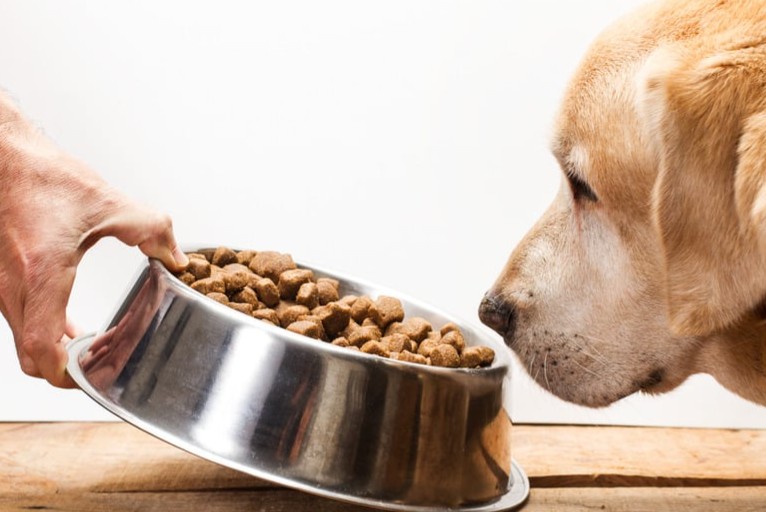
Structure Regulates Signals Through predictable feeding rhythms emotional regulation and NeuroBond aligned guidance Labradors can develop clearer internal cues and a calmer relationship with food.
Meal Frequency vs. Volume: Finding the Optimal Feeding Structure
One of the most practical decisions you’ll make in managing your Labrador’s food obsession is how to structure their daily food ration. The difference between multiple small meals and fewer larger meals significantly impacts both satiety signaling and food-seeking behaviour patterns.
The Case for Fewer, Larger Meals
For most Labradors, especially those with food obsession, two substantial meals daily typically works better than three or four smaller ones. This recommendation stems from how satiety mechanisms actually function in your dog’s body.
Why Two Larger Meals Work Better Than Grazing:
- Robust Stomach Distension – Larger volume activates mechanical fullness receptors more effectively
- Stronger Hormonal Signals – Greater nutrient concentration triggers more CCK and GLP-1 release
- Complete Satiety Cycles – Brain receives clear “meal consumed” signal rather than continuous small inputs
- Natural Hunger Development – 12-hour intervals allow genuine appetite building and satisfaction
- Post-Meal Settling – Triggers parasympathetic “rest and digest” response
- Psychological Completion – Dog experiences actual meal satisfaction rather than endless snacking
- Reduced Vigilance – Clear feeding times reduce chronic food-monitoring behavior
- Circadian Alignment – Supports natural metabolic rhythms and anticipation patterns
When your Lab eats a larger meal, several satiety signals activate more robustly than with small portions. Stomach distension—the physical stretching of the stomach wall—triggers vagal nerve signals that communicate fullness to the brain. This mechanical satiety response requires actual volume; tiny portions simply don’t stretch the stomach enough to activate these sensors meaningfully.
Additionally, hormonal satiety signals like CCK (cholecystokinin) and GLP-1 (glucagon-like peptide-1) respond to the presence of nutrients in the digestive tract. While Labradors with POMC mutations may have impaired satiety hormone function, they still produce some response. Larger meals create more robust hormonal signals than scattered small portions do.
Think of it this way: four 50-calorie snacks throughout the day might meet your Lab’s energy needs, but none of them delivers sufficient volume or nutrient concentration to meaningfully trigger satiety responses. Your dog’s body never registers “I’ve eaten a meal”—just “I’ve had continuous small food exposures.”
🐕 Understanding Your Labrador’s Food Obsession 🍖
A Neurobiological Journey from Genetics to Management
Phase 1: The Genetic Blueprint
Understanding the POMC Gene Mutation
The Science
23% of Labradors carry a POMC gene deletion that prevents satiety signals from functioning properly. This isn’t poor training—it’s DNA preventing your Lab from experiencing the “full” sensation that tells other dogs to stop eating.
What You’ll Notice
• Food-seeking immediately after meals
• Intense motivation during training
• Higher likelihood of weight gain
• Genuine inability to self-regulate intake
Action Step
Consider genetic testing through veterinary genetics companies. Knowing your Lab’s status validates your experiences and guides realistic management expectations throughout their life.
Phase 2: The SEEKING System
Distinguishing Dopamine from Hunger
The Neuroscience
Your Lab’s dopamine-driven SEEKING system can activate independently of hunger. This creates reward anticipation that feels urgent and compelling but exists separately from nutritional need—like endless scrolling despite no real need for information.
SEEKING vs. Hunger Signals
SEEKING: Persists after eating, intensifies with cues, maintains healthy weight
HUNGER: Correlates with time since meal, resolves after eating, accepts any food
Recognition Practice
Through the NeuroBond approach, observe your Lab’s patterns for one week. Document when seeking occurs, what triggers it, and whether food resolves it. This reveals which system drives their behavior.
Phase 3: The Training Paradox
When Rewards Create Obsession
The Mechanism
Multiple daily training sessions with food rewards maintain elevated dopaminergic tone. Your Lab’s reward circuits never fully cycle down to baseline, creating sustained SEEKING activation that extends beyond training contexts.
Warning Signs
• Hypervigilance around your pockets and hands
• Inability to settle between sessions
• Task devaluation (only works for food)
• Generalized food-seeking in all contexts
Rebalancing Strategy
Implement variable reward schedules, increase task duration before rewards, develop non-food reinforcers (play, toys, swimming), and use daily meal ration for training rather than extra treats.
Phase 4: The Slot Machine Effect
Why Inconsistency Is Devastating
The Psychology
Unpredictable rewards create sustained dopamine elevation. Your Lab’s brain releases dopamine during seeking itself, not knowing if this attempt will succeed. Each “no” doesn’t reduce dopamine—it maintains it, because the next attempt might work.
Critical Warning
Being “mostly” consistent creates intermittent reinforcement. The Sunday exception, the occasional slip, the “just this once”—these transform your consistency into the most powerful conditioning pattern that exists.
The Solution
Absolute consistency across all household members for 4+ weeks. Document every food scenario, establish non-negotiable rules, prepare for high-risk situations, then reintroduce only predictable flexibility.
Phase 5: Meal Structure & Timing
Optimizing Satiety Physiology
The Physiology
Two substantial meals 12 hours apart trigger stronger satiety signals than grazing. Larger volumes create stomach distension (mechanical fullness), while concentrated nutrients trigger CCK and GLP-1 release more robustly than scattered small portions.
Optimal Schedule
Adults: 2 meals daily (e.g., 7 AM and 7 PM)
Puppies <6 months: 3-4 meals
Seniors: 2-3 meals based on capacity
Implementation Protocol
Consistent timing, calm preparation, designated location, clear rituals, post-meal quiet period (20-30 minutes for hormone development), definitive ending with bowl removal and location change.
Phase 6: Puzzle Feeding & Foraging
Satisfying SEEKING Through Engagement
Why It Works
Dopamine activates most intensely during pursuit and problem-solving, not consumption. Puzzle feeding extends the SEEKING phase (10-30 minutes vs. 90 seconds), provides cognitive satisfaction, and creates genuine mental fatigue that promotes relaxation.
Puzzle Types
• Stationary puzzles: Kong Wobbler, Bob-A-Lot (10-20 min)
• Snuffle mats & scatter feeding (5-15 min)
• Puzzle boards: Nina Ottosson (15-30 min)
• Frozen Kongs (30-60 min)
• Lick mats (10-20 min)
Critical Rule
Use existing daily food ration for puzzles—don’t add calories. Rotate 3-5 puzzle types for novelty. Start simple, supervise initially, gradually increase difficulty. Subtract all puzzle food from daily total.
Phase 7: Stress & Arousal Recognition
Identifying Hidden Drivers
The Connection
Stress hormones directly stimulate hunger-promoting AgRP neurons even without energy deficit. Chronic arousal biases the brain toward immediate reward-seeking as a coping mechanism, manifesting as intensified food focus.
Arousal Signs
Physical: Dilated pupils, tense muscles, elevated breathing, excessive panting
Behavioral: Hypervigilance, difficulty settling, reduced sleep (<12 hours), quick escalation
Regulation Strategies
Implement 2-3 mandatory rest periods daily (30-60 min), teach active relaxation protocols, practice sniff walks, reduce environmental stimulation, create quiet zones, maintain predictable routines.
Phase 8: Age-Specific Adjustments
From Puppyhood to Senior Years
Puppy Foundation (0-12 months)
Feed 3-4 structured meals, establish calm rituals early, introduce puzzle feeding during exploratory stage, build diverse reward preferences, use meal ration for training. Patterns set now persist lifelong.
Adolescent Intensity (6-18 months)
Expect increased food obsession during dopamine system reorganization. This is normal neurological development. Maintain strict consistency—patterns established here often persist into adulthood.
Senior Adaptations (7+ years)
Adjust to reduced mobility (snuffle mats vs. complex puzzles), monitor for cognitive dysfunction affecting meal memory, consider 3 smaller meals if digestive capacity decreases, maintain structure despite increased frequency.
🔍 Quick Comparison Guide
SEEKING vs. Hunger
SEEKING: Immediate post-meal, cue-triggered, healthy weight maintained
HUNGER: Time-correlated, any food accepted, resolves with eating
2 Meals vs. Grazing
2 Meals: Strong satiety signals, complete cycles, natural hunger development
Grazing: No closure, perpetual anticipation, chronic arousal
Stress vs. Boredom
Stress: Event-triggered, anxiety indicators, brief food relief
Boredom: Inactive periods, improves with enrichment, no anxiety signs
Consistency vs. Intermittent
Consistent: Behavior gradually extinguishes, dog can relax
Intermittent: Behavior intensifies, slot machine effect, persistent seeking
Puppy vs. Senior
Puppy: 3-4 meals, pattern-setting, high neuroplasticity
Senior: 2-3 meals, adapted enrichment, cognitive considerations
POMC+ vs. POMC-
POMC+: Genuine satiety dysfunction, lifelong management needed
POMC-: Normal satiety possible, behavior-focused intervention
⚡ Quick Reference Formula
Optimal Schedule: 2 meals × 12 hours apart + 20-30 min post-meal rest
Puzzle Duration: 10-30 minutes per meal (extends consumption 6-20×)
Consistency Period: Minimum 4 weeks absolute consistency to break intermittent patterns
Rest Requirements: Adult Labs need 12-14 hours sleep + 2-3 enforced quiet periods
Genetic Prevalence: 23% of Labs carry POMC deletion (1 in 4)
🧡 The Zoeta Dogsoul Perspective
Understanding your Labrador’s food obsession isn’t about control—it’s about connection. Through the NeuroBond approach, we recognize that behavior emerges from neurochemistry, not defiance. The Invisible Leash reminds us that true guidance comes from awareness and structure, not restriction and denial. When we create clear boundaries with emotional clarity, we honor both the science and the soul of who our Labs are.
Moments of Soul Recall happen when your Lab experiences genuine satisfaction—not from another treat, but from the trust that their needs are understood and met through consistent, loving structure. When we stop interpreting SEEKING as suffering and start seeing it as a neurological pattern we can support, we shift from guilt-driven feeding to wisdom-guided care.
That journey from confusion to clarity, from reactive feeding to intentional nourishment—that’s where the deepest bonds form. That balance between neuroscience and compassion is the essence of Zoeta Dogsoul.
© Zoeta Dogsoul – Where neuroscience meets soul in dog training
The Grazing Problem
Many well-intentioned owners, wanting to keep their Lab satisfied, implement frequent small feedings throughout the day. This grazing pattern, while seeming kind, often intensifies food obsession rather than reducing it.
Why Grazing Intensifies Food Obsession:
- No Closure – Nervous system never achieves completion around feeding cycles
- Perpetual Anticipation – Dog remains aware next food opportunity is always imminent
- Prevents Settling – Never triggers post-meal parasympathetic relaxation
- Reduced Significance – Each feeding event loses psychological impact
- Constant Arousal – Maintains low-level food-seeking activation throughout day
- Incomplete Satiety – Small volumes never trigger robust satiety hormone release
- Disrupted Circadian Rhythms – Irregular timing prevents metabolic preparation
- Increased Hypervigilance – Dog monitors constantly because food appears unpredictably
When food appears multiple times daily in small amounts, your Labrador’s nervous system never achieves closure around feeding. There’s no clear “feeding cycle complete” signal that allows them to shift into non-food-seeking modes. Instead, they remain in a state of perpetual anticipation, always aware that the next food opportunity is relatively soon.
Grazing also prevents the natural post-meal settling that should occur. After a substantial meal, dogs naturally experience a period of decreased activity and increased rest—the body allocating resources to digestion. Small frequent feedings never trigger this parasympathetic shift, leaving your dog in a more constant state of arousal and alertness.
Additionally, grazing reduces the psychological satisfaction that comes from a complete meal. Each feeding event loses significance when food is always around the corner. The sense of having eaten, of being provided for, of experiencing completion diminishes when meals are fractured into numerous small events.
Optimal Timing Recommendations
For most adult Labradors, feeding twice daily at approximately 12-hour intervals provides the best balance.
Adult Labrador Feeding Schedule Guidelines:
- Twice Daily – Two meals approximately 12 hours apart for adult Labs
- Consistent Times – Same times every day (e.g., 7 AM and 7 PM)
- Natural Hunger Cycles – 12-hour intervals allow genuine appetite building
- Circadian Alignment – Body prepares physiologically for expected feeding times
- Energy Management – Spacing supports stable energy levels throughout day
- Digestive Rest – Allows proper digestive completion between meals
- Predictable Anticipation – Dog can anticipate feeding without chronic vigilance
- Household Integration – Schedule aligns with human routines for consistency
Age-Specific Adjustments:
- Puppies Under 6 Months – 3-4 meals daily for smaller stomach capacity
- Adolescents 6-12 Months – Transition from 3 to 2 meals gradually
- Adults 1-7 Years – Standard 2 meals daily
- Seniors 7+ Years – 2-3 meals depending on individual needs and health status
- Medical Conditions – Adjust frequency as directed by veterinarian
This timing allows genuine hunger to develop between meals—your dog’s ghrelin (hunger hormone) naturally rises, then is satisfied by feeding, creating a more complete hormonal cycle than occurs with frequent feeding. The 12-hour interval is long enough for true anticipation but not so long that energy levels drop problematically.
Consistency in timing matters enormously. Your Labrador’s body develops circadian rhythms around feeding times, preparing physiologically for food at expected intervals. When meals arrive at 7 AM one day, 9 AM the next, and 6 AM the day after, this circadian preparation is disrupted, potentially weakening satiety signals and increasing food-seeking anxiety.
For puppies under six months, more frequent feeding (3-4 times daily) is typically necessary for their smaller stomach capacity and higher metabolic needs. However, as they mature, gradually transitioning to twice-daily feeding helps establish better satiety patterns for their adult life.
Senior Labradors sometimes benefit from returning to three smaller meals if digestive capacity decreases or if medical conditions require more frequent feeding. However, even for seniors, avoid continuous grazing—maintain clear meal events with beginnings and endings.
Portion Size Calculations
The total daily caloric requirement for your Labrador depends on their weight, activity level, age, and whether they’re intact or neutered. Your veterinarian can help determine the appropriate total daily calories, typically ranging from 1,000 to 2,000 calories for adult Labs depending on size and activity.
Once you know the daily total, divide it into two portions. For a moderately active 70-pound Labrador requiring approximately 1,400 calories daily, this means two 700-calorie meals. Measure these portions carefully using a proper measuring cup or kitchen scale—visual estimates often result in overfeeding.
If you’re using portion-controlled kibble, the feeding guidelines on the bag provide starting points, but individual needs vary. Monitor your Lab’s body condition (you should be able to feel their ribs with light pressure but not see them prominently) and adjust portions accordingly.
Remember that training treats and any other food throughout the day must be subtracted from the daily total, not added on top of it. If your dog receives 100 calories in training treats, reduce meal portions by 50 calories each to maintain the same daily total.
The Volume-Density Balance
Some Labradors benefit from meals that provide more physical volume relative to calories. This can be achieved by mixing their regular kibble with low-calorie vegetables like green beans, carrots, or cucumbers (ensure they’re dog-safe vegetables).
The additional volume creates greater stomach distension—triggering more mechanical satiety—without significantly increasing calories. This approach can be particularly helpful for Labs who need weight management but show persistent hunger.
However, avoid making vegetables the majority of the meal, as your dog still needs the complete nutrition from their regular food. Vegetables should comprise no more than 10-15% of the meal volume. Always introduce new foods gradually to avoid digestive upset.
Meal Composition Matters
The macronutrient composition of your Lab’s food influences satiety duration. Generally, higher protein and fiber content promotes better satiety than high-carbohydrate foods. If your Labrador seems constantly hungry despite adequate calories, consider whether their food provides sufficient protein and fiber.
Quality commercial foods formulated for satiety typically include moderately high protein (25-30%), moderate fat (10-15%), and increased fiber (8-12%) to promote fullness without excessive calories. Your veterinarian or veterinary nutritionist can recommend appropriate options for your specific dog.
When More Frequent Feeding Might Be Necessary
While twice-daily feeding works best for most Labs, some situations warrant more frequent smaller meals. Dogs with diabetes requiring insulin typically need meals timed with injections. Some medical conditions affecting digestion or metabolism may require more frequent feeding.
Additionally, if your Labrador experiences genuine blood sugar crashes between meals—showing lethargy, weakness, or disorientation—more frequent feeding might be medically necessary. However, distinguish this from normal energy fluctuations or SEEKING-related restlessness.
If medical or behavioral assessment suggests more frequent feeding is truly necessary, maintain clear structure around each feeding event. Three or four small meals should still have predictable timing, clear rituals, and definitive beginnings and endings—not continuous grazing.
The goal is always creating clear feeding cycles that allow your Labrador’s nervous system to experience anticipation, consumption, satisfaction, and rest—rather than perpetual low-level seeking with incomplete resolution. 🐾
Reducing Training-Related Food Dependency
If your training practices have contributed to food obsession, thoughtfully adjusting your approach can help recalibrate your Labrador’s reward system without abandoning effective training principles.
Implement variable reward schedules rather than continuous reinforcement. Once your Lab reliably performs a behaviour, begin intermittently rewarding it—sometimes treats, sometimes praise, sometimes play, sometimes nothing beyond the intrinsic satisfaction of task completion.
This variability maintains motivation while reducing the constant dopamine activation that comes from predictable food delivery. Your dog learns that behaviours have value beyond food, helping restore some intrinsic motivation.
Increase task difficulty or duration before reward delivery. Rather than treating every three seconds during a training session, require longer sequences or more challenging behaviours before food appears. This creates more substantial completion cycles rather than fragmented micro-rewards.
For example, instead of treating after each individual sit, down, and stay, string these together into a sequence that earns one reward at the end. The longer cycle allows more complete activation-satisfaction-resolution patterns in the nervous system.
Develop non-food reward systems that engage other motivational circuits. Most dogs find certain toys, activities, or interactions genuinely rewarding beyond food. Your Labrador might love tug games, retrieve, swimming, or particular forms of physical affection.
Identifying these alternative rewards and incorporating them into training reduces food’s monopoly on your dog’s reward system. This helps rebalance their overall motivational landscape, making food one rewarding element among several rather than the singular source of satisfaction.
Implement “work-to-eat” programs that increase task completion requirements. Rather than free-feeding or delivering meals after simple sits, consider having your dog work for portions of their daily food through more substantial activities.
This might mean scattering kibble in the yard for foraging, using puzzle feeders that require problem-solving, or delivering meals as training rewards during actual work sessions. The increased effort and engagement required helps food feel more “earned” and may enhance whatever satiety your dog experiences.
Moments of Soul Recall reveal how memory and emotion intertwine when your Labrador connects genuine accomplishment with food reward—the satisfaction goes deeper than dopamine alone. 😊
Environmental and Lifestyle Foundations
The broader context of your Labrador’s life significantly influences food-seeking behaviour. Addressing underlying arousal, stress, and enrichment needs creates the foundation for all other interventions.
Ensure adequate physical exercise appropriate to your dog’s age and condition. Labradors are working dogs bred for vigorous physical activity. Insufficient exercise creates restless energy that often channels into food-seeking as an available outlet.
Daily sustained exercise—running, swimming, retrieving—provides physical fatigue that reduces overall arousal levels and creates genuine rest periods where food-seeking naturally decreases. A truly tired Labrador is less likely to obsessively monitor for food opportunities.
Provide substantial mental stimulation through problem-solving and novel challenges. Cognitive engagement activates brain regions beyond the reward circuits, offering satisfaction through mastery and exploration rather than consumption.
Scent work, problem-solving games, learning new skills, and environmental exploration all engage your Lab’s considerable intelligence. These activities provide dopamine release through accomplishment rather than food, helping rebalance their neurochemical landscape.
Food Puzzles and Enrichment Feeding: Satisfying SEEKING Without Overfeeding
One of the most effective strategies for managing Labrador food obsession involves redirecting their SEEKING system toward engagement and problem-solving rather than simple consumption. Food puzzles and enrichment feeding transform eating from a two-minute gulp into an extended activity that satisfies multiple needs simultaneously.
How Food Puzzles Work with Dopamine Systems
Remember that your Labrador’s dopamine system activates most intensely during pursuit and problem-solving, not during consumption itself. Food puzzles leverage this neurobiology brilliantly—they extend and intensify the SEEKING phase while providing the same caloric intake as bowl feeding.
When your Lab works to extract kibble from a puzzle feeder, their brain experiences sustained dopamine release throughout the problem-solving process. This creates genuine satisfaction from the activity itself, not just from eating. The cognitive engagement activates prefrontal cortex regions involved in planning and problem-solving, providing mental stimulation that reduces overall arousal and food-fixation.
This approach also increases “time to food”—the duration from food presentation to consumption completion. A meal that would disappear in 90 seconds from a bowl might occupy your dog for 15-30 minutes in a puzzle feeder. This extended duration allows satiety hormones more time to activate, potentially improving whatever satiety response your Lab can generate.
Types of Food Puzzles and Their Applications
Different puzzle types serve different purposes and suit different skill levels. Understanding these categories helps you select appropriate options for your Labrador.
Food Puzzle Categories and Uses:
Stationary Puzzles (Kong Wobbler, Bob-A-Lot, Tug-A-Jug)
- Moderate difficulty with contained mess
- 10-20 minute engagement for determined Labs
- Excellent for single meals
- Good for beginners and intermediate dogs
Snuffle Mats and Scatter Feeding (fabric mats, grass foraging)
- Engages natural foraging instincts
- 5-15 minute completion time
- Taps into search-and-find behaviors
- Provides mental stimulation with physical activity
Interactive Puzzle Boards (Nina Ottosson designs, sliding compartments)
- Beginner to advanced difficulty levels
- 15-30 minute engagement for complex designs
- Excellent cognitive challenges
- Ideal for portion-controlled feeding
Frozen Food Toys (stuffed Kongs, freezable puzzles)
- Longest duration enrichment option
- 30-60 minute engagement when properly frozen
- Best for extended quiet periods
- Requires advance preparation
Lick Mats (textured silicone mats)
- Encourages slow consumption through licking
- Inherently calming repetitive motion
- 10-20 minute duration
- Works well with wet food or spreads
Treat Balls and Dispensers (IQ balls, rolling dispensers)
- Physical activity combined with problem-solving
- Variable difficulty based on opening size
- 10-25 minute engagement
- Good for active Labs who need movement
Different puzzle types serve different purposes and suit different skill levels. Understanding these categories helps you select appropriate options for your Labrador.
Stationary Puzzles include feeders like the Kong Wobbler, Bob-A-Lot, or similar tip-and-roll dispensers. Your dog noses or paws the toy to release kibble gradually. These work well for beginners and provide moderate difficulty with contained mess. They’re excellent for single meals and can keep a determined Lab busy for 10-20 minutes.
Snuffle Mats and Scatter Feeding engage your dog’s natural foraging instincts. Scatter your Lab’s kibble in grass, hide it in a snuffle mat’s fabric folds, or distribute it around a safe outdoor area. This taps into innate search-and-find behaviours, providing mental stimulation alongside feeding. Most Labs can complete scatter feeding in 5-15 minutes depending on area size and kibble distribution.
Interactive Puzzle Boards like Nina Ottosson designs feature compartments, sliders, and obstacles your dog must manipulate to access food. These range from beginner to advanced difficulty and provide excellent cognitive challenges. They’re ideal for portion-controlled feeding and can extend meal time to 15-30 minutes for complex designs.
Frozen Food Toys like stuffed Kongs provide the longest-duration enrichment. Stuff a Kong with a portion of your Lab’s daily food (mixed with safe additions like plain yogurt, pumpkin, or banana), freeze it, and present it during times when you need extended quiet engagement. A properly frozen Kong can occupy a determined Labrador for 30-60 minutes.
Lick Mats encourage slow consumption through repetitive licking rather than gulping. Spread a portion of wet food, pureed pumpkin, or plain yogurt (calculate calories into daily total) on a textured mat. The licking motion is inherently calming and extends eating duration significantly.
Implementation Guidelines
Start with easier puzzles before progressing to complex ones. If your Lab has never used food puzzles, beginning with an advanced puzzle creates frustration rather than engagement.
Step-by-Step Puzzle Feeding Implementation:
- Start Simple – Begin with basic scatter feeding or simple tumbler toys
- Supervise Initially – Watch first sessions to ensure appropriate engagement
- Demonstrate If Needed – Show your dog successful strategies without doing it for them
- Gradually Increase Difficulty – Progress to more complex puzzles as skills develop
- Use for Meals – Redirect existing food ration into puzzles, don’t add extra calories
- Rotate Puzzle Types – Keep 3-5 different puzzles in rotation for novelty
- Monitor Duration – Aim for 10-30 minutes of engagement per session
- Adjust Difficulty – Simplify if frustration occurs, increase if completing too quickly
- Calculate All Food – Subtract puzzle food from daily caloric total
- Maintain Freshness – Clean puzzles regularly and retire worn items
Start with easier puzzles before progressing to complex ones. If your Lab has never used food puzzles, beginning with an advanced puzzle creates frustration rather than engagement. Start with simple scatter feeding or a basic tumbler toy, then gradually increase difficulty as your dog develops problem-solving skills.
Use puzzle feeding for main meals when possible, not as additional feeding opportunities. The goal is redirecting existing food ration into enriching activities, not adding calories. If your Lab receives 700 calories per meal, that entire portion can go into puzzle feeders rather than a bowl.
Supervise initial sessions to ensure your dog engages appropriately. Some Labs might attempt to destroy toys out of frustration or try to cheat by flipping everything violently. Guide them toward successful strategies, demonstrating if necessary, to build their problem-solving confidence.
Rotate puzzle types to maintain novelty and engagement. If you use the same feeder every single day, it becomes routine and less mentally stimulating. Rotating through 3-5 different puzzle options keeps the challenge fresh and engaging.
Duration Recommendations
Optimal puzzle feeding extends meal duration to 10-30 minutes for most applications. This timeframe provides sufficient cognitive engagement and allows satiety hormones to activate without creating excessive frustration.
For morning meals when time is limited, simpler 10-15 minute puzzles work well. Evening meals can accommodate longer 20-30 minute activities when you have more supervision time available.
Frozen Kongs for special occasions or times when you need your Lab settled (during work calls, evening relaxation) can extend to 30-60 minutes. However, these shouldn’t be daily occurrences—save them for specific needs to maintain their special appeal.
If your Lab completes puzzles too quickly (under 5 minutes), increase difficulty or portion size. If they take longer than 45 minutes or show frustration, reduce difficulty or simplify the setup.
Avoiding Overfeeding Through Enrichment
The temptation with food puzzles is adding more food because the activity seems beneficial. Resist this. Puzzle feeding should redistribute your dog’s existing daily ration into enriching activities, not add to it.
Calculate your Lab’s daily calories, then divide those calories across bowl meals, puzzle meals, training treats, and any enrichment activities. Everything counts toward the daily total. If you provide a 200-calorie frozen Kong, subtract those calories from the next meal.
Consider implementing “meal-free enrichment” alongside food puzzles. Provide chew items like bully sticks, raw carrots, or frozen washcloths for oral satisfaction without significant calories. Scatter ice cubes for your Lab to chase and crunch. These engage similar SEEKING and oral behaviors without the caloric load.
Foraging Opportunities Beyond Manufactured Puzzles
Your Labrador’s ancestors foraged for food—searching, exploring, problem-solving to locate nutrition. Recreating elements of this natural pattern provides profound enrichment.
Creative Foraging Activities:
- Scent Trails – Drag food-scented cloth along paths for dog to follow to hidden rewards
- Room Treasure Hunts – Hide meal portions in different locations throughout safe areas
- Box Puzzles – Place food under or inside cardboard boxes for discovery
- Muffin Tin Games – Put kibble in muffin tin cups, cover with tennis balls
- Towel Wrapping – Wrap portions in towels for dog to unwrap
- Grass Scattering – Distribute kibble throughout safe outdoor grass areas
- Leaf Hiding – Conceal portions under safe leaves or in ground depressions
- Tree Distribution – Scatter food around trees or bushes in supervised yard
- Stair Seeking – Place portions on different stair steps for climbing and finding
- Garden Foraging – Hide food in safe garden areas away from plants
Create scent trails by dragging food items (or a cloth rubbed with food scent) along paths your dog then follows to find hidden rewards. This engages scenting abilities and provides extended SEEKING satisfaction.
Hide portions of your Lab’s meal in different locations around a safe area—under boxes, behind objects, in various rooms. This creates a “treasure hunt” that can occupy 20-40 minutes while providing the same calories as a bowl meal.
Use outdoor spaces creatively. Scatter kibble in grass, hide portions under leaves or in safe ground depressions, distribute food around trees or bushes. Supervise to ensure all food is found and to prevent resource guarding if other animals are present.
The Cognitive Fatigue Benefit
Beyond extending meal duration, food puzzles create cognitive fatigue—mental tiredness that promotes rest and relaxation. After 20-30 minutes of focused problem-solving, your Lab’s brain has expended genuine cognitive energy. This often results in a calmer, more settled dog for hours afterward.
This cognitive fatigue serves the same arousal-reducing function as physical exercise but through different pathways. A Lab who’s both physically exercised and cognitively enriched through puzzle feeding shows markedly reduced food-seeking behaviour compared to one who’s only physically tired or only fed conventionally.
When Puzzle Feeding Isn’t Appropriate
Some situations don’t suit puzzle feeding.
Situations Requiring Caution with Puzzle Feeding:
- Multi-Dog Households – Resource guarding risk requires separate feeding areas and supervision
- Joint/Mobility Issues – Physical limitations may make certain puzzles frustrating or painful
- Excessive Frustration – Dog becomes aggressive or distressed with puzzle challenges
- Pre-Exercise Timing – Avoid immediately before vigorous activity to prevent bloat risk
- Medical Restrictions – Certain health conditions require specific feeding methods
- Very Young Puppies – Under 12 weeks may need simpler feeding approaches initially
- Post-Surgical Recovery – Limited activity periods require less physical puzzle types
- Severe Food Aggression – Professional assessment needed before implementing
Multi-dog households where resource guarding might occur require careful management—separate feeding areas and supervision. Dogs with joint issues or mobility limitations may struggle with certain puzzle types—choose appropriate options or stick with simpler scatter feeding.
If your Lab becomes excessively frustrated or aggressive toward puzzle feeders, simplify the challenge rather than abandoning enrichment entirely. Some dogs need slower progression through difficulty levels.
Additionally, avoid puzzle feeding immediately before high-activity periods. The cognitive engagement is mildly stimulating, making puzzles ideal for before-rest periods but less suitable right before vigorous exercise.
Through the NeuroBond approach, puzzle feeding becomes more than distraction—it’s genuinely satisfying your Labrador’s need for purposeful engagement with their world. 🧡
Identify and minimize environmental stressors that amplify food-seeking. Chronic stress biases the brain toward immediate reward-seeking as a coping mechanism. What stressors might be affecting your Labrador?
Common sources include inconsistent routines, inadequate rest periods, overstimulation, insufficient social contact, or environmental unpredictability. Addressing these foundational stressors reduces the compensatory food-seeking that stress triggers.
Maintain consistent daily schedules that reduce uncertainty. Dogs thrive on predictability. When your Labrador knows what to expect—when walks happen, when you leave and return, when play occurs—they experience less anxiety and can settle more readily between activities.
This predictability reduces the hypervigilance that often manifests as constant food monitoring. Your dog learns the structure of their day and can relax into it rather than remaining on alert for unpredictable opportunities.
Provide appropriate enrichment that engages natural behaviours. Labradors evolved to perform specific jobs—retrieving, swimming, carrying objects. When these natural behaviour patterns go unexpressed, dogs often develop substitute behaviours, frequently channeling energy into food-seeking.
Opportunities for appropriate work—retrieving games, water activities, carrying objects during walks—satisfy these innate drives. When natural behaviours find appropriate expression, compensatory food-seeking often decreases markedly.
Stress and Arousal Assessment: Identifying the Hidden Drivers
Not all food-seeking stems from hunger or reward anticipation. Sometimes it reflects underlying stress, anxiety, or chronic arousal that manifests as food-focused behaviour. Learning to recognize when stress drives food-seeking helps you address root causes rather than just managing symptoms.
Understanding Stress-Related Food Seeking
Research shows that stress hormones directly influence hypothalamic appetite circuits. When your Labrador experiences chronic stress, their HPA axis (hypothalamic-pituitary-adrenocortical axis) activates, producing glucocorticoids that can stimulate hunger-promoting AgRP neurons even when no energy deficit exists.
Additionally, stress modulates dopamine and serotonin metabolism in ways that increase preference for palatable foods. Your Lab might intensify food-seeking not because they’re hungry or bored, but because their brain is seeking the stress-buffering effects of food consumption.
This creates a concerning pattern: stress drives food-seeking, food provides temporary relief, but the underlying stress remains unaddressed. Over time, food-seeking becomes a primary coping mechanism, intensifying alongside unresolved stressors.
Observable Signs of Chronic Arousal
Chronic arousal exists on a spectrum from subtle to obvious. Learning to recognize these signs helps you identify when food-seeking reflects stress rather than appetite or reward anticipation.
Physical Indicators of Chronic Arousal:
- Dilated Pupils – Enlarged pupils even in normal lighting conditions
- Tense Musculature – Muscles appearing “ready” rather than relaxed throughout body
- Elevated Respiratory Rate – Breathing faster than normal 10-30 breaths per minute at rest
- Difficulty Settling – Unable to maintain relaxed positions for extended periods
- Excessive Panting – Panting when temperature and activity level don’t warrant it
- Tense Facial Muscles – Visible tension around eyes, muzzle, and forehead
- Elevated Tail Carriage – Tail held higher than normal resting position during neutral activities
- Body Trembling – Frequent shaking or trembling without obvious external cause
- Tight Skin – Skin appears taut rather than loose and mobile
- Rigid Stance – Standing with weight forward, ready to spring into action
Physical indicators your Lab might be experiencing chronic arousal:
- Dilated pupils even in normal lighting conditions
- Tense body posture with muscles appearing “ready” rather than relaxed
- Elevated respiratory rate when resting (normal is 10-30 breaths per minute at rest)
- Difficulty settling or maintaining relaxed positions for extended periods
- Excessive panting when temperature and activity don’t warrant it
- Tense facial muscles, often visible around the eyes and muzzle
- Tail carried higher than normal resting position even during neutral activities
- Frequent body shaking or trembling without obvious cause
Behavioral Indicators of Elevated Arousal:
- Hypervigilance – Constantly scanning environment, unable to “switch off” awareness
- Exaggerated Startle Responses – Jumping or reacting intensely to normal household sounds
- Difficulty Disengaging – Unable to shift attention away once focused on stimulus
- Restlessness – Frequent position changes, unable to settle in one spot
- Excessive Grooming – Repetitive licking, chewing, or other self-soothing behaviors
- Reduced Sleep Quality – Sleeping less than 12-14 hours daily or restless sleep
- Quick Escalation – Rapid transition from calm to excited with minimal provocation
- Slow Baseline Return – Taking long time to calm down after excitement or activity
- Attention Fragmentation – Unable to focus, constantly distracted by environment
- Pacing Behaviors – Repetitive walking patterns without clear purpose
Behavioral indicators of elevated arousal:
- Hypervigilance—constantly scanning environment, unable to “switch off”
- Exaggerated startle responses to normal household sounds
- Difficulty disengaging from stimuli once focused
- Restlessness with frequent position changes
- Excessive grooming, licking, or other repetitive behaviors
- Reduced sleep quality or quantity (adult dogs should sleep 12-14 hours daily)
- Quick escalation from calm to excited states with minimal provocation
- Slow return to baseline after excitement or activity
When you observe multiple indicators persistently rather than occasionally, chronic arousal might be driving compensatory food-seeking behavior.
Environmental Stressor Checklist
Systematically evaluating your Labrador’s environment helps identify stressors you might not have recognized. Go through this checklist thoughtfully, considering your dog’s daily experience:
Routine and Predictability Stressors:
- Does your daily schedule vary significantly from day to day?
- Do you leave and return at unpredictable times?
- Does your Lab experience long periods of uncertainty about when things will happen?
- Are there sudden changes in routine (new work schedule, household changes)?
- Does your dog lack clear structure around activities like walks, feeding, play?
- Do household members maintain inconsistent schedules?
- Are weekends drastically different from weekdays?
- Do you frequently change training or management approaches?
Social and Interaction Stressors:
- Does your Lab spend excessive time alone beyond their tolerance?
- Are there tense human relationships in the household they’re exposed to?
- Do they lack adequate calm, positive interactions with family members?
- Is there a new baby, new pet, or other major social change?
- Do they experience overwhelming social demands (excessive guests, handling)?
- Are they subjected to rough play from children?
- Do they lack appropriate dog-dog social opportunities?
- Is there conflict with other household pets?
- Do visitors create stress through inconsistent interactions?
- Are they excluded from family activities causing isolation?
Physical Environment Stressors:
- Are there persistent noises (construction, traffic, neighbor dogs) they can’t escape?
- Does your home lack a quiet, safe retreat space exclusively for your dog?
- Are there temperature extremes or inadequate shelter from weather?
- Is there insufficient space for normal movement and comfort?
- Do they lack access to comfortable resting areas?
- Is the home chaotic with constant activity and no quiet periods?
- Are there frightening stimuli (smoke alarms, appliance sounds)?
- Does inadequate lighting create nighttime stress?
- Are there slippery floors making movement difficult or anxious?
- Do household renovations or changes create ongoing disruption?
Activity and Stimulation Stressors:
- Does your Lab receive insufficient physical exercise for their energy level?
- Are they over-exercised to the point of exhaustion without adequate recovery?
- Do they lack mental stimulation and problem-solving opportunities?
- Are they chronically bored with inadequate enrichment?
- Do they experience overwhelming stimulation without down time?
- Is exercise quality poor (just yard time vs. engaged activity)?
- Do they lack variety in daily activities and experiences?
- Are natural behaviors (retrieving, swimming, carrying) not accommodated?
- Is playtime too rough or overstimulating?
- Do they lack appropriate work or job to perform?
Health and Comfort Stressors:
- Might your dog be experiencing undiagnosed pain or discomfort?
- Are there unaddressed medical issues affecting wellbeing?
- Do they have access to comfortable sleeping areas suited to their body?
- Are their basic needs (water, temperature regulation, elimination) reliably met?
- Do they show signs of allergies or skin irritation?
- Are dental issues creating chronic discomfort?
- Do digestive problems cause ongoing distress?
- Are parasites present causing discomfort?
- Does arthritis or joint pain limit movement?
- Are vision or hearing changes creating anxiety?
Identifying even 2-3 significant stressors provides intervention targets that may reduce food-seeking more effectively than food management alone.
Tracking Food-Seeking Patterns
Understanding when food-seeking intensifies reveals whether it correlates with stress events or follows other patterns. Keep a simple log for 1-2 weeks documenting:
Key Patterns to Track:
- Time of Day – When does intense food-seeking occur (morning, afternoon, evening, throughout)?
- Triggering Events – What happens immediately before seeking intensifies (departures, phone calls, visitors, noises)?
- Your Emotional State – Are you stressed, rushed, tired, or distracted when seeking intensifies?
- Recent Activity – Had your Lab just exercised, been alone, experienced excitement, or been resting?
- Success Rate – How often does seeking result in food delivery?
- Duration – How long does each seeking episode last?
- Intensity Level – Rate 1-10 how intense the seeking behavior appears
- Environmental Context – Where does seeking occur (kitchen, living room, during meals)?
- Other Behaviors – What else is happening (barking, pacing, staring, whining)?
- Resolution – What ends the seeking episode (feeding, distraction, timeout)?
Time of day: When does intense food-seeking occur? Some Labs show morning intensity, others evening, others throughout the day. Patterns might correlate with household activity, your stress levels, or circadian factors.
Triggering events: What happens immediately before seeking intensifies? Did someone leave the house? Did you receive a phone call? Did a neighbor’s dog bark? Were there household visitors? Identifying triggers reveals whether seeking is event-driven or constant.
Your emotional state: Are you stressed, rushed, tired, or distracted when your Lab’s seeking intensifies? Dogs read our emotional states remarkably well. Your stress might trigger their stress, which manifests as food-seeking.
Recent activity: Had your Lab just exercised? Been alone? Experienced excitement? Understanding activity context helps distinguish whether seeking reflects under-stimulation, over-stimulation, or arousal that hasn’t properly resolved.
Success rate: How often does the seeking result in food? This reveals whether intermittent reinforcement patterns are maintaining the behavior regardless of other factors.
After 1-2 weeks, review your log. Clear patterns indicate specific intervention points. If seeking intensifies every evening when household activity peaks, evening arousal management becomes a priority. If it correlates with your departure preparations, separation anxiety might be contributing. If it follows excitement or play, arousal down-regulation strategies are needed.
Distinguishing Stress-Seeking from Hunger or Boredom
Learning to differentiate these states helps you respond appropriately rather than defaulting to food-related solutions.
Your Labrador’s Food-Seeking Likely Reflects Stress or Anxiety When:
- Seeking intensifies during or after identifiable stressful events
- Other stress indicators (panting, restlessness, hypervigilance) accompany food focus
- Providing food offers only very brief relief before seeking resumes
- Seeking occurs even when they’ve recently eaten adequate meals
- Other anxiety behaviors (pacing, whining, clinginess) are present
- Seeking increases when routine disruptions occur
- Behavior worsens during thunderstorms, fireworks, or other anxiety triggers
- Seeking correlates with separation from family members
Your Labrador’s Food-Seeking Likely Reflects Boredom or Under-Stimulation When:
- Seeking is most intense during long inactive periods
- Physical exercise or mental enrichment significantly reduces seeking
- Your dog shows reduced engagement with their environment beyond food
- Seeking decreases when novel activities or environments are introduced
- Other boredom indicators (destructive behavior, excessive sleep) are present
- Behavior improves dramatically with increased enrichment
- Dog appears restless but not anxious
- Seeking occurs primarily during unstimulating times of day
Your Labrador’s Food-Seeking Likely Reflects Genuine Hunger When:
- Intensity directly correlates with time since last adequate meal
- They show reduced selectivity and accept any available food
- Seeking resolves completely after sufficient caloric intake
- Weight loss, poor coat quality, or low energy accompanies seeking
- Parasites or medical conditions affecting absorption are present
- Body condition score indicates underweight status
- Energy levels are genuinely low between meals
- Veterinary assessment confirms inadequate nutrition
This differentiation guides intervention. Stress-driven seeking requires stress reduction and alternative coping strategies. Boredom-driven seeking needs enrichment and engagement. Genuine hunger requires medical assessment and feeding adjustments.
Arousal Regulation Strategies
When assessment reveals that chronic arousal contributes to food-seeking, implementing specific arousal regulation practices can be transformative.
Practical Arousal Management Techniques:
- Mandatory Rest Periods – Schedule 2-3 enforced 30-60 minute quiet times daily
- Designated Rest Spaces – Provide crate, bedroom, or quiet area for downtime
- Active Relaxation Training – Practice “Relaxation Protocol” or “Capturing Calmness” exercises
- Reward Calm States – Reinforce settled behavior rather than only active behavior
- Sniff Walks – Allow extensive sniffing rather than structured, fast-paced walking
- Gentle Massage – Practice calming touch and body work regularly
- Parallel Activities – Exist near your dog without interaction demands
- Reduce Stimulation – Lower TV volume, limit window access, create quiet zones
- Minimize Chaos – Establish household calm periods throughout day
- Prevent Arousal Accumulation – Build in rest before arousal becomes excessive
- Calm Transitions – Slowly transition between activities rather than abrupt changes
- Predictable Downtime – Schedule specific relaxation periods at consistent times
Create mandatory rest periods throughout the day. Just as you might schedule walks or training, schedule 2-3 enforced rest periods where your Lab goes to a quiet area (crate, bedroom, designated space) for 30-60 minutes of genuine downtime. This prevents arousal from accumulating throughout the day.
Teach active relaxation skills through protocols like “Relaxation Protocol” or “Capturing Calmness” training. These systematically reward and reinforce calm, settled states, helping your dog develop the skill of deliberate relaxation rather than relying on exhaustion for rest.
Implement calming activities like sniff walks (allowing extensive sniffing rather than structured walking), gentle massage, or calm parallel activities where your dog simply exists near you without interaction demands. These reduce arousal more effectively than high-intensity exercise alone.
Reduce stimulation exposure by limiting television volume, restricting access to windows overlooking high-activity areas, creating quiet zones, and minimizing unnecessary household chaos. A calmer environment supports a calmer nervous system.
When food-seeking decreases alongside these arousal management strategies, you’ve confirmed that stress was a significant contributing factor—and you’ve addressed root causes rather than just symptoms. 😊
Creating Sustainable Change: The Long View
Addressing your Labrador’s food obsession requires patience, consistency, and realistic expectations. The neurobiological and behavioural patterns driving their behaviour developed over time—often over their entire lifetime—and changing them requires sustained effort.
Understanding the Timeline
Neurochemical rebalancing doesn’t happen overnight. If your Lab’s dopamine system has been highly activated through months or years of particular feeding and training patterns, their brain needs time to recalibrate to new patterns.
You might see some immediate improvements—reduced begging if you consistently stop reinforcing it, for example. But deeper changes in how your dog experiences food reward, processes satiety signals, and regulates seeking behaviour develop over weeks and months, not days.
Expecting too much too quickly leads to frustration and inconsistency. Settling into the process with patient persistence serves both you and your dog better than demanding rapid transformation.
Age-Related Considerations: Food Obsession Across the Lifecycle
Your Labrador’s relationship with food evolves throughout their life, and understanding these developmental stages helps you implement age-appropriate strategies while building foundations that serve them long-term.
Puppy Food Obsession: Setting Patterns for Life
The first year of your Labrador’s life represents a critical window for establishing feeding patterns and reward system calibration. Unfortunately, it’s also when many inadvertent habits form that create lifelong food obsession.
The Puppy Training Paradox
Puppies require frequent training sessions to learn basic skills, house manners, and socialization responses. Modern puppy training relies heavily on food rewards—and for good reason. Puppies have short attention spans, limited impulse control, and strong food motivation that makes training relatively straightforward.
However, this creates a challenge. Your 10-week-old Lab might receive 50-100 food rewards daily through training, puppy classes, and socialization exercises. Their developing brain becomes exquisitely attuned to food as the primary source of dopamine, the main currency of interaction with humans, and the solution to every situation.
By six months, you’ve potentially delivered tens of thousands of food rewards, creating neural pathways that associate food with nearly every aspect of life. This isn’t wrong or harmful—it’s effective training. But it does mean your Lab’s reward system is heavily calibrated toward food from the earliest developmental stages.
Critical Puppy Feeding Practices
During puppyhood, establish practices that support healthy food relationships long-term.
Puppy Feeding Foundation Strategies:
- Structured Meal Times – Feed 3-4 times daily with consistent timing
- Clear Meal Boundaries – Each feeding has definite beginning, middle, and end
- Calm Feeding Rituals – Establish low-arousal meal preparation and delivery
- Early Puzzle Introduction – Begin enrichment feeding during exploratory developmental stage
- No Grazing – Avoid continuous food availability or unpredictable timing
- Diverse Reward Development – Build non-food reward preferences early (play, toys, social interaction)
- Meal-Ration Training – Use daily food allocation for training rather than extra treats
- Volume Awareness – Ensure puppies learn what satisfying fullness feels like
- Post-Meal Settling – Teach calm rest after eating from early age
- Appropriate Solutions – Match different needs with different solutions (not always food)
Feed puppies under six months 3-4 times daily to accommodate their small stomach capacity and higher metabolic needs. But make each feeding a structured event with clear beginning, middle, and end—not continuous grazing or unpredictable timing.
Implement calm feeding rituals even with young puppies. The excitement you create around puppy mealtimes sets patterns that persist into adulthood. Calm food preparation and delivery teaches your puppy that food appears without excessive arousal, establishing emotional patterns that support better regulation later.
Begin puzzle feeding and foraging activities early. Puppies are naturally curious and exploratory—this developmental stage is ideal for introducing enrichment feeding. A puppy who learns that eating involves problem-solving and exploration develops different neural associations than one who only experiences bowl feeding.
Most importantly, avoid using food as the solution to all puppy challenges. When your puppy is bored, overtired, anxious, or seeking attention, sometimes they need something other than food. Teaching puppies that their various needs have various solutions prevents food from becoming the universal answer.
Balancing Training Needs with Long-Term Food Relationships
You don’t need to abandon food-based training with puppies—it’s too effective to dismiss. However, implement these practices to support better balance:
Begin variable reinforcement earlier than you might think. Once your puppy reliably performs a behavior, start intermittently rewarding it. Every third repetition, every second repetition, unpredictably. This maintains learning while reducing the constant dopamine activation that comes from continuous reinforcement.
Incorporate non-food rewards progressively. Puppies who love tug can earn tug games. Puppies who love fetch can earn throws. Social puppies can earn greeting interactions. Building diverse reward preferences early prevents food from monopolizing their motivational landscape.
Use your puppy’s meal ration as training rewards when possible. Rather than feeding breakfast in a bowl and then doing training with extra treats, use breakfast kibble as training rewards. This keeps total daily food intake appropriate while providing extensive training opportunities.
The Adolescent Intensification
Between 6-18 months, many Labradors show increased food obsession even with good management. This reflects both neurological development and behavioral maturation.
During adolescence, your Lab’s dopamine system undergoes significant reorganization. Reward sensitivity often increases during this period, making food (and other rewards) more compelling than in early puppyhood or adult life. This is normal neurological development, not a management failure.
Simultaneously, adolescent dogs test boundaries and experiment with behaviors. Food-seeking that previously responded to redirection might intensify as your adolescent Lab explores whether persistence yields results.
Maintain consistency through this challenging period. Adolescent intensification is temporary, but inconsistent responses during this window can establish patterns that persist beyond adolescence. The teenager who learns that intense begging eventually works becomes the adult who begs relentlessly.
Adult Labradors: Maintenance and Adjustment
By 2-3 years, your Lab’s brain and behavior patterns have largely matured. The food obsession you observe in adulthood reflects the combination of genetic factors, developmental history, current management, and learned patterns.
Adult Labs benefit from the interventions described throughout this article—structured feeding, arousal management, enrichment activities, and consistent boundaries. This is the lifestage where patience and consistency yield the most significant long-term improvements.
However, recognize that adult patterns established over years won’t transform overnight. An adult Lab with 5 years of food-obsessed behavior needs months of consistent alternative experiences to recalibrate their reward system and behavioral expectations.
Senior Labradors: Changing Needs and Adaptations
As your Labrador enters senior years (typically 7+ years, though this varies), their food behavior may shift in various directions. Understanding these changes helps you adapt management appropriately.
Senior-Specific Food Behavior Considerations:
- Reduced Metabolic Rate – Lower calorie needs despite potentially increased seeking
- Weakened Satiety Signals – Age may further compromise already-impaired satiety
- Cognitive Changes – Memory impairment affecting meal awareness and impulse control
- Medical Factors – Thyroid, diabetes, or other conditions affecting appetite
- Mobility Limitations – Reduced ability to use physical puzzle feeders
- Digestive Capacity – May benefit from 3 smaller meals vs. 2 larger ones
- Medication Effects – Some medications increase appetite
- Pain-Related Seeking – Chronic pain may drive comfort-seeking through food
- Anxiety Increase – Cognitive dysfunction creating uncertainty and food focus
- Sleep Disruption – Altered rest patterns affecting hunger regulation
Adapting Enrichment for Seniors:
- Replace complex physical puzzles with snuffle mats and lick mats
- Reduce scatter feeding area size for mobility comfort
- Increase meal frequency if digestive capacity decreases
- Maintain structure even with increased frequency
- Adapt foraging activities to physical abilities
- Continue enrichment but adjust difficulty and duration
Metabolic Changes Affecting Appetite
Senior dogs often experience reduced metabolic rate, meaning they require fewer calories to maintain weight. Paradoxically, some seniors show increased food-seeking despite needing less food. This might reflect:
Changes in satiety hormone function with aging, further weakening already-compromised satiety signals in Labs with POMC variations. Cognitive changes affecting impulse control and delayed gratification. Reduced activity creating more opportunity for food-focused behavior. Medical conditions affecting appetite regulation (thyroid function, cognitive dysfunction, diabetes).
If your previously food-obsessed Lab becomes even more fixated in senior years, veterinary assessment helps rule out medical contributors while guiding appropriate feeding adjustments.
Cognitive Dysfunction and Food Behavior
Canine cognitive dysfunction (similar to dementia in humans) affects some senior Labs. This can manifest as increased food-seeking through several mechanisms:
Memory impairment means your dog might not recall recently eating, experiencing genuine uncertainty about their feeding status. Anxiety associated with cognitive decline can increase comfort-seeking through food. Reduced impulse control makes resisting food-seeking urges more difficult. Disrupted circadian rhythms affect hunger patterns and feeding anticipation.
If your senior Lab shows increased food obsession alongside other cognitive changes (disorientation, altered sleep patterns, reduced interaction), discuss cognitive support strategies with your veterinarian. Some interventions address both cognitive function and food behavior simultaneously.
Physical Limitations and Feeding Adjustments
Senior Labs often develop arthritis or mobility limitations that affect feeding management. Puzzle feeders requiring significant physical manipulation might become frustrating rather than enriching. Scatter feeding in large areas might be exhausting rather than engaging.
Adapt enrichment approaches to your senior’s physical abilities. Snuffle mats provide foraging without extensive movement. Lick mats offer slow feeding without physical challenges. Shorter scatter areas maintain enrichment while accommodating reduced mobility.
Additionally, some seniors benefit from returning to 3 smaller meals daily if digestive capacity decreases or if medical conditions require more frequent feeding. Maintain structure around these meals—frequency increases shouldn’t mean unstructured grazing.
The Compassion Balance in Senior Years
There’s a temptation to become more permissive with senior dogs, feeling they “deserve” extra treats or special food experiences in their golden years. While understandable, this can intensify food obsession and create weight management challenges that significantly impact senior quality of life.
Excess weight in senior Labs places tremendous stress on already-compromised joints, increases cardiac workload, and can worsen metabolic conditions. The kindness of extra food often translates to reduced mobility, increased pain, and decreased overall wellbeing.
Instead, show love through activities your senior still enjoys—gentle swimming, sniff walks at their pace, comfortable resting spots, patient companionship. These serve their actual wellbeing better than additional food that might shorten or diminish their senior years.
Developmental Continuity
The patterns you establish in puppyhood influence adolescent behavior. Adolescent management affects adult patterns. Adult habits shape senior years. This developmental continuity means that investing in healthy food relationships early pays dividends across your Lab’s entire lifetime.
If you’re reading this with a puppy, you have an extraordinary opportunity to build foundations that prevent severe food obsession from ever developing. If you’re managing an adult or senior Lab, understand that changing established patterns requires patience—but it’s never too late to improve their food relationship and overall quality of life.
That journey across your Labrador’s lifetime, guided by understanding and consistent support—that’s where the deepest bonds form. 🐾
Recognizing Individual Variation
Not every Labrador experiences food obsession identically. Your dog’s specific combination of genetic factors, reinforcement history, current lifestyle, and individual temperament creates a unique presentation.
This means intervention approaches need tailoring to your specific situation. A Lab whose obsession stems primarily from training-related reward sensitivity needs different strategies than one whose behaviour reflects more significant satiety dysfunction or stress-related coping mechanisms.
Observing your dog carefully, documenting patterns, and adjusting approaches based on what you observe helps you develop truly personalized interventions rather than applying generic protocols that may not address your Lab’s specific needs.
Consistency Across All Family Members
Perhaps the most common reason interventions fail is inconsistency within households. If you implement structured feeding while your partner occasionally gives table scraps, or if you resist begging while your children sometimes share their snacks, you’re inadvertently creating the intermittent reinforcement that powerfully maintains seeking behaviour.
Everyone interacting with your Labrador needs to understand and implement the same approaches. This requires communication, education, and sometimes difficult conversations about why saying “no” to those pleading eyes actually serves your dog’s wellbeing better than giving in.
When to Seek Professional Support
Some situations benefit from professional guidance beyond what articles can provide. Consider consulting a veterinary behaviourist or qualified behaviour consultant if:
- Your Labrador’s food-seeking severely impacts their quality of life or yours
- You observe signs of genuine distress, anxiety, or compulsive behaviour
- Weight management becomes problematic despite appropriate feeding
- Your dog shows aggression related to food or guarding behaviour
- You’ve implemented management strategies consistently for several months without improvement
- You suspect underlying medical issues contributing to the behaviour
Professional assessment can identify factors you might miss, suggest approaches tailored to your specific situation, and provide ongoing support through the change process.
Medical Considerations: Ruling Out Underlying Conditions
Before attributing your Labrador’s food obsession entirely to neurobiological and behavioural factors, ensuring no underlying medical conditions drive increased appetite is essential.
Metabolic and Endocrine Disorders
Several medical conditions can genuinely increase hunger and food-seeking behaviour. Hypothyroidism, diabetes mellitus, hyperadrenocorticism (Cushing’s disease), and certain pancreatic conditions can all create legitimate metabolic hunger.
A veterinary examination including appropriate blood work helps rule out these conditions. If your Lab shows other concerning signs—excessive thirst or urination, weight changes despite consistent feeding, energy level changes, or coat quality deterioration—medical evaluation becomes even more important.
Gastrointestinal Function
Malabsorption conditions, inflammatory bowel disease, or parasite infestations can prevent your dog from properly utilizing the nutrients they consume, creating genuine nutritional deficiency despite adequate food intake.
If your Labrador maintains intense food-seeking while losing weight, showing poor coat condition, or experiencing digestive symptoms, gastrointestinal assessment is warranted. These conditions require medical treatment, not behaviour modification.
Medication Side Effects
Certain medications, particularly corticosteroids, can dramatically increase appetite. If your Lab’s food obsession began or intensified after starting a medication, discussing this with your veterinarian may reveal medication-related causes that require dose adjustment or alternative treatments.
The Importance of Professional Assessment
Your veterinarian can evaluate your dog’s overall health, body condition score, and medical history to determine whether medical factors contribute to food-seeking behaviour. This assessment provides the foundation for appropriate intervention—medical treatment if needed, behavioural and management approaches if the behaviour reflects neurobiological and conditioning factors rather than disease.
Living Successfully with a Food-Obsessed Labrador
Even with optimal management, your Labrador may always show more food interest than other breeds. Accepting this reality while implementing supportive strategies allows you to live harmoniously with your food-motivated friend without constant stress or guilt.
Embracing Your Dog’s Nature
Your Labrador’s intense food interest isn’t a character flaw or training failure. It reflects breed-specific neurobiology that served working retrievers well—dogs who worked enthusiastically for food rewards excelled at their jobs and were preferentially bred.
This trait, when properly channeled, can be an asset. Food motivation makes training relatively easy, creates opportunities for enrichment through food puzzles and games, and provides a reliable reinforcer when you genuinely need one.
The goal isn’t eliminating food interest—it’s helping your dog develop better regulation and preventing food from becoming an obsession that dominates their entire experience.
Building Frustration Tolerance
An often-overlooked aspect of supporting food-obsessed Labradors is building their capacity to tolerate wanting something without immediately receiving it. This frustration tolerance is a learnable skill that profoundly improves quality of life.
Starting with very brief periods of “not yet” and gradually extending them, you help your dog develop the neurological capacity to remain calm while wanting something. This might begin with having your Lab wait just three seconds before releasing them to their meal, then five seconds, then ten, gradually building duration.
The ability to want something, experience the wanting without intense distress, and trust that satisfaction will come eventually creates resilience that extends far beyond food contexts. Your dog learns that desire doesn’t equal emergency, that waiting doesn’t mean deprivation, and that calm patience often leads to reward.
Creating a Balanced Life
Your Labrador’s life should contain abundant sources of satisfaction beyond food. Physical activity, mental challenges, social interaction, environmental exploration, appropriate work opportunities, and genuine connection with you all contribute to wellbeing.
When food becomes the predominant source of dopamine and satisfaction, life narrows problematically. But when your Lab experiences daily joy through varied activities and experiences, food takes its appropriate place as one pleasure among many rather than the singular focus of existence.
That balanced life, rich with appropriate engagement and free from obsessive fixation—that’s what we work toward together.
Conclusion: Understanding Is the Foundation for Change
The persistent hunger you observe in your Labrador reflects a complex interplay of genetic predisposition, neurochemical function, learned behaviour, and sometimes genuine satiety differences. What appears as simple greediness often involves sophisticated brain mechanisms that your dog experiences as genuinely compelling drives.
Understanding these mechanisms doesn’t minimize the challenge of living with a food-obsessed Lab, but it does empower you to respond more effectively. When you recognize dopamine-driven SEEKING for what it is, you can resist the guilt that leads to counterproductive feeding. When you understand how training practices may have inadvertently amplified reward sensitivity, you can adjust approaches thoughtfully.
Your Labrador isn’t being manipulative, stubborn, or poorly behaved when they fixate on food. They’re responding to neurobiological and learned patterns that feel urgent and compelling to them. Approaching their behaviour with understanding, patience, and science-informed strategies helps both of you navigate this challenge successfully.
The journey toward better food-relationship may be gradual, requiring consistency and patience. But each small improvement—a few minutes of calm after meals, reduced begging intensity, better engagement with non-food activities—represents genuine progress in your dog’s neurological and emotional wellbeing.
You’re not just managing a behavioural problem; you’re supporting your beloved companion in developing healthier patterns that enhance their quality of life and deepen the bond you share. Through understanding, consistency, and compassionate structure, you guide your Labrador toward a more balanced relationship with food and a richer, more satisfying overall life experience.
That journey, undertaken with knowledge and patience, strengthens the connection between you—not through indulgence, but through genuine understanding and support for your dog’s true needs. That’s the heart of the relationship we build together. 🧡










