
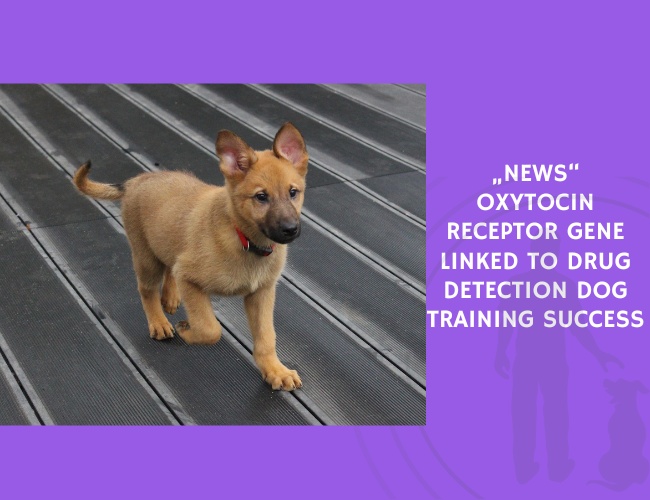
Published in the Journal of Heredity, A. Konno, M. Inoue-Murayama, T. Kikusui, and colleagues investigated whether polymorphisms in the canine oxytocin receptor (OXTR) gene influence outcomes in professional drug detection dog training programs. Drug detection dogs play a critical role in human society by locating prohibited substances, yet not all dogs complete training successfully.
The study analyzed 340 Labrador Retriever dogs trained in Japan for drug detection work. Researchers genotyped an exonic single nucleotide polymorphism (SNP), rs8679682, within the OXTR gene and compared training success rates across different genotypes. Dogs carrying the C allele (T/C and C/C genotypes) showed a significantly higher likelihood of successfully completing training compared with dogs carrying the T/T genotype.
In addition to genetic analysis, professional trainers provided subjective personality assessments for each dog. Scores related to Training Focus were positively associated with training success, indicating that behavioral traits linked to sustained attention and engagement are critical for detection work.
The findings support the hypothesis that the oxytocin system contributes to dog–human co-evolution and plays a role in shaping responsiveness to human-guided training. Although the precise molecular mechanisms of OXTR signaling in canine behavior remain unclear, the results suggest that OXTR gene variants regulate individual differences in learning and performance.
The authors conclude that integrating genetic information with behavioral assessment may improve selection and training strategies for working dogs. Such insights have the potential to enhance efficiency, welfare, and success rates in professional detection dog programs while deepening understanding of the biological foundations of canine social behavior.
Konno, A., Inoue-Murayama, M., Kikusui, T., et al. (2018). Effect of Canine Oxytocin Receptor Gene Polymorphism on the Successful Training of Drug Detection Dogs. Journal of Heredity, published June 27, 2018. https://doi.org/10.1093/jhered/esy020










