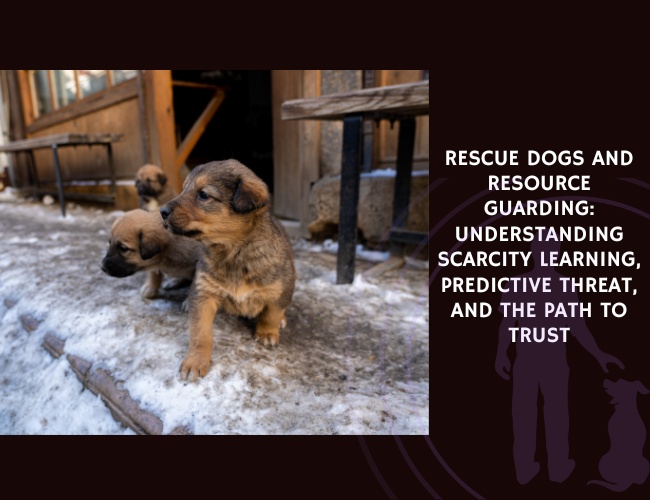
When you welcome a rescue dog into your home, you might notice something unexpected. Your gentle companion transforms the moment you approach their food bowl. Their body stiffens, their eyes harden, and a low rumble emerges from deep within their chest. This isn’t defiance or dominance—it’s a window into their past, a protective response born from experiences you may never fully know.
Resource guarding in rescue dogs represents one of the most misunderstood behaviors in canine rehabilitation. While traditional perspectives frame this as a “problem to fix,” the reality reveals something far more nuanced: your dog is communicating unmet security needs rooted in historical instability. Understanding the science behind this behavior transforms how we approach it, shifting from confrontation to compassion, from suppression to genuine resolution.
Let us guide you through the complex interplay of memory, prediction, and emotional security that shapes resource guarding in rescue dogs. Through this understanding, you’ll discover how to rebuild trust and help your furry friend finally feel safe.
The Economics of Scarcity: How Past Deprivation Shapes Present Behavior
Did you know that the pattern of resource access matters more than the total amount your dog received? Research on scarcity and behavioral economics reveals a surprising truth: intermittent deprivation creates more intense defensive responses than chronic, predictable lack.
When Uncertainty Inflates Value
Your rescue dog doesn’t simply guard food—they guard the security that food represents. Studies examining healthcare access barriers demonstrate how inconsistent resource availability fundamentally alters value perception. When resources have been historically unreliable, their perceived worth inflates disproportionately to their objective value.
Imagine experiencing hunger unpredictably throughout your life. Sometimes meals appeared regularly, other times days passed with nothing. This creates a cognitive framework where every resource becomes potentially precious because you cannot predict when the next opportunity will arrive. Your dog’s brain has learned a painful equation: scarcity equals threat.
This scarcity learning manifests in behaviors you might observe:
- Rapid resource consumption: Your dog eats frantically, as if the food might vanish at any moment. They’re not being greedy—they’re responding to learned uncertainty about future access.
- Generalized guarding: A dog who experienced food insecurity often extends protective behavior to toys, beds, spaces, and even human attention. The underlying lesson transcends specific resources: “If I lost food, I could lose anything valuable.”
- Hypervigilance around resources: You might notice your dog’s entire body language shifts when resources appear. Their alertness reflects constant threat monitoring, a survival mechanism honed through unpredictable past experiences.
- Defensive posturing: Stiff body language, whale eye (showing whites of eyes), and positioning between you and the resource signal protective readiness.
- Resource hoarding: Collecting multiple items in one location, creating a “treasure pile” that must be defended simultaneously.
The Intermittent Scarcity Paradox
Here’s where rescue dog behavior becomes particularly complex. Dogs from consistently deprived backgrounds sometimes show less guarding intensity than those from unpredictable environments. Why? Chronic deprivation can lead to learned helplessness—a reduced expectation that defensive behavior will secure resources. Conversely, intermittent availability creates hypervigilance and aggressive defense because the dog learned that sometimes protection works, sometimes it doesn’t, requiring constant vigilance.
Consider these patterns:
- Consistent deprivation response: Dogs experiencing persistent hunger or lack may display resignation rather than guarding. They’ve learned that defensive energy yields no results, so they conserve their efforts.
- Unpredictable environment response: Dogs from intermittent availability situations show more intense guarding because their experience taught them that vigilance sometimes succeeds. This intermittent reinforcement creates the strongest behavioral patterns.
- Multiple home transitions: Dogs who moved between shelters, foster homes, or living situations learned that stability is an illusion, intensifying their need to control whatever resources they currently possess.
- Competition history: Dogs who had to compete with other animals for resources develop hair-trigger defensive responses that persist long after competition ends.
- Forced sharing experiences: Dogs who were punished for protecting resources but never taught cooperative alternatives often develop more covert, dangerous guarding patterns.
The environmental instability your rescue dog experienced matters profoundly. A dog who moved between multiple homes, shelters, or situations learned that nothing remains stable. This creates a defensive framework extending far beyond simple resource protection. 🧠
Scarcity Generalization Across Domains
Your dog’s brain doesn’t compartmentalize scarcity experiences neatly. Research on food insecurity demonstrates how deprivation in one domain creates systemic stress responses affecting behavior across multiple contexts. This explains why a dog with food insecurity history might also guard seemingly unrelated resources.
The generalization pattern typically follows this progression:
Primary scarcity in food → Secondary guarding of toys, beds, spatial territory, and human attention
Social isolation history → Protective behavior around people, proximity seeking, and contact guarding
Environmental instability → Defensive responses to resting places, routine disruptions, and transitional moments
Your dog’s brain has constructed a protective framework: if valuable resources disappeared before, any valuable resource could disappear again. This isn’t irrational—it’s a learned survival strategy based on lived experience.
Predictive Threat Assessment: Your Dog’s Internal Early Warning System
Your rescue dog doesn’t simply react to current events—they’ve built a sophisticated predictive model of human behavior. This cognitive processing represents one of the most fascinating aspects of resource guarding: anticipatory defense.
Reading the Patterns: How Dogs Predict Human Intentions
Through the NeuroBond approach, we understand that dogs constantly process environmental patterns, building probabilistic models of what human actions predict. Your dog has learned to read you with remarkable accuracy, often triggering defensive behavior before you consciously intend any resource removal.
Consider what your dog might have learned:
- Human approaches food bowl → 80% probability of removal based on past experience
- Human reaches toward toy → 60% probability of confiscation
- Human enters resting space → 40% probability of displacement
- Human picks up leash near bed → 70% probability of forced movement
- Human calls name while dog has resource → 55% probability of command to release
- Multiple humans approach simultaneously → 90% probability of overwhelming intervention
These aren’t conscious calculations but learned associations encoded through repeated experiences. Your dog’s defensive response triggers not when you actually take something, but when your behavior matches patterns that previously predicted loss.
This anticipatory defense creates a challenging dynamic. You might approach your dog’s bowl simply to add more food, but if their predictive model associates your approach with removal, defensive behavior activates before your helpful intention becomes clear. The dog responds to predicted probability, not actual current threat.
The Subtle Signals Dogs Track
You might wonder what specific cues trigger your dog’s threat prediction system. Studies on environmental pattern recognition reveal that dogs track incredibly subtle human signals:
- Direct eye contact combined with approach often signals impending interaction with guarded resources. Your dog notices when your gaze fixes on their possession.
- Body language tension or hesitation communicates uncertainty or conflict, which dogs interpret as threat potential. If you’re nervous about approaching, your dog reads that anxiety.
- Reaching hand movements trigger defensive responses because hands historically removed resources. Even helpful reaching can activate this learned association.
- Verbal cues previously paired with resource removal carry predictive weight. If “drop it” or “leave it” preceded forced removal in your dog’s past, those words alone can trigger guarding.
- Spatial positioning matters profoundly. Standing over your dog, blocking exit routes, or moving into their personal space activates defensive protocols.
- Change in breathing pattern as you approach indicates emotional state changes that dogs perceive as threat-relevant.
- Footstep speed and rhythm communicate intention. Quick, purposeful steps predict intervention more than slow, casual movement.
- Presence of other people or animals during your approach multiplies perceived threat intensity through audience effects.
The critical insight here: your dog often guards against anticipated loss rather than actual removal attempts. Your predictive signal pattern matters more than your conscious intention. This explains why well-meaning approaches sometimes trigger intense defensive responses—you accidentally activated threat prediction pathways through innocent behaviors.
Learning History: How Human Interference Shaped the Behavior
The most painful aspect of rescue dog resource guarding isn’t the behavior itself—it’s recognizing how human actions often created or intensified it. Let’s explore how well-intentioned but misguided interventions can inadvertently train escalation.
The Escalation Training Trap
Research on behavioral modification demonstrates that suppressing early warning signals accelerates aggressive escalation. When your dog’s subtle defensive communications fail to prevent perceived threats, they rapidly learn to bypass those signals and move directly to more intense responses.
The escalation ladder typically progresses through these stages:
Stage 1: Freezing and stiffening — Your dog’s body becomes still, muscles tense. This represents their first communication: “I’m concerned about what’s happening.” If humans ignore this signal and continue approaching, the dog learns subtle warnings don’t work.
Stage 2: Lip curl and low growl — The warning intensifies. This is still communication, not aggression. However, if this behavior is punished or ignored, the dog learns they must escalate further to be heard.
Stage 3: Snap or air bite — Now genuinely defensive behavior emerges. If this finally causes human retreat, the dog learns a devastating lesson: only aggressive responses prevent loss.
Stage 4: Contact bite — The endpoint of suppressed communication. The dog learned that nothing less than actual biting achieves their goal of resource protection.
Many rescue protocols inadvertently train this escalation by “testing” dogs—deliberately approaching guarded resources to assess defensive intensity. Each test that ignores early warnings teaches the dog that only extreme responses work. You can see how this creates a dangerous cycle where initially mild guarding behaviors intensify into serious aggression not because the dog is “bad,” but because subtle communication proved ineffective. 😄
The Inconsistency Problem
Perhaps nothing creates more anxiety and defensive behavior than inconsistent human responses. Research on resource allocation patterns shows that unpredictable intervention creates higher stress than consistent—even consistently negative—patterns.
Consider what your rescue dog might have experienced:
- Meal timing unpredictability: Sometimes fed at 7am, sometimes noon, sometimes not at all that day
- Conditional resource access: Allowed to keep toys on good behavior days, forcibly removed as punishment on others
- Handler-dependent responses: One family member tolerates guarding, another punishes it severely
- Mood-based interventions: Resources removed when human is stressed, ignored when human is relaxed
- Inconsistent exchange protocols: Sometimes rewarded for releasing, other times items simply taken without acknowledgment
- Variable safe space respect: Sometimes allowed undisturbed rest, other times displaced without warning
- Situational rule changes: Guarding tolerated at home but punished in public settings
This inconsistency prevents your dog from developing a reliable predictive model. Unable to anticipate outcomes, they maintain chronic hypervigilance and defensive readiness. The stress of unpredictability often exceeds the stress of reliably negative experiences because at least negative consistency allows adaptation.
Your dog’s past might include multiple caretakers with different approaches, shelter environments with varying protocols, or previous owners who responded inconsistently based on mood or circumstances. Each variation reinforced that humans cannot be predicted, that resource security depends entirely on constant defensive readiness.
Resource Categories: Not All Guarded Items Are Equal
Understanding what your dog guards—and why—provides crucial insight into their scarcity history and security needs. Resources carry different defensive values based on historical patterns and emotional associations.
The Guarding Hierarchy
Research on food environments and resource access reveals that different resource types activate varying defensive intensities. Your dog’s guarding hierarchy might look something like this:
High-value food items typically trigger the most intense guarding:
- Bones and raw meaty items: Require extended consumption time, activating prolonged defensive vigilance
- Novel protein sources: New flavors or textures carry inflated value due to uncertainty about future availability
- Stolen or found food: Items acquired outside normal feeding routines often trigger more intense guarding
- Human food items: Carry special value due to scarcity and association with human consumption
- Long-lasting chews: Bully sticks, rawhides, or dental chews that provide extended engagement
- Frozen treats or food puzzles: Items requiring time investment to access increase protective intensity
Resting spaces often rank surprisingly high in the guarding hierarchy:
- Elevated surfaces: Couches, beds, chairs provide visibility and perceived safety advantage
- Enclosed areas: Crates, under furniture, corners offer protection from multiple approach angles
- High-traffic boundaries: Doorways or hallways where dogs can monitor household movement
- Temperature-controlled spots: Cool tiles in summer, sunny patches in winter carry comfort value
- Scent-saturated locations: Areas where the dog’s scent is strongest feel like secure territory
- Socially significant spaces: Near primary attachment figures or in central household locations
Human proximity and attention can become guarded resources, particularly for dogs with social isolation history. Your lap, your attention during stress, or exclusive access to you might trigger defensive behavior toward other pets or people. This isn’t possessiveness—it’s learned scarcity around social connection.
Toys and interactive objects carry value partly based on their association with play and human interaction. Novel items often trigger guarding because uncertainty inflates perceived value. Your dog can’t predict how long this new resource will be available, so defensive protocols activate.
Spatial transitions and territory boundaries might seem like unusual guarding targets, but dogs who experienced frequent displacement or unstable living situations often protect doorways, thresholds, vehicle access, and territory boundaries. These represent control over their environment, something they previously lacked.
You might notice your dog guards intensely in some categories while remaining relaxed in others. This pattern directly reflects their individual scarcity history and what resources were most unreliable in their past. 🧡
Environmental Predictability’s Profound Impact
Studies examining environmental stability and resource access demonstrate that predictability significantly reduces defensive behavior. Your dog’s current environment either intensifies or reduces guarding based on consistency factors:
High predictability environments (lower guarding risk):
- Consistent feeding schedules: Same times daily with reliable portion sizes
- Designated safe spaces: Specific locations that remain undisturbed and respected
- Reliable daily routines: Predictable patterns for walks, meals, play, and rest periods
- Clear communication: Consistent verbal cues and body language from all household members
- Stable household composition: Same familiar people and animals without frequent changes
- Predictable guest protocols: Visitors managed consistently with advance notice
- Routine environmental sounds: Familiar background noise patterns without sudden disruptions
Low predictability environments (higher guarding risk):
- Irregular meal timing: Frequent schedule changes or missed feeding times
- Frequent displacement: Being moved from resting areas without consistent reason
- Chaotic household dynamics: Unpredictable activity levels, loud arguments, or frequent disruptions
- Ambiguous human signals: Different family members using conflicting commands or approaches
- Changing household members: Frequent visitors, temporary residents, or pets coming and going
- Inconsistent space access: Sometimes allowed on furniture, sometimes not, without clear patterns
- Unpredictable environmental stressors: Construction, renovations, or irregular loud noise events
Creating environmental predictability represents one of the most powerful interventions you can implement immediately. When your dog learns that resources arrive reliably, that safe spaces remain undisturbed, and that humans behave consistently, the defensive motivation underlying guarding diminishes organically.
Protective. Learned. Resolving.
Scarcity Shapes Defense Resource guarding emerges when past unpredictability teaches the nervous system that access is uncertain making protection a rational survival response rather than defiance.
Prediction Drives Tension Intermittent availability inflates perceived value activating hypervigilance body stiffening and defensive positioning whenever resources appear.
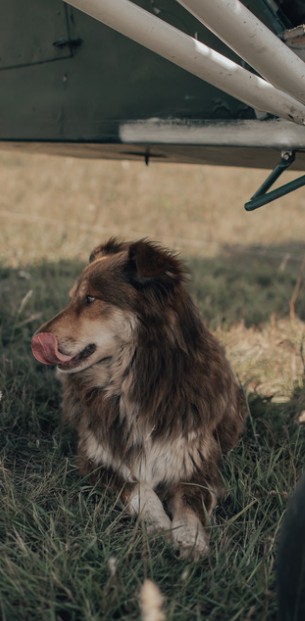

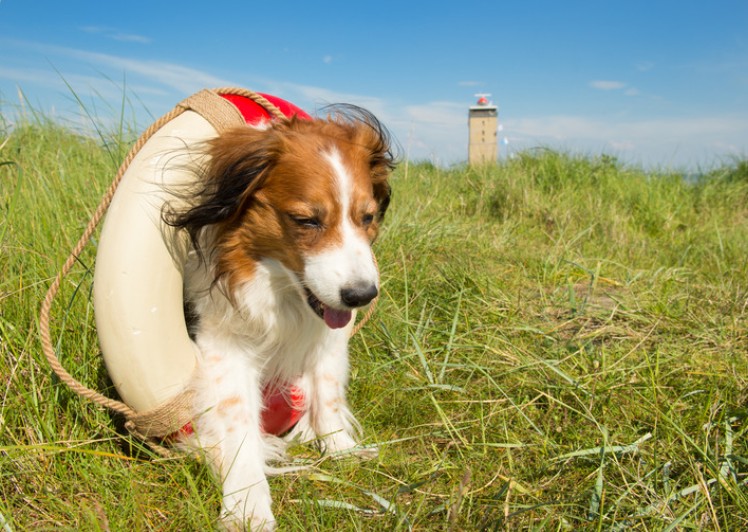
Security Dissolves Guarding Through consistent access calm presence and NeuroBond aligned trust building the need for defense fades allowing safety cooperation and relaxed sharing to develop.
Emotional State and Stress: The Hidden Multiplier
Your dog’s emotional state profoundly influences when and how intensely guarding behavior manifests. Understanding the role of cumulative stress and arousal reveals why the same situation might trigger guarding one day but not another.
The Stress Accumulation Effect
Research on stress responses and behavioral thresholds demonstrates that cumulative stress progressively lowers defensive triggers. Think of your dog’s guarding threshold as a bucket—each stressor adds water, and when it overflows, defensive behavior activates even for minor triggers.
Here’s how stress accumulation might unfold in your dog’s day:
- Morning disruption: Sleep interrupted by loud noises or early household activity (threshold reduced by 2 units)
- Breakfast anxiety: Food delivered late or in unfamiliar location (threshold reduced by 1 unit)
- Midday social stress: Unexpected visitor arrives or household argument occurs (threshold reduced by 2 units)
- Afternoon environmental stress: Construction noise, thunderstorm, or delivery person at door (threshold reduced by 1 unit)
- Exercise deficit: Missed walk creates pent-up energy and frustration (threshold reduced by 1 unit)
- Evening approach: You approach their food bowl, normally 3 units of perceived threat
In a calm state with a baseline threshold of 10 units, approaching the food bowl wouldn’t trigger guarding. But after accumulated daily stressors reduced the threshold to just 3 units, that same 3-unit approach now meets the defensive activation threshold, triggering guarding behavior.
This explains why your dog might tolerate certain situations on calm days but react defensively on stressful days. The approach didn’t change—their capacity to cope with perceived threat diminished through cumulative stress.
🐕 The Journey from Scarcity to Security 🧡
Understanding and Resolving Resource Guarding in Rescue Dogs Through Trust-Based Rehabilitation
Phase 1: Recognition & Understanding
Weeks 1-2: Identifying the Pattern
What Resource Guarding Really Means
Resource guarding isn’t dominance—it’s a rational defensive response to learned scarcity. Your rescue dog’s brain has constructed a protective framework based on historical instability where resources were unreliable or unpredictable.
Observable Behavioral Markers
• Body stiffening when you approach resources
• Rapid consumption or hiding items
• Hard stares, whale eye, or freezing
• Growling, lip curling, or defensive posturing
• Guarding multiple resource categories (food, space, toys, attention)
The Scarcity Learning Pattern
Dogs from unpredictable environments show more intense guarding than those from consistently deprived backgrounds. Intermittent scarcity creates hypervigilance because sometimes protection worked, sometimes it didn’t—creating the strongest behavioral patterns through intermittent reinforcement.
Phase 2: Environmental Stabilization
Weeks 1-4: Creating Predictable Security
Establish Resource Abundance
• Multiple food bowls in different locations
• Numerous toys rotated regularly
• Several comfortable resting spaces
• Feed dogs separately to eliminate competition
• Ensure resources exceed needs significantly
Build Predictable Routines
Consistent feeding times, regular walk schedules, and predictable daily patterns teach your dog that resources arrive reliably. This consistency directly addresses the scarcity perception underlying defensive behavior.
Critical: What NOT to Do
Never “test” your dog by deliberately approaching guarded resources. Never use alpha rolls, forced submission, or punishment. These approaches confirm threat predictions and train escalation rather than resolution.
Phase 3: Threshold Mapping & Distance Respect
Weeks 2-4: Learning Your Dog’s Boundaries
Identifying the Safe Distance
Your dog has a “safe distance”—the proximity at which they remain relaxed when you’re near guarded resources. This might be 10 feet, 6 feet, or 3 feet. Observe soft body language, loose tail, and willingness to look away from the resource as indicators.
Signs You’re Below Threshold (Safe Zone)
• Soft, relaxed body language
• Loose, waggy tail
• Normal breathing patterns
• Can look away from resource
• Responds to your voice
• Accepts treats or shows interest in you
Signs You’ve Crossed Threshold (Danger Zone)
• Body stiffening or freezing
• Hard stare with dilated pupils
• Accelerated consumption
• Lip curling or growling
• Whale eye (showing whites)
• Crouching over resource protectively
Phase 4: Predictable Non-Interference
Weeks 2-6: Building the Foundation
The Non-Interference Protocol
• Walk past resources at safe distance following consistent routes
• Use curved paths rather than direct approaches
• Toss treats at distance without entering defensive space
• Exit before your dog shows any tension
• Maintain predictable movement patterns
• Never remove resources during this phase
What Your Dog Is Learning
Through the NeuroBond approach, your dog begins rebuilding their predictive model. Your presence near resources no longer predicts loss. This phase establishes environmental predictability—the foundation for everything that follows.
Expected Progress Markers
After 2-4 weeks, you should observe reduced body tension when you’re near, occasional glances toward you rather than fixed stares, and gradual tolerance of closer proximity. Progress may be subtle but foundational.
Phase 5: Positive Association Development
Weeks 4-12: Transforming Threat Into Opportunity
The Addition Protocol
• Approach only to safe distance
• Toss higher-value treat near your dog
• Immediately retreat
• Repeat consistently: approach = addition, not removal
• Gradually reduce distance over weeks as body language stays relaxed
Trade-Up Exchange Training
Offer something genuinely better in exchange for what your dog has. Wait for voluntary release—never grab. Immediately provide the high-value reward. Sometimes return the original item to teach that release doesn’t always mean permanent loss.
The Cognitive Transformation
Your dog’s predictive model is transforming: “Human approach = resource increase.” This represents a fundamental shift from defensive protection to cooperative anticipation. The Invisible Leash reminds us that awareness, not tension, guides this transformation.
Phase 6: Cooperative Exchange & Trust Consolidation
Months 3-6: Partnership Emerges
Signs of Genuine Cooperation
• Dog brings items to you voluntarily
• Relaxed, immediate release with soft body language
• Chooses to consume resources near you
• Initiates play with resources
• Pauses eating to interact with you
• Seeks continued interaction after exchanges
Trust as Predictive Reliability
Through Soul Recall, we understand how these positive emotional memories intertwine with behavior. Your dog has rebuilt their social contract with humans, transforming from defensive protection to collaborative partnership based on accumulated trustworthy experiences.
Generalization & Maintenance
Systematically introduce new contexts, various resource types, and different family members. Maintain consistent protocols to preserve trust. Some guarding may persist with highest-value items—this is normal and represents realistic success.
Phase 7: Ongoing Stress Management
Continuous: Maintaining Low Arousal
Understanding Stress Accumulation
Cumulative daily stressors progressively lower your dog’s defensive threshold. Sleep disruption, unexpected visitors, loud noises, missed walks—each reduces the stimulus intensity required to trigger guarding. Monitor and minimize these stressors actively.
Stress Reduction Strategies
• Create quiet spaces during chaotic household times
• Maintain consistent exercise routines
• Provide adequate rest and recovery
• Minimize environmental disruptions
• Manage visitor interactions predictably
• Recognize arousal states and adjust training accordingly
When to Pause Training
If your dog shows high arousal (rigid muscles, rapid breathing, fixed stare, unresponsiveness to cues), stop all training. Behavior modification happens in calm states, not defensive states. De-escalation must precede learning.
Phase 8: Long-Term Success & Realistic Expectations
Months 6-12+: Celebrating Progress
Success Markers to Celebrate
• Restored warning signals (growling before biting)
• Context-specific rather than generalized guarding
• Reduced intensity (growling vs. biting)
• Faster recovery from defensive episodes
• Voluntary sharing in many contexts
• Increased trust signals and proximity seeking
Realistic Expectations
Complete elimination of all guarding behavior represents an unrealistic goal for many rescue dogs with significant scarcity history. Some guarding of highest-value items may persist—this is normal and acceptable when communication remains clear and intensity has reduced.
Maintenance Protocols
Continue occasional trade-up exchanges, maintain environmental predictability, respect communication signals, monitor stress accumulation, and ensure household consistency. These practices preserve the trust you’ve worked so patiently to build.
🔄 Guarding Intensity by Background Type
Chronic Food Deprivation
Intensity: Moderate to Low
Pattern: May show resignation more than active guarding
Focus: Primarily food-related
Recovery: Faster with consistent provision
Intermittent Scarcity
Intensity: High to Extreme
Pattern: Hypervigilant, aggressive defense
Focus: Generalizes across resources
Recovery: Slower, requires extended trust-building
Social Isolation History
Intensity: Moderate
Pattern: Guards attention and proximity
Focus: Human contact, social resources
Recovery: Responds well to relationship-building
Multiple Home Transitions
Intensity: High
Pattern: Environmental instability focus
Focus: Resting spaces, territory boundaries
Recovery: Needs extended environmental stability
Competition-Based History
Intensity: High
Pattern: Hair-trigger responses
Focus: High-value items, feeding situations
Recovery: Requires complete competition elimination
Punishment-Based Training
Intensity: Extreme
Pattern: Silent guarding (no warnings)
Focus: Unpredictable, context-dependent
Recovery: Most challenging, may need professional help
⚡ Quick Reference: Timeline Expectations
Weeks 1-4: Environmental management & foundation (minimal visible change—this is normal)
Weeks 4-12: Trust building & positive associations (gradual relaxation observable)
Months 3-6: Cooperative exchange emerges (significant intensity reduction)
Months 6-12: Maintenance & generalization (stable, predictable responses)
Key Formula: Patience × Consistency × Predictability = Trust × Time
🧡 The Zoeta Dogsoul Perspective
Resource guarding represents your rescue dog’s rational response to learned scarcity—a protective mechanism rooted in historical instability. Through the NeuroBond approach, we recognize that trust becomes the foundation of behavioral transformation. The Invisible Leash teaches us that awareness, not force, guides the path from defensive protection to cooperative partnership. As Soul Recall reveals, positive emotional memories gradually replace threat predictions, allowing your dog to finally experience genuine security. This journey requires patience, but every consistent interaction rebuilds the social contract that defensive behavior was attempting to protect. When we understand guarding as communication of unmet needs rather than dominance, we create space for authentic healing—where scarcity transforms into abundance, threat becomes trust, and defensive vigilance gives way to peaceful cooperation.
© Zoeta Dogsoul – Where neuroscience meets soul in dog training
Arousal States and Decision-Making Capacity
Studies on physiological arousal and cognitive function reveal that elevated arousal states impair fine motor control, signal discrimination, and decision-making capacity. This has profound implications for resource guarding:
Low arousal states: Your dog can evaluate threat levels, choose proportional responses, distinguish subtle differences in your intention, and accept reassurance. Learning and behavior modification are possible. Signs include:
- Soft, loose body language
- Normal breathing rhythm
- Ability to look away from resource
- Response to verbal cues
- Interest in treats or toys beyond guarded item
High arousal states: Your dog shifts to binary response patterns (freeze or fight), reduced ability to discriminate between safe and threatening signals, and impaired learning capacity. Training during these states proves ineffective or counterproductive. Signs include:
- Rigid muscle tension
- Rapid, shallow breathing or panting
- Fixed stare on resource or threat
- Unresponsive to familiar cues
- Inability to accept food or treats
Chronic elevated arousal: Persistent hypervigilance becomes your dog’s baseline, creating generalized defensive responses, exhaustion, and inability to relax even in objectively safe situations. Indicators include:
- Difficulty settling or resting
- Hyperreactive startle responses
- Generalized anxiety across contexts
- Sleep disturbances or restless sleep
- Digestive issues from prolonged stress
The Invisible Leash reminds us that awareness, not tension, guides the path forward. Attempting behavior modification during high arousal states is like trying to teach calculus to someone in the middle of a panic attack—the physiological state prevents learning. De-escalation must precede training.
This understanding transforms intervention approaches. Rather than persisting with training when your dog shows arousal signs, you learn to recognize these states and prioritize calming before attempting any resource-related work.
Social Contracts and Trust: The Foundation of Behavioral Change
Perhaps the most powerful insight into resource guarding emerges from understanding trust as predictive reliability. Your dog’s defensive behavior reflects disrupted social contracts—learned expectations that humans threaten rather than protect resource security.
Trust Building Through Predictable Positive Patterns
Research on integrated care systems demonstrates that trust emerges from consistent, predictable, positive interactions repeated over time. Your rescue dog needs to rebuild their predictive model of human behavior, replacing threat associations with security expectations.
The trust-building framework follows this progression:
Phase 1: Predictable Non-Interference (2-4 weeks)
During this foundation phase, you establish new patterns without requiring any change in your dog’s behavior:
- Establish safe distances: Identify and respect the proximity threshold where your dog remains relaxed
- Predictable movement patterns: Walk past resources following consistent routes at regular times
- Non-threatening body language: Avoid direct approaches, use curves rather than straight lines toward resources
- Toss treats at distance: Deliver high-value rewards without entering your dog’s defensive space
- Quiet observation: Notice and mentally note your dog’s relaxation signals without demanding interaction
- Exit predictably: Leave the area before your dog shows any tension, teaching that your presence is temporary
- Consistency across household members: Ensure everyone follows identical protocols to prevent confusion
This phase rebuilds basic environmental predictability. Your dog begins learning that your proximity doesn’t predict loss. They can relax slightly when you’re near because your behavior has become reliably non-threatening. Patience during this phase establishes the foundation for everything that follows.
Phase 2: Positive Association (4-8 weeks)
Now you actively build positive predictions through systematic training:
- Approach-and-add protocol: Walk toward resource, add something better, immediately retreat
- Trade-up exchanges: Offer higher-value items in return for lower-value possessions
- Hand-feeding near resources: Deliver meals by hand in areas where guarding previously occurred
- Proximity rewards: Drop treats closer to your dog as they maintain relaxed body language
- Resource multiplication: Add second food bowls, toys, or resting spots while dog uses the first
- Positive prediction patterns: Ensure your approach predicts value addition at least 90% of interactions
- Voluntary release rewards: Immediately and generously reward any spontaneous offering or dropping of items
Through this phase, your dog’s predictive model transforms: “Human approach = resource increase, not decrease.” This represents a fundamental cognitive shift from defensive protection to cooperative anticipation. The dog who once stiffened at your approach begins showing interest or even excitement because they’ve learned you bring value rather than threat.
Phase 3: Cooperative Exchange (ongoing)
Eventually, cooperation emerges organically through these indicators:
- Voluntary resource sharing: Your dog brings items to you without prompting or anxiety
- Relaxed release behavior: Dropping or releasing happens with loose body language and soft eyes
- Proximity seeking during resource use: Your dog chooses to consume resources near you rather than hiding
- Play invitation with resources: Initiating tug or fetch games, demonstrating trust in shared engagement
- Calm acceptance of approach: No stiffening, staring, or defensive signals when you move near resources
- Return expectations: Your dog anticipates receiving items back after temporary exchanges
- Generalized cooperation: Trust extends across multiple resource types and household contexts
This phase reveals that trust has consolidated. Through the Soul Recall concept, we understand how these positive emotional memories intertwine with behavior, creating new response patterns rooted in security rather than scarcity. Your dog has rebuilt their social contract with humans, transforming from defensive protection to collaborative partnership. 🧡
Recognizing Trust Development Markers
You might wonder how to assess whether your trust-building efforts are working. Behavioral markers reveal your dog’s internal state:
Guarding behaviors (low trust) include stiff body posture, hard staring, growling or snapping, accelerated resource consumption, spatial blocking to prevent approach, and avoidance after interactions.
Tolerance behaviors (moderate trust) show soft eyes, loose body language, brief freezing followed by release, normal eating pace, allowing your approach within certain distances, and neutral behavior after interactions.
Cooperation behaviors (high trust) demonstrate relaxed postures or play bows, immediate voluntary release, pausing eating to interact with you, inviting your proximity, and actively seeking continued interaction after resource exchanges.
These markers help you gauge progress and adjust your approach accordingly. If your dog remains in guarding mode despite weeks of effort, you might need to increase distance, improve environmental predictability, or address underlying stress factors preventing trust development.
Common Interpretation Errors and Training Mistakes
Understanding what resource guarding isn’t helps prevent interventions that intensify rather than resolve the behavior. Let’s examine the most common misinterpretations and their consequences.
The Dominance Myth
Perhaps no misunderstanding causes more harm than interpreting resource guarding as dominance. The common belief that “the dog is trying to dominate me by guarding resources” fundamentally misrepresents the behavior’s nature and motivation.
Evidence-based reality reveals that resource guarding reflects defensive behavior driven by learned scarcity and threat prediction, not social hierarchy assertion. Your dog isn’t attempting to establish dominance—they’re protecting perceived scarce resources based on historical instability.
Dominance-based approaches create devastating outcomes:
- Alpha rolls and forced submission: Escalate fear and defensive behavior by confirming the dog’s threat predictions—you become the very threat they feared
- “Show them who’s boss” confrontations: Teach the dog that humans are indeed dangerous around resources, intensifying rather than reducing guarding
- Punishment for guarding behavior: Suppresses communication without addressing underlying security concerns, often leading to “silent guarding” where dogs skip warnings
- Forced removal exercises: Train dogs that humans will take resources regardless of signals, eliminating warning behaviors and increasing bite risk
- Physical corrections: Create fear-based compliance that increases overall anxiety and stress-related behavioral problems
- Intimidation tactics: Damage trust fundamentally, making all future training efforts more difficult as the dog becomes defensive across contexts
These approaches don’t resolve resource guarding—they create dogs who either escalate to more dangerous aggression or learn to hide their defensive responses until forced to their absolute breaking point. The behavior you suppress doesn’t disappear; it goes underground, emerging later with more intensity or in more dangerous forms.
Forced Removal and Its Consequences
Another common error involves deliberately testing or challenging your dog’s guarding behavior. Some training protocols recommend regular “resource exchanges” where you take items to establish “leadership.” This approach fundamentally misunderstands canine learning.
When you repeatedly approach and remove guarded resources:
- Threat prediction confirmed: Your dog’s model that “human approach = resource loss” is validated repeatedly
- Defensive intensity escalation: The dog learns that only strong guarding prevents removal, so behavior intensifies
- Trust erosion: Your behavior proves unpredictable or threatening, damaging the foundation needed for cooperative training
- Scarcity mindset reinforcement: The underlying perception of resource unreliability intensifies rather than diminishes
- Warning signal suppression: Early communication attempts prove ineffective, so dogs skip straight to more intense responses
- Generalization to new contexts: Guarding spreads to previously non-guarded resources as overall insecurity increases
- Relationship damage: The human-dog bond suffers as your presence becomes associated with loss rather than security
Forced removal protocols essentially train the very behavior they claim to address. Each successful “test” where you take a resource teaches your dog that vigilance and aggression are necessary for resource protection. 😄
The Speed Trap
Many guardians become frustrated with the slow pace of trust-building protocols. Why can’t we just teach the dog to “drop it” and move on? This urgency ignores the deep emotional and cognitive patterns underlying guarding behavior.
Resource guarding doesn’t represent a simple skills deficit—it reflects learned emotional responses encoded through repeated experiences. Attempting rapid behavior change through obedience commands addresses symptoms while ignoring causes.
Effective intervention requires patience aligned with your dog’s emotional processing capacity. Trust builds through accumulated positive experiences, not through forced compliance. Rushing this process often backfires, creating additional stress that intensifies guarding behavior.
Evidence-Based Management: Practical Approaches That Actually Work
Understanding the science behind resource guarding equips you to implement interventions addressing root causes rather than merely suppressing symptoms. Let’s explore proven approaches that resolve defensive behavior through trust restoration.
Environmental Management: Your First Priority
Before attempting any direct behavioral training, optimize your dog’s environment to reduce guarding triggers and stress accumulation:
- Provide resource abundance: Multiple food bowls in different locations, numerous toys rotated regularly, several comfortable resting spaces
- Eliminate competition situations: Feed dogs separately, provide individual play sessions, ensure each animal has private space
- Establish feeding routines: Same times daily with consistent portions and locations
- Create undisturbed safe zones: Designate specific areas where your dog will never be displaced or interrupted
- Implement predictable schedules: Regular patterns for walks, meals, play, training, and rest periods
- Reduce environmental stressors: Minimize loud noises, create quiet spaces during chaotic times, manage visitor interactions
- Respect early warning signals: Honor your dog’s communication by backing away when they show initial tension
- Stabilize household dynamics: Consistent rules across all family members, predictable daily routines, minimal disruptions
These environmental modifications often reduce guarding intensity substantially before you implement any direct training. By addressing underlying insecurity, you remove much of the defensive motivation.
The Addition Protocol: Transforming Threat Into Opportunity
This simple but powerful approach reverses your dog’s learned associations about human proximity to resources:
Step 1: Identify your dog’s “safe distance”—the proximity at which they remain relaxed when you’re near guarded resources. This might be 10 feet, 6 feet, or 3 feet depending on their trust level.
Step 2: When your dog has a resource, approach only to their safe distance. Before any tension appears, toss a higher-value treat near them and immediately retreat.
Step 3: Repeat this pattern consistently. Your approach predicts resource addition (the treat), not removal. Your retreat communicates you’re not a threat.
Step 4: Gradually reduce distance over weeks as your dog’s body language remains relaxed. If tension reappears, you’ve moved too fast—increase distance again.
Through this protocol, your dog’s predictive model transforms: “Human approach = resource increase.” Defensive motivation dissolves because you’ve addressed the underlying scarcity perception. 🧠
The Trade-Up Exchange: Cooperative Resource Sharing
Once your dog tolerates your proximity without defensive tension, you can introduce cooperative exchanges:
Principle: Never take without offering something better. Every resource “trade” results in net gain for your dog.
Implementation:
- Your dog has a medium-value toy
- You offer a high-value treat in exchange
- Wait for voluntary release (don’t grab)
- Immediately provide the treat
- Return the original toy
This teaches your dog that releasing resources to you creates opportunities rather than losses. Voluntary release becomes associated with positive outcomes, not defensive necessity.
Common mistakes to avoid:
- Grabbing before release: Don’t reach for the item before your dog voluntarily releases—this recreates the forced removal dynamic you’re trying to reverse
- Failing to return items: Sometimes return lower-value items after the exchange so your dog learns release doesn’t always mean permanent loss
- Using trade-up only for permanent removal: Don’t create a bait-and-switch dynamic where trades always mean the dog loses the original item
- Insufficient value difference: Ensure the offered item is genuinely more valuable to your dog, not just what you think is better
- Inconsistent application: Use the protocol every time, not just when convenient, to build reliable predictions
- Rushed progression: Don’t advance to smaller value gaps before your dog consistently and relaxedly releases for large gaps
- Negative emotions: If you feel frustrated or impatient, your body language telegraphs threat, undermining the protocol
Threshold Respect: Working Below Defensive Activation
Perhaps the most critical principle: always work below your dog’s defensive threshold. Training occurs in the relaxed state before guarding behavior activates.
Signs you’re working below threshold:
- Soft body language: Relaxed muscles, no tension in shoulders or hindquarters
- Loose, waggy tail: Natural tail carriage with gentle movement
- Willingness to look away: Dog can break eye contact with resource to check in with you
- Engagement with you: Responds to your voice, accepts treats, shows interest in interaction
- Normal breathing patterns: Steady, calm respiration without panting or holding breath
- Exploratory behavior: Sniffing, investigating environment, not fixated solely on resource
- Play signals: Offering play bows, bringing toys, initiating interaction despite resource presence
Signs you’ve crossed threshold:
- Body stiffening: Sudden muscle tension, frozen posture
- Hard stare: Fixed gaze on resource or approaching person, dilated pupils
- Tail changes: Tucking, bristling, or stiff vertical position
- Accelerated consumption: Frantically eating or using resource faster
- Lip curling or growling: Escalating warning signals
- Whale eye: Showing whites of eyes while maintaining resource focus
- Crouching over resource: Body positioned protectively around item
- Air snapping: Quick bite motions without contact as escalating warning
If you see threshold-crossing signs, you’ve pushed too far, too fast. Increase distance, reduce pressure, and rebuild trust before proceeding. That balance between science and soul—that’s the essence of Zoeta Dogsoul.
Remember: behavior modification happens in the calm state, not the defensive state. Rushing past your dog’s comfort threshold creates counterproductive stress rather than learning opportunities.
Long-Term Management and Realistic Expectations
Resource guarding rooted in scarcity learning and historical trauma requires patience and realistic timeline expectations. Understanding what success looks like helps you maintain perspective throughout the rehabilitation process.
Timeline Expectations
Weeks 1-4: Environmental management and foundation building. You might see minimal behavioral change as you establish predictability and safety. This is normal—internal emotional processing precedes visible behavior change.
Weeks 4-12: Trust building and positive association development. You should observe gradual relaxation around resources, increased tolerance of your proximity, and occasional voluntary resource sharing.
Months 3-6: Cooperative exchange consolidation and generalization. Guarding intensity diminishes significantly. Your dog shows relaxed body language during resource interactions and initiates sharing behaviors.
Months 6-12: Maintenance and stability. While complete elimination of guarding might not occur, defensive intensity should reduce to manageable levels with reliable triggers and predictable responses.
Some dogs progress faster, particularly those with less severe scarcity history or higher baseline trust. Others require extended timelines, especially dogs with complex trauma backgrounds or multiple competing behavioral concerns.
When Professional Help Is Essential
Certain guarding presentations require professional behavioral veterinarian involvement:
- Silent guarding: Dog shows no warning signals before biting, representing extreme suppression of communication and creating serious safety risks
- Severe bite history: Injuries requiring medical attention indicate defensive intensity beyond typical guardian management capacity
- Multiple bite incidents: Pattern of repeated biting across different contexts or with different people
- Extreme fear or panic responses: Suggests concurrent anxiety disorders requiring comprehensive treatment beyond guarding-specific protocols
- Aggression toward children: Any guarding directed at young household members requires immediate professional intervention
- Unstable household environments: Chaotic dynamics prevent the consistency necessary for behavioral improvement
- Owner fear or anxiety: If you’re genuinely afraid of your dog, professional guidance is essential for safety and effective treatment
- Generalized aggression: Guarding combined with aggression in other contexts indicates more complex behavioral concerns
- Medical concerns: Pain, neurological issues, or other health problems may underlie or exacerbate guarding behavior
Professional support might include medication to reduce baseline anxiety, creating windows for behavioral work. Comprehensive treatment plans addressing multiple behavioral concerns simultaneously. Intensive environmental modification guidance. Extended supervision and accountability throughout rehabilitation.
Celebrating Progress While Maintaining Safety
You might feel frustrated that your dog still guards certain high-value items even after months of work. This is normal. Complete elimination of all guarding behavior represents an unrealistic goal for many rescue dogs with significant scarcity history.
Success markers include:
- Restored warning signals: Your dog shows growling or stiffening before escalating to biting—communication has been restored rather than suppressed
- Context-specific guarding: Defensive behavior occurs only with specific high-value items rather than generalizing across all resources
- Reduced intensity: Guarding has decreased from biting to growling, or from growling to mild stiffening
- Faster recovery: Your dog returns to relaxed state quickly after defensive episodes rather than remaining hypervigilant
- Voluntary resource sharing: Cooperation occurs in many contexts, even if not universally
- Increased trust signals: More frequent soft eyes, relaxed body language, proximity seeking during non-resource times
- Threshold distance reduction: Your dog tolerates closer proximity to resources than when you started training
- Longer calm periods: Extended stretches without any guarding incidents indicate improving baseline security
- Generalization to new people: Trust extends beyond primary trainer to other household members or familiar visitors
These improvements represent genuine progress even when some guarding persists. Your dog has rebuilt partial trust, reduced overall anxiety, and developed more adaptive coping mechanisms.
Moving Forward: From Understanding to Implementation
Resource guarding in rescue dogs emerges from rational, adaptive responses to learned scarcity and unpredictable resource access. Your dog isn’t defective, dominant, or deliberately difficult—they’re communicating unmet security needs based on historical instability.
The science reveals clear patterns:
- Scarcity learning inflates resource value: Historical food or resource insecurity creates disproportionate protective responses to items’ objective worth
- Intermittent deprivation intensifies guarding: Unpredictable resource access creates more intense defensive behavior than chronic, predictable scarcity
- Predictive threat triggers defense early: Dogs respond to learned probability patterns, activating guarding before actual loss attempts occur
- Suppression-based training increases bite risk: Punishing warning signals eliminates communication without addressing underlying anxiety, leading to dangerous “silent guarding”
- Trust-building resolves root causes: Predictable positive associations effectively reduce guarding by addressing insecurity rather than suppressing symptoms
- Environmental stability moderates intensity: Consistent routines, abundant resources, and respected boundaries significantly reduce guarding frequency
- Stress accumulation lowers thresholds: Cumulative daily stressors progressively reduce the stimulus intensity required to trigger defensive responses
- Arousal states impair learning: Training during high-arousal defensive episodes proves ineffective or counterproductive
Your intervention approach should prioritize:
- Environmental management first: Establish predictability and resource abundance that addresses scarcity perception directly before attempting behavioral training
- Build positive associations gradually: Work systematically through trust-building phases rather than rushing to forced compliance
- Work below defensive thresholds: Enable learning through calm-state training rather than triggering stress responses
- Respect communication signals: Honor warning behaviors rather than suppressing them, maintaining the dog’s ability to communicate distress
- Practice patience with timelines: Recognize that deep-rooted defensive patterns require extended rehabilitation periods aligned with emotional processing capacity
- Ensure household consistency: Coordinate approaches across all family members to prevent conflicting signals that increase anxiety
- Address cumulative stressors: Minimize daily stress accumulation to maintain higher defensive thresholds
- Monitor progress markers: Track improvement through behavioral indicators rather than expecting perfection
- Seek professional guidance when needed: Recognize situations requiring expert intervention for safety and effectiveness
The most profound insight: resource guarding isn’t a behavioral problem to suppress but rather communication of security needs requiring compassionate response. Through the NeuroBond approach, we recognize that trust becomes the foundation of learning, transforming defensive relationships into collaborative partnerships.
Your rescue dog experienced scarcity and instability that taught them defensive vigilance represented survival. Your role isn’t to dominate or suppress this learned protection—it’s to rebuild their world as genuinely secure, where resources flow reliably, where humans add rather than remove value, and where cooperation yields better outcomes than defense.
This journey requires patience, consistency, and compassion. Some days you’ll feel frustrated by slow progress or unexpected setbacks. Remember that your dog is rebuilding fundamental trust in human reliability after that trust was shattered. Every calm interaction near resources, every trade-up exchange, every moment of predictable non-interference adds another positive experience to their emotional ledger.
Over time, these accumulated experiences reshape your dog’s predictive models, replacing threat anticipation with security expectations. The stiff body softens. The hard stare gives way to soft eyes. The defensive growl transforms into relaxed acceptance or even collaborative sharing.
When we understand guarding as defensive value protection based on rational threat assessment rooted in historical scarcity, we can design interventions addressing causes rather than suppressing symptoms. This approach respects your dog’s emotional experience, honors their communication, and produces sustainable behavioral change without compromising the human-dog relationship you’re working so hard to build.
Your rescue dog deserves the opportunity to finally feel safe, to learn that resources arrive reliably, and to discover that humans can be trusted partners rather than threats to security. Through evidence-based understanding and compassionate implementation, you can help them write a new chapter—one where scarcity becomes abundance, where threat transforms into trust, and where defensive protection gives way to peaceful cooperation.
That’s the essence of Zoeta Dogsoul—the recognition that sustainable behavioral change emerges not through dominance or suppression, but through rebuilding the emotional foundations that defensive behavior was attempting to protect. Your patience, your consistency, and your commitment to understanding your dog’s perspective create the conditions for genuine healing.
The journey ahead requires dedication, but the destination—a relationship built on mutual trust where your rescue dog finally feels secure—makes every patient step worthwhile. 🧡