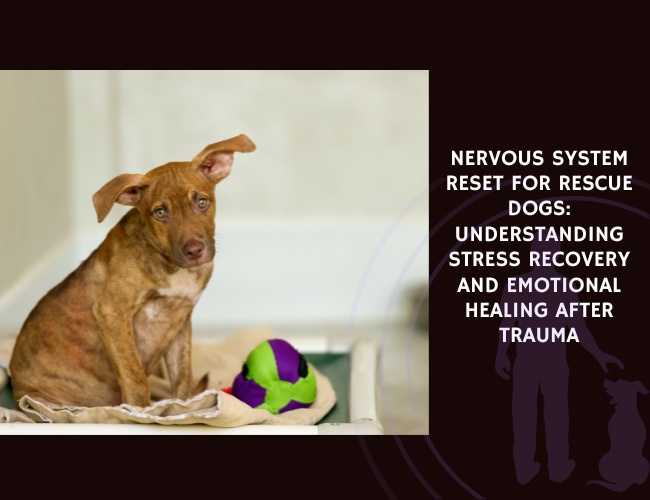
When you welcome a rescue dog into your home, you might expect an immediate flood of gratitude and relief. Perhaps you imagine your new companion settling in within days, eager to embrace their second chance. Yet many rescue dog guardians find themselves navigating something entirely different: a dog who seems perpetually on edge, struggles to relax, or appears calm but oddly disconnected. What you’re witnessing isn’t stubbornness or poor temperament. You’re observing the visible signs of a nervous system that hasn’t yet learned it’s safe.
Understanding how trauma reshapes the autonomic nervous system changes everything about how we approach rescue dog rehabilitation. This isn’t about training commands or establishing rules. It’s about giving a dysregulated nervous system the time, safety, and support it needs to recalibrate. Let us guide you through the science of stress recovery and show you why patience, predictability, and presence matter far more than any training protocol.
The Invisible Weight: How Chronic Stress Rewires the Nervous System
Your rescue dog’s past isn’t just a collection of memories. It’s written into the very fabric of their autonomic nervous system, the unconscious network that governs everything from heart rate to digestion, from arousal to recovery. When dogs experience prolonged unpredictability, confinement, loss, or threat, something fundamental shifts in how their nervous system operates.
Sympathetic Dominance: Living in Permanent High Alert
Think of the autonomic nervous system as having two primary modes: the sympathetic “go” system that mobilizes for action, and the parasympathetic “slow” system that facilitates rest and recovery. In a balanced nervous system, these systems work together, shifting fluidly based on environmental demands. But chronic stress fundamentally alters this balance.
Rescue dogs who have experienced repeated trauma often develop what researchers call sympathetic dominance. Their nervous system becomes biased toward high arousal and hypervigilance, as if the threat never truly passed. This isn’t a choice or a behavior problem. It’s an autonomic adaptation that once served a critical survival function but now prevents genuine rest and recovery.
You might notice this as:
- A dog who never seems to fully relax, even in objectively safe environments
- Hypervigilance to sounds, movements, or changes that wouldn’t typically trigger stress
- Difficulty transitioning from arousal to calm, as if stuck in a perpetual state of readiness
- Extended recovery windows following even minor stressors
This pattern emerges from experiences many rescue dogs have endured:
- Repeated environmental unpredictability where they couldn’t predict what would happen next
- Loss of primary attachment figures who provided co-regulation and safety
- Confinement or restriction of natural behaviors that left no outlet for stress
- Exposure to threatening or chaotic environments where vigilance was necessary for survival
- Frequent relocations between shelters, foster homes, or living situations
- Social isolation or lack of appropriate socialization during critical developmental periods
- Resource scarcity creating competition stress around food, water, or safe spaces
- Physical restraint, punishment, or aversive training methods
When the Brake System Fails: Incomplete Parasympathetic Recovery
Even more concerning than sympathetic dominance is what happens to the parasympathetic recovery system. Research shows that individuals with chronic stress exposure exhibit impaired parasympathetic recovery even when the environment becomes objectively safe. For your rescue dog, this means their nervous system has lost the ability to fully downregulate.
Through the NeuroBond approach, we recognize that this isn’t about willpower or personality. Your dog’s nervous system quite literally cannot access the states of deep rest and recovery that facilitate healing. The parasympathetic brake system that should slow arousal and promote calm has become less responsive.
This manifests in observable patterns you might recognize:
- Extended recovery windows where your dog takes far longer than expected to calm down after arousal
- Inability to fully return to baseline calm even in familiar, safe environments
- Persistent low-level vigilance where relaxation never seems complete
- Difficulty transitioning between arousal states as if stuck between gears
- Shallow or rapid breathing even in resting states
- Inability to settle into deep, restorative sleep
- Digestive issues or appetite irregularities due to chronic stress
- Muscle tension that never fully releases
The science reveals something critical here: passive safety alone is insufficient for nervous system recalibration. Your dog needs more than the absence of threat. They need active signals that facilitate recovery, which is where your role as an external regulator becomes essential.
Understanding True Recovery Versus Learned Shutdown
Here’s where many well-intentioned rescue dog guardians make a critical mistake. They see their dog becoming quiet and still, interpret this as “calming down,” and believe progress is happening. But behavioral stillness doesn’t always indicate nervous system recovery. Sometimes it signals something far more concerning: shutdown.
Genuine Regulation: What Healing Actually Looks Like
When a nervous system genuinely recovers, you see flexibility. A dog who is truly regulated can modulate their responses appropriately based on context. They show capacity for social engagement without constant hypervigilance. They exhibit exploratory behavior, curiosity about their environment, and spontaneous play. Their body language reflects variable states rather than rigid patterns.
Signs of genuine regulation include:
- Behavioral flexibility: Responses vary appropriately based on context and situation
- Exploratory behavior: Sniffing, investigating, showing curiosity about environment
- Spontaneous play: Moments of playfulness that emerge naturally without prompting
- Variable body language: Postures and expressions change based on emotional state
- Appropriate social engagement: Seeks connection without desperation or withdrawal
- Context-appropriate arousal: Can be excited when warranted, calm when safe
- Progressive recovery speed: Returns to baseline faster after stressors over time
- Consolidated sleep patterns: Deeper, more restorative rest cycles
- Soft, relaxed body during rest: Muscles release tension fully
- Capacity for joy: Genuine moments of happiness and contentment
Physiologically, genuine regulation shows up in measurable ways. Heart rate variability increases, indicating healthy parasympathetic engagement. Recovery time after arousal shortens progressively. Sleep patterns become consolidated and restorative. The dog can experience appropriate levels of arousal without getting stuck in extremes.
Most importantly, a genuinely regulated dog demonstrates what we call the Invisible Leash: that quality of awareness and connection that doesn’t require constant control or management. They can be calm without being frozen, engaged without being hypervigilant, responsive without being reactive.
Learned Helplessness: When Calm Masks Dysregulation
Now contrast this with learned inhibition or shutdown. A dog who has learned that nothing they do matters, that resistance is futile, or that expression leads to negative consequences may become very still. They may appear “well-behaved” or “calm.” But their nervous system tells a different story.
Warning signs of suppression rather than regulation:
- Flat affect across all contexts, as if emotional range has been compressed
- Rigid, unchanging behavioral patterns that don’t vary based on situation
- Absence of spontaneous behavior, curiosity, or playfulness
- Social withdrawal or dissociation, where the dog is present but not truly engaged
- Consistently suppressed arousal that never rises even when enthusiasm would be appropriate
- Lack of improvement over months despite environmental safety
- “Frozen” stillness rather than relaxed calm
- Avoidance of eye contact or interaction even in safe contexts
- No vocalization or communication attempts
- Absence of normal stress relief behaviors (shaking off, yawning, stretching)
This distinction matters profoundly because obedience-heavy interventions applied before nervous system stabilization can inadvertently create or reinforce shutdown rather than facilitate genuine recovery.
Approaches that risk creating shutdown:
- High-demand training before nervous system stabilization
- Punishment-based or correction-heavy methods
- Insufficient recovery time between training sessions
- Focus on behavioral output over internal state assessment
- Lack of choice or autonomy in training contexts
- Forced exposure to fear triggers (“flooding”)
- Alpha rolls, leash corrections, or physical intimidation
- Ignoring stress signals in favor of compliance
- Withholding resources until obedience is demonstrated
🧡 Your dog doesn’t need to learn to be still. They need to learn that movement, expression, and engagement are safe.
The Architecture of Safety: Environmental Predictability and Sensory Management
If you take nothing else from this article, understand this: for a rescue dog with a dysregulated nervous system, environmental predictability matters more than training. More than socialization. More than obedience. The foundation of nervous system recovery is a world that makes sense.
Routine as Nervous System Medicine
Think about how uncertainty feels in your own body. That slightly queasy sensation before an important meeting. The low-level tension when you don’t know what’s coming next. Now imagine living in that state constantly. That’s the reality for a rescue dog in an unpredictable environment.
Environmental predictability rests on four foundational pillars:
Temporal Predictability:
- Consistent feeding times daily
- Regular sleep and wake schedules
- Predictable walk or potty break routines
- Stable quiet hours and activity periods
- Reliable transition cues between activities
Spatial Clarity:
- Unchanging safe spaces that remain available
- Consistent furniture arrangement and layout
- Clear boundaries about accessible versus off-limit areas
- Designated decompression zones that stay constant
- Predictable pathways through the home
Sensory Consistency:
- Managed volume levels and sound environments
- Reduced variability in visual stimulation
- Controlled frequency of novel sensory experiences
- Predictable patterns of household activity and noise
- Consistent lighting patterns matching day/night cycles
Social Predictability:
- Stable relationship patterns with household members
- Consistent emotional tone from primary caregivers
- Predictable interaction styles and approaches
- Regular presence of the same core people
- Minimal introduction of new social contacts during early recovery
The Sensory Burden of Modern Life
Here’s something most people don’t consider: the modern human environment is often sensorially overwhelming for dogs, even those without trauma histories. For rescue dogs with heightened sensitivity to environmental stressors, typical household chaos can prevent nervous system recovery entirely.
Common household sensory stressors that accumulate:
- Television sounds with unpredictable volume changes and sudden noises
- Doorbell rings that signal unpredictable arrivals
- Visitors arriving without warning or pattern
- Children’s high-energy play with sudden movements and loud voices
- Kitchen appliances with sharp, startling sounds (blenders, mixers, timers)
- Street noise from traffic, construction, or neighborhood activity
- Constantly changing household activity levels
- Phone notifications, alarms, and electronic sounds
- Vacuums, hair dryers, and other loud cleaning equipment
- Window views with visual stimulation from passing people, dogs, or vehicles
You might need to create a decompression zone: a quiet space with minimal sensory input where your dog can truly rest. This isn’t isolation; it’s providing access to genuine recovery.
Essential elements of an effective decompression zone:
- Soft, comfortable bedding that retains your dog’s scent
- Dim lighting or blackout capability to reduce visual stimulation
- Consistent white noise or fan to mask unpredictable household sounds
- Protection from visual stimulation (covered crate or enclosed bed for dogs who seek it)
- Temperature control for comfort
- Water always available within the space
- Location away from high-traffic household areas
- Minimal decorative items or visual clutter
- No forced interaction or demands when dog is in this space
- 24/7 access without restrictions
🧠 Remember: what looks like laziness or withdrawal might actually be your dog’s desperate attempt to find sensory peace in an overwhelming environment.
The Time Truth: Realistic Expectations for Nervous System Recovery
If you’ve been told your rescue dog should “settle in” within two weeks, someone has done you a profound disservice. Nervous system recalibration after chronic stress operates on a completely different timeline than behavioral adaptation. Understanding these phases helps you maintain patience and recognize genuine progress.
Phase 1: Decompression (Weeks 1-4)
The initial month isn’t about progress in the traditional sense. This is the decompression phase, where your primary focus is establishing safety. Your dog may actually appear more dysregulated than expected. Stress signals might increase as they feel safe enough to express rather than suppress.
What to expect during decompression:
- High variability in behavior from hour to hour or day to day
- Possible increase in stress signals (panting, pacing, whining)
- Extreme avoidance or extreme clinginess, sometimes alternating
- Poor appetite or finicky eating patterns
- Sleep disturbances or excessive sleeping
- Hypervigilance to household sounds and movements
- Difficulty settling or sustained restlessness
- Testing of boundaries as your dog assesses the environment
- Moments of apparent calm followed by sudden arousal
During this phase, minimize demands and expectations. Resist the urge to introduce training, socialization, or behavioral work. Prioritize environmental predictability above all else. Your dog’s job is simply to exist in a safe space. Your job is to provide that space without asking for anything in return.

Phase 2: Oscillation (Months 2-6)
As you move into months two through six, expect what we call the oscillation phase. Your dog’s regulation capacity will vary dramatically. Good days will alternate with difficult ones. You’ll see glimpses of the dog they might become, then watch them retreat into stress patterns again.
Characteristic patterns during oscillation:
- Good days alternating with difficult days in unpredictable patterns
- Gradual increase in baseline stability, though inconsistent
- Emerging capacity for brief periods of genuine calm
- Setbacks that feel like starting over, then improvement again
- Progressive shortening of recovery time after stressors
- Tentative exploration or social engagement followed by retreat
- Sleep patterns becoming slightly more consolidated
- Appetite stabilizing but still variable
- Trust development that remains fragile and context-dependent
This phase challenges many guardians because progress isn’t linear. You might celebrate a breakthrough only to face setbacks the next day. But this oscillation actually indicates that the nervous system is beginning to develop flexible responses rather than maintaining rigid stress patterns.
Gradually, you’ll notice increasing baseline stability. The good days become slightly more frequent. The difficult days become slightly less intense. Recovery windows shorten incrementally. Trust begins to emerge, though it remains fragile.
Phase 3: Integration (Months 6-18)
Months six through eighteen mark the integration phase, where progressive stabilization of regulatory capacity occurs. Your dog shows increased resilience to minor stressors. Secure attachment patterns develop. You observe more consistent emotional regulation and reduced reactivity.
Integration phase progress markers:
- More consistent emotional regulation across varied contexts
- Reduced reactivity to previously triggering stimuli
- Emerging playfulness or curiosity that’s sustained rather than fleeting
- Secure attachment behaviors (seeking proximity, using you as secure base)
- Increased resilience to minor household stressors
- Sleep becoming deeply consolidated and restorative
- Appetite normalizing with consistent patterns
- Ability to recover from arousal within minutes rather than hours
- Spontaneous exploration of environment
- Social engagement without hypervigilance or desperation
This is when elements of Soul Recall begin to emerge: those moments when your dog demonstrates intuitive response and deep relational bonding, accessing emotional memory in ways that support rather than destabilize them.
During integration, you can gradually expand behavioral expectations, but always with regulation as the foundation. Training becomes possible because the nervous system can now handle the cognitive load and mild stress of learning. But if you push too hard, you risk regression.
Phase 4: Consolidation (18+ Months)
Full nervous system recalibration often requires eighteen months or longer. The consolidation phase isn’t about dramatic changes but rather the deepening and stabilization of regulatory capacity.
Consolidation achievements:
- Robust stress resilience across varied contexts and challenges
- Flexible responses to novel situations without overwhelm
- Secure attachment with increasing confidence in relationship
- Emotional regulation maintained during transitions or changes
- Appropriate arousal modulation matching environmental demands
- Deep, restorative sleep with minimal disruption
- Consistent appetite and healthy digestive patterns
- Quick recovery from stressors, often self-regulating
- Sustained curiosity, playfulness, and social engagement
- Trust in environment and primary relationships solidified
This timeline isn’t a failure of your dog or your approach. It’s the biological reality of how nervous systems heal from chronic stress.
The Relationship Foundation: Attachment, Co-Regulation, and Your Role as an Anchor
You are not just your dog’s guardian. For a rescue dog recovering from trauma, you become something far more essential: an external regulator. Your nervous system, your emotional state, and your presence provide the scaffolding that allows your dog’s dysregulated system to begin finding balance.
How Secure Attachment Facilitates Nervous System Recovery
Research on attachment demonstrates that secure relationships fundamentally shape autonomic development and emotional stability. When your rescue dog develops secure attachment with you, several critical processes become possible.
Autonomic co-regulation occurs when your regulated state helps stabilize your dog’s dysregulated state. This isn’t conscious or effortful; it happens through proximity, consistent presence, and your own embodied calm. Your dog’s nervous system begins to entrain to yours.
Stress buffering means that your predictable relationship reduces threat perception. When your dog trusts that you respond consistently, their nervous system can lower its vigilance. They don’t need to monitor every environmental change because you’ve become a reliable source of safety information.
Recovery acceleration happens because safe relationships enable faster return to baseline after stressors. Your presence provides what researchers call a “secure base” that facilitates emotional processing. Your dog can approach the edge of their comfort zone and return to you for regulation support.
Emotional integration becomes possible through this secure base. Your dog can begin processing difficult experiences rather than simply suppressing or avoiding them. Moments of Soul Recall, where past experiences surface, can be worked through rather than remaining as unprocessed trauma.
Your Nervous System Matters
Here’s what many rescue dog guardians don’t realize: your emotional state directly impacts your dog’s recovery. Dogs are remarkably attuned to human autonomic states. If you’re anxious, frustrated, or emotionally inconsistent, your dog’s nervous system registers this as environmental unpredictability.
Providing autonomic anchoring through calm presence doesn’t mean suppressing your emotions or being artificially serene. It means developing awareness of your own nervous system states and working toward greater regulation. When you become predictable in your emotional availability, you create the conditions for your dog’s nervous system to trust and relax.
Your role as external regulator includes:
- Maintaining consistent emotional tone even when your dog struggles
- Responding to stress signals with calm acknowledgment rather than alarm
- Allowing your dog to seek proximity without forcing interaction
- Modeling regulated states through your own embodied presence
- Providing predictable responses that reduce environmental uncertainty
- Creating safety through emotional availability rather than control
- Offering your calm as an anchor during your dog’s dysregulation
- Recognizing and honoring your dog’s communication attempts
This is the essence of the Invisible Leash: that connection forged not through control but through co-regulation, where awareness and attunement guide the relationship rather than management and demand.
The Cost of Inconsistency
Just as secure attachment facilitates recovery, inconsistent human emotional states prevent it. When the humans in a dog’s life fluctuate dramatically in mood, energy, or responsiveness, the dog’s nervous system cannot establish stable safety cues.
How inconsistent human states disrupt recovery:
- Prevents establishment of predictable safety cues your dog can rely on
- Maintains hypervigilance due to environmental unpredictability
- Blocks development of secure attachment patterns
- Reinforces need for constant environmental monitoring
- Creates confusion about which behaviors will receive which responses
- Generates anxiety about human mood states and availability
- Prevents your dog from trusting relational cues for safety
- Undermines all other recovery efforts by destabilizing the foundation
Research on autonomic dysregulation shows that inconsistent emotional environments maintain hypervigilance because the environment remains unpredictable. Your dog cannot develop secure attachment patterns when they don’t know which version of you they’ll encounter. They’re forced to continue environmental monitoring rather than trusting relational cues.
This doesn’t mean you need to be perfect. It means working toward greater consistency in how you show up emotionally, particularly during the critical early phases of recovery. Your dog needs to learn that you are predictable, safe, and emotionally available, even when circumstances change.
Reading the Signs: Assessment and Distinguishing Recovery from Suppression
How do you know if your rescue dog is genuinely recovering or simply learning to suppress their stress? This distinction is critical because the interventions that support recovery differ dramatically from those that might inadvertently reinforce shutdown.
Autonomic Indicators of Genuine Recovery
While you likely don’t have access to heart rate variability monitors at home, you can observe behavioral markers that correlate with autonomic recovery. Progressive improvement manifests in several ways.
You’ll notice increasing behavioral flexibility where your dog can modulate responses based on context rather than showing rigid patterns. A dog who barked at every sound begins discriminating between concerning and irrelevant noises. A dog who couldn’t settle begins showing context-appropriate arousal levels.
Emerging exploratory behavior signals that your dog’s nervous system has capacity for curiosity rather than needing all resources for vigilance. Sniffing new objects, investigating changes in the environment, or showing interest in novel experiences indicates regulatory reserves.
Appropriate social engagement means your dog can interact without hypervigilance or withdrawal. They seek connection, respond to social cues, and demonstrate interest in relationship without appearing desperate or detached.
Reduced recovery time after stressors shows improving regulation. Where your dog once needed hours to calm after arousal, they now return to baseline in minutes. This accelerating recovery capacity indicates parasympathetic system improvement.
Spontaneous play or curiosity emerges as the nervous system develops safety margins. Play requires feeling secure enough to be vulnerable. Curiosity indicates capacity beyond mere survival. These behaviors signal profound shifts in autonomic state.
Warning Signs That Demand Attention
Conversely, certain patterns suggest your dog may be shutting down rather than recovering. Flat affect across all contexts, where emotional expression remains compressed regardless of situation, indicates suppression rather than regulation.
Rigid, unchanging behavioral patterns that don’t vary based on environmental changes suggest learned inhibition. A dog who is always “calm” in exactly the same way, never showing enthusiasm or appropriate arousal, may be demonstrating shutdown.
Absence of spontaneous behavior, where your dog only acts in response to direct cues and never initiates exploration or interaction, signals disconnection rather than peace. Social withdrawal or dissociation, where your dog seems present but not truly engaged, indicates profound dysregulation.
If you’re seeing these patterns, especially if they persist or worsen over months despite environmental safety, your dog needs different support. This isn’t about training harder; it’s about creating conditions that allow genuine nervous system recovery rather than learned compliance.
At-a-Glance: Recovery Versus Suppression
To help you track your dog’s progress, here’s a comparison table you can reference throughout your journey. True recovery looks fundamentally different from suppression, and recognizing these patterns helps you adjust your approach accordingly.
Genuine Recovery Indicators:
- Behavioral flexibility: Responses vary appropriately based on context
- Increasing exploratory behavior: Sniffing, investigating, showing curiosity
- Appropriate social engagement: Seeks connection without desperation or withdrawal
- Progressive improvement in recovery time: Returns to baseline faster after stressors
- Spontaneous play or joy: Moments of lightness emerge naturally
- Consolidated sleep patterns: Deeper, more restorative rest
- Context-appropriate arousal: Can be excited when appropriate, calm when safe
- Variable body language: Postures and expressions change with situation
Suppression Warning Signs:
- Flat affect across contexts: Emotional range appears compressed
- Rigid behavioral patterns: Same response regardless of situation
- Absence of spontaneous behavior: Only acts when cued or prompted
- Social withdrawal: Present but not engaged, dissociated quality
- Consistently suppressed arousal: Never shows enthusiasm or appropriate excitement
- No improvement over months: Patterns remain static despite environmental safety
- Behavioral compliance without engagement: “Obedient” but disconnected
- Stress signals during “calm”: Body tension, whale eye, or displacement behaviors present
🧠 Check in with this comparison monthly. Recovery should show progressive movement toward flexibility and engagement, even if the pace feels glacial.
Understanding Setbacks: Why Recovery Isn’t Linear
Here’s something that catches nearly every rescue dog guardian off-guard: just when you think you’re making progress, your dog regresses. The dog who finally started relaxing suddenly won’t settle. The dog who began exploring confidently retreats to hypervigilance. Your dog who seemed to trust you now acts wary again. And you wonder: what did I do wrong?
The answer is usually: nothing. You’re witnessing the normal, expected pattern of nervous system recovery. Understanding why setbacks happen and how to respond transforms potential crisis points into opportunities for deeper healing.
Normal Regression: What It Looks Like and Why It Happens
Regression isn’t failure. It’s how nervous systems process and integrate change. Think of recovery as a spiral rather than a straight line. Your dog circles back through familiar stress patterns, but each time from a slightly more regulated place.
Characteristics of normal, healthy setbacks:
- Temporary duration (hours to a few days rather than weeks)
- Context-specific triggers (identifiable stressors or situations)
- Return to improved baseline rather than staying stuck at regression level
- Decreasing frequency over months (setbacks become less common)
- Reduced intensity with each occurrence (less severe than previous setbacks)
- Shorter recovery time needed to return to baseline
- Your dog maintains some regulatory capacity even during setback
- Improvement resumes once triggering situation resolves
Normal setbacks typically show these characteristics. They’re temporary, usually lasting hours to a few days rather than weeks. They’re context-specific, triggered by identifiable stressors like environmental changes, accumulated stress, or developmental windows. And critically, they resolve with a return to improved baseline rather than staying stuck at the regression level.
Why do these setbacks happen? Several mechanisms are at play.
Common reasons for normal regression:
- Stress Accumulation: Individual challenges handled well but cumulative load requires decompression
- Environmental Triggers: Sounds, sights, or situations similar to past trauma activate old patterns
- Developmental Windows: Nervous system processing phases where integration creates temporary instability
- Positive Stress: Even good experiences create physiological stress requiring recovery time
- Schedule Changes: Disruptions to routine temporarily destabilize predictability
- Seasonal Transitions: Changes in daylight, weather, or household patterns
- Anniversary Reactions: Unconscious responses to time periods matching past trauma
- Growth Edges: Pushing slightly beyond current capacity creates temporary overwhelm
- Physical Factors: Illness, pain, or hormonal changes affecting regulation capacity
Stress accumulation occurs when your dog handles individual challenges well but needs periodic decompression to process the cumulative load. Even positive experiences create physiological stress that requires recovery time.
Environmental triggers can activate old patterns. A sound similar to past trauma, a person who moves like someone threatening, or situations that echo previous experiences can temporarily dysregulate your dog’s nervous system. This isn’t permanent backsliding; it’s evidence that the nervous system is still learning to distinguish past from present.
Developmental windows matter too. As your dog’s nervous system recalibrates, they pass through phases where old patterns surface for integration. This looks like regression but actually represents the nervous system processing and releasing stored stress.
You might also notice what appears as regression around the 3-week, 3-month, and 6-month marks. These transition points often bring temporary increases in stress behaviors as your dog’s nervous system adjusts to new levels of safety and integration.
Concerning Regression: When to Worry
While most setbacks are normal, certain patterns warrant closer attention and potentially professional support. Concerning regression shows different characteristics than normal oscillation.
Red flags indicating regression requires professional assessment:
- Persistence: Regression lasting weeks or months without improvement
- Generalization: Regression spreading across all contexts rather than remaining situation-specific
- Progressive Worsening: Each setback more intense than the last
- New Behaviors: Emergence of concerning behaviors not previously present (aggression, self-harm)
- Complete Shutdown: Total withdrawal or dissociation that deepens over time
- No Recovery: Zero forward movement despite optimal environmental conditions
- Physical Symptoms: Development of stress-related health issues (digestive problems, skin conditions)
- Deteriorating Baseline: Overall regulation capacity declining rather than improving
- Loss of Gains: Complete loss of previously achieved progress
Watch for persistence. If regression lasts weeks or months without improvement, something more than normal processing is occurring. Generalization is another warning sign, when regression spreads across all contexts rather than remaining specific to triggering situations. Progressive worsening over time, where each setback is more intense than the last, indicates the approach isn’t working.
Complete absence of improvement over 3-6 months, where your dog shows no forward movement despite environmental stability, suggests the nervous system isn’t accessing recovery processes. Emergence of new concerning behaviors like self-harm, severe aggression, or complete shutdown that wasn’t previously present requires immediate professional evaluation.
Dysregulated. Guarded. Healing.
Chronic Stress Imprint Prolonged threat unpredictability and loss recalibrate the autonomic nervous system toward constant readiness preventing genuine relaxation even in safe environments.
Sympathetic Dominance State Trauma biases regulation toward high arousal vigilance and slow recovery keeping the dog locked in action mode with limited access to restorative calm.



Co Regulation Restores Through predictable presence relational safety and NeuroBond aligned guidance the nervous system relearns downregulation enabling recovery trust and emotional stability.
How to Respond Without Derailing Recovery
Your response to setbacks profoundly impacts whether they become learning opportunities or deepen dysregulation. Here’s how to navigate regression without panic or overcorrection.
Effective setback response protocol:
- Recognize Without Alarm: Acknowledge calmly: “I see you’re having a harder time today”
- Return to Basics Immediately: Drop back to earlier recovery phase support regardless of recent progress
- Increase Environmental Predictability: Reduce variables, minimize novel experiences, create extra structure
- Maintain Your Own Regulation: Keep yourself calm; your dysregulation compounds their struggle
- Avoid Punishment or Suppression: Treat stress behaviors as communication, not problems to eliminate
- Provide Extra Decompression Access: Make safe space more available and protect it vigilantly
- Reduce All Demands Temporarily: Simplify expectations to absolute basics
- Give Time Before Course Correction: Wait 5-7 days before deciding setback is concerning
- Document Patterns: Note triggers, duration, intensity to identify if this is normal or problematic
- Resist Comparison: Don’t measure against other dogs or previous timeline expectations
First, recognize the setback without alarm. Your calm acknowledgment—”I see you’re having a harder time today”—validates without creating additional stress. Avoid the temptation to immediately “fix” or intensify interventions.
Return to basics immediately. Whatever phase your dog seemed to be in, drop back to earlier-phase support. More predictability, less demand, increased access to decompression space. Think of this as providing extra scaffolding during a challenging period.
Increase environmental predictability temporarily. Reduce variables, minimize novel experiences, and create extra structure. Your dog’s nervous system is communicating it needs simpler, more predictable conditions right now.
Maintain your own regulation. This is critical. If you become anxious about the setback, your dog picks up on that dysregulation and it compounds their struggle. Your steady presence reassures their nervous system that this is manageable.
Don’t punish or suppress stress behaviors. If your dog starts barking more, pacing, or showing other stress signals, these are communications, not problems to eliminate. Respond to the underlying need rather than the surface behavior.
Give it time before changing course. Unless you’re seeing concerning regression patterns, wait at least 5-7 days before deciding the setback represents something more serious. Most normal regressions resolve within this window.
🧠 💚 Nervous System Recovery Timeline for Rescue Dogs
Understanding the 18+ Month Journey from Dysregulation to Deep Healing
Phase 0: Understanding the Starting Point
Before Recovery Begins: Recognizing Dysregulation
What’s Really Happening
Your rescue dog’s nervous system is stuck in survival mode. Chronic stress has created sympathetic dominance—their “fight or flight” system runs constantly while the “rest and digest” system barely functions. This isn’t behavior; it’s biology.
Observable Signs
• Hypervigilance to sounds and movements
• Inability to fully relax even in safe spaces
• Extended recovery after minor stressors
• Rigid body language or flat affect
• Difficulty transitioning between arousal states
Critical Distinction
Shutdown vs. Calm: A frozen, still dog may look peaceful but could be in complete shutdown. True calm includes flexibility, curiosity, and appropriate arousal. Watch for behavioral variety, not just stillness.
Phase 1: Decompression
Weeks 1-4: Establishing Safety Foundation
Your Primary Focus
Create environmental predictability. Your dog’s nervous system needs to learn the world follows patterns. Same feeding times, same quiet spaces, same routines daily. Predictability is nervous system medicine.
What to Expect
• High behavioral variability (hour to hour, day to day)
• Possible increase in stress signals as dog feels safe enough to express
• Extreme avoidance or clinginess, sometimes alternating
• Sleep disturbances or excessive sleeping
• Testing boundaries while assessing environment
Your Action Steps
Zero training. Zero socialization beyond essentials. Create decompression zone with soft bedding, dim lighting, white noise. Allow 100% dog-initiated interaction. Your dog’s only job: exist safely. Your job: provide that safety without demands.
Phase 2: Oscillation
Months 2-6: The Wave Pattern of Progress
The Oscillation Reality
Good days alternate with difficult ones unpredictably. Your dog’s nervous system is learning flexible responses instead of rigid stress patterns. This inconsistency IS the progress. The nervous system is building capacity through practice.
Progress Markers
• Gradual increase in good day frequency (3-4 good days, 1-2 difficult)
• Shortened recovery time after stressors (hours instead of days)
• Tentative exploration or social engagement
• Sleep patterns becoming more consolidated
• Trust development, though still fragile
Your Support Role
Introduce parallel presence—sit quietly near your dog without expectations. Respond to their cues for engagement rather than initiating. Through the NeuroBond approach, your regulated nervous system helps stabilize theirs. Maintain environmental consistency even when tempted to expand.
Phase 3: Integration
Months 6-18: Building Stable Regulation
Deepening Stability
Your dog shows more consistent emotional regulation across contexts. Reactivity to previous triggers decreases. Secure attachment patterns form. This is when Soul Recall emerges—your dog accessing emotional memory in ways that support rather than destabilize them.
Observable Changes
• Increased resilience to minor household stressors
• Emerging playfulness that’s sustained, not fleeting
• Recovery from arousal within minutes rather than hours
• Spontaneous environmental exploration
• Social engagement without hypervigilance
Training Introduction
NOW you can introduce regulation-focused training: settle work (self-regulation practice), consent-based handling (trust through choice), engagement games (connection without dependency). Always regulation first, skills second. Stop if stress exceeds recovery capacity.
Phase 4: Consolidation
18+ Months: Deep Nervous System Recalibration
Full System Integration
Not dramatic change but profound deepening. Your dog’s nervous system now has robust stress resilience, flexible responses to novelty, and maintained regulation during transitions. The Invisible Leash is visible: awareness and connection without control.
Consolidation Markers
• Appropriate arousal modulation matching environment
• Deep, restorative sleep with minimal disruption
• Quick self-regulation after stressors
• Sustained curiosity, playfulness, engagement
• Secure attachment with confident relationship trust
Ongoing Support
Maintain core routines and environmental predictability. Your dog can now handle more variability but consistency remains supportive. Refine behavioral skills as needed, always with nervous system state as primary consideration. The foundation is solid.
Ongoing: Setback Navigation
Throughout Recovery: When Progress Spirals Backward
Normal vs. Concerning
Normal setback: Temporary (hours to days), context-specific, returns to improved baseline. Concerning regression: Persists weeks, generalizes across contexts, progressive worsening. Most setbacks are normal nervous system processing, not failure.
Why Setbacks Happen
• Stress accumulation requiring decompression
• Environmental triggers similar to past trauma
• Developmental windows during integration
• Schedule changes destabilizing predictability
• Even positive experiences create physiological stress
Response Protocol
Recognize without alarm. Return to basics immediately—drop back to earlier phase support. Increase predictability, reduce demands, maintain your regulation. Wait 5-7 days before deciding if this is concerning. Setbacks become less frequent, less intense, with faster recovery over time.
Essential: Your Nervous System
Throughout All Phases: Managing Guardian Regulation
Why You Matter
You are your dog’s external regulator. Your dysregulation prevents their recovery—not someday, immediately. Dogs attune to human autonomic states. Your anxiety, frustration, or inconsistency becomes environmental unpredictability that maintains hypervigilance.
Your Dysregulation Signs
Physical: jaw clenching, shallow breathing, shoulder tension, sleep disruption. Emotional: irritation, resentment, despair, guilt. Behavioral: avoiding dog emotionally, obsessive research, rumination. Recognize these to intervene early.
Regulation Practices
Three slow breaths before responding. Body scan for tension multiple times daily. Focus on regulating yourself when dog struggles. Schedule your own decompression time. Find witness support. Permission for imperfection—recognizing difficult moments and returning is the skill.
When Needed: Professional Intervention
Recognizing What’s Beyond Home Management
Red Flags
Aggression breaking skin or escalating. Self-harm behaviors. Complete shutdown lasting 3+ months without improvement. Severe separation anxiety causing injury. No progress despite 3-4 months of optimal environmental management. These require specialized support.
Who to Seek
Veterinary Behaviorist (DACVB): Severe cases, medication assessment. Certified Behaviorist (CAAB/ACAAB): Complex behavior modification. Trauma-Informed Trainer (CPDT-KA/CBCC-KA): Implementation support. Verify their understanding of regulation-first approaches.
Questions to Ask
“What’s your experience with rescue dog trauma recovery?” “Can you describe shutdown vs. calm?” “How do you determine readiness for training?” Look for professionals who understand nervous system state, not just behavioral compliance. Timelines in months/years, not weeks.
🔍 Recovery vs. Suppression: Know the Difference
Genuine Recovery
Behavioral flexibility that varies with context. Emerging curiosity and exploration. Appropriate arousal—excited when warranted, calm when safe. Progressive improvement in recovery speed after stressors.
Learned Suppression
Rigid patterns that don’t change. Flat affect across all situations. Absence of spontaneous behavior. Social withdrawal or dissociation. “Calm” but disconnected—compliance without engagement.
Normal Setback
Temporary regression lasting hours to days. Context-specific trigger. Returns to improved baseline. Decreasing frequency and intensity over months. Part of healthy nervous system processing.
Concerning Regression
Persistent decline lasting weeks without recovery. Generalizes across all contexts. Progressive worsening. New concerning behaviors emerge. No response to environmental optimization.
High-Risk Approaches
Training before stabilization. Punishment or corrections. Forced exposure (“flooding”). Focus on behavioral output over internal state. These create suppression, not recovery.
Regulation-First Model
Environmental safety first. Minimal demands during recovery. Autonomic markers guide progression. Long-term stability over short-term compliance. Produces genuine nervous system recalibration.
⚡ Quick Recovery Rules
The 3-3-3 Rule: 3 days to decompress, 3 weeks to learn routine, 3 months to feel home. But for trauma recovery: Add 18 months for nervous system recalibration.
When in doubt: Reduce demands, increase safety. You can always expand later.
Recovery hierarchy: Environmental predictability → Secure attachment → Regulation capacity → Training skills
Progress measure: Not behavior compliance, but recovery speed after stressors and behavioral flexibility across contexts.
🧡 The Zoeta Dogsoul Perspective
True recovery isn’t about training your dog to appear calm. It’s about supporting their nervous system’s return to genuine regulation. Through the NeuroBond approach, we recognize that your regulated presence becomes the external scaffolding for your dog’s internal healing. The Invisible Leash emerges not from control, but from co-regulation—that deep attunement where your dog’s nervous system learns to trust yours as a guide back to safety. And in moments of Soul Recall, when past trauma surfaces, you provide the secure base that allows processing rather than re-traumatization.
This timeline isn’t a failure of quick fixes. It’s honoring the biological reality of how nervous systems heal from chronic stress. Your patience isn’t passive—it’s the most active intervention you can offer. Every day of environmental predictability, every moment of regulated presence, every choice to prioritize your dog’s internal state over external behavior builds the foundation for genuine, lasting recovery.
That balance between neuroscience and soul—that’s where true healing lives.
© Zoeta Dogsoul – Where neuroscience meets soul in dog training
Timeline: How Setbacks Change Over Recovery
Understanding how regression patterns typically shift helps you maintain perspective and recognize genuine progress even through difficult moments.
Decompression Phase (Weeks 1-4): High variability is the norm. You might see significant oscillation day to day or even hour to hour. This isn’t regression; it’s the baseline instability you’re working with. Don’t expect consistency yet.
Oscillation Phase (Months 2-6): Setbacks happen frequently but begin showing patterns. You might notice 3-4 good days followed by 1-2 difficult ones. Gradually, the ratio improves. Setback intensity often decreases even if frequency remains similar. Recovery time from setbacks shortens—from days to hours, then from hours to minutes.
Integration Phase (Months 6-18): Setbacks become less frequent and less intense. You might see regression around major transitions (moving, new family member, schedule changes) but baseline stability holds. Your dog recovers more independently, needing less external support to return to regulation.
Consolidation Phase (18+ Months): Setbacks become rare and mild. When they occur, your dog typically has internal resources to self-regulate. You’re no longer managing crisis; you’re supporting resilience.
🧡 Progress isn’t measured by the absence of setbacks. It’s measured by how quickly your dog recovers from them, how well you both navigate them, and how the pattern evolves over months.
The Practical Framework: Supporting Your Rescue Dog’s Nervous System Journey
Theory only matters if it translates into action. Here’s how to apply this understanding of nervous system recovery to your daily life with your rescue dog.
Level 1: Foundation (Weeks 1-4)
Your singular focus during the first month is establishing environmental predictability while minimizing demands. This might feel passive, but it’s the most active thing you can do for your dog’s recovery.
Foundation phase priorities:
- Consistent Daily Schedule: Maintain religiously – morning routine, meal times, quiet periods, sleep schedules
- Designated Decompression Space: Unchanged and always available with low sensory input
- Zero Training Expectations: Resist all urges to introduce training, socialization, or behavioral work
- Dog-Initiated Interaction Only: Allow your dog to approach; never force engagement
- Minimal Handling: Only necessary for health/safety; avoid unnecessary touching or grooming
- Predictable Feeding: Same time, same location, same routine daily
- Brief, Functional Potty Breaks: Quick and predictable, not exploratory walks
- Visitor Restrictions: Minimize or eliminate non-essential visitors
- Household Calm: Reduce overall activity level and noise during this critical period
- Observation Focus: Watch and learn your dog’s patterns without intervening
Create a consistent daily schedule and maintain it religiously. Morning routine, meal times, quiet periods, and sleep schedules should be as predictable as possible. Your dog’s nervous system needs to learn that the world follows patterns.
Designate a decompression space that remains unchanged and available. This area should offer low sensory input: quiet, dimly lit, with soft bedding and consistent white noise if needed. Your dog can retreat here without interference.
Resist all urges to introduce training, socialization beyond essential contexts, or behavioral modification. Your dog’s only job is existing safely. Monitor for basic health and safety needs, but otherwise practice what might feel like uncomfortable non-intervention.
During this phase, allow your dog to initiate all interaction. If they approach, respond calmly and predictably. If they withdraw, honor that choice. You’re teaching through your consistent presence that they have agency and safety.
Creating Your Decompression Environment: Room-by-Room Guide
Theory becomes real when you can walk through your home and make specific changes. Here’s how to set up an environment that actively supports nervous system recovery.
The Decompression Zone (Essential):
Your dog needs one space that remains consistently their safe haven. Choose a quiet room or area away from household traffic. This might be a spare bedroom, a sectioned corner of your bedroom, or a quiet bathroom.
Setup specifics: Soft, comfortable bedding that retains your dog’s scent. Dim lighting or the ability to control light levels—consider blackout curtains. White noise machine or fan to mask unpredictable household sounds. Covered crate or enclosed bed if your dog seeks den-like spaces. Water always available. No toys or stimulation unless your dog specifically seeks them.
The key principle: this space never becomes associated with punishment, isolation, or demands. It’s pure sanctuary. Your dog should have 24/7 access, and you should minimize your presence there unless your dog initiates interaction.
Living Areas (Household Management):
Where your dog spends time with family requires different considerations. Visual barriers matter enormously. Use baby gates, furniture placement, or ex-pens to create spaces where your dog can observe without being in the middle of activity.
Sensory management includes keeping television volume moderate and consistent. Avoid sudden loud scenes or channel surfing that creates unpredictable sound spikes. Create “quiet hours” where household activity level drops significantly. Even 2-3 hours of reduced stimulation daily makes a difference.
Establish clear pathways your dog can use to exit to their decompression zone. If they need to navigate through chaos to reach safety, they won’t use it. Make the escape route obvious and always accessible.
Kitchen and Feeding Areas:
Feed in a location away from household traffic during the initial months. Your dog’s nervous system needs to eat without monitoring for threats. This might mean feeding in their decompression zone or a quiet corner.
Maintain absolutely consistent feeding times and locations. The predictability of meals becomes an anchor in your dog’s day. Consider whether food-dispensing toys create enrichment or additional cognitive load. For some rescue dogs, simple bowl feeding reduces stress during early recovery.
Outdoor Spaces:
If you have a yard, create a predictable toilet area that remains consistent. Same spot, same routine, minimal environmental variability. Your dog learns this is a quick, functional space rather than an overwhelming exploration zone.
For walks, consider whether your dog truly benefits from them during decompression phases. Some rescue dogs find walks so overwhelming that eliminating them temporarily and using yard access or very brief, routine potty trips actually accelerates recovery.
Managing Visitors and Household Traffic:
During the first months, minimize visitor access or create protocols that protect your dog’s recovery. When visitors are necessary, brief them before arrival: no direct eye contact or approach to the dog, no excited greetings or attempts to pet, allow the dog to observe from distance without interaction, keep voices moderate and movements calm.
Consider having visitors enter through a specific door that allows your dog to be in a separate space until they settle. The goal isn’t permanent isolation but protecting your dog from overwhelming social demands during vulnerable recovery phases.
Multi-Dog Household Considerations:
If you have other dogs, this complicates recovery significantly but isn’t impossible. Your rescue dog needs the option to separate from other dogs completely. Use gates or separate rooms so interaction is optional, not forced.
Feed separately, always. Resource competition creates stress that derails nervous system recovery. Each dog needs their own decompression space. Sharing might develop later, but initially, separation is essential.
Monitor your other dogs’ energy and arousal carefully. A high-energy, socially pushy dog can prevent your rescue dog from ever downregulating. You may need to manage your other dogs’ behavior more strictly than usual to create the calm environment your rescue needs.
Sensory Management Toolkit:
Specific tools that help many rescue dogs include white noise machines positioned to mask sudden sounds, calming music designed for dogs (research-backed options like Through a Dog’s Ear), ThunderShirts or anxiety wraps for some dogs during high-stress periods, pheromone diffusers (DAP/Adaptil) in main living areas, and blackout options for dogs who struggle with visual stimulation.
Tools worth considering for sensory management:
- White Noise Machines: Mask unpredictable household sounds with consistent background noise
- Calming Music: Research-backed options like Through a Dog’s Ear or iCalmDog
- Anxiety Wraps: ThunderShirt or similar gentle pressure garments (test individual response)
- Pheromone Diffusers: DAP/Adaptil in main living areas and decompression zone
- Blackout Curtains: Control visual stimulation and support healthy sleep cycles
- Fan or Air Purifier: Provides consistent white noise plus air circulation
- Crate Covers: For dogs who benefit from den-like enclosed spaces
- Baby Gates: Create visual and physical barriers without full isolation
- Soft Lighting: Lamps with warm, consistent light rather than overhead glare
- Snuffle Mats or Lick Mats: Low-stress enrichment that supports regulation
Not every dog needs every tool, and some dogs are overwhelmed by additional input. Pay attention to your individual dog’s responses and adjust accordingly.
Your home environment is either supporting or undermining every other recovery effort. Making these modifications isn’t optional; it’s foundational.

Level 2: Stabilization (Months 2-6)
As you move into the oscillation phase, introduce predictable human presence in low-demand ways. Sit quietly near your dog without expectation. Read, work on your laptop, or simply exist in parallel with them. This teaches that human proximity doesn’t always mean demands.
Stabilization phase guidelines:
- Parallel Presence: Exist near your dog without demands or expectations
- Dog-Initiated Engagement: Respond to approach attempts; never force interaction
- Environmental Consistency: Maintain stability even when tempted to expand experiences
- Honor Communication: Recognize and respect all stress signals immediately
- Gradual Exposure: Only if dog shows readiness through confident body language
- Low-Demand Activities: Scatter feeding, sniffing games, passive enrichment only
- Consistent Routine Maintenance: Keep all foundation elements stable
- Brief Separation Practice: Very short absences if dog shows tolerance
- Calm Household Rhythm: Maintain reduced stimulation levels
- Progress Tracking: Document small improvements to maintain perspective during oscillations
Begin dog-initiated interaction where you respond to your dog’s cues for engagement rather than initiating based on your schedule or preferences. When your dog approaches, offer calm acknowledgment. When they move away, let them go without following.
Maintain environmental consistency even as you might feel tempted to expand your dog’s world. Changes should be minimal and gradual. Remember that stability supports recovery far more than enrichment at this stage.
Support emerging regulatory capacity by recognizing and honoring your dog’s communication. If they signal overwhelm, reduce demands immediately. If they show readiness for slight expansion, allow it without pushing.
This is when elements of the NeuroBond approach become most visible: you’re building trust through consistent, attuned presence rather than through training or intervention. Your dog learns that communication works, that their signals matter, and that you can be trusted to respond rather than override.
Level 3: Integration (Months 6-18)
Only during the integration phase should you gradually expand behavioral expectations, and even then, regulation must remain the foundation. Any training you introduce should be low-stress, choice-based, and focused on building confidence rather than compliance.
Regulation-focused training approaches appropriate for integration:
- Settle/Relaxation Training: Mat work where goal is self-regulation practice, not obedience
- Consent-Based Handling: Cooperative care building trust through choice and gradual exposure
- Engagement Games: Relationship-strengthening activities without performance pressure
- Choice-Based Learning: Training where dog can opt in/out freely
- Confidence Building: Simple, achievable tasks that create success experiences
- Environmental Resilience: Gradual, positive exposure to previously triggering stimuli
- Communication Skills: Teaching ways for your dog to request help or resources
- Decompression Signals: Training dog to seek their safe space when overwhelmed
- Slow, Calm Leash Skills: Building comfort with structure without pressure or corrections
- Species-Appropriate Outlets: Sniffing, foraging, gentle exploration activities
Regulation-focused training might include: teaching your dog to settle on a mat where the goal is self-regulation practice, consent-based handling exercises that build trust while respecting boundaries, or engagement games that strengthen connection without creating dependency.
Continue supporting flexible stress responses by maintaining your role as external regulator. When challenges arise, your calm presence provides the secure base your dog needs to navigate difficulty and return to balance.
Build confidence through success experiences, but carefully. Tasks should be achievable without significant stress. The goal isn’t obedience; it’s helping your dog discover they can handle mild challenges and recover from them.
Level 4: Consolidation (18+ Months)
During consolidation, you can refine specific behavioral skills as needed, but always with nervous system state as the primary consideration. If training a particular behavior creates stress that your dog can’t recover from easily, the skill can wait.
Maintain regulatory support during challenges because nervous system flexibility, while improved, remains sensitive to stress accumulation. Your dog may handle individual stressors well but still need recovery time to prevent overwhelm.
Continue environmental predictability as an ongoing foundation. While your dog may now tolerate more variability, maintaining core routines and spatial consistency supports long-term nervous system health.
That balance between science and soul, between understanding the neurobiology of stress recovery and honoring the emotional journey of healing—that’s the essence of Zoeta Dogsoul. 🧡
Translating Theory to Daily Life: Real Scenarios and Decision Trees
Understanding nervous system recovery conceptually is one thing. Knowing what to do when your dog won’t settle at 2 AM or freezes on the sidewalk is another. Let’s translate theory into the moment-by-moment decisions you’ll actually face.
Scenario 1: Your Dog Won’t Settle After Guests Leave
You had visitors over for dinner. You managed it carefully: guests stayed in one area, your dog had access to their decompression zone, interactions were minimal. But now, hours after everyone left, your dog is pacing, panting, unable to settle. What’s happening and what do you do?
What’s actually occurring: Your dog’s nervous system handled the stress in the moment through hypervigilance and arousal. Now that the immediate “threat” has passed, their system is trying to discharge that accumulated activation but doesn’t have the regulatory capacity to downregulate smoothly. This isn’t misbehavior; it’s incomplete stress processing.
Decision tree:
First response: Return to basics. Guide your dog (without force) to their decompression zone. Sit nearby if your presence helps, or give space if they prefer. Don’t try to actively calm them; just provide safe space for autonomous regulation.
If pacing continues beyond 30 minutes: Check your own nervous system state. Are you anxious about their pacing? Your dysregulation can prevent their recovery. Consciously regulate yourself first—slow breathing, soft body language, neutral emotional tone.
Avoid: Training commands, forced settle cues, irritation or frustration, attempts to distract with play or toys, food unless it’s genuinely calming for your specific dog.
Support: White noise or calming music, dim lighting, your quiet presence without demands, gentle physical contact only if your dog seeks it, patience for the process to unfold naturally.
Expect: This might take 1-3 hours. That’s normal for a dysregulated nervous system processing moderate stress. If this becomes a pattern, reduce visitor exposure further until your dog’s baseline regulation improves.
Scenario 2: Your Dog Freezes on Walks
You’re three weeks into having your rescue dog. You’ve been doing short, predictable walks. Today, your dog suddenly freezes on the sidewalk. Won’t move forward, backward, or respond to encouragement. What do you do?
What’s actually occurring: Your dog’s nervous system has hit overwhelm. The freeze response is an autonomic state where mobilization (fight/flight) isn’t available, so the nervous system defaults to immobilization. This is profound dysregulation, not stubbornness.
Decision tree:
Immediate response: Stop all forward pressure. Don’t pull the leash, coax, or encourage movement. Your dog is communicating they cannot proceed.
Assessment: Scan the environment for triggers you might have missed. Sometimes the trigger is obvious (loud noise, another dog), sometimes it’s subtle (smell, visual pattern, environmental association with past trauma).
If in immediate danger (street, weather): Calmly pick your dog up if size permits, or create a barrier between them and traffic while you wait. Don’t rush; your calm matters more than quick resolution.
If safe to wait: Sit down near your dog. Take the pressure off entirely. Let them observe, process, and wait for signs of autonomic shift—ear movement, attention shifting, small movements. This might take 5 minutes or 30 minutes.
Recovery: When your dog shows readiness (looks toward home, shifts weight, orients attention), allow them to lead pace and direction. Often this means heading directly home, and that’s okay.
Future adjustments: This freeze indicates walks are currently too demanding. Reduce distance, duration, or eliminate walks temporarily. Use yard access or very brief potty trips instead. Your dog’s nervous system is communicating its current capacity; listen to it.
Scenario 3: Your Dog Suddenly Becomes “Velcro”
For weeks, your dog maintained distance, using their decompression zone frequently, showing appropriate independence. Suddenly, they’re following you everywhere, showing distress when you’re out of sight, unable to settle unless touching you. What changed?
What’s actually occurring: This shift can happen for several reasons. Your dog may be moving from hypervigilant independence (I must monitor everything myself) to secure base seeking (you’ve become trustworthy enough to depend on). Or they may be responding to accumulated stress and need more co-regulation. Or environmental changes you haven’t noticed are creating insecurity.
Decision tree:
First, assess context: Has anything changed? Schedule, household routine, your emotional state, environmental factors? Even subtle shifts can dysregulate a recovering nervous system.
If this seems like developing attachment: Support it temporarily without creating dependency. Allow proximity without constant interaction. Sit near your dog without engaging. Let them observe you as their anchor. Gradually (over weeks) build brief separations.
If this seems like increased anxiety: Return to earlier recovery phase protocols. More predictability, less complexity, simpler environmental setup. Your dog is communicating they need more support right now.
Avoid: Pushing independence before they’re ready, irritation at “clinginess,” forcing separation to “teach” independence, ignoring the communication.
Support: Parallel presence without demands, gradual micro-separations (you in kitchen, dog in doorway), maintaining calm energy, recognizing this as either attachment development or stress signal—both need support, not correction.
Timeline: If attachment-based, this often peaks around 6-12 weeks and gradually resolves as security deepens. If stress-based, it should improve within days as you adjust environmental demands. If it intensifies or persists beyond 2-3 weeks, consider professional assessment.
Scenario 4: Good Days and Bad Days Oscillation
Monday your dog seems almost normal—exploring, showing curiosity, engaging with you. Tuesday they’re back to hypervigilant, won’t eat, startles at everything. Wednesday is somewhere in between. This pattern repeats weekly. How do you navigate it?
What’s actually occurring: This is the oscillation phase—completely normal for months 2-6 of recovery. Your dog’s nervous system is developing regulatory flexibility, but it’s inconsistent. Good days represent moments when their system achieves regulation. Bad days show what happens when that capacity is depleted.
Decision tree:
On good days: Resist the urge to capitalize on improvement by increasing demands, introducing new experiences, or pushing training. Instead, allow your dog to enjoy the regulated state without complication. Build their confidence that good days don’t come with hidden costs.
On bad days: Return immediately to decompression phase protocols. Minimal demands, maximum predictability, increased support. Don’t try to recreate yesterday’s success or feel frustrated about the regression.
Pattern tracking: Keep simple notes about good/bad days and potential correlating factors (weather changes, household schedule variations, your stress levels, cumulative activity). Patterns often emerge that help you predict and support oscillations.
Avoid: Thinking bad days mean failure, pushing on good days to “make up” for bad ones, inconsistent responses based on daily fluctuation, expecting linear progress.
Support: Matching your support to daily capacity, celebrating good days without pressure, accepting bad days without alarm, recognizing the oscillation itself as progress toward regulation.
Expect: This pattern typically continues for 3-6 months, with gradual increase in good day frequency and decrease in bad day intensity. By month 6-9, most dogs show more baseline stability with occasional difficult days rather than constant oscillation.
Quick Reference: When Your Dog Shows X, Consider Y, Avoid Z
Hypervigilance (scanning, alert posture, reactivity to sounds):
- Consider: Environmental overwhelm, accumulated stress, insufficient decompression time
- Provide: Quiet space, reduced stimulation, your calm presence, time
- Avoid: Exposure-based approaches, pushing through, corrections, additional stimulation
Withdrawal (seeking isolation, avoiding interaction, hiding):
- Consider: Overwhelm, need for autonomic recovery, introversion as recovery style
- Provide: Safe space access, respect for boundary, parallel presence without demands
- Avoid: Forced interaction, interpreting as rejection, pulling dog out of safe space
Frantic energy (zooming, unable to settle, manic behavior):
- Consider: Stress discharge, incomplete arousal processing, possible overstimulation
- Provide: Safe space to move, no added stimulation, patient waiting, calming environment
- Avoid: Adding excitement, punishment, physical restraint, interpreting as “happy energy”
Flat affect (disconnected, no response to positive stimuli):
- Consider: Shutdown, learned helplessness, profound overwhelm, possible suppression
- Provide: Immediate reduction in all demands, professional assessment, pure safety
- Avoid: Trying to cheer them up, increased stimulation, training, social pressure
Regression after progress:
- Consider: Normal recovery pattern, stress accumulation, triggering event, developmental window
- Provide: Return to basics, increased support, patience, perspective
- Avoid: Panic, intensifying interventions, disappointment, giving up
🧠 The most important decision tree of all: When in doubt, reduce demands and increase safety. You can always expand later, but pushing too hard too soon creates setbacks that take weeks to recover from.
Managing Your Own Nervous System: The Guardian’s Journey
Here’s something rarely discussed in rescue dog resources: your nervous system matters as much as your dog’s. Not in a vague “self-care is important” way, but in the concrete reality that your dysregulation directly prevents your dog’s recovery. You cannot be an external regulator while internally dysregulated.
The challenge is that living with a rescue dog recovering from trauma is inherently stressful. You’re navigating behaviors you don’t understand, progress that feels impossibly slow, judgment from others who think you should “just train the dog,” and your own fear that you’re failing. This creates a perfect storm for guardian burnout, which then undermines everything you’re trying to build.
Recognizing Your Own Dysregulation Signs
Before you can regulate yourself, you need to notice when you’ve lost regulation. Your signs might differ from these examples, but common patterns include physical indicators like jaw clenching or teeth grinding, shallow breathing or breath holding, shoulder tension or headaches, digestive issues or appetite changes, and sleep disruption.
Physical signs you’re dysregulated:
- Jaw clenching or teeth grinding (especially at night)
- Shallow, rapid breathing or unconscious breath holding
- Shoulder and neck tension creating headaches or pain
- Digestive disruption (upset stomach, irregular appetite)
- Sleep disturbances (difficulty falling asleep, frequent waking, unrefreshing sleep)
- Chronic fatigue despite adequate rest
- Muscle tension that doesn’t release
- Increased heart rate even at rest
- Hand tremors or restless movement
- Frequent illness due to stress-compromised immune function
Emotional signs manifest as irritation at your dog’s behaviors that previously didn’t bother you, resentment about the time and energy recovery requires, anxiety about whether progress is happening, despair that things will never improve, and guilt about feeling frustrated or overwhelmed.
Emotional signs of guardian burnout:
- Irritation at behaviors that previously didn’t trigger you
- Resentment about time and energy recovery requires
- Anxiety or rumination about whether progress is happening
- Despair that things will never improve or change
- Guilt about feeling frustrated or overwhelmed
- Emotional numbness or disconnection from your dog
- Disproportionate reactions to minor setbacks
- Loss of compassion or empathy for your dog’s struggle
- Difficulty finding joy in small improvements
- Questioning your decision to adopt this dog
Behavioral patterns emerge as avoiding your dog emotionally, going through motions without presence, seeking constant reassurance from others about progress, ruminating about whether you made the right choice, and researching obsessively for solutions or different approaches.
Behavioral patterns indicating dysregulation:
- Avoiding emotional engagement with your dog
- Going through care routines mechanically without presence
- Seeking constant external validation about progress
- Obsessive research for new solutions or approaches
- Ruminating about whether you made the right choice
- Withdrawing from support systems or isolating
- Difficulty maintaining other life responsibilities
- Inconsistent responses based on your mood state
- Impulsive decision-making about interventions
- Difficulty following through on established protocols
Cognitive shifts include black-and-white thinking (“this is never going to work”), catastrophizing future scenarios, interpreting normal setbacks as failure, losing perspective on incremental progress, and difficulty remembering why you wanted to help this dog.
If you’re experiencing several of these regularly, you’re not weak or unsuited for this work. You’re a human being with a nervous system experiencing chronic, unpredictable stress. The same mechanisms affecting your dog are affecting you.
Why Your Regulation Matters So Profoundly
When you’re dysregulated, several critical processes break down. Your emotional availability decreases. You’re physically present but not truly there, and your dog’s nervous system registers this absence. Dogs are remarkably attuned to human emotional states. They sense when you’re going through motions versus genuinely present.
Your predictability erodes. Dysregulation makes you emotionally inconsistent—patient one moment, frustrated the next. This unpredictability prevents your dog from establishing secure attachment because they can’t predict which version of you they’ll encounter.
Your ability to read subtle signals diminishes. When you’re stressed, you miss the early communications your dog offers. You don’t notice the slight tension that precedes overwhelm or the tentative approach that signals readiness for connection. This means you can’t respond supportively before situations escalate.
Your own nervous system becomes a stressor. Remember that autonomic co-regulation works both directions. Your dog’s hypervigilant nervous system picks up on your anxiety, frustration, or despair. Their system responds to yours, creating a dysregulation feedback loop.
Your decision-making suffers. Stress narrows perspective and reduces cognitive flexibility. You might push when you should support, give up when perseverance matters, or implement interventions that feel active but undermine recovery.
Simple Practices for Maintaining Your Regulation
You don’t need hours of meditation or perfect calm. You need practical tools that work in the midst of challenging moments. These practices help you return to regulation when you notice yourself slipping.
Practical regulation tools that actually work:
- Breath as Anchor: Three slow breaths with extended exhale before responding to dog’s behavior
- Body Scan Check-in: Quick tension survey (jaw, shoulders, gut, hands) several times daily
- Parallel Regulation: Focus on regulating yourself when dog struggles; they often entrain to you
- Perspective Anchors: Photos or notes comparing week one to now; external evidence of progress
- Scheduled Decompression: Protected time completely away from dog responsibility
- 5-Minute Micro-Breaks: Brief separation when you notice dysregulation building
- Supportive Witness: One person who understands without offering advice or judgment
- Permission for Imperfection: Recognize difficult moments don’t make you a failure
- Somatic Release: Movement, stretching, or shaking to discharge accumulated tension
- Grounding Practices: Naming what you see/hear/feel to return to present moment
Breath as anchor: When you notice tension or reactivity, pause and take three slow breaths. Extend your exhale longer than your inhale. This activates parasympathetic response and creates space between stimulus and reaction. Do this before responding to your dog’s behavior.
Body scan check-in: Several times daily, quickly scan your body for tension. Jaw, shoulders, gut, hands. Just notice without judgment. Often awareness alone shifts patterns. If you find tension, breathe into that area and consciously soften.
Parallel regulation: When your dog is struggling, focus on regulating yourself rather than fixing them. Consciously slow your breathing, soften your body language, lower your energy. Often your dog’s system will begin entraining to yours.
Perspective anchors: Create simple reminders of timeline and progress. Photos from week one versus now. Notes about small changes you’ve observed. These external anchors help when your stressed brain insists nothing is working.
Scheduled decompression: You need recovery time as much as your dog does. Build in periods where you’re completely away from the responsibility. Even 30 minutes where someone else monitors your dog, or where you’re in a different space, matters enormously.
Supportive connections: Find at least one person who understands the work you’re doing. Not someone who offers advice or judgment, but someone who can witness your experience. This might be another rescue dog guardian, a supportive friend, or a professional who gets the complexity.
Permission for imperfection: You will have moments of frustration, impatience, or doubt. This doesn’t make you a failure. Recognizing these moments, taking space to regulate, and then returning with renewed presence is the actual skill. Perfection isn’t possible or necessary.

What to Do When You’re Frustrated or Exhausted
There will be days when you simply don’t have the capacity you wish you had. Your dog is struggling, you’re depleted, and you need concrete strategies for navigating the moment without causing harm.
Emergency protocol for guardian depletion:
- Acknowledge Reality: Name what’s true without shame: “I’m overwhelmed right now”
- Create Immediate Separation: Put dog in safe space with enrichment; take 15-30 minutes away
- Do Minimum Viable Care: Food, water, bathroom, safety – everything else can wait
- Reach Out for Witness: Text friend, post in support group, call someone who understands
- Revisit Your Why: Reconnect with deeper motivation for this work
- Remember It’s Temporary: This intensity doesn’t last forever; timeline moves forward
- Permission to Feel: Frustration, exhaustion, doubt are normal – not character flaws
- Rest Before Resuming: Don’t return to interaction until you’ve found some regulation
- Lower Expectations Temporarily: Reduce demands on yourself and your dog for today
- Seek Professional Support: If depletion is constant, you may need additional help
First, acknowledge what’s true without shame. “I’m overwhelmed right now.” Naming the reality creates space around it. You’re not a bad person for struggling with genuinely difficult circumstances.
Create immediate separation if needed. Put your dog in their safe space with enrichment (frozen Kong, long-lasting chew). Close the door. Take 15-30 minutes completely away. This isn’t abandonment; it’s preventing dysregulated interaction that helps neither of you.
Do minimum viable care. On hard days, meeting basic needs is enough. Food, water, bathroom access, safety. Everything else can wait. Your dog’s nervous system will handle a day of minimal interaction far better than interaction saturated with your frustration.
Reach out for support. Text a friend, post in a supportive online group, call someone who gets it. You don’t need solutions; you need witnessing. Connection helps your nervous system regulate.
Revisit your why. Why did you choose to support this dog’s recovery? Reconnecting with your deeper motivation can provide perspective when you’re lost in daily struggle. This isn’t about guilt; it’s about remembering meaning.
Remember this is temporary. The intensity of early recovery doesn’t last forever. Your dog’s regulation improves, which makes your job easier. The timeline is long, but it does move forward. Eighteen months feels eternal in month three but is finite in perspective.
Give yourself permission to feel whatever you feel. Frustration doesn’t mean you don’t care. Exhaustion doesn’t mean you’re weak. Doubt doesn’t mean you’re failing. These are normal human responses to sustained difficult work.
Getting Your Household on the Same Page
If you live with others, misalignment about approach creates massive additional stress. Your partner thinks you’re coddling the dog. Your kids want to play when the dog needs quiet. Your roommate invites friends over without considering the impact. These conflicts add layers of difficulty to already challenging work.
Creating shared understanding:
Bring everyone together for a single conversation about timeline and approach. Share this article or similar resources. The goal is collective understanding of why environmental predictability and minimal demands matter.
Non-negotiable protocols for household recovery support:
- Visitor Management: Advance notice required; specific entry protocols; respect for dog’s space
- Noise Level Boundaries: Quiet hours established and honored by all household members
- Approach Rules: No one approaches dog; all interaction is dog-initiated
- Decompression Space Protection: Zone remains undisturbed; no one enters without necessity
- Feeding Consistency: Same person, same time, same location, same routine
- Training Moratorium: No one attempts training or corrections during recovery phases
- Stress Signal Response: Everyone learns to recognize and respond to dog’s communication
- Unified Language: All household members use same cues and approach style
- Emergency Protocol: Clear plan for who handles dog during crises or difficult moments
- Regular Check-ins: Weekly family meetings to assess and adjust approach together
Be specific about non-negotiables for recovery: visitor protocols, noise levels during certain hours, approaching the dog, use of decompression space. When people understand the “why,” they’re more likely to honor the “what.”
Assign clear roles if possible. Who manages feeding? Who provides the predictable morning routine? Who ensures the decompression space stays undisturbed? Clear delegation reduces conflict and ensures consistency.
Create simple signals for household awareness. A sign on the decompression zone door. A group text when the dog is struggling. Visual cues that help everyone adjust without extensive discussion.
Managing conflicting comfort levels:
Some household members will be comfortable with the long timeline and minimal intervention approach. Others will feel anxious about “not doing enough.” Neither is wrong, but the household needs unified approach.
Acknowledge different comfort levels without judgment. “I know you want to help more actively. I understand the waiting feels passive. Here’s why this approach serves recovery better.”
Establish trial periods. “Let’s commit to this approach for 6 weeks, then assess together.” Time-bound agreements reduce resistance and allow evidence to accumulate.
Document small changes so everyone can see progress, not just struggle. Photos, brief notes, small observations shared regularly help those who are anxious about the timeline.
If someone truly can’t align, discuss impact and boundaries. Can they minimize their interaction with the dog? Can they follow basic protocols even if they disagree with the philosophy? Sometimes agreement isn’t possible, but cooperation might be.
Children in the household:
Kids need age-appropriate understanding of the dog’s recovery. Young children can grasp “the dog is learning to feel safe, and we help by being gentle and quiet.” Older children can understand more about nervous system recovery.
Simple, clear rules children can follow:
- No Approaching Safe Space: Decompression zone is always off-limits to children
- No Loud Play Near Dog: Keep high-energy activities away from dog’s areas
- No Touching Unless Dog Approaches: Wait for dog to initiate all physical contact
- Adult Supervision Always: No unsupervised interaction under any circumstances
- Gentle Voices and Movements: Practice calm energy around dog
- No Sudden Approaches: Move slowly and predictably when near dog
- Respect Distance Signals: When dog moves away, children stay back
- No Food Sharing: Dog eats separately; children never approach during meals
- Ask Before Acting: Check with adult before any interaction with dog
- Report Concerns: Tell adult immediately if dog seems scared or uncomfortable
Create clear, simple rules that kids can follow: no approaching the decompression space, no loud play near the dog, no touching unless the dog comes to them, adult supervises all interaction.
Help children understand this is temporary. The restrictions that feel like forever to a child actually have a timeline. Creating visual progress markers helps kids maintain patience.
Recognize this is hard for children too. They wanted a playful companion and got a dog who needs space. Validate their disappointment while maintaining necessary boundaries.
🧡 You cannot pour from an empty cup, but this work empties your cup faster than most endeavors. Protecting and replenishing your own nervous system capacity isn’t selfish. It’s essential to your dog’s recovery.
When to Seek Professional Support: Recognizing What’s Beyond Home Management
The reality is that some rescue dogs need professional intervention beyond what this article can provide. Recognizing when you’ve reached the limits of home management isn’t failure. It’s responsible assessment that serves your dog’s genuine needs.
Behaviors That Warrant Professional Evaluation
Certain patterns indicate trauma or dysregulation beyond what environmental management and time alone can address. These red flags don’t necessarily mean your dog is “unfixable,” but they do suggest you need specialized support.
Aggression patterns that create safety concerns:
Seek immediate professional help for:
- Bites that break skin or show increasing intensity over time
- Aggressive responses to benign triggers (gentle petting, walking past, environmental sounds)
- Resource guarding generalizing beyond typical food/toy contexts to spaces, people, or random objects
- Redirected aggression toward humans when aroused by other stimuli
- Aggression appearing without identifiable trigger or warning signals
- Aggressive behavior increasing in frequency or severity despite reduced demands
- Targeting specific demographics (children, men, people with specific characteristics)
- Predatory behavior toward smaller animals or children
- Guarding behavior that escalates to severe aggression
- Inability to recover from aggressive episodes without extended time
Note: Some fear-based reactivity is normal in rescue recovery and improves with nervous system regulation. Professional help is needed when aggression is severe, escalating, or creates genuine safety risks.
Self-harm or extreme distress behaviors:
- Tail chasing, spinning, or repetitive behaviors that cause physical injury
- Severe separation anxiety where the dog injures themselves trying to escape or causes property destruction beyond normal stress responses
- Complete refusal to eat for extended periods (beyond 48 hours) despite rule-outs of medical issues
- Self-mutilation like excessive licking leading to wounds, biting at own body parts
- Behaviors suggesting extreme panic or disconnection from reality
Complete shutdown that doesn’t improve:
- Three or more months of flat affect with no emerging curiosity, play, or social engagement
- Inability to eat, drink, or eliminate normally due to fear or shutdown
- Dissociative states where the dog seems completely unreachable
- Lack of any improvement in basic functioning despite months of environmental support
- Regression into deeper shutdown over time rather than gradual improvement
Concerning patterns around specific scenarios:
- Extreme reactions to normal household events (doorbell, phone ringing) that don’t improve with desensitization
- Inability to settle or sleep for days at a time
- Severe reactivity to specific demographic groups (men, children) that suggests specific trauma and requires careful protocol
- Medical behaviors like severe pain response to touch in absence of medical cause
Warning Signs of Deterioration Versus Normal Struggle
How do you distinguish between normal recovery struggle and genuine deterioration that requires intervention?
Normal struggle patterns:
- Variability from day to day but no consistent worsening trend
- Setbacks that resolve within days to a week
- Some good moments even during difficult phases
- Gradual, incremental improvement even if painfully slow
- Behaviors that respond to reduced demands and increased support
- Your dog shows capacity for regulation, even if inconsistently
Deterioration patterns:
- Progressive worsening over weeks despite environmental optimization
- Setbacks that deepen rather than resolve
- Complete absence of any positive moments or improvements
- New concerning behaviors emerging (aggression, self-harm, complete shutdown)
- No response to reduced demands—behaviors persist regardless of environmental changes
- Your dog shows no capacity for regulation even in optimal conditions
Trust your gut, but verify with data:
Keep simple notes about behaviors, frequency, intensity, and context. When you’re in the daily struggle, it’s hard to see patterns. Notes help you identify whether things are genuinely worsening or you’re experiencing normal discouragement.
Share those notes with professionals during assessment. Concrete data helps them understand patterns beyond a single visit’s snapshot.
Questions to Ask Potential Professional Helpers
Not every professional who works with dogs understands trauma recovery. Before committing, ask these questions:
Essential questions for vetting professionals:
- “What’s your specific experience with rescue dogs recovering from trauma?” – Look for concrete examples, not generalities
- “Can you describe the difference between a dog who’s shut down versus genuinely calm?” – Tests understanding of regulation vs. suppression
- “How do you determine when a dog is ready for training?” – Should assess nervous system state, not just behavioral compliance
- “What’s your approach when a dog regresses?” – Look for reducing demands and supporting regulation, not pushing through
- “What timeline do you typically see for trauma recovery in dogs?” – Should mention months to years, not weeks
- “How do you involve guardians in the process?” – Want collaborative partnership, not top-down directives
- “What’s your position on punishment or corrections for fearful dogs?” – Answer should be clear opposition to aversive methods
- “How do you assess progress – what markers do you use?” – Should include autonomic indicators, not just behavioral compliance
- “What’s your experience with dogs who need medication support?” – Should view medication as potential tool, not failure
- “Can you provide references from clients with similar cases?” – Verify track record with trauma recovery specifically
“What’s your experience specifically with rescue dogs recovering from trauma?” Look for specific examples, not generalities.
“Can you describe the difference between a dog who’s shut down versus a dog who’s calm?” This reveals whether they understand regulation versus suppression.
“How do you determine when a dog is ready for training?” You want someone who assesses nervous system state, not just behavioral compliance.
“What’s your approach when a dog seems to be regressing?” Look for responses about reducing demands and supporting regulation, not pushing through or intensifying training.
“Do you have experience with the timeline of trauma recovery in dogs?” Professionals familiar with this work understand it’s measured in months to years, not weeks.
“How do you involve the guardian in the process?” You want collaborative partnership, not someone who takes over without teaching you.
Trust professionals who ask extensive questions about your dog’s history, your current approach, your household setup, and your observations. Be wary of quick fixes, guarantees, or approaches that rely heavily on control or suppression.
Seeking professional help isn’t giving up. It’s recognizing that some trauma requires specialized expertise to navigate safely and effectively.
Common Mistakes: What Most Guardians Wish They’d Known Earlier
Learning from others’ experiences can save you and your dog months of unnecessary struggle. These are the patterns that consistently emerge when rescue guardians reflect on their journey.
“I Thought I Was Helping But I Was Actually…”
Mistake 1: Premature Socialization
Many guardians, wanting to help their dog overcome fear, expose them to various people, dogs, and environments too early. The thinking: “They need to learn the world is safe.”
What actually happens: A dysregulated nervous system cannot learn safety through exposure. Each experience that exceeds regulatory capacity deepens dysregulation. The dog becomes more fearful, not less, because their nervous system keeps confirming “the world is overwhelming.”
What works instead: Establish baseline regulation first through environmental predictability and safety. Only introduce novel experiences when your dog shows regulatory capacity for them, demonstrated by resilience to minor household stressors.
Mistake 2: Forcing Interactions to “Build Confidence”
The thinking: “If they just interact with friendly people/dogs, they’ll realize it’s okay.” So guardians encourage or require interaction with visitors, other dogs, or new people.
What actually happens: Forced interaction when a dog is signaling discomfort teaches them their communication doesn’t matter. This either creates shutdown (I’ll stop signaling since it doesn’t work) or escalates behavior (I need to be more dramatic to be heard).
What works instead: Allow all social interaction to be dog-initiated. Your dog approaches if they choose. If they don’t, that choice is honored. This teaches their communication is respected, which builds genuine confidence.
Mistake 3: Mistaking Shutdown for Calm
The thinking: “They’ve finally settled down! Progress!” The dog lies still, doesn’t react to much, appears “good.”
What actually happens: Without assessing other indicators (exploratory behavior, social engagement, appropriate arousal in some contexts), you might be celebrating shutdown rather than regulation. The dog has given up trying to cope, not learned to regulate.
What works instead: Assess the full picture. Is stillness accompanied by flexibility, curiosity, and social engagement? Or is it rigid, flat, and disconnected? Genuine calm includes capacity for appropriate arousal and engagement.
Mistake 4: Overcompensating With Stimulation
The thinking: “My poor dog had such a hard life. Now I’ll give them every toy, adventure, and enrichment opportunity.”
What actually happens: A dysregulated nervous system experiences enrichment as overwhelm. Too many choices, too much novelty, too much cognitive demand depletes regulatory capacity rather than building it.
What works instead: Simplicity first. One or two simple, familiar options. Routine over variety. Predictability over enrichment. Expand only when your dog demonstrates capacity for complexity.
Mistake 5: Believing “Time Alone Will Heal”
The thinking: “I’ll just give them space and eventually they’ll come around.”
What actually happens: While time is essential, passive waiting without active environmental management rarely produces genuine recovery. Dogs can exist in dysregulated states indefinitely without intervention.
What works instead: Time plus environmental predictability, plus co-regulation support, plus appropriate professional help if needed. Active creation of conditions that facilitate recovery, not passive waiting.
Mistake 6: Comparing to Other Dogs’ Timelines
The thinking: “That rescue dog was adopted three months ago and is already doing great. What’s wrong with mine?”
What actually happens: You spiral into anxiety and self-doubt, which dysregulates you, which dysregulates your dog, which slows actual recovery.
What works instead: Your dog’s timeline is their timeline. Variables include trauma severity, duration, developmental stage when it occurred, temperament, and countless other factors. Comparison serves no one.
Mistake 7: Implementing Every Strategy You Find
The thinking: “I’ll try this supplement, and this training method, and this environmental change, and this behavioral protocol all at once.”
What actually happens: You can’t identify what helps versus what hinders. Your dog experiences constant changes, which prevents the predictability essential for recovery.
What works instead: Change one variable at a time. Implement, observe for at least 2-3 weeks, assess impact, then consider next change. Systematic over chaotic.
Mistake 8: Ignoring Your Own Limits
The thinking: “My dog needs me. I can’t take breaks or I’m failing them.”
What actually happens: You burn out. Your dysregulation undermines your dog’s recovery. You either give up entirely or persist in a state of resentful exhaustion that helps neither of you.
What works instead: Recognize that maintaining your own regulation is service to your dog. Breaks, support, and boundaries aren’t selfish. They’re essential infrastructure for sustainable recovery support.
Learning From These Patterns
Most guardians make several of these mistakes. That’s normal and doesn’t mean you’ve permanently harmed your dog or failed. What matters is recognizing patterns when they emerge and adjusting course.
Your dog’s nervous system is remarkably resilient. When you shift from unhelpful patterns to supportive ones, recovery can resume. Mistakes create setbacks, not permanent damage, in most cases.
The goal isn’t perfection. It’s informed, attuned responsiveness that improves over time. Each mistake you recognize and adjust is growth in your capacity to support your dog’s journey.
Moving Forward: Honoring the Journey
Your rescue dog’s recovery isn’t a training problem to solve. It’s a biological process to support. When you shift from trying to fix behaviors to facilitating nervous system recalibration, everything changes.
You stop seeing your dog’s hypervigilance as disobedience and recognize it as a nervous system doing exactly what chronic stress taught it to do. You stop interpreting withdrawal as stubbornness and understand it as a desperate attempt to find regulation in an overwhelming world. You stop pushing for progress on your timeline and start honoring the biological reality of how nervous systems heal.
This approach requires patience that might feel uncomfortable in a culture that values quick fixes. It demands consistency when you’re tired and doubting whether anything is working. It asks you to trust in processes you cannot see, changes happening at the autonomic level long before behavioral shifts become visible.
But here’s what this approach offers in return: a dog who genuinely recovers rather than simply learning to suppress. A relationship built on secure attachment rather than compliance. A nervous system that develops true resilience rather than fragile obedience. A companion who can eventually access the full range of their emotional capacity—joy, curiosity, playfulness, connection—because their autonomic foundation supports it.
The timeline is long. Eighteen months or more of committed, patient support. But compare this to a lifetime of managing a dog whose nervous system never truly healed, whose behaviors are suppressed but whose internal state remains dysregulated, whose potential for genuine connection was sacrificed to the urgency of behavioral outcomes.
Your rescue dog didn’t choose their trauma. They didn’t decide to develop a dysregulated nervous system. What they did was survive. They made it through circumstances that might have broken them entirely. They endured until they could find you.
Now they need you to understand that survival created adaptations that no longer serve them. They need you to provide the time, safety, predictability, and co-regulation that allow their nervous system to finally learn what was true all along: the threat has passed. They are safe. They can rest.
This is the work. Not training. Not fixing. Not managing. Supporting. Witnessing. Anchoring. Being the regulated presence that makes recovery possible.
Every dog deserves this patient, informed approach. But perhaps rescue dogs, who have already given so much just to survive, deserve it most of all.