
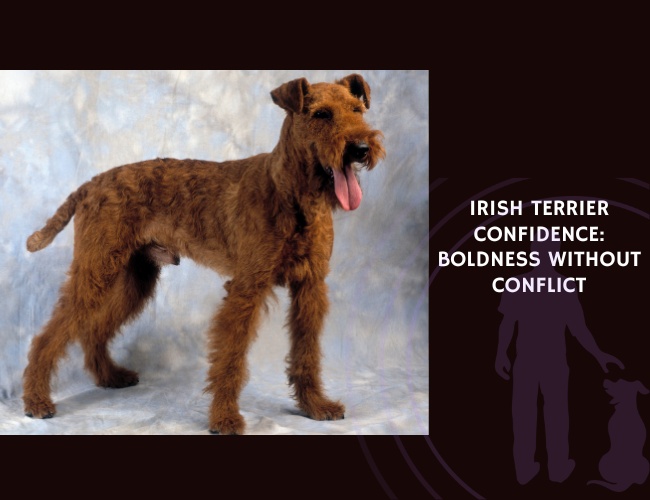
The Irish Terrier stands among the most spirited of all terrier breeds, carrying a reputation as a “dare-devil” with a heart full of courage and a body built for action. But what separates this breed’s magnificent boldness from conflict-seeking confrontation? Understanding the difference means the contrast between a confident companion and a dog perpetually on edge, ready to turn every interaction into a challenge.
This distinction matters deeply. You might notice that your Irish Terrier seems to walk through the world with an unmistakable presence, a readiness that feels both admirable and, at times, concerning. That forward energy, that quick pivot from calm to engaged, that unwillingness to back down—these traits emerge directly from centuries of purposeful breeding. Yet they also create a delicate balance that modern handlers must learn to navigate.
Let us guide you through the fascinating neurobiology and behavioral patterns that define Irish Terrier confidence, and more importantly, how to channel that magnificent spirit without inviting conflict into your daily life. 🧡
Historical Role & Temperament Design: The Making of a Dare-Devil
Understanding the Irish Terrier means traveling back through generations of purposeful selection, where every trait you see today served a specific, often dangerous function on Irish farms and battlefields.
Farm Workers, Messengers, and Family Protectors
The Irish Terrier’s historical functions have profoundly shaped its unique temperament, characterized by a rare blend of courage, speed, and an immediate readiness to engage. Unlike breeds developed for a single specialized task, the Irish Terrier needed to be a generalist—equally capable of hunting vermin in tight spaces, carrying messages across war-torn landscapes, and protecting the family homestead from both animal and human threats.
This versatility demanded something exceptional. As vermin controllers, they needed to be fearless in confronting pests, often in confined spaces where retreat meant failure. Their role as messengers during wartime necessitated not just speed and endurance, but the mental fortitude to continue through chaos, explosions, and danger without faltering. Their function as family protectors required an inherent boldness to deter threats and a keen sense of loyalty that made them willing to stand between their people and danger.
These roles collectively fostered a temperament that is quick to react, physically capable, and mentally resilient. The Irish Terrier was quite literally bred to face challenges head-on, with retreat being the least favorable option. Did you know that this historical foundation creates a dog whose first instinct, even today, is forward pressure rather than avoidance?
How Historical Roles Shape Modern Behavior:
- Vermin control work → Fearlessness in confined spaces, quick reaction to movement, high prey drive, persistent engagement
- Messenger duties → Mental resilience under stress, ability to focus despite chaos, sustained drive without human direction
- Property protection → Alert vigilance, willingness to challenge threats, strong territorial instincts, immediate response to perceived danger
- Independent farm work → Self-reliance in decision-making, problem-solving orientation, resistance to passive obedience, intelligent boundary testing
Selection for Forward Pressure and Fight Readiness
Given their historical duties, Irish Terriers were indeed selected for traits that emphasize forward pressure and a certain “fight readiness” that exceeds many other terrier breeds. Unlike some terriers bred primarily for digging or specific hunting tasks, the Irish Terrier’s versatility across roles, particularly protection and vermin control, favored individuals who were not only brave but assertive and persistent in confrontation.
This selection pressure created what we see today—a breed with a low propensity for retreat and a high probability of engagement when challenged. They don’t simply stand their ground; they often move forward into uncertain situations with confidence that can appear almost reckless to handlers unfamiliar with the breed’s nature.
Independence and Modern Boundary Testing
The history of independent work, where Irish Terriers often had to make decisions without direct human command, instilled a strong sense of self-reliance and intelligence. On the farm, they couldn’t wait for instructions when a rat appeared or when a potential threat approached the property. They assessed, decided, and acted.
In modern contexts, this independence manifests as a willingness to challenge boundaries or test rules, especially if leadership is perceived as inconsistent or unclear. Their inherent problem-solving abilities, combined with their boldness, mean they are less likely to passively accept limitations. You might notice your Irish Terrier exploring the limits of your authority, not out of malice, but because their genetic heritage tells them that intelligent assessment and independent action are valuable survival skills.
Through the NeuroBond approach, we recognize that this independence isn’t defiance—it’s genetic memory seeking appropriate structure.
True Confidence vs. Confrontation: Reading the Difference
Distinguishing between genuine confidence and arousal-driven confrontation becomes crucial for understanding and managing Irish Terrier behavior effectively. The difference isn’t always obvious, but learning to read these signals transforms your relationship with your dog. 🧠
Behavioral Markers of Genuine Confidence
True confidence in an Irish Terrier reveals itself through specific, observable patterns. A confident dog displays a relaxed yet attentive body posture, with fluid movement and clear, decisive actions. Watch how a truly confident Irish Terrier assesses a situation—there’s a calmness in the evaluation, a moment of consideration before action.
A confident dog will encounter a new situation, make a choice, and recover quickly from any minor stressors. Their tail may be up, but it’s not rigid. Their ears are forward, but they swivel to catch sounds. Their mouth may be closed, but it’s soft, not tense. When something unexpected happens, they might startle but quickly return to baseline, investigating with curiosity rather than alarm or aggression.
The recovery speed tells the story. A confident Irish Terrier who encounters something surprising—a loud noise, an unfamiliar object—will orient toward it, assess briefly, and either investigate calmly or dismiss it and move on. The entire sequence might take seconds, and throughout, you’ll notice relaxed breathing, loose body movement, and a willingness to check in with you.
True Confidence Indicators:
- Relaxed, fluid body posture with soft muscle tone
- Tail up but wagging or mobile, not rigid
- Ears forward but scanning, swiveling to catch sounds
- Soft mouth and jaw, possibly panting calmly
- Brief assessment before action, showing decision-making process
- Quick recovery from startle (seconds, not minutes)
- Willing to check in with handler during assessment
- Can take treats and respond to cues near mild triggers
Conflict-Seeking Arousal Indicators:
- Stiff, rigid body with visible muscle tension
- Fixed forward stare without breaking focus
- Hackles raised along spine and sometimes shoulders
- Hard, closed mouth or escalating vocalizations
- Immediate reaction without assessment period
- Slow recovery or holding arousal after incident
- Ignoring handler completely, tunnel vision on trigger
- Unable to take treats or respond to familiar cues
Conflict-Seeking Arousal Patterns
In contrast, conflict-seeking arousal typically involves a stiffening of the body that’s unmistakable once you learn to see it. The dog’s muscles become tense, creating a rigid quality to their stance. You’ll notice a fixed forward stare—not the soft, scanning gaze of interest, but a hard, locked focus that doesn’t break.
Raised hackles often accompany this state, running along the spine and sometimes extending to the shoulders. Vocalizations escalate from low growls to insistent barks, increasing in intensity and frequency. This state is accompanied by a heightened physiological response—faster breathing, dilated pupils, heightened muscle tension—all indicating a readiness for confrontation rather than a calm assessment.
The key difference? In arousal-driven confrontation, the dog isn’t evaluating options. They’ve already decided that action is necessary, and they’re preparing their body for engagement. The decision precedes the assessment, driven by internal arousal rather than external necessity.
Excitement Escalation vs. Fear-Based Responses
Irish Terriers, due to their inherent boldness and low retreat probability, are generally less prone to fear-based aggression compared to some other breeds. This distinction matters tremendously when planning training and management strategies.
Instead, their escalation often stems from excitement, a strong prey drive, or a perceived social challenge. Their “dare-devil” nature means they are more likely to meet a challenge head-on, interpreting social pressure or perceived rudeness from another dog as an invitation to engage rather than a threat to be avoided.
You might see this when your Irish Terrier spots a dog across the street. Rather than cowering or attempting to hide behind you, they pull forward, body tense with excitement and readiness. The energy isn’t fear—it’s anticipation, challenge acceptance, an eagerness to engage that can quickly spiral if not properly managed.
When Frustration Becomes Conflict
Frustration serves as a significant trigger for conflict behavior in bold dogs like the Irish Terrier. Blocked movement, such as being restrained on a leash when they want to engage or investigate, can quickly transform their natural forwardness into reactive aggression.
Imagine your dog’s experience: they see something that every fiber of their being tells them to investigate or address, yet the leash prevents forward movement. The frustration builds rapidly, often faster than in less bold breeds, and that frustration seeks an outlet. Sometimes that outlet becomes the very thing that blocked them—the leash, your hand, or any nearby target.
Inconsistent rules or unclear boundaries can also lead to frustration, as the dog struggles to understand expectations. This confusion potentially leads to increased boundary testing and confrontational behaviors as they try to assert control or relieve their confusion. The Irish Terrier’s intelligent, independent nature means they need clarity and consistency to feel secure. Without it, their boldness can manifest as oppositional behavior.
Common Frustration Triggers That Lead to Conflict:
- Leash restraint when dog wants to investigate or greet
- Blocked doorways or pathways when dog is in forward-moving mode
- Inconsistent rules (sometimes allowed on furniture, sometimes not)
- Unclear handler communication or mixed signals
- Waiting without understanding why or for how long
- Interrupted play or activity without transition warning
- Being pushed past threshold in training sessions
- Environmental restrictions without alternative outlets for drive
Social Boundaries & Status Sensitivity: The Respect Code
Irish Terriers often exhibit a distinct approach to social interactions, influenced by their historical roles and inherent temperament. Understanding this “respect code” helps you navigate the social world with your dog more effectively.
The Terrier Respect Code
It’s plausible that Irish Terriers operate with a stronger “respect code” than many companion breeds. Their history as independent workers and protectors suggests a need for clear social hierarchies and boundaries. They may interpret pushy or rude behavior from other dogs as a challenge to their social standing or personal space, prompting them to respond with pushback rather than avoidance or submission.
This assertiveness is a hallmark of their confident nature. Where a Golden Retriever might tolerate another dog’s rude greeting with patient acceptance, an Irish Terrier is more likely to communicate clearly and immediately that such behavior is unacceptable. They’re setting boundaries, not starting fights—though the distinction can be lost in the intensity of their communication.
Interpreting Rude Dog Behavior
Irish Terriers are likely to interpret rude dog behaviors such as charging greetings, mounting, or intrusive sniffing as direct social challenges or invasions of personal space. Given their quick arousal speed and historical “fight readiness,” they are likely to respond rapidly and assertively to such provocations.
Their response might be immediate and firm, aiming to establish boundaries and communicate their displeasure effectively. What appears to other handlers as “starting a fight” is often, from the Irish Terrier’s perspective, a necessary correction of social rudeness. They’re not interested in conflict for conflict’s sake—they’re establishing that certain behaviors are unacceptable.
You might notice that your Irish Terrier has little patience for the boisterous, boundary-less greetings that some dogs offer. While other breeds might tolerate being bowled over or having their space invaded, your Irish Terrier will likely communicate “back off” with unmistakable clarity.
Rude Dog Behaviors Irish Terriers Typically Challenge:
- Charging greetings with no respect for personal space
- Mounting attempts (regardless of the “reason”)
- Persistent face sniffing without permission signals
- Body slamming or rough physical contact during greetings
- Sustained direct eye contact with forward body pressure
- Intrusive genital sniffing without proper greeting sequence
- Resource guarding displays over communal space or items
- Pushy behavior around food, toys, or handler attention
Same-Sex Tension and Finishing What’s Started
Due to their strong personalities and potential “respect code,” Irish Terriers can be prone to same-sex tension, particularly with other dominant or assertive dogs. They often exhibit a “don’t start it, but finish it” pattern, meaning they may not initiate conflict but will readily engage and persist if provoked or challenged.
This behavior stems from their inherent courage and unwillingness to back down once a confrontation has begun. It’s not that they’re looking for trouble, but once trouble finds them, their genetic programming tells them that backing down is not an option. This can create challenging situations in dog parks or social settings where other dogs might test boundaries.
The same-sex tension appears particularly pronounced with other confident, assertive dogs who also have strong ideas about social hierarchy and personal space. Two Irish Terriers of the same sex, or an Irish Terrier and another strong-willed terrier, may find themselves in a social dance where neither is willing to defer, creating an escalating tension that requires careful management.
Arousal Speed & Recovery Ability: Understanding the Switch
Understanding an Irish Terrier’s arousal and recovery patterns is key to managing their intensity. The speed at which they transition between states directly impacts your daily life together. 🧠
Rapid Transition to High Drive
Irish Terriers are known for their rapid transition from a neutral state to high drive. This latency—the time between trigger and response—can be significantly influenced by various triggers. Movement, especially of small animals or fast-moving objects, can instantly activate their prey drive. One moment they’re walking calmly beside you, the next they’re lunging toward a squirrel with explosive force.
Social challenges from other dogs or even perceived threats can quickly escalate their arousal. Furthermore, your tone and body language play a crucial role. Handler tension or excitement can inadvertently amplify the dog’s arousal, leading to a quicker shift to a high-drive state. Research indicates that selective activation of certain neurons can elicit rapid transitions from sleep to wakefulness and produce sustained arousal, which is commonly observed after acute stress exposure.
You might notice that your Irish Terrier seems to have an “on-off” switch rather than a gradual dial. They’re either calm or fully engaged, with little middle ground. This binary quality makes management both simpler and more challenging—simpler because the signs are clear, more challenging because the transition happens so quickly that prevention becomes essential.
Triggers That Accelerate Arousal Speed:
- Movement-based: Squirrels, cats, joggers, bicycles, skateboards, children running
- Social challenge: Direct stares from other dogs, aggressive posturing, barrier frustration
- Handler energy: Tense leash grip, anxious body language, raised voice tone, frantic movements
- Environmental: Sudden loud noises, unexpected movements in peripheral vision, crowded spaces
- Prey drive: Small animal scurrying, birds taking flight, rapid motion at ground level
- Territorial: Approach to home territory, someone at the door, dogs passing property line
Recovery Patterns and Sustained Arousal
While Irish Terriers can be quick to engage, their recovery ability can vary significantly. Without proper training and management, they may hold arousal after an incident, especially if the situation was highly stimulating or if they felt unresolved. This sustained arousal can predispose them to repeated confrontational behavior, as they remain in a heightened state of readiness, making them more likely to react to subsequent triggers.
Think of it as their nervous system remaining in an elevated state even after the initial trigger has passed. The dog who barked at another dog ten minutes ago might still be carrying that arousal, making them more reactive to the next dog they encounter. This stacking effect means that multiple minor incidents throughout a walk can accumulate, leading to what appears to be an overreaction to a relatively minor final trigger.
Teaching recovery becomes as important as teaching engagement. Your Irish Terrier needs to learn that after activation, there’s a return to baseline. This skill doesn’t come naturally to many terriers—it must be taught, practiced, and reinforced until it becomes a reliable pattern.
Signs Your Irish Terrier Is Holding Arousal (Poor Recovery):
- Panting continues 10+ minutes after trigger has passed
- Scanning behavior—constantly looking for the next trigger
- Unable to settle or lie down calmly within 15 minutes
- Hypervigilant to sounds and movements that normally wouldn’t register
- Lower threshold for reactivity to subsequent triggers
- Difficulty taking treats or responding to familiar cues
- Pacing, circling, or inability to maintain position
- Tail remains elevated and stiff rather than relaxing
- Continued muscle tension visible in shoulders and neck
Movement Triggers and Prey Drive
Movement serves as one of the most powerful triggers for Irish Terrier arousal. Their eyes are wired to detect motion, and their bodies are built to pursue. A jogger passing by, a bicycle, a skateboard, a child running—any of these can flip the switch from calm to activated in milliseconds.
The intensity of the prey drive varies among individuals, but the Irish Terrier as a breed tends toward the higher end of the spectrum. This makes sense given their historical role as vermin hunters, where the ability to spot, chase, and catch fast-moving prey directly impacted their effectiveness and survival.
Managing movement triggers requires both environmental awareness and training. You need to see the trigger before your dog does, allowing you to create distance or redirect attention before arousal spikes. Teaching a reliable “watch me” or attention cue gives you a tool to interrupt the visual lock-on that precedes the chase response.
Sleep, Rest & Daily Rhythm: The Foundation of Emotional Stability
The connection between adequate rest and behavioral stability is often overlooked, yet it represents one of the most powerful tools for managing Irish Terrier confidence and preventing conflict escalation.
The Neuroscience of Rest and Recovery
Sleep, rest routines, and a consistent daily rhythm are critical for your Irish Terrier’s emotional stability. Research consistently demonstrates that inadequate sleep or disrupted routines can significantly impair mental recovery processes and emotional stability, potentially leading to increased stress perception and diminished cognitive abilities.
For a high-drive breed like the Irish Terrier, sufficient rest allows their nervous system to reset, reducing overall arousal levels and promoting a calmer, more balanced temperament. Think of sleep as the time when your dog’s brain processes the day’s experiences, consolidates learning, and returns arousal systems to baseline. Without adequate rest, this recovery process remains incomplete.
Poor sleep quality is consistently linked to reduced attention span, impaired memory consolidation, and increased emotional instability. For Irish Terriers, these effects can directly exacerbate confrontational tendencies. A sleep-deprived dog has less capacity for impulse control, recovers more slowly from arousal spikes, and operates with a shorter fuse when encountering triggers.
How Much Rest Does an Irish Terrier Need?
You might be surprised to learn that adult dogs need between 12-14 hours of sleep per day, with puppies and adolescents requiring even more. Yet many high-drive Irish Terriers in active households receive far less, particularly if their environment offers constant stimulation without enforced rest periods.
The quality of rest matters as much as quantity. Your Irish Terrier needs true, deep sleep—not just lying down while remaining alert to household activity. A dog who appears to rest but whose ears perk at every sound, whose eyes track movement, whose body remains slightly tense, isn’t achieving the restorative rest their nervous system requires.
Creating a Rest-Positive Environment
Establishing a rest routine means creating both the environment and the expectation for downtime. Designate a quiet space—a crate, a bed in a calm room, a mat in a low-traffic area—where your Irish Terrier can fully relax without feeling they need to monitor their surroundings.
Creating a Rest-Positive Environment:
- Designate a specific rest area away from household traffic
- Use white noise machines or calming music to buffer sudden sounds
- Ensure the space is temperature-controlled and comfortable
- Provide a covered crate or bed with sides for security
- Dim lighting during rest periods to signal downtime
- Remove stimulating toys—save these for active periods
- Train “place” or “settle” cues associated with this space
- Enforce rest periods after every stimulating activity
- Aim for 12-14 hours of total rest/sleep per 24-hour period
Many Irish Terriers benefit from enforced rest periods, particularly during adolescence when their natural inclination is to remain constantly engaged. After stimulating activities—training sessions, walks, play—implement a “settle” period where your dog practices calm duration. This might feel counterintuitive with such a high-energy breed, but teaching them to power down is as important as providing outlets for their drive.
You might notice that on days following poor sleep or disrupted routines, your Irish Terrier is more reactive, less responsive to cues, and quicker to escalate. This isn’t coincidence—it’s neurobiology. Their capacity for self-regulation depends on adequate neural recovery, which only happens during true rest.
Behavioral Signs of Inadequate Rest:
- Increased reactivity to triggers that are normally manageable
- Reduced impulse control—quicker to lunge, bark, or engage
- Difficulty focusing during training sessions
- Shorter attention span and reduced learning ability
- More frequent boundary testing and rule challenges
- Irritability with other pets or family members
- Reduced tolerance for handling or routine care
- Slower recovery from arousal spikes
- Appearing simultaneously “tired” yet unable to settle
Daily Rhythm and Predictability
Consistent daily rhythms help regulate your Irish Terrier’s nervous system. Feeding at consistent times, walking at similar times, implementing predictable rest periods after activity—these patterns create a framework that supports emotional stability.
When daily routines vary dramatically, your dog’s arousal system remains in a state of preparedness, never fully knowing what to expect or when. This unpredictability can maintain elevated baseline arousal, making them more likely to react strongly to triggers. A predictable rhythm, conversely, allows their system to anticipate rest periods and fully relax into them.
Consider implementing “power down” rituals in the evening—dimming lights, reducing household activity, providing a chew or quiet activity—that signal to your Irish Terrier that the day is ending and rest is approaching. These cues help their nervous system begin the transition toward sleep, improving both the speed of falling asleep and the depth of rest achieved. 🧠
Sample Daily Rhythm for Arousal Management:
- Morning (6-9am): Calm wake-up, bathroom break, breakfast, enforced rest period (1-2 hours)
- Mid-Morning (10am-12pm): Training session or mental enrichment, followed by rest
- Afternoon (1-4pm): Main walk with decompression time, lunch if feeding twice daily, rest period
- Evening (5-7pm): Light activity or training, dinner, enforced settling time
- Night (8pm-6am): Power-down ritual, final bathroom break, overnight sleep in designated rest area
- Total active time: 3-5 hours of engagement spread throughout day
- Total rest time: 12-14 hours of sleep/rest periods

Training Challenges: Corrections, Pushback, and Oppositional Behavior
The Irish Terrier’s temperament creates unique training challenges that require a sophisticated understanding of learning theory and behavioral responses.
Why Harsh Corrections Can Backfire
Irish Terriers possess what might be termed “fight drive,” a willingness to push back against perceived unfairness or excessive force. This trait, bred for confronting threats and persisting through adversity, means that harsh corrections can backfire spectacularly.
When you apply a harsh correction—a hard leash pop, a loud reprimand, physical intimidation—an Irish Terrier’s natural response isn’t necessarily submission or compliance. Instead, their genetic programming may interpret this as a challenge or a fight, triggering oppositional behavior rather than learning. They might escalate rather than submit, turning a training moment into a conflict.
This doesn’t mean Irish Terriers can’t handle corrections or boundaries. It means the corrections must be fair, clear, and proportional. A brief “no” or a calm physical boundary often achieves what yelling or force cannot. Through the NeuroBond approach, corrections become information rather than confrontation, teaching without triggering defensive responses.
Why Harsh Corrections Backfire with Irish Terriers:
- Activates their “challenge reflex” rather than creating compliance
- Triggers oppositional behavior and increased resistance
- Damages trust and erodes the handler-dog relationship
- Creates fear or anxiety that increases arousal and reactivity
- Teaches that conflict is an appropriate response to pressure
- May suppress behavior temporarily but doesn’t teach alternatives
- Can create learned helplessness or shut-down behavior
- Often escalates the very behaviors you’re trying to eliminate
Intelligent Resistance and Boundary Testing
The combination of intelligence and boldness creates what we might call “intelligent resistance.” Your Irish Terrier isn’t just randomly testing boundaries—they’re actively gathering information about the rules, your consistency, and what consequences actually follow their choices.
They might test the same boundary repeatedly, but each time they’re noting your response. Are you consistent? Do you follow through? Does your “no” always mean no, or only sometimes? This information-gathering isn’t defiance—it’s intelligence applied to understanding their social environment.
You might notice that your Irish Terrier seems to push harder when rules are unclear or inconsistently enforced. They’re not being stubborn—they’re trying to establish clarity in an ambiguous situation. Once they understand that a rule is firm and consistently applied, they often accept it readily. But getting to that point requires unwavering consistency from you.
Effective Correction and Boundary-Setting Methods:
- Brief, calm verbal markers (“no,” “eh-eh”) without emotional charge
- Physical spatial pressure (body blocking, claiming space) without force
- Removal of opportunity (closing door, removing toy) as consequence
- Time-outs in calm, neutral spaces (not punishment, just removal from situation)
- Redirection to appropriate alternative behavior with reward
- Environmental management to prevent rehearsal of unwanted behavior
- Consistent consequences that follow every instance of the behavior
- Calm, neutral energy throughout the correction process
- Immediate return to positive interaction once behavior stops
Impulse Control Through Structure
Teaching impulse control to an Irish Terrier means building structure that works with their nature rather than against it. The most effective approach involves creating clear patterns and expectations that become automatic through repetition.
Door boundaries offer a perfect example. Rather than allowing your Irish Terrier to blast through doorways whenever they please, teach that every door requires a pause, a check-in with you, and permission to proceed. This single pattern, consistently enforced, teaches self-control that generalizes to other situations.
Food manners provide another opportunity. Teaching your dog to wait calmly while their bowl is prepared, to sit or lie down before receiving it, and to wait for a release word before eating builds the neural pathways of impulse control. These moments of required restraint, practiced multiple times daily, strengthen their ability to pause and think rather than simply react.
Foundation Impulse Control Exercises:
- Door boundaries: Sit and wait at every doorway until released
- Food manners: Calm sit-stay during meal preparation, wait for release word
- Place work: Go to designated spot and hold position with duration
- Wait at curbs: Automatic stop and sit before crossing streets
- Greeting protocol: Sit for petting, all four paws on ground for interaction
- Toy release: “Drop it” or “give” on first cue, rewarded with return or trade
- Leash manners: Stop forward movement when leash tightens, reward loose leash
- Settle practice: Down-stay on mat/bed in various locations and durations
The Invisible Leash principles emphasize calm pacing, spatial clarity, and predictable transitions. These elements teach your Irish Terrier that leadership is consistently present and that conflict is unnecessary. By maintaining a calm, consistent pace during walks, defining personal space clearly, and signaling transitions predictably, you communicate reliable leadership. This structure provides security and predictability, reducing the need to take charge or react defensively.
Teaching Bold Stillness
Teaching “bold stillness” involves training your Irish Terrier to maintain a calm, confident posture without feeling the need to move forward or engage. This skill represents the pinnacle of impulse control—the ability to observe and assess without immediate action.
Start with “place” or “stay” exercises in low-distraction environments, gradually increasing the challenge level as your dog succeeds. The goal isn’t just physical stillness, but mental calmness—a dog who can remain on place while interesting things happen around them, without their arousal spiking or their body tensing for action.
Teaching your dog to observe without reacting requires practice and patience. Use a “watch me” or “look” cue to redirect their attention to you when distractions appear. Reward calm duration—the longer they remain relaxed and attentive to you despite distractions, the more you reinforce that state.
The goal is to instill understanding that confidence doesn’t always require action. Sometimes the most powerful response is a controlled presence, a calm observation, a choice not to engage. This mental maturity transforms a reactive dog into a thoughtful one, preserving all their magnificent boldness while adding the critical element of choice. 🧡
Teaching Bold Stillness: Progression Steps
- Week 1-2: Place/stay in quiet home environment, 30-second duration, no distractions
- Week 3-4: Increase duration to 2 minutes, add mild distractions (toys visible, person walking by)
- Week 5-6: Practice in different locations in home, add moderate distractions (doorbell, TV on)
- Week 7-8: Move to front yard or quiet outdoor space, 1-minute duration with distance
- Week 9-10: Practice near mild triggers at distance (dogs 50+ feet away, people passing)
- Week 11-12: Gradually decrease distance to triggers while maintaining calm stillness
- Ongoing: Practice in increasingly challenging environments, reward calm duration heavily
Practical Impulse Control Skills: Your Training Toolkit
Beyond the conceptual understanding of impulse control, your Irish Terrier needs specific, practiced skills that translate theory into reliable behavior. These tools give both you and your dog clear pathways for managing challenging situations.
Disengage Cues: Breaking the Lock
Teaching a reliable disengage cue like “let’s go” or “this way” empowers you to interrupt your Irish Terrier’s focus on a trigger before arousal escalates. This isn’t a correction—it’s information and direction. When you notice your dog beginning to lock onto another dog, a squirrel, or any trigger, your disengage cue means “break that focus and come with me.”
Practice this skill first in low-distraction environments. Say your cue, take a few steps in a new direction, and reward heavily when your dog follows. Gradually increase difficulty by practicing near mild distractions, always setting your dog up to succeed. The goal is building a neural pathway where the cue automatically shifts their attention from the trigger to you and movement away from it.
Training Disengage Cues: Step-by-Step Protocol
- Choose your cue: “Let’s go,” “This way,” or “With me” (keep it consistent)
- Start indoors: Say cue, take 3-5 steps away, mark and reward when dog follows
- Add mild distractions: Practice near toys, food bowls, low-value items
- Increase difficulty: Practice in yard with moderate distractions (birds, sounds)
- Add distance work: Practice disengaging from items at 10, 20, 30 feet away
- Real-world practice: Use on walks when dog shows interest in benign triggers
- Proof with triggers: Practice at distance from dogs, people, other high-value stimuli
- Build reliability: Practice 10-15 reps daily in various contexts for consistent response
Controlled Approach Routines: Managing Excitement
Irish Terriers often struggle with greeting situations because their excitement and forward energy create immediate intensity. A controlled approach routine teaches them that all greetings happen at a calm pace with specific rules.
Start by practicing approaches to non-living objects—a tree, a cone, a doorway. Your dog must walk calmly beside you, sit before reaching the object, wait for your release word, then investigate calmly. This pattern, practiced hundreds of times with objects, eventually transfers to more exciting targets like people or dogs.
The key is absolute consistency. Every. Single. Time. No exceptions for “friendly” moments or when you’re in a hurry. Each exception erodes the pattern and teaches your dog that sometimes excitement gets rewarded, making the behavior inconsistent and unreliable.
Automatic Check-Ins: Building Connection
An automatic check-in is perhaps the most valuable skill you can develop. This means your Irish Terrier habitually looks to you for information and guidance, especially in stimulating environments. Rather than scanning for threats or opportunities independently, they’re checking in: “What should I do? Where are we going? Is this okay?”
Build this through heavy reinforcement during walks and training. Every time your dog looks at you voluntarily, mark it enthusiastically and reward. Make checking in the most rewarding thing your dog can do. Over time, this creates a habit loop where stimulating environments trigger the check-in rather than independent action.
You might notice that as check-ins increase, reactivity decreases. This happens because your dog is seeking your input before reacting, creating a moment of pause that interrupts the trigger-reaction sequence.
Building Automatic Check-Ins: Training Strategy
- Mark and reward every voluntary eye contact during walks (high rate of reinforcement initially)
- Practice “name game”—say dog’s name, mark and reward immediate attention
- Use varied, high-value rewards to maintain motivation for checking in
- Increase difficulty gradually—practice in busier environments as skill develops
- Capture check-ins before triggers appear—reward scanning that includes you
- Create patterns: check-in at every corner, street crossing, direction change
- Fade food rewards gradually, replacing with life rewards (permission to sniff, move forward)
- Practice “find it” games that require dog to check in before searching
- Celebrate enthusiastically when dog chooses to check in near triggers
“Leave It” Under Social Pressure
Teaching “leave it” is common, but teaching it under social pressure—with another dog present, during high arousal, in the presence of strong triggers—requires specific training. This skill prevents escalation when encountering other dogs or tempting distractions.
Start with food or toys, building a strong foundation where “leave it” means “orient away from that thing and look at me.” Gradually progress to practicing near other dogs at distance, rewarding your Irish Terrier for orienting away from the other dog when cued. This is incredibly difficult for a breed wired to engage, which is precisely why it requires extensive practice with careful progression.
The real-world application means you can cue “leave it” when another dog approaches rudely, when your dog spots a trigger, or when arousal begins climbing. Combined with your disengage cue, this gives you powerful tools for preventing conflict before it starts.
Pattern Games and Structured Movement
Pattern games and structured movement are highly effective for reducing confrontation by lowering arousal in high-trigger environments. Engaging your Irish Terrier in predictable patterns of movement—figure-eights, U-turns, walking at different paces—and mental games like scent work or obedience drills redirects their focus and energy.
When you’re in an environment with multiple triggers—a busy park, an urban street—rather than simply walking and hoping your dog can manage the stimulation, give them a job. Practice heel work. Do random direction changes. Stop and ask for a sit-stay, then release and continue. These structured activities channel their drive, reduce anxiety, and prevent the escalation of arousal that often precedes confrontational behavior.
The cognitive engagement of pattern work also fatigues your dog differently than physical exercise alone. Mental tiredness promotes calmness in a way that physical exhaustion doesn’t always achieve, particularly with high-drive breeds who can become more aroused the more they physically exert themselves. 🧠
Effective Pattern Games for Arousal Management:
- Figure-8 weaving: Walk in figure-8 patterns around cones/trees, varying speed and direction
- Random direction changes: Walk 10 steps, turn randomly, reward focus and following
- Pace variations: Alternate between slow walk, normal pace, quick step—dog must adjust
- Up-down transitions: Sit-stand-down sequences in rapid succession with rewards
- Find it scatter: Toss treats in grass, say “find it,” reward thorough searching behavior
- 1-2-3 pattern: Walk 1 step, stop; 2 steps, stop; 3 steps, stop—builds focus and impulse control
- Circle work: Walk in circles (both directions), varying diameter and speed
- Zen bowl: Food bowl on ground, reward dog for looking at you instead of lunging for it
Bold. Balanced. Composed.
Confidence Moves Forward
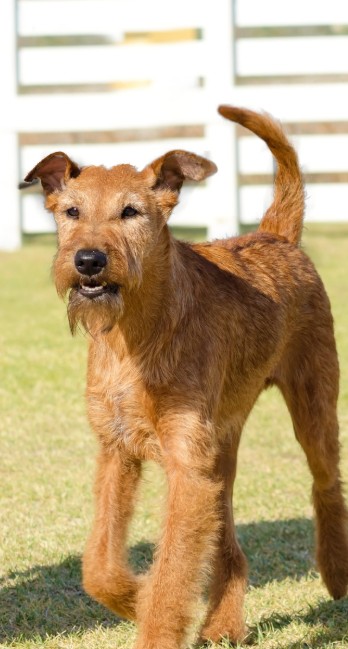
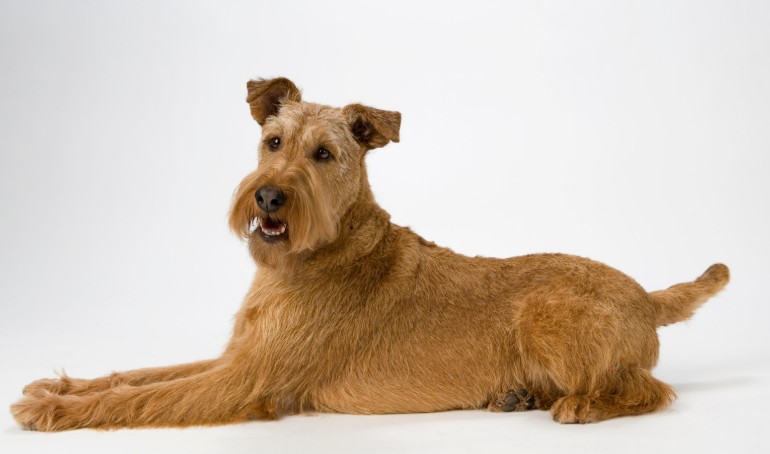
Irish Terriers carry natural forward energy shaped by purposeful courage. Their boldness reflects readiness, not a search for confrontation.
History Built Nerve
Farm work, protection, and messenger roles selected for dogs who engaged challenges directly. This heritage fuels confidence that activates quickly.

Direction Prevents Conflict
When bold energy lacks guidance, it can tip into reactivity. Clear structure channels courage into calm, controlled presence.
Nutritional Impact on Behavior: Feeding the Calm Brain
What you feed your Irish Terrier doesn’t just fuel their body—it directly influences their nervous system, arousal levels, and capacity for impulse control. Understanding the nutrition-behavior connection gives you another powerful tool for managing confidence without conflict.
Protein Quality and Arousal Levels
Irish Terriers, like all high-drive working breeds, require quality protein for muscle maintenance and energy. However, the amount and type of protein can influence behavior. Extremely high protein diets, particularly those heavy in certain amino acids, can increase arousal and reactivity in some dogs.
Tryptophan, an amino acid found in turkey, chicken, and certain fish, serves as a precursor to serotonin—a neurotransmitter that promotes calmness and emotional regulation. Tyrosine, found in high concentrations in red meats and some fish, serves as a precursor to dopamine and norepinephrine—neurotransmitters associated with arousal, alertness, and drive.
For an Irish Terrier already prone to high arousal and quick engagement, a diet heavily weighted toward tyrosine-rich proteins might amplify these tendencies. You might experiment with protein sources that offer better tryptophan-to-tyrosine ratios, potentially supporting calmer baseline behavior.
Protein Sources and Behavioral Impact:
- Higher tryptophan (potentially calming): Turkey, chicken breast, eggs, cottage cheese, certain white fish
- Higher tyrosine (potentially arousing): Red meats (beef, lamb), salmon, tuna, pork, game meats
- Balanced options: Duck, rabbit, whitefish varieties, some plant proteins
- Consideration: Individual dogs vary—observe your dog’s behavior patterns with different proteins
- Strategy: For reactive dogs, consider rotating toward higher-tryptophan proteins as primary source
- Timing: Feed calming proteins in evening meals, can use moderate-tyrosine proteins for breakfast
- Quality matters: Whole food proteins process differently than heavily processed meal-based foods

Complex Carbohydrates and Blood Sugar Stability
Blood sugar fluctuations can significantly impact behavior. Simple carbohydrates cause rapid spikes and crashes in blood glucose, which can manifest as irritability, reduced impulse control, and difficulty maintaining emotional stability—the same challenges that predispose Irish Terriers to conflict.
Complex carbohydrates from sources like sweet potato, oats, and brown rice provide sustained energy release, helping maintain stable blood sugar throughout the day. This stability supports consistent arousal levels and better capacity for self-regulation.
You might notice that on days when your Irish Terrier receives treats high in simple sugars—many commercial training treats fall into this category—their behavior becomes more erratic, their recovery from arousal slower, and their impulse control diminished.
Carbohydrate Sources for Blood Sugar Stability:
- Excellent choices (slow, steady release): Sweet potato, pumpkin, steel-cut oats, brown rice, quinoa, lentils
- Moderate choices: White rice, regular oatmeal, barley, millet
- Avoid or minimize: Wheat flour, corn, simple sugars, white potatoes, many commercial treat fillers
- Training treat strategy: Use protein-based treats (freeze-dried meat, cheese) instead of grain-heavy options
- Meal timing: Consider smaller, more frequent meals to maintain blood sugar stability
- Pre-training meals: Feed 2+ hours before training to avoid post-meal energy spikes
- Monitor behavior: Track correlation between carbohydrate sources and reactivity patterns
Omega-3 Fatty Acids and Brain Function
Omega-3 fatty acids, particularly EPA and DHA found in fish oil, play crucial roles in brain health and inflammatory response regulation. Research consistently demonstrates that adequate omega-3 intake supports cognitive function, learning ability, and emotional regulation.
For Irish Terriers, whose training success depends heavily on their ability to learn impulse control and recover quickly from arousal, ensuring adequate omega-3 intake through quality fish-based proteins or supplementation can support the neural processes underlying behavioral stability.
Omega-3 Fatty Acids: Supplementation Guidelines
- Target ratio: Look for EPA:DHA ratio of roughly 3:1 to 5:1
- Dosage: Generally 20-30mg EPA/DHA per pound of body weight daily (consult your vet)
- Food sources: Sardines, mackerel, anchovies, salmon, fish oil supplements
- Quality matters: Choose supplements tested for heavy metals and freshness (no fishy smell)
- Storage: Keep refrigerated to prevent oxidation and rancidity
- Timeline: Allow 6-8 weeks to see behavioral benefits from supplementation
- Combination approach: Use both whole fish foods and supplements for optimal benefits
- Monitor: Watch for loose stools (indicates too much fat) and adjust accordingly
Additives, Colors, and Behavioral Impact
Some dogs show sensitivity to artificial colors, flavors, and preservatives commonly found in commercial treats and foods. While individual sensitivity varies, these additives can increase hyperactivity and reduce impulse control in susceptible dogs.
If your Irish Terrier seems particularly reactive or struggles with arousal regulation despite solid training, consider eliminating all foods with artificial additives for several weeks to assess whether dietary factors contribute to behavioral challenges.
🐕 Irish Terrier Confidence Development 🧠
From Bold Puppy to Balanced Adult: The Complete Journey
Phase 1: Understanding the Foundation
Birth to 16 Weeks – Critical Imprinting Period
Historical Blueprint
Irish Terriers were bred for independent farm work, vermin control, and protection duties. This heritage created dogs with forward pressure, quick arousal speed, and low retreat probability. Understanding this genetic blueprint is essential—these aren’t dogs who naturally back down from challenges.
What to Expect
• Puppies show early boldness and curiosity
• Quick transitions from calm to engaged states
• Natural inclination toward investigation over avoidance
• Early signs of independence and problem-solving orientation
Foundation Training Focus
Focus on quality socialization over quantity—controlled distance observation of other dogs rather than constant direct interaction. Build neutral responses to triggers early. Establish impulse control foundations through door boundaries and food manners from day one.
Phase 2: Critical Socialization
3-14 Weeks – Building Neutrality Not Excitement
The Socialization Myth
Traditional advice of maximum exposure can backfire with Irish Terriers. Generic puppy classes and dog park chaos often teach patterns you’ll spend years undoing. The goal isn’t meeting hundreds of dogs—it’s learning to exist calmly in their presence.
Quality Over Quantity Approach
• Practice observation at 30-50 feet distance from other dogs
• Keep greetings brief (3-5 seconds) and end before arousal escalates
• Select calm, boundary-respecting playmates carefully
• Reward calmness around triggers, not excitement
• Build check-in behavior early and heavily
Critical Warning
One overwhelming experience during this window can create lasting reactivity patterns. Watch puppy body language closely—if they’re refusing treats, freezing, or showing persistent stress signals, remove them immediately and lower intensity.
Phase 3: Reading True Confidence
4-6 Months – Distinguishing Confidence from Arousal
True Confidence Indicators
Relaxed, fluid body posture with soft muscle tone. Quick recovery from startles (seconds, not minutes). Ability to take treats near mild triggers. Willingness to check in with handler during assessment. The confident dog evaluates before acting—there’s thought, not just reaction.
Conflict-Seeking Arousal Signs
• Stiff, rigid body with visible muscle tension
• Fixed forward stare without breaking focus
• Hackles raised along spine
• Immediate reaction without assessment period
• Slow recovery—holding arousal after incident
• Unable to respond to familiar cues
Building Bold Stillness
Teach your Irish Terrier that confidence doesn’t always require action. Through the Invisible Leash approach, practice “place” work in gradually challenging environments. The goal: a dog who can observe without reacting, maintaining calm presence despite distractions.
Phase 4: Adolescent Confidence Surge
6-18 Months – The Peak Challenge Phase
What Changes During Adolescence
Physical maturity outpaces emotional development. Hormonal changes amplify existing boldness traits. Your previously manageable puppy suddenly tests every boundary, shows increased same-sex tension, and may develop leash reactivity. This regression is normal—not training failure.
Structure Through the Storm
• Increase distance from triggers temporarily
• Enforce 14-16 hours rest daily despite protests
• Maintain all impulse control exercises religiously
• Avoid on-leash dog greetings completely
• Stay emotionally neutral—your anxiety worsens regression
Don’t Make This Mistake
Becoming either overly permissive or excessively harsh during adolescence creates long-term problems. Neither works with Irish Terriers. Maintain calm, consistent boundaries without escalating emotionally. This phase is temporary but your response patterns last.
Phase 5: Mastering Arousal Management
12-24 Months – Teaching Recovery and Regulation
The On-Off Switch Reality
Irish Terriers transition rapidly from neutral to high drive—they’re either calm or fully engaged with little middle ground. Understanding this binary quality means prevention becomes essential. You must see triggers before your dog does and manage distance proactively.
Essential Skills Training
• Disengage cues (“let’s go”) practiced 10-15 times daily
• Automatic check-ins rewarded heavily in all environments
• Pattern games (figure-8s, direction changes) for arousal reduction
• “Leave it” under social pressure with other dogs present
• Recovery training—teaching return to baseline after activation
Sleep’s Critical Role
Inadequate rest directly impairs impulse control and increases reactivity. Your high-drive Irish Terrier needs 12-14 hours of true rest daily. Sleep-deprived dogs show increased reactivity, slower recovery, and reduced learning ability. Rest isn’t optional—it’s foundational.
Phase 6: Nutrition & Behavior Connection
All Ages – Feeding the Calm Brain
Protein Impact on Arousal
Tryptophan-rich proteins (turkey, chicken, certain fish) support serotonin production and calmness. Tyrosine-heavy proteins (red meats, salmon) support dopamine and arousal. For reactive Irish Terriers, rotating toward higher-tryptophan proteins as primary sources may support calmer baseline behavior.
Blood Sugar Stability Strategy
• Choose complex carbohydrates (sweet potato, oats, brown rice)
• Avoid simple sugars in training treats—use protein-based options
• Consider smaller, more frequent meals for stability
• Feed 2+ hours before training sessions
• Add omega-3 supplementation (20-30mg EPA/DHA per pound daily)
Observational Testing
Track your dog’s behavior patterns with different protein sources over 2-4 weeks. If reactivity increases on certain proteins or after high-sugar treats, adjust accordingly. Individual responses vary—your observation matters more than generic guidelines.
Phase 7: Urban Environmental Management
Ongoing – Preventing Chronic Ready Mode
The Urban Conflict Multiplier
Dense urban environments create constant social challenges—tight sidewalks, frequent dog encounters, sensory overload. Each encounter adds to arousal load. By the fifth dog sighting in twenty minutes, your Irish Terrier operates at elevated baseline, making reactions increasingly likely.
Distance and Timing Strategies
• Cross street when seeing dogs 50+ feet away
• Walk during off-peak hours (early morning, late evening)
• Choose routes with wider sidewalks and escape options
• Decline 95% of greeting requests without apology
• Include 10-15 minutes pure sniffing time per walk
• Drive to quieter areas weekly for decompression walks
Handler Energy Management
Your tension amplifies their reactivity. Practice deliberate breathing, loosen your leash grip, relax your shoulders, and maintain steady pace when triggers appear. Your dog reads your respiration rate, muscle tension, and movement quality—calm handler creates calmer dog.
Phase 8: Mature Confident Partnership
24+ Months – Trust-Based Cooperation
When Trust Enables Choice
Through Soul Recall—deep emotional bonding and trust—your Irish Terrier can choose disengagement without feeling diminished. They could engage, could push forward, could confront—but choose to defer to your leadership because the relationship makes that choice more rewarding than independence.
Daily Trust-Building Practices
• Anticipate needs—create distance before they ask
• Advocate consistently—decline inappropriate greetings
• Follow through—if you say “wait,” enforce every time
• Reward effort—acknowledge good choices immediately
• Stay calm through challenges—maintain emotional neutrality
• Honor their signals—respect discomfort communications
The Mature Irish Terrier
A truly confident adult Irish Terrier maintains all their magnificent boldness while possessing the emotional maturity to choose when to engage and when to observe. They walk through the world with presence, noticing potential challenges without needing to address every one. This is confidence refined through trust.
⚖️ Confidence Comparison: Understanding the Spectrum
True Confidence vs. Arousal-Driven Confrontation
Confident: Relaxed body, quick recovery, can take treats, checks in with handler
Confrontational: Stiff body, fixed stare, slow recovery, ignores handler completely
Puppy vs. Adolescent vs. Adult
Puppy (3-6mo): Naturally bold but manageable, building foundation
Adolescent (6-18mo): Confidence surge, testing phase, needs more structure
Adult (24mo+): Refined confidence with mature judgment
Urban vs. Rural Irish Terriers
Urban: Higher baseline arousal, more triggers, needs active management, chronic ready mode risk
Rural: More space for recovery, fewer social challenges, naturally lower stress baseline
Quality vs. Quantity Socialization
Quality: Controlled distance observation, brief successful greetings, calm responses rewarded
Quantity: Dog parks, puppy classes chaos—often creates reactivity patterns
Calming vs. Arousing Exercise
Calming: Scent work, swimming, decompression walks, settles within 15-20 minutes
Arousing: Ball fetching, dog parks, bike runs—increases reactivity for hours
Neutral vs. Tense Handler Energy
Neutral Handler: Calm breathing, loose leash, steady pace—dog remains calmer
Tense Handler: Tight leash, fast breathing, anxious movement—amplifies dog’s reactivity
⚡ Quick Reference: The Golden Rules
Distance Rule: When you see another dog, create distance immediately—don’t wait until they’re 10 feet away
Rest Formula: 12-14 hours total rest daily = better impulse control and lower reactivity
Socialization Ratio: 80% calm observation at distance, 20% brief controlled greetings
Recovery Timeline: Should settle within 15-20 minutes post-trigger; longer indicates arousal management issues
Consistency Law: Every exception to a rule teaches inconsistency—truly zero exceptions
🧡 The Zoeta Dogsoul Integration
Irish Terrier confidence, when properly developed, embodies the essence of the NeuroBond approach—where emotional connection and neurological understanding merge to create balanced behavior. Through the Invisible Leash principles of calm pacing, spatial clarity, and predictable transitions, these magnificent “dare-devils” learn that leadership is present and conflict unnecessary. The result is Soul Recall—a deep trust that allows your Irish Terrier to choose cooperation over confrontation, to demonstrate bold stillness rather than constant engagement, to walk through the world with confidence refined by wisdom.
This isn’t about suppressing their spirit—it’s about channeling their magnificent boldness within a framework of partnership and choice. When you achieve this balance through consistent, calm authority and relationship-based trust, you honor their genetic heritage while building the emotional maturity necessary for modern life. That’s the promise of understanding Irish Terrier confidence: boldness without battle, spirit without chaos, courage paired with choice.
© Zoeta Dogsoul – Where neuroscience meets soul in dog training