
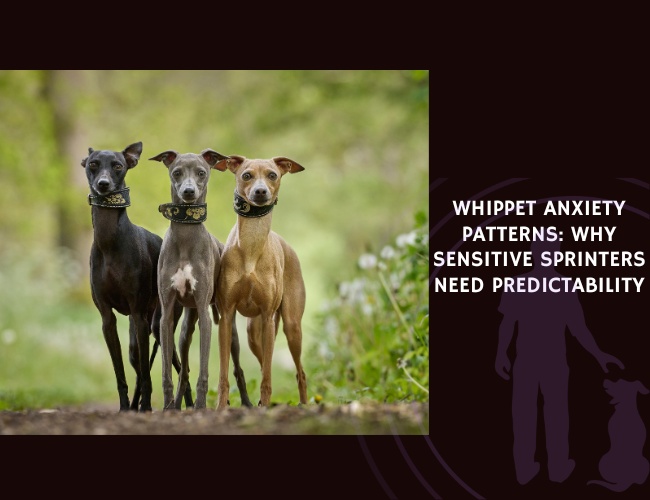
You watch your Whippet freeze mid-step, ears pricked forward, body tensed like a coiled spring. A door slammed three houses away. A shadow moved across the sidewalk. A stranger’s voice carried on the wind. What you’re witnessing isn’t fearfulness or poor socialization—it’s the exquisite sensitivity of a nervous system designed for survival at 35 miles per hour, now navigating a world full of unpredictable stimuli that most breeds simply filter out.
Understanding Whippet anxiety isn’t about fixing a broken dog. It’s about recognizing that their elegant physiology, refined over generations for speed and visual acuity, comes with an emotional architecture that processes the world differently. Their anxiety patterns aren’t flaws—they’re features of a sighthound nervous system operating in modern environments that rarely provide the predictability these sensitive sprinters need to feel truly safe.
Let us guide you through the neurological reality of Whippet sensitivity, where science meets the lived experience of sharing life with a dog whose emotional regulation system can shift from calm to vigilant in a heartbeat—and why the solution isn’t more exposure, but rather more consistency, more ritual, and more understanding of what their unique biology truly needs.
The Sighthound Nervous System: Built for Speed, Wired for Sensitivity
When you look at a Whippet’s sleek silhouette, you’re seeing evolutionary adaptation made visible. Every aspect of their physiology—from their aerodynamic build to their large, expressive eyes—tells the story of a breed designed for explosive acceleration and acute environmental awareness. But this same design creates a nervous system that operates on hair-trigger sensitivity, where threat detection happens faster than conscious processing.
Visual Detection and the Hypervigilance Loop
Your Whippet’s eyes aren’t just beautiful—they’re sophisticated scanning devices with a wider field of vision than most breeds. This evolutionary advantage allowed their ancestors to spot prey at remarkable distances, but in modern environments, it creates a different challenge. Every movement, every shadow, every visual change registers with crystal clarity. In trigger-dense environments like busy urban streets or crowded parks, your Whippet’s brain processes an overwhelming flood of visual information that most dogs simply don’t perceive with the same intensity.
This constant visual processing creates what behaviorists call hypervigilance—a state where your Whippet can’t fully relax because their nervous system remains in perpetual scanning mode. You might notice:
- Gaze tracking movements you haven’t even registered
- Following birds overhead with intense focus
- Head turning toward every passing cyclist or pedestrian
- Fixating on leaves tumbling across the yard
- Difficulty maintaining eye contact because their attention keeps shifting
- Body tension even in supposedly calm environments
This isn’t anxiety yet—it’s their baseline operating system. But in unpredictable environments, this heightened awareness can quickly cascade into genuine distress.
Sensory Amplification: Why Everything Feels More Intense
Research on sensory sensitivity across species reveals that some individuals experience stimuli with notably higher intensity than others. For Whippets, this manifests in multiple sensory channels. Their thin skin and lean musculature offer minimal physical buffering against tactile stimuli—a sudden touch that another breed might barely register can feel startling, even invasive. The same principle applies to auditory processing. Common sounds that may trigger heightened responses include:
- Door slams from neighboring apartments or rooms
- Objects dropped on hard floors
- Sudden voices or laughter
- Appliances turning on unexpectedly (dishwasher, washing machine)
- Keys jangling or items clattering
- Footsteps approaching from behind
- Chairs scraping across floors
These everyday sounds register not as minor disruptions but as significant events requiring immediate threat assessment.
Studies on pain perception and sensory processing demonstrate that sensitivity exists on a spectrum, and your Whippet likely occupies the high-sensitivity end. Their nervous system doesn’t simply receive sensory information—it amplifies it. This means the world genuinely feels more intense to them than to many other breeds. When you understand this fundamental reality, their seemingly “overreactive” responses start making perfect sense. They’re not being dramatic—they’re responding proportionally to stimuli that genuinely register as more powerful in their neurological experience.
The Startle Response: Fight or Flight on Fast-Forward
Initial recovery studies following simulated emergencies reveal how different nervous systems respond to sudden, unexpected events. For Whippets, the startle reflex doesn’t just activate quickly—it activates intensely. Their evolutionary history demanded immediate action upon threat detection: spot the movement, assess the danger, explode into sprint mode. This “fight or flight” system, optimized for survival in open terrain, now operates in living rooms, on city sidewalks, during routine vet visits.
You might see this manifest as:
- Full-body flinch when something drops nearby
- Backward leap when someone approaches too quickly
- Frozen stance when an unfamiliar sound reaches their ears
- Immediate sprint away from unexpected stimuli
- Tucked tail and lowered body posture
- Wide eyes with dilated pupils
- Trembling that persists after the trigger ends
Their baseline arousal sits closer to activation than many breeds, meaning less stimulus is required to trigger a response. This isn’t a training failure—it’s neurobiology. Their sympathetic nervous system, responsible for that surge of adrenaline and cortisol, activates with remarkable efficiency because for generations, this quick response meant the difference between catching prey and going hungry, between detecting a threat and becoming vulnerable.
Sprint Physiology: Fast-On, Slow-Off Arousal Patterns
The same cardiovascular system that propels your Whippet to breathtaking speeds creates a distinct emotional challenge: their nervous system accelerates rapidly but downshifts slowly. Understanding this “fast-on, slow-off” pattern is crucial for managing their anxiety effectively, because what looks like ongoing distress might actually be lingering physiological arousal that hasn’t yet resolved.
Explosive Acceleration and Extended Recovery
Your Whippet’s body is engineered for explosive bursts of energy. Their cardiovascular system can shift from rest to maximum output in seconds—a remarkable adaptation for coursing prey. But this rapid activation creates an unexpected consequence: once highly aroused, whether from play, excitement, or stress, their physiological parameters take considerably longer to return to baseline.
Think about what happens after an intense play session or a startling event:
- Heart rate spikes dramatically
- Respiration accelerates and becomes shallow
- Muscles tense throughout the body
- Stress hormones (cortisol, adrenaline) flood their system
- Blood flow redirects to major muscle groups
- Pupils dilate for enhanced visual acuity
- Digestive processes slow or halt
In endurance breeds built for sustained moderate activity, these parameters gradually normalize through continued movement. Your Whippet’s sprint-oriented physiology doesn’t work the same way. Their parasympathetic nervous system—responsible for “rest and digest” functions—takes more time to regain dominance after the sympathetic system’s intense activation.
Emotional Spillover: When Play Becomes Anxiety
This extended recovery period creates what behaviorists call emotional spillover. High-intensity play, while physically beneficial and emotionally satisfying, can leave your Whippet in a state of elevated arousal that persists long after the activity ends. If you’ve noticed that your typically calm Whippet becomes reactive or restless after vigorous play, you’re observing this phenomenon firsthand.
The challenge lies in the misinterpretation. Behaviors that signal emotional spillover include:
- Post-play pacing or inability to settle
- Heightened reactivity to doorbell sounds
- Increased response to passing dogs or people
- Difficulty focusing on cues they normally know well
- Panting that continues long after physical exertion stops
- Restless sleep or inability to stay in rest position
- Seeking behavior or unusual clinginess
These behaviors often look like anxiety, and on some level they are. But they’re not anxiety about the environment; they’re the residual effects of a nervous system that accelerated intensely and hasn’t yet found its way back down. Without proper cool-down periods and calm transitions, this spillover can make your Whippet more reactive to subsequent stressors, creating a cascade effect where one arousal event compounds the next.
Managing Arousal: The Gradual Down-Shift Protocol
Through the NeuroBond approach, we recognize that managing a Whippet’s arousal isn’t about preventing excitement—it’s about creating intentional recovery periods that allow their nervous system to downshift completely. This means building structured cool-downs into daily routines.
Essential components of the down-shift protocol:
- Gentle walking for five to ten minutes after any arousal spike
- Gradual pace reduction rather than abrupt stopping
- Transition into a quiet space with low stimulation
- Cardiovascular system time to normalize
- Stress hormone metabolism period (20-30 minutes minimum)
- Permission for nervous system to shift into parasympathetic dominance
- No interaction demands during recovery
You might implement a simple but powerful ritual: after play or exercise, transition to calm walking, then into a quiet space with low stimulation. This isn’t restricting your Whippet’s natural exuberance—it’s respecting their physiological reality and creating the conditions for true relaxation rather than residual tension masquerading as calm.
Predictability as Emotional Architecture
For your sensitive Whippet, unpredictability isn’t just uncomfortable—it’s fundamentally destabilizing. Their nervous system, primed for rapid threat detection and immediate response, interprets environmental uncertainty as potential danger. This is where most conventional training approaches miss the mark. Instead of building confidence through varied exposure, your Whippet needs something more foundational: a predictable framework that provides emotional safety before any exploration begins.
Why Routines Outperform Exposure
Research on stress and sensitization models reveals a counterintuitive truth: for highly sensitive nervous systems, repeated exposure to unpredictable stimuli often increases sensitivity rather than building tolerance. This challenges the common “confidence-building exposure” approach that works well for many breeds. Your Whippet doesn’t need to be convinced that the world is safe through varied experiences—they need consistent evidence that their immediate environment follows predictable patterns.
Predictable routines create a sense of control, and control is the antidote to anxiety. When your Whippet knows what comes next—when meals arrive at consistent times, when walks follow familiar patterns, when their sleep space remains undisturbed—their nervous system can allocate less energy to threat scanning and more to genuine relaxation. This isn’t about limiting their world; it’s about creating a stable foundation from which they can then, on their own terms, explore with confidence.
Environmental Unpredictability and Safety-Seeking Behaviors
Watch what happens when you introduce unpredictability into your Whippet’s world. New places trigger increased scanning behaviors. Unfamiliar guests in the home prompt safety-seeking behaviors. Schedule changes disrupt their internal sense of order, creating visible unease even when nothing overtly threatening has occurred.
Signs your Whippet is responding to unpredictability:
- Head movements rapidly tracking multiple stimuli
- Body tension ready for flight response
- Attention fractured across the environment rather than focused
- Retreating to known spaces when available
- Seeking proximity to their trusted person
- Maintaining distance while monitoring the situation
- Panting or stress yawning in the absence of heat or exertion
- Lowered body posture or tucked tail
These aren’t signs of fearfulness requiring exposure therapy. They’re rational responses from a nervous system evolved to prioritize safety through environmental awareness. Your Whippet is attempting to re-establish predictability in a destabilized context. The most effective intervention isn’t forcing them to “get over it” through repeated exposure—it’s acknowledging their need for stability and providing it consistently.
The Anchor Points: Building Emotional Stability Through Ritual
Certain routines carry more stabilizing power than others, particularly those connected to core needs and safety. Four essential anchor points create the foundation:
Sleep Zones:
- Consistent, undisturbed sleep area for complete nervous system down-regulation
- Their ultimate safe space and emotional anchor
- Disruptions trigger visible stress that persists beyond the immediate change
- Should remain in the same location with familiar bedding and scent
Walk Timing:
- Creates temporal anchors through predictable structure
- Allows nervous system to anticipate and prepare rather than uncertain waiting
- Includes consistent pacing, familiar routes, and same entry/exit patterns
- These elements are stabilizing, not monotonous
Feeding Rituals:
- Connect to survival instincts and resource security
- Consistent feeding times, same preparation sequence, same location
- Signals that core needs will be met predictably
- Calm preparation without dramatic announcement reduces arousal
Entry and Exit Patterns:
- Creates transitional stability during departures and returns
- Predictable departure routines prevent panic triggers
- Consistent return patterns reinforce that absence is temporary
- Same greeting sequence signals normalcy has resumed
Your Whippet’s sleep zone represents more than just a comfortable spot—it’s their ultimate safe space, their emotional anchor. A consistent, undisturbed sleep area where they can fully relax without vigilance creates a foundation of security that influences their entire day. You might notice that disruptions to their sleep space—moving their bed, hosting guests who occupy their usual resting area—trigger visible stress that persists beyond the immediate change.
Walk timing functions as a temporal anchor, creating predictable structure in their day. When walks happen at consistent times, your Whippet’s nervous system can anticipate and prepare rather than remaining in uncertain waiting. This predictability extends to the walk itself: following familiar routes, maintaining consistent pacing, using the same entry and exit patterns. These elements aren’t monotonous—they’re stabilizing. 🧡
Feeding rituals carry particular significance because they connect to survival instincts. Consistent feeding times, the same preparation sequence, food offered in the same location—these rituals signal that core needs will be met predictably, reducing background anxiety about resource availability. Even the way you approach feeding matters: calm preparation without dramatic announcement, food placed in their designated spot, space given to eat without pressure.
Entry and exit patterns from the home create what behaviorists call transitional stability. Your Whippet notices when you’re preparing to leave, and predictable departure routines help them understand what’s happening without triggering panic. Similarly, consistent return patterns—the same greeting, the same sequence of actions—reinforce that your absence is temporary and your return is certain.
Sound Sensitivity: The Invisible Stressor
You might not register the distant motorcycle accelerating three blocks away, but your Whippet does. Sound sensitivity in sighthounds often flies under the radar because we focus on their visual acuity, but auditory processing plays a significant role in their anxiety patterns. For many Whippets, noise-based stress accumulates invisibly throughout the day, creating a baseline tension that amplifies other stressors.
Auditory Landscape and Cognitive Load
Your home’s soundscape includes dozens of auditory events every hour that create constant cognitive load. Common sources include:
- Appliances cycling on and off (refrigerator, HVAC, water heater)
- Neighbors moving through shared walls in apartments
- Traffic passing outside windows
- Birds calling and territorial disputes
- Leaves rustling in wind
- Distant voices from neighboring properties
- Footsteps from upstairs apartments
- Plumbing sounds throughout the building
Most breeds filter these sounds as irrelevant background noise. Your Whippet’s sensitive nervous system evaluates each sound for threat potential, creating constant cognitive load even in supposedly quiet environments.
This continuous auditory processing consumes mental resources that might otherwise support relaxation and emotional regulation. You might notice your Whippet rarely seems fully settled, their ears moving to track sounds you haven’t consciously registered. This perpetual monitoring isn’t voluntary—it’s their nervous system operating according to its design, treating auditory information with the same importance as visual data.
Trigger Stacking: The Invisible Build-Up
Here’s where understanding sound sensitivity becomes crucial: individual sounds might not trigger obvious stress responses, but they accumulate. Behaviorists call this trigger stacking—the invisible accumulation of small stressors that eventually manifest as overt anxiety behaviors. Your Whippet might handle the garbage truck in the morning, the door slam at noon, the raised voices in the afternoon. But by evening, a simple knock at the door triggers what looks like disproportionate stress because it’s not really about that knock—it’s about the cumulative load of the entire day’s auditory stressors.
Signs of trigger stacking in action:
- Morning: Handles stimuli with minimal response
- Midday: Beginning to show subtle tension or reduced threshold
- Afternoon: Increased reactivity to sounds that didn’t bother them earlier
- Evening: Disproportionate response to minor trigger
- Behaviors appearing “out of nowhere” when the final stressor arrives
- Inability to settle even after the trigger ends
- Generalized anxiety not tied to specific current stimulus
This phenomenon explains why your Whippet might seem fine most of the time but suddenly display anxiety behaviors without apparent cause. The trigger that pushed them over threshold wasn’t necessarily intense—it was simply the final stressor in a stack that had been building invisibly. Recognizing trigger stacking changes how we manage their environment. Instead of focusing only on the final trigger, we need to reduce the overall accumulation throughout the day.
Sound Management Strategies
Creating a lower-stimulus auditory environment doesn’t mean complete silence—it means predictable, consistent sound that doesn’t require threat assessment. White noise machines, gentle fans, or soft classical music can mask unpredictable environmental sounds without creating their own distress. These consistent sounds provide auditory “coverage” that helps your Whippet’s nervous system remain calmer because there’s less variation requiring evaluation.
During high-stress periods—storms, fireworks, construction—proactive sound masking becomes essential. But even on ordinary days, creating acoustic consistency in their primary living spaces reduces their baseline auditory load. You might designate their sleep zone as a lower-stimulus area where sounds are actively managed, giving their nervous system a genuine respite from constant auditory processing.
Social Interaction: Choice-Based Connection
The contrast between a Whippet’s deep attachment to their person and their wariness of novel social situations creates a complex dynamic. They’re not unfriendly or antisocial—they’re selectively social, needing control over their social interactions to feel safe. This distinction matters enormously for managing anxiety around both human strangers and other dogs.
The Attachment Paradox
Research on attachment and co-regulation reveals that sensitive individuals often achieve emotional stability through close proximity to trusted figures. Your Whippet likely demonstrates intense attachment to their family—following you between rooms, seeking physical contact, showing visible distress during separations. This attachment isn’t clinginess; it’s their nervous system seeking external regulation. Your calm presence functions as scaffolding for their emotional state, helping them maintain equilibrium.
Studies on human-directed attachment in canines suggest this capacity for forming intense bonds has deep evolutionary roots. For your Whippet, this attachment provides genuine neurological benefit—your calm helps regulate their arousal, your predictability creates safety, your emotional neutrality during stress helps them recover faster. But this same attachment intensity can become problematic when they encounter unfamiliar people or dogs, because those interactions lack the established trust that makes their primary relationships stabilizing rather than threatening.
The Pressure of Forced Socialization
Traditional socialization protocols often emphasize exposure—getting your dog comfortable with many people, various dogs, diverse environments. For sensitive Whippets, this approach frequently backfires. Forced interaction, even well-intentioned, registers as a violation of their need for control. You might notice your Whippet tolerating attention from strangers but displaying stress signals:
- Lip licking (not related to food)
- Yawning when not tired
- Turning head or body away from the person
- Freezing or becoming very still
- Whale eye (whites of eyes visible)
- Ears pinned back against head
- Leaning away or backing up
- Seeking to position you between them and the stranger
They’re not enjoying the interaction—they’re enduring it while their stress hormones accumulate.
The challenge intensifies when their attempts to create distance are ignored. A Whippet moving behind their person, backing away from an extended hand, or averting their gaze is communicating clearly: “I need more space, more time, more control over this interaction.” When we override these signals in pursuit of “friendliness,” we teach them that their communication doesn’t matter, potentially escalating to more dramatic avoidance behaviors or, in extreme cases, defensive displays.
The Choice-Based Alternative
Through the Invisible Leash philosophy, we recognize that authentic connection comes through choice, not pressure. Choice-based socialization empowers your Whippet to initiate or terminate interactions, ensuring they maintain the control their nervous system requires. This means allowing them to approach strangers and unfamiliar dogs on their own timeline rather than managing their proximity for them.
Practically, this looks like:
- Ask visitors to ignore your Whippet initially—no eye contact, reaching out, or verbal engagement
- Allow your Whippet to observe from whatever distance feels comfortable
- Reward calm observation with treats delivered by you, not the stranger
- If they choose to approach, keep initial interactions brief (3-5 seconds)
- End interaction before any stress signals appear
- Multiple brief positive exposures build confidence better than one long stressful encounter
- Respect their decision if they choose not to engage at all
Most Whippets, when given space and time, will eventually investigate on their own terms. That self-initiated approach carries completely different emotional weight than a forced interaction. You’re rewarding calm observation of strangers from a distance, reinforcing that watching without interacting is perfectly acceptable. If and when they choose to approach, interactions remain brief and positive, ending before they show any stress signals.
The same principle applies to dog-dog interactions. Rather than forcing proximity at the dog park or during leashed encounters, you create opportunities for observation at comfortable distances. Your Whippet can watch other dogs playing, processing the situation without pressure to engage. If they indicate interest—forward movement, loose body language, play signals—you can allow brief interaction. If they show hesitation or stress, you create distance without drama, reinforcing that their communication is respected and effective. 🐾
Training Philosophy: Calm Clarity Over Excitement
The training approaches that create confident, biddable dogs in high-drive working breeds often create anxious, confused Whippets. Understanding why requires examining not just what you’re teaching, but how your training energy, verbal volume, and reinforcement style affect a sensitive nervous system designed to detect and respond to subtle environmental changes.
The Problem with High-Energy Training
Many popular training methods emphasize enthusiasm, animation, and dramatic praise. The logic seems sound: excited praise motivates the dog, building drive and engagement. For many breeds, this works beautifully. For your Whippet, it often creates the opposite effect. That enthusiastic “GOOD BOY!” delivered at high volume triggers arousal rather than simply reinforcing behavior. The animated movements accompanying dramatic praise register as potentially threatening rather than rewarding.
You might notice your Whippet’s body language during high-energy training reveals discomfort:
- Subtle muscle tension through shoulders and hindquarters
- Dilated pupils even in good lighting
- Increased scanning behaviors, looking away from you
- Moving away from praise rather than toward it
- Stress yawning or lip licking after verbal praise
- Lowered or tucked tail despite “positive” interaction
- Difficulty maintaining attention on the task
- Slower response to known cues
These signs reveal that what’s intended as reinforcement is actually increasing their arousal and, paradoxically, reducing their ability to learn. Their nervous system becomes focused on managing the intensity of the interaction rather than processing the training information.
Low-Verbal, High-Clarity Communication
Whippets respond remarkably well to training that emphasizes calm clarity over verbal volume. Key components of this approach:
- Quiet voice tones—soft “yes” or gentle “good” rather than loud praise
- Minimal words—single cue words rather than sentences
- Predictable cues that don’t require intense processing
- Physical rewards over verbal: calm strokes, brief contact, quiet presence
- Consistent timing that creates clear behavior-reward associations
- No dramatic gestures or animated body language
- Clear start and stop signals for each training session
This low-verbal approach reduces cognitive load. Your Whippet can focus mental resources on understanding the requested behavior rather than managing the emotional intensity of your delivery. Clear, consistent cues given in calm tones create predictability, which their nervous system craves. You’re essentially speaking their language—communication through subtle signals rather than dramatic displays.
The training environment matters too. Quiet spaces with minimal distractions allow better focus than stimulating environments where their nervous system must process multiple inputs simultaneously. Short training sessions of five to ten minutes prevent mental fatigue while maintaining engagement. Each session ends on success—a correctly performed behavior, however simple—building positive associations with the training process itself.
Reinforcement Without Overstimulation
The type and delivery of rewards requires careful consideration. High-value food rewards work beautifully because they provide reinforcement without arousal spikes—your Whippet can focus on the treat rather than managing intense social energy from you. The delivery matters: presented calmly rather than tossed or offered with dramatic flourish, the treat becomes pure reinforcement without additional stress.
Some Whippets prefer brief physical contact—a gentle scratch in their favorite spot, a calm hand resting on their side—as reinforcement. This touch provides co-regulation benefits alongside behavioral reinforcement, strengthening both the learned behavior and the emotional bond. Pay attention to what your individual Whippet finds genuinely rewarding versus what they tolerate. True reinforcement creates anticipation and engagement; tolerated “rewards” create stress they must manage alongside learning.
Consistency in reinforcement timing creates the predictability that supports their learning. When the reward follows immediately and consistently after correct behavior, the connection becomes clear without requiring complex processing. This isn’t about being rigid—it’s about creating patterns their brain can recognize and rely on, reducing the uncertainty that generates anxiety even in training contexts.
Separation Stress: Engineering Safety in Absence
Few things challenge Whippet guardians more than separation anxiety. Their intense attachment, combined with what we might call low environmental robustness—difficulty maintaining emotional stability without their person present—creates genuine distress during absences. But understanding the neurological roots of this distress reveals practical solutions that respect their nervous system rather than fighting against it.
The Attachment-Regulation Connection
Research on mother-infant attachment and sensitive parenting illuminates why separation is so challenging for bonded Whippets. Early attachment studies demonstrate that secure bonds form when caregivers provide consistent, sensitive responses to needs. For your Whippet, you’ve become their primary source of emotional regulation—your presence literally helps organize their nervous system. When you leave, they lose access to their most powerful regulatory tool.
This isn’t dependency in the pathological sense—it’s a normal consequence of their attachment style. In your presence, your calm helps modulate their arousal, your predictability creates safety, your responses to their stress signals teach them the environment is manageable. Without you, their nervous system must self-regulate without that external scaffolding, a task their biology makes challenging. Understanding this reframes separation anxiety from a behavioral problem to a nervous system challenge requiring environmental support.
Beyond Traditional Crate Training
Crate training advocates often present the crate as an anxiety solution: a den-like space providing security during absences. For some Whippets, this works beautifully. For others, the crate becomes associated with confinement and abandonment, amplifying rather than reducing distress. The difference lies not in the crate itself but in how it’s introduced and what broader context surrounds it.
Creating a stable “den zone” extends beyond the physical crate to encompass a consistently safe, low-stimulus space associated exclusively with positive experiences. This might include a crate, but it’s not limited to confinement. The den zone remains accessible and safe whether you’re present or absent, becoming a reliable anchor rather than a reminder of separation. You’re building positive associations through gradual, choice-based introduction: feeding in the space, offering special treats there, allowing voluntary rest time with the door open.
The Graduated Departure Protocol
Gradual departures systematically desensitize your Whippet to absence cues without triggering panic. You begin with micro-absences: picking up keys but not leaving, walking to the door but returning immediately, stepping outside for ten seconds. These brief separations occur below their panic threshold, allowing them to experience your departure and return without flooding their nervous system with distress.
As they habituate to these micro-absences, duration gradually increases—thirty seconds, one minute, five minutes—always staying below visible stress thresholds. You’re teaching their nervous system that departures are temporary, that your return is predictable, and that they can remain regulated during your absence. This isn’t quick, but it’s effective because it respects their processing capacity rather than overwhelming it.
Predictable return rituals complement graduated departures. Your return should be calm rather than dramatic—no enthusiastic greetings that increase arousal, no prolonged interactions that make your presence more emotionally charged than your absence. A quiet “hello,” brief contact, then proceeding with normal routines teaches them that your return is simply part of the predictable pattern, not an emotionally intense event requiring their entire focus.
Environmental Support During Absence
Sound masking during absences serves multiple purposes: it covers external noises that might trigger alert responses, it provides consistent auditory input reducing the silence that amplifies every sound, and it creates acoustic continuity between your presence and absence. White noise, classical music designed for canine stress reduction, or a consistently running fan—any of these can create a more stable auditory environment.
The space itself matters. Low-stimulus environments during absences prevent trigger stacking. Close curtains to reduce visual stimulation from outside, ensure temperature comfort, provide access to water and their safe space. You might leave recently worn clothing in their den zone—your scent provides some regulatory support even in your absence. Some Whippets benefit from puzzle feeders or long-lasting chews that occupy their focus during the initial departure period, creating a positive association with your absence.
That balance between structure and sensitivity—that’s the essence of Zoeta Dogsoul. Understanding that your Whippet’s anxiety isn’t something to eliminate but something to work with, creating the environmental conditions where their sensitive nervous system can achieve the stability it’s designed for when given proper support. 💙
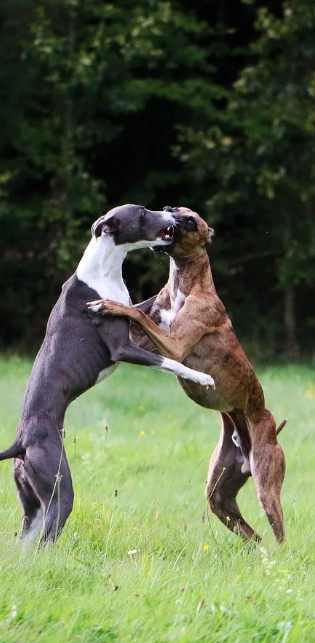
Sensitive. Fast. Overstimulated.
Speed Shapes Sensitivity
Whippets process the world through a nervous system built for rapid detection. What appears as anxiety often begins as heightened perception.
Vision Drives Vigilance
Their sighthound eyes register movement others ignore, keeping the brain in constant scan mode. Without predictability, this vigilance escalates into stress.


Consistency Creates Safety
Stable routines and familiar patterns calm their reactive system. Predictability allows their sensitivity to settle into ease rather than alertness.
Health Considerations: The Physiology Behind the Psychology
Anxiety doesn’t exist in isolation from physical health. Your Whippet’s lean physiology, efficient metabolism, and breed-specific health considerations create interconnections between their physical state and emotional regulation. Recognizing these connections helps distinguish anxiety with medical roots from purely behavioral patterns, ensuring your approach addresses underlying causes rather than just symptoms.
⚡ Managing Whippet Anxiety: The 7-Phase Protocol 🐕
Understanding and supporting your sensitive sprinter’s nervous system through structured intervention
Phase 1: Recognition & Baseline Assessment
Understanding your Whippet’s unique sensitivity patterns
Neural Reality
Whippets possess a “fast-on, slow-off” nervous system optimized for sprint physiology. Their sympathetic activation occurs rapidly, but parasympathetic recovery takes significantly longer than endurance breeds. This creates extended arousal periods that appear as anxiety.
Observable Behaviors
• Full-body startle responses to minor sounds
• Extended scanning behaviors in new environments
• Difficulty settling after play or excitement
• Heightened reactivity during afternoon/evening (trigger stacking)
Your First Action
Begin a 7-day anxiety journal documenting triggers, recovery times, and baseline behaviors. Video your Whippet during typical rest periods to establish their genuine relaxation capacity versus surface-level calm masking elevated arousal.
Phase 2: Environmental Audit & Optimization
Reducing invisible stressors in your Whippet’s living space
Visual Landscape Management
Their wide-field vision processes constant movement as potential threats. Obscure windows in rest areas, position sleep zones away from high-traffic sight lines, and maintain consistent furniture arrangements. Each visual change requires cognitive remapping that depletes regulatory capacity.
Acoustic Architecture
Sound masking is essential, not optional. White noise machines in sleep zones mask unpredictable environmental sounds. Add soft surfaces (rugs, curtains) to dampen acoustic edges. Your Whippet evaluates every appliance cycle, footstep, and distant voice for threat potential.
Safe Space Engineering
Create a genuine den zone—not just a crate but a consistently safe, undisturbed space associated exclusively with rest and positive experiences. This becomes their emotional anchor, the one location where complete nervous system down-regulation is possible.
Phase 3: Predictable Routine Architecture
Building the temporal structure sensitive nervous systems require
The Four Anchor Points
Sleep zones, walk timing, feeding rituals, and entry/exit patterns create temporal predictability. Consistency within 15-minute windows matters—their nervous system tracks time and allocates resources based on anticipated events. Variability is interpreted as environmental instability.
Metabolic Stability Through Feeding
Shift to 3-4 smaller meals daily to maintain blood sugar stability. Their lean physiology depletes glucose rapidly, triggering cortisol release that mimics anxiety. Add a small bedtime snack to prevent nighttime blood sugar drops that disrupt sleep quality.
Morning & Evening Rituals
Begin and end each day with identical sequences. Morning: quiet waking → elimination → breakfast → rest. Evening: calm walk → feeding → pre-sleep ritual → lights out. These bookend routines signal nervous system states more powerfully than any training protocol.
Phase 4: Arousal Management Protocols
Structured recovery after every activation spike
The Non-Negotiable Cool-Down
After ANY arousal spike—play, fast walking, excitement, stress—implement: 5-10 minutes calm walking → transition to low-stimulus space → provide calm activity → allow 20-30 minutes minimum before expecting settled behavior. Their physiology requires this time; expectations don’t override biology.
Exercise Recalibration
Reduce total exercise by 25% from current levels. Convert one daily walk to pure sniffing walk (slow pace, extensive ground investigation). Mental exercise—scent work, puzzle feeders—provides more beneficial fatigue than physical exertion without triggering extended arousal states.
Avoid These Arousal Triggers
Dog parks, play groups, and unstructured play with high-energy dogs create arousal spikes without your control. High-energy praise and dramatic training reinforcement register as threatening rather than rewarding. Skip these entirely during the foundation-building period.
Phase 5: Low-Arousal Training Protocols
Calm clarity over enthusiastic confusion
Communication Style Shift
Adopt low-verbal, high-clarity approach. Use quiet voice tones, minimal words, predictable cues. A soft “yes” or gentle “good” communicates approval without triggering arousal. Physical rewards (calm strokes) often carry more value than verbal praise for sensitive nervous systems.
Session Structure
Multiple 3-5 minute sessions throughout the day outperform single longer sessions. Train in quiet spaces, one behavior per session, always end on success. The ritual of consistent, calm, successful interaction builds confidence more than the specific behaviors trained.
Choice-Based Socialization
Empower your Whippet to initiate or terminate social interactions. Ask visitors to ignore them initially. Reward calm observation from distance. If they approach, keep interactions brief (3-5 seconds) and end before stress signals appear. Control creates safety; forced interaction creates trauma.
Phase 6: Common Trigger Management
Specific protocols for predictable challenges
Storms & Fireworks Protocol
Before event: monitor forecasts, set up interior safe zone with white noise, close curtains. During: remain emotionally neutral, offer calming activities, don’t force interaction. After: maintain calm 30-60 minutes post-event during recovery. Preparation prevents panic better than comfort during crisis.
Vet Visit Management
Days before: practice gentle handling at home. Day of: maintain normal morning routine, arrive early but wait in car until room ready. At clinic: request slow, calm staff approach, continuous treats during exam, minimal restraint. Post-visit: immediate sniffing walk, low-stimulus rest of day.
Separation Stress Protocol
Graduated departures starting with micro-absences (10 seconds) below panic threshold. Predictable return rituals—calm greeting, proceed with normal routine. Sound masking during absences. Build confidence through hundreds of successful short separations, not forcing extended tolerance.
Phase 7: Progress Assessment & Adjustment
Recognizing improvement and knowing when to escalate care
Success Indicators (30 Days)
• Recovery time decreased 5-10 minutes after arousal
• Better sleep quality (faster settling, fewer wakings)
• Reduced trigger stacking response
• More frequent genuine relaxation behaviors
• Improved stress tolerance during routine disruptions
Realistic Expectations
Your Whippet will remain a sensitive Whippet—you’re managing their nature, not eliminating it. Progress isn’t linear. Some days will be harder. The goal is building resilience and reducing baseline anxiety, not creating a fearless dog. Sensitivity is part of their identity.
When to Seek Professional Help
If anxiety prevents learning, quality of life is significantly impaired, self-harm behaviors emerge, or 3-6 months of consistent management shows no improvement—consult a veterinary behaviorist. Some anxiety requires medication alongside environmental management. This isn’t failure; it’s appropriate medical intervention.
🔄 Understanding Different Anxiety Presentations
Normal Sensitivity vs. Pathological Anxiety
Normal: Anxiety connects to identifiable triggers, shows relaxation periods, improves with management.
Pathological: Generalized distress regardless of environment, complete inability to relax, requires professional intervention.
Whippets vs. Endurance Breeds
Whippets: Fast-on, slow-off arousal. 30-60 min daily exercise. Mental stimulation prioritized.
Endurance Breeds: Gradual arousal/recovery. 60-120+ min exercise. Physical outlet prioritized.
Puppy vs. Adult vs. Senior
Puppy (3-14 weeks): Critical socialization requiring careful calibration.
Adult (2-7 years): Most stable regulation period.
Senior (8+ years): Increased vulnerability, sensory decline, cognitive changes.
Structured vs. Unstructured Play
Structured: You control start/stop, predictable, built-in recovery. Supports stability.
Unstructured: Dog parks, play groups, unpredictable energy. Often destabilizes sensitive systems.
Trigger Stacking Timeline
Morning: High stress tolerance, handles stimuli well.
Afternoon: Accumulated load, reduced threshold.
Evening: Minor triggers cause major response—not about that trigger, about cumulative stress.
Single-Dog vs. Multi-Dog Household
Single-Dog: Full environmental control, easier management, consistent regulation.
Multi-Dog: Energy contagion challenges, requires individual safe spaces, rotation schedules often needed.
⚡ Quick Reference: Essential Formulas
Recovery Time Formula: Arousal duration × 3-4 = minimum recovery time needed
Exercise Guideline: 30-60 min total daily (mostly calm walking), not hours
Feeding Schedule: 3-4 meals daily for blood sugar stability
Cool-Down Protocol: 5-10 min calm walk + 20-30 min quiet rest after ANY arousal
Training Sessions: 3-5 minutes each, multiple times daily
Socialization Rule: Brief positive exposures (3-5 sec) ending before stress signals
Sleep Requirement: 12-16 hours daily in genuinely undisturbed space
🧡 The Essence of Managing Whippet Anxiety
Through the NeuroBond framework, we recognize that your Whippet’s sensitivity isn’t a flaw requiring correction—it’s exquisite neurological design requiring appropriate support. Predictable structure, low-noise leadership, and calm co-regulation create the emotional architecture where their natural speed and awareness coexist without anxiety dominating their experience.
The Invisible Leash reminds us that awareness, not tension, guides the path. When you provide calm pacing, smooth transitions, and spatial consistency, you eliminate the micro-surprises that keep their nervous system on alert. This isn’t control through force—it’s connection through understanding.
Through Soul Recall—the deep trust built through thousands of predictable interactions—your Whippet learns that their sensitivity is understood rather than punished, supported rather than forced to change. This transforms anxiety from a barrier into the foundation of extraordinary partnership, where structure creates freedom and sensitivity becomes strength.
© Zoeta Dogsoul – Where neuroscience meets soul in dog training
Metabolic Sensitivity and Blood Sugar Stability
Whippets carry minimal body fat, creating unique metabolic challenges. Their efficient energy use means they process and deplete glucose relatively quickly, making them more susceptible to blood sugar fluctuations than breeds with more substantial body composition. Low blood sugar—hypoglycemia—doesn’t just affect energy levels; it directly impacts emotional regulation. The same physiological response that manages blood sugar involves stress hormones, creating a biochemical environment that can mirror or amplify anxiety.
You might notice increased restlessness, shaking, or anxiety-like behaviors that correlate with longer fasting periods. A Whippet showing anxiety symptoms several hours after their last meal might actually be experiencing metabolic stress rather than environmental stress. This suggests practical intervention: smaller, more frequent meals throughout the day maintain more stable blood sugar levels, reducing one source of physiological stress that can manifest as behavioral anxiety.
Thyroid Function and Emotional Regulation
Thyroid disorders, particularly hypothyroidism, occur in some Whippets and create wide-ranging effects including behavioral changes that can mimic anxiety. The thyroid regulates metabolism, but it also influences neurological function, emotional processing, and stress response. A Whippet with declining thyroid function might display increasing anxiety, reactivity, or difficulty settling—changes that look purely behavioral but have clear physiological roots.
If your Whippet develops anxiety symptoms that seem disproportionate to environmental factors, or if existing anxiety patterns suddenly intensify without clear trigger, thyroid screening provides valuable information. Standard veterinary panels sometimes miss subclinical thyroid issues, so comprehensive thyroid testing—including Free T4, Total T4, and thyroid antibodies—offers more complete assessment. Addressing underlying thyroid dysfunction can significantly improve emotional regulation when hormone levels are contributing to anxiety patterns.
Pain, Discomfort, and Behavioral Change
Chronic pain or physical discomfort creates constant background stress that reduces overall stress threshold. A Whippet dealing with undiagnosed joint discomfort, dental pain, or gastrointestinal issues carries a baseline stress load that makes them more reactive to environmental triggers. Their anxiety isn’t imaginary—it’s their nervous system responding to cumulative stress that includes both physical discomfort and environmental factors.
Thin-skinned, lean breeds like Whippets sometimes display subtle pain signals that differ from more stoic breeds:
- Decreased activity or reluctance to engage in previously enjoyed activities
- Reluctance to jump onto furniture or climb stairs
- Changes in sleep position—sleeping flat instead of curled, for example
- Increased irritability or reduced tolerance for handling
- Stiffness after rest periods
- Licking or attending to specific body areas
- Changes in gait or weight distribution
- Seeking softer surfaces or avoiding hard floors
These signs warrant veterinary evaluation because addressing physical discomfort often reduces anxiety-like behaviors that are actually stress responses to pain.
The Sleep-Anxiety Connection
Sleep quality profoundly influences emotional regulation. Whippets require substantial rest—often 12 to 16 hours daily—for nervous system recovery and emotional processing. Disrupted sleep, whether from environmental factors, discomfort, or insufficient safe space, creates sleep debt that manifests as increased reactivity, reduced stress tolerance, and heightened anxiety responses.
Signs of quality sleep versus sleep disruption:
Quality Sleep Indicators:
- Settles within 5-10 minutes in sleep zone
- Achieves deep sleep (twitching, soft snoring, complete relaxation)
- Sleeps on side or stretched out showing comfort
- Minimal position changes once settled
- Wakes calmly and gradually
- Maintains good mood and stress tolerance during day
Sleep Disruption Indicators:
- Takes 20+ minutes to settle or cannot settle at all
- Remains in alert postures (curled tight, head up)
- Frequent repositioning suggesting discomfort
- Startle responses to minor sounds during rest
- Wakes suddenly or with anxiety
- Increased reactivity and reduced stress tolerance during day
Protecting sleep becomes a health intervention as much as a behavioral one. Your Whippet’s sleep zone should remain genuinely undisturbed—not just quiet but free from interruptions, sudden touches, or unexpected intrusions. They need the security of knowing their rest periods are sacred, allowing complete nervous system down-regulation. Sleep disruption compounds other anxiety factors, creating a cycle where poor sleep increases anxiety, which further disrupts sleep quality.
Life Stage Considerations: Anxiety Across the Years
Your Whippet’s anxiety patterns evolve throughout their life, influenced by changing physiology, accumulated experience, and the natural aging process. Understanding these life stage variations helps you adapt your approach to their current neurological and physical reality rather than expecting them to maintain consistent emotional patterns across dramatically different developmental phases.
Puppy Sensitivity: The Critical Socialization Window
Whippet puppies experience the world with nervous systems that are simultaneously hyper-responsive and not yet fully developed. The critical socialization period—roughly 3 to 14 weeks—represents a window when they’re biologically primed to form associations about what’s safe versus threatening. But their sensitive predisposition means this period requires careful calibration. Too little exposure leaves them unprepared for normal environments; too much exposure, especially intense or unpredictable experiences, can sensitize rather than socialize.
The principle of “short, positive exposures” becomes crucial. Brief encounters with novel stimuli—new sounds, surfaces, people, environments—that end before any stress response develops create positive associations. You’re not pushing them to “get over” fear but rather ensuring their first experiences are consistently pleasant and unthreatening. A five-minute visit to a quiet outdoor café where they observe calmly creates better foundation than an hour at a chaotic dog park where they become overwhelmed.
Adolescent Intensity: Navigating Heightened Reactivity
Adolescence, roughly 6 to 18 months, brings hormonal changes, rapid physical growth, and often an intensification of anxiety patterns. A Whippet who seemed confident as a young puppy might display increasing sensitivity during this period. This isn’t regression—it’s normal developmental change. Their growing body processes sensory information differently, their changing brain chemistry affects emotional regulation, and their increasing awareness of environmental complexity creates new challenges.
Maintaining predictable routines becomes especially important during adolescence. When so much is changing internally, external consistency provides essential stability. You might also need to temporarily reduce environmental complexity, recognizing that their processing capacity is partially allocated to managing developmental changes. The training and socialization foundation you established earlier supports them through this turbulent period, but don’t expect linear progress—some temporary increases in anxiety are normal and expected.
Adult Stability: The Confidence Peak
Most Whippets achieve their most stable emotional regulation between 2 and 7 years old, assuming their environment has provided consistent structure and their health remains good. This doesn’t mean anxiety disappears, but their nervous system has matured, they’ve accumulated positive experiences within predictable patterns, and their physical health typically supports optimal emotional regulation.
This stability window represents the time to gently expand their comfort zones if desired. With their foundation of trust and predictability firmly established, they can handle slightly more environmental variation without destabilization. But even during this optimal period, they remain sensitive Whippets—their need for routine, calm handling, and environmental predictability doesn’t vanish; it’s simply more resilient to occasional disruption.
Senior Sensitivity: Aging and Increased Vulnerability
As your Whippet ages—typically around 8 to 10 years old—physiological changes affect anxiety patterns. Sensory decline means they may startle more easily because they don’t detect approaching people or sudden movements as readily. Cognitive changes can increase confusion and disorientation, particularly regarding routine changes. Physical discomfort from arthritis or other age-related conditions reduces stress tolerance. Sleep needs increase while sleep quality may decline.
Senior anxiety requires especially gentle management. Their lifetime of consistent routines becomes even more critical as cognitive flexibility decreases. Changes that younger Whippets might handle—moving furniture, altering walk times, hosting guests—can significantly destabilize senior dogs. Your role becomes increasingly protective: maintaining their familiar environment, reducing unavoidable stressors, providing extra physical comfort, and recognizing that their anxiety might have medical components requiring veterinary support.
The relationship built over years of trust rituals, predictable patterns, and calm co-regulation reaches its full value during these senior years. Your presence, your consistency, your understanding of their unique needs—these elements provide the security that allows them to age with dignity rather than distress. Through Soul Recall, those accumulated positive associations and established trust patterns continue supporting them even as their physical capabilities decline.
Environmental Design: Creating a Low-Stress Living Space
Your home isn’t just where your Whippet lives—it’s the primary environment shaping their nervous system’s baseline state. Thoughtful environmental design reduces the constant low-level stress that accumulates from trigger-rich spaces, creating conditions where your Whippet can achieve genuine relaxation rather than perpetual vigilance. This isn’t about expensive renovations; it’s about understanding which environmental factors most affect their sensitive processing and adjusting accordingly.
Visual Calm: Managing the Scanning Imperative
Large windows offering expansive views might seem like enrichment, but for many Whippets, they create constant visual stimulation requiring threat assessment. Every passing car, walking pedestrian, or moving animal triggers their scanning response. You might notice your Whippet spending hours at the window, body tense, focus locked on the changing scene outside. This isn’t enjoyable observation—it’s compulsive monitoring driven by their sighthound neurology.
Creating visual calm might mean partially obscuring windows in your Whippet’s primary rest areas. Privacy film, sheer curtains, or strategically placed furniture can reduce their visual field without eliminating natural light. The goal isn’t darkness but rather limiting the stream of movement that keeps their nervous system engaged. You’re essentially giving them permission to stop scanning by reducing what there is to scan.
Their sleep zone particularly benefits from visual simplicity. Position their bed away from direct window views, in spaces where walls provide natural visual boundaries. This isn’t confinement—it’s creating a microenvironment where their brain can fully disengage from monitoring duties, allowing authentic rest rather than surface-level sleep interrupted by the need to track movement.
Acoustic Architecture: Sound as Structure
The sounds within your home create a constant acoustic landscape your Whippet processes continuously. Hard surfaces amplify and reflect sound, creating sharp acoustic edges that startle sensitive ears. Household appliances cycle unpredictably, creating sudden noise events throughout the day. External sounds—traffic, neighbors, weather—penetrate walls with varying intensity, creating an auditory environment that demands constant evaluation.
Strategic use of sound-absorbing materials softens this acoustic environment. Area rugs, fabric furniture, wall hangings, even curtains absorb and dampen sound, reducing the sharpness of acoustic events. You’re not pursuing silence but rather creating a gentler soundscape where noises arrive more gradually and with less startling intensity.
Continuous background sound serves a different purpose: it masks unpredictable external sounds while providing consistent auditory input that doesn’t require threat assessment. White noise machines positioned near your Whippet’s rest areas create acoustic consistency that helps their nervous system remain calmer. The sound doesn’t need to be loud—just present enough to blur the individual sounds that would otherwise trigger alert responses.
Spatial Consistency: The Stability of Unchanging Layout
Your home’s spatial organization contributes more to your Whippet’s sense of security than might be obvious. When furniture arrangements remain consistent, they navigate confidently without needing to constantly remap their environment. When their resources—food station, water bowls, toy storage—occupy predictable locations, they access what they need without uncertainty. This spatial predictability reduces cognitive load and supports their sense of environmental control.
Frequent rearrangement, while providing novelty for some breeds, creates low-level stress for sensitive Whippets. Each change requires remapping, vigilance regarding new visual lines and movement patterns, and adjustment to altered acoustic properties. If you do need to change your home’s layout, do so gradually, maintaining their core spaces—sleep zones, feeding areas—in consistent locations while adjusting peripheral elements over time.
Temperature and Physical Comfort
With minimal body fat and thin skin, Whippets experience temperature variations more acutely than many breeds. Physical discomfort from cold creates background stress that reduces their overall stress threshold. You might notice increased anxiety during winter months or in air-conditioned environments not because of seasonal anxiety but because of chronic mild hypothermia affecting their nervous system.
Providing multiple temperature options allows them to self-regulate: blankets in their rest areas, access to sun spots during cool weather, cooler tile floors during warmer months. Clothing for cold weather or indoor use isn’t mere fashion—for many Whippets, it’s a stress-reduction tool that maintains physical comfort and thereby supports emotional regulation.
Nutrition & Anxiety Connection: Feeding Strategies for Nervous System Support
The relationship between nutrition and emotional regulation extends far deeper than many guardians realize. Your Whippet’s lean physiology and efficient metabolism create specific nutritional needs that directly impact their nervous system’s stability. Understanding how feeding patterns, meal composition, and timing affect their anxiety helps you use nutrition as a foundational anxiety management tool rather than just a means of providing calories.
Blood Sugar Stability and Emotional Regulation
Your Whippet’s minimal body fat means they process and deplete glucose more rapidly than breeds with more substantial body composition. This metabolic efficiency creates vulnerability to blood sugar fluctuations that don’t just affect energy levels—they directly influence emotional stability. When blood sugar drops, the body releases stress hormones like cortisol and adrenaline to mobilize stored energy. These same hormones create physiological states identical to anxiety: increased heart rate, heightened vigilance, restlessness, trembling.
You might notice your Whippet displaying anxiety-like behaviors several hours after meals—pacing, inability to settle, increased reactivity, or seeking behavior. These signs often indicate blood sugar fluctuation rather than environmental stress. Their nervous system isn’t responding to threats; it’s responding to metabolic instability that mimics threat conditions. This distinction matters because the solution isn’t behavior modification—it’s feeding adjustment.
Optimal Feeding Schedules for Anxiety Management
Traditional once-daily or twice-daily feeding schedules, while convenient, often don’t provide the metabolic stability sensitive Whippets need. A more effective approach divides their daily caloric intake into smaller, more frequent meals that maintain steadier blood sugar levels throughout the day.
Three meals daily—morning, midday, and evening—create better metabolic stability for most Whippets. This schedule prevents the extended fasting periods that trigger stress hormone release. Some highly sensitive or particularly lean Whippets benefit from four smaller meals, especially during high-stress periods when anxiety itself increases metabolic demands. You’re essentially providing continuous fuel that prevents the physiological stress response triggered by hunger and low blood sugar.
Meal timing matters as much as frequency. Consistent feeding times become temporal anchors that reduce anxiety about resource availability while also preventing the blood sugar dips that occur during unpredictable fasting periods. Your Whippet’s body learns to anticipate meals, regulating metabolism more efficiently and reducing the stress response associated with uncertain food access.
Nutritional Components That Support Calm
Beyond scheduling, meal composition influences nervous system function. Protein quality and type affect neurotransmitter production—the chemical messengers that regulate mood, arousal, and stress response.
Beneficial nutritional components for anxious Whippets:
Tryptophan-Rich Proteins:
- Turkey (dark meat has higher tryptophan levels)
- Chicken, particularly breast meat
- Salmon and other fatty fish
- Eggs (whole eggs including yolks)
- Cottage cheese or plain yogurt
Omega-3 Fatty Acids (EPA and DHA):
- Wild-caught salmon
- Sardines (with bones for added calcium)
- Mackerel
- High-quality fish oil supplements (consult vet for dosing)
- Krill oil as an alternative source
Complex Carbohydrates:
- Sweet potato (supports steady glucose release)
- Oats or oatmeal
- Brown rice
- Pumpkin (also beneficial for gut health)
- Quinoa in moderate amounts
These aren’t magic anxiety cures, but they provide the nutritional building blocks for optimal neurotransmitter function and nervous system stability.
Pre-Bedtime Feeding Rituals for Better Sleep
A small, strategic bedtime meal serves multiple purposes for anxious Whippets. Nutritionally, it prevents the nighttime blood sugar drop that can cause restless sleep or early waking. The mild rise in insulin following eating promotes tryptophan transport to the brain, supporting serotonin and subsequently melatonin production—hormones essential for sleep quality.
Behaviorally, a consistent pre-bedtime feeding ritual signals that the day is ending and rest is approaching. This might be a small portion of their dinner saved for bedtime, or a specific bedtime snack given at the same time nightly. The ritual itself becomes a powerful cue for nervous system down-regulation, while the nutritional component prevents the metabolic disturbance that disrupts sleep.
The bedtime meal should be easily digestible and not so large that it causes discomfort. Effective bedtime snack options:
- A few tablespoons of their regular food
- Small amount of plain yogurt with a drizzle of honey
- Piece of banana with a teaspoon of almond or peanut butter
- Turkey slice rolled with a small amount of sweet potato
- Scrambled egg (cooled to room temperature)
- Small portion of cottage cheese
- Kong stuffed with wet food and frozen earlier in day
These simple options provide the mild blood sugar stabilization and neurochemical support for sleep without creating digestive stress or excessive fullness.
The Gut-Brain Axis in Sensitive Dogs
Emerging research on the gut-brain axis reveals that intestinal health directly influences emotional regulation and stress response. The gut microbiome—the community of bacteria living in the digestive system—produces neurotransmitters, communicates with the nervous system, and influences immune function in ways that affect behavior and emotional stability.
For sensitive Whippets, supporting gut health may reduce anxiety symptoms that have gastrointestinal components. Digestive discomfort creates background stress that lowers overall stress threshold, while inflammatory processes in the gut can trigger inflammatory responses in the brain that affect mood and anxiety. You might notice that periods of digestive upset coincide with increased anxiety—this isn’t coincidence but rather the gut-brain axis in action.
Probiotic supplementation or probiotic-rich foods like plain yogurt or kefir may support gut microbiome health. Prebiotics—fiber that feeds beneficial bacteria—from sources like pumpkin, sweet potato, or specific supplements support bacterial communities. Digestive enzymes can assist dogs who show signs of incomplete digestion. These interventions don’t replace anxiety management but complement it by addressing one physiological factor that influences nervous system function.
Exercise Protocols: Movement Without Overstimulation
The assumption that anxious dogs need more exercise to “burn off energy” often backfires spectacularly with Whippets. Their sprint physiology means exercise itself can become an anxiety trigger when improperly structured. Understanding how much movement they actually need, what types of exercise support versus destabilize their nervous system, and how to facilitate complete recovery from arousal transforms exercise from a potential stressor into a genuine regulation tool.
Redefining Exercise Needs: Quality Over Quantity
Whippets don’t require the hours of daily exercise that many assume athletic-looking dogs need. Their sprint physiology is designed for brief, intense bursts followed by substantial rest—not sustained activity. Most adult Whippets thrive on 30 to 60 minutes of total daily exercise divided into multiple sessions, with the majority being calm walking rather than high-intensity activity.
Over-exercising creates more problems than it solves. Extended periods of arousal, whether from running, playing, or environmental stimulation during exercise, trigger that “fast-on, slow-off” nervous system pattern we discussed earlier. The result is a dog who seems physically tired but remains mentally wired, unable to settle, more reactive to stimuli, and displaying increased anxiety. You’re not helping them by exhausting them—you’re creating physiological stress their nervous system must then recover from.
The exercise sweet spot for anxious Whippets involves brief movement sessions that provide physical outlet without pushing into overstimulation. Two or three calm walks daily, perhaps with one including a brief opportunity for faster movement in a safe area, typically meets their physical needs while supporting rather than destabilizing emotional regulation.
Structured vs. Unstructured Play: The Critical Distinction
Structured play—activities you control and can stop predictably—supports nervous system stability in ways unstructured play cannot.
Structured Play Examples:
- Gentle tug with clear start (“get it”) and stop (“drop it”) cues
- Retrieving a toy 3-5 times with built-in pause periods between throws
- Calm hide-and-seek games inside your home
- Scent games where they search for hidden treats
- Training-based games like “find it” or “touch”
- Interactive toys you control the pace of (flirt pole used calmly)
Unstructured Play Risks:
- Dog parks with unknown dogs and unpredictable behavior
- Play groups with varying energy levels
- Free-for-all running with other dogs
- Play that continues until dogs are exhausted
- No clear ending point controlled by you
- Intense arousal spikes without recovery periods
- Other dogs’ behavior triggering your Whippet’s stress response
These activities provide engagement and physical movement while maintaining the predictability their nervous system requires. Unstructured play—dog parks, play groups, free-for-all running with other dogs—rarely serves anxious Whippets well. The unpredictable nature of other dogs’ behavior, the intense arousal spikes, the lack of control over when or how play ends—these elements create exactly the conditions that destabilize sensitive nervous systems. Your Whippet might seem to “love” the dog park, but watch carefully: are they actually relaxed and enjoying themselves, or are they in a state of high arousal that looks like fun but leaves them overstimulated and reactive afterward?
For Whippets who do play with other dogs, the play partner matters enormously. Another calm, appropriately matched dog who engages in brief play sessions with natural pause periods can be wonderful. A high-energy dog who relentlessly pursues or overwhelms them creates stress even if your Whippet continues engaging—their participation might be social pressure rather than genuine enjoyment.
The Essential Cool-Down Protocol
This might be the most important exercise principle for anxious Whippets: every arousal spike requires a structured cool-down period. After sprinting, after excited play, after any activity that elevated their heart rate and arousal, they need time and structure to downshift completely before you expect calm behavior.
The non-negotiable cool-down protocol:
- Immediate transition to calm walking after high-intensity activity ends
- Five to ten minutes of gentle, consistent-paced walking
- Gradual pace reduction as cardiovascular system normalizes
- Move to low-stimulus environment (their rest area, quiet room)
- Provide calm activity option (safe chew, lick mat, puzzle feeder)
- Allow 20-30 minutes minimum before expecting settled behavior
- No interaction demands during recovery period—let them decompress
- Access to water but no food immediately after intense exercise
This walking serves multiple purposes—it allows their cardiovascular system to gradually normalize, their respiration to settle, their stress hormones to begin metabolizing. The movement prevents abrupt physiological shifts while the calm pace signals that the exciting activity has ended and it’s time to return to baseline.
After the cool-down walk, transition to a low-stimulus environment—their rest area, a quiet room—where they can complete the down-regulation process. Don’t expect immediate settling; their nervous system needs 20 to 30 minutes or more to fully downshift from high arousal. Providing a safe chew, access to water, and simply leaving them alone to decompress supports this process. You’re teaching their nervous system that arousal spikes are temporary and predictable return to baseline always follows.
Mental Exercise: Engagement Without Arousal
Mental exercise—activities that engage their cognitive capacity without triggering high arousal—can be more tiring and satisfying for anxious Whippets than physical exertion.
Effective mental exercise options:
- Scent work: Hiding treats around the house or yard for them to find
- Puzzle feeders: Varying difficulty levels to match their skill
- Nose games: “Which hand” games or muffin tin puzzles with treats
- Simple training sessions: Learning new cues in calm, 5-minute blocks
- Food-dispensing toys: Kongs, lick mats, snuffle mats
- Slow feeding: Scatter feeding in grass or on textured surfaces
- Hide and seek: You hide, they find (low-energy version)
- Object discrimination: Teaching them names of different toys
These activities work so well because they occupy the mental resources that might otherwise go toward anxiety and vigilance, while maintaining the calm physical state that supports emotional stability. A fifteen-minute scent detection game where your Whippet searches for hidden treats can provide more beneficial fatigue than a thirty-minute high-arousal play session, without the subsequent overstimulation and difficult recovery period.
Sniffing Walks: The Undervalued Exercise Form
Allowing extensive sniffing during walks provides profound benefits that pure physical exercise cannot match. Why sniffing walks are so valuable:
- Activates calm-focus neural pathways rather than arousal systems
- Engages investigation and satisfaction circuits in the brain
- Reduces visual scanning time by redirecting attention to scent
- Provides mental fatigue without physical overstimulation
- Allows processing of environmental information at their own pace
- Supports parasympathetic nervous system (rest and digest)
- Creates positive associations with outdoor environments
- Gives hypervigilance system a break from constant visual monitoring
Sniffing walks should be exactly that: slow-paced walks where your Whippet sets the pace and you allow substantial sniffing time. These aren’t about distance covered or physical exertion—they’re about mental engagement and environmental processing in a low-arousal context. You might cover only a few blocks in twenty minutes, but your Whippet receives more regulatory benefit than from a brisk two-mile walk that keeps them in alert, scanning mode.
Multi-Dog Household Considerations: When Your Whippet Shares Space
Living with other dogs creates both opportunities and challenges for anxious Whippets. While some find emotional support in canine companionship, others experience increased stress from the constant social demands, arousal contagion, and competition for resources that multi-dog households inevitably involve. Understanding how to structure shared spaces and manage inter-dog dynamics protects your sensitive Whippet’s nervous system while maintaining harmony.
Energy Contagion and Arousal Matching
Dogs naturally mirror each other’s emotional states—a phenomenon behaviorists call emotional contagion. When one dog becomes aroused, excited, or stressed, others in the household often match that energy level. For your anxious Whippet living with a high-energy breed, this creates a persistent challenge: they’re constantly being pulled toward higher arousal states by their housemate’s natural exuberance.
Signs of energy contagion affecting your Whippet:
- Calmer behavior when alone versus when other dog is present and active
- Increased reactivity to triggers when high-energy dog is involved
- Difficulty settling even in rest periods when other dog is restless
- Matching play intensity that exceeds their comfort level
- Anxiety symptoms appearing after household dog becomes excited
- Unable to disengage from other dog’s arousal
- Pacing or restlessness mirroring the other dog’s energy
- Shortened recovery times before being re-aroused by housemate
This isn’t coincidence—they’re responding to and matching the energy level around them, even when that energy level exceeds what their nervous system can comfortably maintain. The high-energy dog’s excitement about visitors triggers your Whippet’s arousal; the energetic dog’s play invitations create pressure to engage even when your Whippet needs rest.
Managing this dynamic requires recognizing when your Whippet needs separation from the household energy. This isn’t punishment—it’s protection. Creating regular periods where your Whippet can rest in a separate space, away from the arousing presence of more energetic dogs, gives their nervous system essential recovery time. You’re preventing the constant upward pressure on their arousal that makes genuine relaxation impossible.
Creating Individual Safe Spaces
In multi-dog homes, your Whippet needs spaces that are exclusively theirs—not just a bed in a shared room but actual physical spaces where other dogs cannot access them. These retreat zones allow them to escape social pressure, regulate their nervous system without interference, and rest without the vigilance required when other dogs might approach unpredictably.
Effective safe space solutions:
- Baby gates creating Whippet-only zones in specific rooms
- Elevated spaces (beds, furniture) only your Whippet can access
- Designated quiet room with door closed during rest periods
- Crate with door open as retreat space other dogs cannot enter
- Under-desk or closet spaces they can access but others cannot
- Separate sleeping rooms at night if needed
- Rotation schedules where dogs alternate access to certain spaces
- Clear household rules that all family members enforce consistently
The key is consistency and respect: these boundaries must be maintained by you and understood by all household dogs. When your Whippet retreats to their safe space, that signals they need solitude, and other dogs must honor that communication.
Separate feeding areas prevent resource stress that can create background anxiety. Even if your dogs show no obvious food aggression, the presence of another dog during meals creates subtle pressure that prevents complete relaxation during eating. Feeding in separate rooms or at least with substantial distance allows your Whippet to eat without social vigilance, supporting better digestion and removing one source of daily stress.
Social Stress from Constant Interaction
Well-meaning guardians sometimes assume that dogs always enjoy each other’s company, but this isn’t universally true. For sensitive Whippets, constant social interaction with household dogs can be exhausting even when relationships are positive. The ongoing need to read social signals, respond appropriately, negotiate shared spaces, and maintain social bonds requires mental and emotional energy that anxious dogs often lack.
Subtle signs your Whippet experiences social stress from household dogs:
- Always deferring to the other dog (at doors, around resources, in play)
- Tension visible around doorways or transitions between rooms
- Reluctance to settle fully when other dogs are near
- Appearing more relaxed during times when household dogs are absent
- Avoiding certain areas where other dog typically rests
- Eating hesitantly or quickly as if guarding food
- Hyper-awareness of other dog’s location at all times
- Stress signals (yawning, lip licking) during dog-dog interactions
- Preferring to rest in unusual locations away from other dogs
You might not see obvious conflict, but these signals suggest the social environment creates stress even without overt aggression or obvious problems.
Structured separation periods—times when dogs are routinely in different spaces—can dramatically reduce this constant social pressure. Perhaps your Whippet rests in your bedroom while other dogs stay in the living area during afternoon quiet time, or different dogs accompany you for individual walks. These separations aren’t about preventing problems—they’re about providing relief from constant social demands that accumulate into significant stress for sensitive individuals.
Managing Play Dynamics
Play between household dogs can be beneficial or stressful depending on how it’s structured and supervised. Rough, intense play that your Whippet tolerates rather than enjoys creates arousal spikes without the positive emotional component that makes arousal worthwhile. You’re looking for balanced play with natural pause periods, mutual engagement where both dogs initiate and both dogs disengage, and energy levels that remain compatible.
When play becomes one-sided—one dog consistently pursuing while your Whippet attempts to create distance or disengage—that’s not appropriate play even if it seems friendly. Intervention protects your Whippet from the stress of unwanted social interaction and teaches the other dog that pursuit doesn’t achieve engagement. Creating structured play sessions with clear start and stop points, rather than allowing constant availability for play, helps manage this dynamic.
Some Whippets genuinely prefer minimal play with household dogs, instead finding satisfaction in parallel activity—resting near each other without interaction, walking together without playing, sharing space without engaging. This preference is valid and should be respected rather than trying to force play that serves your vision of dog relationships rather than your Whippet’s actual needs.
Specific Trigger Management: Common Anxiety Triggers & Response Protocols
Knowing the theory of Whippet anxiety management is valuable, but specific situations demand specific protocols. These common triggers challenge nearly every anxious Whippet, and having clear response strategies prevents improvisation during high-stress moments when both you and your dog are least equipped to make optimal decisions.
Storms and Fireworks: Weather and Noise Events
Before the Event:
- Monitor weather forecasts and local event schedules to prepare rather than react
- Create a safe zone in the most interior, sound-dampened room—bathrooms and closets often work well
- Set up white noise or calming music before anxiety develops
- Close curtains to minimize light flashes
- Consider a pressure wrap or anxiety vest applied before arousal spikes
During the Event:
- Move to the prepared safe zone before or immediately when anxiety begins
- Remain calm and emotionally neutral—your tension amplifies theirs
- Engage in low-key activities that provide distraction: gentle massage, slow feeding of special treats, quiet companionship
- Don’t force interaction or comfort if they prefer solitude; respect their coping preference
- Never punish fear responses or attempt to “expose” them to the sounds
After the Event:
- Maintain calm for 30-60 minutes post-event as their nervous system downshifts
- Keep environment low-stimulus during recovery period
- Return to normal routines to signal that the threat has passed
- Note their specific responses to refine preparation for future events
Vet Visits: Medical Care Without Trauma
Preparation (Days/Weeks Before):
- Schedule appointments during quieter clinic hours when possible
- Ask about “happy visits”—brief, non-invasive clinic stops for treats only
- Practice handling at home: touching paws, looking in ears, gentle restraint with immediate reward
- Consider pre-visit calming supplements (consult your vet about timing)
Day of Visit:
- Maintain normal morning routine to minimize overall disruption
- Avoid feeding a large meal immediately before to prevent nausea from stress
- Bring highest-value treats and familiar comfort items
- Arrive slightly early to allow adjustment time without rushing
At the Clinic:
- Request to wait in car or outside until exam room is ready, avoiding crowded waiting rooms
- Ask vet staff to move slowly and calmly, explaining procedures before touching
- Advocate for minimal restraint—request your Whippet remain on the floor or in your lap when possible
- Give treats continuously during examination when safe, creating positive associations
- Request breaks if your Whippet reaches threshold—brief procedures can be split into multiple steps
Post-Visit Recovery:
- Allow immediate sniffing walk to process stress and decompress
- Return home to low-stimulus environment for several hours
- Don’t schedule other stressful activities the same day
- Maintain extra predictability for 24-48 hours post-visit
Car Travel: Movement Anxiety Protocols
Building Car Comfort (For Dogs with Car Anxiety):
- Start with car stationary: feed meals, play games, rest in car with engine off
- Progress to engine on, no movement, with positive activities
- Very brief drives (end of driveway and back) with immediate reward
- Gradually increase duration, always ending before anxiety develops
For Established Travel:
- Secure properly in crash-tested crate or harness—physical safety reduces anxiety
- Provide familiar bedding and recently worn clothing for scent comfort
- Crack windows for airflow but not so much that wind creates stress
- Stop every 60-90 minutes for sniffing walks and nervous system breaks
- Avoid feeding large meals before travel; offer small snacks during stops
Managing Motion Sensitivity:
- Ask your vet about anti-nausea medication if motion sickness is present
- Keep car temperature cool—overheating increases anxiety
- Play calming music or white noise to mask road sounds
- Face travel crate forward rather than sideways when possible
Grooming and Handling: Touch Sensitivity Approaches
Home Grooming Sessions:
- Keep sessions very brief initially (2-3 minutes), building duration gradually
- Work on one body area per session rather than attempting full grooming
- Use highest-value treats given continuously during handling
- Stop immediately if stress signals appear—multiple short sessions outperform one stressful session
- Practice handling daily even when grooming isn’t needed to maintain desensitization
Professional Grooming Considerations:
- Seek groomers experienced with sensitive sighthounds
- Request individual appointments rather than busy salon environments
- Communicate specific triggers and stress signals unique to your Whippet
- Start with just nail trims or simple services before full grooming
- Consider mobile groomers who come to your home, reducing travel and environment stress
Nail Care Specifically:
- Consider scratch boards or filing rather than clipping if clippers cause stress
- Use a Dremel-style grinder introduced gradually with extensive positive conditioning
- Work on one nail per day rather than all nails in one session if needed
- Ensure proper restraint that’s secure but not restrictive—they need to feel safe, not trapped
Holiday Disruptions: Managing Seasonal Chaos
Visitor Management:
- Prepare visitors before arrival: ask them to ignore your Whippet initially, no direct approach
- Create an easily accessible retreat space where your Whippet can observe without pressure
- Keep initial visits brief—leave them wanting more rather than becoming overwhelmed
- Maintain core routines (feeding, walks) despite household disruption
- Consider separating your Whippet during the most chaotic moments rather than forcing participation
Schedule Changes:
- Maintain morning and evening routines as absolutely consistent anchors even when midday varies
- Prepare your Whippet before major disruptions when possible
- Return to normal schedules immediately after holidays end
- Accept that recovery from major disruptions may take days—plan accordingly
Environmental Changes (Decorations, Furniture):
- Introduce changes gradually when possible, not all at once
- Keep your Whippet’s core spaces (sleep zone, feeding area) unchanged
- Ensure new items don’t block their usual pathways or sight lines
- Monitor for increased anxiety with new scents (candles, potpourri) or sounds (music)
When to Seek Professional Help: Red Flags and Escalation
Understanding the difference between normal Whippet sensitivity requiring environmental management and anxiety that needs professional intervention empowers you to make appropriate care decisions. Some anxiety patterns respond beautifully to the approaches outlined in this article; others indicate underlying issues requiring veterinary or behavioral specialist expertise.
Distinguishing Sensitivity from Pathological Anxiety
Normal Whippet sensitivity, even when intense, shows several characteristics:
Normal Sensitivity Indicators:
- Anxiety connects to identifiable triggers (sounds, changes, separations)
- Shows periods of genuine relaxation, even if brief
- Can be redirected or comforted, even if recovery takes time
- Anxiety improves with consistent routine and environmental management
- Maintains normal appetite throughout most of the day
- Sleep patterns remain generally consistent
- Social engagement with family continues normally
- Physical health remains stable
Pathological Anxiety Requiring Professional Help:
- Generalized anxiety without clear triggers—constant distress regardless of environment
- Complete inability to relax, even in familiar, quiet environments
- Self-harm behaviors: excessive licking creating wounds, destructive behaviors causing injury
- Severe panic attacks: loss of bowel/bladder control, complete disorientation, inability to recover
- Aggression emerging from anxiety, particularly redirected aggression toward family
- Appetite loss lasting more than 24 hours related to anxiety
- Sleep disruption so severe they cannot achieve restorative rest despite opportunity
- Withdrawal from family or activities they previously enjoyed
- Physical symptoms: chronic diarrhea, vomiting, significant weight loss
Understanding the difference between normal Whippet sensitivity requiring environmental management and anxiety that needs professional intervention empowers you to make appropriate care decisions.
Signs Anxiety is Worsening Despite Management
Sometimes anxiety intensifies despite your best efforts, signaling the need for professional assessment:
- Threshold sensitivity decreasing—stimuli that previously didn’t trigger anxiety now cause distress
- Recovery time increasing—they need longer to return to baseline after any arousal
- Baseline anxiety level rising—they never achieve the calm states they previously showed
- Trigger stacking happening faster—fewer stressors required to reach threshold
- Behavioral repertoire narrowing—previously enjoyed activities now avoided
- Physical symptoms appearing: chronic diarrhea, weight loss, excessive shedding, skin issues without medical cause
These patterns suggest either an underlying medical condition affecting emotional regulation, or anxiety severe enough to require more intensive intervention than environmental management alone can provide.
When Medication Consultation is Appropriate
Anti-anxiety medication carries stigma in some dog owner communities, but for some Whippets, it’s an essential tool that enables the very training and environmental management that can eventually reduce medication needs. Consider consulting your veterinarian about medication when:
- Anxiety prevents your Whippet from learning or benefiting from behavior modification
- Quality of life is significantly impaired—they cannot enjoy walks, play, or normal activities
- Their anxiety creates physical health problems: chronic stress-related illness, self-trauma
- Severe separation anxiety creates dangerous behaviors or extreme distress
- Multiple triggers exist and environmental management cannot control all simultaneously
- You’ve implemented consistent management for 3-6 months without improvement
Medication isn’t failure—it’s appropriate medical treatment for a nervous system dysregulation that has neurochemical components. The goal is typically to reduce anxiety enough that your Whippet can learn, can benefit from behavior modification, and can begin experiencing positive associations that eventually may allow medication reduction or discontinuation.
Working with Veterinary Behaviorists
Veterinary behaviorists are veterinarians with specialized training in behavior and emotional disorders. Consider consulting one when:
- Anxiety is severe or complex, involving multiple triggers and contexts
- You need help distinguishing behavioral from medical causes
- Previous interventions haven’t achieved adequate improvement
- You need medication prescribed with behavior modification expertise
- Aggression has emerged alongside anxiety
- You want comprehensive assessment and structured treatment plan
Find veterinary behaviorists through the American College of Veterinary Behaviorists (ACVB) directory. While not always geographically accessible, many offer remote consultations after initial veterinary records review.
Differentiating Anxiety from Medical Issues Requiring Urgent Care
Some signs that appear anxiety-related actually indicate medical emergencies:
Seek immediate veterinary care for:
- Sudden, severe behavioral change in a previously stable dog
- Pacing, restlessness, or distress accompanied by unproductive retching, distended abdomen, or attempts to vomit (potential bloat—life-threatening emergency)
- Anxiety symptoms with changes in water consumption, urination, or coordination
- Collapse, loss of consciousness, or seizure activity
- Breathing difficulty, blue-tinged gums, or extreme lethargy
- Pain responses to touch where no pain previously existed
Schedule prompt (same-week) veterinary evaluation for:
- Anxiety emergence or intensification coinciding with changes in appetite, thirst, elimination
- New onset of anxiety in a previously confident adult dog
- Physical symptoms accompanying behavioral changes: scratching, digestive issues, skin problems
- Anxiety that appears immediately after starting new medications or dietary changes
- Sudden fear of specific body positions or movements suggesting pain
The guidance throughout this article assumes your Whippet’s anxiety stems from their sensitive nervous system operating in challenging environments. But anxiety can be a symptom of pain, metabolic disorders, neurological problems, or other medical conditions. When anxiety doesn’t fit the expected pattern or doesn’t respond to appropriate management, medical evaluation ensures nothing more serious is being masked by what appears to be behavioral sensitivity. 🐾
The Integrated Approach: NeuroBond in Daily Practice
Understanding Whippet anxiety through neuroscience and ethology is valuable, but the real work lies in translation: converting knowledge into daily practices that consistently support their sensitive nervous system. The NeuroBond framework integrates these elements into coherent patterns that become second nature, creating an environment where your Whippet’s sensitivity is understood, supported, and channeled toward stable confidence rather than chronic anxiety.
Morning Architecture: Starting the Day with Calm
Your morning routine sets the tone for your Whippet’s entire day. Rushed, unpredictable mornings create immediate arousal that colors everything that follows. A structured morning sequence—waking at consistent times, following the same preparation pattern for their breakfast, maintaining calm energy throughout—establishes the day’s foundation of predictability.
This might look like: quiet waking, calm movement to their feeding area, food prepared and offered with minimal verbal engagement, brief outdoor time for elimination following familiar routes, return to their rest space for post-meal settling. The entire sequence follows the same pattern daily, creating a ritual their nervous system anticipates and trusts. You’re not adding complexity—you’re removing uncertainty, which for your Whippet is the greatest gift.
Walk Rituals: Movement with Meaning
Walks provide more than exercise—they’re opportunities for environmental exposure within the safety of your presence and consistent routine. But the walk’s structure matters as much as its occurrence. Through the Invisible Leash principles, walks become moving meditation rather than stimulation overload.
Calm pacing signals stability—no rushed movement, no sudden direction changes without warning. You’re maintaining consistent rhythm that allows your Whippet to settle into movement rather than remaining on alert. Smooth transitions between walking, stopping, and resuming create flow without jarring interruptions. Spatial consistency means maintaining predictable personal space, neither allowing them to pull ahead into uncertain territory nor requiring tight heel position that restricts their natural gait.
Following familiar routes during high-stress periods provides environmental predictability, allowing them to focus on enjoying movement rather than processing novel inputs. Varying routes during calm periods expands their comfort zone gradually without overwhelming their processing capacity. You’re reading their nervous system state and adjusting environmental complexity accordingly.
Training as Ritual: Daily Connection Through Structure
Short, consistent training sessions scattered throughout the day serve multiple purposes: they maintain learned behaviors, provide mental engagement without overwhelming, and reinforce the trust foundation through predictable interaction patterns. These sessions don’t require formal setup—three minutes before breakfast practicing calm sits, two minutes before walks reviewing leash manners, five minutes in the evening working on relaxation cues.
The training itself is less important than the ritual of consistent, calm, successful interaction. You’re communicating through these sessions that you have clear expectations, that your Whippet is capable of meeting them, and that doing so results in pleasant outcomes. This pattern of successful prediction and execution builds confidence that generalizes beyond the specific behaviors being trained.
Evening Down-Regulation: Preparing for Rest
Your evening routine should consciously facilitate nervous system down-regulation, preparing your Whippet for genuinely restful sleep rather than fitful dozing. This might include a final calm walk focused on elimination rather than exercise, gentle physical contact if your Whippet finds it regulating, reduced household activity and sound levels, and consistent bedtime timing.
Creating a pre-sleep ritual signals their nervous system that active monitoring can cease. Perhaps this is a specific touch pattern, a quiet phrase, placement of their favorite blanket—whatever cue becomes associated with “now we rest.” Over time, this ritual alone can help initiate parasympathetic dominance, supporting faster sleep onset and deeper rest quality.
Flexibility Within Structure: Adaptive Consistency
The apparent paradox of managing Whippet anxiety lies in balancing predictability with necessary adaptation. Life inevitably includes disruptions—travel, visitors, schedule changes, illness. The goal isn’t rigid adherence to routine that becomes its own source of stress when unavoidable changes occur. Rather, it’s building such a strong foundation of trust and predictability that your Whippet can handle necessary variations because the core elements remain consistent.
During disruptions, double down on what can remain predictable: maintain feeding times even if location changes, preserve sleep zone sanctity even during travel by bringing familiar bedding, continue your calm energy even when external circumstances shift. You’re providing the stability points that help them navigate the unstable elements without complete destabilization.
Your First 30 Days: Building the Foundation
Understanding Whippet anxiety is valuable, but transformation happens through consistent implementation. These first thirty days establish the foundational patterns that will support your Whippet’s nervous system for years to come. This isn’t about perfection—it’s about creating enough consistency that your Whippet begins experiencing the predictability their biology requires.
Week 1: Establishing Core Routines and Baseline Assessment
Your Primary Goals:
- Implement consistent feeding times and sleep routines
- Begin baseline observation of anxiety triggers and patterns
- Create physical safe spaces
Daily Schedule Template:
Morning (Same Time Daily):
- 6:30 AM: Quiet waking, no immediate interaction
- 6:35 AM: Outdoor elimination walk (same route, 5-10 minutes)
- 6:45 AM: Breakfast in designated feeding area
- 7:00 AM: Rest period in sleep zone (no interaction, low stimulus)
- 7:30 AM: Brief calm interaction or training (3-5 minutes)
Midday:
- 12:00 PM: Second meal (if feeding 3x daily)
- 12:15 PM: Outdoor sniffing walk (15-20 minutes, low intensity)
- 1:00 PM: Mental enrichment activity (puzzle feeder, scent game)
Evening:
- 5:30 PM: Third meal or main evening meal
- 6:00 PM: Rest period
- 7:00 PM: Calm evening walk (15-20 minutes, familiar route)
- 8:30 PM: Pre-bedtime ritual begins
- 9:00 PM: Bedtime snack and final elimination
- 9:15 PM: Sleep zone, lights out
Week 1 Specific Actions:
Day 1-3: Observation and Setup
- Create or designate your Whippet’s sleep zone (quiet, visually calm, temperature-controlled)
- Establish feeding station (consistent location, minimal traffic)
- Begin anxiety journal: note triggers, recovery times, baseline behaviors
- Take video of typical day to establish behavioral baseline
Day 4-7: Routine Implementation
- Follow the schedule template as precisely as possible
- Note what times work best for your household and adjust slightly if needed
- Begin tracking meal times and anxiety levels to identify blood sugar connections
- Practice calm, low-verbal interactions throughout day
Environment Assessment Checklist (Complete During Week 1):
Visual Environment:
- ☐ Windows in rest areas obscured or privacy film applied
- ☐ Sleep zone positioned away from main traffic patterns
- ☐ Clear sight lines maintained (no anxiety from hidden approaches)
- ☐ Consistent furniture arrangement—no frequent changes
- ☐ Remove or cover mirrors if they cause scanning behavior
- ☐ Minimize visual clutter in primary rest areas
Auditory Environment:
- ☐ White noise source installed in sleep zone
- ☐ Sound-dampening materials added (rugs, curtains) in primary living areas
- ☐ Daily sound triggers identified and documented
- ☐ Times of day when noise stress is highest noted
- ☐ Appliance sounds evaluated for startle potential
- ☐ External noise sources identified (traffic, neighbors)
Physical Comfort:
- ☐ Multiple temperature options available (blankets, cool surfaces)
- ☐ Comfortable, supportive bedding in sleep zone and other rest areas
- ☐ Water always accessible in multiple locations
- ☐ No disruption to rest areas during sleep periods
- ☐ Appropriate clothing available for temperature management
- ☐ Soft surfaces available for joint comfort
Safety and Access:
- ☐ Retreat spaces available in multiple rooms
- ☐ Clear pathways without obstacles requiring navigation stress
- ☐ Resources (food, water, toys) in predictable locations
- ☐ Other pets cannot access Whippet’s designated safe zones
- ☐ Household members understand and respect safe space boundaries
- ☐ Emergency exits accessible if they feel trapped
Week 2: Arousal Management and Recovery Protocols
Your Primary Goals:
- Implement structured cool-down after any arousal spike
- Begin distinguishing normal sensitivity from trigger stacking
- Establish clear start and end points for activities
Key Focus: The Cool-Down Protocol
After ANY arousing event (play, fast walking, excitement, stress), implement this sequence:
- Immediate transition to calm walking (5-10 minutes)
- Movement to low-stimulus environment
- Provision of calm chew or quiet activity
- 20-30 minutes minimum before expecting settled behavior
- No interaction demands during recovery period
Week 2 Specific Actions:
Day 8-10: Exercise Adjustment
- Reduce total exercise duration by 25% from current level
- Convert one daily walk to sniffing walk (slow pace, extensive sniffing)
- If currently doing dog parks or play groups, skip one session and observe behavior difference
- Practice one cool-down protocol daily even without intense exercise
Day 11-14: Arousal Pattern Recognition
- Document arousal spikes and recovery times in journal
- Identify “false calm”—your Whippet appearing settled but actually still elevated
- Note activities that create longest recovery periods
- Begin recognizing trigger stacking: multiple small stressors creating cumulative effect
Arousal Management Protocol Examples:
After Morning Walk with Excitement:
- Last 3 minutes of walk: deliberately slow pace
- Enter home calmly, no excited greeting
- Direct to sleep zone with high-value chew
- Leave alone for 30 minutes minimum
After Visitor Interaction:
- Remove Whippet to quiet space before they reach overwhelm
- Provide calming activity (sniff mat, lick mat)
- Keep separated minimum 1 hour post-visit
- Shorter, positive visits are better than longer stressful ones
After Veterinary Appointment:
- Immediate outdoor sniffing session (10-15 minutes)
- Return home directly, no additional stops
- Low-stimulus environment rest of day
- Extra sleep zone access, maintain other routines precisely
Week 3: Nutritional Optimization and Sleep Protection
Your Primary Goals:
- Adjust feeding schedule for metabolic stability
- Implement pre-bedtime feeding ritual
- Protect and enhance sleep quality
Week 3 Specific Actions:
Day 15-17: Feeding Schedule Adjustment
- If currently feeding 2x daily, split into 3 meals (same total amount)
- Maintain exact meal times—no variation exceeding 15 minutes
- Document behavior changes related to blood sugar stability
- Note times of day when anxiety is typically highest (often correlates with longest fasting periods)
Day 18-21: Sleep Zone Enhancement
- Assess current sleep quality: how easily do they settle? Do they wake frequently?
- Implement white noise if not already using
- Establish bedtime ritual: same sequence nightly (small meal, elimination, specific touch pattern or phrase, lights out)
- Protect sleep zone absolutely—no interruptions, no household traffic during rest
Bedtime Ritual Template:
8:30 PM: Gradual household activity reduction 8:45 PM: Final outdoor elimination (calm, brief) 9:00 PM: Bedtime snack (2-3 tablespoons food or specific snack) 9:05 PM: Move to sleep zone 9:10 PM: Specific touch pattern or quiet phrase 9:15 PM: Lights out, white noise on, you leave area
Sleep Quality Indicators to Track:
- Time required to settle initially
- Number of position changes before sleeping
- Frequency of waking during night
- Morning energy level and stress signals
- Improvement in daytime anxiety with better sleep
Week 4: Trigger Management and Progress Assessment
Your Primary Goals:
- Implement specific protocols for identified triggers
- Assess overall progress and adjust approach
- Identify remaining gaps in management
Week 4 Specific Actions:
Day 22-25: Trigger-Specific Protocols
- Choose your Whippet’s top 3 triggers from journal observations
- Implement specific protocols from Trigger Management section for each
- Document outcomes—which approaches work best?
- Adjust environmental management to reduce trigger exposure
Day 26-28: Progress Review
- Compare current baseline to Day 1 video and journal entries
- Measure improvements: recovery time, trigger threshold, relaxation quality
- Identify patterns: which interventions created most change?
- Note remaining challenges requiring ongoing work
Day 29-30: Future Planning
- Decide which routines are non-negotiable going forward
- Identify areas where you can introduce slight variation without destabilizing
- Plan for upcoming challenges (holidays, travel, schedule changes)
- Determine if professional support is needed based on progress
30-Day Progress Indicators:
Positive Changes to Expect:
- Decreased recovery time after arousal spikes (even 5-10 minutes improvement is significant)
- Better sleep quality: faster settling, fewer night wakings, deeper sleep
- Reduced trigger stacking: handling multiple stressors better cumulatively
- Improved appetite if previously reduced by anxiety
- More frequent relaxation behaviors: sighing, sleeping on side, loose body posture
- Increased predictability in your Whippet’s responses to known stimuli
- Longer periods of calm between reactivity episodes
- More willingness to explore within safe parameters
- Reduced baseline tension visible in body language
- Quicker return to normal routines after disruptions
Don’t Expect Complete Transformation:
- Your Whippet will still be a sensitive Whippet—you’re managing, not eliminating their nature
- New triggers may appear as you notice subtle patterns previously missed
- Progress isn’t linear—some days will be harder than others
- Environmental unpredictability will still create stress responses
- The goal is building resilience and reducing baseline anxiety, not creating a fearless dog
- Sensitivity remains part of their identity and always will
- Some situations may always require management
- Individual variation means your Whippet’s progress may differ from expectations
If You’re Not Seeing Expected Progress:
Review Your Implementation:
- Check journal for consistency gaps—even small routine variations matter
- Assess if trigger stacking or unidentified stressors are present
- Verify that all household members are following protocols
- Ensure sleep quality is truly protected
- Confirm feeding schedule maintains blood sugar stability
- Evaluate if exercise type and quantity match recommendations
Consider External Factors:
- Unidentified medical issues affecting emotional regulation
- Pain or discomfort not yet diagnosed
- Seasonal or environmental changes creating new stressors
- Household changes you haven’t fully accounted for
- Other pets’ influence on anxiety levels
- Neighborhood or community changes affecting soundscape
Evaluate Realistic Expectations:
- Is your Whippet’s baseline sensitivity simply more intense than average?
- Are you comparing to other breeds rather than sensitive Whippets?
- Have you allowed sufficient time for nervous system adaptation?
- Is pathological anxiety present rather than normal sensitivity?
When to Seek Professional Support:
- Anxiety prevents learning or benefit from behavior modification
- Quality of life significantly impaired for dog or family
- Physical health problems emerging from chronic stress
- Multiple triggers overwhelming your management capacity
- Three to six months of consistent management without improvement
- Uncertainty about whether anxiety is normal or pathological
Consult veterinary behaviorist if anxiety appears pathological rather than management-responsive, or if you need medication consultation combined with behavior modification expertise.
Maintaining Long-Term Success:
The patterns established during these thirty days form your ongoing foundation. Consistency remains essential—these routines don’t become optional after the first month. Your Whippet’s nervous system will always benefit from predictability, calm handling, environmental management, and the trust rituals you’ve created.
As life inevitably disrupts routines, you’ll notice your Whippet’s anxiety increases. This isn’t failure—it’s confirmation that the management works. Return to baseline routines as quickly as possible after disruptions, recognizing that recovery may take several days of absolute consistency to rebuild the stability that was temporarily lost. 💙
Conclusion: Embracing Sensitivity as Design, Not Defect
Your Whippet’s anxiety patterns aren’t failures of temperament or training—they’re the natural consequences of a nervous system exquisitely designed for speed, visual acuity, and rapid environmental response now operating in modern contexts rarely providing the predictability such sensitivity requires. Every freeze at unexpected sounds, every careful observation of strangers, every reluctance to embrace unpredictable change makes perfect sense when you understand the neurological reality driving these responses.
The solution isn’t desensitizing them into something they’re not. It’s creating environmental conditions and interaction patterns that respect what they are: sensitive sprinters whose nervous systems accelerate rapidly and downshift slowly, whose sensory processing amplifies stimuli most breeds barely notice, whose emotional regulation depends on predictable structure and calm co-regulation from their trusted humans. This isn’t accommodation of weakness—it’s recognition of their biological truth and provision of what that biology needs to thrive.
Through predictable routines, low-stimulus environments, choice-based social interaction, calm training approaches, and the consistent trust rituals that build authentic security, you’re not eliminating your Whippet’s sensitivity. You’re channeling it toward stable confidence, where their acute awareness becomes an asset rather than a burden, where their emotional responsiveness strengthens rather than strains your bond, where their need for connection creates deep relationship rather than desperate dependency.
This is the work of understanding breed-specific neurology and honoring it rather than fighting against it. This is the practice of creating the emotional architecture sensitive dogs need—not through force or flooding, but through consistency, calm, and respect for the reality of how their nervous systems actually function. This is the pathway from anxiety to equilibrium, from reactive sensitivity to confident awareness, from struggling against their nature to supporting it completely.
Your Whippet came to you carrying generations of evolutionary refinement—speed, grace, visual brilliance, and yes, sensitivity. Understanding that the sensitivity isn’t separate from their other gifts but intrinsically connected to them changes everything. You’re not managing a problem dog. You’re partnering with a sensitive sprinter who needs your calm leadership, your predictable presence, and your understanding that their anxiety makes sense given who they are. And when you provide those things consistently, their sensitivity transforms from liability into the foundation of extraordinary connection—the kind of relationship where trust runs so deep that awareness replaces anxiety, where structure creates freedom, and where sensitivity becomes the bridge to remarkable partnership rather than the barrier preventing it. 🧡










