
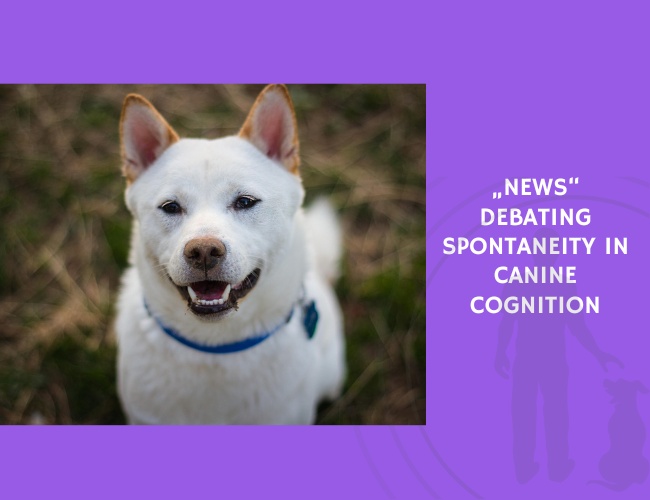
In 2020, Clive Wynne published a critical reflection on the concept of spontaneity in canine cognition. His commentary responds to a Scientific Reports article by Fugazza and Miklósi, who described a dog’s ability to perform “spontaneous” categorization—an ability often taken as evidence of flexible, human-like cognition.
Wynne’s central point is that the term “spontaneous” requires careful definition before it can be meaningfully applied to animal behavior. If a behavior is labeled spontaneous simply because it occurs without explicit training, the term risks becoming scientifically empty. Dogs frequently engage in complex behaviors shaped by a rich history of prior learning, socialization, and reinforcement, making it difficult to establish whether any observed action truly emerges without environmental prompting.
The commentary encourages researchers to scrutinize the assumptions underlying claims of high-level cognitive skills in dogs. Wynne argues that without rigorous methodological controls, behaviors that appear spontaneous may actually reflect subtle cues, learned associations, or previously acquired categorization abilities. As such, the concept should only be invoked when alternative explanations have been thoroughly ruled out.
This discussion highlights a broader issue within comparative cognition: the need for conceptual clarity when studying nonhuman minds. For dogs—a species living closely with humans and exceptionally responsive to social cues—identifying truly spontaneous cognition poses additional challenges. Wynne’s analysis thus emphasizes the importance of careful interpretation and transparent terminology in advancing our understanding of canine mental life.
Source: Wynne, C. (2020). Can a dog be spontaneous? Learning & Behavior.










