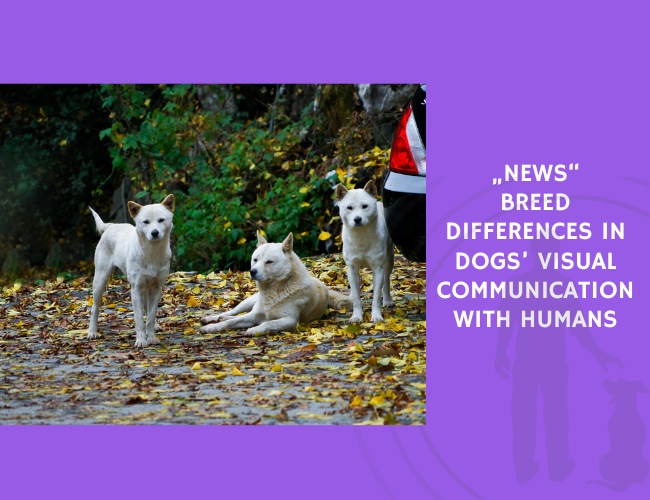
The study by Konno, Romero, Inoue‐Murayama, Saito, and Hasegawa (2016) explores how domestication history and breed ancestry shape visual communication between dogs and humans. Eye contact plays a central role in initiating and sustaining human–dog relationships, functioning as a powerful social cue that supports bonding, cooperation, and joint attention.
A total of 125 purebred dogs were tested using two standardized behavioral paradigms: a visual contact task, measuring how quickly a dog makes eye contact with a human, and an unsolvable task, assessing human-directed gazing when the dog encounters a problem it cannot solve alone.
The dogs were grouped into five genetic breed clusters—Ancient, Herding, Hunting, Retriever–Mastiff, and Working—based on established phylogenetic relatedness. Results showed a striking pattern: Ancient breeds, which retain closer genetic similarity to wolves, took significantly longer to initiate eye contact and gazed at humans for shorter durations during the unsolvable task compared with all other breed groups.
This reduced reliance on human-directed gaze suggests that communicative eye contact may be a relatively recent outcome of domestication and selective breeding. While modern working and companion breeds have been shaped to cooperate closely with humans, ancient breeds may express more independent behavioral tendencies rooted in ancestral wolf-like traits.
The findings highlight the evolutionary and genetic influences underlying dog–human communication, emphasizing that not all breeds use gaze in the same way—and that these differences reflect deep domestication history rather than specific working roles.
Source: Konno, A., Romero, T., Inoue‐Murayama, M., Saito, A., & Hasegawa, T. (2016). Dog Breed Differences in Visual Communication with Humans. PLoS ONE.