
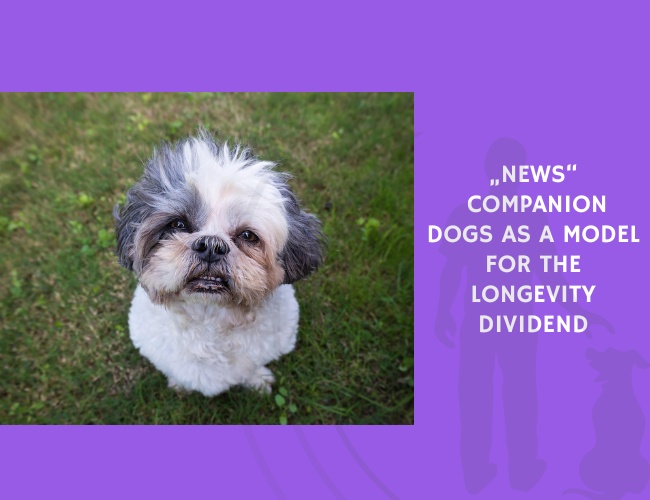
The work of Creevy, Austad, Hoffman, O’Neill, and Promislow (2016) examines the extraordinary suitability of companion dogs for research on aging, morbidity, mortality, and the broader concept of the longevity dividend (LD)—the idea that delaying aging processes yields widespread health, social, and economic benefits.
Dogs are the most phenotypically diverse species on the planet, with dramatic differences across breeds in morphology, behavior, lifespan, and disease susceptibility. This diversity, combined with shared living environments with humans, positions dogs uniquely as translational models. Like humans, dogs are exposed to environmental risk factors such as pollutants, sedentary lifestyles, and dietary variation, making them more representative of human aging patterns than traditional laboratory animals.
The authors review existing knowledge of age-specific morbidity and mortality, detailing how different breeds display predictable health trajectories, from early-life disorders to late-life decline. These robust breed-specific health profiles, along with extensive veterinary medical infrastructure and accessible electronic health records, allow researchers to detect biological patterns of aging that parallel human conditions.
However, the review also emphasizes limitations. Many dogs are euthanized before natural death, complicating precise lifespan data. The influence of owner decisions, lifestyle factors, and varying veterinary care can introduce additional variability. Despite these challenges, the evidence strongly supports the idea that dogs offer a powerful, realistic model for investigating both the biological mechanisms and societal implications of the longevity dividend.
Overall, the review concludes that companion dogs hold tremendous promise for advancing aging research in ways not possible with traditional models, helping translate scientific discoveries into meaningful improvements in healthspan for both humans and animals.
Source: Creevy, K., Austad, S., Hoffman, J. M., O’Neill, D., & Promislow, D. (2016). The Companion Dog as a Model for the Longevity Dividend. Cold Spring Harbor Perspectives in Medicine.










