
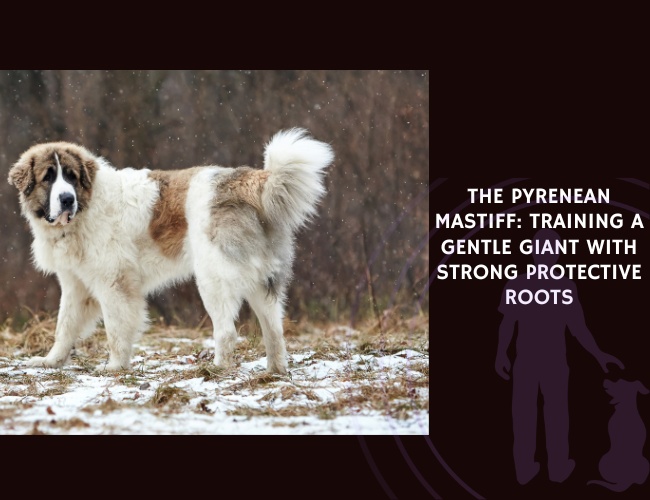
When you first encounter a Pyrenean Mastiff, the sheer presence stops you in your tracks. Standing between 120 and 240 pounds of calm, watchful guardian, you might wonder how something so massive can move with such deliberate grace. These dogs carry centuries of mountain heritage in their bones—bred to face wolves and bears across the Aragonese Pyrenees, yet gentle enough to rest their enormous head in your lap for hours. But here’s what every prospective owner needs to understand: that gentleness and that guardian instinct aren’t opposing forces. They’re intertwined in ways that make this breed both remarkable and challenging in modern life.
Let us guide you through the fascinating world of training a Pyrenean Mastiff, where understanding their protective roots becomes the foundation for building a trusting relationship with your gentle giant.
Historical Foundations: Where Guardian Instinct Was Born
The Mountain Heritage
Picture this: the year is 504 A.D., and Visigoth King Eurico has just formalized the ancient practice of transhumance—the mass seasonal migration of sheep across mountain passes. Five Pyrenean Mastiffs accompany a single shepherd and a flock of 1,000 sheep through territories where wolves and bears hunt. These dogs weren’t pets. They were autonomous decision-makers, working partners who needed to assess threats, deter predators, and protect their charges with minimal human direction across vast, dangerous landscapes.
This historical context isn’t just interesting backstory. It’s the key to understanding why your Pyrenean Mastiff does what they do in your suburban backyard today. The behavioral blueprint was forged through centuries of specific selection pressures, creating a dog whose instincts run deep and whose responses follow ancient logic.
The Deterrence Strategy
Here’s something that surprises many people: Pyrenean Mastiffs were bred primarily for deterrence, not confrontation. Their defensive strategy operated on multiple levels before physical engagement ever became necessary:
The Historical Deterrence Layers:
- Perimeter patrol and scent-marking – Created invisible boundaries that announced the flock’s territory through strategic marking patterns
- Vocal warning systems – Barking at any sound, any movement, anything that might signal danger to alert both predators and shepherd
- Visual intimidation displays – Leveraging impressive size, commanding posture, and what historical records describe as a “raging beast” presentation
- Physical engagement – Reserved as absolute last resort when all other deterrents failed
The fascinating part? It rarely went further than the first three levels. Few predators looked at a raging 200-pound mastiff and thought, “Yes, I’ll fight that today.”
This selection history created:
- High thresholds for actual physical confrontation
- Strong preference for threat assessment over immediate reaction
- Impressive visual and vocal deterrent capabilities
- Reserved physical force as final option, not first response
The carlanca—those famous spiked collars protecting the dogs’ necks during wolf encounters—tells us something important. If physical confrontation were common, these dogs would have needed armor on more than just their necks. The carlanca suggests that when fights did happen, they were brief and focused, not prolonged battles.
What This Means for Modern Training
Your Pyrenean Mastiff’s threshold architecture reflects their functional history:
Concern Threshold: LOW (High Vigilance)
- Bred to notice and assess all environmental changes
- Expected to maintain awareness across large territories
- Selected for sensitivity to novel stimuli without panic
Courage Threshold: HIGH (Confident Assessment)
- Required to face apex predators (wolves, bears) without fleeing
- Needed to maintain position despite threat
- Selected for calm evaluation rather than reactive fear
Response Threshold: GRADUATED (Measured Escalation)
- First response: observation and positioning
- Second response: vocal warning (barking)
- Third response: visual display (size, posture, movement)
- Final response: physical engagement (rare)
Understanding this architecture changes everything about how you approach training. You’re not trying to suppress their guardian instincts. You’re learning to guide them, to become the decision-maker they’re looking for in this confusing modern world where “threats” arrive in delivery trucks and neighbors cross invisible boundaries all day long.
The Gentle Giant Paradox: Understanding True Temperament
What Genuine Gentleness Looks Like
You’ve probably read that Pyrenean Mastiffs are gentle giants. It’s true, but let’s be precise about what that means. Gentleness in this breed isn’t passive submission or suppressed behavior. It’s an active choice, a fundamental aspect of their character that coexists with their protective instincts.
Watch a genuinely gentle Pyrenean Mastiff, and you’ll notice specific patterns:
Physical Indicators of Genuine Gentleness:
- Relaxed body posture with soft muscle tone
- Loose, natural movement and weight distribution
- Soft eye contact with gentle gazes and slow blinks
- Willingness to look away when appropriate
- Measured, deliberate choices rather than reactive movements
- Comfortable with proximity without tension or hovering
Behavioral Indicators:
- Voluntarily initiates gentle contact (that characteristic head-in-lap behavior)
- Shows emotional resilience, recovering quickly from startles
- Demonstrates contextual appropriateness, adjusting to situations
- Remarkably gentle with children despite massive size differential
That’s the magic of this breed—they understand they’re big, and they choose to be careful. 🧡
Distinguishing Gentleness from Shutdown
But here’s what you need to watch for: behavioral shutdown can masquerade as calmness.
Physical Signs of Shutdown:
- Frozen posture with rigid stillness
- Minimal movement or responsiveness
- Persistent eye contact avoidance
- Whale eye, lip licking, yawning without cause
- Panting when it’s not hot
- Withdrawal behaviors, seeking escape
Behavioral Patterns Indicating Suppression:
- Lacks voluntary engagement or contact initiation
- Shows slow recovery from stress events
- Displays generalized inhibition across all contexts
- Refuses interaction despite no physical barriers
The critical distinction? A genuinely gentle Pyrenean Mastiff chooses calm behavior and seeks connection. A shut-down dog avoids interaction and shows persistent stress signals. If your dog displays these shutdown patterns, that requires a different approach entirely—one focused on building confidence and reducing environmental pressure.
The Attachment-Protection Paradox
Now we arrive at one of the most challenging aspects of living with a Pyrenean Mastiff: the deeper their bond with your family, the stronger their protective responses become. This is the attachment-protection paradox, and understanding it is crucial for successful training.
When your Pyrenean Mastiff forms deep family bonds, several mechanisms amplify their guardian instincts:
How Attachment Amplifies Protection:
- Increased vigilance intensity – Monitoring threats more intensely near bonded family members
- Heightened alert status – Proximity to children or vulnerable humans raises threat assessment sensitivity
- Stronger protective responses – Perceived threats to bonded individuals trigger more intense reactions than threats to themselves
- Expanded threat definition – Anything causing family member distress may be interpreted as requiring intervention
- Intervention in family dynamics – Rough play between children, emotional upset, or perceived “unfairness” can activate protective positioning
- Role assumption – Without clear human leadership, dogs may assume responsibility for family management
There’s something magical about the bond between guardian breeds and children—that observation applies powerfully to Pyrenean Mastiffs. But the magic requires careful management. These dogs perceive children as vulnerable “flock members,” responding to children’s unpredictable movements and vocalizations with heightened vigilance. Through the NeuroBond approach, we recognize that trust becomes the foundation for teaching your dog which situations truly require their intervention and which ones you’re already managing perfectly well.
Strategic Positioning: The First Warning
Your Pyrenean Mastiff’s first protective response is rarely aggression. It’s positioning:
Characteristic Positioning Behaviors:
- Body blocking – Placing themselves between family and perceived threat
- Physical barrier creation – Maintaining position without aggression or vocalization
- Quiet standing – Stationary presence as deterrent, silent watchfulness
- Prepared readiness – Alert posture without escalation or forward movement
- Monitoring stance – Observing situation while maintaining strategic position
This preference for positioning over confrontation reflects their historical role. Most predators were deterred by presence alone, making physical combat unnecessary.
Training Implication – Why This Matters: You must recognize and manage positioning behaviors early. This is your dog’s first-line protective response, and allowing unchecked positioning can lead to:
- Increased confidence in independent decision-making
- Escalation to more assertive blocking behaviors
- Eventual physical intervention if positioning is “ignored”
- Dog assuming primary protective role instead of supporting your leadership
Adolescent Development: When Your Perfect Puppy Changes
The Critical Vulnerability Period
Here’s something that catches many Pyrenean Mastiff owners completely off guard: somewhere between 6 and 18 months, that gentle, cooperative puppy you’ve been raising suddenly seems like a different dog. They’re testing boundaries you thought were established. They’re more reactive to triggers. They seem to have forgotten everything they learned. And you might wonder: “What happened? Did I do something wrong?”
The answer is no. What happened is adolescence—and for guardian breeds, this developmental period presents unique challenges that every owner needs to understand.
When Protection Matures Before Self-Control
The fundamental challenge of adolescence in Pyrenean Mastiffs is timing. Their protective instincts are maturing and intensifying, reaching near-adult levels of drive and motivation. But their emotional regulation system—the part of the brain that manages impulse control, assesses situations calmly, and moderates responses—is still developing. This creates a dangerous mismatch: adult-level protective drive with juvenile impulse control.
Imagine giving someone enormous responsibility and the physical capability to act on it, but without the emotional maturity to make good decisions. That’s your adolescent Pyrenean Mastiff. They feel the pull to protect, they have the size and confidence to act, but they lack the wisdom to know when protection is actually needed versus when they’re overreacting to normal situations.
Common Adolescent Changes You’ll Notice:
- Heightened territorial responses to previously ignored stimuli
- Increased confidence in independent protective decision-making
- Testing of established boundaries and previously accepted rules
- Amplified protective responses around family members, especially children
- More intense reactions to the same triggers that were handled calmly months earlier
- Questioning whether household protocols still apply now that they’re “grown up”
The Hormonal Storm
For male Pyrenean Mastiffs, testosterone increases during adolescence create additional complexity:
Hormonal Impact on Behavior:
- More intense territorial behavior – Increased marking, patrolling, boundary monitoring frequency
- Mounting behaviors – Sometimes directed at people, furniture, or other dogs
- Heightened reactivity – Faster, stronger responses to protective triggers
- Testing boundaries with other dogs – Particularly other males, assessing social hierarchy
- Increased independence – Stronger drive to make autonomous protective decisions
Female dogs experience their own hormonal fluctuations, though typically less dramatic in terms of territorial escalation. But both sexes experience significant neurological development during this period that affects behavior in ways that can seem baffling.
The Adolescent Brain Changes Everything
The adolescent brain is, quite frankly, a mess. Neurological development during this period creates:
How Brain Development Affects Behavior:
- Increased emotional reactivity – More barking, whining, clinginess, and intensity in all responses
- Decreased attention span – Focus drops from five minutes to thirty seconds seemingly overnight
- Unpredictable mood swings – Calm one moment, reactive the next, with no apparent trigger
- Heightened fear responses – Suddenly showing concern about previously comfortable situations
- Reduced frustration tolerance – Less patience with training, handling, or environmental challenges
- Impaired impulse control – Acting before thinking, rushing toward stimuli without assessment
Perhaps most challenging for Pyrenean Mastiff owners: fear responses and reactivity to new stimuli heighten during adolescence. Your dog might suddenly show concern about things that never bothered them before. This isn’t regression—it’s a normal part of brain development where the fear circuitry becomes temporarily more sensitive.
Social Filters: Learning Who Deserves Protection
Adolescence is when dogs develop their adult social filters—the internal system that determines which people, dogs, and situations are safe versus threatening. For Pyrenean Mastiffs, this is a critical period where they’re essentially calibrating their guardian instincts based on experience.
During this phase, your dog may respond with fear, curiosity, or defensive behavior to stimuli that were previously familiar and comfortable. Dogs who were friendly with everyone as puppies may become more selective, showing wariness toward strangers or unfamiliar dogs. This is actually normal social maturation for guardian breeds, but it requires careful management.
The danger is that negative experiences during this period can create lasting associations. An overwhelming encounter with a rowdy dog at the park might establish “other dogs are threats” as your dog’s default assumption. A frightening visitor interaction could teach “strangers approaching the house require aggressive defense.” You’re essentially programming your dog’s threat assessment system during these months.
This is why consistency, predictability, and positive experiences matter exponentially more during adolescence than at any other time. 🧠
What Testing Boundaries Really Means
When your adolescent Pyrenean Mastiff tests boundaries, they’re not being deliberately defiant or disrespectful. They’re doing exactly what they’re neurologically programmed to do: questioning previously accepted rules to determine if they still apply now that they’re “grown up.”
Your dog might experiment with expanded territorial claims. “I used to only guard the house, but what about the driveway? The sidewalk in front? The park where we walk?” They’re testing whether independent protective decisions are “allowed” now that they feel more capable. They may challenge your authority in protective contexts specifically—cooperating perfectly with obedience commands but pushing back when you try to manage visitor greetings or territorial situations.
This isn’t personal. It’s developmental. Your dog is essentially asking: “Now that I’m bigger and stronger and more confident, do these rules still apply? Are you still in charge? Or is it my turn to make decisions about protection?”
Your Response Determines Everything
How you respond during this adolescent phase shapes your adult dog’s behavior for life. The wrong response—becoming frustrated, escalating corrections, engaging in power struggles—can create lasting damage to your relationship and amplify protective behaviors into genuine problems.
The right response requires understanding, patience, and unwavering consistency. Maintain structure despite testing. When your dog challenges a boundary, calmly reinforce it without drama. Your visitor protocol still applies, every single time, even when your adolescent dog acts like they’ve never heard of it. Consistency proves that the rules weren’t conditional on your dog being small and cute—they’re permanent family structure.
Enforce consistent boundaries without harsh punishment. Your adolescent Pyrenean Mastiff needs clear limits, but harsh corrections during this emotionally volatile period can create fear, defensiveness, or aggressive responses. Firm, calm, matter-of-fact enforcement works better than emotional confrontation.
Practice patient repetition of established rules. Yes, you taught this six months ago. Yes, your dog seemed to understand it perfectly. You’re going to teach it again now, probably multiple times, because the adolescent brain genuinely struggles with recall and impulse control. This isn’t your dog being stupid or stubborn—it’s neurology.
Increase supervision during high-risk situations. Your adolescent Pyrenean Mastiff needs more management, not less, even though their increased size might make you think they should have more freedom. They need you to prevent them from making protective decisions they’re not equipped to make wisely.
The Most Important Thing to Remember
Here’s what every Pyrenean Mastiff owner needs burned into their brain during the adolescent phase: these behaviors are not signs that your puppy is “bad” or “broken” or that you’ve failed as a trainer. They’re signs that your dog is growing up, exactly as they should be.
The dog who tests boundaries at ten months isn’t damaged. They’re developing. The dog who seems to forget training isn’t being willful. They’re experiencing normal adolescent brain development. The dog who shows heightened protective responses isn’t aggressive. They’re maturing into their guardian heritage without yet having the emotional regulation to moderate those instincts appropriately.
Adolescence ends. The brain develops, hormones stabilize, emotional regulation improves, and the dog you carefully raised starts to reemerge—more capable, more confident, and more reliably responsive to your guidance. But how you navigate these challenging months determines whether your adult Pyrenean Mastiff trusts your leadership or has learned to make independent protective decisions you’ll struggle with for years.
Patience during adolescence is an investment in a lifetime of partnership. 🧡

Territorial Cognition: How Your Dog Sees Boundaries
The Expansive Territory Concept
Let’s talk about how your Pyrenean Mastiff conceptualizes territory, because it’s probably much larger than you think. Their historical work involved transhumance routes covering vast distances, fluid boundaries defined by flock location, and perimeter patrol and scent-marking as primary territorial maintenance. They weren’t guarding a fenced yard. They were protecting a moving, changing territory that could span miles.
Without clear guidance from you, your Pyrenean Mastiff may conceptualize territory in expanding circles:
How Your Dog Defines Territory (Without Clear Guidance):
- Core Territory – House interior (highest protection priority, most vigilant monitoring)
- Primary Territory – House + yard (active patrol zone, regular boundary checking)
- Extended Territory – Street, driveway, visible surroundings (monitoring zone, alert status)
- Fluid Territory – Anywhere family members are present (protection follows family)
This creates obvious challenges in suburban settings:
- Property lines sit close to neighbors
- Public sidewalks border private property
- Delivery drivers regularly cross boundaries
- Visitors approach doors frequently
- Your dog isn’t being unreasonable—they’re applying ancient logic to modern geography
The Cost of Unclear Boundaries
When territorial rules are unclear or inconsistent, your Pyrenean Mastiff experiences genuine stress:
What Unclear Boundaries Create:
- Working without clear guidelines – Forced to make independent decisions about what requires protection
- Cognitive dissonance – Inconsistent responses to same stimuli (greeting some delivery drivers, barking at others)
- Role ambiguity – Uncertain whether you’re managing situations or they need to step in
- Progressive territory expansion – Starting with house, gradually extending to entire neighborhood
- Increased response intensity – Escalating from observation to vocal warning to physical blocking
- Generalized vigilance – Monitoring everything constantly because nothing is clearly “not their problem”
The psychological mechanism is straightforward: when someone must take responsibility for something but lacks clear authority or guidance about how to do it, they experience chronic stress and may develop rigid, overprotective patterns. Your Pyrenean Mastiff needs you to define what’s actually their concern and what you’re managing yourself.
Teaching Boundary Recognition
So how do you communicate territorial boundaries to a dog whose instincts tell them to protect expansively? The Invisible Leash reminds us that awareness, not tension, guides the path. Your goal is teaching your dog that certain boundaries matter and certain activities beyond those boundaries aren’t their concern.
Practical Boundary Training Steps:
Spatial Awareness Training:
- Walk the perimeter regularly with your dog on leash
- Mark boundaries with your presence and reinforcement
- Teach your dog where property lines exist through consistent physical management
- Use treats and praise when your dog checks in with you at boundaries
Create Inside/Outside Distinctions:
- Inside the fence requires alert monitoring (appropriate vigilance)
- Outside the fence is simply environmental noise (not your concern)
- Consistently reinforce this distinction through management
Threshold Training at Doorways and Gates:
- Your dog pauses at thresholds, waiting for your permission to cross
- Establishes that you control boundary crossings, not them
- Practice daily with every doorway and gate transition
- Gradually add distractions once basic pause is reliable
Calm Exposure to Boundary Crossings:
- Your dog observes from a secure position
- Delivery drivers approach while dog remains in controlled location
- Neighbors walk past while dog watches from designated spot
- Building understanding that these crossings don’t require intervention
Absolute Consistency:
- Every boundary crossing needs same response from you
- Letting some deliveries pass without comment but reacting to others creates confusion
- Your dog needs to know: “When someone crosses this line, here’s what happens, and here’s what I do about it”
Visitor Protocols: Managing the Most Challenging Scenario
Why Visitor Arrivals Trigger Maximum Response
Let’s be honest: visitor arrivals are probably the most challenging scenario you’ll face with your Pyrenean Mastiff. Why? Because everything about this situation triggers their guardian programming. Someone approaches the boundary (detection). They assess threat level through distance, behavior, and familiarity (usually finding them unfamiliar). They respond by positioning themselves between family and visitor, offering vocal warnings, potentially physical blocking.
This is compounded by family response patterns. Family members often show excitement, creating arousal that your dog interprets as concern. Movement toward the door suggests urgency. Emotional energy in the environment raises your dog’s alert level. Without clear protocols, they default to their historical programming, and that programming says: “Unannounced boundary crossing by unfamiliar individual requires management until proven safe.”
The Structured Greeting Protocol
Here’s what changes everything: giving your dog a clear job that doesn’t involve decision-making. The structured greeting protocol has four phases, each communicating something specific to your Pyrenean Mastiff:
Phase 1: Pre-Arrival Preparation
- You notice the visitor before your dog does (doorbell cameras help enormously)
- You control your dog’s position (place command, barrier, or leash management)
- You claim the door space (you manage the threshold, not them)
- Dog learns: “Handler sees this coming and is taking control”
Phase 2: Controlled Entry
- You open the door, not your dog trying to push through
- You greet the guest first, establishing handler-guest relationship
- You control guest movement, directing where guest goes
- Dog learns: “Handler establishes relationship with new person”
Phase 3: Managed Introduction
- You decide if and when your dog greets
- You control proximity (leash, barriers, commands maintaining distance)
- You monitor interaction constantly, ready to intervene
- Dog learns: “Handler permits or denies contact based on their assessment”
Phase 4: Clear Resolution
- You signal “all clear” (releasing dog, returning to normal patterns)
- Dog learns guest is now “approved” and no longer requires monitoring
- Situation has definitive endpoint, tension can release
- Dog learns: “Handler will tell me when situation is resolved”
The Psychological Impact: This structure communicates:
- “I (handler) am managing this situation”
- “Your (dog’s) job is to observe and trust my judgment”
- “You don’t need to make independent decisions”
- “I will tell you when action is needed”
Your Pyrenean Mastiff’s natural barking tendency can be channeled through clear protocols rather than suppressed:
The Barking Management Sequence:
1. Allow Initial Alert Bark
- Acknowledges your dog’s guardian role
- Validates their awareness of the stimulus
- Shows you’re not trying to suppress their nature
2. Immediate “Enough” Command
- You’re taking over management of the situation
- Clear verbal cue that their alert job is done
- Calm, matter-of-fact tone (not angry or frustrated)
3. Reward Silence
- Reinforces that quiet attention is more valuable than continued barking
- Start with very short silence duration (5 seconds)
- Gradually increase duration as your dog understands the pattern
4. Proceed With Greeting Protocol
- Demonstrates your competence to handle situations
- Shows your dog their alert allowed you to manage effectively
- Builds trust in your leadership
Training From Young Age: Starting from a young age, reward your dog the moment they stop barking for more than five seconds. This teaches:
- Barking alerts handler (appropriate guardian behavior)
- Handler manages situation (dog can relax)
- Silence is rewarded (better outcome than continued barking)
- System works reliably (builds trust in your management)
Over time, your dog learns that their job is to notice and alert, not to manage and control. That shift changes everything about living with a protective breed.
Still. Grounded. Intelligent.
Calm Before Action
Bergamascos do not rush because their intelligence is built on evaluation, not impulse. Their pauses signal thinking, not hesitation.
Mountains Shaped Minds
Alpine work demanded independent judgement combined with human cooperation. This heritage created dogs who assess situations fully before moving.
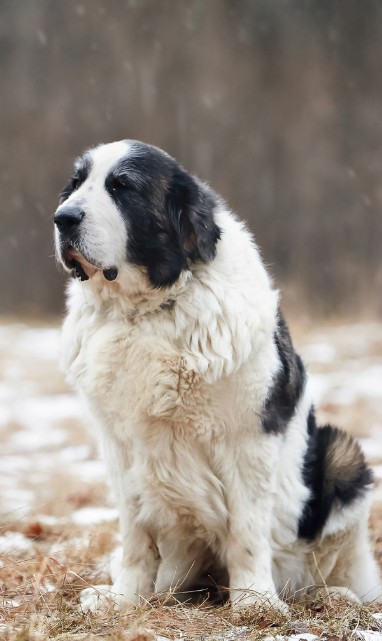
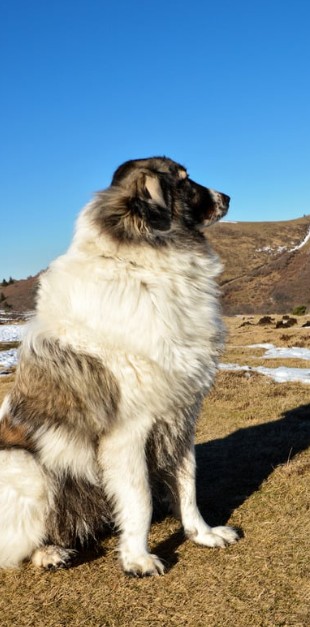
Quiet Holds Strength
Their confidence expresses itself through presence rather than display. When understanding is complete, their responses are steady, reliable, and deeply intentional.
Size, Arousal, and the Physics of Protection
Let’s talk about something critical: the unique risk factors created by your Pyrenean Mastiff’s size.
Physical Mass Creates Unique Challenges:
- Adult weight: 120 to 240-plus pounds
- Significant momentum when moving, even at moderate speeds
- Substantial impact force even without aggressive intent
- Genuine difficulty for handlers to physically control or redirect
- Size disparity makes safe physical intervention nearly impossible
The Guardian Breed Response Pattern: Guardian breeds typically show:
- Slow initial escalation – Graduated threat response with thoughtful assessment
- Measured decision-making – Rather than reactive responses
- Thoughtful assessment – Before committing to action
But they also show:
- Difficulty de-escalating once committed to action
- Momentum (physical and psychological) that’s hard to reverse
- Reduced responsiveness to handler cues once threshold is crossed
- Commitment to protective action that overrides other considerations
This is why prevention matters exponentially more than management. 🧠
Behavioral research indicates that dogs are slower to escalate but harder to de-escalate once they cross a certain internal threshold. For Pyrenean Mastiffs, this manifests clearly in two distinct states:
Pre-Threshold State (Manageable):
- Responsive to handler cues and verbal direction
- Can be redirected relatively easily
- Shows graduated warning signals you can observe
- Maintains behavioral flexibility and options
- Still thinking and accessible to your guidance
- You can interrupt the escalation chain
- Creating distance remains effective
Post-Threshold State (Difficult to Manage):
- Reduced handler responsiveness, may not hear you
- Committed to protective action despite your cues
- Difficult to interrupt or redirect
- Displays behavioral rigidity—locked into response pattern
- Nearly impossible to manage without physical intervention
- Physical intervention dangerous for handlers
- Dog has “decided” and follows through
Understanding these states helps you recognize the critical importance of early intervention—once your dog crosses threshold, your management options become extremely limited and potentially unsafe.
🏔️ Training Your Pyrenean Mastiff: The Guardian’s Journey 🐕
Understanding the gentle giant with protective roots—from historical heritage to modern family life
Phase 1: Understanding Guardian Heritage
The Foundation of Modern Behavior
Pyrenean Mastiffs were bred for centuries to protect flocks across the Aragonese Pyrenees. Five dogs accompanied one shepherd with 1,000 sheep through wolf and bear territory. This heritage created dogs with autonomous decision-making abilities and graduated threat response systems.
• Concern Threshold: LOW – They notice everything
• Courage Threshold: HIGH – They don’t panic or flee
• Response Threshold: GRADUATED – Observe → Position → Vocalize → Display → Engage (rarely)
You’re not suppressing their guardian instincts—you’re learning to guide them. In modern suburban life, you become the decision-maker they’re looking for, helping them navigate a world where “threats” arrive in delivery trucks and neighbors cross boundaries all day.
Phase 2: Recognizing Genuine Temperament
Gentleness vs. Shutdown
• Relaxed body posture with soft muscle tone
• Voluntary contact initiation (head-in-lap behavior)
• Quick recovery from startles
• Contextual appropriateness with children
• Frozen posture with rigid stillness
• Persistent eye contact avoidance
• Whale eye, lip licking, stress yawning
• Slow recovery from stress events
Deeper family bonds amplify protective responses. Your dog monitors threats more intensely near bonded members, perceives children as vulnerable “flock members,” and may assume family management responsibility without clear human leadership. This isn’t a problem—it’s breed heritage requiring guidance.
Phase 3: Navigating Adolescence (6-18 Months)
When Your Perfect Puppy Changes
Protective instincts mature BEFORE emotional regulation stabilizes. Your adolescent has adult-level protective drive with juvenile impulse control—enormous responsibility without the wisdom to use it wisely. This creates the most challenging training period.
• Heightened territorial responses to previously ignored stimuli
• Testing established boundaries and rules
• Unpredictable mood swings and emotional reactivity
• Decreased attention span (5 minutes to 30 seconds)
• Amplified protective responses around family members
Maintain structure despite testing. Enforce consistent boundaries without harsh punishment. Practice patient repetition. Increase supervision during high-risk situations. Remember: Your dog isn’t broken—they’re growing up. This phase ends, but how you navigate it shapes adult behavior forever.
Phase 4: Managing Territorial Cognition
Teaching Boundaries in Modern Spaces
• Core Territory: House interior (highest protection priority)
• Primary Territory: House + yard (active patrol zone)
• Extended Territory: Street, driveway, visible surroundings
• Fluid Territory: Anywhere family members are present
Inconsistent territorial rules create chronic stress. Your dog works without clear guidelines, forced to make independent decisions. This leads to progressive territory expansion, increased response intensity, and generalized vigilance—monitoring everything constantly because nothing is clearly “not their problem.”
Walk perimeters regularly on leash. Practice threshold training at every doorway and gate. Create clear inside/outside distinctions. Use calm exposure to boundary crossings by others. Most important: absolute consistency—every boundary crossing needs the same response from you.
Phase 5: Mastering Visitor Protocols
The Most Challenging Scenario
1. Pre-Arrival: You notice visitor first, control dog’s position, claim door space
2. Controlled Entry: You open door, greet guest first, control guest movement
3. Managed Introduction: You decide if/when dog greets, control proximity
4. Clear Resolution: You signal “all clear,” situation has definitive endpoint
Allow initial alert bark (acknowledges guardian role) → Immediate “Enough” command (you’re taking over) → Reward silence → Proceed with protocol. Starting from young age, reward the moment they stop barking for 5+ seconds. This teaches: barking alerts handler, handler manages situation, silence is rewarded, system works reliably.
This structure communicates: “I am managing this situation. Your job is to observe and trust my judgment. You don’t need to make independent decisions. I will tell you when action is needed.” Over time, your dog learns their job is to notice and alert, not to manage and control.
Phase 6: Reading Early Warning Signals
Prevention Over Management
At 120-240 pounds, your Pyrenean Mastiff creates significant momentum when moving. Guardian breeds show slow initial escalation but difficulty de-escalating once committed. Once threshold is crossed, they’re nearly impossible to manage without dangerous physical intervention. Prevention matters exponentially more than management.
• Silent blocking: Positioning between family and stimulus
• Fixed gaze: Intense focus, “locked on” appearance
• Subtle weight shifts: Weight forward onto front legs
• Stillness/freezing: Sudden cessation of movement
• Orientation changes: Body turning toward stimulus
These signals represent the narrow window where intervention is most effective. Acknowledge alert → Take over management → Redirect to alternative position. Once escalation proceeds beyond these subtle signs, de-escalation becomes exponentially more difficult. Intervene early, always.
Phase 7: Confident vs. Insecure Guarding
Assessing Your Dog’s Emotional State
Truly confident guardian dogs guard LESS because internal security allows accurate threat assessment. They show calm watchfulness, measured responses proportional to threat level, brief warning barks followed by assessment, and quick recovery once stimulus passes. They observe before responding and accept handler guidance readily.
Insecure dogs over-guard because uncertainty drives conservative responses. They show rigid body stiffness, excessive/prolonged barking, constant hypervigilance, and slow recovery after triggers. They react before assessing, resist handler guidance, over-generalize threats, and remain activated long after stimulus is gone.
Reduce trigger exposure immediately. Establish absolutely consistent protocols. Acknowledge alerts without reinforcing panic: “I see it too, I’ve got this.” Build positive associations through controlled exposure from safe distances. Never punish protective responses—this deepens insecurity. Demonstrate reliable competence in handling situations.
Phase 8: Training Philosophy & Emotional Sensitivity
Respect, Structure & Understanding
If you scold this breed, it hurts their feelings deeply. Emotional wounds persist longer than physical ones. Harsh corrections conflict with natural autonomy and damage trust profoundly. When seeking behavior is thwarted, rage circuitry is aroused—creating internal conflict that can produce explosive responses. Physical corrections are ineffective with dogs this large.
When overwhelmed, Pyrenean Mastiffs disengage and quietly resist—not challenge. Watch for slowing movement, looking away, increased stress signals, reduced responsiveness. This isn’t stubbornness—it’s overwhelm. Reduce pressure immediately, simplify demands, return to successful exercises, reassess your approach entirely.
Start with positive reinforcement creating strong handler-dog bonds. Use slow repetition—guardian breeds need multiple repetitions for concept mastery. Provide meaningful routines and clear role definition. Teach the learning process itself, building problem-solving confidence. Develop cooperative partnership rather than forced compliance. They’re very smart and can be very biddable if taught how to learn from a young age.
🔍 Pyrenean Mastiff vs. Other Guardian Breeds
Size: Pyrenean Mastiff is larger (120-240 lbs vs. 85-115 lbs)
Temperament: PM more emotionally sensitive
Barking: Both vocal, PM responds better to structured protocols
Independence: Anatolian more independent
Family bonding: PM bonds more deeply
Training: PM more sensitive to corrections, needs gentler approach
Puppy (0-6 months): Learning phase, building foundation
Adolescent (6-18 months): Most challenging, testing boundaries
Adult (18+ months): Stabilized if foundation solid
Rural: Natural environment, fewer triggers, can patrol expansively
Suburban: Requires extensive management, consistent boundaries, trigger reduction strategies
Male: Larger, more territorial marking, stronger adolescent hormonal surge
Female: Smaller but equally protective, less territorial marking, steadier temperament
Confident: Guards less, accurate assessment, quick recovery, accepts guidance
Insecure: Over-guards, hypervigilant, slow recovery, resists redirection
Consistency + Clear Boundaries + Early Intervention = Confident Guardian
The 5-Second Rule: Reward silence 5 seconds after initial alert bark
The Threshold Rule: Intervene at subtle signals (blocking, fixed gaze, weight shifts)
The Territory Rule: Same response to same trigger, every single time
The Adolescent Rule: 2x structure during 6-18 months = lifetime partnership
The Emotional Rule: If you scold, it hurts deeply—use positive methods
Training a Pyrenean Mastiff isn’t about suppressing who they are—it’s about understanding the NeuroBond between you, where trust becomes the foundation of every interaction. The Invisible Leash reminds us that awareness, not tension, guides the path. Your gentle giant doesn’t need physical control—they need your calm, competent leadership that allows them to relax into family life.
Through moments of Soul Recall, you’ll recognize how deeply memory and emotion intertwine in guardian behavior. Every consistent protocol, every early intervention, every patient repetition during adolescence builds a relationship where your dog trusts your judgment completely. They can be the watchful protector they were born to be without carrying constant stress and confusion.
This is where science meets soul—understanding the neurological architecture of guardian breeds while honoring the profound emotional sensitivity that makes them remarkable family companions. That balance, that harmony between protective roots and gentle nature, is the essence of Zoeta Dogsoul.
© Zoeta Dogsoul – Where neuroscience meets soul in dog training
Understanding the “Explosive” Dog Phenomenon
Some Pyrenean Mastiffs develop reputations as “explosive” dogs—seemingly calm one moment, then erupting into intense protective responses with minimal warning. Owners describe it as going from zero to ten instantly, with no apparent middle ground. This can be frightening, confusing, and dangerous. But understanding why this happens transforms it from mysterious and unmanageable to predictable and preventable.
The explosion isn’t actually instantaneous, even though it appears that way. What’s happening is that the graduated escalation you should be seeing is compressed or hidden, making the response seem sudden when it’s actually the culmination of multiple factors converging.
The masked threshold of perception is the first culprit. Your Pyrenean Mastiff’s sensory system might not detect a stimulus until it’s already very close or directly engaging. This happens frequently with approaches from behind, stimuli obscured by barriers (fences, cars, buildings), or situations where your dog is focused elsewhere and doesn’t notice the trigger approaching. Without early detection, there’s no time for the usual graduated response pattern. Your dog’s brain goes directly to high-level protective response because the perceived threat is immediate and close.
Think about how differently you’d respond if you saw someone approaching from a block away versus suddenly discovering them standing right next to you. The same principle applies to your dog—detection distance determines response intensity.
The startle element removes the assessment period entirely. When your dog is startled by an unexpected stimulus, the defensive response activates before the thinking brain can process what’s actually happening. This is pure survival neurology—the amygdala triggers immediate defensive action while the cortex is still trying to figure out what happened.
Common Startle-Based Explosion Triggers:
- Sudden noises without visual warning – Vehicles backfiring, construction sounds, dropped objects
- Unexpected physical contact – Someone touching the dog from behind, children suddenly grabbing
- Rapid approach movements – Joggers passing quickly, dogs rushing up without warning
- Contextual surprise – Stimuli appearing in “safe” locations where your dog isn’t monitoring
- Barrier appearances – People suddenly visible over fences or through gates
- Wake-up disruptions – Being startled from sleep by sudden activity
Environmental trigger stacking creates what appears to be disproportionate responses. Your Pyrenean Mastiff isn’t exploding over one trigger—they’re exploding because that trigger is the final addition to accumulated stress that’s been building throughout the day, week, or even longer.
Here’s how trigger stacking works: each stressful event raises your dog’s arousal level. In an ideal situation, that arousal level decreases back to baseline before the next trigger occurs. But in trigger-dense suburban environments, your Pyrenean Mastiff might encounter dozens of low-level stressors before they return to baseline: the mail carrier’s arrival, dogs barking down the street, delivery trucks, children playing loudly, neighbors mowing lawns, people walking past the fence.
Each event adds a layer of stress. None individually crosses the threshold for intense response. But collectively, they’ve pushed your dog’s arousal level so high that the next trigger—even a minor one—pushes them over threshold into explosive response. The trigger that “caused” the explosion didn’t really cause it. It was simply the last straw on a stack that had been building all day.
This is why your Pyrenean Mastiff might handle a delivery driver calmly in the morning but react explosively to the same situation in the afternoon. The difference isn’t the delivery driver. It’s everything that happened between morning and afternoon that you might not have even noticed raising your dog’s stress level.
Chronic stress accumulation makes explosive responses increasingly likely over time. If your Pyrenean Mastiff lives in a constant state of environmental overwhelm—trigger-dense neighborhood, unclear boundaries, inconsistent protocols, minimal downtime—their baseline arousal level never fully returns to calm. They’re perpetually operating at 60-70% stress capacity, meaning any significant trigger pushes them over threshold quickly.
Dogs in chronic stress also develop lower thresholds for protective responses. What would have required substantial stimulus to trigger becomes reactive to minimal provocation. This isn’t behavioral deterioration—it’s physiological adaptation to chronic overwhelm. Your dog’s nervous system has recalibrated what constitutes “threat requiring response” because everything feels threatening when you’re constantly stressed.
Preventing Explosive Responses
The good news? Once you understand the mechanisms, prevention becomes much more achievable than trying to manage explosive responses after they start.
Prevention Strategies That Work:
Increase Detection Distance:
- Walk in locations where your dog can see approaching stimuli from farther away
- Arrange home environment to eliminate blind corners where people suddenly appear
- Use elevated resting spots providing broader visual monitoring range
- Position furniture to maximize your dog’s view of entry points
Reduce Startle Triggers:
- Use doorbells or intercom systems providing warning before people reach the door
- Teach children and guests to announce themselves before approaching
- Create predictable patterns for common events
- Keep pathways clear so people don’t accidentally touch resting dogs
Manage Trigger Stacking:
- Monitor your dog’s stress accumulation throughout the day
- Provide decompression time after stressful events
- Create daily “off duty” periods without environmental monitoring
- Reduce unnecessary trigger exposure on already stressful days
Build Environmental Predictability:
- Maintain consistent daily routines reducing cognitive load
- Use predictable responses to common triggers
- Establish clear protocols eliminating decision-making stress
- Create structured patterns your dog can learn to anticipate
Recognize early arousal indicators before they become explosive responses:
Early Warning Signs of Rising Arousal:
- Increased restlessness – More pacing, inability to settle in usual spots
- More frequent checking – Repeatedly going to windows or doors without specific triggers
- Tighter body posture – Muscle tension, weight shifting forward
- Reduced responsiveness – Not responding to familiar cues as reliably
- Decreased tolerance – Less patience with normal household activity
- Vigilant scanning – Constant environmental monitoring without obvious cause
When you notice these indicators, immediately reduce trigger exposure. Move your dog to a quieter location, block visual access to stimuli, engage in calming activities (slow walking, gentle grooming, quiet presence), and avoid introducing additional stressors until your dog returns to baseline.
The “explosive” Pyrenean Mastiff isn’t a fundamentally different dog requiring different training. They’re a dog whose environmental circumstances, trigger exposure, or sensory processing creates compressed or hidden escalation patterns that make graduated responses impossible. Change those circumstances, and the explosiveness often resolves entirely.
Early Warning Signals: Your Prevention Window
So what do you watch for? Which early-warning signals must you learn to spot before your Pyrenean Mastiff crosses that threshold?
Critical Early Warning Signals & Responses:
1. Silent Blocking
- Dog positions between family and stimulus with no vocalization yet
- Deliberate placement and maintained position
- Your Response: Acknowledge their alert, take over management, redirect to alternative position
2. Fixed Gaze
- Intense focus on stimulus with reduced environmental responsiveness
- “Locked on” appearance with minimal blinking
- Your Response: Break visual focus (call dog, move dog, block line of sight), redirect attention
3. Subtle Weight Shifts
- Weight moving forward onto front legs in preparation for movement
- Increasing muscle tension and balance changes
- Your Response: Interrupt preparation, redirect movement, create distance from stimulus
4. Stillness/Freezing
- Sudden cessation of all movement with rigid posture
- Held breath and preparation for action
- Your Response: Immediate intervention—do not wait for next escalation stage
5. Orientation Changes
- Body turning toward stimulus with ears forward and focused
- Tail position change (raised, stiff) indicating readiness
- Your Response: Redirect orientation, create alternative focus, manage stimulus approach
These signals represent the narrow window where intervention is most effective. Moments of Soul Recall reveal how memory and emotion intertwine in behavior—once escalation proceeds beyond these subtle signs, your dog is accessing deeply embedded guardian programming, and de-escalation becomes exponentially more difficult.
Reading Your Dog’s Emotional State: Confident vs. Insecure Guarding
The Confidence Paradox
Here’s something that surprises many Pyrenean Mastiff owners: the most confident guardian dogs actually guard less frequently and less intensely than insecure ones. This seems counterintuitive until you understand the underlying psychology.
A truly confident Pyrenean Mastiff assesses situations accurately because their internal security allows clear evaluation of actual threat levels. They don’t need to prove anything. They’re not operating from fear or uncertainty. They can distinguish between genuine concerns (unfamiliar person approaching the children directly) and routine events (neighbor getting mail, delivery driver at a distance). Their confidence enables selective, appropriate responses rather than blanket reactivity.
Insecure dogs over-guard because uncertainty drives conservative responses. When you’re not sure if something is threatening, the safest assumption is to treat it as threatening. Better to overreact to a harmless situation than underreact to a genuine threat. This creates dogs who bark at everything, position constantly, and struggle to settle because they never feel secure enough to relax their vigilance.
Understanding which type of guardian behavior your Pyrenean Mastiff is displaying changes everything about how you address protective responses.
Physical Indicators of Confident Guarding
Watch a confident Pyrenean Mastiff responding to a trigger, and you’ll see specific patterns:
Physical Indicators of Confident, Appropriate Guarding:
- Calm watchfulness – Relaxed but attentive posture with soft muscle tone
- Steady breathing – No panting, gasping, or respiratory changes
- Measured responses – Actions proportional to actual threat level
- Brief warning bark – Single bark or short series, followed by assessment
- Stable positioning – Maintains position without excessive movement, pacing, or circling
- Soft recovery – Quick return to baseline once stimulus passes (seconds to minutes)
Physical Indicators of Insecurity-Based Reactivity:
- Stiffness – Rigid posture with tense muscles, weight shifted forward
- Excessive barking – Prolonged, high-pitched, or frantic vocalization
- Low growling under tension – Continuous rumbling, throat tension even when quiet
- Hypervigilance – Constant scanning, inability to settle or look away
- Displacement behaviors – Pacing, circling, inability to focus on anything except potential threats
- Prolonged activation – Remaining stressed long after stimulus is gone
Behavioral Patterns of Confident Protection:
- Observes before responding – Takes time to assess rather than reacting immediately
- Accepts handler guidance readily – Complies when you redirect or indicate situation is handled
- Distinguishes appropriately – Doesn’t treat regular mail carrier same as unknown person
- Shows “all clear” signals – Relaxed posture, returns to previous activity, disengages from monitoring
- Proportional escalation – Response intensity matches actual threat level
- Recovers quickly – Returns to normal behavior once situation resolves
Behavioral Patterns of Insecure Reactivity:
- Reacts before assessing – Immediate response without observation period
- Resists handler guidance – Shows conflict between trusting you and feeling compelled to manage
- Over-generalizes threats – Everything seems suspicious, can’t distinguish normal from novel
- Slow or absent recovery – Remains activated and stressed after trigger removal
- Indiscriminate responses – Same high-intensity reaction regardless of actual threat level
- Lingering hypervigilance – Can’t relax even in safe, familiar contexts
Understanding insecurity-based guarding requires examining its causes:
Why Insecurity Develops:
Poor Early Socialization:
- Creates narrow categories of “normal” based on limited early experiences
- Novel stimuli in adulthood more likely categorized as threats
- Dog hasn’t learned that most environmental variations are safe
Inconsistent Boundaries and Unclear Rules:
- Dog uncertain about their role and your management capabilities
- Can’t rely on your judgment, must make independent protective decisions
- Decisions driven by anxiety rather than accurate threat assessment
Punishment-Based Training for Protective Behavior:
- Creates profound internal conflict between guardian instincts and handler fear
- Protective drive doesn’t disappear—instead creates suppression and explosive releases
- Dog simultaneously compelled to guard and afraid to guard
Chronic Environmental Overwhelm:
- Perpetual stress without adequate recovery time
- Baseline anxiety increases, making everything feel more threatening
- Nervous system adapts by becoming hypervigilant and quick-to-respond
Inconsistent Human Responses:
- Sometimes triggers are managed, sometimes ignored, sometimes punished
- Dog can’t predict what response is appropriate
- Leads to anxious over-guarding or confused hesitation
If your Pyrenean Mastiff shows insecure guarding patterns, the solution isn’t more training in the conventional sense. It’s building genuine confidence through environmental management, clear protocols, and positive experiences that teach your dog the world is predictable and you’re reliably competent.
Building Confidence – Action Steps:
Reduce Trigger Exposure Immediately:
- Your dog can’t build confidence while constantly overwhelmed
- Create calmer environments with fewer triggering stimuli
- Use visual barriers, strategic furniture placement, white noise
Establish Absolutely Consistent Protocols:
- Every doorbell produces the same management sequence
- Every delivery follows identical routine
- Every visitor arrival uses the same protocol
- Consistency allows your dog to predict outcomes reliably
Acknowledge Without Reinforcing Panic:
- Use calm verbal acknowledgment: “I see it too, I’ve got this”
- Validates their guardian awareness while taking over management
- Never punish protective responses—this deepens insecurity
Build Positive Associations:
- Controlled exposure from safe distances where dog maintains calm
- Reward calm observation, not just quiet compliance
- Gradually reduce distance as confidence builds
- This is slow, systematic work that can’t be rushed
Demonstrate Reliable Competence:
- Handle situations calmly and effectively every time
- Show your dog that your management produces safe outcomes
- Trust builds through repeated experiences of your competent leadership
A confident Pyrenean Mastiff is the goal—selective in response, trusting in your judgment, and secure enough to relax when you indicate situations are managed. 🧡
Training Philosophy: Building Leadership Through Clarity
The Consistency Imperative
Your Pyrenean Mastiff needs consistency more than most breeds. Why? Because their guardian instincts mean they’re constantly assessing situations and making decisions about what requires protection. Without consistent responses from you, they default to their own judgment. And their judgment, while appropriate for 16th-century transhumance work, often isn’t appropriate for modern suburban life.
Consistency means same stimulus, same response, every single time. If delivery drivers sometimes get ignored and sometimes trigger barking interventions from you, your dog learns nothing except that the situation is unpredictable. If visitors sometimes get enthusiastic greetings and sometimes get controlled protocols, your dog can’t discern patterns or defer to your judgment.
Create predictable patterns in daily life. Doorbell rings mean this sequence of events. Visitors arrive through this protocol. Walks follow this structure. Feeding happens at these times with this behavior expectation. Your Pyrenean Mastiff’s guardian brain is constantly looking for patterns to predict threats. Give them patterns they can rely on.
Emotional Leadership vs. Dominance
Let’s be clear about something: effective leadership with a Pyrenean Mastiff has nothing to do with dominance, alpha rolls, or physical intimidation. These dogs were bred to work independently and make autonomous decisions. Trying to dominate them creates conflict, not cooperation.
What works is emotional leadership—being the calm, confident decision-maker your dog can trust. When situations arise, you assess them first. You make decisions. You communicate those decisions clearly. Your dog watches you remain calm during visitor arrivals, confident during veterinary visits, assured when other dogs approach. That calmness becomes their permission to relax.
Emotional leadership shows in your body language. You breathe calmly during stressful moments. You move deliberately, not reactively. You position yourself between your dog and stimuli when you’re managing situations. You use your voice to reassure, not to intimidate. Your Pyrenean Mastiff learns: “When my human is calm, I can be calm. When my human takes over, I can observe instead of act.”
Understanding Your Dog’s Emotional Sensitivity
Here’s something absolutely critical that every Pyrenean Mastiff owner must understand: if you scold this breed, it hurts their feelings deeply. This isn’t anthropomorphizing or being overly sentimental. This is a fundamental aspect of the breed’s temperament that shapes how you can and cannot train them effectively.
Pyrenean Mastiffs possess profound emotional sensitivity combined with their guardian heritage. They’re bred to work independently, making autonomous decisions about protection. They’re also bred to bond deeply with their families, forming emotional connections that drive their protective motivation. This combination creates a dog who is simultaneously independent and emotionally vulnerable—they need to make their own assessments, but they desperately need your approval and partnership.
Why Harsh Corrections Are Especially Damaging:
Emotional Wounds Persist Longer:
- A harsh verbal correction or physical punishment doesn’t just create momentary discomfort
- Damages trust in ways that affect your relationship for days, weeks, or permanently
- Dog learns “my human is unpredictable and potentially threatening”
- Directly undermines emotional leadership and trust-based partnership
Conflicts With Natural Autonomy:
- These dogs were bred to face apex predators with minimal human direction
- Confrontational training triggers fundamental conflict
- Guardian instincts say “assess and respond,” but harsh training makes handler feel like threat
- Creates dogs compelled to protect yet afraid of handler’s response
The Neuroscience of Suppressed Drive:
- When seeking behavior is thwarted, rage circuitry is aroused (affective neuroscience)
- Harsh training blocks natural guardian drives through punishment
- Frustration activates rage circuits in the brain
- Generates internal conflict between protective instincts and handler compliance
- Can produce “anger attacks with no external provocation”
Physical Corrections Are Ineffective:
- You cannot physically overpower a mature Pyrenean Mastiff
- Attempting to escalate force creates dangerous confrontations
- Handler can’t “win” physical contests with 120-240 pound dogs
- Dog learns handler is both threatening AND physically manageable—extremely dangerous
Recognizing Disengagement vs. Defiance
One of the most common—and damaging—misinterpretations happens when Pyrenean Mastiffs disengage during training. The handler sees what looks like stubborn refusal and responds by increasing pressure. But disengagement isn’t defiance. It’s overwhelm.
When training pressure exceeds what your Pyrenean Mastiff can process, they typically disengage and quietly resist rather than challenge outright.
Disengagement Behavioral Indicators:
- Slowing down or stopping movement entirely – Physical withdrawal from activity
- Looking away or “checking out” mentally – Eyes distant, unfocused, or deliberately averted
- Increased stress signals – Yawning, lip licking, sniffing ground without purpose
- Reduced responsiveness – Not responding to cues they normally understand perfectly
- Physical withdrawal – Moving away when possible, creating distance
- Lowered body posture – Head down, tail tucked, trying to appear smaller
- Passive resistance – Not fighting, but not cooperating either
The Cognitive State Isn’t Defiance—It’s Overwhelm: Your dog isn’t refusing to comply out of stubbornness. They’re experiencing:
- Cognitive overload from excessive demands or pressure
- Emotional shutdown from feeling threatened or confused
- Inability to process what you’re asking or why
- Conflict avoidance rather than confrontation
- Self-protection from perceived threat (training pressure becomes threatening)
Common Handler Misinterpretations:
- “Stubbornness” – Believing the dog needs more pressure to comply
- “Dominance” – Thinking the dog requires stronger corrections to “submit”
- “Laziness” – Assuming motivation through force is needed
- “Testing boundaries” – Interpreting overwhelm as deliberate challenge
- “Doesn’t respect me” – Personalizing the dog’s inability to process demands
Every one of these interpretations is wrong and makes the problem worse.
What Disengagement Actually Signals:
- Your dog is emotionally overwhelmed by demands or pressure
- They’re unable to process what you’re asking or why it matters
- They’re seeking to avoid conflict rather than engage in it
- They’re protecting themselves from perceived threat
- Training pressure has exceeded their processing capacity
When disengagement appears, effective handlers immediately recognize what’s happening and adjust:
How to Respond to Disengagement:
Reduce Pressure Immediately:
- Stop drilling the same command repeatedly
- Stop repeating the cue louder or with more intensity
- Stop physically manipulating the dog
- Give your dog mental space to recover
Simplify Demands:
- Return to something easier that your dog can succeed at
- Break the challenging task into smaller, manageable pieces
- Completely change to a different, simpler activity
- Focus on rebuilding confidence through success
Return to Previously Successful Exercises:
- Let your dog do something they know well and can perform correctly
- Rebuilds sense of competence and cooperation
- Restores positive emotional state
- Reminds dog that training can feel good
Reassess Your Training Approach Entirely:
- If your dog consistently disengages, your methods aren’t working
- You need a different approach, not more intensity
- Consider whether your expectations are realistic for this individual
- Seek professional guidance if disengagement persists
Disengagement is communication. Your dog is telling you “this is too much, too confusing, too overwhelming.” Listen to that communication instead of overriding it with force. 🧠
The best approach to working with a Pyrenean Mastiff starts with positive reinforcement training. This isn’t about being permissive or avoiding all corrections. It’s about building a communication system based on cooperation rather than coercion.
What Positive Reinforcement Training Creates:
- Strong handler-dog bond – Lasts through maturity and adolescent challenges
- Communication foundation – Allows dogs to figure out how to communicate with handlers
- Genuine two-way understanding – Not just command obedience, but true partnership
- Eager cooperation in mature dogs – Understanding the system and trusting the partnership
- Intrinsic motivation – Dog wants to cooperate, not just complying to avoid punishment
- Confident problem-solving – Dog tries new behaviors without fear of correction
Slow Repetition and Patience: Guardian breeds require:
- Patient progression through learning stages without rushing
- Multiple repetitions for concept mastery (they’re not fast learners)
- Gradual complexity increase rather than jumping ahead
- Recognition that slow, fun training helps your young Pyrenean Mastiff learn
- Understanding this isn’t a failing—it’s how their brains consolidate learning
Meaningful Routines Provide Security: Structure provides security for independent thinkers:
- Predictable daily patterns – Consistent feeding times, regular exercise schedules, established rest periods
- Clear role definition – You manage decisions, they provide monitoring and alert
- Cooperative protection – Shared responsibility with clear leadership, not independent action
- Ritual-based interactions – Structured greeting protocols, consistent threshold management
Intelligence Requires Appropriate Engagement: They are a very smart breed who can be very biddable if worked with and taught how to learn from a young age:
- Teach the learning process itself – How to problem-solve and try different behaviors
- Build problem-solving confidence – Reward creative thinking and persistence
- Create intrinsic motivation through success – Dog enjoys training because it feels good
- Develop cooperative partnership – Rather than forced compliance or dominance
Individual variation matters: Not every Pyrenean Mastiff is the same, and some individuals may need firmer boundaries or different approaches as they mature. But that’s not the standard for the breed. Positive methods should be the default approach. If corrections become necessary, they should be minimal, strategic, and never harsh. Harsh methods should be exceptional, never routine. Individual assessment guides specific approaches, but the foundation remains trust-based partnership.

The Power of Predictable Outcomes
Your Pyrenean Mastiff’s guardian brain is fundamentally risk-assessment oriented. They’re constantly evaluating: “Is this situation safe? Does this require my intervention? What outcome will my actions produce?”
Training becomes exponentially easier when you create predictable outcomes. When your dog positions themselves between you and a visitor, the outcome is always: “I acknowledge your alert, I take over management, you move to your place, and I handle the situation competently.” Not sometimes this happens and sometimes you let them continue positioning. Always the same outcome.
When your dog alerts to sounds outside, the outcome is always: “I hear it too, I check it out, I confirm it’s not our concern, we return to normal.” Your dog learns they don’t need to escalate because you’re reliably handling assessment and decision-making.
This builds what the NeuroBond approach recognizes as foundational: trust through predictable, competent leadership. Your dog doesn’t need to guard independently because you’re demonstrably managing situations effectively.
Socialization: Navigating the Guardian Breed Difference
Critical Period Considerations
Socialization with guardian breeds follows different principles than socialization with sporting or herding breeds. Your Pyrenean Mastiff puppy needs exposure, but not overwhelm. They need to learn about the world, but not learn to ignore their instincts entirely.
During the critical socialization period (roughly 3-14 weeks), focus on building positive associations with the types of people, animals, and situations your dog will encounter regularly. But—and this matters—don’t push past your puppy’s comfort level. Guardian breeds need time to assess. Forcing interaction before they’re ready can create negative associations or teach them to suppress natural caution, which can backfire later.
Your goal is teaching your puppy: “New things are interesting, not threatening. I can observe and assess. My human helps me determine what’s safe.” Not: “Everything is immediately approachable and requires enthusiastic greeting.”
Adult Dog Socialization Strategies
If you’re working with an adult Pyrenean Mastiff, socialization looks different. You’re not building associations from scratch; you’re potentially modifying existing patterns. This requires patience and realistic expectations.
Start with controlled, structured exposures. Your dog observes situations from a safe distance, at a level where they can maintain calm focus. You reward calm observation, building positive associations with presence rather than interaction. Gradually decrease distance as your dog demonstrates comfort.
Never flood your adult Pyrenean Mastiff—throwing them into overwhelming situations hoping they’ll “get used to it.” Guardian breeds under pressure may suppress reactions temporarily, but the internal stress builds and can emerge as sudden, intense responses later. Slow, systematic desensitization respects their guardian nature while expanding their comfort zone.
Environmental Management: Setting Your Dog Up for Success
Modern suburban environments are uniquely challenging for guardian breeds. High trigger density means constant boundary crossings, frequent novel stimuli, persistent low-level arousal, and limited opportunity for true relaxation. Your Pyrenean Mastiff’s brain, designed for patrolling vast territories with occasional predator encounters, now faces dozens or hundreds of “potential threats” daily.
Strategic Environmental Management:
Reduce Visual Triggers:
- Window films or frosting – Limits visual access to street activity
- Strategic furniture placement – Blocks sightlines to busy areas
- Curtains during high-traffic times – Reduces monitoring opportunity
- Rearrange dog’s favorite spots – Away from windows facing streets
Create Interior Safe Zones:
- Designated relaxation areas – Where your dog can relax without monitoring duty
- Away from windows and doors – No visual/auditory access to triggers
- Comfortable, den-like spaces – Crates, beds in quiet corners
- Associated with off-duty status – Dog learns these spaces mean no monitoring needed
Establish On-Duty/Off-Duty Times:
- Clear temporal boundaries – Your dog doesn’t need to monitor 24/7
- Specific monitoring windows – When guardian vigilance is appropriate
- Explicit rest periods – You handle alerts, dog relaxes completely
- Consistent daily schedule – Same on/off pattern builds routine
Reduce Acoustic Triggers:
- White noise machines – During rest periods to mask external sounds
- Strategic room selection – Quieter areas of house for resting
- Sound-dampening materials – Curtains, rugs reduce noise transmission
- Predictable sound patterns – Helps dog distinguish important from background noise
This isn’t about preventing your dog from ever encountering triggers. It’s about reducing chronic stress and conserving emotional resources for situations that actually require attention and management.
How Household Chaos Creates Hypervigilance
Beyond external triggers, the internal environment of your home profoundly affects your Pyrenean Mastiff’s guardian behavior. Chaotic, unpredictable households create hypervigilant dogs who struggle to distinguish genuine threats from normal family activity. Understanding this connection helps you create home environments that support calm, confident guardian behavior rather than anxious over-protection.
The pattern recognition problem: Pyrenean Mastiffs evolved to detect pattern deviations. Their entire guardian system operates on the principle that “normal” is safe and “abnormal” requires attention. But this system only works when “normal” is actually consistent and predictable.
What Happens In Chaotic Households:
- No reliable patterns – Daily routines inconsistent (feeding at random times, sporadic walks)
- Unpredictable family dynamics – Members coming/going without patterns
- Can’t establish baselines – Without patterns, can’t determine what’s “normal”
- Everything becomes suspicious – Can’t distinguish routine from abnormal
- Threat assessment fails – System designed to spot deviations can’t function
- Defaults to hypervigilance – Treats most variations as requiring attention
- Constant monitoring – Never truly relaxes because perpetually trying to predict
- Elevated arousal – Maintains ready-to-respond status continuously
- Lowered thresholds – Chronic activation means smaller triggers produce larger reactions
Emotional unpredictability amplifies stress: Beyond schedule inconsistency, emotional chaos in the household creates guardian anxiety. When family members frequently argue, when children are allowed to roughhouse without boundaries, when the household operates at high emotional intensity, your Pyrenean Mastiff interprets this as environmental instability requiring increased protection.
Remember, these dogs perceive family distress as potential threats. Raised voices signal conflict. Emotional upset in family members activates protective positioning. Chaotic energy makes your dog believe situations require management. In stable, calm households, your dog learns “my family functions smoothly without requiring my intervention.” In chaotic ones, they learn “things are constantly going wrong and I need to monitor everything closely.”
Inconsistent responses to triggers teach helplessness: Perhaps most damaging is inconsistent human response to the same triggers. Sometimes the doorbell means guests who are welcomed. Sometimes it means delivery drivers who are ignored. Sometimes visitors get enthusiastic greetings. Sometimes they trigger corrections when your dog gets excited. Sometimes your dog is allowed to bark at outside noises. Sometimes they’re told to be quiet.
Your Pyrenean Mastiff cannot learn from these inconsistent experiences. They can’t develop reliable response strategies because nothing works consistently. This creates learned helplessness—the dog stops trying to figure out the “right” response because there doesn’t seem to be one. But the guardian drive doesn’t disappear. It manifests as either excessive, indiscriminate guarding (protect against everything because you can’t predict what’s actually threatening) or anxious, confused responses where your dog second-guesses their own assessment.
The accumulation effect on stress thresholds: Chronic stress from unpredictable environments doesn’t just create moment-to-moment overwhelm. It physiologically changes your dog’s nervous system. Baseline cortisol levels remain elevated. The sympathetic nervous system stays activated. Response thresholds lower as the brain adapts to chronic stress by becoming more reactive to potential threats.
This means your Pyrenean Mastiff in a chaotic household will show protective responses to triggers that wouldn’t bother them in a calm, predictable environment. It’s not that they’re more aggressive or poorly trained. It’s that their nervous system has adapted to environmental unpredictability by becoming hypervigilant and quick-to-respond. This is physiological adaptation, not behavioral choice.
The solution isn’t perfect calm at all times—that’s neither realistic nor necessary. The solution is predictable patterns, consistent responses, and emotional regulation that teaches your dog the household functions reliably without requiring their management.
Creating Household Stability:
Establish Routine Daily Patterns:
- Consistent feeding times – Same times daily, not random feeding
- Predictable walk schedules – Regular exercise patterns your dog can anticipate
- Recognizable family activities – Patterns for morning routines, evening habits
- Reliable bedtime routines – Consistent end-of-day patterns
- Builds confidence through repetition and predictability
Create Emotional Stability:
- Model calm responses – Your calm handling teaches these events don’t require alarm
- Establish child behavior boundaries – No roughhousing escalating to screaming
- Prevent conflict interpretation – No apparent distress your dog interprets as requiring intervention
- Keep household intensity moderate – Rather than oscillating between chaos and forced calm
- Use calm verbal tones – Even during stressful moments
Implement Absolutely Consistent Trigger Responses:
- Every doorbell = same protocol – No variation in how this is handled
- Every delivery = same routine – Identical management each time
- Every visitor = identical management – No exceptions to greeting protocol
- Consistency allows learning – Dog learns reliable cause-effect relationships
- Predictability calms guardians – Breeds trying to predict and prepare for threats
Provide True Downtime:
- Designate off-duty times/spaces – Where dog genuinely doesn’t monitor
- Crate time with white noise – Blocking external sounds for rest
- Quiet bedroom without windows – Resting without monitoring ability
- Specific evening hours off – You handle all alerts, dog relaxes
- Permission to stop monitoring – Guardian breeds need explicit downtime
The Invisible Leash reminds us that awareness, not tension, guides the path. In calm, predictable households, that awareness operates from confident assessment rather than anxious hypervigilance.
Physical exercise matters, but not in the way many people think. Your Pyrenean Mastiff doesn’t need marathon running sessions. They need appropriate, breed-specific physical activity that satisfies their heritage without creating arousal.
What Works Well:
- Long, slow-paced walks – Allow patrol-style movement and environmental monitoring
- Natural processing speed – Let your dog gather information at their pace
- Swimming – Provides low-impact exercise for large-breed joints
- Draft work or cart pulling – Engages their working heritage appropriately
- Gentle hiking – Varied terrain without high-impact running
- Nosework activities – Mental + physical engagement without arousal
What Doesn’t Work Well:
- High-arousal, fast-paced activities – Spike excitement levels problematically
- Dog parks – Your dog feels compelled to monitor and manage other dogs’ behavior
- Repetitive fetch – Builds obsessive focus and arousal patterns
- Running alongside bikes – High-speed, high-impact, arousal-building
- Competitive play with other dogs – Can trigger guarding or management behaviors
- Marathon exercise sessions – Inappropriate for large-breed joint health
Your Pyrenean Mastiff needs activities that engage their mind and body without activating guardian arousal. The goal is satisfied, tired dog—not overstimulated, wound-up dog.
Mental Enrichment for Guardian Breeds
Mental enrichment for your Pyrenean Mastiff should engage their assessment capabilities and problem-solving inclinations. Scent work allows systematic searching and decision-making. Puzzle feeders require patience and strategy. Training sessions that teach impulse control and pattern recognition satisfy their cognitive needs.
The goal is giving your dog’s brain appropriate work. Guardian breeds need to think, assess, and solve problems. Without appropriate outlets, they’ll create their own work—usually in ways you don’t want, like deciding neighbor activity requires management or that visitors need more intensive screening protocols.
Health Considerations: Training the Comfortable Dog
Pain, Discomfort, and Behavioral Changes
Your Pyrenean Mastiff’s behavior is intimately connected to physical comfort. Large breeds face specific health challenges that can dramatically impact training and behavior: hip dysplasia, elbow dysplasia, arthritis, and other orthopedic issues are common.
Pain changes behavior in subtle ways before it’s obvious. Your dog may become less responsive to training cues because moving hurts. They may show increased irritability because chronic discomfort reduces patience. They may demonstrate heightened protective responses because physical vulnerability increases perceived need for distance and control.
If your Pyrenean Mastiff suddenly shows behavioral changes—increased barking, reduced tolerance for handling, reluctance to move, or heightened reactivity—consider physical discomfort first. Veterinary evaluation should precede behavioral modification assumptions. You can’t train away pain, and trying creates learned helplessness and damaged trust.
Joint Health and Exercise Management
Your Pyrenean Mastiff’s size puts enormous stress on joints. Exercise management throughout their life affects both health and behavior. Puppies need controlled exercise that builds muscle without damaging developing joints. Avoid sustained running, jumping, or repetitive impact activities until growth plates close (around 18-24 months).
Adult dogs need regular, moderate exercise that maintains fitness without causing injury. Monitor for signs of overexertion: limping, reluctance to continue, excessive panting, or stiffness after exercise. Senior dogs require adjusted activity levels that maintain mobility without causing pain.
Comfortable dogs train better. Dogs in pain become defensive, less responsive, and more reactive. Prioritize physical health as the foundation for behavioral training success.
Senior Years: Adapting Your Approach
The Aging Guardian
Your Pyrenean Mastiff’s senior years bring changes that affect training and management. Sensory decline means reduced hearing and vision, which can create startle responses to stimuli they don’t detect until they’re very close. Cognitive changes may include increased anxiety, altered sleep patterns, and reduced frustration tolerance. Mobility limitations affect their ability to respond to cues or move away from uncomfortable situations.
Adapt your approach by increasing environmental predictability. Maintain consistent routines that reduce cognitive load. Provide clear, close-range communication since distant cues may not be detected. Create comfortable resting areas that support aging joints and allow easy monitoring of household activity.
Your senior Pyrenean Mastiff may show heightened protective responses because vulnerability increases vigilance. They may bark more because they can’t hear as well and compensate through vocalization. They may resist handling because arthritis makes touch painful. Understanding these changes allows compassionate adaptation rather than frustration.
Maintaining Quality of Life
Quality of life for aging guardian breeds means balancing their instinctive nature with their changing capabilities. Your senior Pyrenean Mastiff still needs purpose and engagement, but adjusted to physical limitations. Short, gentle walks provide continued environmental awareness without exhaustion. Light training sessions maintain cognitive engagement. Continued social interaction preserves emotional wellbeing.
Watch for signs of declining quality: increased anxiety, social withdrawal, reduced interaction with family, persistent discomfort despite pain management, or loss of interest in previously enjoyed activities. These signals may indicate it’s time for honest conversations with your veterinarian about comfort and dignity.
The years you’ve invested in building trust and emotional connection pay forward here—your aging Pyrenean Mastiff trusts you to make decisions that honor both their guardian spirit and their comfort needs. 🧡
Living Successfully With a Pyrenean Mastiff: Final Considerations
The Commitment Reality
Let’s be direct about what living successfully with a Pyrenean Mastiff requires. This isn’t a casual companion breed you can manage through occasional training and basic care. Your Pyrenean Mastiff needs consistent, thoughtful leadership throughout their life. They need environmental management that respects their guardian heritage. They need training that channels instincts rather than suppressing them. They need handlers who can read subtle signals and intervene early.
The time investment is substantial. Daily structured protocols for common triggers. Regular training sessions that maintain clear communication. Constant environmental awareness to prevent trigger stacking. Visitor management that never becomes casual or inconsistent. This is years of deliberate, conscious partnership.
The financial investment matters too. Quality veterinary care for large breeds. Potential orthopedic interventions. Professional training support when needed. Environmental modifications to reduce triggers. This breed requires resources.
The Rewards of Getting It Right
But when you get it right? When you understand your Pyrenean Mastiff’s protective roots and work with them rather than against them? When you build the kind of trust and communication that allows your gentle giant to relax into family life? The rewards are profound.
You have a dog who reads situations with remarkable accuracy. Who understands their role because you’ve defined it clearly. Who trusts your judgment because you’ve proven consistently competent. Who is genuinely gentle because they don’t carry constant stress and confusion. Who can be the calm, watchful presence they were bred to be without the burden of independent decision-making in an overwhelming world.
You have that magical bond between guardian and family—the protective presence that keeps watch without becoming problematic, the massive dog who carefully navigates around toddlers, the vigilant guardian who trusts your assessment of safety. That balance between science and soul—that’s the essence of Zoeta Dogsoul, where understanding breeds connection and connection enables trust.
So we arrive at the critical question: is this breed right for you? Consider these factors honestly:
Essential Capabilities You Need:
Consistent Leadership:
- Can you provide consistent leadership and clear protocols throughout your dog’s life?
- Guardian breeds need handlers who establish and maintain structure without wavering
- Are you prepared for daily protocols that never become casual or optional?
Reading Subtle Signals:
- Can you read subtle behavioral signals and intervene before escalation?
- This breed requires handlers who learn communication patterns
- Will you commit to proactive rather than reactive management?
Environmental Management:
- Can you manage a trigger-dense environment appropriately?
- Suburban living requires constant awareness and environmental control
- Do you have housing that supports visual/auditory management?
Physical Capability:
- Do you have the physical capability to handle 120-240 pounds of dog?
- Even best-trained Pyrenean Mastiffs have momentum and mass
- Can you safely manage your dog in various situations?
Time Investment:
- Can you commit to extensive socialization and training from puppyhood through adolescence and beyond?
- Guardian breeds need years of consistent investment, not months
- Are you prepared for daily training and management throughout the dog’s life?
Emotional Temperament:
- Do you have the emotional temperament for a protective breed?
- Living with constant monitoring, continuous assessment, protective responses
- Can you remain calm and confident during challenging situations?
Practical Considerations:
Potential Complications:
- Visitor management protocols some guests may find off-putting
- Neighbor relationships affected by barking and boundary vigilance
- Insurance considerations and potential premium increases
- Liability concerns with large, protective breed
- Housing restrictions in many rental situations
- Veterinary costs for large-breed health issues
Long-Term Reality:
- Years of deliberate, conscious partnership required
- Substantial time investment daily for protocols and management
- Financial investment in veterinary care, training, environmental modifications
- No casual ownership or “figuring it out as you go”
If you can answer yes to these considerations—genuinely yes, with full understanding of what they require—then the Pyrenean Mastiff may offer a deeply rewarding partnership. These dogs give their whole hearts to their families. They bring centuries of guardian heritage, remarkable gentleness, impressive loyalty, and profound presence to every interaction.
But they need handlers who understand them, environments that support them, and training that works with their nature rather than against it. They need people who recognize that protective roots and gentle nature aren’t contradictory—they’re complementary aspects of a remarkable breed that requires remarkable commitment.
Your gentle giant is waiting for someone who understands what that truly means.










