
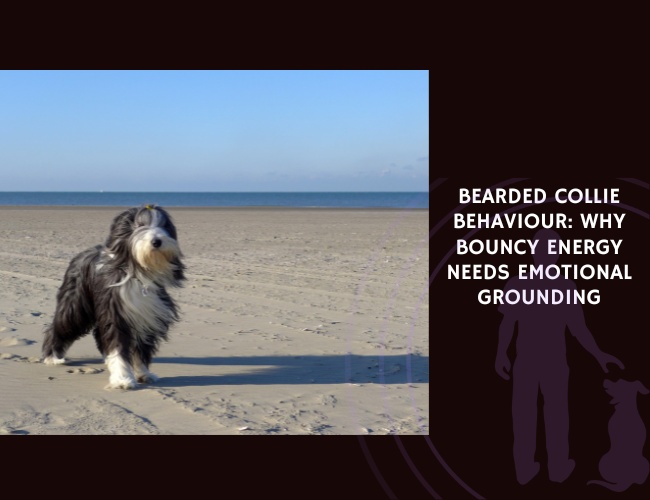
When you watch a Bearded Collie bound across a field, coat flowing like silk in the wind, it’s easy to fall in love with their infectious energy. That signature “Beardie bounce” captures hearts instantly—a joyful spring in their step that seems to defy gravity itself. But beneath that charming exterior lies something more complex than simple exuberance. This breed carries centuries of Scottish herding heritage in their DNA, and with it comes a sophisticated interplay of instinct, emotion, and cognition that shapes every moment of their day.
You might notice your Beardie can’t quite settle in the evening, or that their excitement sometimes tips over into something that feels less joyful and more frantic. This isn’t a flaw in your dog’s character—it’s a reflection of who they are at their core. The same traits that made them invaluable partners to Scottish shepherds navigating harsh highland terrain can become challenges in a modern family home without the right understanding and support. Through the NeuroBond approach, we can learn to differentiate between regulated joy and behaviors stemming from anxiety or overstimulation, creating the emotional grounding your Beardie needs to thrive.
Character & Heritage: The Hill Herder’s Legacy
The Bearded Collie’s story begins on the windswept hills of Scotland, where farmers needed a dog capable of working independently across challenging terrain in unpredictable weather. This wasn’t gentle shepherding in flat meadows—this was demanding physical and mental work requiring sustained movement, quick directional changes, and independent problem-solving skills. Every bounce, every quick pivot, every alert expression you see in your Beardie today connects directly to this heritage.
The Springy Gait: More Than Just Cute
Your Beardie’s characteristic bounce isn’t an accident of genetics—it’s a functional adaptation honed over generations. That springy, ground-covering gait allowed their ancestors to navigate rocky slopes, boggy ground, and dense heather efficiently while maintaining endurance throughout long working days. The “bounce” served as natural shock absorption, protecting joints and maintaining momentum over varied and challenging surfaces. When you see your Beardie leap joyfully around your living room, you’re witnessing hundreds of years of selective breeding for agility and movement efficiency.
This physical heritage manifests in several distinctive ways you’ll recognize in daily life:
- Bounding and leaping: The ability to clear obstacles and gain vantage points was essential for monitoring scattered sheep across hillsides. In your home, this translates into those exuberant vertical leaps when greeting you or playing.
- Rapid spinning: While sometimes a sign of over-arousal, spinning connects to the circling behavior used to gather and move livestock. Combined with high energy, this innate drive can express itself in rapid spins when your Beardie is excited or seeking an outlet.
- Lightning-fast directional changes: The need to respond instantly to sheep movement and shepherd commands honed their agility. This gives them quick reflexes and dynamic movement that can be breathtaking to watch—and occasionally challenging to manage.
- Sustained trotting: That ground-covering gait allowed them to work all day without exhaustion, which means your Beardie has stamina that outlasts what most family activities provide.
- Low crouching: When focusing intently, many Beardies drop into a crouch—the classic herding “stalk” position carried forward from their working ancestors.
The Seeking System: Always On, Always Ready
From an Affective Neuroscience perspective, Bearded Collies likely possess a highly active SEEKING system—one of the primary emotional systems identified by researcher Jaak Panksepp. This system drives exploration, anticipation, and the pursuit of resources, often manifesting as a strong urge to move and engage with their environment. For a herding dog, continuous motion isn’t just about completing work; it’s about staying alert, engaged, and ready to respond to any change in the environment.
This genetic predisposition toward continuous motion serves as a primary mode of self-regulation. Movement provides kinetic release for their high energy while delivering rich sensory input through proprioceptive feedback. The physical act of moving helps them feel grounded and present. However, when under-exercised or mentally understimulated, this innate drive can become dysregulated, leading to restless pacing, incessant bouncing, or an inability to settle that frustrates both dog and human. 🧠
Understanding Herding Cognition in Family Life
The cognitive processes that made Bearded Collies exceptional herding dogs don’t disappear when they move into a suburban home. Their minds are still wired for scanning, circling, and anticipating—behaviors that translate into distinctive patterns you might recognize in your daily life together.
The Constant Scanner
Herding dogs evolved to continuously scan their environment for movement, changes, and potential problems. In a home setting, this manifests in several recognizable patterns:
- Constantly watching windows and doors, monitoring every movement outside
- Patrolling from room to room, checking on each family member’s location
- Tracking subtle environmental changes—shadows, reflections, or movements you might not even notice
- Positioning themselves strategically to maintain visual contact with multiple family members
- Responding to sounds or movements before they’re consciously noticeable to humans
- Difficulty settling in spaces with high visual stimulation or many sight lines
This isn’t anxiety in the clinical sense—it’s their herding cognition seeking fulfillment. Your Beardie might constantly watch windows and doors, seemingly monitoring every movement outside. They might patrol from room to room, checking on each family member’s location and activity.
You might also notice they’re incredibly attuned to subtle cues that precede events. The moment you pick up your keys, stand up from your desk, or reach for the leash, they’re already responding. This anticipation served them well when predicting livestock movement, but in family life, it can create a dog who is always “on,” constantly in a state of readiness that makes genuine relaxation difficult.
The Family Herder
That instinct to gather and move translates directly into how your Beardie interacts with your household. Many owners report their Beardie “herding” family members—nudging, circling, or positioning themselves to control movement, especially with children or guests. This behavior intensifies during moments of dispersal (family members going to different rooms) or chaos (multiple people moving at once). The Invisible Leash reminds us that their attempts to control space and movement come from deep instinct, not dominance or behavioral problems.
The spinning and bouncing you observe often represents attempts to “gather” attention or initiate interaction. When they can’t physically move their “flock,” they channel that drive into their own movement patterns. Understanding this helps you see that what might look like misbehavior is actually your Beardie trying to do what their genetics tell them is important work.
When Anticipation Becomes Frustration
The herding mind is always predicting, always preparing for the next event. This constant state of anticipation makes it extraordinarily difficult for many Beardies to switch off completely. They’re perpetually waiting for the next cue, the next activity, the next event requiring their attention. When this anticipation goes unmet, or when the environment proves unpredictable, frustration builds and often expresses itself as increased kinetic energy—more pacing, more whining, more bouncing.
This is where the difference between their heritage and modern life creates tension. A working Beardie had clear jobs throughout the day with natural peaks and valleys of activity. Your family Beardie might lack this structure, leading to a state of constant readiness with nowhere to direct their energy and focus.
Signs your Beardie needs better structure and emotional grounding:
- Inability to settle even after extensive physical exercise
- Constant monitoring of household activity and family members
- Immediate arousal response to any environmental change
- Difficulty transitioning between activities
- Persistent attention-seeking or demand behaviors
- Over-reaction to minor stimuli or changes
- Restless sleep or frequent waking
- Compulsive behaviors emerging (licking, spinning, pacing)
Understanding these patterns helps you recognize when your Beardie needs not more stimulation, but better emotional grounding and structure. 🐾
Bouncy Energy vs. Emotional Dysregulation
The Bearded Collie’s “happy bounce” is iconic and endearing, but learning to distinguish between genuine joy and emotional distress hidden beneath kinetic behavior is crucial for your dog’s wellbeing. Not all movement means the same thing, and recognizing these differences allows you to respond appropriately to your Beardie’s actual emotional state.
When the Bounce Signals Wellbeing
A healthy, joyful bounce has distinctive characteristics you can learn to recognize:
- Context-appropriate timing: The bouncing occurs during play, greetings, or genuinely exciting events, but your Beardie can settle relatively quickly afterward when the stimulus passes
- Relaxed body language: Look for a loose, wiggly body with soft eyes, a relaxed open mouth, and full-body tail wagging—the whole dog appears loose and fluid
- Effortless movement: The bounce itself is light and natural, not frantic or compulsively repetitive, with a quality of ease to it
- Responsiveness: Your Beardie can disengage from bouncing when you offer a calm cue, showing they maintain executive function and aren’t “stuck” in the behavior
- Brief duration: Genuine joy-based bouncing typically occurs in short bursts, followed by a natural return to calmer engagement or rest
- Natural breaks: Even during excited play, you’ll see spontaneous pauses where your dog checks in with you or shifts attention
- Invitation quality: The bouncing often includes play bows or attempts to engage you in the fun
When you see these signs, your Beardie is expressing authentic positive emotion through their natural movement style. This is the behavior we want to support and encourage—energy that comes from a place of emotional security and genuine enthusiasm. 🧡
When Movement Masks Dysregulation
Conversely, bouncing that stems from anxiety, frustration, or sensory overload presents differently:
- Inappropriate context: Excessive bouncing in situations that don’t warrant such high arousal—when guests are trying to sit down, during quiet times, or when asked to perform simple, familiar tasks
- Tense body language: Watch for a stiff body, wide or darting eyes, tight mouth, rapid or low tail wag, and panting without physical exertion—the overall impression is tension, not looseness
- Compulsive quality: The bouncing or spinning becomes repetitive, almost ritualistic, and difficult to interrupt, with a driven, stuck quality rather than spontaneous joy
- Loss of responsiveness: Your Beardie seems unable to respond to familiar cues or settle down, as if caught in a loop they can’t exit
- Escalation patterns: The bouncing may intensify into other stress behaviors like nipping, excessive barking, or frantic pacing
- Post-event exhaustion: After prolonged intense bouncing, your dog appears exhausted, irritable, or withdrawn—signs of significant energy expenditure driven by stress rather than play
- No natural breaks: The movement continues relentlessly without the spontaneous pauses seen in regulated play
- Defensive quality: If interrupted, your dog immediately resumes the behavior or shows frustration at the interruption
From a neuroscience perspective, while joyful bouncing engages the PLAY system, chronic stress or overstimulation can recruit the FEAR or RAGE systems instead. The resulting behavior might look playful on the surface, but represents the dog attempting to cope with internal pressure through kinetic release. This is dysregulation wearing the mask of exuberance.
Reading the Subtle Signs: A Practical Observation Guide
Learning to read your Beardie’s emotional state accurately requires attention to subtle behavioral markers that reveal what’s happening beneath the surface. These indicators help you differentiate between regulated playfulness and dysregulated over-arousal, allowing you to intervene appropriately before stress escalates.
Eye Tension and Gaze Quality
Your Beardie’s eyes tell a profound story about their internal state. Learning to read these subtle differences transforms your ability to support them effectively.
Regulated play and calm states show several eye characteristics:
- Soft, almond-shaped eyes with a relaxed gaze
- Natural blinking patterns—frequent, regular blinks indicating comfort
- “Play bow eyes” during active play—bright and engaged but not staring or fixed
- Gaze that shifts fluidly between you, toys, and the environment
- Brief eye contact that feels warm rather than intense
- Relaxed eye muscles with no tension around the brow or corners
- Pupils appropriately sized for lighting conditions
Dysregulated arousal or stress presents very different eye signals:
- Hard, staring eyes that seem to lock onto stimuli without natural breaks
- “Whale eye”—white of the eye visible because they’re tracking something without turning their head
- Dilated pupils beyond what lighting conditions warrant
- Eyes that dart rapidly without settling on anything
- Furrowed brow creating visible tension around the eyes
- Reduced or absent blinking—a sign of high stress or focus
- Glassy or unfocused appearance despite apparent alertness
- Avoiding eye contact entirely or seeking it desperately and intensely
The quality of attention matters too. A regulated Beardie maintains soft focus that can easily shift. A dysregulated Beardie develops tunnel vision, seemingly unable to look away from whatever has captured their attention, or conversely, eyes that won’t focus on anything—constantly scanning without truly seeing.
Vocal Patterns and Pitch Analysis
Your Beardie’s vocalizations carry rich information about their emotional state, but many owners struggle to distinguish between different types of barking, whining, or other sounds.
Regulated play vocalizations have distinctive characteristics:
- Varied in pitch and intensity rather than monotonous
- Rhythmic quality with natural breaks and pauses
- Play growls that sound loose and theatrical rather than tense
- The distinctive “woo-woo” sounds with melodic quality
- Barks that stop easily when play pauses or redirects
- Volume appropriate to the activity—not excessive
- Often accompanied by relaxed body language and loose movement
Dysregulated arousal vocalizations sound qualitatively different:
- High-pitched, repetitive, frantic barking that seems driven
- Whining that sounds distressed—thin, persistent, escalating
- Growls that are tense, low, and sustained indicating genuine discomfort
- Vocalizations that continue despite changes in context
- Screaming or shrieking sounds indicating extreme stress
- Obsessive repetition of the same sound or bark pattern
- Volume that escalates progressively rather than remaining stable
- Sounds that seem involuntary rather than communicative
Pay particular attention to pitch changes within the same interaction. If your Beardie’s barks start playful but steadily climb to higher, more frantic pitches, they’re escalating beyond their regulation capacity and need support to de-escalate.
Body Stiffness, Fluidity, and Movement Quality
The quality of your Beardie’s movement reveals volumes about their emotional state, beyond simply noting whether they’re active or calm.
Regulated movement and play shows these body characteristics:
- Loose, fluid body mechanics with visible muscle relaxation
- “Wiggly” quality where movement flows through the entire body
- Play bows with clearly defined curves and natural relaxation
- Weight shifts naturally and smoothly between movements
- Ease and lightness to all movement patterns
- Body curves naturally—spine shows flexibility
- Tail flows naturally with body movement rather than held rigidly
Dysregulated arousal creates visible body tension:
- Muscles appear tight and held even during movement
- Stiff posture—body looks rigid rather than flowing
- Bouncing or spinning that looks mechanical rather than natural
- Hunched back indicating defensive tension
- Tail held stiffly (either high and rigid or tightly tucked)
- Weight locked in the front end or shifting abruptly
- Overall impression of tension barely contained
- Hackles raised along the back or neck
- Body appears compressed or contracted rather than extended
Watch how your Beardie transitions between movements. Smooth transitions suggest regulation; abrupt, jerky changes suggest stress or over-arousal exceeding their processing capacity.
Mouth and Panting Indicators
Your Beardie’s mouth and breathing patterns provide essential information about stress levels that many owners overlook until they learn what to watch for.
Regulated, calm states show these mouth characteristics:
- Relaxed, open mouth often described as a “smile” with loose lips
- Panting that matches activity levels appropriately
- Mouth naturally closes during rest or focused attention
- Tongue appears relaxed, often lolling to one side during rest
- Jaw muscles appear soft and loose
- Lips hang naturally without tension
- Normal salivation levels—not excessive or absent
Dysregulated states present several key mouth indicators:
- Tight, closed mouth during contexts where you’d expect relaxation
- Excessive panting without corresponding physical exertion
- Lip licking (quick tongue flicks to the nose or lips) as stress signals
- Yawning outside of tired contexts—a displacement behavior
- Tight “grin” where lips pull back but mouth remains tense
- Fast, shallow panting suggesting high arousal or panic
- Deep, heavy panting after minimal exertion indicating stress
- Drooling more or less than typical for the individual dog
- Jaw tension visible when mouth is closed
The speed and quality of panting matters too. Fast, shallow panting suggests high arousal or panic. Deep, heavy panting after minimal exertion indicates stress exhausting them more than physical activity would.

Responsiveness and Environmental Engagement
Beyond specific physical markers, your Beardie’s ability to respond and engage reveals their regulation status.
Well-regulated dogs maintain environmental awareness and social responsiveness even during exciting activities. They can easily redirect when you call their name or offer an alternative. They engage in reciprocal play—offering play bows, taking turns, showing natural pauses. Their attention can shift between activities fluidly. They notice and respond to social cues from both humans and other dogs.
Dysregulated dogs seem “deaf” to familiar cues or their name, as if their processing capacity is overwhelmed. They ignore or seem unable to process social signals. They can’t disengage from whatever has captured their attention or from their repetitive behavior pattern. The behavior seems compulsive rather than chosen—they appear stuck in a loop. Even when their body is exhausted, they can’t stop the driven behavior.
Your Real-Time Observation Checklist
When assessing your Beardie’s state in the moment, quickly scan these markers:
✓ Eyes: Soft and shifting, or hard and staring? ✓ Vocalizations: Varied and playful, or high-pitched and frantic? ✓ Body: Loose and fluid, or tight and stiff? ✓ Mouth: Relaxed and open, or tight with stress signals? ✓ Breathing: Appropriate to activity, or excessive without exertion? ✓ Responsiveness: Can they hear and respond to you, or are they “gone”? ✓ Movement quality: Effortless and flowing, or driven and compulsive? ✓ Context appropriateness: Does the arousal level match the situation?
Three or more stress indicators appearing together signal dysregulation requiring your intervention—not punishment, but support to help them de-escalate and find calm again. Through repeated observation using this framework, you’ll develop an intuitive feel for your Beardie’s states, allowing you to intervene proactively before stress becomes overwhelming. 🧠
How Beardies Express Stress: The Upward Spiral
Understanding how Bearded Collies typically express stress helps you recognize early warning signs and respond appropriately. Unlike some breeds that tend toward shutdown or withdrawal when stressed, Beardies generally express distress through increased, externalized activity—what we might call “going up” rather than “going down.”
Why Beardies Escalate Rather Than Withdraw
Given their highly active SEEKING and PLAY systems, combined with their genetic predisposition for continuous motion, Bearded Collies are biologically wired to express internal states through external activity. When stress builds, their instinctive response is movement, not stillness.
This tendency toward externalized stress expression includes several recognizable behaviors:
- Jumping at people, furniture, or objects in frantic, repetitive patterns
- Rapid spinning or circling that seems driven rather than playful
- Zoomies or FRAPs that appear more frantic, less directed, and harder to interrupt
- Frantic pacing without clear purpose or destination
- Excessive barking, whining, or other vocalizations driven by arousal
- Mouthing or nipping, especially when overstimulated or seeking outlets
- Inability to hold still even briefly—constant motion requirement
- Hyper-reactivity to minor stimuli that wouldn’t normally trigger response
- Demand barking or attention-seeking that escalates when ignored
This upward stress expression differs significantly from breeds prone to shutdown, withdrawal, or stillness under stress. Where an overwhelmed Beagle might hide or a stressed Great Dane might freeze, your Beardie amps up. This can make their stress less obvious to owners who interpret all activity as happiness or energy needing release, when actually the dog is becoming increasingly dysregulated.
The Difference Between Play Zoomies and Stress Zoomies
Many Beardie owners report sudden explosive bursts of running, spinning, and bouncing—commonly called “zoomies” or FRAPs. These can be perfectly healthy play behaviors or concerning stress releases, and distinguishing between them matters.
Play-based zoomies show these characteristics:
- Typically occur after periods of rest or calm
- Often follow baths, successful bathroom trips, or pleasant weather changes
- Movement has a playful quality despite high energy
- Dog might play-bow between bursts or invite chase
- Episodes are relatively brief (a few minutes maximum)
- Dog settles easily afterward, appearing satisfied and happy
- Body language throughout shows looseness and joy
- Can often redirect or engage them mid-zoom if needed
- Accompanied by relaxed facial expressions and soft eyes
Stress-release zoomies present different warning signs:
- Often occur after periods of tension or overstimulation
- Triggered by visitors leaving, household chaos, or extended arousal
- Movement feels frantic and desperate rather than joyful
- Dog seems unable to stop even when clearly tiring
- Eyes appear wide or hard, mouth tight with tension
- Unresponsive to redirection or engagement attempts
- May include stress vocalizations during the episode
- After the episode, dog appears exhausted but still wired
- Sometimes followed by a crash into withdrawal or irritability
- Route patterns seem less playful, more driven and repetitive
Recognizing the Path Toward Shutdown
While Beardies typically express stress upward through increased activity, prolonged or extreme stress can eventually lead to shutdown—a state where they’ve exhausted their coping capacity entirely. This is rare but serious, and recognizing the warning signs allows intervention before reaching this point.
The progression often follows this pattern:
- Initial escalation: Increased bouncing, pacing, and vocalization as stress begins building
- Frantic phase: Behaviors become more repetitive and difficult to interrupt—the dog seems driven and unable to self-regulate
- Brief freezing: Moments of stillness appear, but with visible tension—they’re not resting, they’re frozen
- Declining responsiveness: Ability to process cues or interact normally decreases dramatically
- Exhaustion onset: Physical fatigue becomes visible but mental arousal remains high
- Shutdown: Dog finally stops moving but appears withdrawn, avoids interaction, or seems emotionally “gone”
If you observe your typically bouncy Beardie becoming still and withdrawn, especially following a period of frantic activity, this represents a serious stress response requiring immediate environmental changes and potentially professional support. This isn’t a dog who has “finally calmed down”—this is a dog who has exceeded their stress threshold so severely they’ve shut down to cope.
What This Means for Your Response
Understanding that your Beardie expresses stress primarily through increased activity rather than decreased activity changes how you interpret and respond to their behavior. That frantic bouncing probably isn’t “just energy”—it’s likely a stress response requiring emotional support and environmental management, not just more exercise. The inability to settle after intense play or stimulation signals dysregulation, not tiredness. Your intervention goal should be helping them de-escalate, not exhaust them further.
This knowledge helps you resist the common trap of responding to stress-driven hyperactivity with more high-arousal activities, inadvertently amplifying the stress cycle. Instead, you can recognize the upward spiral early and provide the calm grounding your Beardie needs to find their way back down. 🧡
Bouncy. Bright. Unsettled.
Joy Needs Grounding
The Bearded Collie’s famous bounce is not pure happiness but regulated movement shaped by purpose. Without emotional grounding, that joy easily spills into restlessness and inner chaos.
Herding Still Lives
Scottish hill work required constant motion, independence, and rapid adjustment to changing conditions. In modern homes, this legacy shows up as perpetual readiness rather than calm presence.



Energy Seeks Safety
What looks like boundless enthusiasm often masks a nervous system that struggles to switch off. When emotional safety is established, their movement becomes playful instead of driven.
Social Enthusiasm and Boundary Confusion
Bearded Collies’ friendly, outgoing nature is one of their most beloved traits, but this very sociability can create specific challenges in modern homes. Without clear structure and boundaries, their enthusiasm for connection can become overwhelming for both the dog and their humans, contributing to chronic dysregulation.
🐾 Understanding Bearded Collie Behaviour 🧠
From Bouncy Energy to Emotional Grounding: A Journey Through Regulation
Phase 1: Understanding the Hill Herder
Recognizing Heritage in Daily Behavior
🧠 The Genetic Blueprint
Your Beardie’s characteristic bounce, spinning, and constant movement aren’t random behaviors—they’re functional adaptations from centuries of Scottish highland herding. That springy gait absorbed shock on rocky terrain, while rapid directional changes responded to scattered sheep. Understanding this heritage helps you see their energy as purposeful rather than problematic.
👀 What You’ll Notice
• Constant scanning of windows and doors
• Patrolling family members between rooms
• Instant response to subtle environmental cues
• Difficulty settling in visually stimulating spaces
• “Herding” behavior with children or guests
✅ Your First Step
Start observing your Beardie’s movement patterns without judgment. Note when they scan, circle, or position themselves strategically. This awareness forms the foundation for understanding whether their energy comes from joy or dysregulation.
Phase 2: Mastering Body Language Reading
Distinguishing Joy from Stress
🔍 The Observation Framework
Learn to assess six key markers in real-time: eye tension (soft vs. hard stare), vocal patterns (varied vs. frantic), body fluidity (loose vs. stiff), mouth signals (relaxed vs. tight), breathing (appropriate vs. excessive), and responsiveness (engaged vs. “gone”). Three or more stress indicators together signal dysregulation requiring your support.
⚠️ Red Flags for Dysregulation
• Whale eye (white showing) with hard stare
• High-pitched, repetitive vocalizations
• Stiff body even during movement
• Excessive panting without exertion
• Unresponsive to familiar cues
• Compulsive repetition of behaviors
💚 Practice Daily
Spend 5 minutes daily observing your Beardie during different activities. Use the real-time checklist to assess their state. Over time, this becomes intuitive, allowing you to intervene before stress escalates.
Phase 3: Understanding Upward Stress Expression
Why Beardies Escalate Rather Than Shutdown
🌊 The Upward Spiral
Unlike breeds that withdraw under stress, Beardies externalize through increased activity—jumping, spinning, frantic zoomies, and excessive vocalization. This upward expression makes their stress less obvious because movement looks like happiness to untrained eyes.
🎯 Play vs. Stress Zoomies
Play-based: After rest periods, playful quality, brief duration, easy settling afterward, loose body language.
Stress-release: After tension/overstimulation, frantic quality, unable to stop, wide eyes and tight mouth, exhausted but wired afterward.
🚨 Shutdown Warning Signs
If your typically bouncy Beardie becomes still and withdrawn after frantic activity, this signals severe stress threshold breach—not “finally calmed down.” This requires immediate environmental changes and potentially professional support.
Phase 4: Managing the Stress Bucket
Preventing Micro-Stress Accumulation
💧 The Bucket Concept
Imagine an invisible stress bucket that fills with each trigger—doorbell rings, car doors slamming, fast movements, emotional tension. Individually manageable, but collectively they fill the bucket. When it overflows, seemingly minor triggers create explosive reactions. The person walking by the window isn’t the cause—they’re the final drop.
🔔 Common Micro-Stressors
• Environmental sounds (trucks, doorbells, appliances)
• Visual stimulation (window activity, shadows)
• Social/emotional factors (household tension, rushed routines)
• Physical discomfort (mats, overgrown nails, digestive upset)
🌿 Recovery Protocols
After arousing events, implement 15-30 minute rest breaks in quiet spaces. Use calming activities: slow sniff walks, scatter feeding, gentle massage, calm training. Close curtains during high-traffic times. Monitor bucket level through subtle signs: increased scanning, slight restlessness, reduced responsiveness.
Phase 5: Breaking the Clown Pattern
Teaching Off-Duty Time
🎪 The Performance Trap
When bouncy behaviors consistently generate laughter and attention, your Beardie learns that entertainment equals connection. This creates pressure to constantly perform rather than simply existing calmly. The line between genuine connection and performance blurs, leading to chronic partial arousal and emotional exhaustion.
🚫 Signs of Performance Pressure
• Can’t relax when people are present
• Lacks “off switch” around family or guests
• Continues performing when physically tired
• Any human attention triggers immediate behaviors
• Confused or distressed during quiet family time
✨ Establishing Rest Periods
Designate specific daily rest periods (after meals, afternoon quiet time, evening wind-down). During these, completely ignore performance behaviors—no eye contact, verbal response, or engagement. Instead, quietly acknowledge genuine calm with gentle praise or slow strokes. Your Beardie learns calm behavior earns attention too.
Phase 6: Creating Regulation-Supportive Spaces
Environmental Management for Calm
🪟 The Open-Plan Challenge
Open-plan homes keep your Beardie’s scanning instinct perpetually engaged—constant visual and auditory access to all activity prevents genuine sensory rest. Create visual barriers using gates or dividers, designate a door-closed rest space, and use crate training positively to provide den-like enclosure limiting input.
🚶 Walking Strategy Shifts
Busy streets create sensory overload—fast-moving vehicles trigger herding instincts, unpredictable encounters add stress. Choose quieter residential routes, walk during low-traffic times, allow frequent sniff breaks, and keep walks shorter but more frequent. Quality of experience matters more than distance.
🛡️ Essential Environmental Features
• At least one low-stimulation rest space
• Strategic window management during settle times
• White noise or calming music masking sounds
• Clear spatial associations (activity vs. calm areas)
• Comfortable resting surfaces in multiple locations
• Appropriate temperature control
Phase 7: Embodying Calm Leadership
Your Energy Shapes Their Regulation
🌊 Emotional Contagion Reality
Your Beardie reads your micro-expressions, body tension, breathing patterns, voice tone, and energy level with remarkable precision. When you’re calm and centered, they have a stable platform for regulation. When you’re stressed or fragmented, they lose that anchor and their behavior reflects your internal state.
🔄 Breaking the Anxiety Loop
Beardie bounces frantically → You become frustrated → Your tension rises → Beardie senses escalation → Bouncing intensifies → Your frustration grows → Loop continues. Inconsistent responses (sometimes calm attention, sometimes frustrated scolding, sometimes ignoring) send profoundly mixed signals preventing regulation skill development.
🧘 Building Your Anchor Practice
Cultivate self-awareness of your emotional state shifts. Practice conscious deep breathing before and during interactions. Establish predictable daily rhythms. Be fully present rather than mentally elsewhere. Hold clear expectations with patient, calm energy. Remember: consistency in energy matters more than perfection.
Phase 8: Pattern-Based Training Approach
Structure for a Soft, Moving Mind
🎯 Low-Pressure Philosophy
Beardies respond exceptionally to low-pressure, play-based training with clear start/stop signals. Their sensitivity means they overwhelm easily under pressure. High-arousal reinforcement (squeaky toys, intense tug, shrill praise) keeps their nervous system flooded, making settling afterward extremely difficult. The goal is focused engagement, not frantic excitement.
🌀 Grounding Activities
Loose-leash walking: Consistent pace, predictable turns, quiet directional leadership reducing scanning needs.
Scent games: Hide-and-seek, tracking, container searches—engaging nose naturally calms while building confidence.
Herding-style tasks: “Find it” scattered treats, “gather” toys to basket, directional games providing purposeful movement.
⏸️ Critical Start/Stop Signals
Use specific words or gestures indicating “training beginning” and “training over, now settle.” Without clear endings, your dog remains perpetually “on,” anticipating the next command. This explicit transition teaching is essential for a breed that struggles to switch off.
📊 Bearded Collie Regulation: Key Comparisons
Regulated Joy vs. Dysregulation
Regulated: Context-appropriate, loose body, effortless movement, responsive, brief bursts, natural breaks
Dysregulated: Inappropriate context, stiff body, compulsive quality, unresponsive, escalating, post-exhaustion
Play Zoomies vs. Stress Zoomies
Play: After rest, playful quality, brief duration, easy settling, loose body, can redirect
Stress: After tension, frantic quality, unable to stop, exhausted but wired, hard eyes, unresponsive
Heritage Need vs. Modern Life
Heritage: Clear daily jobs, natural activity peaks/valleys, purposeful scanning, independent problem-solving
Modern: Unclear purpose, constant readiness, no job structure, monitoring without outlet
High-Arousal vs. Low-Pressure Training
High-Arousal: Squeaky toys, intense tug, shrill praise → Elevated arousal, settling difficulty, reinforces hyperactivity
Low-Pressure: Calm games, scent work, clear signals → Focused engagement, easier down-regulation, sustainable learning
Best Fit vs. Challenging Fit Homes
Best Fit: Active engagement, frequent human presence, calm leadership, structure valued, training as relationship
Challenging: Chaotic households, long work hours, sedentary lifestyle, inconsistent rules, minimal time
Upward Stress vs. Shutdown Breeds
Beardies (Upward): Jumping, spinning, frantic zoomies, excessive vocalization—stress through increased movement
Shutdown Breeds: Withdrawal, hiding, stillness, avoidance—stress through decreased activity
⚡ Quick Reference: The Regulation Formula
Emotional Grounding =
● Consistent Calm Human Anchor +
● Pattern-Based Low-Pressure Activities +
● Strategic Rest Periods +
● Environmental Stress Management +
● Clear Social Boundaries
Remember: Beardies need regulation support, not more stimulation. Three or more stress markers = intervention time. Trigger stacking explains “random” explosions. Your calm presence is their foundation.
🧡 The Zoeta Dogsoul Perspective
Through the NeuroBond approach, we understand that your Beardie’s bouncy energy becomes an expression of authentic joy only when rooted in emotional security and appropriate outlets. The Invisible Leash reminds us that true connection flows not from tension, but from calm, directional presence that reduces frantic scanning and provides the grounding they desperately need. In moments of Soul Recall, we recognize how deeply memory and emotion intertwine—your consistent calm presence becomes the emotional floor upon which your Beardie’s natural exuberance can safely dance.
This isn’t about suppressing who they are. It’s about understanding what they need to thrive—where their heritage meets modern life, where movement finds meaning, where energy discovers emotional grounding. That balance between their hill-herding heart and your steady presence—that’s the essence of Zoeta Dogsoul.
© Zoeta Dogsoul – Where neuroscience meets soul in dog training
The “Everyone’s Clown” Phenomenon
In busy, energetic households, many Beardies discover that their natural exuberance—jumping, spinning, vocalizing, and generally being entertaining—generates laughter, attention, and engagement from family members. This creates a powerful reinforcement loop that can be difficult to break.
Your Beardie performs some naturally bouncy behavior—perhaps a dramatic leap, an amusing spin, or an enthusiastic vocalization. Family members laugh, smile, make eye contact, speak to the dog, or physically engage. From your Beardie’s perspective, this registers as powerful positive reinforcement. They learn that these behaviors effectively generate the social connection they crave. The behavior increases in frequency and intensity because it’s working—it gets them what they want.
Over time, this pattern can create several problems:
- Pressure to constantly perform and entertain rather than simply being present
- Blurred line between genuine connection and performing for attention
- Internal sense that value comes from being entertaining
- Uncertainty about how to engage without performance behaviors
- Emotional exhaustion from maintaining constant “on” state
- Difficulty reading what’s actually expected (mixed signals)
- Increased anxiety during quiet times
- Performance becomes reflexive rather than chosen
Your Beardie may begin to feel pressure to constantly perform and entertain rather than simply existing calmly within the family.
This phenomenon intensifies in households with children, where the kids’ natural high energy and excitement powerfully reinforce the dog’s most aroused behaviors. Multiple family members might inadvertently compete for the dog’s attention using increasingly stimulating approaches. The Beardie receives inconsistent feedback—sometimes the behavior is rewarded, sometimes ignored, sometimes discouraged—creating confusion about what’s actually expected.
When Connection Becomes Performance Pressure
The pressure to constantly entertain carries real emotional weight for your Beardie. Dogs who fall into this pattern often struggle to find “off-duty” time—moments when they’re not actively working to engage someone or monitoring for opportunities to perform. This constant state of social readiness prevents genuine rest and contributes to the inability to self-regulate.
You might notice your Beardie displaying these patterns:
- Can’t relax when people are present—constantly offering behaviors to engage attention
- Lacks an “off switch” around family or guests
- Continues attempting to engage or entertain even when physically tired
- Any attention from humans triggers immediate performance behaviors
- Appears confused or distressed during quiet family time with no interaction
- Escalates behaviors when initial attempts don’t generate response
- Shows signs of anxiety when not actively engaging someone
- Becomes more frantic as people begin to disengage or ignore them
This isn’t a dog who is naturally hyperactive—this is a dog who has learned that social connection requires constant performance, and who hasn’t developed the security to simply exist calmly alongside their people. The emotional exhaustion from maintaining this performance can be significant, even if it looks like pure joy from the outside.
Constant Social Availability and the Rest Deficit
Another challenge in busy modern homes is the near-constant availability of social interaction. With multiple family members, children with varying schedules, frequent guests, or households with multiple pets, your Beardie might never experience genuine quiet or solitude where they can truly disengage and rest.
Every time your Beardie begins to settle, someone comes home, moves to a different room, or initiates interaction. They might start to relax, then children arrive home from school bringing energy and activity. Another family member walks through the room, making eye contact or speaking to the dog. A guest arrives, creating greeting arousal. Another dog in the household initiates play or movement. The result is fragmented rest attempts that never deepen into genuine recovery.
This constant social availability creates several regulation problems:
- Never learns to disengage from social opportunities and choose rest instead
- Struggles to distinguish between “interaction time” and “rest time”
- Never achieves deeper rest stages essential for nervous system recovery
- Chronic partial arousal becomes baseline—never fully activated but never truly at rest
- Sustained medium-level arousal exhausts them over time
- Regulation skill development requires practice that never happens
- Stress bucket fills continuously without adequate emptying opportunities
Teaching “Off-Duty” Time
Creating clear boundaries around social interaction isn’t about withholding affection—it’s about teaching your Beardie that they’re valued even when calm and quiet, and providing the structure they need to develop genuine rest skills.
Start by establishing specific “rest periods” in your daily routine where social interaction is minimized. This might include:
- After meals—designated quiet digestion time
- Designated afternoon quiet time when household activity reduces
- Evening pre-bed wind-down period
- During your own work or focus time
- When certain family members need quiet for their activities
- Following any high-arousal activity or excitement
During these periods, your Beardie goes to a designated rest space—a crate, bed, or quiet room where household activity is minimal.
Importantly, completely ignore performance behaviors during rest periods—no eye contact, no verbal response, no engagement, even if the behavior seems “cute” or is demanding. Instead, quietly acknowledge genuine calm. When your Beardie settles and relaxes, you might offer a gentle word of praise, a slow stroke, or a calm treat delivery. The message becomes clear: calm behaviors earn attention too, not just entertaining ones.
Create a clear distinction between “active time” when engagement and play are welcome, and “rest time” when the expectation is calm. Use specific words, locations, or routines to signal which mode you’re in. During active time, engage enthusiastically with appropriate play and interaction. During rest time, model calm behavior yourself—read, work quietly, or rest nearby—showing your Beardie what this time is for.
Gradually, your Beardie learns they don’t need to constantly perform to maintain connection. They develop security in simply being present. The ability to choose rest even when social opportunities exist. An understanding that their value isn’t contingent on entertaining others.
The Boundary-Clear Home
Homes where Beardies thrive tend to have clear, consistent boundaries around social interaction. Everyone understands and enforces these boundaries similarly. This doesn’t mean a rigid or joyless household—it means predictable structure that helps your Beardie understand what’s expected in different contexts.
These homes establish clear structures:
- Greeting protocols so arrival excitement has clear start and stop points
- Designated specific times and spaces for calm versus active engagement
- Children (and adults) trained to reward calm behavior with attention
- Performance behaviors largely ignored rather than reinforced
- Opportunities for genuine solitude and uninterrupted rest
- Quiet presence celebrated as much as playful engagement
- Consistent enforcement of boundaries by all family members
- Clear transitions between activity and rest periods
The irony is that Beardies with clear boundaries and structures around social interaction often become more genuinely joyful and connected. Freed from the pressure to constantly perform, they can relax into authentic relationship where their calm presence is valued as much as their entertaining antics. The bouncy enthusiasm remains, but it emerges from security and appropriate context rather than from anxious need to maintain attention. 🐾
Trigger Stacking and Micro-Stress Accumulation
One of the most misunderstood aspects of Bearded Collie behavior is why they sometimes seem to “explode” with frantic energy or reactivity seemingly out of nowhere. Understanding trigger stacking and micro-stress accumulation explains these puzzling episodes and guides more effective management.
The Stress Bucket Concept
Imagine your Beardie carries an invisible bucket that collects stress throughout the day. Each stressor—whether large or small—adds water to this bucket. When the bucket is relatively empty, your dog handles new challenges easily. As the bucket fills, their tolerance decreases. When the bucket overflows, you see dramatic behavioral responses to triggers that wouldn’t normally cause issues.
This model helps explain why your Beardie might handle a particular situation well one day but react intensely to the same situation another day. The situation itself isn’t necessarily the problem—the problem is everything else that already filled the bucket before that situation occurred. A trigger that would be manageable when the bucket is empty becomes the overflow point when the bucket is already full.
The stress bucket fills throughout the day, sometimes across multiple days if recovery isn’t adequate. It empties through rest, recovery activities, and genuine relaxation. However, for sensitive breeds like Beardies, the bucket fills faster than many owners realize, and empties more slowly than expected.
Common Micro-Stressors
Many triggers adding to your Beardie’s stress bucket are subtle enough that owners miss them entirely. These micro-stressors don’t create obvious reactions in the moment, but they accumulate silently until the bucket overflows.
Environmental sounds contribute significantly:
- The doorbell ringing (even without visible reaction, it registers)
- Delivery trucks, garbage trucks, or large vehicles passing
- Car doors slamming in the neighborhood
- Sudden loud noises—dropped items, kitchen sounds, TV action scenes
- The dog next door barking or other neighborhood dogs
- Construction or yard work sounds nearby
- Sirens or emergency vehicle sounds
- Ambient noise levels in busy households
- Appliances cycling on—refrigerators, HVAC systems, dishwashers
Visual stimulation adds its own load:
- People, dogs, or vehicles passing windows
- Shadows or movement visible through windows
- Household members moving quickly or unpredictably
- Children’s active play creating fast movement
- Other pets moving through the environment
- Sunlight patterns changing throughout the day
- Reflections or mirror movements
- Delivery people approaching the door
- Wildlife in the yard—squirrels, birds, rabbits
Social and emotional factors fill the bucket invisibly:
- Tension between family members, even unspoken
- Rushed morning or evening routines
- Visitors arriving and departing
- Children’s emotional outbursts or conflicts
- Your own stress or anxiety absorbed through emotional contagion
- Conflicts with other household pets
- Changes in household schedule or routine
- Lack of clear leadership or direction
- Inconsistent responses to their behavior
Physical discomfort contributes constant low-level stress:
- Minor digestive upset or food sensitivities
- Coat mats or tangles causing discomfort
- Overgrown nails creating walking difficulty
- Seasonal allergies or mild skin irritation
- Uncomfortable temperatures—too hot or too cold
- Physical fatigue from inadequate rest
- Hunger or thirst not immediately addressed
- Need to eliminate without access to appropriate areas
Each of these individually might seem insignificant, but they accumulate throughout the day. By evening, your Beardie might have experienced dozens of small stressors that collectively fill their stress bucket substantially.
Why Wild Bursts Happen Hours Later
This delayed expression of accumulated stress puzzles many owners. Your Beardie experiences various triggers throughout the morning and afternoon—the mail carrier’s arrival, your departure for work, delivery noises, neighborhood dogs barking, children arriving home with high energy. Each adds to the stress bucket, but your dog manages fine in the moment. By early evening, the bucket is nearly full, though you’re unaware because there’s been no obvious problem.
Then something minor happens—perhaps someone walks past a window, or you simply stand up to move to another room. This ordinarily insignificant trigger becomes the bucket overflow point. Your Beardie suddenly erupts into frantic zoomies, excessive barking, jumping, or other intense behaviors. From your perspective, the reaction seems completely disproportionate to the trigger. You might think, “They see people walk by that window all the time—why are they freaking out now?”
The truth is, the person walking by isn’t really the cause—it’s simply the final drop that overflowed an already-full bucket. The real causes were all the accumulated micro-stressors from throughout the day. This is why the same trigger gets different reactions on different days. The trigger itself isn’t variable—your Beardie’s stress load when encountering the trigger is variable.
The Pattern of Delayed Eruptions
Understanding this pattern changes how you interpret your Beardie’s behavior. Those “random” wild bursts typically aren’t random—they follow predictable patterns once you start tracking them. They often occur at specific times of day when stress has naturally accumulated. They’re more likely on particularly busy or chaotic days. They correlate with specific environmental or schedule changes even hours after those changes occurred. They’re more common when your Beardie has had inadequate rest or recovery time in preceding days.
Many owners report their Beardie seems “worse” in the evening, but actually, evening behavior often reflects the accumulated stress of the entire day finding its outlet. The solution isn’t more evening exercise to “tire them out”—it’s reducing stress accumulation throughout the day and improving overall regulation capacity.
Recovery Protocols Between Stressors
Managing trigger stacking requires both reducing triggers when possible and, crucially, providing recovery opportunities between unavoidable stressors to prevent accumulation.
Strategic rest breaks throughout the day help empty the bucket incrementally. After any arousing event—guests visiting, delivery arrivals, household chaos, or stimulating activities—implement a short enforced rest period. This might be 15-30 minutes in a quiet space where your Beardie can decompress. This isn’t punishment—it’s recovery support. The rest break prevents the stress from the previous event from carrying forward and adding to the next stressor.
Calming activities between stressors help actively reduce stress:
- Slow sniff walks where your dog can move at their own pace
- Scatter feeding where they search for food pieces
- Gentle massage or slow petting focused on relaxation
- Calm, pattern-based training exercises
- Simple tricks performed in a low-pressure way
- Quiet time in a darkened, cool space
- Gentle grooming or brushing if your dog finds it calming
- Chewing appropriate items that promote relaxation
Environmental management reduces bucket-filling wherever possible:
- Close curtains during high-traffic times to limit window monitoring
- Use white noise to mask environmental sounds during rest
- Create physical barriers limiting access to high-stimulation areas
- Maintain routine and predictability during inherently stressful times
- Temporarily reduce optional activities during high-stress periods
- Remove or relocate items that trigger arousal unnecessarily
- Provide refuge spaces where your dog can retreat freely
Monitoring the bucket level means learning to recognize early signs:
- Subtle increases in scanning behavior
- Slight restlessness or difficulty staying in one position
- Reduced responsiveness to familiar cues
- Minor attention-seeking behaviors increasing
- Less ability to settle easily than usual
- Increased interest in windows or environmental monitoring
- Small changes in body tension even while resting
- More frequent position changes while supposedly settled
Long-Term Bucket Management
Beyond immediate recovery protocols, long-term stress management increases your Beardie’s bucket capacity over time. Dogs who regularly experience genuine rest and recovery develop larger stress buckets—they can handle more before overflowing. Those taught explicit self-regulation skills have more tools for emptying their bucket independently. Dogs living in generally predictable, structured environments with clear routines have lower baseline stress, meaning their bucket starts each day less full. Beardies with consistent calm human anchors manage stress more effectively through co-regulation support.
The goal isn’t creating a stress-free existence—that’s impossible and unnecessary. The goal is managing stress accumulation so it never reaches overflow while building your Beardie’s capacity to handle normal life stressors without dysregulation. Understanding trigger stacking transforms those “random” behavioral explosions into predictable, manageable patterns you can intervene with proactively. 🧠

Environmental Impact: Where Your Beardie Lives Matters
The physical environment where your Bearded Collie spends their time significantly influences their ability to regulate their energy and emotional state. Modern living situations that work well for humans often create specific challenges for sensitive, high-motion breeds like Beardies. Understanding these environmental factors allows you to make strategic modifications supporting better regulation.
The Open-Plan Challenge
Open-plan homes have become increasingly popular in modern architecture, offering sight lines and flow that many humans find appealing. For your Beardie, however, these layouts present specific regulation challenges that are worth understanding and addressing.
In an open-plan space, your dog has constant visual and auditory access to all household activity. They can see family members moving between kitchen, living, and dining areas. They hear every conversation, every kitchen sound, every television program. They monitor doors, windows, and hallways all from a single vantage point. For a breed with strong herding instincts and scanning tendencies, this constant stream of information keeps them in perpetual alert mode.
The absence of refuge spaces means your Beardie never experiences true sensory rest. Even when lying down, they’re still processing household activity. There’s no escape from the environment’s stimulation. Their natural scanning and monitoring instincts remain engaged because there’s always something to watch, always someone to track. The result is chronic low-level arousal—not full excitement, but never genuine rest either.
This environmental setup makes it extraordinarily difficult for many Beardies to self-regulate or practice genuine settling. They might physically lie down, but remain mentally alert, ready to spring into action at any moment. This sustained partial arousal prevents the deep rest necessary for nervous system recovery and emotional regulation skill building.
Strategic modifications can help significantly:
- Create visual barriers using baby gates, room dividers, or strategic furniture placement
- Designate a specific room with a door as rest space during downtime
- Use crate training positively to provide an enclosed, den-like space
- Minimize your own activity in open spaces during dog’s rest periods
- Close doors to unused areas to reduce monitoring requirements
- Use curtains or screens to limit sight lines temporarily
- Establish specific “off-limits” zones where your dog doesn’t need to monitor
- Create predictable rest schedules so your dog knows when to disengage
The goal isn’t renovating your home, but thoughtfully managing how your Beardie experiences the space, especially during times when regulation and rest are priorities.
Busy Street Walking and Sensory Overload
Many Beardies live in urban or suburban environments where daily walks occur along busy streets filled with fast-moving vehicles, diverse sounds, numerous smells, and unpredictable encounters with people and other dogs. For a breed already prone to scanning and environmental monitoring, these walks can become more stressful than restorative.
Your Beardie’s herding brain interprets fast-moving vehicles as potential stimuli requiring attention or response. Cars, motorcycles, bicycles, joggers—all moving quickly through their environment—can trigger their natural instinct to track and react to movement. Each passing vehicle adds to their arousal load, even if they don’t react overtly.
The auditory environment on busy streets is intense. Traffic noise, horn honks, engine sounds, sirens, construction equipment, people talking loudly, other dogs barking—all register as stimulation requiring processing. The sheer volume of novel smells—other dogs, urban wildlife, food, people, garbage, landscaping—provides information but also demands significant cognitive processing to categorize and understand.
Unpredictable encounters with other dogs, people approaching to pet them, children darting past, or crowded sidewalk navigation requires constant environmental management. Each encounter, even brief, adds to the stress bucket we discussed earlier. For some Beardies, these walks that are supposed to provide exercise and mental stimulation actually contribute to dysregulation rather than alleviating it.
Alternative walking approaches can transform the experience:
- Seek quieter routes—residential side streets over main roads
- Walk during lower-traffic times (early morning or later evening)
- Practice loose-leash walking structures that provide rhythm and direction
- Allow frequent sniff breaks where your Beardie can stop and investigate
- Keep walks shorter but more frequent rather than long high-stimulation treks
- Find green spaces or trails with minimal vehicle traffic
- Build in rest stops where you both pause and observe calmly
- Use the walk for calm connection rather than maximum exercise output
For some Beardies in urban environments, the most beneficial “walks” might be 15-minute scent exploration sessions in quieter areas rather than 45-minute treks along busy streets. Quality of experience matters more than duration or distance.
Dog Park Dynamics: Fun or Frantic?
Dog parks seem like ideal outlets for energetic breeds, but for sensitive Beardies, these environments often create more stress than benefit despite appearing like the dog is “having fun.”
The typical dog park environment is inherently chaotic. Multiple dogs with varying play styles, energy levels, and social skills interact unpredictably. High-speed chases crisscross the space. Play can escalate quickly or shift between dogs without warning. There’s constant need to monitor other dogs, avoid collisions, manage social dynamics, and navigate shifting playgroups. For your Beardie, this requires sustained high-level environmental awareness and rapid decision-making.
Many Beardies enter dog parks and immediately become extremely aroused—not necessarily from joy, but from the overwhelming stimulation. They might engage in frantic running, intense wrestling, or constant scanning and inserting themselves into other dogs’ interactions. What looks like play often shows the stress markers we discussed earlier: hard, staring eyes; tense body even while moving; difficulty disengaging; unresponsiveness to owner cues; and escalating intensity rather than natural play breaks.
After dog park visits, many owners report their Beardie is exhausted but wired—physically tired but unable to settle, sometimes for hours. This pattern indicates the experience was overstimulating and stressful despite the physical exercise received. The dog’s nervous system became flooded, requiring extended recovery time.
Making dog park decisions requires honest assessment of your individual Beardie’s response. Some dogs genuinely benefit from dog park play—they show:
- Loose, regulated play with natural breaks and pauses
- Ability to disengage easily from play
- Responsiveness to you throughout the visit
- Appropriate settling afterward within reasonable time
- Choice to take breaks independently
- Soft, comfortable body language during interactions
- Variety in activities rather than frantic repetition
- Natural social checking-in with you during play Many Beardies, however, show concerning signs at dog parks:
- Entering a frantic state immediately upon arrival
- Inability to self-regulate or take voluntary breaks
- Showing stress signals despite appearing “happy”
- Having difficulty responding to name or cues
- Requiring hours to settle after leaving
- Over-arousal that escalates throughout the visit
- Frantic play that lacks natural pauses
- Obsessive monitoring of other dogs rather than playing
- Defensive or tense body language despite continued engagement
Alternative socialization approaches often serve Beardies better:
- Arrange controlled playdates with one or two well-matched dogs
- Take parallel walks with a dog friend for companionship without intensity
- Engage in structured group training classes
- Focus on quality of interaction over quantity
- Prioritize human-dog interaction if your Beardie prefers this
- Use sniff walks in areas where other dogs have been (indirect socialization)
- Consider that some Beardies thrive without extensive dog-dog interaction
Not every dog needs or benefits from dog park culture. If your Beardie shows signs of stress-based arousal rather than genuine joy during these visits, honoring their individual needs and finding alternative outlets serves them better than forcing participation because it seems like what active dogs “should” enjoy.
Creating the Regulation-Supportive Home Environment
Regardless of your specific living situation, certain environmental modifications support better regulation:
- At least one low-stimulation space for genuine rest
- Strategic window access management during settle times
- White noise, calming music, or fans to mask environmental sounds
- Clear spatial associations (activity areas vs. calm areas)
- Appropriately comfortable resting surfaces in multiple locations
- Temperature control ensuring comfort
- Good air quality and ventilation
- Appropriate lighting—dimmer options for evening rest periods
- Minimal clutter that might trigger scanning behaviors
Your physical environment either supports your Beardie’s regulation efforts or works against them. Thoughtful environmental management isn’t about restricting your dog’s life—it’s about creating the conditions where their natural exuberance can emerge from a foundation of security and rest rather than from a place of dysregulation and overwhelm. 🧡
The Role of Emotional Contagion
One of the most overlooked aspects of Bearded Collie behavior is their profound sensitivity to human emotional states. These dogs don’t just observe your emotions—they absorb and mirror them, creating a feedback loop that can either support regulation or amplify dysregulation.
Reading Beyond Words
Your Beardie processes your emotional state through multiple channels simultaneously:
- Micro-expressions in your face revealing feelings before you’re aware of them
- Body tension patterns—tight shoulders, clenched jaw, rigid posture
- Breathing patterns—shallow, rapid breathing signaling stress
- Voice tone shifts—pitch, volume, and speed changes
- Energy level—rushed, frantic movement versus calm, purposeful action
- Eye contact quality—hard staring versus soft connection
- Scent changes—stress hormones released through your skin
- Movement patterns—jerky versus smooth, rushed versus measured
Research in canine cognition consistently shows that dogs, particularly sensitive breeds like Beardies, are masters at reading human emotional cues, often responding to our feelings before we’re fully conscious of them ourselves.
This means your internal state directly influences your Beardie’s regulation capacity. When you feel calm, centered, and emotionally coherent, your dog has a stable platform from which to modulate their own arousal. When you feel stressed, anxious, or emotionally fragmented, your Beardie loses that stabilizing anchor and their behavior often reflects this instability.
The Anxious Human-Anxious Dog Loop
Consider this common scenario: Your Beardie is bouncing frantically, and you’re becoming increasingly frustrated. Your tension rises, your voice becomes sharper, your movements more jerky. Your dog senses this escalation and becomes even more aroused—partly from feeding off your energy, partly from increased anxiety about your obvious distress. The bouncing intensifies. Your frustration grows. The loop continues.
This isn’t about blame. It’s about understanding that emotional states are contagious, and sensitive dogs like Beardies are particularly susceptible to this contagion. Breaking the loop requires you to consciously regulate your own state first, providing the calm presence your dog needs to find their own calm.
Inconsistency and Its Impact
Bearded Collies also struggle significantly with inconsistent emotional responses from their humans. If your Beardie’s frantic energy is sometimes met with calm attention, sometimes with frustrated scolding, sometimes with excited play, and sometimes with being ignored, they receive profoundly mixed signals. This inconsistency makes it nearly impossible for them to learn appropriate coping mechanisms or understand what response their behavior will generate.
The confusion and unpredictability created by inconsistent human responses often drives increased anxiety and more dysregulated behavior. Your Beardie is trying to solve an equation that keeps changing, and the cognitive and emotional strain of this uncertainty frequently expresses itself as more bouncing, more pacing, more of the behaviors you’re trying to reduce.
Through the NeuroBond approach, consistency becomes the foundation—not rigid rules, but consistent emotional presence and predictable rhythmic responses that give your Beardie the security to relax. 🧠
The Power of the Calm Human Anchor
Bearded Collies are significantly more stable, secure, and capable of self-regulation when they have at least one consistently calm, emotionally coherent human anchor in their lives. This isn’t about perfection—it’s about presence and predictability.
What Does a Calm Anchor Provide?
A calm, emotionally coherent human provides multiple forms of support:
- Emotional grounding: A stable emotional “floor” helping the dog feel fundamentally safe
- Predictability and trust: Consistency in energy, expectations, and responses
- Co-regulation: Calm energy helps bring the dog’s arousal levels down
- Clear communication: Body language and energy clarity beyond words
- Foundation for learning: Stable platform for processing information and skill development
- Security in uncertainty: Reliable presence during stressful situations
- Model for regulation: Demonstration of how to manage arousal effectively
This concept represents the core of emotional leadership—not dominance, not control, but providing the internal architecture that allows your Beardie’s bouncy energy to remain joyful rather than frantic. That’s the essence of Zoeta Dogsoul.
Building Your Anchor Role
Becoming this calm presence doesn’t require perfection—it requires intention:
- Self-awareness: Notice your own emotional state and how it shifts
- Conscious breathing: Simple, deep breathing before and during interactions
- Predictable rhythms: Establish consistent daily routines and interaction patterns
- Centered energy: Practice being fully present rather than mentally elsewhere
- Patient expectation: Hold clear expectations with calm, patient energy
- Emotional honesty: Acknowledge your own stress rather than hiding it poorly
- Recovery practices: Build your own stress management and recovery time
- Boundary maintenance: Know when you need space to maintain your center
Training Style: Structure for a Soft, Moving Mind
Training a Bearded Collie requires understanding their unique blend of intelligence, sensitivity, and kinetic drive. The right approach can harness their energy and brilliance, while inappropriate methods can exacerbate their struggles with over-arousal and regulation.
Low-Pressure, Play-Based Learning
Bearded Collies respond exceptionally well to low-pressure, play-based training with clear start and stop signals—and they struggle significantly with training that relies on endless hype and high-arousal methods. Their emotional sensitivity means they can easily become overwhelmed or shut down under pressure or harsh corrections. A low-pressure approach fosters trust and willingness to engage, tapping into their natural intelligence and problem-solving abilities.
Play-based learning engages their natural PLAY system, making training enjoyable and intrinsically motivating. This might involve incorporating short bursts of retrieve, hide-and-seek games with toys or treats, or simple agility obstacles into training sessions. The key is that these activities have clear beginnings and endings, not continuous excitement that prevents them from learning to regulate their arousal.
The Critical Importance of Start/Stop Signals
For a breed that struggles to “switch off,” clear start and stop signals are absolutely essential:
Start signals: A specific word or gesture that indicates “training is beginning” helps your Beardie shift into focused attention. This might be as simple as “Ready?” followed by showing them a toy or treat pouch, or moving to a designated training area.
Stop signals: Equally important are clear signals indicating “training is over, now settle.” This could be a release word like “All done,” putting away training equipment in a deliberate way, or moving to a designated rest area. Without these clear endings, your dog may remain in an “on” state indefinitely, constantly anticipating the next command or activity.
These transitions need to be taught explicitly, not assumed. Many Beardies need structured help learning that “stop” actually means “you can relax now” rather than “keep anticipating what’s next.”
The Problem with High-Arousal Reinforcement
While enthusiasm has its place, overuse of high-arousal reinforcement—squeaky toys, intense tug games, shrill praise—can significantly impair your Beardie’s ability to settle afterward and contribute to chronic dysregulation.
These highly stimulating reinforcers keep your dog’s nervous system in a state of high alert. Their body becomes flooded with adrenaline and other excitatory neurochemicals. Without deliberate cool-down periods and training in down-regulation, transitioning back to calm becomes extremely difficult. If the only way your Beardie gets rewarded is through high-arousal activities, they learn that being “amped up” is the desired state, inadvertently reinforcing hyperactivity and making calm behavior seem less valuable.
This doesn’t mean never using exciting reinforcers—but their application needs to be strategic, balanced with calm activities, and always followed by clear “cool down” or “settle” protocols.
Pattern-Based Work for Emotional Grounding
Slower, pattern-based activities are exceptionally effective in improving emotional grounding for Bearded Collies. These tasks tap into their natural cognitive and physical drives in ways that promote focus and calm rather than frantic energy.
Loose-leash walking structures provide rhythmic regulation:
- Consistent pace maintained throughout the walk
- Clear, predictable turns and direction changes
- Regular stops at designated points
- Quiet directional leadership reducing scanning needs
- Focus on handler connection rather than environmental monitoring
- Predictable route patterns that become familiar
- Natural rhythm that promotes calm rather than excitement
Scent games and nose work offer mental grounding:
- Hide-and-seek with treats scattered in specific patterns
- Food puzzles that require problem-solving
- Tracking games following scent trails you’ve laid
- Container searches where treats hide in boxes
- Outdoor sniffing sessions with freedom to explore scents
- Discrimination games identifying specific scents
- Progressive difficulty levels maintaining engagement
Calm herding-style tasks fulfill instincts constructively:
- “Find it” games with scattered treats mimicking search patterns
- “Gather” commands to collect toys into a designated basket
- Simple directional games (left, right, forward, back)
- Controlled circling around you on cue
- Target following at various paces and directions
- “Go to” bed or mat exercises
- Boundary work establishing edges and spaces 🧡
Rest, Recovery, and the Ability to “Come Down”
For an energetic and sensitive breed like the Bearded Collie, rest and recovery quality matters just as much as physical exercise. Many owners focus intensely on providing enough activity but overlook the equally important need for teaching genuine rest.
The Paradox of the Tired Beardie
You might discover a frustrating paradox: your Beardie can be physically exhausted yet remain mentally wired and unable to settle. This happens when exercise engages their body without providing the mental satisfaction or emotional regulation they need. A two-hour off-leash play session with other dogs might tire their legs while actually increasing their overall arousal and anxiety, especially if the social interaction was chaotic or overstimulating.
Physical exhaustion without mental satisfaction or emotional grounding often creates a dog who is simultaneously tired and restless—their body needs rest, but their mind remains activated and unable to down-regulate. This state feels uncomfortable and can manifest as continued pacing, whining, or inability to settle even when clearly fatigued.
Creating the Conditions for Rest
True rest requires deliberate creation of supportive conditions:
- Predictable rest periods: Built into daily routine helping anticipation
- Designated rest spaces: Specific areas associated with calm (crate, bed, quiet room)
- Cool-down protocols: Structured transitions after exciting activities
- Reduced sensory input: Limiting visual and auditory stimulation
- Comfortable physical environment: Appropriate temperature, bedding, darkness
- Capture and reinforce calm: Notice and reward settled behavior
- Quiet human presence: Your own calm modeling nearby
- Protection from interruption: Ensuring rest periods remain uninterrupted
The environment significantly impacts rest ability. Consider these factors:
- Visual stimulation control: Manage what your dog can see through windows
- Sound environment: White noise, calming music, or complete quiet based on individual needs
- Temperature and comfort: Physical comfort appropriate for the season
- Enclosed vs. open spaces: Some prefer crates limiting input, others need visual monitoring access
- Lighting levels: Dimmer lighting for rest periods
- Air quality: Good ventilation without drafts
- Household traffic patterns: Low-traffic areas for rest spaces
- Proximity to family: Some need isolation, others need nearby presence
The ability to “come down” from arousal and genuinely rest is a learned skill for many Beardies, not an automatic process. With structured support, most can develop stronger self-regulation and more restorative rest patterns. Through Soul Recall, moments of deep rest become associated with safety and comfort, building positive emotional memory around calm states.
Nutrition and Biochemistry
While behavior and training receive most attention, nutrition plays a significant role in your Beardie’s ability to regulate their energy and emotional state. What goes into your dog’s body directly affects their nervous system function and emotional stability.
The Food-Behavior Connection
Certain dietary factors can significantly impact regulation:
- Protein quality and quantity: Source and amount affecting arousal levels
- Carbohydrate sources: Complex carbs supporting serotonin vs. simple sugars creating spikes
- Omega-3 fatty acids: Essential fats supporting brain health and emotional regulation
- Additives and preservatives: Artificial ingredients potentially increasing hyperactivity
- Food sensitivities: Undiagnosed intolerances creating discomfort and stress
- Hydration levels: Adequate water intake supporting overall function
- Meal size and frequency: Impact on blood sugar stability
- Treat quality: What’s used for training affecting overall nutrition balance
Meal Timing and Routine
When your Beardie eats can impact their energy patterns throughout the day:
Consistent meal times: Feeding at regular times helps stabilize blood sugar and creates predictable energy patterns. This consistency supports overall regulation and reduces anxiety around food.
Pre-activity feeding: Some dogs perform better physically and emotionally when fed before high-energy activities, while others need empty stomachs. Observing your dog’s response guides optimal timing.
Evening feeding: Some Beardies settle more easily in the evening with a substantial evening meal, while others become activated by late feeding. Again, individual observation guides best practice for your specific dog. 🧠
Health Considerations and Physical Comfort
Physical discomfort or underlying health issues can significantly impact behavior, particularly in sensitive breeds like Bearded Collies. What appears to be behavioral challenges may sometimes reflect physical problems requiring veterinary attention.
Common Physical Issues Affecting Behavior
Physical discomfort often manifests as behavioral changes:
- Joint and musculoskeletal pain: Hip dysplasia, arthritis, or joint issues making certain positions uncomfortable
- Digestive discomfort: Gastrointestinal issues, food sensitivities, or upset creating restlessness
- Skin conditions: Itching, irritation, or discomfort hidden beneath that beautiful coat
- Dental problems: Tooth pain or gum disease affecting comfort and appetite
- Ear infections: Often missed but creating significant discomfort
- Vision changes: Declining sight increasing anxiety or altering environmental perception
- Hearing changes: Altered auditory perception affecting responses
- Hormonal imbalances: Thyroid or other endocrine issues affecting mood and energy
- Parasites: Internal or external parasites creating discomfort
- Urinary tract issues: Frequent need to eliminate creating stress
The Grooming Factor
The Bearded Collie’s coat requires significant maintenance, and grooming comfort directly impacts wellbeing. Dogs experiencing matting, skin irritation under their coat, or discomfort from overgrown nails may show increased restlessness and difficulty settling. Regular, positive grooming experiences support both physical comfort and emotional stability.
When to Consult Your Veterinarian
If your Beardie’s behavior changes suddenly, or if management and training approaches aren’t yielding expected improvements, a thorough veterinary examination can rule out or identify underlying physical contributors to behavioral challenges. This is particularly important before concluding that behavior is purely emotional or training-related.
Environmental Management: Setting Up for Success
Your home environment significantly influences your Beardie’s ability to regulate their energy and emotional state. Thoughtful environmental management can reduce triggers for dysregulation while supporting calm behavior.
Creating Calm Zones
Designating specific areas of your home as “calm zones” helps your Beardie understand where settling is expected and rewarded. These spaces should be:
Low-traffic areas: Away from constant movement that triggers their scanning and herding instincts.
Visually limited: Where they can’t constantly monitor windows, doors, or household activity that keeps them in alert mode.
Comfortable: With appropriate bedding, temperature, and potentially calming music or white noise.
Positively associated: Built through positive reinforcement and never used for punishment or isolation.
Managing Arousal Triggers
Identifying and managing specific triggers that push your Beardie into over-arousal helps prevent dysregulation before it starts:
Doorbell management: Doorbells often trigger intense arousal. Consider disconnecting it or changing the sound, teaching your Beardie an alternative behavior for guest arrivals, or managing their location when visitors are expected.
Window watching: If your Beardie spends hours watching out windows and becoming aroused by every passerby, managing this access during high-traffic times can significantly reduce overall arousal levels.
Household activity: During chaotic times—morning routines, children’s activities, evening commotion—having a plan for your Beardie (whether that’s a calm space, a food puzzle, or structured activity with one person) prevents them from getting caught in the chaos and becoming dysregulated.
Exercise Timing and Type
The timing and type of exercise significantly impacts your Beardie’s regulation:
Morning movement: Many Beardies benefit from moderate exercise early in the day, taking the edge off their energy and helping them settle better throughout the day.
Pre-evening calm activities: Engaging in calming activities (scent work, slow walks, training) in the hour or two before desired settling time can facilitate better evening relaxation than intense play.
Varied activity types: Mixing physical exercise with mental stimulation and calm activities provides more balanced fulfillment than pure high-energy play.
Social Needs and Companion Animals
Bearded Collies were bred to work alongside humans and often other dogs. Their social needs influence behavior and regulation capacity significantly.
The Human-Dog Bond
Beardies are typically people-oriented dogs who thrive on close connection with their humans. Isolation or lack of meaningful interaction can create anxiety and dysregulation regardless of physical exercise levels. Quality time together—whether training, walking, grooming, or simply being present in the same space—fulfills important social needs.
However, this people-orientation can also create challenges. Beardies may struggle with alone time if not properly prepared for independence. Gradually building positive associations with solitude and teaching self-regulation when separated from their people prevents separation anxiety and promotes overall stability.
Living with Other Dogs
Many Beardies enjoy living with other dogs and can benefit significantly from appropriate canine companionship. A well-matched companion can provide play opportunities, social learning, and companionship that reduces overall household pressure.
However, the wrong match can create increased stress. Consider:
Energy compatibility: A very high-energy, arousing playmate may actually increase your Beardie’s overall arousal rather than helping them regulate. Sometimes a calmer companion provides better balance.
Play style: Some dogs play in ways that trigger your Beardie’s herding behaviors or create excessive arousal. Observing play dynamics and intervening when play becomes too intense helps everyone stay regulated.
Individual space: Even dogs who enjoy each other’s company need opportunities for individual attention and separate spaces where they can rest without social pressure.
The key is ensuring companion animals support regulation rather than adding to arousal and stress.
Adolescence and Maturity
Understanding developmental stages helps set realistic expectations and provide appropriate support as your Beardie matures.
The Adolescent Challenge
Bearded Collies typically enter adolescence around 6-9 months and may not fully mature until 2-3 years old. Adolescence often brings increased energy, decreased responsiveness to previously reliable training, and intensified herding behaviors. This developmental stage requires patience and consistency while avoiding the temptation to abandon structure when your previously compliant puppy suddenly seems to forget everything they learned.
During adolescence, maintaining your calm anchor role becomes even more crucial. Your Beardie’s brain is reorganizing, hormones are shifting, and their world feels uncertain. The structure and emotional stability you provide helps them navigate this challenging period without developing lasting patterns of dysregulation.
Maturity and Settling
Most Beardies naturally settle somewhat as they mature, particularly if they’ve been taught good self-regulation skills throughout development. However, this breed often retains significant energy and playfulness throughout their lives. “Settling” doesn’t mean becoming sedate—it means developing better regulation, discrimination, and the ability to match their energy to context appropriately.
The mature Beardie who has received appropriate support develops into a dog who can be exuberantly playful when the situation calls for it, yet calm and settled when that’s what’s needed. This flexibility represents successful emotional development and regulation skill building. Through consistent application of NeuroBond principles, your Beardie learns to read situations accurately and respond with appropriate energy levels. 🧠
Lifestyle and Environmental Fit
Finally, considering whether your lifestyle truly fits a Bearded Collie’s needs determines whether your relationship will be harmonious or constantly challenging.
Best Fit Scenarios
Bearded Collies thrive in homes featuring:
- Active engagement prioritized: Daily walks, training activities, and mental engagement as lifestyle priorities
- Frequent human presence: Someone home much of the time or work-from-home situations
- Calm leadership available: At least one household member bringing natural calm, consistent energy
- Structure and routine valued: Families appreciating routines and consistent daily structure
- Training as ongoing relationship: Enjoyment of teaching and working together long-term
- Physical space appropriate: Adequate space for movement and play
- Financial resources: Ability to provide grooming, training, veterinary care
- Time availability: Several hours daily for exercise, training, grooming, interaction
- Patience for adolescence: Understanding that maturity takes 2-3 years
- Commitment to mental stimulation: Willingness to provide cognitive challenges beyond physical exercise
Challenging Fit Scenarios
Situations that often create difficulties include:
- High-energy, chaotic households: Constant activity and noise preventing calm periods needed for rest
- Long work hours with minimal interaction: Being left alone 8-10 hours daily
- Sedentary lifestyles: Owners seeking low-maintenance companions
- Inconsistent households: Dramatically varying schedules or rules changing by person
- First-time dog owners: Without experience managing high-energy, intelligent breeds
- Small living spaces: Insufficient space for appropriate movement and play
- Limited time availability: Unable to dedicate several hours daily to care and engagement
- Financial constraints: Limited budget for grooming, training, veterinary care
- Preference for independence: Expecting a dog who self-entertains
- Aversion to training: Viewing training as optional rather than essential
The Honest Assessment
Before bringing a Bearded Collie into your life, honestly assess not just whether you can meet their needs now, but whether you can maintain that commitment throughout their 12-15 year lifespan. Your circumstances will change—can you adapt while still providing what this breed requires? The right match creates a deeply rewarding partnership. The wrong match creates frustration and behavioral challenges for everyone involved.
Conclusion: The Grounded Beardie
The Bearded Collie’s bouncy energy represents something beautiful when it emerges from a foundation of emotional security, appropriate outlets, and calm human leadership. That characteristic bounce becomes an expression of authentic joy rather than a mask for anxiety or dysregulation. The difference lies not in suppressing who they are, but in understanding what they need to thrive.
These dogs carry centuries of working heritage in their DNA. They were bred for intelligence, independence, sustained activity, and close cooperation with humans in demanding conditions. In modern family life, these same traits require thoughtful management, appropriate outlets, and emotional grounding from their people. When you provide clear structure, consistent calm presence, and understanding of their unique needs, your Beardie can develop into a dog who maintains their wonderful enthusiasm and energy while also possessing the self-regulation skills to settle and rest.
The journey requires commitment. It demands that you become the calm anchor your Beardie needs, maintaining emotional coherence even when their energy feels overwhelming. It requires balancing their physical needs with mental stimulation and genuine rest. It means understanding that their scanning, circling, and bouncing come from instinct, not disobedience, and responding with structure rather than frustration.
When you get it right, you’ll have a companion who brings infectious joy to your daily life while remaining a grounded, emotionally stable partner. Their bounce will reflect genuine happiness emerging from secure attachment and appropriate fulfillment. Their energy will feel manageable because they’ve learned to regulate it effectively. Their intelligence will shine through focused engagement rather than frantic activity.
Is this breed right for you? Only you can answer that question honestly. A Bearded Collie asks for significant commitment—to activity, training, emotional consistency, and ongoing relationship building. They’re not a dog who raises themselves or flourishes with minimal input. But for the right person or family willing to provide what they need, the reward is a deeply connected, joyful, and remarkable companion whose bouncy energy brings light to every day.
The question isn’t whether your Beardie should stop being bouncy—it’s whether their bounce comes from joy or distress, from fulfillment or frustration. With understanding, structure, and calm leadership, you can ensure it’s the former. That balance between movement and calm, between heritage and modern life, between their nature and your guidance—that’s where the magic happens. That’s the essence of Zoeta Dogsoul. 🧡










