
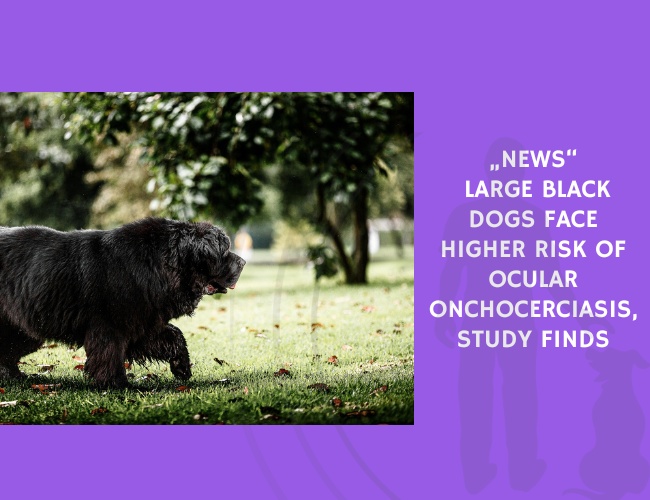
Published in Veterinary Ophthalmology, this study investigates whether specific physical characteristics—particularly coat color and body size—affect a dog’s likelihood of developing canine ocular onchocerciasis. The disease is caused by the filarial parasite Onchocerca lupi and transmitted by black flies, whose feeding preferences may contribute to uneven disease risk.
The research included 125 dogs diagnosed with confirmed or suspected onchocerciasis and a comparison group of 1,255 unaffected dogs. To evaluate risk factors, the authors compared the predicted distribution of size and coat color—assuming no association with disease—with the actual characteristics of affected dogs.
Results revealed a clear pattern: large, black-coated dogs were significantly more likely to develop ocular onchocerciasis than expected by chance (p = 0.012). Other size and color combinations did not show meaningful associations, suggesting a specific interaction between vector behavior and this subset of dogs.
To test whether black flies preferentially target darker colors, the researchers deployed black, brown, and white traps. The trapping data strongly supported color-based attraction: black traps captured significantly more black flies than traps of other colors (p < 0.001). This finding aligns with previous knowledge about vector attraction to dark surfaces and provides a biologically plausible explanation for the elevated disease risk in black dogs.
While the authors note that additional factors—such as environment, geography, and individual exposure—likely contribute to infection risk, the results offer clinicians valuable guidance. Recognizing that large black dogs may carry heightened risk can help veterinarians more accurately assess potential cases and educate owners about preventative strategies, particularly in regions where O. lupi is endemic.
Overall, this work strengthens understanding of how vector behavior intersects with canine phenotype to influence disease prevalence, providing a practical tool for early detection and risk communication.
Source: Taylor, M. E., Auten, C. R., Foster, T., Ebbs, E. T., & Hofkin, B. V. (2021). Canine ocular onchocerciasis in New Mexico: Risk factors for disease. Veterinary Ophthalmology. Published April 9, 2021.










