
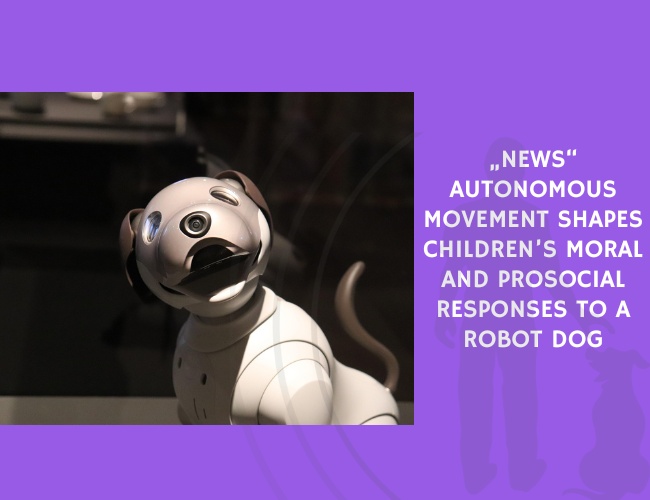
Presented at the Annual Meeting of the Cognitive Science Society, this study by N. Chernyak and Heather E. Gary investigates why children sometimes extend prosocial and moral behaviors toward non-human entities such as robots. The authors hypothesize that children’s moral regard may stem from their understanding of others as autonomous beings.
To test this idea, the researchers asked five- and seven-year-old children to interact with a robot dog under two experimental conditions. In one condition, the robot dog appeared to move autonomously, generating its own motions. In the other, the robot appeared remote-controlled by the experimenter. The aim was to determine whether the perceived autonomy of the robot would change how children interpreted its mental states and moral standing.
The results showed that children interacting with the autonomous robot dog attributed significantly higher emotional and physical sentience to it. They were more likely to describe the robot as having desires, feelings, and physiological states. Children also referenced moral concerns as applying to the autonomous robot—such as considerations of harm or fairness—far more often than when interacting with the controlled robot.
The study additionally found that children who owned a dog at home behaved more prosocially toward the autonomous robot dog. This suggests that real-world experiences with animals may influence how children generalize empathy and moral reasoning to robotic companions.
Overall, the findings indicate that autonomy cues play a powerful role in shaping children’s developing social cognition. When a robot appears self-directed rather than externally controlled, children attribute richer internal states to it and behave in ways that reflect moral regard. This has implications for the design of social robots, educational tools, and therapeutic technologies that aim to foster positive child–robot interactions.
Source: Chernyak, N., & Gary, H. E. (2014). Autonomous Movement Predicts Children’s Moral Regard and Prosocial Behavior Towards a Social Robot Dog. Annual Meeting of the Cognitive Science Society. Published 2014.










