
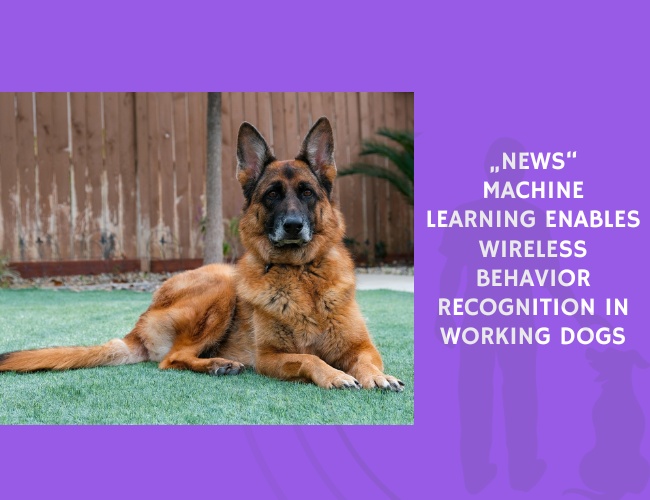
Presented at the 2013 IEEE International Conference on Body Sensor Networks, this study by R. Brugarolas, R. Loftin, Pu Yang, D. Roberts, B. Sherman, and A. Bozkurt addresses a key challenge in working dog training: the need for objective, scalable, and lower-cost assessment tools. Traditional training relies heavily on human interpretation, which can be subjective and inconsistent. To reduce reliance on human observation, the authors designed a canine body-area network (cBAN) that combines wearable sensors with computational modeling.
As a first step toward this system, the researchers used inertial measurement units (IMUs) mounted on a canine vest to remotely detect a range of static postures (sitting, standing, lying down, standing on two legs, eating off the ground) and dynamic activities (walking, climbing stairs, walking down a ramp). The IMUs captured accelerometer and gyroscope data, allowing detailed characterization of motion patterns.
To classify behaviors, the team applied decision tree classifiers and Hidden Markov Models (HMMs), using heuristic features derived from the sensor data. These models enabled accurate recognition of both postures and movements, even across varying body positions and sensor orientations. Data were collected from six Labrador Retrievers and one Kai Ken, demonstrating that the approach works across dogs with different morphologies.
Analysis of how sensor location and orientation affected outcomes further refined the system, helping to optimize placement for robust real-world use. The high classification accuracies achieved suggest that wireless sensor systems paired with machine learning can provide objective real-time insight into canine behavior—a critical step toward more consistent and efficient training for working dogs.
By laying the groundwork for a fully integrated cBAN, this study highlights the potential of wearable technology and computational models to transform the training and management of detection dogs, service dogs, and other working canines. Such tools may reduce training costs, increase handler accuracy, and support data-driven decision-making in operational environments.
Source: Brugarolas, R., Loftin, R., Yang, P., Roberts, D., Sherman, B., & Bozkurt, A. (2013). Behavior recognition based on machine learning algorithms for a wireless canine machine interface. 2013 IEEE International Conference on Body Sensor Networks. Published May 6, 2013.










