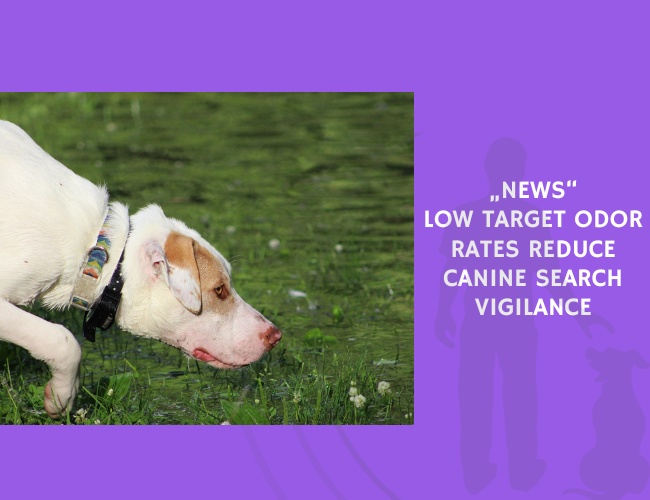
Published in the Journal of The Experimental Analysis of Behavior, the study by E. Aviles-Rosa, M. DeChant, Paola A. Prada-Tiedemann, and Nathaniel J. Hall offers a controlled laboratory model for understanding how infrequent target odors influence canine detection performance. While operational reports have long suggested vigilance decrements when targets rarely appear, empirical models capturing these dynamics have been limited.
The researchers trained 18 dogs to detect smokeless powder using an automated olfactometer in two distinct environments: an “operational” room and a “training” room. During baseline sessions, dogs encountered a high target odor prevalence (90%) in both rooms for five daily sessions. This established consistent search behavior and provided a performance benchmark.
Next, the target odor frequency was reduced to 10% in the operational room while remaining at 90% in the training room. When exposed to this low-prevalence environment, dogs showed a significant decrement in detection performance. This reduction was primarily driven by
When the prevalence returned to 90% in both rooms, all dogs recovered their performance, confirming that vigilance decrements were reversible and directly linked to odor frequency. The study also identified several behavioral indicators correlated with trial accuracy, including tail position, search score, latency, and the duration of environmentally directed behaviors. These cues may help handlers identify when a dog is in a low-vigilance state and adjust training or operational parameters accordingly.
Overall, the research provides a valuable framework for examining search vigilance decrement in detection dogs. Understanding how odor prevalence shapes search behavior can inform training protocols, operational deployment strategies, and welfare considerations. By identifying predictable behavioral markers of reduced vigilance, the study supports the development of more effective detection programs that maintain performance even when targets are rare.
Source: Aviles-Rosa, E., DeChant, M., Prada-Tiedemann, P. A., & Hall, N. J. (2023). A laboratory model of canine search vigilance decrement, I. Journal of The Experimental Analysis of Behavior. Published March 5, 2023.