
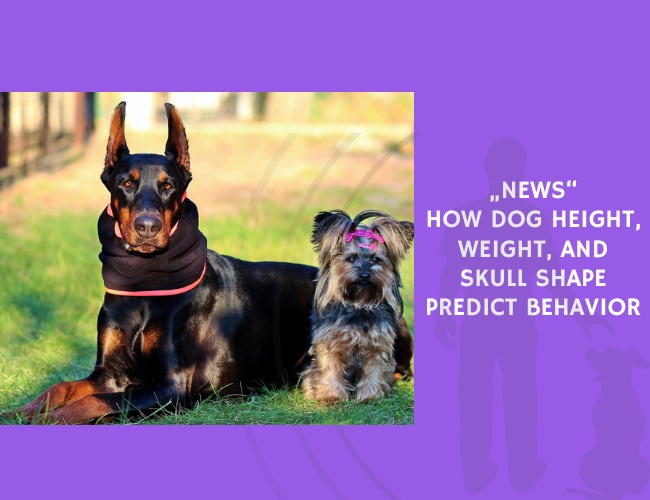
Published in PLoS ONE, the study by P. McGreevy, D. Georgevsky, J. Carrasco, M. Valenzuela, D. Duffy, and J. Serpell investigates how canine morphology relates to behavioral tendencies using large-scale international C-BARQ data. Dogs are uniquely well suited for such analysis because their skull shapes, head proportions, and body sizes vary dramatically across breeds, offering natural experiments in morphology–behavior relationships.
The authors examined cephalic index (CI)—the ratio of skull width to skull length—alongside breed-average height and bodyweight. Morphological measurements from show-quality dogs in Australia were combined with behavioral data from 8,301 dogs across 49 breeds worldwide. Using stepwise backward elimination regressions, the researchers identified significant associations between morphology and 33 behavioral traits, most of which were rated as undesirable in companion dogs.
Height emerged as the strongest predictor: 14 behaviors were associated with height alone, and nearly all regression coefficients were negative. This means that behavior becomes more problematic as height decreases. Shorter breeds showed higher levels of mounting behavior, touch sensitivity, separation-related problems, dog-directed fear, non-social fear, owner-directed aggression, urine marking, attachment/attention-seeking, and other issues. Only trainability showed a positive relationship with height.
Bodyweight also predicted behavioral tendencies. Heavier dogs exhibited lower levels of excitability and were less likely to be described as hyperactive. Combined effects of bodyweight and skull shape predicted several additional traits.
Cephalic index (CI), which reflects skull and therefore brain shape, showed its own distinct relationships. Higher CI (more brachycephalic skull shape) was associated with increased self-grooming and allogrooming, while lower CI correlated with more chasing behavior. When combined with height or bodyweight, CI contributed to predicting additional patterns of behavior.
By revealing that morphology and behavior co-vary in systematic ways, the study underscores the biological relevance of breed differences and highlights potential considerations for breeding, selection, welfare assessment, and behavior management. The authors note that while correlations are strong, the mechanisms linking morphology to behavior remain unclear and require further investigation into neural architecture, sensory processing, and evolutionary history.
Source: McGreevy, P., Georgevsky, D., Carrasco, J., Valenzuela, M., Duffy, D., & Serpell, J. (2013). Dog Behavior Co-Varies with Height, Bodyweight and Skull Shape. PLoS ONE. Published December 16, 2013.










