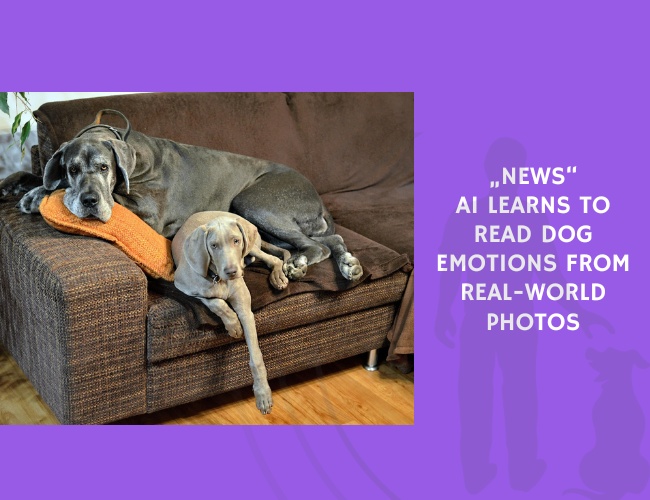
Presented at the Ninth International Conference on Animal-Computer Interaction (ACI 2022), the study by Fernanda Hernández-Luquin and colleagues set out to test whether computer vision systems can recognize dog emotions from images captured “in the wild.” Rather than relying on highly controlled lab photos, the team deliberately focused on natural, messy, real-world scenarios where dogs appear in diverse contexts, poses, and lighting conditions. Their goal was to build the foundations for dog emotion–aware computational systems that could support welfare monitoring, behavior analysis, and more responsive dog–computer interactions.:contentReference[oaicite:0]{index=0}
To achieve this, the researchers created the Dog Emotions in the Wild (DEBIw) dataset, consisting of 15,599 images of dogs downloaded directly from the internet. Each image was manually labeled by multiple human taggers using a web-based interface, assigning one of four target emotions: aggression, anxiety, contentment, and fear. This multi-annotator approach helped increase labeling reliability while capturing a broad diversity of dogs, backgrounds, and camera qualities, making DEBIw a realistic benchmark for automated dog emotion recognition in everyday life.:contentReference[oaicite:1]{index=1}
The team then evaluated a variety of state-of-the-art image classification methods, including deep learning architectures and an AutoML-based solution. Remarkably, despite the uncontrolled nature of the data—no cleaning, segmentation, or keypoint marking of faces or bodies—the best-performing model reached a macro-average F1 score of 0.67 across the four emotion categories. This performance demonstrates that modern computer vision can extract meaningful affective signals from ordinary dog photos, even when they are noisy, cluttered, or poorly framed.:contentReference[oaicite:2]{index=2}
Beyond raw performance metrics, the authors highlight that their pipeline is non-invasive, easy to instrument, and straightforward to retrain. Because the system relies only on standard images, it can potentially be integrated into consumer devices, welfare-monitoring platforms, or training tools without adding physical sensors or disrupting the dog’s routine. For ethologists, trainers, and behavior specialists, DEBIw offers a scalable way to study how dogs’ visible expressions correlate with internal emotional states across different contexts and individual histories.:contentReference[oaicite:3]{index=3}
Hernández-Luquin and colleagues also emphasize that DEBIw is only a first step. The current dataset focuses on four broad emotions and draws exclusively on internet imagery, which may reflect cultural and platform-specific biases. Future work could expand the emotional categories, incorporate other cues such as motion or vocalizations, and combine image-based recognition with physiological or contextual data. Nonetheless, by publicly documenting their dataset and benchmark results, the authors provide a crucial foundation for subsequent research on AI-driven dog emotion recognition and its ethical use in real-world applications.:contentReference[oaicite:4]{index=4}
Source: Hernández-Luquin, F., Escalante, H. J., Villaseñor-Pineda, L., Reyes-Meza, V., Pérez-Espinosa, H., & Gutiérrez-Serafín, B. (2022). Dog emotion recognition from images in the wild: DEBIw dataset and first results. Proceedings of the Ninth International Conference on Animal-Computer Interaction (ACI 2022). https://doi.org/10.1145/3565995.3566041
::contentReference[oaicite:5]{index=5}