
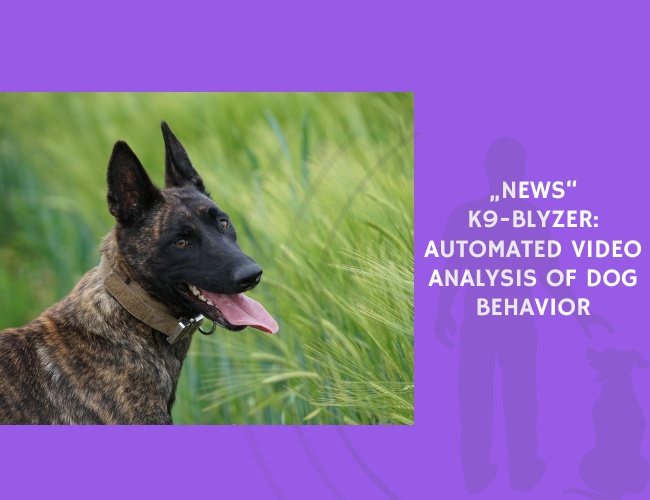
Presented at the International Conference on Animal-Computer Interaction, the research by Shirzad Amir, A. Zamansky, and D. Linden highlights the growing potential of automated systems to transform the study of animal behavior. While automated analysis has advanced rapidly for species such as birds, insects, and rodents, canine behavior remains challenging to model due to dogs’ size, mobility, and complex social signaling.
K9-Blyzer (Canine Behavior Analyzer) aims to address these difficulties by providing a video-based, automated behavioral analysis framework. The tool uses computer vision techniques to detect, track, and classify canine actions, enabling researchers to analyze footage without relying solely on labor-intensive manual coding.
The authors present preliminary results involving automatic analysis of dog–robot interaction videos. These early tests show the system’s potential to identify behavioral patterns that would be time-consuming for humans to code, highlighting its value for scalable and repeatable behavioral research.
The paper also outlines future directions, including expanding the behavioral repertoire the system can classify, improving tracking accuracy, integrating multimodal data, and enabling real-time analysis. Such developments could support work in training research, welfare monitoring, enrichment design, and ACI studies.
Ultimately, K9-Blyzer underscores the promise of automated behavioral analysis for enhancing scientific understanding of how dogs interact with their environments, technologies, and social partners.
Source: Amir, S., Zamansky, A., & Linden, D. (2017). K9-Blyzer: Towards Video-Based Automatic Analysis of Canine Behavior. Presented November 21, 2017.










