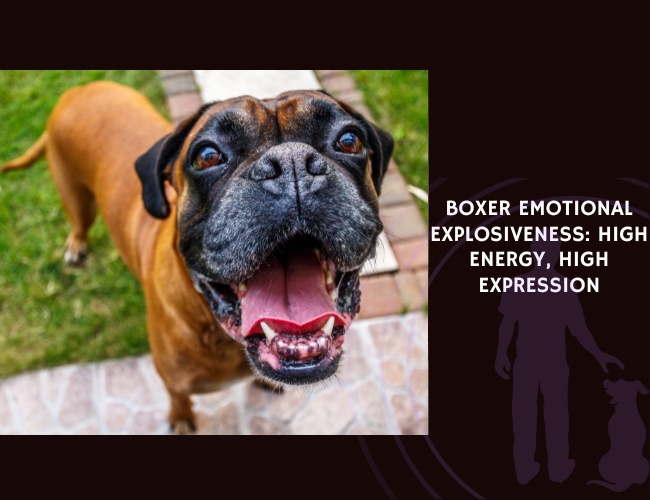
Have you ever watched your Boxer transform from calm companion to whirling dervish in what seems like seconds? You’re witnessing one of the breed’s most defining characteristics—emotional explosiveness. This isn’t about aggression or bad behavior. Instead, it’s about a dog with feelings so big, so immediate, and so all-consuming that they can shift the entire energy of a room in moments. Understanding this emotional intensity is the key to nurturing a joyful, balanced relationship with your Boxer.
The Boxer’s emotional world operates at a different frequency than many other breeds. Where some dogs experience gentle ripples of feeling, Boxers experience waves—sometimes tsunamis. This guide will help you understand the neuroscience, behavioral patterns, and practical strategies behind Boxer emotional explosiveness, so you can support your furry friend in channeling all that magnificent energy into joy rather than chaos.
The Roots of Intensity: Breed Heritage & Arousal Architecture
Your Boxer’s explosive emotional style didn’t appear by accident. It’s written into their genetic blueprint, shaped by generations of selective breeding for specific working roles. Originally developed from Bullenbeisser dogs in Germany, Boxers were bred for hunting large game, later transitioning into military, police, and guardian roles before becoming beloved family companions. Each of these roles required specific emotional capacities that still echo in your modern Boxer’s behavior.
The Working Dog Blueprint
These historical roles demanded rapid emotional shifts. A working Boxer needed to move seamlessly from calm vigilance to intense engagement, from patient waiting to explosive action. This requirement created dogs with robust PLAY and SEEKING systems—primary emotional circuits identified in affective neuroscience research. When you see your Boxer’s eyes light up at the prospect of interaction, you’re witnessing these deeply embedded drive systems activating.
The breed’s selection for courage, engagement, and what many describe as “clownish” behavior created dogs with naturally larger emotional swings. Your Boxer doesn’t just feel excitement—they feel EXCITEMENT. They don’t just experience frustration—they experience overwhelming, body-consuming FRUSTRATION. This intensity is part of their charm, but it’s also what makes emotional management so crucial.
Genetic Predispositions to Emotional Intensity
Modern Boxers carry genetic tendencies that influence how they experience and express emotion:
- High baseline arousal: Boxers tend to operate at a higher energy frequency than many breeds, meaning they’re closer to their emotional threshold even at rest
- Rapid arousal escalation: Once stimulated, Boxers can move from calm to intensely aroused more quickly than breeds with different working histories
- Strong contact-seeking drive: The innate desire for physical and social connection creates powerful motivation that, when blocked, generates significant frustration
- Expressive behavioral repertoire: Boxers were selected for dogs that “show” their feelings through exaggerated physical displays—jumping, pawing, whole-body wiggles, and vocal expression
Understanding these inherited tendencies helps you recognize that your Boxer’s explosive moments aren’t willful misbehavior. They’re the natural expression of a nervous system designed for rapid engagement and intense interaction. 🧠
Next, we’ll explore how this high-energy drive interacts with emotional regulation capacity—and why that relationship creates the explosive moments you’ve experienced.
The Energy-Regulation Gap: High Drive vs. Self-Control
Here’s where things get interesting. Boxers possess enormous physical energy and an intense drive to move, interact, and engage. But this powerful motor doesn’t always come with equally powerful brakes. The gap between arousal capacity and self-regulation ability is where emotional explosiveness lives.
When Arousal Overwhelms Cognition
Think of your Boxer’s brain during high arousal as a control room where the alarm bells are ringing so loudly that the operators can’t hear instructions. This isn’t a perfect metaphor, but it captures an essential truth: high arousal reduces access to inhibitory control and working memory. During intense excitement, frustration, or joy, your Boxer’s ability to process commands, remember training, and make considered choices temporarily goes offline.
This explains behaviors you’ve probably witnessed:
- Perfect recall at home completely disappearing at the dog park
- Solid “sit” cues ignored during greeting excitement
- Well-practiced impulse control vanishing when the doorbell rings
- Calm walking skills evaporating when another dog appears
These aren’t failures of training. They’re regulatory breakdowns—moments when emotional intensity overwhelms cognitive capacity.
The Arousal Cascade
Boxer emotional explosiveness often follows a predictable pattern. Your dog doesn’t typically go from zero to explosive in one step. Instead, arousal builds in layers:
- Trigger activation: Something interesting appears (a person, dog, squirrel, opportunity for play)
- Seeking system engagement: Your Boxer’s brain activates approach and investigation drives
- Motor activation: Physical energy mobilizes—muscles tense, heart rate increases, breathing quickens
- Cognitive narrowing: Attention focuses intensely on the trigger; peripheral awareness decreases
- Threshold crossing: Arousal reaches the point where inhibitory control fails
- Explosive expression: Jumping, lunging, vocalization, or other high-intensity behaviors emerge
Through the NeuroBond approach, you can learn to recognize earlier stages of this cascade and intervene before your Boxer crosses the threshold into explosive expression. The goal isn’t to eliminate excitement—that would diminish what makes Boxers wonderful—but to keep arousal organized rather than chaotic.
The “Wild Moments” Aren’t Defiance
When your Boxer seems to completely ignore you during explosive episodes, it’s easy to interpret this as stubbornness or willful disobedience. But what appears as “won’t listen” is almost always “can’t access.” The parts of their brain responsible for learning, memory retrieval, and behavioral choice are temporarily less available due to arousal-induced cognitive changes.
This understanding shifts how you approach management. Instead of becoming frustrated with apparent defiance, you can focus on:
- Preventing situations that predictably push your Boxer past their regulatory threshold
- Building emotional fitness through graduated exposure to triggers
- Creating calming rituals that help downshift arousal before it becomes explosive
- Recognizing your own role in either amplifying or buffering your dog’s emotional intensity
Your Boxer wants to succeed. They want connection with you. When they explode into wild behavior, they’re not choosing chaos—they’re overwhelmed by their own emotional intensity. Understanding this fundamental truth transforms how you guide them toward better self-regulation. 🐾
Reading the Storm: Communication Style & Misinterpretation
Boxers communicate with their entire being. They’re whole-body conversationalists who use paws, chest bumps, play bows, facial expressions, and a rich vocabulary of vocalizations to express their internal states. This expressive style is part of their undeniable charm—watching a Boxer “talk” with wiggling hindquarters and animated face wrinkles brings joy to millions of owners worldwide.
But this same expressiveness creates challenges. Your Boxer’s communication style can be misread by both humans and other dogs, leading to conflicts that further destabilize emotional regulation.
The Boxer Communication Toolbox
Your Boxer uses distinctive signals that differ from many other breeds:
- Paw communication: Frequent use of front paws to bat, tap, or “box” during play and interaction—hence the breed name
- Chest bumps: Using body weight and chest to make contact, which can seem overwhelming to smaller or less robust dogs
- Facial animation: Wrinkled brow, expressive eyes, and mouth movements that create a remarkably human-like range of expressions
- Vocal variety: Everything from grumbles to “woo-woo” sounds, growls that are playful rather than threatening, and bark patterns that communicate different states
- Full-body wiggles: The famous Boxer kidney-bean dance, where excitement literally curves their entire spine
When Playfulness Looks Like Roughness
Here’s where misinterpretation creates problems. Your Boxer’s play signals—the boxing with paws, the tackling approach, the noisy vocalizations—can resemble aggression or rudeness to dogs unfamiliar with the breed’s style. What your Boxer intends as “Let’s play!” another dog might read as “This is a threat.”
Similarly, humans can misread Boxer communication. Owners might see continued boisterousness as pure joy when their dog is actually escalating toward stress. The outward display of energy can mask internal overwhelm, leading to missed opportunities for intervention before an explosive episode occurs.
The Hidden Stress Beneath Expression
This is perhaps the most important aspect of Boxer communication to understand: their strong physical expressiveness can obscure subtle stress signals. Where other breeds might show early warning signs through lip licking, yawning, or turning away, Boxers often maintain their animated presentation even as internal stress builds.
Signs that your expressive Boxer is moving toward overwhelm rather than pure joy:
- Play bows that become more frantic rather than relaxed
- Vocalizations that increase in pitch or intensity
- Pawing that transitions from gentle taps to harder strikes
- Body contact that becomes more forceful or persistent
- Decreased responsiveness to your verbal cues
- Mouth tension despite apparent playfulness
- Inability to settle or take breaks during interaction
Learning to read these more subtle signals beneath the exuberant surface is essential for managing Boxer emotional explosiveness. You become your dog’s early warning system, recognizing when arousal is building toward threshold before they explode into behaviors that are difficult to redirect. 🧡
The Tipping Point: Joy vs. Stress in High Arousal
One of the most challenging aspects of living with a Boxer is identifying the precise moment when joyful excitement tips into stress-driven chaos. This crossover point exists for all dogs, but for Boxers—with their naturally high arousal and intense expressiveness—the transition can be rapid and the consequences more dramatic.
Excitement Stress: When Too Much Good Becomes Overwhelming
Did you know that positive arousal can become just as dysregulating as negative stress? Your Boxer can experience what researchers call “excitement stress”—a state where high positive arousal overwhelms their regulatory capacity. The feelings start as joy but escalate into something chaotic and uncontrolled.
Picture this scenario: Your Boxer is at the dog park, playing with a compatible friend. The play starts beautifully—reciprocal chase, gentle wrestling, clear communication. But as arousal builds, you notice changes. The play becomes more intense, less reciprocal. Your Boxer stops taking natural breaks. The vocalizations get louder. Body contact becomes harder. What began as pure joy has crossed into overwhelming excitement that your dog can no longer organize.
Environmental Factors That Shift the Crossover Point
The threshold between joyful engagement and stress-driven explosiveness isn’t fixed. It shifts constantly based on environmental conditions:
- Space constraints: Tight indoor spaces or crowded dog parks reduce your Boxer’s ability to regulate arousal through movement and distance
- Social density: Multiple dogs or people create more stimulation, pushing arousal higher faster
- Noise levels: Loud environments add sensory load that consumes regulatory resources
- Duration of stimulation: Prolonged exposure to exciting stimuli depletes your Boxer’s capacity to maintain organization
- Physical state: Fatigue, hunger, or underlying health issues lower the threshold for regulatory breakdown
- Your own energy: Your emotional state directly influences your Boxer’s arousal levels—if you’re anxious or over-excited, so are they
Understanding these variables helps you make better decisions about when and how to engage your Boxer in stimulating activities. It’s not about avoiding excitement—it’s about managing the dose and recognizing when environmental conditions are likely to push past their regulatory capacity.
Recognition and Response
Identifying your individual Boxer’s crossover point requires careful observation. Each dog’s threshold is slightly different, influenced by genetics, life experience, current training level, and immediate environmental factors. Watch for these transition signals:
Early warning (still in joyful arousal):
- Increased play intensity but still responsive to breaks
- Higher vocalizations but easily quieted
- Energetic movement with maintained awareness of surroundings
- Engagement with you when you call or gesture
Approaching threshold (sliding toward stress):
- Frantic quality to movement—less organized, more chaotic
- Decreased responsiveness to your voice or gestures
- Harder body contact or more intense mouthing during play
- Inability to settle even briefly
- Fixation on play partner or stimulus without natural breaks
Past threshold (explosive/dysregulated):
- Complete non-responsiveness to familiar cues
- Wild, uncontrolled movement patterns
- Possible redirection of arousal toward inappropriate targets
- Vocalizations that sound stressed rather than playful
- Physical signs of stress: dilated pupils, rapid breathing, excessive panting
The Invisible Leash concept becomes particularly valuable at this juncture. Rather than relying on physical restraint alone, you develop energetic awareness and calm presence that helps guide your Boxer back toward organization before they fully tip into chaos.
Learning your Boxer’s personal signs of approaching threshold allows you to intervene with calming rituals, environmental changes, or structured breaks before explosive behavior becomes necessary. This proactive approach is far more effective than attempting to regain control after an explosion has already occurred. 😄

Frustration Flashpoints: When Goals Get Blocked
If excitement stress represents one major trigger for Boxer emotional explosiveness, frustration represents the other. Boxers experience intense frustration when their drives are activated but goals are blocked. Understanding this frustration-explosion connection is essential for preventing some of the most challenging behavioral episodes.
The Frustration-Aggression Link
Research in behavioral psychology has long recognized that blocked goals under high motivation create frustration, which can surface as aggressive or explosive behavior. For Boxers—with their intense SEEKING systems and strong desire for contact and engagement—this pattern is particularly pronounced.
Common frustration scenarios that trigger explosiveness:
- Restrained greetings: Being held back from an approaching person or dog while arousal builds
- Interrupted play: Having joyful interaction suddenly ended without appropriate transition
- Barrier frustration: Seeing desired stimuli (dogs, people, wildlife) through fences, windows, or while on leash without ability to approach
- Delayed gratification: Waiting for food, toys, or interaction when drive is already activated
- Social access denial: Being separated from family members or other household pets when contact is desired
Barrier Behaviors and Leash Explosions
Some of the most dramatic Boxer explosive episodes occur around barriers. You’ve likely witnessed or experienced fence-running, where your Boxer races the fence line barking intensely at a passing dog or person. Or gate-lunging when someone approaches the front door. Or leash explosions when another dog appears during walks.
These behaviors are primarily frustration-driven rather than aggressive. Your Boxer isn’t necessarily threatening—they’re expressing the overwhelming frustration of activated drive with no outlet. The arousal has nowhere to go, so it explodes outward in dramatic displays.
The leash is a particularly powerful frustration trigger because it creates consistent goal-blocking. Your Boxer sees something interesting, their approach drive activates, and the leash prevents natural investigation or interaction. Repeated experiences of this pattern can create what’s sometimes called “leash reactivity”—explosive displays specifically occurring while on leash that may not appear in off-leash contexts.
Trigger Stacking and Cumulative Frustration
Here’s a concept that explains why your Boxer sometimes explodes seemingly out of proportion to a single trigger: trigger stacking. Multiple frustration events within a short timeframe don’t just add—they multiply. Each small frustration consumes regulatory resources and raises baseline arousal, so that what would normally be manageable becomes the final straw that triggers explosion.
A trigger stacking example:
- Morning: Breakfast delayed by 30 minutes (small frustration)
- Mid-morning: Favorite toy rolls under furniture out of reach (medium frustration)
- Lunch: Another dog walks past window during nap time (medium frustration)
- Afternoon: Being held back from greeting a visitor at the door (the trigger that unleashes explosive jumping and vocalization)
The afternoon explosion isn’t really about the visitor. It’s about cumulative frustration that has been building all day. Understanding this pattern helps you recognize that sometimes explosive episodes need to be addressed by managing the day’s overall frustration load rather than just the immediate trigger.
Prevention Through Goal Fulfillment
Managing frustration-driven explosiveness requires ensuring your Boxer’s primary drives receive appropriate, organized fulfillment:
- Physical exercise: Sufficient movement opportunities that match your Boxer’s energy level
- Mental stimulation: Problem-solving activities, training games, and novel experiences that engage cognitive capacity
- Social contact: Appropriate amounts of human and dog interaction tailored to your individual Boxer’s social needs
- Play opportunities: Regular, structured play sessions that allow joyful expression within safe parameters
- Routine predictability: Consistent schedules that reduce uncertainty and anticipatory frustration
When these core needs are met proactively, your Boxer has more regulatory resources available to handle the inevitable frustrations that arise in daily life. They’re less likely to explode because their overall frustration bucket isn’t already near capacity.
Moments of Soul Recall—those instances where your Boxer checks in with you despite high arousal or frustration—reveal the power of emotional connection in buffering against explosive responses. Building this intuitive trust creates a foundation that helps your dog choose connection over chaos, even when drives are activated and goals are blocked. 🐾
Big. Fast. Felt.
Boxers don’t ease into emotion. Their feelings arrive fully formed—joy becomes motion, frustration becomes noise, and excitement becomes presence you can almost feel in the air.
Arousal rises like a spark. High baseline energy and fast emotional escalation make expression visible, physical, and immediate—not mischievous, but deeply wired.



Intensity is their language. When channeled, it becomes connection rather than chaos—because a Boxer doesn’t just feel. They live their feelings out loud.
The Human Factor: How Your Energy Shapes Theirs
Your emotional state and behavioral responses play a far more significant role in Boxer emotional explosiveness than many owners realize. Boxers are emotionally contagious—they absorb and amplify human energy rather than buffering it. Understanding this dynamic transforms how you approach managing explosive moments.
Emotional Mirroring and Amplification
When you’re excited, your Boxer becomes more excited. When you’re anxious, your Boxer becomes more aroused and potentially reactive. When you’re calm and grounded, your Boxer has access to external regulation that helps them organize their own emotional state. This isn’t anthropomorphism—it’s observable behavioral reality rooted in the social neuroscience of human-dog bonding.
Your Boxer reads your emotional state through multiple channels:
- Vocal tone and pitch: Higher, faster, louder voices increase arousal; lower, slower, quieter voices decrease arousal
- Body tension and movement: Quick, jerky movements create excitement; smooth, deliberate movements create calm
- Breathing patterns: Shallow, rapid breathing signals stress; deep, regular breathing signals safety
- Facial expressions: Even subtle changes in your expression communicate emotional state
- Energy quality: The overall “vibe” you bring to interactions—rushed, chaotic, grounded, peaceful
Boxers don’t just notice these cues—they respond to them automatically and rapidly. Your emotional state becomes part of their environment, influencing their arousal level and regulatory capacity.
Unintentional Reinforcement Patterns
Many owners accidentally reinforce the explosive behaviors they wish to eliminate. This happens because Boxer explosiveness can be endearing, entertaining, or simply difficult to ignore. Consider these common scenarios:
Reinforcing explosive greetings:
- Laughing at jumping behavior because it’s funny or cute
- Providing attention (even corrective attention) to over-the-top excitement
- Allowing physical contact during wild behavior
- Using excited verbal tones during greetings that amplify arousal
Reinforcing barrier frustration:
- Repeatedly calling your Boxer away from the fence, which provides attention during fence-running
- Allowing prolonged window-watching that builds frustration
- Inconsistent responses that sometimes permit and sometimes prevent barrier reactivity
Reinforcing play explosiveness:
- Engaging in wrestling or rough play when your Boxer is already over-aroused
- Using toys or games as rewards immediately after explosive episodes
- Allowing play to continue past the point where your Boxer can regulate
These patterns teach your Boxer that explosive behavior is effective at gaining desired outcomes. The behavior isn’t occurring because your dog is “bad”—it’s occurring because it works.
Creating Calming Rituals
The antidote to unintentional amplification is intentional regulation. By consciously managing your own emotional state and creating structured rituals around potentially explosive moments, you provide external scaffolding for your Boxer’s emotional regulation.
Effective calming approaches:
- Pre-arrival routines: When you return home, pause outside to breathe and ground yourself before entering. Your calm entry reduces greeting explosiveness.
- Transition protocols: Create consistent patterns that signal emotional state changes—from play to calm, from excitement to rest, from isolation to reunion.
- Low-verbal leadership: Reduce verbal chatter, especially in high-arousal moments. Your calm silence is more regulating than excited talking.
- Consistent response patterns: Develop predictable responses to specific triggers so your Boxer knows what to expect, reducing uncertainty-driven arousal.
- Breathing as communication: Deliberately slow your breathing during tense moments. Many dogs will unconsciously match their breathing to yours.
Through the NeuroBond approach, you recognize that your emotional state isn’t separate from your Boxer’s behavior—it’s fundamentally connected. You become an active participant in their emotional regulation rather than a passive observer of their explosiveness. This shift in perspective empowers you to influence outcomes through conscious presence and intentional energy management. 🧡
⚡ Understanding Boxer Emotional Explosiveness 💥
Managing high energy and intense expression in your Boxer through neuroscience-based understanding and compassionate guidance
🧠 The Arousal Architecture
Why Boxers Experience Big Emotional Swings
Your Boxer’s breed heritage created dogs with robust PLAY and SEEKING systems—powerful drives for interaction and engagement. These historical working roles required rapid shifts from calm vigilance to intense action, resulting in naturally larger emotional swings than many breeds.
The Energy-Regulation Gap
Boxers possess enormous physical energy but the regulatory “brakes” don’t always match the powerful “motor.” High arousal reduces access to inhibitory control and working memory, making explosive responses more likely.
Key insight: What appears as defiance during wild moments is actually regulatory breakdown—arousal overwhelming cognitive capacity.
🎯 Major Explosion Triggers
Excitement Stress Crossover Points
High positive arousal can become overwhelming. Watch for the transition from joyful play to chaotic explosiveness:
• Frantic movement quality replacing organized play
• Decreased responsiveness to verbal cues
• Harder body contact or intense mouthing
• Inability to take natural breaks during interaction
Frustration Flashpoints
Blocked goals under high motivation create intense frustration that surfaces as explosive behavior:
• Restrained greetings (held back from desired interaction)
• Barrier frustration (fences, windows, leash constraints)
• Interrupted play without appropriate transitions
• Trigger stacking—multiple frustrations within short timeframes
✨ Management & Training Solutions
Emotional Pacing Training
Move beyond basic obedience to train emotional capacities—the ability to transition smoothly between states without explosive spikes.
• Pre-activity grounding rituals to enter excitement from calm
• Post-activity decompression routines for downshifting
• Structured arousal exposure below explosive threshold
• Rewarding organized arousal rather than waiting for perfect calm
Environmental Design for Success
Thoughtfully designed spaces dramatically reduce explosive episodes by supporting rather than challenging regulation. Create distinct zones (calm areas, play zones, transition spaces), manage visual access to prevent barrier frustration, ensure non-slip flooring for confidence, and establish predictable routines that reduce anticipatory arousal.
⚠️ The Human Amplification Factor
You Mirror and Magnify Emotional States
Boxers are emotionally contagious—they absorb and amplify human energy rather than buffering it. Your excited greeting creates more excitement. Your anxiety increases reactivity. Your calm presence provides external regulation.
Critical awareness: When you’re rushed, chaotic, or over-excited, your Boxer’s explosive tendencies intensify proportionally.
Unintentional Reinforcement Patterns
Laughing at jumping, providing attention during wild behavior, and using excited verbal tones during greetings all teach your Boxer that explosiveness works. Even corrective attention reinforces the pattern by providing the social contact your dog seeks.
⚡ The Boxer Arousal Management Formula
Prevention (environmental design + routine predictability) + Capacity Building (emotional pacing training + impulse control) + Human Regulation (calm presence + consistent responses) = Organized Joy (intensity without chaos)
Your Boxer’s explosiveness isn’t a flaw to eliminate—it’s profound feeling that deserves understanding and gentle guidance toward safe, joyful expression.
🧡 The NeuroBond Approach to Boxer Intensity
Through the NeuroBond framework, you become your Boxer’s external regulatory structure—providing calm, low-verbal leadership that keeps arousal online but organized rather than explosive. The Invisible Leash reminds us that awareness, not tension, guides emotional expression. When you understand the neuroscience behind your Boxer’s big feelings and respond with compassionate structure rather than frustration, you transform potential chaos into magnificent, organized joy.
© Zoeta Dogsoul – Where neuroscience meets soul in dog training
Environmental Architecture: Designing Spaces for Emotional Success
Certain environments reliably trigger Boxer emotional explosiveness while others support regulated, joyful expression. By thoughtfully designing your Boxer’s physical environment, you can dramatically reduce the frequency and intensity of explosive episodes.
High-Risk Environments
Understanding which settings predictably challenge your Boxer’s regulatory capacity allows you to either avoid them or prepare more carefully. Common explosive triggers include:
Doorways and entry points:
- High traffic zones where people arrive and depart
- Visual access to outdoor activity that activates but frustrates drive
- Acoustic amplification that makes sounds more startling
- Confined space that limits movement options during arousal
Dog parks and social areas:
- Unpredictable social dynamics with unfamiliar dogs
- Varying play styles that may not match your Boxer’s communication
- Arousal escalation through group excitement
- Insufficient space for dogs to regulate through distance
Indoor play in confined spaces:
- Limited room for dogs to use distance to downshift arousal
- Proximity to furniture and objects that increase collision risk during wild play
- Acoustic properties that amplify exciting sounds
- Lack of clear boundaries between play zones and calm zones
Visual barrier areas:
- Fences where dogs, people, or wildlife regularly pass
- Windows with views of stimulating activity
- Gates and doorways that create barrier frustration
- Any separation from desired social contact
Supportive Environmental Design
Creating spaces that support rather than challenge emotional regulation involves thoughtful attention to multiple factors:
Space and layout considerations:
Your Boxer benefits from environments that offer both stimulation and regulation opportunities. Consider creating distinct zones within your home and yard:
- Calm zones: Areas with minimal stimulation, comfortable resting spots, and association with relaxation rather than excitement
- Play zones: Clearly defined spaces where energetic expression is appropriate and safe
- Transition zones: Intermediate areas that help shift between calm and arousal states
- Observation points: Spots where your Boxer can watch activity without frustration-building barriers
Flooring and surface impact:
The physical surface under your Boxer’s feet influences their emotional state more than most owners realize. Slippery floors create low-level anxiety that consumes regulatory resources and can contribute to explosive episodes. Your Boxer may slide during play or have difficulty controlling movement, which increases stress.
Optimal flooring characteristics:
- Non-slip surfaces in high-activity areas
- Comfortable traction during play and movement
- Temperature regulation for comfort
- Easy cleaning without harsh chemical residues that might affect stress levels
Acoustic management:
Sound levels and quality significantly impact Boxer arousal. Loud, chaotic acoustic environments push arousal higher, while quieter, more predictable soundscapes support regulation.
Sound considerations:
- White noise or calming music to buffer external triggers
- Reduced echo in play areas to prevent arousal amplification
- Sound barriers between your Boxer and frequently triggering noises
- Quiet zones where your dog can escape from acoustic overstimulation
Visual access management:
What your Boxer can see matters enormously for emotional regulation. Visual access to triggering stimuli without ability to engage creates profound frustration.
Strategic visual control:
- Window film or barriers at fence-running heights
- Furniture placement that limits frustration-building views
- Positive associations with observation points that don’t permit barrier frustration
- Environmental enrichment that redirects attention from trigger-viewing
Routine and predictability:
While not strictly environmental in the physical sense, your daily routine creates a temporal environment that profoundly influences emotional stability. Boxers thrive on predictable patterns that reduce anticipatory arousal and provide clear expectations.
Stabilizing routine elements:
- Consistent timing for meals, walks, and play
- Predictable sequences of events (e.g., walk, then breakfast, then rest)
- Regular calming activities built into daily structure
- Adequate rest periods between stimulating activities
Multi-dog household considerations:
If you have multiple dogs, the social environment adds another layer of complexity. Dogs influence each other’s arousal levels, and Boxers may be particularly prone to excitement escalation in group settings.
Managing multi-dog arousal:
- Separate feeding areas to reduce competitive arousal
- Individual play opportunities to prevent contagious excitement
- Calm-down periods after group activities
- Recognition of which dog combinations amplify arousal
The Invisible Leash extends beyond your direct interaction with your Boxer to include the environmental energy you create. A thoughtfully designed space communicates calm expectations and provides structure that supports emotional organization. Your environment becomes a silent partner in regulation, reducing the frequency of explosive episodes and creating conditions where your Boxer’s joy can express safely. 😄

Training for Emotional Fitness: Beyond Basic Obedience
Traditional obedience training teaches behaviors—sit, stay, come, heel. While these skills have value, managing Boxer emotional explosiveness requires training emotional capacities, not just behavioral responses. This shift from obedience to emotional fitness represents a fundamental reconceptualization of what training means.
Emotional Pacing: The Missing Skill
Your Boxer needs to learn how to transition between emotional states smoothly rather than lurching from calm to explosive and back. This capacity for emotional pacing is trainable, but it requires different methods than traditional command-based obedience.
Emotional pacing training focuses on:
- Arousal awareness: Teaching your Boxer to notice their own arousal level
- Voluntary downshifting: Building the skill to choose calming behaviors even when excited
- State transitions: Creating smooth pathways between different emotional intensities
- Recovery capacity: Developing the ability to return to baseline after arousal spikes
These aren’t behaviors you command—they’re capacities you build through systematic practice and environmental design.
Structured Arousal Exposure
One of the most powerful tools for building emotional fitness is graduated exposure to arousal triggers under controlled conditions. This isn’t about flooding your Boxer with overwhelming stimulation. Rather, it’s about carefully calibrated experiences that build regulatory capacity incrementally.
The process follows this pattern:
- Identify specific triggers: What situations reliably create explosive arousal in your individual Boxer?
- Establish baseline threshold: At what intensity does your Boxer begin losing regulatory control?
- Create sub-threshold exposure: Present the trigger at a level below the explosive threshold
- Reward organized arousal: Reinforce moments when your Boxer maintains organization despite stimulation
- Gradually increase intensity: Slowly raise the challenge as regulatory capacity builds
- Practice state transitions: Build in deliberate shifts from arousal to calm
This methodical approach respects your Boxer’s current capacity while systematically expanding it. You’re not expecting your dog to magically develop self-control—you’re building the neural pathways that support regulation through repeated practice at manageable levels.
Impulse Control Games
Specific training games develop the cognitive flexibility and impulse control that support emotional regulation. These games make training engaging while building essential capacities:
- Wait for release games: Food or toys that require calm waiting before access
- Choose calmness activities: Multiple options where the calm choice earns the reward
- Attention games: Exercises that build focus despite distractions
- Find it/search activities: Mental engagement that channels arousal into organized behavior
- Pattern interrupts: Teaching your Boxer to shift behavior rapidly on cue
The key is making these games rewarding and fun rather than purely restrictive. You’re not just saying “no” to explosive behavior—you’re saying “yes” to organized alternatives that meet the same underlying needs.
Pre-Activity Grounding
Before potentially explosive situations, establishing a grounding ritual helps your Boxer enter the experience with more regulatory resources available. These pre-activity protocols become cues that signal “we’re about to do something exciting, but we’re starting from calm.”
Effective grounding rituals might include:
- Brief settle exercises before play or walks
- Calm touch or massage to reduce baseline arousal
- Breathing together—literally matching your breathing to help your dog regulate
- Predictable sequences that your Boxer associates with organized activity
Post-Activity Decompression
Equally important is teaching your Boxer how to downshift after stimulating experiences. Many explosive episodes occur not during the activity itself but in the transition afterward, when arousal is high but the outlet has ended.
Decompression strategies:
- Designated calm-down spaces after exciting activities
- Quiet activities that channel remaining arousal (chewing, sniffing games)
- Gradual rather than abrupt endings to play or social time
- Physical settling cues (gentle pressure, calm touch)
- Time allowances for arousal to naturally dissipate
The Role of Calm Rewards
Traditional training often uses excitement as reward—enthusiastic praise, energetic play, animated toy interaction. For Boxers prone to explosiveness, these rewards can be counterproductive, as they spike arousal just when you’re trying to build calmness.
Alternative reward strategies:
- Calm verbal praise delivered in a low, soothing tone
- Food rewards given during quiet moments rather than high excitement
- Gentle physical affection rather than rough play
- Access to desired activities only when your Boxer demonstrates regulation
- Environmental rewards like sniffing time or exploration
Through this approach, your Boxer learns that calmness—not explosiveness—opens doors to what they want. You’re fundamentally reshaping the reinforcement contingencies around emotional expression.
Recognizing Individual Variation
Every Boxer’s path to emotional fitness looks slightly different. Some dogs respond quickly to environmental management, while others need extensive impulse control training. Some benefit most from routine and predictability, while others need help specifically with social arousal or barrier frustration.
Tailoring your approach requires honest assessment of:
- Your individual Boxer’s primary triggers
- Which situations most reliably create explosiveness
- Your dog’s current regulatory capacity
- Your own consistency and follow-through ability
- Resources available for training and management
Through the NeuroBond framework, training becomes less about dominance or control and more about providing scaffolding for your Boxer’s emotional development. You’re a supportive guide helping your dog build capacities they don’t yet possess, rather than an enforcer demanding behaviors they can’t reliably access under arousal. This fundamental shift in perspective transforms both the training relationship and outcomes. 🧠
Living Joyfully With Intensity: Practical Daily Management
Understanding the neuroscience and behavioral patterns behind Boxer emotional explosiveness provides the foundation. But you also need practical, day-to-day strategies that translate knowledge into livable routines. This section offers concrete approaches for managing explosive tendencies while preserving the joy and exuberance that make Boxers so special.
Morning Routines That Set the Day’s Tone
How your day begins significantly influences your Boxer’s emotional regulation throughout the hours that follow. Chaotic, rushed mornings create baseline arousal that makes explosive episodes more likely. Structured, calm mornings provide regulatory resources that buffer against triggers.
Effective morning patterns:
- Wake at consistent times to reduce anticipatory arousal
- Begin with calm physical contact before high-energy greetings
- Provide bathroom access before excitement-building activities
- Offer breakfast after your Boxer demonstrates calmness
- Include brief mental stimulation (sniffing games, simple training)
- Start the day with your energy grounded rather than rushed
Managing the Greeting Explosion
Arrivals—yours, visitors’, or encountering people during walks—rank among the most reliable explosion triggers for Boxers. Their intense desire for social contact combined with forced waiting creates overwhelming arousal.
Greeting management strategies:
For your arrivals home:
- Pause outside before entering to center yourself
- Enter calmly without immediately acknowledging your Boxer
- Allow arousal to dissipate slightly before providing attention
- Reward the first moment of calmness rather than waiting for perfection
- Make low-key arrivals the norm, saving enthusiastic greetings for specific trained contexts
For visitors:
- Prepare your Boxer before guests arrive rather than allowing surprise
- Practice the greeting ritual with familiar people before trying with strangers
- Use distance and barriers initially, gradually allowing closer contact as calmness permits
- Give your Boxer an alternative behavior to perform (go to mat, hold a toy)
- Educate visitors about ignoring initial explosiveness and rewarding calm
For street encounters:
- Maintain generous distance from approaching people or dogs
- Redirect attention before your Boxer fixates on the approaching trigger
- Practice “Find it” games that engage your dog’s nose and interrupt arousal escalation
- Use body blocking and calm energy rather than verbal corrections
- Reward attention to you in the presence of potential triggers
Exercise: Quality Over Quantity
Many owners believe that exhausting their Boxer through intense exercise will prevent explosive behavior. Sometimes this works temporarily, but it can also backfire. Over-exercising in chaotic, highly arousing ways can actually increase explosive tendencies by repeatedly practicing unregulated arousal.
Effective exercise approaches:
- Structured walks: Controlled, calm walking with sniffing opportunities rather than frantic pulling
- Mental exercise: Training games, puzzle toys, and novel experiences that tire the brain
- Organized play: Play sessions with clear beginnings, middles, and ends rather than continuous chaos
- Varied activities: Different types of exercise throughout the week to prevent over-reliance on single outlets
- Post-exercise rest: Ensuring adequate recovery time rather than continuous stimulation
The Power of Decompression Activities
Between stimulating experiences, your Boxer needs activities that help process arousal and return to baseline. These decompression activities aren’t about forced inactivity—they’re about channeling energy into organizing rather than explosive outlets.
Valuable decompression activities:
- Chewing: Long-lasting chews that provide rhythmic, calming oral activity
- Sniffing games: Hide and seek with treats or toys that engage the nose
- Slow feeding: Food puzzles and slow feeders that extend meal times
- Gentle training: Low-arousal training sessions that build connection without excitement
- Massage and calm touch: Physical connection that soothes rather than stimulates
When to Seek Additional Support
While many Boxer explosive tendencies can be managed through understanding and environmental modification, some situations benefit from professional guidance. Consider seeking help from a qualified behavior professional when:
- Explosive episodes are escalating in frequency or intensity despite management efforts
- Explosiveness includes concerning aggression toward people or animals
- Your Boxer seems unable to downshift even in calm environments
- You feel overwhelmed or unsafe managing your dog’s behavior
- Multiple strategies have been tried without meaningful improvement
- Your Boxer’s behavior is limiting their quality of life or yours
Professional support isn’t an admission of failure—it’s a recognition that complex behavioral patterns sometimes need specialized expertise. Look for trainers or behavior consultants who understand arousal-based behavioral challenges and use science-based, force-free methods.
Celebrating Your Boxer’s Joy
Here’s what often gets lost in managing explosive tendencies: Boxer exuberance, properly channeled, is a gift. The same emotional intensity that creates challenges also creates profound capacity for joy, enthusiasm, connection, and loyalty. Your goal isn’t to eliminate your Boxer’s big feelings—it’s to help them express those feelings in ways that enhance rather than disrupt life together.
When you see your Boxer’s eyes light up with excitement, when they wiggle their entire body in greeting, when they bound across the yard in pure joy—these moments reflect the emotional depth that makes the breed extraordinary. Your job is simply to provide the structure, support, and guidance that allows that intensity to flow in organized directions.
That balance between honoring emotional authenticity and building regulatory capacity—that’s the essence of Zoeta Dogsoul. It’s recognizing that emotional explosiveness isn’t a flaw to be eliminated but an expression of profound feeling that deserves to be understood, respected, and gently shaped toward joyful expression. 🐾
Understanding Your Explosive Companion
Living with a Boxer means living with big feelings. These dogs experience the world at an emotional intensity that can be startling if you expect them to behave like calmer breeds. But once you understand the neuroscience, behavioral patterns, and management strategies behind Boxer emotional explosiveness, you can support your furry friend in channeling that magnificent energy toward joy rather than chaos.
Remember that your Boxer’s explosive moments aren’t defiance or bad behavior—they’re overflow. They’re what happens when powerful drives meet limited regulatory capacity, when intense arousal overwhelms cognitive control, when enormous feelings need expression but lack organized outlets. Your role isn’t to punish these explosions but to prevent them through thoughtful environmental design, build capacity through emotional fitness training, and provide the calm, grounded presence that helps your Boxer organize their internal storms.
Every Boxer is unique, with individual triggers, thresholds, and regulatory capacities. What works beautifully for one dog may need adjustment for another. Pay attention to your specific Boxer’s patterns, honor their individual needs, and remain patient as you build new skills together. Change doesn’t happen overnight, but with consistent, compassionate approach, even highly explosive Boxers can develop better emotional regulation.
The intensity that creates challenges also creates extraordinary capacity for love, loyalty, and connection. Your Boxer’s big feelings mean they experience joy more profoundly, bond more deeply, and engage more enthusiastically than many other dogs. When you provide the structure that allows safe expression of that emotional depth, you unlock one of the most rewarding relationships in the canine world.
So embrace your explosive companion. Understand their arousal architecture, respect their emotional sensitivity, provide scaffolding for regulation, and celebrate the exuberant spirit that makes Boxers unforgettable. With knowledge, patience, and consistent application of the principles we’ve explored, you and your Boxer can navigate emotional intensity together—transforming potential chaos into organized joy. 🧡