
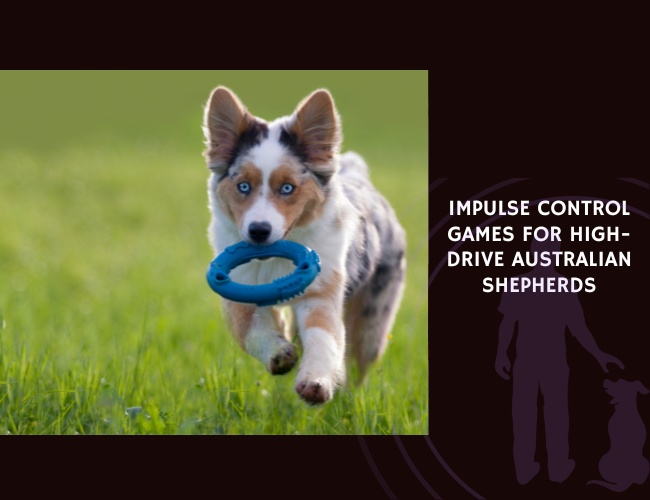
If you share your life with an Australian Shepherd, you already know the intensity that comes with those bright, watchful eyes. You’ve witnessed the lightning-fast reactions to a bouncing ball, the laser focus when something moves across their field of vision, and perhaps the frustration when your brilliant companion simply can’t settle. This isn’t disobedience or stubbornness. What you’re observing is a finely tuned working brain doing exactly what generations of selective breeding designed it to do: notice, anticipate, and act.
Australian Shepherds carry an extraordinary cognitive architecture built for herding work. Their minds are wired to read subtle movement patterns, predict trajectory changes, and make split-second decisions about controlling livestock. In a modern home environment, however, these same remarkable abilities can manifest as challenges:
How herding traits show up in daily life:
- Motion sensitivity for reading sheep → reactivity to bicycles, joggers, and passing cars
- Anticipatory thinking for predicting livestock → jumping ahead of your cues and commands
- Intense work drive for controlling movement → inability to settle or be still
- Eye-stalk-chase sequence for herding → fixation on and pursuit of moving objects
- Strategic blocking behaviors → inappropriate herding of children, other pets, or visitors
Traditional training often approaches these behaviors as problems to suppress through obedience commands. But what if we reframed the conversation entirely? What if, instead of asking your Australian Shepherd to fight against their fundamental nature, we taught them to channel that extraordinary drive into structured self-regulation? What if impulse control became not a restriction, but a sophisticated job for their intelligent mind?
This is where game-based impulse control training transforms everything. By leveraging your Aussie’s cognitive strengths through purposeful, structured games, you create a framework where self-regulation feels like partnership rather than punishment. Through the NeuroBond approach, we build voluntary self-control that integrates their natural drives into calm, thoughtful responsiveness. This isn’t about dampening their spirit. It’s about teaching them that pausing, evaluating, and choosing the right moment to act is the most sophisticated job of all.
Understanding the High-Drive Australian Shepherd Brain
Before diving into specific games and strategies, you need to understand what’s happening beneath the surface when your Australian Shepherd struggles with impulse control. Their behavior isn’t random or willful. It’s the predictable expression of a specific neurological architecture designed for work.
The SEEKING System and Herding Drive
Deep in your Aussie’s brain, a powerful motivational system called SEEKING drives their constant engagement with the environment. This system, identified through affective neuroscience research, is responsible for appetitive behaviors and goal-directed action. In working breeds like Australian Shepherds, this system runs particularly hot. It’s what makes them tireless workers, always scanning, always ready, always motivated to engage.
When this SEEKING system over-activates without proper structure, you see premature action. Your dog lunges before you’ve given the cue. They break their stay the moment something moves. They anticipate your throw and race after the ball before it leaves your hand. This isn’t a training failure on your part. It’s the natural expression of a powerful drive system that hasn’t yet learned to integrate waiting as part of the action sequence.
The herding instinct itself carries a specific behavioral pattern: eye, stalk, chase, block, and control. Each element involves intense focus and a drive to move and manage:
The herding sequence in action:
- Eye – Intense, unwavering focus on the target with minimal blinking
- Stalk – Slow, deliberate approach with lowered body posture and controlled movement
- Chase – Rapid pursuit to apply pressure and influence direction
- Block – Positioning to prevent movement in unwanted directions
- Control – Strategic pressure application to guide movement where desired
When you ask your Australian Shepherd to practice impulse control, you’re asking them to override the “chase” component that feels hardwired into their system. The challenge is that their natural inclination screams “act on that movement now!” while you’re asking for cognitive control that says “wait for my signal.”
Here’s what matters: the “control” aspect of herding actually suggests your dog has the capacity for strategic engagement. They already know how to time their movements, calculate distances, and make thoughtful decisions about when to move and when to hold pressure. This existing capability can be redirected toward self-control within structured games, but only if we work with their brain’s design rather than against it.
Why Structure Succeeds Where Suppression Fails
You’ve probably noticed that your Australian Shepherd excels when they have a clear job with defined parameters. They can master complex agility sequences, learn intricate tricks, and work for hours when the task has purpose and predictable structure. Yet ask them to simply lie quietly while unpredictable chaos unfolds around them, and they fall apart.
This isn’t contradictory. It’s completely predictable given how their cognitive processing works:
Why structure works for the Aussie brain:
- Clear goals provide direction for their intense SEEKING system
- Defined rules create a framework their pattern-recognition abilities can grasp
- Predictable sequences allow their anticipatory thinking to work productively
- Purposeful tasks satisfy their need for meaningful contribution
- Measurable success provides feedback their intelligent mind craves
- Cooperative elements tap into their relational intelligence
Australian Shepherds thrive on purpose. When impulse control is presented as a clear, goal-oriented task with defined rules and predictable outcomes, it aligns perfectly with their cognitive strengths. Games that promote impulse control through purposeful engagement tap into their problem-solving abilities, giving their active mind something meaningful to process. They’re not fighting their drives; they’re directing them toward a specific outcome.
Passive patience in unpredictable environments, by contrast, offers no clear framework for their constantly churning predictive processing model. Without a defined “job” or recognizable pattern, their brain struggles to find meaning in the waiting. The SEEKING system has no target, no goal, no purpose. This creates cognitive dissonance that rapidly escalates arousal and collapses their ability to participate thoughtfully.
The solution isn’t more obedience drilling. It’s providing structure that transforms impulse control into purposeful work that satisfies their need for mental engagement. 🧠
Anticipatory Thinking: Blessing and Challenge
Your Australian Shepherd’s ability to predict movement patterns is one of their most remarkable cognitive gifts. They can read your body language before you’re consciously aware of what you’re about to do. They know the ball is about to be thrown based on subtle shifts in your shoulder position. They anticipate the direction livestock will move based on environmental pressure and herd dynamics.
This predictive processing is extraordinary intelligence at work. But it also creates a specific challenge for impulse control.
When your Aussie anticipates an outcome that involves movement or reward, their strong SEEKING drive can override inhibitory control before you’ve even finished giving your cue. They’re not being disobedient. Their brain has already calculated the trajectory, predicted the outcome, and triggered the motor response. By the time you say “wait,” their body is already in motion.
This is similar to how emotional arousal impairs cognitive inhibition in humans. When your Australian Shepherd sees that ball in your hand, anticipation generates significant emotional arousal. That arousal makes it extraordinarily difficult to delay action, even when they intellectually “know” they should wait for your release cue.
The key to working with anticipatory thinking is expanding their cognitive processing to include “waiting” as a purposeful, decision-based action within their predictive framework. They need to learn that pausing to evaluate, reading your signals, and choosing the right moment to act is itself a sophisticated prediction skill—perhaps the most sophisticated one of all.
Motion Sensitivity and the Challenge of Cognitive Regulation
Australian Shepherds don’t just see movement. They experience it with heightened neurological intensity that most other breeds simply don’t possess. This motion sensitivity is what makes them brilliant herders, but in domestic environments, it’s often the primary trigger for impulse control breakdowns.
How Fast Movement Overwhelms the System
You’ve seen it happen. Your Australian Shepherd is lying calmly beside you. Then a jogger runs past the window, a squirrel darts across the yard, or a bicycle speeds by. In an instant, your dog transforms from calm companion to intense, reactive, nearly vibrating with the need to move.
Fast-moving triggers generate rapid and intense increases in emotional arousal that can quickly overwhelm your Aussie’s capacity for cognitive control. When arousal levels spike this quickly, cognitive participation collapses. Your dog literally cannot think through their response because the emotional activation has bypassed higher-level processing.
The neural pathways associated with detecting, tracking, and responding to movement are highly developed in Australian Shepherds. When fast motion enters their environment, these pathways activate intensely and immediately. The SEEKING system and orientation systems fire up together, creating what feels like an irresistible compulsion to track, chase, and control that movement.
Static stimuli don’t generate this same intensity. A parked car, a person standing still, or a ball resting on the ground may interest your dog, but they don’t trigger the same explosive arousal response. The difference lies in how movement activates their most primitive, deeply ingrained behavioral systems.
Neurological Processing Differences
While research hasn’t yet mapped every detail of breed-specific neural processing, we can infer from behavioral patterns that Australian Shepherds process movement with heightened sensitivity compared to many other breeds. Their herding background required the ability to detect and respond to subtle motion changes instantly. This means their sensory systems, particularly vision, feed into decision-making pathways with less filtering and more direct access to motor responses.
In less reactive breeds, there might be more “space” between noticing movement and acting on it—more cognitive processing that evaluates whether action is necessary. In Australian Shepherds, that gap is compressed. The detection-to-action pathway is highway-fast by design.
This neural architecture served them beautifully in working contexts where instant response to livestock movement was essential. In your living room, it means your dog’s nervous system floods with activation every time something moves, making cognitive regulation exponentially more difficult.
Redirecting Motion-Fixation Into Motion-Reading
Here’s the transformational insight: you cannot eliminate your Australian Shepherd’s motion sensitivity, nor should you try. Instead, you can redirect motion-fixation into structured motion-reading—teaching your dog to pause, evaluate, and respond thoughtfully rather than react automatically.
Games offer the perfect vehicle for this redirection. Through controlled, predictable motion within a game context that requires cognitive engagement and decision-making, you train your Australian Shepherd to process movement differently.
Instead of “see movement → chase movement,” the cognitive sequence becomes “see movement → read movement for cues → make decision → act according to rules.” This builds new neural pathways that transform automatic reaction into thoughtful response.
For instance, games involving controlled timing and delayed action can teach your dog to “read” motion for specific signals. They learn that not all movement requires the same response. Some movement signals “wait.” Other movement signals “your turn to act.” The motion itself becomes information to process rather than a trigger to react to.
This aligns with research showing that serious games can significantly improve emotion regulation and reduce impulsivity. By structuring the interaction with motion, you help your dog develop cognitive frameworks for processing what they see, creating space between stimulus and response where thoughtful decision-making can occur.
The Invisible Leash reminds us that true control isn’t about physical restraint. It’s about awareness and partnership that guides from within. When your Australian Shepherd learns to read motion rather than simply react to it, they develop an internal compass that allows them to navigate high-stimulus environments with thoughtfulness rather than reflexive action. 🐾
Game-Based Self-Regulation: What Works and Why
Not all games are created equal when it comes to building impulse control in high-drive Australian Shepherds. The most effective games share specific characteristics that align with your dog’s cognitive architecture while systematically building their capacity for self-regulation.
Characteristics of effective impulse control games:
- Clear structure with defined rules your dog can learn and predict
- Purposeful waiting periods integrated into inherently rewarding activities
- Progressive difficulty that matches your dog’s developing capacity
- Immediate, meaningful consequences for both success and failure
- Cognitive engagement that occupies their intelligent mind productively
- Arousal management built into the game design itself
- Opportunities for decision-making rather than passive compliance
- Natural reinforcement through game mechanics rather than arbitrary rewards
- Scalable complexity allowing growth from foundation to advanced levels
- Relational elements that strengthen partnership rather than just individual performance
The Foundation: Controlled Timing and Delayed Action
The cornerstone of impulse control games is the integration of waiting periods into inherently rewarding activities. These aren’t passive “sit and stay” exercises where your dog simply endures stillness. Instead, they’re dynamic games where waiting becomes an active, purposeful part of achieving a desired outcome.
Wait-to-Release Games
These games teach your Australian Shepherd that holding position until released is the pathway to something they want. The structure is simple but powerful:
Core elements of wait-to-release structure:
- Present a high-value reward (food, toy, opportunity to move) in clear view
- Require a waiting period of specific duration appropriate to current skill level
- Release with a clear, consistent cue that signals permission to act
- Immediately deliver the reward as a direct consequence of successful waiting
- Mark the exact moment of good decision-making for clarity
- Gradually extend duration only after achieving reliability at current level
- Vary the reward type to maintain interest and motivation
- Practice in multiple contexts to build generalization
The key is starting with extremely short durations—perhaps just one or two seconds—where success is virtually guaranteed. Your Aussie’s brain needs to experience the connection between “I waited” and “I got what I wanted” repeatedly before that neural pathway strengthens.
As they build capacity, gradually extend the duration. But always stay within their current ability range. Pushing too fast creates failure experiences that teach the opposite lesson: “waiting doesn’t work, breaking position works better.”
These games tap into what researchers have found about digital games and impulse control: when structured appropriately, game-based practice creates measurable improvements in self-regulation and decision-making abilities. The game framework makes the practice feel purposeful rather than restrictive.
Decision-Tree Games
These more sophisticated games require your Australian Shepherd to evaluate multiple cues and choose the appropriate response based on context. This builds cognitive flexibility and inhibitory control simultaneously.
For example, you might teach your dog that:
A hand signal to the left means “move left to the target” A hand signal to the right means “move right to the target”
A hand held up means “freeze and wait for the next cue” No signal means “maintain your current position”
The complexity of processing multiple possible outcomes and inhibiting incorrect responses strengthens executive function. Your dog’s working memory is engaged in holding the rule structure while their inhibitory control prevents premature action.
Decision-tree games directly address the cognitive load challenge. By giving your Australian Shepherd’s active mind genuine work—processing variables, evaluating contexts, making choices—you redirect the energy that would otherwise fuel impulsive behavior into thoughtful problem-solving.
Slow-Motion Work Games
Australian Shepherds are built for speed and explosive action. Slow-motion work feels unnatural initially, which is precisely why it’s so valuable for impulse control development.
These games might include:
Walking at an extremely slow pace while maintaining heel position Taking a treat from your hand with exaggerated gentleness Performing tricks in slow motion with deliberate, controlled movement Moving through an obstacle course at quarter-speed
Slow-motion work requires intense cognitive engagement to override natural tempo. It builds impulse control at a fundamental level by teaching your dog that they can modulate their own arousal and movement speed. This is the opposite of suppression. It’s active self-regulation.
Research on games designed to improve emotion regulation shows that practice modulating physiological arousal while completing challenging tasks creates real improvement in regulatory capacity. Slow-motion games do exactly this, giving your Australian Shepherd practice controlling their activation level while engaged in work they find meaningful.
Cooperative Attention Games
These games build impulse control through shared focus rather than individual restraint. The foundation is teaching your dog that maintaining attention on you, even in distracting environments, is itself a rewarding partnership activity.
Attention game variations:
- Basic eye contact – rewarding any voluntary look at you
- Duration eye contact – rewarding sustained focus for increasing time periods
- Eye contact despite mild distractions – maintaining focus while you move
- Eye contact during environmental distractions – focusing on you while stimuli appear
- Name response – immediately looking at you when you say their name
- Auto check-ins – rewarding your dog for choosing to look at you without being asked
- Focused heeling – maintaining eye contact while walking beside you
- Attention switching – rapidly shifting focus from environment back to you on cue
- Relaxed attention – maintaining connection without hard staring or tension
- Distance attention – focusing on you from various distances
Start in low-distraction environments and reward your Australian Shepherd for choosing to look at you rather than at environmental stimuli. Gradually increase the challenge by introducing mild distractions—a toy on the ground, another person walking by, gentle movement in the periphery.
The sophisticated version involves duration: can your dog maintain focus on you for five seconds? Ten seconds? While something mildly interesting happens nearby?
This isn’t about demanding attention through force. It’s about building a neural pathway where connecting with you becomes more rewarding than reacting to environmental triggers. Through the NeuroBond approach, this shared attention becomes the foundation for all impulse control work. When your dog learns that staying connected to you helps them navigate arousal and uncertainty, they begin to regulate with you rather than against their impulses.
The Arousal Ladder: Managing Intensity Intelligently
Perhaps the most critical insight for game-based impulse control work is understanding arousal management. Your Australian Shepherd cannot practice cognitive control when their arousal level has spiked beyond their cognitive capacity.
Think of arousal as a ladder with distinct levels:
The Arousal Ladder – Detailed levels:
Level 1 – Calm baseline:
- Your dog can think clearly and process complex information
- Body is relaxed, breathing is normal, muscles are soft
- Demonstrates sophisticated self-control with minimal effort
- Can learn new skills and practice advanced behaviors
- Maintains focus easily despite mild distractions
Level 2 – Mild interest:
- Engagement increases slightly but cognitive function remains strong
- Some muscle tension beginning to appear
- Can still process information and make thoughtful choices
- Learning is still effective though requiring slightly more effort
- Good level for most training sessions
Level 3 – Moderate arousal:
- Focus narrows somewhat on interesting stimuli
- Impulse control becomes more effortful but still possible
- May need more valuable rewards to maintain engagement
- Learning efficiency begins to decrease
- Maximum level for practicing new impulse control skills
Level 4 – High arousal:
- Cognitive participation begins to collapse
- Reflexive reactions increase, thoughtful responses decrease
- Breathing becomes rapid, body tension is obvious
- Cannot learn new skills, may struggle with well-practiced behaviors
- Immediate arousal reduction needed before continuing training
Level 5 – Over-threshold:
- No cognitive processing possible
- Pure reactive drive expression without thought
- Complete inability to respond to familiar cues
- Learning impossible, potential for behavioral damage
- Must end session immediately and reset completely
Impulse control games must be practiced at Levels 1-3. If your dog has climbed to Level 4 or 5, no learning can occur. They’re neurologically incapable of engaging their executive function at that arousal state.
This means you need to engineer game sessions that maintain appropriate arousal levels:
Arousal management strategies for training sessions:
- Use lower-value rewards initially to prevent excitement from spiking too high
- Introduce movement and intensity gradually across multiple sessions
- Build duration slowly, never rushing progression
- Always end sessions before arousal spikes too high
- Take breaks between repetitions to allow arousal to settle
- Practice in cooler temperatures when possible as heat increases arousal
- Avoid training when your dog is already aroused from other activities
- Use calm, slow movements and quiet vocal tones yourself
- Incorporate calming activities (sniffing, slow walking) between exciting elements
- Monitor your dog’s stress signals constantly and respond immediately
- Keep sessions shorter than your dog’s current attention and regulation capacity
- Schedule training after moderate exercise when arousal is manageable
- Use environmental management to reduce arousal triggers during practice
Research shows that unmanaged arousal quickly depletes working memory and executive function resources, leading to behavioral breakdowns. By keeping your Australian Shepherd within their cognitive capacity zone, you create the conditions where actual learning and skill development can occur.
Environmental Structure and Setup Success
The environment where you practice impulse control games dramatically influences success rates. Australian Shepherds are intensely perceptive, and every detail of the training environment sends signals that either support or undermine their ability to engage cognitive control.
Starting in Low-Distraction Spaces
Your living room filled with family activity, your yard with squirrels and neighbors, the park with dogs and joggers—these are all expert-level environments. Expecting your Australian Shepherd to practice brand-new impulse control skills in these contexts sets up failure.
Instead, begin in the most boring, predictable space available:
Ideal characteristics for starting training environments:
- Quiet room with minimal visual stimulation through windows
- Consistent, low-level background noise (no sudden sounds)
- Time of day when environmental activity is lowest
- Removed competing stimuli (toys, food bowls, other pets)
- Comfortable temperature preventing heat-related arousal
- Familiar space where your dog already feels secure
- Adequate space to work without feeling confined
- Good lighting without harsh glare or deep shadows
- Clean, non-slippery flooring for safe movement
- Away from exterior doors where triggers might appear suddenly
A quiet room with minimal visual stimulation. A time of day when environmental activity is lowest. Remove as many competing stimuli as possible so your dog’s cognitive resources can focus entirely on the game you’re teaching.
This isn’t forever. It’s foundation-building. Once impulse control pathways strengthen in low-distraction environments, you systematically introduce complexity. But trying to build these skills in challenging environments from the start overwhelms your dog’s capacity and creates frustration for both of you.
Strategic Distance Management
Distance from triggering stimuli is another powerful variable you can manipulate. Your Australian Shepherd might become completely reactive to a bicycle passing at five feet but maintain reasonable control when the bicycle is fifty feet away.
Use this to your advantage:
Distance management strategies:
- Identify your dog’s current threshold distance for various triggers
- Practice impulse control games at distances where success is possible (notice but not reactive)
- Gradually decrease distance over many sessions, never rushing
- Return to greater distance if your dog shows stress or reactivity
- Use different distances for different trigger intensities
- Practice at various angles, not just head-on approaches
- Combine distance with other variables (speed of trigger, duration of exposure)
- Create “safe zones” at specific distances where your dog knows impulse control is expected
- Use distance strategically during walks to set up training opportunities
- Never decrease distance so much that your dog goes over threshold
Practice impulse control games at whatever distance allows your dog to notice the trigger but still engage cognitive processing. This might mean working far from the dog park initially, gradually decreasing distance as their skills strengthen.
The principle is simple: create conditions where success is possible. As capacity builds, make conditions gradually more challenging. This systematic approach, sometimes called desensitization when combined with positive associations, builds genuine resilience rather than just hoping your dog will eventually “get it.”
Predictability Reduces Cognitive Load
Australian Shepherds do better with impulse control when the environment and routine are predictable. This might seem counterintuitive—shouldn’t we prepare them for unpredictable real-world conditions?
Eventually, yes. But initially, predictability reduces cognitive load, freeing up mental resources for the difficult work of impulse control.
How to build predictability into training:
- Use the same training space consistently during foundation building
- Practice at the same time of day when possible to establish routine
- Follow the same warm-up sequence before impulse control games
- Use consistent verbal cues and hand signals across all sessions
- Maintain similar session structure (warm-up, work, cool-down, reward)
- Keep environmental variables constant initially (lighting, sounds, distractions)
- Introduce your dog to the training space before formal work begins
- Use the same rewards and reward delivery methods
- Follow a predictable progression from easy to harder challenges
- End sessions at similar points (time or repetition count)
When your dog knows what to expect from the environment, they don’t need to spend cognitive energy scanning for threats or processing novel information. All their executive function capacity can focus on self-regulation.
Create predictable routines for game sessions. Use the same space, the same time of day, the same warm-up sequence. Your Australian Shepherd’s pattern-recognition abilities will help them shift into “impulse control game mode” more easily when the context provides clear signals.
As they become proficient, introduce unpredictability gradually. Change the location. Vary the timing. Add novel elements. But do so systematically, always ensuring your dog maintains enough cognitive control to actually practice the skills you’re teaching. 🧡
Driven. Alert. Waiting.
Impulse isn’t disobedience. For an Aussie, motion means purpose. Their mind fires before the body can pause—not from defiance, but from design.
Control is the real work. Herding isn’t just chasing—it’s timing, positioning, withholding until action matters. Teaching pause honors instinct, it doesn’t suppress it.

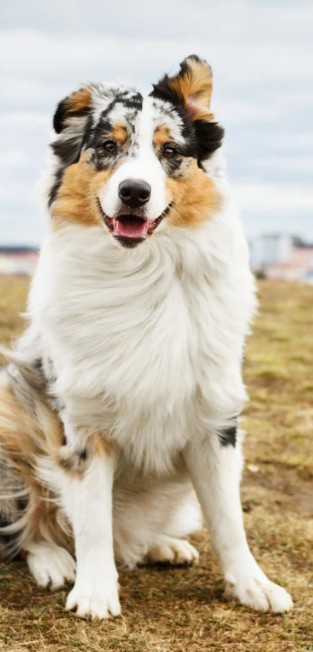
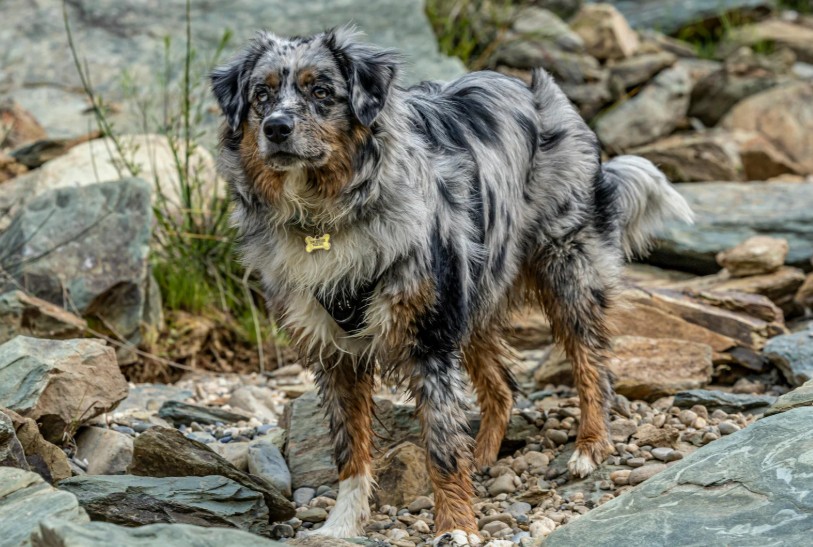
Waiting becomes a job. When stillness carries structure, the working mind finds peace. In the space before movement, intelligence settles into choice.v
The Human Factor: Your Role in Your Dog’s Success
Here’s a truth that many dog training approaches overlook: your emotional state, communication clarity, and relationship quality are as important to impulse control development as any game or technique. Australian Shepherds are relationally intelligent. They read you constantly, and what they read directly influences their capacity for self-regulation.
Emotional Structure vs. Pressure
When you bring pressure to impulse control practice—frustration, tension, urgency, irritation—you undermine everything you’re trying to build. Pressure elevates arousal, triggers stress responses, and can even create learned helplessness where your dog stops trying because effort doesn’t lead to success.
Emotional structure is something entirely different:
What emotional structure provides:
- Calm, consistent, predictable presence your dog can rely on
- Clear communication without emotional charge or frustration
- Ability to manage the environment proactively to support success
- Steady energy that helps your dog feel safe engaging cognitive control
- Consistent responses to both success and failure without drama
- Patient progression that respects your dog’s current capacity
- Confidence that transmits “we can handle this together”
- Boundaries that are firm but never harsh or punitive
- Emotional regulation modeling that your dog can mirror
- Partnership energy rather than adversarial pressure
When you provide emotional structure, something remarkable happens: your Australian Shepherd begins to regulate with you rather than against their impulses. They use your calmness as an anchor for their own arousal management. Your steady presence becomes the framework within which they can practice self-control.
This is supported by research showing that partner-directed emotion significantly influences decision-making and cognitive control. Your dog doesn’t exist in emotional isolation. They’re constantly influenced by your state, using you as a reference point for how to interpret and respond to situations.
Reading Your Dog’s Signals
Effective impulse control work requires you to accurately read your Australian Shepherd’s arousal level and cognitive state. When you miss the signs of rising arousal, you push them past their capacity and create failure experiences.
Learn to recognize the subtle signals that indicate arousal escalation:
Physical signs of increasing arousal:
- Increased breathing rate or panting even without physical exertion
- Muscle tension, particularly visible in the face, neck, and shoulders
- Widening eyes with more visible white (whale eye)
- Dilated pupils even in consistent lighting
- Shifting weight forward onto front legs in preparation for movement
- Scanning behavior or fixated, hard staring at triggers
- Whining, barking, or other vocalizations increasing in frequency or pitch
- Inability to take treats or showing disinterest in normally high-value rewards
- Inability to respond to familiar, well-practiced cues
- Increased pacing or inability to settle even briefly
- Ears held forward rigidly or scanning rapidly
- Tail held high and stiff rather than relaxed
- Trembling or quivering muscles
- Excessive drooling or lip licking
- Loss of focus on you with tunnel vision on triggers
These signals tell you that arousal is climbing and cognitive capacity is decreasing. When you see them, don’t push harder. Instead, decrease difficulty, increase distance from triggers, or end the session entirely. Practicing impulse control games when your dog is over-threshold teaches nothing useful and potentially creates negative associations with the work.
Communication Clarity and Timing
Australian Shepherds thrive on clear information. Ambiguous cues, inconsistent timing, or unclear criteria create cognitive confusion that makes impulse control exponentially more difficult.
Elements of clear communication:
- Release cue should sound identical every time – same word, same tone, same volume
- Body language when cueing “wait” should be consistent and recognizable
- Criteria for success should be crystal clear in your own mind before asking
- Timing of rewards should mark the exact moment of good choice
- Marker words or clicker use should be precise and immediate
- Your positioning relative to your dog should be predictable during training
- Hand signals should be distinct and not accidentally cued
- Environmental setup should clearly communicate expectations
- Facial expressions should remain neutral to avoid confusing signals
- Your movement patterns should be deliberate and meaningful
Timing matters enormously. Marking the exact moment of success—when your dog makes the choice to wait, to look at you, to control their movement—creates the clearest learning pathway. Even a one-second delay in marking weakens the connection between behavior and consequence.
Consider using a marker word or clicker to capture precise moments. This removes ambiguity and helps your Australian Shepherd understand exactly which behaviors you value.
Building “Waiting with Purpose”
This might be the most important concept for working with high-drive Australian Shepherds: waiting must have purpose. Simply asking your dog to “hold still” offers no meaning, no contribution to partnership, no job. It’s suppression, and it feels arbitrary.
“Waiting with purpose” transforms the experience entirely:
Elements that create purposeful waiting:
- Clear connection between waiting and achieving a shared goal
- Understanding that their stillness enables the next step of cooperation
- Recognition that waiting is their contribution to team success
- Anticipation of meaningful action following the wait period
- Awareness that their control makes the partnership work better
- Pride in successfully fulfilling their role in the task
- Trust that the wait will lead to something worthwhile
- Mental engagement in holding the position rather than passive endurance
- Understanding the “why” behind the waiting through repeated patterns
- Feeling valued for their ability to control themselves
Your dog waits because they’re holding position for the team’s success. They wait because they’re preparing for the next phase of shared work. They wait because that’s their role in the cooperative task you’re accomplishing together.
This taps directly into their desire for relational responsibility. Australian Shepherds want to contribute. They want to be valuable team members. When waiting becomes a meaningful contribution rather than passive restraint, it aligns with their fundamental drives rather than fighting them.
Frame impulse control games as partnership tasks. “We’re going to work together on this. Your job is to hold position until I signal. Then we move together.” This language and framing might seem subtle, but it shifts the entire dynamic from compliance-based to cooperation-based.
Through moments of Soul Recall—those instances where your dog’s emotional memory and relational trust guide their choices—you begin to see voluntary self-control emerge. They’re not fighting their impulses through sheer willpower. They’re choosing control because it strengthens the bond and serves the partnership. That’s sustainable impulse control that lasts.
🧠 Impulse Control Development Journey
The 7-Phase System for Building Self-Regulation in High-Drive Australian Shepherds
Phase 1: Understanding Your Aussie’s Brain
Building the Foundation
Your Australian Shepherd’s brain runs on a powerful SEEKING system that drives constant environmental engagement. This isn’t disobedience—it’s sophisticated neurological wiring designed for herding work. The eye-stalk-chase-block-control sequence is hardwired into their cognitive architecture.
• Lightning-fast reactions to moving objects
• Anticipating your actions before you complete them
• Struggle with passive waiting in unpredictable environments
• Intense focus that can override cognitive control
Begin observing your dog’s arousal ladder. Learn to recognize the difference between calm baseline (Level 1), mild interest (Level 2), and moderate arousal (Level 3). All impulse control training must happen at Levels 1-3, never when your dog has climbed to high arousal or over-threshold states.
Phase 2: Creating the Learning Space
Engineering Success Through Environment
Predictability reduces cognitive load, freeing up mental resources for the difficult work of impulse control. Start in the most boring, low-distraction space available. Your living room with family chaos or yard with squirrels are expert-level environments—not foundation spaces.
• Choose a quiet room with minimal visual stimulation
• Practice during low-activity times of day
• Remove competing stimuli (toys, food bowls, other pets)
• Ensure comfortable temperature and good lighting
• Establish consistent training routines and warm-up sequences
Never start training near windows with trigger visibility, during high-energy times, or in spaces with unpredictable interruptions. Attempting to build foundation skills in challenging environments guarantees failure and creates negative associations with impulse control work.
Phase 3: Foundation Wait-to-Release Games
Building the Core Skill
Wait-to-release games teach that holding position until released is the pathway to reward. Start with 1-2 second durations where success is virtually guaranteed. Your Aussie’s brain needs to experience the connection between “I waited” and “I got what I wanted” hundreds of times before the pathway strengthens.
• Week 1: 1-3 second waits with food in closed hand
• Week 2: 3-5 second waits, transfer to food bowl
• Week 3: 5-10 second waits with low-value toys
• Week 4: 10-15 second waits with higher-value rewards
• Practice 2-3 times daily, 5-10 repetitions per session
Your dog maintains soft eye contact, relaxed body posture, and waits for your release cue without breaking position. Success rate should be 90%+ before increasing duration. If your dog breaks position frequently, you’ve progressed too quickly.
Phase 4: Movement Freeze Training
Redirecting Motion-Fixation
This phase teaches your Australian Shepherd to pause and evaluate movement rather than react automatically. You’re building new neural pathways: “see movement → read movement for cues → make decision → act according to rules” instead of “see movement → chase movement.”
• Level 1: Dropped treat falling straight down
• Level 2: Slowly rolling ball (1-2 mph)
• Level 3: Faster rolling ball (3-5 mph)
• Level 4: Small bouncing ball (6-12 inches)
• Level 5: Tossed toy at short distance
• Level 6: Fast-moving objects (frisbee, remote toy)
Spend 1-2 weeks minimum at each movement level. High-drive Australian Shepherds may need 2-3 months to progress through all levels reliably. This isn’t failure—it’s appropriate skill development for a brain wired for intense motion reactivity.
Phase 5: Decision-Based Complexity
Building Executive Function
Decision-tree games require your dog to evaluate multiple cues and choose appropriate responses based on context. This builds working memory (holding rules), inhibitory control (not choosing wrong options), and cognitive flexibility (adapting to different contexts) simultaneously.
• Directional targets with hand signals
• Slow-motion trick performance requiring controlled movement
• Duration eye contact despite distractions
• Multi-step sequences with pause points
• Choice-based games with varying reward values
Watch for increased errors, inability to focus, stress signals, or disengagement. These games are mentally exhausting. Keep sessions to 5-10 minutes maximum. Mental fatigue is just as real as physical fatigue and requires adequate recovery.
Phase 6: Environmental Graduation
Transferring Skills to Reality
Generalization requires hundreds of successful repetitions in controlled environments before skills transfer reliably. You’re essentially re-teaching the skill in each new context. This phase typically takes 2-4 months of consistent practice across varied environments.
• Quiet room → Room with household sounds
• Indoor → Quiet backyard
• Backyard → Low-traffic sidewalk
• Low-traffic area → Moderate activity zones
• Single triggers → Multiple simultaneous triggers
• Predictable → Unpredictable timing
Never jump directly from training environment to high-distraction real-world contexts. Each failed attempt in overwhelming environments creates negative neural pathways that undermine months of foundation work. Progress slowly, maintain 80%+ success rates, and use strategic distance management.
Phase 7: Drive Integration & Mastery
When Control Becomes Partnership
Advanced impulse control isn’t rigid rule-following—it’s your Australian Shepherd learning to read contexts and make appropriate independent decisions. They maintain working partnership during high-arousal activities: agility runs, herding work, search and rescue, or competitive sports.
• Off-leash reliability in moderate distraction environments
• Maintaining control with multiple simultaneous triggers
• Context-appropriate behavior without constant cueing
• Cooperative work under high arousal and excitement
• Voluntary self-control emerging through relational trust
Reaching this phase typically requires 6-12 months of consistent, systematic training. Some high-drive Australian Shepherds may need longer. This represents the full integration of drive and control—intensity channeled through partnership rather than chaos.
📊 Training Approaches Compared
Focuses on suppressing drives through repetitive commands. Often creates compliance without understanding. Works against the Aussie’s natural architecture, leading to stress, shutdown, or explosive breakthrough behaviors when arousal spikes.
Redirects drives into structure through purposeful games. Builds genuine cognitive capacity while honoring the dog’s intelligence. Creates voluntary self-control that lasts because it works with the brain’s design, not against it.
Attempts to eliminate behaviors through corrections. May create temporary suppression but damages trust, increases anxiety, and often produces aggressive fallout. Teaches dogs what not to do without building alternative cognitive pathways.
Relies on physical exhaustion to reduce reactivity. While necessary, exercise alone doesn’t teach cognitive control. An tired Aussie with no impulse training will still react impulsively—they’ll just be too tired to sustain it long.
Uses environmental restriction to prevent unwanted behaviors. Necessary for safety and rest, but doesn’t build skills. Dogs don’t learn impulse control in crates—they only learn to wait for freedom to resume impulsive behaviors.
Combines relationship, structure, and neuroscience. Builds impulse control through partnership where the dog regulates WITH you rather than against their impulses. Creates resilient, context-appropriate decision-making that honors both drive and wisdom.
80% success rate = proceed to next difficulty level
70-79% success = stay at current level, build more fluency
Below 70% success = decrease difficulty immediately
Session length formula: 5-10 minutes for foundation work • 3-5 minutes for high-arousal challenges • 2-3 sessions daily beats one long session
Arousal management: If your dog can’t take treats, you’re already over threshold • Always end sessions at Level 1-2 arousal • Never practice impulse control at Level 4-5 arousal
Through the NeuroBond approach, impulse control becomes partnership rather than restriction. Your Australian Shepherd learns to regulate with you through emotional structure and clear communication, not against their drives through pressure and suppression.
The Invisible Leash emerges when your dog’s internal framework of awareness guides them more reliably than any physical restraint. This is voluntary self-control built on trust, understanding, and relational responsibility—not fear or compliance.
In moments of Soul Recall, where emotional memory and partnership guide choices, you witness the beautiful integration of drive and wisdom. Your high-intensity Australian Shepherd isn’t dampened—they’re channeling their remarkable energy through thoughtful decision-making.
This is where neuroscience meets soul: honoring your dog’s powerful drives while cultivating the cognitive architecture that allows those drives to be expressed through partnership, purpose, and control. That balance—that’s the essence of Zoeta Dogsoul.
© Zoeta Dogsoul – Where neuroscience meets soul in dog training
Practical Game Protocols for Australian Shepherds
Let’s move from theory to practice. Here are specific game protocols designed for the high-drive Australian Shepherd brain, progressing from foundation skills to advanced impulse control work.
Protocol 1: The Foundation Wait-to-Release
This builds the fundamental concept that waiting leads to reward.
Begin in a quiet, low-distraction environment. Hold a treat in your closed hand at chest height. Your Australian Shepherd will likely try to get the treat—nosing your hand, pawing, staring intently.
Wait for any moment—even just one second—where they stop trying to access the treat. The instant they pause, open your hand and deliver the treat with a clear release word like “okay” or “take it.”
Repeat this process, gradually extending the pause duration before you release. Start with one second, then two, then three. Build slowly, ensuring success at each level before progressing.
Key principles for foundation work:
Essential elements for wait-to-release success:
- Make success easy initially – start with durations so short failure is nearly impossible
- Mark the exact moment of good choice with consistent marker word or clicker
- Keep sessions short (5-10 repetitions) to prevent mental fatigue
- End on success, not failure – stop while your dog is still engaged and successful
- Practice 2-3 times daily rather than one long exhausting session
- Use extremely high-value rewards that make the wait worthwhile
- Maintain consistency in your release cue – same word, same tone, every time
- Progress gradually – only increase duration when current level is 90% reliable
Once your dog understands this basic concept, transfer it to other contexts. Put their food bowl down but require a brief wait before releasing them to eat. Hold a toy but require stillness before tossing it. The pattern is always the same: self-control leads to reward.
Protocol 2: The Movement Freeze Game
This directly addresses motion sensitivity by teaching your dog to freeze when movement occurs rather than chase it.
Start with very low-intensity movement. You might drop a treat from standing height, creating downward motion. As the treat falls, say “freeze” or “wait.” When your dog holds position rather than lunging for the falling treat, mark the moment and deliver an even better reward.
Progress to rolling a ball slowly across the floor. Cue the freeze. Reward heavily for holding position while the ball moves.
Gradually increase movement intensity following this progression:
Movement freeze game progression:
- Slowly rolling ball (1-2 mph) at predictable trajectory
- Faster rolling ball (3-5 mph) in straight line
- Bouncing ball with small bounces (6-12 inches high)
- Bouncing ball with higher bounces (1-2 feet)
- Tossed toy at short distance (3-5 feet)
- Tossed toy at medium distance (10-15 feet)
- Tossed toy at longer distance (20+ feet)
- Fast-moving objects (frisbee, remote control toy)
- Multiple objects in sequence
- Unpredictable movement patterns
At each level, your Australian Shepherd must demonstrate reliable impulse control before progressing. If they break position, you’ve moved too fast. Return to the previous level and build more foundation.
The ultimate goal: your dog can watch high-intensity movement and maintain cognitive control, waiting for your release cue before engaging. This is advanced work that may take weeks or months to develop fully. That’s normal and appropriate.
Protocol 3: The Decision-Based Direction Game
This builds cognitive flexibility and inhibitory control through directional choices.
Set up two targets (platforms, bowls, markers) several feet apart. Teach your dog to move to whichever target you indicate with a hand signal or pointed finger.
Now add the impulse control element: place a treat on each target. Your dog must move to the target you indicate, even though both have treats. They must inhibit the impulse to go to the closer target or their preferred side.
Start with obvious, easy choices. Make the correct target very clear. Reward heavily for correct decisions.
Increase difficulty systematically through these stages:
Decision-tree game complexity progression:
- Two targets far apart (8+ feet) with obvious directional cues
- Two targets closer together (5-6 feet) requiring more precision
- Using more valuable treats on the “wrong” target to increase temptation
- Pointing less obviously, requiring your dog to read subtle cues
- Adding a third target option for more complex decision-making
- Adding a fourth target creating a full directional grid
- Requiring faster decision-making with shorter processing time
- Introducing distractions while your dog makes decisions
- Changing the reward value unpredictably across targets
- Adding duration before they can move to the chosen target
This game engages working memory (holding the rules), inhibitory control (not going to the wrong target), and cognitive flexibility (adapting to different contexts). It’s mentally tiring in the best way, building executive function capacity.
Protocol 4: The Slow-Motion Precision Game
Australian Shepherds are naturally fast. This game teaches movement control at unnaturally slow speeds.
Begin with a simple behavior your dog knows well—perhaps a “spin” or “touch” command. Now ask them to perform it in deliberate slow motion. You might need to guide initially, physically slowing their movement while reinforcing slower execution.
Reward specifically for controlled, slow movement. Gradually build duration and precision.
Slow-motion work variations:
- Slow-motion spins (3-5 seconds per complete rotation)
- Exaggerated slow walking at glacially slow pace (1 step per 2-3 seconds)
- Slow-motion down position from stand (5+ seconds to complete)
- Deliberate slow sit from stand position
- Slow-motion trick performance (wave, shake, bow)
- Taking treats with exaggerated gentleness and control
- Moving through obstacle courses at quarter normal speed
- Slow-motion recall coming to you over 10+ seconds
- Transitioning between positions with deliberate control
- Slow-motion play bow or stretching behaviors
This work is neurologically demanding. It requires constant inhibition of the natural urge to move quickly. Keep sessions brief but practice regularly. The control they develop in slow-motion work transfers beautifully to normal-speed situations.
Protocol 5: The Distraction Graduation Sequence
This protocol systematically builds your dog’s ability to maintain impulse control in increasingly challenging environments.
Start where your dog can succeed—perhaps in your quiet hallway. Practice foundation impulse control games until performance is reliable (80%+ success rate).
Introduce the smallest possible increase in difficulty. Maybe someone walks through the hallway once during practice. If your dog maintains control, you’ve calibrated correctly. Practice at this level until reliable.
Gradually increase environmental challenge following this sequence:
Environmental distraction progression:
- Quiet room with no activity → room with mild household sounds
- Solo practice → one person present but stationary in room
- Stationary person → person moving slowly nearby
- Indoor practice → quiet backyard or enclosed space
- Quiet yard → yard with mild wildlife activity (birds, distant squirrels)
- Low-traffic area → area with occasional passing people at distance
- Distant triggers → triggers moving closer (always sub-threshold)
- Single trigger type → multiple different trigger types
- Predictable triggers → unpredictable timing and appearance
- Familiar locations → novel environments with similar challenge levels
At each level, ensure reliability before progressing. If success rate drops below 70%, you’ve moved too fast. Return to the previous level.
The goal isn’t to rush through progression. It’s to build genuine, reliable impulse control that works in real-world contexts. This takes time. For a high-drive Australian Shepherd, reaching advanced distraction levels might require months of systematic work. That’s not failure. That’s appropriate skill development for a brain wired for intense reactivity. 🐾
Troubleshooting Common Challenges
Even with well-designed protocols, you’ll encounter challenges. Australian Shepherds are complex, and impulse control work pushes against powerful drives. Here’s how to address the most common obstacles.
Challenge: My Dog Anticipates and Acts Before the Cue
This is classic Australian Shepherd pattern-prediction. They’ve learned the game structure and their brain races ahead, triggering action before you’ve released them.
Solutions to reduce anticipatory behavior:
Anti-anticipation strategies:
- Introduce unpredictability in duration – vary randomly between one and seven seconds so they can’t predict release timing
- Occasionally “fake them out” by acting like you’ll throw but don’t, rewarding maintained position
- Practice in different locations and contexts so the entire pattern doesn’t become predictable
- Temporarily increase the difficulty of the wait slightly so they can’t succeed by anticipating
- Change your body language and positioning to prevent pattern recognition
- Use different release cues occasionally to keep them listening rather than guessing
- Add a secondary cue they must wait for (verbal plus hand signal)
- Reward heavily for waiting despite obvious preparation signals from you
- Practice “fake outs” where anticipated reward doesn’t appear, teaching careful cue-reading
This forces them to actually wait for your cue rather than predicting based on patterns.
Challenge: My Dog Loses Control When Arousal Spikes
If your Australian Shepherd falls apart the moment intensity increases—a faster-moving trigger, a more exciting reward, a busier environment—their arousal is overwhelming their cognitive capacity.
Solutions for managing excessive arousal:
Arousal reduction techniques:
- Reduce intensity dramatically – use lower-value rewards, slower movement, calmer environments
- Implement arousal management techniques before practicing impulse control sessions
- Take a brief walk to burn off excess energy before training
- Practice calming massage or TTouch techniques to lower baseline arousal
- Do several minutes of slow-paced obedience work as warm-up
- Practice the “arousal up, arousal down” pattern – brief play, then calm behavior, then play again
- Use calm, slow breathing yourself to influence your dog’s state
- Lower your voice volume and slow your speaking pace
- Increase distance from triggering stimuli significantly
- Shorten session length to prevent arousal accumulation
This teaches your dog that arousal is something that can fluctuate rather than being an all-or-nothing state.
Challenge: My Dog Seems Stressed or Shut Down During Training
If your Australian Shepherd appears worried, hesitant, or disengaged during impulse control work, they’re not in the right emotional state for learning.
Solutions for stress or shutdown responses:
Reducing training pressure and rebuilding confidence:
- Examine whether you’re bringing pressure or tension to the training – work on your own calm presence
- Make the games easier and more rewarding – success should vastly outweigh failure
- Ensure the games feel like play rather than drilling – keep sessions short, energetic, and fun
- End on success and celebration rather than pushing through struggles
- Consider whether past training experiences created negative associations with the work
- Rebuild the relationship with impulse control through extremely positive, low-pressure games
- Use higher-value rewards that create genuine excitement
- Shorten duration requirements dramatically
- Remove all environmental pressure and practice in the safest space possible
- Take a break from formal training and focus on relationship-building activities
- Consult with a qualified positive reinforcement trainer if shutdown persists
You might need to rebuild the relationship with impulse control work through extremely positive, low-pressure games.
Challenge: Progress Is Slow or Plateaus
Building impulse control in a high-drive Australian Shepherd isn’t quick work. But if you’re seeing no progress over several weeks, something needs adjustment.
Solutions for training plateaus:
Strategies to overcome stalled progress:
- Break down the skill into smaller components – identify intermediate steps that bridge the gap
- Increase practice frequency but decrease session length – five two-minute sessions often beat one fifteen-minute session
- Examine whether your criteria are clear and consistent – ambiguous expectations create confusion
- Consider whether physical health issues might be interfering – pain, vision problems, or neurological issues impact impulse control
- Assess if your dog truly understands the foundation or if you’ve progressed too quickly
- Return to easier levels and build massive fluency before advancing again
- Change your reward type or value to increase motivation
- Vary your training location to ensure the behavior isn’t location-dependent
- Video your sessions to identify patterns you might be missing in real-time
- Seek feedback from a qualified trainer who can observe objectively
- Take a brief training break (3-5 days) to prevent burnout and return fresh
Sometimes taking two steps back allows you to take three steps forward.
Challenge: Skills Don’t Transfer to Real-World Situations
Your Australian Shepherd is brilliant in training sessions but falls apart when a bicycle zooms by on the trail. This is a common generalization challenge.
Solutions for improving real-world skill transfer:
Generalization strategies:
- Build massive fluency in training environments first – you need hundreds of successful repetitions before skills transfer reliably
- Create intermediate training environments that bridge the gap between controlled practice and real-world chaos
- When transferring to real environments, go back to basics entirely – use higher-value rewards, accept shorter duration, work at greater distance
- You’re essentially re-teaching the skill in a new context, which requires patience
- Use environmental management strategically – create enough distance from triggers that success is possible
- Gradually decrease distance over many sessions, never rushing progression
- Practice in multiple different controlled environments before attempting high-distraction real-world contexts
- Layer in one new variable at a time rather than changing everything simultaneously
- Maintain extremely high reinforcement rates during early generalization phases
- Accept that real-world performance will initially be far below training environment performance
- Celebrate small victories in challenging contexts rather than expecting perfection
Gradual, systematic exposure builds genuine reliability rather than hoping your dog will suddenly “get it.”
The Science Behind the Success
Understanding why these approaches work provides both motivation and guidance for your journey with your Australian Shepherd. Let’s explore the neurological and psychological mechanisms that make game-based impulse control training effective.
Theoretical foundations supporting this approach:
- Affective Neuroscience explaining drive systems and motivation
- Cognitive Load Theory demonstrating how arousal impacts executive function
- Predictive Processing Model showing how anticipation drives behavior
- Neuroplasticity research proving the brain’s ability to form new pathways
- Emotion Regulation Theory explaining arousal management strategies
- Behavioral Game Theory demonstrating structured play’s learning benefits
- Social Learning Theory highlighting the importance of relational context
- Working Memory research showing cognitive capacity development
- Positive Reinforcement principles creating sustainable motivation
- Ethological understanding of breed-specific behavioral patterns
Building New Neural Pathways
Every time your Australian Shepherd successfully practices impulse control, they’re literally building neural pathways. The connection between “stimulus appears” and “I wait for the signal” strengthens with each repetition. Neurons that fire together wire together.
Initially, these pathways are weak. The older, more established pathway—”stimulus appears” and “I react immediately”—is a neural superhighway built through genetics and early experience. Your new pathway is a barely visible trail through dense forest.
But with consistent, positive practice, that trail becomes a path. The path becomes a road. Eventually, with enough reinforcement, it can become the preferred route. This is neuroplasticity in action: the brain’s ability to create new connections and strengthen chosen pathways through experience.
The game-based approach works because it makes practicing the new pathway intrinsically rewarding. Your Australian Shepherd isn’t enduring impulse control. They’re enjoying games that happen to build self-regulation as a side effect. This positive emotional context strengthens learning and makes the new pathways more likely to be chosen in the future.
Why games work better than drilling:
- Games feel voluntary rather than compulsory, increasing engagement
- Natural enjoyment creates positive emotional associations with impulse control
- Playful context reduces performance pressure and stress
- Game structures provide clear feedback on success versus failure
- Competition with self (improving scores/duration) provides ongoing motivation
- Variability within games maintains interest over many repetitions
- Games often include natural breaks preventing mental fatigue
- Success in games feels inherently rewarding beyond external treats
- Game mechanics can disguise repetitive practice as novel challenges
- Partnership elements in games strengthen your bond while building skills
This positive emotional context strengthens learning and makes the new pathways more likely to be chosen in the future.
Working Memory and Executive Function Development
Impulse control games strengthen your dog’s working memory and executive function—the cognitive tools that allow them to hold information, plan actions, and inhibit inappropriate responses.
Decision-based games, particularly those requiring your dog to remember rules and evaluate contexts before acting, provide working memory exercise. The more they practice holding mental information while inhibiting impulses, the stronger these cognitive capacities become.
This is similar to how working memory training in humans can improve cognitive control and reduce impulsive behaviors. The brain adapts to demands placed on it. By systematically asking your Australian Shepherd’s brain to engage executive function in manageable, successful ways, you build their cognitive capacity over time.
Emotion Regulation Through Structured Practice
One of the most valuable aspects of impulse control games is that they provide practice managing emotional arousal in a structured, supportive context. Your dog experiences the trigger, feels the arousal spike, but has a framework (the game rules, your support, the established pattern) that helps them choose control over reaction.
This repeated practice of feeling arousal and successfully managing it builds emotion regulation capacity. Research shows that games designed to help individuals practice modulating physiological arousal while completing challenging tasks create real improvements in regulatory ability.
Your Australian Shepherd learns experientially that arousal doesn’t have to lead to reactive behavior. They can feel excited, intensely interested, even somewhat frustrated, and still make thoughtful choices. This is profound learning that extends far beyond any specific game, influencing how they navigate all high-arousal situations.
The Relational Component
Perhaps the most important element of successful impulse control development is the relational foundation. When your Australian Shepherd trusts you as a partner who provides clear information, emotional support, and reliable structure, they can use that relationship as a framework for managing their own drives.
This is where the NeuroBond approach becomes essential. You’re not just training behaviors. You’re building a partnership where your dog learns to regulate with you rather than fighting against their impulses alone. Your calm presence, clear communication, and emotional structure become the scaffold that supports their developing self-control.
Research confirms that partner-directed emotion and social connection significantly influence cognitive control and decision-making. Your Australian Shepherd doesn’t regulate in isolation. They regulate within the context of your relationship. The stronger that relational foundation, the more resilient their impulse control becomes. 🧡
Beyond Games: Lifestyle Factors That Support Impulse Control
While structured games form the core of impulse control training, several lifestyle factors significantly influence your Australian Shepherd’s capacity for self-regulation. Addressing these elements creates the optimal conditions for success.
Physical Exercise: Meeting Working-Breed Needs
An under-exercised Australian Shepherd is a neurological time bomb. Their bodies and brains were designed for hours of physical work daily. When that need goes unmet, the energy that should fuel appropriate work instead fuels impulsive, reactive, sometimes destructive behaviors.
Adequate physical exercise doesn’t teach impulse control directly, but it creates the physiological state where impulse control practice can succeed. A dog buzzing with pent-up energy cannot engage their cognitive control systems effectively. Appropriate exercise brings arousal down to levels where thinking becomes possible.
Appropriate exercise options for Australian Shepherds:
- Running or jogging alongside you (1-2 hours daily for adult dogs)
- Hiking with varied terrain that engages their problem-solving abilities
- Swimming for low-impact, high-intensity cardiovascular work
- Agility training combining physical exertion with mental engagement
- Fetch with structured rules rather than mindless repetition
- Actual herding work with livestock if available in your area
- Bike attachment running (with proper training and equipment)
- Dock diving or other high-intensity sport activities
For most Australian Shepherds, this means at least one to two hours of genuine physical activity daily. Not just standing in the backyard. Active engagement: running, hiking, swimming, agility, fetch, or actual herding work if available.
However, avoid exercising your dog immediately before impulse control practice. They need recovery time to shift from high arousal back to a thinking state. Exercise earlier in the day, then practice impulse control games when they’re pleasantly tired but not exhausted.
Mental Stimulation: Feeding the Intelligent Mind
Physical exercise alone isn’t sufficient. Australian Shepherds have extraordinarily active minds that need genuine cognitive engagement. Without appropriate mental stimulation, that intelligence finds inappropriate outlets—often in the form of impulsive, reactive, or obsessive behaviors.
Provide daily mental challenges beyond impulse control games:
Mental enrichment activities:
- Puzzle feeders and food-dispensing toys of varying difficulty levels
- Novel training sessions teaching new skills and commands
- Scent work or nose games utilizing their tracking abilities
- Problem-solving tasks like finding hidden toys or navigating obstacles
- Trick training with increasing complexity and chain behaviors
- Interactive toys requiring sequential actions to obtain rewards
- “Find it” games hiding treats or toys throughout the house
- Learning names of specific toys and retrieving on command
A mentally satisfied Australian Shepherd has less cognitive energy seeking outlets through reactivity and impulsive behavior. Their need for engagement has been met through appropriate channels.
Sleep and Rest: The Underestimated Essential
High-drive dogs often struggle with self-initiated rest. Your Australian Shepherd might run themselves into exhausted over-arousal if left to their own devices. Chronic under-rest creates a stress-loaded system where impulse control becomes exponentially more difficult.
Adult Australian Shepherds need 12-14 hours of sleep and rest daily. Puppies and adolescents need even more. This might seem like a lot, but quality rest is essential for emotional regulation, cognitive function, and stress recovery.
Create structured rest periods throughout the day. Use crates or quiet spaces where your dog can fully disengage from environmental stimulation. Many owners find that their dog’s impulse control improves dramatically simply by ensuring adequate rest.
Nutrition: Fueling the Brain
While nutrition research specific to canine impulse control is limited, we know that diet influences brain function, energy levels, and emotional regulation. Poor nutrition can create physiological stress that undermines behavioral work.
Ensure your Australian Shepherd receives:
Nutritional elements supporting cognitive function:
- High-quality, complete nutrition appropriate for their life stage and activity level
- Adequate protein (minimum 25-30% for active adults) to support neurotransmitter production
- Omega-3 fatty acids (EPA and DHA) supporting brain health and reducing inflammation
- B-vitamins essential for nervous system function and stress management
- Antioxidants protecting brain cells from oxidative stress
- Consistent meal times to stabilize blood sugar and energy levels
- Appropriate caloric intake preventing energy crashes or excess
- Limited simple carbohydrates that can cause energy spikes and crashes
Avoid ingredients that might trigger reactivity or hyperactivity in your individual dog. Some Australian Shepherds are sensitive to certain proteins, additives, or ingredients. If you notice behavioral changes correlating with diet, work with your veterinarian to identify potential sensitivities.
Environmental Management: Reducing Chronic Stress
Australian Shepherds living in chronically stressful environments—constant chaos, unpredictable routines, frequent triggering stimuli—exist in a state of elevated baseline arousal that makes impulse control nearly impossible.
Create as calm and predictable a home environment as possible:
Environmental management strategies:
- Establish consistent daily routines for meals, exercise, training, and rest periods
- Provide a quiet resting space away from household traffic and visual stimulation
- Manage window access if your dog becomes reactive to passing triggers
- Use white noise or calming music to buffer unpredictable environmental sounds
- Minimize unnecessary exposure to triggering situations during foundational training
- Create visual barriers (curtains, frosted film) to reduce motion visibility
- Designate specific zones for calm behavior versus active play
- Schedule high-arousal activities strategically away from rest times
This isn’t about bubble-wrapping your dog forever. It’s about creating optimal conditions during the critical skill-building period. Once impulse control capacity is strong, you can systematically introduce more complexity and unpredictability.
Advanced Concepts: Taking Impulse Control Further
Once your Australian Shepherd has solid foundation skills, you can develop increasingly sophisticated impulse control capacities that transform how they navigate the world.
Off-Leash Reliability Through Distance Control
Many Australian Shepherd owners dream of reliable off-leash control, but this requires impulse control at the highest level. Your dog must maintain cognitive engagement and respond to cues even when exciting stimuli appear and physical restraint is absent.
Build this systematically following these progression steps:
Off-leash reliability progression:
- Practice all impulse control games on a long line (20-30 feet) before attempting off-leash work
- Use extremely high-value rewards for distance control – make coming back more rewarding than chasing
- Start in fenced, low-distraction areas where escape isn’t possible
- Gradually increase environmental challenge while maintaining high success rates (90%+)
- Build a rock-solid recall that works even in high-arousal situations
- Practice emergency stops from distance with long-line backup
- Introduce mild distractions at distance while off-leash in fenced areas
- Practice off-leash work during low-energy times when arousal is naturally lower
- Use variable reinforcement schedules once behavior is extremely reliable
- Always carry higher-value rewards than environmental distractions offer
- Never test off-leash reliability in unsafe environments or near roads
- Accept that some individuals may never be trustworthy off-leash and that’s okay
The Invisible Leash concept becomes literal here. Your dog’s internal framework of awareness and partnership guides them more reliably than any physical restraint. This is the ultimate expression of impulse control: choosing connection and control even when freedom to act impulsively is available.
Handling Multiple Triggers Simultaneously
Real-world environments rarely present single, isolated triggers. Can your Australian Shepherd maintain impulse control when a jogger runs by while another dog barks and a squirrel darts across their field of vision?
This advanced skill requires systematic progression:
Multi-trigger management progression:
- Establish solid foundation with single triggers at low-moderate intensity
- Practice with two simultaneous low-intensity triggers (stationary person + distant bird)
- Gradually increase the intensity of one trigger while keeping the other mild
- Introduce two moderate-intensity triggers simultaneously
- Add a third trigger at low intensity while maintaining two moderate triggers
- Practice rapid trigger switching – shifting focus between multiple stimuli
- Build duration of impulse control while multiple triggers remain present
- Increase unpredictability of trigger appearance and intensity
- Practice in environments where trigger density naturally increases
- Build your dog’s ability to refocus on you despite multiple competing stimuli
- Reward heavily for choosing engagement with you over environmental chaos
When your dog can maintain cognitive control during multi-trigger situations, they’ve developed genuine resilience and sophisticated emotion regulation capacity.
Reading Context and Making Independent Decisions
The most advanced impulse control isn’t rigid rule-following. It’s your Australian Shepherd learning to read contexts and make appropriate decisions independently.
This might look like:
Context-appropriate behavior examples:
- Remaining calm when a friendly dog approaches but alerting appropriately to a genuinely threatening situation
- Playing gently with a small dog or puppy but more roughly with a large, resilient playmate
- Understanding that certain contexts require calmness (veterinary office, grooming salon) while others allow excitement (agility class, hiking trails)
- Knowing when herding behavior is appropriate (working livestock) versus when it must be inhibited (children playing)
- Reading human body language to determine when approach is welcome versus when distance is preferred
- Adjusting arousal levels based on environmental context automatically
- Discriminating between “work time” requiring focus and “free time” allowing relaxation
- Understanding which toys or games are appropriate in which locations
- Recognizing when impulse control is critically important (near roads) versus less critical (fenced yard)
Building this requires extensive, varied experience where your dog learns the nuances of different situations. You can’t simply drill this. Your Australian Shepherd must live it, experiencing many contexts with your guidance, gradually developing the sophisticated judgment that allows appropriate independent decision-making.
Cooperative Work Under High Arousal
Can your dog maintain working partnership with you during extremely exciting activities? This is impulse control in its most practical, beautiful form.
Examples of cooperative work under high arousal:
Advanced impulse control in action:
- Maintaining position and following cues during fast-paced agility runs despite intense excitement
- Holding a stay while you throw their favorite toy, waiting for release despite overwhelming desire to chase
- Working sheep with controlled intensity rather than chaotic chasing or over-pressuring
- Performing search and rescue work with focus despite exciting scents and environmental distractions
- Maintaining heel position during competitive obedience despite crowd noise and other dogs
- Executing precise dock diving or flyball sequences with controlled power
- Holding start-line stays in competitive sports despite intense anticipation
- Performing scent detection work methodically despite excitement over finding target scent
- Maintaining gentle mouth pressure during retrieve work even when highly aroused
- Working calmly in protection sports with controlled bite work and reliable outs
- Executing complex trick sequences in stimulating performance environments
This level of impulse control represents the full integration of drive and control. Your Australian Shepherd isn’t suppressing their excitement. They’re channeling it through structured, cooperative work. Their intensity becomes an asset rather than an obstacle.
This is the essence of Zoeta Dogsoul—the balance between honoring your dog’s powerful drives while cultivating the cognitive architecture that allows those drives to be expressed through partnership rather than chaos. When science meets soul, when structure meets relationship, impulse control transforms from restriction to sophisticated teamwork. 🧠
Conclusion: Building Resilient Self-Regulation
Impulse control in high-drive Australian Shepherds isn’t about dampening spirit, suppressing drives, or demanding robotic obedience. It’s about building cognitive architecture that allows your dog’s remarkable intelligence and intensity to be expressed through thoughtful partnership rather than reactive chaos.
The game-based approach works because it aligns with how your Australian Shepherd’s brain actually functions. By providing structure, purpose, and relational context, you transform impulse control from an impossible demand into meaningful work that satisfies their need for engagement.
This journey requires patience, consistency, and genuine understanding of your individual dog’s capacities and challenges. Progress won’t be linear. There will be setbacks, plateaus, and moments of frustration. That’s normal and expected when working with a brain wired for intensity and immediate action.
But with systematic practice, appropriate environmental management, and strong relational foundation, you can build genuine, resilient impulse control that serves your Australian Shepherd throughout their life. You’re not just training behaviors. You’re developing cognitive capacity, strengthening neural pathways, and building emotion regulation skills that influence every aspect of how your dog navigates the world.
Remember that every moment of successful self-control strengthens the pathway toward more self-control. Every game session where your dog chooses to pause, evaluate, and respond thoughtfully rather than react impulsively is a small victory that accumulates into transformation.
Through moments of Soul Recall, where emotional memory and relational trust guide choices, you’ll begin to see voluntary self-control emerge naturally. Your Australian Shepherd doesn’t wait because they must. They wait because partnership and cooperation feel more rewarding than impulsive action.
That’s the heart of the NeuroBond approach—building self-regulation through relationship rather than restraint, through understanding rather than suppression, through games that honor your dog’s drives while cultivating the cognitive tools to express those drives with wisdom and control.
Your Australian Shepherd’s intensity is a gift. With the right approach, impulse control becomes not the suppression of that gift but rather its most sophisticated expression. When your dog can harness their remarkable energy, intelligence, and drive within a framework of thoughtful partnership, you’ve achieved something profound: a working-breed dog who is both fully themselves and fully capable of navigating the complex modern world with grace.
The work is challenging. The rewards are extraordinary. Every moment you invest in building your Australian Shepherd’s impulse control capacity is an investment in a calmer, more confident, more resilient companion who can share your life fully rather than being constantly managed through restriction.
This is the journey. Walk it with patience, with clear communication, with emotional structure, and with deep respect for the remarkable mind you’re privileged to know. The destination—a high-drive Australian Shepherd with genuine, voluntary self-control—is worth every step. 🐾










