
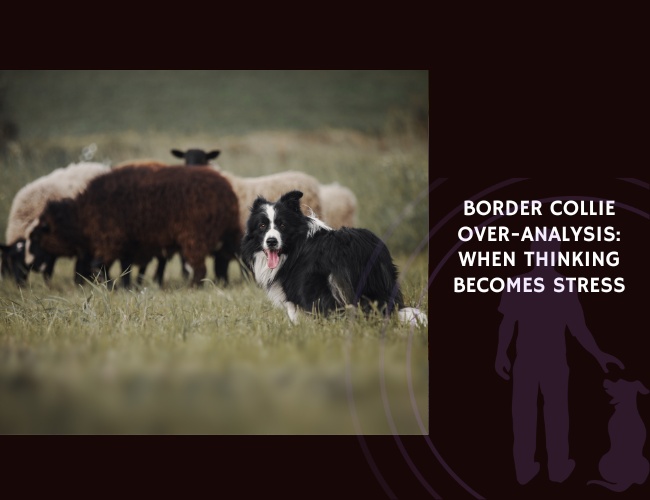
Have you ever watched your Border Collie stare intensely at a shadow for minutes on end? Or noticed them fixating on reflections, movements, or patterns that other dogs simply ignore? You might be witnessing something far more complex than simple curiosity. For some of the world’s most intelligent working breeds, their extraordinary cognitive abilities can become a double-edged sword—turning their greatest strength into a source of chronic mental exhaustion.
Let us guide you through the fascinating yet challenging world of hyper-cognition in Border Collies, where thinking too much becomes not just a quirk, but a genuine welfare concern. This isn’t about a dog being “too smart for their own good”—it’s about understanding when cognitive processing crosses the line into cognitive overload, and what that means for your furry friend’s emotional wellbeing.
The Genius Mind: Understanding Border Collie Intelligence
Border Collies weren’t bred to simply follow commands. They were developed over centuries to make independent decisions while managing livestock across vast, unpredictable terrain. Your Border Collie’s ancestors analyzed flock movement patterns, predicted sheep behavior, calculated spatial positioning, and adjusted their strategy in real-time—all while working at considerable distances from their human partners.
This selective breeding created dogs with exceptional:
- Pattern recognition capabilities: They instinctively identify and respond to subtle changes in movement, posture, and environmental flow
- Predictive processing: Their minds constantly forecast outcomes based on current data, preparing multiple response options
- Spatial intelligence: They possess remarkable ability to calculate distances, angles, and positioning in three-dimensional space
- Working memory capacity: They can hold and manipulate multiple pieces of information simultaneously while executing complex tasks
But here’s where the story becomes more complicated. These cognitive superpowers require constant fuel—mental stimulation, clear purpose, and predictable outcomes. When these needs aren’t met, or when the environment becomes too chaotic to “solve,” something unexpected happens. The thinking doesn’t stop. It accelerates.
Border Collies vs. Other Intelligent Breeds: What Makes Them Different?
You might wonder whether all intelligent dog breeds face similar cognitive challenges. While many working breeds possess impressive mental capabilities, Border Collies represent a unique combination of traits that makes them particularly vulnerable to cognitive overload.
Australian Shepherds, while similarly bred for herding, typically possess stronger emotional regulation systems relative to their cognitive drive. They were developed to work more closely with humans, creating dogs who balance independent thinking with social-emotional attunement. An Aussie experiencing stress often seeks human connection for regulation, while a Border Collie may intensify their cognitive processing instead.
German Shepherds demonstrate exceptional intelligence focused on human partnership and protection work. Their cognitive architecture emphasizes reading human cues and following complex instructions rather than independent environmental analysis. A German Shepherd’s stress typically manifests as heightened protectiveness or bonding behaviors, not the same pattern-seeking cognitive loops Border Collies display.
Poodles possess remarkable problem-solving abilities and trainability, but their breeding emphasized cooperation and performance rather than autonomous decision-making across vast spaces. Poodles generally show better natural “off switches”—the ability to disengage from cognitive tasks when work concludes.
Belgian Malinois share high drive and intense focus, but their cognitive energy channels more narrowly toward specific tasks with human direction. They can develop obsessive patterns, but typically around action-based behaviors rather than analytical processing.
What distinguishes Border Collies is the unique combination of:
- Exceptionally high autonomous decision-making drive
- Extraordinary pattern recognition operating constantly in the background
- Breeding for sustained, independent work across long durations
- Predictive processing systems calibrated for managing complex, moving targets
- Lower natural inclination to seek human emotional regulation when stressed
This doesn’t mean Border Collies are “worse” or “better” than other breeds—just different. Understanding these distinctions helps you recognize whether your dog’s behaviors represent typical Border Collie cognition or individual personality traits requiring different approaches.
If your Border Collie shows cognitive stress patterns, you’re not dealing with a defective dog or poor training. You’re working with the natural expression of cognitive gifts that require specific understanding and support. 🧠
When Intelligence Meets Modern Life: The Mismatch Problem
Your Border Collie’s mind evolved for wide-open fields and clear objectives. Now many live in apartments, suburban homes, or urban environments where their analytical abilities encounter constant, unsolvable puzzles. Imagine being a master chess player forced to solve incomplete puzzles all day, every day, without any resolution. That’s the cognitive dissonance many Border Collies experience.
Through the NeuroBond approach, we understand that this isn’t about lack of exercise alone. It’s about the fundamental mismatch between cognitive capacity and environmental demands. Your dog’s brain is wired to:
- Predict and control movement patterns (but city pigeons fly chaotically)
- Solve spatial puzzles (but there’s no “solution” to rush-hour traffic)
- Make consequential decisions (but modern pet life offers few genuine choices)
- Process information toward specific outcomes (but most daily stimuli have no clear resolution)
This mismatch creates what researchers in human psychology call “cognitive-affective conflict”—when thinking patterns and emotional needs pull in opposite directions. Your Border Collie wants to solve, predict, and control, but their environment offers endless stimulation without satisfying conclusions.
Sensory Overload: When Everything Matters Too Much
Did you know that Border Collies may process sensory information differently than other breeds? Their working heritage demanded heightened awareness—noticing the slightest ear flick from a sheep, detecting subtle shifts in herd momentum, tracking multiple moving targets simultaneously. This sensory acuity served them brilliantly in open pastures. In modern environments, it becomes overwhelming.
Consider what your Border Collie might be processing during a simple walk through your neighborhood:
- Vehicles approaching from multiple directions with varying speeds
- Dozens of people with unpredictable movement patterns
- Other dogs displaying complex body language signals
- Sounds layering from construction, traffic, conversations, and distant noises
- Visual stimuli from fluttering leaves, moving shadows, reflections in windows
- Scents from garbage bins, other animals, food establishments, and passing strangers
While other breeds might filter out most of this “background noise,” your Border Collie’s mind potentially processes it all as relevant data requiring analysis. This is hyperscanning—their brain works overtime to categorize, predict, and respond to environmental input that doesn’t actually require their attention.
Research from human neuroscience shows that low sensory filtering thresholds lead to cognitive fatigue and stress-related exhaustion. When your brain can’t easily dismiss irrelevant stimuli, mental resources deplete rapidly. The same principle applies to your Border Collie. Their magnificent vigilance becomes a burden when there’s simply too much to monitor, too much to predict, and no way to control the outcomes. 🧠
The SEEKING System: When Drive Becomes Obsession
In affective neuroscience, the SEEKING system represents the brain’s motivation and reward circuitry—the drive to explore, solve problems, and achieve goals. Border Collies possess extraordinarily active SEEKING systems. This motivated their ancestors to work tirelessly, finding deep satisfaction in completing herding tasks.
But what happens when this powerful drive encounters environments without clear goals or achievable outcomes?
The SEEKING system doesn’t simply turn off. Instead, it can become dysregulated, seeking patterns and problems where none exist. You might observe this as:
- Shadow chasing: Your dog fixates on light patterns, desperately trying to “catch” or control them
- Reflection obsession: Windows, water bowls, or shiny surfaces become targets for intense staring
- Compulsive herding: Attempting to control the movement of children, other pets, or even vehicles
- Toy fixation: Bringing the same ball repeatedly, unable to disengage from the “task”
- Hypervigilance: Constant scanning for potential “work” or problems to solve
This isn’t playfulness—it’s your dog’s brilliant problem-solving drive misfiring without appropriate outlets. The Invisible Leash reminds us that true guidance isn’t about physical control, but about providing cognitive clarity and emotional direction. When that clarity is absent, your Border Collie’s mind can loop endlessly, searching for problems to solve.
Predictive Processing Failure: The Anxiety of Unpredictability
Border Collies are exceptional prediction machines. Their minds constantly generate forecasts about what will happen next, preparing appropriate responses in advance. This predictive processing served them magnificently when working livestock—anticipating where sheep would move, predicting escape routes, calculating intercept angles.
In unpredictable modern environments, this system encounters constant prediction errors. Your dog predicts that the jogger will pass by, but they stop suddenly. They anticipate the car will continue, but it parks unexpectedly. They forecast that you’ll throw the ball, but you answer your phone instead.
Each prediction error generates cognitive stress. While occasional errors are manageable, chronic unpredictability creates sustained mental strain. Research in human psychology demonstrates that inability to predict or control outcomes leads to learned helplessness, anxiety, and emotional dysregulation. Your Border Collie may experience similar psychological impacts when their predictive models repeatedly fail.
You might notice this manifesting as:
- Stress barking when routines change
- Anxious pacing when unable to anticipate what’s next
- Displacement behaviors like excessive licking or scratching
- Shutdown or avoidance when environments become too chaotic
- Heightened reactivity to unexpected sounds or movements
The emotional cost of constant prediction failure shouldn’t be underestimated. For a breed whose cognitive identity centers on anticipation and control, chronic unpredictability represents a fundamental threat to their sense of stability and competence.
Cognitive Looping: When Thinking Becomes Compulsive
Perhaps one of the most troubling manifestations of cognitive overload is mental looping—when your dog’s mind gets stuck in repetitive thought-action patterns without resolution. This resembles obsessive-compulsive patterns observed in humans under chronic stress.
Mental looping in Border Collies often appears as:
Physical fixations: Staring at specific spots on walls, floors, or ceilings for extended periods, as if problem-solving an invisible puzzle. Their eyes may track non-existent movement, and they resist redirection.
Behavioral rituals: Performing the same sequence repeatedly—circling before lying down dozens of times, checking doors in specific orders, or touching objects in patterns that seem purposeful but achieve nothing.
Task obsession: Bringing toys compulsively, attempting to initiate play even when clearly exhausted, or continuing to “work” long after the activity should naturally conclude.
Phantom herding: Making herding movements—crouching, circling, intense eye contact—directed at nothing, as if their instincts are running on autopilot without actual targets.
These aren’t bad behaviors requiring correction. They’re symptoms of a mind struggling with excessive cognitive load and insufficient emotional regulation capacity. When problem-solving instincts operate without appropriate outlets or clear feedback loops, they can become self-perpetuating cycles that your dog cannot easily escape. 🐾
Executive Function Overload: When Mental Resources Deplete
Think of executive function as your dog’s mental management system—the cognitive resources that allow them to focus attention, inhibit impulses, plan actions, and regulate emotions. Research in human neuroscience shows that executive function relies on limited mental resources that deplete under sustained cognitive demand.
Your Border Collie’s high working memory usage—constantly processing, analyzing, and planning—places enormous demands on their executive function. Add environmental stressors, unpredictability, and lack of clear outlets, and these mental resources become critically depleted.
When executive function overloads, you might observe:
- Reduced impulse control: Your normally well-trained dog suddenly struggles with basic commands
- Emotional volatility: Small triggers produce disproportionate reactions
- Decision paralysis: Hesitation or inability to respond to situations they normally handle easily
- Attention difficulties: Struggling to focus, easily distracted, or conversely, locked into hyperfocus
- Behavioral regression: Returning to puppy-like behaviors or previously resolved issues
This isn’t stubbornness or disobedience. It’s mental exhaustion. Just as you might struggle with patience or decision-making after a cognitively demanding day, your Border Collie’s behavior deteriorates when their mental resources deplete.
The relationship between cognitive load and emotional regulation is particularly critical. Research demonstrates that high working memory usage increases stress, especially when emotional regulation capacity is low. For your Border Collie, the constant cognitive processing leaves fewer resources available for managing emotions, creating a vulnerability to stress-related behavioral problems.
The Emotional Cost: When Smart Dogs Suffer
Behind every cognitive pattern lies an emotional experience. Your Border Collie isn’t just “thinking too much”—they’re experiencing genuine emotional distress when their cognitive systems become overwhelmed.
Moments of Soul Recall reveal how deeply memory and emotion intertwine in behavior. When your dog encounters situations that previously triggered cognitive overload, their emotional memory activates even before conscious processing begins. This means past experiences of mental exhaustion, unpredictability, or unsolvable problems can create anticipatory anxiety that amplifies current cognitive load.
The emotional landscape of cognitive overload may include:
- Frustration: The deep dissatisfaction of possessing problem-solving abilities without appropriate outlets or successful resolutions—seen as restlessness, whining, or destructive behavior
- Anxiety: The chronic worry generated by unpredictable environments and repeated prediction failures—manifesting as hypervigilance, stress signals, or avoidance behaviors
- Learned helplessness: The emotional shutdown that occurs when your dog repeatedly tries to solve, control, or predict situations without success—leading to passivity, disengagement, or depression
- Emotional conflict: The internal struggle between instinctive drives (to herd, control, solve) and environmental reality (no sheep, no clear tasks, no resolutions)—creating persistent tension without release
Understanding this emotional dimension transforms how we view cognitive overload. This isn’t an intellectual problem—it’s a welfare concern. Your Border Collie’s extraordinary intelligence, without proper support, becomes a source of chronic suffering rather than joyful engagement with their world.
Urban Environments: The Perfect Storm for Cognitive Overload
City living presents unique challenges for hyper-cognitive breeds. The urban environment combines multiple stress factors that collectively trigger “analysis excess”—excessive cognitive processing without resolution.
Consider how urban settings challenge your Border Collie’s cognitive systems:
- Constant unpredictability: Traffic patterns, pedestrian flow, and urban wildlife create endless variation without predictable structure—your dog’s mind works continuously to forecast and respond, but nothing settles into reliable patterns
- Sensory chaos: The sheer volume of sights, sounds, smells, and movements in cities overwhelms sensory processing systems designed for open pastures with clear focal points
- Confinement paradox: Limited space combined with high stimulation creates frustrating situations where your dog’s mind remains highly active but their body has minimal outlets for physical expression
- Social complexity: Urban dogs encounter numerous other dogs and people daily, each representing complex social data requiring processing, prediction, and response—far more than ancestral working dogs experienced
- Lack of “solvable” tasks: Unlike herding work with clear beginnings, middles, and satisfying conclusions, urban stimuli present endless problems without resolutions
Research on human populations shows that chaotic environments trigger maladaptive cognitive patterns as coping mechanisms. Your Border Collie’s “overthinking” in urban settings isn’t a personality flaw—it’s a predictable response to environmental conditions that mismatch their cognitive architecture.

Recognition: Signs Your Border Collie Is Cognitively Overwhelmed
How do you know if your dog is experiencing cognitive overload rather than simply high energy or intelligence? Watch for these behavioral and emotional signals:
Mental fixations: Staring at walls, shadows, or reflections for extended periods; obsessing over specific sounds or movements; inability to disengage from particular stimuli even with redirection.
Physical manifestations: Excessive panting without physical exertion; tense body posture; dilated pupils; excessive paw licking or self-grooming; stress-related digestive issues.
Behavioral changes: Increased reactivity to previously tolerable stimuli; difficulty settling or relaxing even after physical exercise; compulsive behaviors that seem purposeful but achieve nothing; regression in training despite consistent work.
Emotional indicators: Stress barking without clear triggers; anxious pacing or circling; avoidance of previously enjoyed activities; shutdown or withdrawal when environments become chaotic; disproportionate reactions to minor changes.
Cognitive signals: Difficulty focusing on training; forgetting previously reliable commands; decision paralysis in familiar situations; hypervigilance without apparent cause; inability to stop “working” even when exhausted.
The key distinction is persistence and context. All dogs show some of these behaviors occasionally. Cognitive overload reveals itself through chronic patterns—behaviors that continue despite adequate physical exercise, that worsen in unpredictable environments, and that resist traditional training approaches focused purely on obedience.
Age-Related Cognitive Changes: From Puppy to Senior
Cognitive overload doesn’t affect Border Collies uniformly across their lifespan. Understanding how hyper-cognition manifests at different ages helps you anticipate challenges and adjust your approach appropriately.
The Puppy Phase (8 Weeks to 18 Months)
Hyper-cognition often emerges surprisingly early in Border Collie puppies. While many breeds show generalized puppy energy, Border Collie puppies frequently display cognitive intensity by 12-16 weeks. You might notice:
Early warning signs: Intense staring at movements even as young puppies; difficulty disengaging from visual stimuli like ceiling fans or shadows; frustration when unable to “control” moving objects; exceptional awareness of environmental patterns and changes.
The adolescent surge: Between 6-12 months, cognitive intensity often increases dramatically as their brains mature. This coincides with physical development, creating a perfect storm of mental and physical energy seeking outlets. Many guardians mistake this period for “bad behavior” when it’s actually cognitive systems coming fully online without adequate direction.
Critical intervention period: Early puppyhood offers your best opportunity to establish healthy cognitive patterns. Teaching “off switches,” building positive associations with rest, and providing structured problem-solving activities creates neural pathways that support lifelong emotional regulation.
Puppy-specific strategies:
- Short, frequent training sessions with clear endings rather than extended work periods
- Enforced nap times in quiet spaces to build rest habits
- Heavily rewarding disengagement and calmness, not just performance
- Predictable daily routines that allow their predictive systems to develop accuracy
- Limited exposure to chaotic environments until emotional regulation strengthens
The Prime Working Years (18 Months to 7 Years)
During these years, Border Collies possess peak cognitive capacity combined with physical capability. This stage presents both opportunities and vulnerabilities.
Cognitive peak challenges: Their minds operate at maximum efficiency, which means maximum vulnerability to overload without appropriate outlets. A three-year-old Border Collie in an understimulating environment may develop more severe cognitive stress than they showed as puppies.
Pattern entrenchment: Behaviors established during this period—whether adaptive or maladaptive—become deeply ingrained. A five-year-old who has spent years developing obsessive patterns will require more intensive intervention than addressing the same behaviors in a puppy.
Work-life balance needs: Border Collies in their prime need the most carefully calibrated balance between cognitive engagement and rest. Too little stimulation creates frustration and obsessive behaviors; too much creates exhaustion and emotional dysregulation.
Senior Years (7+ Years)
Aging brings interesting changes to cognitive processing in Border Collies. Contrary to what you might expect, cognitive overload doesn’t necessarily improve with age.
Cognitive rigidity increases: Older Border Collies often show more intense reactions to unpredictability as cognitive flexibility naturally declines. Changes in routine or environment that younger dogs might manage become more stressful for seniors.
Compensatory hypervigilance: As sensory capabilities decline (hearing loss, vision changes), some Border Collies actually increase cognitive processing to compensate. They may rely more heavily on pattern recognition and prediction, potentially worsening existing overload patterns.
Physical limitations create frustration: When aging bodies can’t execute what their minds still desperately want to do, cognitive-emotional conflict intensifies. A senior Border Collie may fixate more on controlling their environment precisely because they’ve lost some physical control.
But also—wisdom and acceptance: Some senior Border Collies do develop better coping mechanisms over time, especially if they’ve received appropriate support throughout their lives. They may show improved ability to self-regulate and disengage, having learned through experience that not everything requires solving.
Senior-specific considerations:
- Increased need for routine predictability to reduce cognitive load
- Gentler cognitive activities that provide satisfaction without exhaustion
- More frequent rest periods with longer recovery times
- Extra environmental stability during health changes or mobility challenges
- Patience with increased “grumpiness” that may reflect cognitive fatigue
Life Stage Transitions
The transitions between life stages often trigger temporary increases in cognitive stress. Moving from puppyhood to adolescence, adjusting to middle age, or entering senior years all require cognitive and emotional recalibration.
During transition periods, you might see temporary regression in behaviors, increased stress signals, or emergence of new obsessive patterns. This doesn’t mean you’ve failed—it means your dog is navigating developmental changes that temporarily overwhelm their regulatory systems.
Understanding your Border Collie’s life stage helps you set realistic expectations and adjust support appropriately. The cognitive strategies that worked brilliantly for your two-year-old may need significant modification for your nine-year-old senior. 🐾
Quiet. Watchful. Overloaded.
This isn’t obedience you’re seeing — it’s cognitive tension.
Your Border Collie doesn’t merely react to the world — they interpret it, predict it, and mentally rehearse their response before moving a muscle.
Intelligence without structure becomes anxiety.
Centuries of selective breeding created minds built for precision, pattern analysis, and autonomous decision-making. But without outlets for that analytical drive, cognition turns inward.



To help them, don’t add more — refine more.
Mental enrichment doesn’t mean endless stimulation. It means clear jobs, defined boundaries, purposeful rest, and emotional regulation.
Rest Isn’t Just Physical: The Need for Cognitive Recovery
Here’s a critical insight that many Border Collie guardians miss: your dog can be physically exhausted but mentally still racing. Traditional approaches focus on exercising the body, but cognitive recovery requires intentional mental rest.
Think about your own experience after a cognitively demanding day. You might feel physically tired but mentally wired—unable to easily transition to relaxation despite physical exhaustion. Your Border Collie experiences similar states. Their body may be spent from running, but their mind continues processing, analyzing, and seeking patterns.
True cognitive recovery requires:
- Environmental simplicity: Creating spaces with minimal stimulation—quiet rooms, dimmed lighting, reduced visual complexity—allowing their sensory processing systems to truly rest
- Predictable routines: Establishing consistent daily patterns that reduce the cognitive load of constantly predicting what happens next—when routines are reliable, your dog’s predictive processing can relax
- Passive calming activities: Providing enrichment that engages without demanding problem-solving—long-lasting chews, sniffing activities, gentle massage, or simply lying near you without interaction
- Mental disengagement training: Teaching your dog that doing nothing is valuable—learning to “power down” is a critical life skill for intelligent breeds
- Sleep quality: Ensuring your dog gets adequate sleep in truly restful environments—cognitive recovery happens during sleep, when the brain processes and consolidates information without new input
The Invisible Leash reminds us that true guidance sometimes means leading your dog toward stillness rather than activity—teaching them that awareness doesn’t always require action.
🧠 Border Collie Cognitive Overload: The 8 Stages 🐾
Understanding When Thinking Becomes Stress – A Complete Journey Through Recognition and Recovery
Phase 1: Early Recognition
Identifying the First Warning Signs
Understanding the Baseline
Border Collies possess exceptional pattern recognition and predictive processing abilities. These cognitive superpowers served them brilliantly in herding work but can misfire in modern environments. Watch for intense staring at shadows, fixation on reflections, or inability to disengage from moving stimuli—these aren’t curiosity, they’re early signs of cognitive overload.
What You’ll Notice
• Mental fixations lasting several minutes
• Obsessive tracking of non-existent movements
• Difficulty settling even after physical exercise
• Stress barking without clear triggers
• Hypervigilance in familiar environments
Phase 2: Environmental Analysis
Identifying Cognitive Stressors in Your Dog’s World
The Mismatch Problem
Your Border Collie’s mind evolved for wide-open fields with clear objectives. Modern environments—urban chaos, unpredictable routines, endless stimulation without resolution—create constant “unsolvable puzzles” that their analytical brain cannot ignore. This fundamental mismatch between cognitive capacity and environmental demands drives stress accumulation.
Common Environmental Triggers
• Urban sensory chaos (traffic, crowds, construction)
• Unpredictable household routines
• Chaotic dog parks with random interactions
• Reflective surfaces and moving shadows
• Constant visual access to street activity
Immediate Environmental Changes
Create “cognitive sanctuaries” with minimal visual complexity. Use curtains to block street views, establish quiet rest zones away from household activity, and maintain consistent furniture arrangements. Your dog’s spatial processing systems can relax when physical space remains predictable.
Phase 3: Understanding Cognitive Budget
Balancing Mental Engagement with Essential Rest
The Executive Function Principle
Think of cognitive resources as a daily budget that depletes with use. Your Border Collie’s high working memory usage—constantly processing, analyzing, predicting—drains this budget rapidly. When executive function overloads, you see reduced impulse control, emotional volatility, and behavioral regression. This isn’t disobedience; it’s mental exhaustion.
Daily Cognitive Budget Guidelines
• Total structured cognitive work: 45-90 minutes (spread across day)
• Individual sessions: 10-20 minutes maximum
• Rest between sessions: Minimum 2-3 hours
• Total rest/low-stimulation: 7-8 hours daily
• Sleep: 9-10 hours for full recovery
Warning: Budget Depletion Signs
If your dog shows difficulty with normally easy commands, disproportionate reactions to small triggers, or decision paralysis, their cognitive budget is depleted. Continuing mental work at this point worsens stress rather than providing healthy stimulation.
Phase 4: Strategic Activity Selection
What Helps vs. What Harms
Activities That Support Cognitive Health
• Nosework (10-15 min): Engages different neural pathways, provides natural completion
• Structured trick training (5-10 min): Clear beginning, middle, end with frequent success
• Predictable puzzle feeders (15-20 min): Consistent solving methods your dog can master
• Settle and watch exercises: Transforms vigilance into regulated skill
Activities That Worsen Cognitive Stress
• Endless fetch: No endpoint, triggers compulsive loops without resolution
• Laser pointers: Completely unsolvable, creates lasting fixations on light
• Chaotic dog parks: Too many unpredictable variables to process
• Constant herding opportunities: Living things don’t stay herded, task never completes
The Invisible Leash Principle
True guidance isn’t about physical control, but about providing cognitive clarity and emotional direction. When activities have clear structures, predictable outcomes, and satisfying completions, your Border Collie’s mind can engage productively rather than loop endlessly.
Phase 5: Implementing Cognitive Rest
Teaching the Power-Down Skill
Mental Rest vs. Physical Rest
Your dog can be physically exhausted but mentally still racing. True cognitive recovery requires intentional mental rest—environments with minimal stimulation, predictable routines that reduce prediction load, and passive activities that engage without demanding problem-solving. Think of cognitive rest as allowing your dog’s analytical processor to enter “sleep mode.”
Building Rest Protocols
• Morning enforced rest (90 min): After breakfast, prevent all-day hypervigilance
• Post-activity decompression (30-60 min): Transition time with long-lasting chews
• Afternoon quiet period (2+ hours): Low-interaction house time
• Evening wind-down (90 min): Calm presence before bedtime ritual
Creating Rest Environments
Designate specific rest zones with minimal visual complexity—quiet rooms with dimmed lighting, covered crates, or spaces away from windows and household traffic. Use white noise to mask unpredictable sounds. Your dog should learn that certain areas mean “recovery time, not processing time.”
Phase 6: Emotional Regulation Training
Building Self-Regulation Capacity
The NeuroBond Approach to Balance
Through NeuroBond principles, training becomes about re-balancing awareness, focus, and emotional regulation without suppressing intelligence. The goal isn’t to make your Border Collie less smart, but to help them use their intelligence adaptively—knowing when to engage and when to rest.
Key Training Protocols
• Capturing calmness: Reward stillness and disengagement, not just action
• Attention disengagement: Teach looking away from stimuli on cue
• Predictability protocols: Create structured routines with consistent outcomes
• Task completion rituals: Clear ending cues for dogs who struggle to stop “working”
• Choice and control: Offer meaningful decisions without overwhelming load
Expected Progress Timeline
Initial settling improvements may appear within 1-2 weeks of consistent protocols. Significant behavioral changes typically emerge over 6-12 weeks. Deep pattern restructuring requires 3-6 months of sustained support. Progress isn’t linear—expect occasional setbacks during stressful periods.
Phase 7: Age-Appropriate Adjustments
Adapting Support Across Your Dog’s Lifespan
Puppies (8 Weeks – 18 Months)
Hyper-cognition often emerges by 12-16 weeks. This is your critical intervention window. Focus on teaching “off switches,” enforced nap times, and heavily rewarding disengagement. Total cognitive work should stay under 45 minutes daily with very short sessions (5-10 minutes). Early patterns establish lifelong regulation capacity.
Prime Years (18 Months – 7 Years)
Peak cognitive capacity meets peak vulnerability. Dogs in their prime need the most carefully calibrated balance between engagement and rest. Too little stimulation creates frustration; too much creates exhaustion. Behaviors established now become deeply entrenched—invest in proper patterns during these crucial years.
Seniors (7+ Years)
Cognitive rigidity often increases with age, making unpredictability more stressful. Some seniors show compensatory hypervigilance as sensory capabilities decline. Provide extra routine predictability, gentler cognitive activities, more frequent rest periods, and patience with increased sensitivity to change.
Phase 8: Sustainable Lifestyle Integration
Creating Lifelong Cognitive-Emotional Balance
Soul Recall and Pattern Recognition
Moments of Soul Recall reveal how deeply memory and emotion intertwine in behavior. Your dog’s past experiences of cognitive overload create emotional memories that can trigger anticipatory anxiety. Long-term success means building new positive emotional associations with both engagement and rest—teaching their nervous system that balance is safe and sustainable.
Sustainable Daily Practices
• Maintain consistent daily rhythms with predictable activity/rest patterns
• Schedule 1-2 “low cognitive load” days weekly
• Regular assessment as needs change with age or circumstances
• Connect with understanding community for ongoing support
• Celebrate progress while remaining patient with the non-linear journey
Measuring Success
Success isn’t the absence of all fixations or perfect calmness—it’s your dog showing ability to disengage, settle after reasonable decompression time, maintain training reliability, and display genuine enjoyment during activities. Quality of life improvements reveal themselves gradually through reduced stress signals and increased emotional resilience.
🔍 Border Collies vs. Other Intelligent Breeds
Australian Shepherds
Key Difference: Stronger emotional regulation relative to cognitive drive. Aussies typically seek human connection for stress regulation, while Border Collies intensify cognitive processing instead. Better natural balance between independent thinking and social-emotional attunement.
German Shepherds
Key Difference: Intelligence focused on human partnership rather than autonomous environmental analysis. Stress manifests as heightened protectiveness or bonding behaviors, not analytical cognitive loops. Stronger natural inclination toward following human guidance.
Poodles
Key Difference: Remarkable problem-solving but breeding emphasized cooperation over autonomous decision-making. Better natural “off switches”—ability to disengage from cognitive tasks when work concludes. Less susceptibility to endless analytical loops without resolution.
Belgian Malinois
Key Difference: High drive and intense focus but cognitive energy channels more narrowly toward specific tasks with human direction. Can develop obsessive patterns but typically around action-based behaviors rather than analytical processing and pattern recognition.
Border Collie Uniqueness
Distinctive Combination: Exceptionally high autonomous decision-making drive + extraordinary pattern recognition operating constantly + breeding for sustained independent work + predictive systems for complex targets + lower natural inclination to seek human emotional regulation = unique cognitive vulnerability.
Multi-Dog Households
Special Consideration: Calm, emotionally stable dogs can model relaxation. High-energy chaotic dogs add unpredictable variables demanding constant processing. Social interactions constitute cognitive work—even positive relationships draw from the same mental resource pool as environmental analysis.
⚡ Quick Reference: The Cognitive Balance Formula
Daily Cognitive Budget: 45-90 minutes structured work ÷ multiple sessions = 10-20 minutes each
Rest Formula: Minimum 2-3 hours between cognitive sessions + 7-8 hours low-stimulation + 9-10 hours sleep
Activity Success Marker: End while dog still wants more = Good | End when dog shows fatigue = Too long
Environmental Rule: Predictable space + minimal moving stimuli = Cognitive rest possible
Age Adjustments: Puppies 30-45 min total work | Adults 45-90 min | Seniors 30-60 min with gentler activities
Warning Sign: Physical tired but mentally wired = Need cognitive rest, not more exercise
🧡 The Zoeta Dogsoul Perspective 🧡
Your Border Collie’s brilliant mind is both their greatest gift and their potential vulnerability. Through the NeuroBond approach, we understand that emotional connection, trust, and shared understanding form the foundation where intelligence can flourish without overwhelming the nervous system. The Invisible Leash teaches us that true guidance means providing cognitive clarity and emotional direction—awareness without tension, engagement without exhaustion. Soul Recall reminds us that emotional memories shape behavioral responses; building positive associations with both work and rest creates sustainable patterns that honor your dog’s extraordinary capabilities.
This journey isn’t about limiting intelligence—it’s about creating conditions where cognitive gifts enhance rather than diminish quality of life. That balance between mental challenge and genuine rest, between problem-solving drive and calm contentment, between analytical brilliance and emotional peace—that’s the essence of Zoeta Dogsoul. Your Border Collie’s mind will always be extraordinary. With understanding, patience, and thoughtful support, it can be extraordinarily happy as well.
© Zoeta Dogsoul – Where neuroscience meets soul in dog training
Training for Cognitive Balance: A Different Approach
Traditional dog training focuses on teaching specific behaviors or commands. For cognitively overwhelmed Border Collies, you need something different—training that builds emotional regulation capacity alongside cognitive engagement.
Capturing calmness: Rather than always rewarding action or performance, systematically reward stillness, relaxation, and disengagement. Place a mat in various locations and reinforce your dog for simply lying down without doing anything—teaching that rest is valuable work.
Predictability protocols: Create highly structured routines where specific cues predict specific outcomes consistently. This reduces cognitive load by allowing your dog’s predictive systems to operate efficiently with regular success.
Attention disengagement: Teach your dog to look away from stimuli on cue. This gives them a cognitive tool for managing overwhelming input—a way to actively choose not to process certain information.
Impulse control with emotional support: Build wait behaviors paired with calming touch or soothing verbal cues. This creates associations between self-control and emotional comfort, rather than just suppression.
Task completion rituals: For dogs who struggle to stop “working,” create clear ending cues that signal task completion. This might be a specific word paired with putting toys away in a designated location, providing cognitive closure.
Choice and control: Regularly offer meaningful choices—which path to walk, which toy to play with, whether to engage or rest. This satisfies the need for decision-making without overwhelming cognitive load.
Through the NeuroBond approach, training becomes about re-balancing awareness, focus, and emotional regulation without suppressing intelligence. Your goal isn’t to make your Border Collie less smart, but to help them use their intelligence more adaptively—knowing when to engage and when to rest.
Specific Activity Recommendations: What Works and What Backfires
Not all mental enrichment serves Border Collies equally. Some activities provide satisfying cognitive engagement with clear endpoints, while others inadvertently worsen cognitive stress by creating endless loops without resolution.
Activities That Support Cognitive Health
Nosework and Scent Games (Duration: 10-15 minutes)
Scent work offers exceptional cognitive engagement with built-in satisfaction. Your dog searches for hidden treats or scent articles, using problem-solving skills that have clear success markers—they either find the scent or don’t.
Why it works: Scent work engages different neural pathways than visual processing, giving your Border Collie’s hypervigilant visual system a break. Each successful find provides dopamine release with natural completion—the opposite of endless, unsatisfying loops.
How to implement: Start simple with treats hidden in cardboard boxes arranged in a line. Gradually increase difficulty by hiding scents in different rooms or outdoor spaces. Always end sessions after successful finds while your dog still wants more.
Structured Trick Training (Duration: 5-10 minute sessions, 2-3 times daily)
Teaching specific tricks with clear criteria provides cognitive challenge with achievable goals. Complex behaviors broken into small steps allow your dog to experience frequent success.
Why it works: Clear beginning, middle, and end. Your dog learns a discrete skill with defined success criteria, providing the task completion that Border Collies crave.
How to implement: Choose tricks requiring body awareness and problem-solving (backing up, figure-eights through legs, touching specific objects). Practice in short sessions that end definitively with a completion ritual.
Food Puzzles with Predictable Solving (Duration: 15-20 minutes)
Not all puzzle toys serve cognitively stressed dogs well, but certain types provide appropriate challenge. Look for puzzles with consistent solving methods where your dog learns the “rules” and can reliably succeed.
Why it works: Predictable problem-solving that your dog can master reduces frustration while still engaging cognitive capacity. The food reward provides clear success feedback.
How to implement: Rotate 3-4 different puzzle feeders on a schedule. Avoid puzzles that require luck or have variable solving methods. Once your dog solves a puzzle efficiently, that’s success—don’t make it harder to prolong the activity.
Settle and Watch (Duration: Building from 2 minutes to 15+ minutes)
Teaching your dog to calmly observe movement without responding transforms their natural vigilance into a regulated skill rather than compulsive hypervigilance.
Why it works: Acknowledges their need to monitor while building impulse control and emotional regulation around stimuli. Creates a cognitive task (watching) with clear behavioral expectations (remaining calm).
How to implement: Position your dog on a mat with a long-lasting chew. Sit where you can both observe moderate activity (people walking, birds at a feeder). Heavily reward calmness. Gradually increase stimulation levels as their settling ability strengthens.
Treibball or Other Structured Herding Games (Duration: 10-20 minutes)
For dogs without access to actual livestock, structured games that engage herding instincts with clear rules provide appropriate outlets.
Why it works: Satisfies herding drive through controlled, achievable tasks with visible completion. Your dog gets to use their natural abilities within structured parameters.
How to implement: Teach your dog to push large exercise balls toward a goal. Create specific starting and ending positions. Build consistent rules about when the game begins and ends.
Activities That Often Backfire
Endless Fetch or Ball Play
While it seems like great exercise, unstructured fetch can worsen cognitive stress for Border Collies prone to obsession.
Why it backfires: No clear endpoint. The ball’s movement triggers their chase-and-control instincts but never provides satisfying resolution. Many Border Collies enter compulsive states, continuing even when physically exhausted because the cognitive loop hasn’t closed.
If you use fetch: Structure it rigidly. Set specific numbers of throws (5-10), use a clear beginning and ending ritual, and enforce breaks between sessions. Never throw “one more time” when your dog is obsessing.
Laser Pointers or Light Chasers
These should be avoided entirely for Border Collies prone to cognitive overload.
Why it backfires: Creates completely unsolvable problems. Your dog can never catch the light, never control it, never achieve completion. This triggers exactly the cognitive frustration that drives obsessive patterns. Many dogs develop long-term fixations on light and shadows after laser pointer play.
Complex Agility or Competitive Training Without Rest Periods
While agility can be excellent enrichment, excessive training or trial preparation can overwhelm cognitive systems.
Why it backfires: Demands sustained intense focus, rapid decision-making, and high physical output simultaneously. Without adequate rest between sessions, this depletes mental resources faster than they can recover.
If you do agility: Treat it as cognitive work requiring rest. Build rest days into training schedules. Watch for signs of mental fatigue, not just physical tiredness. Keep sessions short and focused.
Chaotic Dog Parks or Unstructured Social Play
Many Border Collies find dog parks overwhelming rather than enriching, especially those already showing cognitive stress.
Why it backfires: Too many unpredictable variables—random dogs with various play styles, chaotic movement patterns, no clear “rules” to understand. Your Border Collie’s analytical mind tries desperately to predict and control social dynamics that are fundamentally unpredictable.
Better alternative: Structured play dates with one or two known dogs in controlled environments. Create predictable play patterns and enforce calm breaks.
Constant Access to Herding Opportunities
Whether it’s children, other pets, or even robotic vacuums, allowing your Border Collie to “herd” constantly reinforces obsessive patterns.
Why it backfires: Living things don’t stay herded. The task never completes. Your dog enters endless loops of trying to control movement that continues regardless of their efforts.
Better approach: Provide herding outlets through structured activities with clear start and stop points, not 24/7 access to potential targets.
Duration Guidelines: How Much Is Enough?
Total daily cognitive work: 45-90 minutes spread across multiple sessions (not continuous)
Individual session lengths:
- Puppies: 5-10 minutes
- Adults: 10-20 minutes
- Seniors: 5-15 minutes
Rest between sessions: Minimum 2-3 hours between structured cognitive activities
The crucial principle: End while your dog still wants more. If they’re showing fatigue, obsessive patterns, or difficulty disengaging, you’ve gone too long. Success is completion with enthusiasm intact, not exhaustion.
Weekly rhythm: Include 1-2 “low cognitive load” days each week with minimal problem-solving demands—just gentle walks, passive enrichment, and rest.
Remember: For Border Collies prone to cognitive overload, less structured enrichment done well serves them better than extensive activities that trigger obsessive loops or provide no satisfying completion. Quality and structure matter more than quantity. 🧡
Environmental Management: Creating Cognitive Sanctuaries
Your Border Collie’s living environment profoundly impacts their cognitive stress levels. Creating spaces that support mental rest while still honoring their intelligence requires thoughtful design.
Key environmental design principles:
- Visual complexity reduction: In rest areas, minimize moving objects, reduce reflective surfaces, and limit visual access to high-activity zones—your dog’s eyes are drawn to movement, so controlling visual input allows cognitive rest
- Acoustic management: Use white noise or calming music to mask unpredictable sounds that trigger analysis and prediction—consistent background sound is easier to filter than irregular, attention-grabbing noises
- Spatial predictability: Maintain consistent furniture arrangements and designated areas for specific activities—when physical space is predictable, your dog’s spatial processing systems require less active monitoring
- Enrichment rotation: Rather than constant access to all toys and puzzles, rotate enrichment items on a schedule—this prevents cognitive habituation while avoiding overwhelming choice and constant stimulation
- Designated “thinking zones” and “rest zones”: Create environmental clarity about when cognitive engagement is expected versus when rest is appropriate—your dog can learn that certain areas or times mean “work” while others mean “recovery”
- Outdoor access with structure: If possible, provide access to outdoor space that combines predictability (consistent layout, reliable boundaries) with appropriate stimulation (natural smells, controlled visual interest)
The goal isn’t to create a sterile, boring environment. It’s about intentional design that provides clear cognitive cues about when and how to engage, preventing the exhausting state of constant analytical vigilance.
Multi-Dog Household Dynamics: Complex Social Equations
If you share your home with multiple dogs, your Border Collie’s cognitive challenges become intertwined with social dynamics that can either support or worsen their stress patterns.
How Cognitive Overload Affects Social Behavior
A Border Collie experiencing cognitive stress often displays altered social interactions with other household dogs:
- Herding and control attempts: Your cognitively stressed Border Collie may try to manage other dogs’ movements, constantly repositioning them or blocking doorways—this isn’t dominance, it’s their pattern-control instincts misfiring onto available targets
- Social withdrawal: Alternatively, some overwhelmed Border Collies retreat from dog-dog interaction entirely—their depleted cognitive resources leave nothing available for processing complex social cues, so they avoid the additional mental load
- Irritability and reduced tolerance: Executive function depletion affects impulse control and frustration tolerance—your normally patient Border Collie might snap at other dogs over minor provocations like food bowls, toys, or simple proximity when their cognitive reserves are exhausted
- Hypervigilance toward other dogs: Instead of relaxing in their pack, your Border Collie monitors constantly—they track every movement, position change, or interaction, unable to trust that the social environment will remain stable without their active surveillance
- Competitive stress behaviors: Resource guarding or competitive behaviors may emerge not from true competition but from cognitive inflexibility—your overwhelmed dog struggles to adaptively assess when resources are actually threatened versus when situations are safe
Does Having Another Dog Help or Harm?
The answer depends entirely on the other dog’s temperament and your household management.
When another dog helps:
Calm, emotionally stable dogs can model relaxation and appropriate rest behaviors. A laid-back Labrador who naps contentedly provides a living example that rest is normal and safe. Your Border Collie may gradually adopt similar patterns through social learning.
Dogs who ignore irrelevant stimuli help your Border Collie learn selective attention. When the other dog doesn’t react to passing cars or distant sounds, it provides social proof that these stimuli don’t require analysis.
Structured playmates who engage in clear, predictable play patterns with natural breaks offer healthy social enrichment without the chaos of uncontrolled dog parks. This satisfies social needs while maintaining cognitive manageability.
When another dog worsens the situation:
High-energy, chaotic dogs add unpredictable variables that demand constant cognitive processing. Your Border Collie never rests because they’re continuously predicting and responding to their housemate’s erratic behavior.
Competing working breeds can create escalating stress cycles. Two Border Collies or an Aussie-Border Collie pair may amplify each other’s intensity, both seeking control or trying to “herd” each other in frustrating loops.
Dogs with behavioral issues require your Border Collie to maintain heightened vigilance. A reactive or aggressive housemate means your Border Collie’s predictive systems stay activated, anticipating and trying to prevent conflicts.
Managing a Border Collie Alongside Calmer Breeds
Pairing your Border Collie with naturally calmer breeds can work beautifully with intentional management:
- Provide separate rest spaces: Even in harmonious multi-dog homes, your Border Collie needs space where they’re not monitoring other dogs—separate resting areas prevent cognitive rest from being interrupted by housemate movement
- Individual attention and activities: Your Border Collie benefits from one-on-one time for structured cognitive work—this prevents them from trying to “include” or control other dogs during activities meant for focus and task completion
- Enforce calm parallel time: Practice having all dogs settle in the same room on separate mats with their own long-lasting chews—this builds your Border Collie’s ability to remain calm despite nearby activity, a crucial skill for multi-dog households
- Monitor for herding behaviors: Actively interrupt and redirect when your Border Collie attempts to control other dogs’ movements—provide alternative outlets through structured herding games or toys rather than allowing them to practice on living housemates
- Respect different energy needs: Your Border Collie needs both more cognitive engagement and more structured rest than many breeds—don’t feel obligated to exercise all dogs identically, as your Border Collie might need nosework while your Golden Retriever simply needs a walk
- Create household rhythms: Establish predictable daily patterns where all dogs eat, rest, and have activity periods at consistent times—this reduces your Border Collie’s need to constantly predict what happens next in the household social structure
The Social Stress Factor
Remember that for your cognitively intense Border Collie, even positive social interactions with other dogs constitute cognitive work. Processing social cues, predicting behavior, and navigating relationships all draw from the same mental resource pool used for environmental analysis and problem-solving.
This means that in multi-dog households, your Border Collie may reach cognitive exhaustion more quickly even without obvious external stressors. The simple presence of other dogs—requiring continuous low-level social processing—reduces the cognitive capacity available for everything else.
This isn’t a reason to avoid multi-dog households, but it does mean recognizing that your Border Collie’s cognitive budget includes social processing costs. They may need more deliberate rest periods, simpler environmental management, or more carefully structured activities compared to what they’d require as an only dog.
Through the NeuroBond approach, we understand that healthy relationships—whether with humans or other dogs—require cognitive and emotional resources. When those resources are depleted by chronic stress, all relationships suffer. Supporting your Border Collie’s cognitive health ultimately supports their ability to be a relaxed, appropriate member of your multi-dog family. 🐾
The Power of Clarity: Emotional Communication for Cognitive Calm
Your Border Collie’s cognitive stress often stems from unclear emotional communication. When they can’t read your intentions, predict your responses, or understand the emotional climate, their analytical systems work overtime trying to solve the puzzle of you.
Clear emotional communication reduces cognitive load through:
- Consistent emotional signals: When your body language, tone, and energy consistently match your intentions, your dog can predict your behavior accurately, reducing the need for constant analysis
- Transparent expectations: Clearly communicating what you want—through consistent cues and immediate feedback—eliminates the cognitive work of guessing or interpreting ambiguous signals
- Emotional stability: Your calm, predictable emotional baseline provides an anchor for your dog’s own emotional regulation—when you’re emotionally consistent, they don’t need to constantly monitor and adjust to your changing states
- Clear boundaries: Establishing and maintaining clear, consistent rules about what’s acceptable reduces decision-making load—your dog can relax into structure rather than constantly evaluating whether behaviors are permitted
- Recognition of effort: Acknowledging your dog’s attempts to please or understand—even when they get it wrong—maintains emotional connection while providing clear feedback about accuracy
The NeuroBond approach emphasizes that emotional clarity isn’t about being rigid or emotionless. It’s about being readable and predictable, which allows your Border Collie’s cognitive resources to focus on appropriate tasks rather than decoding your emotional landscape.
Nutrition and Cognitive Function: The Often-Overlooked Connection
While behavioral and environmental factors receive most attention, nutrition plays a crucial role in cognitive function and stress resilience. Your Border Collie’s highly active brain requires specific nutritional support, and deficiencies can worsen cognitive stress.
Essential nutrients for cognitive health:
- Omega-3 fatty acids: Critical for brain health, neuroplasticity, and emotional regulation—EPA and DHA support cognitive function and may help modulate stress responses
- B-complex vitamins: Essential for neurotransmitter production and nervous system function—deficiencies can contribute to anxiety and cognitive difficulties
- Antioxidants: Cognitive processing generates oxidative stress—antioxidants from blueberries, spinach, and other sources support brain health during high cognitive demand
- Quality protein sources: Amino acids are building blocks for neurotransmitters that regulate mood, focus, and stress response—consistent, high-quality protein supports cognitive function
- Complex carbohydrates: Provide steady glucose supply to the brain, avoiding the energy spikes and crashes that can worsen emotional regulation difficulties
- Magnesium: Supports nervous system function and may help with anxiety and stress-related behaviors
Consider working with a veterinary nutritionist if your Border Collie shows signs of cognitive overload. While nutrition alone won’t resolve behavioral issues, it provides the physiological foundation for cognitive and emotional regulation.
When Professional Support Is Needed
Sometimes, despite your best efforts, cognitive overload creates behavioral patterns that require professional intervention. Knowing when to seek help is crucial for your dog’s wellbeing.
Consider professional support when:
- Obsessive or compulsive behaviors persist despite environmental and routine changes
- Your dog shows signs of significant anxiety or depression affecting their quality of life
- Aggressive or reactive behaviors emerge from cognitive frustration
- Sleep disturbances continue, preventing adequate rest and recovery
- Your dog seems unable to relax or settle, even in calm environments
- Quality of life is diminished—your dog seems unhappy, stressed, or emotionally shutdown
Look for professionals who understand the cognitive and emotional complexity of working breeds—veterinary behaviorists, certified behavior consultants, or trainers with advanced knowledge of canine cognition and stress. The right professional will view behaviors as symptoms of underlying cognitive-emotional states rather than problems to suppress.
In some cases, medication might be appropriate as part of a comprehensive approach. Anti-anxiety medications or supplements can provide temporary support while behavioral and environmental interventions take effect. This isn’t “giving up” on training—it’s providing your dog with the neurological support they need to engage successfully with behavioral modification.
A Day in the Life: Sample Schedule for Cognitive Balance
Theory becomes meaningful only when translated into daily practice. Here’s a realistic day-in-the-life example showing how to balance cognitive engagement with essential rest for an adult Border Collie prone to cognitive overload.
This schedule demonstrates what we might call a “cognitive budget”—the careful allocation of mental resources across the day to prevent depletion while still honoring your dog’s intelligence.
Morning: Foundation Setting (6:00 AM – 9:00 AM)
6:00 AM – Wake and Calm Outdoor Time (20 minutes)
Begin with a calm morning routine in the same order daily. Your Border Collie’s predictive systems work efficiently when mornings follow consistent patterns. A brief outdoor break for elimination in your yard or a very short, calm walk—not stimulating exercise yet.
Cognitive load: Minimal. This is orientation time, not engagement time.
6:20 AM – Breakfast Puzzle Feeder (15 minutes)
Feed breakfast through a predictable puzzle feeder your dog has mastered. This provides gentle cognitive engagement while satisfying hunger—linking problem-solving with basic need fulfillment.
Cognitive load: Low-moderate. Familiar problem with reliable solution.
6:35 AM – Enforced Rest Period (90 minutes)
After breakfast, your Border Collie goes to their designated rest area—a quiet space with minimal visual stimulation. This might be a crate with a cover, a bedroom with curtains closed, or a quiet corner with a comfortable bed. Provide a long-lasting chew if they struggle to settle.
Why this matters: Most Border Collies wake mentally activated. This enforced rest prevents them from immediately beginning their day of hypervigilance. Morning rest when cognitive systems are fresh actually helps set calmer patterns for the entire day.
8:05 AM – Structured Walk (30 minutes)
A moderate walk with clear structure. Not a sniffing expedition or high-stimulation urban route. Choose familiar, relatively calm paths. Practice attention games—rewarding your dog for checking in with you, for disengaging from stimuli on cue, for calm walking.
Cognitive load: Moderate. Physical exercise combined with structured cognitive tasks (attention, impulse control).
8:35 AM – Post-Walk Decompression (30 minutes)
Return home to calm settling. No immediate intense activity. Your dog can drink water, perhaps have a small treat, and should naturally settle. If they struggle, guide them to their rest area with a chew.
Midday: Low Cognitive Load Period (9:00 AM – 2:00 PM)
9:00 AM – 12:00 PM – Quiet House Time
If you work from home, this is low-interaction time. Your Border Collie has access to their rest areas, water, and perhaps one non-stimulating chew toy. The environment remains calm—no television, minimal household activity if possible.
This is crucial: Your dog doesn’t need constant engagement. They need extended periods where nothing requires their analysis or response.
12:00 PM – Midday Scent Game (10 minutes)
Break up the day with brief, structured nosework. Hide treats in a few cardboard boxes in one room. Your dog searches and finds. Clear beginning (you say “Find it”), clear ending (all treats found, you say “All done”).
Cognitive load: Moderate, but brief and with satisfying completion.
12:10 PM – Lunch & Extended Rest (2+ hours)
Feed lunch through hand-feeding during a brief training session (practicing known cues, rewarding calmness) or another puzzle feeder. Then back to rest areas for an extended afternoon rest period.
Many guardians skip this: But afternoon rest is essential. Your Border Collie’s cognitive resources are already partially depleted from morning activities. Preventing afternoon hypervigilance protects evening emotional regulation.
Afternoon: Cognitive Engagement Window (2:00 PM – 5:00 PM)
2:00 PM – Primary Training Session (15 minutes)
This is your main cognitive workout of the day. Work on trick training, practicing new skills, or reinforcing complex behaviors. Keep it structured with clear success criteria. End while your dog still wants more.
Cognitive load: High, but time-limited and structured.
2:15 PM – Active Exercise (30-45 minutes)
This could be a longer walk, fetch with strict structure (specific number of throws with breaks), treibball practice, or playing with another dog if you have appropriate playmates. Physical outlet for the mental energy you’ve just activated.
3:00 PM – Post-Exercise Decompression (60 minutes)
Your Border Collie will likely be physically tired but mentally still activated. Enforced quiet time with a frozen Kong or other long-lasting, low-cognitive-load enrichment. This helps them transition from activation to rest.
4:00 PM – Quiet Parallel Time (60 minutes)
If you’re home, this is time where your dog is near you but not actively engaging. They’re on their mat while you read, work, or do quiet activities. You’re building their ability to “be” without “doing.”
This skill is crucial: Teaching your Border Collie that proximity doesn’t equal interaction or work requirements.
Evening: Winding Down (5:00 PM – 10:00 PM)
5:00 PM – Dinner Routine (20 minutes)
Feed dinner through another brief training session or puzzle. Alternatively, scatter feeding in the yard engages their scenting abilities with low cognitive intensity—searching without problem-solving.
5:20 PM – Brief Outdoor Break (10 minutes)
Quick bathroom break in yard or very short walk. Calm activity only.
5:30 PM – Evening Rest Period (90 minutes)
Another extended rest while your household transitions into evening activities. This prevents your dog from monitoring dinner preparation, family arrivals, or other household busyness.
7:00 PM – Calm Family Time (60 minutes)
Your Border Collie can be present with family but should remain settled. Practice rewarding calm behavior while the household is active around them. This builds their ability to be part of family life without hypervigilance.
8:00 PM – Final Outdoor Time (15 minutes)
Last bathroom break—calm, brief, predictable.
8:15 PM – Bedtime Routine (15 minutes)
Consistent pre-bed ritual. Perhaps gentle massage, calm settling on their bed, a final small chew. The ritual itself becomes a cognitive cue that day is ending—no more problems to solve.
8:30 PM – 6:00 AM – Sleep
9.5 hours of nighttime rest. Your Border Collie’s sleeping area should be quiet, dark, and separate from household activity. Quality sleep is where cognitive recovery actually happens.
The Cognitive Budget Breakdown
Total cognitive work: Approximately 70 minutes of structured mental engagement spread across the day
Total rest/low-stimulation time: Approximately 7-8 hours of enforced or encouraged rest
Moderate activity time: About 90 minutes of walks, exercise, and household presence
Sleep: 9-10 hours
Key Principles Illustrated
Front-load rest: Notice the morning rest period after breakfast. This prevents all-day hypervigilance.
Short, structured cognitive sessions: No single activity exceeds 15-20 minutes of intense cognitive work.
Mandatory decompression: After every activation (walks, training, exercise), built-in quiet time allows nervous system recovery.
Predictable rhythm: Same general structure daily. Your Border Collie’s predictive systems can relax when the day follows reliable patterns.
More rest than you think: Combined rest and low-stimulation periods total 10-12 hours daily. This isn’t laziness—it’s essential cognitive health maintenance.
Adjustments for Your Individual Dog
For puppies: Shorter activity periods (5-10 minutes), more frequent rest, total cognitive work under 45 minutes daily.
For seniors: Gentler activities, more rest, potential for afternoon nap extension.
For severely stressed dogs: Initially reduce cognitive work even further—perhaps 30-45 minutes total—while building rest tolerance.
For working dogs: Dogs with jobs (actual herding, agility competition, etc.) need even more carefully managed rest to prevent professional burnout.
This schedule isn’t a rigid prescription but a framework showing the balance between engagement and rest that supports cognitive health. Your specific timing will vary based on your lifestyle, but the principles remain: structured engagement, intentional rest, predictable patterns, and genuine cognitive recovery time. 🧠
Living Well with a Brilliant Mind: Long-Term Strategies
Supporting your cognitively gifted Border Collie isn’t about a quick fix—it’s about developing lifestyle patterns that honor their intelligence while protecting their emotional wellbeing.
Essential long-term strategies:
- Embrace structured enrichment: Provide regular, predictable opportunities for cognitive engagement through structured activities like nosework, trick training, or puzzle-solving—but always with clear beginnings and endings
- Build rest into routines: Schedule downtime as intentionally as you schedule activities—teach your dog that rest periods are normal, expected, and valuable
- Develop emotional literacy: Learn to read your dog’s stress signals early, before cognitive overload reaches crisis points—intervene proactively with calming protocols or environmental simplification
- Cultivate patience with the process: Rebalancing cognitive-emotional systems takes time—progress may be gradual, with occasional setbacks during stressful periods
- Connect with understanding community: Seek out other guardians of high-cognitive breeds who understand these challenges—shared experiences and strategies provide valuable support
- Regular assessment and adjustment: Your dog’s needs may change with age, health status, or life circumstances—regularly evaluate whether your current approach continues to serve their wellbeing
- Celebrate the gift: Despite the challenges, your Border Collie’s extraordinary mind is remarkable—finding the balance that allows their intelligence to be an asset rather than a burden is deeply rewarding work
The Wisdom of Balance: Final Reflections
Your Border Collie’s brilliant mind is both their greatest gift and their potential vulnerability. In the right context—with clear purpose, appropriate outlets, and supportive guidance—their cognitive abilities shine magnificently. In overwhelming, unpredictable, or understimulating environments, these same abilities can become sources of chronic stress and behavioral struggle.
Understanding when thinking becomes stress isn’t about limiting your dog’s intelligence. It’s about creating conditions where their cognitive gifts enhance rather than diminish their quality of life. Through thoughtful environmental design, clear emotional communication, appropriate outlets, and genuine rest, you can help your Border Collie use their extraordinary mind adaptively.
The journey toward cognitive-emotional balance requires patience, observation, and willingness to see beyond traditional training approaches. You’re not just teaching behaviors—you’re supporting the overall mental health and emotional wellbeing of a remarkably complex being whose cognitive experiences may be far richer and more challenging than most people recognize.
Moments of Soul Recall reveal the deep emotional truth: your Border Collie doesn’t just want to be smart—they want to feel understood, purposeful, and emotionally secure. When you provide the structure, clarity, and support that allows their intelligence to flourish without overwhelming their emotional systems, you create something special. That balance between cognitive engagement and emotional peace, between mental challenge and genuine rest, between problem-solving drive and calm contentment—that’s the essence of Zoeta Dogsoul.
Your Border Collie’s mind will always be extraordinary. With understanding, patience, and thoughtful support, it can be extraordinarily happy as well. 🐾










