
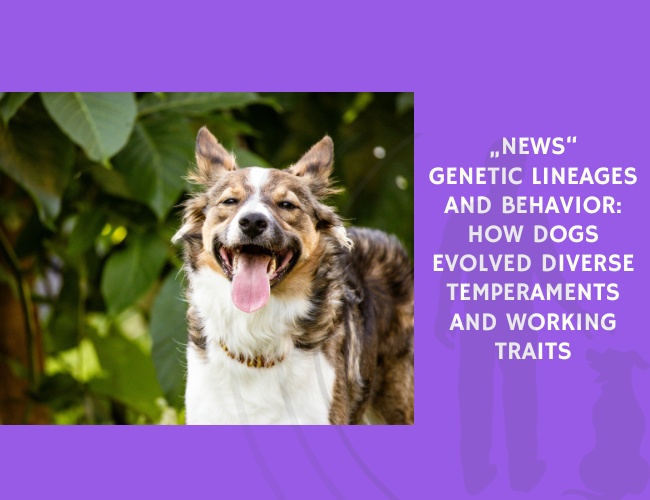
In this 2022 study published on bioRxiv, E. Dutrow, James Serpell, and Elaine Ostrander investigated the genetic foundations of behavioral diversity across dog breeds. Using genetic data from more than 4,000 dogs, semi-feral, and wild canids, and behavioral survey data from over 46,000 companion dogs, the authors unveiled a sophisticated framework linking genetic lineage, neurodevelopmental pathways, and behavioral traits.
The researchers identified ten distinct canine genetic lineages, each associated with specific behavioral tendencies, such as herding, protection, hunting, scent tracking, companionship, and livestock guarding. These lineages help explain why behavioral patterns cluster across breeds, even when physical traits appear vastly different.
A crucial discovery was that behavioral diversification in dogs is primarily driven by non-coding regulatory variation—rather than changes in coding genes. These non-coding regions influence how genes involved in neurodevelopment, emotional regulation, learning, and motor coordination are expressed.
One highlighted example includes the sheepdog-associated lineage, which showed genetic enrichment for axon guidance functions, supporting the idea that herding dogs possess specialized neural wiring for interpretation of movement, coordination, and spatial problem-solving.
The study further confirmed that many lineage-associated genes converge in **neurodevelopmental co-expression networks**, forming a biological foundation for core behavioral traits, such as:
• Social sensitivity and bonding
• Impulse control and focus
• Problem-solving and learning style
• Prey drive and motor patterns
• Environmental adaptability and cautiousness
This framework positions the domestic dog as a powerful model for studying the genetic origins of behavior. By linking genetic lineage, brain development, and behavioral expression, the research offers new potential for breeding insight, behavioral prediction, and working dog selection.
Source: Dutrow, E., Serpell, J., & Ostrander, E. (2022). Canine lineages reveal genetic drivers of dog behavioral diversification. bioRxiv. Published April 27, 2022.










