
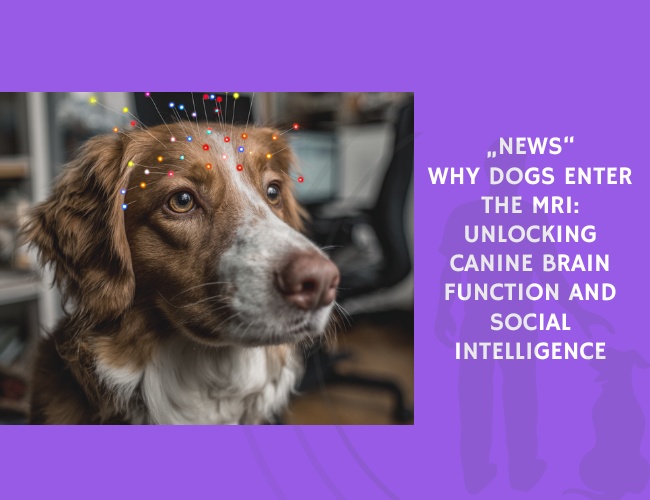
In this 2016 study, G. Berns and P. Cook explored how training dogs to remain still in MRI scanners has allowed researchers to investigate canine brain function in a non-invasive and ethical manner. This breakthrough has transformed the study of dog cognition by enabling scientists to observe live neural activity in response to social, emotional, and cognitive stimuli.
Prior to this development, knowledge of canine cognition was largely based on behavioral studies. Brain imaging research was limited due to ethical, practical, and methodological challenges. However, by successfully training dogs to cooperate voluntarily—without sedation or restraint—researchers were able to examine how dogs process reward, emotions, faces, voices, and human social signals inside the scanner.
These fMRI studies revealed neural pathways associated with social reward, attachment, and sensory processing, offering deeper insights into dogs’ remarkable sensitivity to human gestures, emotions, and communication. The findings suggest that dogs possess specialized brain mechanisms for processing human voices, emotional tone, and facial expressions, reflecting their long evolutionary relationship with humans.
Beyond canine cognition, Berns and Cook suggest that trained canine fMRI models have implications for understanding human developmental neuroscience and psychopathology. Because dogs share emotional and social environments with humans, they may serve as unique models for exploring attachment, empathy, decision-making, and anxiety-related behaviors.
This study represents a major milestone in canine neuroscience—demonstrating that dogs are not just behavioral subjects, but viable participants in advanced neuroimaging research, capable of revealing how evolution shaped cognitive and emotional systems across species.
Source: Berns, G., & Cook, P. (2016). Why Did the Dog Walk Into the MRI? Published October 1, 2016.










