
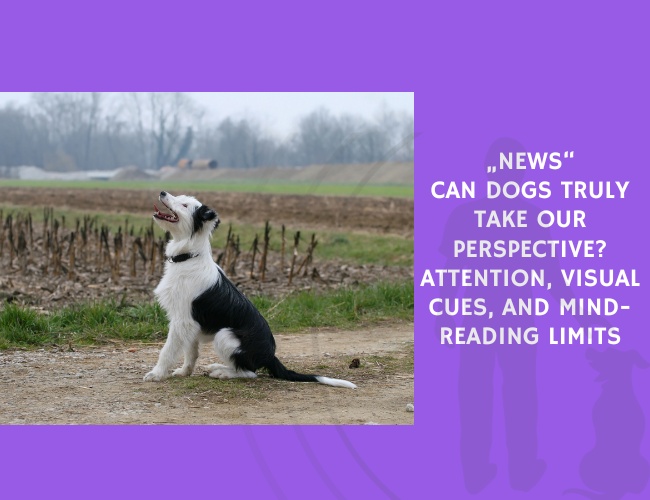
In this 2011 study published in Learning & Behavior, M. Udell, N. Dorey, and C. Wynne investigated whether dogs are capable of perspective taking—the ability to understand what another individual can see, know, or attend to. Prior research had suggested that dogs could recognize human attentional states, such as knowing whether a person is looking at them or not, leading to speculation about whether dogs possess a form of theory of mind.
This study provided two key findings. First, researchers showed that **grey wolves**, a nondomesticated species, also demonstrated sensitivity to human attentional state in certain contexts. This suggests that **attentional awareness is not exclusive to domesticated dogs**, nor a product solely of human-dog coevolution.
Second, the study demonstrated that **dogs do not respond equally to all visual cues of human attention**, contradicting the idea that they naturally understand all human attentional signals. Instead, dogs were **more attuned to familiar cues encountered in their home environment**, such as direct eye contact or body orientation—rather than subtle or unfamiliar cues used only in laboratory settings.
The authors concluded that while dogs can respond to some human attentional cues, **their behavior is largely based on learned experiences, context familiarity, and conditioning**, rather than true inference about human mental states. Some dogs perform well in perspective-taking tasks, while others do not—indicating variability based on environment, experience, and training.
These findings challenge the assumption that dogs possess full theory of mind. Instead, dogs rely on **contextual learning, sensitivity to attention cues, and environmental familiarity**, rather than true mind-reading.
Source: Udell, M., Dorey, N., & Wynne, C. (2011). Can your dog read your mind? Understanding the causes of canine perspective taking. Learning & Behavior. Published June 4, 2011.










