
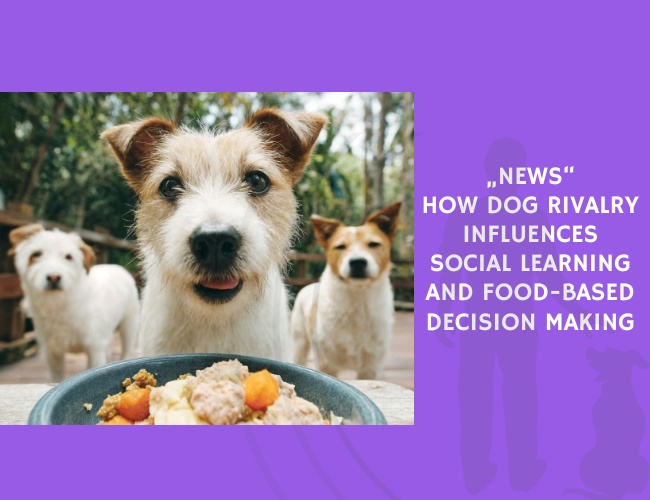
In this 2017 study published in Animal Cognition, Christy L. Hoffman and M. Suchak investigated how rivalry between dogs living in the same household affects their ability to learn from each other during decision-making tasks involving food. Unlike previous research using unfamiliar, highly trained demonstrators, this study focused on real-life dynamics between familiar dogs.
Using the Canine Behavioral Assessment and Research Questionnaire, the researchers calculated rivalry scores to measure each dog’s tendency for competitive or aggressive interactions with their household companion. Dogs were then tested in a local enhancement task where they observed a demonstrator dog eat all the food from one plate, while an adjacent plate still contained food.
Results showed that low-rivalry dogs were more likely to approach the empty plate, indicating greater reliance on social cues and observational learning. High-rivalry dogs, in contrast, were more likely to approach the plate with food, suggesting a reduced tendency to follow the actions of their companion.
However, this difference disappeared when dogs had to wait five seconds before choosing a plate, suggesting that immediate social influence plays a stronger role than delayed processing. The same behavioral pattern was observed in a control condition when a human removed the food instead of another dog.
Hoffman and Suchak suggest that high-rivalry dogs pay less attention to other dogs’ actions because their low tolerance for proximity reduces social monitoring. Conversely, low-rivalry dogs exhibit higher awareness of others’ behavior, making them more responsive to social learning opportunities.
The study emphasizes that everyday household dynamics—especially competitive relationships—can significantly shape how dogs process information, make decisions, and learn from each other.
Source: Hoffman, C. L., & Suchak, M. (2017). Dog rivalry impacts following behavior in a decision-making task involving food. Animal Cognition. Published April 18, 2017.










