
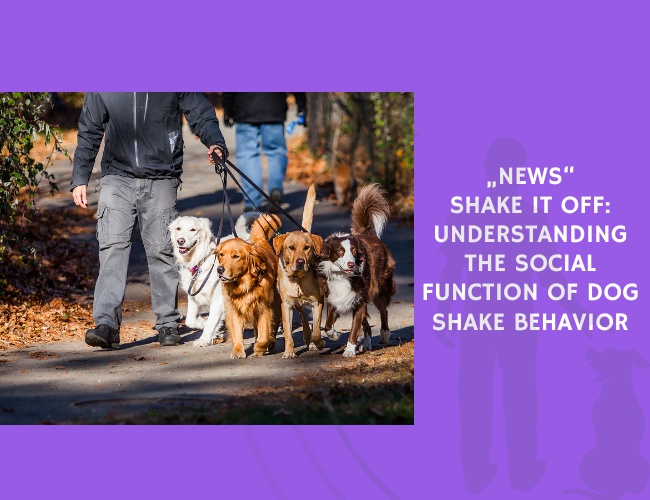
Shaking is one of the most familiar dog behaviors, yet its meaning has often been misunderstood. While humans commonly assume that a shake indicates stress, arousal, or discomfort, this recent study by Bryce, Nurkin, and Horowitz (2024) shows a different interpretation: the shake commonly functions as a behavioral transition signal—a moment where the dog “resets” between activities.
Across 120 documented shakes from 96 dogs in daycare and dog park settings, researchers found that shaking most frequently occurred between two distinct activities—such as moving from play to rest, interaction to disengagement, or from exploration to social contact. The shake did not reliably correlate with emotional stress signals or shifts in body posture typically linked to fear, frustration, or anxiety.
Shaking in dogs may serve as a cognitive and behavioral reset — a natural “marker” between moments.
Key Findings from the Study:
- Shaking most commonly occurred between activities, rather than during emotional arousal.
- There was no strong link between shaking and affective postures (fear, stress, appeasement).
- Shaking often functioned as a socially neutral transition behavior—a reset before re-engagement.
- Dogs used shaking both in solitary and social contexts, suggesting it supports internal regulation rather than communication.
This supports the NeuroBond and Invisible Leash framework: dogs use subtle, self-regulating behaviors to manage their engagement—not just emotionally, but cognitively. A shake may indicate, “I am shifting modes,” rather than “I am stressed” or “I am uncomfortable.”
Implications for Training and Interpretation:
- Do not rush to interpret shaking as stress or appeasement—it may simply signal cognitive reset.
- During training, a shake may occur when a dog transitions from confusion to clarity.
- In social settings, shaking may appear when a dog disengages from play or prepares to re-enter calmly.
- Recognizing behavioral transition markers can improve our understanding of canine regulation and timing in communication.
Shaking, therefore, is more than a physical action—it is part of a dog’s internal self-regulation, assisting in moving between social, environmental, and mental states.
Source: Bryce, A., Nurkin, P., & Horowitz, A. (2024). Shake It Off: Investigating the Function of a Domestic Dog Behavior in Social Contexts. Animals.










